



Abstract
Since the murder of George Floyd, there has been much more focus on tackling racism and other forms of structural and institutional inequities in ways not seen before by many. This moment of reckoning has, for the first time in recent history, resulted in individual and institutions grappling, with structures, systems, policies and processes that mimic and perpetuate unequal experiences and outcomes. A consequence of these grapplings has been individual and institutional galvanising, aimed at reducing gaps in experiences and removing barriers to equitable outcomes. This paper presents evidence from one primary and four secondary schools, of leaders contending with racism through people, processes, policies and systems to improve experiences and outcomes for staff and students between May 2020 and December 2022.
Introduction and context
Since the murder of George Floyd, there has been much more focus on tackling racism and other forms of structural and institutional inequities in ways not seen before by many. This moment of reckoning has, for the first time in recent history, resulted in individual and institutions grappling with systems of inequity as they seek to improve conditions for those who study and work in them. A consequence of individual and organisational grapplings has been significant individual and institutional investments and activities, aimed at reducing gaps in experiences and removing barriers to equitable outcomes. In effect some leaders recognise that structural and other barriers do exist, and that these can, and do stymie the experiences and outcomes of marginalised groups, and that they have an important role to play in tackling these through people, processes, policies and systems.
Whilst not claiming triumphalism, this paper presents evidence from one primary and four secondary schools, of leaders leading anti-racist change for staff and students in their schools between May 2020 and December 2022.
Pen portrait of the schools and leaders
School 1: Laurance Haines School (Primary) Larger than average primary school situated in West Watford – 470 funded places filled including nursery 30 hours provision. Draws from an area with an extremely diverse and varied social composition, with pockets of severe deprivation, which is not reflective of the vast majority of Hertfordshire. 91.2% of the school population are from a global majority group (35.2% national). 65% of pupils are bi-lingual or multilingual and have English as an Additional Language (21.3% national). Over 40 languages and dialects spoken at the school. 17.9% are in receipt of pupil premium (Ever 6) (25.5% national). 10.9% are recognised a needing SEND support (13% national). School 2: Secondary (Catholic, Girls) St Philomena’s Catholic High School for Girls is a large single sex 11–18 school. The school is truly comprehensive, welcoming students from a diverse range of backgrounds and abilities. Educational outcomes are consistently outstanding with all students securing strong pathways and meaningful progression. The school’s curriculum is ambitious and is founded on eight pillars which provide students with an experience rich in breadth and depth. What underpins the pillars is the school’s Catholic ethos. The diversity of the community is growing and how it is reflected and celebrated is essential in enabling all students and staff to have a sense of belonging. We term this particular work, ‘Imago Dei’ – made in the image and likeness of God. As we move into Year 3 of our targeted work; work is led by both staff and students and continues to evolve and impact the community. School 3: Secondary (Catholic, Girls) Ursuline High School is a much larger than average school situated in Wimbledon SW London–1069 in years 7–11; 339 in the sixth form. The school draws from 69 primary schools across London and Surrey. The school has 15/17 possible ethnic groups 34% White British 25% Any other white background 9% Black or Black British 7% Mixed 5% Any other ethnic group. In the sixth form, this changes to 24% white British with increases in all other ethnicities. 19% of main school students and 27% in the sixth form have English as an Additional Language. Thirty-seven different languages are spoken in the school. Two hundred and thirteen students are bilingual. FSM numbers are below national average at 14%. Pupil Premium is 15% and 16% of students receive a bursary in the sixth form. 12% of students receive SEND support across the school.
School 4: Secondary with 6th Form
Stoke Newington School (SNS) in Hackney, London. It is a local authority-maintained school with the highest number of students on roll, serving just over 1700 students 11–19 years. The school serves a diverse school population reflective of the local demographics. The ward is in the wealthiest part of Hackney, therefore making the context quite different from other local schools. SNS is the school of choice for parents who are committed to the philosophy of the local community school and as such has a strong buy-in from parents/carers. Compared to other schools, the School has five times the number of young people with Education, Health and Care Plans further reflecting the inclusive ethos of the school. During the pandemic of 2020 and the horrific murder of George Floyd during this time, the school seized the opportunity to stand tall in addressing racism and truly becoming a place where all stakeholders have a strong sense of belonging.
School 5: Secondary – Grammar
Townley Grammar is a larger than average girls’ grammar school with mixed 6th form in Bexleyheath. Draws from many areas with a very diverse group of students from a range of different ethnicities. 26.1% students represent Black or Black British–African. 16.7% represent White-British, 9.7% Asian or Asian British–Any other Asian Background and 11.5% Indian with about 30% representing wider ethnic groups. The school has lower than national average number of students recognised as needing SEND support and lower than national average number of students are in receipt of pupil premium. The school differs to traditional grammar schools due to the fact the school catchment area spans boroughs of London beyond the immediate geography of the school. The level of diversity in the school is not similar in the local area.
Why do leaders matter in anti-racist work?
School leaders are undoubtedly the single most important factor in promoting and ensuring equity in their schools and/or in addressing equity imbalances and concerns. Miller (2019a) argues that school ‘leaders/leadership can be a powerful antidote to race inequality and discrimination in organisations’ (p. 2), and that ‘School leaders set the tone for their schools, and they can therefore influence, if not define its overarching ethos’ (Miller, 2020a, p. 9). Miller (2019a) also argues that despite performativity constraints and other barriers, committed school leaders find ways to make anti-racism central to their personal practice and to the life of their schools. In his five-part framework of leadership and anti-racism, Miller (2020a) answers the question of why school leaders are crucial to and anti-racism. He provides: • School leaders have the power to influence race relations positively • School leaders have the power to establish and influence cultures • School leaders can help reframe problems, ameliorate conflicts and inform strategies • School leaders can secure buy-in and create an institutional multiplier effect • School leaders can more easily influence practice outside their institutions (p.6)
This framework will be used as an analytical framework for assessing and understanding the actions and evidence of case study school leaders and schools reported in this article.
School leaders have considerable power, and this power carries with it, a crucial role to help transform society. As mentioned above, schools cannot afford to simply mimic society, rather, they have an important responsibility and role in changing society. Acker-Hocevar et al. (2015) note that ‘School leadership is not simply putting prescribed solutions into action, but a constant encounter with quandaries that demand thinking and problem solving, responding, and adjusting to the situations at hand’ (p. 5). This observation points to two things: first the complex nature of school leadership, and second, the fact that leaders can expect to be called upon to respond to events and situations within and outside their schools, which have an impact on what goes on in their school.
Miller (2018) notes that, ‘School leaders and school leadership are positioned as having a vital role in improving school level efficiency and in transforming the fortunes of national education systems through schooling’ (p.2). These observations are important in the context of anti-racism work since, the issues and challenges school leaders have to grapple with continue to evolve, and as a result, they too must also evolve in their understanding in order to respond to these effectively.
Anti-racism work is a choice and school leaders have the option of deciding against engaging with this agendas or not, since they will not be ‘judged’ for their’s or their institution’s stance on anti-racism but on the degree to which learners can contribute to increasing a country’s likelihood of economic transformation. Nevertheless, ‘school leaders are also operating in an evolving context of simultaneous and significant life changing events, many of which are outside their control and many of which have the potential to shape or determine their own performance as well as the performance of their schools’ (Miller, 2018, p. 2). Furthermore, Miller (2020a) also notes, [I]t is virtually impossible to (re)-culture a school without first, equipping the leaders to see that tackling institutional and other forms of racism is not an ‘add on’ but part of its ‘core business’, and second, assisting them in combining their skills and knowledge to work with, and motivate others in building and ensuring cultures of equity for all (p. 9).
For school leaders to see and treat anti-racism and inclusion as ‘core business’, they must first see these issues as important, and second, important enough for their schools to get involved with, whether the government agrees or not. In other words, school leaders have significant agency and autonomy over what their school prioritise.
The murder of George Floyd, and the individual and institutional anti-racist catalysing that has emerged is consistent with what Hutton calls the ‘intensity of leadership’. Hutton (2014) notes that ‘intensity’ is an important personal quality (to be) possessed by each school leader, and that the degree of ‘intensity’ possessed by school leaders is manifested in their ‘doing’ or in their actions. Hutton also notes that the ‘quality of leadership is enhanced by the intensity of leadership’ – meaning leaders who are prepared to combine their power with courage, can and do take difficult and/or unpopular decisions for the marginalised in their organisations even if such decisions make them unpopular or puts them out of sync with government and/or popular opinion.
Furthermore, and as previously asserted, school leaders need to be aware of, and be concerned about social issues, and this should position their schools not only as having a role in national economic transformation but also in social transformation. Thus, and as noted by Miller (2020a): When school leaders understand racism, and its effects; many will want to attempt to tackle this, not only within their organisation but also beyond, recognising the interlocking relationship between what happens in educational institutions and what happens in society (p.6).
Anti-racist leadership therefore starts with a personal commitment to change self and the organisation and is sustained by an understanding and a recognition of the impacts of racism, and their role in tackling it.
Case studies
The Centre for Teaching and Learning (CTL) (1994) suggests that case studies ‘tell a story’ (p.1). Golich et al. (2000) suggest they ground understanding of events ‘in reality’ (p.3). Pulling these points together, a logical inference is that case studies, therefore, tell a story about events and/or individuals, in a particular content, at a point in time. Put differently, case studies will include the following key elements (i) background information of the institution or entity, (ii) the major players involved, and a description of persons portrayed in the case, (iii) the event or incident which led to the problem or issue (iv) and the required decision or solution to be provided for resolving it (Harvard Law School (2016). According to Zainal (2007), the case studies allow the researcher to ‘closely examine the data within a specific context’ and ‘… explore and investigate contemporary real-life phenomenon through detailed contextual analysis of a limited number of events or conditions, and their relationships’ (pp. 1–2). Each school in this article, and each leader are treated as a single entity or case study. This is important because of the integrated nature of leadership and context. That is, this article seeks not to understand the leader on their own, nor their work in their school on its own, but in treating them as an integrated entity we can see each leader as shaping a school context whilst being simultaneously shaped by that context since, ‘leadership shapes context, and context shapes leadership’ (Miller, 2018, p. 121).
Evidence of leaders leading change in anti-racism and inclusion
Motivation for anti-racism and inclusion work
The five school leaders in this article provided different factors and reasons for their involvement in anti-racism work. Although it was not always easy to separate the personal (the individual) from the professional (the leader), responsiveness to global, national and institutional waves of anti-racism due to the murder of George Floyd, religious teachings and the pursuit of fairness and justice were common motivators. [W]e had a number of staff, who, like many across the globe, were personally impacted by the tragic murder of George Floyd, and they came to me and said, ‘Look, we are feeling really impacted by this personally, we know that some of the community will be too, especially the children, we can’t ignore it’. And we started to, I suppose, have a very honest and exposing conversation around the impact of racism in its various forms, and discrimination in its various different forms. And it was really apparent to me at that point that we were not doing enough to be truly anti-discriminatory to be truly anti-racist, in everything that we did as a school (P1).
P5 also identified the murder of George Floyd as a galvanising moment, arguing ‘the global raising awareness of injustices ignited a fire within me to do more and respond to young people’s burning desire for positive change in relation to race in particular. The murder of George Floyd further energised our resolve to be an anti-racist school’.
P3 located her work within notions of racial and social justice, underpinned by religious teachings. She set out: It’s all about justice, about social justice, racial justice. You know, from a Christian or Catholic perspective, it was about the Good Samaritan, but it’s also about the rich man as well. And justice was certainly part of it and fairness, and those Christian ideas about walking justly, and being a good Samaritan. But, during the journey, we changed from the Good Samaritan, because the Good Samaritan first became a bit patronising about the helping bit. It’s about justice and the rich man giving, walking away from his wealth; giving away everything he has. So, the basic intrinsic reason was really about justice and fairness (P3).
P2 noted a longstanding commitment to inclusion buttressed by religious teachings and responsiveness to the needs of learners. She reasoned, Anti-racism always been a commitment, as the leader of a Catholic school. I’ve always taught and worked in Catholic schools. The driving force is that education has the ability to level the playing field for young people in terms of access and in terms of outcomes. It was really about ensuring that each individual is able to achieve that goal in an environment where they felt safe and respected, and actually to grow, being able to identify with who they are and make connections about where they come from, and where they see themselves going, in terms of bringing about changes for the common good and not just for self.
The range of factors motivating school leaders to get involved in anti-racism work appear to be existential, moral and educational. In terms of existential, these were connected to the murder of George Floyd and the attendant global galvanising which followed. In terms of moral, this was connected to religious teachings as well as about treating others how we would like to be treated. In terms of educational, this was about the content of education provided to children and young people, and the role of education in promoting equity and justice.
Institutional conditions
Aside from the existential, moral and educational factors noted above, several factors at school level provided an opportunity for school leaders to engage in anti-racism work.
P3 noted two things: a letter from past students and an earlier shift in culture among current students. One was that we had a letter from past students which outlined what they felt was racism within the school when they attended. And when I read it, I was physically sick. My governors, we all read it, and everybody felt the same. You just felt so ashamed that this is what people’s experiences have been in our school. Now, whether I agreed with some of it or not, was irrelevant. But that was it. The second thing was our current students. In January 2020, before George Floyd was murdered, I felt something had changed in our school…. there was a change of culture, an internal disconnect with students and I presented it to the local authority as a prevent issue. I thought something was going on, you know, in the community. But it turned out it wasn’t actually a prevent issue. There was activism going on in in the communities of racially minoritised students…. And that was something that we were totally unaware of because we weren’t part of those communities. So we had to act, forcing our institution at all levels - governance, senior leaders, staff and students to change.
Despite having a diverse staff and student body, and despite his school being located in a diverse community, P1 had not previously engaged with staff, students and/or the community about racism. George Floyd’s murder led to the creation of a ‘forum’ which provided himself and his white senior team an opportunity to hear and learn first-hand, and an opportunity for the school to respond to historical events and to address current concerns. He pointed out: I thought we were probably doing a good enough job. But it was very clear that we weren’t. What happened was it ended up taking shape in a forum, where more and more staff wanted to come along and be a part of the conversation. And that gave it real strength, because people were coming to share their own experiences of discrimination and racism. And if it was really shocking, really shocking…. And that for some, they felt that it wasn’t going to change, regardless of us having this conversation. The hurt, for lack of a better word, that staff felt for themselves, for their children, for their own parents and their lived experiences was really shocking.
P5 noted that although his school was diverse, there was not a strong sense of belonging, something that needed to change. He provided: We are a very diverse organisation in terms of students…. the sense of injustice that some students expressed drove us/me to want to do more to ensure that our school is more than just diverse. We are a community bound by values and every one can feel a strong sense of belonging.
P2 identified the need for the school to be responsive to social changes, as well as changes in the demographic make-up of her school. She provided: Since I arrived as Headteacher in 2011, we went from a large majority of white students to almost 50% of white students and 50% of students of different ethnicities. And so our school has been on a journey of change…. Student voice has meant that the children spoke more about the need to see themselves reflected more in the curriculum…. Then obviously, we had the pandemic, with the pandemic, there was a huge movement out of London, which meant that Catholic numbers were falling as well, because families from Europe returned. We then had the really big incident that caused the world to stop – the murder of George Floyd. And following that, our young people started sharing stories and incidents and experiences of racism that they had been subjected to at school….
A complex and overlapping set of factors were provided by P4, who noted: The institutional drivers behind our work include strong governor, leadership and staff commitment to addressing inequality, the personal experiences of those staff and students of Black and Global Majority Heritage
1
, and the need to address disparity in outcomes, especially for Black boys….
Addressing systemic racism, responding to feedback from staff and students, improving staff and students wellbeing, building more inclusive cultures, and responsiveness to social issues affecting a school and/or its community were noted as factors driving anti-racism work among school leaders in this study.
Institutional activism: anti-racism and inclusion efforts
P5 noted the development of an Equity, Diversity and Inclusion (EDI) policy, the delivery of targeted EDI training, revamping of the school’s behaviour policy, commissioning an independent review of key school policies and the creation of a reporting dashboard for racist incidents among key activities undertaken by the school. We have created from scratch, a whole school/Trust EDI policy to provide enhanced accountability and regulation across the school. We have delivered staff training on the fundamentals of EDI, race conscious language and unconscious bias training, revamped the school’s behaviour policy and systems to ensure rules are applied fairly and do not discriminate against any group. Furthermore, we commissioned an external organisation to review key school policies, have amended the student uniform rules and punctuality procedures that were previously impacting a disproportionate number of BAME students. In addition, we have created a fully student-led equity commission and developed enhanced reporting tools for students to report any racist incident, and any safeguarding issues. Furthermore, we have undertaken a whole school EDI survey.
P3 identified the creation and implementation of an EDI Action Plan, undertaking curriculum reviews, SLT coaching and an EDI Culture Review among the activities her school had undertaken. She outlined: Among the things we have done are the creation of an EDI Action Plan for the school which had six areas. For example, curriculum, assessment, professional development, policies. Each area was led by a member of SLT, which was a Key Performance Indicator (KPI) for them. We also started a Taskforce, with representation from parents and parents and governors, students and staff. The Taskforce is still active, and we meet every half term, with an agenda, etc. We have also used an anti-racism coach to support SLT’s thinking. That was really challenging. You know, we were entering a new, it was like a whole new learning experience, not just learning, but personal experience. It wasn’t just the brain, it had an effect on the emotions, the heart as well. So the journey that we have been was not just, you know, intellectual, it is affective as well. We have also invested in targeted CPD for senior and middle leaders with a number having completed a full year’s worth of training, and we have had our curriculum reviewed. We also undertook an EDI Culture Review very early on….
P4 elaborated several key activities. For example: We have undertaken an externally commissioned EDI Culture Review, the report from which has given us a lot to focus on by way of an EDI Action Plan. We have also had the implementation of the Action Plan evaluated 12 months later, by the same organisation, to gauge our progress against the action items. In addition, we have launched a forum for parents/carers of students of BGM heritage, which has been very successful, and which has led to the launch of a forum for parents / carers of students with SEND. We have commissioned training for all staff on anti-racism and safeguarding and have provided middle leaders with targeted training in leadership and equity. In addition, we reviewed our enrichment offer and introduced new clubs and societies, commissioned an external review of our History curriculum, and we have established a Taskforce on Black Exclusion and Black Achievement, aimed at reducing Black exclusion and improving and outcomes for Black students. The Taskforce includes a combination of staff, parents, governors and external stakeholders. We are also partnering with primary schools and higher education institutions to address behavioural and transition issues.
P2 also outlined an array of activities: The first thing that we did was develop a working party comprising staff, parents, governors, students and external visitors to shape our inclusion and anti-racism work. We called our work Imago Dei, which means “Image of God” as we believe that God doesn’t differentiate in terms of who we are or where we come from. We are all made in God’s image and likeness. We have also completed a lot of training around anti-racism, intersectionality and adultification, all of which have enabled us to review our school’s mental health provision – moving from an approach where we would question a child, to validate their experiences to one of taking it as is, as the situation, as their lived experience, and as a result, there is a process to be followed. We have also launched our anti-racism policy, commissioned external curriculum reviews of three subjects in Year 1, and this is ongoing in other subjects, reviewed our extracurricular provision, making sure it meets the young people’s interests…. We have also been much more purposeful in how we look at and use data (e.g.,: behaviour, outcomes, student feedback), and through this we are able to really drill down at the views of specific groups of students, in terms of their lived experience. We have introduced cultural days - led by students, and these are not an extension of Black History Month, but a holistic celebration of the community We also commissioned an External EDI Culture Review early on which informed many of our current and future actions.
P1 also notes several activities: Our inclusion and anti-racism is anchored on the words of a well respected EDI expert
2
who said – “I see you, I hear you, I belong”. Our school campaign is “you see, you hear me, I belong”. These words have guided all our work. We started with a monthly event where staff were invited to come and be a part of a discussion, and as time has gone on, it’s evolved into a more of a working party in a truly collaborative approach to school improvement work. And we hadn’t quite anticipated it would go that way. But that’s a key part of the change. Another key action is looking at the curriculum, the content, the way it’s being delivered, the language of learning we use, and we are investing a lot of time into redesigning to make it make it more inclusive, more representative of the community we serve. And that’s evident in some of the texts that we’ve invested in, and that the children can choose from. We have invested in diversity stickers, the labels for these books, so children can more easily find texts that may well be representative of themselves, their family, their community. We have invested in training to build racial literacy, and a literacy of inclusion, to reduce ignorance or insecurity or lack of confidence. We continue to equip our staff to be able to talk with a safe language. We have also celebrated World Hijab Day, held picnics, and focused on themed days and celebrated through songs written by our children. The result of this effort is a sense of belonging - which is this golden ticket we’re working toward.
A range of activities and interventions have been introduced and implemented by school leaders in their school contexts, to reflect the challenges and opportunities within those contexts. Working with external partners was a key element of their approach, and for them was as important as working with staff, students, parents and governors. The variety and sum of activities and interventions undertaken by schools and their leaders therefore point to individual commitment and institutional energising at multiple levels.
Impact
School leaders were cautious not to claim their work was done. They acknowledge the ‘journey’ both they and their schools are on. Nevertheless, they have been able to identify cultural and other changes within their schools.
P4 noted: [T]here is an openness to discuss matters related to race, and this was not there before. If there is an issue with behaviour - by exploring this under ‘race’ lens we are more likely to seek interventions instead of sanctions. There have been improvements in parent partnerships – crucially increased participation of Black and Global Majority parents, including at PTA meetings…. In Autumn term 2022 we also saw a reduction in exclusions. We’ve received really good feedback from the external review about our History curriculum, which has given other subjects the confidence to want to have their curriculum reviewed externally. The culture is more open and honest about our commitment to anti-racism, although recognising this is not a short-term fix…. Although our school is acknowledged locally and beyond for its commitment to anti-racist work, we know we still have a far way to go.
P2 provided: I would say is that it’s a journey, and that the students recognise that this is a journey, and our work still isn’t a finished product. It is very much an ecosystem of work within the school linked to a larger ecosystem. I think, a big impact has been our intranet site, which we continue to build on and share information, resources and statistics about race, and about human love and disability. We have a reading list comprised of Black authors, we have improved the reading ages of nearly all students at Key Stage Three. Where students are below a reading age, there is an expectation that teachers will work with parents to identify and remove barriers in order that all students achieve and enjoy their time with us. Our Imago Dei work has evolved into three strands Imago Dei race, Imago Dei disability and an Imago Dei human love. Our students (girls) have asked for trousers, and trousers are coming in January 2023. I think the culture of the organisation is one that’s more outward listening, and one where there are specific structures in place where young people will go to report. There’s a confidential safeguarding reporting button for reporting racism and other concerns around discrimination. Restorative justice is key for us, and the young people know this is the case, and if discrimination has been experienced, there will be a system followed a policy or procedure implemented, and outcomes clearly communicated.
P5 highlights: The EDI policy has made holding staff/students to account much easier, and this has influenced practice among staff. Changes to our behaviour policy and rewards system have seen the number of detentions halved in a year and BAME students (particularly Black African students) are no longer disproportionately sanctioned. The student-led ‘Equity Commission’ has enhanced student EDI activity as shown by our recent cultural showcase which was very successful (100% positive feedback). We have adapted our late procedures to reduce disproportionate sanctioning of BAME students, and our EDI survey results show students now feel confident to report racist incidents. There is a real sense of greater belonging and positivity within the school community, with students keen to work with school leaders to develop new initiatives and celebration events.
P2 shared: I think, as a whole school, we are much more comfortable with each other, right from the top down, and were are more confident in tackling racism, and being anti-racist. People’s confidence has grown, and we’ve got feedback that students feel more confident that racism will be addressed, that racism won’t be accepted, and that they now see themselves much more in the curriculum than ever before. We have done surveys, twice a year to see where the students are at in this journey, and we are seeing a greater sense of belonging and being part of the community. We have raised expectations of staff regarding racially minoritised students and provided training and questioning when reviewing teaching sets and data. We have kept permanent exclusions to single digit numbers with a cohort of almost 1500 students. And in terms of direction in terms of university choices, we’ve increased the percentage of Asian minoritised students applying to universities. Overall, there’s been the competence to investigate and to be open and to be clear about any incidents of racism, and it has given students a greater understanding of racism, including white students, and how to be anti-racist. But we acknowledge that there’s still work to be done.
P1 outlined: If I may start with school culture. Our children are speaking really passionately about their own sense of heritage, their own sense of identity. And for children as young as they are to be able to have an understanding of that, and to communicate that in such a proud way, is really quite special. We’ve got a school full of activists. Also, staff collaboration is stronger than I’ve ever felt it. Every member of our school team knows that they have a place, knows that their voice can influence, you know, change in a really positive way, and this is something I feel really fortunate about, as a member of the team, and to be part of. The collaboration has been possible because I think the forum has broken down hierarchical barriers. Teaching Assistants knowing they have a voice, is a really powerful thing. So there is a sense of belief in what we’re doing, and that our approach is the right move forward. We’ve built up our racial literacy collectively, which has equipped us to really shape policy and procedure in a much more inclusive way. We’re dealing with incidents of racism and discrimination in a more robust way, we’ve got a really balanced approach to consequences for the perpetrator, and support and guidance. Staff and students have all commented on the sense of belonging being stronger…. And that’s, that’s exciting.
Creating a sense of belonging, having a voice, dismantling of hierarchies, working together with students and parents and other stakeholders, setting up and/or improving reporting systems, and regularly seeking feedback from staff and students about their experiences are interventions that appear to be having beneficial outcomes for the schools. Furthermore, implementing and/or monitoring the implementation of policies, rethinking the use ‘ability groups’ and the use of sanctions versus exclusions shows the school leaders and their schools are pushing back against both structural and institutional racism.
Discussion
Miller (2019a) notes, [E]ducational leaders wield significant power, and are uniquely placed to influence staff, students and other stakeholders in ways that help raise their awareness of and attention to issues of racism/race discrimination, and to helping and enabling them to tackle race and other forms of discrimination, and to promoting, building and sustaining educational institutions in ways that positively influence all who study and work therein (p.2).
Summary of actions and approaches taken by schools/leaders.
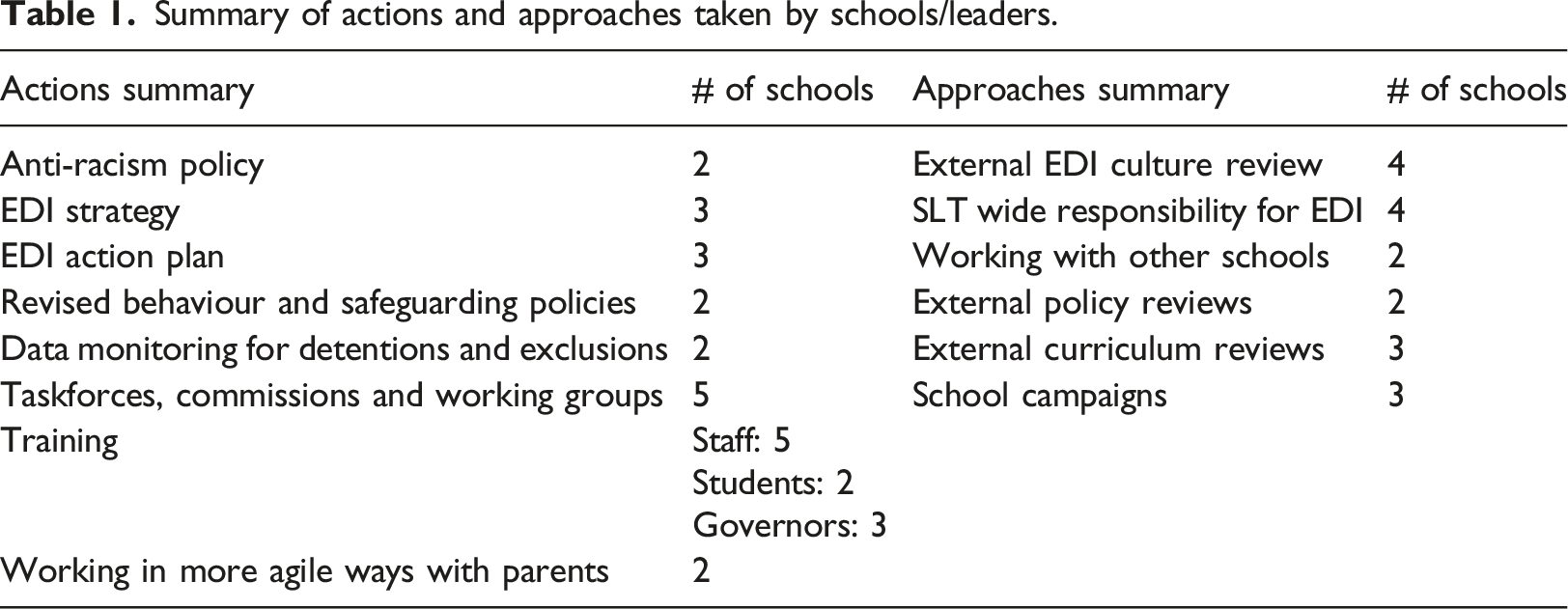
Returning to Miller (2020a) framework, we can more closely assess the anti-racism work of school leaders in line with the evidence above.
School leaders can reframe problems, ameliorate conflicts and inform strategies (framing the context)
Case study school leaders were motivated by doing good. Responding to global, national and institutional hurt and anger brought about by the murder of George Floyd, school leaders accepted it could not be business as usual. They faced a choice, ignore calls and the need for action on racism and/or other social inequalities or lead the charge against and engage in action against racism and other social inequalities. Recognising their personal and institutional power and acknowledging the outpouring of pain among staff and students to be real, they chose instead to lead the charge against and engage in action against racism and other social inequalities. Accordingly, they rallied their institution, some of them at professional risks, to be accountable to this moment in history, and to work for the liberation and empowerment of staff and students of BAME heritage in ways not previously seen or considered. Freire’s (1998) observation ‘that education is not the ultimate lever for social transformation, but without it transformation cannot occur’ (p. 37) was thus the prism through which these school leaders engaged anti-racism and inclusions at the personal and institutional levels. They didn’t seek a personal benefit from engaging in anti-racism and inclusion work. Rather, they applied their efforts and resourcing in the hope these would improve institutional conditions, experiences and outcomes. As Shields (2010) sets out, ‘Transformative leaders, who focus on both critique and promise, do more than bemoan current failures and tinker around the edges of deep and meaningful reform. Indeed, they act courageously and continuously to ensure more equitable learning environments and pedagogical practices for all children’ (p. 27). Although P2 acknowledged, ‘I’m not putting myself at the centre of this work’, it was clear these leaders were central to the scope of work their schools have engaged in or undertaken, and to what their schools have managed to do and to achieve. Without the personal and institutional commitment of these leaders, their staff and students would not have been engaged in such meaningful anti-racism work, nor would they be able to signpost any evidence of improvements and/or change. P1 notes that ‘it was uncomfortable, it was exposing, and thankfully, we didn’t shy away from it’, underlining the fact that ‘transformative leadership takes account of the ways in which the inequities of the outside world affect the outcomes of what occurs internally in educational organizations’ (ibid).
School leaders can secure buy-in and create an institutional multiplier effect (whole school learning)
From the evidence presented, training was a crucial tool used by school leaders in their attempts to tackle racial and other inequalities. We saw for example, school leaders in one school participating in a year-long coaching programme, and in another bespoke anti-racism training provided to the school board and senior leaders, and in all five schools anti-racism and inclusion training provided regularly to all staff. Furthermore, we see evidence of students learning new content both through curriculum adaptations led by their teachers, and/or through other initiatives to centre them. This emphasis on training is an important one since leaders wanted to build ‘racial literacy’, ‘inclusion literacy’ and ‘confidence’ in the staff and students in order to create and foster a multiplier effect within the school community where respect and belonging hallmarks. The fact that leaders availed themselves for training sessions and coaching activities is important for many reasons. First, the preparation and continued development of school leaders is vital if schools are to secure their ambitions and plans for improvement (Miller et al., 2022). Second, as the ‘drivers’ of an education system through the work they do in schools, school leaders need to have an up-to-date knowledge of the regulatory, institutional, social and cultural environments in which they work; and ‘drivers’ need to have an up-to-date skillset to function confidently and competently in these environments (ibid). Third, where ‘educational leaders do not have a thorough enough understanding of racism in its many manifestations --for example, individual, institutional, societal--nor do they comprehend the ways in which they are perpetuating White racism in their schools, even though most are well-meaning individuals…. This lack of understanding or awareness is highly problematic and consequential’ (Young 2000, p.3). Furthermore, as Stewart-Hall et al. (2022) noted training, ‘… can support leaders to notice racism and whiteness, to question why there is resistance to anti-racism and learn strategies to understand the dynamic nature of racism to counter it in their schools’ (p.15).
School leaders have power to influence race relations positively/school leaders have the power to establish and influence cultures (collective energising)
Beyond whole school learning, we also see evidence of collective or whole school energising. That is, a range of activities happening simultaneously, which includes multiple stakeholders. Miller (2020b) notes that ‘anti-racism in education is a collective endeavour’ describing it as a ‘limbic activity’ which must draw of a range of individuals and inputs to be both sustainable and successful. We saw evidence of students, parents, teachers, teaching assistants and school governors – all getting involved in the anti-racism and inclusion efforts of their schools whether through delivering insets for staff, drawing on their professional expertise and/or lived experiences, and through attending training, meetings, events and through membership of working groups and taskforces. The wide-ranging entry points and efforts of school leaders is testament to the uniqueness of each school context, and to the fact that ‘anti-racist work requires many combinations’ (Stewart-Hall et al., 2022, p.15) to address racism.
The dialogic, reflective, cooperative and interactive approach taken by school leaders provided both voice and agency to multiple stakeholders, enabling and allowing them to feel confident to contribute to the schools in ways not previously done before, and to take a more personal interest in its success. But it wasn’t without challenges. As P1 noted, ‘It’s not been for everybody… and we’ve lost a couple of members of the team over the last year or so. And a large part of that is because they’ve not believed in a sense of direction. That’s okay by me because we’re in a better place for it’. Notwithstanding, the evidence from the case study schools and leaders shows a reconceptualising of stakeholders’ identities, from passive to active, from on the fence to in the centre, from wanting transformation to seeking or pursuing transformation and being enabled and allowed to do so. Put differently, the evidence points to deep level re-culturing of entire school communities both as a response to, and in seeking to dismantle systemic structures of oppression, a point elaborated by Walker et al. (2022) who noted, ‘achieving anti-racist school environments requires time and opportunity for school leaders to gain a ‘deep understanding’ of issues supported by a reflective community of practice’ (p. 14).
School leaders can establish and influence cultures (belonging)
All the efforts of the schools and school leaders are geared towards staff and students achieving a sense of belonging no matter who they are or who they love. The school leaders in the case studies were ‘switched on’ identity concerns in their schools. As a result, they had devised systems to ensure staff and students felt heard, felt safe and felt protected.
Rethinking how exclusions and disciplinary issues are handled (P4), introducing an anti-racism policy, and a policy around hairstyles for Black girls (P4), introducing a confidential reporting button (P2), introducing Imago Dei – Race, Disability and Human Love (P2), introducing trousers as part of the uniform allowed for girls (P2), dismantling hierarchies and allowing teaching assistants to have a voice (P1), celebrating International Hijab Day (P1), setting up a taskforce to study Black exclusion and Black achievement (P4), rethinking the use of ‘ability groups’ for Black students (P3), asking initial teacher training provider to send an ethnically diverse pool of trainees (P2) are evidence on considered attempts by school leaders and schools, not only to create and foster a sense of inclusion but also to promote and enable a sense of belonging.
P1 suggested ‘a sense of belonging is this golden ticket where we’re working towards’ whilst also noting, ‘if we are not making decisions that could and should lead to a sense of belonging for all then they’re not worth it… these decisions are just not worth spending time on’. P2 pointed out that ‘Students are feeling a greater sense of belonging and being part of a community’ and as a result, the school has grown in terms of capacity and provision. This was also backed up by P5 who described a ‘real sense of greater belonging and positivity within the school community'.
School leaders can more easily influence practice outside their institutions (external multiplier effect)
Although some leaders were not clear about how or whether the work in their school had influenced schools and practice outside their school, there was evidence this was happening. For example, both Catholic Girls schools in the study work in close partnership with each other. Furthermore, the Girls Grammar school, and the primary work closely other schools in their respective Academy Trusts. On the other hand, P4 describes a situation where ‘Headteachers from local schools and out borough have sought advice from the school on setting up forums similar to the ones we set up. We have had interest from schools in Lambeth, Croydon and Haringey….’. P1 also noted, ‘A case study we wrote on the formation of the forum has been shared with colleagues across Hertfordshire, and in March, I will co-host a workshop on creating a safe space to talk about race, at the Herts for Learning - National Race Equity Conference’.
Conclusions
Leaders described their work as ‘taking small steps’ and they showed great humility about their anti-racist efforts should be presented. They were keen to avoid any perception of triumphalism. As noted by P1, [M]ore doors are being opened and we are being given the opportunity to spread the word. Keeping EDI on leader’s agenda is absolutely imperative for the longer-term impact of this work, of which some may not be felt or recognised for years to come.
The school leaders in the study have approached anti-racism as a whole school endeavour, drawing in and on governors, parents, staff and students. They have also shown it is sometimes necessary to seek external expertise and help. Pyatt (1998) cites Black educator and civil rights lawyer, Derrick Bell, as saying, I want a less racist world in 2020, but it won’t come. . . unless we are willing to risk our careers, unless we are willing to have confrontation rather than conformity. This is the price we pay for our humanity. . . in a culture everlastingly hostile to our color (p. 23).
Society in England, and education in England have both failed to realise Bell’s ambitions in the suggested timeframe. However, what society in England, and education in England have seen is anti-racist galvanising on a scale not seen before in the past 50 years.
The case study schools, and school leaders provide evidence of social justice leadership in action. That is, through the evidence of school leaders and schools standing up to racism in education and in society, and of leaders trying to ensure safer spaces and more equitable conditions for students and staff we see several characteristics of social justice leadership in practice. Social justice leaders, according to (Miller et al., 2019b) ‘actively try to right wrongs inflicted on marginalised groups’, ‘use their position to create safe spaces and opportunities that promote equity between individuals and groups’, show ‘social justice activism both in their intent and approach’, show they ‘understand the material, economic and social differences between different groups’ and ‘focus on creating equity-based opportunities for all’ (p. 6–7). This evidence we have seen from the school leaders and schools in this article satisfy these characteristics of social justice leadership.
Footnotes
Declaration of conflicting interests
The author(s) declared the following potential conflicts of interest with respect to the research, authorship, and/or publication of this article: The author Paul Miller is the editor of Equity in Education & Society and did not participate in the editorial handling or peer review process.
Funding
The author(s) received no financial support for the research, authorship, and/or publication of this article.
Correction (March 2024):
Article updated to correct conflict of interest statement.
