



Abstract
This study aims to assess reliability and construct validity of the Greek version of the Attitudes Towards Teaching All Students Scale. All teachers were employed either with preschool or first-school-age children. In Study 1, we performed exploratory factor analysis in order to assess the factor structure in a sample of n = 253 in-service teachers. In Study 2, we performed confirmatory factor analysis to confirm the proposed 3-factor structure in a sample of n = 610 in-service teachers. Results suggest that the Greek-adapted version of ATTAS-mm is a reliable and valid research tool and they are discussed in terms of pre-service and in-service teachers’ training.
Keywords
Multiple factors can promote or impede inclusive education (Avramidis and Norwich, 2002) with educators having to assume a critical role due to their active participation in it (Forlin and Chambers, 2011; Forlin et al., 1996; Ηardy and Woodcock, 2015; Sharma and Jacobs, 2016; Woodcock and Nicoll, 2021). Admittedly, a plethora of collective agreements and declarations had a significant impact on the formation of attitudes, policies, and implementations (United Nations, 2008, 2020), with key milestone being the Salamanca statement (United Nations, 1994). In the case of Greece, relevant legislation commits the State to provide education to all students (Law 2817/2000, 3699/2008, 4547/2018). Nonetheless, there are still important obstacles in the implementation of inclusive education (Kypriotaki and Pieridou, 2018). In fact, “the country lacks an agreed-upon framework for defining and implementing inclusive services and practices” (Warren et al., 2021: p. 173); most of these obstacles are associated with the attitudes and perceptions of educators. Consequently, it is of primary importance to assess their attitudes not only as a means of prevention and early intervention but also as a means of implementing teaching for all, especially in mainstream education classes, where educators need to be capable of implementing and “safeguarding” the equal participation of all students as well as the acceptance of difference among peers (Saloviita, 2015). Over the last few years, research has focused on the significance of inclusive education and how it can be achieved through various interventions (e.g., Lenakakis et al., 2018) in the qualities which teachers of specialized educational support (“parallel support”) possess (Κoutsoklenis and Papadimitriou, 2021). In addition, in studies with a Greek sample, it becomes apparent that different and contradictory findings exist regarding the perceptions of educators as far as the teaching of students in mainstream classes is concerned (Kypriotaki and Pieridou, 2018).
There are two types of scales that examine educators’ perceptions toward inclusive education. On the one hand, there are scales that have been constructed within the Greek context so as to examine educators’ perceptions (e.g., Kypriotaki 2007; Kypriotakis et al., 2000) and on the other hand, there are existing scales that have been translated, adapted in the Greek language, or standardized in the Greek population (e.g., Avramidis and Kalyva 2007).
More specifically, the first category includes questionnaires that aim to assess teachers’ perceptions toward the inclusive education of children with Special Educational Needs or/and Disability (SEND). For instance, in their study, Tzouriadou and Barbas (2001) examined preschool teachers’ perceptions on issues concerning integration, disability, early intervention, and education. The sample was composed of 1009 educators from Greece and Cyprus, and the tool used for data collection was a questionnaire. The first part of the questionnaire included demographic information, and the second part consisted of 14 questions regarding the aforementioned areas. Findings illustrated that educators adopted a superficially positive stance toward the integration of other students in mainstream education and highlighted, among other things, the inefficiency of the educational contexts to embrace adaptions in order to provide inclusive education for young children with disabilities.
Additionally, Kypriotakis et al. (2000) examined the perceptions of teachers of primary education toward education and the integration of students with SEND. The participants were 258 educators, and the tool used was a questionnaire designed by the authors and consisted of both close-ended and open-ended questions. The results of the study showed that educators had positive attitudes with those possessing less working experience, making more substantial effort so as to integrate children in mainstream classes and with those receiving further training having even more positive attitudes. In a similar vein, in a study conducted by Kypriotaki (2007) involving 192 teachers of preschool education, a questionnaire, including two subscales, was used (designed by the author) to explore educators’ attitudes toward inclusive education (24 items) and toward their preparedness to respond successfully to its needs. From the subscale Integration – Inclusion, three factors emerged: qualities of a preschool teacher, education in mainstream preschool education, and education in special preschool education, and from the scale concerning Educators’ preparedness three factors emerged, respectively: existing knowledge and preschool teachers’ training, appropriate teaching response, and continuous study and engagement with issues concerning Special Education. The study demonstrated that educators had positive attitudes toward the integration of children with difficulties in mainstream education classes. It further revealed that attending relevant workshops and having experience reinforce their positive attitudes. However, they mentioned concerns over their lack of knowledge and preparedness to successfully meet the needs of inclusive education. Moreover, their experience with SEND children creates further doubts regarding their preparedness to respond successfully to this whole venture.
Similarly, Zoniou—Sideri and Vlachou (2006) designed a questionnaire so as to examine educators’ perceptions regarding inclusive education and disability. The participants were 641 mainstream education teachers from all levels of education. The questionnaire included two parts, the first consisting of questions concerning inclusive education (e.g., consequences for peers, educators) and the second one dealing with disability (e.g., definitions of disability). The results demonstrated that participants had conflicting views regarding inclusive education and disability. For instance, they deem that educators of mainstream education classes are not responsible for the inclusive education of children with SEND and that inclusive education does not help children with respect to their cognitive abilities and therefore schools should operate in a specific way that “protects” those children.
The second type, with existing scales that have been translated, adapted, or standardized in the Greek population, includes studies conducted by Papadopoulou et al. (2004) as well as Doulkeridou et al. (2011). Such studies examined the perceptions of Physical Education educators regarding the integration of students with difficulties. The first study delved into the attitudes of 93 Physical Education teachers by using the Teacher Integration Attitudes Questionnaire (Sideridis and Chandler 1997), which assesses scores for four factors: skills, benefits, acceptance, and support. The results of the study showed that educators do not feel prepared to successfully teach students with difficulties, and their willingness to include them depends on their level of knowledge regarding such difficulties. The second study, which included 410 educators, used the scale Attitudes toward Teaching Individuals with Physical Disabilities in Physical Education (ATIPDPE) by Kudlacek et al. (2002) with Physical Education teachers adopting a positive stance without any differences between the two sexes.
In their study, Tsakiridou and Polyzopoulou (2014) attempted to examine educators’ attitudes toward inclusion in public schools in combination with self-efficacy and how it potentially influences the process of inclusion. The participants were 416 educators (primary, preschool, and secondary education teachers), and their attitudes toward inclusive education were assessed using the Attitudes Toward Inclusive Education Scale (Wilczenski, 1992, 1995) which includes 16 items and for preschool teachers 14 items assessing four factors: physical integration, academic integration, behavioral integration, and social integration (Cronbach’s a = 0.92, 6-point Likert scale). Findings showed that educators had positive attitudes toward inclusive education, and women adopted an even more positive stance together with those who had attended workshops and those with teaching experience being aware of the existence of Centers of Interdisciplinary Assessment, Counseling, and Support and as such they knew where they could turn to for advice, while secondary education teachers adopted a more negative stance. In total, it can be noted that educators have more neutral attitudes while a higher self-efficacy promotes successful response to the needs of students with SEND.
Another study, conducted by Batsiou et al. (2008) in Greece and Cyprus (primary education teachers), examined educators’ attitudes as well as their intentions regarding the teaching and integration of children with SEND in mainstream education classes as well as the factors that influence such attitudes. The participants were 179 educators (87 from Greece), and their attitudes and intentions concerning the education of all students were assessed through the use of a questionnaire that was based on “Planned Behavior Theory” (Ajzen, 1988) and was adapted in the Greek language by Theodorakis (1994). It included seven dimensions: intention, attitudes, subjective norms, self-identity, attitude strength, knowledge, and information with Batsiou et al. (2008) adding experience as well. Findings of the study showed that educators had positive attitudes toward the integration of children with SEND in the mainstream classroom. More specifically, men had more teaching experience than their female counterparts. However, factors such as previous experience, knowledge, self-identity, attitude, strength, and tertiary-level education in relation to Special Education were considered for their effect on their attitudes or their intentions as far as the education of students with SEND is concerned. In a study conducted by Galaterou and Antoniou (2017), the “Opinions Relative to the Integration of Students with Disabilities” (ORI) (Antonak and Larrivee, 1995; Larrivee and Cook, 1979) scale was used, consisting of 25 items. Participants were 203 educators, and their opinions regarding inclusive education and the level of anxiety they experience in their profession in relation to demographic information were examined. Findings demonstrated that they had positive attitudes toward inclusive education. No differences were found between men and women, and the ones who were younger had more positive views, while having higher stress levels was associated with less positive views.
Likewise, Papas et al. (2018) investigated educators’ views toward inclusive education and findings showed that they had positive attitudes even though they mentioned certain obstacles in the implementation of education for all. More specifically, the sample was composed of 147 educators who were administered the questionnaire “Teachers’ beliefs and attitudes toward Inclusive Education” (Papas et al., 2018). It included five parts: demographic information, their level of confidence regarding the education of all students, their attitudes regarding the inclusion of students based on their special educational need/disability, information concerning the learning outcomes for students with and without special educational needs, and the obstacles faced regarding the education of all students. Findings demonstrated that women were more positive and tolerant of difference. There was caution against certain special educational needs such as autism spectrum disorder, and the obstacles mentioned were the lack of specially trained personnel, the lack of funding, and the large number of students in the class.
In addition, the My Thinking about Inclusion (MTAI-Teacher’s Scale) that was originally designed by Stoiber et al. (1998) composed of 28 items (a type of Likert 5 scale ranging from “I totally agree” to “I totally disagree”) was adapted in the Greek language by Avramidis and Kalyva (2007). The participants were 155 educators. This scale is composed of three subscales that examine the following: a. core perspectives (12 items), b. expected outcomes (11 items), and c. classroom practices (5 items). The reliability coefficients were satisfactory and were formed at 0.78 for the first subscale, 0.82 for the second, 0.65 for the third, and 0.87 for the entire scale. The questionnaire adapted in the Greek language by Avramidis and Kalyva (2007) included demographic information (e.g., age, gender, and years of experience), and educators were asked to what extent they were ready to successfully meet the needs of each child with SEND based on inclusive practices as well as to evaluate-classify 10 methods associated with inclusive education. The results of the study showed that working experience is correlated with more positive views toward inclusive education than educators with minimal or no working experience, slightly positive views toward children with SEND as well as concerns over practical difficulties that can potentially emerge in a classroom that promotes inclusive education.
Furthermore, Vogiatzi et al. (2021) validated the Greek version of the Revised Sentiments, Attitudes, and Concerns about Inclusive Education Scale (SACIE-R) by Forlin et al. (2011). Participants were 465 in-service teachers. Results showed that SACIE-R was a reliable tool regarding inclusive education, and factor analysis yielded a two-factor model: 1. attitudes and 2. concerns over teaching children with SEND with women having more positive attitudes than men.
Finally, many studies have been conducted through the method of observation (e.g., Barbas et al., 2006; Vlachou et al., 2015). Summing up, valid and reliable research tools adapted in the Greek context are scarce. Consequently, there is a great need of a reliable and valid research tool, appropriate for cross-national comparisons for the assessment attitudes toward inclusion. Cross-national comparisons could enable not only to reform of inclusive practices employed but also educational policy regarding inclusive education.
As it has already been mentioned, despite multiple efforts and improvements in the current legislation, inclusive education continues to remain a difficult venture in Greece. Therefore, the use of scales or their use in combination with other tools can foreground important aspects and can become a driving force behind future changes-improvements in inclusive education. Becoming aware of educators’ perceptions can potentially result in educational workshops/programs that are more frequent and longer in length so that students with SEND can be supported. They can also be used as a criterion for teachers’ professional development while participating in intervention programs enrolling students with SEND.
Moreover, it is of great importance to adapt the theory of planned behavior for the assessment of teachers’ attitudes toward inclusion of students with SEND based on Ajzen (1991, 2020). Within the context of this theory, an effort is being made so as to understand the manner through which human behavior can be altered by positing that a behavior is not only deliberative but also planned as well. In this way, within the context of planned behavior, human actions are characterized by three different dimensions: the cognitive, affective, and behavioral dimension (Gregory and Noto, 2012). This gap is being filled by the scale ATTAS-mm. It is a brief tool (composed of nine items) and simple to use, qualities which constitute important criteria for scales according to researchers (Fernández-Bustos et al., 2021; Saloviita 2015).
Method
Participants
Study 1
A total of 253 participants took part in Study 1. All of them were in-service teachers (44 males and 209 females). A total of 17% of the participants aged between 22 and 31, 21.7% aged between 32 and 41, 30% aged between 42 and 51, 23.3% aged between 52 and 61, while a 2% aged more than 62 years. We attempted to have an equal distribution of the sample with respect to educational levels. Consequently, 52.3% of participants were employed in preschool education and 47.7% in primary education. The highest degree for the majority of them, comprising a 47.8% of the sample, was bachelor. 37.2% had a master’s degree, 12.3% a master’s degree in Special Education, and 2.4% had a PhD. Almost half of the sample (46.6%) had attended a training seminar in the field of Special Education. Moreover, the range of participants based on their educational experience was as follows: 0–4 years: 21.3%, 5–9 years: 11.9%, 10–14 years: 19.8%, 15–19 years: 21.3%, and >20 years: 25.7%. 49.8% of the participants worked in urban communities, 31.6% in suburban, and 18.6% in rural. Regarding the extent of their experience working with individuals with disabilities, 62.1% had either 2–10 h or 1 h or fewer per month. The socioeconomic status of the community in which they worked was moderate (income/education in the middle 60%) for the majority of them (78.3%). Finally, the majority of them (45.5%) planned to teach for a long period (greater than 20 years).
Study 2
A total of 610 participants took part in Study 2. All of them were in-service teachers (96 males and 514 females). A total of 18.2% of the participants aged between 22 and 31, 29.7% aged between 32 and 41, 30.5% aged between 42 and 51, 20.5% aged between 52 and 61, while a 1.1% aged more than 62 years. We attempted to have an equal distribution of the sample with respect to educational levels. Consequently, 57.7% of participants were employed in preschool education and 42.3% in primary education. The highest degree for the majority of them, comprising a 48.5% of the sample, was bachelor. 33.4% had a master’s degree, 14.9% a master’s degree in Special Education, and 2.1% had a PhD. Almost half of the sample (45.7%) had attended a training seminar in the field of Special Education. Moreover, the range of participants based on their educational experience was as follows: 0–4 years: 23.0%, 5–9 years: 14.4%, 10–14 years: 19.3%, 15–19 years: 20.8%, and >20 years: 22.5%. 53% of the participants worked in urban communities, 31.6% in suburban, and 15.4% in rural. Regarding the extent of their experience working with individuals with disabilities, 61.8% had either 2–10 h or 1 h or fewer per month. The socioeconomic status of the community in which they worked was moderate (income/education in the middle 60%) for the majority of them (77.5%). Finally, the majority of them (50.5%) planned to teach for a long period (greater than 20 years).
Measures
Attitudes towards teaching all students scale-mild to moderate (ATTAS-mm)
ATTAS-mm (Noto and Gregory, 2012, 2018, 2019) is a questionnaire designed to assess attitudes toward inclusive education. The authors provided sufficient evidence for the validity and reliability of the scale (α = 0.833). ATTAS-mm is consisted of nine variables. It covers extensive content and addresses cognitive, affective, and behavioral dimensions of attitude. The cognitive factor (Q1–Q3) assesses teachers’ beliefs whether all students can succeed in general education classrooms (e.g., “Q1: Most or all separate classrooms that exclusively serve students with mild to moderate disabilities should be eliminated”). The affective factor (Q4–Q6) assesses the development of personal and professional relationships (e.g., “I would like to be mentored by a teacher who models effective differentiated instruction”). Finally, the behavioral dimensions of attitude factor (Q7–Q9) assesses teachers’ efforts to create an accepting environment for all students (e.g., “I would like people to think that I can create a welcoming classroom environment for students with mild to moderate disabilities”). ATTAS-mm scoring is being made through a 7-point Likert scale used (1 = very strongly agree to 7 = very strongly disagree). Specifically, a high score indicates negative attitudes toward school inclusion of children with disabilities.
Teachers’ Sense of Self-Efficacy Scale (TSES)
Teachers’ Sense of Efficacy scale (TSES) (Tschannen-Moran and Hoy, 2001) was used in order to assess ATTAS-mm convergent and divergent validity. For this purpose, we utilized items included in instruction strategies (e.g., “How much can you do to adapt your lessons to an appropriate level for each student separately?”), class management (e.g., “How well can you impose a system of class management for every student group?”), and student involvement (e.g., “How much can you do to motivate students who portray a decreased interest in schoolwork?”). Teachers enrolled in the sample completed this self-rating scale by stating the degree to which they consider every sentence to be characterizing them (1 = does not apply to me at all, 5 = fully applies to me).
ATTAS-mm translation
A two-stage procedure was implemented for the translation of the ATTAS-mm. In the first stage, ATTAS-mm was translated to Greek. The Greek version of ATTAS-mm was created by three bilingual (Greek–English) speakers, who translated the scale independently. A special educator (the first author) and a psychologist (the second author) working in the field of special and inclusive education reviewed all translations. The authors’ comments on translations were implemented to develop a revised version of ATTAS-mm. Afterward, a different translation team employed the back-translation technique to build evidence of the accuracy of the translation of ATTAS-mm. Discrepancies were identified through comparing the back-translation to the original English version. Taking into serious consideration all comments, the research team agreed to a final draft of the Greek ATTAS-mm which was conceptually equivalent to the English version.
Procedure
For the purposes of the study, we completed two data collection processes. The first data collection was carried out during the first term of 2021, while the second one during the rest three terms of the same year. The first dataset was used in order to assess the factor structure through exploratory factor analysis. The second dataset was used in order to confirm and validate the proposed three-factor structure. As there is no research that addresses particularly the validity of ATTAS-mm in Greece, the original raw data collection was carried out through face-to-face questionnaires. All participants gave their informed consent, and this was ensured by providing them with clear written and verbal information about the research and the planned use of data. Confidentiality and protection of data were also ensured for the archiving of recorded and written data. The present approved research upheld the ethical standards of Department of Preschool Education of the University of Crete, Greece (593/23.06.2021).
Data analysis
Firstly, we implemented a preliminary-descriptive analysis in both samples, in order to estimate frequencies, means, and standard deviations. Afterward, we evaluated the normality and homoscedasticity through Kolmogorov–Smirnov’s and Levene’s criteria. The adequacy of the sample size for explanatory factor analysis was indicated by the Kaiser–Meyer–Olkin test. For the EFA, we used principal component analysis with varimax rotation. Moreover, we evaluated internal consistency through Pearson correlation and Cronbach’s alpha (Taber, 2018). For the data analysis, we used SPSS 25.0. For the confirmatory factor analysis (CFA), we used SPSS Amos 23.0. Goodness-of-fit indices were evaluated in order to draw decisions regarding the best model fit. More specifically, we estimated the model chi-square (p-value >0.05), the adjusted goodness of-fit index (AGFI≥0.90), the confirmatory fix index (CFI ≥0.90), the Tucker–Lewis index (TLI ≥0.95), the root mean square error of approximation (RMSEA <0.08), and the (standardized) root mean square residual (SRMR<0.08) (Hooper et al., 2008; Kline, 2015).
Results
Study 1
Statistical analysis (principal component analysis with varimax rotation) yielded a 3-factor solution. All factors corresponded to those initially established by Gregory and Noto (2012). The cognitive factor (items Q1, Q2, and Q3), which assessed teachers’ beliefs whether all students can succeed in general education classrooms, explained 44.56% of total variance. The affective factor (Q4, Q5, and Q6), which assessed the development of personal and professional relationships, explained 18.10% of total variance. Finally, the behavioral dimensions of attitude factor (Q7, Q8, and Q9), which assessed teachers’ efforts to create an accepting environment for all students, explained 10.55%. Communalities ranged from 0.743 to 0.805 for all items. Results from measures of sampling adequacy indicated factorability. More specifically, the Kaiser–Meyer–Olkin (KMO) value was formed at 0.798, and Bartlett’s sphericity test (χ
2
(36) = 1033.155) was significant (p = 0.000). ATTAS-mm demonstrated high reliability for Full Scale: α = 0.843, Subscale 1—Cognitive: α = 0.794, Subscale 2—Affective: α = 0.746, and Subscale 3—Behavioral: α = 0.813. Summary of the proposed 3-factor model fit.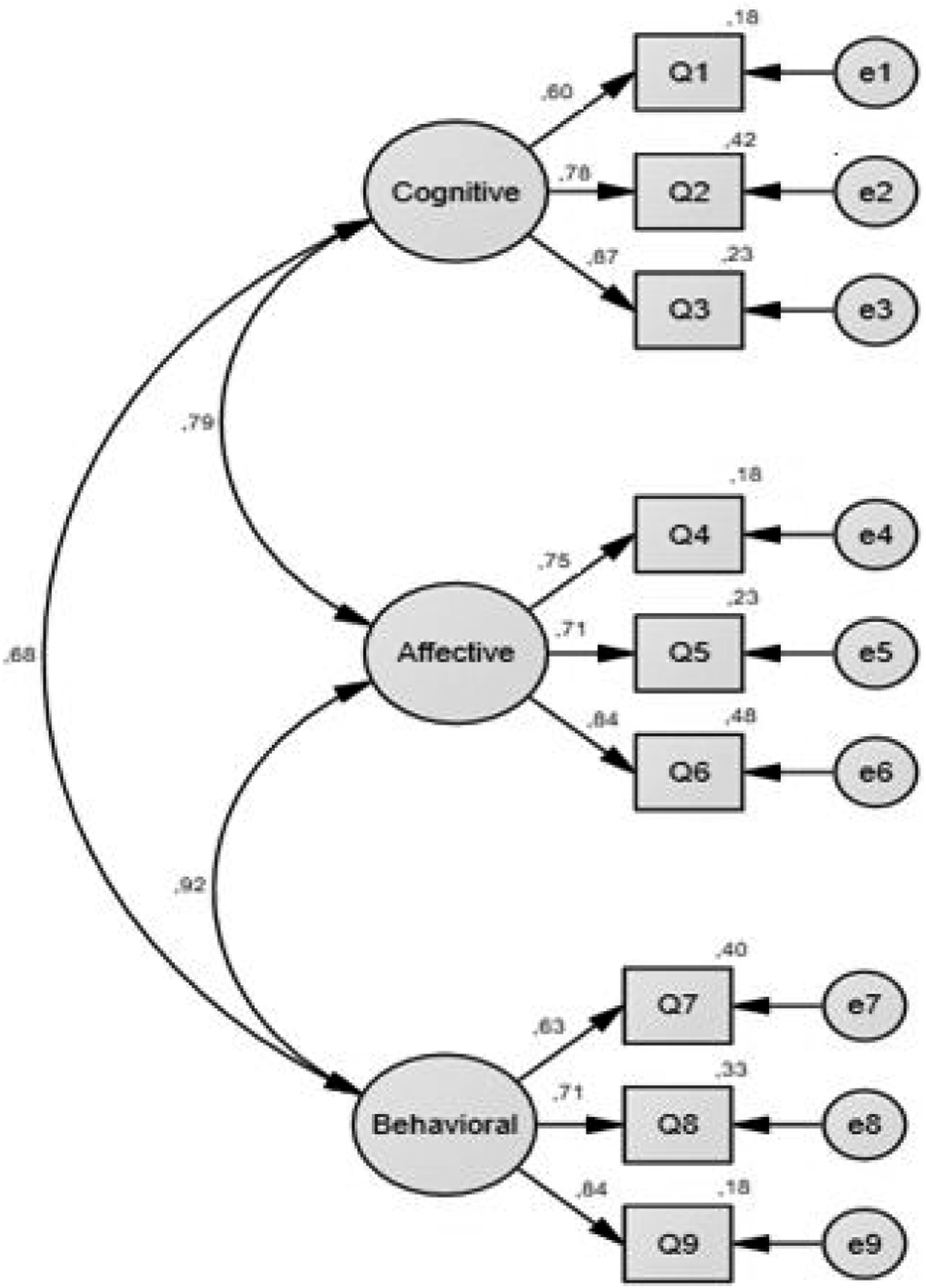
Study 2
In study 2, we evaluated the internal 3-factor structure that was suggested by the statistical analysis of Study 1. For this purpose, we performed CFA, with the use of maximum likelihood (ML) method. The indices suggested a good model fit for the 3-factor model (x 2 = 41.521, p = 0.245>0.05, x 2 /df = 1.70; GFI = 0.91; AGFI = 0.86; SRMR = 0.04; CFI = 0.95; RMSEA = 0.02). The 3-factor model is represented in the following figure (Figure 1).
In order to evaluate convergent validity, we performed correlational analysis between the sums of items belonging to each subscale and full scale of ATTAS-mm with those of TSES (Tschannen-Moran and Hoy 2001). The cognitive factor was positively correlated with instruction strategies (r = 0.57, p < .01), class management (r = 0.68, p < .01), and student involvement (r = 0.71, p < .01). Similarly, the affective factor was positively correlated with instruction strategies (r = 0.41, p < .01), class management (r = 0.69, p < .01), and student involvement (r = 0.67, p < .01). Finally, the development of personal and professional relationships was positively correlated with instruction strategies (r = 0.64, p < .01), class management (r = 0.73, p < .01), and student involvement (r = 0.72, p < .01).
Discussion
In accordance with the objective of this study, which is to assess reliability and construct validity of the Greek version of the Attitudes towards Teaching All Students Scale (ATTAS-mm), and based on the results obtained, we can state that the ATTAS-mm scale is a valid and internally consistent scale with a high level of reliability. The internal consistency of the statements of this scale shows that the included items are grouped together to measure the same dimension of the attitude. With regards to the reliability of the scale, the results indicate that it is a highly reliable scale.
Two studies were conducted to determine the psychometric properties of the adapted ATTAS-mm in Greek. In the first study, the aim was to assess whether the adapted version of the original scale presented adequate reliability and validity by examining the factor structure with EFA in 253 in-service teachers, and in the second study, the authors attempted to confirm the proposed 3-factor structure in a sample of 610 in-service teachers. Having confirmed the validity and reliability of the Greek version of the scale, the findings from its use in 253 and 610 teachers, respectively, are significant. In the first study, the EFA showed adequate evidence of structural validity of the ATTAS-mm scale. In the second study, the CFA showed that the 3-factor structure for ATTAS-mm (cognitive, affective, and behavioral) was validated. Goodness of fit suggests that the attitudes of Greek in-service teachers toward teaching all students can be described by this 3-factor model, and the ATTAS-mm can be used to measure Greek teachers’ beliefs toward inclusive education. The 3-factor model of ATTAS-mm is placing emphasis on these three dimensions as proposed by Gregory and Noto (2012) by applying the theory of planned behavior (Ajzen, 1991, 2020).
Moreover, Cronbach’s alpha coefficient provided data for the internal consistency of the scale. ATTAS-mm demonstrated high reliability for Full Scale: α = 0.843, Subscale 1—Cognitive: α = 0.794, Subscale 2—Affective: α = 0.746, and Subscale 3—Behavioral: α = 0.813. These results are in line with the findings of Noto and Gregory (2012), from the original scale and they were confirmed 7 years later (Noto and Gregory, 2019).
In the present study, the rationale for choosing such a scale stems from the necessity to follow the international trend for inclusive education, in accordance with the legislation, as well as the statements and practical actions toward this direction. Information of this kind is important in order to prevent exclusion practices and actions in the classroom due to teachers’ unawareness and negativity toward the inclusion and education of students with SEND.
However, it is also important ATTAS-mm to be validated in other countries (Charitaki et al., 2022). In this regard, it will be very interesting to compare if the ATTAS-mm scale works the same for other teacher samples in other countries. Hence, the results obtained in this research are confirmed and validated with data from other countries. The main strengths of this current study are the large teacher sample and its reliability encompassing teachers from different levels of education (preschool, primary, and secondary).
Exploring teachers’ attitudes toward students with disabilities through a scale such as the ATTAS-mm is essential (Vogiatzi et al., 2022) for the interventions implemented in favor of the inclusive education and children with SEND. Therefore, emphasis should be placed in pre-service teachers through the process of becoming a professional in-service teacher by administering and using the data from the ATTAS-mm scale so that appropriate training of both pre-service and in-service teachers can be implemented. In order to transform “education for all” into a reality, university students must keep up to date with the most recent developments on supporting students with various problems and difficulties. Such actions can suppress educators’ negative attitudes or improve the integration of students in a school that offers education to all students. “A presupposition for the inclusion of students with SENs to succeed is the proper preparation of teachers by the relevant tertiary educational institutions or seminars so that educators are unafraid not only to confront the challenge of the unknown, but also to pursue ways of becoming informed about programmes and methods that are used for the education of these students” (Batsiou et al., 2008: p. 216).
The present study has several implications, since it can be used in the case of in-service teachers and also as a tool for measuring pre-service teachers’ attitudes toward inclusive education. Finally, policy makers should take into consideration both pre-service and in-service teachers’ perceptions toward inclusive education in order to create and implement interventions promoting inclusion for all students in the learning process. In conclusion, ATTAS-mm is presented as a valid tool concerning the assessment of the attitudes toward teaching to all students showing adequate psychometric properties. This research could be a framework for future longitudinal studies examining teachers’ perceptions in correlation with or without other scales in order to provide essential data regarding teachers’ characteristics as well as teaching children with SEND.
Footnotes
Declaration of conflicting interests
The author(s) declared no potential conflicts of interest with respect to the research, authorship, and/or publication of this article.
Funding
The author(s) received no financial support for the research, authorship, and/or publication of this article.
