



Abstract
Environmental education programs have been shown to produce numerous positive outcomes for participants. However, literature also shows that imbalances may exist regarding the distribution of those outcomes and discrepancies related to affordance of benefits to diverse populations; in some instances, those discrepancies do not simply lack inclusion, but perpetuate the exclusion of certain individuals. While there are likely many factors and potential solutions related to this discrepancy, a closer look at student funds of knowledge within learning context may provide insight regarding program modifications. Incorporating student funds of knowledge within a learning experience has been shown to benefit learners and support more meaningful experiences. The present paper presents an evaluation tool designed to measure the extent to which a curriculum incorporates student funds of knowledge. Further, we demonstrate the use of this evaluation tool through the examination of an existing curriculum: Project WET 2.0. The curriculum provided limited opportunities to incorporate student funds of knowledge. Students participating in Project WET 2.0 may not experience the benefits associated with incorporating student funds of knowledge including stronger connections between outside worlds and classroom content.
Though there is extensive research suggesting that environmental education results in numerous positive outcomes for learners (e.g., Ackerley, 2019; Cason and Gills, 1994; Gill, 2014; Hattie et al., 1997; Kruger et al., 2010; Pfouts and Schultz, 2003), those benefits may not be afforded to all participants (e.g., Adsit-Morris and Gough, 2017; Maina-Okori et al., 2018; Ma’mun et al., 2018; McCabe and Nekaris, 2019; Nxumalo and Ross, 2019; Roberts, 2015). In some instances, diversity in environmental education may extend beyond the lack of support, but be the case where participants are explicitly excluded from participation. In regard to race, Stapleton (2020) argues that environmental education has lacked a racially conscience progression, McLean (2013) suggests the normalization of a white perspective, and Nxumalo and Ross (2019) express concern associated with racialized perspectives. Gender differences may also contribute to marginalization within environmental education as well. This may be illustrated through the lack of literature based on gender differences as Adsit-Morris and Gough (2017) explicitly call for more queer scholarship.
Incorporating funds of knowledge within the classroom may be an important step for educators in providing effective and meaningful learning experiences for all students. Street (2005) made a similar claim in addressing cultural dominance in American Schools. That is, the quality of classroom instruction could be improved through the incorporation and capitalization of students’ household and community resources (Moll et al., 1992). Within environmental education specifically, Cruz et al. (2018) suggest that framing learning within the context of funds of knowledge may be useful when addressing concerns associated with participation rates within underserved communities. Additionally, an approach to environmental education focusing on funds of knowledge allows the educator to be a mediator between life experiences within and beyond the classroom (Cruz et al., 2018). Ultimately, the incorporation of student funds of knowledge may improve and enhance learning through the provision of more equitable educational experiences.
There are numerous published resources and complete curricula designed for various ages and settings covering a diverse range of environmental issues and topics; whether these curricula incorporate funds of knowledge is an open question. These curricula are developed by various groups including governmental agencies and non-profit organizations, including the curriculum and materials produced by the Project WET (Water Education Today) Foundation. Producing curriculum for nearly 30 years, Project WET has provided environmental educators with resources to support their mission of “advancing water education to understand global challenges and inspire local solutions” (Project WET Foundation, 2022a). Exploring the relationship between Project WET curriculum and funds of knowledge may benefit educators and researchers given its prominence and broad audience. Therefore, the purpose of this study is to evaluate the Project WET Curriculum and Activity Guide 2.0 for the incorporation of student funds of knowledge. The following research question was explored: To what extent does the Project WET Curriculum and Activity Guide 2.0 support the incorporation of student funds of knowledge?
Answering this question may help us understand whether Project WET will help educators connect out-of-school experiences with classroom learning. Further, demonstrated use of the evaluation tool will support greater exploration of the use of student funds of knowledge within the environmental education community.
Conceptual framework: Funds of knowledge
Originally developed by Velez-Ibanez and Greenberg (1992) and Moll et al. (1992), the concept of funds of knowledge is rooted along the US-Mexican borderlands. Velez-Ibanez and Greenberg (1992) coined the term as part of an anthropologic study to describe strategic and cultural resources within a household. Applications of funds of knowledge to student learning have been extensive since Moll et al. (1992) extended the use of the term from this anthropologic understanding into the field of education. Given this nearly 50-year history, much literature supports the benefits of this approach. Specifically, Barton and Tan (2009) illustrated through a study of hybrid learning that funds of knowledge support both the depth and breadth of student learning. Additionally, Sanchez Tapia et al. (2018) found that a culturally appropriate curriculum supported significant learning gains among students. Some researchers (Volman and Gilde, 2001) found impacts on student behavior, self-confidence, collaboration, and engagement in addition to learning gains.
Researchers offer multiple definitions for funds of knowledge (Hogg, 2011). Sources of funds of knowledge may include within and between households, family, community, peers, popular culture, culture, and life experience (Hogg, 2011). Our research is grounded in Gonzales and Moll’s (2002) description of funds of knowledge as a simple premise based on the notion that individuals are competent and possess knowledge gained from life experiences. Though there are many different aspects that contribute to funds of knowledge, we can think of it generally as the resources and information that students access beyond the classroom. Below, we discuss three subthemes of funds of knowledge that further clarify the concept within education.
Student agency
Student agency, or student-driven learning, is where students have choice in the activities and directions of learning and is one element of funds of knowledge. Barton and Tan (2009) note that application of funds of knowledge to education involves working with students in the development of learning directions while also including them in the planning process. Additionally, student agency involves establishing a space for discourse in which students can authentically be themselves (Barton and Tan, 2009). Moll et al. (1992), in discussing funds of knowledge, note that students should be active learners and highlight the importance of student inquiry.
Community-based learning
Given that funds of knowledge stem from outside of the classroom, numerous researchers highlight the importance of incorporating community-based learning in their definition of the theory. One specific aspect of community-based learning involves embracing aspects of students’ lives outside of the classroom through involving out-of-school worlds (Barton and Tan, 2009), embedding learning in real world problems (Sanchez Tapia et al., 2018), and even incorporating elements of popular culture (Edwards et al., 2016). Further relating to learning outside of the classroom, Sanchez Tapia et al. (2018) also reference the importance of transfer of knowledge into and beyond the learning environment as part of the learning process. Moll et al. (1992) also address community-based learning by suggesting that students should utilize their social contacts.
Diverse student identities
A third element of funds of knowledge includes the opportunity for students to express their thoughts, opinions, and ideas. Barton and Tan (2009) note aspects of funds of knowledge that support this third element of the incorporation of diverse student identities; they suggest that student identities should be incorporated into the classroom, students should be able to share content in which they are the expert, and that all students should have the opportunity to volunteer information. Similarly, Sanchez Tapia et al. (2018) note educators should leverage prior knowledge and experiences while aligning learning with student culture and values. Additionally, facilitators should actively foster an environment in which students are invited to share their knowledge (Barton and Tan, 2009).
Funds of knowledge in environmental education
Few studies explore funds of knowledge within environmental education settings and even fewer have evaluated curricula through a funds of knowledge lens. Existing literature makes the argument that a funds of knowledge approach is important within the context of environmental education. Specifically, Cruz et al. (2018) suggest that a funds of knowledge approach paired with social capital in environmental education will benefit underserved Latin American communities. Edwards et al. (2016) also noted benefits associated with incorporating funds of knowledge within environmental education and suggested that this partnership helps to facilitate stronger connections between educational content and participants’ everyday lives.
It is also important to acknowledge that there may be some instances in which students may lack funds of knowledge related to a specific content area. However, as the literature highlights the benefits of incorporating funds of knowledge, we argue the necessity of supporting facilitators in providing opportunities to share that knowledge. Further, not all aspects of funds of knowledge rely on prior knowledge, but instead, support learner agency and development of connections between curriculum and their own lives. In this paper, we evaluate a widely used curriculum to investigate whether it may be supporting learning of diverse individuals through the incorporation of funds of knowledge.
Methods
Curriculum selection
The Project WET Curriculum and Activity Guide 2.0 was selected for this research project due to its prominent presence within the field of environmental education. According to Project Wet’s 2021 Impact Report (Project WET Foundation, 2021), educators using the curriculum and materials educated nearly three million people worldwide in 101 countries. Written in 2011, the 2.0 curriculum is the revision of the original Project WET Curriculum and Activity Guide published in 1995. The curriculum supports four core beliefs: (1) water connects us all, (2) water is for all water users, (3) water must be managed sustainably, and (4) water depends on personal responsibility and action (Project WET Foundation, 2022a). Various resources including educator guides, children’s activity and story books, downloadable products, digital resources, maps, and posters have been developed by Project Wet along with the opportunity to participate in training programs on how to facilitate learning experiences.
The Project WET materials incorporate specific attention to standards including the Next Generation Science Standards, Common Core State Standards, Ocean and Climate Literary Principles, Early Childhood Education Standards, as well as many state-specific standards. Project WET notes that the methodology includes hands-on and investigative activities. Further, Project WET suggests that their activities are accurate and science-based, interactive, multisensory, adaptable, contemporary with the incorporation of technology and 21st century skills, cross-cultural, relevant, solution oriented, and measurable (Project WET, 2022b). Having a global reach, Project WET and their curricula have the potential to impact a broad and diverse group of learners within the context of water-based environmental education.
Research design
In order to answer the present research question regarding to what extent the Project WET Curriculum and Activity Guide 2.0 supports the incorporation of student funds of knowledge, we used a deductive qualitative approach by conducting a content analysis in which the text of lessons were evaluated (Krippendorff, 2018). Though potentially limiting as it does not involve observation of lesson facilitation, this method was selected as we focus specifically on the overt curriculum and because it allows for researchers to summarize the frequency of specific categories within a given text (Bengtsson, 2016). In this case, we summarized the frequency of elements of funds of knowledge within a written curriculum. We further defined three additional questions based upon the previously discussed subthemes (student agency, community-based learning, and diverse student identities). a. Does the Project WET Curriculum and Activity Guide 2.0 provide opportunities for student agency in learning? b. Does the Project WET Curriculum and Activity Guide 2.0 provide opportunities for community-based learning? c. Does the Project WET Curriculum and Activity Guide 2.0 provide opportunities for the expression of diverse student identities?
We developed a set of between five and seven indicators (see Appendix A) to measure the extent to which the Project WET Curriculum and Activity Guide 2.0 provided opportunities for each subtheme, using the relevant literature (e.g., Barton and Tan, 2009; Edwards et al., 2016; Moll et al., 1992; Sanchez Tapia et al., 2018).
The indicators were organized in an evaluation tool to be utilized in the process of reviewing and coding the curriculum. This evaluation tool is akin to the sample checklist for evaluation as defined by Williams (1983) in which items are weighted or scored based upon their presence within the curriculum. Similarly, the American Association for the Advancement of Science (AAAS)’s (2002) Project 2061 involves a rating system of curriculum based upon defined criteria that served as a model for the development of this tool.
The final version of the evaluation tool (Appendix A), aimed at measuring the incorporation of funds of knowledge, includes a rating for each subtheme ranging from not met to excellent based upon the number of indicators with sufficient evidence present within the curriculum. We reported results regarding the final rating based upon whether the indicators were completely or partially met.
Data analysis
The Project WET Curriculum and Activity Guide 2.0 is divided into 7 units each with 5 to 17 lessons with a total of 64 lessons. Four lessons from each unit were randomly selected resulting in a total of 28 lessons included in the analysis, providing a diverse sampling of the curriculum’s lessons. Analysis involved all published components associated with each lesson including extension activities.
Structural coding, guided by the evaluation tool developed to measure student funds of knowledge across the three subthemes of student agency, community-based learning, and diverse student identities, was used by a team of researchers to evaluate the curriculum. This coding method was selected as it supports the indexing of data across different categories, in this case, aspects of a lesson across indicators (Saldana, 2009).
Two researchers were involved in the coding process to allow for intercoder reliability. Following the coding of six initial lessons, researchers compared results for each indicator and discussed differences. For 11 of the 17 indicators, there was 100% agreement, for three of the indicators, there was 83% agreement, and for the final three indicators, there was a 67% agreement. Discrepancies were discussed until consensus was reached in areas where there was no initial agreement. In order to increase intercoder reliability, an additional six lessons were coded by both members of the research team on the three indicators with low agreement. Following this second round of coding, there was 83% agreement for one of the reevaluated indicators. However, the last two indicators did not achieve an 80% agreement level; so, individual codes were discussed for evaluated lessons and a consensus was reached. At this point, the remaining lessons were coded by the first author. A score for each subtheme was calculated based on the levels of evidence present.
Evaluation tool
Each subtheme (student agency, community-based learning, and diverse identities) was assigned a rating based on the number of indicators shown to have evidence for support. Ratings were calculated based on how many lessons included evidence to support the indicator allowing us to provide a nuanced depiction of the inclusion of funds of knowledge. Though not identical, thresholds for rating levels were modeled after the AAAS curriculum evaluation in which a rating of excellent was assigned if most indicators were met, satisfactory if indicators are sufficiently met, and poor if no more than one indicator was met (AAAS, 2002). In some cases, AAAS (2002) prioritized certain indicators and included a rating between satisfactory and poor. In order to recognize the fact that indicators were present in some, but not all lessons, we added an additional metric in which indicators were considered completely met if there was evidence present in every lesson and partially met if evidence was present in 14 or more (50%) of lessons.
In order to compute final ratings, we completed the following steps: a. use the evaluation tool to review each individual lesson b. calculate the percentage of lessons with evidence of support for each indicator under the separate subthemes to determine whether indicator was completely met or partial met c. determine the number of indicators with evidence of support (for both complete and partial) d. use Table 1 below to determine the rating, based on the number of indicators with support, for both complete support and partial support. Subtheme rating criteria.
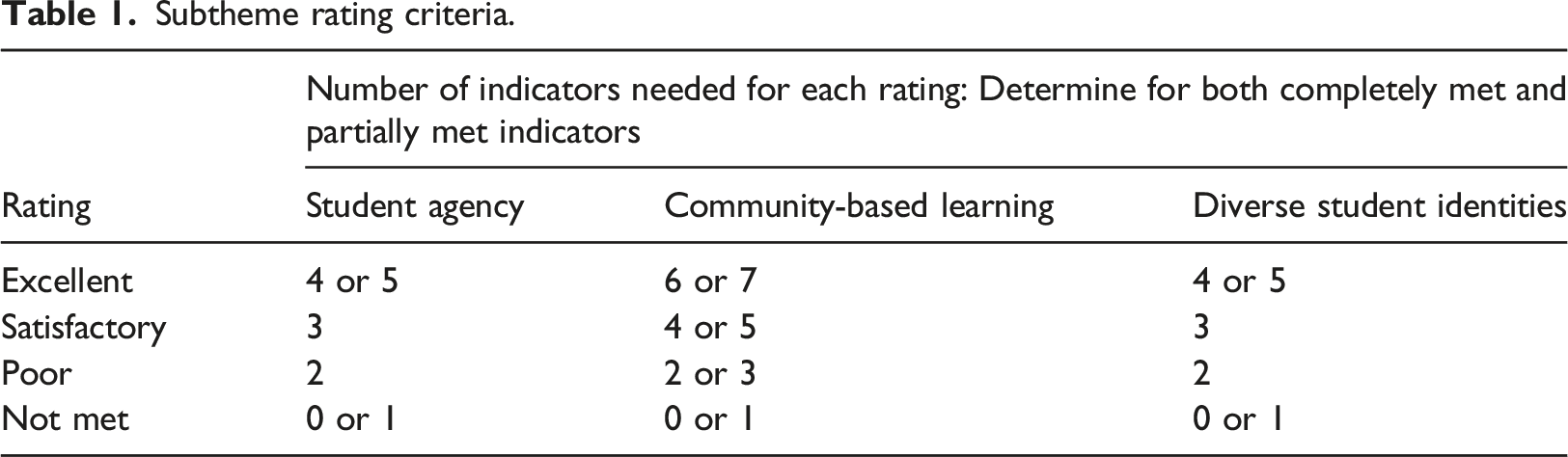
For example, student agency includes five indicators; after evaluating lessons, if we find that four or five of those indicators had evidence in 100% of lessons, the ratings for student agency would be excellent for complete support. However, if either four or five indicators did not have support across all lessons (100%), but were present in at least half (50%), the rating for partial support would be excellent.
Findings
Because the evaluation tool is designed to assign a rating based upon each subtheme and the research question is subdivided as well, we present findings for each subtheme with corresponding evidence.
Student agency
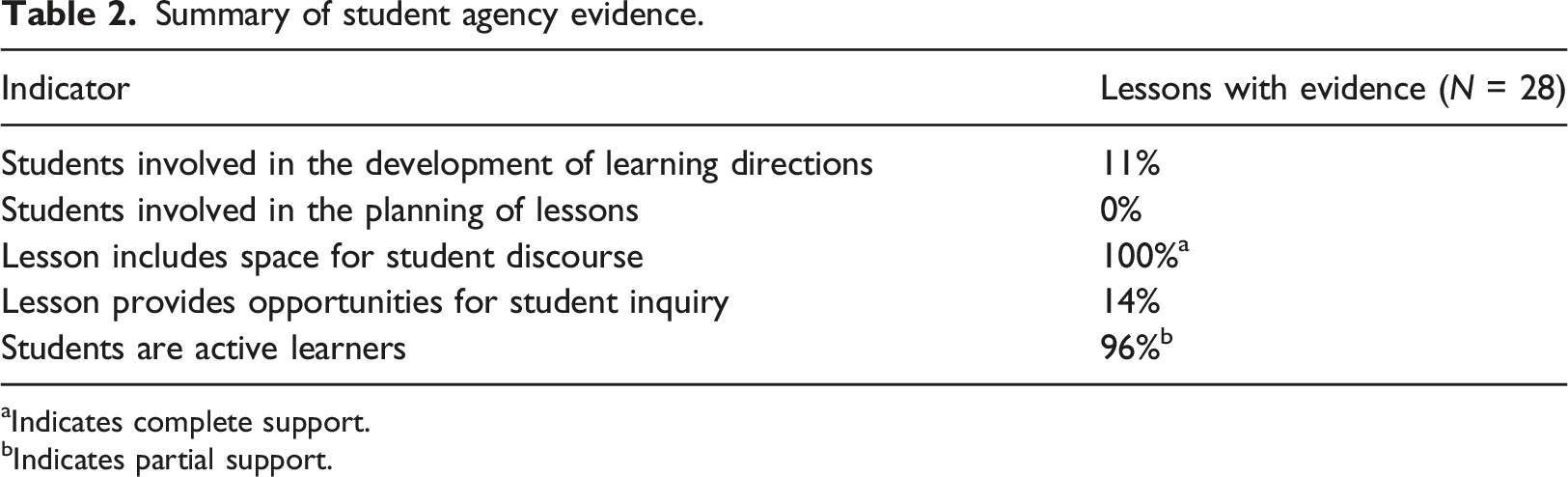
Summary of student agency evidence.
aIndicates complete support.
bIndicates partial support.
The indicator relating to student discourse was supported in all evaluated lessons. The level and type of discourse varied and was included in different stages of lessons. In some cases, the space for discourse was included in the “Warm Up” activity in which students were asked a question such as in Unit 1 Lesson 3 “Hanging Together” where the facilitator posed the question “What do students think gives water electrical charge?” (Project WET Foundation, 2011: p. 21). However, many lessons involved group work in which students had the opportunity to engage in discourse with each other. Evidence for this type of discourse can be seen in Unit 6 Lesson 6 “Water Crossings” where the lesson reads “Divide the class into small groups. Each team will build a water crossing conveyance…Since each team only gets one chance to succeed, encourage groups to discuss their options” (Project WET Foundation, 2011: p. 489). Additionally, in some lessons, such as Unit 4 Lesson 8 “Sum of the Parts” students engage in discourse during the “Wrap Up” by discussing the results of the activity together.
Though not present in all evaluated lessons, the indicator relating to students being active learners was nearly completely met. Evidence for this indicator was most frequently present within the “Activity” segment of lessons. Evidence ranged from students “playing a water-hauling game” in Unit 4 Lesson 6 “The Long Haul” (Project WET Foundation, 2011: p. 274), to acting out the “role of water as it flows” in Unit 3 Lesson 5 “Just Passing Through” (Project WET Foundation, 2011: p. 164), to studying “victim cards” related to the 1854 cholera epidemic in London in Unit 2 Lesson 8 “The Poison Pump” (Project WET Foundation, 2011: p. 108).
The remaining three indicators had very little supporting evidence across the evaluated lessons. The indicator relating to student inquiry had some support, however, this was typically present within extension activities in which students were encouraged to develop experiments or to conduct further research related to the content covered in the main portion of the lesson. Only three lessons had evidence to support the indicator related to students’ involvement in the development of learning directions. An example can be seen in Unit 7 Lesson 1 “Discover the Waters of our National Parks” in which students are able to select three national parks, battlefields, memorials, or seashores to focus on during the activity portion (Project WET Foundation, 2011: p. 498). The final indicator in this subtheme relating to students being involved in the planning of lessons was not supported in any of the evaluated lessons.
Community-based learning
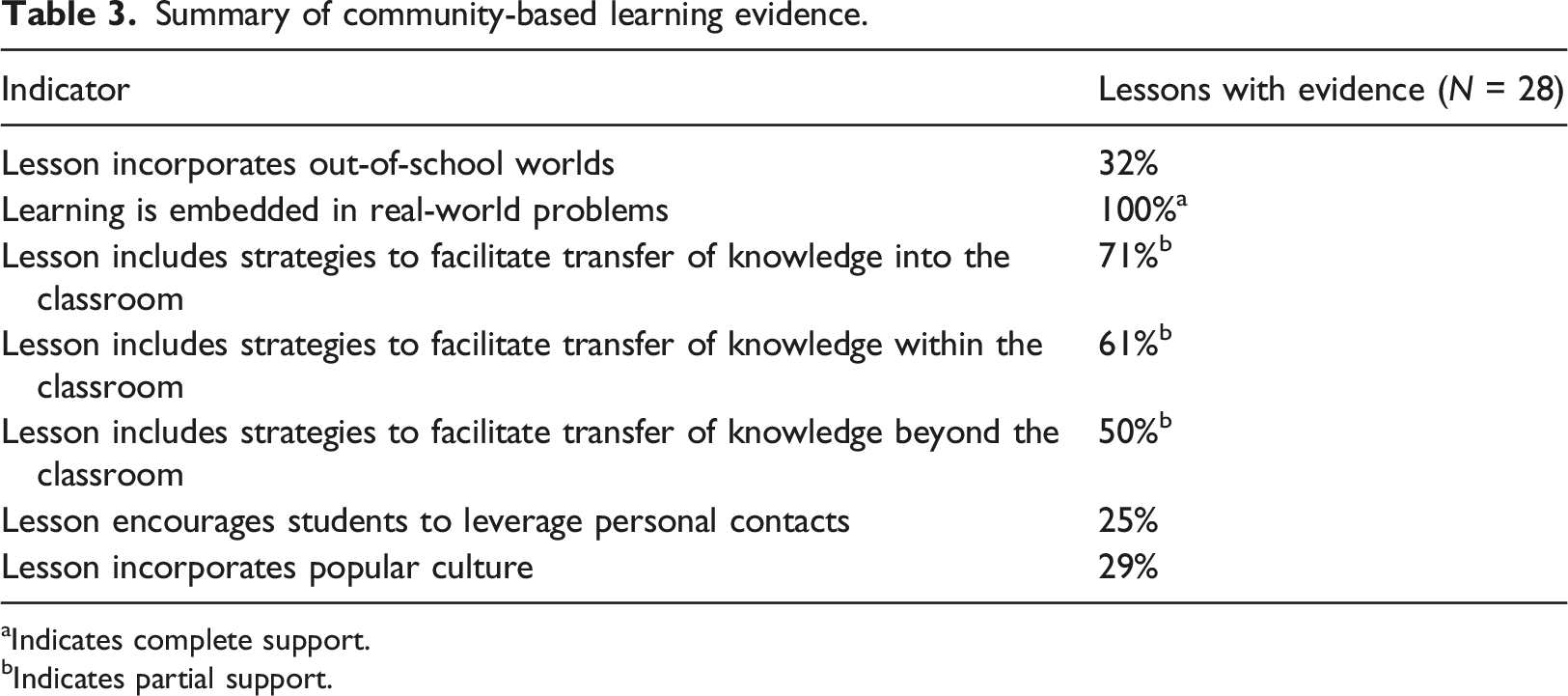
Summary of community-based learning evidence.
aIndicates complete support.
bIndicates partial support.
All of the evaluated lessons showed evidence for the indicator related to real-world problems. Most commonly, this indicator was present in the “Making Connections” section of each lesson. For example, in Unit 2 Lesson 5 “The Life Box,” the making connections piece of the lesson references the need for water and air to survive and in Unit 4 Lesson 1 “A-maze-ing Water” the lesson refers to washing family cars, litter on the sidewalk, and dog walking. There is also evidence to support real world problems in other elements of lessons as well; Unit 2 Lesson 7 “On Track with Hydration” has students record their drinking habits throughout a day as well as consider marketing strategies for different beverage companies.
The three indicators related to transfer of knowledge were all supported with evidence from at least 50% of evaluated lessons. Most frequently observed was the transfer of knowledge into the classroom. This was very common among extension activities where students were instructed to conduct independent research related to the main learning objectives and activities. In Unit 2 Lesson 6 “Ocean Habitats,” the extension was to “Have students search Internet videos sites for films about the ocean, zones, and marine species” (Project WET Foundation, 2011: p. 77). However, we also saw evidence of this indicator through inviting speakers to the classroom as in Unit 4 Lesson 6 “The Long Haul” where the lesson recommends inviting a speaker from the local municipal water service into the classroom.
Over half of the lessons also supported the transfer of knowledge within the classroom indicator. This transfer of knowledge occurred frequently during the main activity portion of lessons where students would be assigned a task in small groups and then share or discuss results with the rest of the class. In Unit 3 Lesson 9 “Springing into Action,” this discussion is taken a step further as the curriculum also suggests instructing students to collaborate on a class definition of a term.
More than 50% of the lessons included evidence of transfer of knowledge beyond the classroom. Evidence for this indicator was almost exclusively present within the “Wrap Up” or “Extension” sections of the lessons. Often, this indicator was included through the suggestion that students share what they learned with family, friends, or other classrooms. However, there were also some more involved elements such as Unit 6 Lesson 3 “Pass the Jug” in which the “Wrap Up” activity suggested the creation of a display for their school and Unit 4 Lesson 8 “Sum of the Parts” where students were to write letters to local government officials.
Though the remaining three indicators were not present in at least 50% of evaluated lessons, there was some evidence to support these factors of student funds of knowledge. In reference to out-of-school worlds, some lessons such as Unit 2 Lesson 8 “Poison Pump” encouraged students to visit the local museum and Unit 3 Lesson 5 “Just Passing Through” suggested students conduct an inventory within their school yard or community. It is relevant to note that evidence for this indicator was typically only found within the “Extensions” or “ActionEducation” components of the lessons. Popular culture was also evident in about one third of the examined lessons and was typically represented through the inclusion of supplemental literature and, in one case, use of the Olympics theme song. The final indicator within this subtheme relating to leveraging personal contacts had the least support within community-based learning and was typically supported by lessons requiring students to connect with family.
Diverse student identities
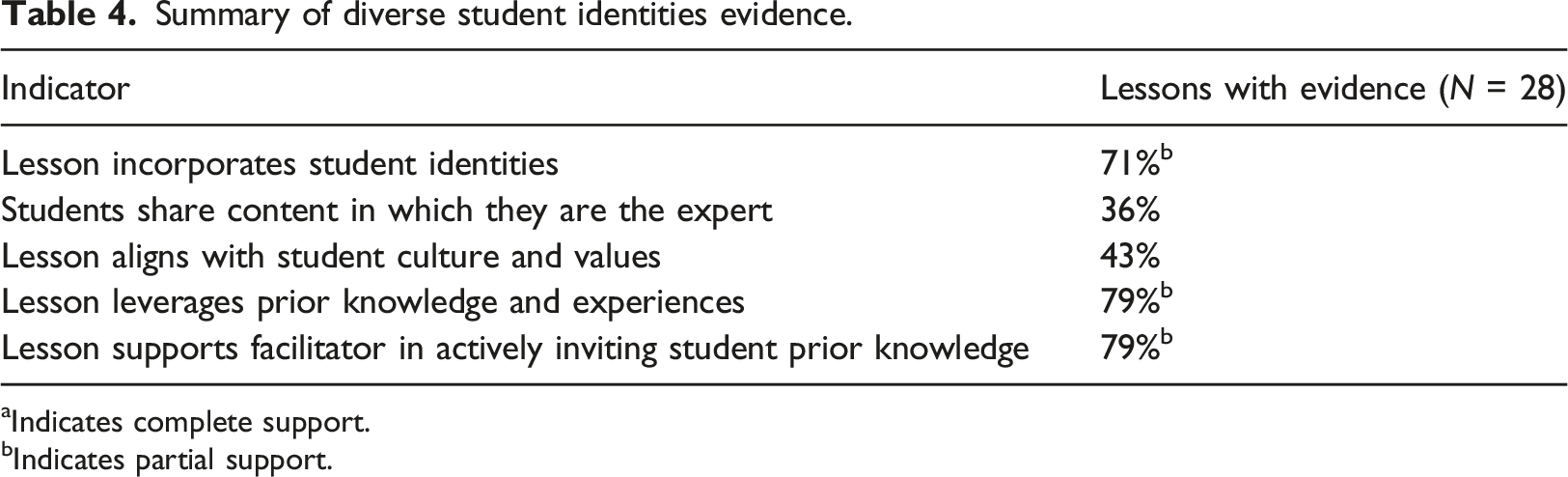
Summary of diverse student identities evidence.
aIndicates complete support.
bIndicates partial support.
The support for leveraging student prior knowledge and experiences along with supporting the facilitator in inviting student prior knowledge was evident in more than half of the evaluated lessons. These two indicators were almost always found together with the same aspects of the lesson found as evidence. For example, in Unit 1 Lesson 6 “What’s the Solution,” the lesson prompts the teacher “Ask the students about mysteries they have read or seen on television” (Project WET Foundation, 2011: p. 38) and in Unit 3 Lesson 9 “Springing into Action” the students are asked about what they know and have heard about spring water.
Student Identities are supported in many of the lessons as well, typically through opportunities for creativity. This is shown in Unit 6 Lesson 6 “Water Crossings” where students are asked to write a fictional story based on the content of the lesson. There is also evidence to support this indicator related to student identities where students are given choice in their learnings as in Unit 5 Lesson 16 “Urban Waters” with students selecting water-related careers in which they specifically have interest.
The last two indicators were not as prominent throughout the curriculum, both only having support in about one third of evaluated lessons. Some of the evidence for student culture and values was specifically related to exploring water-related topics within their unique community such as acknowledging their local watershed or using maps from the region within the activities. Opportunities for students to share content in which they are the expert varied across the lessons but included instances for students to share information with the entire class or share content learned during the lesson with others outside of the classroom.
Discussion
Our evaluation tool suggests that the Project WET 2.0 curriculum could be more successful at incorporating student funds of knowledge. Most indicators did not have evidentiary support across all lessons (complete support) and findings were only slightly better when considering partial support. This information provides three frameworks for consideration: first, we may explore the associated implications for learners engaging in curriculum lacking inclusion of funds of knowledge; second, we may consider implications related to pedagogy and opportunities for professional development; third, we may use these findings to guide curricular modifications.
Implications for learners
Generally, these findings indicate that students experiencing this curriculum may be missing out on the benefits associated with incorporating student funds of knowledge given its lack of explicit inclusion in the curriculum. This may be problematic as we consider the relationship between funds of knowledge supporting diverse learners in conjunction with the current state of environmental education that may marginalize certain individuals based on race or gender. Diverse learners may not have access to the benefits of a funds of knowledge approach including stronger connections between the outside world and classroom content (Edwards et al., 2016), great learning gains (Barton and Tan, 2009; Sanchez Tapia et al., 2018), as well as support in development of self-confidence and greater engagement (Volman and Gilde, 2001). Further, when considering Cruz et al.’s (2018) suggestion that funds of knowledge may be beneficial for underserved communities, educators using this curriculum may be missing productive opportunities for those with limited engagement in environmental education.
Implications for pedagogy
These findings highlight gaps that are present within this curriculum and may serve as guidance for facilitator training and professional development. We found that student agency is the area most absent from the curriculum with several of the indicators having very little or no support. Multiple researchers (e.g., Barton and Tan, 2009; Moll et al., 1992) suggest that student agency is a critical component of funds of knowledge. An absence of student agency indicates that students have less choice and ownership over their own learning which may lead to less meaningful experiences. Pedagogically, if facilitators are aware of this and other gaps, they may be able to supplement the existing written curriculum to support student choice and other elements of funds of knowledge.
Though not as deficient as student agency, there are also several aspects of community-based learning and diverse student identities that were less prominent in the curriculum. The curriculum does not frequently encourage students to leverage personal contacts (Moll et al., 1992) and provides few opportunities for students to share content in which they are the expert (Barton and Tan, 2009). Students’ experience may be diminished, resulting in weaker connection to the content, when elements of student funds of knowledge like these (leveraging personal contacts and student sharing of knowledge) are absent from a curriculum. Again, we see this as an opportunity in which facilitator training may be beneficial. Encouraging facilitators to understand and become immersed in the community in which they are teaching may help to provide greater context and support the instructor in drawing community-based connections.
Implications for curriculum
Reviewing the findings with a greater level of precision, where individual indicators are considered rather than entire subthemes, may be more informative regarding how student funds of knowledge are embedded within the learning and potentially inform decisions regarding curricular modifications. Additionally, the differences observed between complete and partial support across the curriculum helps us raise important questions about what goals should be set for the inclusion of funds of knowledge in curricula. Should curriculum writers strive for all aspects of student funds of knowledge to be embedded in all lessons in a curriculum or is sufficient for different elements to be incorporated across different lessons? Is it possible for all lessons to address all aspects of student funds of knowledge? There is potential value in considering partial support as it could be argued, that holistically, over the course of the entire curriculum, student funds of knowledge are embedded within learning. However, this may be problematic if the curriculum is not taught as a whole but rather with individual lessons being selected and facilitated as stand-alone learning experiences.
Limitations
We acknowledge that this evaluation reviews the written content alone. In any educational experience, learning may be highly dependent on the instructor and how the written content is interpreted and facilitated. According to Kazemi and Hubbard (2008), instructors use curriculum in different ways based upon their personal preferences, prior experiences, and beliefs that, in some cases, may undermine the intent of the curriculum. Do instructors actually facilitate all parts of every lesson? If not, some indicators that were shown to have support may not be present during the actual lesson. Further, many pieces of evidence were drawn from extension activities that may be left out of facilitation all together. This suggests more research is needed to understand choices educators make with regards to inclusion or exclusion of funds of knowledge support when teaching this and similar curricula.
Conclusion
The present study leads to multiple implications and opens the door for numerous avenues for further research. First, we have highlighted the important relationship between student funds of knowledge and environmental education. Second, this project has produced a literature-based evaluation tool for funds of knowledge that can be used to evaluate any curriculum both within and beyond the context of environmental education. Curriculum developers and educators may use this funds of knowledge tool to produce more valuable and inclusive learning experiences for diverse learners. This tool may be beneficial as researchers and practitioners work to address the discrepancies associated with unequal affordance of beneficial outcomes. Regarding the Project WET Curriculum and Activity Guide 2.0, these findings may inform potential curriculum modifications to further support the inclusion of student funds of knowledge which may improve the learning experiences of students.
While this research has answered some questions regarding student funds of knowledge, environmental education, and the Project WET curriculum, it also leads to new questions. It may be valuable to explore individual indicators in depth: Are certain indicators consistently supported by evidence or consistently absent from the curriculum? Are there relationships and correlations between indicators that are jointly present or jointly absent? Are some indicators more important and meaningful to student learning than others? This research also presents questions about the connections between student funds of knowledge and the facilitation and pedagogy of instructors. Embedding student funds of knowledge within environmental education will benefit learning for all participants and this project is just one step in further exploring and fostering that connection.
Supplemental Material
Supplemental Material - Evaluating curriculum for student funds of knowledge: A review of project WET 2.0
Supplemental Material for Evaluating curriculum for student funds of knowledge: A review of project WET 2.0 by Jennifer Hileman, Emily Olsen and Julia D Plummer in Equity in Education & Society
Footnotes
Acknowledgements
We thank Bailey Kellermann for their support during the initial stages of the development of the student funds of knowledge evaluation tool.
Declaration of conflicting interests
The author(s) declared no potential conflicts of interest with respect to the research, authorship, and/or publication of this article.
Funding
The author(s) received no financial support for the research, authorship, and/or publication of this article.

Supplemental Material
Supplemental material for this article is available online.
References
Supplementary Material
Please find the following supplemental material available below.
For Open Access articles published under a Creative Commons License, all supplemental material carries the same license as the article it is associated with.
For non-Open Access articles published, all supplemental material carries a non-exclusive license, and permission requests for re-use of supplemental material or any part of supplemental material shall be sent directly to the copyright owner as specified in the copyright notice associated with the article.
