



Abstract
In discussing what young people need in order to thrive in school and work environments, the existing education and workforce literature largely credits the types of social and cultural capital that are gained from middle-class upbringings, and rarely are working-class and low-income counterparts valued or considered conducive to achievement. In this research paper, we discuss how minoritized students from low-income homes described their first experiences in summer internships and their earliest memories related to work. Our student participants, 25 Bronx high school seniors, largely credited their guardians’ and family members’ work ethic (cultural capital) in working-class jobs as critical in their own motivational development. Our findings indicate that the experiences underrepresented youth have at home, through lessons and examples, lead to positive benefits and the development of certain forms of cultural capital, which can lead to academic success and occupational identity formation.
Introduction, implications, and questions
The types of contributions that parents and guardians make to their children’s development go well beyond simply addressing the costs of education and childcare. Parents and guardians also provide their children with the basic social and cultural wherewithal for achieving in various environments. 1 Parenting influences are critical for fostering a young person’s personal and social development in the world as well as influencing the educational choices and actions children take, which directly impacts a young person’s future social mobility (Berríos-Allison, 2005; Hunter et al., 2019; Lareau, 2011, 2015). Specific to occupational identity, parents also foster proclivity toward different vocations, influencing early-age adolescents’ professional development by providing valuable career information and modeling professional skills in the family environment (Koçak et al., 2021). Kielhofner’s (2008) definition of occupational identity is appropriate and fitting and is defined as a “composite sense of who one is and wishes to become as an occupational being generated from one’s history of occupational participation, volition, habituation, and experience as a lived body” (p. 106). Parents and mentors, activities and environments, opportunities, resources, and exposure all influence occupational identity and a child’s sense of belonging and confidence (Callahan et al., 2019).
Specifically, parents provide their kids with various forms of social and cultural capital by modeling forms of knowledge, behaviors, relationships, and skills that can directly translate into financial and other rewards. This impacts positive academic and occupational identity formation—or how a young person sees themselves and their capacity to succeed in educational and professional domains (Bourdieu, 1986; Howard, 2003; Phellan & Kinsella, 2009). Parents can also influence how young people actively gain forms of capital for themselves—through the lessons and examples they impart. Not only are parents our first teachers but often introduce us to many people and opportunities that become beneficial to our future. Although working-class parents may not have access to the same “lucrative” resources as their wealthier counterparts, these forms of inspiration and motivation appear to have similarly long-lasting effects.
However, much of the existing research on academic and occupational identity focuses on understanding middle and upper class families and fails to acknowledge the multiple, positive contributions that working-class minoritized parents can make to their children’s developing attitudes and abilities—or cultural capital (Kundu, 2020). Rather, when included, these parents’ influences are often explained through implicit deficit framing, with partial if not fully limiting impact, with the youth in question needing to gain forms of dominant social and cultural capital outside of their home in order to thrive in the dominant landscape (Lareau, 2011). The most “foundational” parenting and family literature largely implies that forms of capital acquired within low-income homes are not as conducive to mainstream academic and professional success, as well as health and wellness outcomes, as those gleaned in more affluent homes (Alexander, 2016; Dominguez and Arford, 2010; Lareau, 2011, 2015).
Through this study, we have strived to broaden these limiting perspectives by interviewing academically engaged Bronx high school seniors, who participated in their first paid summer work experiences. We contend that the dominant discourse would be both improved and could better serve diverse student needs through identifying and cultivating the cultural assets that underrepresented young people have. Specifically, we expand upon the existing yet limited fundamental notion of “family contribution” to be more inclusive of low-income homes, where minoritized guardians also rear their children to appreciate scholastic processes and opportunities and to subsequently work hard to achieve. According to Yosso (2005), underrepresented individuals have additional, unrecognized reservoirs of capital that exist beyond Bourdieu’s theory of cultural capital, including aspirational, familial, social, navigational, resistant, and linguistic forms of capital. She describes community cultural wealth as “a range of knowledge, skills, abilities, and contacts possessed and utilized by Communities of Color to survive and resist macro and micro-forms of oppression” (p. 77). Aligned with this enduring and significant work (2005, 2014), as well as that of Ladson-Billings (2000), Delgado Bernal (2002), and Nieves (2021), we present valuable family contributions from low-income, minoritized homes, employing an asset-based lens to challenge the notion that limited financial support, social networks, and cultural experiences are associated with weakened abilities to succeed in higher education or the workforce.
Our findings indicate that according to youth, working-class, minoritized caregivers pass on valuable forms of cultural capital that help them navigate new environments, seek out resources and mentors when challenged, and motivate them to succeed through their displays of diligence and family-oriented values. Our data have been pleasantly uplifting as these excited young people’s narratives offer stark contrasts to recent, negative portrayals of minority parents in the mainstream, which can suggest indifference or disdain toward educational opportunity (AUTHOR 1, 2022). Our work also corroborates the idea that existing concepts of capital are inherently racialized through negative, or “deficit,” perspectives that position some students as underprepared to excel in K–12, higher education, and the workplace (Cartwright, 2022).
The narratives we share also depict how experiencing intergenerational inequality affects how young people ideate about their futures, how the earliest memories associated with work impact students’ present goals, and how culturally and socially supportive work experiences (e.g., summer internships) can inform their choices. Research indicates that initial work experiences are critical for underprivileged students when forming their occupational identities and social networks, developing a desire to do well in school and make plans related to college and thereafter (Fisher, 2018; Nieves, 2021). Our research corroborates these findings.
Two basic research questions guided the early parts of our investigation: (1) How do young Black and Latinx people from low-income backgrounds describe the support they receive from their families as they begin their first paid job experiences? (2) What kinds of stories and experiences do young people share when asked specifically about their earliest memories associated with the concept of “work”?
Review of relevant literature
“Parental contribution” and “parental involvement” are terms that encapsulate how parenting factors (including but not limited to a parents’ age, education, values, literacy levels, and time spent with adolescents) impact a child’s abilities, interests, and future outcomes (Lyytinenet al., 1998; Topor et al., 2011). More specifically, research supports the finding that parent contribution and involvement are linked to explicit scholastic outcomes such as a student’s early interest in books or their high school performance and career aspirations (Topor et al., 2011). However, existing literature that focuses on working-class families suggests that a child must achieve despite their upbringing, having to acquire rewarded social and cultural capital outside of the home to succeed (Lareau, 2011; Odenbring, 2018). These perspectives can stem from overly structural views on poverty and its limitations; naturally, lower-income students and families contend with many factors that can inhibit access to opportunities such as enrichment programs or connections to internships (Eden and Lein, 1997; Fosse, 2016; Kundu, 2020; Massey and Denton, 1993; Kundu, 2019). In this article, we contend that social and economic disadvantages do not necessarily restrict underrepresented guardians from contributing forms of capital that benefit their children’s school and career affinities, attitudes, and achievements (Kundu et al., 2022; Nieves, 2021).
Levine and Sutherland (2012) indicate that low-income parents can provide “non-dominant” or “alternative” forms of social and cultural capital that facilitate an adolescent’s future school and career achievements by providing knowledge and guidance about specific occupations and career-related information to the best of their ability. Nonetheless, there still remains a paucity of literature that presents the many ways that minorities in low-income households positively contribute to their children’s outlook toward college and their career (Nieves, 2021). To address these voids, in our research, we included data from semi-structured focus groups where students spoke about their earliest memories associated with work to investigate how attitudes toward occupations and vocations develop. While this paper contributes to a limited but necessary pathway of research where minority parents are acknowledged for their indelible impact on their children’s educational and professional ambitions, more research is needed to better understand how to institutionally support minority students in lower-income households and recognize their inherently diverse gifts and assets.
Low-income families and structural barriers
Existing literature typically includes discussion around the importance of focusing on students from low-income homes in primary ways: that foremost, students living in poor and under-resourced communities face major, routine, structural-level challenges that can be limiting to their futures, including, but not limited to, food scarcity, inadequate health care, broken families, substance abuse, increased crime, under-resourced schools, and diminished intergenerational mobility (Kozol, 2012; Sharkey, 2013). As such, the lasting impact of poverty on the lives of adolescents and their families can be vast and multi-generational (Jack, 2019; Sharkey, 2013). Given this contextual backdrop, low-income families are often described as experiencing constant despair and being unhelpful (at best) or harmful (at worst) toward the aim of improving their children’s life outcomes and possibilities (Haider, 2021).
Students from low-income backgrounds often lack resources fundamentally conducive to fostering learning and excitement toward academics. In K–12 settings, youth from low-income backgrounds often attend under-resourced schools and encounter obsolete technology, interact with novice and overburdened teachers and mentors, and receive fewer opportunities to take higher-level science, math, and college-prep courses (Duncan and Murnane, 2011; Kundu, 2020; McKillip and Luhm, 2020). This lack of access can diminish a child’s ability to follow burgeoning interests and form new ones—a type of academically inclined cultural capital. Moreover, high-achieving, working-class students are no more likely to earn a bachelor’s degree than students from middle- or upper-class families with average academic achievement (Tough, 2014). Students can also internalize biases about their social class—that low income is associated with lower intelligence—and worry about experiencing negative social interactions in college (Rheinschmidt and Mendoza-Denton, 2014). As such, students with socioeconomic disadvantages also experience higher rates of school dropout and, later, termination from employment.
The literature also strongly suggests that poverty affects the quality and quantity of parenting because parents are financially taxed, spread thin between multiple obligations, and have less time to nurture their children (Kundu et al., 2022). A large body of work has also indicated that lower-income children are more susceptible to experiencing neglect or abuse at home (Giovannoni and Billingsley, 1970; Kotch et al., 1995). The confluence of these issues renders the positive effects from low-income families on their children more invisible within research, practice, and policy (Tu and Okazaki, 2021).
Parenting and transmitting capital
When examining the relationships between socioeconomically disadvantaged parents and children, families are often described as lacking the “ability” to support their children on the path to success (Barnett, 2008; Duncan Greg and Brooks-Gunn, 1997; Lareau, 2011; Roksa and Kinsley, 2019). Specifically, home and family research studies largely focus on the transmission of social and cultural capital and subsequent outcomes, but typically holds a narrow view of what these concepts entail and look like.
At an elementary level, cultural capital is a person’s ability to navigate various environments and leverage the appropriate conduct, language, and materials such as clothing and beliefs of the dominant social class. Social capital describes a person’s relationships and networks, with the subsequent benefits that these relationships may afford such as unlocking opportunities, obtaining information, or gaining access to key positions or resources (Bourdieu, 1986; Coleman, 1988; Putnam, 2001). Transmitting cultural capital to one’s children has been found to improve family well-being due to expressing and passing-on generational, cultural, and heritage-based norms, customs, and values to subsequent generations (Dalziel, 2018). Bronfenbrenner’s (1979b) work indicated that parents can also provide social connections to their children by proxy—bringing home lessons from work or other spaces to positively influence children without a child needing to directly encounter a certain environment for themselves. For example, children who witness the motivation and hard work of their parents often develop tenacity toward pursing their own goals (Ma et al., 2020).
Willms and Tramonte (2010) suggest that cultural capital gleaned at home can have strong, positive impacts on students’ sense of belonging in school spaces and work environments while strengthening their future aspirations. Most parents, when able, enjoy supporting their children’s long-term, professional interests by providing social and emotional support as well as being involved in their children’s academic activities (Tramonte and Willms, 2010). Working-class parents’ messages to their children are to not repeat the same mistakes they may have made while also suggesting that working hard will result in greater financial stability than they could provide (Jeffrey and Marcia, 2004). Orthner et al. (2004) large-scale research suggests that within low-income households, parents’ ability to provide “economic, problem-solving, communication, family cohesion, and social support assets” (p. 159) leads to positive, long-term intergenerational outcomes for their children.
An important distinction which we would like to make in this paper is that we do not wish to fall into the same trap that we are trying to disarm: we do not include this scholarly context in order to position any types of parenting behaviors as particularly better for childrearing and claim others as harmful. Rather our focus is to simply highlight the diverse kinds of cultural capital that can be beneficial to young adults as they transition toward college and career while making it clear that working-class parents do in fact provide and transmit such values and traits through their example-setting and lessons. Our goal has been to simply document these factors and influences, which we have done in our study.
Challenges related to gaining meaningful work experience
According to the current literature, students with socioeconomic safety nets have a higher chance of matriculating into the professional programs of their choice (Amani and Mkumbo, 2018; Kneebone, 2017; Tejas et al., 2012). In contrast, higher levels of family poverty are negatively correlated with a young person’s future career success and future employment opportunities (Odenbring, 2018). Minority and lower-income students face significant challenges related to gaining meaningful work experiences, including a lack of resources and financial support, and they are more likely to experience unfair treatment at work and unequal employment conditions due to implicit and explicit bias, causing students to lack self-advocacy (Negru-Subtirica and Badescu, 2021). Students from low-income backgrounds are also likely to have to work jobs with lower wages, inflexible hours, less autonomy, and fewer benefits (Heinrich, 2014).
The contributions of working-class parents
Despite experiencing various pressures and constraints, working-class parents often strive to contribute substantially toward the aim of obtaining short- and long-term stability (Cheang and Goh, 2018; Kundu, 2020). Low-income parents can provide children with academic motivation and structure at home that is conducive to achievement in school, with existing literature indicating that most parents want what is best for their children (Test, 2015). In fact, the family networks of marginalized, lower-income youth have been found to be active and involved, cultivating many academic and professional abilities and instilling professional ethics in adolescents (Carey, 2016; Carreón et al., 2005).
Working-class parents can be particularly driven by the aspirational goal of lifting their families out of poverty, and they place high values on the education of their children (Ceballo et al., 2014; Kundu et al., 2022; Orthner et al., 2004). More specifically, research has indicated that when parents’ sacrifices are clear and when they are highly involved in their children’s school and future decision-making, students experience significant, positive academic outcomes (Ceballo et al., 2014). Moreover, when parents share stories about their struggles with poverty or immigration, their children form stronger desires to achieve in academic settings, with one goal being to pay back their parents (Ceballo et al., 2014).
Related to career exploration, how guardians communicate about their own jobs largely influences a child’s understanding of their own future professional prospects (Dumais and Ward, 2010). Children often consider career interests that are somewhat related to their parent’s occupation, though they may seek additional financial reward in order to give back to their family (Dumais and Ward, 2010). Parents or other family members can influence a young person’s future career interests directly or indirectly, consciously or unconsciously, through their presence (Chifamba, 2019). More specifically, parents can provide knowledge, skills, and attitudes about specific occupations and the ability to access, evaluate, and understand career-related information to children (Levine and Sutherland, 2012). Their influence is particularly critical during adolescence through modeling within their family environment, when youth absorb a variety of information and consider their own opportunities (Joseph, 2012). Something as simple as a parent working full-time is recognized and absorbed by a young person as a form of cultural capital (Dumais and Ward, 2010). Among low-income preschoolers with at least one guardian parent working, adults worked an average of 55 hours a week in total (Phillips, 2002), suggesting that adolescents from these families are routinely exposed to a strong work ethic associated with earning and job consistency.
Limitations and voids in existing scholarship
Low-income and minority parents have long been negatively framed in both political discourse and research journals, depicted as lacking both effective parenting skills as well as necessary financial resources for adolescents to thrive (Cooper, 2021). Some scholarship goes further to suggest that these parents have negative relationships with their children (Barnett, 2008; Kotch et al., 1995). Odenbring’s (2018) research indicates that family poverty significantly negatively impacts children’s career success, revealing substantial gaps that may explain bias toward the perceived negative ways parents from poor families educate their children. The gaps included a lack of research on the positive contributions of low-income families on children instead exacerbating their social limitations. There also exists societal bias around lower-income parents being lazy (Odenbring, 2018). Due to this stereotype, lower-income adult minorities face diminished work or developmental opportunities because employers may consider them less reliable or trustworthy (Johns et al., 2005). These labels further trickle down to and negatively affect the opportunities of low-income minority youth (Odenbring, 2018).
Neglecting to acknowledge the benefits working-class families provide their children furthers bias and stereotyping, assessing their abilities, potential, and existing forms of capital by primarily emphasizing what is lacking (Kundu, 2020). By largely focusing on income and resulting diminished resources and opportunities, existing scholarship fails to recognize the general importance of parental involvement in a child’s education, regardless of income background, and tends to exclude the sacrifices made and benefits provided by working-class parents (Topor et al., 2011). Assessing children based on shortfalls can be harmful to students, as bias hinders positive career development and identity formation (Gorski, 2011).
Additional, additive, and asset-based research is needed to better understand how low-income parents provide useful social and cultural capital toward academic and occupational identity development. The existing evidence overattributes structural limitations and subsequent outcomes to culture alone, enforcing the premise that working-class parents are less involved in and have negative influences on their children’s scholastic activities (Cooper, 2021). While foundational literature in the areas of family studies, child development, and academic and occupational identity do include discussions around the contribution of all parents to their children, there is scarce literature that specifically addresses how low-income, minority families contribute positively to a child’s long-term achievement and stability. By such omission, it can be assumed that the parents examined were largely White and middle- or upper-class.
And due to the limited amount of existing research on the many beneficial influences of lower-income guardians on their children’s achievements, studies that particularly focus on this relationship are needed. They can provide learning opportunities with which to create policies, design interventions, and better support parents with financial burdens so they might successfully guide their children toward stability, breaking the bonds of intergenerational poverty. Uplifting the underutilized, diverse talents of marginalized and underrepresented youth populations is proven to increase workforce economic output and productivity as well as ensure young people are prepared to thrive in a rapidly changing global economic environment (Brown and Tannock, 2009; Merisotis, 2016; Sukarieh and Tannock, 2014).
Again, to contribute to this area of scholarship, the guiding research questions in our investigation include: (1) How do Black and Latinx young people from low-income backgrounds describe the support they receive from their families as they begin their first paid job experiences? (2) What kinds of stories do these young people share when asked about their earliest memories associated with the concept of “work” and “having a job”?
Design, guiding theoretical frameworks, methods
Setting and contextual backdrop
Our student participants were recruited by the support of a nonprofit organization, referred to here as “Going Places,” headquartered in a low-income neighborhood of New York City. Going Places works with young people and schools to produce and support effective Work-Based Learning (WBL) programs while providing resources to manage state funding related to WBL and tracking students and data. Going Places helped put our research team in touch with Work-Based Learning Coordinators (i.e., administrative staff at partnering high schools who facilitate the internships for students) as well as coordinators at host companies (who organized the internship programs at the work sites).
The National Governors Association defines Work-Based Learning as an approach that “provides students with authentic work experiences [to] develop employability and technical skills that support success in careers and post-secondary education… [culminating] in an assessment and recognition of acquired knowledge and skills” (Hauge, 2018: p. 2). WBL appears to have the potential to provide students—especially low-income students—with the skills and experiences necessary to improve their postsecondary and career pathways. These types of curricula have been incorporated in many New York City schools, with success found in schools that provide early initiatives geared toward improving education outcomes and “helping young people gain access to high-quality learning opportunities in the workplace” (Kemple and Willner, 2008: p. 3).
Data sources and evidence
Our first author facilitated the focus group interviews, each with five to eight student participants, over a 6-week period. These group interviews took place during the last week of internships to capture the totality of student experiences while still fresh in their minds. These focus groups ran between 70 and 90 minutes long, totaling approximately eight to 9 hours of group interview data, including data from 44 high school students who participated in paid internships over the summer. Students were mostly between 16 and 18 years of age. They were students at seven high schools around a low-income borough of New York City. These schools are part of a larger network of schools promoting WBL and internships for their students.
The first author also observed students working at internship sites for 15 hours. He compiled brief field notes, noting common and unique occurrences as well as interactions between students and students and their mentors. These field notes triangulated the data captured in student testimonies in focus groups (Carter et al., 2014), providing contextual nuance to emerging themes and explanation behind teenage participants’ observed behavior and activities. Through an inductive research process, the researcher first observed the internship settings and students within them, then started initial conversations with students to recognize patterns useful for creating focus group protocol.
The interviews were conducted both at school and at internship sites, allowing the high school students to relax and feel comfortable in an environment familiar to them and their peers. The goal was to allow students to be as open as possible about the nature of their work experiences. All individuals (and parents, where necessary) explicitly consented to participating in this study. Following IRB protocol, every participant signed forms allowing their voices to be recorded and transcribed and for their identity to be protected.
In this paper, we present quotes and insights from Amira (female, 17), Elizabeth (female, 17), Xavier (male, 18), Bart (male, 17), Reina (female, 18), and Julio (male, 18), all students of color. These are aliases used to protect the identity of these young people. These students attended two Title 1 high schools where they and their classmates predominantly identified as minorities and all qualified for free or reduced lunch. Most of the students at these schools are of Dominican and Puerto Rican background.
The interviewer conducted in-depth group interviews where student participants elaborated beyond their initial answers and conversed a little with one another. However, most of the focus group followed this structure: the interviewer posed a question, students may or may not have asked for a rephrase or clarification, then went around answering the question individually. They then had the opportunity to respond to another participants’ answer and reflect on it. Some students also began their answers by connecting it to a previous speaker, making the focus groups feel natural and not overly structured. About halfway through the conversation, the interviewer began to ask participants about their earliest memories related to “work,” what it felt like to have a job, and about role models.
Data were coded, labeled, and organized to identify different emerging themes from these conversations. Multiple themes emerged—often related to the development of student interests, relationships being formed with peers and mentors, and newfound interpersonal skills (e.g., asking for help in a workplace, speaking with or emailing a supervisor professionally) or technical skills (related to internships in various fields including technology, visual and performing arts, and film and content creation). However, the focus of this paper were themes related to experiences at home with guardians and students’ earliest memories of work. Common patterns emerged as participants combined their personal experiences with career insights gained from their parents.
Analysis guided by theoretical framing
We applied two primary framing strategies in order to situate, examine, and analyze our data within the lived experiences of young people: basic constructivist approaches, such as social constructivism, and basic phenomenology.
Social constructivism (Creswell, 2009) is a practical theoretical framework that assists researchers’ analysis, revealing insights into how people interact with the world and craft meaning out of experience. Our youth participants co-constructed knowledge with each other and through conversation, as well as with the researcher who relied on natural developments in the conversation to direct follow-up topics. In relying on data derived from focus groups, it is particularly important to acknowledge that the participants are actively constructing knowledge with their peers and the interviewer (Goode and Stroup, 2015), rather than just taking in information passively, as they reflect on the commonalities of their internship and home-life experiences. This was useful in assessing how students discussed their summer work experiences—specifically related to how these were their first paid jobs—as well as how they described their earliest memories associated with the concept of working. Since our interviewer also served as a facilitator in focus groups, we account for their participation affecting the direction and flow of the dialogue. We acknowledge that one limitation of this approach is that it can overinflate certain themes that participants are drawn toward, which can be particularly common for excited teenagers, but it was their consistent return to and elaboration of certain conversations that piqued our interest toward this topic as a whole. Despite this, constructivism proved beneficial in understanding youth aspiration and its connection to home experiences and parenting influences, as directly described by participants, and we were able to construct information from participants during both data collection and when merging our thematic findings with existing literature.
The qualitative data analysis was also informed by basic phenomenological methods and approaches, focusing on understanding the explicit commonalities of certain lived experiences within a diverse group (Amedeo and Barbro, 2003). Phenomenology stresses the value in accessing phenomenon as they happen in real time, in individuals’ expression of their consciousness, to best make meaning of their shared memories (Giorgi and Giorgi, 2003; Wojnar and Swanson, 2007). We believe this approach to be the most respectful of the young people who shared their experiences and memories with us, primarily basing our interpretations on what they said in their own terms, as we will share in our findings. For purposes of this research, we paid particular attention to students’ earliest memories around work and role models to understand how young people construct meaning toward occupations in general and performance in school and at their work sites. Phenomenology provided a tool to situate our participating students’ complex narratives around parental influences within larger themes related to work ethic and academic goal setting (Manyam and Panjwani, 2019).
Aligned with the aims of qualitative analysis, we aspire to make room for the voice of individuals closely affected, but often absent from, the related policy-level discussions that affect their lives. As such, our themes were generated through an inductive reasoning approach—going from the specific, granular details that were directly mentioned by participants to connecting broad, recurring patterns to consider what was generalized. It was precisely because so many participants credited their families in such an explicit way, through the telling of vivid stories, that they piqued our attention to their frequency and motivated the endeavor to locate the commonalities between them. Similarly to Braun & Clarke’s (2006) approach of “thematic analysis,” we developed our themes through a gradual process of first familiarizing ourselves with our data before generating codes and considering broad themes that we sharpened over time. We examined the perspectives of our participants to find similarities and differences that yielded unexpected insights, such as how work ethic displayed in a working-class job is an important resource and an atypical form of beneficial cultural capital.
Resulting findings
The findings from our research indicate and corroborate that according to adolescents, there are in fact multiple affordances, sacrifices, and displays of work that working-class guardians provide their children, which can facilitate the development of occupational and academic identities at an early age. Regardless of job classification (such as “white collar” or “blue collar”), formative parental influences on youth’s memories were displays of hard work and tirelessness, a work ethic in the pursuit of providing stability to one’s family. In fact, all of these students came from Title I schools that are on the lower end of the income distribution, and students recalled stories and memories of parents primarily working labor-intensive, “low-skill” jobs with unfavorable hours.
Our phenomenological analyses indicated that the striving of parents largely left positive impressions on the youth who internalized these struggles as that of their entire family and subsequently developed the desire to achieve in order to contribute to the family transcending intergenerational poverty. When discussing their own motivations to achieve, in short and immediate terms, youth credited these guardians’ sacrifices as helping them to be particularly grateful for the paid summer internships that they participated in as part of the WBL program, where they would have the opportunity to develop critical skills for thriving in college and career.
Two major thematic findings emerged from the data: (1) participants largely, explicitly described gaining concrete understandings of what “hard work” and/or “dedication” looks like through witnessing their guardians engage in tiring work, thus desiring to emulate that effort in their own contexts; (2) participants explained in-depth about learning and appreciating the forms of “sacrifice” expressed through parents’ actions toward providing for the family. Students reflected that their parents’ efforts in predominantly labor-intensive jobs motivated the formation and pursuit of their own goals. Subsequently, the goals expressed by youth were related to the general desire to help their family become more financially stable by the time they reached “adulthood.”
Through the confluence of these two findings, another third, primary finding emerged through this research: adolescents implicitly described gaining certain forms of cultural capital, specifically from observing their parents performing working-class jobs, that became conducive to success in their more professionalized internship roles. This corroborates the idea that low-income, minority parents can indeed provide immensely beneficial “contributions” to their children’s academic and career trajectories, though these may appear to be distinct or atypical forms of capital specific to their home characteristics and identities.
Though no youth directly used the terminology “intergenerational poverty,” they did describe various experiences that led to their own developing awareness of their families’ financial limitations (e.g., the inability to purchase certain things that other children had) as well as certain generational influences (e.g., actions of grandparents and parents) that helped them see their own potential to contribute to the family’s future stability and prosperity. Participants connected the prioritization of their own goals with the value of putting family first, exhibiting a unique form of grit, or passion and perseverance, for long-term goals (Duckworth, 2016), compared to the majority of the literature that primarily associates diligence with one’s own personal goals versus goals at the family level.
Primary thematic findings
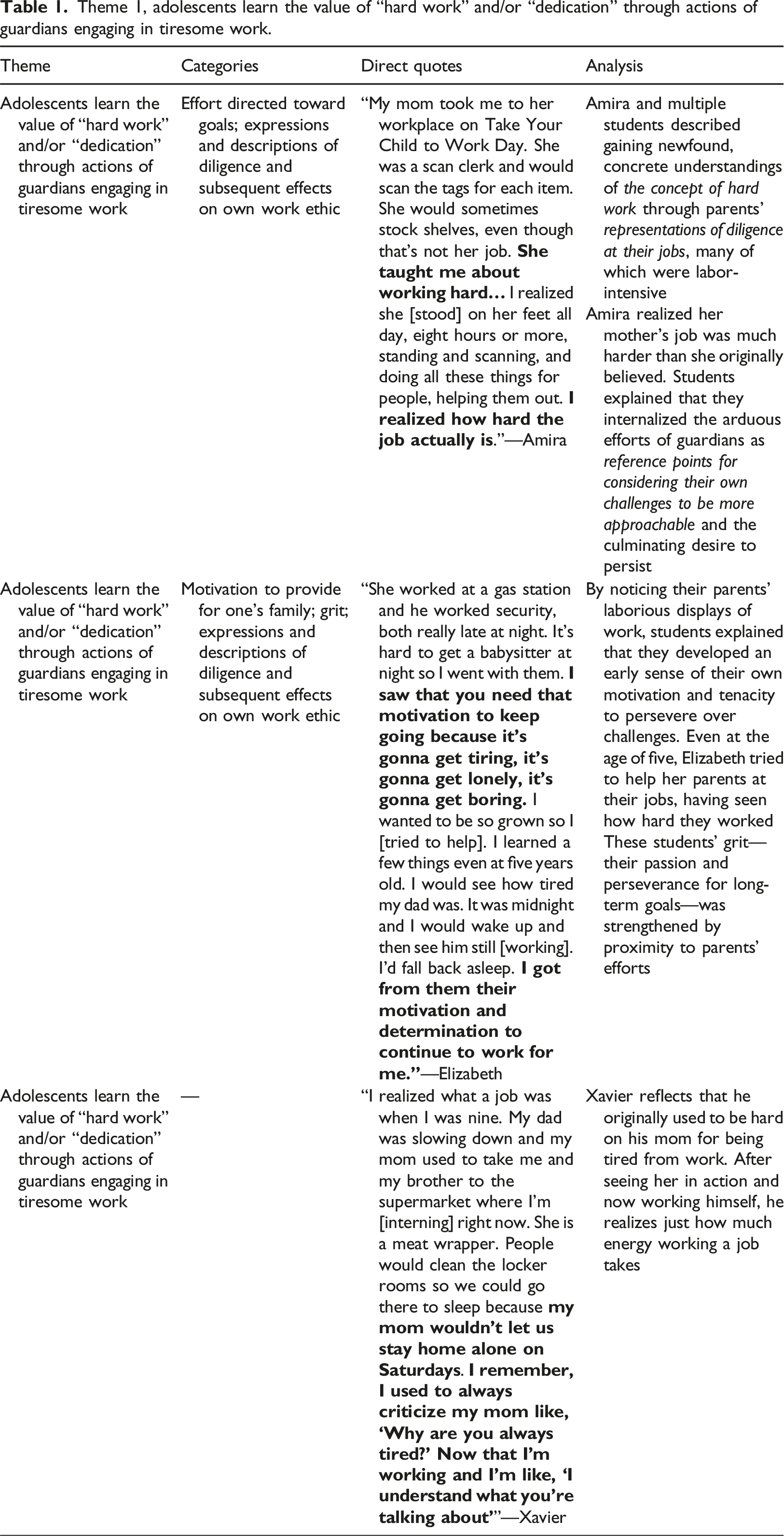
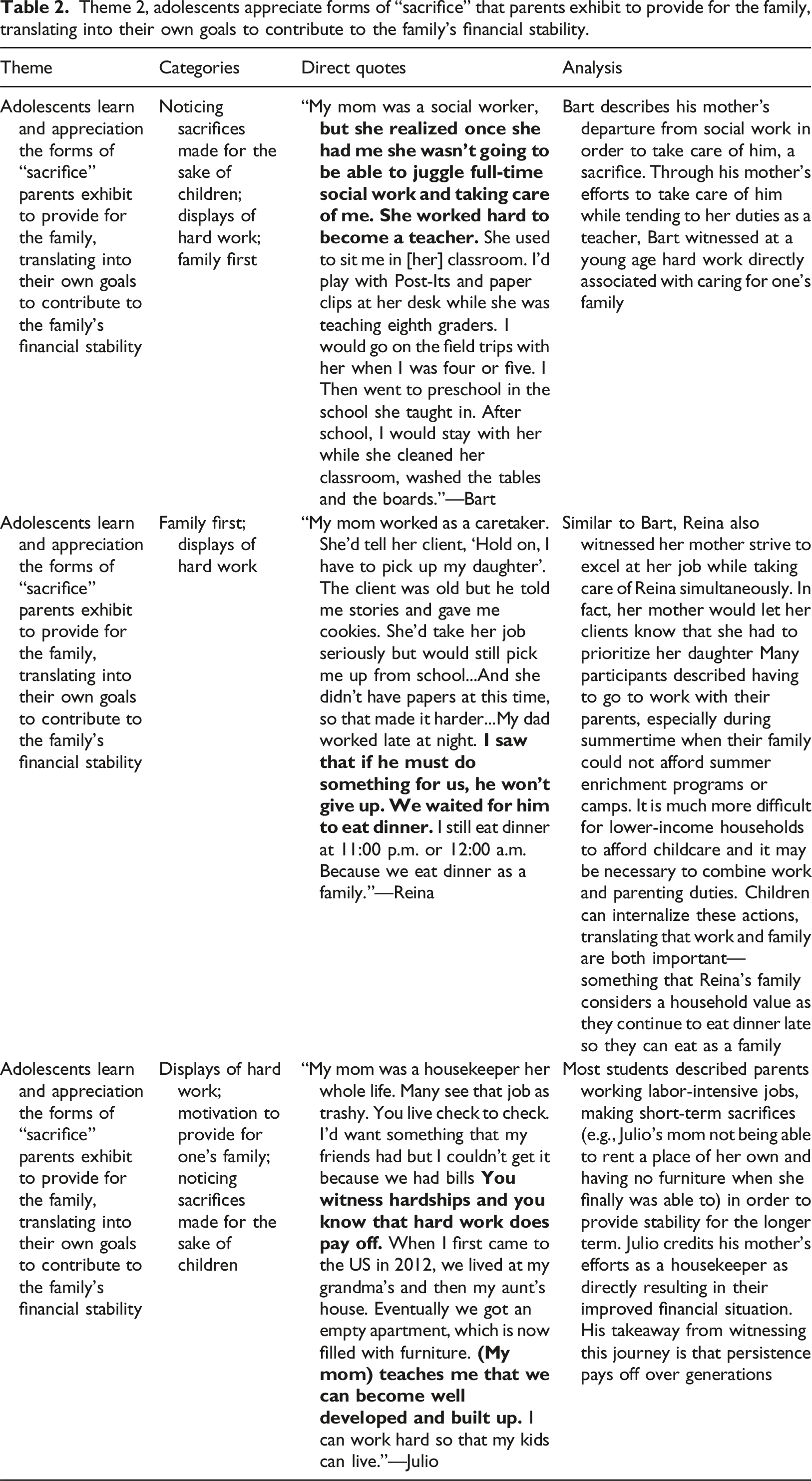
With the hopes of sharing more data in an accessible way, we present our first two themes in these tables below—content categorized in order from (1) the theme presented, (2) the categories that were used to inform the development of that theme (often reflective of the codes applied to the narrative in the analysis software), (3) a direct quote from a youth participant’s interview that supports the theme, and (4) some brief accompanying analysis. Our third theme, related to youth developing alternate forms of capital, emerged from situating these two themes in proximity to each other and stepping back to see a more holistic, bird’s-eye view.
Theme 1, adolescents learn the value of “hard work” and/or “dedication” through actions of guardians engaging in tiresome work.
Theme 2, adolescents appreciate forms of “sacrifice” that parents exhibit to provide for the family, translating into their own goals to contribute to the family’s financial stability.
Amira, Elizabeth, and Xavier implicitly and explicitly mention gleaning certain takeaways and perspective shifts, as well as gaining hard and soft skills, from observing their parents at work. Their narratives indicate that they also gained basic procedural knowledge that is useful to thriving in any workplace (e.g., learning that even scanning items or wrapping meat is important, challenging, and tiring; that one must occupy themselves in order to be more productive as well as pass the time). In these quotes, there is also an underlying message about the importance of collaboration and teamwork in the workplace; Amira shares a story about her mother taking on tasks that were not explicitly a part of her job, and Xavier recalls his mother’s coworkers cleaned the locker room for him and his brother to sleep in.
The interaction of these two themes, regarding displays of hard work and personifications of sacrifice, results in a broader narrative around how underrepresented adolescents can develop productive forms of cultural capital conducive to achieving in culturally standard or dominant environments. The “alternate” or distinct forms of capital that these young people acquire at home may not be commonly referenced in existing literature as critical to success, literature that emphasizes more middle-class and heterogeneous customs and norms as most transferrable to school or the workplace. For example, middle- and upper-class families rarely have to take their children to work with them because they lack other childcare options or work irregular hours or weekends—experiences that were common among our sample. As the student narratives illustrate, often these influences led our participating young people to develop flexibility, resourcefulness, optimism, and other character qualities that lead to long-term success.
In the data that supported our second theme, our participants discussed recognizing various sacrifices by their parents in order to provide. The stories and memories shared with us worked to challenge the existing concepts of “hardship” as something to pity. In fact, labor for the sake of providing for one’s family was framed as partially rewarding and part of nurturing. When youth participants recounted parents having to take them to work, they linked together the importance of working toward stability and caring for one’s family. They also gleaned the value of being resourceful and multitasking. Relatedly, many of our participants also explained that when they experience challenges at school or in their internships, they felt confident in their ability find solutions, ask for help, or locate resources to overcome what they faced.
We also believe it is a worthwhile exercise to critically nuance these themes by once again relying on what participants directly stated in focus groups. There was, in fact, a subtle and latent tension underlying these conversations as multiple young people expressed both immense gratitude for the upbringing their caretakers provided through hardship as well as an obvious desire to accomplish more than they were able to. At least five participants remarked about how hard their parents had to work (in labor-intensive jobs) to afford their children opportunities. These sentiments do not appear to be at odds with but are rather complementary to the message that young people want to succeed to make their parents’ hard work worthwhile as well as to make parents proud. They also highlight how youth can be simultaneously aware of the daily impacts of structural limitations while developing their own plans for the future.
Through their parents, our participants described assurance around learning that short-term sacrifices pay off in the long term. Our data and analysis confirm that minority youth from working-class backgrounds can and often do receive multiple, positive support from their guardians at home. In particular, the family contributions that stood out most were related to adolescents forming academic and occupational identities where hard work was valued as beneficial for the family. Though the parents mentioned likely provide what can be considered “alternative” forms of social and cultural capital to their children, their constant attention to and support of their children’s development can be connected to a child’s eventual success in “dominant” cultural contexts and their aspirations to be financially stable and contribute toward their family’s transcendence of intergenerational poverty.
Significance and discussion
High school student interns described receiving many positive benefits from their parents that appear directly associated to gaining forms of cultural capital that are necessary to succeed at work. Our analysis shows that certain forms of capital, those perhaps considered atypical, nontraditional, and distinct from those prevalently included in the literature on socialization and adolescent development, can in fact be very valuable in motivating young people and facilitating their goal development.
Our study confirms Ceballo et al.’s (2014) work that when children recognize their parents’ sacrifices, students are significantly more motivated to study and future work. When parents share their struggles with poverty, their children develop a stronger desire in the academic environment to, among other goals, give back to their parents and work very hard to escape poverty (Table 2, theme 2). Through in-depth interviews, we identified what Levine and Sutherland (2012) have said: parents can provide their children with career knowledge, skills, and attitudes. For example, the participants learned from their parents that hard work pays off. Participants highlighted that involvement in their parents’ work impacts their future careers, which confirmed Dumais and Ward (2010)’s idea that young people see something as simple as their parents working full time as a form of cultural capital. Our findings align with Yosso, 2005 primarily because we have evidence that cultural capital can take various forms and still beget rewards in dominant spaces. In conjunction with our major themes, we’ve identified the “alternative” or unique forms of capital these students gained at home and demonstrated that these are keys to their success. It’s clear that students from low-income families receive positive cultural and social capital from their parents related to their work, and we acknowledge that students from low-income families can apply these forms of capital to find their way in future career development
This conversation is indicative of the need for broader and more inclusive discourse around what cultural assets underrepresented students embody and have to offer to our dominant institutions in order to reshape them. The rarity of recognizing the varied contributions and influences of low-income parents, such as displaying a tireless work ethic, maintaining a positive disposition despite experiencing routine structural limitations, and demonstrating family-first mentalities and values, is perhaps more a function of our general-achievement ideology which inherently favors middle-class norms and customs as driving success. Neglecting to acknowledge the many positive and unique cultural and social capital resources and lessons that lower-income and minority students receive at home misses critical perspectives around identity formation, opportunity gaps, and how to support students who encounter them (Delpit, 2006; Kundu et al., 2022). Greater proximity to students’ realities is needed in order to be more culturally competent and understand the various structural obstacles encountered as well as the workarounds that families have been exercising for generations.
Most of the participants in this project have already become or will become first-generation college students by the time this article is published. They carry with them many lessons, skills, traits, traditions, and strategies for achieving from their families. These would be valuable to identify and chronicle in order to create more holistic supports for other students. Though there exist many pressures for minoritized, low-income, and marginalized youth to succeed, their parents’ examples have often helped them believe that effort begets rewards, in a sense continuing the traditions of the American Dream, despite experiencing more barriers than most. When the ultimate ends are to chart new and more stable courses for one’s family, as our participants have indicated learning from their guardians, no means are too little.
This paper broadens the concept of “family contribution” to champion for more inclusivity and celebration of student gifts and identities. Leveraging the underutilized, diverse talents of marginalized youth populations is conducive to their thriving in the rapidly changing global economic environment (Brown and Tannock, 2009; (Merisotis, 2016); Sukarieh and Tannock, 2014). We suggest that if policy-makers or leaders of Work-Based Learning programs in various institutional settings (schools, community colleges, universities, and workplaces) are able to better acknowledge the often-latent forms of capital and giftedness that youth from low-income backgrounds bring to the table, they can better tailor opportunities to serve and upskill a more diverse group of students. Often these programs seem to indicate that these students must learn wholly new codes of conduct to succeed, and we reject this premise. Inclusive practices can better strengthen underrepresented youths’ developing occupational identities and foster competencies beneficial to social mobility.
Footnotes
Acknowledgements
Much of our thematic findings came directly from the young people who participated in this study, and we appreciate them for their energy and time in sharing their stories with us.
Declaration of conflicting interests
The author(s) declared no potential conflicts of interest with respect to the research, authorship, and/or publication of this article.
Funding
The author(s) received no financial support for the research, authorship, and/or publication of this article.
