



Abstract
The disproportionality in the school workforce in England’s schools has drawn little interest from policymakers and education practitioners. This article addresses the noted gap in the literature and provides trends empirical evidence in England’s teachers workforce by ethnic background and its disproportionality when compared to the pupils they teach. Our main data source was the School Workforce Census, the largest and most comprehensive source of data on teachers available in England. It used the diversity gap and the teacher-student parity index, for comparing the proportions of teachers and students from different ethnic groups to gain an understanding of the demographic reality of today’s schools. The main findings of the research confirm without doubt the education system in England is characterised by ethnic disproportionality in the school teaching workforce and the ethnic background of the teaching staff does not mirror the profile of the pupils. The evidence clearly shows that there is a growing mismatch between the ethnic diversity of the pupil population and that of the teachers in their schools. This is detrimental to the growth and learning of students. Conclusions and policy implications are given in the final section of the research article.
Introduction
Education is seen by ethnic minority communities in the UK as a gateway for opportunity through which young people acquire skills, knowledge and experiences. Yet in the U.K and elsewhere, education is highly unequal and there is disproportionality in terms of opportunity when compared to their peers – White British pupils. Research evidence also shows that the ethnic gap between ethnic minority students and their teachers has become even more mismatched over time despite the increased number and proportion of minority teachers in schools (Demie and See. B.H, 2021; Ingersoll et al., 2021; Demie, 2019a, 2022a,b; Ingersoll et al., 2020; Villegas and Irvine, 2010). However, we would argue that those gains have been eclipsed by the rapid growth of the minority student population, and students from some minority backgrounds are underachieving leading to an achievement gap. One key factor that may contribute to underachievement and the parity gap may be disproportionality in the teaching workforce in England. To address these inequalities, we need more research that tackles racial inequality using empirical evidence and identifies effective responses to the challenges that give rise to unequal opportunities and outcomes.
Miller (2020, 2021, 2018) carried out pioneering work on race and school leadership. His research on Black Leaders matter (2018) evaluated the factors that contributed to black male school leaders' career progression within the teaching profession. He argued that ‘fewer BAME teachers in the leadership role in education and there are only 230 BAME teachers in over 24000 primary and secondary schools’ (Miller and Callender 2018: 183). He pointed out that ‘race discrimination /racial inequality is a factor in the progress of teachers of Black, Asian and minority ethnic heritage in England’. His research also looked at what works in tackling race inequality in school leadership and suggested the need for more anti-racial training for school leaders and teachers in schools (Miller, 2021).
Callender (1995:145) further looked into the causes of underachievement in Black children and pointed out ‘that, unlike their White peers, Black children experience a disproportionate amount of negative interaction in the day-to-day affairs of classroom life’. She highlighted the role of Black educators in multi-ethnic schools including their dual position in relation to the Black community and the educational establishment. Callender’s research (2021) also highlighted the absence of male teachers in primary schools and argued for the need for the teacher workforce to reflect the communities it serves as schools have become more ethnically diverse in the UK.
Demie’s research into the underachievement of BAME pupils in England shows the barriers and the challenges policymakers and schools face including the lack of BAME teachers that can serve as role model. He pointed out that the reasons for underachievement are wide-ranging and complex. ‘Within education literature recently four main schools related factors have emerged: ‘Headteachers poor leadership on equality issues, stereotyping; teachers’ low expectations; institutional racism, lack of diversity in the school workforce, exclusions, and failure of the national curriculum to reflect adequately the needs of a diverse and multi-ethnic society’ (Demie and Mclean 2017a: 3; Demie, 2021, 2022b). The overall evidence from the research suggests that Black achievement remains poor when compared to that of the White British (Demie and Mclean 2017a: 3; Demie 2021, 2022b). This underachievement of some ethnic minority students remains a concern and is an issue that policymakers and schools need to address. Demie’s research on what works in successful multicultural schools also suggests that it is not always doom and gloom and it is possible to tackle the underachievement of BAME pupils and narrow the gap nationally. The research identified many success factors and strategies which contributed to the raising achievement and tackling inequalities including: ‘Headteachers’ excellent leadership on diversity and equality issues; effective teaching and learning; use of a relevant inclusive curriculum; parental engagement, good link with the community and parents; a clear stand on racism; diversity in the school workforce; a celebration of cultural diversity; and effective use of pupil’s voice’ (see Demie, 2019a: 192); Demie and Mclean 2017b: 75)
This article builds on previous research in UK (see Miller, 2020, 2021, 2018; Demie, 2022b, 2021, 2019a, 2019b; Demie and Mclean 2017a, 2017b; Callender, 1995 and 2021) and provides empirical evidence and trends in the teaching workforce by ethnic background and its disproportionality when compared to their peers in the context of England. It uses the diversity gap and the Teacher-Student Parity Index, for comparing the proportions of teachers and students from different ethnic groups to gain an understanding of the demographic reality of today’s schools.
Why the need for diversifying the teacher workforce?
There is comprehensive research into the widespread concern into the complex determinants of teacher demand and supply in England and other countries (See et al., 2020, 2021; Morris et al., 2021; Tereshchenko et al., 2020; Ingersoll et al., 2021; Ingersoll et al., 2020; Ingersoll and May, 2011). In the USA, Ingersoll et al. (2021) has carried detailed research into the demographic transformation of the teaching work force. Previous literature also documented the need for increasing the diversity of the teaching profession. Although the lack of racial/ethnic diversity among teachers has drawn some empirical attention in both the USA and UK, from our literature review we also identified five major theoretical arguments for diversifying the teaching force (see for detail Ingersoll et al., 2020; Villegas and Irvine 2010; Goldhaber et al., 2019; Quintero and Hansen, 2017). These includes ‘teachers of colour serve as role models for all students; the potential of teachers of colour to improve the academic outcomes and school experiences of students of colour; and the workforce rationale’. (Villegas and Irvine 2010: 176).
The first theoretical argument in the literature focuses on ‘demographic parity’ for teachers of Black and ethnic minority role models (Clewell and Villegas, 1998; Villegas and Davis, 2008; Villegas and Lucas, 2004). This argument holds that teachers from ethnic minority groups are important as role models for students from all ethnic groups. The underlying thinking is that the racial and ethnic makeup of the teaching force should reflect that of the student population. With increasing ethnic diversity in schools there is a growing need for more teachers from ethnic groups as role models in schools (e.g. Demie and See, 2021; Demie 2019a; Villegas and Lucas, 2004; Clewell and Villegas 1998). Many researchers also argued for the need to emphasise the role that teachers of ethnic minority can play in helping students to strive for academic success by encouraging them to envision professional careers for themselves. A significant body of literature argues that a match between the race and ethnicity of teachers and students leads to better student outcomes, (e.g. Ogbu, 1992; Demie 2019a). It is particularly useful for those living and attending schools in disadvantaged settings. They benefit from seeing role models of their race in a position of authority (Adkintomide and Oluwatosin, 2011; Fordham and Ogbu, 1986; Villegas and Lucas, 2004). Cole (1986) also highlighted how ethnic minority teachers serve as role models for students of ethnic minorities. She argues that because Black and ethnic minority students often come from economically impoverished backgrounds and have limited access to teachers who are racially or ethnically similar to them to strive for academic and social success. Others also argued that the diversity of ethnic minority students have a benefit for White students to have an ethnically and linguistically diverse teaching workforce (Villegas and Irvine, 2010: 177). They highlighted that:
‘Seeing people of minority ethnic group in professional roles communicates to white students that adult of racial/ethnic minorities backgrounds are successful and contributing members of society.’
In summary, the role model factor argument for diversifying the teaching workforce is compelling and supported by other researchers. They argued one of the reasons ethnic minorities want to be a teacher is to serve as a role model for students of ethnic minorities (Ochoa 2007; Villegas and Irvine 2010).
The second major argument in support of increasing teacher diversity suggests that ethnic minority are uniquely positioned to promote learning for students of Black and Minority Ethnic background (BAME) because they bring to teaching their life experiences and cultural backgrounds of students (Villegas & Lucas, 2002). This argument builds on a view that students from ethnic groups benefit from being taught by teachers of similar cultural backgrounds. In general, compared to their white counterparts, minority teachers are more likely to understand many aspects of the lives of minority students (Callender, 1995, 2020; Miller, 2020, 2021; Miller and Endo, 2005; Quiocho and Rios, 2000). Other research also argued about the insight and personal contribution that BAME teachers have to ethnic inequalities which is useful for classroom teaching (Achinstein and Aguirre, 2008; Foster, 1993.) Researchers also noted that ethnic minority teachers challenge better ethnic minority students than their white peers ensuring that they engage and succeed academically (Demie, 2019b, 2022b; Foster, 1993). This is further supported by a growing number of empirical studies which show that having teachers from ethnic minority groups have a positive impact on various outcomes for students (for reviews, see Villegas and Irvine, 2010; Villegas and Lucas, 2004; Villegas et al., 2012).
The third major argument in support of increasing teacher diversity is that Black and ethnic minority teachers are more likely to have high expectations for ethnic minority students (Demie, 2022b, 2019a; Ferguson, 2003; McKown and Weinstein, 2008; Villegas and Irvine, 2010). This is important because students, especially Black students, appear to be more sensitive to teacher expectations (McKown and Weinstein, 2008; Demie, 2022a, 2022b). There is also evidence in the literature that White teachers allow negative stereotypes to lower expectations, which perpetuates poor performance of Black and ethnic minority students (Demie, 2019a; 2022b, 2021). Overall previous studies in Britain suggest that many White teachers hold lower expectations of black students compared to White British (see Demie, 2019a; Demie, 2022a, 2022b). Other studies also reported similar findings and argued that teachers’ low expectations were responsible for the underachievement in the USA for African American and Latino students compared to White European (McKown and Weinston, 2008). There are now studies that argue on the academic benefit of the use of a diversified multi-ethnic workforce in schools to reflect the school population. The evidence so far suggests that when the teacher workforce represents different ethnicities equitably, and when Black students were taught by a teacher from the same ethnic background, Black and Minority Ethnic (BAME) students do better (Demie 2019a; 2022b; Villegas and Irvine, 2010). Research conducted in the United States (Villegas and Irvine, 2010: 180) suggests teachers from minority backgrounds are particularly likely to: • ‘Have high expectations of the students • Use culturally relevant teaching (e.g. in terms of their use of language • Develop caring and trusting relationships with students • Confront issues of racism through teaching • Serve as advocates for their students, helping them understand and navigate cultural expectations, and • May be more willing than their white counterparts to work in schools with high ethnic minorities.’
The fourth argument concerns teacher shortages in schools with significant ethnic minorities located in disadvantaged areas. Teachers from ethnic groups are likely to be well-suited to teach students where a significant number of the school population are of an ethnic minority background. They are also committed to making a difference in the lives of disadvantaged students in inner city schools. Researchers in this field argue that such teachers are more likely than White British teachers to seek employment in schools serving racially diverse student populations, often in low-income, urban school districts (see Foster, 1997; Ladson-Billings, 1995; Quiocho and Rios, 2000; Demie and See, 2021). In addition, research in this area has shown that these schools disproportionately suffer from general teacher shortages and there is a need for diversification of the teaching force to tackle the problem of teacher shortages (Liu et al., 2008; See et al., 2021).
The fifth theoretical argument on the need in diversifying the teaching workforce related to the importance of cultural background of the students and the community school serves. It argues that teachers of different backgrounds are able to draw on their own cultural contexts when determining instructional strategies and interpreting students’ behaviour. A review of the literature suggests that Black students are more likely to be disciplined and suspended from school than other students (e.g. Demie 2019a, 2021, 2022a, 2022b). There are disparities in disciplinary actions that are based in part on teacher interpretation of student behaviour, and teachers' negative stereotypes (Demie, 2021, 2022a, 2022b). Equally research on school exclusions also suggests several ways that increasing the diversity of the teacher workforce improves outcomes for students of ethnic minority background (Demie, 2019a, 2022a).
In general, research on the effects of teacher diversity have found ethnic minority students do appear to benefit when they are taught by a teacher of the same race or ethnicity (Demie 2019a, 2022a, 2022b; Ingersoll et al., 2021; Tereshchenko et al., 2020; Villegas and Irvine, 2010). Much of the previous research also argues that attracting more minority teachers critical as it helps to meet the learning needs of an increasing proportion of the school population (Villegas and Irvine, 2010). In addition, as argued above it is widely believed that minority teachers can act as mentors and role models for minority students. Other international evidence also suggests that exposure to teachers from a similar race/ethnicity has the promising potential to help ethnic minority students attain greater educational success (Villegas and Irvine, 2010; Demie, 2019a). There is also evidence from these studies that increasing the proportion of minority teachers in schools can help raise their aspiration, tackle educational inequality and reducing school exclusion (Demie 2019a, 2022a, 2022b).
However, in countries such as the UK, little attention has been paid to using trend emperical data to develop policies for increasing the diversity in the ranks of teachers and school leaders. There is certainly a gap in the literature in the United Kingdom in terms of using school workforce data compared to the USA
The United Kingdom is an ethnically diverse society, and the population has changed in the last decade with decreasing proportion of White British and increasing representation of ethnic minority groups. The 2011 Census data show that the total population of England and Wales was 56.1 million (ONS, 2012). Of these 80.5% were White British followed by Asian ethnic groups 7.5%. Other White 4.4%, 3.3% Black, 2.2% Mixed and 1.0% Other ethnic groups (ONS, 2012). In 2019, White British made up 78.4% (a decline of 2 percentage points since 2011) and Other White increased to 5.8%. All other ethnic minority groups have also shown an increase (ONS, 2019).
For England, the school census data shows that the largest number of pupils in England’s schools in 2021 was White British (65%), followed by Asian (12%), White Other (7.5%), Mixed (6.4%), Black (5.7%), Other (2.1%) and unclassified (1.6%). While Black, Asian and ethnic minority student numbers now stand at 34.5% (DfE, 2021a).
Trends in Percentage of teachers by ethnic background in England schools 2005–2021.
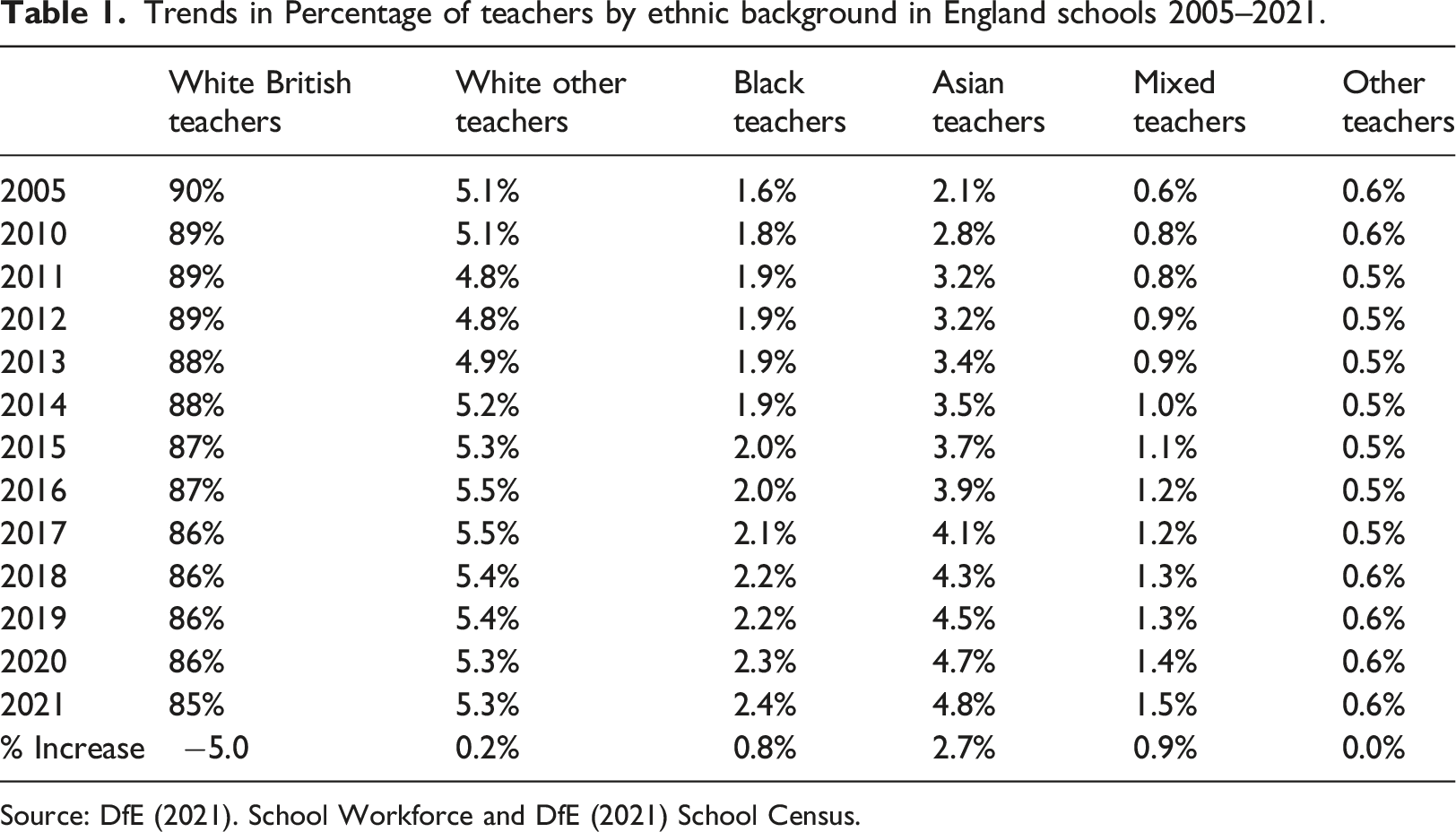
Source: DfE (2021). School Workforce and DfE (2021) School Census.
These shifting trends in teacher and pupil demographics have implications for the recruitment and retention of ethnic minority teachers. More importantly, they have a consequential effect on the attainment and socio-emotional outcomes of ethnic minority pupils for the reasons above. Additionally, Black and minority ethnic teachers bring different perspectives and life experiences, exposing children to cultural diversity, which reflect the languages, cultures and ethnic background of the local community and society at large. Staff of ethnic minority heritage should be represented across all schools and within the leadership team (regardless of the demographic of the school population) as this brings a rich cultural diversity to the school community and fosters better understanding and tolerance among different groups of children.
The disproportionality between ethnic minority teachers and White British, the main ethnic group in England, has been a big issue and debate in schools (Demie, 2019a, 2022b; Morgan and Scarlett, 2021; Kershaw, 2021; Adams, 2021; Tereshchenko et al., 2020). The need to diversify the teaching force has received national attention recently when some researchers, and educational leaders, put the spotlight on the clashing student-teacher demographics clearly evident at that time in schools (Adams, 2021; Demie 2019a; Demie and See, 2021).
There is now a general agreement among policymakers and practitioners on the need to have a teacher workforce that looks like England reflecting the diversity of the community the school serves. What is a concern for the research is that while the country’s population and students have grown and become more racially and ethnically diverse, the teaching force seems to have shown little change. Another serious concern and challenge for practitioners is that ethnic minority students in the primary, secondary and special schools increasingly lack role models, and they are not taught by teachers who understand their racial and cultural backgrounds. The ethnic minority teacher shortage is a major reason for the minority achievement gap and underachievement in schools. We would argue the disproportionality in the teaching workforce between White British and ethnic minority teachers in schools is a major issue for equal opportunities (for reviews, see Demie and See, 2021; Demie 2019a; 2022b; Morgan and Scarlett, 2021; Adams, 2021; Tereshchenko et al., 2020).
Methods
Building on previous research this study sought to address three research questions: 1. What do the trend data tell us about the demographic changes and growth of the number of ethnic minority students and teachers in England schools? 2. What do the trend data tell us about disproportionality in the ethnic minority and White British teaching workforce in England? 3. What are the implications for policy and practice and future research agenda?
This article is organised around the three major themes of on ethnic minority and White British teacher supply and demand. The second section of the article briefly describes our data and methodological approach for research. The third section of the article provides some context background data on England showing the trend in demographic changes in the ethnic minority and White British teaching workforce in England. The third section examines disproportionalities in the teaching workforce by ethnic background. The final section presents conclusions and implications for policy and research.
The data
This study uses data from the School Workforce Census to analyse the characteristics of the school teaching workforce. The school workforce census is an annual statutory data collection of the composition of the school workforce in all primary, secondary, and special maintained, academy and free schools in England. The census collects data on all teaching and support staff in regular employment. School must complete statutory censuses by law unless there’s a good reason not to.
This study uses ethnic group categories which are composed of one or more ethnicities as set out in Table 3. Throughout this study, the definitions of ethnic minority teachers and White British teachers are based on school census classifications of race/ethnicity in England. All ethnic group that are not White British are considered ethnic minorities in context of England. This includes as ethnic minorities any ethnic group that is White Other (including Irish), Black (Black Caribbean, Black African and Black Other), Asian (Indian, Bangladeshi, Pakistani, Chinese and Asian Other), Mixed(White and Asian, White and Black Caribbean, White and Black African, Mixed other) and Other(Any other ethnic group) (See DfE, 2021a).
In this research, changes over time and differences between regions are described in either terms of percentage point changes or a percentage change. Percentage point changes are the unit difference between two percentages as opposed to the ratio in which something has changed.
In this paper, we use the term disproportionality to refer to the overrepresentation or underrepresentation of ethnic minority pupils and teachers relative to the total population in the school and the national average.
Analysis
To analyse the shifting trends over time, we use a time-series analysis. We first look at how minority representation among teachers is measured. Research in teacher diversity usually uses ‘the diversity gap’, which is the most common way to quantify diversity among teachers. This has its own shortcomings and there are other better options to consider. In a number of studies, three alternative ways to measure diversity in the teacher workforce were considered. There is a belief that such a methodological approach is important to influence policymakers’ and practitioners’ priorities about where minority teachers are most needed.
One approach is the student-based diversity gap, which is the most common method used in this area of research. It is calculated by taking the difference between ethnic minorities among full-time state maintained schoolteachers from the minority students in the population. For example, if roughly 50% of students are ethnic minorities nationwide, compared to fewer than 20% of teachers the difference will produce a national diversity gap of roughly 30 percentage points. The intuition underlying this measure is that teachers should be as diverse as the students they serve.
The second approach is to use diversity gaps based on the adult population. Instead of comparing against students, this diversity gap is calculated as the difference between the ethnic minorities among the adult population aged 21–65 and the minorities among full-time public teachers.
The third approach is the student-teacher parity index which is a desirable measure that is more comparable across contexts. The index was developed by Villegas et al. (2012) to gain a more nuanced understanding of the racial/ethnic makeup of the teaching population which the standard diversity gap ignores. To address this issue of comparability, we use a student-teacher parity index calculated as the share of ethnic minority students to the share of ethnic minority teachers. The index for each racial/ethnic group is calculated by dividing the percentage of teachers from that group (in the overall teaching force) by the percentage of students from the same group (in the overall student population) for a given year. By design, then a value of 1.0 indicates parity in the proportion of teachers and students from the same racial group. This measure has been occasionally used in research and it helps us to explore opportunities for potential exposure between students and teachers, regardless of the size of the minority population in a region. It is important to note that this new measure is a ratio and no longer a gap.
Results
Changing trends in the ethnic minority teacher workforce and student population in England
Changes in the ethnic profile of the teacher and pupil population in England (2010/11–2021).
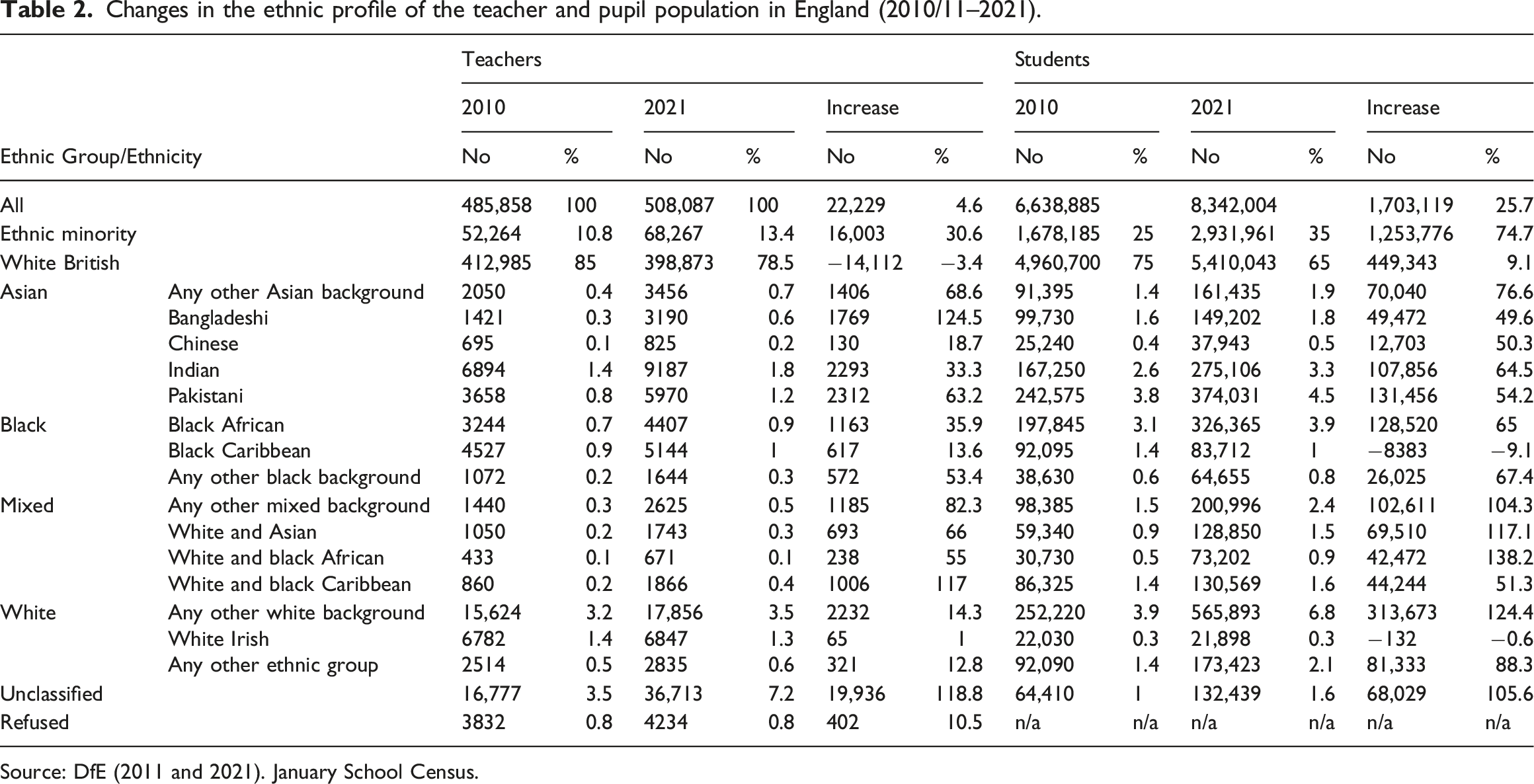
Source: DfE (2011 and 2021). January School Census.
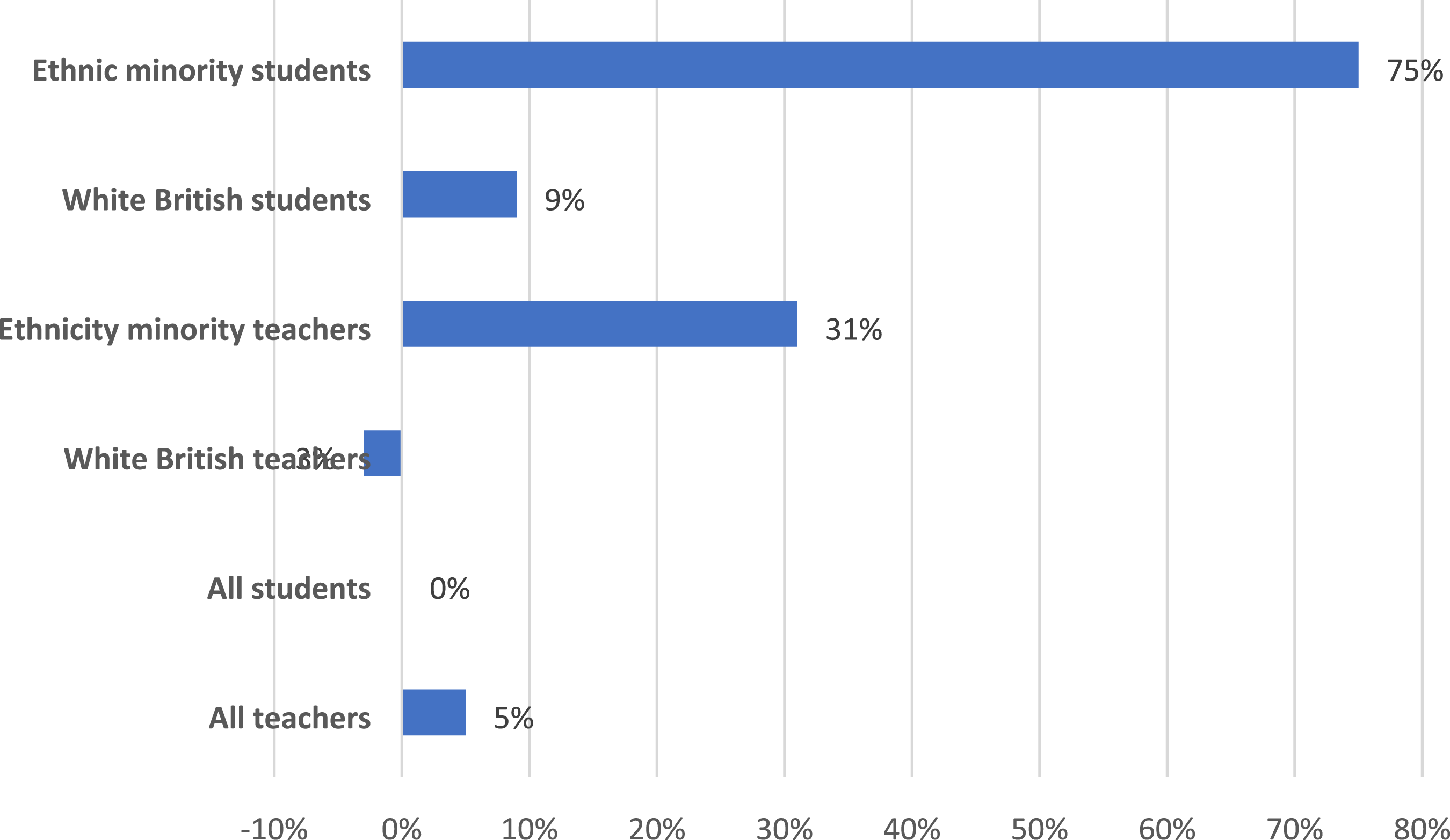
Percentage changes in White British and ethnic minority students and teachers between 2011 and 2021.
Although the number of minority ethnic teachers has increased, the number of ethnic minority students has increased at an even faster pace. Between 2011 and 2021, ethnic minority student population grew by a phenomenal 75%, while ethnic minority teachers increased by only 31%. It is clear that the increase in the number ethnic minority teachers has not kept pace with the growth in ethnic minority pupil population. Figure 2 shows the percentage change in student and teacher population by ethnic groups. Number of ethnic minority Teachers in England. Source: DfE (2021a). School Workforce.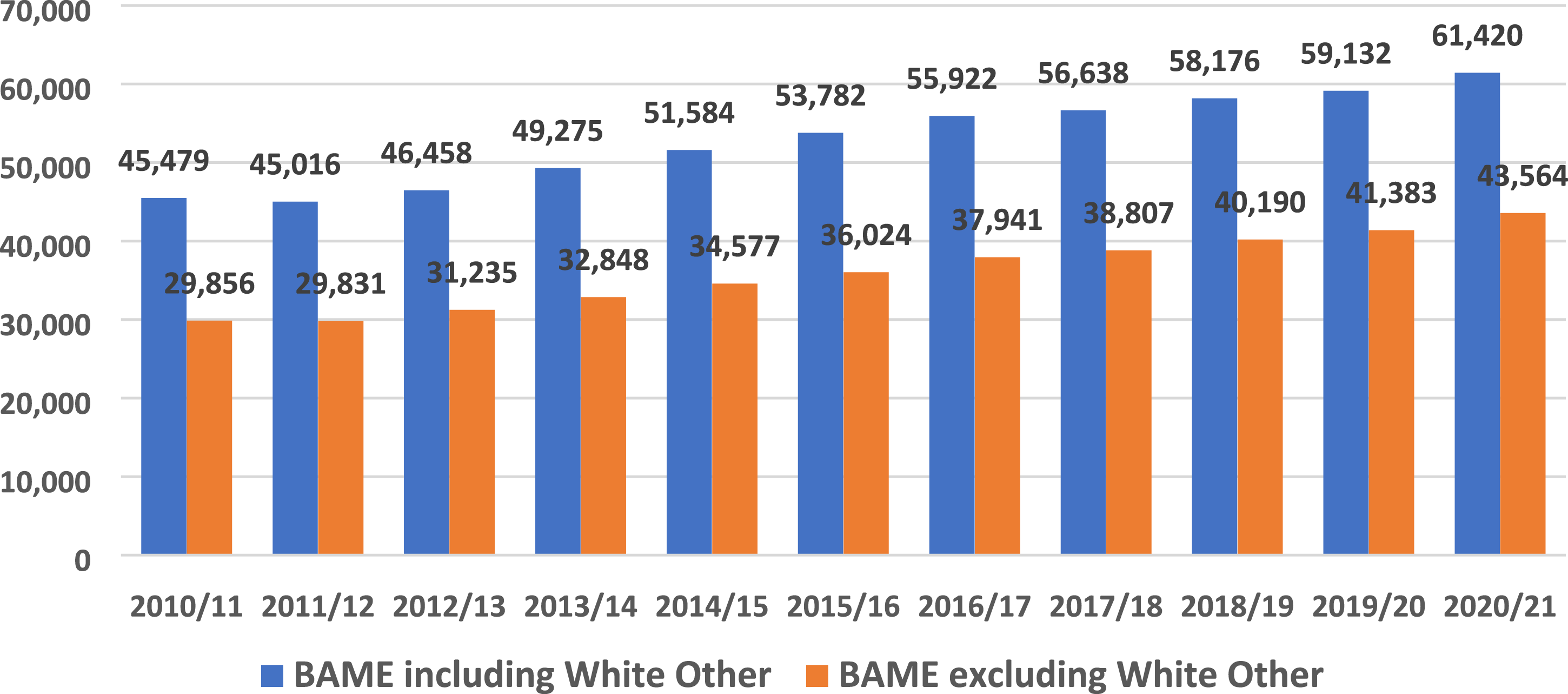
This widening of the ethnic minority student-teacher parity gap is a cause for concern for reasons outlined in our theoretical argument for greater diversity in the teaching workforce. These figures are warning signs of the increasing gap, which is growing. Policies to address the diversification of the teaching workforce are now urgently needed.
Comparing profile of the ethnic makeup of the ethnic minority teacher and student population in England
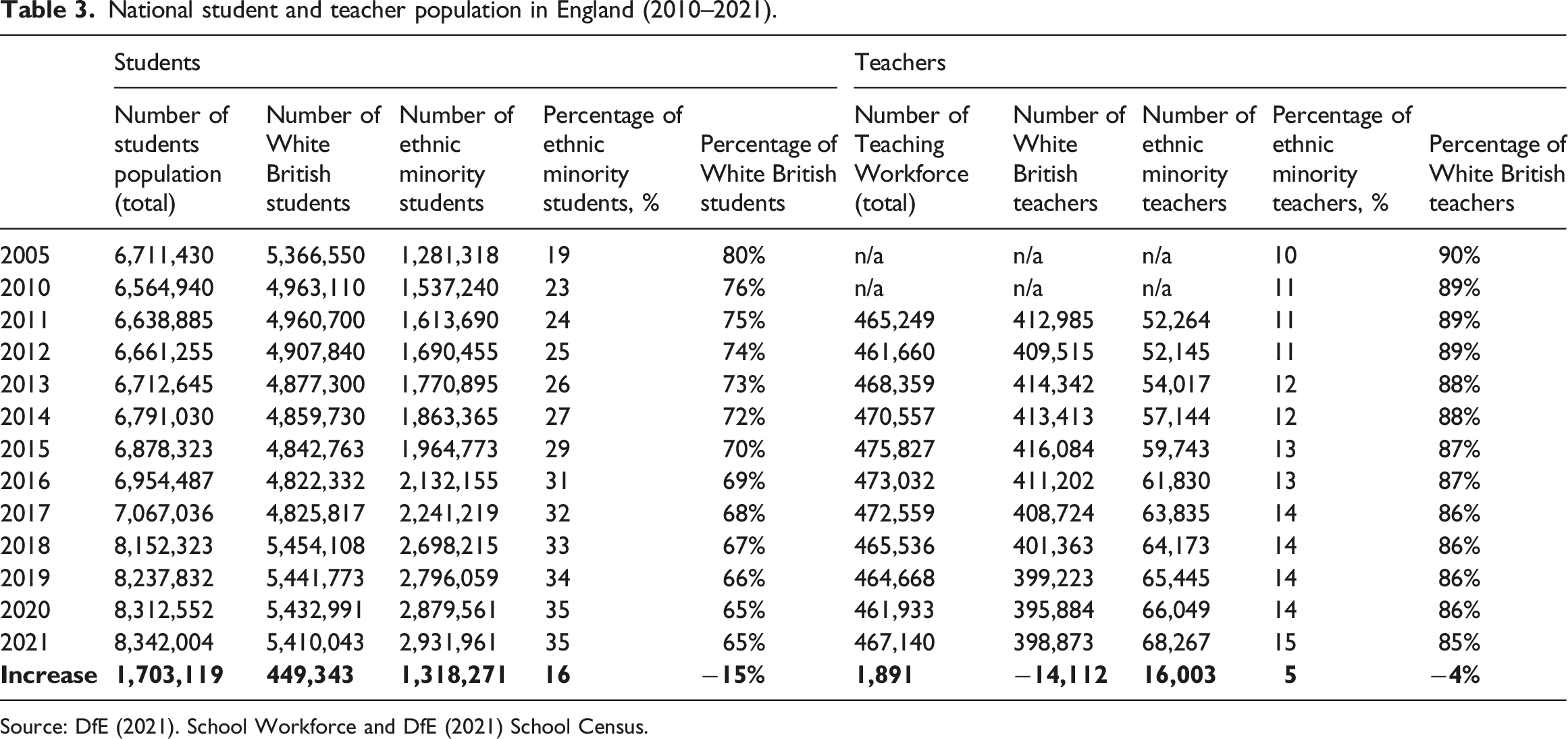
National student and teacher population in England (2010–2021).
Source: DfE (2021). School Workforce and DfE (2021) School Census.
Table 3 shows that the ethnic composition of the teacher population broadly represents that of the student population.
Among the group classified as ethnic minority, teachers from a White other background made up the largest group, making up 3.5% of the workforce in 2021 (Table 3). This was followed by Indian (1.8%), and then White Irish at 1.3%. It should be noted, however, that 8% of teachers did not specify their ethnicity.
The ethnic minority classification used is based on the DfE and ONS grouping approach. However, if we want to look at all White teachers Table 3 and Figure 2 show interesting evidence. The data suggest that there were 398,873 White British and 17,856 White Other teacher and 6847 White Irish which from the White overall categories in the school workforce. The BAME including White Other and White Irish based on national classifications and this forms 61,420 teachers but if White other is excluded from BAME the Black, Asian ethnic minority is reduced down to 48,564 teachers suggesting again White teachers dominate the teaching workforce in English schools. I would argue this is a concern as there are fewer Black or Asian teachers (Figure 2).
Figures 3 and 4 also compare the changes in student and teacher ethnic composition between 2010 and 2021. Between 2010 and 2021 the biggest student increase was recorded by those classified as mixed ethnicities, Other Asian and Other Black background. Among the other minority ethnic groups, Black African, Indian and Pakistani showed more than 50% increase (Figure 3). Similarly, in the same period there has been significant increase in the teacher population (see Figure 3). The group that shows the biggest increase is Bangladeshi (124%) followed by White and Black Caribbean (117%), mixed ethnicities, Pakistani (63%), Other Black (53%), White and Black African (55%). All the other groups showed less than 50% change. Change in teacher ethnic profile between 2011 and 2021 (%). Change in student ethnic profile between 2010 and 2021 (%). Source: DfE (2011a and 2021b). January School Census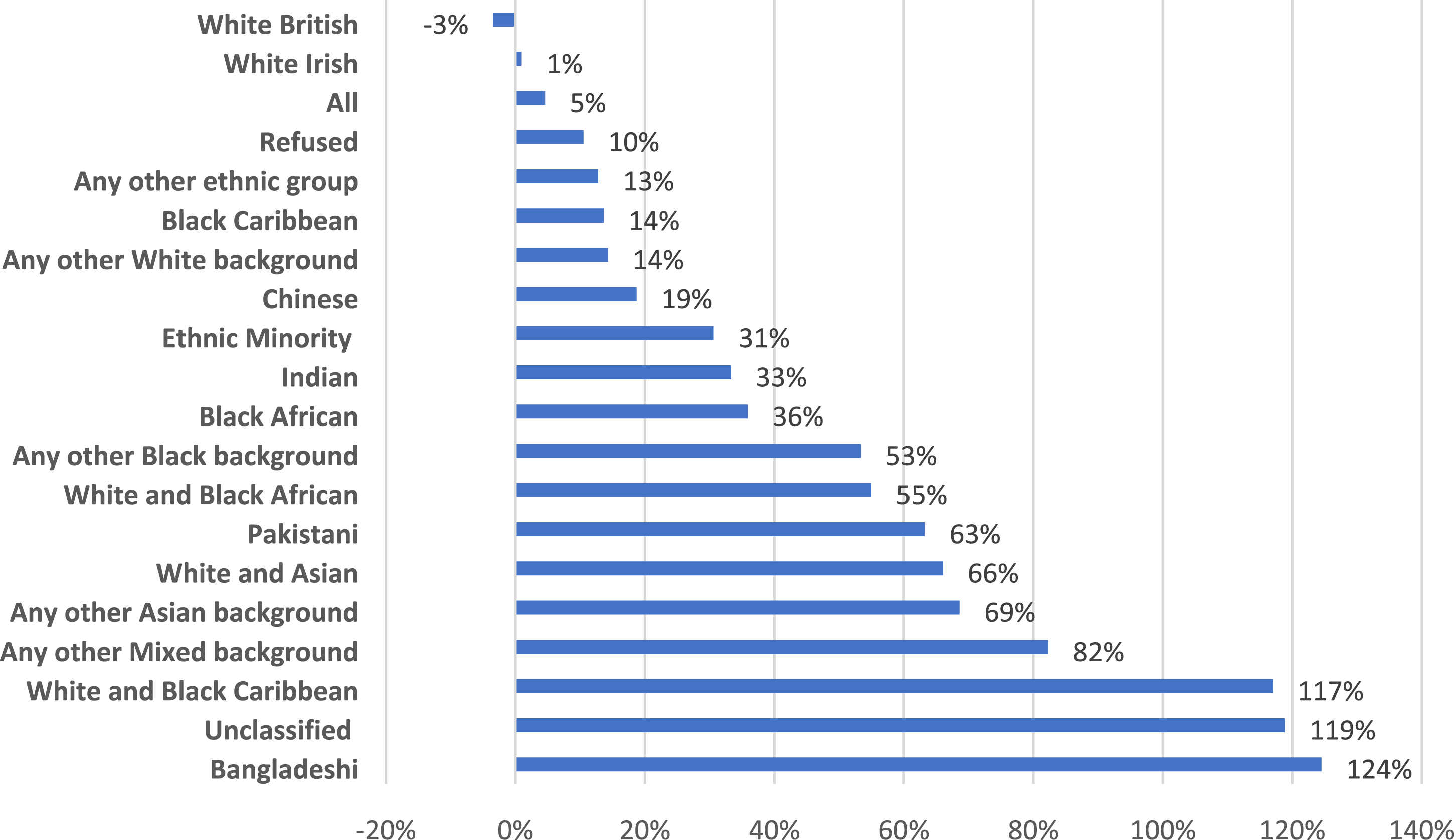
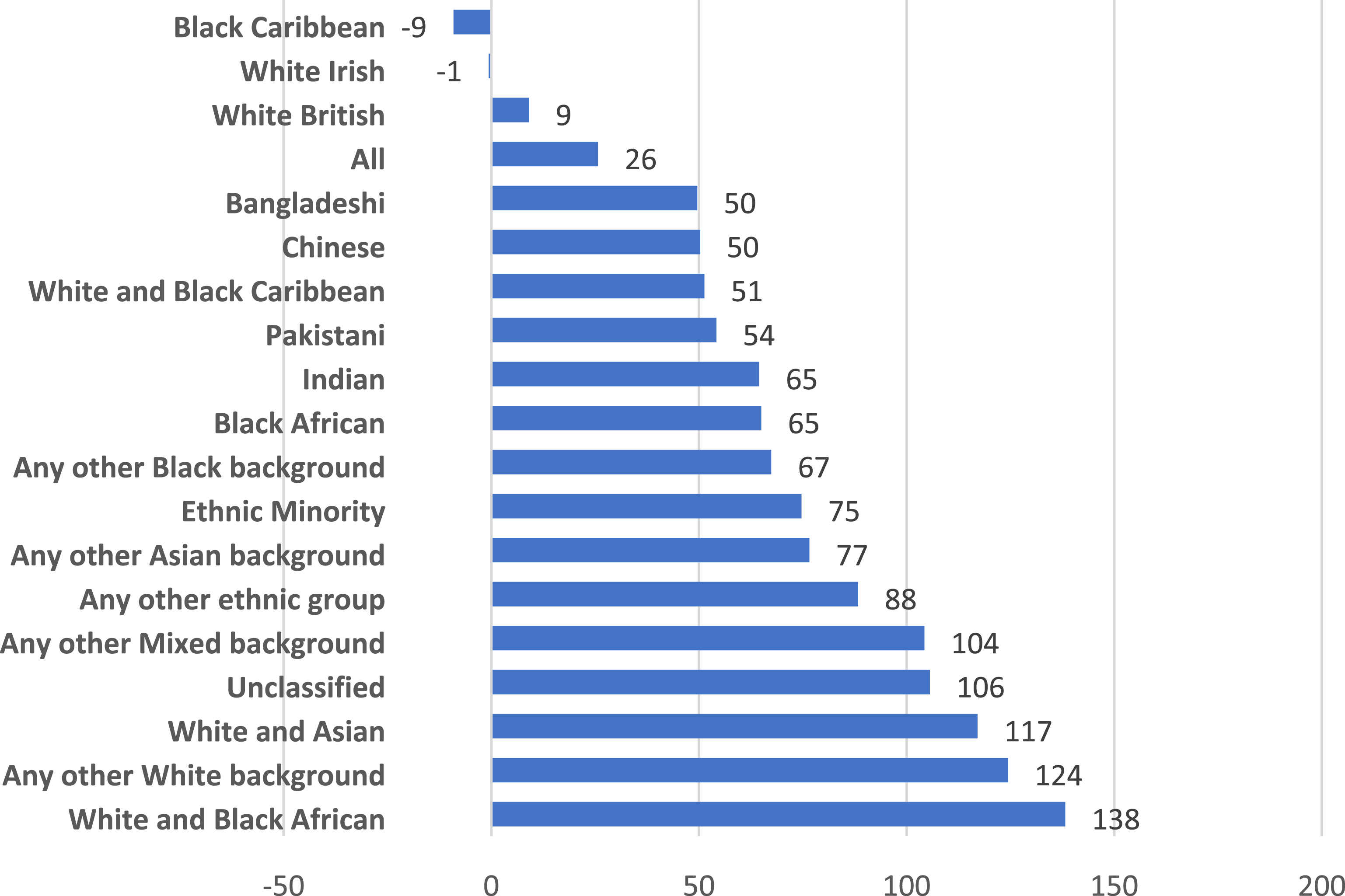
Similarly, Figure 4 shows that in the same period there has been significant increase in the student population. The student group that shows the biggest increase is White and Black African (138%) followed by Other White (124%), White and Asian (117%), Other Mixed group (104%), Other ethnic group (88%), Other Asian (77%), Other Black (65%), Black African and Indian (65%), Pakistani (54%), White and Black African (51%) and Chinese and Bangladeshi (50%)/White and Black Caribbean (117%), Pakistani (63%), Other Asian (69%), Other Mixed group(82%), White and Black African (55%) and Black African (36%). White British growth was 9% White Black Caribbean number in school gone down by 9%.
Disproportionality in the ethnic minority teaching workforce and ethnic minority students
Figure 5 shows the changing proportion of ethnic minority teachers and students from 2005 to 2021. Although the proportion of minority ethnic teachers has increased, it still lags behind that of the student population. Changing proportion of minority ethnic students and teachers.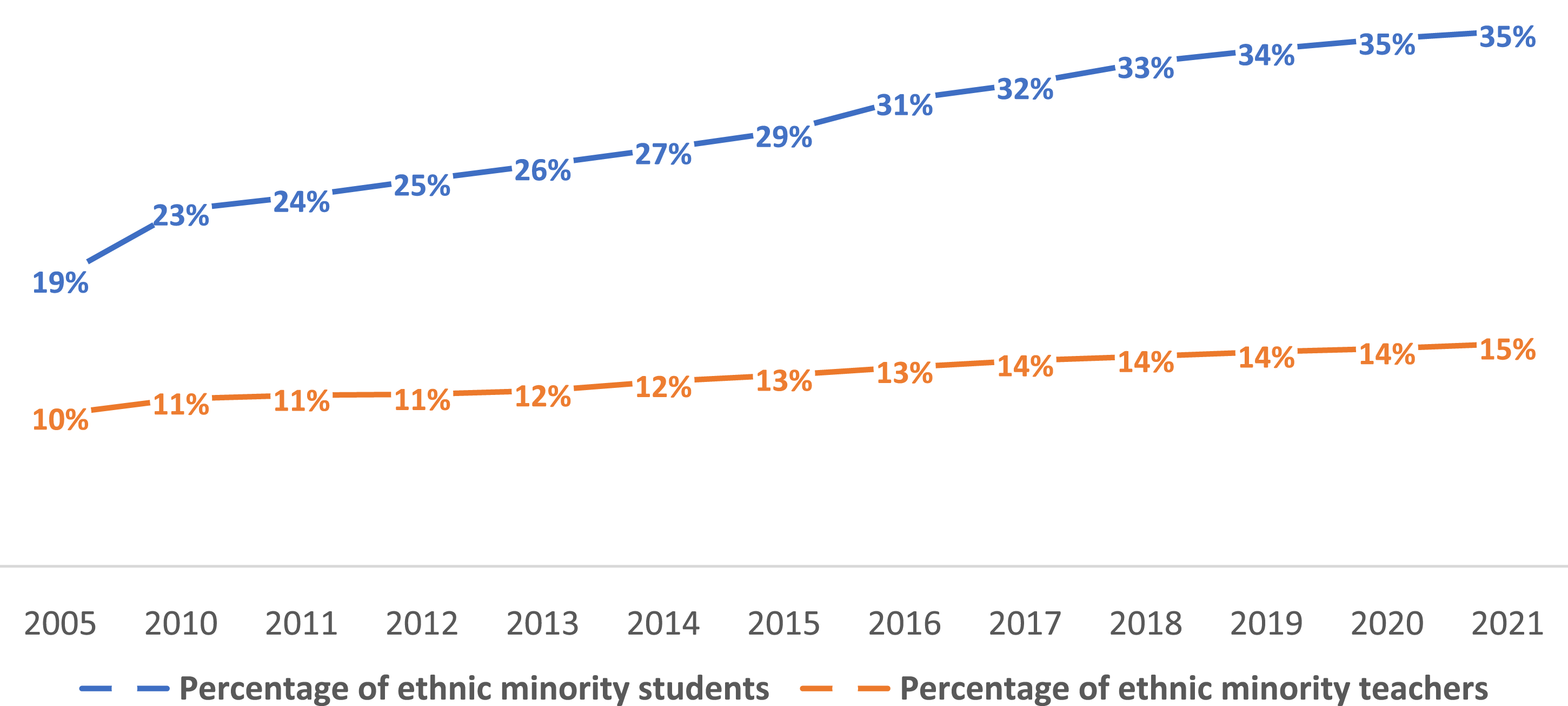
Figure 6 is a visual representation of the Student-Teacher Parity Indices for White and minority groups from 2005 to 2021. As shown, White teachers were overrepresented each year, with indices above the critical 1.0 level (from 1.1 to 1.3). For example, the 2021 index of 1.3 signals that the proportion of White teachers employed that year was 1.3 times that of White students. By contrast, minority teachers were consistently under-represented over time, with Parity Indices well below the decisive 1.0 level (in the range of 0.5 to 0.4). In 2021, the Student-Teacher Parity Index for ethnic minorities was 0.4, indicating that the state maintained schools employed only 40% of the total number of minority teachers needed to match the proportion of ethnic minority students (i.e. to reach the critical 1.0 level). Ethnic minority teachers and students were in fact slightly closer to proportional parity in 2010 (with an index of 0.5) than they were in 2021 (with a lower index of 0.4). Ethnic Parity Index.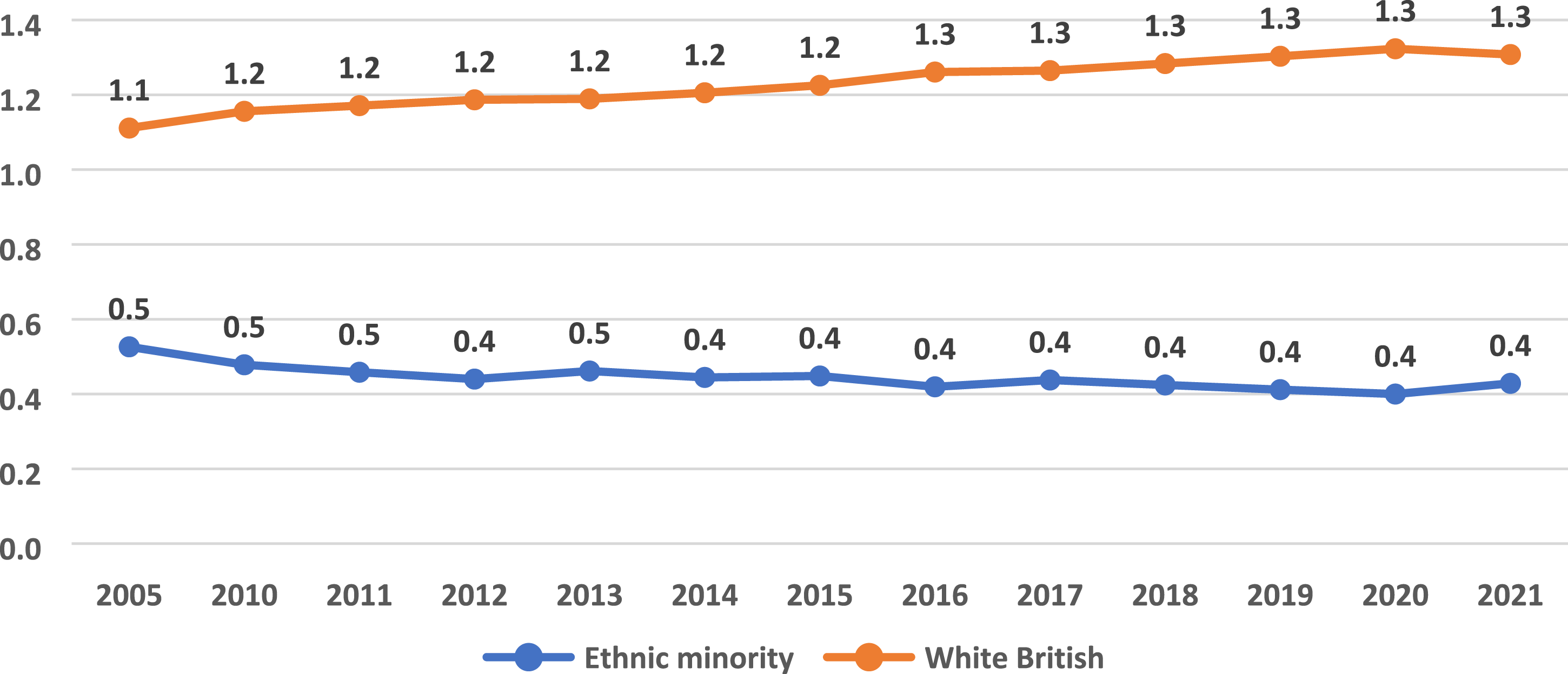
Disproportionality in the ethnic minority and White British teaching workforce by role
The schoolteacher workforce is made up of a variety of roles which can broadly be divided into Leadership – Headteachers, Assistant Headteachers and Deputy Headteachers and classroom teachers. We next examine how the different roles within the teaching workforce has changed in the last decade.
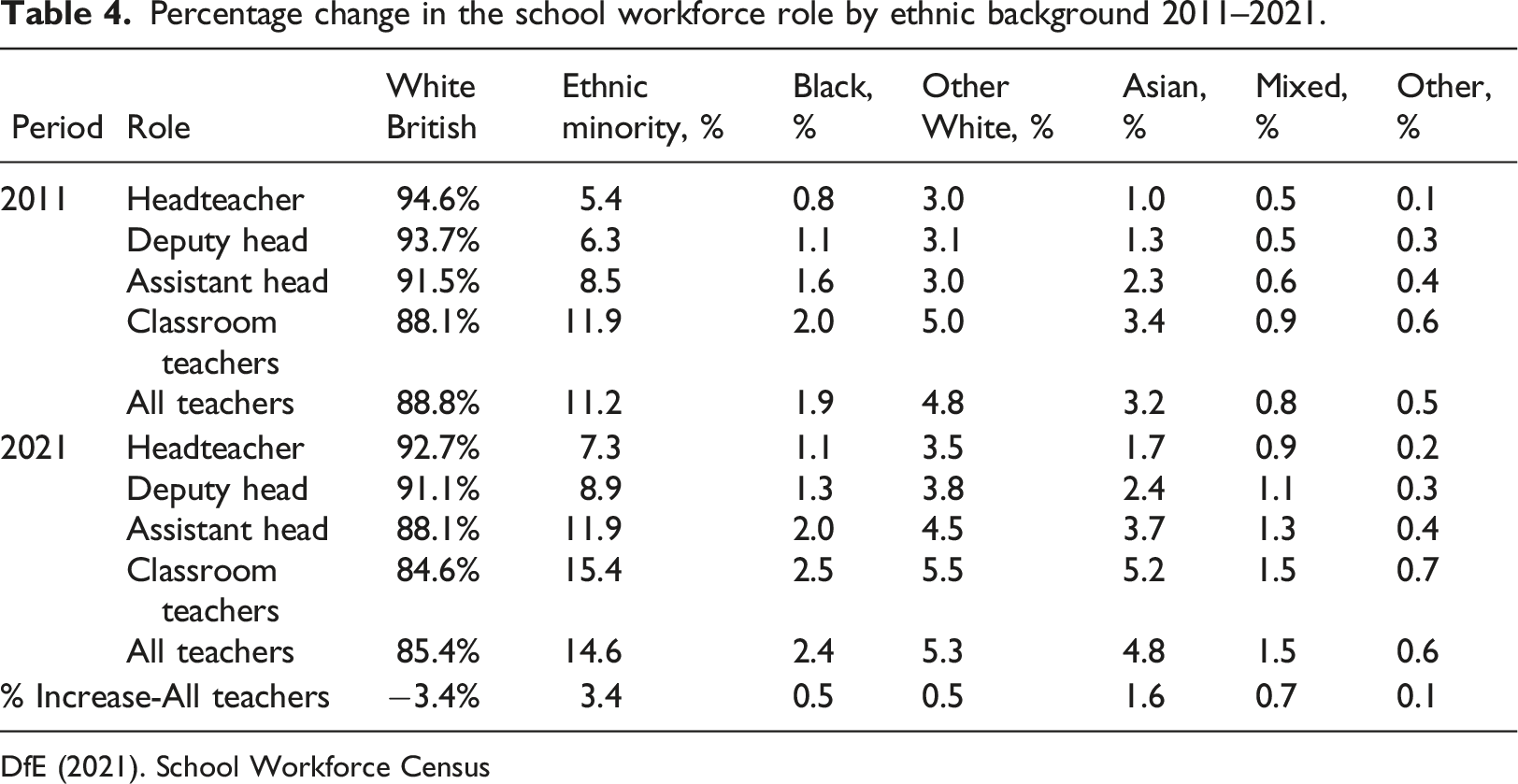
Percentage change in the school workforce role by ethnic background 2011–2021.
DfE (2021). School Workforce Census
Figure 7 shows that among White British teaching workforce, there has been a decline in the number across all roles from headteacher, classroom teacher and deputy head in the last 20 years, with the exception of Assistant Head. Among the minority ethnic workforce, there has been an increase across all roles, with the biggest growth in Assistant Head (+91%). Percentage change in ethnic minority and White British school teachers by role 2010–2021. DfE (2021a). School Workforce Census.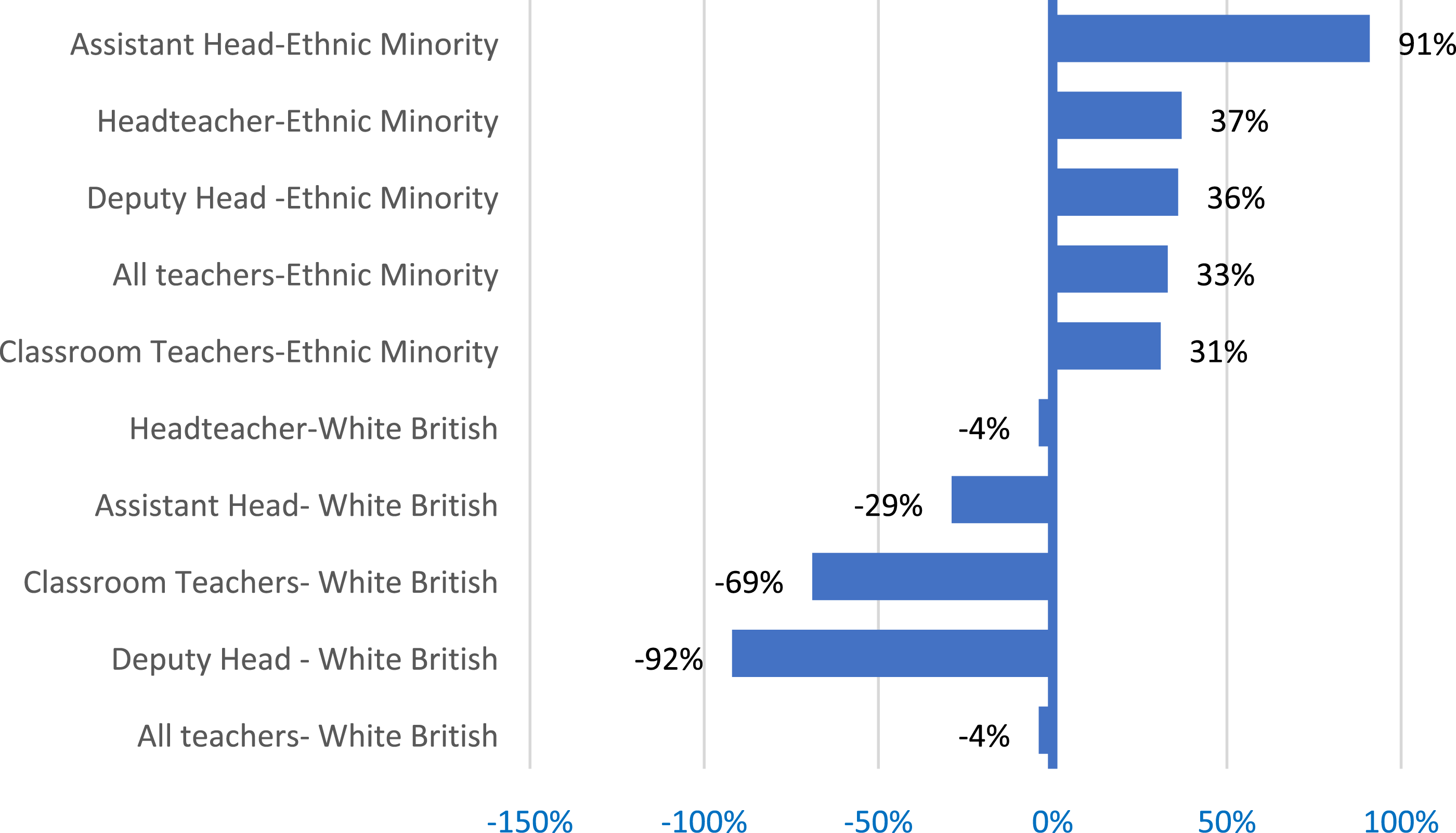
During this period, the number of White British teachers has gone down by 4% with a net loss of over 16,000 teachers, contrasting with an increase of over 17,000 teachers from an ethnic minority background, up 33% on the number in 2010 (Figure 6). What this shows is that although the teaching workforce is growing more diverse, the Student-Teacher parity gap for ethnic minorities is growing while that for White British is narrowing, suggesting that the increase in number of ethnic minority teachers is nowhere near enough to parallel that of the growth in minority ethnic student population.
Table 4 also show that among the minority ethnic groups, the biggest increase has been among Asian teachers across all roles, except for Assistant Head where the biggest growth has been among the Other White teachers.
The changing of the teaching workforce by regions in England (2011–2021)
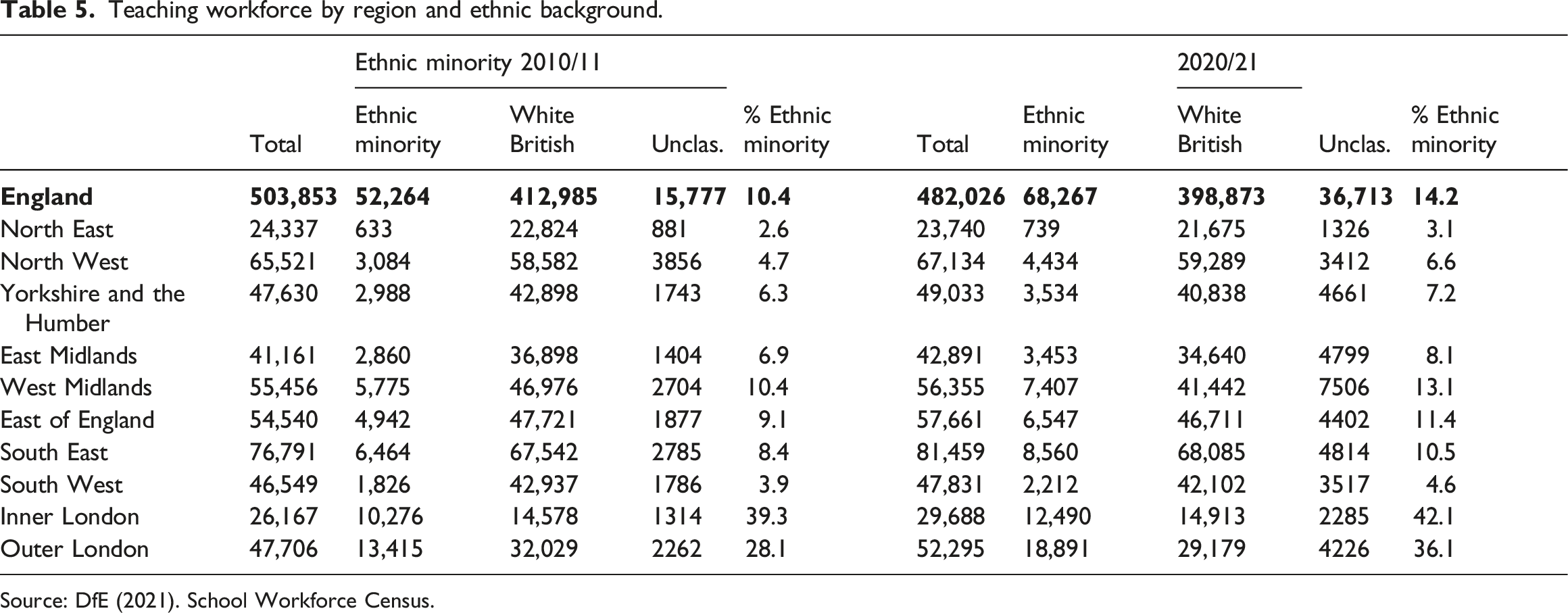
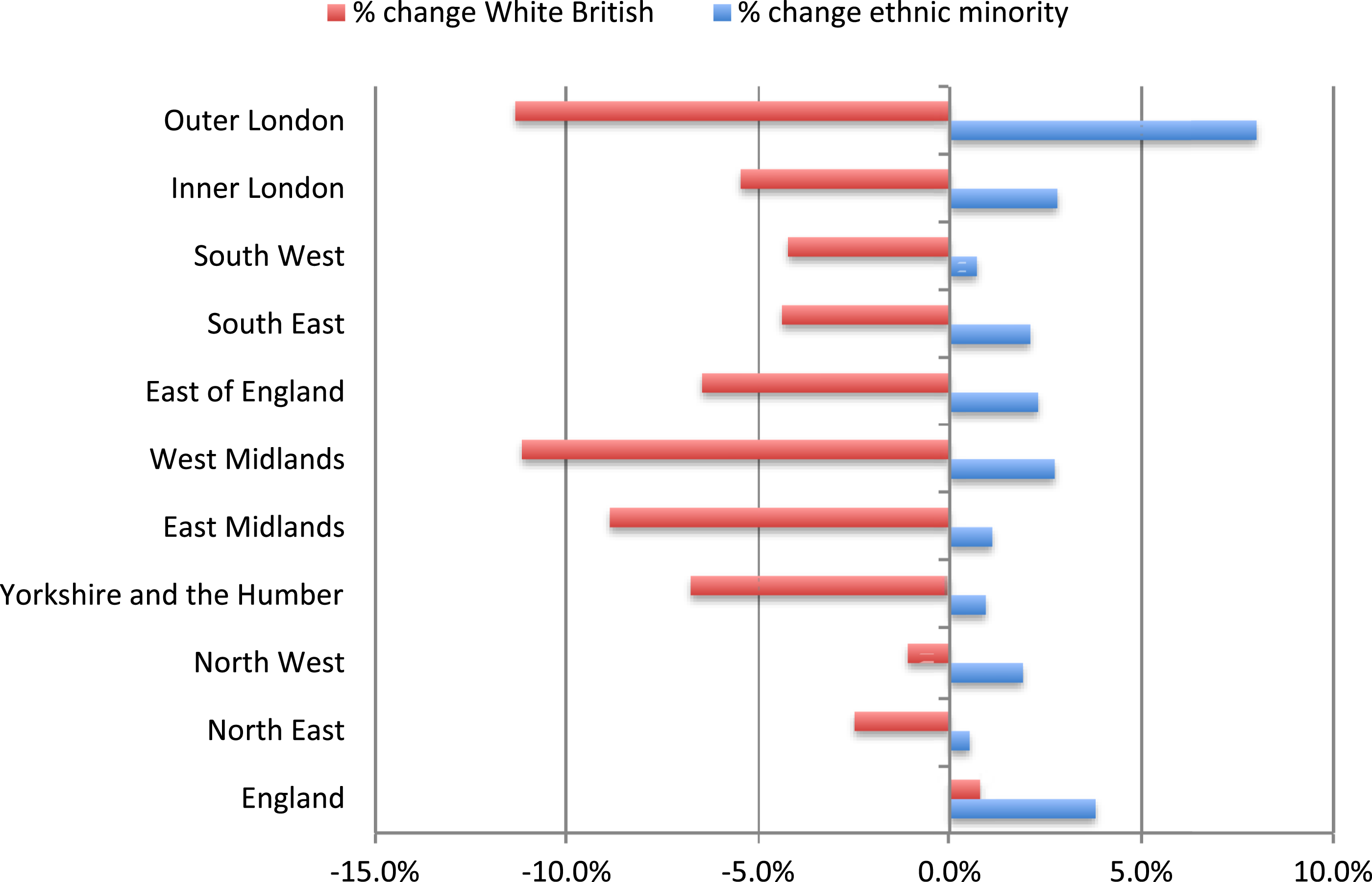
All regions across England have shown an increase in the proportion of minority ethnic teachers between 2011 and 2021, the biggest increase being in Outer London, perhaps reflecting the growing ethnic minority pupil population in the region (Figure 9). This trend indicates a growing diversity in the teaching workforce across all regions.
The data also show the highest proportion of teachers from ethnic minorities in all leadership roles was in Inner and Outer London, followed by the West Midlands. This shows a greater geographic spread of ethnic minorities. The pattern that headteachers are less diverse than senior leaders, who in turn are less diverse than middle leaders, is consistent across all regions (See DfE 2018).
Teaching workforce by region and ethnic background.
Source: DfE (2021). School Workforce Census.
Number of applicants to initial teacher training by ethnicity (England). Source: https://www.ucas.com/data-and-analysis/ucas-teacher-training-releases/ucas-teacher-training-end-cycle-2020-data-resources. Note: The White British group is on a different scale.
Disproportionality of applicants accepted to teacher training by ethnic background
As discussed earlier, the minority-ethnic Student-Teacher parity gap is widening (see Figure 6). One simple (not easy) way to close this gap is to increase the number of minority ethnic teachers. Looking at the latest UCAS (Universities and Colleges Admissions Service) data, the signs are positive with an increasing number of minority ethnic teachers applying to initial teacher training although the number of applicants for all groups has dropped in the last year (Figure 9). The group that made the biggest increase between 2014 and 2020 is the Other (+72%), followed by the Unknown (+62%), Mixed ethnicity (39%), Asian (+35%) and Black (+23%). There is a 4% drop in the number of White applicants. Changing composition of ethnic minority teachers by regions in England (2011–2021). Source: DfE (2021). School Workforce Census.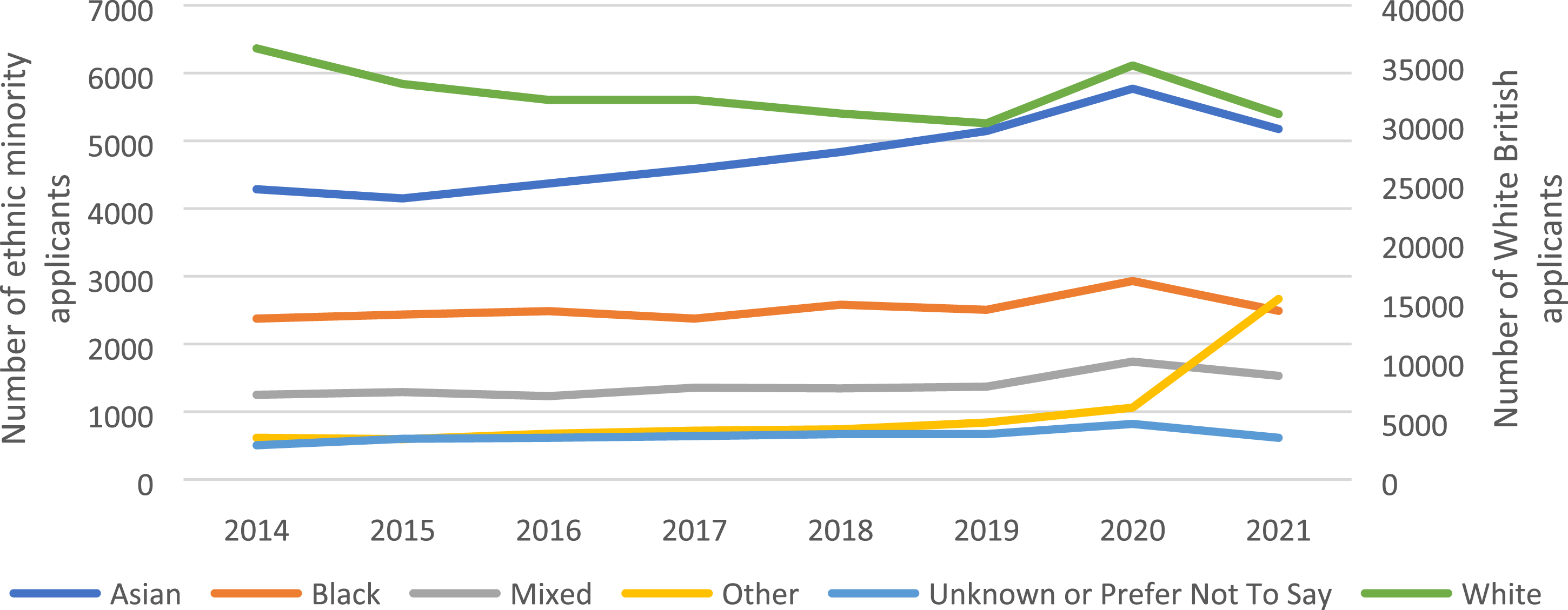
However, the data also show a striking disproportionality in acceptance rates between applicants from minority ethnic background and those that identified themselves as White (Figure 10). Although all ethnic groups have seen an increase in application (Figure 10), White applicants were the most likely to be accepted across all years. Applicants classed as Black and Other were the least likely to be accepted, with only under 50% accepted into initial teacher training across all years. Percentage of applicants accepted by ethnic groups (2014–2021). Source: https://www.ucas.com/data-and-analysis/ucas-teacher-training-releases/ucas-teacher-training-end-cycle-2020-data-resources.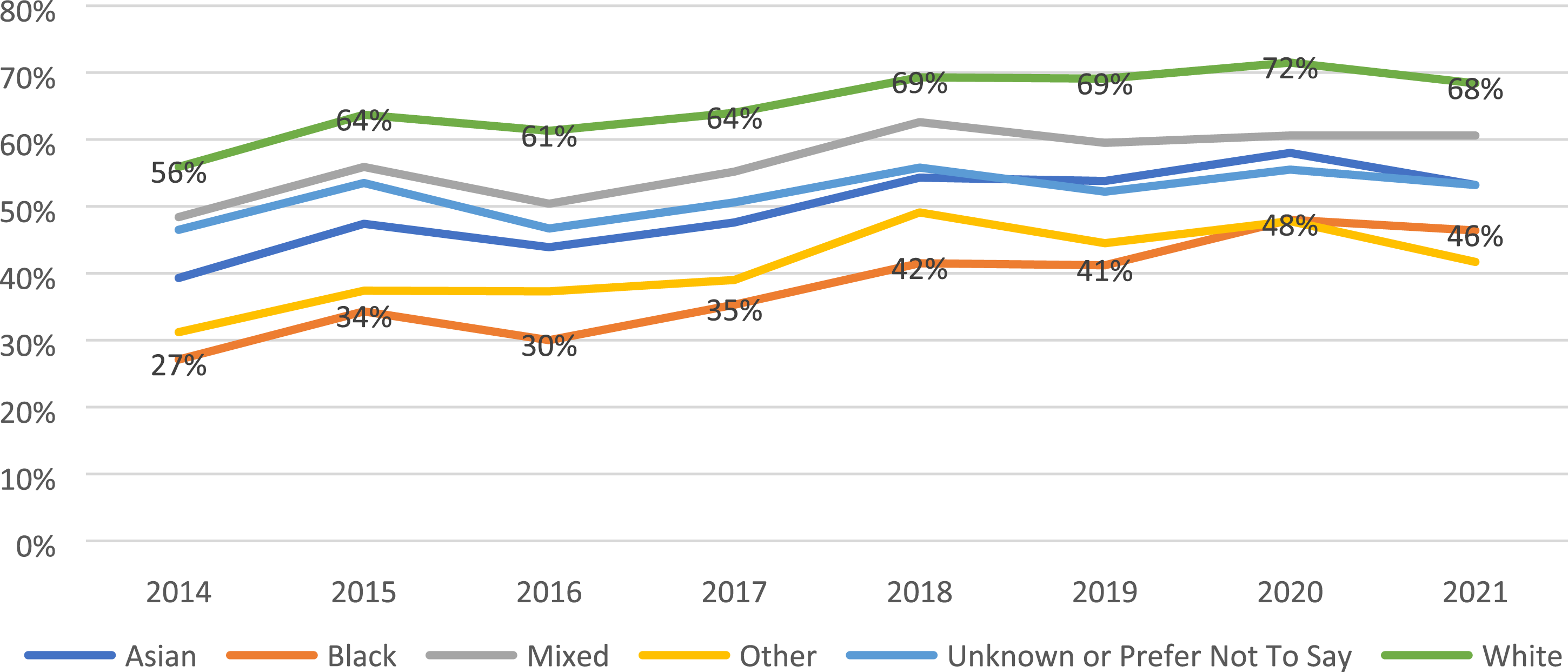
The above evidence about applicants accepted to ITT teacher training is further supported by recent research by the National Foundation for Educational Research (NFER) that highlights how applicants from White ethnic backgrounds have higher acceptance rates to ITT courses than every other ethnic group (Worth et al., 2022:Vii.) The study also found that:
‘Acceptance rates onto teacher training courses were 9 percentage points lower for applicants from mixed-ethnicity backgrounds, 13 percentage points lower for applicants from Asian backgrounds and 21 percentage points lower for applicants from black and other minority-ethnic backgrounds compared with acceptance rates for white applicants.’ This is despite the NFER data suggesting that teacher training applicants from Asian, black, and other minority-ethnic backgrounds are “over-represented” when they apply (
Worth et al., 2022
).
To increase the number of ethnic minority teachers and close the ethnic Student-Teacher disparity gap, we need to increase the acceptance rates of teachers from minority ethnic background. Such great disparities in acceptance into teacher training warrant further investigation. Could there be an unconscious bias among teacher training providers, is there an institutional discrimination or is it the case that minority applicants somehow fall short of the criteria required.
Discussion, conclusions and implications
Much has been written over the past two decades about the need for diversity in the teaching workforce in England. Yet, there is still persistent ethnic disproportionality in the teaching workforce with White British teachers being over-represented compared to the student population, while minority ethnic teachers are under-represented. A review of literature and data shows that the ethnic gap between ethnic minority students and their teachers has actually increased over the years in England (Demie and See, 2021). However, little attention has been given to racial and ethnic diversity in England’s teaching force. This article explored the importance of improving the diversity of the teaching workforce in England and addresses the noted gap in the literature. It provided detailed empirical evidence of the trends and disproportionality in the teaching workforce by ethnic background over time.
Our main data source was the schools' workforce census, the largest and most comprehensive source of data on teachers available in England. Three alternative methodological approaches were used to measure diversity in the teacher workforce. This includes measuring trends over time in terms of percentage point changes; diversity gap and the Teacher-Student Parity Index, for comparing the proportions of teachers and students from different ethnic groups to gain an understanding of the demographic reality in schools. The main findings of the research showed that the ethnic gap between ethnic minority students and their teachers has actually increased over the years and there continues to be a persistent racial-ethnic parity gap between the percentage of minority students and the percentage of minority teachers in England’s schools. It is clear from the empirical evidence that there is a growing mismatch between the degree of racial/ethnic diversity in the student population and the degree of diversity in the teaching workforce. This finding is supported by previous research that suggests a long-standing concern about the mismatch between the teacher workforce and student populations (Tereshchenko et al., 2020; Demie, 2019a). A number of other conclusions also can be made from the analysis of trend school census data in England:- Firstly, England is a multi-ethnic country where diversity plays a key role. The demographics of England’s school population are also changing dramatically due to increased birth rates of ethnic minorities and immigration from European communities and the Commonwealth countries, which were part of the old British empire. The evidence from the data also shows that although the large majority of the population identifies themselves as White British, there are significant populations that identify themselves as ethnic minorities. The national census data shows that 19.5% of the United Kingdom’s population identified themselves as belonging to minority ethnic groups, with the largest groups being Indian (2.5%), Pakistani (2.0%), Black Caribbean (1.1%), Black African (1.9%), Other White ethnic group (4.4%) and those of mixed backgrounds 2.2% (ONS, 2012). Similarly, the largest number of pupils in England’s schools in 2021 were White British (65%), followed by Asian (12%), White Other (7.5%), Mixed (6.4%), Black (5.7%), Other (2.1%) and unclassified (1.6%).
Secondly, the distribution of minority ethnic populations is not uniform across England, and this is reflected in the student and teacher population. Regional analysis shows that London had the greatest concentration of teachers from ethnic minority backgrounds (42% inner London and 36% in outer London compared to just 3.1% in the North East and 4.6% in the South West – the lowest). The imbalance between the ethnic minority population and teachers is troubling as the ethnic minority teachers can serve as exemplary role models for ethnic minority students, have the potential to be social change agents, and can positively impact student achievement in the changing English education system. Ethnic minority teachers also bring different perspectives and life experiences, exposing children to cultural diversity, which reflects the languages, cultures, and ethnic backgrounds of the local community and society at large.
Thirdly, there continues to be a persistent racial-ethnic parity gap between the percentage of minority students and the percentage of minority teachers in England’s schools. Although 35% of the student population is classed as minority ethnic (DfE, 2021a), only 15% of the teachers are from minority ethnic backgrounds, suggesting a significant student-teacher gap in England. This is evidence of an ethnic disparity in our teaching workforce. Our analysis of the data using the Student-Teacher Parity Index indicates that this gap is growing, suggesting that White British teachers were overrepresented while minority teachers were consistently underrepresented over time.
The disproportionality for ethnic minority teachers is most marked at the leadership level. The evidence points to racial inequality as ‘being an almost endemic problem at the leadership levels of teaching’. Those classed as White British people made up 93% of headteachers, 90% of deputy or assistant headteachers, and 85% of classroom teachers. Of the whole teaching workforce, only 7% of headteachers and 15% of the classroom teacher, were from an ethnic minority. The trend data also showed that the growth in the teaching workforce varied greatly across different ethnic subgroups. Staff from an Asian background saw the biggest in the last decade (an increase of 1.6%), followed by the group of Mixed ethnicities (+0.7%) and Black and White Other (+0.5%). It is important to note that there are small numbers of ethnic minority staff in senior leadership positions, suggesting a double-bind hurdle for ethnic minority staff to progress.
Finally, we would argue as concluding remarks teachers’ race and ethnicity do matter in the education of students of ethnic minorities. To foster a diverse and inclusive society, it is imperative that staff of ethnic minority heritage should be represented across all schools, regardless of the demography of the school population, as this brings a rich cultural diversity to the school community and fosters better understanding and tolerance among different groups of children. However, the review of the literature suggests that the issue of ethnic disproportionality has not attracted considerable attention in the United Kingdom. Although we also recognise the positive impact of a diverse teaching workforce, there have been no rigorous studies in England on how this could be achieved.
The overall conclusion from our analysis confirms that the education system in England is characterised by ethnic disproportionality in the school teaching workforce. Tackling the ethnic disproportionality gap and increasing the supply of ethnic minority teachers in schools in England should be now an education policy priority. Similar research findings were also reported from international studies in the United States of America (see Ingersoll et al., 2021; Ingersoll et al., 2020; Villegas and Irvine 2010).
Implications for policy and future research
The literature review and empirical evidence in this study show there is a disproportionally in the teaching workforce between White British and those from ethnic minorities backgrounds. It also supports the well-known argument in literature that improving the diversity of the teacher workforce would help in tackling racial inequality and closing the achievement gap between ethnic minorities and White British in England’s schools (Demie 2019; Villegas and Irvine, 2010; Villegas and Lucas, 2004; Villegas et al., 2012). However, it is important to note that the teacher workforce diversity is just one of many ways to improve the education system and there are many other ways also to tackle the issue through targeted interventions to challenge racism in schools. Another weakness that needs to be noted is the argument of the need to diversify the teacher workforce may present substantial challenges. One challenge as can be seen from the literature review and this study is that we know very little about what contributes to the lack of diversity in the teaching workforce. It is important policymakers and practitioners understand the answer to that question before we can design effective strategies to recruit more teachers of ethnic minorities. Another challenge argued by Goldhaber et al. (2019: 5) is that:
“While the empirical evidence is consistent with the four theoretical arguments about the importance of teacher workforce diversity discussed above, we don’t have conclusive evidence for why students of colour appear to benefit from assignment to a teacher of the same race.”
Our study also has other limitations. It has not looked into the many aspects of the school workforce. It is reasonable to conclude from the above discussion that little research has been done even in the area of why diversity matters. We would argue that diversity really matters to create a more inclusive and diverse school community that reflects the wider society. As far as we know from the literature review, there is little research on overall demographic changes and trends in the teaching workforce by the types of schools, different local authorities, and regions to improve our understanding of the scale and direction of these trends. In England, research into the recruitment and retention of ethnic minority teachers is also patchy (Tereshchenko et al., 2020). We also do not have research that identifies the barriers and good practices in developing recruitment and retention of ethnic minority teachers in England. Our research has not answered a number of research questions related to the school teaching workforce including • What are the demographic changes and trends in the teaching workforce over the period in the United Kingdom, by types of school, local authorities and regions? • What are the barriers and good practices to the recruitment and retention of minority ethnic school leaders and teachers? • How does the staff ethnic diversity influence the experience of ethnic minority and majority students?
There are also other limitations in the data used that require further research. The publicly available DfE (2021a, 2021b) and ONS (2012) school workforce data classify White other as ethnic minority while the teachers training data classify them as White. There is a problem with both national data categorisation suggesting, a clear requirement for further research into White Other ethnic category, which includes those speaking languages such as Polish, Albanian, German, Spanish, French, Portuguese, Italian, Romanian, Russian, Hungarian, Swedish, Turkish, Greek, Lithuanian etc. There is also a need for further research into all Whites and Black and Asian to gain a fuller picture in teaching workforce in the future.
We would argue that inequality in access in education will not end without detailed disaggregated ethnic data. The recommendations from our findings are that if any country is serious about racial inequality, they need to recognise first the importance of cultural, ethnic and linguistic diversity by collecting disaggregated ethnic data of teachers and all school students. We also need to ensure that the number of non-responses is minimised by making the school workforce data collection statutory in the same way as the national census.
There are in fact vast opportunities for research into the Black and ethnic minority teaching workforce. One could easily draw specific research projects in any of the fields mentioned above. There is no doubt that research initiatives will have recognition and would be also widely accepted.
This research only looked into ethnic disproportionality in the school workforce which has considerable importance in this area of research. The point that has been made in our research is that what has been done so far is just the beginning and there is a need for more research into the importance of teachers' diversity and what needs to be done to tackle ethnic disproportionality in English education.
Our findings provide empirical evidence of the growing disparity between the minority ethnic student and teacher workforce. Previous research has shown that ethnic disproportionality in the school workforce is an issue and students in general (not only those from minority ethnic backgrounds) would benefit from a more diverse teaching staff. Greater diversity and inclusivity in the teaching workforce are needed to reflect the increasing diversity in our population. Our analysis shows that this disproportionality is widening. There is therefore now an urgent need for policymakers to consider policies to increase the diversity of the teacher workforce as one of many strategies to improve the academic attainment of ethnic minority students.
Footnotes
Declaration of conflicting interests
The author(s) declared no potential conflicts of interest with respect to the research, authorship, and/or publication of this article.
Funding
The author(s) received no financial support for the research, authorship, and/or publication of this article.
