



Abstract
Translational products can help bridge the gap between research and practice by sharing scientific evidence in ways that non-academic audiences find accessible and useful. Here we present five translational design principles for dissemination of research evidence to public health practitioners and partners. The result of more than two decades of work in the development, production, revision, and continuous improvement of the Best Practices User Guides and supplemental reports, we illustrate the principles here using Tobacco Where You Live: Native Communities, a guide for tobacco prevention and control for American Indian and Alaska Native groups and their public health partners. The team developed the translational design principles through a multi-phase process: (1) conducting a multi-state evaluation and national advisory workgroup to identify translational features for communicating evidence, (2) applying findings to develop a set of translational products, CDC’s Best Practices User Guides and Tobacco Where You Live Supplements, and (3) evaluating product quality through a national survey. Users find the evidence-based guides helpful, easy to understand, and actionable. The five principles contend that translational products should: (1) stem from evidence-informed sources, (2) include actionable information, (3) have a modular structure, (4) use language for an understandable delivery, and (5) come in accessible formats. Though the User Guides and the example here address tobacco use, researchers and practitioners can use the translational design principles to communicate evidence for various public health challenges and opportunities. Broad applications of the principles can help to increase intervention fidelity and the impact of public health evidence.
New research evidence is too slow to reach those who can best use it in public health. 1 Products from science and academia intended for public health practitioners are rarely designed in ways that are actionable or useful on the ground. While researchers prefer to disseminate findings through peer-reviewed journals, less than half of local and state health department staff favor academic journals as sources of recent evidence. 2 A critical step to address this gap is to increase public health research dissemination of translational products that share evidence in ways that non-academic audiences find accessible and useful. Guidance on product development remains relatively limited and is fragmented across disciplines. 3 Wider application of research translation best practices is unlikely among academic researchers without a straightforward framework that is adaptable to a wide range of research areas.
The translational design principles are the result of more than two decades of work for the development, production, revision, and continuous improvement of the Best Practices User Guides and Tobacco Where You Live Supplements. More specifically, we began in 2001 by conducting a multi-state evaluation on the usefulness of the existing Best Practices for Comprehensive Tobacco Control Programs. We convened an expert advisory workgroup to identify key translational features for communicating evidence, applied findings to the development of new guidelines, and evaluated their quality and usefulness through an online survey of tobacco control practitioners. Though we developed them for creation of the User Guides aimed at tobacco control program managers in U.S. states and territories, the principles are useful for many types of researchers and their public health partners on the ground to address diverse public health challenges. What follows is a brief explanation of each of the principles and a use case example.
The Translational Design Principles
The principles illustrate that translational products should (1) stem from evidence-informed sources, (2) include actionable information, (3) have a modular structure, (4) use language for an understandable delivery, and (5) come in accessible formats. Too often, a crucial dimension is absent, and the research does not lead to action—for example, the source is evidence-informed, but the information lacks actionable implementation guidance. Similarly, information may be actionable but delivered using technical language that is not understandable to non-specialist audiences or in a format not accessible for all users. More information about each principle follows. A condensed, one-page explanation of the principles is available in the online supplement.
Evidence-Informed Sources
Evidence-informed products integrate the best available science and research with local knowledge and lived experience of community health issues and resources. 4 Diverse partners and community members are an important source of local context in translational product development to ensure products are understandable, relevant, and credible.
Actionable Information
Actionable products provide relevant implementation guidance alongside supporting resources. Pairing implementation guidance with evidence can help ensure fidelity, or the degree to which an intervention is delivered as intended. 2 Giving discrete steps helps users imagine themselves doing the behavior, which increases the likelihood of uptake and makes guidance more useful for organizations or communities with fewer resources. 3 Practitioners have also repeatedly noted the importance of tailoring materials to the local context. Giving practitioners a clear call to action, the flexibility to choose from multiple implementation strategies, and hyperlinks to additional implementation resources can also facilitate action.5,6
Modular Structure
Modular products, whether in print or on the web, organize content into sections or parts that can stand alone. This enables quick access to information and facilitates sharing with team members, partners, and community members based on roles or interests. Organizational elements such as headings, tables of contents, and bullet points capture readers’ attention and help them follow and process text more easily. Formatting content into sections and consistently using these organizing aids can help users, including different team or coalition members with different responsibilities and interests, quickly identify relevant information and compare potential strategies. 7
Understandable Delivery
Understandable products use plain language and are designed to deliver information that is easy for the audience to comprehend. Simplifying language by using everyday words and short sentences removes barriers for readers and improves information processing, retention, and persuasiveness. 3 These strategies improve comprehension even among stronger readers. Technical jargon may decrease the likelihood that the audience will accept and use the product. Keeping products short can help users understand and remember the material. Design elements like graphics and white space also make products easier to understand. Graphics add meaning to text, improve comprehension, aid memory, and improve users’ intentions of and action on incorporating recommendations into practice. 8
Accessible Formats
Accessible products follow US Section 508 accessibility standards to accommodate users with a wide range of abilities. 9 High color contrast and careful font choice enhance readability and increase users’ likelihood of taking recommended actions. Designing documents with an easily navigable structure, designated styles, and hierarchical headings that can be used with assistive devices can further reduce barriers to use. Including alternative text for graphics makes them accessible to those using screen readers.
Feedback
We surveyed tobacco control staff across the U.S in 2019. Ninety-seven practitioners responded (30% of 328 invitations), including tobacco control and chronic disease staff from 85% of the 50 states and 9 territories. Over 95% of respondents agreed that the products contained evidence (100%) that was understandable (99%), actionable (99%), and modular (96%) such that individual sections could be shared for specific purposes or with partners in diverse roles. We assessed accessibility separately using the US Department of Health and Human Services' guidelines on accessibility. 9
Tobacco Where You Live – Native Communities: A Use Case Example
Nine User Guides have been published to provide evidence and implementation guidance for topics covered in the Best Practices for Comprehensive Tobacco Control Programs, CDC’s guiding document for funding and administering state tobacco control programs. Topics covered in the User Guides include coalitions, youth engagement, health equity, program infrastructure, health communications, and cessation. Additionally, in 2022, the team published three User Guide supplements as part of the new Tobacco Where You Live series: Native Communities, Mapping Techniques, and Retail Strategies to Promote Health Equity. The goal of Tobacco Where You Live Supplements is to empower tobacco control program managers, staff, and partners to understand community needs, overcome challenges, and reduce inequities. Figure 1 depicts a sample page from Tobacco Where You Live: Native Communities. The excerpt illustrates how the translational design principles can help researchers and practitioners communicate evidence for public health practice. Interested users can access all the User Guides at https://www.cdc.gov/tobacco/php/state-and-community-work/guides-for-states.html. Translational design principles in action. Sample page illustrating how the translational design principles can help researchers and practitioners communicate evidence for public health practice. Source: Tobacco Where You Live: Native Communities Supplement.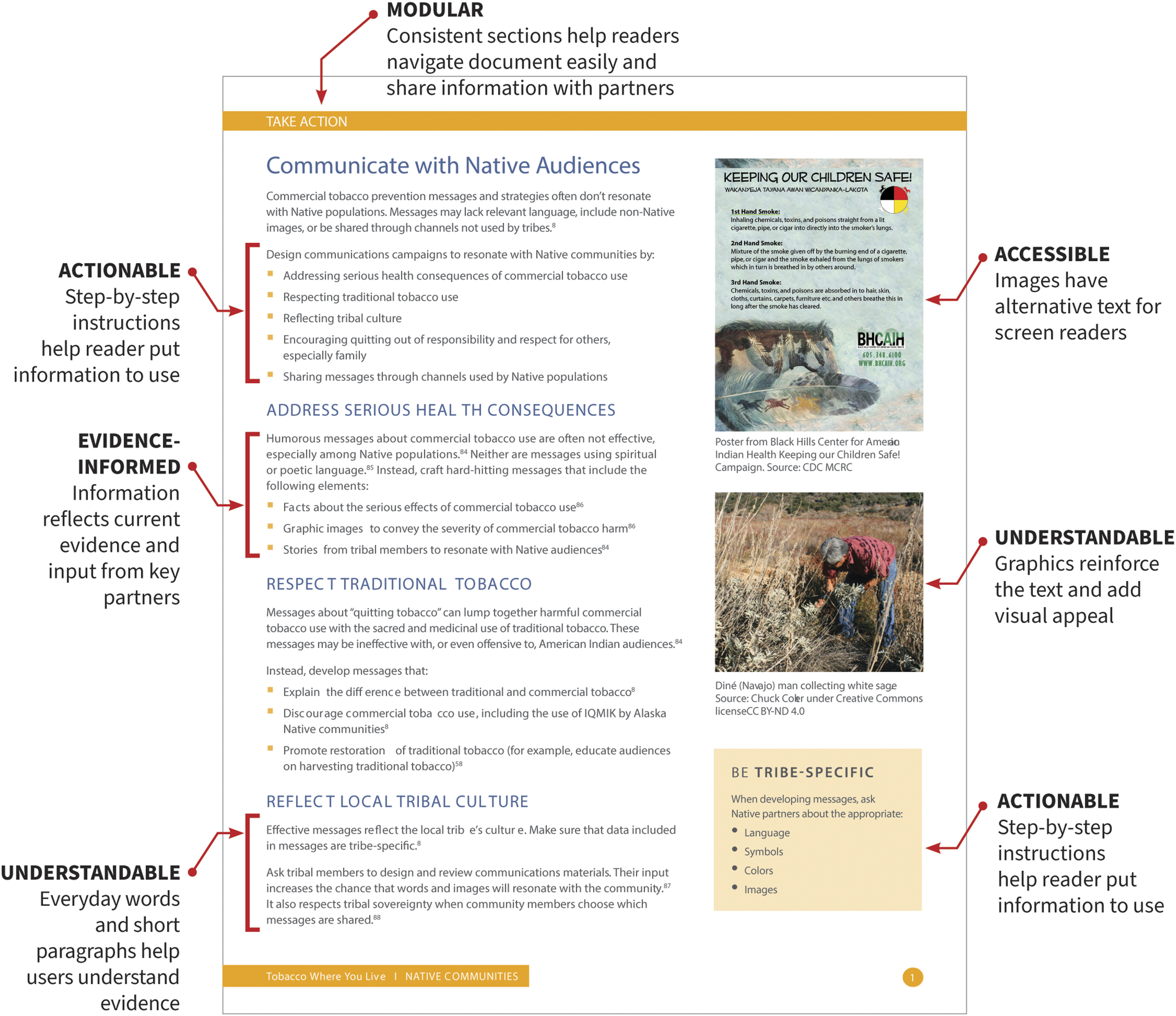
Evidence-Informed Sources
Depicted in the middle left column of Figure 1, information disseminated in the Native Communities Supplement reflects current evidence and input from tobacco control leaders in Native communities. Information was gathered through expert consultation during planning, synthesis of scientific and grey literature, and partner review. First, topic experts and practitioners helped determine content direction and organization, identify gaps in existing guidance, provide insight on practical and political aspects of the topic, and identify possible case studies. Their recommendations informed an extensive review of the scientific and grey literature to determine the depth and breadth of evidence, identify recommendations, and reveal evidence gaps. Funding partners reviewed the findings. Finally, the project team drafted recommendations and gathered more in-depth feedback from reviewers to ensure that recommendations were up-to-date, practically feasible, and responsive to practitioner and partner needs. Involving partners with relevant expertise and experience at each phase helped build credibility with future users and form connections to support dissemination.
Actionable Information
The Native Communities supplement breaks down the topic into manageable steps and guidance for specific situations (illustrated in the step-by-step instructions in the top left column and bottom right column of Figure 1). The supplement also includes real-world examples throughout, including two longer case studies that describe real program experiences and lessons learned. As resource use has increasingly shifted online, the supplements have added more interactive hyperlinks to additional implementation resources.
Modular Structure
Native Communities includes the following sections: • Make the Case – Brief overview of why the topic is essential to tobacco control efforts • Learn the Basics – Background and history of the topic • Get Ready – Guidance on conducting assessments, engaging with the community, and building partnerships • Take Action – Instructions on how to plan, implement, and evaluate topic-specific strategies • Explore Community Examples – Real-world examples of putting evidence into practice
Modularity approaches the subject from multiple perspectives, allowing users to access information in multiple ways according to their interests or role and share sections easily with partners. Defining sections and including them in each supplement (as shown at the top of Figure 1) also sets clear expectations about what type of information will be in each guide and where it will be located. This modular structure facilitates efficient information retrieval and encourages use of multiple guides.
Understandable Delivery
The writing in all of the User Guides is plain language. For example, sentences communicate a single idea and paragraphs are short, typically 3–5 sentences (see Figure 1, bottom left and middle right). The guides also include photographs and figures like the images depicted in Figure 1 to give users’ eyes a rest, add visual interest, highlight key information, tell stories about data, and visually explain systems and processes.
Accessible Formats
Relatively simple changes can offer a dramatic increase in usability for all audience members, especially those with disabilities. As depicted in the top right column of Figure 1, Native Communities includes alternative text for graphic elements, increasing understanding for both users with disabilities and those who do not require accommodations. For other changes that require more technical expertise, such as creating a tagging structure for screen readers, excellent resources are available that can help anyone learn to create accessible documents. 9
Implications for Research and Practice
The translational design principles are a necessary part of the research process for several reasons. Most importantly, relying solely on academic formats to disseminate research excludes most practitioners, as they are unlikely to have access or time to read the findings. In cases where academic articles do reach practitioners, other critical dimensions of translational product design are absent. Understanding and implementing the design principles do not require advanced training, allowing many types of professionals with or without a scientific background to use them to create translational documents for diverse audiences, including policy makers and the public.
Once translational products are developed, active and targeted dissemination strategies are crucial for ensuring the information reaches and resonates with its intended audience, thus maximizing impact. An active approach uses tailored messages that are designed for specific audiences and delivered through appropriate channels (e.g., direct email, social media, non-academic conferences) using planned strategies. This targeted approach enhances the likelihood of successful knowledge transfer and uptake, fostering informed decision-making and behavioral change. 10 Furthermore, active dissemination ensures that the distribution of information is timely and efficient, utilizing appropriate channels and platforms to reach each audience effectively.
Beyond the User Guides featured here, the translational design principles were fundamental in the NCI-funded ASPiRE Center (Advancing Science and Practice in the Retail Environment for tobacco). The Center produced multiple types of rapid-response translational products for public health professionals, including case studies of successful policy efforts, annual fact sheets on retail tobacco policy progress, biannual Insights from the Field reports sharing interview and survey results on retail policy progress, and tobacco retailer density fact sheets tailored to 30 cities represented on ASPiRE’s Community Advisory Board. These were disseminated on ASPiRE’s website, through social media, and directly to local public health department partners and regional and national organizations. City-specific tobacco sales fact sheets, also following the design principles, were developed and disseminated in partnership with the Campaign for Tobacco-Free Kids, earning on-air and online media coverage across the country.
Public health practitioners face urgent challenges that require evidence-informed solutions, but critically, they lack timely access to actionable scientific evidence. Thoughtful design and delivery of evidence-informed strategies from researchers can improve public health partners’ access to and use of diverse and grounded approaches. The five design principles offered here can help. Broad use of the translational design principles could help to increase intervention fidelity and the impact of public health evidence for various public health challenges and opportunities.
Supplemental Material
Supplemental Material - Five Translational Design Principles for Communicating Research to Practice in Public Health
Supplemental Material for Five Translational Design Principles for Communicating Research to Practice in Public Health by Stephanie Anderse, Laura Brossart, Zara Petković, Rebecca Wilz, Amy Endrizal, Rachel Hackett, Angella Sandra Namwase, Veronica L. Chaitan, Mia T. Vogel, Douglas A. Luke, Todd Combs in Community Health Equity Research & Policy
Footnotes

Ethical Considerations
Institutional Review Board of Washington University in St. Louis approval for this study was obtained through the research institution (IRB # 201804044).
Consent to Participate
Consent was obtained through a brief, downloadable information sheet provided in the written recruitment email, which stated the survey purpose, expected completion and data confidentiality practices.
Author Contributions
Funding
The authors disclosed receipt of the following financial support for the research, authorship, and/or publication of this article: The Best Practices User Guides project on which this work is based was funded by the Centers for Disease Control and Prevention [contract number 200-2015-87568]. Views reported herein are solely those of the contributing authors.
Declaration of Conflicting Interests
The authors declared no potential conflicts of interest with respect to the research, authorship, and/or publication of this article.
Data Availability Statement
Data collected for this work is available from the authors upon request.
Supplemental Material
Supplemental material for this article is available online.
References
Supplementary Material
Please find the following supplemental material available below.
For Open Access articles published under a Creative Commons License, all supplemental material carries the same license as the article it is associated with.
For non-Open Access articles published, all supplemental material carries a non-exclusive license, and permission requests for re-use of supplemental material or any part of supplemental material shall be sent directly to the copyright owner as specified in the copyright notice associated with the article.
