



Abstract
Research has long-documented how Canada’s temporary foreign worker programs (TFWP) foster workers' precarity through their status as non-citizens and living and working conditions, ultimately, impacting their health. While studies point to limited supports and services for workers, their role in reinforcing or alleviating the precarious conditions that migrant agricultural workers experience remains largely unexplored. This paper draws on interviews with 35 service providers in three migrant-intensive regions in southwestern Ontario, to explore how service providers describe and construct support. We explore the barriers workers face in accessing services, challenges providers experience in supporting workers, and strategies employed to surmount these barriers. We argue that this multiregional analysis is important to illuminate how support shapes and is shaped by the larger structural context, namely common features of Canada’s TFWP. A more comprehensive understanding of support moreover, provides direction for sustainable interventions that can promote the health and wellbeing of this population.
Introduction
For decades, research has documented how Canada’s temporary foreign worker programs (TFWP) foster workers' precarity through their status as non-citizens and their living and working conditions.1–5 In 2021, approximately 61,000 migrant agricultural workers (MAWs) entered Canada accounting for an 11.9% increase from 2020, marking the most substantial annual rise since 2016. 6 In the same year, Ontario alone employed nearly 27,000 MAWs, representing approximately 43.2% of Canada’s entire temporary foreign workforce employed in agriculture. 6 MAWs from the Caribbean Islands and Mexico are recruited through bi-lateral agreements under the Seasonal Agricultural Workers Program (SAWP) to work for up to 8 months per year. Under the Temporary Foreign Workers Program-Agricultural Stream (TFWP-AS), workers from Mexico, Jamaica, Honduras, Guatemala, Thailand, Vietnam, and the Philippines are employed through Labour Market Impact Assessments to spend up to 2 years in Canada. These programs differ in terms of conditions of entry, length of stay, recruitment pathways, accommodation entitlements, and access to healthcare1,7 however, precarity characterizes their daily lives and impacts their overall mental health and wellbeing.8,9
While MAWs are entitled to certain benefits, including public health care and labour protections, unlike immigrant newcomers, they are not entitled to settlement services, including language training and translation and are largely excluded from mandates or funding provisions of settlement agencies. 10 Studies point to limited supports and services for these workers,11,12 yet the role of these services in reinforcing or alleviating the precarious conditions that MAWs experience has yet to be examined. MAWs face significant gaps in services, programming, and legal protections while living and working in Canada.11,12 Existing research identifies the importance of informal and formal support,13,14 the impact of gaps in support within primary care or workplace injury,15,16 the limitations in existing provisions, and best practices in providing support for MAWs. 16 Yet, there is no comprehensive picture of how support shapes, and is shaped, by the larger structural environment that MAWs face. Understanding this support landscape can identify important points of intervention to promote the health and wellbeing of this group. Furthermore, such knowledge is key to empowering service providers (SPs) and MAWs, and holding larger stakeholders accountable, to drive social change that is more inclusive and equitable for migrant populations.
Previous research highlights that there is an absence of a systematic approach to support this workforce. In fact, in many regions of Canada, MAWs’ access to services, and SPs' ability to support workers, is undermined by ad hoc, short-term service delivery, and the limited resources and capacity of grassroots, advocacy, and community-based organizations.14,17,18 Consequently, this population may also face exclusion and marginalization from certain services. Limited understanding of the complex supports that MAWs require to access services is also often not well demonstrated in public programming. 19 Ultimately, in Canada, the supports identified for MAWs are partial, and fragmented, understandably so, as they are typically provided by poorly resourced, grassroots voluntary, and advocacy organizations, and churches. 18 Given that workers are entitled to social and health care benefits, examining the supports available to this group offers an opportunity to interrogate whether the precarious conditions that TFWP forge can be addressed in these support domains. To connect localized community-based, sector-specific and cross-sector practices of support to common barriers and initiatives we interviewed SPs who engage with MAWs in Southern Ontario.
The paper draws on interviews with 35 SPs in three migrant-intensive regions in Southern Ontario, (Windsor-Essex, Haldimand-Norfolk, and Niagara) to explore how support is described and constructed by SPs, whose insights derive from their experience in supporting MAWs. We explore the barriers workers face in accessing services, challenges providers experience in supporting workers and strategies they employ to surmount these barriers. We argue that an analysis of these three regions can uniquely contribute to a body of scholarship that tends to be situated in specific localities. Furthermore, this multiregional understanding of how services and supports are (or aren’t) in place for MAWs can begin to illuminate how support shapes and is shaped by the larger structural context, namely common features of Canada’s TFWP.
The following section reviews how research has conceptualized Canada’s TFWP to foreground the structural barriers that engender workers’ precarity. These studies demonstrate the systemic and multi-layered components of precarity, yet they do not confront support as a conceptual arena that may reinforce or mediate precarity. We trace the way support across sectors (e.g. health, legal, settlement) has been identified in the literature on MAWs to identify its features and the way informal and grassroots supports have emerged as pre-eminent ways workers are supported due to the limited provisions of formal support. While the distinction between formal and informal support has heuristic value in rendering visible the ‘absence’ of systemic support, this paper draws from insights of SPs and informal supports alike in order to illustrate how constructions of support are discursive and multi-layered, and reflect particular locations in grassroots, health care, governmental, civil society organizations and agencies. SPs offer a valuable perspective into the relations, practices of and barriers to support particularly in an environment where support is so provisional, fluid, and contingent.
Review of the Literature
Structural Violence, Liminality and Relentless Border Walls: Gaps in Services and Protections for Migrant Agricultural Workers
MAWs have complex healthcare, legal and social needs and support provision for this group is best delivered in cross-sectoral and multifaceted ways that require adequate funding and the engagement of both informal and formal actors. Yet decades of research indicates that MAWs face significant gaps in relevant services, programming and legal protections while living and working in Canada.11,12 The systemic nature of these disadvantages and risks have been conceptualized in ways that foreground the exclusionary framework of TFWP and the precarious conditions MAWs experience. The identification of TFWP as an expression of structural violence 20 is echoed in “relentless border walls” (RBW), 17 liminality, 21 and social quarantining 22 that influences workers' access to various services and protections. Indeed, the differential inclusion of MAWs in migration management regimes4,23 has been conceptualized as a significant driver of the multiple forms of precarity workers experience through their status as non-citizens, their exclusion from family unity, labour mobility10,24–26 and settlement services27,28 their participation in a closed, temporary program, their reliance on circular (and therefore deportable) migratory status, and a limited amount of relevant services that enable adequate health care and protections.14,20 These conditions create an ever-present conditionality of this groups’ membership as a factor shaping their entry into Canada and their access to various services, protections, social connections and overall well-being. 14
Precarity moreover imbues the liminal spaces that MAWs inhabit because the contradictory, ‘in-between’ position they occupy is fraught with uncertainty and contingency. This group, for instance, inhabits a tension both through their inclusion as essential labourers, and their marginality and precarity in relation to nationhood and citizenship.21,22 These broader dynamics create a greater sense of uncertainty while also restricting and collapsing these individual’s social and personal lives in Canada. Workers experience loneliness, isolation, and lack of belonging that is produced by fears of deportation and working conditions18,29–32 that have significant consequences for workers’ health.12,33 Despite the multi-layered dimensions of precarity, studies also point to the way workers navigate, transgress, and resist the intersecting oppressive forces that regulate and restrict their participation in society,5,34 both through their own initiatives,35,36 and through their connections with formal and informal support persons.17,37
Advances and Challenges in Service Delivery for Migrant Agricultural Workers
Under Canada’s TFWP, MAWs are entitled to benefits and legal protections, including public health insurance and legal protections. These entitlements are however managed through federal, provincial, and municipal jurisdictions23,38 in a piecemeal manner that is not coordinated, and does not account for workers’ needs, their living and working conditions, or how the employer-driven nature of these programs informs how and whether workers can access these rights. Workers are ostensibly provided public healthcare through a formal apparatus of paid SPs in hospitals and community clinics; yet, they require a myriad of secondary supports for which there is no formal funding or stable provisions to access these services. Workers are thereby reliant on a range of providers, both formal (those who are paid and work for government and agencies) and informal, (those who are volunteer, or paid, through grassroots organizations) in migrant-intensive regions across the country. As studies show, MAWs are excluded from both formal and informal supports due to their status as non-citizens, the constraints of TFWP, their exclusion from immigrant newcomer settlement services11,39 and the absence of secondary services needed to access these entitlements.
Common services that MAWs require include health care services, including outreach and navigation, legal and labour services, that involve general guidance and representation, social services, such as recreational, faith-based and community building, and migration and settlement programming, such as language lessons and orientation to distinct Canadian settings.1,17,18,37 Research on the availability of supports for MAWs, while not extensive, points to how gaps in services 40 and the absence of a systematic framework of support,11,14,17 undermine MAWs’ well-being. 41 Yet very few studies have explored the possibilities and pitfalls of support provision to interrupt, mitigate, or even reinforce the day-to-day precarity faced by MAWs.
Select scholarship has explored the implications or need for specific health services and protections for MAWs, especially in the areas of occupational health and safety, 15 sexual health 42 and primary care delivery. 16 MAWs in Canada have limited and inconsistent access to occupational health and safety training and protective equipment.11,15,19 Research with MAWs and SPs have identified additional point-of-care and access barriers which include limited language interpreters, transportation, time off work, knowledge to navigate the healthcare system, and employer’s mediation in health issues.16,42 Initial barriers to service provision can also result in challenges for medical follow-up and continuity of care. 16 Targeted services offered through community health centres exist in some regions for workers, however, access to care remains unreachable due to not having a provincial health card (despite eligibility), lack of confidentiality, and non-citizen status that motivates workers to sacrifice their health for their employment. 43 Moreover, a significant driving force behind workers’ perseverance in their employment, despite health concerns that may risk medical repatriation, 44 is the necessity to provide financial support for family members back home. Within the COVID-19 context, delays or barriers to healthcare seeking led to preventable deaths among this population. 12
Less literature has explored the role of supports and sectors outside of, or in addition to, healthcare delivery, with exceptions including a support model inclusive of health, settlement and legal services 19 and case studies of legal protections and collective bargaining.45,46 Prior research in British Columbia has documented the context and implications of a cross-sectoral service provision model that helped to address gaps in transportation and translation services, and increased capacity for legal support.11,17,47
Studies have also explored the existence (or absence) of community supports often pointing to the way workers are socially excluded from the communities where they work and live. Such literature includes that of peer relations, civic engagement, 48 social and interpersonal attachments and opportunities associated with belonging.18,49 This deprivation engenders in workers, a sense of isolation, loneliness, and social segregation that is gendered50,51 and intensified by the persistence of racism and limited knowledge communities have of their contribution to local economies.18,22,32,37,52 Currently, there is little research that examines support within communities or the service delivery landscape across regions and sectors. The absence of services and the limited access of workers to support contributed to the disproportionate impact of COVID-19 on MAWs. 23 While the federal and provincial governments provided additional short-term ad hoc funding for language translation, language classes, training and mental health supports during COVID, a more sustained program of support, the ‘Migrant Support Program’ was not initiated until 2021 and is only now, in 2023 under delivery. Our study undertaken in (2021 - 2022) sought to identify how this patchwork of support delivery, including informational, appraisal, instrumental or emotional53,54 provided by formal (i.e. government, agency, or trained staff)55,56 or informal (i.e. grassroots volunteers, or peers) persons and organizations shaped the way SPs provide support to MAW.
Methodology
We undertook a critical constructivist approach to narrative inquiry to capture relational, cultural and political stories of how support is delivered, and how MAWs’ experiences are described. Motivated to identify and situate personal narratives of service delivery within the broader “meta” or “macro” narratives of how service delivery occurs57,58 we adopted Clarke’s ordered maps to alert our team to socio-cultural, economic, and historical discourses that could help us further interpret our data. 59 This method was helpful to identify all elements, meanings, and points of significance in relevant situations. It also provided a framework by which to read our data from multiple lenses (e.g. temporally, symbolically, socio-culturally, collectively) to both understand and critique oppressive forces, and build knowledge towards social change. 60
To explore the larger context of service delivery for MAWs we examined three distinct regional settings in Southern Ontario, Niagara, Haldimand-Norfolk and Windsor-Essex. These regions were selected based on their common, relevant features, while also accounting for the analytic impact of their distinct characteristics. Common features of each region included: 1) a long history and high density of MAWs in the region and; 2) a provincial context, by which certain laws, protections, and health services would be of equal applicability. Distinct aspects of each region included 1) types of crops or industries (e.g. greenhouses predominate in Windsor-Essex but not in Niagara); 2) proximity to urban centres (e.g. Haldimand-Norfolk is farther from larger cities than Niagara and Windsor-Essex) and; 3) history of funding and infrastructure for services in each region. Data in Niagara and Haldimand-Norfolk was gathered from September 2021 – November 2022. Data in Windsor-Essex was gathered from a study conducted previously with aligned aims (March 2021 – 2022), enabling a seamless secondary analysis.61,62
Eligible SPs were selected based on their involvement in providing formal or informal support that encompassed various dimensions of help provision to MAWs in the regions of interest. Our recruitment, in each region, was aided by existing support networks where we interviewed a total of 35 SPs, 19 in Windsor-Essex and 8 in both Haldimand-Norfolk and Niagara. By working with our network of organizational partners through referral-based sampling, and prior knowledge of each region, recruitment ended when no new individuals were being recommended for contact by our team. Such a sampling approach is appropriate when the population of interest is scattered, not highly visible and small in number.63,64 Informed written consent was obtained from all participants. All SPs worked in the healthcare, settlement, and legal sectors or were part of grassroots and multiservice organizations. Some participants held a variety of affiliations, inhabiting multiple roles under which they offered support. Participants described the support they offered under the domains of health care, social care, settlement, labour, community-development, non-profit and/or faith-based. While most participants in the Windsor-Essex region delivered support in a formal capacity, participants interviewed in Haldimand-Norfolk and Niagara represented roughly half formal and informal SPs.
During interviews, SPs were asked to identify challenges, priorities, successes, and current initiatives. They were asked to reflect both on their specific role as well as their organizations’ mandates in considering their contribution to supporting MAWs. Fieldnotes were recorded after each interview to capture first impressions, negotiations of meanings, and notable themes. As such, our approach prompted us to consider the practices of support provision both in terms of the meaning ascribed to it (e.g. how SPs constructed their practice), but also, how the larger political, cultural and economic context shaped service delivery (e.g. parameters, norms, barriers). To address real or perceived power differentials between interviewer and interviewee, all participants were invited (and most participated) in several meetings and activities. This included 1) planning meetings, leading up to, and upon initiating data collection (n = 4, 1 – 2 per region); 2) member-check meetings both during the data analysis phase (n = 3, 1 per region), and virtual cross-regional meetings (n = 2) to develop a strategic direction for future research upon the development of the project, and upon completion of data analysis. Most participants were thus engaged in both feedback of generated findings, and, in action-planning for the future direction of the project based on the emerging findings. It was however, made clear to participants that no identifying information about them as individuals or their organization would be shared with anyone outside of the academic research team. The interviews were conducted in English by four graduate (and one doctorate prepared) research assistants, although co-PIs also participated in interviews. All trainees were provided instruction and guidance on the interview process, ethical requirements and overarching methodological principles. All interviews were audio-recorded and carried out via video-conference and ranged from 45 to 80 min in length.
Data analysis consisted of several readings of the transcribed interviews before the development of a narrative ‘storied’ summary of each interview. Subsequently, all team members re-read transcripts, using ordered maps as outlined by Clarke (2005) to organize emerging ideas. This enabled a closer reading to ensure that each narrative was fully situated within its broader historical and social context. Next, we adopted Braun and Clarke’s (2006) 65 approach to thematic analysis by collating smaller codes and patterns into broader themes. This included the use of Nvivo coding through track change highlights and the use of page and line number to contextualize examples. We continuously reflected on our role in the construction and co-construction of themes and stories as they were identified throughout our research process. As a group of nurse researchers (with clinical backgrounds) and social scientists, but also, individuals with different national backgrounds (e.g. Guatemalan, Canadian, etc.) and prior/concurrent roles (e.g. not-for-profit, public health, advocate and community-based initiatives) our divergent positionalities were at play throughout the research process. We found for instance that individuals brought different meanings and understanding to emerging themes that added productive tensions and complexity to our analysis. Ethics clearance from both faculty members’ institutional review boards was granted to carry out research procedures.
Findings and Discussion
Our findings indicated that MAWs faced a disproportionate need for services in comparison to the limited supports that could be delivered. For participants, the act of service delivery was defined by the dialectic between what SPs’ believed to be best or enabling practices, and the extent to which the existing support system, or the Fragile Support Landscape, provided an environment to enact these supports. Furthermore, both MAWs’ need for, and navigation of services occurred within the larger context of workers’ structural vulnerability to violence.
20
(See Figure 1). Despite these complex barriers, SPs advocated for a “Structure of Accountability” To Address Structural Vulnerability. Furthermore, SPs expressed hardiness and optimism by looking towards the future, capitalizing on new opportunities sparked by COVID-19, and building strategic coalitions and collaborations. We organized these strategies under the theme of Seeking the Silver Lining Amidst Precarity: Future-Oriented Strategies. Together, these themes illustrate the dynamics of hierarchical and contested power in the construction of support for this population, yet also hint at strategies for resistance and reimagining how MAW are positioned in society. Fragile support landscape amidst structural vulnerability.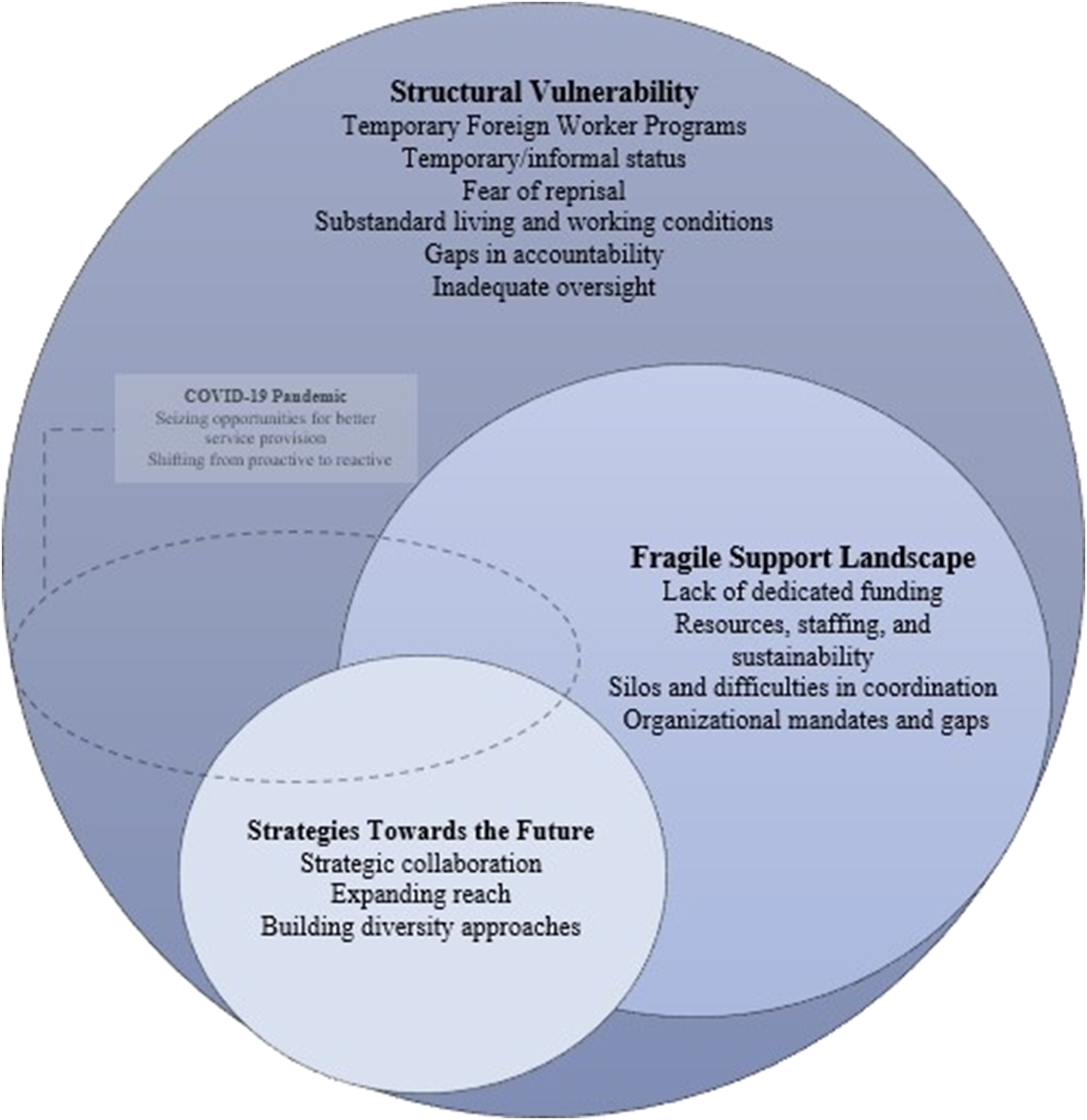
While each region under examination offers a unique support context in different stages of development, our findings present a preliminary discussion of overlapping forces that limit and constrain support for MAWs while also rendering visible the strategic efforts by SPs. All participants have been given pseudonyms along with acronyms that identify the region under which the individual predominantly provides services, with WE representing Windsor-Essex, HN for Haldimand-Norfolk and N for Niagara. To facilitate engagement with prior literature, the discussion section is interwoven into our description of findings below.
“A Structure of Accountability” to Address Structural Vulnerability
Previous research has emphasized the structural barriers that limit access to supports and services for MAWs 16 such as fear of reprisal, awareness of deportability, 29 and risk of blacklisting from future involvement in TFWP. 66 The majority of participants recognized workers’ precarious status as a barrier to providing support, Corinne (HN) said, “people are scared to call us”. Additionally, dependence on employers remained a salient feature of MAWs’ service-seeking realities, one which required significant attention to offset.
Participants in all regions identified larger political factors that impacted service delivery in many ways. For instance, participants commented on the interconnection between workers’ deportability, and privacy and confidentiality when seeking healthcare services. Apart from workers feeling less inclined to initiate contact with healthcare providers, their deportability also affected how comfortable they were with disclosing the severity of their symptoms, as Andrew (WE) stated “we get a lot of hesitancy, worry and the need to keep things private”. In addition, others pointed to the added complication of employers playing a more direct role in workers’ access to care. Employers acting as workers’ primary mode of contact, and gatekeepers of medical documents necessary to mobilize care, “blur the lines between private [confidential] healthcare and employment” (Lisa-N). These challenges extend beyond the healthcare sector as other participants commented on workers’ structural vulnerability and their (in)ability to access legal services to combat issues such as gender or racial harassment, and labour and housing violations. Several participants mentioned that these challenges were intensified by the COVID-19 pandemic.
MAWs’ precarity, both because of their temporary or informal status, and also, because of substandard living and working conditions21,67,68 were identified as significant determinants to the degree that SPs could address workers’ needs, and, the accessibility of services. Furthermore, agricultural production in Canada is generally concentrated in rural areas wherein workers are bound to live on employers’ properties, at a considerable distance from town centres. Limited access to public transportation routes and movement monitoring by employers, 7 particularly salient during the COVID-19 pandemic, 23 renders workers physically and socially isolated with limited access to brick and mortar services. SPs in all regions were aware of these specific challenges that arise from workers’ limited mobility to and from bunkhouses, as well as their own difficulties in locating and accessing workers on-site. They also understood that workers in these regions primarily rely on taxi or bicycle transportation. Consequently, SPs recognized the overarching need for a more robust, systematic, affordable, and accessible transportation infrastructure in rural regions, as well as the more pressing need in the interim for SPs to deliver accessible service sites so “[workers] can at least ride their bikes” (Natasha-N). Several participants also discussed exploitative working conditions that exposed MAWs to a disproportionate need for specific services such as occupational health and safety. They also commented on the difficulties of remaining accessible to workers who typically work beyond traditional business hours.
SPs expressed uncertainty about the extent that the support they offered could fully address the real threats and needs faced by MAWs, especially when reflecting on inadequate oversight of MAWs’ standards of living.15,68 Many participants, especially those in the WE and HN region, called for a reform of TFWP that better highlights who is responsible for workers’ well-being. Participants expressed that the formal expectation that employers be responsible for facilitating care for MAWs posed significant challenges. This expectation, along with a lack of stringent enforcement mechanisms that allow for “some structure of accountability” (Corinne-HN), played a central role in how workers accessed, and how SPs delivered supports. Participants also mentioned how employers’ de facto role as facilitators, or rather, inhibitors, of support, was mutually reinforcing in light of the lack of a sophisticated and sustainable support landscape upon which to draw. Overlapping factors like gaps in accountability, and employer gatekeeping in service provision, shaped and constricted methods of service delivery. For instance, offering services on or off the farm, both came with implications for employers’ role/responsibility, and workers’ access to, and risk, in seeking support.
Fragility of the Support Landscape
Several factors were identified as indicative of the fragility of the support landscape available to MAWs. For one, the marginality of MAWs’ positioning in Canada was largely mirrored in some of the organizational challenges faced by the network of SPs interviewed, for example, through dedicated funding and its consequences (i.e. limited resources, staffing, sustainability) and eligibility of services. Such challenges, combined with limited coordination across certain organizations, and the COVID-19 pandemic had implications for SPs’ reach, accessibility of support, and scope of help available for MAWs. Likewise, informal actors working in a volunteer capacity also described the impact of COVID-19 and limited resources in influencing the level of support they could provide MAWs. In short, service delivery was characterized by a patchwork of services, truncated programming, or even full-on gaps across several domains of service provision. The consequences of this precarious support landscape both triggered and self-perpetuated challenges of limited capacity for coordination, implementation and reach in meeting the needs of MAWs.
Limited Funding and Resources: “Sometimes it’s fine, sometimes it’s problematic”
Limited overall funding, and MAW-specific funding had several implications for the capacity, staffing and approach of SP organizations. As previously mentioned, funding for programs and services were not solely dedicated to MAWs. Therefore, participants in all regions mentioned the challenges of balancing competing priorities, and even engaging in unrecognized or clandestine efforts to meet the needs of this population. Emily (N) stated:
“We're funded by the Ministry of Health. So it sort of limits our capacity. For years working with migrant workers we weren't announcing a lot of the work we were doing. Because the prevailing thinking was they aren't Ontario residents.”
A lack of dedicated funding also put the onus on SPs to secure resources, where participants identified a need to fundraise in order to safeguard services for workers. Absence of sustainable funding had implications for how organizations were able to mobilize volunteers, run services, implement new initiatives and invest in comprehensive communication strategies. For instance, despite identifying language barriers as “one of the biggest issues, especially for Mexican workers” (Isabelle-N), organizations in N and HN described limited resources to develop a systematic communication strategy, which in turn, further reinforced language as an obstacle for support provision. Informal SPs noted that the demand for translation and language-related accompaniment within formal organizations exceeded their capacity.
Resource challenges within specific organizations, and at a more societal level, had implications for how SPs were able to offer their services. For instance, some organizations identified minimized investment in transportation, communication and interpretation as limiting their options for reaching MAWs. In some cases, organizations felt forced to rely on employers as intermediaries in service provision even though it could jeopardize workers’ autonomy and rights to confidentiality. Some participants expressed ambiguity in this regard, not seeing another way forward: “Sometimes it's fine, sometimes it's problematic. Because you might not want to disclose so much in a medical appointment if the person who's interpreting for you is someone you know in a different capacity” (Phoebe-WE).
Due to limited funding, organizations also described staffing and time constraints as directly limiting the degree of services that could be offered to MAWs. Most participants described being “a small team” without the ability to reach the thousands of workers in their region. While funding and staffing have been identified as unique challenges in support provision for MAWs16,21,69–71 our research illustrates the interplay between this organizational scarcity, and the tentative and incomplete eligibility of supports and protections for MAWs that ultimately reinforces their precarity.
Shifting from Proactive to Pandemic: “COVID Really put a Knife in This”
Canada’s response to the COVID-19 pandemic failed to adequately address its impact on MAW, rather, its shifting policy framework exacerbated existing systemic issues among the population. 72 Within this context, participants described an increased demand for their services, with energies shifting to crisis response over more proactive services. Irene (WE) stated, “you can imagine how many calls were received from workers. Positive with COVID, and they didn't know what to do, or where to go?”. While SPs became a more critical source of information, directing workers on changing resources and protocols dictated by the pandemic context, a lack of in-person outreach and community events complicated their roles as SPs. A lack of face-to-face relationship-building forced all SPs to switch their mode of service delivery, moving to virtual service provision or cancelling services altogether. In many cases, SPs doubted their ability to connect with workers to the same degree: “From what I understand you know the reach isn't as broad when it's virtual [re: health fair]” (Emily-N). Participants expressed that a reliance on virtual communication affected dissemination of information and quality of support offered. The resulting lockdown also hampered the progress of some initiatives in WE, affecting the further growth of services, “due to the lockdown, it's been so hard getting this initiative going. COVID really put a knife in this. Getting more people on board and growing as a service” (Oliver-WE). While the impact of COVID-19 has been widespread, growing research indicates that the most negative health and social burdens of the pandemic have been shouldered by racialized, migrant and precarious labourers.23,38,72–75 Our research underlines the ways in which SPs were further hindered in providing necessary help and resources to MAWs within the COVID-19 context, ultimately, exacerbating this groups’ precarity.
“Groups Working Independently of Each Other …” a Need for More Coordination
Speaking to the fragmented nature of services for MAWs in their region, participants discussed limited coordination and collaboration between organizations,“what I see is, you know, again groups working independently of each other” (Roxanne-WE). At times, organizations were more likely to work in isolation because of incommensurable perspectives or approaches to working with MAWs. This could manifest as different organizational mandates, grassroots versus more formal organizations, or different perspectives of MAWs’ needs. For example, one informal SP contrasted their approach to support to other organizations, noting, “they [workers] are not coming for charity, you need to know what they want. They want support, they want to be part of the community. Don't give them charity.” (Valentina-WE). Likewise, working across secular and faith-based organizations was perceived as a potential barrier for collaboration by some faith-based SPs in WE and N:
“I find that one organization doesn’t want to collaborate with another because of their mandate. Ours is religion and spiritual care, if someone is against our values they may not want to partner, not common but there have been times where there is conflict in mandates. (Marie-N).
Limited research has considered potential conflicts or alignment in values or mandates that may shape coordinated service provision for MAWs. Given that SPs identified the need for closer partnerships across organizations in the delivery of support for MAWs, research delineating consensus-based processes that enable service provision coordination across sectors is warranted. 76
Seeking the Silver Lining Amidst Precarity: Strategies Towards the Future
Despite the conditions of precarity that limited both access to and methods of service delivery, SPs remained dedicated to enacting strategic and creative approaches in supporting MAWs. These practices largely fell under two domains: 1) Seizing opportunities from the COVID-19 pandemic to catalyze more substantial support and; 2) Strategic collaboration, building diversity and expanding reach. While some of these strategies were still in development, or aspirational, they indicated the level of commitment and creativity of SPs to develop meaningful strategies amidst scarcity in resources and the precarious conditions faced by MAWs.
Seizing Opportunities Sparked by COVID-19
The COVID-19 pandemic brought renewed attention to the visibility of MAWs as essential and valued workers. This led to the recognition of the value of community supports, and subsequently the need to prioritize efforts that target this population. For those organizations that historically targeted MAWs, some felt that their value was recognized and highlighted during the pandemic, Valentina (WE) stated “they [the government] saw the value of what we do”. This generated emergency funding opportunities to support a number of programs and initiatives providing municipalities, public health, and the federal and provincial governments with the impetus to coordinate responses and support workers. SPs and organizations who included MAWs in their mandates, but were previously unable to provide more explicit support due to resource limitations and multiple priorities, seized opportunities and were able to take a “deeper dive” (Brandon-WE) into MAWs’ needs.
The complex consequences of the pandemic also necessitated cross-organizational communication and collaboration. SPs were active in developing cross-sectoral partnerships that enabled referrals and information exchanges, tentatively overcoming silos. While the COVID-19 pandemic inhibited methods of support, like outreach initiatives and community gatherings, it also allowed SPs to focus on gaps in service provision as Danielle (N) stated, “[the pandemic]…allowed you to realize where the gaps were and to start seeking out people who could provide these services”. Notable gaps identified by participants were, sexual health services in Niagara, mental health supports in Niagara and Windsor-Essex, and legal navigation in Haldimand-Norfolk. Nevertheless, the temporariness of COVID-19 funding opportunities, efforts, and approaches have been questioned by SPs as unsustainable. Furthermore, significant scholarship has questioned whether the increased visibility of the essential nature of MAWs’ labour has translated into improved policies or service provision commitments by governments across the world,74,77 including Canada12,19,46 Nonetheless, COVID-19 brought opportunities for SPs to highlight the challenges faced by MAWs, bringing recognition and stronger footing for funding to support this group. This increased recognition was viewed as an opportunity to build stronger infrastructure to address the day-to-day precarity faced by MAWs.
Strategic Collaboration, Building Diversity and Expanding Reach
Participants in all regions also discussed working with other community organizations in efforts to mobilize more coordinated approaches to service provision. Through partnered spaces, SPs have built platforms to discuss common challenges, solutions, and methods of service delivery. These spaces have enhanced the likelihood of cross-sectoral referrals, resulting in a more systematic support for MAWs and helping SPs to apply local knowledge to their programming.
Participants representing formal organizations also pointed to the benefits of collaborating with grassroots and non-profit organizations who offer more informal supports as they are able to “bridge [services] between the top and the bottom” (Valentina-WE). Front-facing initiatives such as social events, culturally mindful storefronts, and clothing drives provide workers with access to a listening ear and assistance to navigate the wider system. As Antonio (HN) mentioned, “open dialogue [with workers] to discover issues is needed to understand problems.” SPs offering formal services benefited from these partnerships as it provided them an opportunity to create more connection with workers, discover their needs, and enhance learning. Additionally, with limited dedicated spaces for workers in all regions, churches and libraries have been recognized by SPs as important places where workers congregate and disseminate services. “They have set up community hubs so that workers can come to socialize…and also to provide them with information and resources” said Natasha (N). Participants mentioned creatively utilizing these spaces to expand their reach and hold health clinics, legal sessions, and language classes. Participants in all three regions, however, identified the need for a social hub for workers that is sustainably funded.
SPs have begun to identify and respond to the diverse needs of the MAW population as a way to address unique barriers to access different groups of workers, notably, women and Caribbean workers. SPs have since begun to adopt diversity and equity approaches such as, cultural training for volunteers, mobilization of culturally appropriate food during quarantine periods, and hiring representative staff, as Elaina (WE) commented, “it’s really hard, because they [Caribbean workers] don’t see representation when it comes to [service provision]”. Likewise, the value of professional language translation services has been embraced, especially in the Windsor-Essex region. While some of these efforts are in their infancy, what is emerging is greater recognition for more purposeful, equitable support. Data-driven service provision was touted as an important strategy to account for and guide programs toward a more inclusive support system. Ultimately, SPs were motivated to find creative and flexible methods to reach and engage workers despite their capacity and resource limitations.
This study has identified several strategies, including several SP characteristics and commitments that have been documented in prior literature. 19 Yet our research indicates that through new and changing terrains of precarity faced by MAWs, SPs sought to enact new strategies, often working with the limited resources available to them to deliver support and, to coordinate responses to mitigate the gaps and patchwork of available services. Prior research suggests that these strategies are shaped by the level of motivation and affinity to the cause that support persons possess.14,17 We extend this analysis by considering SPs orientation to equity and diversity, their exposure to ‘just in time funding’ through the COVID-19 crisis and by pointing to the emerging configurations of support in three distinct regions.
SP narratives point to relative degrees of formal support that render them differently positioned to advance services in each region. Most SPs participants in Windsor-Essex were engaged in formal service provision and their insights and participation here reflect the emergence of a nascent structure of support that, however fragile, emerged through prior community development initiatives, the support of the local immigration partnership council and strategic funding provided during COVID-19.18,62 In Niagara, SPs (a mix of formal and informal) expressed enthusiasm for the newly formed networks that had been developed and strengthened under renewed attention and concern for MAWs in the region, despite limited mandate or resourcing to provide comprehensive services. In Haldimand-Norfolk, a small group of dedicated SPs described the challenges of providing support amidst a grower context of guardedness, and with limited resources to reach a widely geographically distributed MAW population. Thus supports for MAW were much more represented by informal and/or transient (i.e. briefly funded) actors in this region. Despite the variation between formal and informal support across these regions, SPs emphasized that in addition to the constraints in working and living conditions, MAWs are excluded from the funding models and mandates of most organizations and agencies that service Canadians and immigrant newcomers in two ways. Firstly, they are explicitly excluded from services (such as newcomer settlement services). Immigration, Refugees and Citizenship Canada (IRCC) offers immigrant newcomers a wide range of services such as employment and housing support, and language training however, they employ narrow eligibility restrictions and MAWs are effectively excluded from their mandate. 10 Secondly, they are excluded due to the absence of adequate secondary services they need to ensure access to benefits. While Windsor-Essex was able to envision a fragile framework for support during COVID-19, their funding for language translation and mental health for example, was nonetheless derived from short-term, targeted funding pots that included MAW on a temporary basis. Similarly, through the strong involvement of a few churches and a few community health clinics, Niagara has a history of sustained support in health-related services, yet initiatives are highly limited by demand, catchment and the complexity of needs in the region, and even more limited in other domains. By contrast, Haldimand-Norfolk is understood to be a particularly under-resourced region with a historically, conservative political background that tends to be unreceptive to building support for MAW. Yet recent changes in the funding landscape may be increasing the presence of formal supports in the region.
Notably, in 2021, the federal government launched increased funding dedicated to the expansion of support and services for MAWs in Ontario. 78 While this initiative shows promise in advancing more systemic support for workers across Ontario, it remains provisional and in early stages of delivery. Although an advancement for the overall support landscape, our study points to the still, overarching constraints reinforced by TFWP and the extent to which they impact SPs’ capacity. This research suggests that until substantive changes to the precarity engendered by TFWP are made,1,2 SPs efforts will remain complicated.
Limitations
SPs foreground how the gap between workers entitlements and their practical access to service is complicated and intensified through multiple fissures, that result from ad hoc, short-term funded support, limited knowledge of workers’ needs, and poor co-ordination of services within regions. The creation of a ‘Migrant Workers’ Support Program’ in 2021 provides an ideal foundation to map service and supports more systematically in future. The limitation of our study reflects the challenges of identifying services and supports in a context where such provisions are fleeting and fluid. Moreover, although community-based initiatives in each region provided a valuable foundation for recruiting SPs, referral-based sampling may have excluded supports and SPs who are unknown and working in isolation from other SPs, especially in the informal realm (for more on informal SPs in Windsor-Essex see Basok & George, 2020).
Secondly, there was a lack of consistency in the collection of sociodemographic data between regions because of the merging of primary and secondary data. Consequently, demographic details of our sample are not easily compiled. This may have implications for how our findings are understood. Nonetheless, we have been able to report on aspects of our sample that prior literature has indicated is of relevance. 14 Finally, our participants’ accounts highlighted gaps in service provision for MAWs and point to suggestions and examples to address these challenges. However, the nature of study findings do not enable us to prescribe specific strategies or practices that may be (most) effective for supporting MAW. Moving forward, a focus on intervention-based research is needed in order to understand what strategies work best to improve service provision for MAWs.
Conclusion
Our research sought to contribute to a gap in Canadian literature on the range of supports available that either mitigates, reinforces, or interrupts the precarity of MAWs by exploring the mechanisms and processes of support available to MAWs across three migrant-intensive regions of Southern Ontario. Given the complex need and vulnerabilities faced by this group, we were interested in understanding support provision across various sectors, including health, social, legal and settlement agencies. Our research indicates that support persons, and the organizations that they represent, are active in “seeking the silver lining” by remaining future-oriented, and seizing opportunities to respond and extend services throughout changing contexts, including moments of crisis, like the COVID-19 pandemic. Nonetheless, the support landscape for MAWs remains fragmented and fragile to change due to limited and unsustainable funding opportunities, and the eligibility criteria of government and organizational mandates that may not be fully inclusive of temporary MAWs. Yet ultimately, government investment and action to ensure a more sustained funding of services for MAWs is required. Consistent resourcing of services can help SPs to address underlying facets of structural violence that currently undermine the optimal pursuit of health and wellbeing among this population. Likewise, the structural violence and precarity faced by MAWs largely dictates the constraints and challenges faced by SPs who are forced to reckon with complex and structural challenges with limited and constrained resources. Cross-sectoral collaboration can be leveraged as a key contributor to support services for MAWs and provide unique opportunities for organizations to develop coordinated strategies that can make a bigger impact to address the complex needs of this population. Health, social and other support organizations may benefit from considering precarity as a factor that shapes both 1) how MAWs’ access and navigate care and protection, and 2) how services and programs are designed. Our focus on three distinct regional contexts of service provision provide beginning guidance of the need for unique points of intervention that highlight the strengths and particular challenges faced in each locality. Promising actions may include a commitment of federal funding for rural and small municipalities to invest in transportation infrastructure for MAWs, and an expansion of accessible services for MAWs, both through a broadening of eligibility for government-funded services, and through more meaningful pathways for permanent residence.
Footnotes
Declaration of conflicting interests
The author(s) declared no potential conflicts of interest with respect to the research, authorship, and/or publication of this article.
Funding
The author(s) disclosed receipt of the following financial support for the research, authorship, and/or publication of this article: This research, was funded in part by the Faculty of Health Sciences Research Development Grant at Western University, Mitacs Accelerate IT26734, Social Sciences and Humanities Research Council of Canada Partnership Development Grant.
