




Abstract
Public service interpreters are at risk of burnout and vicarious trauma, as are all practitioners in the helping professions. A few rare studies on this subject show the almost systematic absence of support offered to interpreters to face these challenges. Furthermore, training and theories describing the practice of interpreting ignore the emotional aspect of this type of work. The main objective of this study is to highlight the strategies used by interpreters to cope with emotionally charged interventions. Following an exploratory and qualitative design, 21 sign and speech language interpreters agreed to recount a significant event in their careers. These narratives were subjected to a deductive thematic analysis according to three theoretical frameworks, thus allowing to highlight the relational dynamics during an interpreted intervention (stances and positionings) and the necessary cognitive efforts. Four coping strategies emerged from the analysis. Two are collaborative and seem to lead to a satisfactory resolution of the event, even if the emotional load is strong and poses significant challenges during the intervention. The other two have an obstructive impact on the communication. Taken together, the results of this study show that public service interpretation is an emotional as well as a cognitive and relational effort.
1. Introduction
Public service interpreting (PSI) is a growing field. It involves the appointment of a third party to provide cultural and cross-linguistic mediation between a person, usually from a minority group, and the agents of public institutions (Pöchhacker, 2004). It involves both sign and speech languages. The main characteristic of PSI, which differentiates it from conference interpreting, is that interpreters are part of the interaction they are interpreting (Metzger, 1999; Roy, 2000; Wadensjö, 1998). They will, with their voice and body, and usually in the first person and in two languages, convey not only the meaning of what is being expressed, but also the range of emotions that accompany the exchanges. This “body and soul” involvement in the narrative of users and practitioners is not without psychological consequences.
1.1 Overview of the literature
Over the last 20 years, a few researchers have explored the emotional impact associated with the practice of PSI and interpreters’ coping strategies. From these research, several similar findings emerge. The first is that public service interpreters (PSIr) are at risk for vicarious trauma (or secondary traumatic stress) and burnout due to a variety of factors (working conditions, conflicting views on PSIr role, etc.) among which their sustained exposure to dramatic narratives is a major one (Darroch & Dempsey, 2016; Dean & Pollard, 2001; Geiling et al., 2022; Kindermann et al., 2017; Knodel, 2018; Valero Garcés, 2015). Although there are few studies, it seems clear that interpreters may experience considerable psychological effects from their professional activity, similar to all other helping relationship practitioners (Pearlman & Saakvitne, 1995). The second is certainly the scarcity of support (training, supervision, debriefing, etc.) offered to PSIr in all languages and organisations. A few studies show the value of supervision (Costa et al., 2020), joint workshops with members of the health care team (Goldhirsch et al., 2021; Leanza et al., 2021), self-care training (Creeze et al., 2015), or stress management training (Park et al., 2017), but these remain exceptional cases. Third, although a majority of these (few) studies focus on specialised contexts in which dramatic narratives are unfortunately common, such as mental health care or refugee intervention, the emotional burden can be significant in all interpretive settings (Lai & Costello, 2021). Fourth, a handful of studies report interpreters’ coping strategies in difficult interventions (Lai & Costello, 2021; Sultanić, 2021; Valero Garcés, 2015; Wilson & Walsh, 2019), that is, efforts to manage stressful events (Lazarus & Folkman, 1984). There are other studies that deal with coping in PSI, but the focus of these studies is not on emotionally charged interventions, but rather on the difficulties inherent to interpreting work (rapid flow, poor work organisation, or technical problems in remote interpreting). In these cases, coping strategies are either task-oriented or even material, such as acquiring a good headset (Korpal, 2021; Wang, 2018). A distinction can also be made between coping strategies used during the intervention and those used afterwards. Studies on the former are rather rare. For example, Lai and Costello (2021) distinguished strategies of engagement with others or oneself (e.g., yoga or informal debriefing) from strategies of disengagement (e.g., use of alcohol or over sleeping), both seems to be afterwards strategies. Finally, there are a few factors that stand out as protective or, conversely, precipitating disorders associated with this emotional load (Geiling et al., 2022). The protective factors are age, experience, training, and support. In sum, the older, the more experienced, and the more trained the interpreters are, and the more support they have access to, the less likely they are to develop burnout or vicarious trauma. The reverse is also true, to which must be added suffering from a prior trauma (Geiling et al., 2022).
Costa et al. (2020) suggested that emotions have been excluded from PSI teaching due to a misinterpretation of the neutrality requirement present in the ethical codes (this misinterpretation was already challenged by Metzger in his seminal work on the myth of neutrality, 1999). Indeed, several research findings show that interpreters practice (or attempt to practice) emotional detachment as a coping strategy to protect themselves (Lai & Costello, 2021) or else feel caught in a bind precisely because of their codes of ethics that emphasise neutrality, on the one hand, and confidentiality, on the other (Darroch & Dempsey, 2016). By strictly enforcing these two principles, some interpreters force themselves not to express anything about their own feelings being afraid that they could be perceived as unprofessional and do not feel permitted to discuss difficult cases due to the risk of breaking confidentiality (Darroch & Dempsey, 2016).
The aim of the present research is to describe coping strategies used by interpreters during emotionally charged interventions using an approach rooted in existing theories of cognitive and interactional dynamics in interpreting.
1.2 Theoretical framework
From a theoretical perspective, there have been some interesting developments over the past two decades to describe the cognitive and interactional dynamics at work in an interpreted intervention. This is the case with the typologies of roles (Leanza, 2005) and positionings (René de Cotret et al., 2021) or the Efforts of Interpretation model (Gile, 2009). However, the emotional dimension of the interaction is only explicitly part of the typology of positionings. It is quickly mentioned in the other two frameworks. The tendency to exclude emotions (Costa et al., 2020) would also be at work in the theorisation necessary for the subtle understanding of the activity and that is ultimately used for its teaching.
Gile’s (2009) translational approach to conference interpreting, both simultaneous and consecutive, emphasised the cognitive resources and constraints unique to interpreting. His Effort Model identifies key efforts: Reception (comprehending received speech), Memory (short-term retention and retrieval of speech), Production (rendering speech in the target language with contextual indications), and Coordination (distributing attentional resources). Pointurier (2014, 2016) enriched this model for sign language interpreting, and thereby PSI, by adding Space Management (attending to the physical environment) and Interactions Management efforts (handling interactions in multi-participant settings). Gile’s (2009) tightrope hypothesis suggested interpreters operate at the edge of their attentional capacity, with any disruption risking cognitive overload. Pointurier (2016) also noted that the affective context in PSI significantly impacts cognitive load and resource availability.
Leanza (2005, 2006) identified four symbolic stances that interpreters can adopt regarding cultural differences: linguistic agent, System agent, Lifeworld agent, and integration agent. The first two stances support the dominant discourse, often ignoring, denying, or assimilating cultural differences. The latter two stances legitimise differences and seek meaningful compromises. Leanza draws from Habermas’ (1984, 1987) theory of communicative action, which distinguishes the System, characterised by strategic action oriented towards efficiency and success, from the Lifeworld, characterised by communicative action aimed at collectively considering a situation to reach a freely agreed-upon consensus on understanding and action (Habermas, 1984, 1987; Scambler & Britten, 2001). Although from a theoretical point of view the notion of role used by Leanza no longer seems adequate (see the reflections of Mason, 2009; René de Cotret et al., 2021), this typology highlights that interpreting involves an emotional subtext, which is often not explicitly addressed.
The Typology of Healthcare Interpreter Positionings (René de Cotret et al., 2021) characterises interpreters’ multiple positionings in interactions. It identifies four types: (1) Active, where interpreters firmly engage in actions like transmission and clarification; (2) Proactive, where interpreters are also attentive to their internal world, showing empathy and neutrality; (3) Hyperactive, where interpreters dominate the interaction, leading to disclosure and distortion; and (4) Reactive, where interpreters’ poorly contained emotions result in over-familiarity and hypersensitivity. The first two types foster trust in the practitioner–interpreter relationship, while the latter two create distrust. This Typology considers interpreters’ emotions, particularly in Proactive and Reactive types. However, its limitation is that it was developed from mental health workers’ perspectives, not interpreters’.
Since there is currently no theoretical framework that specifically addresses coping in interpreted interactions, it seemed heuristic to use the three theoretical frameworks (Positionings, Stance, and Effort) in a perspective of in-depth exploration of emotionally charged interpreted situations to highlight interpreters’ coping strategies by focusing on the key concepts that are considered central to PSI. In general, a strategy is the way in which a person consciously or unconsciously organises his or her actions to perform his or her role in a given situation. For interpreters, these actions can be evaluated according to the three frameworks presented above. In this sense, we postulate in this study that interpreters’ coping strategies in emotionally charged situations can be unpacked according to positioning, posture, and effort.
Emotion is understood as
a complex reaction pattern, involving experiential, behavioral, and physiological elements, by which an individual attempts to deal with a personally significant matter or event [. . .] Emotion typically involves feeling but differs from feeling in having an overt or implicit engagement with the world. (American Psychological Association, n.d.)
As the definition recalls, there’s a consensus in psychology that emotions can be grasped according to three main components: physiological, expressive/behavioural, and subjective (Sander & Scherer, 2019). This last component includes the valence (positive or negative) and the arousal level (e.g., excitation, calmness) the situation induces. An emotionally charged situation is a personally significant event with a high level of arousal, whose valence can be both positive and negative. This is the kind of situation we will explore in this study, from the interpreters’ perspectives to highlight the strategies they use to cope with this emotional load.
The articulation of the three frameworks presented above will allow for an innovative analysis and should lead to a finer understanding of the relational issues at stake in PSI and their emotional implications for interpreters. In this way, we hope to reduce the sidelining of emotions from the practice and theorisation of PSI.
2. Objectives
As mentioned, the main objective is to highlight the strategies used by interpreters to cope during emotionally charged interventions. Thus, according to our theoretical framework, the secondary objectives are to assess for each of these impactful events: (1) positionings interpreters implement, (2) stances they occupy, and (3) efforts they must make.
3. Method
The research design is exploratory and qualitative. This research design allows for the discovery of new perspectives and a deeper understanding of complex phenomena. It is also known for the richness of the data it collects. These data can reveal profound insights into participants’ experiences. An exploratory, qualitative approach also generates hypotheses and theories that can be tested in future research. It contributes to the construction of new knowledge and the development of robust theoretical frameworks (Creswell & Poth, 2016; Richards, 2015).
3.1 Participants and procedure
The target participants are practicing PSIr, both in sign and speech language. After obtaining the research ethics committee certificate of Centre Intégré Universitaire de Santé et Services Sociaux de la Capitale-Nationale [Integrated University Center of Health and Social Services] (Québec), Canada (which was sufficient to deploy the research in France since it did not involve patients or clinical trials), an invitation to participate was distributed to interpreters’ associations and services in public institutions in Canada and France. The invitation was also disseminated on Facebook, in certain targeted groups. The inclusion criteria were to be a practicing PSIr in Canada and France, and to speak and write French, which was the language used for the invitation, the online questionnaire, and the research interview. There were no exclusion criteria as the research focused on impactful events and not on language or culture specificities.
The research was organised in two phases. Phase 1 consisted of collecting, through an online questionnaire, in addition to some socio-demographic information, a brief account of an impactful interpreted event. In other words, and in line with our framework, we asked participants to briefly describe the context and the behavioural and subjective components of a significant interpreting experience, that is, an emotionally charged situation. Instructions and detailed questions are presented in Appendix 1. Participants were then invited to leave their contact information, if they wished, for an in-depth interview about this same event (Phase 2). The semi-structured interview was conducted online by the third author. It first recalled the event described in the questionnaire and allowed the participant to provide additional information. Then, it explored the event in detail according to the three chosen theoretical frameworks. The interview grid is available in Appendix 2. This article focuses only on the interviews from Phase 2.
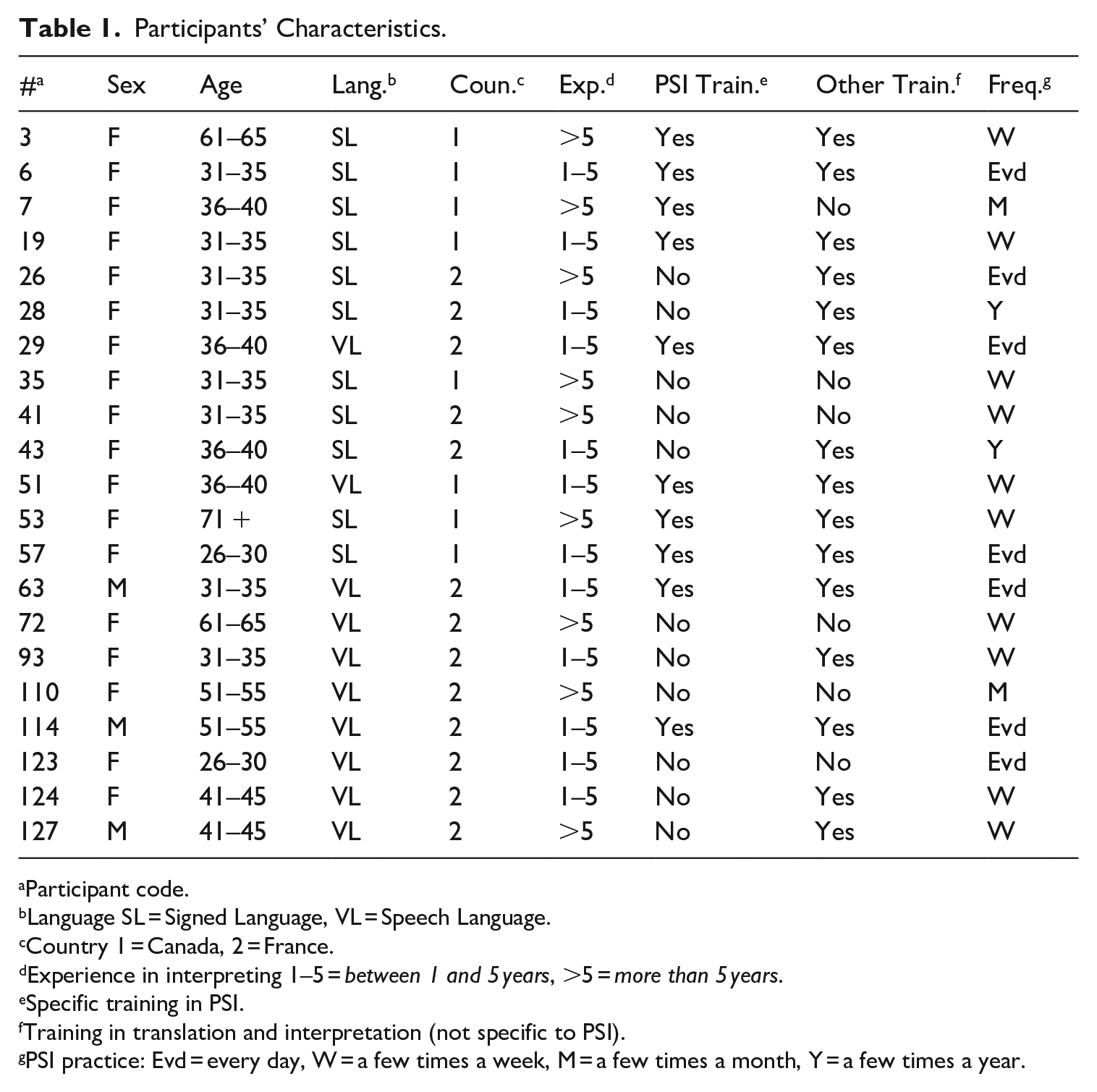
Twenty-one interpreters (18 women) responded positively to the invitation to explore their narrative further. For reasons of confidentiality, as the interpreting communities are small, socio-demographic information is given in such a way as not to identify the participants (Table 1).
Participants’ Characteristics.
Participant code.
Language SL = Signed Language, VL = Speech Language.
Country 1 = Canada, 2 = France.
Experience in interpreting 1–5 = between 1 and 5 years, >5 = more than 5 years.
Specific training in PSI.
Training in translation and interpretation (not specific to PSI).
PSI practice: Evd = every day, W = a few times a week, M = a few times a month, Y = a few times a year.
Most (16) are between 26 and 45 years old, and five are over 50. Thirteen of them work in France and 11 in sign language. In addition to the two sign languages, the participants interpret for 24 different languages (English, Arabic, Spanish, Serbian, Russian, Portuguese, Dari, etc.). Twelve have between 1 and 5 years of experience, the other nine have more than 5 years. Sixteen have taken at least one training course, sometimes leading to a diploma, in interpreting or translation, nine of them specifically in PSI. The other five report having had no training in interpretation or translation. Seventeen interpret frequently (between a few times a week and every day). The remaining four interpret from a few times a year to a few times a month.
3.2 Coding and analysis
The interviews were transcribed, anonymised, and verified by student volunteers from Université Laval, Canada. They were then subjected to a deductive thematic analysis (Braun & Clarke, 2006) following the elements of the theoretical frameworks of Positionings, Stances, and Efforts. The QDA Miner software (Provalis Research) was used. The coding was carried out by the third author, a psychoeducation master student interested in intercultural interventions including PSI, under the supervision of the other two authors, in an iterative process and collaborative effort (Saldaña, 2015) that included several meetings to discuss the coding and adapting it to the particularities of the corpus, thus allowing for a greater reliability (Richards, 2015).
The first author, a psychology professor specialised in qualitative methodologies and PSI, initially performed a case similarity analysis based on the coding. It was produced using QDA Miner. This analysis makes it possible to graphically show the similarities between different cases (interviews) in relation to selected codes. Carried out separately for the three theoretical models, it made it possible to visualise the way positionings (by type), stances and efforts were organised between the narratives, which led to a first categorisation. Then, each of the five categories obtained was discussed in a weeklong meeting by the three authors, the second one being a professor of sign language interpreting with extensive experience in practicing, researching, and teaching PSI. This discussion focused on the interviews themselves, which were reread on the spot, rather than on the coding, to verify the accuracy of the previous analyses, and, above all, the similarities between the interviews within the same category. In this process of interdisciplinary team rereading analysis, and reworking, which ensures trustworthiness (Drapeau, 2004), four categories were finally determined. They were also named and defined.
4. Results
4.1 Overview of the events
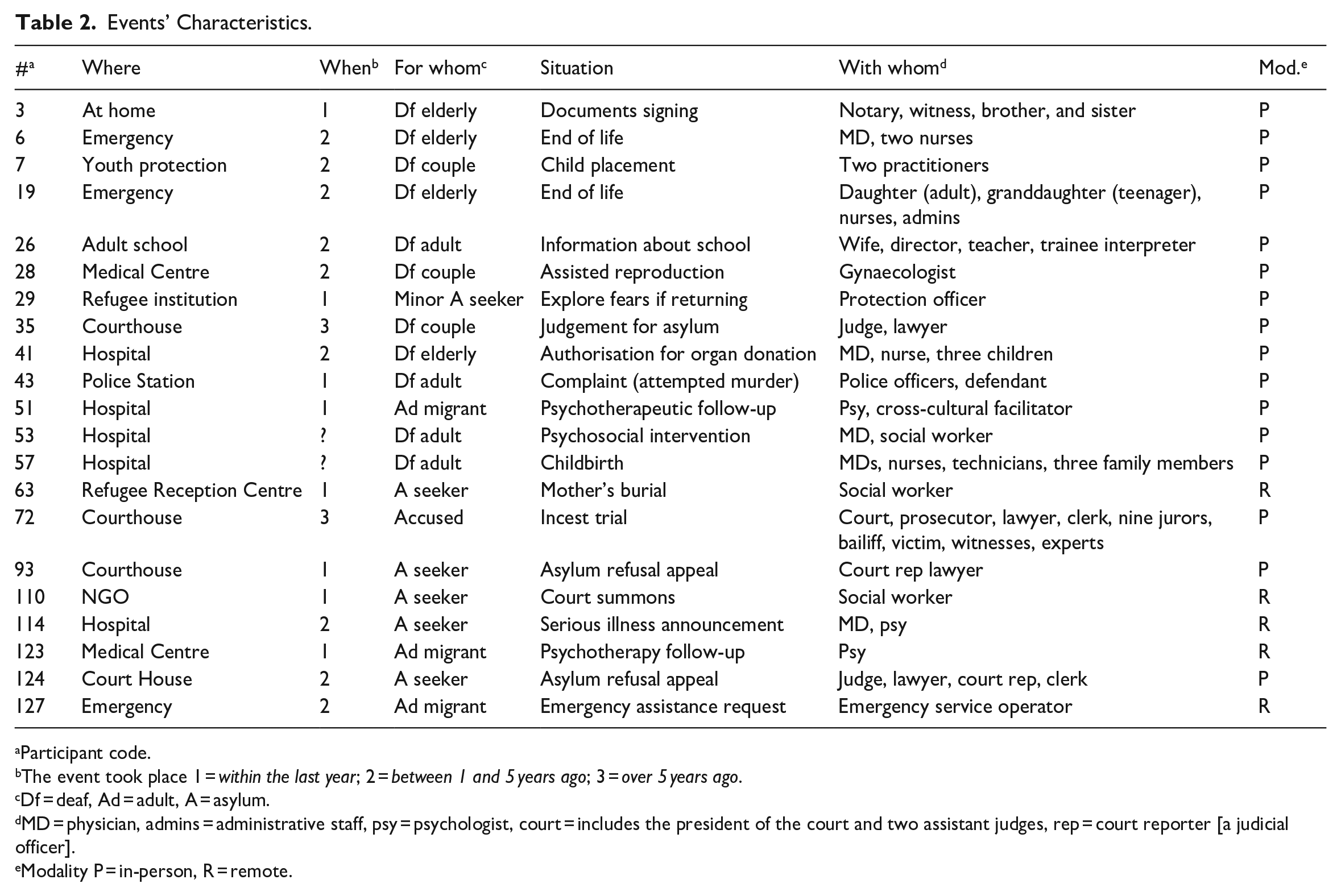
Table 2 presents the general characteristics of the events collected through the questionnaires and then further explored in interviews. Most of these events took place in judicial or medical settings. Only five took place over the phone. These remote interpreting situations involve the fewest protagonists. In addition to the interpreter, there is usually only the person needing the services (user) and the person able to provide the services (practitioner). In other cases, there are many protagonists besides the interpreter and the user, such as family members, several physicians, nurses, police officers, judges, or educators. In addition to the complexity of the situations linked to the characteristics described above, all these events are associated with a significant emotional charge for the protagonists.
Events’ Characteristics.
Participant code.
The event took place 1 = within the last year; 2 = between 1 and 5 years ago; 3 = over 5 years ago.
Df = deaf, Ad = adult, A = asylum.
MD = physician, admins = administrative staff, psy = psychologist, court = includes the president of the court and two assistant judges, rep = court reporter [a judicial officer].
Modality P = in-person, R = remote.
4.2 The coping strategies
Table 3 presents the four coping strategies according to the type of positionings, stance, and effort they involve. Most of positionings and stances and all the efforts are mentioned by the interpreters in their interviews. However, the analysis showed that some of these actions are favoured or more present than others depending on the event. In this sense, a strategy describes the main actions reported by the participant to cope with this situation, without excluding the possibility that other actions were present during the event.
The Four Strategies for Coping With Impactful Events.
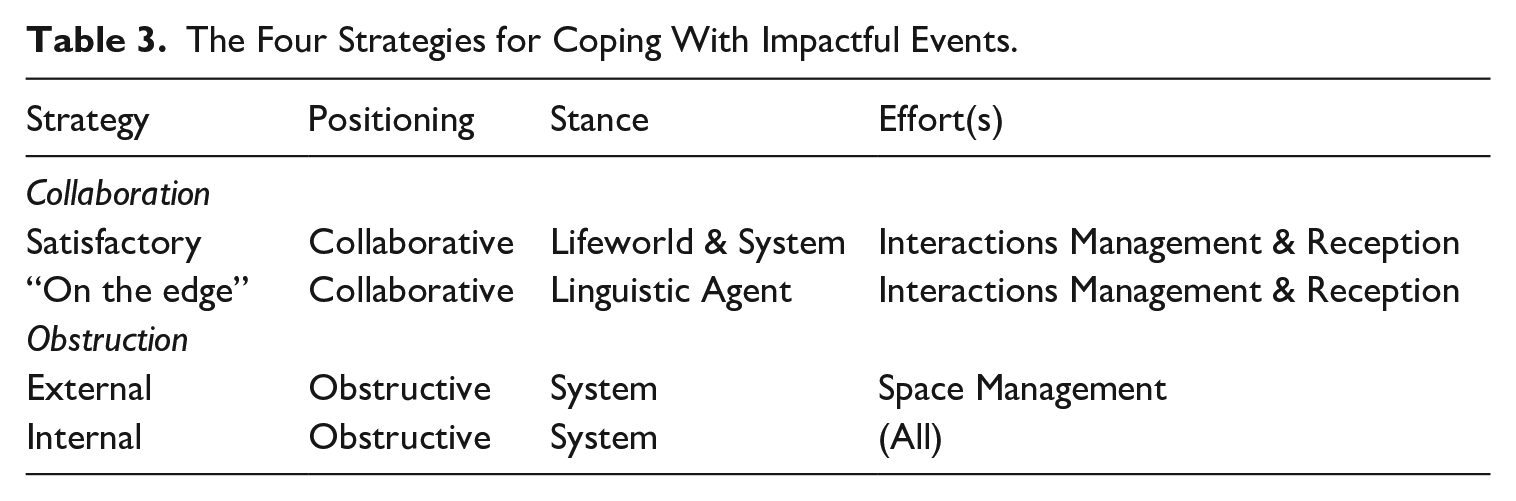
Two of the strategies are based on collaborative positionings and two on obstructive positionings. The collaborative strategies are distinguished primarily by interpreters’ stances, which oscillate between Lifeworld and System, whereas the obstructive strategies seem to entail a stance favouring the System. The efforts mentioned for the collaborative strategies are quite similar: Interactions Management and Reception. Among the events showing an obstructive strategy, some stand out for their over-representation of the Space Management Effort. This strategy is called external. In contrast, the internal obstructive strategy has a poorly differentiated set involving all Efforts.
4.2.1 Satisfactory collaboration
Events 3, 7, 26, 43, 53, 63, 114, 123, and 127 make up this category. The situations reported took place in a variety of settings: psychosocial (7, 53, 123), judicial (3, 43, 63), educational (26), and medical (114, 127). Interventions 63, 114, 123, and 127 took place over the phone, in the spoken language, and in France. Events 26 and 43 also took place in France.
Interpreters who report this strategy were able to satisfactorily overcome a difficult, emotionally charged situation. In terms of positionings, the interpreters are Active and Proactive, so that a relationship of trust with practitioners and users is established. For example, Interpreter 7 took the liberty of interrupting many times the exchanges to convey the delicate message of a child’s foster placement.
Researcher (R): Were you able to interpret everything that was said? 7: Yes. I was able to interpret, but there were many times when I had to interrupt one party or the other to say, “Just a second, I’ll take the time.” But yes. I was able to interpret the whole discussion.
In terms of stances, this strategy is deployed differently for in-person and remote interpretation. For an in-person event, interpreters tend to adopt a System agent stance. This means interpreters reinforce the System’s discourse, sometimes by adding text. This choice increases satisfaction during the interpretation, probably because protagonists feel that interpreters conform to their expectations, which improves the bond of trust, but also by preventing interpreters from regretting for not having intervened. Interpreter 3, during a notary signing session involving siblings with a deaf sister, took the liberty of explaining legal terms.
3: [. . .] sometimes the notary, he said words that the deaf person did not understand. Then, uh, you know, [the user] would look at me in a questioning way [. . .]. So, I would intervene in this way, saying: “Well, that, that, such and such a thing, that means that [. . .]” [. . .] in the code of ethics, we are not supposed to intervene, [but] when I see that it is going to penalize the person or that, you know that afterwards I am going to say to myself: “I should have said something.” There, then I regret it. I prefer to tell her at that time.
Remote interpretations lean more towards the Lifeworld. Indeed, three of the four interpreters (63, 114, and 123) report that, since they cannot see the people present during the interpretation situation, this leads them to actively immerse themselves in the users’ experiences. In this sense, the emotions experienced during phone interpretation situations can be more intense than if interpreters were on site. Situation 123 is a phone interpretation with a psychologist who works with trauma victims and a man who has experienced torture.
123: [. . .] I immersed myself . . . Maybe it wasn’t very wise of me, but I immersed myself in this person’s story, and [. . .] it made it easier to convey the message, what he wanted to bring to the psychologist. It was much easier because I put myself in his shoes. But the difficulty is that it affects you emotionally, and afterwards, you need a little time to come back to yourself.
This immersion is also true for the fourth remote event (127), which involves an emergency call, but the immersion is in the System. The operator asks the interpreter to obtain information and not to interpret a dialogue. In this sense, the interpreter is forced to do the operator’s work and thus acts as a System agent.
127: [. . .] the emergency services, when they are put through to you, they say: “Here, I have a person who speaks such and such a language, I need to know where he is and what is going on.” [. . .] And it is the interpreter who [. . .] chooses his own wording to try to get the information and as soon as the emergency services operator has this information, finally, that is all he is interested in. [. . .] And then, I would say, they don’t care how the interpreter does; all they want is the information.
It is particularly the Interactions Management and the Reception Efforts that are used, both in-person and remotely. Interpreter 26 was hired for a meeting between the director of a vocational training centre and a deaf man. However, this man did not speak [language] sign language, although this was the language mastered by the interpreter. Thus, the interpreter had to use to a large extent the Interactions Management Effort to organise an efficient dynamic between the many people present. She also made an important effort to understand the issues and convey them in creative and effective ways.
R: [. . .] were you cut off? 26: Not at all. I did interrupt a lot though, especially the director, in [language], to be sure to understand what he was intending to say, to be sure of choosing the right way to translate, knowing that in front of me, I had someone who didn’t speak the same languages as me at all. So, I really had to find the right issue to say the right information at the right time. Also, I gave him [the director] a lot of advice on how to phrase or write things so that it would be clearer. So, it was more me interrupting than the others interrupting me, they were really letting me finish my translations. Also, I sometimes did a lot of consecutive interpreting [. . .] since that allowed me to really grasp the information, to be able to repeat it in several ways to make sure it was understood.
In these events, there is a successful effort directly related to the emotionality associated with the situation. Interpreter 43 says she filters the stress transmitted by the police officer who is questioning a deaf woman suspected of attempting to murder her husband.
43: [. . .] it was her [the police officer] behavior that caused the stress. [. . .] I experienced the stress first and to make sure that she [the deaf person] understood me, as she was a person with whom we did not have the same language, I would re-sign much more gently, much more calmly, etc. So, she felt it less, because I was filtering a little bit.
4.2.2 Collaboration “on the edge”
Four of the five events in this category, 29, 35, 93, and 110, took place in judicial institutions. Event 41 took place in a medical setting. Event 110 reported an intervention over the phone. Event 35 is the only one that took place in Canada and in sign language.
The emotional charge is greater than with the previous strategy. Despite this high emotional load, interpreters manage to maintain a balance between their experiences and users’ experiences, hence the name “on the edge.”
With this strategy, interpreters are Active and Proactive in their positionings, so that communication between practitioners and users is optimised. Despite the presence of a strong emotional burden, a relationship of trust between practitioners and users can be maintained through interpreters.
Event 41 took place in a hospital with the adult children of a woman who will soon die, one of whom was deaf. They had to decide about donating their mother’s organs. In this excerpt, the interpreter expresses both empathy and vigilance.
R: Then do you understand what the children wanted from the meeting? 41: I think it was in stages. There was hope . . . [. . .] And once things were said in relation to that [mother’s impending death] it was another form of hope, but it didn’t leave room for their mom’s life. So it was, all at once within the same exchange, I think they went through different emotions [. . .]. It’s also accepting the person’s departure before they’re even gone by giving their consent [. . .] for an organ donation. So, I think there were a lot of steps and, behind that, thinking, “If I agree too, it’s a joy anyway, because it’s going to save people.” So, I think they went through a lot of emotions.
In terms of stance, the strategy involves a form of great fidelity to the text without opting for a System or Lifeworld stance. This seems to be a way to keep a healthy distance from the emotional charge.
The situation reported by Interpreter 29 took place in a judicial context, at the [refugee institution]. The asylum seeker was 16 years old and had been drawn into a prostitution network since she was 11 years old. The interpreter was moved, especially since the girl reminded her of her own daughter.
R: [. . .] Did you empathize more with one party over another? 29: Even though I felt a lot of empathy for this claimant, I didn’t allow myself to advocate for any position because it’s not my role as an interpreter to do that at all. [. . .] I can, at the limit, correct a word, an expression that was not well understood, explain them to put things in their place, but I don’t have the right to take a position for one side or the other. [. . .] I think I have remained neutral.
It is mostly Interactions Management and Reception Efforts that are mentioned by interpreters. In Event 35, the interpreter made a lot of effort to capture the words of a deaf couple who were there to receive the judgement of their asylum claim. She used three different sign languages and lip reading.
35: [. . .] at that point, the ability to listen was influenced because there, you ask yourself questions: “What is the sign?” [. . .]. For me it was fine, but I had to hustle. R: Was the lexicon in general understandable? 35: Yes. Well, you know, the lexicon in sign language, no, but the lip reading helped. Yes, it was understandable because they [the deaf couple] put a little bit of [sign language 2] words, a little bit of [sign language 1], a little bit of another sign language. So, it was understandable [. . .].
4.2.3 External obstruction
Four events relate to this strategy: 6, 19, 28, and 72. The first three took place in a medical setting and the last one in a judicial context; all of them took place in-person and in sign language, except for Event 72. Two of the events took place in France (28 and 72) and two in Canada (6 and 19).
Interpreters who report this strategy are faced with difficulties in their intervention, mainly caused by elements of the environment. These situations provoke frustration, distress, doubts, powerlessness, anger, and so on. Unlike the previous strategies, this one does not allow for a satisfactory resolution of the event.
If positionings are obstructive, it seems to be the consequence of circumstances beyond interpreters’ control, those who find themselves without room to use all their professional skills. These circumstances are, for example, clumsiness or impatient gestures towards users on the part of practitioners, or even more direct affronts such as racist micro-aggressions. Interpreter 6, who admits being partial, was called to the bedside of a deaf elderly who was living his last moments. The medical team wanted to know whether he wanted medical assistance in dying.
R: Were you more empathetic to one party over another? 6: Ah, definitely the patient. Because right now I was like, “Okay, but you can’t take his little nod and say . . .” You know, it’s kind of like me saying, “Myeahhh.” That’s kind of the [language] equivalent. [. . .] “Do you want medical assistance in dying? Myeahhh.” [. . .]. That’s it, so that’s why I said: “Well, the gentleman nodded a little, but I can’t really tell you anything more, I can’t confirm that the question was understood either.” [. . .] It was more difficult, . . . after that, the physician hit him hard on the thigh [the interpreter mimes hitting his own thigh]: “Sir! Sir! Do you want medical aid in dying?” [. . .] Poor man, in any case, it was not obvious.
In this strategy, interpreters tend more to a stance of System agent. The context does not allow them to enter users’ Lifeworld, mainly because practitioners are not interested in it or the circumstances do not lend themselves to it, despite the fact that it could be important. This can sometimes be explained by a time constraint, or even by the urgency of the situation. Being “stuck” in this stance leads interpreters to feel various negative emotions such as inadequacy, frustration, helplessness, or doubt. Interpreter 19 was called to the hospital bed of an elderly deaf woman. This woman was disoriented and seemed to be in a lot of pain. Before the interpreter arrived, the patient’s (teenage) granddaughter acted as interpreter, and other family members were present.
R: Generally speaking, how did the discussions go? 19: I wasn’t given any instructions on how to interpret. It was more like: “Ah, you are the interpreter. Ah okay, we’ll finally understand each other!” Then, at the same time, when I was trying to establish communication, nothing was happening, because the lady was not present as such. So, the staff would often repeat the same questions, speaking louder [. . .]. So, regarding the discourse, there was repetition, there was a lot of movement, and the staff members were talking to each other. So sometimes I was wondering if I should interpret. Usually I do, but the lady doesn’t even understand a simple question like, “Are you in pain here?” So, I thought, I’m not going to bombard her with information. [. . .]. So, it was a little confusing at first. “Who wants to talk? Do I let you [the patient’s granddaughter] sign? Do I interpret for you?” The parameters weren’t clear to me at first with the lady’s granddaughter. “Do I stay?” “Ah that’s okay, my husband is coming by later.” [Response from the deaf person’s daughter] Okay, what does that mean? Do you want me to stay? But when is “later”?
The Space Management Effort is particularly called upon in these situations. Indeed, “externally obstructed” interpreters are typically found in medical and judicial settings. In court, interpreters’ physical locations are predetermined and must be respected, leaving little flexibility of movement. In hospitals, on the other hand, interpreters must find an adequate place to establish communication between the patient and the practitioners, while leaving enough space for the latter to provide the necessary care, as reported by Interpreter 19.
19: So, they [the practitioners] had to be around her all the time in the beginning. So, it was back and forth . . . [. . .] they were often in front of me, I would say. Sometimes I was at the end of the bed because the two on either side were around the lady. So, there I was in the way. [. . .] you always feel like you’re in the way when you go into a hospital.
In short, interpreters who deploy such a strategy seem to do so despite themselves. Often, they feel conflicted between their personal and professional values, just as they feel a tension linked to the circumstances in which the event is taking place, without having the possibility of changing the course as they would like. This tension is not without emotional consequences for interpreters, as can be seen in the following example involving Interpreter 72 in a criminal court for an incest trial:
72: I was really offended because, during a break, the public prosecutor asked me [. . .] “Is that [incest] culturally common in the defendant’s country of origin?” “What. . . Excuse me?” [In an offended tone] Sorry, no, it is not common. I even gave the example of my grandfather who had ten children, seven of whom were girls, he was illiterate [. . .] and he never abused his daughters [. . .]. I answered very badly to the prosecutor, I even surprised myself, because it hurt me deeply [. . .].
4.2.4 Internal obstruction
This strategy includes three events: 51, 57, and 124. The events took place, in person, in a psychosocial (51) and medical (57) environment in Canada, and in a judicial environment in France (124). Sign language was used for Event 57.
As with the other strategies, interpreters experienced difficulties during their interventions, but these difficulties and their consequences seem here to be attributable to interpreters’ own behaviours. They do not necessarily report a greater emotional load, and sometimes positive emotions such as joy and pride, while some aspects of interpreting seem to diverge from recommended practices.
Positionings are obstructive. Interpreters’ attitudes do not help to create the link between practitioners and users and can even lead to mistrust.
In the following situation, a hospital birth, the interpreter knew her client, who was also a close friend. Consequently, she was overly familiar.
R: Other than feeling good during the situation, did you experience any other emotions? 57: Well, [. . .] there were some comments from the spouse that I didn’t like. So, I felt a little bit of anger. I even said to him, “You’re lucky you’re not my partner because I would have punched you in the face!” He was saying [to the patient] things like “Seriously, stop yelling at me! You’re hurting me because you’re squeezing my hand!” I was thinking, “I would like to see you putting a baby through your vagina, you know [angry tone].”
Interpreters are in System or Lifeworld agent stances but do not seem to understand that this is not the right one and that they could switch to the other, and still be professional. The following example concerns Interpreter 51 who had to interpret in the context of psychotherapy.
R: Did you feel you were advocating one point of view over another? 51: I don’t think I had more sympathy for one or the other. However, in this therapy, I see that the psychologist and then the patient are each speaking from their own perspectives, [. . .] and then it seems like they don’t understand each other. I understand them both. Sometimes, the psychologist asks a question and then I understand it and I understand why he asks it, and then I know what answer he expects, but I know that the patient is not going to understand that. I feel like [. . .] that for her, that question is not relevant [. . .]. Then, in fact, she often answers something else. [. . .] I am in the middle and [. . .] then I find that we are wasting our time.
Regarding the Efforts, none of them stand out as being more important. Probably the lack of a clear guideline means that all efforts are employed without any of them being used more effectively to improve the situation.
5. Discussion
The analysis of impactful interpreted events shows that interpreters use collaborative or obstructive coping strategies. Collaborative strategies seem to allow interpreters to overcome the consequences of the emotional burden associated with the event. On the contrary, situations involving an obstructive strategy seem mostly to leave interpreters with negative and unresolved feelings.
The satisfactory collaboration strategy involves interpreters of all ages and experiences. All but one (123) had at least some training in translation/interpretation. It should be noted that, for this strategy, in-person interpretations were all in sign language, and all but one of the events that took place over the phone fall into this category. The last remote event is found in the other collaborative strategy. For this second strategy, interpreters are mostly untrained and rather young, which distinguishes them quite clearly from the first strategy. It is worth to note that frequency of interpreting is not a factor that distinguishes strategies. Training and experience are considered protective factors for burnout and vicarious trauma among PSIr (Geiling et al., 2022; Lai & Costello, 2021). Interpreters who report an event involving the satisfactory collaboration strategy accumulate several of the protective factors in contrast to “on-the-edge” interpreters. Another important distinction between the two strategies is the lack of oscillation between Lifeworld and System for the “on-the-edge” strategy. This seems to demonstrate that this capacity to move from one universe of meanings to another already noted by Brisset et al. (2013), which other authors translate into a proactive neutrality (René de Cotret et al., 2021) or interpreters’ agentivity (Delizée, 2022a, 2022b), is fundamental not only to ensure good communication between parties, but also to cope with the intense emotional burdens that are characteristic of many interpretated situations. For the “on-the-edge” strategy, the demands on the various cognitive and emotional resources seem so great for interpreters that it becomes difficult for them to engage in either universe. The result is still satisfactory although to the limit of the resources available, which is in line with Gile’s (2009) tightrope hypothesis.
Three of the four interpreters involved in the events exhibiting an external obstructive strategy are rather young and inexperienced. The frequency of interpreting does not seem to play a part. The oldest of the four (72) reports an event that took place 30 years ago when she was young and inexperienced. During these events, it seems clear that strong external factors directed interpreters’ actions towards an unsatisfactory strategy to the point of leaving the situation with an unresolved emotional charge. Inexperience and a young age are probably some of the reasons why interpreters did not find the resources to cope more effectively with the situation (Geiling et al., 2022; Lai & Costello, 2021). However, it appears in these events that training was not a protective factor, as they were almost all trained. These events took place in emergency rooms, medical facilities, and courthouses. It is recognised that these are institutions (health and justice) where hierarchies are strong, and where questioning the decisions of those in authority is not within the reach of young interpreters who are outsiders to the institution, even if they are trained (Leanza et al., 2020). The lack of recognition of interpreters within these institutions is a recurring issue (Inghilleri, 2005; Koskinen, 2020; Pointurier, 2016). It affects interpreters’ coping strategies, emotions, and potentially their psychological health.
The internal obstruction strategy involves three interpreters who are also rather young, inexperienced but trained. Here again, the frequency of interpreting is not at stake. The difference with the previous strategy lies mainly in the fact that despite the assessment of the situation as unsatisfactory, interpreters continued to act with full knowledge of the situation, without strong external constraints. The reasons for this choice of strategy seem to be more specific to the interpreters than to the situation itself. Two explanatory hypotheses can be put forward. The first is that the strategy could be the result of a poor understanding and application of the deontological codes. Thus, the obligation of neutrality would be understood as the impossibility of making a proposal to help communication and would lead to the abandonment of all agentivity. This is, among others, what Darroch and Dempsey (2016) noted in their literature review. This is also a main point in Dean and Pollard’s (2022) discussion: even if trained, interpreters lack ethical reasoning abilities. The second would be a matter of personal choice (and misjudgement), as in Event 57. In this situation, the interpreter had made the choice not to remain in her professional role since she was also in the role of friend. In both hypotheses, it is a blurring of the boundaries of the profession that results in an unsatisfactory strategy.
The study shows that it is not only necessary to have a good training, which values interpreters’ agentivity and ethical reasoning abilities, but that it is also crucial that institutions that call upon interpreters, recognise the complexity of their role to enable them to use this agentivity. It would be advisable that these institutions and their agents also recognise the potential impacts of interpreters’ exposure to dramatic events, as they do for other practitioners.
From a theoretical perspective, the project has shown (if it has not already . . .) that in any act of interpreting, there is an emotional effort. Theoretical frameworks that identify the relational (Leanza, 2005; René de Cotret et al., 2021) or cognitive (Pointurier, 2016) dynamics at work in PSI only partially capture this. In the future, it would be wise to develop a nuanced understanding of interpretive dynamics that puts emotional issues and coping strategies on the same level as others, as, for example, did Koskinen (2020) in analysing translation and interpretation as affective labour, that is, work in which employee “is either in a face-to-face or voice-to-voice contact with clients, with the task of evoking particular emotions in them, and in which the employer manages the employees’ emotional conduct through training and supervision (Hochschild 1983/2003: 147)” (p. 29). Considering PSI as affective labour and requiring emotional effort should allow emotions to find a place in interpreting teaching as one of its constitutive elements. Interpreting is a form of human communication and therefore, necessarily, permeated by emotions.
This exploratory study highlighted the value of combining the three theoretical frameworks employed and opened perspectives on the validation of the four coping strategies identified and their characteristics. Indeed, in this study, it was the significant events that were the focus, rather than the characteristics of the various interpreting practices. Future research could focus on specific elements, such as context (health, education, etc.), modality (face-to-face, remote), or type (oral or sign language), and check whether the strategies identified here are found there, under what conditions and with what characteristics. It is also widely recognised and demonstrated that emotions, although universal in essence (Matsumoto & Hwang, 2013), are expressed and perceived differently according to cultural background. This could be another angle of research to develop: depending on the protagonists’ cultural backgrounds, and taking interpretation practices into account, do the coping strategies identified here still apply? Another line of research would be to consider psychological theories on coping and see if links can be made between these theories and the strategies identified here.
There are some limitations to this project. The first is the wording of the invitation that may have induced a (small) bias in the selection of events as it does not directly invite to recall an emotionally charged event. This formulation was chosen so that participants felt free to choose an event that was meaningful to them, in line with the definition of emotion. They then had ample opportunity to detail the emotions they felt in Phase 2 of the research, since many of the questions dealt directly or indirectly with the emotional charge. Nevertheless, some interpreters were more detailed in their recall of the emotional aspects of the event than others. As a result, some narratives are richer than others. This is at the same time a common challenge and the hallmark (as it shows the diversity of human experience) in qualitative research, especially when it deals with intimate phenomena and calls on the participants’ trust and ability to share this intimacy (Roulston & Choi, 2018). The second is that the material collected is a set of events selected and reported by interpreters themselves. This is a limitation in that it would have been necessary to verify systematically (a) the personal link the interpreter had with this particular issue (as for Interpreter 29 who sees the young girl she is interpreting for as her daughter) and (b) the accuracy of these events. For the later, this was not the objective. Interpreters’ coping experiences were the focus, and as such the former would have helped discuss the strategies. However, the study responds to the scarcity of interpreters’ perspectives on these issues as pointed out by Lai and Costello (2021). The last limitation is that we do not have a measure of burnout or vicarious trauma for the participating interpreters. Such measures would have complemented the analysis. This could be included in future mixed-methods research projects.
Footnotes
Appendix 1
Appendix 2
Acknowledgements
Our warm thanks go to the interpreters who sincerely shared their sometimes difficult experiences. We are also grateful to the student volunteers who transcribed the interviews and ensured the quality of the transcription. Finally, we thank Carrie Schipper, editor, for her work in editing the text.
Declaration of conflicting interests
The author(s) declared no potential conflicts of interest with respect to the research, authorship, and/or publication of this article.
Funding
The author(s) disclosed receipt of the following financial support for the research, authorship, and/or publication of this article: This project was made possible by the Fonds France Canada pour la Recherche (2019 competition, no award number).
Biographies
 ). His research interests focus on the activity of health professionals in a context of diversity and interpreted interaction. He studies public service interpretation along three axes: interpreted interaction itself, representations of the protagonists and training (of interpreters as well as people who have to work with interpreters).