



Abstract
This article sheds light on how conference interpreting practice has changed since the beginning of the pandemic in Austria by drawing on the sociological concepts “body” and “space” as analytical and conceptual categories, among others shaped by Lindemann and Lindemann and Schünemann. The results of this study yield insights into the different modes of spatial organisation for conference interpreting during the pandemic; the ways these different organisational settings impacted cooperation among interpreters; and the interpreters’ perceptions of these reconfigurations in space and bodily presence. The data, obtained through an online survey and interviews with in total nine conference interpreters in Austria, show that a range of organisational settings is possible when working (completely or partly) remote, all entailing their individual particularities. Among the observed settings were conferences held on-site with strict anti-COVID measures; “hybrid” settings where interpreters worked on-site with speakers joining online or vice versa; and remote interpreting assignments. In remote assignments, more communication was necessary before the conference, for example, to discuss handovers. Additional communication tools were resorted to, and interpreters preferred working together in one physical place, for example, to facilitate cooperation. However, they also saw advantages in remote assignments.
1. Introduction
Remote simultaneous interpreting has been used in the context of conferences since the 1970s. Among the first instances of its use was the UNESCO General Conference in Nairobi 1976, where the interpreters were not on-site but located in Paris, France. A satellite link with an audio-video quality equivalent to a standard television broadcast at the time enabled the connection (Ziegler & Gigliobianco, 2018). In the last decades, great technological innovations have been accomplished that allow for a faster and more stable connection and facilitate worldwide communication.
However, the potential of remote interpreting at conferences was not fully explored for decades until the COVID-19 pandemic made its implementation inevitable in the spring of 2020. Due to the far-reaching restrictions imposed by government measures to contain the COVID-19 virus, affecting both private and professional spheres, conferences had to be held and interpreted online to be feasible at all despite the obligatory restriction of physical social contact. Only a few weeks passed from the announcement of the disease to its official status as a pandemic, and the conference (interpreting) sector had to quickly adapt accordingly. This resulted in a changed working situation for a large number of professionals in the field and the need to react appropriately to the conditions. Conference interpreters thus had to come to terms with the pandemic and the resulting changes in working conditions in a very short time. Among these changes were different modes of spatial organisation of the conferences. This article aims at shedding light at these changes and their impact on conference interpreters in Austria by drawing on the sociological concepts “body” and “space” as analytical and conceptual categories.
Remote simultaneous interpreting is a topic of high relevance given its impact on many practitioners worldwide in the last few years but also the repercussions the pandemic will have on the field in the next years. Not a lot of research has been conducted in this area. Until now, most studies focused on the economic impact the pandemic had on interpreters and translators (see Buján & Collard, 2021; Hoyte-West, 2022; Iacono et al., 2021). This study focuses on the working conditions and the individuals working in the field. The data used for this article were collected in the summer of 2021, about a year and a half after the outbreak of the pandemic in early 2020. Due to the short time span of less than 2 years and the quick solutions that this challenging time demanded of the interpreters, this article will refrain from using the term (interpreting) “strategies” and instead will refer to adapted modes of behaviour and action.
Throughout this article, the different modes of spatial organisation for conference interpreting during the pandemic will be discussed. Subsequently, their impact on interpreters is explored, and their perceptions were addressed. The sociological concepts of body and space serve as the analytical and conceptual categories for this article. The aim of this article is to gain an insight into the different modes of spatial organisation for conference interpreting and, above all, to show the impact on interpreters and highlight their adapted modes of behaviour. As already mentioned, the object of research in this article is related to sociological concepts of space and body (Lindemann, 2015, 2016; Lindemann & Schünemann, 2020) in order to be able to address the shift from the professional to the private context caused by the pandemic. The second section is dedicated to this.
Initiated by quarantine orders, home office and home-schooling regulations, and general recommendations to stay at home, many people were constrained to pursue their work or education out of their own homes. Households formed new arrangements as the shift towards working at home encompassed a wide range of occupational and educational fields, making no exception for conference interpreters. In this context, it is particularly compelling to question what effects the spatial change had on the interpreters’ work and how they adapted their behaviour and actions to the new situation. Physical conditions, such as the individual’s body and self-perception, but also the space that surrounds it will be considered. To date, this perspective has been adapted only to a very limited extent in the field of interpreting studies, with limited studies referring selectively to spatial or physical phenomena (see Cooper et al., 1982; Creeze et al., 2015; Diriker, 2004; Eichmeyer, 2017). For this study, an empirical study of experienced conference interpreters in Austria was conducted, namely an online survey and interviews with individual interpreters in the summer of 2021. This will be explored in more detail in the third section, covering the empirical study design.
The fourth section sheds light at possible booth constellations and their impact on practitioners, presenting on-site, remote, and hybrid assignments in dedicated sections each. The fifth section presents different cooperation ways in the before-mentioned constellations. The data will be discussed in the context of this study in Section 6 which also acts as a conclusion.
2. Body and space
The human body constitutes a vital part of any (interpreted) communication, which leads to a multimodal understanding of interpreted communication. In this context, not only the audible but also the visible modes, that is, the physical or embodied resources of communication, are considered. When communicating, the interacting individuals have a variety of verbal and nonverbal expressive resources to choose from. These available modalities include, for example, gestures, facial expressions, gaze, and body pose but also the manipulation of objects, the constellation of the interactants in relation to each other, and their positioning in the space available, which is expressed by the proximity or distance of the participants to each other (Kinnunen, 2017). This might lead to the conclusion that all actors can make use of the same modalities when communicating. However, this is often not true for interpreters. For example, conference interpreters are usually seated in an interpreting booth from where they are typically not visible to the audience as the booths tend to be located in the back of the room. Therefore, conference interpreters cannot make use of modalities such as gestures or mimic with their audience. These types of modalities can only be used when communicating with their booth partners. The following subsections will shed light at the role of the human body in the context of (remote) interpreting and the space surrounding it.
2.1 Body
In recent years and decades, sociological disciplines in particular have taken a closer look on the human body. The sociology of the body is a comparatively young field of sociological research, requiring time to establish as such. The interest of sociology on the body increased in the 1990s, a period for which a “body turn”—also referred to as “somatic” or “corporeal turn”—could be identified. Before this turn, the body served as a research object due to the social, economic, cultural, political, media, and technological processes that occurred in earlier research (Hoffmann, 2018). Body and space are inseparably linked given that there is always space surrounding the body. This section will focus on the body while the next discusses the role and importance of (the body’s surrounding) space.
The performative aspects of body have increasingly been the focus of scholarly interest in the last two decades (Hoffmann, 2018). The focus lies primarily on embodiment, that is, on having and being a body, on owning and perceiving the body, but also on the associated social and cultural imprints and appropriations. In this context, most of the research in translation studies has either used video recordings as a method of data collection or focused on video-mediated communication and interpreting in dialog interpreting. Video recordings of embodied behaviour are a helpful way for researchers to collect data: the latest development of cheap and easy-to-use digital image-recording technologies enabled researchers to closely analyse multimodality in human communication (Keating, 2015). Studies on this matter are conducted on discrete aspects of visual semiotic modalities, for example, gaze (Kendon, 2004), gesture (Streeck, 2009), body, and space, as well as on interrelated modalities (Deppermann, 2013).
Within cultures, the body’s relationship to space and other people’s bodies is conventionalized to some degree. This is an essential resource for researchers attempting to comprehend the essence of communication and convey meaning within this situation. New digital communication tools, for example, web cameras used in video-mediated online communication, and digital interaction spaces, for example, video conferencing tools, have altered and are still altering habits and possibilities for multimodal expression. This also gives raise to new challenges for the integration of modalities. Most studies regarding multimodality are conducted within the field of dialog interpreting, and some factors may not be applied very much to conference interpreting. The same applies for the few studies focusing on body or space. This underlines the significance of the present study.
When bodies interact in space, they are expected to release information that can be used to infer important aspects of social relationships like participation rights, hierarchy, and roles; both in terms of how they relate to specific people and actions and how they are projected for the future happenings. Humans read the embodied behaviours of others to make assumptions about how they could interact in a variety of circumstances, possibly relying on only one multimodal interchange. Predicting the future and personal future actions is also explored in the notions of Lindemann and Schünemann (2020) as explored in the following paragraphs. Studies have noted that even when individuals are not consciously attempting to convey meaning, they “secrete semiotic material” (Goodwin, 1995), sending signals via posture, facial expressions, clothing, and other indicators that others continuously read. Interactants consider these semiotic discharges as holding significance, whether or not these assessments are verified. The same view is reflected in the axiom of Paul Watzlawick (1980) that “one cannot not communicate.” This axiom states that every behaviour is a form of communication. However, the present study focuses on conference interpreters who are usually working from within an interpreting booth, usually located behind the audience and therefore not visible for their audience. Thus, the voice of conference interpreters is the only form of communication with their audience. Remote simultaneous interpreting via a video link might in this case be a successful approach to expand the range of modalities available to the interpreters, as their video could be broadcasted in the video conferencing tool.
This article follows the theoretical framework proposed by Gesa Lindemann from the University of Oldenburg, Germany. As Lindemann’s approach is seen as the most fitting for this research purpose, the author will use her framework in its translated version in the terms proposed by Lindemann and Schünemann (2020).
When action, interaction, and communication are understood from a bodily theoretic perspective, social actors are understood as “embodied selves.” Lindemann and Schünemann (2020) describe the following notions:
(a) An embodied self experiences itself here/now in relation to its environment.
(b) It perceives its environment and anticipates a future with concrete relevance for the current situation. This future is embedded in a broader future horizon.
(c) The embodied self is less a subject perceiving its situation from a distance and more a self experiencing itself here/now as affected by the events in its surroundings.
(d) At the same time, the self mediates between its perception of its surroundings, its experience of its own condition, and the expected future by relating its behavior and actions to its environment.
(e) Excentric embodied selves do not exist in a purely immediate embodied way in relation to their environment; their relationship to it and to themselves is rather mediated by technology and symbolic-institutional structures (Lindemann & Schünemann, 2020).
This article will henceforth refer to the embodied self and the five notions presented previously. The relation between the embodied self and it is here/now is especially relevant for this study, as it aims to shed light at the inference of professional and private life when working from home; an environment and circumstances that largely differ from working in a booth. Lindemann and Schünemann (2020) clearly attribute great importance to the environment of an embodied self, underlining that this framework is highly appropriate for this study. In the following section, the embodied self and the space surrounding it will be further explored.
2.2 Space
The importance of the (socio-cultural) environment, that is, the physical space in which interpreting takes place, and its influence on the interpreters and their work only slowly moved into interest of the field of interpreting studies. For example, Diriker (2004) points to the physical space in interpreting booths and the space surrounding the interpreters in the study she conducted. She related her findings, as well as other spatial environmental factors, to the interpreting performance of the conference interpreters that participated in her study. One of Diriker’s interviewees pointed out the creaky floor in the booth and described how it was disturbing their work. Another participant concluded, “After all, the headset and even the chair have an impact on my performance” (Diriker, 2004, p. 68). This quote clearly suggests that the spatial environment is a crucial factor for the work of conference interpreters.
Space can also be understood as a result of the relationship between the bodies in motion, for example, in relativistic views. Space is thereby created as a process through action, placing particular emphasis on aspects of relationship and action. The physical-material elements of space are not given priority roles, or as Henri Lefebvre (1991, p. 30) puts it: “(social) space is a (social) product.”
Following the framework proposed by Lindemann and Schünemann (2020), it is also essential to shed light on the space surrounding individuals. As they explore in their five notions, the embodied self perceives its environment and draws information from it, for example, in relating its (future) behaviour and actions to its environment. However, they also underline in their fifth notion that the relation of the embodied self and its environment is mediated by factors such as technology. This holds especially true for remote interpreting.
Following the approach proposed by Lefebvre (1991), media can be regarded in the context of remote interpreting as a space created through the interaction between conference interpreters, participants, speakers, and all others involved. Their participation is enabled through the media, acting as an extension of their individual body. In this sense, space may be considered a placeholder for the relationalisation of human bodies. Werlen (2015) concludes that media act as a mediating instance, allowing in the absence of one’s own body to experience social interaction in physical separated spaces. By representing an extension of the body for relating to objects by means of electronic transmission over distance, media assume an intermediate role. Thereby, media communication can enable an extension of current and potential ranges to global dimensions, enabling real-time communication across physical distance. Lindemann (2015) refers to the increasing interweaving of the analogue and media worlds as the emergence of an “existence,” initiated by the construction of a digital space. Lindemann’s concept describes the increasing entanglement between the existence in our physical world and that in the medial space.
Lindemann (2015) also introduces the concept of digital space-time that corresponds to this digital space in the dimension of time. Digital space-time is abstracted from the day and night rhythms or the seasons of the physical environment and, moreover, is independent from the present and/or any forthcoming relation of the embodied self and the environment. Digital space-time is transformed into a matrix in which every existence is permanently integrated according to digital space-time. This matrix includes the world in its present state as well as the world of real-time recorded events.
Furthermore, the embodied self is dissolved into a multitude of starting points, enabling the classification within a network of other bodies and entities. The embodied self is dissolved into a multitude of starting points for integration into the network with other social actors, transmitting only fragments of information and knowledge. Through these points, the embodied self is placed in social relations by technology. Consequently, social interactions are enabled to take place in digital space-time and thereby in medial space. This meets Waldenfels’ (2010) demand of place and time that enable the existence of the embodied self. Lindemann (2016) also emphasises the perception of the embodied self and the relation to its environment that has an impact on the embodied self.
As explored above, the embodied self experiences itself here/now and becomes aware of its environment. For simultaneous interpreters, this means they experience themselves here/now in relation to their environment, that is, in the case of on-site simultaneous interpreting in an interpreting booth. For remote simultaneous interpreting, a variety of possible environments exist for interpreters, as communication can take place across the physical distance when using real-time media communication tools (Werlen, 2015). The physical locations of the interpreters in remote interpreting might be separated from each other by a significant physical distance from the other participants and interpreters. However, all conference participants, including organisers and interpreters, are in a medial space in which they can participate in the communication with the other participants. All of them are in front of their computer, in their here/now, despite differences in local circumstances such as time of the day, which may differ for each individual. This phenomenon arises from digital space-time. Participating is possible from almost any location; a stable connection and a quiet working environment are a few examples of the small number of conditions for the interpreters’ location (Lindemann, 2016).
As medial space is ambiguous, being a product of action and communication, it shapes itself variably on the basis of technical conditions and changing modes of production and aesthetics (Hoffmann, 2018). The embodied self thus reacts to all that it experiences in the medial space. In the process, it is assigned several tasks that can be particularly challenging, especially in the context of remote simultaneous interpreting: Additional to the “usual” tasks of conference interpreters, remote interpreting involves supplementary activities and responsibilities resulting in a higher demand of mental resources, which will be explored in Section 4.
In multimodal interaction analysis, the concept of space refers to the physical environment in which the interpreted interaction takes place but also to the abstract interaction of space that is created when the interacting participants use the space to communicate in a certain way, as is the case in an interpreted interaction (Schmitt & Deppermann, 2007). The interaction space, in this context, (e.g., the conference with its booths or the online interpreting platform) needs to be created before the verbal interaction can begin. Following Schmitt and Deppermann (2007), the space is not only a condition for the interaction but also a result of the initial interaction, created during interaction (see also Hausendorf et al., 2012). All participants in the interaction being physically present at one physical location forms a different basis for the communication situation from that in cases where one or more of the people involved are not on-site but connected via video or telephone with their bodies only virtually present. However, this scenario is comparable to conference interpreting, where the interpreters work in a booth and do not have direct contact with the other participants expect for their booth colleagues (Kinnunen, 2017). Thus, there is already a certain physical distance for the interpreters in their booths from their audience during on-site conference interpreting.
3. Empirical study design
The study was conducted in the summer of 2021, about one and a half years after the outbreak of the pandemic. The author contacted 20 active conference interpreters in Austria individually via e-mail asking them to complete the online survey and whether they would agree to an additional interview with the author. Over a period of 4 weeks, the author was able to collect answers to the survey from nine practitioners. All the participants in the survey had been working as interpreters for more than 15 years when the study was conducted from June to August 2021. Table 1 provides an overview of the participants’ profiles.
Demographic Profile of Participants.
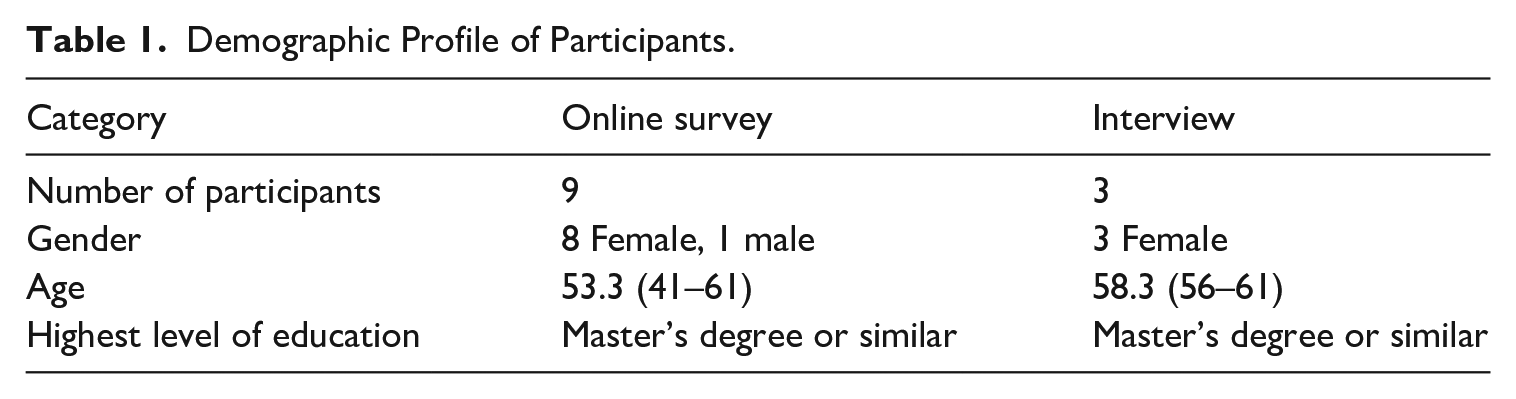
The participants completed a survey consisting of six different thematically organised groups of questions. The first set of questions centred on the interpreters’ experiences with remote interpreting, asking whether they had done remote interpreting assignments before the pandemic, if they had learnt about the use of remote interpreting tools during their education, and if they had taken training classes since the outbreak of the pandemic. The next set of questions focused on interpreting on-site during the pandemic, investigating, for example, the circumstances and working conditions. The following set of questions centres on remote interpreting via a video link, and the subsequent on telephone interpreting. All three of these sets of questions were only displayed for the participating interpreter, if they checked “yes” in the first question asking if they had worked in such a conference mode. The fifth set of questions focused on aspects of body and space in interpreting and consisted mostly of open questions, whereas those in the first four sets of question were mostly of the multiple-choice style with the possibility to add personal answers. The sixth set of questions aimed at collecting demographic data of the participants, as shown previously.
Three of the nine interpreters agreed to participate in an online interview with the author for approximately 30 minutes each. The author set up individual interviews with the interpreters and sent them the link for the online meeting room a week before the interview, along with a consent form. All interpreters signed the form before sending it back to the author who kept them for a certain period of time.
The interviews allow for a triangulation of the data and a deeper understanding of the interpreters’ experiences and perceptions. The interviews were recorded and transcribed, with parts of the transcripts then being regrouped under the following categories: (a) challenges in remote interpreting, (b) interpreting on-site with anti-COVID measures, (c) consequences of physical absence, (d) visibility, (e) perspective. In a separate column, the author rephrased the main points raised by the interviewees in an attempt to obtain a certain generalisation of the data collected in regard to the categories mentioned previously. This allowed the author to select the relevant parts and information from the transcripts for the research purpose. In this case, the data relating to points a, b, and c were regarded as providing meaningful insights and therefore chosen to be presented in this article.
4. The possible pandemic booths and their impact on interpreters
4.1 On-site
Especially in the beginning of the pandemic, conferences were rarely held on-site due to restrictions imposed by governments worldwide. After the first lockdown was lifted, conferences were—in some places—slowly moved back from online settings to being held on-site, respecting the imposed safety measures. This holds true for conferences in Austria, as confirmed by the interpreters participating in this study. This section will focus on on-site conferences and—if applicable—the anti-COVID measures that influenced the interpreters and their work.
One participant stated that she had been working in conferences under the same circumstances as before the pandemic in the summer of 2020. At that time, only few anti-COVID restrictions were in place in Austria. The interpreter worked together with her colleague in a booth; no negative COVID test results, masks, or other anti-COVID measures were mandatory at the conference venue, neither for the interpreters, nor for the participants or speakers. However, she underlined that this was only the case for a few weeks, before more severe anti-COVID measures were again imposed in Austria in the late summer of 2020. Throughout this study, this was the only mention of working in prepandemic circumstances at on-site conferences.
Especially before vaccinations were available, the interpreters had to provide a negative COVID test result, not older than 48 or 72 hours at times. One interpreter has shown herself particularly stressed by this obligation, stating that she is “always a bit nervous before interpreting” and that taking a COVID test the day before the conference or even the same day added to her stress level. She mentioned the uncertainty of obtaining the result in time and expressed with relief that ever since being vaccinated, she did not have to show a negative test result. From her statement, it can be clearly seen that some anti-COVID measures added further stress to the practitioners, even before actually starting their job at the conference.
Further anti-COVID measures imposed at conferences that were mentioned by the interpreters in the survey are the following: no food or drinks provided at the venue, no headphones provided, disinfecting the equipment provided before and after interpreting, wearing masks at the venue. One person also stated that they had to wear a mask inside the booth when interpreting, which was “very disturbing.” All the participants stated that they worked at least once alone in a booth, with their colleague sitting in another booth. In this case, the interpreters preferred having their colleagues in a booth where they could have an unobstructed view of each other. This was explained by the need to coordinate turn-taking between the individual interpreters. They would use body language and visible gestures to illustrate the other person that they would like to hand over. This of course demanded communication beforehand to agree on certain gestures in advance. If the interpreters were sitting in booths next to each other, they sometimes communicated by tapping softly on the glass between the booths to indicate the need for handing over or to get their colleagues’ attention for other purposes. In the context of the proposed theoretical framework, one could argue that interpreters are used to use more modalities in their communication with their booth colleagues than with their audience and would, therefore, make the effort to keep as many modalities when communicating with their booth colleagues; in this case, allowing eye contact or the possibility to tap on the glass between the individual booths.
However, it was not always possible for the interpreters to see their colleagues or to have them sitting next to each other. In these cases, the interpreters used the same communication ways as if one or both of them was/were not physically present. These findings will be presented in the following section, focusing on remote and hybrid modes of spatial organisation for conferences.
Not all conference participants and speakers were always present at the venue. Different interpreters stated that some conference participants and speakers were not present but instead participating online, resulting in a hybrid conference setting. However, as the interpreters were still working on-site, the author argues that this setting can be regarded as “on-site” in the context of this study, the most significant difference being in having a video and audio link to the speakers instead of seeing them from their booths and hearing them via an audio link.
4.2 Remote
This section will focus on remote interpreting, both telephone and video interpreting. Telephone interpreting is considered the oldest form of remote interpreting, as it was already considered a possible interpreting option in the middle of the last century and has been used in health care and police settings since the 1980s and 1990s (Pöchhacker, 2004). Braun (2004) describes interaction via video conferencing as synchronous technically mediated interpersonal communication. This type of communication has already significantly influenced communication processes in numerous domains. Videoconferencing brings many advantages such as low-cost and rapid worldwide accessibility.
Three of the nine participants interpreted via telephone, all of them in consecutive interpreting settings. Six of the nine interpreters stated that they worked via video interpreting; all six stated that they were interpreting simultaneously and four also consecutively. This ratio, that is, that only one third of the participants interpreted via telephone, reflects the scientific literature and research on telephone interpreting in conference settings which concludes that in most cases of remote interpreting in conference settings, interpreting via a video link is preferred to telephone interpreting. The present study could also only gather a small amount of data, which will be presented below before exploring data gathered on video interpreting.
All three interpreters stated that they worked alone on the telephone interpreting-assignment; therefore, no communication between individual interpreters was needed. The participants were overall satisfied with telephone interpreting. The interpreters used a smartphone and a tablet or notebook for their assignment; however, being responsible for the technical equipment was an additional stress factor for the participants. Beforehand, they ensured a quite working environment by taking certain measures, for example, informing their family. The participants saw advantages in telephone interpreting assignments, for example, not having to travel and wearing comfortable clothes; arguments that were also raised in the context of video interpreting which will be explored in the following section. In general, it can be concluded that in the context of this study, video and telephone interpreting are very similar. However, the fact that telephone interpreting was only used for consecutive interpreting brings along certain differences, for example, that the interpreters were not working in teams, and therefore, no additional ways—and tools—of communication were needed.
A distinctive characteristic of video interpreting is the absence of direct eye contact. As Braun (2004) explains, most cameras are located at the top of the screen, while the transmitted image of the interlocutor usually takes up most of the screen. When listening and speaking, people tend to look at the other person’s face, that is, at the screen itself, instead of looking directly at the camera. The positioning of the video recording device thus results in a viewing angle that does not allow direct eye contact. The AIIC (n.d.) recommends in its Distance Interpreting Recommendations that speakers, like interpreters, look into the camera instead of the screen to return eye contact.
The participants were not satisfied with video interpreting: One person chose the option “very displeasing,” two “rather displeasing,” and three “neutral” to describe their experience. The data clearly suggest that the general dissatisfaction of the practitioners stems primarily from having to bear the responsibility for all technological matters, collaboration between the individual interpreters and factors of uncertainty such as background noise, both from the interpreters and their colleagues, as well as from the participants and the speakers. The interpreters reported that the sound quality of the speakers participating online was often poorer than that of the speakers present at the venue, making it more challenging for them. One interpreter also mentioned that “people speak faster online” for different reasons, which also adds to the difficulty of simultaneous interpreting.
In the survey, the author asked the interpreters in which spatial settings they had worked since the beginning of the pandemic. The interpreters could choose more than one answer; the total count of answers given is therefore higher than nine and amounts to 19. The following answers were collected: Six persons worked from home; three in their office outside of their homes; one in a translation/interpreting agency; one person at their colleague’s house; two at their colleague’s office; four at their client’s office (not where the conference was organised); and two elsewhere, which was not specified by the participants.
The interpreters were also asked during the survey to add up the number of spatially separated locations of the conference participants (interpreters, organisers, participants, and speakers) and to then indicate the total number of locations. All the interpreters chose the answer “3 or more.” This leads the author to conclude that no triad of spaces can be observed based on the different roles of the actors involved (interpreters, organisers, participants, and speakers) but that the communication network is much more complex and involving many different embodied selves and their individual spatial environments.
The modalities available in video interpreting were mentioned previously. Video interpreting allows the interpreters to use other modalities, for example, facial gestures and expressions via the video link, compared with just their voice, as it is usually the case in interpreting booths. However, all the participants stated that their cameras where either switched off all the time or only activated in the beginning and end for a short presentation of the interpreters or when the organisers thanked them. Several interpreters stated that the client specifically asked them not to turn on their cameras, some of them even included something along the lines of “to ensure a better transmission of the data” as explanation. One interpreter also added, “Who would like to see sweating interpreters.” This suggests that this interpreter would not like to be seen while interpreting and feels more comfortable in their anonymous working environment, which is largely similar to working in a booth.
The study also aimed at shedding light on the effect of remote interpreting on the level of concentration of the interpreters. When asked how the six interpreters would rate their concentration and distraction during video interpreting compared with working in a booth on-site, one person said they were much more concentrated working via a video link. One person reported being a little more focused. Three people reported being a little more distracted, and one person stated being “much more distracted.” The data clearly suggest that cooperation with the other interpreters was a major source of distraction; this factor was mentioned five times, making it the most frequently mentioned reason. The background noise of the speakers was also a significant source of distraction, as was the distance from the conference proceedings and feeling tired more quickly than when working on-site. Two participants mentioned being distracted from interpreting when working with a digital device. The presence of their family in the next room as well as the unfamiliar working environment, for example, at home instead of in the interpreting booth, were both mentioned twice as distracting factors. Interaction with the speakers and the interpreters’ own background noise were both mentioned once. Two people added their own reasons for feeling disturbed when they were video interpreting; the answers being “sound quality of the participants” and “taking care of the technical equipment on my own.” Generally, the participants felt “a bit more distracted” because of the following reasons: “open office space,” “not separated from the rest of the flat,” “doorbell,” “people passing through,” and “dog,” as well as “because you also have to keep the technical side in mind.” The person who was “much more concentrated” explains this as, “You have to work more concentrated simply because of the sound and the technical aspects.” In summary, collaborating with other interpreters from a distance, the technical components as well as the spatial environment represent significant sources of distraction. However, one person felt that these possible sources of distraction led to them working more concentrated. This underlines the individual perception of embodied selves in their individual here/now and the challenges and advantages this environment brings with it.
Greater effort when interpreting via video compared with interpreting on-site was also mentioned by the participants. The interpreters also felt more stressed due to the small screen and the need to have many tabs and windows open at the same time. The participants stated being exhausted more quickly. This phenomenon can be explained by the additional stress factors as mentioned above. The data collected indicate that the interpreters reacted to this accelerated fatigue by reducing individual interpreting time by 5-10 minutes, resulting in an absolute interpreting time of 20-25 minutes before handing over to their colleagues to ensure high-quality interpretation.
While this section focused on remote interpreting, the next will shed light at hybrid forms which are, to some extent, similar to remote settings, especially regarding communication between interpreters, for example, when one or all the interpreters was/were working remotely.
4.3 Hybrid forms
Not all mentioned modes of spatial organisation for conference interpreting during the pandemic could be clearly categorised as “on-site” or “remote.” In some cases, as will be explored in this section, organisers or the interpreters themselves opted for hybrid settings. The author categorises all settings in which one of the parties involved, for example, one or several interpreters but also one or several speakers, as “hybrid.” In this context, participants often referred to working in a “hub.” An interpreting hub replaces interpreting booths usually found at conference venues when interpreters work in locations where no booths are available. This includes conference venues without booths but also locations outside of the conference venue. The participants mentioned the term “hub” to refer to the client’s offices other than conference venues; a translation/interpreting office or also “private hubs.” This means that the interpreters worked together in one physical location even if the conference was organised to be held entirely online. It can therefore be said that working on remote interpreting assignments is not limited to individual, private spaces, and interpreters sometimes form their own hubs, where interpreters work in the private spaces of their colleague or invite them into their personal space. This clearly suggests that there is a variety of possible here/now constellations and spatial influences among the participating interpreters. In this section, the possible settings that were found in the study and their impact on the interpreters will be discussed, focusing mainly on interpreting hubs as most other hybrid settings are, in the context of this study, covered in Sections 4.1 or 4.2.
In remote interpreting assignments, the participants worked at the client’s office, from a translation/interpreting agency or together with colleagues at their homes or personal offices. The survey particularly addressed this form of spatial organisation by asking if the interpreters met up with their colleagues to interpret at one location, even though all the interpreters were connected individually to the conference via a audio/video link. In total, six interpreters answered this question, three voting “yes” and three “no.” Four out of the six interpreters provided an additional comment explaining their answer. The following comments were given by those voting “yes”: (a) better contact between colleagues; (b) because it simply makes the work easier (noting down numbers, names, easier handover); (c) personal preference, due to the possibility of mutual support and the existence of redundancy. One person also commented why they voted “no” and never met up with their colleagues: (a) was not planned and (b) different places of residence. Thus, working in a hub was seen as advantageous by half of the participants. However, working in a hub was not an option for all of them; in some cases, they and their colleagues did not live in the same city or they did not work at the same physical space for other reasons that were not collected in the survey.
Working in hubs was also addressed in the interviews. One interviewee expressed great satisfaction regarding working in a hub, saying that it worked well because all interpreters were sitting in a booth. This suggests that it was not a private location but a location with interpreting booths. This interviewee also reported that a client provided her and her colleague with rooms at the company’s headquarters. There were no booths, but the interpreters worked in vast conference rooms, physically and spatially together on site. The interpreter expressed great satisfaction with working in one physical room, “especially if it is a long day of interpreting.” She added that working on-site had—in this case—the advantage of a provided technician: “That was relieving, I could sit back, the technician set it up and it was done.” (Interview conducted and translated by the author, 2021). One of the interviewees stated that she had made her own office space available to form a private hub: “Because my office is very spacious and my internet connection is very good. My colleagues would come over—if possible—and we would try to sit next to each other and interpret.” (Interview conducted and translated by the author, 2021).
Especially in the context of this research, the inference between private and personal space is highly relevant. The interpreter, who stated that she was making her office available for forming a private hub, did not see any interference between her private and personal space, explaining that these spaces had in her professional life always been physically close but still separated: […] I ran my company from my house from the very beginning. No matter where I lived, I have always worked from home, I also ran my translation agency from home. I always had to step away from my private space, in this case physically one floor down, that’s where my office is. That has always been separate […]. (Interview conducted and translated by the author, 2021)
The interpreter underlines that there is a certain physical distance between private and work spaces, even if both are in the same building. In this specific case, her office is located on another floor in the same house. This shows that the interpreter is well aware of a possible interference between private and professional life and takes active measures against this interference, not only since the outbreak of the pandemic and working more from home but—as she states—“always.” A certain physical distance between her working space and private space can be observed in this example. Despite having worked out of her home for most of her professional life as an interpreter and translator, she stated that completing remote interpreting assignments from home was a lot more stressful than working at the conference venue. For the interpreter, having to bear the responsibility of a stable internet connection and having to assure that all devices (e.g., laptops, headsets, microphones) used during the assignment were working was a major additional stress factor. However, she stated that when other interpreters came to her house to work with her, she experienced less stress as there were more alternatives, for example, for technical equipment. The space created by those present together has an impact on each individual person and thus also on their professional activity. In the case of the interpreter and her colleagues, they also bring these particularities of their personal here/now into the medial space in which they work. Building on the assumptions of Schmitt and Deppermann (2007), the interpreter’s office, which she provides as a hub, is first the physical working environment, the office space on a lower floor, where the abstract interaction space with the other interpreters, but also with the rest of the conference participants, is subsequently created. This space is thus created together with the interpreter’s colleagues and eventually shared when interpreting. As Kinnunen (2017) also noted, the working circumstances and conditions are different when the interpreters work together in a hub, as opposed to the interpreters all being in separate locations and constructing this space through an online medium, all of them being in different spatial settings with their individual characteristics.
The results of the survey elaborated previously also confirm that forming a private hub at home was popular among participants. They mentioned easier communication between the interpreters, which was enabled by direct possible communication without (additional) online communication tools or devices. In addition, the interpreters could use the modalities they are used to when working together with their colleagues in a booth. However, a booth is a more neutral working environment than the hub in the private home office of an interpreter, and different other factors might influence their work. The next section will explore possible cooperation ways in remote or hybrid settings.
5. Cooperation in the different modes of spatial organisation
Both in the survey and in the interviews, turn-taking, that is, handing over from one interpreter to the other, was seen as the biggest challenge. However, the data collected suggest that the interpreters were able to overcome these difficulties. In the survey, the participants were asked to rate the quality of the cooperation in remote interpreting assignments. The following answers were collected in open-ended questions with text boxes, each answer once if not stated otherwise: “Excellent”; “Good”; “Very good” (2x); “If the connection held, fairly good, often problems with the relay channels and during handover”; “Good, but even with remote interpreting assignments I strongly prefer to work with the colleague in the same place.”
This suggests the interpreters found the cooperation on site to be better than that via a virtual connection but that they were overall satisfied with working together with their colleagues, regardless of the spatial organisation. For on-site assignments, the interpreters preferred working together with their colleagues in one booth. If this was not possible, they opted for booths located next to or across from each other to communicate using acoustic or visual signals, as explored above. If this was not possible, they relied on the same communication methods as they did during remote assignments, for example, instant messaging tools as explored below. When working in a hub, the interpreters used the same ways of communication as in on-site assignments as they were located in the same physical location. Working in a hub has therefore a similar spatial distance than working on-site in booth and allows for similar modalities being used when communicating with other interpreters.
Regarding remote assignments, bigger spatial distance can be observed, due to interpreters not working in one physical location and therefore having to use alternative ways to communicate as the interaction space is not directly created by individuals in the same room but via media. In this context, the participants reported initial difficulties that were solved by the time of the interview, explaining that they found a way to hand over so that nothing gets lost. One participant explained the solution she had found with her colleagues, stating that they use instant messaging services like WhatsApp to communicate and agree on the turn-taking before the conference: If immediately after the last word of the speaker or if you interpret the presenter who is saying a few words or if you interpret the questions. It needs to be agreed upon in advance because we can’t hand over so spontaneously. You can no longer say that it’s too much for you and that your partner should take over. (Interview conducted and translated by the author, 2021)
The interpreter states that turn-taking has to be discussed before the conference, and that is not possible to be as spontaneous as it is when sharing a booth. She also explained how turn-taking took place: In the last five minutes before the hand-over, you keep a close eye on the microphone symbol. The moment you hand over, you send an agreed codeword via WhatsApp. To keep it as short as possible, I just texted “you” to a colleague in Vienna with whom I frequently work. In the last five minutes before the handover, you watch what’s happening on the screen closely, you look at your mobile phone, with certain platforms it also works very well in the chat. But some didn’t work with chat. Most of the time we had three or four devices: one notebook for the presentation, one for interpreting and one for internal communication. (Interview conducted and translated by the author, 2021)
Here, the additional tasks for interpreters become evident, for example, communicating with their colleagues, which involves different communication ways. Therefore, the interpreters were using various devices for their work. As stated in the fifth notion of Lindemann and Schünemann (2020), embodied selves do not exist in a purely immediate embodied way relating to their environment, but it is mediated by technology. This will be further explored in the next section.
6. Discussion and conclusion
This last section aims at drawing a summary of the findings and further discussing them in the context of the proposed analytical concepts of body and space, as proposed by Lindemann (2015, 2016) and Lindemann and Schünemann (2020).
Concerning on-site interpreting during the pandemic, a relatively small range of changes were noticed. These consisted of negative COVID tests, keeping their distance, and other hygiene measures, especially at the beginning of the pandemic. The impact on interpreters was mainly related to scheduling COVID tests in advance and ensuring good communication with their colleagues in all possible constellations of interpreting booths. In this context, a clear effort could be observed to ensure multimodal communication between interpreters. The space in which they work and communicate is not only a condition for the interaction but also is created during the interaction as a result of the initial interaction (Schmitt & Deppermann, 2007) which can be validated by the interpreters’ efforts for multimodal communication.
The direct physical environment of conference interpreters is crucial not only in terms of technical equipment and the physical accessibility of colleagues but also in terms of the information that can be drawn from it. A unique feature in remote interpreting is the physical presence of each person in their individual here/now, in front of their monitor or other technical transmission devices. As explored in the notions of Lindemann and Schünemann, the embodied self in here/now is affected by the events of its surroundings. Especially at the beginning of the pandemic, it can be assumed that the participants did not have a (private) space that had at least similar characteristics to their actual working environment or that of the conference; therefore, it can be argued that differences and possible challenges arise from this. Possible disruptive factors that also influence the shared medial space can also have negative effects on the interpreters’ working conditions, since the physical space environments have an influence not only on the participants’ bodies but, following Lefèbvre’s explanations, also on the construction of the medial space in which the interpreting situation is located. Furthermore, it can be said that the participants’ embodied selves are the products of action and communication in the media space, both influenced by other embodied selves and their environments.
This study aimed at yielding insight into cooperation between the interpreters in different organisational settings. It can be concluded that remote interpreting demands additional cognitive capacities from them and is as a possible source of distraction. The interpreters interviewed were able to adapt their ways of cooperation to the new challenges and communicated with each other via different channels. However, this added additional tasks for the interpreters, making, in their opinion, the online assignments more stressful than working on-site. As a consequence, the interpreters reduced their individual interpreting times by 5-10 minutes to still be able to ensure high-quality interpreting. This shortening can clearly be described in terms of behaviour and actions in dealing with the new working conditions and their challenges. According to Lindemann (2016), this accelerated fatigue can be said to be the embodied self’s own state of experiencing and thus experiencing itself as a subject affected by the events of its environment. Furthermore, this can be interpreted as a consequence to the reaction of the embodied self to the experiences in the medial space, as additional activities and responsibilities are added to the “usual” tasks of interpreters. This leads to an increase in the mental capacities required on the part of the interpreters, which also explains the accelerated exhaustion.
Cooperation in a hub, either in a private space or provided by the clients, was also discussed in this study. For some of the participants, direct cooperation at a physical location, that is, a hub, was an option they resorted to, even if this setting was not initiated by the client. The interpreters saw advantages in the fact that communication and handover were easier as they were together in a physical space and that various other disruptive factors could also be reduced. At this point, the influence of the spatial environment once more becomes evident, especially if the approach of Schmitt and Deppermann (2007) is taken into consideration.
A certain willingness to work on remote interpreting assignments in certain situations in the future was noted. In general, however, it became apparent in the course of the study that the participants prefer working on-site to remote assignments, even if they were able to adapt themselves and their work processes to the new conditions and their challenges by adopting a suitable behaviour, when working both on remote assignments and in the pandemic booth on-site.
The data sample obtained in this study is relatively small; all nine study participants live and work in Austria. Therefore, further studies should be undertaken in this regard, focusing on body and space in (remote) simultaneous interpreting. For this purpose, the framework used by the author proved to be fruitful, as challenges for conference interpreters posed by the pandemic were addressed more holistically by focusing on the impact of bodily presence and physical location on cooperation, communication, and perceptions of space among the practitioners and their colleagues in the pandemic booth. The pandemic has certainly brought about major changes in this field, and it can be assumed that new developments will emerge, especially from a technological point of view. These will continue to shape the working conditions and environments of interpreters, and new areas of research will emerge in this context.
Footnotes
Declaration of conflicting interests
The author(s) declared no potential conflicts of interest with respect to the research, authorship, and/or publication of this article.
Funding
The author(s) received no financial support for the research, authorship, and/or publication of this article.
