



Abstract
Crisis classifications are integral to COVID-19 press conferences. During the initial outbreak of the pandemic, public health officials classified the crisis status of the community. Depending on the status assigned, the community faced various consequences such as lockdowns and travel restrictions. This study traces Taiwanese health officials’ classification practices across temporal orders and participation frameworks. I call this successive link of discursive practices ‘crisis classifications in mobility’ to elucidate the processes of category production and dissemination. The mobility moved from uncertainty to certainty as health officials and journalists negotiated whether the first death of COVID-19 constituted a sign of community infection or community spread. Officials deployed metadiscourse to render some categories mobile and others immobile. Journalists used metadiscourse to push forward candidate categories and animate conflicting accounts given by local experts and a global superpower. Classifications in mobility capture these challenges of deconstructing and reconstructing categories in building public consensus.
Introduction
This study proposes the notion of ‘crisis classifications in mobility’ – that is, processes of making crisis classifications circulable – to explain information production and dissemination during a health crisis emergency. To illustrate the notion, I draw on a press conference episode during which public health officials reported the first COVID death in Taiwan in February 2020. The episode sparked a wave of public shock and panic because the public health officials were initially uncertain about the transmission pathway. Up until the first death, Taiwan had kept most COVID cases at bay and had no sign of community transmission. However, the deceased had no recent history of international travel and presented no record of contact with other COVID cases, thereby suggesting the possibility of undetected virus transmission within the community.
Given the uncertainty and the possibility, health officials, journalists, and online public viewers became interpellated in a push-and-pull metadiscourse about classifying Taiwan’s crisis status as community infection or community spread. For health officials, ‘community infection’ refers to the location of infection, and ‘community spread’ denotes widespread infections within the community. Based on this official classification scheme, Taiwan is in the status of community infection. However, journalists relayed voices from the United States Centers for Disease Control and Prevention (US CDC) that classified the situation in Taiwan as community spread. Meanwhile, local so-called medical experts considered community spread and community infection synonyms, casting doubt on Taiwanese health officials’ transparency in disclosing pandemic information. As they witnessed the unfolding of these referential conflicts, online public viewers provided critical comments. Some questioned the ulterior motives of the journalists, and others were confounded by the technical explanations offered by the authorities. In this way, the mobility of official classifications was disrupted by doubts about which categories were relevant and whose classifications were adequate.
Classification disputes are not uncommon, particularly when a new pathogen wreaks havoc on the existing social order. However, these disputes can be obstinate because classifications have consequences (Briggs and Mantini-Briggs, 2016). The classification of community spread can hurt a nation’s international image, lead to the imposition of a travel ban by other countries, and result in economic damage. In contrast, the classification of community infection implies that the outbreak is still controllable and thus has relatively minimal impact on economic activity. Consequences of pandemic classifications are further complexified by geopolitical power, particularly in Taiwan where there is a strong quest for international recognition (Seilhamer, 2019) due to the island’s enduring struggle with China over its sovereignty.
To provide a robust understanding of these classification disputes, I investigate metadiscourse about categorical reference and explore the over-time recontextualization of crisis categories in participation frameworks that include online comments (i.e. YouTube live chat) and offline interactions (i.e. press conferences). I show that classification is worthy of attention because it not only sorts pandemic situations into categorical types but also contextualizes categorical reference in institutional, biomedical, and geopolitical power. I argue that classification effectively becomes mobile once there is consistency in categorical reference across social groups. Health officials’ assiduous adoption of metadiscourse and attention to participation frameworks are necessary to (re)calibrate categorical reference with the public.
In what follows, I first introduce the notion of crisis classifications in mobility by drawing on interdisciplinary research to conceptualize the relationship between classification and mobility. I then explain the data collection and analytic processes. Subsequently, I present the analysis of classifications in chronological order. I show how Taiwanese health officials strove to build a consensus in categorical reference but encountered various challenges. In the conclusion, I summarize key findings and discuss implications.
Crisis classifications in mobility
Classification is about segmenting or orienting toward the world (Bowker and Star, 1999): it aggregates standards or categories into a system that can then be referenced to make sense of the world. Classification involves understanding what something is equivalent to or different from (McGarty, 2012). In this sense, classification is inherently about sorting correspondence and difference. From a rhetorical perspective, classification entails a dialectical relationship between categorization (correspondence), which groups an instance with other instances or in a general category, and particularization (difference), which extracts an instance from other instances or from a general category because the instance needs to be treated as a special case (Billig, 1985). As a social system, classification is associated with power given that they are upheld by groups of individuals who regiment which categories are relevant or irrelevant. Billig (2021) indicated that during the COVID-19 crisis, qualitative categories such as good or bad governance were discursively constructed by politicians through the manipulation of quantitative categories such as round and precise numbers.
For classifications to be known, they need mobility. One way of achieving mobility is to transform categories in a classification system into ‘boundary objects’ that can inhabit different social spheres and satisfy the information requirements of different groups while maintaining their consistent identity across sites (Bowker and Star, 1999: 16). Latour’s (1986: 7) term ‘immutable mobiles’ aptly captures the qualities of mobility and consistency. Scientific practice involves circulating reference in a chain of transformations without losing traceability (Latour, 1999). Equally important is understanding what impedes mobility, such as the active production of gaps in knowledge creation and circulation. A case in point is Briggs and Mantini-Briggs’ (2016) critical discourse study of a mysterious epidemic in the rainforest of eastern Venezuela in 2008. The epidemic claimed the lives of indigenous children. Parents, ethnomedicine healers, physicians, epidemiologists, and health officials all demanded a diagnosis, but they had gaps in their perspectives. Some perspectives were deemed knowledgeable, while others were cast as superstitious or speculative. These gaps thwarted diagnosis and stalled information mobility.
This study engages in the interdisciplinary discussion about the coproduction of mobility, knowledge, and classification by exploring COVID-19 crisis classifications in mobility. Here mobility has two aspects that merit consideration: production and circulation. In production, my focus is on the metadiscourse of (de)constructing categories that renders some categories mobile but others immobile. ‘Metadiscourse’ is defined as discourse about discourse or the reflexivity of language (Gordon, 2023) and broadly encompasses metalanguage (Jaworski et al., 2004), metapragmatics (Blum-Kulka, 1997), and meta-talk (Schiffrin, 1980). Consider the following example of metadiscourse and mobility. During the initial outbreak of COVID-19, Taiwanese health officials drew on metadiscourse statements such as ‘What exactly are their definitions?’ and ‘everyone often asks us’ to foster the mobility of categories about when an individual should and should not wear a mask (Lee, 2023). Other mask-wearing examples inside a language classroom and at a convenience store were given to show that while producing mobility involves connecting categories to expert knowledge and practices, retaining mobility involves stripping parts of these indexical histories created by experts and reconfiguring them with practices meaningful to broader social groups (Bowker and Star, 1999; Briggs, 2021).
In circulation, I trace the act of recontextualization (Bauman and Briggs, 1990) that extracts a text about classifications out of its discursive context and inserts it into another while striving to maintain the cohesion, coherence, and effectiveness of the text across time. Classificatory recontextualization is considered a layered spatiotemporal phenomenon because it is anchored in temporal orders and participation frameworks, or footings in Goffman’s (1981) terminology, that include different speaking roles – that is, an animator who produces utterance, an author who composes utterance, a principal who commits to utterance, and a figure who belongs to the utterance world – as well as hearing roles – that is, a ratified participant who is either addressed, as in two-party interaction, or unaddressed, as in multiparty interaction; and a bystander who is not officially ratified in the interaction but can access the interaction unintentionally (an overhearer) or intentionally (an eavesdropper).
Recontextualization also involves modifying source texts on a gradient, with a replication of the original texts on one end and an alternation of them on the other (Bauman, 2004). The minimizing and maximizing of intertextual gaps indexes different participatory roles. For instance, a journalist may recontextualize medical experts’ opinions to question government officials’ account of a crisis situation. To maintain their neutrality and minimize the intertextual gap, the journalist may animate utterances from other medical experts (principals) without committing to the opinions. Alternatively, the journalist may become an author, re-composing the opinions of the experts to facilitate their pursuit of newsworthy information. Thus, studying participation roles in recontextualization can offer a glimpse into the power dynamic of circulating classifications.
Emerging studies have shown the production and circulation of COVID-19 discourse in chronology. Seargeant (2023) presented the semiotic gaps among three news events in the United Kingdom: the first conference on COVID-19; the impromptu conference by Dominic Cummings, the UK prime minister’s advisor, to explain his breaching of a lockdown order; and Cummings’ testimony in parliament a year after the impromptu conference. The analysis shows how authority and trust in crisis leadership were multimodally indexed but started to crumble in Cummings’ narrative and in his testimony in parliament. Focusing on written texts, Billig and Marinho (2023) analyzed a public exchange of letters between the UK minister of health who was manipulating COVID-19 data and the chair of the UK Statistics Authority who sought to prevent data manipulation. The critical discourse analysis showed the chair’s interdiscursive shift from diplomatic voice to undiplomatic reply. This shift attracted media attention and forced the minister to send a cooperative reply and rectify the manipulated statistics.
The current study continues this line of inquiry by extending the analysis to the production and circulation of COVID-19 crisis categories. Exploring the processes of producing and inhibiting category circulation can help elucidate the challenges of shaping public perceptions of crisis situations into categorical types and the importance of establishing a consensus in categorical reference. In the remainder of the paper, I answer the following questions: What impedes classifications from traveling across time and sites? and How do metadiscourse and participation frameworks aggravate or alleviate barriers to mobility?
Data collection and analysis
The data of the study comes from a larger project on multimodal public health communication in Taiwan. The project is based on the collection of 785 video recordings of COVID-19 press conferences from January 21, 2020 (the first conference) to April 27, 2023 (the last conference), yielding about 609 hours of footage.
The conferences in Taiwan were led by the health and welfare minister, also called the commander of the Central Epidemic Command Center (CECC), along with other health officials. The conferences typically began with health officials’ update on the pandemic situation, which was followed by a question-and-answer session between journalists and the officials. The commander and other officials sat in a panel on stage, and the journalists sat in rows off stage as the on-site audience. Engaging with the journalists in discussions about crisis classifications were two primary panelists: the commander and the convenor of the specialist advisory panel. The commander responded to most of the journalists’ questions and controlled speaking turns. As a leading expert in infectious disease, the convenor was addressed as ‘professor’ by the officials and often assigned the task of explaining medical information. The conferences were livestreamed on social media platforms to enhance the accessibility of public health information.
I analyzed the collected videos first by theme and then by linguistic features. In my thematic analysis, I focused on the topic of the first COVID death because this topic exemplifies the challenges of disseminating official information when an investigation is ongoing. I concentrated on the question-and-answer session of each conference since it was at this juncture that intense discussions about classifications emerged. After identifying the sequences, I transcribed them according to an adapted version of Du Bois et al.’s (1993) discourse transcription system (Appendix). In these transcripts, which appear throughout the rest of this article, I present each utterance in Chinese characters followed by an English translation. I enhance the readability of the translation by changing the English syntax or inserting additional English words in parentheses whenever necessary.
I analyzed the transcripts and rewatched the videos with a focus on linguistic features, which brought precision and consistency to my thematic analysis. Specifically, I focused on metadiscourse that characterizes language use in classifications as well as participation frameworks that show the power dynamic of circulating classifications. Some features of metadiscourse include referents that indicate an element of language (e.g. ‘definition’ and ‘word game’), operators that modify or combine textual propositions into a form that parallels logical operations (e.g. ‘professionally speaking’ and ‘so-called’), and verbs of saying (e.g. ‘say’ and ‘communicate’; Schiffrin, 1980). As used here, participation frameworks refer to Goffman’s (1981) notion of footings. Footings entail different roles of producing (i.e. animator, author, principal, and figure) and receiving (i.e. ratified versus unratified; intended versus unintended) utterances. While metadiscourse and participation frameworks are different analytical units for understanding classification in production (metadiscourse) and circulation (participation frameworks), they often combine to form the mobility of crisis classifications. For example, a verb of saying is a metadiscursive term that can enact the participation role of an animator or author. Finally, I thematically coded and discursively analyzed comments made by online viewers while the conferences were being broadcast live on YouTube. These comments were used to explore online metadiscourse. To preclude any retracing of usernames online, I present only the English translation of the comments.
Analysis
This section chronologically presents the interactions among health officials, journalists, and online viewers related to the crisis classifications. Some of the dates feature more than one excerpt because the original sequence was segmented to allow a presentation of discourse analysis. Online viewers’ comments are provided at the end of each excerpt or after the last excerpt of a sequence.
February 16
The conference started with an official announcement of the first COVID death in Taiwan. At the time of the announcement, there were only 18 COVID cases identified by the officials in Taiwan, and the majority of them were detected at the border. Following the announcement, journalists were keen to know more about the deceased and what the first death meant at the community level.
Excerpt 1
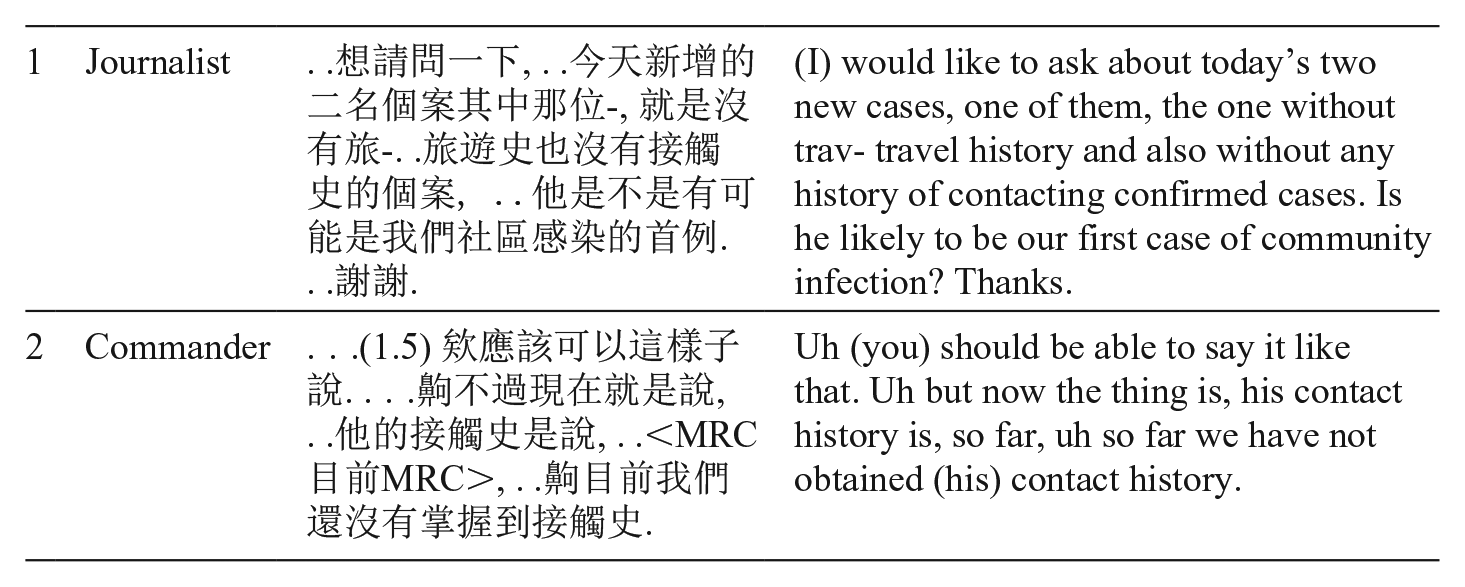
In Excerpt 1, the journalist initiated the category of community infection in a yes-or-no question (1) that limited the response options to two. In response (2), the commander ratified the journalist’s footing as an author by endorsing (‘should be able to’) the journalist’s classification in metadiscourse (‘say it like that’). However, the classification was only provisional. The contrastive conjunction ‘but’ introduced the commander’s uncertainty about the classification. The uncertainty was temporally conditioned by the commander’s use of the words ‘now’ and ‘so far’ as well as the prosodic feature of carefully enunciating ‘so far.’ Excerpt 1 demonstrates the production of a temporary classification through its official ratification in metadiscourse.
In Excerpt 2, a second journalist followed up to the exchange presented in Excerpt 1. The journalist used a disjunctive question (‘local infection’ or ‘local death’) to limit the classification to two types (1). The metadiscursive question ‘then is it ok to say’ again indexed the journalist’s footing as an author who proposed categories and sought official ratification, and the disjunctive format put forward the newsworthy categories.
Excerpt 2
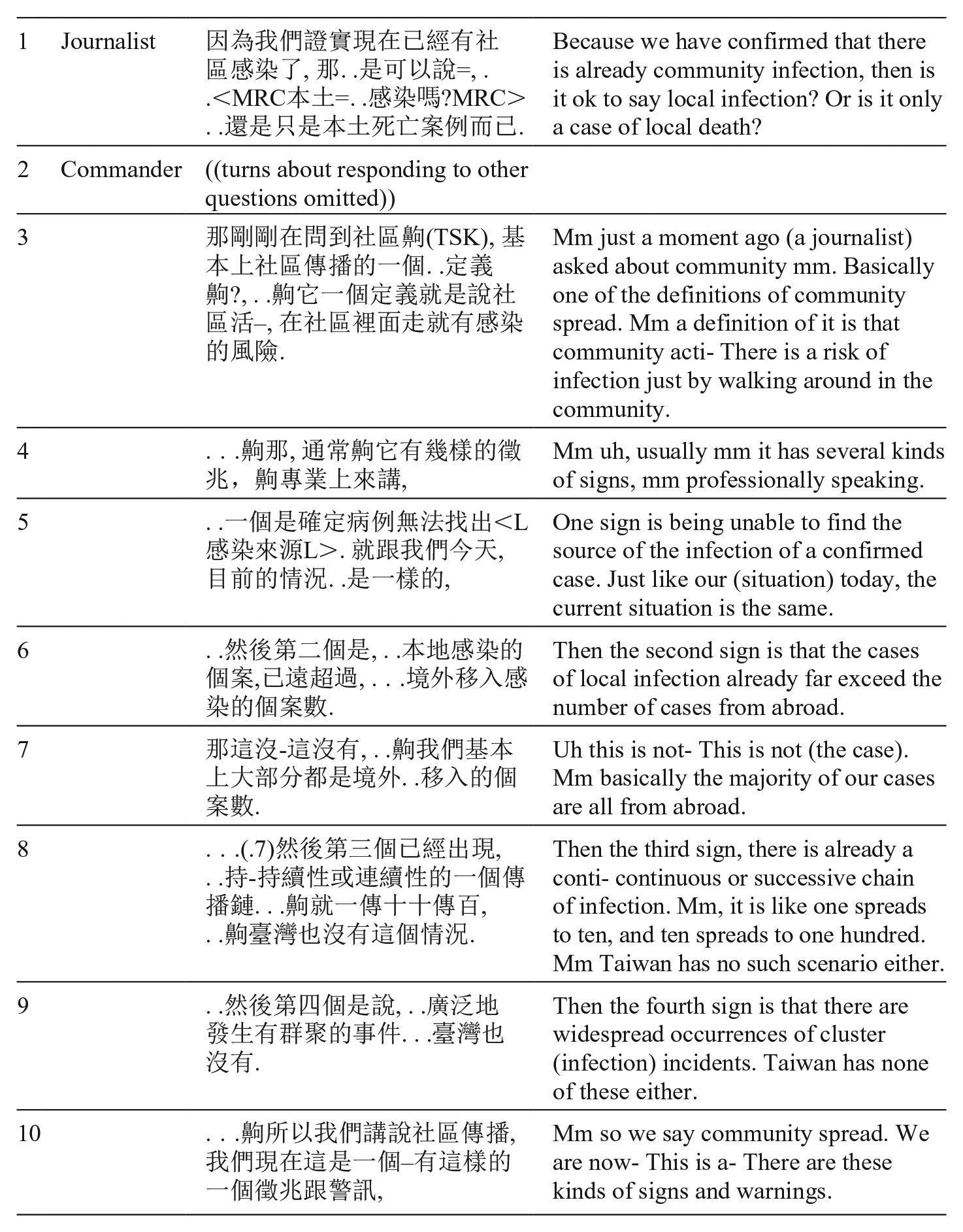
In Excerpt 2, the commander strategically introduced the criteria of community spread. While the category of community spread had never been used by the journalists, the commander attributed the category to the journalists (3). Subsequently, the commander used the metadiscursive referent ‘definition’ to elaborate on the categorical type (3) and the metadiscursive operator ‘professionally speaking’ (4) to instruct the audiences on specific ways of interpreting the signs of community spread. To emphasize the inapplicability of community spread, each sign (except the first sign) was introduced and then used to particularize (Billig, 1985) Taiwan’s situation: ‘not the case’ (7), ‘no such scenario either’ (8), and ‘has none of these either’ (9).
As the interactions in Excerpts 1 and 2 were being livestreamed on YouTube, online viewers unleashed their criticism of the journalists’ questioning. Their metadiscourse focused on the journalists’ ulterior motive and repetitive questions: ‘Journalists are (just) waiting for a slip of the tongue to “confirm” (community infection),’ and ‘China Times, stop asking questions. (They just) keep repeating questions.’ Although most viewers were skeptical of the journalists, they diverged in their responses to the official classifications. Some believed there was no community infection, commenting, ‘Community infection has not been confirmed yet, OK?’ Others recontextualized the commander’s initial response to argue that there was indeed community infection: ‘The first journalist just asked if it is community infection. The minister’s first sentence in response said “(you should) be able to said it like that” . . . ’ In all these comments, the referent of community infection was in fact community spread. In other words, the commenters confused the two terms. The referential mixing suggests one of the challenges of making official classifications mobile.
February 17
The next day, as more cases were identified as close contacts of the first death, journalists became blunt in challenging official classifications. In Excerpt 3, a journalist demanded the commander respond to their question in a yes-or-no format.
Excerpt 3
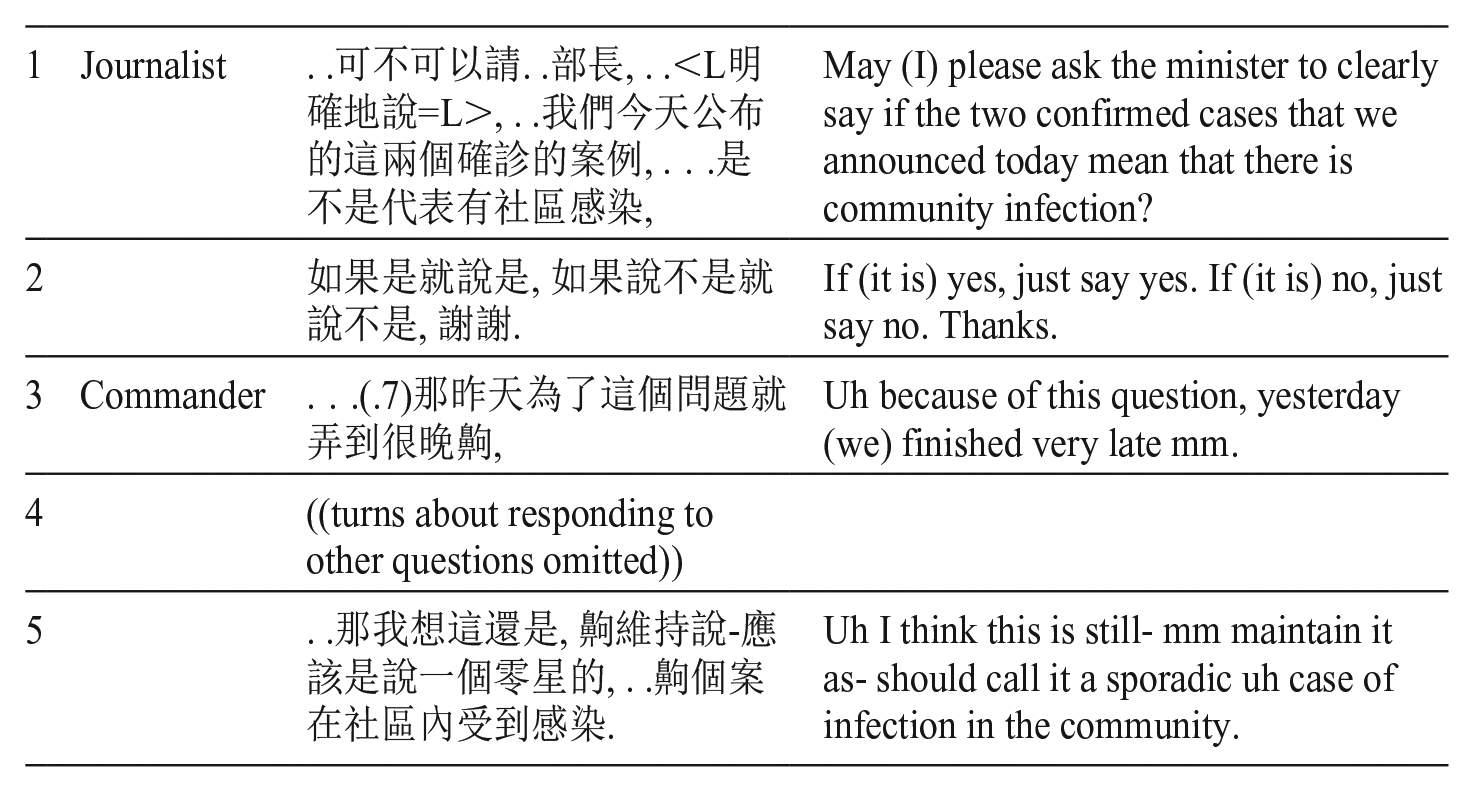
In Excerpt 3, the journalist’s demand is face-threatening because it metadiscursively stipulated the manner (‘clearly say’) and limited the response options (1–2). Here, too, the journalist was still an author who composed response options but forcefully sought official ratification. The journalist’s continuous use of community infection suggests a lack of an agreement with the officials on the categorical reference. Instead of responding to the journalist’s yes-or-no question, the commander assumed the roles of the author and principal to assert his control of the classification. In line 5, he insisted on official classification through the obligatory modal verb ‘should’ and the metadiscursive verb ‘call’ that connects the meta layer (‘I think this is still’) with the object layer (‘a sporadic uh case of infection in the community’).
The journalist’s question was criticized by many online viewers. Many of them commented on the manner – ‘really impolite’ – and motive – ‘(I) feel like (the journalists) are here to make trouble.’ The viewers displayed their strong sense of discontent by recontextualizing parts of interaction and injecting excess punctuation marks into comments, such as ‘if (it’s) yes, just (say) yes. If (it’s) no, just (say) no??? It’s just no.’
Afterward, another journalist targeted the commander’s response (Excerpt 4.1, line 1) by requesting further details and voicing their suspicion that the motive behind the classification was Taiwan’s international image.
Excerpt 4.1
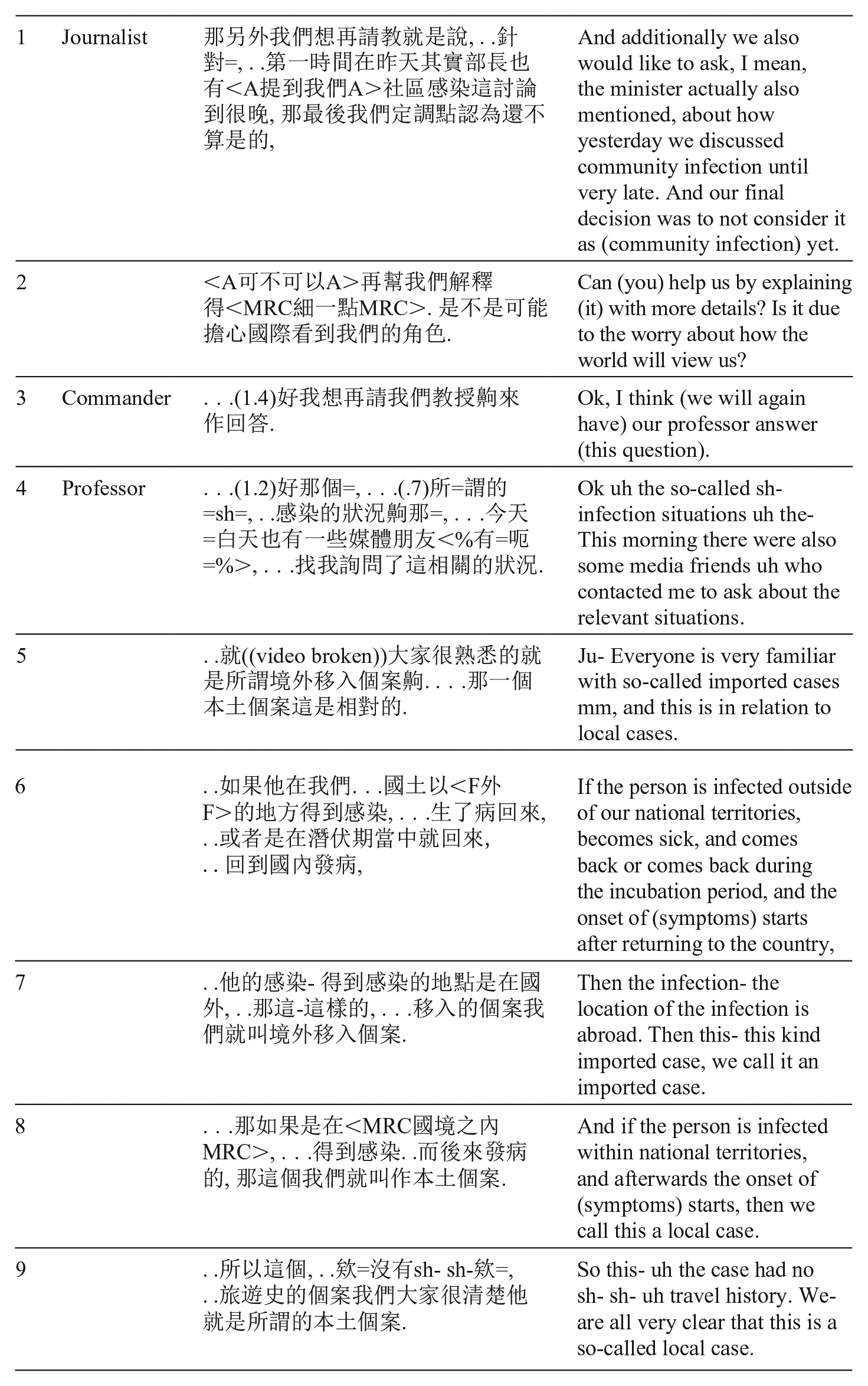
In Excerpt 4.1, the commander allocated the speaking turn to the professor on the panel (3). The professor explained a classificatory principle. His speech focused on different infection locations. Hypothetical conditionals using ‘if’ (6, 8) created imaginary mental states, and metadiscursive statements – ‘we call it’ (7) and ‘we call this’ (8) – assigned a category to each imaginary state. After introducing the classificatory principle, the professor applied the classificatory principle to the case of interest via the causal inference ‘So this uh the case.’ He classified the case as the categorical type of a local infection through his use of the metadiscursive operator ‘so-called’ (9).
In Excerpt 4.2, the professor introduced the classificatory principle of hospital infection versus community infection Excerpt 4.2
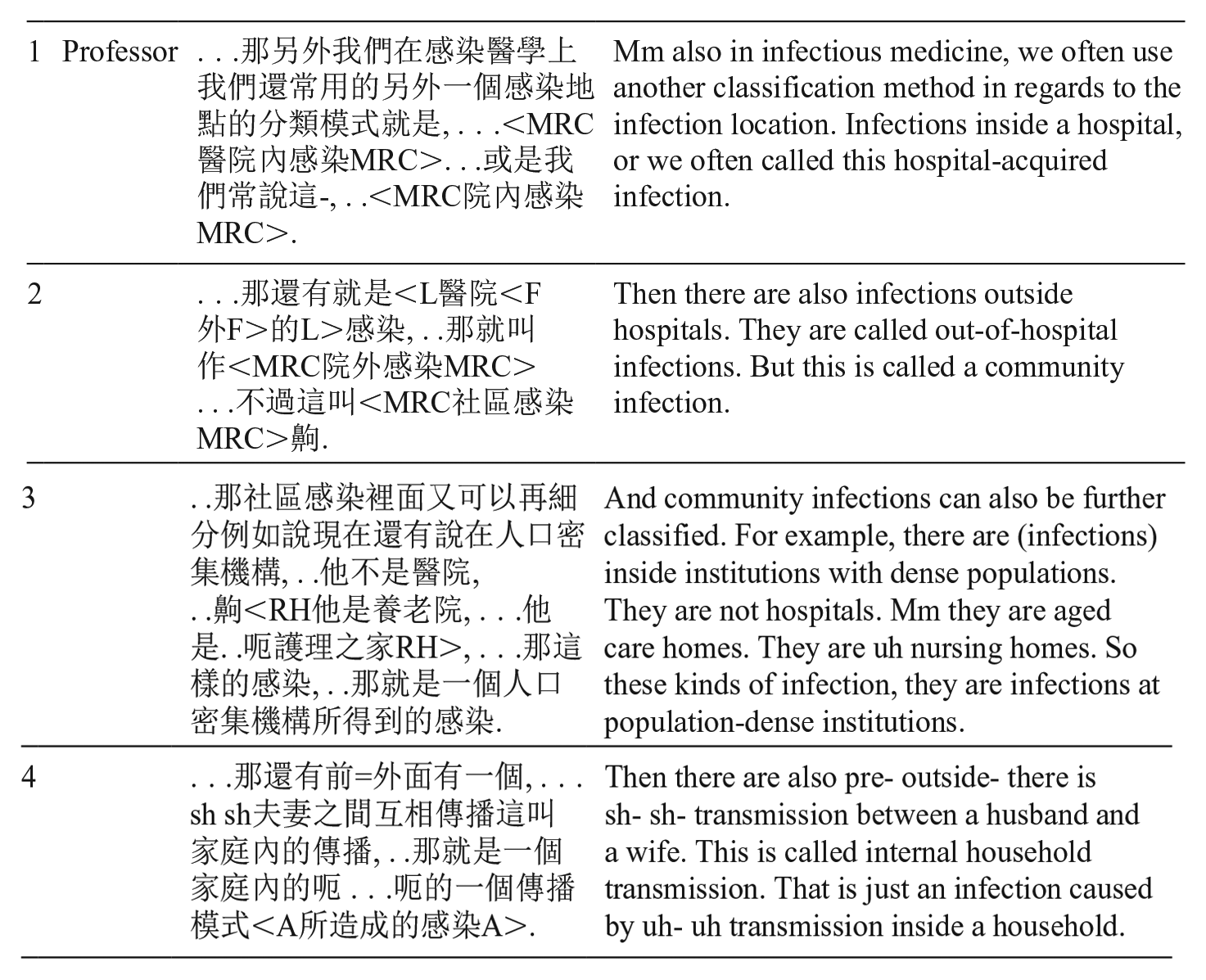
In Excerpt 4.2, harnessing his biomedical authority by saying ‘In infectious medicine, we’ (1), the professor introduced the categories prosodically (each word distinct and emphasized) and metadiscursively (‘we often called this,’ ‘They are called,’ ‘this is called’; 1–2). He then deconstructed community infection with his use of the metadiscursive operator of ‘for example’ (3) and the metadiscursive verb of ‘called’ (4). Throughout, his use of the metadiscourse worked in tandem with the categories to show his participatory roles as an animator who recontextualized terms frequently used in infectious medicine; an author who translated examples into biomedical references (i.e. ‘transmission between a husband and a wife’ becomes ‘internal household transmission’ in line 4); and a principal who was committed to the biomedical system of classifications. In other words, his biomedical expertise was instantiated in classification and constructed in the interface of metadiscourse and participatory roles.
In Excerpt 4.3, the professor’s illustration cut to the heart of the discreteness between community infection and community spread Excerpt 4.3
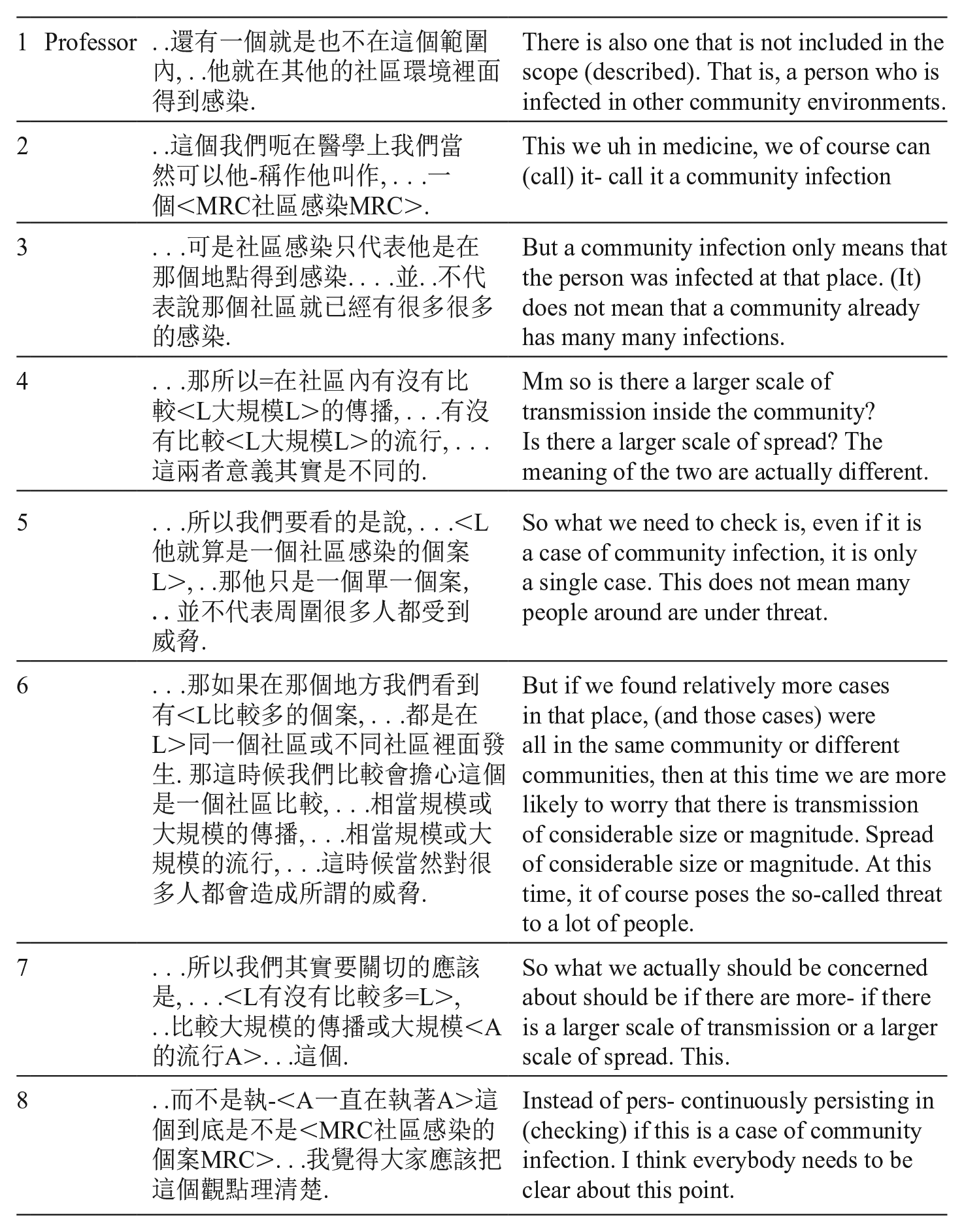
In Excerpt 4.3, after introducing another aspect of community infection and reiterating his biomedical authority (1–2), the professor explained that community infection only denoted the location of infection; it did not suggest a risk of community spread. His use of the metadiscursive operator of ‘only means’ emphasized this exact and concrete distinction he sought to make (3). He then particularized the situation of community spread by contrasting the referential differences in metadiscursive operators ‘does not mean’ (3, 5) as well as metadiscursive referent ‘The meaning of the two are actually different’ (4). The sequence concluded with a discussion of appropriate and inappropriate classifications (7–8).
The journalist’s question in Excerpt 4.1 was largely lauded by online viewers: ‘(I) praise the content of the journalist’s questions, and the way (he) asked them.’ The professor’s detailed account also received mostly positive comments. Some viewers praised his biomedical expertise by associating his professional identity with his speech style: ‘(He) is worthy of being a professor. After his explanation, (I) have no objections at all.’ Others created a pedagogical frame associated with his ‘professor’ identity in order to praise his talk and to position the journalists as students who could benefit from the instruction: ‘The professor is lecturing’; ‘This is going to be on the exam. Need to remember’; and ‘The press conference has turned into a class for journalists.’ Among the positive appraisals of the professor’s explanation, several viewers pointed out the gist of the messaging: ‘Community infection ≠ community spread’ and ‘what is important is whether there is community spread.’ These comments suggest the official classifications delivered in these excerpts were better received by online viewers than those in Excerpts 1 and 2.
February 20
Two days after the professor’s explanation, a businessperson returning from China was identified as a close contact of the deceased. Antigen tests suggested that the businessperson had been infected with SARS-CoV-2. Health officials drew on this scientific data to formulate a theory of virus transmission. According to the theory, the businessperson had to have been the infection source because the deceased had no history of international travel. The theory suggested Taiwan had no unknown source of infection in the community and thus no community spread.
However, in Excerpt 5, a journalist brought international politics into focus.
Excerpt 5
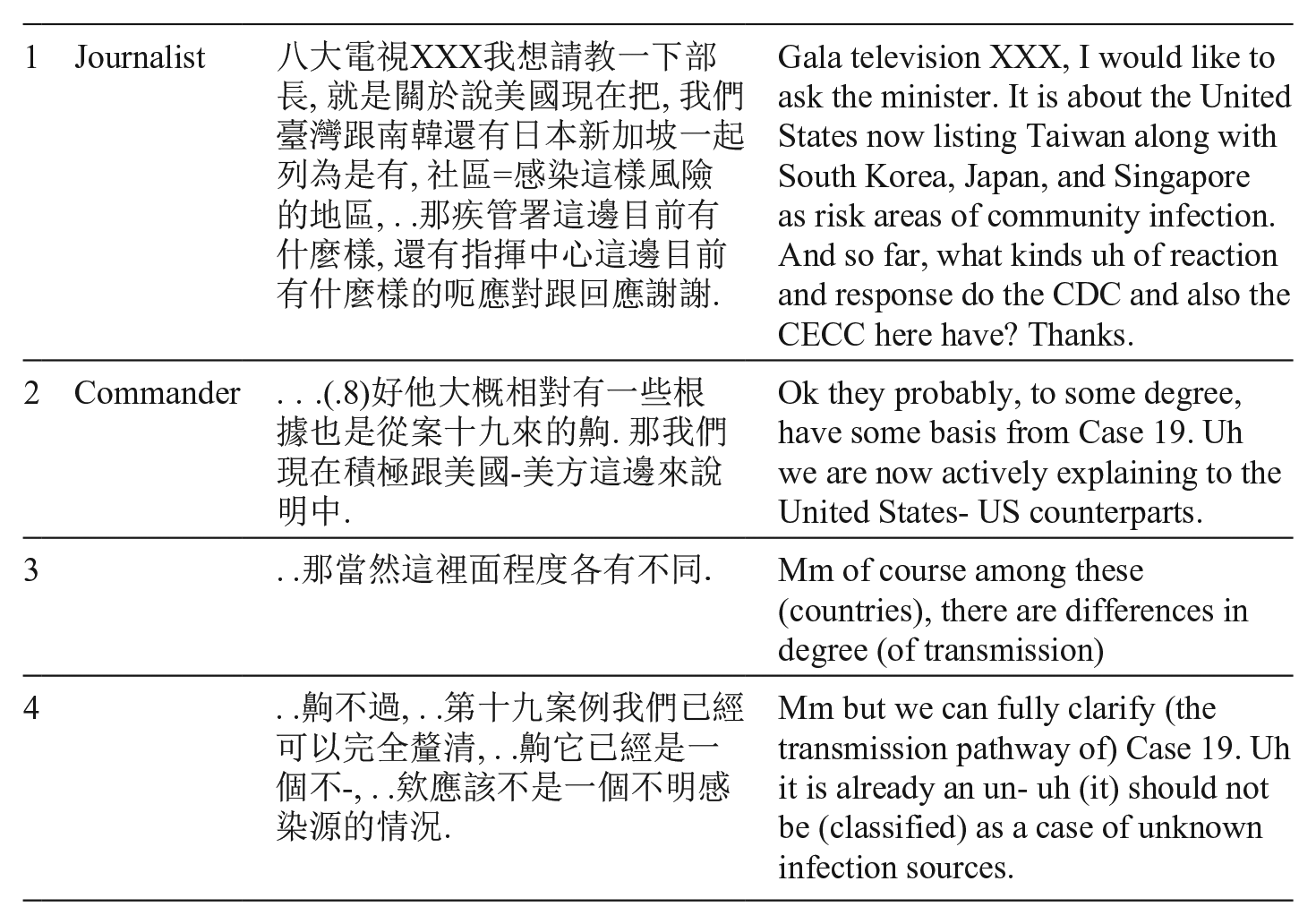
In Excerpt 5, the journalist recontextualized the US classification in which US CDC had geographically lumped Taiwan, South Korea, Singapore, and Japan together and classified them as a region at risk of community infection (1). While the US CDC’s website used community spread to classify these places, the journalist continued to use community infection to refer to community spread. Against this backdrop of international politics, the commander speculated about the data that the United States might have used to arrive at the classification and metadiscursively shared both what he was doing – ‘explain’ – and how he was doing it – ‘actively’ (2).
Excerpt 5 thus demonstrates that both the production and circulation of a local crisis category are influenced by international political power. The scale conflict between the local and the global is reflected in the participatory roles inhabited by the Taiwanese journalist (animator) and ascribed to the United States (author and principal), other Asian countries (figure), and health officials in Taiwan (addressed recipient). This participation framework also figured strongly into the live chat of online viewers (bystander) in their metadiscourse about appropriateness (e.g. ‘The United States has raised the level of travel warning in Taiwan. It’s necessary to explain (the situation) to the United States’) and inappropriateness (e.g. ‘Explaining to the United States is not important, ok?’).
Conflicts also emerged domestically. The journalist in Excerpt 6 referenced domestic medical experts to metadiscursively characterize the official account.
Excerpt 6
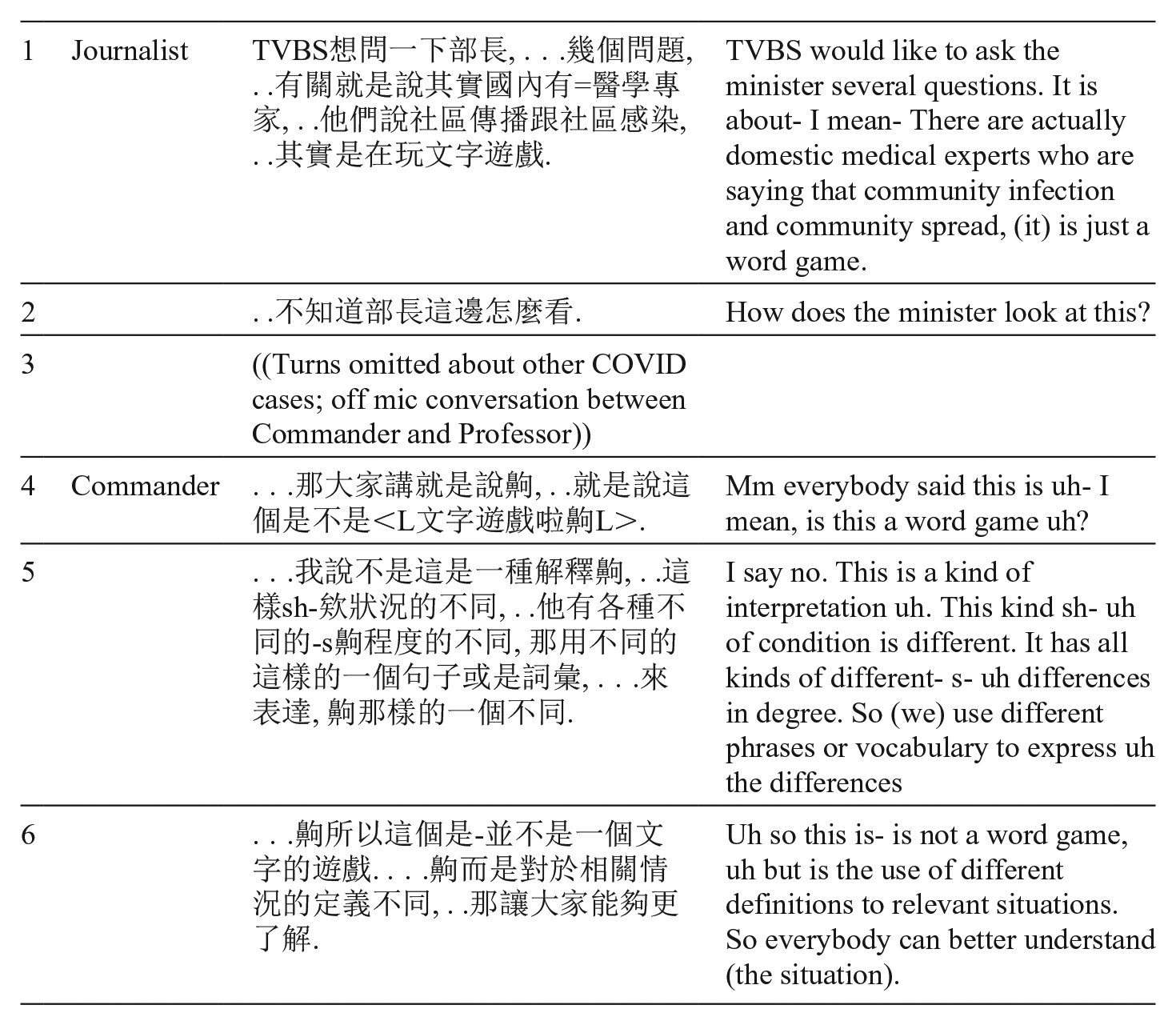
In Excerpt 6, a journalist animated the voice of domestic medical experts that metadiscursively characterized the official classification as ‘a word game’ (1). In response, the commander reframed the commentary as a disjunctive question asked by ‘everybody’ (4). The elevation of scope (from domestic medical experts to everybody) and change of mood (from the indicative to the interrogative) legitimized his response and enhanced his authority. His subsequent metadiscourse rationalized language choices used in the official classification (5–6).
Multiple online viewers sided with the commander. They made a link between the absence of categorical distinction and the consequence of public panic: ‘Indeed clarifying these terms is meaningful. (If) ordinary people do not understand, it can easily lead to panic.’ They also recycled the information from previous press conferences to advance the commander’s perspective: ‘Community acquired [infection] and community outbreak are of course different. The key is if (the case) is traceable. Why so persistent with words?’
In Excerpt 7, a journalist revived the topic of US classification Excerpt 7
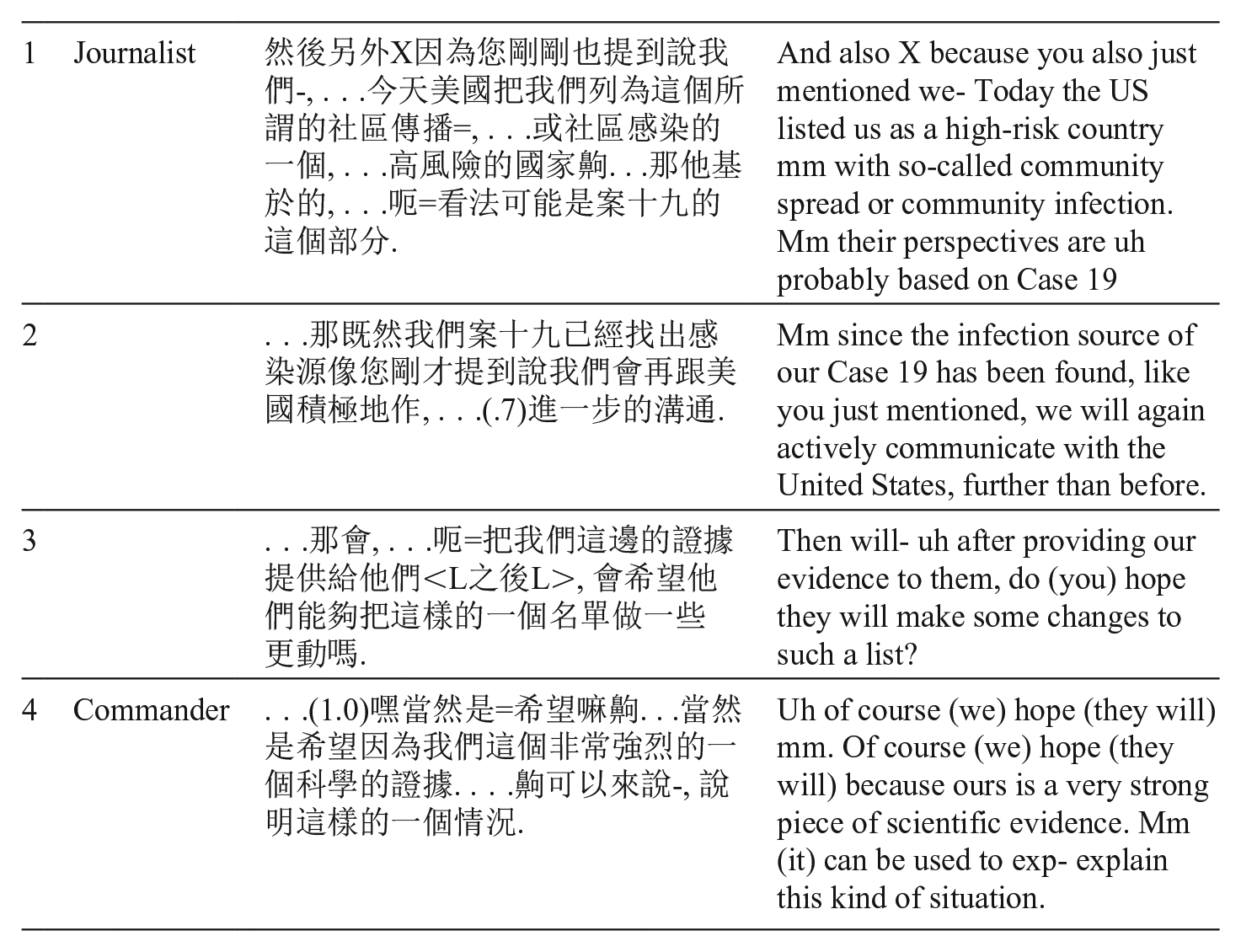
In Excerpt 7, the journalist animated previous exchanges through paraphrases, repetition (‘actively’), and metadiscursive verbs (‘just mentioned’) and operators (‘so-called’; 1–2). Given the prior referential controversy about playing a word game, the journalist adopted both categorical forms to refer to widespread infections within the community (1). The journalist sought official ratification of the hope that the United States would change its classification of Taiwan based on the new evidence. The commander affirmed a positive response through repetition and use of the degree adverbs ‘of course’ and ‘very’ followed by the metadiscursive verb ‘explain’ (4).
Online viewers considered the journalist’s inquiry not a genuine question. Some of the commenters remarked, ‘Is the journalist here for a chat?’ and ‘You already answered (the question). Why are you asking?’ The metadiscourse demonstrates the viewers’ awareness that the journalist’s question was not useful for generating new information.
February 21
The final sequence (Excerpt 8) comes from a conference held five days after the first death was initially announced. A journalist followed up on the progress of the communication with the United States.
Excerpt 8
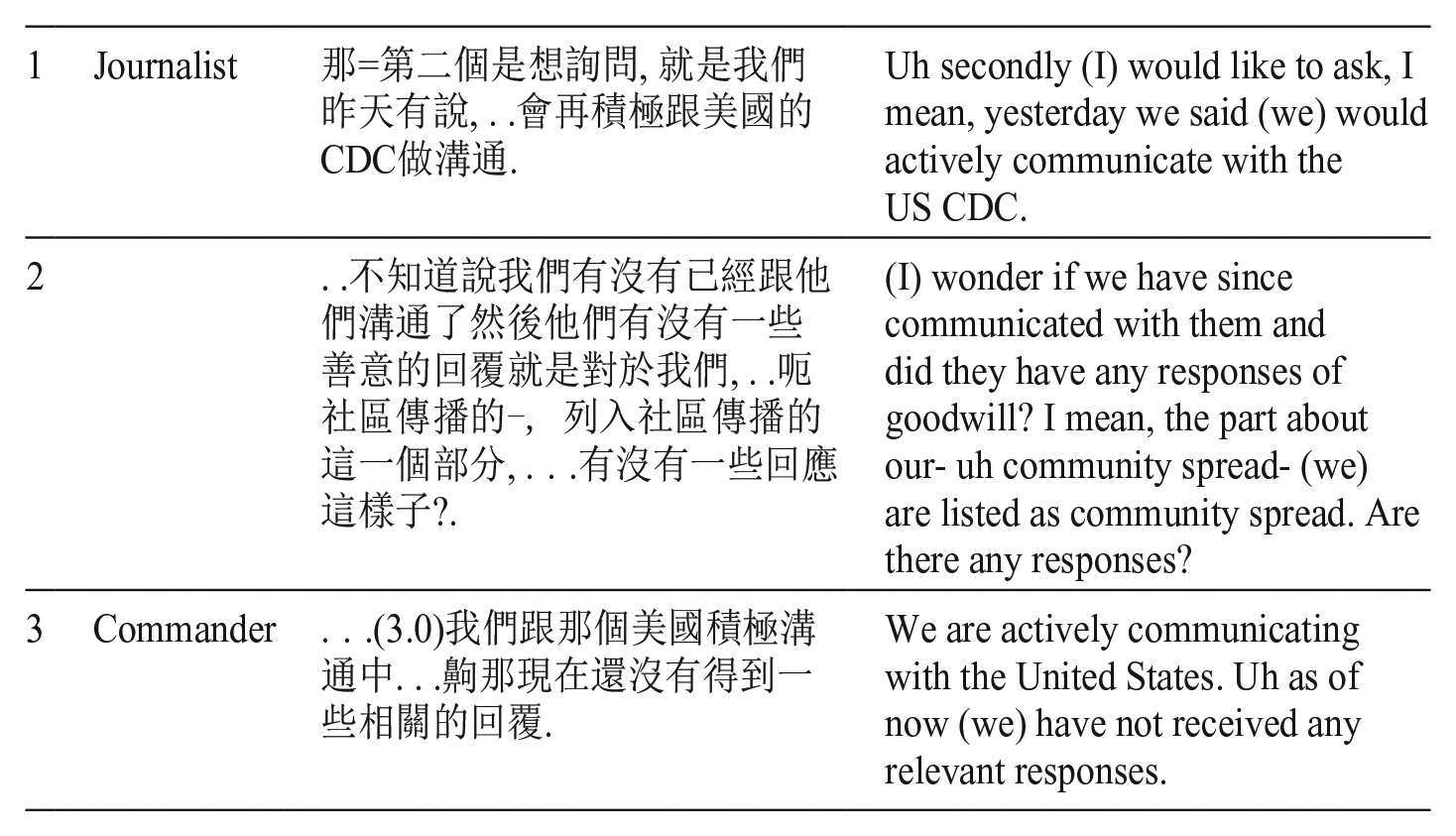
In Excerpt 8, the follow-up was interdiscursively created through the metadiscursive statement ‘yesterday we said’ and the phrase ‘actively communicate with’ (1) that had been recontextualized from previous interactions. The interdiscursivity positioned the journalist as the animator. Unlike in previous excerpts, in this excerpt, the journalist used community spread to refer to the risk of contracting COVID-19 in the community (2). In reply, the commander recycled the metadiscursive verb by stating that they are ‘actively communicating’ with the United States although they had not yet received a response (3).
Online viewers harbored antagonism toward the journalists who had repeatedly pursued more or less identical topics over the past five days: ‘When I joined just now, I thought I was watching a replay. It turns out to just be a repeat of asking (the same questions).’ They also accused the journalists of intending to mislead the public: ‘Journalists endangering the country?’
Discussion
This article proposed the notion of ‘crisis classifications in mobility’ to capture the processes of producing and circulating crisis classifications. The analysis revealed how two categories – community infection and community spread – were deconstructed and reconstructed in online and offline metadiscourse. The two categories struggled to become immutable mobiles (Latour, 1986) because much effort was expended on creating their consistent forms of categorical reference among the officials, journalists, and online public viewers. As the two categories were recontextualized across time and participation frameworks, gaps in categorical reference were exposed. The referential gaps had nonreferential implications, that is, a lack of transparency or the level of control over the crisis.
Health officials faced two primary challenges regarding the gaps. The commander’s initial ratification of the journalist’s classification was temporary due to the evolving situation and moving targets. However, this ratification was taken by other journalists as official confirmation of community spread. To repair the miscommunication, officials expended significant effort on their subsequent explanations. Furthermore, to help the public understand the two types of crisis situations, the health officials endeavored to distinguish between the two categories through the discursive practices of categorization, which grouped the first death into the category of community infection, as well as particularization, which extracted the first death from the category of community spread (Billig, 1985). In doing so, they unwittingly promoted the circulation of community spread, which did not suit the pandemic situation in Taiwan. If the officials had not elaborated on the distinction, community infection would have continued to serve as the referential form of community spread in public discourse. This created a dilemma for the health officials, who had to choose between delineating categorical differences and constraining the circulation of inadequate classifications. These communicative challenges gave the impression that health officials were prompt but inconsistent in communicating crisis, which perpetuated doubts over the officials’ transparency in disclosing information.
Journalists exacerbated the gaps in categorical reference. They proposed candidate categories and pushed for official ratification. Initially, the journalists treated community infection as community spread. The referential mixing was immune to official explanation and correction. Not until one journalist relayed domestic experts’ criticism about the officials playing a word game did other journalists start to attend to the referential nuances of both categories. Throughout, journalists drew on metadiscourse to constrain officials’ ways of speaking; limit officials’ response options; request detailed accounts; animate opposing viewpoints; solicit official accounts; and create interdiscursivity to legitimize their follow-ups. In the end, community spread was accurately adopted by journalists even though the US classification of Taiwan remained unchanged.
Amidst the gaps in categorical reference, many online viewers expressed antagonism toward journalists’ repeated questioning. In their online metadiscursive activities, these viewers questioned journalists’ language use vis-à-vis their ulterior motives and professional training. While some viewers were able to discern the categorical differences, other viewers admitted they had difficulty discerning the categories based on officials’ explanations. Although the viewers’ online comments at times indicate a mixed reception to the official classifications, they also collectively sketch the contours of ideal communication. On the one hand, health officials need to clearly explain their principles of classification and clarify key terms. On the other hand, journalists should carefully attend to officials’ accounts, politely ask questions, and avoid repeating questions. These metadiscursive comments may appear simple and trivial, but they may also facilitate the process of transforming official classifications into boundary objects for cooperation across social worlds (Bowker and Star, 1999).
The analysis presented multiple interlocking challenges of productively constructing and collaboratively disseminating crisis classifications. One of the challenges lies in the participation structures that regiment who can say what to whom and when. This regimentation is shown in the metadiscourse of all parties. Health officials drew on the metadiscourse to recreate categorical reference, to instantiate their classification principles, and to exert their biomedical authority and institutional infrastructure to navigate the footings of animator, author, and principal. Rarely did they respond to journalists’ disjunctive questions by directly adopting the categorical choices the journalists had provided. This may have been to avoid giving too much weight to inadequate classifications. When they did accept a journalist’s classification, as in Excerpt 1, they emphasized that such a classification was only provisional given the ongoing investigation. However, constantly dismissing questions or offering ambiguous responses may result in the public perception of officials as evasive and untrustworthy. To prevent these unwanted associations, when a situation is still unraveling, it may be better for officials to directly acknowledge journalists’ questions and then admit what is unknown or acknowledge uncertainty.
Journalists’ participation status evolved along with their use of metadiscourse. Early in the mobility, individual journalists enacted the participatory role of an author, composing categories that needed to be ratified by officials. Later, they inhabited the role of an animator, enacting heteroglossia voices to press for official accounts. Nevertheless, their participatory roles often made them appear pushy, aggressive, and dissenting and in turn caused them to incur criticism from online public viewers. A decisive role played by journalists is to voice the public’s concerns and doubts so as to foster the public reception of health messaging. However, if conferences are overshadowed by journalists’ repeated questioning and pushing for ratification, these communicative styles may be interpreted as journalistic proclivities for opposition and controversy, thereby thwarting efforts to engage the public in managing a public health crisis.
Conclusion
This study introduced the notion of crisis classifications in mobility to understand the challenges of reporting the first COVID-19 death in Taiwan. The analysis showed that classification in mobility can open up a new way of understanding public health crisis communication: public health crisis communication is not simply a product for guiding the sayable and unsayable, but it is also a process of making categories circulable and repairing gaps in circulating categories. As the process unfolded, metadiscourse was continuously recruited by public health officials, journalists, and online viewers to negotiate differences in categorical reference. Participation frameworks offered insight into the power dynamics across institutional, biomedical, and geopolitical levels. The findings illustrate that public health officials need to base their communication on clear, consistent classifications and recalibrate categorical reference with the public in order to minimize gaps and maximize mobilities across social spheres.
The study is not without limitations. While classification is no doubt an important dimension of public health communication, it is not the only dimension. Also necessary is an investigation of how other aspects of communication such as pandemic narratives and statistics are infused with mobility. Additionally, although this study primarily focuses on language use, mobility is equally shaped by the use of semiotic means such as figures and gestures. Future studies could expand this study’s analytic scope by exploring how classifications are visualized in figures and gestures and whether the visualization propels more effective mobility.
Footnotes
Appendix
Acknowledgements
I am grateful to Stephanie Scott who offered valuable suggestions on different drafts of the article.
Declaration of conflicting interests
The author declared no potential conflicts of interest with respect to the research, authorship, and/or publication of this article.
Funding
The author received no financial support for the research, authorship, and/or publication of this article.