



Abstract
Community interpreting norms and research have been heavily influenced by a Western-centric community of practitioners and an individualist, positivist philosophy. This has resulted not only in an entrenched emphasis on professional interpreters’ detachment, neutrality, and invisibility but also in research which often ignores interpreting service users from culturally and linguistically diverse communities. This article addresses the complexity of operationalising horizontal methodologies during interpreting research in an effort to centre marginalised voices and epistemologies. The study involved a research project conducted with the Latin American community in Aotearoa New Zealand, employing horizontal one-on-one and group dialogues to assess interpreting service users’ views on allyship and social justice in spoken-language community interpreting. In this article, horizontal methodologies are presented as a culturally affirming way for Latin American service users to co-produce knowledge, and for Latin American researchers to engage with their own identity, recognise their impact on society, and challenge colonial research practices and interpreting norms.
Keywords
1. Introduction
How we do research is crucial because “our doing is intricately related to our knowing” (Kovach, 2020, p. 40). Therefore, the research process is always informed by an understanding of what is and is not knowledge. Research methodologies affect which data are collected and how we engage with it to derive meaning from it (Nakhid & Farrugia, 2021). Based on these understandings of research, the present article focuses on the use of horizontal methodologies—developed by Latin American and European transdisciplinary researchers—to explore the concepts of allyship and social justice in spoken-language community interpreting (Kaltmeier & Corona Berkin, 2012). If the goal of social justice is the full and equal participation of all groups (Reason & Davis, 2005), any development in our understanding of the interpreter’s role informed by the notion of social justice needs to be tied not only to the knowledge of practitioners and academics but also to what interpreting service users need and expect from their interpreters. However, few studies within the field of interpreting have focused on the views of service users (Hlavac, 2019, p. 162), whose engagement in research can be difficult (Edwards et al., 2005; MacFarlane et al., 2009).
To conduct research with interpreting service users from the Latin American communities living in Aotearoa New Zealand, horizontal methodologies offered the potential to create knowledge collaboratively through dialogue, actively attempting to disregard academic distance and Eurocentric paradigms while prioritising a Latin American epistemology (Cornejo & Rufer, 2020; Corona Berkin, 2020a). These methodologies are based on the epistemologies of the South, developed to address the “abyssal line” that divides what is valid, normal, and ethical—that which is conceived in the metropolis—from what is not—colonial knowledge (de Sousa Santos, 2018). Ultimately, the expectation was that horizontal research with Latin American interpreting service users would help interpreting studies, practicing professionals and educators move past entrenched notions of the interpreter role, offering innovative alternatives.
This article begins with a summary about the importance of acknowledging power asymmetries in community interpreting. The summary is followed by a brief account of the relationship between power and the concept of invisibility in the previous literature, as well as its impact on this research in particular. Next, the article presents the decolonial and self-affirming reasoning underpinning the methodological choices made throughout the research project. The focus is then placed on describing horizontal methodologies together with the experience of their operationalisation in the context of Latin American interpreting service users in Aotearoa New Zealand.
2. Power and Responsibility in Community Interpreting
Power can be defined as “a phenomenon that intersects the relationship between those who are granted privilege by virtue of social institutional systems and those without those same privileges” (Russell & Shaw, 2016, p. 2). Power differentials are an intrinsic part of community interpreting because power is negotiated interpersonally through discourse (Mason & Ren, 2013). Moreover, this negotiation is framed by institutions which reflect the covert hierarchies imposed by the state (Rudvin, 2005). In this sense, every public service provider working for an institution is an indirect representative of the state with access to effective and concrete power leveraging tools (Rudvin, 2005). Even though interpreters do not often have access to the institutional power wielded by government, authorities, corporations, or organisations, they hold a powerful position due to their linguistic and cultural knowledge, which turns them into the only party who can understand everything that is being said throughout the exchange (Mason & Ren, 2013). Concurrently, interpreters’ agency to make decisions that affect the outcomes of that exchange often places them, for better or worse, between service users and what they need (Baker-Shenk, 1991; Davidson, 2000).
The role played by interpreters in this power negotiation is often concealed by cultural and linguistic hegemonies which hide systemic injustices (Coyne & Hill, 2016). At the same time, the invisibility ideal has been stopping interpreters from engaging constructively with other parties before, during, and after the interpreted event (Dean & Pollard, 2018). Invisibility fosters interpreters’ reactive rather than proactive engagement in problem-solving and leads to a disregard of professional responsibility (Dean & Pollard, 2011). However, responsibility is a key issue in every profession. For interpreters, this means remaining accountable for their decisions, as these have a very real impact on the life of others (Baker-Shenk, 1991). Nevertheless, the traditional ethos of neutrality and non-engagement that is still prevalent in interpreting practice “often blinds [practitioners] to the consequences of their actions” (Baker & Maier, 2011, p. 3).
With some exceptions (e.g., Angelelli, 2004a; Cronin, 2003), this situation has led to a dearth of literature about how professional interpreters think about their relationships to others (Baker & Maier, 2011; Dean & Pollard, 2018). In recent years, however, scholars have come to acknowledge interpreters’ role in minorities’ emancipatory processes, addressing issues such as interpreters’ ability to reassert or disrupt public narratives, interpreters’ ethical and political judgements in conflict zones, and interpreters’ role in the social construction of identity (Baker, 2010; Inghilleri, 2009; Tipton, 2008; Van Doorslaer, 2018). If it is true that the idea of neutral dialogue denies history, hierarchies and the positioning of the subject (Spivak & Harasym, 2014), conceptualising interpreters as neutral denies their “personal experience, judgement and culture as well as the socio-cultural structural differences inherent in each language” (Rudvin, 2002, p. 223). In a context of globalisation, social injustices across the world, aggressive political ideologies and violent conflict, a disembodied understanding of communication—and, therefore, interpreting—is unsustainable (Cronin & Luchner, 2021).
Rather, interpreting is a socially situated activity (Inghilleri, 2003). This means that power asymmetries at the individual level are constantly interacting with other collective sources of power (at the institutional and socio-political levels). It also means that interpreters’ professional responsibility extends beyond service users to include the wider community (Baker & Maier, 2011). Extending the focus of interpreting studies beyond the translation of speech to include the broader context of the interpreted event reveals asymmetric transfer conditions and helps conceptualise interpreting as an interactive social event (Wolf & Fukari, 2007). As suggested by Baumgarten and Cornellà-Detrell (2018), now that interpreting has been firmly positioned within historical and sociological perspectives and its profile is rising in the humanities and social sciences, “it is perhaps time to engage in a more sustained manner with the ways in which the manifold facets of power are refracted and reflected in translation processes” (p. 1).
3. The Ally Model of Interpreting
The study focused on allyship and social justice in spoken-language interpreting in Aotearoa New Zealand (Marianacci, 2022). 1 The ally model of interpreting recognises interpreters’ power, and contextualises it within the broader scheme of power differences and historic oppression, taking into consideration the power wielded (or not) by the other participants of the interpreted event (Witter-Merithew, 1999). This model enables interpreters to consciously choose to act in ways that will promote social justice, empower interpreting service users and offer equality of access (Baker-Shenk, 1991).
The ally model of interpreting arose together with the deaf civil rights movement in the United States and has mostly been studied from within the field of signed languages (e.g., Elliott, 2016; McCartney, 2017; Minges, 2016; Ziebart, 2016). In the field of spoken-language interpreting, the ally model has been mostly overlooked and often perceived as problematic (Hsieh et al., 2013). This might be because allyship is at odds with an understanding of the profession which supports interpreters’ detachment (Boéri & de Manuel Jerez, 2011), but also because of the constraints different actors, settings, and the purpose of communication impose on interpreter agency (Hertog, 2020). Highly regulated legal settings, for example, often involve a demand for literal renditions because of the legal community’s association of the conduit model with accuracy and the preservation of original statements (Tamura, 2021).
Behaviours associated with allyship have been relegated to other occupations such as that of intercultural mediators and patient advocates, who are assigned broader functions and are seen as the ones who can achieve and ensure mutual comprehension (Theodosiou & Aspioti, 2015; Verrept, 2019). When contrasted to these roles, interpreters are portrayed as language switchers who can address the language barrier only (Pokorn & Mikolič Južnič, 2020). However, such a distinction ignores the close relationship between language and culture, which makes interpreters’ linguistic role inseparable from cultural mediation tasks (Pöchhacker, 2008).
In Aotearoa New Zealand, research into the interface between health navigators and interpreters found “a significant overlap between the roles of navigators and interpreters in the study area, with navigators routinely interpreting for patients, especially in the hospital” (Gray et al., 2017, p. 2). The overlap between the profiles of community interpreters and intercultural mediators is confusing for interpreters and service users alike, but it is indicative of the need for advocating and mediating functions which have remained largely unmet by professional interpreters (Gray et al., 2017; Pöchhacker, 2008). In such a context, the ally model is a way to address users’ needs and expectations, either as an alternative or a complement to intercultural mediators and patient navigators.
To find out about users’ needs, however, more research is needed into service users’ experiences of interpreters from their own point of view (Edwards et al., 2005). The few projects involving interpreting service users in the international literature warrant further research into allyship, social justice, and the expansion of the interpreter role. For example, Costa and Briggs’s (2014) study on users’ experiences in psychological therapy in the United Kingdom found that service users are often confused by the role of the interpreter and disappointed because their expectations are not fulfilled. Martínez-Gómez’s (2015) research on non-professional interpreter interventions in two Spanish prisons found a tendency for users to prefer interpreters who lean towards the visible end of interpreter intervention.
As part of new paradigms constructed to fight alienating research practices, the coproduction of knowledge has been used in different disciplines to prioritise the relationship between subjects over the subject-object/researcher-researched dichotomy (Bialakowsky et al., 2020). This coproduction of knowledge often takes place within participatory action research, collaborative research, and decolonial methodologies (Palumbo & Vacca, 2020). However, Aotearoa New Zealand’s tradition in terms of decolonising research practices (e.g., Anderson et al., 2015; Hutchings & Lee-Morgan, 2016; Smith, 2021) has not necessarily been reflected in local interpreting research. Local interpreting studies tend to focus on interpreters and/or public service providers, typically using surveys and/or interviews for data collection (e.g., Britz, 2017; Crezee et al., 2011; Magill, 2017; Seers et al., 2013; Wang & Grant, 2015).
Recently, in the first study of its kind, Shrestha-Ranjit et al. (2020) researched the effectiveness of interpreting services for Bhutanese forced migrants from the perspective of not only the service providers but also the service users themselves. This qualitative research project collected data through focus groups with Bhutanese men and women, as well as individual interviews with health professionals. These data were thematically analysed, using the World Health Organisation’s AAAQ (availability, accessibility, acceptability, and quality) framework to evaluate access to health care (World Health Organization, 2008). The findings revealed an inadequate provision of socioculturally and linguistically effective interpreting services, which resulted in a call for “practice and policy changes to realize the right to health care for refugee populations in New Zealand” (Shrestha-Ranjit et al., 2020, p. 1707).
By focusing on the ally model within spoken-language interpreting, this study centres the voices of interpreting service users from culturally and linguistically diverse (CALD) communities who have largely remained unheard. By engaging members of CALD communities in the research process, the study acknowledges the complexities of interpreting as a social practice which must meet the expectations of those who need interpreting services the most. Moreover, it assumes that the complexity of interpreted communication calls for research that moves beyond disciplinary boundaries, as well as a methodology which respects the ways of being and knowing of every person involved in the research process.
4. Centring Marginalised Voices
In all professions, norms and guidelines are often created by the centre of decision-making power, both physically and as a community of practice. This means that interpreting guidelines have been heavily influenced by communities of practitioners with a Western-centric bias (Rudvin, 2007). The primacy of neutrality and invisibility that underpins the conduit metaphor in professional interpreting relies heavily on Western individualist philosophies and the rational scientific model (Rudvin, 2002). Regardless of the academic community’s effort to move past the conduit model of interpreting (e.g., Angelelli, 2004b; Enríquez Raído et al., 2020; Llewellyn-Jones & Lee, 2013; Tipton, 2008; Wadensjö, 2014), the conduit metaphor is still supported by institutional regulations and prescriptive codes of ethics (Tate & Turner, 2001, p. 54). Moreover, interpreter training has traditionally based guidelines and curricula on interpreters’ detachment instead of viewing interpreting as a complex, socially situated practice (Baker & Maier, 2011; Boéri & de Manuel Jerez, 2011). To this day, there continues to be a disconnect between research findings based on actual interpreting practice and the expectations of the professional organisations that codify and communicate what interpreters should and should not do (Dean & Pollard, 2022). Despite a more recent emphasis on responsibility and reflexivity in interpreter education, the focus on loyalty and neutrality which still permeates professional codes of ethics continues to influence the priorities of interpreter training programmes (Floros, 2020).
The field’s inability to move past the conduit model can be understood in relation to the concept of professional habitus, defined as “a specific predisposition, a way of thinking, which is in harmony with the structures of the professional field in which the agent is situated” (Aguilar Solano, 2012, p. 39). The conduit model of communication and the tenet of invisibility imposed by social conventions have helped develop a translatorial habitus tending towards subservience to translation norms. These norms have been internalised, reinforced, and reproduced despite empirical research highlighting interpreters’ agency and decision-making power (Sela-Sheffy, 2005). Despite its incredibly diverse population, Aotearoa New Zealand has a limited tradition in translation and interpreting (Enríquez Raído et al., 2020), as well as a language policy characterised by uncoordinated legislation dispersed around and originating from different government departments (Harvey, 2014). Interpreting service provision is still characterised by frequent use of untrained practitioners who are not necessarily exposed to the latest research in their field (Enríquez Raído et al., 2020). Moreover, the endorsement of prescriptive codes of ethics such as the Code of Ethics and Code of Conduct of the New Zealand Society of Translators and Interpreters (NZSTI, 2013) promotes the perpetuation of conduit-like behaviours (Dean & Pollard, 2018; Enríquez Raído et al., 2020; Janzen & Korpiniski, 2005; Major & Napier, 2019; Wang, 2014).
Nevertheless, the Bourdieusian concept of habitus allows for transformation through the repositioning within a cultural space (Bourdieu, 2000). Interpreters themselves can be “either conservative or revolutionary with regard to the accepted repertoire in the field” (Sela-Sheffy, 2005, p. 5). When examining allyship and social justice in spoken-language interpreting, this study sought the latter: a revolutionary positioning within interpreting studies. To achieve this, the research methodology needed to contribute to the de-centring of conservative voices in an attempt to bring about change in interpreting research and practice.
The de-centring was both literal and figurative. On one hand, the silencing of migrants due to their linguistic background is mirrored in interpreting research, where their knowledge is not often sought for policy and theory development. The voices of service users from CALD communities have often been absent from research (Edwards et al., 2005; Hlavac, 2019), even when numerous scholars have highlighted the importance of listening to what users have to say (Alexander et al., 2004; Greenhalgh et al., 2006; Pöchhacker, 2021). In this sense, users’ exclusion from interpreting research could be considered a sign of what Freire (1996, p. 60) defined as a “lack of confidence in the [oppressed] people’s ability to think, to want, and to know.” As discussed below, the study reported in this article identified a series of drivers to participation which are inextricably linked to this project’s methodology and the space created for service users’ voices.
On the other hand, the de-centring of conservative voices was related to the influences of Western ideology on research itself. How research is conducted affects a project’s capacity to achieve the representation of marginalised populations. There is therefore an urgent need to centre marginalised voices, particularly in nations such as Aotearoa New Zealand, “where social research continues to be conducted within settler colonial approaches to evidence collection” (Nakhid & Farrugia, 2021, p. 178). Therefore, the focus of this article is how this research on allyship and social justice was undertaken.
A recent report prepared for the New Zealand Human Rights Commission on the drivers of migrants’ experiences of discrimination has found that institutional, personally mediated and internalised racism are prevalent in Aotearoa New Zealand (Malatest International, 2021). The report highlighted the continuous impact of colonial systems and institutions, white privilege, racial supremacy, and Eurocentricity. This context, and my identity as an Argentinian immigrant doing research in Aotearoa New Zealand, had a considerable influence on this study. The project prioritised doing research together with the local Latin American community as much as possible, as the ultimate goal was to “[affirm] the epistemic rights of the racially devalued, and decolonial options to allow the silences to build arguments” (Mignolo, 2009, p. 162). To this purpose, all the dialogues were conducted in Spanish using research paradigms that respected a Latin American epistemology. This Latin American epistemology is understood in the context of de Sousa Santos’s (2016, p. 18) “epistemologies of the South,” whose definition is based not simply on a geographical concept, but as the production and validation of knowledge anchored in the experiences of resistance of those social groups which have been systematically subjected to the “injustices, dominations and oppressions caused by colonialism, capitalism, and patriarchy” (p. 18).
5. Horizontal Methodologies
The study on allyship and social justice in spoken-language interpreting in Aotearoa New Zealand was conducted using horizontal methodologies. Horizontal methodologies were developed by a transdisciplinary group of Latin American and European researchers who understand the research process and the production of knowledge as a political commitment to create better living in public spaces (Kaltmeier & Corona Berkin, 2012). Based on the three main axes of the generative conflict, the autonomy over our own viewpoint, and discursive equality developed below, the aim of horizontal methodologies is to arrive at different answers and avoid perpetuating the same hegemonic discourses (Cornejo & Rufer, 2020). There is certainly a relation between horizontal methodologies and critical theory, but the former goes beyond the critical perspective and the Eurocentric analytical tools which were created to support capitalist and colonial domination (Corona Berkin, 2020a). Similarly, unlike intercultural approaches which are often used to guide translation and interpreting research, horizontal methodologies avoid the normalised practice which tends to seek stability and crisis-avoidance (Corona Berkin, 2020a). In contrast to collaborative or participatory methods, horizontal methodologies strive to alter the structural asymmetries sustaining hegemonic research (Corona Berkin, 2020a).
This research relied on dialogue as the means through which new knowledge is constructed, drawing from all voices involved (Corona Berkin, 2020b). Horizontal methodologies consider that the social nature of subjects is the starting place for any research because we build our own identity in dialogue with others (Kaltmeier & Corona Berkin, 2012). Consequently, dialogue played a central role in this research project. In a context of power differentials, exploitation and discrimination, this dialogue cannot be expected to be harmonious. From the perspective of horizontal methodologies, research can build knowledge based on this lack of harmony because conflict is seen as the moment and space where different discourses can be heard. Only then can different voices come together to create new knowledge. Because demands are a fundamental part of human relationships, every dialogue will elicit a generative conflict, when the interest of the researcher is brought “into shocking relief with the interest of the researched” (Kaltmeier, 2017, p. 53). Generative conflicts arise at the intersection of different perspectives, such as those offered by academics and non-academics, or by researchers from different disciplines. These conflicts are considered a crucial part of social research and they are, in fact, a pre-condition for horizontality (Corona Berkin, 2020a).
However, for conflict to become useful and productive—that is, for conflict to be generative—the parties to the interaction need autonomy over their own viewpoint (Corona Berkin, 2020a). This means that the parties need to be able to express themselves from their own point of view and in a range of styles, defining their own identity beyond labels which have been historically imposed by dominant structures and Eurocentric knowledge. This autonomy is constructed through the horizontal dialogue itself, where interlocutors take turns as both speakers and listeners. These conditions involve the need to accept even the knowledge that the parties do not understand, or which goes against what they believe. In this way, every interaction offers the possibility of establishing discursive equality so that all parties can portray themselves how they want to be seen (Corona Berkin, 2020a).
Horizontal methodologies involve a conscious effort to minimise academic distance. Instead, knowledge is validated through reciprocity and an open, uncertain, and productive dialogue (Cornejo & Rufer, 2020). In a horizontal context, the academic’s task is not to speak about the other but rather to speak with the other (Kaltmeier, 2017). While this premise is also the base for the coproduction of knowledge within a variety of research traditions (Palumbo & Vacca, 2020), in this case it is understood within a much broader context of equality and liberation (de Sousa Santos, 2018). Horizontal researchers engage in dialogue and share their own interests with an equal: their interlocutors. In this way, horizontal methodologies stand against the researcher–participant dichotomy which is seen to further perpetuate inequality.
For this study, the three main axes of horizontal methodologies—the generative conflict, autonomy over our own viewpoint, and discursive equality—were first explored in dialogue with Esteban Espinoza, CEO of Aotearoa Latin America Community (ALAC). Founded in 1993, ALAC is a community organisation that has long been involved in translation and interpreting coordination under their wellbeing framework, which was established to support Latin American migrants in their resettlement in Aotearoa New Zealand (Aotearoa Latin American Community [ALAC], n.d.). However, ALAC consists mainly of social and community workers, not professional interpreters. Therefore, their input did not feature in previous academic interpreting research in Aotearoa New Zealand.
This was the first step in the horizontal research journey which went on to include Latin American interpreting service users, social workers, and professional interpreters. Throughout this first dialogue, ALAC highlighted a number of conflicts within the Latin American community in Aotearoa New Zealand which were later incorporated into the research process. When I communicated my interest in centring Latin American migrants’ understanding of social justice in spoken-language community interpreting, ALAC stressed the relevance of the research topic and recognised language as an instrument of power. Discussions involved Latin Americans’ position as perpetual foreigners in Aotearoa New Zealand, as well as the dependency and disempowerment that results from a lack of English proficiency (Gray et al., 2017; Rudvin, 2005; Watt et al., 2018). Another point was the relationship between social inequality and linguistic abilities, which was established as a basis on which to build the study.
As its origin is intrinsically tied to the provision of interpreting as a part of other advocacy and social services, ALAC’s early involvement in the project offered a different view of interpreting and translation provision. ALAC’s ad hoc interpreting does not need to abide by the code of ethics of the NZSTI (2013), thus offering an important new angle to interpreting in practice. The initial dialogue with ALAC also helped identify several problems with the provision of interpreting services in Aotearoa New Zealand. These problems included the wide range of perceptions about the interpreter’s job; the acknowledgement of the power of language and, therefore, of interpreters; users’ lack of trust towards professional interpreters and the confrontation—instead of collaboration—between professional interpreters and community representatives; and users’ vulnerability, disempowerment and lack of agency in their new country. These topics later re-emerged in the other dialogues of this study, creating a thread that kept the project’s narrative together (Albarrán González, 2020). In this sense, the whole study stands as a conversation among Latin Americans in Aotearoa New Zealand who have both collective and distinct individual experiences from which to contribute, whether they are service users or service providers.
5.1 Operationalising Horizontality
The operationalisation of horizontal methodologies throughout the project was considerably challenging. The main proponents of horizontal methodologies stated that they “never imagined these horizontal approaches as a method” (Cornejo & Rufer, 2021, p. 109). Instead, the choice of method had to be informed by horizontal methodologies based on their adequacy and relevance. Therefore, one of the challenges of this research was finding methods which would respect horizontal methodologies, but still comply with academic time constraints and limitations.
As shown in Figure 1, the research design included four one-on-one dialogues with Spanish-speaking interpreting service users in Aotearoa New Zealand who had required interpreters in the past. I positioned myself as an interlocutor participating on the same terms as everyone else who joined me in dialogue, distancing myself from the concept of “interviews” as they are often understood in academic contexts. A recent overview of empirical designs in community interpreting studies (Vuori & Hokkanen, 2020) found that interviews tend to be short and rarely depict a narrative approach where the interviewees can speak freely about a topic. Moreover, this overview found that interviews in community interpreting research are not generally considered a space for the co-production of discourses, where cultural meanings are negotiated through the interaction. S. Wilson (2001) warns that a method might be built on dominant paradigms and be inseparable from them. Therefore, I used the concept of one-on-one dialogues instead, informed by horizontal methodologies.
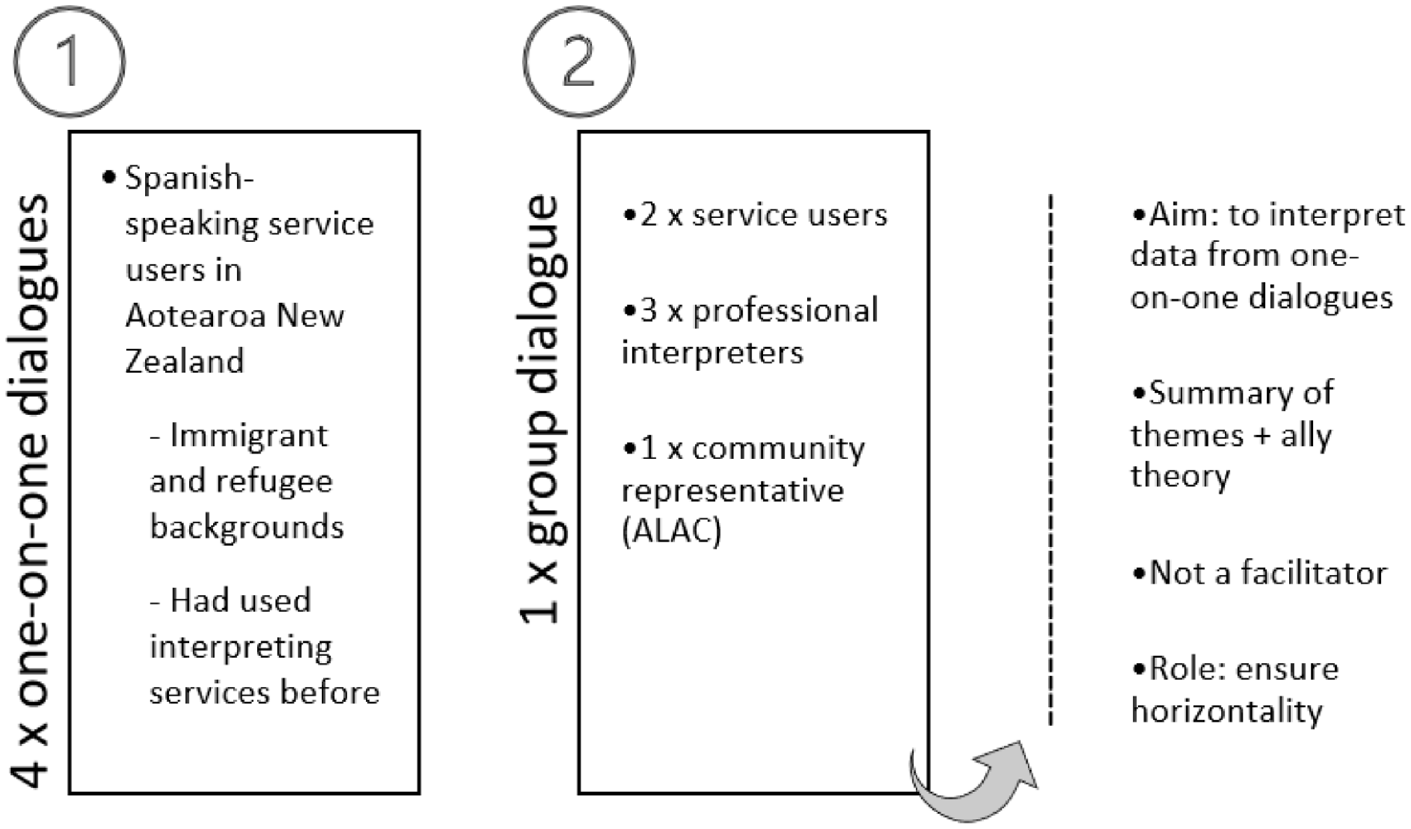
Research Design.
As a result, the one-on-one dialogues varied in length, depending on the availability, interest, and desires of the interlocutors, ranging from 1.5 hr to 40 min. Moreover, because asymmetry is reinforced by one-way questions (Briones, 2020), the one-on-one dialogues allowed for all interlocutors to alternate between the roles of speaker and listener (Cornejo & Rufer, 2020). “You have asked me so many things. Now I’m asking you,” one of the service users stated during our dialogue, highlighting the nature of the horizontal knowledge exchange. The result of the polyphony places the researcher’s vision and interpretation as one of many possible perspectives, therefore reducing the researcher’s authority (Kaltmeier, 2012, p. 48).
Following a horizontal perspective, participation in the research was based on transparency and participative choices (Kaltmeier, 2012, p. 35). For this reason, both ALAC and every individual who participated in the one-on-one dialogues were able to recommend others whom they thought would have knowledge to contribute to the conversation. The first user who participated in the one-on-one dialogues connected me with the second, someone I would not have been able to reach otherwise. ALAC shared the advertisement on their social media and chose their own representative for the group dialogue, but did not put forward any service users for the dialogues. The third user was found through a Facebook group, while the fourth was part of my personal network. To keep the study within scope, only four service users were involved in the one-on-one dialogues.
The one-on-one dialogues were followed by one group dialogue which involved two service users (SU1 and SU2), three professional English-Spanish interpreters from Latin America living in Aotearoa New Zealand (PI1, PI2, and PI3), and one Latin American community representative from ALAC (CR). The shared Latin American background made it possible to engage with each other through shared worldviews, realities, and cultural practices, thus centring our own traditions and ways of knowing (Nakhid, 2021). The group dialogue’s aim was to carry out the interpretation of the data from the one-on-one dialogues to incorporate meanings and contexts beyond the thematic analysis of the data (Wolcott, 1994). Before the meeting, each person was sent a summary of the themes from the one-on-one dialogues, together with a summary of the characteristics of an ally. This text was both a product of the one-on-one dialogues with service users, and the object of analysis of the group dialogue.
On the day of the meeting, I presented the themes using a PowerPoint presentation and shared the following questions which were to guide the discussion once the presentation was over:
What are the ideal characteristics of an interpreter?
What excites me about the ally model in interpreting? What worries me or stops me from implementing it?
What does the model look like in practice? What do we have to do?
However, the horizontal group dialogue was different from a focus group, where the researcher acts as a detached facilitator who does not participate in the discussion but rather guides the group so that it addresses the research question and objectives (Davis, 2016). As one of seven interlocutors, I had no authority over the others to constrain their answers so that they would directly address the questions I had prepared. Instead, my main role was to try to guarantee horizontality, particularly discursive equality and the autonomy of every person’s viewpoint. The proposition of horizontal methodologies is neither about finding harmonious ways of incorporating the voices of others, nor about following the hegemonic principles embedded in research (Corona Berkin, 2012). Rather, it seeks to establish the necessary conditions that allow for the horizontal co-production of knowledge. Therefore, after a lengthy discussion that took place throughout the presentation of the themes, the group only had time to address the first of the three questions shared above. Answers to the question were written on a piece of paper which was then stuck on a poster on the wall. We discussed each contribution one by one until we agreed on its content, adding clarifications if necessary. New themes and concerns emerged from the group dialogue, where users’ knowledge was confronted with the knowledge of the community representative and, mainly, of the professional interpreters. These emerging concerns were incorporated into the research and used as an added layer of meaning-making. However, the process was considerably complex, so its challenges and limitations are addressed below.
5.2 Challenges and Limitations
The implementation of the research design had challenges involving the methods used for data analysis, the role of conflict, and emotions in research, as well as other limitations that resulted from time constraints and managing a research project with a specific focus. In terms of data analysis, horizontal methodologies do not see research as the process of connecting theories to the specificities of a particular context (Corona Berkin, 2020a). Instead, they consider that those who participate in the research process to create new knowledge already possess theories shaped by their background, history, and context (Corona Berkin, 2020a). Moreover, horizontality seeks to avoid the process of purification through which data is adapted and analysed to fit pre-established expectations, terminology, and theories, erasing the presence and rationale of anyone who cannot be forced into those categories (Kaltmeier, 2012).
For these reasons, the study presented the findings in two forms. First, findings were presented in the form of transcriptions so that the reader could engage directly with the knowledge produced by interpreting service users. By prioritising the transcriptions and, therefore, the dialogues themselves, this study sought to distance itself from Western analytical tools which contribute to the coloniality of knowledge (Corona Berkin, 2020a). Seeing each interlocutor as a subject exchanging knowledge in context can help counter the subject–object relationship between the researcher and researched to focus on relationship-building (Kluttz et al., 2020).
The findings were then presented in the form of a thematic analysis. Researchers’ analyses following Western methods have often been considered reductive, as they decontextualise knowledge by sorting data into thematic groups (Kovach, 2021). Fernández Santana (2020, p. 102) suggests that, “in thematic analysis, the importance of the topic (as defined by the researcher) prevails as the criterion for collecting, organising and interpreting data,” resulting in fragmented knowledge. Moreover, grouping knowledge in themes is inconsistent with making meaning in a holistic manner (Kovach, 2021). Therefore, this conventional analysis of research data is incompatible with the horizontal methodologies that guided this study.
However, as stated, it is not the method which determines the characteristics of a methodology, but rather how that method is incorporated into the research paradigm (Kovach, 2020). Previous decolonial and culturally affirming studies have used a series of writing strategies to ensure the inclusion of contextual information, as well as the integrity of participants’ narratives (Fernández Santana, 2020). Other studies have resorted to a mixed-method approach that included transcriptions for contextualisation and a thematic analysis of the same data to draw further meaning from it (Kovach, 2021). Contextualisation and interconnectedness are key parts of the horizontal production of knowledge which seeks to offer multiple perspectives that can help us understand social events beyond the perspective of the researcher (Corona Berkin, 2020a).
It was in this spirit that the transcriptions of the dialogues were presented first as a way of prioritising the service users’ voices and honouring their stories and experiences. This way the transcriptions helped to contextualise the information once it was depicted as themes. The thematic analysis was used to assist the process of connecting service users’ knowledge. After presenting the findings in the form of transcriptions and themes, the interpretation of the data was conducted through the group dialogue with service users, professional interpreters, and a community representative from ALAC to further enhance horizontality.
Besides interpreting the data from the one-on-one dialogues, another aim of the group dialogue was to create a horizontal space through research so that different voices would be heard in a context of discursive equality. As stated above, polyphony is seen to reduce the role of the analyser and limit the authority of the researcher with the aim of conceiving their interpretation as only one of the possible perspectives (Kaltmeier, 2012). Through this combination of methods, the study contributed to the construction of horizontality, while still answering the research questions in line with academic constraints and expectations.
In addition to the challenge posed by data analysis, other challenges emerged during the group dialogue. First, one meeting did not offer enough time to address all the prepared questions. In addition, the dialogue was fraught with conflict and emotions. The tension resulted mainly from the juxtaposition of two opposing beliefs, represented by one of the service users (SU1) on the one hand, and one of the professional interpreters (PI1) on the other hand. SU1, who had participated in the first round of one-on-one dialogues, renewed during the group dialogue their call for interpreters’ humanity, altruism, and accountability. This user represented a typically marginalised voice within interpreting studies who, in this case, was demanding change in the interpreting profession. Countering SU1’s request, PI1, the interpreter with the most experience in the room, supported maintaining a considerable distance from service users.
In Aotearoa New Zealand, interpreters must adhere to the code of ethics of the NZSTI (2013). This code determines that interpreters must focus exclusively on transferring messages without omission or distortion, and without engaging “in other tasks such as advocacy, guidance or advice” (NZSTI, 2013, p. 3). According to this code, interpreters must remain unbiased at all times, without softening, strengthening, or altering the messages conveyed (NZSTI, 2013). PI1’s opinions were supported by this code which fosters impartiality and non-intervention (Tate & Turner, 2001), contributing to the legitimisation of “powerful public institutions at the expense of less powerful voices” (Inghilleri, 2012, pp. 39–40). This conflict between two opposing stances can be seen in the following extract:
The disagreement between SU1 and PI1 continued throughout the entire dialogue. In the end, the conflict peaked when, offended by PI1’s position, SU1 stated:
I was aware of the potential for conflict because I had already conversed with SU1 in the first round of one-on-one dialogues. Moreover, the issue regarding the interpreter’s bias, function, non-involvement, and positioning is itself reflected in the academic literature (e.g., Crezee et al., 2020; Dean & Pollard, 2018; Major & Napier, 2019; L. Wilson & Walsh, 2019) and had motivated the whole research project. However, after the meeting, I felt overwhelmed and concerned by the tension in the dialogue. According to horizontal methodologies, for conflict to be productive, interlocutors must be able to maintain the autonomy over their own viewpoint and enjoy discursive equality. I considered that I had failed to guarantee a productive space of autonomy and equality, and felt responsible for the situation we had faced.
As a researcher, I believe in recognising that the emotions embedded in these experiences are a valid and productive part of the research process. These emotions tend to be obscured and ignored, rarely making it into any publication (Jenkins et al., 2020). Therefore, I share the reflections in this article to push back on what Jenkins et al. (2020, p. 7) call the “environment of the neoliberal academy,” where “failure is a risky business.” Moreover, I do so in recognition of the support of supervisors, family members and peer researchers who patiently listened to me as I unpacked my emotions, until I was ready to re-engage with the material.
As a final challenge, I would also like to comment on a series of decisions which were made due to time constraints, but have the potential for further horizontalisation. First, during the one-on-one dialogues, pre-recorded videos of acted scenarios were used to illustrate certain interpreting dilemmas and interpreter behaviour. The scenarios, involving catheter-care discharge for a patient who has gone into urinary retention, were written in consultation with a practising registered nurse based on their medical expertise and knowledge of the hospital procedures. The scenarios also included instances of interpreter agency and intervention adapted from Baker-Shenk’s (1991) examples of sign-language interpreters acting as allies of the deaf community in the United States. There is certainly scope to further horizontalise the production, ownership, and use of visual artefacts such as these videos, with the aim of using them as tools for dialogue and engagement (Mitchell et al., 2018). Horizontalising the production of the visual artefacts used for data collection would contribute to the creation of material which is culturally relevant and draws from service users’ own ways of knowing.
Second, I was the one who conducted the thematic analysis and determined the agenda for the group dialogue. In addition, the group dialogue participants received only a summary of the themes for their interpretation and did not have access to the full transcripts of the one-on-one dialogues with the service users. It is possible that this lack of horizontality had repercussions on the way the group dialogue developed and the interruptions experienced during the presentation of the themes, as discussed above. However, I tried to address these limitations by having two of the original four service users present in the group dialogue so that they could offer their knowledge directly and speak for themselves.
Finally, even though horizontal methodologies question the academic field’s understanding of authorship as a way to accumulate prestige, and instead encourage co-authorship (Kaltmeier, 2017), I abided by my institutional requirements that established that my contribution to any publications arising out of the research had to be of at least 80%. In a different research context, however, both the thematic analysis and the writing process could be conducted cooperatively in a horizontal manner. In the present case, I was solely responsible for the write-up process, using academic English even though the whole research was conducted in our native Spanish language. Given that the proponents of horizontal methodologies consider that the use of academic rhetoric and English as the academic lingua franca are limitations imposed by the academic field (Kaltmeier, 2012), I will translate the findings into Spanish and share the knowledge through Latin American community organisations in Aotearoa New Zealand such as ALAC.
5.3 Discussion and Implications
According to horizontal methodologies, generative conflicts arise at the intersection of different perspectives and are the starting points for the production of knowledge (Kaltmeier, 2017). Therefore, after the period of emotional turmoil described above, I understood that the confrontation of opposite stances was a necessary part of the research process. Indeed, in contrast with the experiences of other researchers in the field (e.g., Edwards et al., 2005; Major & Zielinski, 2016; Zimányi, 2010), my interlocutors in the group dialogue were interested and engaged. In interpreting research, service users can be hard to find and engagement can be difficult (MacFarlane et al., 2009). Previous research involving CALD participants has resorted to different methods of engagement, such as utilising bilingual research assistants who could draw on community organisations and their own personal networks to contact potential participants (Edwards et al., 2005), or hiring professional interpreters so that they can provide their services during data collection (Major & Zielinski, 2016). For example, Edwards et al. (2005) highlight the difficulty in successfully getting Chinese, Kurdish, Bangladeshi, Indian, and Polish users to participate in their research project on users’ experiences of interpreters in England. The bilingual research assistants involved had “to dedicate much time and effort to establish a relationship of trust with potential research participants and persuading them to be interviewed” (p. 79).
According to Corona Berkin (2020a), research can be easily sustained when there is reciprocity and all sides are gaining knowledge. Even though every interlocutor involved in this research project was given a standard supermarket gift card as a token of appreciation, food was provided when hosting a meeting, and a small gift was presented when the meeting took place at the interlocutor’s house, a horizontal understanding of reciprocity goes beyond a simple economic exchange, and involves the mutual benefit of all members of the community. In this regard, I believe that my position as a Latin American seeking to meet other Latin Americans to create new knowledge together was conducive to engagement. This is consistent with Shrestha-Ranjit et al.’s (2020) findings from one of the few studies involving CALD interpreting service users in Aotearoa New Zealand. In this study, data were collected by one of the main researchers, who shared the linguistic, cultural, and religious background of the Bhutanese migrants who participated in the study. According to the authors, this researcher’s cultural sensitivity, and the care with which she engaged with people and organisations throughout the project, was a strength of the research (Shrestha-Ranjit et al., 2020).
Interestingly, the interpreting service users who participated in the present study identified the following drivers for their participation: a feeling of appreciation and gratitude towards the interpreters that they had worked with; an interest in the topic and a desire to contribute to the creation of new knowledge; a feeling of fraternity towards fellow Latin Americans; and a feeling of sisterhood, arising from one of the female service users and directed mainly at me as a female peer. Interlocutors were not told beforehand that they would receive a supermarket gift card in exchange for their time nor the nominal value of the gift card, which potentially rules out this factor as a driver of engagement.
On my part, during the dialogues I expressed an interest in changing interpreting service provision, improving users’ experiences and their lives, closing the gap between interpreting theory and interpreter behaviours in practice, and getting closer to the Latin American community in Aotearoa New Zealand. This last driver arose as a part of the research project, which took place in the context of the Covid-19 pandemic. At the time, travelling and border restrictions meant I was unable to return to Argentina for an uncertain amount of time. During that period, this study and the connections I formed with those in situations similar to mine served to expand not only my support network, but also my understanding of home.
After nearly 3 hr, once the meeting was over, one of the interpreters (PI2) stated: “This is amazing. Being here alone is excellent to start the conversation.” As we exited the building, one of the service users (SU2) told me how much they had learned and enjoyed the conversation. The community representative (CR) contacted me afterwards to tell me how much they enjoyed having spaces where they could hear different points of view and learn from others. Moreover, after reaching out to every member of the group dialogue, I found an interest in keeping the conversation going. The study could have included a follow-up meeting to continue the discussions, were it not for the time constraints and the COVID-19 lockdown of August 2021 in Aotearoa New Zealand, which began the day after the group dialogue took place (Unite against COVID-19, 2021). However, the interest in the topic and the keen participation of the parties involved signal the need to create more spaces for horizontal dialogue and to further expand on the current research.
6. Conclusion
As researchers, we cannot assume that the co-production of knowledge with academics is either useful or desirable to the communities involved (Jenkins et al., 2020). However, this study has revealed that the interest and desire are there if we engage with communities in relevant and culturally affirming ways, instead of defaulting to foreign and external research practices. The study found that service users involved in the study preferred a humane interpreter, rather than a conduit or machine, making clear and explicit calls for empathic, kind, caring, helpful, and even affectionate services from their interpreters. These attitudes were considered central to users’ feelings of ease and their trust in interpreters. Breaking the ice, establishing rapport, having close ties, and developing a familiarity with the interpreter were seen to improve communication. Moreover, service users’ understanding of the ethical principles in the code of ethics (NZSTI, 2013) was flexible and context-dependent. This view aligns with calls for teleological perspectives in interpreting practice and training (Dean & Pollard, 2018; Enríquez Raído et al., 2020), and contradicts previous research in Aotearoa New Zealand (Ministry of Business Innovation & Employment [MBIE], 2016) that found an alignment between users’ expectations of their interpreters and the guidelines in the code of ethics (NZSTI, 2013). In this sense, it is possible that using a culturally affirming methodology based on a Latin American epistemology made it possible for this research to access a different kind of knowledge regarding users’ views on the interpreter role, as the manner research is conducted affects its capacity to represent marginalised populations (Fernández Santana et al., 2019).
In relation to allyship, users showed limited previous knowledge of ally theory, but a readiness to adopt the concept. Comparable to Minges’s (2016) conclusion that American Sign Language interpreters’ positive views on allyship and social justice reveal a potential for the expansion of allyship within professional interpreting, the study found similarly positive views, in this case among interpreting service users. In agreement with existing local and international research (Crezee & Roat, 2019; Shrestha-Ranjit et al., 2020), this study underscores that, in some cases, linguistic aid alone might not be enough to guarantee access to services and information for members of CALD communities. Moreover, inadequate interpreting services were found to reinforce feelings of frustration, helplessness, disappointment, and even depression.
Regarding the incorporation of users’ perceptions of allyship and social justice into interpreting practice, the findings highlight the importance of interpreters’ empathy and flexibility, which some interpreting guidelines consider crucial when working with vulnerable populations (Bambarén-Call et al., 2012; Bergunde et al., 2018). Moreover, interpreters’ self-reflection, critical thinking, and responsibility were considered conducive to a better understanding of situated problems and needs, which would in turn allow for the incorporation of social justice and allyship concepts in interpreting. To bring about true change in the interpreting field, this process must go beyond simply finding new labels for the interpreter’s role. To achieve this, any discussion about new roles and models should be accompanied by a sharp focus on the consequences of interpreters’ actions. In that sense, the findings are consistent with previous calls for professional responsibility, which occupies a central position in other caring professions such as medicine, teaching, and social work (Baker & Maier, 2011; Drugan & Tipton, 2017). Similarly, the findings support the academic literature arguing for the consolidation of interpreting as a practice profession that requires a combination of technical, interpersonal, and judgement skills (Dean & Pollard, 2018). As Dean and Pollard (2018) suggest, discussions about the interpreter’s role within an ally model of interpreting cannot be the only factor guiding interpreters’ decision-making, as deliberations over the role must be complemented by a teleological understanding of ethics.
These research findings highlight the need to create spaces where CALD service users can share their knowledge as equals. The study also advances the understanding of interpreting as a social practice, because horizontal methodologies, in which dialogue is understood as a process of identity formation and knowledge construction with the other (Kaltmeier & Corona Berkin, 2012), were themselves conducive to the self-reflexivity needed for the development of a sociology of interpreting (Wolf & Fukari, 2007). This article argues that horizontal methodologies, while sometimes difficult to implement in constrained academic contexts, enable the co-construction of knowledge among Latin American people, while challenging colonial research practices. Now, more than ever, the interpreting profession needs to demonstrate that interpreters are cognizant of their impact on society and show a willingness to engage with it (Baker & Maier, 2011). In that sense, this research is a call for other researchers to accept different realities, engage more actively with the research process, and build relationships with the world around them.
Footnotes
Declaration of conflicting interests
The author(s) declared no potential conflicts of interest with respect to the research, authorship, and/or publication of this article.
Funding
The author(s) disclosed receipt of the following financial support for the research, authorship, and/or publication of this article: This research was funded by the Auckland University of Technology and portions of these findings were presented at the Fifth Conference of Interdisciplinarity in Interpreting and Translation organised by the Interdisciplinary Research Center of the Graduate Institute of Translation and Interpretation, Shanghai International Studies University (SISU).
