



Abstract
This article explores inter-professional collaboration in multilingual TV/radio production by focusing on media stakeholders’ perceptions and experiences of working with interpreters, and their bearing on the final broadcasting of interpreting on TV and radio. A mixed method approach is followed, consisting of qualitative analysis of video-recorded semi-structured interviews with stakeholders (broadcasters, producers, camera and sound operators and editors) involved in the production of two original broadcasts by Spanish State and Regional Andalusian Broadcasting companies, covering the Fourth Cines del Sur Film Festival (2010) in Granada. The analysis focuses on production-related issues and audience-oriented collaboration between stakeholders and interpreters. It is then corroborated with the original broadcasts of the two programmes and unbroadcast footage of off-air interactions with interpreters and the interpreter-mediated interviews. Drawing on the notions of “broad” and “narrow” context, the study demonstrates that inter-professional collaboration, and that the different degrees of knowledge integration across media and interpreting fields of knowledge ultimately shape the ways in which interpreting is performed and broadcast.
Keywords
Introduction
This article explores inter-professional collaboration in multilingual TV/radio production, and its bearing on the final broadcasting of interpreting on TV and radio. Traditionally focused on quality, constraints, problem solving, the role of the interpreter and codes of practice, media interpreting research has tended to isolate interpreting from the inter-professional collaborative fabric in which it takes place (see Castillo Ortiz, 2015b). Moreover, methods have mostly drawn on the broadcasts, that is, the end-product and, at most, retrospective interviews with interpreters (Wadensjö, 2008), at the expense of other relevant data. In an attempt to explore the overlooked collaborative nature of interpreting in multilingual media production, this study turns its attention to media stakeholders working with interpreters (i.e., broadcasters/presenters, producers, journalists, editors, and sound and image technicians) by analysing their perceptions and experiences on working with interpreters, and checking these against their practical work with interpreters during the interpreter-mediated broadcast production.
The methodology for this study draws on the following three complementary sets of multimodal data: (a) original broadcasts of Spanish State and Regional Andalusian Broadcasting Companies (RTVE and RTVA), (b) raw unbroadcast footage/tracks of interpreter-mediated interviews in two of their programmes (El Séptimo Vicio and El Sur, respectively), and (c) video-recorded semi-structured interviews with the stakeholders involved in the production of the interpreter-mediated broadcast, namely broadcasters, producers, camera and sound operators and editors involved in both RTVE and RTVA programmes. The methodology chosen responds to a complex understanding of context in media interpreting, as conceptualised by Cicourel (1992) and adapted to interpreting settings by Mason (2006), where the “broad context” includes all the production arrangements and negotiations that ultimately shape the “narrow context” of interpreter-mediated interaction.
The focus of the analysis thus lies on the contribution of the above-mentioned stakeholder interviews on their perceptions of working with interpreters when checked against the interpreter-mediated data (both broadcast and unbroadcast), that is, actual practice. They prove to be crucial in evidencing that the use of several sources and different perspectives during the data collection process leads to a more comprehensive understanding of multilingual TV/radio production as a whole, something which, arguably, could not be addressed with the sole use of the end-product as research data.
Issues such as the choice of interpreting modality (simultaneous, consecutive, liaison), the type of broadcast (live, pre-recorded, edited voice over), and the management of the interaction (situational arrangements and turn-taking) are under particular scrutiny in the study, in order to shed light on the decision-making process and the inter-professional relationship in the production of interpreter-mediated events. As we shall see, interpreting is de facto part of the production and all stakeholders—not only the presenter, as usually assumed (Straniero Sergio, 1999)—have varying views on the necessity of interpreting, its potential constraints on the actual unfolding of the interaction and the overall production. All have a bearing (albeit unequal) on the final broadcasting of multilingual TV/radio programmes. As evidenced in the data analysis, media stakeholders’ perspectives on interpreting sometimes collide and require negotiation. Such negotiation is contingent upon the stakeholders’ level of linguistic and interpreting awareness, broadcasters’ linguistic policies and conventions, as well as decisions around propositional content. As this study demonstrates, inter-professional collaboration is power-embedded and manifests different modes and degrees of knowledge integration, ultimately, shaping the ways in which interpreting is performed and broadcast.
The Study of Interpreter-Mediated Broadcast Productions
This section addresses the main developments and contributions in the field of media interpreting research which have approached interpreter-mediated media events putting the broad context (Cicourel, 1992) surrounding the exchange, that is, events, production arrangements and interactional features, at the centre of their analysis.
Most of the research on spoken media interpreting has limited its scope to TV interpreting and simultaneous interpreting (Alexieva, 1999, 2001; Antonini, 2010; Bross-Brann, 1995; Chiaro, 2002; Daly, 1985; Falbo, 2011; Jääskeläinen, 2003; Katan & Straniero Sergio, 2001; Kurz, 1982; Kurz & Pöchhacker, 1995; Mack, 2002; Moreau, 1998; Straniero Sergio, 1999). When it comes to radio within media interpreting research, it includes, at most, a passing reference to radio interpreting (Antonini, 2010; Chiaro, 2002; Kurz & Bros-Brann, 1996 ; Liepins, 1996; Pöchhacker, 2007; Skuncke, 1983; Wadensjö, 2008). Only a few studies have focused on the analysis of interpreter-mediated radio broadcasts, specifically on radio interviews (e.g., Castillo Ortiz, 2015a; Wadensjö, 2000), alerting to the need for further research in this area.
Like conference interpreting and public service interpreting, media interpreting is a field of “situated practice” (Linell, 1997) or a “situated system of activity” (Wadensjö, 1998, following Goffman, 1981) in its own right. This involves specific discoursal and interactional features which are intrinsically linked to the elements of the setting(s) in which it takes place: the medium (TV, radio, online media platform, etc.), the programme, with its arena and ethos of broadcasting (Castillo Ortiz, 2015a, based on Scannell, 1988, 1991), and the production or broadcast conditions under which the interpreter-mediated interaction occurs. They can all be included under the umbrella term of “broad context” (Cicourel, 1992). Research in media interpreting has rarely put the impact of this broad context at its centre, and we find only a few cases where broad contextual features are considered primary determining factors of the exchange (Mason & Stewart, 2001; Wadensjö, 1998) and put at the forefront of the research (e.g., Castillo Ortiz & Comte, 2011; Gieve & Norton, 2007; Jiménez Serrano, 2011; Katan & Straniero Sergio, 2003). In this discussion, context is conceptualized not only as a constraint on the production of talk, but also as a product of the use of language and participants’ cooperation (Straniero Sergio, 1999, p. 304), thus “context” has a dynamic character that no analysis of social interaction should omit.
The “broad context” sets the foundations for and shapes the “narrow context,” which Mason (2006, p. 366), drawing on Cicourel (1992), defines as the “local element whereby user assumptions are negotiated and re-negotiated continuously in interaction.” In the case of media interpreting, the narrow context is highly complex since, as Alexieva (2001, p. 114) points out, participants’ actions are oriented to two levels of communication, which in the case of interpreters involves interacting, often simultaneously, with these two levels: on one hand, the “on-screen” level, where the primary interlocutors interact with each other, meaning that the interviewer and the interviewee(s) alternately perform the roles of speaker and addressee (Alexieva, 2001, p. 114); on the other hand, the “off-screen” level, consisting of the initiator (the TV channel through its programme managers who are responsible for the invitation of the interviewees) and the audience as the final addressees of the performance.
Focusing on what Alexieva calls the “off-screen” level, Jiménez Serrano (2011) introduces the concept of “backstage conditions” (p. 120) in live TV interpreting assignments as a factor affecting quality according to the following two salient variables: visibility and exposure. The “backstage conditions,” a term borrowed from theatre, cover “all the elements constraining the interpreter’s work, which mostly belong to the world behind the TV camera.” Corresponding to the “broad context,” in Cicourel’s terms, these may include the interpreter’s location during the event, the subsequent interpreting modality and technical arrangements (e.g., sound quality, volume, camera), all of which has an impact on what could be referred to as “the onstage arena,” or the “narrow context,” in Cicourel’s terms, where aspects such as stress and visibility (the original focus of the author) may manifest themselves. Beyond stress and visibility implications, this article seeks to explore the ways in which media production stakeholders and the interpreters work together towards the delivery of the onstage (my emphasis).
Media discourse can also be considered part of the broad context under study. Mack (2002) explores television discourse with a view to sketching “a general background for the systematic analysis of characteristics and typologies of orally translated television discourse in Italy” (p. 204). The author claims the need to “improve our understanding of [television’s] working mechanisms” (Mack, 2002, p. 203) through the analysis of large collections of recordings of “impromptu oral translations” on Italian television (see Straniero Sergio, 1999). Acknowledging Mack’s claim involves departing from the sole focus on the end-product and delving deeper into these “working mechanisms” by approaching stakeholders.
Like Katan and Straniero Sergio (2003), Mack (2002) underlines the salient peculiarities of media discourse when interpreting is involved:
the industrial character of message production for mass communication, involving enormous personal and technical resources and economic interests, [. . .] makes it difficult to identify and clearly distinguish between animator, author and principal of a message. (p. 205)
Mack points to the collaborative and negotiated aspects of interpreter-mediated events, which tend to be highly conventionalised due to the “industrial character of message production.” Despite this conventionalised nature, it is still quite complex to analyse, since authorship of that discourse is blurred, and there are no clear lines between presenters (“animator”), scriptwriters (“author”) and producers (“principal”), and interpreters.
His analysis of interpreters’ performances on Italian TV leads Mack (2002) to conclude his study with a “deliberately provocative statement,” pointing to the mismatch between interpreters’ and the medium’s priorities, including the polarisation of interpreters’ self-perceptions of their performance in the media as “interpreters” versus “mediators”:
[referring to Italian television] Some of its interpreters still live on the other side of the (media) moon, where the faithful transmission of meaning, even at the expense of form, for a co-operative audience is the supreme goal of interpreting, while others use their power as mediators in a far from impartial way. (p. 212)
This statement invites us to further research how this may be the case in different productions and to what extent it distinguishes media interpreting from other fields of interpreting practice. As I have argued elsewhere (Castillo Ortiz, 2015a, see Mack, 2002), several factors impinge on the diverse uses of media interpreting for broadcasting purposes: the generalised lack of inter-professional collaboration of media and language professionals, a highly monolingual view of media broadcasting (particularly in the Western European broadcasters under scrutiny in research literature), and the effects of outsourcing of interpreting services, which limit negotiation and collaboration (Castillo Ortiz, 2021). This suggests that the media interpreter’s habitus (Bourdieu, 1990, p. 78) is either highly diffused or under-researched and, therefore, still obscure and worth exploring from the vantage point of production practices. In order to do so, it is necessary to enlarge the lenses and explore how foreign voices are represented on TV and radio.
The representation of foreign voices on TV and radio
The study of broadcast production has centred its attention on strategies to deal with foreign voices, which may or may not involve interpreters, broadcast conventions and/or practices concerning the representation of those foreign voices, as well as the ideological issues underpinning such representations.
Focusing on British broadcast television, Gieve and Norton (2007) analyse a corpus of 22 televised travel, documentary and lifestyle programmes, filmed outside the United Kingdom (with or without interpreters), and broadcast between 2003 and 2005. Although they focus on the end-product (i.e., multilingual talk-in-interaction on TV) and the ideological implications of attitudes towards linguistic difference, their model to delve deeper into the production arrangements and conditions paves the way for further studies on the broad context of interlingual (interpreter-mediated) exchanges in TV production. They create a model of analysis in the following two stages: they first account for the relationships between the broadcast protagonists, and then identify strategies for the representation of linguistic differences. As regards the set of relationships shaping interaction, the authors identify on one hand, hosts, narrators, journalists, British people travelling abroad, whom the authors define as the “monolingual English native or near-native speakers” (Gieve & Norton, 2007, p. 192), who are representative of the target audience; on the other hand, the Others—the foreign language speakers, “those with whom the protagonists may not be able to communicate” (Gieve & Norton, 2007, p. 192). They use the model to examine whether protagonists “demonstrate a primary orientation to the audience or to those with whom they are in presence of and interacting with” (Gieve & Norton, 2007, p. 192).
Gieve and Norton (2007) identify strategies to represent linguistic difference with regard to the way communication is accomplished across different stages in production and, ultimately, in broadcast, as presented in Table 1.
Summary of Strategies Used in Dealing with Encounters Across Linguistic Difference (Gieve & Norton, 2007, p. 207).
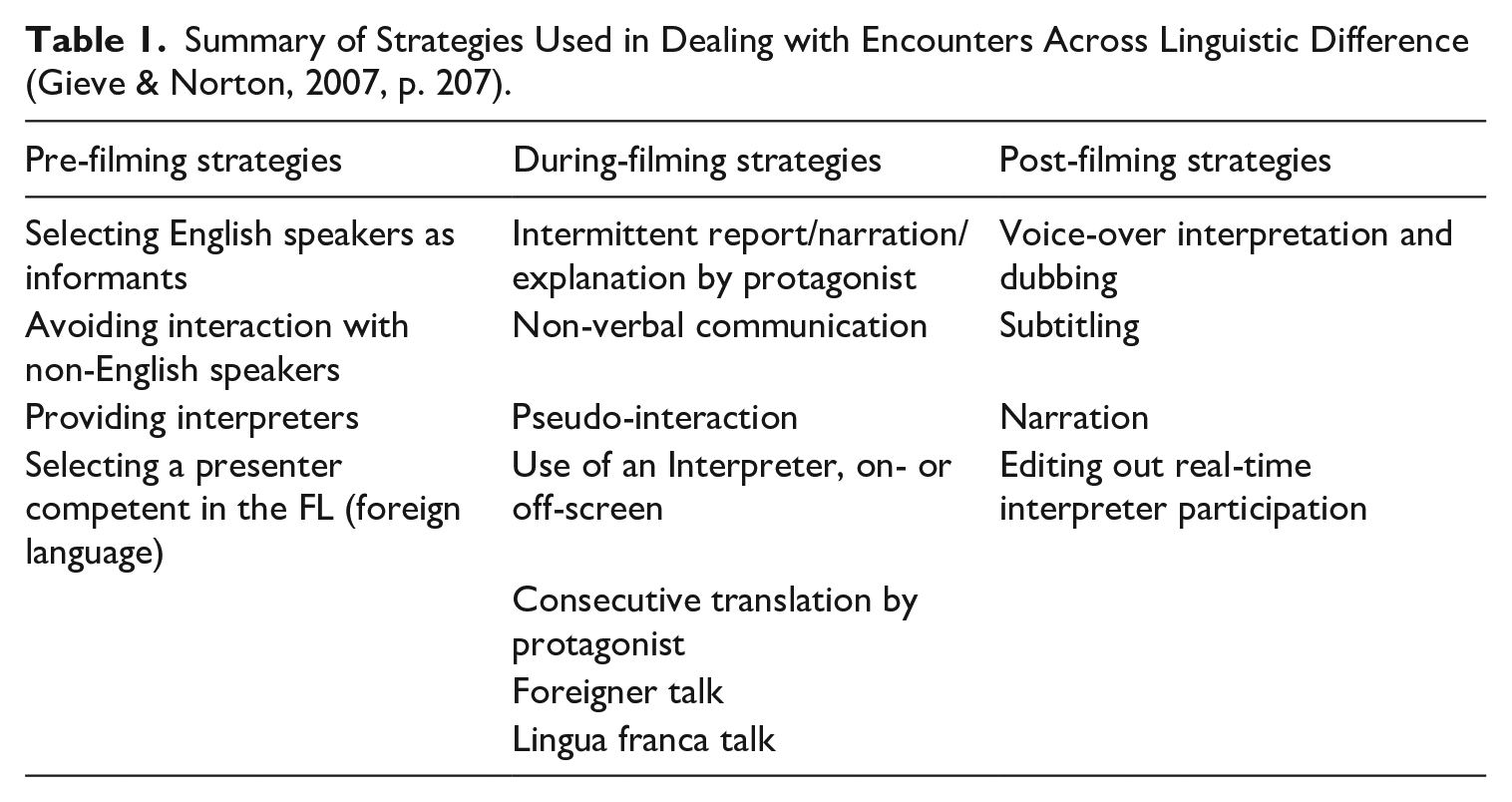
Among the different strategies identified in this table, interpreting may feature at each stage of production: in pre-filming strategies when there is a policy or an urgent need of providing an interpreter (a clear recognition of the Other); during filming, with the use of an interpreter who may appear off-screen or on-screen (with different implications for making visible of language difference in the end product); and in post-filming, where the real-time interpreter’s renditions may be edited, voiced-over or dubbed. However, there is no further qualitative or quantitative analysis in Gieve and Norton’s study, beyond the claim they make about the reluctance to resort to interpreters and the preference for English speakers as informants or interviewees. Hence, the provision of interpreters is rather vague in their analysis, although they emphasise that it is neither central nor common practice in these types of broadcasts.
Katan and Straniero Sergio (2003) explore the representation of foreign voices on TV, through a qualitative analysis of 50 hours of Italian interpreter-mediated talk show material (see also Straniero Sergio, 1999). They find that the overriding norm in this context is the “comfort factor,” understood as “the degree to which the TV audience is entertained” (Katan & Straniero Sergio, 2003, p. 131; see also Katan & Straniero Sergio, 2001). This norm leads to broadcasters’ and hosts’ control of the interpreting process before, during and after the interpreted event through three layers of gatekeeping. The first layer is, as in Gieve and Norton’s (2007) case, of an organisational nature: the decision on “what to translate” but also, “how an event is to be translated,” the possibility of subtitling, overvoicing and interpretation by the journalists and presenters themselves (see also Chiaro, 2002; Gieve and Norton, 2007; Jääskeläinen, 2003), “the decision to use one modality or another” (Katan & Straniero Sergio, 2003, p. 137). Interestingly, they argue that broadcasters’ choice of modality rests upon “programme strategies, general channel broadcasting policies, the TV genre (talk show, live media event, pre-recorded interview etc), the target audience, and the particular effect that the programme director wishes to achieve.” The high impact of these factors on the organisation of interpreter-mediated broadcast events and, ultimately, on the representation of foreign voices, has so far been overlooked in media interpreting studies and which this article seeks to redress.
The second layer of gatekeeping occurs at the level of the interaction: how the broadcasters control the interpreting process by gatekeeping both the verbal and non-verbal behaviour of the interpreter and how they shape the identity of the interpreter (Katan & Straniero Sergio, 2003, p. 137). Likewise, the interpreter also functions as a gatekeeper (Wadensjö, 1998), but she or he is selected and briefed (overtly and/or covertly) to satisfy the values inherent in the “dominant submerged ideologies” (Katan & Straniero Sergio, 2003, p. 135).
The third level of institutional gatekeeping takes place in programmes that are not broadcast live and where control during the editing stage may be extensive, including having access to the text before simultaneously translating it, correcting or “retouching” an earlier interpretation on the producer’s request, or having a previously recorded simultaneous interpretation voiced-over (Katan & Straniero Sergio, 2003, p. 142). Katan and Straniero Sergio (2003, pp. 142–143) analyse the different ways in which this can be done in TV to suit the broadcasters’ interests.
Katan and Straniero Sergio conclude that the submerged ideologies in the organisation of interpreter-mediated events in TV production have a crucial effect not only on the way the interaction unfolds, but most notably on how the interpreter’s traditional habitus (Bourdieu, 1990, p. 78) changes: first, traditional beliefs about interpreter invisibility, the supremacy of the source text and equivalence are challenged. The interpreter is being judged, “no longer on source text/target text criteria, but, as Marx suggests, in terms of ‘Commodity Fetishism’” (Katan & Straniero Sergio, 2003, p. 132). Hence, Katan and Straniero Sergio argue that short-term profit and the ability to maintain or increase audience share are becoming the pre-eminent values guiding media interpreting performance, at least in the case of TV shows. Second, and most importantly,
TV interpreters are being encouraged, through the natural selection process, to enter the media habitus. Broadcasters expect interpreters not just to have the relevant linguistic skills but also to be good performers and to participate in the non-verbal interactions (Straniero Sergio, 1999). The “deadly click” power of popular culture is obliging or encouraging interpreters (depending on their own comfort factor) to take on roles which traditionally have not been part of their profession.
What Katan and Straniero Sergio (2003) and Gieve and Norton (2007) show is that the inclusion, organisation and broadcast of interpreter-mediated media events follow pragmatic, financial and time-space constraints, but also, most notably, political and ideological ones which determine the interaction. Gieve and Norton (2007, p. 209) highlight that Others tend to be represented as “unreachable, irredeemably different, marked by linguistic difference before all else”. This reluctance to engage with Others, together with the ideological trend to put foreign language speakers in a potentially weaker position (Gieve & Norton, 2007, p. 209) may explain the low occurrences of interpreter-mediated events (whether live or pre-recorded). However, this problematic trend may be tied to a particularly monolingual view of broadcasting in Britain, despite its attempt to evolve towards cultural and ethnic diversity and inclusiveness (Department for Culture, Media & Sport, 2016). This study aims to find out whether this is also the case in other media outlets in this case Spain, and whether a particular setting is bound to be more linguistically and culturally sensitive, and how encountering Others is negotiated at different production stages by directly interviewing media stakeholders themselves, looking at the interactions themselves and triangulating this with off-stage footage and unbroadcast data. In my previous overview (Castillo Ortiz, 2021, p. 336) of the myriad of interpreter-mediated broadcasts and media productions, I have conceptualised media interpreting as intrinsically heterogeneous, and I have alerted to the need to account for the complexity of practices by attending to interpreting modalities, broadcasting genres and events, working conditions and quality assurance or assessment, the “communicative ethos of broadcasting” (Scannell, 1988), and to adopt more appropriate methodological and theoretical framework for this purpose.
Approaching research in media interpreting within a continuum, this study is placed at the intersection between (a) the need to unveil how production conventions—as well as improvisations—are implemented within teams of media professionals involved in actual broadcast productions (Wadensjö, 2008); (b) the increasingly pressing debate and mapping of working conditions across media outlets (Jacobs, 2017); and (c) the resulting avenue of a redefinition of media interpreting quality (Pignataro & Velardi, 2013) that accounts for aspects and variables that go beyond the end-product. With this wider picture in mind, this study aims to address the first path (a, above) by exploring media stakeholders’ practical perceptions of interpreting in multilingual TV/Radio production, and their implications for interpreter-mediated broadcasts.
Method and Data Description
This study draws on the following three complementary sets of multimodal data: (a) original broadcasts of the Spanish State and Regional Andalusian Broadcasting Companies (RTVE and RTVA) covering the Cines del Sur Film Festival in Granada, (b) raw unbroadcast footage of the interpreter-mediated interviews in these programmes, and (c) video-recorded semi-structured interviews with the stakeholders involved in the production of the interpreter-mediated broadcast. This design is similar to Wadensjö’s study of a once-off live radio interview (2000), but it differs in the sense that it broadens the scope from the narrow context of interaction to the broad context of production. These data are triangulated by drawing on snapshots of broadcast and unbroadcast footage. The mixed method approach has the advantage of mitigating the risk of speculating about stakeholders’ expectations, views and impact on interpreters’ role and interpreting quality, while granting greater reliability to the findings. Issues such as the choice of interpreting modality (simultaneous, consecutive, liaison), the type of broadcast (live, pre-recorded, edited voice-over), and the management of the interaction (situational arrangements and turn-taking) are under particular scrutiny in the study, to shed light on the decision-making process and the inter-professional relationship in the production of interpreter-mediated events.
The data revolve around the special coverage of the fourth Cines del Sur Film Festival (Granada, Spain, 2010) by two programmes: Al Sur weekly cultural magazine, of Canal Sur Televisión Andalucía (RTVA) and El Séptimo Vicio film programme, of Radio 3 (RTVE). Their inclusion in this research is prompted by some common characteristics to these programmes and to their respective production crews: both programmes are run by public service broadcasting institutions, they have covered all 10 festival editions, they relied upon the interpreters hired by the festival organisers for every interview with non-Spanish speaking guests, the production crews were a mix of local staff (RTVA Granada) and non-local staff (namely technical staff, such as camera and sound operators), coming from Seville’s main RTVA headquarters. Furthermore, special coverage staff were dispatched to Granada from the broadcasting houses: the main presenter of Al Sur and two journalists were sent from Seville, in the case of RTVA, and the presenter of El Séptimo Vicio was sent from Madrid, in the case of RTVE.
What makes Cines del Sur interesting in terms of interpreter-mediated data is the amount of foreign language filmmakers, actors and, to a lesser extent, producers, directors of photography, scriptwriters, and so on, invited to the festival to promote and present their films both to the press through press conferences and exclusive interviews, and to the audiences through post-film Q&As, masterclasses and other audience-engaging events. Being a film festival covering the so-called Global South, international guests would come from a myriad of countries, languages and cultures. In this sense, although English was the most common foreign language often used as lingua franca, other languages were commonly present in the festivals, such as French, Arabic, Chinese (both Mandarin and Cantonese) and Persian, and occasionally Russian and Japanese. These conditions created a linguistically diverse event where translation and interpreting were at the core of communication internally and, most importantly, externally, to gather local, regional, national and international attention through as much media coverage as possible.
On the Use of Filmed, Semi-Structured Interviews
In the face of the general absence of written policies, guidelines and media institutions’ statements on how they approach interpreter-mediated broadcasts, the application of mixed methods which involve the triangulation of different layers of data becomes key. Considering that AV production is an inter-professional, collaborative activity, it is expected that the final appearance of the broadcast is the result of guidelines, conventions, orders and/or negotiations between stakeholders, which, in the case of interpreter-mediated media events, are yet to be addressed.
With this background in mind, filmed, open, semi-structured interviews were carried out with media stakeholders involved in the TV or radio broadcasts under study. The interviews were designed in a way that stakeholders would feel empowered (Turner & Harrington, 2009) to talk openly about their concerns, experience, knowledge and views on the interpreting activity and the interpreter in the programmes they work for. Interviews largely focused on broad context aspects both in terms of production arrangements and orientation to the audience, most notably, the comfort factor (Katan & Straniero Sergio, 2003).
Participants and Interview Conditions
The first methodological concern is who is to be approached and how, to get a comprehensive picture of the collaborative nature of this kind of communicative event.
A total of 13 media stakeholders were interviewed between 14 and 18 June 2010 as part of the overarching research project, entitled Interpreting in the Media: Liaison Interpreting in TV/Radio Settings, funded by Heriot-Watt University’s School of Management and Languages. Only those stakeholders directly relevant to the purpose of this article are included in the analysis below: the broadcaster or producer, the sound technicians of Radio 3’s El Séptimo Vicio film programme crew, and the staff involved in the Canal Sur TV Cines del Sur Film Festival special programme, namely the producer, executive producer, four journalists involved in the programme throughout the years and the camera operator involved in the 2010 edition. The research project included an ethical approval statement which was passed on to all interviewees. They all ratified the statement and gave permission to use the different data sets for the different purposes of the research project. Interpreters were also interviewed, but are not included in this article, as their experiences and perceptions of media interpreting as opposed to other work settings, falls out of the main aims of this study.
The interviews with stakeholders were carried out in Spanish, within the framework of the Cines del Sur Film Festival in Granada, by Geraldine Comte, a professional filmmaker who holds a Master’s Degree in Anthropological Cinema and Documentary (University of Paris X, Nanterre). Excerpts are therefore presented in Spanish with their respective back translations. The interviews were filmed because part of the objective of the above-mentioned research project was to produce two short documentaries aimed at disseminating this research in an innovative way in academia, that is, by audiovisually disseminating research that deals with audiovisual environments. The documentaries were also used for pedagogical purposes, to introduce media interpreting courses and workshops. The two documentaries are each 13-min long and are entitled The Role of the Broadcaster in an Interpreter-Mediated Radio Interview (Castillo Ortiz & Comte, 2010) and The Behind the Scenes Journey of TV Interpreting (Castillo Ortiz & Comte, 2011). They were released in the Languages and the Media and Media for All conferences, respectively, and are available upon request from the authors. For this reason, interviews were not anonymised, and authorisations were granted by Canal Sur TV, Radio 3 and Cines del Sur Film Festival to both film and use the footage in any research output by the author.
Semi-Structured Interviews Approach and Focus
In this regard, the semi-structured interviews consisted of the following three sections, namely (a) Background Information, covering the stakeholders’ roles and positions (Mason, 2009), and the kind of multilingual and interpreter-mediated events they usually cover; (b) the place of interpreting in TV/radio production; and (c) working with an interpreter.
The semi-structured nature of the interviews allowed for a critical and reflective view on the social activity under scrutiny, while frequency, representativeness and eventual systematisation of practices were still sought. To achieve these objectives, interview guidelines and advice were given to the interviewees prior to the filmed interview by the research team (the author and the interviewer, Geraldine Comte), for example, asking them to provide answers as comprehensively and thoroughly as possible, and to mention general practice and particular examples dealing with the issues in question. As part of her interviewing procedure, the interviewer used documentary interviewing techniques, drawing on her experience, adopting the position and ethos of a naïve or curious yet professional and well-informed interviewer (see Barbash & Taylor, 1997; Wengraf, 2001).
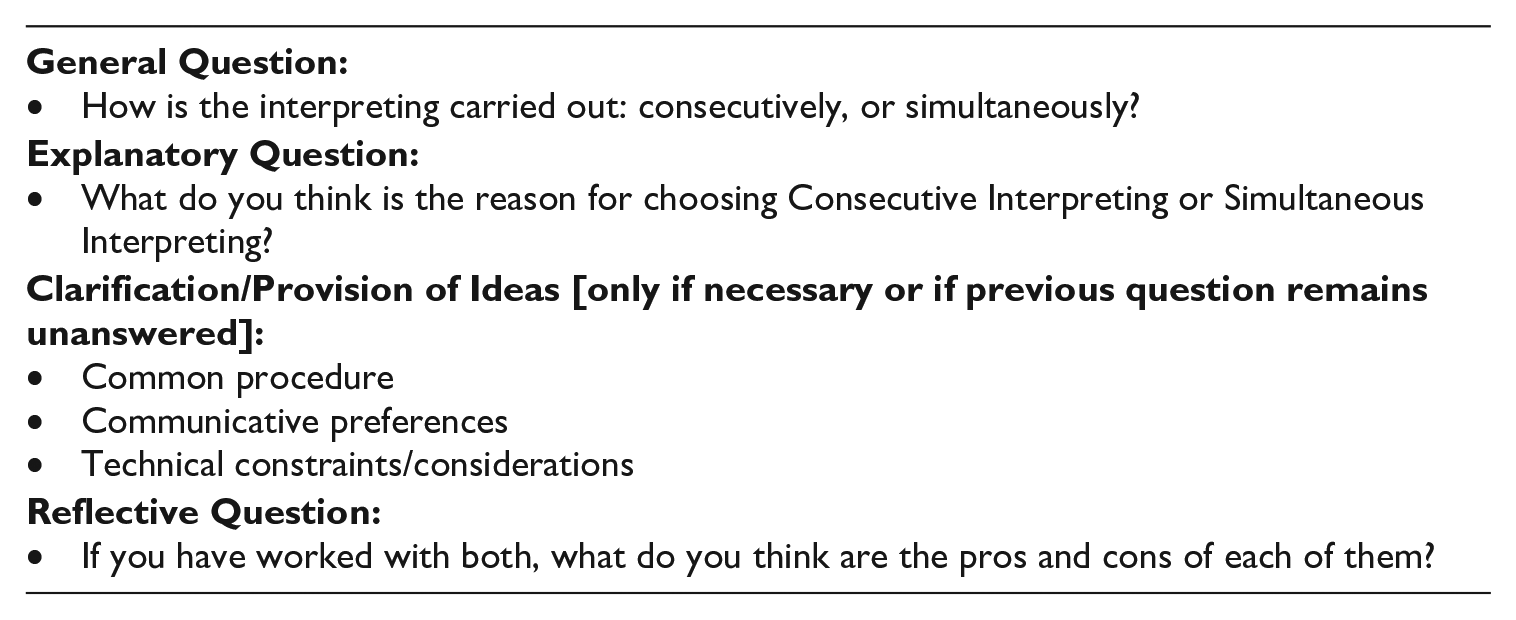
One important aspect is that we had the advantage of conducting the semi-structured interviews on the site of broadcast production at the Film Festival. This allowed us to use the interviews to corroborate what we observed in the actual broadcast production. That is, we could ask for clarification, for further explanations and even provide a list of possible answers in case interviewees were at a loss for words, as in the following excerpt of the interview guide:
Analysis and Findings
For this article, the analysis focuses on the following three aspects of the semi-structured interviews: (a) organisational aspects, relating to the medium and/or institution(s) making the event possible; (b) knowledge-based aspects, or participants background; and (c) interactional aspects, which have to do with stakeholders’ relationships and communicative ethos that their interaction is based on. These categories aim at reflecting the broad media context under study, but also relate to those used in discourse analysis (Hatim & Mason, 1990; Tebble, 1999) when looking at how the context influences the interpreter-mediated interaction, that is, mode, field and tenor. Although the analysis is qualitative, the excerpts presented here as illustrative examples reflect frequency, representativeness and conventionalisation of practices (Wengraf, 2001). The analysis focuses particularly on the most salient aspects in line with the research aims: constraints or aspects inherent to the medium as broad context, and negotiated aspects whereby different stakeholders contribute prior, during and after the interpreter-mediated interview.
Organisational Aspects
Organisational aspects are addressed below from the following three standpoints: hiring the interpreter, the interpreting modality and production arrangements.
The broadcasts studied showed an increasing dependence on externally hired interpreters, mostly due to budget constraints in cultural programmes:
. . . normalmente es la distribuidora o los organizadores del festival de cine quienes contratan al intérprete [. . .] y nosotros normalmente dependemos del o de los intérpretes que ellos ofrecen. . . . it is usually the film distributor or film festival organisations who hire the interpreter [. . .] and we usually rely on the interpreter(s) they provide. (Paco Gómez Zayas, Director and host of the Cines del Sur special, Canal Sur, RTVA)
As evidenced by Castillo Ortiz (2015a, 2015b), interpreting budget allocations prioritise news channels and prime time shows. In this particular case study, all interpreters who took part in Canal Sur and Radio 3 interviews were hired by the Cines del Sur film festival on a freelance basis. Due to data protection issues, interpreters’ names are undisclosed, but the number of interpreters and working languages (with Spanish as the pivot language) are representative of both the festival’s linguistic needs and the sensitivity towards language diversity: English (3), French (2), Persian (2), Portuguese (1) and Mandarin Chinese (1).
Heavy reliance on externally hired interpreters has consequences on the subsequent production of interpreter-mediated encounters, as it requires constant inter-professional re-organisation and re-negotiation due to continuous changes in the production crew (most notably interpreters) covering film festivals. This is evidenced in interviewees’ practical perception of the interpreting modality and production arrangements.
The interpreting modality (simultaneous, consecutive, dialogue) is seen as a key negotiated aspect based on different factors, as outlined by stakeholders. The first salient aspect is that there seems to be some confusion about the terminology and what it implies, which may be due to previous experience working with interpreters, or lack thereof, as the Canal Sur camera operator explains,
Ayer hicimos una prueba, un invento, hacerlo simultáneamente, o sea, a la vez que iba hablando la entrevistada, [. . .] a la misma vez fue traduciendo la traductora a español y se grabó simultáneamente. Entonces eso, según nos contaban en montaje, es más fácil, porque ya va casi como en directo, o sea, tiene la misma duración, la misma entonación, la misma duración que como si fuera real. Yesterday we tried something new [on location]: we did it simultaneously. That is, while the interviewee [. . .] was talking, the translator [interpreter] was translating into Spanish at the same time and it was recorded simultaneously. It makes it easier, the editing team told us, because it’s almost as if it were live. It has the same duration, the same intonation as if it were real. (Juan Antonio Marín Padial, Canal Sur Camera operator, RTVA)
Journalists and presenters, by contrast, tend to provide more informed opinions; a sign of their professional role as media communicators and of stronger experience working with interpreters in their recurrent coverage of film festivals. In the case of TV, they point to preference for simultaneous interpreting, on the ground of post-editing time constraints and immediacy of this modality, as in the following example:
Utilizamos la traducción simultánea y la consecutiva. A mí personalmente me gusta más la simultánea. Me parece que es más eficiente a la hora de aprovechar el trabajo del intérprete. La traducción simultánea, primero, permite también más matices. [. . .] Y además, técnicamente resuelve muchos problemas: no hay que buscar una voz que haga esa traducción, que previamente se ha grabado. Lo que pasa es que no siempre se puede hacer. We use both simultaneous and consecutive interpretation. I personally like simultaneous best. I think it’s more efficient for making the most of the interpreter’s work. Simultaneous translation, first of all, allows for more nuance. [. . .] And also, technically, it solves a lot of problems: we don’t have to find a voice for the translation that was recorded earlier. The thing is, it can’t always be done. (Pedro Romacho, Editor/Journalist in the Cines del Sur special, Canal Sur, RTVA)
Despite the different experiences of the camera operator and editor or journalist in working with interpreters, they converge in their preference for simultaneous interpreting, particularly once they both see it working throughout the whole production process, from the setting of the pre-recorded interview until the post-editing.
In the case of live radio interviews in this case study, there seems to be a mismatch between perceptions and experience based on the presenter’s statement below. Indeed, while simultaneous interpreting is preferred for dynamism (as indicated earlier), in practice it means resorting to a mixture of simultaneous and dialogue interpreting to avoid overlapping talk: simultaneous interpreting takes place into the foreign language with the interpreter’s microphone muted by the sound engineers, and then dialogue interpreting, understood here as consecutive interpreting in interaction, takes place when interpreting into Spanish as the pivot or, rather, the broadcasting language. This is attested to by the cross-analysing of data, that is, both live broadcast and unbroadcast footage. In this sense, the communication flow is as important as the interpreting modality for El Séptimo Vicio radio presenter, Javier Tolentino. In the example below, he comments on the following three modalities: simultaneous, consecutive with short turns, and consecutive with long turns, which he calls “final translation”:
La peor de todas [las modalidades] es la interpretación eh . . . consecutiva, ¿no? Pregunta, pregunta del intérprete al entrevistado, respuesta del entrevistado, traducción del intérprete. Ese sería lo más . . . lo más penoso [. . .] La más interesante es la simultánea; para mí, para la radio, es la que más me importa. Y la más aberrante, con la que peor me llevo es la traducción, digamos, final, ¿no?, en el que da todo su discurso, de una hora, de media hora, de quince minutos, de diez minutos . . . y va el intérprete y hace esa traducción. ¿Valor fundamental de la traducción simultánea? Que crea comunicación, crea espontaneidad. No crea: “corto, paro, sigo.” No crea descontrol, falta de ritmo, sino que hay consecución . . . ¡es una composición natural! The worst of all [modalities] is ehm . . . consecutive interpreting, isn’t it? Question, question by the interpreter to the interviewee, answer by the interviewee, translation by the interpreter. This would be the most . . . the most painful, but sometimes there is no other solution [. . .] The most interesting is simultaneous interpreting; for me, for radio, that’s the most relevant for me. And the most awful, the one I don’t get on well at all is, let’s say, final translation, isn’t it? A whole speech is given, one hour, half an hour, fifteen minutes, ten minutes . . . and then the interpreter produces the translation. What is the fundamental value of simultaneous translation? It creates communication, it creates spontaneity. It’s not: “cut, stop, go on.” It does not create a mess, lack of rhythm; on the contrary, there is consecutivity . . . it’s a natural composition! (Javier Tolentino, Radio 3 radio presenter)
It is evident that emphasis is laid on the interactional implications of the interpreting modality and their impact on the listeners: how and when dialogue interpreting is in place, and perceptions of appropriate turn length, in what can be an implicit reference to the comfort factor (Katan & Straniero Sergio, 2003).
The heterogeneity of the answers when stakeholders talk about interpreting modalities (which they name as “consecutive,” “simultaneous,” “final” and “natural” in these excerpts) shows that this is an issue where perceptions and conventions may lie at the heart of their preferences, and therefore, a space for the interpreter’s input is available. Beyond conceptual disparities, there is a common thread among media stakeholders: their emphasis lies on the dynamism that the interpreter provides through his or her translations in this particular medium, which is tied to the comfort factor. This may explain the preference for simultaneous interpreting or post-edited voiced-over interpretation for TV and liaison or consecutive interpreting in live radio, which avoids overlapping talk that may distract the listener.
As emphasised earlier, production arrangements lie at the heart of the broad context. In pre-recorded interviews on location, there is a shared perception that visual contact with the interviewee is crucial. Placing the interpreter next to and slightly behind the camera to capture the interviewee’s gaze in post-editing, and for reasons of sound quality, is crucial not only for making the interpreter feel integrated into the production team, but also to guarantee the best conditions for an efficient and successful interpreter-mediated production. This arrangement is visible in the Images 1 and 2.
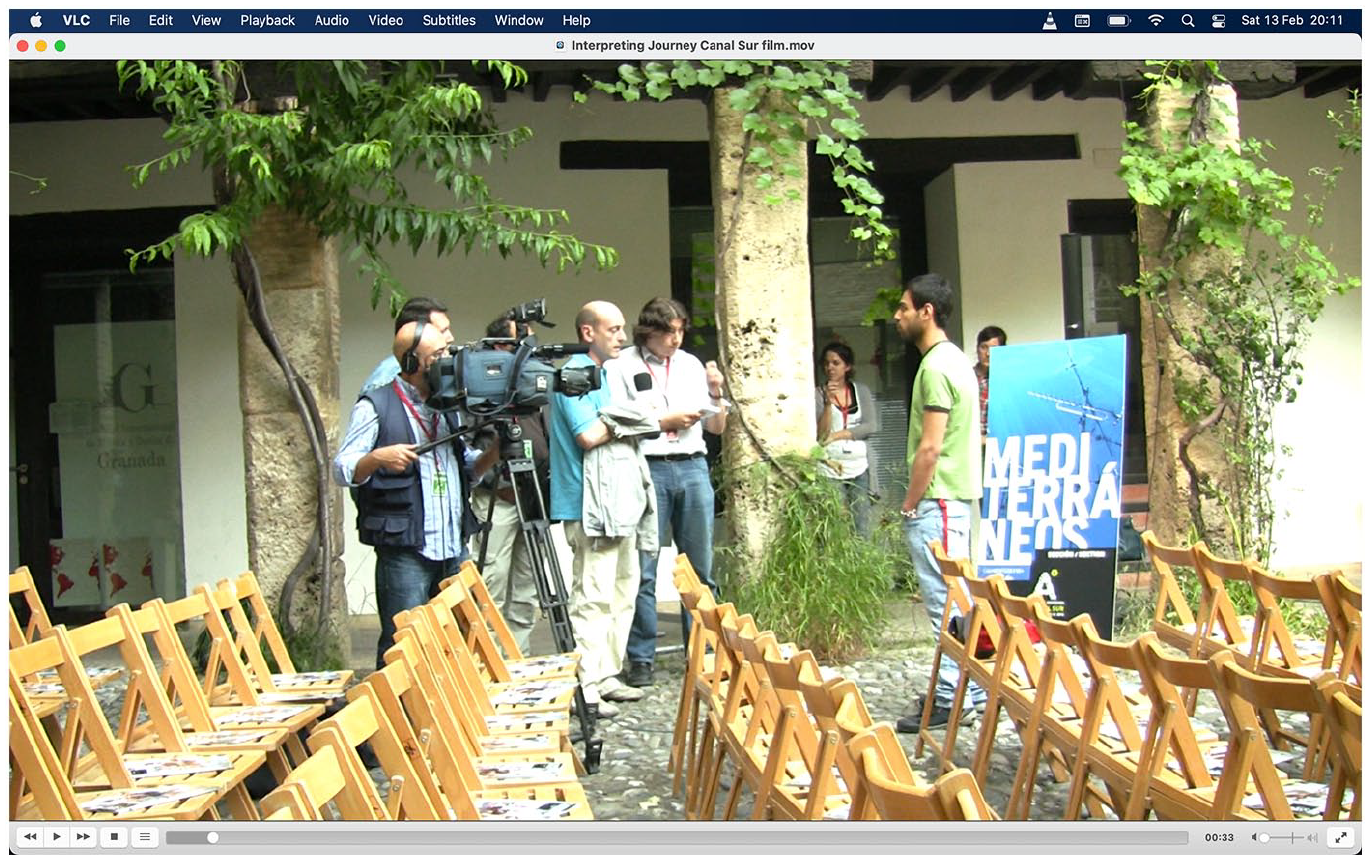
Off-stage Video Recording of Canal Sur’s Al Sur Cines del Sur Film Festival Special. Interview Arrangements. From Left to Right and Front to Back: Camera Operator, Programme Director and Editor, Journalist, Interpreter, Interviewee and Press Officer.
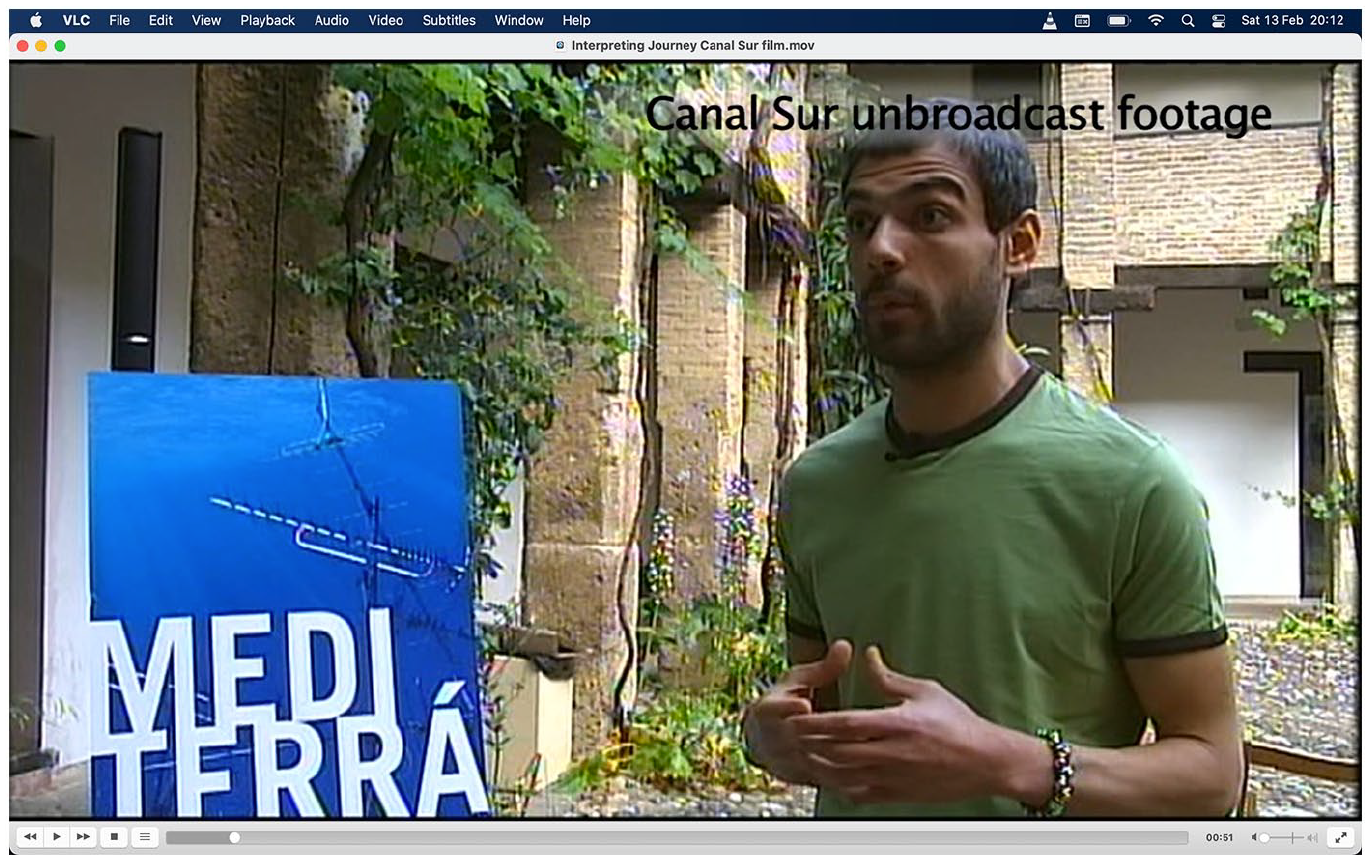
Canal Sur’s Raw Footage of the Interview in Image 1. Interviewee Close-up.
Another aspect that is crucial to stakeholders is obtaining excellent interpreters’ output sound quality, thereby avoiding voice-over in post-editing stages:
Simplemente nosotros intentamos que se escuche bien al intérprete. De hecho le damos un micro, y no es un sonido cualquiera, sino que es un sonido que está controlado y, por lo tanto, es un sonido bueno. All we do is make sure that the interpreter can be heard. In fact we give him or her a mike, and the sound is not just any sound. It’s controlled sound, so it’s high-quality. (Antonio Alarcón, Program Director of the Cines del Sur special, RTVA)
The trend in pre-recorded interviews is to provide a voice-over gender match, therefore, in cases where there is no gender match in the interpreter-mediated interview, the interpreter is informed that his or her utterances will be re-recorded (Images 3 and 4):
Si tenemos que hacer la traducción de una chica, aunque la haga él, pero luego nosotros buscamos que sea una chica la que . . . Digamos que en la tele intentamos que se corresponda el género con la traducción. If we have to do a translation of a woman, even if the interpreter is a man, later we look for a woman to . . . In TV we try to make the translation correspond to the person’s gender. (Antonio Alarcón, Program Director of the Cines del Sur special, RTVA)
Image 3 shows that the interpreter for the actress (left) is a man (centre). The improvised debriefing chat serves to clarify one term used by the interpreter. The fact that both interpreter and journalist (right) know that this interview will have a gender-matching voice-over allows them to discuss the best solution for that term and then pass it on to the editor.
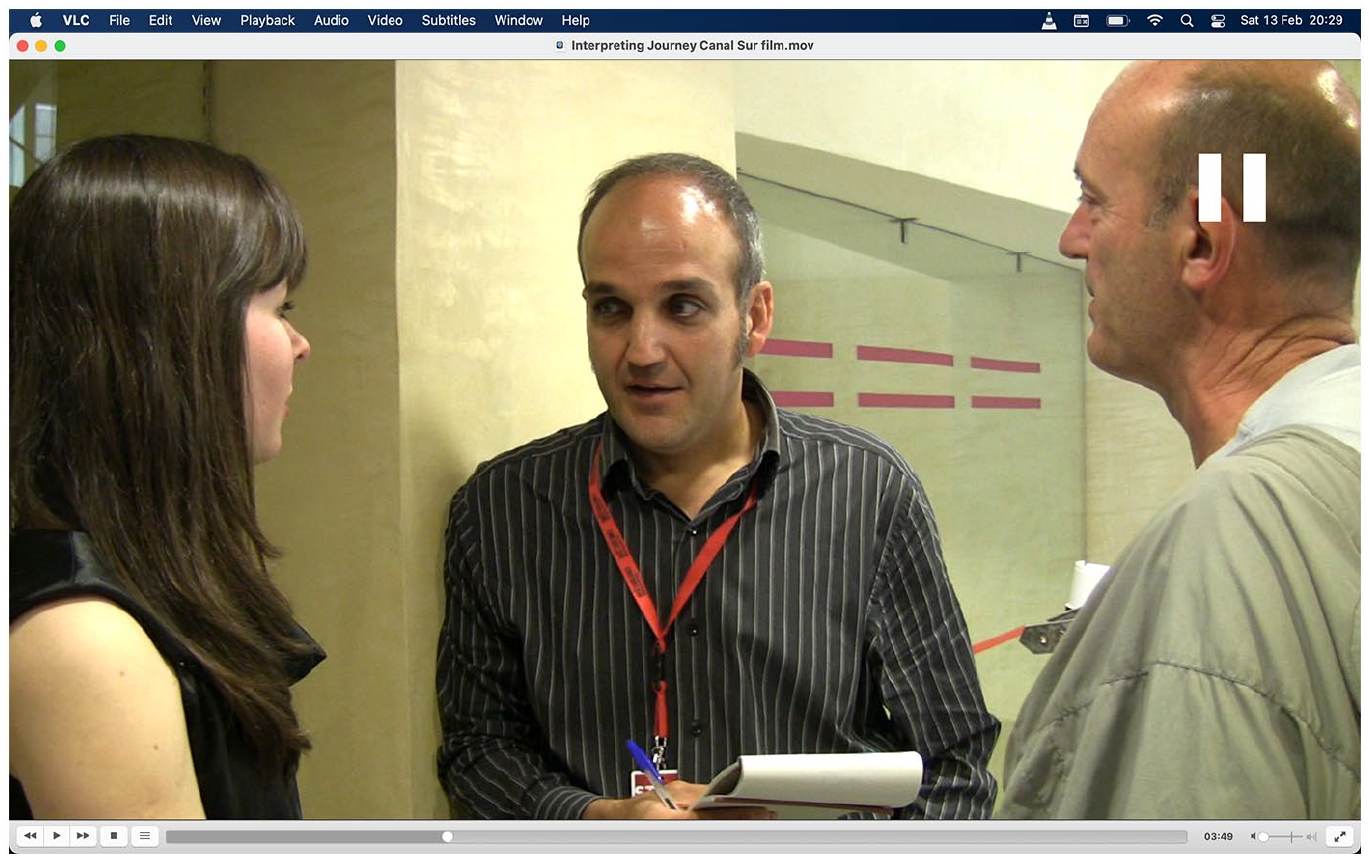
Off-stage Video Recording of Canal Sur’s Cines del Sur Festival Special. Post-Interview Debriefing Between Interviewee, Actress (Left), Interpreter (Centre), and Journalist (Right).
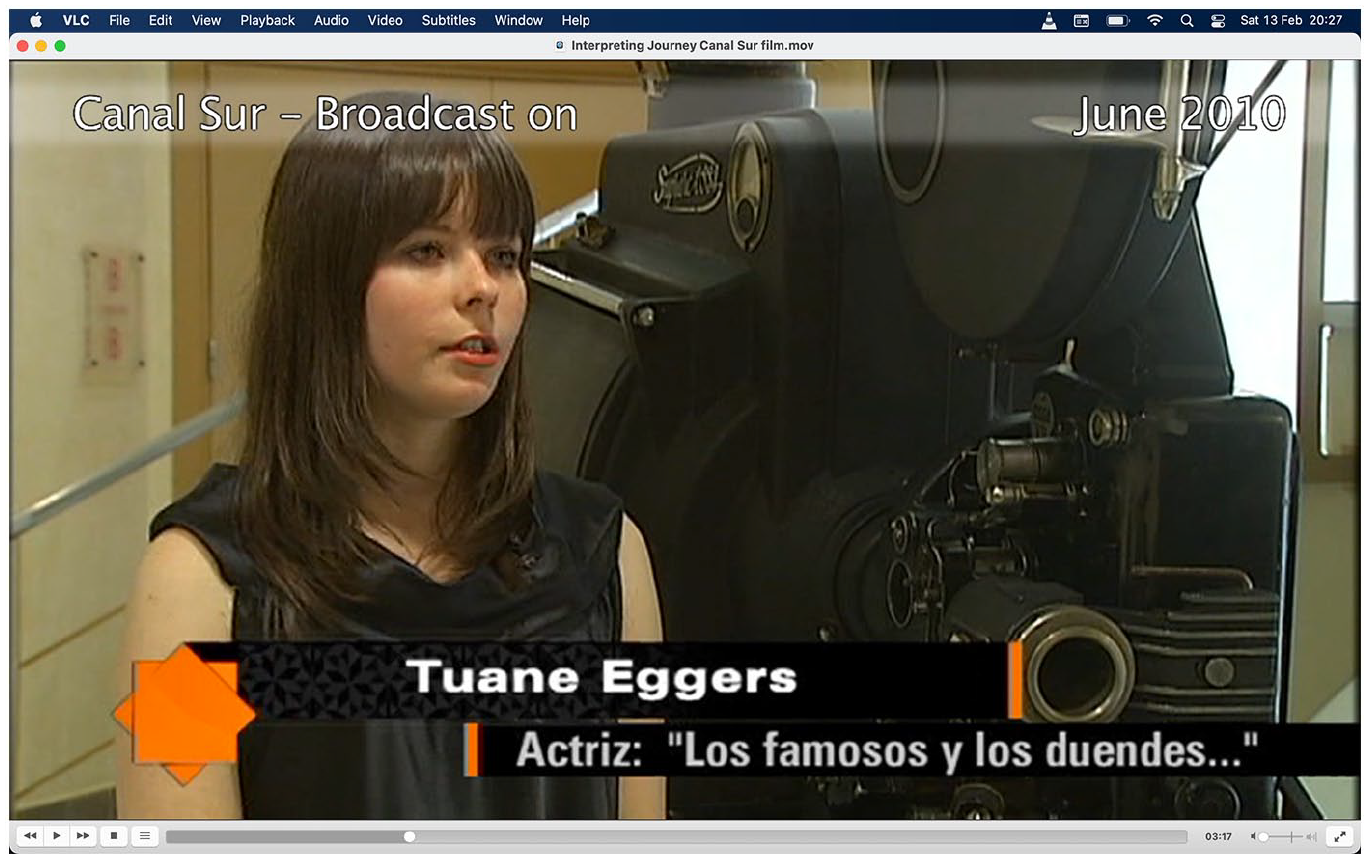
Canal Sur’s Broadcast of Interview with Actress in Image 3, with Female Voice Over.
In this sense, briefing and debriefing sessions with interpreters are an important part of interpreter-mediated encounters. In briefings, journalists, producers or sound/camera engineers might provide some guidelines to the interpreters, but the nature of film festivals, with frantic atmosphere and limited time constraints for interviews do not always make them possible, as Pedro Romacho points out:
Cuando se va a trabajar con un intérprete, si hay tiempo, sí, se puede hablar con el intérprete, pactar cómo se va a hacer la traducción en función de las posibilidades técnicas que haya, en función de donde estemos, pero habitualmente no hay tiempo de charlar antes con el intérprete. When an interpreter is involved, if there’s time, yes, we can talk and decide how the translation will be done, depending on the technical possibilities available, on where we are, but usually there’s no time to talk with the interpreter beforehand. (Pedro Romacho, Editor/Journalist in the Cines del Sur special, Canal Sur, RTVA)
These guidelines, according to the Canal Sur TV crew that took part in the study, may include providing clear utterances which can be edited for voice-over (regardless whether they decide to leave the interpreter’s recording in or re-record it for gender match [see Image 4] or sound quality purposes), that is, with clear gaps between content segments, no hesitations and no repetitions, where possible; using of first person; adapting verb tenses and time references to the context of the eventual broadcast if necessary; avoiding overlapping talk, particularly during consecutive interpreting, so that sound and takes can be edited smoothly.
However, the “live” element in radio broadcasting leads to a more flexible approach, whereby the presenter’s guidelines are to produce a natural, smooth conversation (what he calls “creative interpretation”) with clear sound in which overlapping talk is avoided, if necessary with the support of sound engineers:
Bueno, digamos que hay dos cosas: primero, estábamos hablando de la interpretación creativa, pero hay una interpretación que la limita o la condiciona el medio, el soporte. [. . .] Entonces, la radio es . . . la base es la palabra. [. . .] Y a mí siempre me gusta la naturalidad en la interpretación y también a la hora de hacer la radio. Well, there are really two aspects: first, we’re talking about creative interpretation, but there is something that limits or conditions it, which is the medium, the format. [. . .] In radio, the basis is the spoken word. [. . .] I always like naturalness in interpreting and also in radio. (Javier Tolentino, Radio 3 radio presenter)
Seating arrangements in radio broadcasting are key, and largely overlooked by research (Castillo Ortiz, 2015a), from a technical point of view but also with interactional implications, as the images showing a sequence of seating arrangements throughout the broadcast (Images 5 to 12).
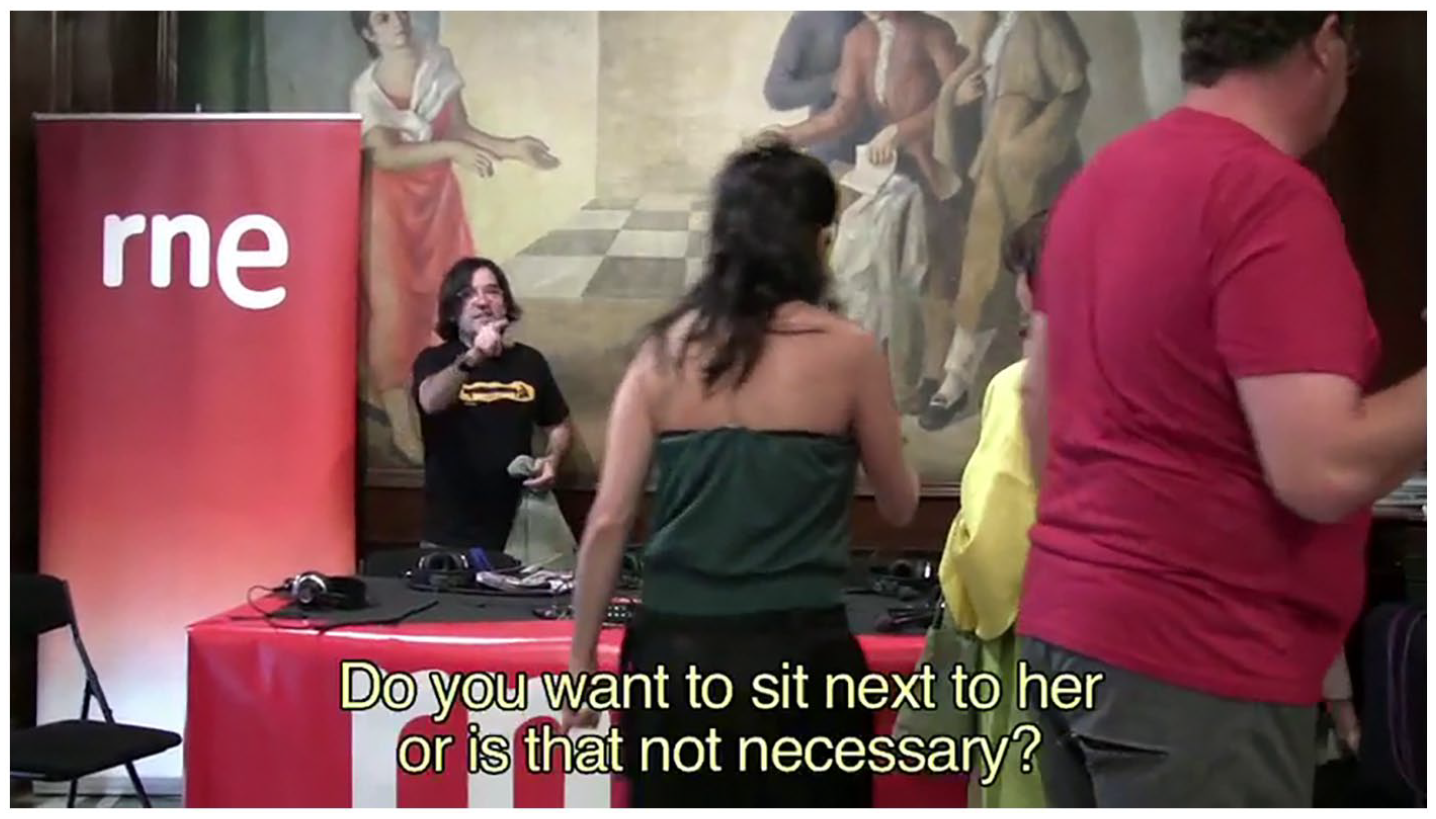
Seating Arrangements Sequence, Pre- and During Live Broadcast. Radio 3’s ESV Cines del Sur Festival Special.
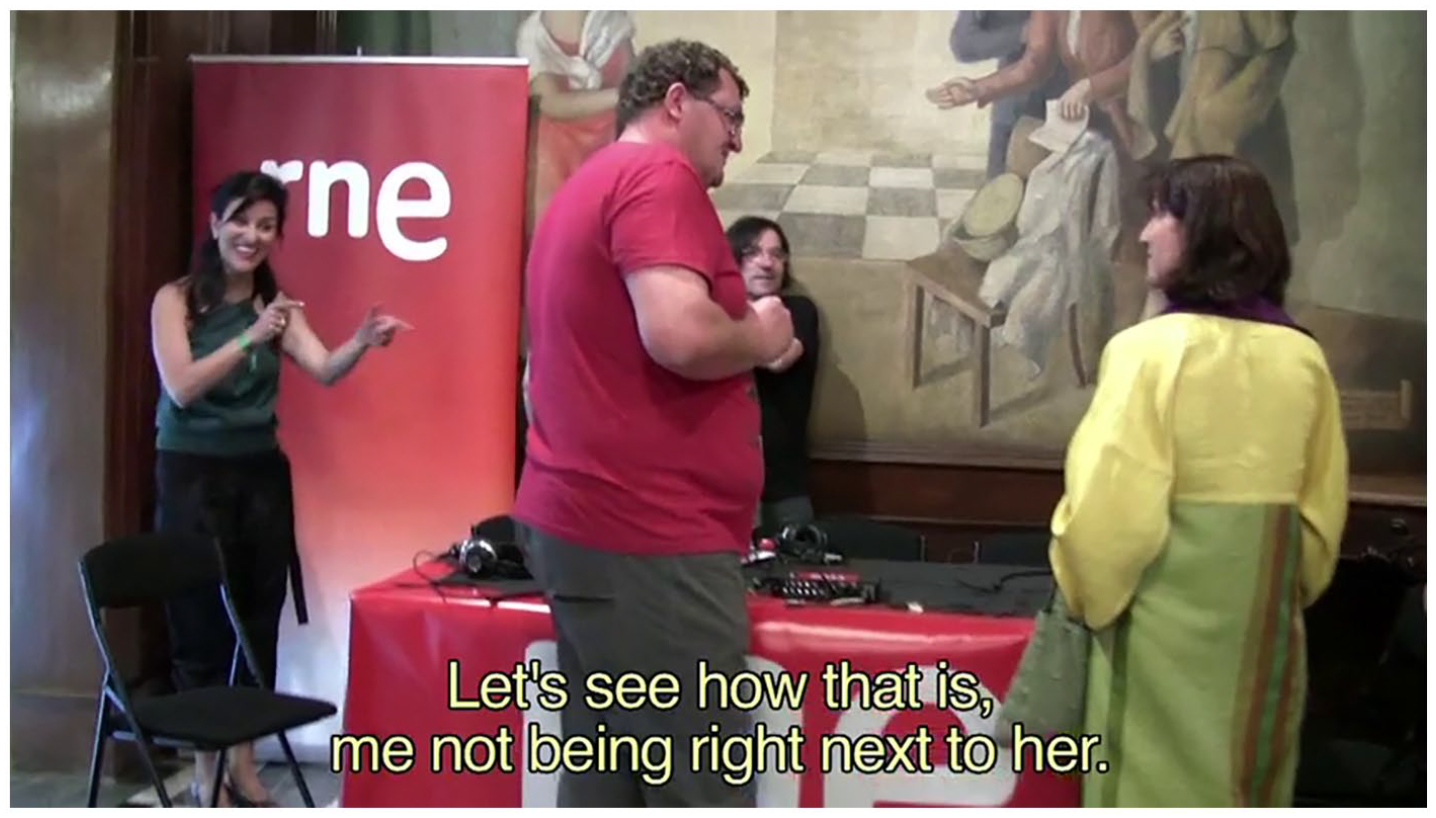
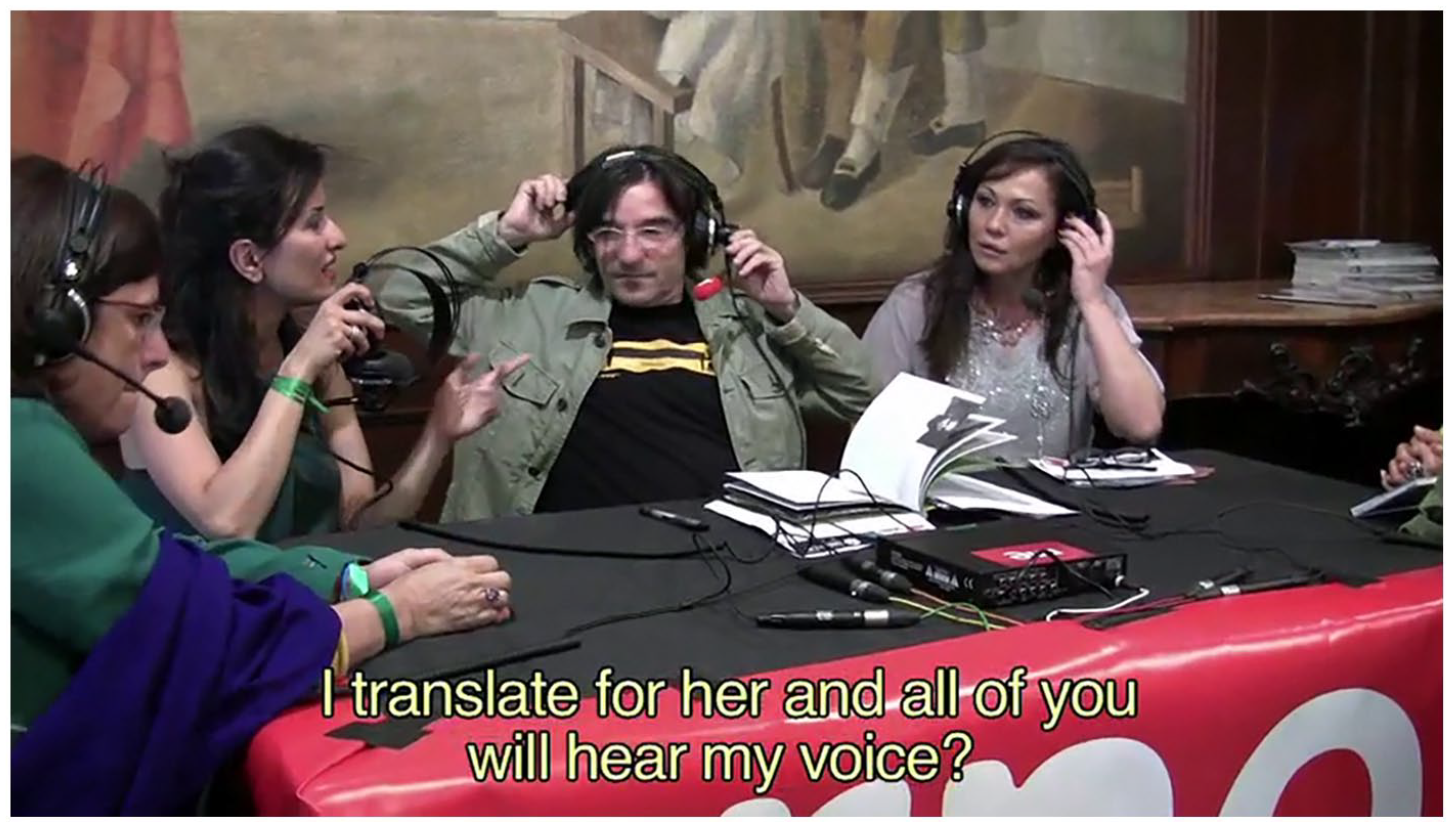
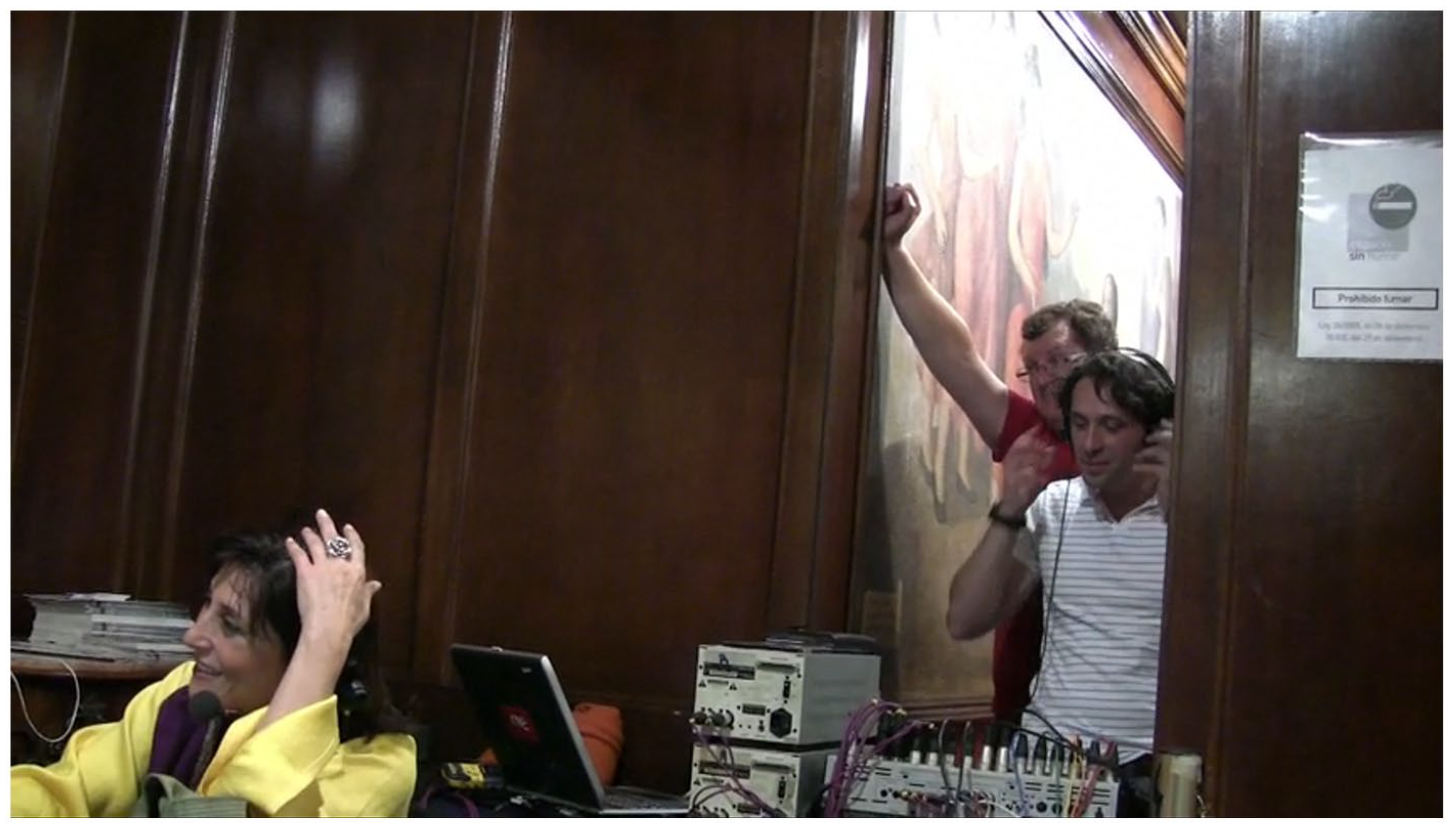
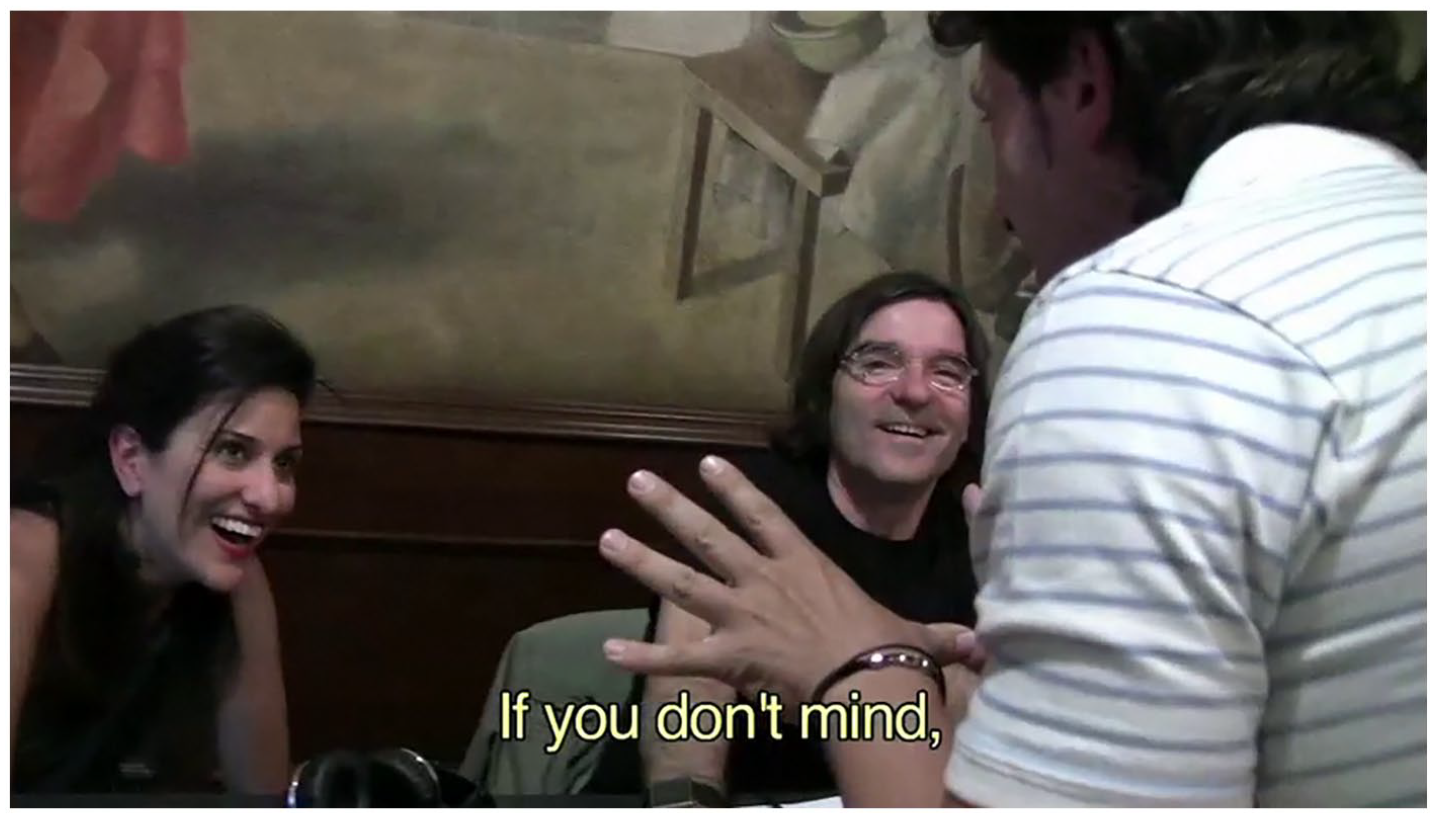
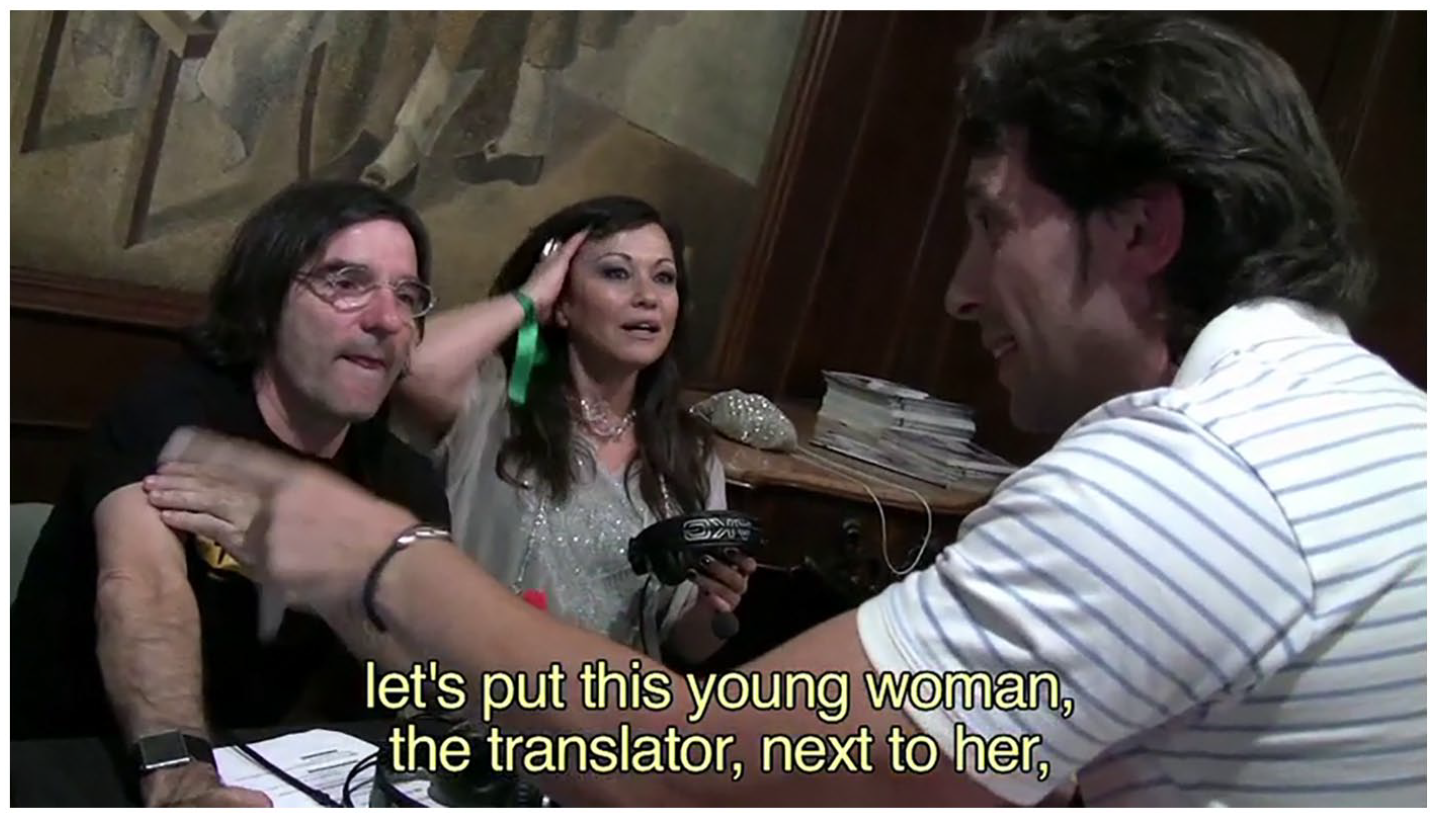
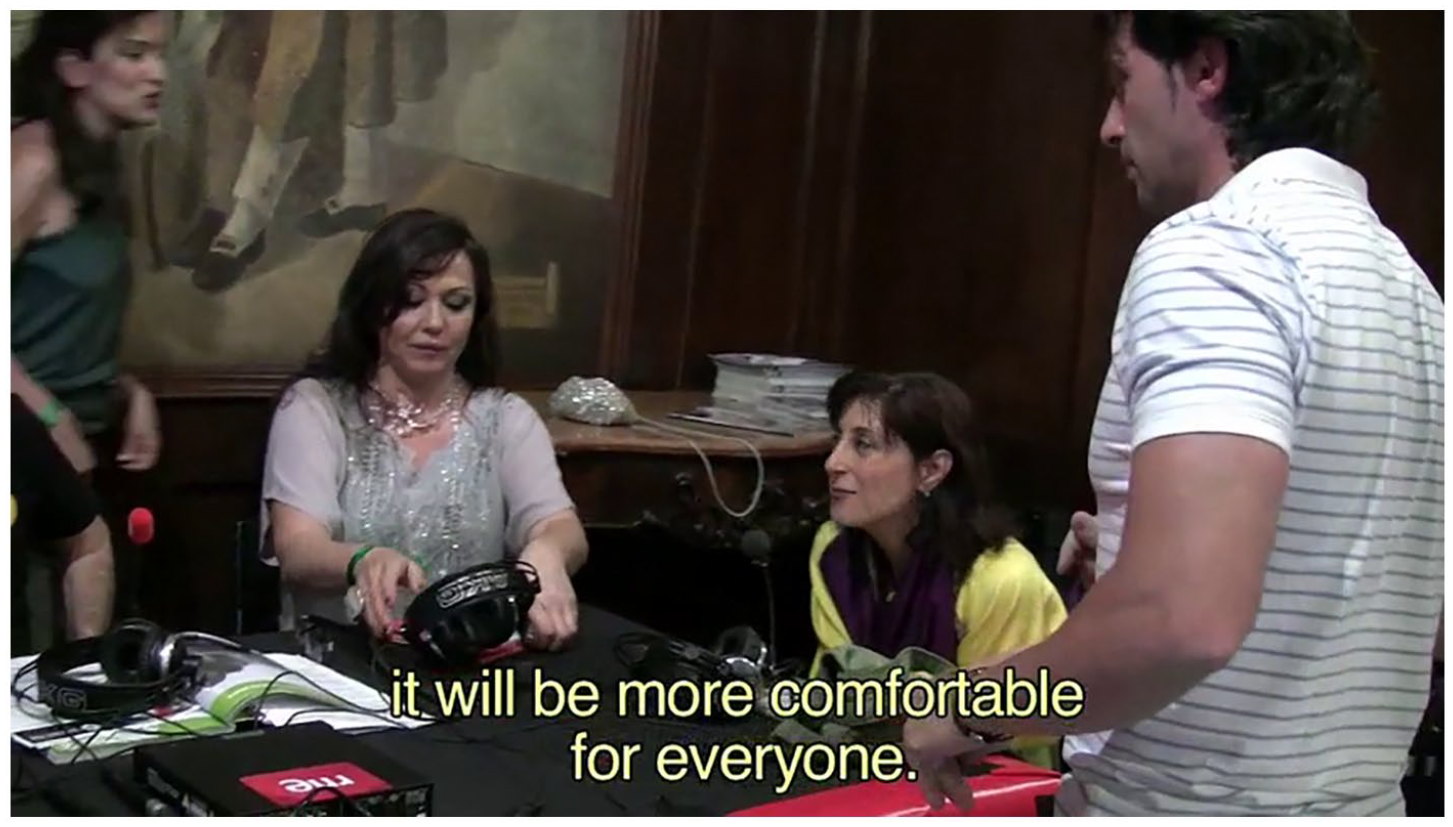
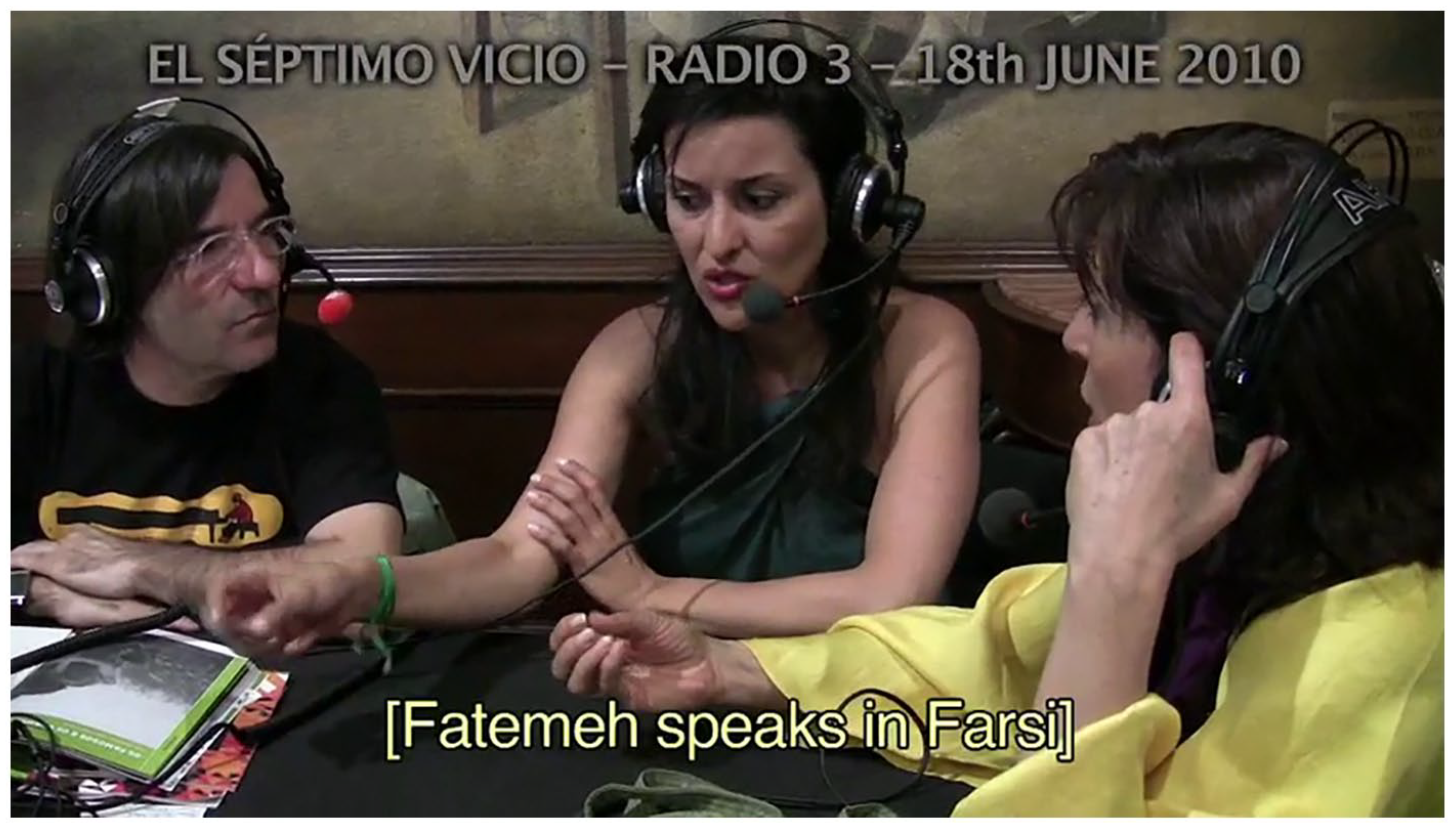
In Images 5 to 12, we observe two seating arrangements involving the interpreter. First, prior to the broadcast, following the presenter’s suggestion, the interpreter and interviewee do not sit next to each other in what is going to be a multi-party broadcast. For the first 25 min of the broadcast, the talk does not always actively involve the Farsi-speaking guest and yet the interpreter (sitting to the right of the presenter) keeps rendering the on-going talk to the interviewee (sitting on the left of the table, in yellow), with subsequent implications for the sound engineers. The visuals for this interview show the focus of the sound engineers on the transitions between the different participation frameworks, which mainly involve output volume adjustments, particularly regarding the interpreter and the interviewee. These situational arrangements also make non-verbal communication play a crucial role so that the talk going on-air to the audience is not affected. This can be seen as overt, non-verbal face work, whereby the interpreter, the presenter and the sound engineers work together off-air to solve a sound problem without bringing the talk-in-interaction to a halt, taking advantage of radio’s communicative nature as a sound-based broadcast medium, and without compromising the comfort factor.
Second, during the first music interlude, one of the sound engineers suggests to change the interpreter’s physical position (see Images 9 to 11 above), thus changing the seating arrangements and providing a new broad context that potentially influences the participation framework and the resulting interaction (narrow context). Once the active participants are back on air, the audience does not notice this change, but the access to visuals provides information on how it is easier for the sound engineers to manage the sound, while the interpreter can also make better use of non-verbal language by being next to interviewee. A further advantage for the broadcast output is that the interpreter now has her own microphone and therefore the sound engineers can lower her sound output when she interprets into Farsi. Therefore, the Spanish language output sound is cleaner, while both interpreter and interviewee welcomed this new situational arrangement, thus improving the rapport with the media professionals and contributing to a collaborative working environment, thereby potentially reducing high-stress levels, which are otherwise common in media settings (as noted by Jiménez Serrano, 2011).
A further salient aspect that shows cooperation and inter-professional cross-fertilisation in the production of interpreter-mediated broadcasts under study is the trust that producers and presenters or journalists have in each colleague in terms of technical skills and creativity:
De alguna forma, se dan ciertas pautas, pero en dejando a cada categoría, al montador, al operador de cámara, al técnico de sonido, que cada uno aporte, digamos, dentro de lo que pueda, su creatividad. So, there are certain guidelines, but letting each category, the editor, the cameraman, the sound technician, letting each one contribute, however they can, their creativity. (Antonio Alarcón, Program Director of the Cines del Sur special, RTVA)
Tolentino sees the potential of editing an interpreter-mediated radio interview, when he describes the scenario of consecutive interpreting of the radio interview that was filmed for the research project (Images 5 to 12) through enumerating the turns and the subsequent discomfort:
. . . pregunta en español, pregunta en persa, respuesta en persa, respuesta en español. Se elimina en la grabación las preguntas, eh . . . en el idioma, y se va de la pregunta en español a la respuesta en persa simultánea; todo eso, a través de un montaje y de montaje de primeros planos y segundos planos. [. . .] Eso hace la agilidad . . . y una mayor brevedad de la entrevista; [. . .] se podría reducir a quince minutos [tras editarla]. . . . question in Spanish, question in Persian, answer in Persian, answer in Spanish. Questions are erased from the recording, ehm . . . in that language [Persian], and then it goes directly to the question in Spanish and the answer in Persian simultaneously [interpreted into Spanish]; all this is made by editing first and second planes of sound. [. . .] This creates agility . . . as well as a shorter interview; [. . .] You could bring it down to fifteen minutes [after editing]. (Javier Tolentino, Radio 3 radio presenter)
Although such editing “is much more useful for news programmes,” since they “require greater brevity and concision,” Tolentino also praises the consecutive modality for the exposure to the foreign Other, particularly in “specialized film programs”: “I like that people, well, listen to the other person in all their dimensions, with all their language” (Javier Tolentino).
The ethos of culture and arts programmes in public service broadcasting may be behind this approach. This ethos is characterised by spontaneity, by moving away from the usual rush of mainstream radio, and by openness to foreign cultures. Although given limited scope in this study, exploration of the communicative ethos of broadcasting in interpreter-mediated events and settings of this kind can be found in Castillo Ortiz (2015a, 2021).
Professional Expectations and Experiences of Working with Interpreters
This sub-section focuses on the narrow context of interpreter-mediated interviews, which in media production includes off-air and on-air interaction, whether live or pre-recorded broadcasts. Aspects such as agreeing on a time and place for the interview, building rapport (off-air), and interpreters’ input, communication flow and overt audience orientation (on-air) are discussed.
Taking into account that the usual practice is that interpreters are hired by the event organisers (here, the film festival), the resulting perceived constraint in terms of off-air interaction is the recurrent negotiation in terms of allocated time and place for the interview:
Normalmente no tenemos problemas con los intérpretes, pero sí puede ser que con la gente de organización, que claro, están preocupados con su agenda, que normalmente es muy rígida. [. . .]. A veces también, son las propias distribuidoras y los entrevistados (actores, actrices . . . ) que vienen con su propia agenda y . . . nos dicen: ¿pero qué pasa aquí? We don’t usually have problems with interpreters, but maybe with the event organizers’ stakeholders, who obviously are very concerned about their schedule, which is usually very rigid. [. . .] Also, sometimes, it is the distributors themselves and even the interviewees (actors, actresses . . . ) who have their own schedule and . . . they ask us about what’s going on? (Paco Gómez Zayas, Director and host of the Cines del Sur special, Canal Sur, RTVA)
Once the interview is arranged, direct negotiation between the different stakeholders’ schedules starts including those of the event organiser, the film distributor, the interviewees and the interpreters who might have their own schedule within the film festival hiring them. The following statement, as well as the previous quotation of the interview with Pedro Romacho (Editor/Journalist) shows the media stakeholders’ trust in the interpreters:
Sobre todo en festivales, y yo creo también que en el caso de algunas distribuidoras, sí es verdad que buscan a traductores que aparte de saber bien su trabajo, pues tienen unos mínimos conocimientos sobre cine, ¿no? Especially at festivals, and I think in the case of some distributing companies, too, what they want are translators who, apart from being good at their job, know something about film, right?. (Paco Gómez Zayas, Director and host of the Cines del Sur special, Canal Sur, RTVA)
This on-location negotiation prior to the interview is likely to shape the type of questions, the expected or suggested length of the answers, and might even affect rapport building (Mason & Stewart, 2001). The statement points at how journalists may check the interpreter’s knowledge of film in general and the film around which the interview will revolve. Time constraints may hamper rapport building, but, as broadcast footage shows (see Image 3), a post-interview chat may also take place to clarify some points of the filmed interview and therefore help during the post-editing if voice-over is inserted (as is the case for the Canal Sur Al Sur programme).
The live broadcast nature of the radio interview highlights the importance of the first contact between the presenter, the interviewee, and the interpreter before going on-air:
. . . siempre me pongo de acuerdo, yo, a título personal, con el intérprete; primero en la necesidad técnica de la interpretación y luego en la creación de la interpretación, en el directo, en el cómo va a ser la entrevista, en el cómo quiero los guiños hacia el entrevistado . . . . . . I always try to find an agreement, me personally, with the interpreter; first, about the technical requirements of the interpretation and then about creation in the interpretation, about being on the air live, what the interview will be like, how I want to create complicity with the interviewee . . . (Javier Tolentino, Radio 3 radio presenter)
Images 5 to 7 are snapshots of that first encounter with interpreter and interviewee(s), demonstrating how the presenter puts his ideas into practice, with a rapport building effort, a clear suggestion for seating arrangements and emphasis on a good flow of communication that looks “as natural as possible.”
On air, the most salient aspect regarding the interpreter-mediated interaction is the acknowledgement of the interpreter as a professional who offers much more than mere language transfer services. Interpreters are therefore not regarded so much as gatekeepers or conduits of propositional content, but as communication professionals who work hand in hand with media professionals to produce a successful broadcast interview:
Habitualmente nosotros [los periodistas] tenemos un gran defecto de formación que es la falta de idiomas. Yo, por ejemplo, hablo un poco de francés y consigo medio entenderme algo en inglés, pero es imposible hacer una entrevista con profundidad y con matices [. . .] Aquí es donde considero que son cruciales los intérpretes para nuestro trabajo. We journalists tend to have a big gap in our training, the lack of foreign languages. I, for example, speak a little French and I manage to get by in English, but it’s impossible to do an in-depth interview, with nuances [. . .]. Here is where I consider interpreters crucial in our work. (Eladio Mateos Miera, Press Officer of Cines del Sur I and II, and Editor/Journalist in Canal Sur News and the Cines del Sur special, RTVA) Yo siempre hago directo o falso directo. [. . .] Hoy, por ejemplo, hemos tenido dos casos de programas de lo que estoy diciendo, ¿no? Hemos realizado una emisión en directo; con toda la naturalidad del mundo me he dirigido al creador, al intérprete, diciéndole que actuara de una forma natural, que preguntara si tenía que preguntar algo, alguna información, pero en directo . . . I always do live broadcasting or fake live broadcasting [unedited pre-recorded broadcast] [. . .] Today, for example, we have had two instances of programmes that show what I am talking about, isn’t it? We have carried out a live broadcast; very naturally, I addressed the creator, the interpreter, telling her to act in a natural way, that she could ask whenever she needed for any information, but live . . . (Javier Tolentino, Radio 3 radio presenter)
The comfort factor behind the request for simplicity and naturalness, the search for authenticity in the interaction, particularly in live radio interviews, and integration into the programme’s ethos (Scannell, 1988) are at the heart of the media stakeholders’ concerns. They go hand in hand with the idea of the interpreter as a “creator,” in Tolentino’s terms. Media stakeholders openly share these expectations with interpreters prior to and during the interviews, as one of the Canal Sur journalists puts it:
Cuando vienen a veces otros traductores, otros intérpretes u otras intérpretes, que vienen de Rusia con el director o que no es el traductor habitual con el que tú trabajas, a veces es más complicado hacerles ver que tú no necesitas una gran parrafada de mucho tiempo o que tú no necesitas que utilicen palabras muy complicadas o que tú no necesitas que utilicen expresiones que sean difíciles de entender por el público en general, ¿no? Porque también el problema de la televisión es que te tiene que entender todo el mundo: desde la portera de la casa hasta el Catedrático de Universidad del último piso. Entonces tú tienes que tener una neutralidad lingüística de alguna forma, que necesitas hacérsela entender al traductor. Sometimes when it’s another translator, another interpreter, who comes from Russia with the director or who isn’t the interpreter you usually work with, it can be difficult to make them see that you don’t need a long paragraph that goes on forever, you don’t need them to use complicated words, or to use expressions that are hard for normal people to understand. Because the problem with television is also that you have to be understood by everyone: from the building’s caretaker up to the University professor who lives on the top floor. So you have to use neutral language, and you have to make the interpreter understand that somehow. (Eladio Mateos Miera, Press Officer of Cines del Sur I and II, and Editor/Journalist in Canal Sur News and the Cines del Sur special, RTVA)
In pre-recorded interviews, interactional aspects such the flow of communication and the form of the interpreter’s renditions may not be as important as content and emphasis, the points highlighted by the Canal Sur programme’s director and editor:
Mira, cuando hay un intérprete, a nosotros lo que nos interesa, sobre todo a mí, te lo digo realmente, es de alguna manera la comunicación; entendernos con la persona que tiene que decir las cosas. Entonces a veces ni siquiera la voz del intérprete aparece, porque lo que hacemos nosotros es, luego, una voz que de alguna manera, incluso dramatice la manera de contar el hecho en cuestión. When an interpreter is involved, what we are interested in, at least in my case, is communication; we want to have a good understanding with the person who is doing the talking. Sometimes the voice of the interpreter isn’t even used, because what we do later is put in a voice that sort of dramatizes the way the things are told. (Antonio Alarcón, Program Director of the Cines del Sur special, RTVA)
In the case of the radio programme under study, and in contrast to TV and to previous studies (c.f. Gieve & Norton, 2007), the “complicity” with the interviewee is also shared with the listeners, who, the presenter claims, are open to foreign voices and understand that interpreting is naturally part of interlinguistic exchange. Hence, there is no need for post-editing or voice-over, but instead a preference for the spontaneity and freshness of a live interpreter-mediated interview:
El oyente no es torpe, no es tonto; sabe perfectamente, a veces, las dificultades de una traducción simultánea y en directo; y que las conozca desde el principio, ¡está muy bien! No es hacer trampa, ni hacer pesadez de ningún tipo, sino es crear una comunicación natural. The listener is not dumb, is not a fool; s/he knows perfectly, sometimes, of the difficulties of a simultaneous interpretation which goes on live; the fact that s/he knows them from the beginning is very good! It is not cheating, nor being tedious by any means; it is just creating natural communication. (Javier Tolentino, Radio 3 radio presenter)
Media stakeholders’ expectations of audience-oriented utterances may take different forms, such as a language that can be generally understood by everyone on TV (Tolentino above), or the erasure of the interpreter’s presence (Gieve & Norton, 2007), as underlined below by the Press officer of Cines del Sur Festival:
En televisión, la interpretación ha de ser como la cámara o como el montaje: una estructura transparente, a través de la cual mirar lo que se quiere contar, pero no te paras a ver los mecanismos que consiguen hacerte a ti comprensible la historia. Es más bien el resultado final, el conjunto, lo que la gente percibe y lo que la gente critica o alaba o pone bien o pone mal, ¿no? In television, the interpretation should be like the camerawork or the editing: a transparent structure, through which viewers see what we are trying to say, but without stopping to see the mechanisms that make the story comprehensible to them. It’s more the final result, the whole, what people perceive and what they criticize or praise, what they like or don’t like. (Eladio Mateos Miera, Press Officer of Cines del Sur I and II, and Editor/Journalist in Canal Sur News and the Cines del Sur special, RTVA)
In the case of radio, interpreters are expected to be creative when rendering audience-oriented utterances:
El error más gordo es [. . .] que el intérprete no quiera hacer una creación, no quiera . . . no tenga esa complicidad contigo para hacer de esa entrevista una creación tanto periodística como desde el punto de vista de la traducción. Entonces, ahí, ya te das cuenta de que ya sería lo peor dejar la entrevista, y decir: “no la hagamos.” [. . .] Pero el error más grande es que el intérprete ¡sea un cobarde! Si te encuentras con un traductor o con un intérprete cobarde puedes, puede acabar de toda en un juzgado de guardia, porque claro, la barrera del idioma es muy importante a veces, ¿no? The biggest mistake [. . .] is when the interpreter doesn’t want to create something, doesn’t want to . . . doesn’t have that complicity with you to make the interview a creation, both journalistically speaking and also in terms of translation. Then, there, you realize that it would be the worst, to stop the interview, and say: “let’s not do it.” [. . .] But the biggest mistake is that the interpreter is a coward! If you are facing a coward translator or interpreter, it may all end up in a summary court, because of course, the language barrier is sometimes very important, isn’t it? (Javier Tolentino, Radio 3 radio presenter)
Drawing on Tolentino’s words, El Séptimo Vicio radio broadcasts create a space for interpreters to perform their task creatively and boldly (or end up in trouble, that is, “in a summary court”), adding interactional value to the broadcast through sharp and fluent renditions, rich use of language and prosodic skills that integrate into the language of radio. In these programmes, creativity and trust, rather than the gatekeeping, largely alluded to in the reviewed literature, seem to be dominant in the interaction and relationship with the interpreter.
Stakeholders’ orientation to the audience when interacting with interpreters shows implicit ideas of what they understand as comfort factor. These ideas highlight how the conceptualisation of the comfort factor when dealing with foreign languages in media production is dynamic, depending not only on the medium (TV, radio), but also on the programme’s ethos and target audience. This translates into different broadcast patterns in terms of how linguistic difference is approached, from post-editing dramatised voice-over on TV to a mixed simultaneous-dialogue live interpreting on radio. Presenters have an idea of what their audiences are willing to accept as natural and therefore what they feel comfortable with. That interpreters are aware of these perceptions and are willing to integrate their skills into events such as film festivals and media productions, which are diverse, flexible and heavily dependent on the broad context of production, is crucial for their successful participation in such productions.
Conclusion
This study finds that media stakeholders have a clear view on the extent, influence and use of the interpreter. It also finds that media interpreting is not considered to be an isolated activity or a mere adjunct service (even if it is sometimes referred to as such). Instead, it is an intrinsic part of the production itself that may also inform and guide the way the TV/radio programme or event is produced and broadcast. This study highlights, therefore, the collaborative character of multilingual media production, and proposes a methodology that moves away from interpreter-centred approaches and that engages with media professionals to gain a wider picture of media production requiring interpreting services.
As indicated through my data analysis, media stakeholders’ views and approaches to interpreting sometimes collide or need to be negotiated, and it is the level of language and the interpreting awareness, experience and cooperation of the production team that ultimately shape the way interpreting is carried out and broadcast. This is particularly true when interpreters are hired externally and there is no contract binding the interpreter(s) to the media outlet, as it is the case in this study. The points raised in this study—negotiation of the interpreting modality, post-editing situational arrangements and interactional aspects such as turn length, overlapping talk and audience-oriented utterances—beg further research in this area of media interpreting. Likewise, differences between TV and radio interpreting, both following the overriding norm of the comfort factor, deserve further exploration.
In contrast with abundant interpreting studies literature and professional associations statements that put forward a rather narrow and conservative conceptualisation of interpreters’ roles, this study illustrates that there are media communication professionals who welcome interpreters as an integral part of their production and therefore understand their skills in all their complexity, that is, going beyond mere language transfer, acknowledging their expertise not only in the subject area (in the case of this study, cinema) but also in the medium (creative interpreting). While all studies following sociolinguistic, interactionistic and communicative approaches referred to in this article point in this direction, they based their findings and conclusions largely on the end products and programme credits. The in-depth description of media stakeholders’ perceptions and practical experiences of working with interpreters in this article contributes to an inter-professional approach to media interpreting which should irrigate interpreting studies, the interpreting profession and interpreting training programmes.
Another crucial point of this study is the perception of the interpreter as an “active participant” (Wadensjö, 1998) in the broadcast interaction. Presenters, editors and journalists in particular acknowledge the need for interpreters to make communication possible and render it to the audience in a way that ties in with the programme’s communicative ethos and does not compromise the comfort factor. In the cultural programmes under study, interpreters are credited, either live on air (in the case of the radio programme) or in the title credits (in the case of the TV programme), which evidences stakeholders’ appreciative attitude towards interpreters. This evidence contradicts previous research (c.f. Alexieva, 1999, 2001; Gieve & Norton, 2007; Jiménez Serrano, 2011; Katan & Straniero Sergio, 2003; Mack, 2002); however, that the data analysed in this study draws on culture and arts broadcasts, as opposed to news, entertainment, infotainment, travel and lifestyle documentaries, may indicate higher awareness of linguistic differences in these settings.
This study therefore contributes to narrowing speculation around how media professionals perceive and make use of interpreting services. The findings in this brief study, which require replication and further study with larger corpora, indicate that when dealing with media professionals, the position (Mason, 2009) occupied by the interpreter is one of collaboration, creativity and openness, rather than conflict, gatekeeping and distrust, and this is largely thanks to media professionals who have a comprehensive understanding of what interpreting involves.
Footnotes
Declaration of conflicting interests
The author(s) declared no potential conflicts of interest with respect to the research, authorship and/or publication of this article.
Funding
The author(s) received no financial support for the research, authorship and/or publication of this article.
