




Abstract
Continued professional development (CPD), tailored to teachers’ needs and expectations, is required for updated skills and knowledge. In this study, twenty-five teachers working with first and second grade students participated in an 11-week programme focusing on enhancing classroom communication. The participating teachers were randomly assigned to either a direct intervention track (intervention) or a delayed intervention track (waiting control). Teachers’ perceptions of activities and interactions in the classroom and self-efficacy were assessed on three occasions: T1, T2, and T3. The direct intervention track received intervention between T1 and T2, while the delayed intervention track received intervention between T2 and T3. A percentage change score for changes between T1 and T2 was calculated, to compare the direct and delayed intervention tracks and assess any intervention effect. Results revealed no significant difference between the groups, i.e., the intervention had no effect on teacher self-reports. The teachers gave an overall positive evaluation of the CPD. Thematic analyses revealed continued need for professional development and insights into the reciprocal influence of student and teacher behaviour. The quantitative and qualitative results paint somewhat different pictures showing the need of mixed methods when analysing these kinds of data.
Keywords
Background
Continued Professional development (CPD), or in-service training, is generally considered the requirement for updated professional skills and knowledge. Some professional bodies require that their members regularly participate in professional development programmes for renewed clinical or professional certification. In other cases, employers offer courses and education programmes to meet the needs of their employees or the workplace. Professional development programmes are also often offered by external parties as commercial products.
The rationale is straightforward and intuitive; through CPD programmes, a large number of professionals, with similar tasks and needs, can develop their skills and knowledge at relatively low cost, often without the need for extended periods of absence from the workplace. Many employers also expect a ripple effect, by which the gains by the participants in the CPD will transfer to non-participating colleagues.
For educators, CPD programmes are abundant. In many countries, the teacher education at universities has struggled to keep pace with the rapid changes in pedagogy and teaching methods promoted by policymakers and schools. As a consequence, professional development has been important in the proliferation and application of research findings, e.g., the use of formative assessment and digital technology in the classroom. In Sweden, the Swedish National Agency for Education has recently used professional development as a way to inform educators on important changes in the curriculum and mandated changes in assessment methods, and to enforce political decisions to establish preventive methods in special needs education (Skolverket, 2019a).
Several factors, related to the design and implementation of the CPD, have been linked to greater educator and student outcomes. Gore et al. (2017) present principles of effective teacher CPD, as established in previous research. These principles include, e.g., a narrow focus on certain aspects of teaching (Hill et al., 2013) or a specific subject area (Penuel et al., 2011), a small group of participating teachers (Korthagen, 2017), and a content which is tailored to the needs of the participants (Aelterman et al., 2013) and integrated into their teaching practice (Armour and Yelling, 2007). In addition, greater effects on child outcomes can be expected from CPD with greater duration and intensity (the average amount was approx. 50 h), than from shorter and less intense programmes (Markussen-Brown et al., 2017). CPD consisting solely of course content (e.g. lectures) can also be expected to show limited effect, as compared to CPD in which components such as coaching and feedback are provided in addition to lectures. The most important predictor is whether the CPD includes more than one component, e.g., coursework in combination with coaching and feedback, or the addition of a language curriculum or use of assessment data to guide lesson planning (Markussen-Brown et al., 2017).
Similar principles for successful CPD, with effects on both educator practices and student learning, can be derived from Goodyear (2017). In an evaluation of a yearlong, collaborative CPD programme, Goodyear (2017) found the crucial components to be 1) individualized, external support from the course leader to all participants, 2) departmental, internal support from the other participants, to enable cooperative learning, and 3) sustained support for the duration of the CPD, tailored to the needs of the individual participants. These ingredients helped establish a pedagogical fluency among the participating teachers, enabling them to routinely use cooperative learning to adapt their practices to the students’ learning needs.
Teachers play a key role in their students’ learning (Hattie, 2009) and in developing classroom environments that support language development, communication and social inclusion. Such classrooms are organized so that they provide high quality language learning experiences (Justice et al., 2008), where children have regular and structured opportunities to develop their language through interactions with both peers and adults (Dockrell et al., 2010). In these classrooms, adults talk to children in ways that enhance receptive and expressive language skills (Dickinson et al., 2014), crucial for literacy development and overall school success (Dickinson, 2011). Highlighting the need for effective classroom communication, including, for example, speech rate, voice quality and interaction, is central. Intensive teacher training on communication strategies has repeatedly been shown to improve teacher knowledge (Goldfeld et al., 2021), instructional support (Wasik and Hindman, 2020), and quality of teacher-child interactions (Egert et al., 2020).
Furthermore, many teachers feel the need for professional development in how to adapt their everyday practices to accommodate students with different language learning needs (Dockrell and Lindsay, 2001). In a recent meta–analysis of studies of CPD focusing on language and/or literacy, Markussen-Brown et al. (2017) showed medium effects of CPD on adult-child interactions and large effects on the physical environment in the classroom, but no significant effect on educator knowledge. While less than 50 percent of the included studies reported effects on child outcomes, Markussen-Brown et al. (2017) revealed a non–significant effect of CPD on child vocabulary and small to medium significant effects on phonological processing skills and letter knowledge. The improvements in child outcomes did not seem to be mediated by improvements in the way the adults interacted with the children.
In contrast to Markussen-Brown et al. (2017) who were unable to find studies with effects on educator knowledge, Cunningham et al. (2010) showed that three one-hour sessions were sufficient to increase teachers’ knowledge about language and communication disorders, and of the appropriate course of action when faced with students with such disorders. The activities in the CPD were diverse, with lectures on communication disorders and strategies for teachers on specific areas of difficulty, as well as how the difficulties can be managed within the curriculum.
The Present study
The approach reported in this study draws on the principles of effective CPD presented above. It aims to support teachers in improving their practice while also developing their efficacy, well-being, and professional engagement. In this study, we benefit from partly replicating the research design of Starling et al. (2012) who provided teachers with practical and usable techniques through interprofessional collaboration (speech-language therapists and teachers). The training programme yielded an increased and maintained use of language modification techniques by the trained teachers, compared to untrained teachers.
Aim
This Study aims to evaluate self-perceived change in teachers’ classroom communication skills following a CPD programme. The development and implementation of the CPD is described in detail and examples of challenges and solutions are presented.
Research Questions
1. Do teachers in the direct intervention track exhibit greater changes in self-perceived knowledge about language and communication in the classroom and self-efficacy than teachers in the delayed intervention track (waiting control) after the training?
2. How did the participating teachers perceive the content of the CPD, and what did they learn?
Method
Participating Schools
In accordance with the key principles of practice-embedded educational research (Snow, 2015), in which collaboration between researchers and practitioners is a key component, contact was established with two school districts in southern Sweden two years prior to the intervention. Several meetings with school directors and headmasters were held in order to involve the schools in planning the CPD and in making the study design feasible for teachers without compromising methodological rigour. Eventually, six schools from two school districts, three from each district, agreed to participate in the CPD. Importantly, one teacher from each school district participated as a co-researcher, helping with both practical questions and with designing some of the content.
The school districts differed from each other and the national average regarding the proportion of students with Swedish as a second language and parents with tertiary education (25% and 59% respectively) (Skolverket, 2019b). The schools in School district A had a higher proportion of students with Swedish as a second language (78–95%) and a lower proportion of parents with tertiary education (19–40%) than the schools in School district B (9–11%, and 82–97%, respectively). Despite these demographic differences, the needs and interests of the headmasters and teachers in both school districts were similar. Both school districts expressed a need to develop their teachers’ ability to engage students in interactions during the lessons and in managing challenging student behaviour. Teachers were provided with written and oral information about the study. The project was approved by the Regional Ethical Review Board in Lund (2016/8).
Participating Teachers
Informed consent was retrieved from 28 teachers. Prior to the CPD, 28 teachers (27 female) provided self-assessments (see 2.5 for details) and passed a 20 dB pure tone hearing screening at 0.5, 1, 2, 4, and 6 kHz. All participating teachers held formal pedagogical degrees of differen t kinds (see Table 1) and were licensed to practice as teachers. Three participants dropped out due to sick leave and change of employment prior to the initiation of the CPD programme. In total, 25 teachers participated. The number of participating teachers from the six schools ranged from 2 to 11.
Demographic data for the 25 participating teachers, divided into a direct intervention track and a delayed intervention track.
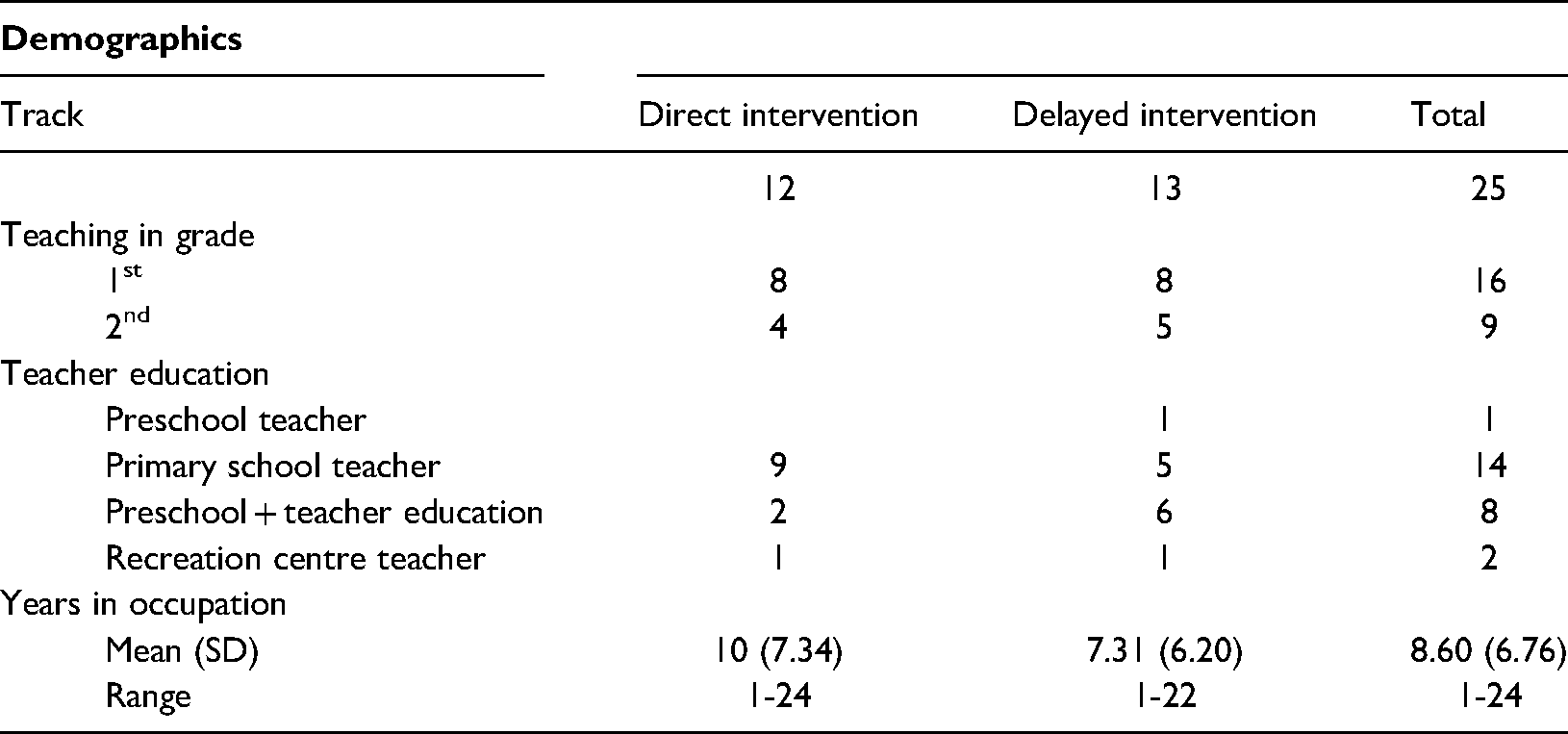
Demographic data for the 25 participating teachers, divided into a direct intervention track and a delayed intervention track.
Data Were collected on three occasions; T1, T2, and T3 (see Assessments below and Figure 1). The assessment battery consisted of background data, two questionnaires, a case-based knowledge assignment about learning disabilities and structured conversations in groups. Filling out all forms took approximately 20 min. The structured conversations lasted approximately 15 min. In this study only the results from the questionnaires and a thematic analysis of the conversations are presented. The case-based knowledge assignment is currently in preparation.
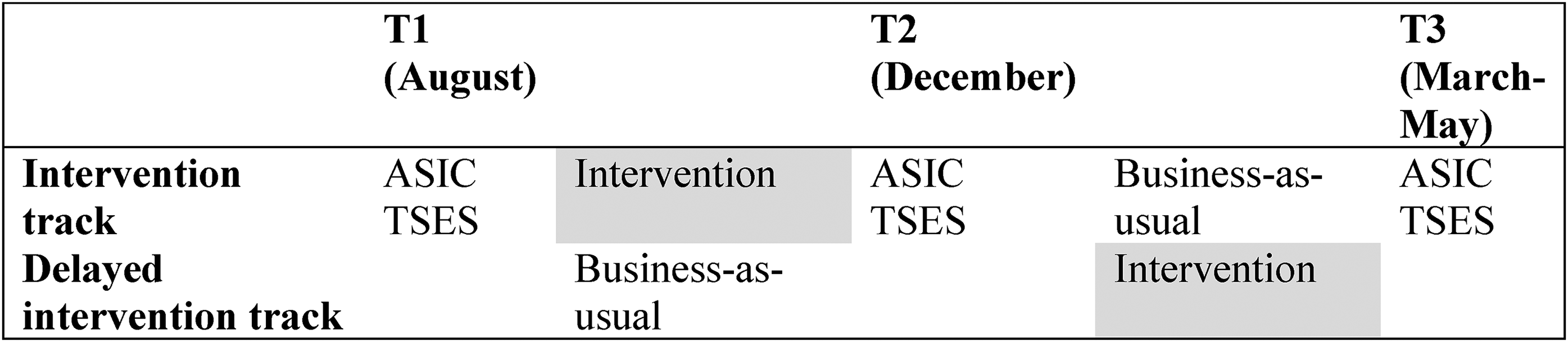
Schematic overview of the intervention design. Note. A percentage change score ((T2-T1)/T1) was calculated to compare changes from T1 to T2 between the direct and delayed intervention tracks.
The Teachers’ Sense of Efficacy Subscale, Classroom Management (TSES) (Tschannen-Moran and Woolfolk Hoy, 2001), adapted to Swedish (Wedholm and Wideklint, 2015) consists of eight questions on the respondents’ self-perceived ability to manage challenging student behaviour and keeping focus on the teaching, e.g., “How much can you do to control disruptive behaviour in the classroom?”. The questions aim to capture the teachers’ ability to influence the unfolding of events in the classroom, and the ability to actively and appropriately intervene when required, making the TSES a proxy for classroom communication skills. Responses are given on a 9-point scale (1 = no ability, 3 = very little, 5 = some, 7 = quite a bit, and 9 = great ability). The mean for the eight items is calculated. A higher score indicates stronger perceived self-efficacy.
ActivitieS and Interactions in the Classroom (ASIC) was first developed as an instrument to assess students’ perception of the classroom environment and teacher behaviour. In the current project, the questionnaire was adapted for use with teachers. The items are statements, e.g., “I feel happy when I go to work”, “I know how to support the students’ vocabulary development”. Responses are given on a 9-point scale (1 = fully disagree to 9 = fully agree), with a higher score indicating more positive perceptions. Originally, the scale consisted of 25 items. An initial analysis of internal consistency, using the pre-intervention scores (n = 28), showed divergent response patterns for five items. These items all had reversed, negative wording, likely to have been misunderstood by some of the respondents, as previously reported elsewhere (Tsang et al., 2017). With these items deleted the Cronbach's Alpha value for internal consistency was .88, indicative of a consistent scale.
The structured conversations with the participating teachers took part at the first introductory session and at the last session. One of the authors asked questions about the teachers’ expectations, knowledge about areas of focus and overall satisfaction with the CPD programme, and another author took notes of the answers. In turn, all participants were encouraged to make a statement.
In all six participating schools, the teachers were working in teacher teams consisting of two or more teachers working together. The schools wished that the teacher teams were held intact to facilitate their everyday work. To track the effect of the CPD programme, the participating teacher teams were divided by the researchers and the principal into intervention groups of 3–7 teachers. To accommodate the teachers, all sessions took place at their own workplace or at a school nearby. Intervention groups constituted only teachers from the same school or mixed groups with teachers from other schools, all depending on the needs and demands of the principals and teachers. This mix of teachers also allowed some control over school-specific factors, e.g., shared teaching conditions and values, as well as possible contamination effects, e.g., teachers talking about the CPD content across intervention groups. The intervention groups (consisting of one or more teacher teams) were then randomly assigned by the researchers to either a direct intervention track (three groups) or a delayed intervention track (two groups). A total of 12 teachers participated in the direct intervention track and 13 in the delayed intervention track.
The groups met on 11 occasions (see Table 2 for form and content). The first session introduced the CPD programme and provided an opportunity for the speech-language therapists and teachers to get to know each other. At the first session, the teachers were also asked to define their own learning goals and discuss their expectations on the CPD. The school's headmaster was present and made a short presentation of the rationale for the intervention. Rules for the following sessions and expectations were formalized. The teachers were provided with a small booklet, containing information about practical issues such as dates, times and areas of focus for the sessions as well as tools for reflection (Kolb, 1984). The teachers also formed collaborative pairs in this session, who observed each other in the classroom, filled out the CSCOT and gave each other feedback. Remaining ten sessions focused on one of three themes; teachers’ verbal and non-verbal communication (sessions 6 and 9), language learning in the classroom (sessions 3, 4, 7, 10) and classroom environment (session 1). The sessions lasted 90 min and were held in the afternoon after school hours.
Content of the in-service training.
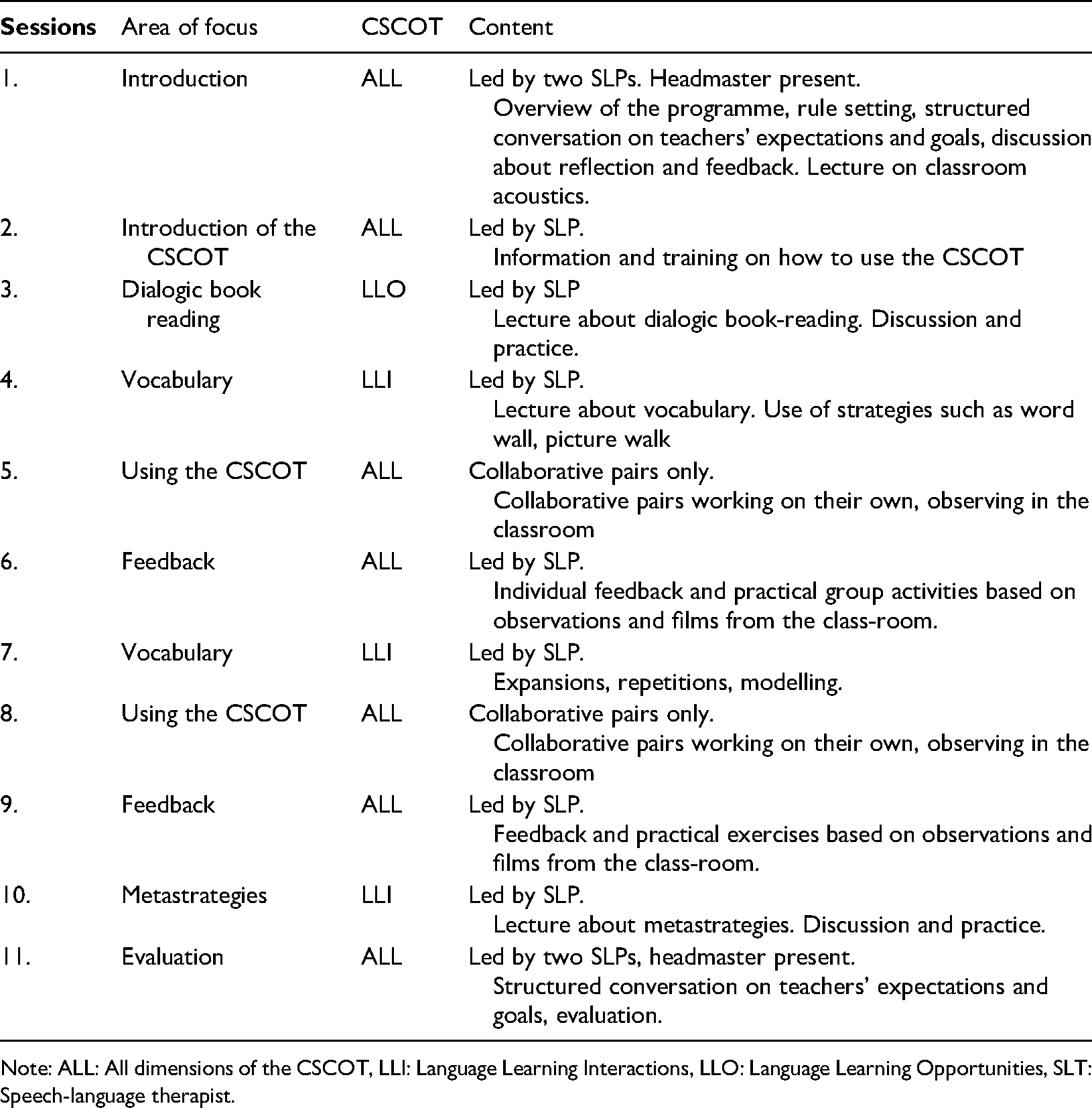
Content of the in-service training.
Note: ALL: All dimensions of the CSCOT, LLI: Language Learning Interactions, LLO: Language Learning Opportunities, SLT: Speech-language therapist.
The intervention themes were informed by the Communication Supporting Classroom Observation Tool (CSCOT) (Dockrell et al., 2015), comprising classroom-based activities within three domains; language learning opportunities (LLO), language learning interactions (LLI), and language learning environments (LLE). LLE was only briefly discussed in the first session, since previous research has found greater awareness among teachers for this domain than for LLO and LLI (Dockrell et al., 2015; Law et al., 2019).
Assessments Took place on three occasions: T1, T2, and T3 (Figure 1). The direct intervention track (n = 12) received intervention during the autumn (from T1 to T2) and was assessed pre-intervention (T1 in August), post-intervention (T2 in December) and at follow up (T3 in March-May) to assess any long-term effects of the intervention. Complete data for TSES and ASIC were collected at each assessment point. The delayed intervention track (n = 13) was assessed twice prior to their intervention, at T1 in August (n = 11) and at T2 in December (n = 8), in order to serve as a control group to the direct intervention track, and received intervention during the spring (from T2 to T3 in March-May, n = 9). For the delayed intervention track, only six out of thirteen participants completed all assessments.
Data Analyses
Despite the demographic differences between the school districts there were no differences between the districts in T1 scores (TSES: t(23) = .11, p = .91; ASIC: t(23) = .70, p = .49). Results for the two school districts are therefore collapsed. A percentage change score ((T2-T1)/T1) was calculated to compare changes from T1 to T2 between the direct and delayed intervention tracks, allowing control for possible differences in the T1 scores.
As described above, intervention research is complex and to fully capture all aspects of change, quantitative measures are seldom enough (Clark and Clark, 2016). Therefore, mixed methods including both quantitative and qualitative analyses, were used.
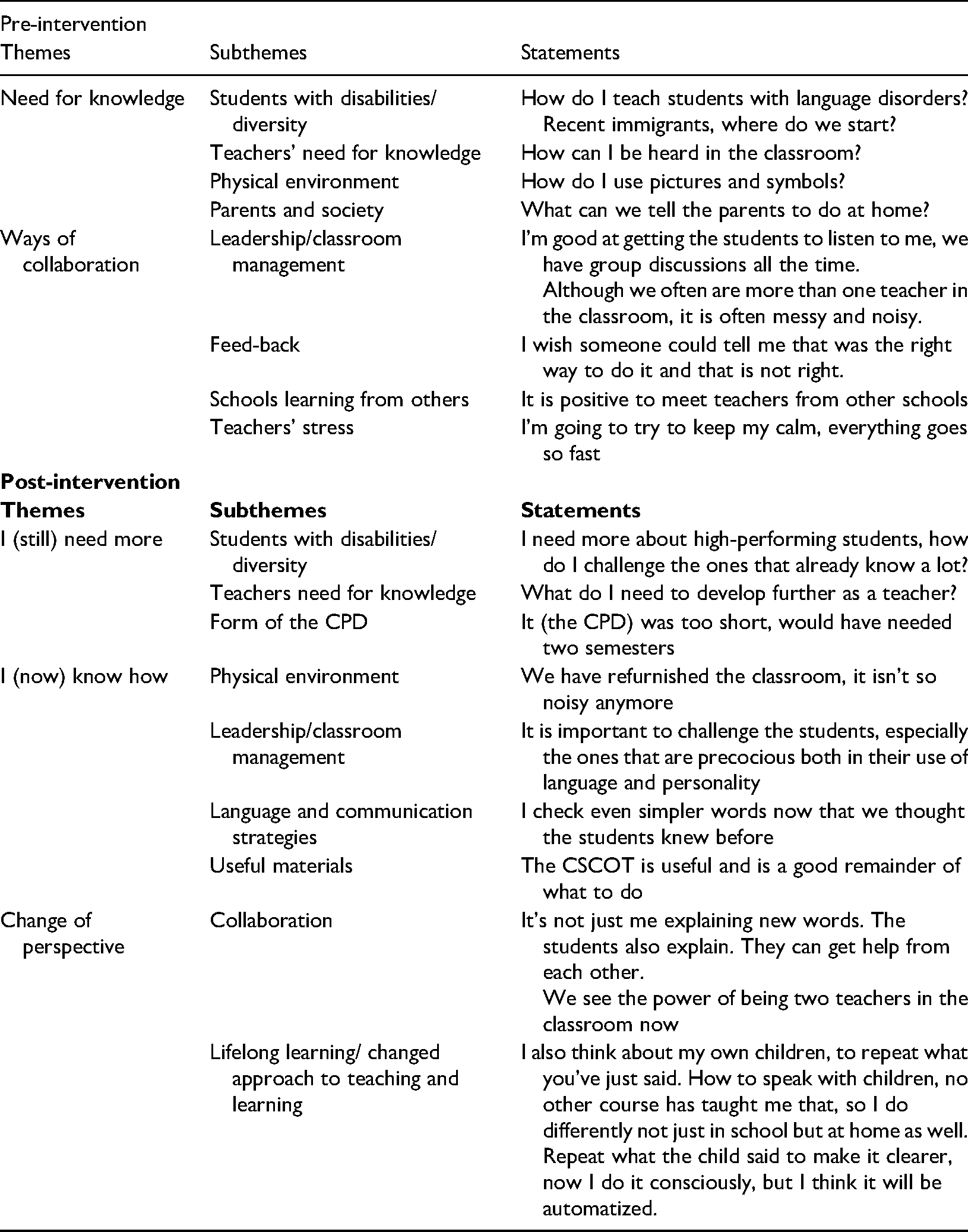
In the initial analysis, the first and last author independently and deductively coded the transcripts of the teachers’ statements, collected during the structured conversations, against the domains of the CSCOT. However, interrater reliability was quite low, .63, and only about 40 percent of the statements could be matched with the CSCOT domains, indicating that the CPD, although based on the CSCOT, had led to additional insights and learning for the participating teachers. Therefore, the statements from both pre- and post-intervention, were reanalysed inductively in accordance with Braun and Clarke (2006). For the reanalysis, all statements were read several times for the authors to get familiarized with the data and to generate initial codes. Multiple codes were possible when statements addressed different topics. Throughout the coding, diagrams and possible interconnections between codes and themes were iteratively created. Two overarching themes were identified pre- and post-intervention, respectively. In addition, four subthemes were identified both pre- and post-intervention. Three additional subthemes emerged in the pre-intervention statements and five additional subthemes were found in the post-intervention statements (see Table 4).
Means and standard deviations for the intervention and delayed intervention tracks on ASIC and TSES.
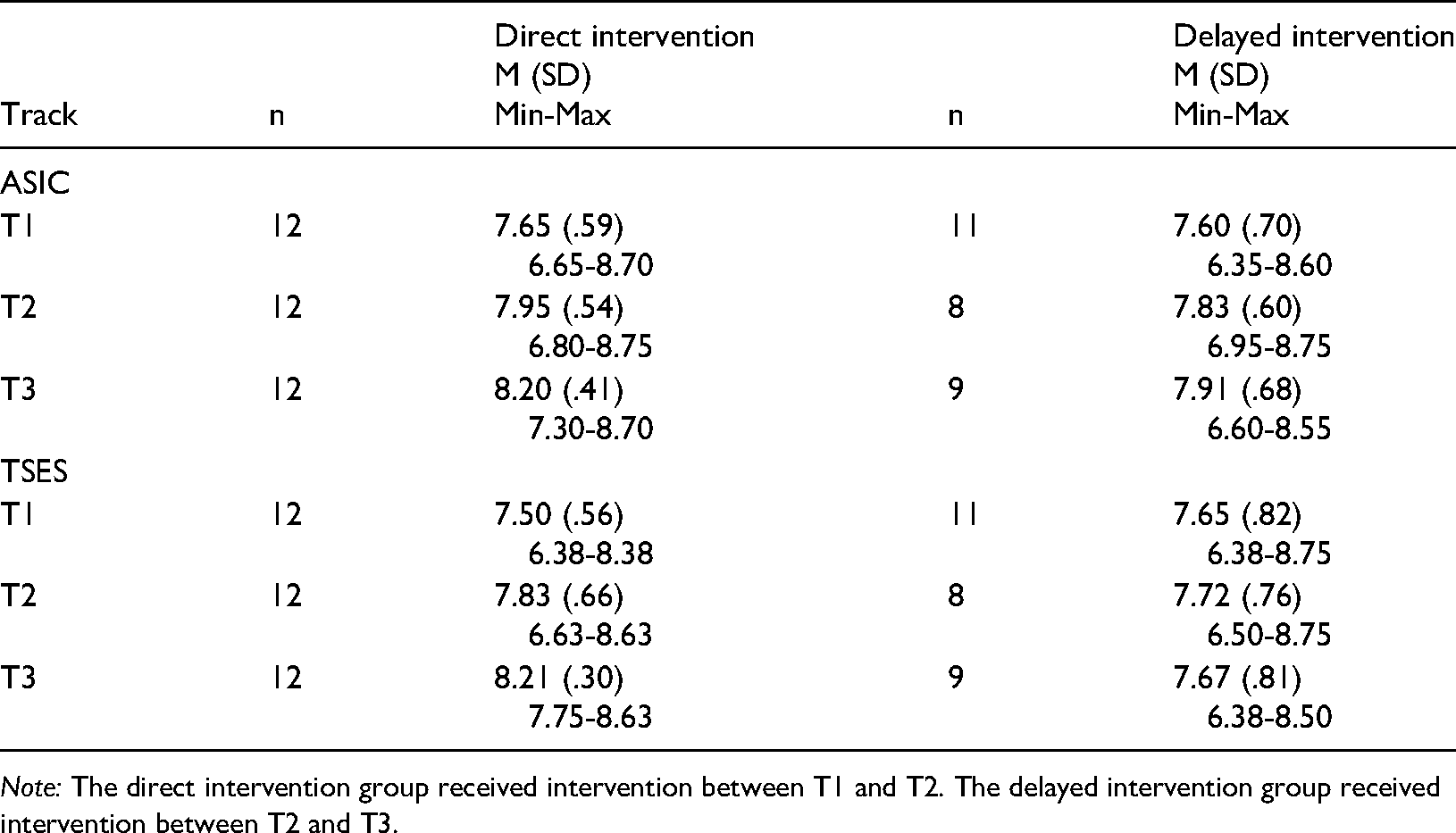
Means and standard deviations for the intervention and delayed intervention tracks on ASIC and TSES.
Note: The direct intervention group received intervention between T1 and T2. The delayed intervention group received intervention between T2 and T3.
Themes, subthemes and statements from pre- and post-intervention assessments.
Quantitative Results
To evaluate the effect of the intervention an independent samples t test was performed, comparing the T1 to T2 change score between the direct and the delayed intervention tracks. The comparison of the change score revealed no significant differences between the intervention track and the delayed intervention track for ASIC (Intervention: n = 12, M = 4.3%, SD = 7.4, range −5–19%, Delayed intervention: n = 7, M = 2.0%, SD = 5.5, −5–10%; t (17) = .60, p = .56, d = .29) or TSES (Intervention: M = 4.6%, SD = 7.7%, Delayed intervention: M = 3.6%, SD = 5.8%, t (17) = .30, p = .77, d = .14).
After pooling the pre- (i.e. T1 for the intervention track and T2 for the delayed intervention track) and post-intervention scores (i.e. T2 for the intervention track and T3 for the delayed intervention track) of all participants, a paired samples t test (n = 18) revealed a significant change in scores from pre- to post-intervention on ASIC; t (17) = 2.49, p = .02, d = .59 but not on TSES; t (17) = 1.38, p = .18, d = .33. The significant difference found between the pre- and post-intervention scores on ASIC was also found for the comparison between T2 and T3 on ASIC (n = 12); t (11) = 2.23, p = .05, d = .64 and TSES; t (11) = 2.89, p = .02, d = .84 for the direct intervention track (Figure 1).
Qualitative Results
The themes that emerged pre-intervention were Need for knowledge and Ways of collaboration. In the theme Need for knowledge, codes and subthemes were all related to the teachers’ need for additional knowledge in specific content areas, such as students with special needs and/or bilingualism, and the teachers’ use of their own voice (see Table 4 for examples of subthemes and statements). The teacher statements in Need for knowledge focus on specific areas and there are few examples of interconnected content areas, e.g., teachers identifying causality or interconnected content areas. Instead, as stated by the participants, the cause of the challenging teaching moments identified by the teachers when setting individual goals for the intervention is placed within the child or the teacher, and it is the teacher's task to address and solve such issues. In the theme Ways of collaboration, the teachers’ point to positive experiences and interest in new collaborative practices, e.g., more collaborative work and feedback to avoid stress and keep the joy for teaching, see Table 4 for examples of statements.
Also at post-intervention some teachers expressed a need for more knowledge. Statements about special student groups and specific areas within the physical environment were collapsed in the theme I (still) need more. Again, the statements reflected uncertainty in how to help all students develop their learning. However, possibly as a result of the CPD, many teachers expressed greater confidence in their classroom management, reflected in the theme I (now) know how. Most statements reflected the practical side of the CPD, methods learned and new materials available. Lastly, and most importantly, teacher statements representing a change in the teachers’ view on communication and teaching are reflected in the theme Change of perspective. In this theme, the teachers expressed more profound changes in how they view their own role, in possible ways of engaging the students in the learning process, and an insight into the bidirectional influence of student and teacher behaviour. The statements in this theme demonstrate that the participating teachers no longer focus solely on problems or possibilities within the teacher or the student but rather on the shared responsibility for the classroom environment.
Discussion
In This study, a CPD programme designed and implemented in accordance with the best available evidence, failed to produce measurable quantitative effects on the teachers’ self-perceived behaviour. The research design allowed for the participating teachers to be active in setting goals, connected the intervention content to the teachers’ everyday work and used a variety of CPD components, intervention features found to be effective in a recent meta-analysis of CPD (Markussen-Brown et al., 2017). Still, no significant differences were found between the intervention and the delayed intervention tracks, indicating that teachers’ self-assessed classroom management skills did not improve as a result of participating in the CPD. When collapsing the pre- and post-intervention scores of the direct and delayed intervention tracks, a significant developmental effect was found, indicating a change in the teachers’ self-reported ability during the intervention period. Although indicative of improvement over time, significant development in this paired samples comparison cannot with certainty be attributed to the intervention alone.
As with all kinds of research, and perhaps in particular interventions studies, many possible confounding factors can be at play. Firstly, although the teachers were asked to set their own goals and use their everyday work experiences as a starting point, the CPD was not fully individualized. Both Goodyear (2017) and Aelterman et al. (2013) point out the necessity of individualized intervention, focussing on the teachers own specific needs and goals. While CPD programmes may seem time-efficient, a more individualized intervention might produce greater effects, possibly even in a shorter time period. In this study, we partly replicated a study by Starling et al. (2012) who reported a significant intervention effect from a similar CPD. Starling et al. (2012) did, in fact, offer more individualized coaching to their participating teachers. It is, therefore, possible that individualization is the active ingredient in an effective intervention, only addressed in two of the eleven sessions in the present study.
Another difference between the study by Starling et al. (2012) and ours is the assessment tools used to measure teacher development. Changes in the teachers’ communicative behaviour may not be most accurately measured through self-assessment. In their meta-analysis, Markussen-Brown et al. (2017) emphasize using measurements that align with the CPD content. CSCOT indeed aligns closely with the CPD content, making it a relevant outcome measure according to Markussen-Brown et al. (2017), but was deliberately not chosen as the identical wordings between intervention content and outcome measure would increase the risk of a positive bias in teacher self-perceptions. Instead, the TSES and ASIC were chosen; TSES as one of few available instruments, and ASIC as a purposely developed tool, both measuring the elusive construct of self-efficacy and classroom management, for which effective communication is critical. The results presented above can be interpreted in at least two ways: 1) the TSES and ASIC were too distant from the CPD content, resulting in invalid results, or, 2) the results of the TSES and ASIC accurately describe teacher change over time, but that the change cannot be attributed to the CPD. Most likely, both explanations are partly true, and more research is needed. For example, results indicate that positive teacher-child relationships are highly associated with better classroom and learning behaviours, highlighting the link between teacher communication and student learning outcomes (Rhoad-Drogalis et al., 2018). This implies that change in teacher behaviour following CPD may be better captured by observing student outcomes. In addition, CSCOT has recently been used both as intervention content and as an outcome measure (Nordberg, 2019; 2020), indicating the dual potential of the CSCOT. Importantly, however, any change in teacher behaviour must be assessed by a critical peer, rather than by self-assessment.
Although rigorous work was done prior to the CPD, methodological constraints could not be avoided completely. Three teachers dropped out before the intervention started and only about half of the participants in the delayed intervention track filled out all questionnaires on all assessments, leaving us with substantial data loss and reduced control over our outcome measures. We can only speculate what made these teachers not participate in all assessments. It is possible that a research-practice gap may have left some of the participating teachers unaware of how research in general, and this study in particular, is conducted, or feeling that research such as this has low value to their teaching practice (Joram et al., 2020). In Joram et al.'s (2020) study, teachers participating in a master's level programme reported feeling disconnected from the research community, leading to low uptake of new research findings and a tendency to base teaching practice on what is already known and certain to work. In addition, teachers who do not regularly read or take part in research are also likely to have a more limited knowledge of research design. This could explain why some participants did not fill out all questionnaires and even why an empty form was returned with the comment “I have already filled out this one”. Taken together, this shows that some of the participants had not fully understood the longitudinal design or the purpose of a control group. In the preparations for the study, we should have made greater efforts to explain the research design to the participants, to avoid any misunderstandings.
In contrast to the quantitative results, the qualitative analyses included reports of an enhanced classroom communication climate and a changed approach to teaching and learning. The teachers who participated expressed a genuine interest in the methods introduced in the intervention and discussed their communication strategies in the classroom with great interest, providing numerous examples of a growing knowledgebase. With increasing knowledge, the questions from the teachers became more complex and informed, and interventionists with relevant background and expertise (speech-language therapists familiar with the school-context) were crucial in making the CPD accepted and interesting for the participating teachers. In particular, as expressed in the theme I (still) want more, the teachers showed a growing interest in language disorder and acknowledged a need of speech-language therapy expertise to fill this gap. Building a teacher CPD around this content has previously been done with promising results by Cunningham et al. (2010). Despite a decade of increased awareness of language disorder the results indicate that teachers still request more strategies for assisting children with language and communication needs.
Another factor that may have contributed to the positive participant reports, was the embedded nature of the intervention, which allowed, e.g., building relations with the teachers, and openly discussing and dissecting their teaching practices from video transcripts, in order to enable personalized coaching on practical teaching issues. This marks a contrast to workshop or lecture based CPD programmes which rely solely on less interactive types of course content.
While the qualitative results indicate change in the teachers’ knowledge of classroom communication the quantitative analyses paint a different picture. The results point to the necessity of objectively and systematically observing both teacher knowledge and teacher behaviour in the classroom, to identify discrepancies between teachers’ self-perceived ability and their actual application of newly acquired knowledge (Mathers, 2021; Miller, 1990).
Conclusion
To Conclude, this study reports a non-significant effect of a 11-week CPD programme aimed to develop classroom communication skills in mainstream school teachers. In contrast to the quantitative results, participants report great benefits of the intervention, express satisfaction with the content and show signs of development and change over the course of the CPD. The results call for caution before the initiation of CPD programmes, and careful evaluation upon their completion. Participant self-assessments may not reliably measure changes in teacher behaviour, and the outcome measure should closely align with the programme content. In addition, changing the teaching practices and adopting a new communicative approach is likely a time-consuming process, and the effect may perhaps not be measurable at once or at a follow-up as early as after three months. Implications also include taking the time to thoroughly explaining the research design to the participants, in order to reduce the risk for data loss. In so doing, a mutual understanding of the complexities of practice-embedded research will evolve, hopefully gradually closing the research-practice gap.
Footnotes
Declaration of Conflicting Interests
The author(s) declared no potential conflicts of interest with respect to the research, authorship, and/or publication of this article.
Funding
The author(s) disclosed receipt of the following financial support for the research, authorship, and/or publication of this article: This work was supported by the The Swedish Institute for Educational Research (grant number 2016/46).
