



Abstract
This article is a (mildly) edited version of a lecture held at the SJTU-IAMCR Emerging Media Forum in Shanghai, China, on April 18, 2025. The lecture is a reflection on the increased sociocultural dominance of data, at the expense of the importance of knowledge and wisdom in particular. The notion of data fetishism—with a reconciliation of Marxist and Freudian traditions—is mobilized to organize a critical reflection about this cultural reconfiguration, and to develop a series of counter-strategies, focusing on the importance of media and information literacy, without ignoring the role of informal learning and knowledge-sharing (as is illustrated by a brief case study of the first interactive film—the Kinoautomat). The lecture ends with a reflection about the role of the university in moving beyond data fetishism, and in stimulating knowledge and wisdom, contextualized by the makeability of technology.
Keywords
Introduction
Inspired by the theme of the SJTU-IAMCR Emerging Media Forum, “Intelligent Transformation and Communication Innovation,” this lecture aims to add to these reflections focusing on what intelligent transformations are, could and should be. As this is a lecture, limited in its capacity to provide detailed and in-depth argumentations but capable of offering a birds’ eye perspective in a more accessible language, I must ask for patience and tolerance for the sometimes too rough arguments and formulations, which are typical for lectures, even when they are transcribed and (mildly) edited.
This lecture will have different parts, starting with a discussion on—what is sometimes called—the hierarchy of data, information, and knowledge, and expanding it, by adding wisdom to this hierarchy. The second part deals with a contemporary reversal of this hierarchy, where wisdom and knowledge are no longer defined as the most important, but where data becomes the center of our attention. The notion of data fetishism will structure the critical analysis of this reversal, also allowing for the discussion of some of the possible strategies to counter this reversal, which center on knowledge acquisition and learning. The diversity of these learning opportunities and the importance of informal learning will then be illustrated by a brief case study on the Kinoautomat, the first interactive film. Finally, I will turn to the role of the university in knowledge acquisition to counter data fetishism, and conclude about the need for a recalibration of human–technology relations.
An Expanded Hierarchy of Data, Information, and Knowledge
When we have a closer look at the hierarchy of data, information, and knowledge (Braganza, 2004; Davenport & Prusak, 1998; Jasimuddin, 2012; Müller & Maasdorp, 2011; Nissen et al., 2000), we see a multitude of discussions and definitions. Still, there is a need to differentiate between these concepts, and a gentle use of discourse theory's (Laclau & Mouffe, 1985) concepts can be helpful here.
The first question thus becomes: What is data? One approach is to define data as the quantification of a part of social reality. Ackoff's (1989, p. 3) definition is slightly broader, defining data as “symbols that represent properties of objects, events and their environments.” One variation is that data are not symbols, but potential signifiers, stored in archives, waiting for actual signification. From a more critical perspective, however, we could also define data as the radical fragmentation of social reality. Equally important is Gunnlaugsdottir's (2003, p. 364) definition of data as “facts without context,” as this definition offers the opportunity to think in terms of increasing contextualizations, when looking at the other components of this hierarchy.
At the second level, we have information, which we can define as the articulation of data. The notion of articulation comes from a discourse-theoretical framework, where this notion has a specific meaning. Articulation is the combination of elements, keeping in mind that the practice of articulation implies that all elements, and the whole, receive a particular meaning. To use Laclau and Mouffe's (1985, p. 105) words: articulation is “[…] any practice establishing a relation among elements such that their identity is modified as a result of the articulatory practice.” This implies that when we combine data—articulate data—the result is no longer mere data—it becomes information—but also that these data gain particular meanings.
Thirdly, there is knowledge. This concept has a more complex definition, as knowledge not only articulates information into discourses—to use a more Foucauldian language—but knowledge also has the element of “truthfulness” articulated with it. Knowledge then becomes the discourses that are considered truthful (or plausible). This also implies some elements of information are accepted and considered part of knowledge, while others are not, and, for instance, discarded as misinformation and disinformation, or considered illegitimate knowledge.
Wisdom is the fourth and last element, and one that is often excluded from this hierarchy, or, at best, left underdeveloped. Still, there are important attempts to add wisdom to this hierarchy (see Ackoff, 1989; Rowley, 2007). Wisdom is important, as it is the application of knowledge—although this does not imply that wisdom is restricted to the knowledge domain. For instance, to have experience and good judgment are considered equally important defining elements of wisdom, but knowledge remains crucial. In different words, wisdom is the integration of knowledge in discursive-material assemblages, structured through the desire for normatively defined outcomes, benefitting society.
The Hierarchy's Reversal
This hierarchy is grounded in a normative prioritization, where especially the societal value of knowledge and wisdom are emphasized. Tuomi (1999, p. 115) also rightfully problematizes the idea that the lower levels of this hierarchy are prerequisites of the upper levels, while “Information can be created only after there is knowledge, and data emerge as a byproduct of cognitive artifacts that assume the existence of socially shared practice of using these artifacts.”
Arguably, the advent of first big data, and later artificial intelligence (AI), has produced a set of discourses in our societies that have reversed this hierarchy. This is hardly a new debate, though: One of the starting points of these academic reflections (Müller & Maasdorp, 2011) is the theater play The Rock from 1934, whose words were written by T. S. Eliot. The play's opening scene has the following lines: “Where is the wisdom we have lost in knowledge? Where is the knowledge we have lost in information?” (Eliot, 1934, p. 7).
But in our contemporary cultural, political and social practices, we are now more and more centralizing the notion of data. Different notions have been developed to critique this sociocultural centralization of data, and the reversal of the hierarchy. One of these concepts is dataism, which was—as far as I can establish—coined, in 2013, by David Brooks in a New York Times opinion piece, and later picked up by Harari in his 2016 book Homo Deus (see Harari, 2016, p. 428ff). This is Brooks’ original formulation: If you asked me to describe the rising philosophy of the day, I’d say it is data-ism. We now have the ability to gather huge amounts of data. This ability seems to carry with it certain cultural assumptions — that everything that can be measured should be measured; that data is a transparent and reliable lens that allows us to filter out emotionalism and ideology; that data will help us do remarkable things — like foretell the future. (Brooks, 2013)
The particularly valuable point that Brooks makes in his definition of dataism is captured by the reference to “certain cultural assumptions,” which allows emphasizing the discursive nature of dataism. Dataism is not a purely material practice, it is also a way of thinking, or, in other words, a discourse. Dataism is not the only critical concept that allows us to think about the societal centralization of data. Inspired by Habermas’ (1987) notion of the colonization of the lifeworld, we can, for instance, speak about the digital colonization of the lifeworld, and/or the colonization of the digital lifeworld.
The concept I prefer to use here, for the critical analysis of this reversal, is data fetishism, which builds on an integration and reconciliation of the two main theoretical approaches toward fetishism, namely the Marxist and the Freudian approaches. Developed together with Andrea Miconi, the data fetishism model (Miconi & Carpentier, 2025) that I would like to propose here, consists of six dimensions (see also Figure 1). In simplified terms, these are the six dimensions:
Decontextualization is the idea that data can do and be anything, by removing the specificity of its contexts; data can literally be stretched to be everything, to capture anything; Reification means that data is considered a living entity. We consider data as something that does things, similar as humans do (with the different moral evaluations that this brings about); Misplacement is the idea that data simply exist, removing the knowledge that we have about how data are actively produced by always particular assemblages; Displacement—a very psychoanalytical dimension—focusses on data allowing us to fulfill the fantasy of truth and knowledge. Data becomes a location allowing us to live out this fantasy; Centralization means that data becomes the center of our thinking and the center of our attention; Dehumanization is best explained by the ironical question: Who needs people when we have data? This dimension captures the erasure of the human.
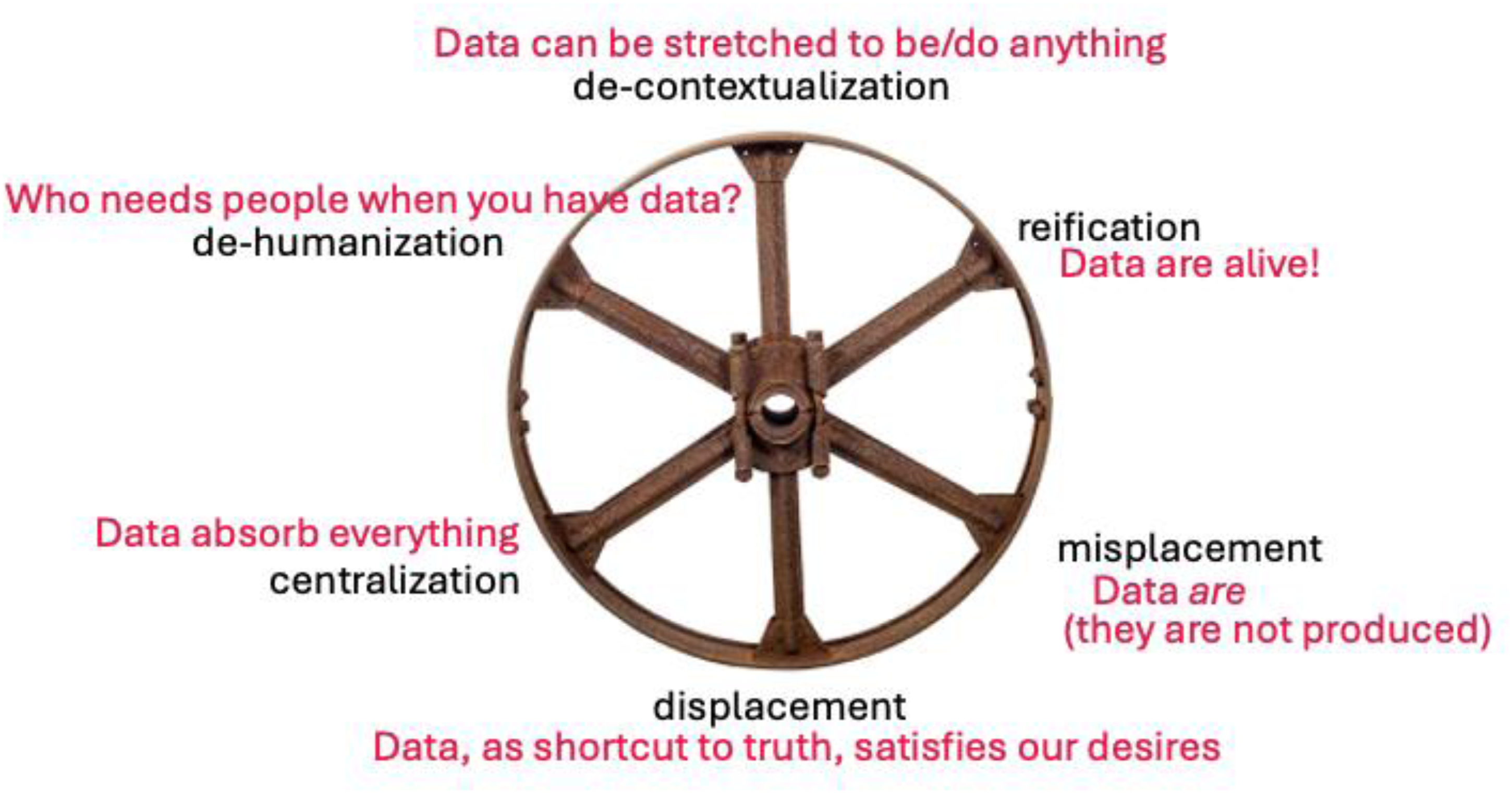
The Six Dimensions of Data Fetishism (Miconi & Carpentier, 2025).
Strategies to Counter Data Fetishism
The previous discussion then raises the question: How to counter data fetishism? If we are—more and more—becoming trapped in the logic of data fetishism, how do we get back out? How do we move back to attaching, in particular, sufficient attention to knowledge and to wisdom?
Before discussing these strategies, there is a need for two disclaimers. First, my point is not that AI is wrong. The point is also not that the generation and usage of data is wrong. It would be unwise to replace the critical analysis of the fetish by a taboo, where technology, AI or data become demonized. Moreover, this does not imply that all discourses about, and all material usages of, data are characterized by a data fetishist construction. The point, in contrast, is that data fetishism is a cultural phenomenon that needs to be critiqued and deconstructed.
In this context, there is arguably a need to better protect information and, in particular, knowledge and wisdom. This almost automatically leads us to strategies to enhance literacy, as literacy is the circulation and distribution of knowledge. And maybe, to be slightly utopian, more attention should also be spent on teaching wisdom, supporting people to become wise—more than “just” knowledgeable, more than “just” being able to use data and information. This utopian dimension of my lecture is inspired by a French slogan from May 1968: “Soyez réalistes, demandez l'impossible,” which translates as “Let's be realistic, let's ask for the impossible.” It is a brilliant slogan, because it shows the importance of utopian thinking, and the importance of critical perspectives on the directions where we want to move toward, as a global community. When we discuss media and information literacy (MIL), we still talk too often about creating knowledge through formal educational structures. Instead a broad approach to MIL is needed to enhance knowledge (and wisdom), and to counter data fetishism. This also implies the inclusion of informal practices in creating knowledge and enhancing wisdom, keeping in mind that we learn through experience, where the confrontation with practice also allows us to become wise(r). Everyday life experiences, in individual but also in informally organized contexts, are as vital as formal learning environments. After all, to quote Pateman (1970, p. 105): “we do learn to participate by participating.”
Secondly, in more traditional approaches to MIL, we often focus on how the media systems work, how technology works, and how representation works …. Sometimes it seems that content and structures are the main heroes of these educational narratives. Of course, these issues are vital, and should be part of knowledge sharing, also when it concerns AI, data, and media as a whole. But there is again a need to broaden the scope and include a focus on process and practice, including participatory practice—focusing on what people actually do, and how this performativity intersects with knowledge and wisdom.
One important component of this practice-based focus is the need to integrate a participatory ethics into MIL, articulating participatory practices and ethical behavior. This again shows the importance of the implementation of (ethical) knowledge, thus combining knowledge and wisdom. There are many building blocks for the development of this participatory ethics which we can consider. Habermas’ ideal speech situation (1984)—and discourse ethics as a later development (Habermas, 1990)—offers one key ethical building block, knowing that this model, with its focus on equal (communicative) power relations, is deeply utopian (which I consider a strength, and not so much a problem). Habermas’ more consensual approach should be extended, though, to avoid underestimating the importance of conflict, and more in particular, agonistic (or peaceful) conflict (Mouffe, 2005). We should also integrate the different models that argue against the use of violence (see, e.g., Canetti, 1960, p. 222), and in favor of respectful practices, procedures, institutions, and communications.
In addition, we need to place more emphasis on the intersection of a participatory ethics with an ethics of truth, without foreclosing the contingencies and constructed nature of truth (see also, e.g., Zagrebelsky, 2009). This is exemplified by Said's (1996, p. 85ff) “speaking truth to power,” and Foucault's interpretation of parrhesia. In the latter case, Foucault (2010) translates parrhesia as veridicity, and describes it in the following terms: “Parrēsia is the free courage by which one binds oneself in the act of telling the truth. Or again, Parrēsia is the ethics of truth-telling as an action which is risky and free” (p, 66, emphasis in original). Secondly, also the intersection of a participatory ethics with an ethics of care (Gilligan, 1982) is important, focusing on the collective care and responsibility for the participatory process itself, the care of all participants for all participants, and the care for the broader participatory culture (Figure 2).
Again, this is not only about educational institutions. A wide diversity of organizations exists, which can all contribute to knowledge production and knowledge sharing in very organic and deinstitutionalized ways. A considerable part of my work in this field has been focused on community media in Cyprus as examples of informal learning—how to engage with a diversity of voices, how to deal with the other (Carpentier, 2017). But here, I prefer to use a different example and take you back in time. To be more exact: We are going back to 1967.
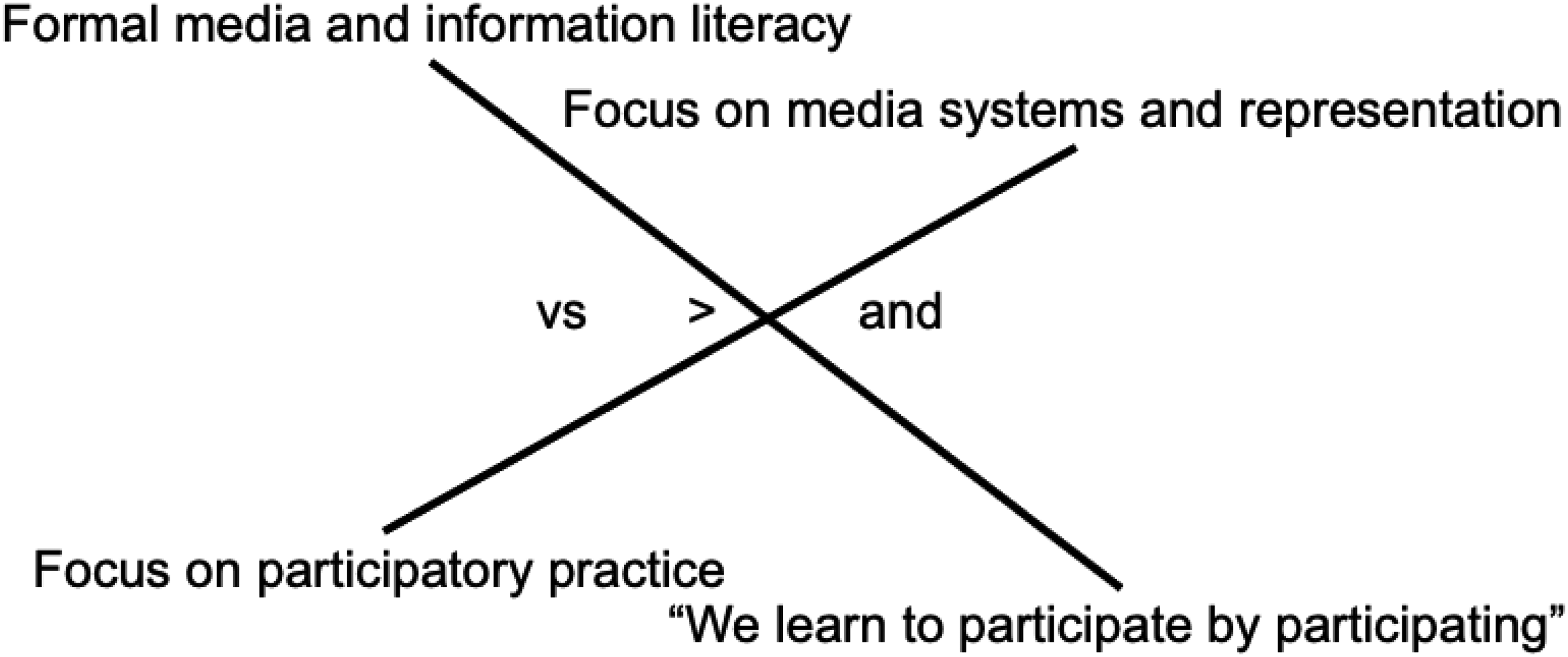
Dimensions of Media and Information Literacy.
The Kinoautomat 1
Kinoautomat: One Man and His House was the first interactive film, produced by the Czechoslovak Barrandov film studio for the World Exhibition in Montreal, Canada, in 1967, with Radúz Činčera as the film's main director (in collaboration with two other directors, Ján Roháč and Vladimír Svitáček). The Czechoslovak pavilion at that World Exhibition turned out to be one of the most popular pavilions at Expo 67, partially because of the Kinoautomat screenings. People queued for hours to go and see this film, because it was the very first moment where the audience could decide on which scenes and which narrative they could see, through a voting system that was materially integrated in the film theater itself, with voting buttons, red and green, that were part of each seat.
Organizing this vote was technically challenging. For instance, film projectors could not be stopped easily, as this would damage the film. Instead, two permanently running main film projectors (together with three others) were used to project the different options and—depending on the audience vote—the projectionist would cover the lens of one of them with a lens cap (Carpentier, 2011, p. 294ff). This implied that a forked narrative structure had to be used, always presenting the audience with only two options, which would then evolve into the same single storyline again (to then branch out again). The Kinoautomat did offer six (real) moments of choice, where the audience could make a decision that mattered, changing the film's on-screen narrative.
As also Hales (2005, p. 60) wrote, live moderation was a key component of the film. The main host—even though the popularity of the film led to the inclusion of other hosts—was the actor Miroslav Horníček, who also played Petr Novák, the main character in the film, which resulted in Horníček talking to himself on screen. But again, the technical issues were considerable, as the two main film reels were continuously running, forcing the host to perfectly time their interventions, even when Horníček did not know the English language and had to learn the phonetic sounds of his lines by heart.
The Kinoautomat offered an important moment in film history because it changed the power relationships in the film theater. It introduced an activation of the audience, while in most other cases they were “only” receiving and interpreting. Instead, the Kinoautomat created the opportunity for the audience to codecide on which version of the film they would see—even though there were limits to the audience's power position (see Carpentier, 2011, pp. 290, 304–305).
Why is this important in the context of this lecture? This is a case of informal learning, where audiences from all over the world came to the world exhibition and were given the opportunity to understand what interactive film was, and what codecision making in the context of a (still minimalist-)participatory film production meant—with all the restrictions that the technological context of the 1960s brought. The Kinoautomat offered an opportunity to acquire knowledge, by engaging with this knowledge through the lived experience of its application—which brings us back to wisdom. Moreover, the Kinoautomat combined this learning process with another element of crucial importance: pleasure. Overall, audience members had a great time learning about participation and were enjoying themselves tremendously.
The second point is that the Kinoautomat's knowledge generating performance was not an individualized process or coincidence. The Kinoautomat's processes were highly organized. The film, with its many scenes, was completely preproduced through the operation of a series of very professional assemblages, going from the Barrandov studio, which produced the film, to the world exhibition which created the context for the Kinoautomat's screenings. These were not coincidences. These were highly organized forms of film participation and informal learning.
Finally, the Kinoautomat worked well, at that very moment, creating a fascinating audience experience in the context of the 1960s and early 1970s. After Montreal 67, it was screened at other world exhibitions in the United States (HemisFair 68 in San Antonio and Expo 74 in Spokane) and it was also screened at the specially reconstructed Prague cinema Kino Světozor in 1971 and 1972, but after that, the Kinoautomat was virtually forgotten, for more than twenty years. Only in 1996 did Czech Television broadcast the film; the film was eventually restored in 2006–2007. The Kinoautomat is a milestone in film history, but the number of screenings—after the film received its second life—remained limited. 2 This demonstrates the importance of context, with its audience preferences and expectations, and industry strategies, when organizing informal learning experiences.
About the Role of the University in Countering Data Fetishism (and More)
What can we then learn from these discussions about the role of the university, as one of the key centers of knowledge production and knowledge sharing? If we maintain our utopian starting point—captured in the slogan “Soyez réalistes, demandez l'impossible”—we can distinguish several strategies to protect and enhance the university's knowledge-sharing role, in order to move beyond the lure of data fetishism.
One strategy is related to pride, as universities do have a significant contribution to knowledge production. Universities could intervene more proactively in the ongoing—and quite old (see Lyotard, 1984)—struggles about the legitimacy of knowledge producing institutions, explain its epistemologies (and their limits) more explicitly, and communicate their own importance more proudly.
Secondly, universities have a long history in protecting knowledge, and have—over time—produced an important toolbox to handle disinformation and misinformation, and establish plausibility and truth. Here, this experience and the university's metaknowledge can be deployed more in contemporary political struggles, where we witness a transformation of political knowledge (Carpentier & Wimmer, 2025, pp. 88–91). As Arendt put it: “What is at stake here is … common and factual reality itself, and this is indeed a political problem of the first order” (Arendt, 1967, as cited in Van Aelst et al., 2017, p. 14). In other words, the university has a role to play in—what I would like to call—countering nonsensical narratives, which range from conspiracy narratives, over propaganda to myths.
Thirdly, there is a structural underestimation of the role of creativity at the university. Universities hardly ever make it explicit how important creativity is for knowledge production. In contrast, the creative component of the knowledge production process is often black-boxed, together with its different pathways, unpredictabilities, contingencies, imaginations, dead ends and failures that characterize knowledge production. In particular, the boundary with the arts—another field of knowledge production—has been too strongly sedimented and policed, while interdisciplinary cross-fertilizations between academia and the arts—as, for instance, arts-based research (Leavy, 2015) has shown—can be highly fruitful for both fields, and for knowledge production as a whole.
My fourth argument is that the university still needs to establish more alliances. The event where this lecture is located, the SJTU-IAMCR Emerging Media Forum, is organized by four different universities, which shows the importance (and capacities) of university collaborations. Its collaboration with the International Association for Media and Communication Research, IAMCR, also demonstrates the importance of global platforms for academic collaboration, bringing in a diversity of voices. Still, more alliances are needed, also within the university, where the social sciences and humanities have a role to play—in interdisciplinary dialogues—to deconstruct data fetishism, and to support the development of more humane approaches toward data, information, and technology.
But these interactions and affiliations should also go beyond the field of academia, I believe. There are many other centers of knowledge production in the world, and academia can also reach out more to them, whilst simultaneously protecting its semiautonomous status, and respecting the semiautonomous status of these other fields. This would also allow universities to support more informal learning opportunities, also outside the formal realm of the university. Moreover, the university can also do more to activate the situated knowledges (Haraway, 1988) of people who are located outside these knowledge production centers and tap into these valuable reservoirs through, for instance, participatory research (Bergold & Thomas, 2012; Fals-Borda & Rahman, 1991), generating opportunities for mutual knowledge acquisition processes and for wisdom to develop.
Finally, we should acknowledge what the university has been doing well for centuries—offering students learning opportunities by confronting them with complexity—which also perfectly allows for the deconstruction of data fetishism in university teaching. But, arguably, universities could do much more in teaching students wisdom. The university can train students in applying knowledge, stimulating them to create, for instance, participatory processes. Or, in other words, the university can train students more in using their creativity to activate the knowledge they have, and to deploy that knowledge for the betterment of society.
A Short Conclusion
We need to be careful not to fall into the trap of technological determinism and media centrism. But there should also be aware of Williams’ (2003, p. 133) wise words, when he wrote that “While we have to reject technological determinism, in all its forms, we must be careful not to substitute for it the notion of a determined technology.” Technologies and humans are entangled. We define each other. We are humans, partially because of technology. Or, in other words, technology is co-constituting humanity.
But this equation also allows us to steer technology into the directions that are desirable. We are not subjected to the power of technology only. We can subject technology to our power. The same argument applies to data. We have the opportunity—despite all difficulties—to put data to good use, and reverse the reversal of the hierarchy of data, information, knowledge and wisdom. But this also requires the activation of knowledge and wisdom to counter data fetishism, to recalibrate human–technology relations and find a better place for data in society.
Footnotes

Funding
The author received no financial support for the research, authorship, and/or publication of this article.
Declaration of Conflicting Interests
The author declared no potential conflicts of interest with respect to the research, authorship, and/or publication of this article.