



Abstract
This study examines the politically engaged interview podcast Mano a Mano, hosted by Brazil's most popular rapper, Mano Brown. Through qualitative content analysis, the research investigates how Brown leverages his celebrity capital to propel debates from the perspective of peripheral communities. By challenging journalistic norms of objectivity and neutrality, the podcast creates a space to amplify underrepresented voices and topics. Brown's personal accounts and subjective approach fosters emotional connections with his audience through intimate, conversational interviews with a diverse range of guests, including politicians, artists, academics, and religious leaders. The study highlights how Mano a Mano incorporates elements of confessional journalism, building empathy while addressing issues such as social, racial, and gender injustice. Additionally, it situates the podcast within the broader context of decolonial approaches, emphasizing its role in amplifying peripheral voices and challenging dominant media narratives. The podcast's conversational chat-based format allows an intimate experience that transcends traditional radio's limitations, offering new possibilities for storytelling and audience engagement. Mano a Mano exemplifies the counter-narrative potential of podcasting and contributes to the evolving political and social discourse of Brazil's peripheries.
Introduction
Podcasts have emerged as a powerful digital medium to engage audiences who demand flexibility to consume information and entertainment, or often a combination of both. Tech companies and media organizations, both legacy and digital-born, have been investing in podcasts given the evidence of a growing public interest in asynchronous listening of digital audio (Newman & Gallo, 2019; Sullivan, 2024). Defined as “an episodic series of digital audio files, which you can download, subscribe to, or listen to” (Newman & Gallo, 2019, p. 8), podcasts are a cultural phenomenon that allows a more personal form of storytelling (Lindgren, 2016). They provide a potential avenue for large media corporations to target wider audiences, experimenting with innovative digital narratives that can generate new revenue streams, but also for independent producers seeking to occupy the media landscape and gain visibility in public discourse. This study centers on a politically engaged interview podcast that by the end of 2022 was ranked third among the most listened-to podcasts on Spotify Brazil (Folha de Paulo, 2022), hosted by rapper Mano Brown, one of the pioneers and most influential voices of the hip hop movement in Brazil. Brown's foray into the journalistic arena as an interviewer for the award-winning Mano a Mano podcast presents an opportunity to understand the political values of podcasts in the context of the Global South and to examine how new narrative forms challenge the conventions of traditional journalism. We argue that the intimate, authentic, and emotional connection fostered by the host's performance intersect with elements of confessional journalism, while reasserting the identities and experiences of historically silenced communities.
According to the Reuters Institute Digital News Report 2024, which covered 47 markets, the monthly consumption of news podcasts has been growing substantially since 2018. In an increasingly unstable media ecosystem, where we have seen a falling interest in the news in general, the audio format continues to attract younger audiences (Newman et al., 2024). Academic research on podcasting has also been expanding, addressing the affordances and the limitations of the medium to transform the media landscape. One of the focuses of scholarly interest is the concept of intimacy in podcasting (Berry, 2016; Clarke & Bjork, 2023; Euritt, 2023; Lindgren, 2016; Spinelli & Dann, 2019). However, much attention is given to productions from the Global North, and research is primarily concentrated on popular shows produced by major media corporations, with fewer empirical studies conducted to date on independent producers from the Global South.
Podcasts genres are diverse, and their definitions are often complex due to a mix of hybrid formats and a vast range of producers, from amateurs to professionals. In their analysis of the top news podcasts in five countries (the UK, the USA, Australia, France, and Sweden), Newman and Gallo (2019) categorize the most common sub-genres within news: talk/interview unscripted (44%); narrative series/single topic (24%); daily news/current affairs (17%); another documentary/many topics (15%), and audio long read (1%). The interview format is the subject of this article. Broadcast corporations and print/digital media companies are the main producers, although in the US podcast production companies are considered big players, producing blockbusters with a global audience (e.g., Dr Death) and establishing partnerships with legacy media brands. Struggling to expand the reach of their online presence and inspired by the success of “deep dive” shows such as The Daily, produced by The New York Times, journalists have been adding podcasts to their workflow. Podcasts allow journalists to contextualize news stories without the constraints of limited space and tight deadlines. It also offers a space for long, immersive narrative formats against the speed of the continuous online news cycle (Karlsson, 2011), and even against the “informative eagerness” of the radio, which privileges the dissemination of news in short blocks (Santos, 2021). Low barriers to entry have been attracting younger producers, who often combine audio with video (Newman et al., 2024). Podcasts are, thus, a disruptive technology that mixes audio, the internet, and the portability of smartphones, challenging traditional media practices and providing a “bridge between a broadcast age of restricted access and a post-broadcast age of availability” (Berry, 2016, p. 667).
Mano Brown (artistic name of Pedro Paulo Soares Pereira) is known as one of the most important names in Brazilian popular music and a critical thinker of Brazil's social and political tensions. His art and meta discourses beyond the hip-hop arena have already been the subject of studies that address the fundamental relevance of rap music for understanding the stigmatization of young people from the outskirts of large cities (Bentes et al., 2013; D’Andrea, 2020; Kehl, 1999; Lacerda, 2022; Nascimento, 2006; Teperman, 2015). His phenomenal rise in the cultural industry made the rapper both a spokesperson for the marginalized periphery and a subject with social and economic capital transcending the social group he represents in his music.
This research draws on a qualitative analysis of 30 episodes of the podcast show Mano a Mano, conceived and hosted by the rapper. Concerned with shifting journalistic norms and formats, the study extends existing research on the concept of intimacy and seeks to add new insights into the practices of podcasting carried out by independent producers to construct a discourse with socially peripheral roots. We aim to contribute to interdisciplinary research on the changing boundaries of journalism by examining if and how the host incorporates tools of confessional journalism to build a more personal and emotional bond with the audiences while confronting classic parameters of journalism such as objectivity, neutrality, and impartiality. This research departs from a theoretical framework set forth by studies on the affordances of podcasting, mainly the sense of intimacy, and journalistic practices that rely on emotions, also exploring how this case study embodies core tenets of alternative media, presenting narratives that are often overlooked by mainstream media.
The following literature review explores three interconnected themes that form the foundational framework for the study. First, it introduces the key elements of podcasting, drawing a correlation between the personal tone often adopted by podcasters to create a sense of intimacy and the emotional impact seen in confessional journalism. Second, the study examines podcasts as a platform for counter-narratives, emphasizing their role in challenging mainstream agendas and representations. This is followed by an analysis of rap's influence on marginalized communities in Brazil, positioning Brown's discourses within a larger framework of resistance against dominant, colonial legacies.
Emotional communication in podcasting
Podcasts walk alongside traditional radio; they do not overlap, replace, or cancel each other, as dictated by the concepts of media convergence (Jenkins, 2006). However, podcasts present typical characteristics of disruption technology. Freer than radio, podcasts are not inserted in linear programming, nor follow one standard format, periodicity, language, and sound effects (Spinelli & Dann, 2019). It is on-demand, targets niche audiences, and provides autonomy to listeners, who can download and listen to the episodes whenever they wish (Euritt, 2023). Episodes can be consumed in transit and require an active engagement of the audiences since discovery happens in a different way than radio. Podcast audiences actively search for content, instead of finding content by chance, as radio listeners do (Berry, 2016; Spinelli & Dann, 2019). According to Berry (2016), the development of podcasting over the last decade has allowed the emergence of elements that are increasingly distinct from radio features. While radio is by nature an intimate medium, podcasting “takes this a stage further and offers, in many instances, a sense of hyper-intimacy” (Berry, 2016, p. 666). Lindgren (2016, p. 1) highlights podcasts’ capacity to generate a unique feeling of intimacy when audio stories are “whispered into our ears” creating a “personalized listening space.” The earphones contribute to that experience pushing the intimacy inside the body, “in a very real sense, re-embodying the voice” (Spinelli & Dann, 2019, p. 84). In turn, Euritt (2023, p. 1) points out that this feeling of intimacy is not inherent. Rather, “podcasts are intimate because they draw on how culture constructs intimacy to communicate the feeling of closeness” (Euritt, 2023, p. 1). As an example, the scholar observes how some podcasters prefer to record at home to incorporate a do-it yourself aesthetic, adding that “recording in a kitchen allows the host to present the show as authentically intimate” (Euritt, 2023, p. 64).
Focusing more specifically on news podcasts, Newman and Gallo (2019) emphasize the host's personality as one of the key features of successful shows. Popular podcasts share the informal and conversational style of the presenter, who “sound relaxed and personal—like real people, or friends engaging in a conversation with us” (Lindgren, 2016, p. 6). Rae (2023) points out that one of the most popular interview podcasts in the world, The Joe Rogan Experience, was created in a home garage without professional equipment by a celebrity with no formal journalism training. The ability to create parasocial relations with the audience via self-disclosure is pointed out by Heiselberg and Have (2023) as one of the main qualities of podcasts hosts. Building on Coward's (2013) research on the steadily growing interest in personal and subjective narratives in journalism, Lindgren extends the analysis of this genre to podcasts and concludes that digital audio stories are empowered by a deeply personal style, putting human experiences in the center of the narrative. A qualitative study of 11 shortlisted and award-winning journalism Australian and British podcasts within the framework of narrative journalism confirms that the intimacy enabled by this audio format results in a personalized approach forged around emotions (Lindgren, 2021). In a significant diversion from objective journalism, Lindgren defines “self-reflexivity and transparency of the reporting process as staple ingredients” of podcasting, mainly in true crime reporting (Lindgren, 2021, p. 2). Rather than a detached tone, podcasts’ presenters adopt an emotional one that can lead to a perception of authenticity, consequently building trust between podcasters and listeners. Accordingly, Dowling and Miller (2019) argue that we should examine podcasts not only through the lens of radio technology development but mainly for their ability to promote immersive online storytelling with an emphasis on personal and subjective approaches. In our attempt to bring new insights into this field of study, here we make a connection between the perception of intimacy and confessional journalism.
When emotions drive the news story
Confessional journalism can be linked to the contemporary “confessional society” (Coward, 2010, 2013). The fascination for reactions and confessions can be symbolized by reality TV shows, where the frontiers between the private and the public are blurred. Confessional is a word that originated in religious practice. Confession of sins or faults by a congregation member is made privately to a priest, pastor, parish, or ecclesiastical authority. The word also designates the therapeutic practice of someone who privately narrates lived experiences to someone else; something that weighs on the conscience and that when reported can be treated (Coward, 2013).
In journalism, personal and emotional elements are increasingly embedded in various narrative forms, from columns to reader-contributed sections. Despite the ideal of journalistic objectivity that portrays journalists as detached and neutral observers (Kaplan, 2009; Kitch, 1999), engaging storytelling that evokes emotions has long been a valued skill (Gluck, 2016). Kitch (1999) and Coward (2013) highlight this paradox: good reporters should remain distant from unfolding stories, yet they also need to be present. Coward explains: “The greatest and most enduring pieces of journalism are often those where the observer has been recognizable as a personality either through their style or through foregrounding their presence” (2013, p. 21). Wahl-Jorgensen (2019) argues that emotions, when carefully outsourced, can enhance quality journalism, as seen in award-winning reports that narrate the emotions of sources to align with objective standards. Vodanovic (2022) contends that journalists sharing personal experiences, as a form of “bearing witness,” should not be dismissed as click-bait. Her analysis of newspaper articles on the 2018 Irish Abortion Referendum shows how confessional journalism blends facts with reflexivity, fostering dialogue between writer and reader.
Beckett and Deuze (2016) remind us that mobile technology has changed the relationship between news and audiences. They stress the importance of “recognizing and putting emotion front and center in our considerations of newswork” (2016, p. 5). Similarly to Vodanovic (2022), Salgado and Strömbäck suggest that interpretative journalism is usually built around a “prominent journalist voice,” going beyond the facts to include contextualization, explanation of meanings, evaluation, or speculation (2011, p. 154). More importantly, Wahl-Jorgensen argues that journalism studies have recently seen “an emotional turn” (2019). Personal accounts of breaking news events, emotionally driven posts on social media and blurring boundaries between private and professional spheres are shaping journalistic practices in a media ecosystem that is “predominantly mobile and profoundly personalised” (Beckett & Deuze, 2016, p. 1).
There are various modes of subjectivity in reporting, including the use of emotions, bias, and self-interest (Chong, 2017). In podcasting, these elements are further amplified, particularly the links between emotional experiences and a sense of intimacy, which are leveraged to build empathetic connections (Lindgren, 2021). For example, British journalist and BBC Radio 5 Live presenter Rachael Bland shared her breast cancer diagnosis and battle with her audience through tweets, Instagram posts, and primarily through her award-winning podcast You, Me and the Big (BBC, 2018). Using Bland's example to examine confessional journalism, Williams (2020) argues that podcasts, unrestricted by time constraints, offer a deeper narrative compared to radio or TV programs. This format creates an environment of communion, enabling hosts to share personal experiences and express their opinions, which stands in sharp contrast to the objective, neutral forms of reporting.
Furthermore, podcasts contribute to the evolution of innovative storytelling forms that depart from the rigid inverted pyramid structure. Narrative reporting, which can be more conversational and opinionated, has been increasingly adopted in both print and TV journalism as it became evident that it could attract wider audiences (Ekström, 2000; Nee & Santana, 2021). While this shift is not entirely new, the podcastsphere facilitates greater experimentation with different genres of subjective reporting, moving away from a strict objectivity model towards a more personal, colloquial approach (Nee & Santana, 2021). Interview format in podcasts is not homogeneous, ranging from Q&A conversations to excerpts from interviews incorporated into heavily edited narratives and panel discussions. In their analysis of news podcasts related to the Covid-19 pandemic, Nee and Santana (2021) found dialogues in most part of the episodes, usually conversations between the host and the reporters. The conversations are recorded and then edited into the podcast. This style also represents a departure from the objectivity norm since reporters are inserted in the stories, as characters but also as experts on the topic, expressing their opinions as credible and trustful voices. The tone is personal and chatty, “coupled with the digital editing of a multitude of sound files to produce a compelling narrative” (Nee & Santana, 2021, p. 1571). It may be argued then that podcasting further complicates the debate around boundaries of journalism practices. For Santos, podcasts represent the “rediscovery of the power of history inside and outside journalism” (2021, p. 198).
Citizen podcast and the potential for social change
As elaborated above, podcasts are a fertile platform for exploring subjectivity in journalism. However, scholarly discourses about shared lived experiences, confessions and emotion tend to focus on journalism practiced by professionals on large media corporations. Concurrently, studies cannot fully account for the impact of podcasting without also looking at the production of content outside traditional media organizations. It is worth remembering that, although legacy media outlets have incorporated podcasts into their workflows, and streaming services have increasingly commercialized podcasting activity, earlier producers were amateur radio enthusiasts (Berry, 2006, 2015, 2016). According to Berry, “podcasting offers a classic horizontal media form: producers are consumers and consumers become producers and engage in conversation with each other” (2006, p. 146). Coming from different backgrounds, podcasters can adopt a de-professionalized approach, similar to blogging, to disseminate content and engage in debates, whether they are journalists, activists, educators, or organizations from different areas (Park, 2016). Previous research has shown that audiences believe citizen-run podcasts can effectively fulfil certain roles traditionally performed by professional journalism, playing the watchdog function, providing relevant information to help engage in public life and interpreting complex issues (Park, 2016).
Even considering that investments from large media companies and Big Techs are transforming the podcastsphere and introducing a more professional and corporate logic to the ecosystem (Sullivan, 2024), podcasts have opened new communication channels for minorities underrepresented in traditional media. It is a critical medium that can make racial issues more visible, for instance, expanding the Black public sphere as argued by Jenkins and Myers (2022). Black podcasters, among them women writers, intellectuals, bloggers, journalists, and activists, are efficiently building counter-narratives sharing their personal experiences in the context of intersectional discrimination. Constantly inviting the audience's participation, they promote debates on historically marginalized themes and help to build or strengthen communities, offering a postcolonial and decolonial critique to challenge the “white innocence” of European nations (Fabbri & Romeo, 2023, p. 52). Similarly, an informal network of Black podcasters from across the United States, who refer to themselves as “the Chitlin’ Circuit,” “reproduce a sense of being in Black social spaces,” such as churches and barber/beauty shops in which intimate and uncensored conversations took place (Florini, 2015, p. 210). In the UK, podcasts led by young Black and Asian producers constitute subaltern counterpublic spaces to “connect, communicate and build solidarity” in their struggle against racism and other forms of discrimination, both as a political and a cultural resistance (Vrikki & Malik, 2019, p. 286).
Casual, intimate and spontaneous conversations are common traits pointed out by those scholars. In sum, Tiffe and Hoffman (2017) define podcasting as a resistance practice for social change, one that can redefine discriminatory and misogynistic sonic spaces. Feminist podcasters, for instance, challenge traditional journalism boundaries when they break with hegemonic vocal norms, characterized by a tone that should sound unbiased and emotionless. But is it journalism or activism? The concept of alternative media, and more specifically alternative journalism, comes into the picture here, since this paper investigates a podcast that has journalists on its production team, but is hosted by a rapper who is not a trained journalist. Alternative journalism is related to terms such as citizens’ media and social movement media. It encompasses a wide range of practices that are “informed by a critique of existing ways (the dominant practices) of doing journalism” (Atton & Hamilton, 2008, p. 1). These challenges to conventional ways of doing journalism seek to represent the interests of underrepresented groups and movements and we have seen an expansion of digital initiatives in Brazil that tackle the imbalance of media power (Sarmento, 2023). Based upon these premises, we argue that the case study examined here can be situated within the framework of alternative journalism.
Mano brown and the peripheral discourse
According to D’Andrea (2020), rap music is intrinsically linked to the emergence of the social and political discourse over the term periphery in Brazil. The group Racionais MCs, led by rapper Mano Brown, is the most important voice of this phenomenon. Their first album, from 1989, founded the base of a “peripheral epistemology” (D’Andrea, 2020, p. 22). By placing the lived experiences of marginalized neighborhoods in the center of the cultural scene through the narration of collective experiences of oppression, they helped to promote change building an identity and a sense of belonging among young people living in peripheral areas. For Teperman (2015), their impact on the younger populations from the favelas and low-income suburbs was unprecedented.
Levy (2018) suggests that the periphery can refer to a geographical location or, in other words, impoverished urban outskirts whose population is more likely to suffer abuse and discrimination. It can also mean “a discourse and an identity for the socioeconomic disadvantaged” (Levy, 2018, p. xix). Concomitantly, cultural expressions from the periphery can be seen in various forms, including art, music, and literature. Rap, as an artistic expression, is a powerful tool for social and political critique, as different scholars have pointed out (D’Andrea, 2020; Lacerda, 2022; Nascimento, 2006; Teperman, 2015). It emerges from a tradition of resistance and directly addresses the lived experiences in the peripheries, tackling themes such as inequality, racism, violence, and the struggle for dignity. The key aspect of “Racionais” discourse is the process of conscientization of the peripheral youth against alienation (Nascimento, 2006). Their lyrics not only address the harsh reality of the peripheries but also celebrate their existence, identity and cultural resistance (Kehl, 1999). According to Nascimento, “if the systematic process of ghettoization of the poor accompanies the project of geographic and existential exclusion, rap's message is also concerned with revealing this territory in all its diversity and conflicts" (2006, p. 6). In 1997, the album “Sobrevivendo no Inferno” (Surviving in Hell) put the group in the mainstream, narrating experiences of poverty, violence, oppression, and racism. Produced by their own independent record company, it sold more than 1.5 million copies.
Opposing hegemonic discourses in Brazil, Racionais’ MCs took on revolutionary roles, reshaping peripheral identity boundaries. Over time, they moderated confrontational stances, like refusing mass media interviews and rejecting corporate-sponsored concerts, to engage more broadly with the music market (Teperman, 2015). Brown built his career independently of traditional media and often criticized it. By expanding his public role, he became a political force beyond hip-hop, asserting his influence in a media landscape that typically ignores or stigmatizes urban peripheries. In 2019, Unicamp, a leading Brazilian university, included the album “Sobrevivendo no Inferno” in its entrance exam reading list, highlighting its lyrics on social issues such as systemic racism. Nascimento (2006) emphasizes that territoriality and visibility of subaltern spaces are central to Racionais’ message. Although an in-depth analysis of rap's artistic and communicative power is outside this study's scope, the genre's role as a decolonial cultural expression contextualizes Brown's podcasting.
Urban peripheries, often excluded from dominant narratives, claim spaces for cultural resistance and creativity, aligning with decolonial thought focused on decolonizing knowledge, practices, and social relations. Mignolo (2021) argues that modernity and colonialism are intertwined, and the pursuit of new knowledge must be done from a perspective that values the experiences and knowledge of marginalized populations. Quijano (2000) discusses the “coloniality of power,” which refers to how power structures continue to operate even after the formalization of the independence of many Latin American countries. He argues that the creation of racial categories during the colonial era was not merely a way to categorize groups of people; it was a tool to establish and maintain power relations. Racial hierarchies became deeply ingrained in societies worldwide, perpetuating oppression and discrimination against indigenous peoples and people of color. Quijano's analysis emphasizes the need to confront and dismantle racial hierarchies as a core component of the decolonial struggle. Lugones (2007), in turn, discusses the intersectionality of oppressions, highlighting how race, class, and gender intersect in the experiences of women and peripheral communities. Drawing on the idea of decoloniality as the reconstruction of silenced histories, Nascimento (2014) suggests that rap music can be understood as a direct confrontation of an imposed silence in Brazil. Its aesthetics, which often incorporates elements of Afro-Brazilian music and funk, empower and enrich the cultural wealth of the peripheries. This mixture of influences becomes an example of how cultures intersect and reinvent themselves, creating new narratives and identities. Through rap, the youth in the peripheries not only contest colonial narratives but also affirm their identities and claim their rights.
In August 2021, Spotify released the first episode of the Mano a Mano podcast, in which Mano Brown interviews a broad range of public figures, from sports to politics, from music to religion. Mano is slang for brother and a term used by rappers to demonstrate equality in contrast to the hierarchical concept of a leader (Kehl, 1999). Brown explained his motivation at a press conference: “In Brazil, information is denied, mainly to Black people. The idea is to present useful content that [excluded] people do not always get” (Mundo Negro, 2022a). He also reflected on how he aimed to challenge the preconceived image of “an ignorant and intransigent guy” and outlined his way of leading the breakup of peripheral invisibility. “Speaking without caring if others will understand is disrespectful. The main target is the young audiences. If you don't look at young people, you are not thinking about the future. If they don't understand what you say, make yourself understood. What is not fit for sharing is worthless,” Brown said (Mundo Negro, 2022b). This communication philosophy resonates with Jenkins (2006) concept of participatory media, which highlights the active role of the audience in the circulation and reshaping of media content. Furthermore, it reinforces the idea of communication as a non-neutral act, aiming to create awareness, education, and visibility, particularly for the historically excluded Afrobrazilian population. In 2023, Mano a Mano won the Best Podcast award from São Paulo's Association of Art Critics.
Method
This research emerged from the interest of the researchers in exploring new narrative forms that explores emotion and the potential of podcasts to give visibility to topics underrepresented in traditional media. The podcast Mano a Mano was chosen as the object of analysis due to the significant impact the show has had in Brazil, reinforcing the image of Mano Brown as a thinker of social reality in peripheral communities. According to Yin (2003), case studies are suitable when a contemporary phenomenon is investigated, and the method is not only valid for the exploratory phase of research. Even though Brown is not a journalist, his production team included a journalist (Semayat Oliveira) who participates in the podcast as a consultant and co-presenter. She was one of the founders of the outlet Nós, Mulheres da Periferia (We, Women of the Periphery) that covers issues related to the experiences of women living in low-income neighborhoods. Hence, it is a show that openly underscores different articulations of struggles from counter-hegemonic positions (Fraser, 1992).
Brown has worked with community organizations to provide education and healthcare services, and he has been a vocal advocate for social and economic justice, as previously addressed. The rapper's journey illustrates Hall's (1997) concept of “representation,” where identities are constantly negotiated and reconstructed in the public sphere. His reflection on the evolution of the public perception of his image, from a marginalized and allegedly intellectually limited figure to a respected communicator, exemplifies what Fanon (1952) describes as the process of mental decolonization. These characteristics justify the choice as a single case study, considering that this methodological strategy is suitable for answering research questions that involve “how” or “why” and “when the focus is on a contemporary phenomenon within some real-life context” (Yin, 2003, p. 2). As the volume of independent podcasts in Brazil is very large and the interviews conducted by Brown are considerably long, expanding the scope of the analysis to include other shows would go beyond the purpose of this study. Limiting the analysis to Mano a Mano resulted in a more manageable sample size.
Considering the broader aim to (a) investigate new narrative forms emerging from digital audio and to (b) critically analyze the subjective performance of the interviewer to address underrepresented themes, this paper explores if and how the host employs elements of confessional journalism, particularly examining the subjective elements incorporated in the episodes that explicitly conflict with conventional journalistic norms (RQ1). Additionally, it investigates how the host leverages his personal voice and self-reflexivity to drive debates and discussions from the perspective of peripheral communities (RQ2). In essence:
RQ1: Focuses on the incorporation of confessional and subjective elements by the host (the confessional practice). RQ2: Explores how this approach influences discussions on peripheral issues (the purpose and social impact of his practice).
With weekly releases and four seasons recorded, there were 64 episodes available when this analysis was conducted. Men (65%) and Black interviewees (74%) were the majority of the participants. By area of residence or area of origin, 79% of those interviewed are from peripheral regions. Only five guests (6%) were considered right-wing or conservative. By profession, interviewees engage in a variety of activities that sometimes overlap. They were mainly artists (49%); activists or intellectuals (15%); athletes or former athletes (9%), religious leaders (7%), scientists (7%), and journalists (5%). Informed by previous studies on the analysis of audio storytelling (Lindgren, 2016, 2021; Nee & Santana, 2021), we have chosen a purposive sampling of 30 episodes spanning the show's four seasons. Table 1 has 10 names that serve as an example of the interviewees. This selection represents a diverse cross-section of the guests and provides an overview of the range of participants featured in the podcast.
Examples of Interviews Analyzed.
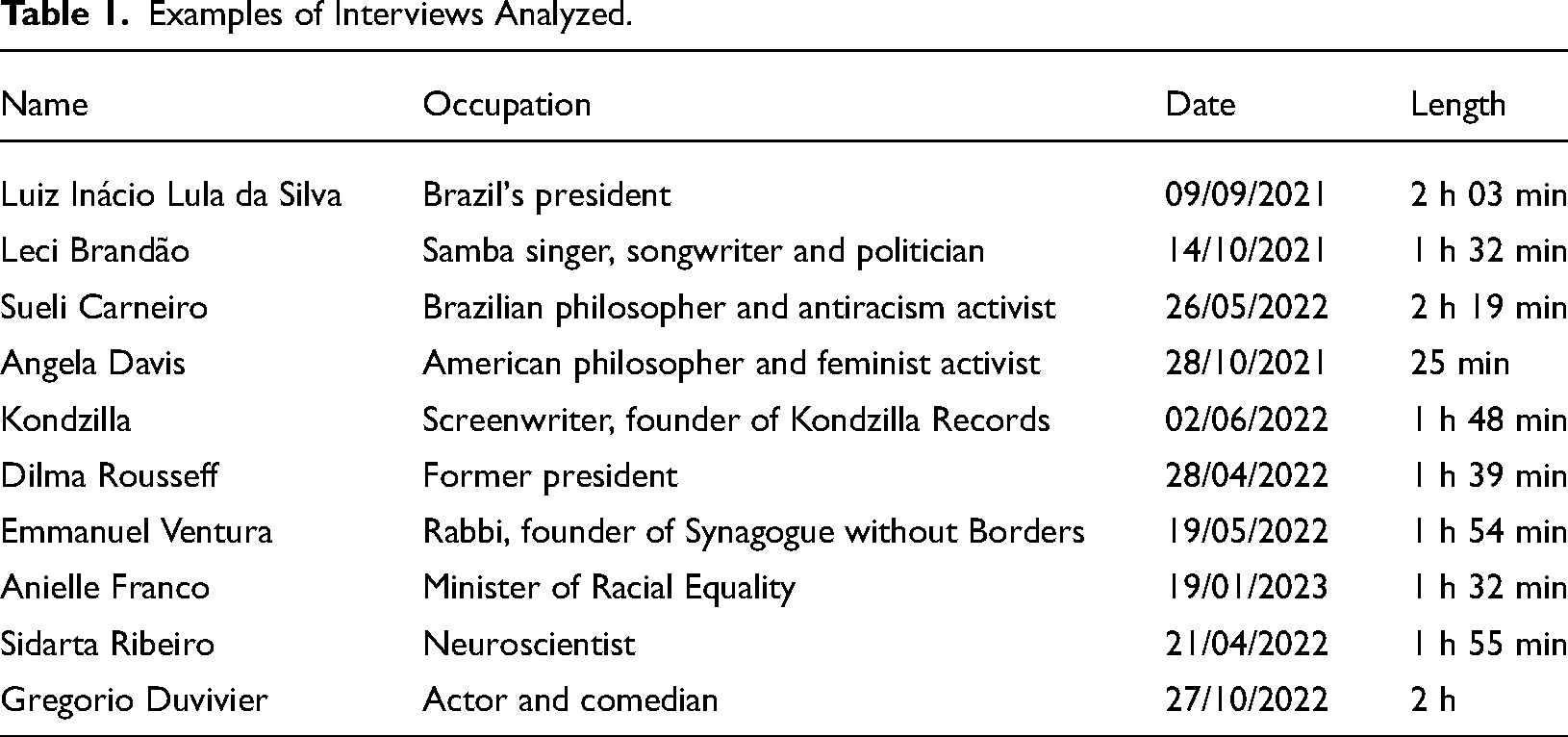
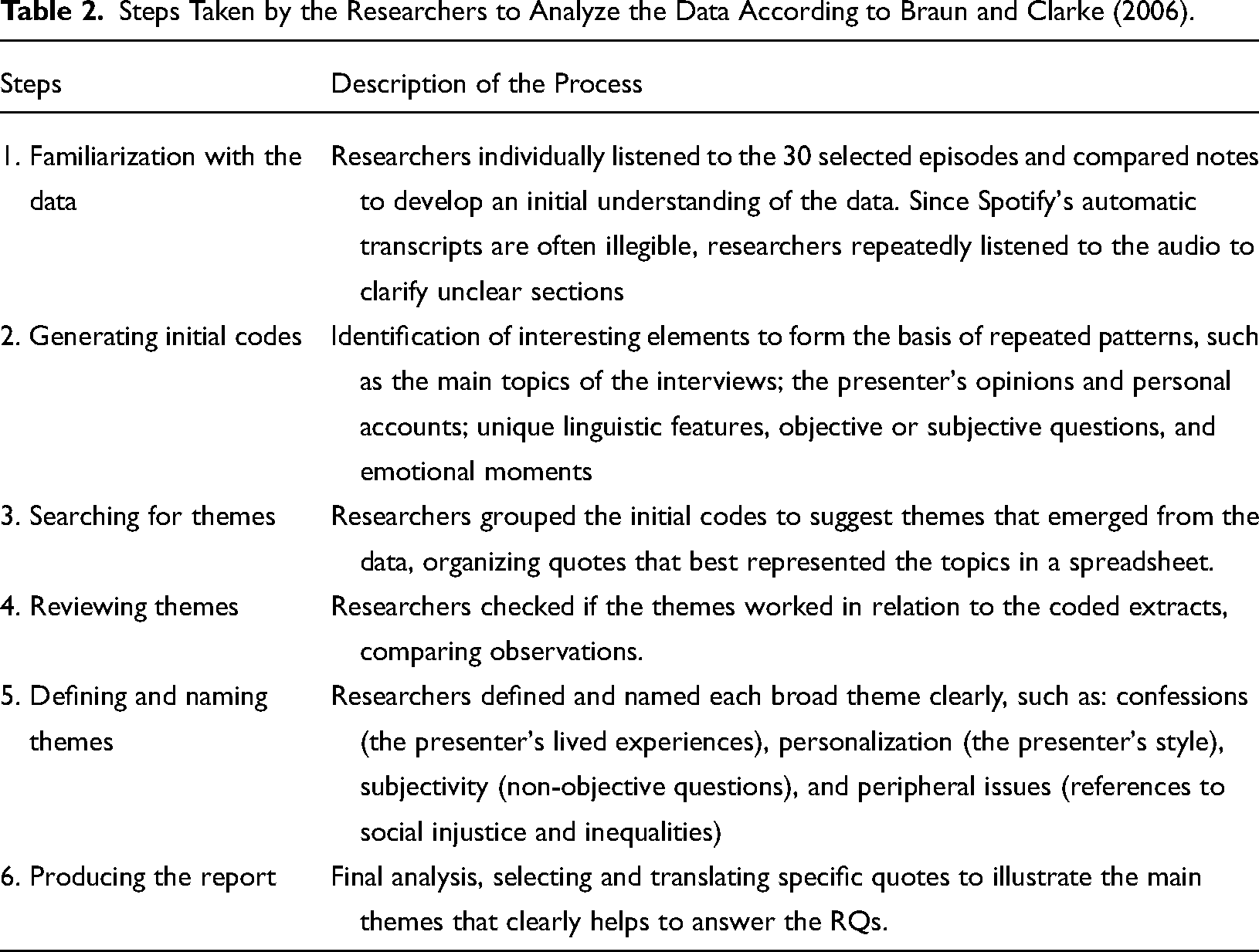
As we were interested in exploring the complex meanings of the confessional and emotional nature of the conversations between the host and the guests, we opted for a qualitative method to reflect on experiences, perspectives, context and histories (Ritchie et al., 2003). Building on Braun and Clarke's guidelines to qualitative research (2006), we used thematic analysis to examine the episodes, identifying and interpreting recurring themes or patterns within the data. The principles of this method are not significantly different from other qualitative analysis techniques, such as discourse analysis (Naeem et al., 2023), but among its main benefits are the method's flexibility and accessibility. To avoid what Braun and Clarke (2006) identify as potential pitfalls, including simply grouping extracts without any true narrative analysis, we followed the six phases suggested by the authors (Table 2).
Steps Taken by the Researchers to Analyze the Data According to Braun and Clarke (2006).
Results
Confessions from the “Quebradas”
This section explores the “confessional” tone that defines the presenter's approach, emphasizing his lived experiences. One of the most common elements found in the sample is the incorporation of personal and emotional issues by the presenter while conducting the interviews. Episodes are not shaped around one specific topic, but the host's interference generally involves his lived experiences as a man born and raised in the quebradas (Portuguese slang used to define neighborhoods on the margins of large urban centres). Pervasive themes of private accounts include narratives of growing up in a poverty-stricken, female-headed household without a father figure, set against the backdrop of violence and hopelessness in São Paulo's peripheries during the 1980s. Next, we highlight some of the most recurring topics that showcase the “confessional” tone adopted by the host (RQ1). His accounts and opinions, interwoven with questions for the guests in an informal conversational tone, cover a range of critical issues surrounding inequality and social injustice.
Systemic racism. Throughout the conversations with his guests, Brown inserts self-exposing events, providing context that invariably reflect experiences of marginalized bodies. This approach contributes to building up his authority as a presenter who has experienced discrimination and openly share his thoughts and reflections with a radical honesty. In several episodes, the interviews address the issue of oppression that disproportionately affects Black people in marginalized Brazilian neighborhoods. To contextualize the kind of violence and racism that has crossed his life, Brown brings up the subject of police brutality and racism. I have seen a lot of George Floyds in my life, and I couldn't do anything to avoid that. I was also a bit of George Floyd once. We too have been beaten by the police and only those who escaped will know why… We live in a system that judges people by their skin colour.
About low-income Black communities: I think Brazil is built on a pyramid of injustice. If you want to dismantle Brazil, you’d have to remove the brick at the bottom, and then it all falls because it was built on inequality, on the class system. The issue of race came along with it—I’m not sure if it came first or if the two came together and never separated again. We became tied to poverty.
When interviewing journalists specialized in public security policies, Brown recounts the problems he has faced and still encounters with systemic racism by security forces, whether in public or private spaces: For a long time, I was very killable. No one would care. I was always the one being pursued, never the pursuer. I was that kid who would enter a shopping mall and immediately be followed by someone [as a suspect] … I’ve always seen the [police] uniform, the authority, as a rival, as someone who wanted to hurt me, humiliate me, assault me… I still get stopped [by security forces]. Once I broke a record: in 7 days, 5 stops… I’ve always been the oppressed one when it comes to public security. The guy who's always lived on the edge, always close to the end.
Racial identity. In a conversation with Brazilian philosopher Sueli Carneiro, a prominent Black feminist and intellectual, Brown reflects on his awakening to anti-racism and his discovery of hip-hop as a vehicle for social change. His journey into “political education” began when he joined discussions at an institute founded by Carneiro, which shaped his purpose. Brown recalls the impact of these gatherings: I used to get there feeling hungry. Soon there would be food and lyrics… We found a path. We were all kind of lost kids. I understood that I had access to young people through rap, but you had the knowledge that we didn’t’, he said, remembering the day he attended a celebration of the centenary of the abolition of slavery in Brazil. ‘I have never seen so many Black people together, so many Black intellectuals discoursing and speaking beautifully.
The connection with the anti-racist movement appears frequently in the sample, alongside reflections on racial identity: As the son of a Black mother and a white father, I’ve always taken a stand from an early age. I never waited for anyone's sympathy. It's a war. This idea of softening Black men, of making them sensitive, only goes so far. There's so much for a Black man to fight against. I’m not sure now's the time to soften (…) You have to stand your ground; there's no way to be passive.
The notion of a “war” underscores the urgency and continuous resistance, rejecting any downplaying of Black men's experiences. The following excerpt was taken from an interview with Angela Davis (he spoke in Portuguese while the philosopher and feminist activist listened to the English translation). He argued about the disempowerment of Black men: Afro-Brazilians want the basics to survive, to fight on equal footing in a country that was built with Black blood. We can't afford to give up. We need to create an identity of what it means to be a Black Brazilian. I believe this struggle is the foundation of our fights, and the Left doesn’t fully understand this. It's different when you arrive in Brazil as a European immigrant, and you get accustomed to your lineage from then on, taking pride in everything that was built. It's different when you don’t even know your grandfather's name because your entire history has been erased.
The statements reflect the complexity of the search for identity within the anti-racist movement. Brown constantly expresses concern with the discourse about what it means to be “a Black person,” highlighting uniqueness and individuality within Black culture, and rejecting the idea of homogeneity. This suggests a desire for recognition of the diversity and complexity of Black experiences, both in diasporas and African contexts, challenging simplistic ideas and generalizations. Some excerpts: There are so many ideas flying around. And it's all about the ‘Black person this, the Black person that’. Who is this Black person, for God's sake? I wish I could find two of them who think alike, but I can’t. Who is this Black person that so many people talk about, man?’ We're a very personalized group of people, with a lot of our own signature style. We don't like being part of everyone's combo. Not even in Africa it is like that. Just because the guy is Black, he doesn't have to wear a cap and be a rapper. We have difficulty understanding when the individual, the man, the citizen, steps out of the reference point and becomes another agent. Brazil is a country that struggles to understand Black citizens who step out of their [usual] place (…). I didn't study, I didn't get my degree, I'm part of the majority. I see the [Black] race wanting to break [these paradigms].
Peripheral capitalism. Brown frequently discusses capitalism through the lens of life on the periphery, where the working class often endures vulnerable conditions, facing limited job security and low wages. To him, the aspiration to “owns one's own business” is more than an economic goal—it's a form of resistance against a system that keeps marginalized communities subservient, as illustrated in the following statement: “The thing is to be well-paid or poorly paid. If we’re not the owners of our own business, we’re definitely going to be subservient to someone. Whoever that may be.”
He shares that he is often accused of “selling out” to the capitalist system and defends the necessity of financial success for marginalized communities.
“We have to demystify the conversation about money,” he says, reflecting on the tension between valuing capital in the context of peripheral capitalism and the fight against social exclusion. In peripheral cultures, such as hip hop, the drive to integrate into the global market often leads individuals to prioritize profit and material wealth. However, Brown argues that it is crucial to understand the underlying desire for acceptance and upward mobility. He views the rap scene's current focus on success as a “neoliberal moment,” where the message is, “I made it, you can too":
It sounds like something an American president would say when they want to win an election, but for us, the good thing is that it sparks something in the heart of someone who needs this’. He adds: ‘We need to make money circulate in Black hands to see if something new happens in this country. The country is tired of the same old hierarchies.
An intimate and chatty tone
Brown's presentation style is filled with subjective elements, going beyond personal accounts (RQ2). The tone of the interviews is always conversational and opinionated, conveying authenticity and spontaneity, much like an unscripted podcast. Laughter and applause (from the team at the studio) are preserved in the edit, creating a relaxed atmosphere conducive to intimate conversations. In this setting, Brown frequently expresses admiration for his guests, contrasting sharply with the formality of traditional hard news interview programs. He often provides his interpretation and analysis of the topic before posing questions, conducting interviews without trying to replicate the tone of a professional journalist or assume the role of a confrontational rap celebrity. Next, we highlight some aspects of the host's approach to discuss peripheral issues that matter to him:
The “Layman” perspective. Brown self-identifies as a “layman,” frequently admitting his lack of knowledge on certain topics. This accessible style reflects his concern for making complex themes accessible, often asking his guests to help clarify these issues. In one instance, he asks a renowned doctor, “Is religion a science?” This approach contributes to an inclusive dialogue, inviting the audience into a space of shared learning. When interviewing Conceição Evaristo, one of the most important Afro-Brazilian writers, he mentions her ‘giant biography’ and emphasizes that he only studied until the last year of middle school and is not even a good reader due to his limited schooling. At one point, he jokes about whether to address her with formal or informal pronouns, highlighting a feeling of reverence. How should I address you? As ma’am? I think it's cooler to use ‘you’, but my mom wouldn’t agree with that, he jokes, highlighting a feeling of inferiority as well as reverence and respect.
In the interview with former football player Ronaldo Nazário, a sports idol in Brazil, the host, an open fan of football, employs the strategy of self-deprecation, announcing that he will take on ‘the character of a coherent interviewer’ because the topics to be discussed, including racism in stadiums, are serious. The break from the formality inherent in traditional programs creates space for more open and sincere discussions, where topics are addressed in a way that facilitates audience identification. You said everything I wanted to hear, and coming from you, it's beautiful. I'm intoxicated with happiness; from the reality you spoke about… With some friends, I smoke; with others, I go to the stadium or drink; with others, I take classes,’ he states to philosopher Sueli Carneiro.
The centrality of the issue of marginalization is also articulated through the theme of religion, which holds a central place in Brazilian society. Amid a surge of religious intolerance, Brown interviewed two female leaders of Afro-Brazilian religions. He explicitly states that he is not religious but explains that his goal is to demystify prejudices around minority religions, such as Candomblé and Umbanda, which are often demonized by Neo-Pentecostal Christian churches. The educational purpose is clear to inform the audiences about minority religions through questions about ritual practices, origins and concepts of African-derived faiths. Addressing the demonization of Exu (Afro-Brazilian divinity), he asks: “Who is Exu and why is it often portrayed as the (Christian) devil?” The question opens space for the religious leaders to discuss the negative stereotypes and discrimination faced by Afro-Brazilian religions. In a conversation with a Baptist pastor, he reveals that he was studying the Bible and was interested in examining the race of biblical characters. He comments: “We put God in the middle of our mess … We use His name a lot but practice little. When it comes to life's competition, God is left out. I don't see God in business. I see carnage.”
Family and childhood. Most of the interviewees are influential figures in Brazil, but the show's lineup differs from the conventional celebrity talk show format. Guests are not there to sell a product, such as a new movie or a book. For example, as he interviews a pair of famous Black actors who are also a married couple, the questions are not about what they were working on, but about their trajectory from the suburbs and from families with no artistic background to the top of Brazilian TV. Brown admits that he always asks questions about the guests’ childhood “because if you had present parents, is one thing, if you didn't it's another story.”
He mentions his own journey to highlight the role of Black women in households abandoned by their male partners: Women took care of everything. Combative, strong. Nothing could get out of their control. I don't remember any fragile Black women in my childhood. I remember war, struggles. All without a husband, with children in their arms, abandoned by Black men. I saw my mother go through this too.
The show does not demonstrate a concern in airing short episodes and neither a pursuit for catchy headlines. Rather, interviews are quite long, allowing the interviewer to make lengthy reflections, sometimes punctuated by swearing and slang, though also giving space for the guests to articulate their points of view without time constraint. The style diverges from the speedy, straightforward news radio format. For instance, when interviewing the then left-wing presidential candidate Luiz Inácio Lula da Silva, the host does not hide his admiration for the politician (and vice-versa). Though the mode is not adversarial, Brown raises questions on the lack of appeal of the leftist discourse among low-income Black voters.
The following quote illustrates how he voices his opinion about a lack of understanding of peripheral experiences by left-wing politicians, touching again on the quest for security and inclusion: What is the struggle of the Black population in Brazil? Keeping traditions, having a family, a house, things that were denied to the Black race. White left-wing politicians ignore this, because very often they already have all of it. They are educated, established, they're talking from the position of authority (…). Tradition, family and property. I have realised that when Black people vote for the right, that's the discourse that attracts them.
Discussion and conclusion
The results reveal a unique interviewing style that combines personalization, emotional depth, and cultural specificity to explore complex topics such as racial identity, capitalism, family, and religion within the context of Brazilian society. Brown diverges from conventional journalism by positioning himself as a “layman” and embracing an informal tone, fostering a sense of intimacy and authenticity with both guests and audience. This approach allows him to address structural issues like racial and social inequalities while grounding them in personal and collective narratives from the periphery. The analysis echoes previous research on the aspect of intimacy and sociability that emanates from podcasts, offering new narrative and interaction possibilities (Berry, 2016;; Euritt, 2023; Heiselberg & Have, 2023; Lindgren, 2016, 2021).
Self-referential comments and a subjective presence make Brown a visible part of the interactions, contrasting with a detached presenter role. Consequently, the conversations gain compelling narrative elements (confessions, emotions, intimacy, contextualization) that establish an emotional connection between participants. Although Brown disregards the detachment typical of professional journalism, his role as an interviewer enables authentic dialogue rather than simple ‘self-revelation’ (Coward, 2009). Confessional journalism has been described as a practice that emphasizes emotional and subjective values, deviating from traditional objectivity (Coward, 2009, 2010, 2013). In response to RQ1, we argue that the podcast aligns with the confessional journalism genre, incorporating a personal voice, shared experiences, emotions, and a subjective presence.
Brown explores confessional journalism's nuances, using strategies that create genuine connections with the audience and address complex social issues around inequality. The host's revealing tone, free from a neutral or expert stance, opens discussions on issues neglected by mainstream media. The emotional impact of this approach is notable. As journalism embraces an emotional turn (Beckett & Deuze, 2016; Wahl-Jorgensen, 2019), it is relevant to examine how podcasts like this one challenge and redefine traditional journalism. Through this podcast, Brown broadens the scope of journalistic practice, showing who can engage in journalism and the formats it can adopt in the digital age. The interviews go beyond entertainment, but also challenging journalism's norms. It has informational, pedagogical and political functions.
In response to RQ2, we argue that Brown's voice reflects diverse aspects of contemporary Brazil, using media to broaden the news agenda and highlight social issues through conversations with guests from various backgrounds. By embracing an intuitive interviewing style and maintaining the vernacular of the quebradas, Brown foregrounds his own experiences and opinions, offering transparency about his lack of expertise in certain areas. His subjective approach contrasts with classical journalism's ideals of neutrality, objectivity, and factuality. Nevertheless, the support of a co-host journalist strengthens Brown's role as a relevant interpreter of social issues.
The interview topics consistently link to peripheral territoriality, a hallmark of rap (Nascimento, 2006). Despite the rap scene's evolution since Racionais emerged, Brown highlights the geographic and socioeconomic identities that shaped his life. In sharing his experience as a Black man raised by a single mother, surrounded by others seeking spirituality and belonging, the host potentially empowers those who identify with his struggles, either through common roots or shared aspirations. His use of colloquial language and reflections on life in the periphery humanize the content and engage guests. As noted, most guests are identified as Black, demonstrating an effort towards inclusion and racial representation though it does not classify Mano a Mano as a Black podcast (Jenkins & Myers, 2022).
This type of media production aligns with postcolonial critique, as other podcasters are doing in Europe, for instance (Fabbri & Romeo, 2023; Vrikki & Malik, 2019). The combination of an ability to stablish an intimate relationship with listeners (including the guests) with a focus on conversations around social inequalities illustrates how podcasters can articulate non-hegemonic discourses. Situating Mano a Mano within confessional journalism, the analysis highlights self-reflexivity and transparency as central elements that drive compelling storytelling, provoke debate, entertain, and normalize taboo subjects, while also challenging stereotypical views of Black identity in Brazil. In summary, the program fosters a dialogue that highlights voices from peripheral communities, expanding discussions around culture, politics, and social issues. The feeling of friendly debates and the liveliness of the interactions create an atmosphere of intimacy, allowing listeners to feel connected to the host and his interviewees (Euritt, 2023).
In conclusion, this case study highlights Mano a Mano as a significant means to challenge traditional gatekeeping norms. Kehl (1999) observed that Racionais refused a pop-star stance, rejecting commercialization in favor of equality with their audience—all Black, poor, and discriminated against (Kehl, 1999). The topics covered in Mano a Mano emphasize issues of exclusion in urban peripheries, placing the podcast at the intersection of critical communication and the strategic use of digital platforms. The podcast showcases innovative communication approaches, reflecting theories on the transformative role of media in society and creating spaces for recognition, education, and visibility. By drawing on concepts from podcasting and subjectivity in journalism studies, this research situates podcasting beyond discussions of new narrative formats and technologies. This interdisciplinary lens allows for an understanding of podcasting as a hybrid space, where media practices, identity discourses, and collective resistance intersect to shape public narratives.
Our exploratory study examines a fast-evolving media ecosystem; thus, further research is essential to explore podcasting's diverse genres and its potential to expand marginalized voices, to foster debate, and to innovate journalistic narratives. While we argue that this single example offers a rich field for academic analysis, focusing on one case study is a limitation to the understanding of independent audio productions in Brazil, where podcasting is expanding. Future research could benefit from comparative analyses with other podcasts that use innovative or hybrid storytelling techniques to address themes of colonialism, racism, and marginalization. Additionally, examining podcasting from a broader Global South perspective, including decolonial audio projects, would provide a richer understanding of how diverse practices in audio storytelling contribute to elevating marginalized voices and challenging historical silences. Another limitation is its focus on the host. Future research could delve into how listeners react to and interact with the podcast on social media platforms.
Footnotes
Declaration of conflicting interests
The authors declared no potential conflicts of interest with respect to the research, authorship, and/or publication of this article.
Funding
The authors received no financial support for the research, authorship, and/or publication of this article.
Ethical statement
The study does not pose any ethical risks or impacts on individuals. A formal ethics review by the College Research Ethics Committee was not required, as the research involves the analysis of publicly available data. Specifically, the podcast under study is freely accessible on Spotify, and no interaction with its creators or audience members took place.
