



Abstract
The film production ecology of Aotearoa New Zealand is an industrial and creative space controlled almost solely by Pākehā (European New Zealanders). However, since the turn of the century, Māori (Indigenous) filmmakers have risen to increasing prominence. Story sovereignty, or Māori control over Māori stories, is the heart of the enterprise and implicit in this is how the story is made, that is, the process of filmmaking. This article examines the practice of Māori film producers and discusses how they bring te ao Māori (the Māori way of being or world view) into the day-to-day management of a film production, as they adapt the Western-originated filmmaking process to their own ends. Analyzing such complexities requires a theoretical framework which accommodates not just the work of the individual, but also the relevant social and cultural context within which they operate. Prominent among the models being applied to analysis of the production of culture is the systems approach initially developed by Mihaly Csikszentmihalyi. Csikszentmihalyi maintains that creativity arises when three essential features interact: the domain, or existing body of knowledge; the individual who produces variation within that body (i.e., creates something new); and the field, or network of experts who recognize value in the new and facilitate its absorption into the domain. Through critical exploration of the practice of the Māori film producer, this researcher has developed a revised version of Csikszentmihalyi's model and presents it from an Indigenous perspective: the revision incorporates and extends the original by connecting the elements of the model through the holistic framework of te ao Māori, to enable analysis of the practice of the screen producer within its specific Indigenous context.
Keywords
Every culture has a right and a responsibility to present its own culture to its own people. That responsibility is so fundamental that it cannot be left in the hands of outsiders, nor be usurped by them. (Barclay, 1996, p. 127)
When Māori filmmaker Taika Waititi accepted his Academy Award for Best Adapted Screenplay for Jojo Rabbit (2019) in February 2020, his win marked a high point in the progress of Māori filmmakers on the international stage. With the film's nomination for Best Picture in the same awards, Waititi and Chelsea Winstanley became the first Indigenous producers to be nominated for this award. Interviewed by UK daily The Guardian, Māori scholar Ella Henry noted that despite the film lacking any obvious markers of Indigeneity, Waititi's storytelling was in fact in keeping with Māori traditions: If you look at the way Taika's films have evolved to use humour and pathos to express trauma, he elevates survival by bringing that pathos and humour and resilience to those stories. So I would say it's a very Māori story. (Graham-McLay, 2020).
Henry's framing of Jojo Rabbit as a “very Māori story” reflects discussions from theorists including Smith (2012) regarding Waititi's ability to marry the global with the local to disrupt “orthodox interpretive frameworks surrounding Indigenous cultural producers” (p. 67). Waititi is just the most visible of several Indigenous filmmakers making a name for themselves internationally; as a Māori screen producer myself, I share with many others a sense that we are starting to achieve a real mass in terms of Indigenous cinema work now being produced worldwide, as the rising number of Indigenous films being released year on year shows (Kozoil, 2024; Punter, 2024).
In Aotearoa New Zealand recently, a range of films from Māori creatives including films partly or wholly in te reo Māori (the Māori language) have seen solid box office success locally and are selling internationally. The emergence of the language in cinema is attested by the release of Disney animated films including Frozen (Buck & Lee, 2013) and Encanto (Bush & Howard, 2021) dubbed into Māori. The richness and energy of Māori filmmaking in the present day has not been arrived at without struggle however. From the early days of cinema, Māori like other Indigenous peoples were subjects of the intrusive lens of the European and it was not until the late 20th Century that Māori filmmakers began to emerge as storytellers in their own right. Forces within the Māori filmmaking community fought long and hard to make Māori voices heard onscreen, not as a story told by others but as a story told by Māori. They include those who fought for recognition of te reo Māori as well as those who fought for the establishment of a wider Māori media ecology, bringing the Indigenous voice “into the national imaginary” (Abel, 2013, p. 211). This surfacing of the Māori voice in film, as in media generally, reflects the ongoing social and political evolution of the nation since the 1970s as the mainstream European-settler culture has come to recognize the rightful place of Māori as the Indigenous, the original, people of the land. Parallel to this, the recognition that it is te ao Māori (the Māori world) that differentiates Aotearoa NZ on the world stage has assisted the growth of Māori film production. This recognition underlies the decisions of government funding bodies in the film and media sectors both to increase their funding for Māori screen storytelling and also to shift, albeit slowly, toward a funding model that requires that Māori own the intellectual property and means of production when Māori stories are told. While this evolution remains a work in progress, story sovereignty, or Māori control over Māori stories, is now a non-negotiable and as producer Stephens (2021) notes “Story sovereignty belongs with the people we serve” (para. 11).
I have in the past written on the Māori producer's creative role (Milligan, 2017; 2021a; 2021b). This article now looks at the work of Māori producers more broadly through discussion of my own and others’ practice, to illuminate how our practice as Indigenous creatives may differ from the work of our mainstream or Pākehā (European New Zealander) colleagues. It comes out of a research project which spanned several years. The research included my own work producing a documentary for cinema and broadcast release, as well as a detailed thematic analysis of the history of Māori filmmaking from the early 20th Century to the present day, and in-depth interviews with six of my peers, experienced Māori producers making drama and documentary projects for the big screen.
The background to the research
The work of the screen or film producer is most often invisible to the public. Producers are rarely stars, unlike actors and directors. The role of the producer is often hard to explain because it is a generalist one, requiring a rather esoteric mix of skills. In essence, the producer is the person who is legally and financially responsible for a particular screen production, for instance a feature film, a television documentary, an on-line series or a game. They usually, though not always, find the story, hire the writer, raise the finance, hire the director, contract the cast and crew, target the right audience and make sure that what was promised to the investors is what is delivered. They then promote and sell the film. This means the producer is ultimately answerable for all aspects of a production, including its creative achievement (Ryan, Goldsmith, Cunningham & Verhoeven, 2014). Thus the work requires creative insight as much as it requires business acumen and producers tend to spread along a continuum, with few whose talents lie solely in the financial sphere and few whose creativity is wholly unmoored from an ability to raise investment, oversee a budget and successfully deliver the film to the marketplace. Producers tend to fall outside the conventional hierarchical structures of the screen industry (Cameron, Verhoeven & Court, 2010), which is to say from a research perspective they sit somewhere between top-down analyses of the screen industries which focus on organizational or industry structures, and bottom-up approaches which focus on labor. The work of the producer has evolved, and continues to evolve, as modes of production change; it is practiced in varying ways depending on the historical, industrial or social conditions, and this underlines the need to anchor study of the role in specific and relevant contexts.
As Indigenous film and media production has risen in visibility, so there has been a parallel rise in attention to this work within the academy, following the foundational work of anthropologists Turner (1991) and Ginsberg. Ginsberg discussed the “Faustian dilemma” (1991) whereby Indigenous media-makers’ access to the means to control their own representation encouraged the spread of “destructive” foreign-language media into Indigenous homes. Ginsberg was referencing the work of the Frankfurt School regarding the malign influence of mass media (1993, p. 560). She argued presciently against this view, proposing that this dilemma did not automatically mean a solely destructive influence on Indigenous lives, perhaps because her fieldwork in outback Australia had given her insight into how Indigenous media-makers welcomed the opportunity to control the means of production and the resulting images and stories. Production of Indigenous media has gone from strength to strength in the thirty-odd years since Ginsberg's “Faustian dilemma” commentary, reflecting the growth of what Hokowhitu and Devadas (2013) term Indigenous peoples’ “tactical use of the media” (p. xvi). Shohat and Stam (2014) cite productions from many different regions which have found mainstream recognition and international audiences, contributing to what they call the “‘mainstreaming’ of indigeneity” (p. 413). Like Hokowhitu and Devadas and many others writing on Indigenous media, Shohat and Stam focus on matters of identity, representation, struggle and empowerment which are foundational concerns for the field. In terms of production, issues of identity and representation (and empowerment) translate in practice for the Indigenous producer into struggles with such matters as who pays and how to reach an audience, and therefore whether and how to embrace or reject the lure of the mainstream.
From this feature film practitioner's point of view, analysis of Indigenous production as opposed to matters such as representation has progressed more sparingly (for example, Davis, 2007; Evans, 2010; Wood, 2008). In Aotearoa NZ, scholarship exploring Māori cinema has focused principally, as in the international arena, on representation (for example, Blythe, 1994; Dennis & Bieringa, 1996; Gauthier, 2008; Joyce, 2007; Keown, 2008; Pihama, 2000). Little yet has been written about Māori film production processes, with the two key writers in this area to date being Mita (1996) and Barclay (2015 [1990]), who are among the elders of modern Māori filmmaking. Additionally, scholars have emerged using a kaupapa Māori (Māori knowledge-based) theoretical approach in reading historical and current Māori screenwork, which also touches on aspects of Māori cinema production (Barnes, 2018; Mercier, 2007, 2010; Waititi, 2007).
The theoretical framework for the research
Hesmondhalgh (2013) makes the point that “[t]he cultural industries and the texts they produce (are) complex, ambivalent and contested” (p. 5) and my own experience as a screen producer has been one of immersion in a practice that is highly complex, realised through processes that are rigorously structured yet open to change at any moment, and affected by external influences over which the practitioner sometimes has little control. Given the complex nature of the practice, a research approach is required which can encompass the individual's process, the collaborative nature of the work, the cultural object which results and its reception in the marketplace, in other words a systemic approach. In 2013, John Caldwell (2013) was calling for “more holistic systems approaches” (p. 163) to the study of media production, concerned as he was that scholars of media production had not engaged with the fast-developing research into complex systems going on elsewhere. This concern subsequently began to be addressed by media theorists working with Mihaly Csikszentmihalyi's systems model of creativity (McIntyre, Fulton & Paton, 2016). Csikszentmihalyi posits that creativity is systemic and arises when three essential features interact: a domain, a field and an individual, where the
Csikszentmihalyi's illustration of the model (Figure 1) represents the interplay of the three elements. The
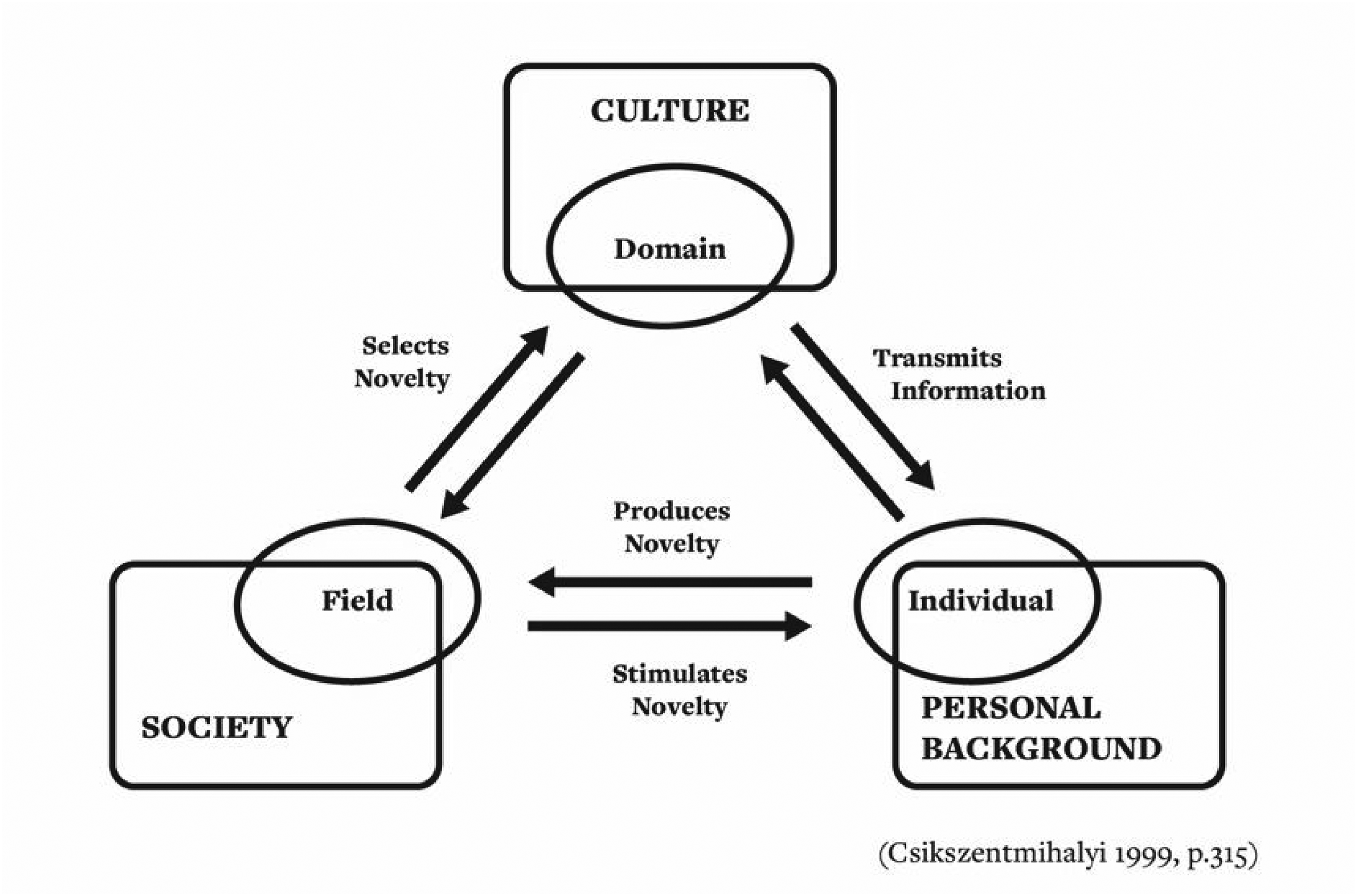
Csikszentmihalyi's systems model of creativity.
Csikszentmihalyi's systems model has formed the theoretical basis for an increasing number of research papers in a wide variety of cultural endeavors, including music recording (Thompson, 2016), filmmaking (Kerrigan, 2013), songwriting (McIntyre, 2008), comedy (Meany, 2016), and journalism (Coffee, 2016). It is notable however that Csikszentmihalyi himself became concerned as his systems model began to be applied by other researchers, that adequate attention be paid to the social context of the research. He drew particular attention to the limitations on women and on minorities in gaining access to opportunities to enhance their professional development, noting the need for researchers to “attend to the role of historical context, the availability of social support systems and differential familial and cultural expectations” (Mockros & Csikszentmihalyi, 2000, 2014, p. 158). This article to some degree addresses Csikszentmihalyi's concerns and the discussion reflects my own experience in concert with commentary from the interviews with my peer colleagues. I then return to Csikszentmihalyi's systems model and reconsider it from an Indigenous standpoint, revising it to incorporate key elements that have been revealed in the way we as Māori filmmakers practice our craft.
The Māori film producer at work
I decided early in this research project that it would be crucial to wrap my own observations and analysis within the knowledge of other Māori film producers, senior practitioners whose feature filmmaking careers ranged from the late 1970s through to the present-day and who are among the most experienced screen producers in Aotearoa NZ. I saw commentary from these industry colleagues to be vital to giving an understanding of how we all experience the cultural, political and economical structures within which we operate. I was conducting intensive rather than extensive interviews (Hesmondhalgh & Baker, 2011) as I was investigating in close-up rather than with a wide lens, focusing intimately on the personal experience of a small number of practitioners. In this way I was seeking to bring into play a range of voices to illustrate the diversity of origins and intentions that we as Indigenous film producers exemplify.
I steered the discussions first on a journey of origins to excavate common elements in the formation of the habitus of the six producers interviewed, in order to understand how their personal and social history informs their choices and actions. I identified and explored key commonalities in their professional experiences, what they preceived as foundational to the work they do, and what they considered enabled or constrained their achievements. I explored with them aspects of practice particular to Indigenous creatives. These include commitments, beyond the immediate work, that come from the obligation of being a minority storyteller and thus a voice for those who may go unseen and unheard in the media. Notably, we canvassed the range of hopes that Indigenous producers share, including the desire to move beyond the burden of representation that some feel they continue to struggle under. The narrative discussions generated by these interviews intersected in varying ways with my own experience, and the similarities and differences between us all shed light on the range of backgrounds, personal qualities and professional ambitions of those of us who are experienced producers in the domain of Māori film production.
Caldwell (2008, p. 2) makes the point that workers in the screen industry self-theorise to a considerable degree and that is certainly my experience, so the fact that my interviews with my colleagues generated thoughtful, intense conversations did not surprise me as I have spent years listening to practitioners like these discuss their work in public and industry forums, and being able to articulate one's thoughts and opinions is intrinsic to the craft of the producer. We also share a common technical language and a common understanding of the more esoteric rules of the industry, so that, like US practitioner-researcher Erin Hill, I benefitted from their awareness that I “got it” when talking shop (Caldwell, 2009, p. 222).
In my discussions with my colleagues, the word “community” is mentioned repeatedly and this is because the aspirations of Māori are deeply rooted in the concept of collectivity (Smith, 2006). Reverend Māori Marsden, tohunga (expert) and scholar, defines the obligations one has in te ao Māori to serve others as “serving one's extended self” (Royal, 2003, p. 42) and comments “Māori social values are based on social obligations which always entail a measure of self-sacrifice” (p. 43). Thus, service to others is fundamental to the Māori way of thinking and acting. Naturally, there have always been those who have emerged to be the person who points the way for the collective. In the same way, a successful producer leads a collective enterprise by identifying the common goal and having the skill to take everyone on the team with them in the pursuit. So it is not difficult to see filmmaking as a highly apposite field for Māori to be working in, given the way that all the artists and craftspeople who make a film effectively become a collective for the duration.
The producer's role at its most complete is a combination of creativity, management and mothering, and all the producers in this research, myself included, have a strong sense of responsibility and obligation, with our commitment to our communities as the foundation. There are of course variations in how we carry out our responsibilities, with differences between those who celebrate the commercial possibilities of a mainstream audience and those for whom the commercial market holds little interest. Hopi filmmaker Victor Masayesva notes: “The tribal person today—who uses new technologies—must have quantitatively more knowledge than the traditionalist and be more facile than the colonizers in order to be understood in the world community” (as cited in Hopkins, 2006, p. 342); in a sense the career of Taika Waititi, who is succeeding in Hollywood as much as in his own Indigenous storytelling, illustrates this. All producers in this research are driven by a commitment to telling diverse Māori stories on screen, and we acknowledge a driving force as the desire to contribute to the health and the growth of our communities through storytelling.
Writing about her struggles in the film industry of Aotearoa NZ in the 1970s, Mita (1996) saw mainstream films from Pākehā filmmakers as stories of dislocation and neuroticism which failed to address the root causes of their characters’ malaise, which she termed “absence of identity”: she criticised the work of such filmmakers for considering trauma always at the level of the personal, never at the level of the political. Mita wrote that Māori films of the time were “driven by identity, resolution and survival” (p. 47). The producers in this research all comment on matters of identity and survival and these comments reflect the complexity of the Indigenous existence. Many of us feel frustration at the narrow and often racist perceptions of Māori by non-Māori and ill-informed expectations of what is appropriate subject-matter for Māori storytelling. Māori theorist Hokowhitu (2013) discusses the problem of the non-Indigenous expectation that Indigenous media must be “authentic” in order to be valid and he critiques “culturalist” considerations of Indigenous media that rarely take into account the lived realities of Indigenous people: … any definition of Indigenous sovereignty must be underpinned by the notion of Indigenous existentialism. Primarily, Indigenous existentialism focuses our historical remembrances upon the paths of political resistance … so that we understand the production of Indigenous identities as outcomes of the choices Indigenous people have made and Indigenous responsibilities. (p. 119).
The sense of struggle is reflected in a frustration with the long shadow cast by the success of Once Were Warriors, Lee Tamahori's (1994) feature. The commercial success of this film about gang and domestic violence changed the landscape in terms of audience expectation and laid to rest the then-prevalent notion that no-one would pay to see a Māori film (O’Leary, 2009). It has however left a dull and irritating legacy for today's Māori filmmakers as interviewee Ainsley Gardiner notes:
It pisses me off actually, that still when Pākehā filmmakers choose to make films about us, it's films about gangs … because that's their only frame of reference …
In her article “Indigenous storytelling: Deconstructing the archetypes,” Yaegl filmmaker Clague (2019) from Australia points to the fundamentally different ways that Indigenous filmmakers view the world and share it with their audiences, noting that the strength and resilience that undergirds Indigenous communities is rarely portrayed or even perceived by non-Indigenous storytellers. This inability to accurately represent what Masel and Taylor (2011) call the “imagined common life” that films allude to means that it is not just characters or events that may be misconceived. Missing from most mainstream representations of Indigenous lives are the social and spiritual elements which bind Indigenous communities together. All the interviewees in various ways express a desire to make visible to a broader audience the much richer world that Māori inhabit, as Quinton Hita notes: We’re fighting negative statistics on every single front so of course that still informs our world but I think that audiences—that's not what they want to see on screen … I think the younger generations don’t want to feel the weight of that baggage. They actually want themselves and the Māori world represented in a less burdened way … I think people are looking for positive energy.
The filmmakers, like the young audiences Hita discusses, are equally looking to feel less burdened. At the same time, reflecting Hokowhitu's (2013) comment in terms of theorizing Indigenous media that “typically those excluded are those who have been most displaced by colonial rule” (p. 119), there is recognition that for many Māori, life remains financially precarious and this is reflected in the precarity of producers’ lives, despite their understanding of the privilege they have of doing fulfilling work. As Tainui Stephens puts it: I think sometimes you get embarrassed by it because you have a reasonable kind of living, no matter how hard it is. I think nurses and teachers are the most undervalued people in our society. So we can gild the lily and talk about the power of stories and I don’t disavow any of that. But I exist equally with respect for those who work at the cliff face.
The precarity of the independent film producer's existence is not specific to Aotearoa NZ but reflects the worldwide community of such producers, especially in small country screen ecologies. Reflected in all the interviews is what Cameron et al. (2010) call “psychic income,” the subjective value of non-monetary satisfaction that plays a large role in keeping producers in their industries. The producers I interviewed all displayed a strong sense of idealism, and a very real satisfaction in being a leader, which is inflected in quite specifically Māori ways. Desray Armstrong uses the metaphor of the marae (communal meeting place) where the kaumātua (elders) lead the discussion in the public space while food is being prepared for the hakari (feast) which follows the formalities: I don’t like to be in the front … What I’ve realised is I can lead from the back and for me it's a bit like a marae situation, you know? In our whānau (family) we’re always in the kitchen and that's not to say that role is any less important than the kaumātua out the front … I just love that synergy and being the person that can help find that balance between (everyone).
Tainui Stephens expresses it in a similarly Māori way: I’ve kind of distilled my management philosophy down to karakia, kōrero and kai (blessing, talking and eating). You have your karakia, you have your togetherness. It's not just a spiritual thing … then kōrero, you have communication … and then kai, you give thanks, whether it's with food or gifts or a thought.
Even when the work is not necessarily going well, there is an esprit de corps among a film crew that is very seductive. Making a film is extremely demanding on everyone; for the producer, being responsible for scores or sometimes hundreds of people, millions of dollars and the associated creative and financial management of a production brings its own kind of pain and satisfaction. Reflecting on my own career together with the responses revealed from my colleagues, it is clear that many of the qualities displayed by us are qualities that would be found among a similar group of independent film producers anywhere. We are driven people, idealists who care passionately about our craft, and though we like making money, it is not our primary motivation. We relish the opportunities afforded us to lead a group of creatives to achieve a common purpose, and we enjoy taking risks. However, there are a number of elements that differentiate us from mainstream producers and these can be regarded as revealing our kinship with other Indigenous producers elsewhere in the world. As noted, there is a common understanding of the producer's responsibility as something going beyond the immediate production, its investors and audience, to incorporate a commitment to the wider community, and this can be observed in the way we bring Māori ways of being into an environment that incorporates many Western ways of working.
Among Māori media makers, there is an ongoing concern about misrepresentation of Indigenous in the media generally, and for some a sense of exhaustion at having continually to fight for the right to tell our own stories from our own perspective, rather than from someone else's notion of what constitutes a “universal” story that will find broad appeal. All of us are highly aware that we are responsible in our work to build on the gifts we have received from those Māori filmmakers like Merata Mita who broke the path for us. We bring a variety of motivations to our work, from a love of cinema to a desire to advance the cause of te reo Māori, alongside a conscious commitment to supporting the development of those who are following in our footsteps. The fact that there is now a growing number of younger Māori producing cinema work, even in this age of convergence, is heartening. However notions of shared or communal ownership, which are foundational to Indigenous thinking, mitigate against raising finance in the current Western model of filmmaking and this remains an issue of primary importance in the development of Māori filmmaking going forward.
Aotearoa NZ is a market where the “mainstream and the margins readily meet”, as Goldson and Smith (2008) have noted in a different context. This is illustrated by the way we Māori producers spend much if not most of our time walking in two worlds, the Indigenous and the non-Indigenous. There is nothing unusual in this in Aotearoa NZ in the present day, where an increasing number of young Māori are being educated in Māori-language kura kaupapa (schools) and wānanga (tertiary institutes), emerging highly educated in both cultures. Additionally, for Māori producers, the growing depth of connection among international Indigenous filmmakers and film funding bodies is supporting a growth of ambition, with recent releases of films partly or entirely in te reo Māori and increasing international coproduction partnerships (Night Raiders, 2021; We Are Still Here, 2022; Muru, 2022; Ka Whawhai Tonu, 2024). We can now be seen to operate in an emergent culture, one in which new kinds of relationships and new practices are valued and may be built on.
Dimensions of difference in the Māori producer's practice
There is no one Māori way of working as there is no one American or Spanish or Chinese way of working. As Māori producers, we have different ambitions and different dreams from one another and this results in different choices being made when engaging in practice. Nevertheless, through the extensive interviews with the producers in this research and through my own experiential knowledge, I can say there are commonalities which can be discussed as dimensions of difference in our practice, a kaupapa Māori (Māori approach) through which our practice is realised, and these can be summarised under four headings:
Whakapapa
Whakapapa is most often translated as “genealogy” but its origins in the word papa or “layer” point to its literal meaning, which is to create a base or foundation, and it is through whakapapa that kinship and economic ties are cemented (Barlow, 1994, p. 174). Thus, the filmmaker's own tribal ties may be highly relevant. Producers Ainsley Gardiner and Cliff Curtis speak of the importance of shooting Taika Waititi's Oscar-nominated short Two Cars, One Night (2003) in the papakāinga or home territory to which Taika and Ainsley both belong: this is the filmmaker's own whakapapa in action, observing the ties to iwi (tribe) and hapū (clan) and imbuing the film with the mana (spiritual power) of this value. There is also the whakapapa of the industry. This whakapapa is the line of descent from filmmakers who have gone before, including Merata Mita, Barry Barclay and others whose work has enabled the achievements of the present generation. There is a strong sense among present-day producers that we have a responsibility to carry their work forward.
Manaakitanga and tikanga
Manaakitanga is the obligation to show respect and care for others. It can be summed up by Tainui Stephens’ management philosophy (above) of karakia, kōrero and kai. Manaakitanga is built on a foundation of the obligations of tikanga, which can be translated as protocol or the right way of doing things. For the Māori filmmaker, tikanga is a set of principles that keeps everyone safe on and off set; it guides behavior so that respect is properly observed. This can be observed for instance in the way producers may ensure their completed film is screened first to elders or senior representatives from the relevant iwi if a film's story relates to a particular tribal area.
Whanaungatanga
Whanaungatanga means relationship or kinship. The whānau is principally the extended family, but can also mean people united in a common cause. Everyone who works on a film becomes whānau for the duration. On a bigger scale, there is the whānau of Māori filmmakers. On a bigger scale again, there is the whānau of Indigenous filmmakers, a worldwide community becoming more and more entwined as our films become more in demand. This sense of connection is not just a convenience of coproduction financing: it is a deep matrix of common cause, of seeing now the opportunity to have our voices heard and our stories told by us. Smith (2006) notes “Māori aspirations (are) deeply located in history, in cultural differences and in the value of the collectivity” (p. 249), a view echoed by interviewee Desray Armstrong when she says this is why “Māori are so good in film generally, because … everyone has their role to play and you can’t do it without any one of those people”.
Te reo Māori
There is growing support for the Māori language across society and the ability to speak the language is increasingly in demand across media, with bilingual graduates sought after. However, most films made by Māori are not made in te reo Māori as most Māori, including filmmakers, do not speak the language fluently. Nevertheless, all the producers interviewed for this research spoke in varying ways of the importance of the language. There is a recognition among all successful filmmakers that without a market of the appropriate size, it is very difficult to raise investment to make a film in te reo. This is recognized by funding bodies like the NZ Film Commission through their separate tranche of funding for films made in te reo. I have earlier discussed how “the Indigenous camera will see differently, frame differently, provide a different context and serve a different philosophy” (Milligan, 2015, p. 349). This is true for films made by Māori whether they are in te reo Māori or English, echoing producer Tainui Stephens’ comment: “I’ve gone where the language is and if not the language, the thinking behind the language.”
This summary of the dimensions of difference in our practice as Māori producers reflects how we, in varying degrees, express a Māori way of being in our work. Returning to the theoretical framing of this research, Csikszentmihalyi's systems model of creativity, the question becomes how to reflect our kaupapa Māori or Māori principles in the model.
Conclusion
The dimensions of difference discussed here can all be summed up in one concept: they are all elements of te ao Māori, the Māori world or Māori worldview, and interpreting the systems model from that perspective, it can be revised thus (Figure 2).
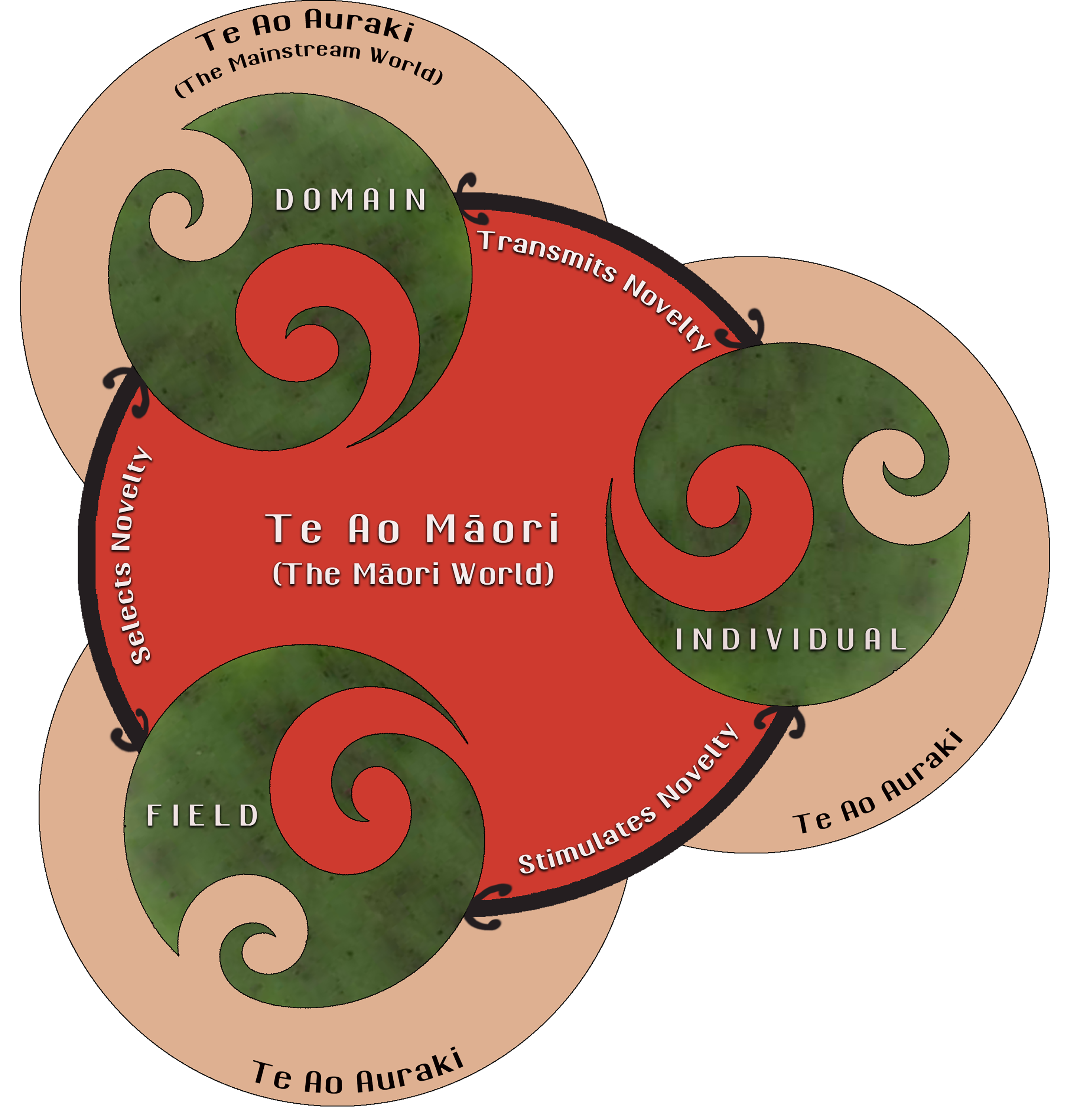
Revised version of Csikszentmihalyi's systems model of creativity.
This revision, which echoes elements of Māori design, incorporates and extends the Western envisioning of the domain, field and individual with the cycle of selection and transmission of novelty as in Csikszentmihalyi's original. It connects these through the holistic framework of te ao Māori, an Indigenous way of being which sees the three elements as interconnected more completely than in the original model. Te ao Māori is the force binding all together, illustrating how central and fundamental the Māori worldview is to the functioning of the individual Māori producer, to much of our domain and to our field. The circles representing the domain, the field and the individual echo the koru (loop, coil) which is a spiral shape based on the appearance of an unfurling silver fern frond. By using this koru design to show the circles open on both sides, the revision shows how all elements, while centered on te ao Māori, are also unavoidably shaped by te auraki, the mainstream world and mainstream practices. Thus, this illustration shows the openness and integration of the relationship between Māori and non-Māori in the film world, but the influence of the mainstream world is tied to each element—the domain, the field and the individual—rather than completely encompassing te ao Māori, so the visualization shows the strength of te ao Māori weighted against te auraki.
As a two-dimensional realization, this visualization suffers from the same issue as Csikszentmihlayi's original model in that it does not show progression through time; from the Māori perspective, one could say that therefore it is not able to illustrate whakapapa (lines of descent). However, the concept of whakapapa is foundational to the concept of te ao Māori so, by implication, the element of time, of inheritance from those who have gone before and intention toward those who come after, is included.
The sense that this visualization can, by extension, be considered a model of the work not just of the Māori producer but of the Indigenous screen producer beyond Māori, is founded on the commonalities, the sister and brotherhood, shared by Indigenous worldwide: the sense of being in a continuum with not just humanity but also the universe, the sense of rootedness to the place of origin, and for filmmakers the sense that through film we can recuperate our destiny. As it is expressed in the Declaration of Indigenous Cinema (Simma & Johnson, 2011):
We will:
Be recognised as the primary guardians and interpreters of our culture
Respect Indigenous individuals and communities
Faithfully preserve our traditional knowledge with sound and image
Use our skills to communicate with nature and all living things
Through screen storytelling heal our wounds
Preserve and pass on our stories to those not yet born
And thus through motion picture make the invisible visible again
We will manage our own destiny and maintain our humanity and pride as
Indigenous people through screen storytelling.
Footnotes
Acknowledgements
The author is grateful to those producers (with their tribal affiliations) who shared their knowledge through interview for this research: Desray Armstrong (Te Aitanga a Hauiti, Ngāti Porou), Cliff Curtis (Ngāti Hauiti, Te Arawa), Ainsley Gardiner (Te Whānau a Apanui, Ngāti Pikiao, Ngāti Awa), Quinton Hita (Ngā Puhi), Larry Parr (Ngāti Raukawa, Muaūopoko), Tainui Stephens (Te Rarawa).
Declaration of conflicting interests
The author declared no potential conflicts of interest with respect to the research, authorship, and/or publication of this article.
Ethical approval
This research study was approved on September 27, 2017 by the Ethics Committee of Auckland University of Technology and written informed consent was obtained from all participants.
Funding
The author received no financial support for the research, authorship, and/or publication of this article.
Author Biography
 . She serves on the Editorial Board of the Journal of Screenwriting. In 2021–2022, she chaired Te Puna Kairangi, a fund supporting high-end film and television production as part of the New Zealand government's response to the effects of COVID on the national screen industry. She has recently been appointed by the NZ government to the Board of New Zealand On Air, the national funding body for public media.