



Abstract
Research on microaggressions has grown, especially race-, gender-, and sexuality-based microaggressions. This study examines how #BodyPositive influencers and activists navigate anti-fat or fatphobic microaggressions in ways that impact them, their activism, and their relationships. We interviewed nineteen self-identified women and non-binary influencers and activists with a minimum of 5000 followers to unpack explicit and subtle forms of fatphobic microaggressions. Following analytical steps of thematic analysis, we identify three interrelated themes: (a) becoming accidental #BodyPostive influencers and activists online and offline; (b) naming “healthy = thin = moral” fatphobic (micro)aggressions; and (c) navigating (micro)aggressions from hate to “you’re so brave”. We conclude with urging social media platforms to establish rules and guidelines for handling (micro)aggressions, including resources to support influencers.
There is growing recognition that race-, gender-, and sexuality-based microaggressions are a public health problem, particularly affecting women, people of color, people with disabilities, and minoritized group members (e.g., Sutin, 2015; Esfandiari, 2018). However, microaggressions committed and perpetuated, whether consciously or unconsciously, based on fat stigmas and weight-based discriminations are often unrecognized and rarely discussed (Munro, 2017). The harms of weight-based microaggressions can be glanced through Dottie Olzman's (2021) “The Fatties Project” that aims to expose the pains of fatphobia and “reconfigure the culture of disgust of fatness into something powerful” (p. 327). During the COVID-19 pandemic, coronavirus triage protocols in the already-fatphobic healthcare system sparked new fears that fat people could be the first to be sacrificed, especially those who are also women, disabled, older, HIV+, and more (e.g., Ward, 2020). Understanding that fatphobic microaggressions are one important vehicle through which fatphobia is (re)produced, this project examines how #BodyPositive influencers and activists encounter and navigate fatphobic microaggressions online and offline. Reflecting a range of activist orientations, we place the term “body positive” within double quotation marks to highlight differences and overlapping moments across movements ranging from individual-focused body love and fat acceptance to structurally-focused fat activism. In our study, some participants understood “body positivity” as centering “something skin to a lifestyle or set of philosophies” (Otis, 2020, p. 159), whereas others approach “body positivity” as fat activism to advance political goals of destigmatizing fatness and fat bodies.
Several gaps have motivated this research. First, although research on race-, gender-, and sexuality-based microaggressions has grown since Pierce's (1974) landmark study, limited attention has been paid to weight-based and/or fatphobic microaggressions. Munro (2017) argued that microaggressions would be a framework with immense potentials for understanding weight stigma and fatphobia. Second, this study responds to Harris and Moffitt's (2019) call to centralize communication in research about (racial) microaggressions as they highlighted that communication scholarship was rarely cited to support claims about microaggressions as communication behaviors. Third, whether social media facilitates and/or limits activism has continued to be debated. For instance, McCabe and Harris (2021) synthesized that, whereas social media can serve as a force for change organizing activism and democratizing communication, social-media-based activism has been critiqued as short-lived and lacking sustained social change. No research that we know has examined how #BodyPositive influencers and activists navigate anti-fat microaggressions in ways that impact their activism online and offline. Although influencers are typically “people who earn income as independent workers providing” carefully curated content to cultivated online audiences (Hund, 2023, p. 29), however, definitions of influencers continue to expand. In this study, we define influencers as individuals who create and/or curate content around a social issue such as “body positivity” to an online audience of at least 5000 followers. Thus, influencers in this study include educators and activists who seek to affect structural changes about fatphobia and might not earn income as influencers.
Guided by the lens of microaggressions, this study deploys in-depth qualitative interviews to examine the communicative experiences of “body-positive” influencers and fat activists encountering fatphobia. Microaggressions are understood as brief, commonplace, incessant, and cumulative assaults, insults, or indignities, whether verbal, behavioral, or environmental, targeted at racial, gendered, and intersecting minorities (e.g., Pierce, 1974; Sue, 2010). The lens of microaggressions is appropriate because it allows us to understand both everyday discriminations motivated by fatphobia and also fat discriminations as racialized, gendered, classed, and more. As Strings (2019) put it, “… the phobia about fatness and the preference for thinness have … been one way the body has been used to craft and legitimate race, sex, and class hierarchies” (p. 6).
In the following sections, relevant research on fatphobia, fat activism, and social media is reviewed and followed by pertinent studies of microaggressions to help contextualize this research. Then, our methodological approach of semi-structured, in-depth interviews with nineteen #BodyPositive influencers and activists is explained. Following the analytical steps of thematic analysis, we present our three themes. We conclude with implications of understanding fatphobic (micro)aggressions as racialized and gendered communication.
Relevant Literature Fatphobia, Fat Activism, and “body-positive” Instagram Influencers and Activists
Broadly, fatphobia (particularly in Western societies) is understood as “the phobia about fatness and the preference for thinness” that is simultaneously historically (re)produced, economically motivated, and socio-politically (re)constructed to shame and denigrate fat (Black) bodies (Farrell, 2011; Strings, 2019, p. 6). Farrell (2011), following the scholarly work of Hillel Schwartz and Peter Stearns, located the U.S.-based cultural originals of fat shame, stigma, and denigration at the turn of the nineteenth century in response to anxieties with industrialization and the birth of advertising and a consumer culture. For instance, William Banting's nineteenth-century high-protein and no-starch diet became today's South Beach and Atkins diets. Essentially, fatphobia is rooted in patriarchal ideals of beauty, attractiveness, and desirability (Cooper, 2016; Williams, 2021). Reflecting the unchallenged preference for thinness until recently, feminists have focused on eating disorders, food politics, and anti-dieting with little attention to anti-fat rhetoric and stigmatization of fat bodies and women (Cooper, 2016). Predominantly, fat experiences are analyzed through the lenses of thin bodies and rarely seen nor heard on their own terms.
Fatphobia is later understood to have radical roots traced back to colonialism, the slave trade, and the spread of Protestantism (Strings, 2019). Strings (2019) examined historical narratives of race and fatphobia, and found that racially motivated stereotypes (e.g., the feared and imagined “fat Black woman” as “savage,” “barbarous”, and “diseased” with “excess fatty tissue”) perpetuated beliefs around Black bodies, particularly Black women's bodies. The so-called “race science” in the eighteenth century linked fatness to blackness in the European imagination. For instance, based on secondhand accounts, French naturalist Julien-Joseph Virey during that period represented African women as sedentary or pregnant who developed “big bottoms and bellies that push out” as they aged (Strings, 2019, p. 86). Doing so influenced both body and beauty standards to those of thinness and White-body supremacy. The ideas of Black bodies and individuals were also ingrained in Protestant beliefs. Black people, particularly Black women, were seen as gluttonous and overtly-sexual, therefore sinful. These beliefs only garnered greater racialized fatphobia to fear the imagined “big, fat Black woman.” Outside of Europe, the idealization of the thin White/European American body type was upheld by media outlets, magazines, and other forms of culture.
Fat activism has emerged as a feminist movement to challenge fatphobia and focuses on anti-fat rhetoric and treatments of fat bodies and women (Cooper, 2016; Farrell, 2011). In the late 1960s, several organizations came to fruition and coordinated to understand the roots of fat oppression and band together against fatphobic practices, norms, and ideals. The establishment of the Fat Underground, along with Louderback's Fat Power Manifesto, was extremely provocative in that the organizations connected fat oppression to both gender and race, which were ideas that had not been apparent before. Formed in 1972, the Fat Underground was able to spell out a “terrain of fatphobia” (Cooper, 2016). This was an acknowledgement of fat people as a presence and worked to view everyday living as a resistance (Cooper, 2016). Their work and writing were also radical in the way that they acknowledged the intersections of race, capitalism, and imperialism. In this study, the work of “body-positive” Instagram influencers and activists can be understood as fat activism vis-à-vis naming fatphobia as an individual act of resistance and/or a political gesture that challenges gendered and raced politics of fatphobic domination that render fat bodies voiceless.
Facilitated by social media, fat activisms today take on many forms ranging from individual-based to structurally-focused approaches. The varying orientations of how “body-positive” income-earning influencers and/or activists do fat activism reflect Cooper's (2016) many forms of what fat activisms actually do. For instance, fat activists can engage in traditional political process fat activism (e.g., creating anti-fat discrimination legislation); build fat activist communities; perform fat activist cultural work (e.g., making art and digital artifact); and do what Cooper (2016) called micro fat activism as small acts and immediate activism that “happens in small, understated moments” in everyday spaces and generally performed by one or two people with clear thought and intention to challenge fatphobia (p. 78). Crucially, fat activism should also be intersectional addressing layered impacts of sexism, racism, fatphobia, able-bodism, and more. To illustrate, Otis (2020) took an intersectional approach to analyze Tess Holiday's body-positive activism as a White, straight, and married cis-woman. Otis argued that, while Holiday's rhetoric reconfigured the fat body as active toward resignifying fat as fit, liberation of White and performatively healthy fat bodies like hers can marginalize chronically-ill and disabled fat bodies and/or fat bodies of color.
While it is generally agreed that social media platforms can facilitate and organize activism (e.g., Cooper, 2016; McCabe & Harris, 2021), there is minimum literature identifying microaggressions fat activists and influencers face on social media. The few studies on social media and “body-positivity” seldom focused on fat (Black) women. Cohen et al.'s (2019) research analyzed user effects of “body-positive” messages and acceptances but did not focus specifically on fat individuals. They found that body acceptance messages and posts positively affected users’ own perceptions of their bodies. Analyzing Fat Activism Movements (FAMs), Striley and Hutchens’ (2020) identified personal motivations for joining FAMs such as battling eating disorders as well as systemic motivations such as finding resistance and community against patriarchal ideals and capitalism rooted in fatphobia. However, how fatphobia might be racialized within FAMs is not discussed. Williams (2021) interviewed three Black plus-sized content creators about their experiences of representing Black plus-sized women in media and amplifying visibility. Thus, this research builds such efforts to better understand fatphobia from the lens of microaggressions in partnership with “body-positive” women and Instagram influencers and activists. We review relevant research on microaggressions next.
Microaggressions (and macroaggressions) across contexts
The growth of microaggressions research recognizes both intersecting identity positions and interlocking systems of oppression. In this study, we extend the growing trajectory to focus on fatphobia and microaggressions. Reiheld (2020) theorized fatphobic microaggressions as a disciplinary mechanism aimed at marginalizing (potentially) fat bodies as unruly in their fatness, thus propping up sociocultural norms that justify fatphobia.
Microaggressions, whether verbal, behavioral, or environmental, can take on three primary forms: microassaults (often conscious and deliberate), microinsults (often unconscious), and microinvalidations (often unconscious and potentially the most damaging form of microaggressions) (Sue, 2010). Microassaults are deliberate, explicit, and harmful derogations and attacks communicated to marginalized groups and group members to threaten, intimate, or make them feel unsafe (e.g., racial epithets, avoidant behaviors, or discriminatory acts). Microinsults are subtle and perhaps unintended interpersonal or environmental communication acts that convey stereotypes, rudeness, and insensitivity to demean marginalized group members’ race, gender, sexuality, and/or body size. Microinvalidations are verbal, nonverbal, or environmental cues that “exclude, negate, or nullify the psychological thoughts, feelings, or experiential reality” of marginalized group members (Sue, 2010, p. 37). Chen and Lawless’ (2018) research with immigrant women faculty evidence that microaggressions are linked to larger macroaggressions associated with discourses of whiteness, patriarchy, xenophobia, and neoliberalism. No communication research that we know has examined linkages between microaggressions and fatphobia and related hegemonic discourses.
While fatphobia, fat shame, and fat stigma are gaining traction, limited empirical studies have explicitly considered fatphobia from the lens of microaggressions (Munro, 2017; Reiheld, 2020). Outside academia, there have been more efforts on social media such as blogger Melissa McEwan's creating the hashtag #FatMicroaggressions in 2013. Munro (2017) specified four reasons why the microaggression framework was immensely valuable in understanding the issue of weight stigma: (a) listening to the victim's lived experience; (b) recognizing the pervasive and ambiguous nature of stigma; (c) acknowledging the complexity of intersecting marginalized identities; and (d) identifying weight-based microaggressions as the first critical step in challenging weight stigma and fatphobia. In terms of verbal microaggressions targeting fatness, Reiheld (2020) identified three types: backhanded compliments (e.g., complimenting a fat person on a small frame or tiny face); weight loss encouragement (e.g., blindly celebrating weight loss as success); and (health) concern trolling (e.g., “I am worried about your health”). Moreover, Reiheld (2020) identified cautionary microaggressions targeting those who are not (yet) fat to reinforce fear of fatness. That is, fatphobic microaggressions do not just target fat bodies but also any bodies that can potentially become rendered fat. Thus, we pose the following question to guide this study: How do “body-positive” social media influencers experience and make sense of fatphobic microaggressions?
Method
Procedures
Prior to conducting one-time, semi-structured interviews with “body-positive” Instagram influencers and activists, we first obtained Institutional Review Board (IRB) approval. The semi-structured interview protocol enabled us to both identify shared narratives and attend to individual lived experiences. The participants were recruited using both purposeful and snowball samplings via the second author's social networks and referrals in the summer of 2019 and 2020. All participants were associated with #BodyPositivity as (part of) their identifier handle on Instagram. This research was supported twice by an internal grant funding summer undergraduate research program. All voluntary participants were asked general questions about their journeys as social media influencers and relevant cultural identities (e.g., race, gender, class, etc.) as well as their experiences navigating microaggressions. With permission, all interviews were audio recorded and transcribed. As a small token of appreciation, all voluntary participants received electronically $20 gift cards after their interviews.
Participants
A total of nineteen Instagram influencers with a minimum of 5000 followers on Instagram participated in this study. The participants’ Instagram presence and influence ranged from 7290 to more than 200 K followers (see Table 1). Collectively, participants were cis-females (n = 15), trans-female (n = 1), nonbinary femme (n = 2), and gender-queer (n = 1), ranging from 24 to 40 years old with an average of 30.53. In terms of race/ethnicity, 7 participants self-identified as women of color (1 Latina, 1 Black/Indian, 1 Chicana, 1 White/Indian, 1 Afro-Latina, 1 Hispanic, and 1 White/Asian Filipina) and 12 participants as White women, including White/Jewish, White/Sicilian, and White/Portuguese/Brazilian. The participants in this study hailed from a wide range of professionals: education (=3 academics in higher education and 1 teacher); health and fitness (=1 aerobics instructor, 1 yoga instructor, 1 dietician, and 1 counselor); entertainment (=1 actress, 2 models, and 1 photographer); management (=1 property manager and 1 officer manger); cremation company; a sex worker and porn creator; a 911 dispatcher; and undisclosed (n = 2). Following a semi-structured interview guide, all interviews were conducted virtually via Zoom in the summers of 2019 and 2020. Interviews followed IRB protocol, were recorded with consent for accuracy, and lasted 45–60 min each. This process resulted in 335 pages of single-spaced transcriptions. As an attempt to protect privacy and ensure confidentiality of Instagram influencers and activists as public figures, we refer to all participants based on their interview order (e.g., P1, P2, P3, to P19). Such robotic pseudonyms, though problematic, can avoid giving away unintended cues about the participants. Instead, we feature as many direct quotes as possible to underscore our respect for their work and humanity.
Participants’ Demographic Background.
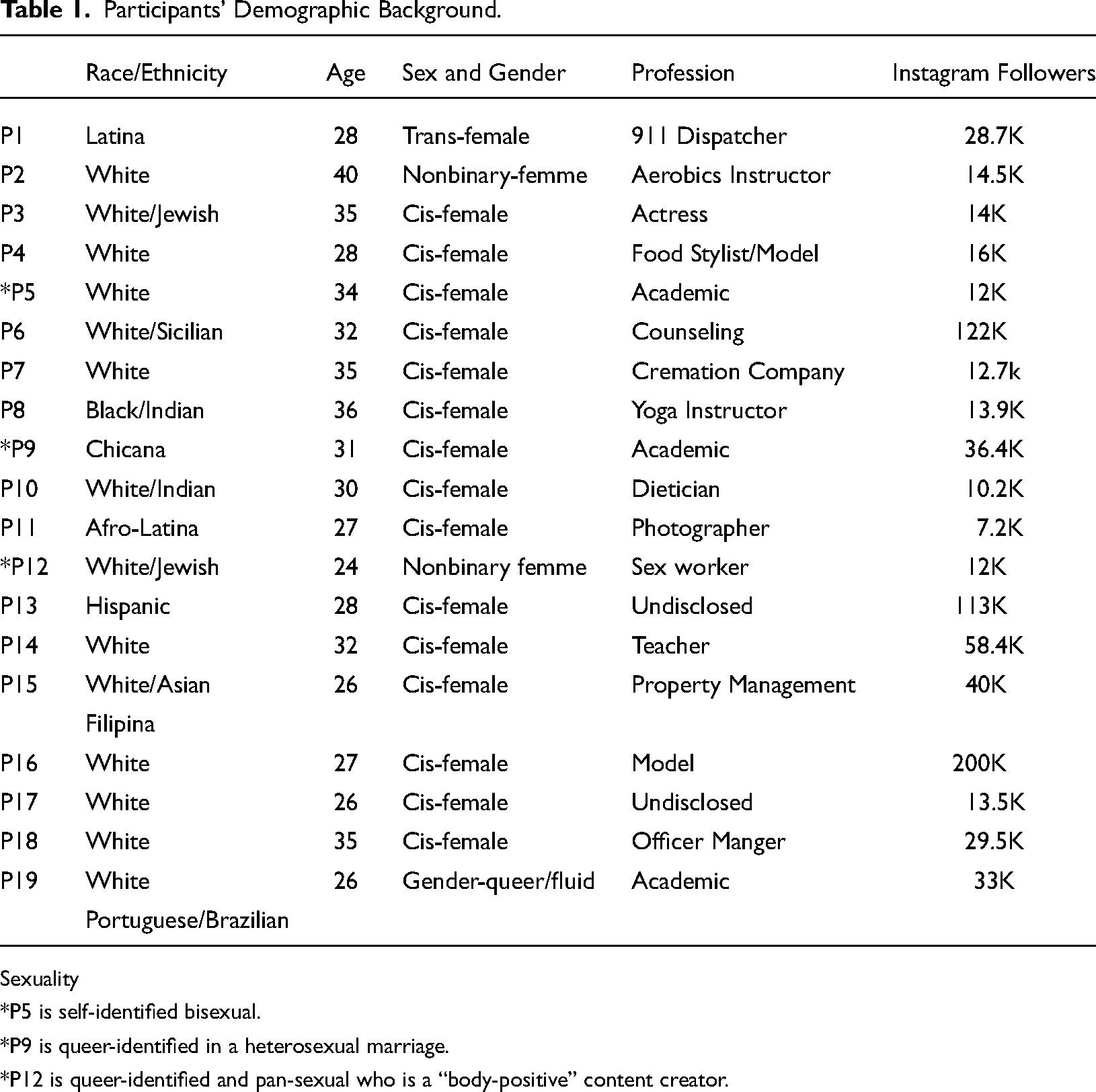
Sexuality
*P5 is self-identified bisexual.
*P9 is queer-identified in a heterosexual marriage.
*P12 is queer-identified and pan-sexual who is a “body-positive” content creator.
Research positionality
The first author identities as an average straight-sized Asian immigrant woman and mother-scholar. Growing up in a Taoist-Buddhist and working-class home in Taiwan, I was simultaneously praised and expected to remain thin according to the Taiwanese standard. My interest in fighting fatphobia stems from my existing research addressing racism and interlocking oppressions. The second author identifies as a White Ukrainian Jewish-Armenian thin woman. Being raised as a ballroom dancer—an industry that highly values thinness—I wanted to understand American society's obsession with idealizing thin bodies. My interest in combating fatphobia relates to my interest in uprooting anti-Blackness and other oppressive colonial systems that seek to control the body. The third author identifies as a plus size White woman. I was raised with fatphobic messages and experienced body shaming by numerous influences in my life. I want to understand the intricacies and foundations of fatphobia and how internalized fatphobia manifests itself interpersonally and in identities.
Thematic analysis
Following Owen's (1984) thematic criteria of recurrence, repetition, and forcefulness, we identified codes through two stages of open coding and closed coding. In the first stage of opening coding, we coded independently. In the second stage of closed coding, we discussed and interrogated the open codes into agreed large themes around fatphobia, microaggressions, and micro fat activism. Overall, our thematic analysis was guided by a heuristic reading of interview discourses that asked how and why communication codes were recurrent, repeating, and forceful in ways that might enable and constrain the patterns across the nineteen “body-positive” Instagram influencers and activists. Thus, we considered how patterned results were connected to underlying cultural practices relating to fatphobia.
Analysis and Interpretations
Becoming accidental #bodyPostive influencers and activists online and offline
The first theme describes how the participants in this study became accidental influencers as they found #BodyPositive communities online and as they kept battling fatphobia in intimate relationships such as family and romance. Contrary to the popular conception of income-earning influencers (Hund, 2023), none of our influencers started their Instagram accounts for financial gains or to become full-time influencers. Finding their respective “body-positive” community kept them posting until they became “accidental” influencers. P17 explained starting Instagram to share photos with her mother: My Instagram started because I was just sending my mom pictures of my outfit all the time. And my mom's affirmations are good. But I want other people to see it too, so I started the page literally just as a place to post my outfits, I had no underlying fat activism or liberation.
Mirroring overlaps and differences between “body positivity” and fat activism (Otis, 2020), the participants in this study all worked to name fatphobia on their platforms and offline, but adopted different approaches. While all participants were associated with #BodyPositivity as (part of) their identifier handle on Instagram, their approaches differed from individual-based lifestyle changes (= influencers) to sociopolitical changes (=activists), and classified their content under terms ranging from “body positivity” to fat liberation. As P1 remarked “I think the biggest issue is that within the body positive movement, we don’t have a solid definition,” “body positivity” could mean self-love, body acceptance or body neutrality to some, and also fat activism, fat liberation or radical fat acceptance to others. Participants, who considered “body positivity” a sociopolitical movement, contested that “body positivity” had become less political as P10 exemplified, “Body positivity does have that watered down connotation.” P4 echoed, “I feel like some people have taken that word ‘body positive movement’ and have made it something that's not all-inclusive, and it's very clique-y.” Identifying as a fat activist, P11 stated, “Fat activism sort of pushes the boundary of what we think we’re comfortable with.” Preferring body liberation to “body positivity,” P2 commented: “I chose body liberation as the movement that I’m part of because I truly believe every single body is affected by fat oppression but also there are many different oppressions that link in the body that are also a part of it.” The ambiguous nature of the term “body positivity” allowed the participants to belong to, (dis)identify, or grow what this movement could be.
Speaking as women and (non-binary) femmes, many participants expressed that internalized fatphobia within families and gendered fatphobia from their mothers both motivated and challenged their activism online and offline. P19 explained, “My parents are fat, and a lot of my family and relatives are fat. And they all have so much internalized fatphobia” When internalized fatphobia is passed down among generations, its impacts become intergenerational. P8 exemplified that her mother had body image struggles of her own, “She was kind of like a skinny-fat person…She had really big body image issues. She was constantly trying to lose weight. She hated her body.” Speaking as a transwoman of color, P1 echoed: my mother “just has her own internalized ideas of…what beauty is, and I don’t blame her. She grew up with very strict parents, very strict household in El Salvador so she has her own things that she's going through.” Particularly, many participants struggled with the internalized misogynistic ideals that their mothers passed onto them (e.g., the ideal of women being small and taking up less space), which Lerner (1987) called paternalistic dominance. P16 exemplified: “I think her [mother's] thing now is, she can’t understand why people would hire me because I’m so big. She's so uncomfortable with her own weight, that my weight bothers her, that I’m comfortable with my weight.” P14 relayed that her mother considered raising fat kids “one of her parenting failures.” Indeed, members of marginalized communities first experience oppressions at home and within families.
Influenced by patriarchal and White/Eurocentric ideals of attractiveness, romantic relationships also presented particular challenges for many participants in this study. Fatphobic societies render fat women of color unattractive, undeserving of love, unworthy of respect, or objects of fetishization. These attitudes can translate to microaggressions both online and offline. P6 recalled her experience of experiencing harassment from her ex-boyfriend over social media after their breakup, “So he broke up with me, and then proceeded to make fun of me online and make fat jokes.” P12 pointed out the hegemonic male gaze in determining what or who is sexy or not: “if a guy finds you sexy, then you’re sexy and the whole world is solved.” P8 elaborated: “It's like men on the internet will always reduce you to whether or not they’re attracted to you.” In romantic relationships, many fat women in this study talked about having to negotiate be(com)ing fetishized. P7 named that: I just was talking to a friend, and she was talking about a dating site, and she was like, ‘Well, I just think that as a plus-size person, you’re always going to have to deal with the fetish side of it.’ And there's levels of, there's super fetish and there's low fetish. I looked, and I thought about it, and I was like, ‘I guess you’re right.’ And then a couple days later I was like, ‘No, we don’t.’ No, we don’t. We don’t have to adhere to that.
Whereas experiencing fatphobia in intimate relationships motivated many participants to become #BodyPositive influencers or activists, reciprocally, becoming influencers or activists in turn affected how they handled fatphobia experiences in their own relationships. To illustrate, witnessing her grandmother's battle with fatphobia triggered P18 to speak up as she explained: “She's grown up in a world that's constantly told her, ‘Cake is bad. You have to be thin to be accepted.’ And even after 85 years of that, still concerned about whether or not she can have the cake. And that's heartbreaking. I think that's why I speak up.” After becoming influencers or activists, a number of participants remarked gaining tools and awareness to navigate childhood, or home-based, fatphobic trauma and/or healing such as P15's father coming around, P9 using the platform to support her parents during COVID, and P17 and P3 realizing things that their parents could have done differently to raise a fat kid. Illustrating Cooper's (2016) micro fat activism, advocacy for the self is imperative for survival and resistance in different interpersonal facets of one's life in a larger body. In this study, the participants highlighted contesting fatphobia in intimate relationships, particularly with parental figures and romantic interests.
Besides bringing visibility to otherwise seldom-seen fat beauties on social media, participants in the study also engaged in intersectional micro-fat activism (Cooper, 2016) within the “body-positive” communities. #BodyPositivity communities supported many participants to feel comfortable being visible and engaging in social media. P14 explained: “I would say it's more also just leaning towards everyday plus-size people living visibly, which I consider activism.” Speaking as a woman of color, P15 shared the power of social media to expose the realities of fatphobia and fat beautify: Just getting to hear these very inspirational, encouraging words from someone who you’re like, ‘No, you are perfect. No way you went through that, no way you went through body dysmorphia or crazy diet habits or working out till you passed out. No way.’ But it's nice because you do get to see the other side of social media where you get to see how human we all are.
Speaking as women and femmes, our participants made it clear that fat women should have the power to not to adhere to the oppressive standard(s) of beautify and/or fetishization. Fatphobia has long been gendered (Cooper, 2016; Farrell, 2011), and the ideas of ownership of bodies flows into fetishization and how women are (de)valued. Misogynistic values empower commenters to feel the need to critique women's bodies or comment if they find them attractive or not. P12 noted, “There's this underlying [notion] if cis-men still find you attractive you then still have worth.” Fetishization is a weapon of domination to minimize and dehumanize women, fat bodies, and people of color. An example of this is P3, ‘Or of course, the guys that are like “hey baby, hey baby, hey baby…’ you don’t pay attention, they’re like, ‘whatever, fuck off, fat cow’.” As #BodyPositive influencers or activists, the participants in this study not only named fatphobia online but also engaged in micro fat activism (Cooper, 2016) in their intimate relationships as critical sites where they experienced fatphobia.
Naming “healthy = thin = moral” fatphobic (micro)aggressions
This second theme describes how #BodyPositive influencers and activists encountered (micro)aggressions as shaped by ideals equating health to thinness and thinness to morality. Interlocking systems of oppression have created this pervasive ideology of healthy = thin = moral that controls the lifestyles and life outcomes of gender-oppressed peoples. The (White) patriarchal ideals of (light-skinned) thinness and curviness control how women's bodies are read, gendered, and racialized (Farrell, 2011; Strings, 2019). Through the filter of the (White) male gaze, women are expected to “perform” beauty in order to be deemed socially desirable. If a woman's body does not fit into the abrasive borders of thinness, then she could be deemed undesirable and then disposable. Almost all aspects of women's lives become affected by their ability to be desirable. P2 explained, “Fat people are kind of these second-class citizens and when you’re planning to get married and raise a family. The American dream really doesn’t include fat people.” The idea of “American exceptionalism” is precisely what Strings (2019) notes when commenting on the invasive thin = moral ideology that plagues American society. The women-identifying participants in this study tried to expose and resist the “healthy = thin = moral” ideology in their online and offline activism.
Echoing Reiheld (2020) on how verbal microaggressions target fatness, the participants identified the “healthy = thin = moral” hegemony, which functioned both to silence them and reproduce fatphobia. Within American neoliberal society, U.S. citizens are expected to have personal responsibility over their lifestyle choices (Tischner & Malson, 2012). Thus, fat bodies are rendered failures of individual decision-making and personal choices. P6 explained this phenomenon: “They’re going to look at your weight loss and be like, ‘Wow. You’re doing so well. You’re taking control of your life. You’re getting healthy.’” As P6 remarked, weight loss is viewed explicitly as a means to become “healthy”, and the process of losing weight is interpreted as having reign over one's life. Although not all forms of weight loss are indeed “healthy” (weight loss can stem from depression, anxiety, or disordered eating habits), societally, weight loss is almost always coded as healthy. Moreover, since fatness is perceived as an aspect of someone's life that can be commandeered by an individual, then the ability to control and manage one's body becomes an indicator of morality or immorality. As such, this becomes a method in which individuals begin to police themselves and others around them. When fatness is rendered unruly (Reiheld, 2020), people feel justified and encouraged to comment on people's bodies, especially their fatness, and in turn reproduce fatphobia. Instagram is an ideal platform for these thin = moral ideologies to be examined, as influencers become spectacles of viewer consumption. Followers are able to consume, appraise, and judge influencers’ bodies through their status quo worldviews with little to no repercussions.
The participants in this study experienced all three types of Reiheld's (2020) verbal microaggressions through backhanded compliments, weight loss encouragement, and concern trolling which was used to reify commonplace weight discrimination. Under fatphobic logic, P11 explained and challenged how weight loss encouragement became common backhanded compliments: People, especially in the U.S. tend to celebrate weight loss, but they don’t know what the reason was. So yeah, somebody could have been sick, or depressed, or lost weight for personal reasons, and people just sort of, ‘Oh my God, you look amazing,’ in response.
Instagram participants in this study also experienced and questioned “concern” trolling over their health or overt outrage related to their fatness. Encouraged by the healthy = thin = moral attitude, many participants experienced socially-accepted outrage over fat bodies: “You’re going to die. I’m so stressed about your health” (P18). Similarly, P13, who picked up dancing over the pandemic, expressed one of the reactions she received to a video she posted of herself dancing: “… one of the comments was even that if COVID didn’t get to me, diabetes would.” Furthermore, a frequent critique of the “body-positive” movement is the idea that it “encourages” obesity. P15 discussed her experience with this, when a commenter said, “How can you say you’re body positive? You’re just encouraging obesity. You’re encouraging laziness.” These comments were unfortunately a common thread for almost all of our participants, and they demonstrate a common aspect of fatphobia—the socially-sanctioned need for total strangers to police fatness under the moral guise of concern for one's health. Although this healthy = moral logic is noticeable through a social media context, when analyzing fatphobia systemically, the participants spoke to their experiences with the medical industry.
Evidencing Sutin et al.'s (2015) finding that weight discrimination increased mortality risk especially in the context of the COVID-19 pandemic, many participants shared their deep anxiety with medical fatphobia that could render them disposable: Fat people are not only having to deal with the shittiness of the world around their fatness, but they’re also having to say, ‘I really can’t get COVID because if I do, the doctor's not going to want to save me. Why? I have everything that they think is wrong with the body. (P19)
The participants exposed the perpetual pathologization of fatness as failing to recognize the different contributions to one's health status (e.g., socioeconomic status, access to resources, genetics, discrimination, etc.). Thus, part of the goal of participants was to use their platform to shift the narrative of these fatphobic biases. P18 exemplified how many in this study spoke to shift our rigid understanding of health into a more nuanced framework that would expose fatphobia and untangle the holistic aspects of health: “But you can’t possibly know from looking at someone, what they’re eating, how active they are. You don’t know anything about what's going on with them.” Furthermore, Instagram activists called for the significance of recognizing that the thin = moral narrative cannot be shifted if not placed within a broader context of race, gender, sexuality, and disability. In this study, P19 speaks on the importance of juxtaposing multiple -isms in order to have the most authentic and inclusive movement: …we cannot have fat liberation without racial justice as a part of it, without disability justice as a part of it. … I think one of the most important thing is calling attention to fat liberation not being able to exist without it being created and grounded in and by Black femmes and Black trans women, and just basically the whole movement of fat liberation was created through Black, Indigenous, people of color first and foremost.
Navigating (micro)aggressions as influencers: from hate to “you’re so brave”
The third theme highlights a spectrum ranging from subtle to explicit manifestations of fatphobia as experienced by the participants in this study: microassaults (e.g., hate messages and discrediting influencer platforms such as glorifying obesity), microinsults (e.g., food talk, assumptions of fitness, creepy fetishization, etc.), and microinvalidations (e.g., backhanded confidence compliments such as “You’re so brave” and “You have such a pretty face”). Extending Reiheld's (2020) verbal microaggressions targeting fatness, our analysis unpacks verbal and nonverbal fatphobic microaggressions experienced by “body positive” influencers and activists. The “glamor” of speaking up as “body-positive” Instagram influencers and fat activists came with multilayered ways of experiencing (micro)aggressions, especially when social media tends to feed defensiveness and reinforce echo chambers. P1 lamented, “That's all what social media is about – it's people getting defensive online.” P6 agreed that it would be a mistake to “consider certain Instagram pages or accounts to be safe spaces” because such thinking could only set someone up “for a big shock, for potential relapse, and for being triggered.” The depth and breadth of fatphobia revealed itself in a spectrum of ways from subtle yet insidious compliments to verbal assaults and creepy fetishization as P19 exemplified: I have definitely gotten fatter over the years of having my platform, so I think that the microaggressions have happened at different levels now. And one of the ways that I think it happens the most often is when there's people who are like, ‘You’re so brave. I could never.’ Those little remarks, I don't think people actually interrogate on what that means because what I hear is, ‘If I looked like you, I would never have the audacity to be outside. And I can't believe that you have the audacity to be outside and living your life.’
On the one side of fatphobic microassaults, six participants shared how both the “body-positive” movement and their platforms were often hated and discredited or questioned. As P1 stated, “People just love to hate fat people” (P1). On social media, comments and reactions can have strong effects on creators’ self-esteem and sense of self-worth. P2 said, “I really truly believe that people are abusive and aggressive online. I don’t think it's micro-anything”. Microaggressions, whether experienced online and/or offline, can cause significant harms (Chen & Lawless, 2018; Sue, 2010). P15 echoed, “It does years and years of damage, definitely.” P7 added, “There's the mental health, because a lot of chunky people suffer from depression. I think it's a byproduct.” Across the participants, fat activists belonging to more marginalized groups (e.g., BIPOC, queer, and lower socioeconomic status) received more hate. All participants experienced folks feeling entitled to hate (on) fat bodies, which can reinforce a hierarchy of bodies with fat female bodies of color at the bottom (e.g., good vs. bad, productive vs. lazy, lacking self-control, etc.). When interacting with trolls, haters and folks beyond reach, the participants in this study generally opted to “block the haters” (P1), “remove a lot of things … like a pig emoji” (P14), and/or “keep calm and just move on” (P15). Assaults also manifested in discrediting “body-positive” influencers and activists’ platforms as P13 remarked, “They call it glorifying obesity. … That's where I see a lot of people saying, ‘When you're a part of that movement, you're glorifying obesity.’” P15 echoed that she received a lot of discrediting messages such as “How can you say you’re body positive? You're just encouraging obesity; you're encouraging laziness.” Microassaults on social media were not at all micro in at least two ways. First, although hating, discrediting, and policing fat bodies have been normalized throughout history (e.g., Farrell, 2011; Strings, 2019), microassaults on social media were witnessed without clear rules and consequences. P8 protested: “Instagram doesn’t even give you the rules of how to use their platform.” Our participants’ strategies for addressing microassaults online were limited to blocking, deleting, disengaging, etc. Second, our participants experienced fatphobic microassaults on social media as attempts to silence “body-positive” influencers and activists and thus stall fat activism, allowing fatphobia to thrive. When microassaults gained resonance, P6 pointed out: “What people really resonated with was actually harmful.”
In the middle are fatphobic microinsults that are socially-accepted yet equally harmful such as unidirectional praises of weight loss, uninvited food talk, and creepy fetishization. P3 explained how the (U.S.) diet culture encourages celebrating weight loss without knowing what the reason might be, “somebody could have been sick, depressed, or lost weight for personal reasons, and people just said, ‘Oh my god, you look amazing,’ in response. … When, in reality, that person could’ve not eaten a meal for days. It's encouraged.” Complimenting weight loss, though socially encouraged, is a problematic social script upholding fatphobia. Fatphobic microinsults also manifested in the form of fetishization—oversexualization and objectification of fat bodies—in this study (e.g., “bestiality fetishes” and oversexualizing women in fat bodies). P12 explained: “There's a lot of people willing to sleep with us behind closed doors, but then [would not acknowledge the sexual relation] in public, telling their friends, telling their family, and posting online.” P15 remarked that “if I mention that I’m seeing a new guy, or if I’m dating, they always have to mention, ‘Oh my gosh, he's really cute. He must be a FA [fat admirer].” The idea of “a fat admirer” underscores that fat bodies are not supposed to be viewed as attractive and deserve to be spectated, watched, and controlled for others’ pleasure or enjoyment.
Juxtaposing fatphobic microassaults and microinsults, the participants in this study highlighted three types of fatphobic microinvalidations: (a) “You’re so brave” (P19); (b) “You’re so confident!” (P11) or “I wish I had your confidence” (P17); and (c) “You have such a pretty face” (P14). Complimenting on Instagram influencers’ micro fat activism and fat bodies dancing in public in terms of bravery and confidence presumes that fat bodies do not belong in the spotlight and fat bodies should not be seen or heard in public (Cooper, 2016). Similarly, responding to a White, conventionally-attractive, cis-women influencer's posts with “You have such a pretty face” literally excludes the fat body to focus on the face, the only part that meets the normative White/European beauty standards. Like Reiheld's (2020) example of complimenting a fat person on a tiny face, comments like this reify the fat body as unruly while also evoking conventional standards of attractiveness rooted in Whiteness. Despite positive intentions, fatphobic microinvalidations exert as much harm if not more.
In this study, fatphobic (micro)aggressions ranged from microassaults, microinsults, and microinvalidations. Our participants’ comments indicate that fatphobic (micro)aggressions function as a disciplinary mechanism to reproduce fatphobia (Reiheld, 2020). In terms of (micro)aggressions online, platforms like Instagram can render more vulnerable members of the community (e.g., fat femmes of color, disabled femmes, etc.) bigger targets of fatphobic (micro)aggressions. For instance, Instagram bans nudity but not vomiting emoji targeting fat activists. Social media platforms can encourage fatphobic (micro)aggressions by doing nothing. Some participants had had folks leaving Instagram. P14 stated: “Some of the people I was connected to left, and it became just Instagram.” P19 advised, “If you’re going to do anything on social media, you’ve got to clean up your social media and unfollow anybody who is toxic to you.” All forms of fatphobic (micro)aggressions, whether unintentional or complimentary, are insensitive, degrading, and harmful because they really uphold and celebrate fatphobia.
Discussion
Motivated by a lack of communication research examining fatphobia (Harris & Moffitt, 2019; Munro, 2017), this study partners with 19 #BodyPositive influencers and fat activists to unpack fatphobic (micro)aggressions. While social media allows the participants in this study to find affirmation and community online to engage in (micro) fat activism on their platforms (Cooper, 2016), they in turn become targets of fatphobic (micro)aggressions as a disciplinary mechanism to silence and discredit their work. Overall, the findings suggest that #BodyPositivity, similar to other social-media activisms, struggles with sustainability and cooptation by capitalism that seeks to brand and limit what influencers can and cannot do (McCabe & Harris, 2021). The first theme, becoming accidental #BodyPostive influencers and activists online and offline, describes diverse experiences of negotiating “body positivity” vs. fat activism in intimate relationships and on social media. The notion of accidental influencers suggest that sustainable social-media activism should lead with community building rather than capitalistic impulses. Reflecting intersecting body oppressions, #BodyPositivity and fat activism differ, overlap, and should take on different forms (Cooper, 2016; Otis, 2020). However, the “body positive” community is most radical and inclusive when it centers the voices of the most marginalized peoples (e.g., fat women, women of color, etc.) and focuses on both individual and structural changes.
The second theme, naming “healthy = thin = moral” fatphobic (micro)aggressions, identifies how the participants expose problematic constructions of health/unhealthy from a (White) U.S./Eurocentric perspective. Underlying “healthy = thin” as a moral prerogative is the unspoken ideals of the (White) thin, fit, and desirable bodies as healthy bodies (Otis, 2020). Preceding any health concerns, Farrell (2011) has traced fat stigma associated with a fat body to the emergence of the diet industry in the 1920s. As a moral prerogative, achieving the “healthy = (White) thin” body is thus assumed an individual responsibility and lifestyle choice that ignores structural barriers and systemic oppressions. By speaking up about the fatphobic logic of “healthy = thin = moral,” #BodyPositive influencers and activists in this study experience pushbacks in the form of fatphobic (micro)aggressions. Our findings extend Reiheld's (2020) verbal microaggressions (e.g., weight loss encouragement and health concern trolling) to social media contexts. When talking about fatphobia is met with (micro)aggressions, our findings suggest that battling fatphobic (micro)aggressions might harm the health of fat women (of color) more than recognized. Still, participants of color in this study go further in pushing back fatphobia by expanding fat activism to also challenge racism and more.
The third theme, navigating (micro)aggressions online and offline from hate to “you’re so brave,” details a spectrum of fatphobic (micro)aggressions from the subtle to the aggressive. Online and offline fatphobic (micro)aggressions are intertwined in this study, which speaks to increasingly mediated social realities. Perhaps social media like Instagram becomes a double-edged sword that both facilitates #BodyPositive communities and perpetuates fatphobic (micro)aggressions. Participant voices in this study share Chen and Lawless’ (2018) concern that some microaggressions are not just micro but also macro, especially omnipresent microassaults of hating on fat bodies. Also, our findings affirm that fatphobic microinvalidations are probably more and most damaging, triggering, and harmful than fatphobic microassaults and microinsults (Sue, 2010).
Overall, the findings in this study highlight that fatphobia is not taken seriously online and offline. By not providing guidelines regarding (micro)aggressions, social media platforms like Instagram become a battlefield of fatphobia vs. fat activism. To engage in social-media activism, #BodyPositive influencers and activists, unfortunately, are gaining battle scares in all three forms of fatphobic (micro)aggressions. While there is power in naming fatphobic (micro)aggressions for what they are, becoming Instagram influencers and activists also impact participants’ intimate relationships—sometimes in more negative ways. Our findings urge social media platforms like Instagram to issue rules and guidelines for handling (micro)aggressions, including resources to support influencers on their platforms.
Fatphobic (micro)aggressions as always-already gendered and racialized
Our findings advocate a shift from microaggressions to (micro)aggressions. This shift communicates an intolerance of hating (on) fat people and aims to put a stop to such bigotry. Following Munro's (2017) move of making sense of where fatphobia connect and overlap with other forms of bigotry, we join the fat activists in this study to highlight the important intersections of fatphobia, racism, and sexism (Farrell, 2011; Strings, 2019). Thus, understanding fatphobic (micro)aggressions as always-already gendered and racialized have important implications. First, women and people of color in fat bodies are well-positioned to see, locate, and name how fatphobic (micro)aggressions work in everyday spaces. Second, resisting fatphobia should equally be about thinking, feeling, and naming racism and sexism. Third, like racism and sexism, fatphobia should be taken seriously and understood to impact health and wellness. Sutin et al. (2015), analyzing nationally representative samples, evidenced that weight discrimination did not just lead to increased morbidity (such as declining health outcomes) but also increase mortality risk. In other words, dealing cumulatively with weight-based hostile interactions and unfair treatments may lower life expectancy.
If fatphobia is gendered and racialized to differentially affect (queer/disabled/transnational) women of color in larger bodies, what does this mean for #BodyPositive activism online and offline? Following Cooper (2016) and the participants in this study, we argue that #BodyPositive activism should be considered feminist and anti-racist activism that takes micro and macro forms from political process activism to everyday activism. That is, we cannot have fat activism without women's rights and racial justice as parts of it. Particularly, to take seriously the racial original of fatphobia in slavery (Strings, 2019) can mean that the most liberatory form of #BodyPositivity as fat activism should also be anti-racist to engage in deliberate thoughts, efforts, actions towards dismantling fatphobic, patriarchal, and racist structures (e.g., Kendi, 2019). On social media, #BodyPostivity should manifest as examples of digital feminism that is reflexive, intersectional, and consciousness-raising about fatphobia and interlocking oppressions (Baer, 2016). As #BodyPositivity as fat activism evolves to connect with feminism and anti-racism, definitions of #BodyPositive influencers shall continue to expand as well (Hund, 2023).
Limitation and future research
The findings of this study should be interpreted with in mind the following limitations. First, 12 out of 19 participants are White-identified. We encourage future research to lead with the voices of fat influencers and activists of color, including diverse experiences across socioeconomic status. Second, we were only able to recruit and interview 1 self-identified transgender woman. Future research can include more voices of fat LGBTQI influencers and activists across sexualities. Third, all interviews were conducted via Zoom and limited the researchers’ sensory awareness of how our participants might experience bodily oppressions onto their bodies. Fourth, our limited awareness of fat activism when we first started the project in the summer of 2019 (e.g., who to recruit, etc.) in conjunction with how the COVID-19 pandemic exposed fault lines of inequities. Mental and family health were more negatively impacted by the COVID-19 pandemic and could be triggering for participants. Given the preliminary finding regarding health and intergenerational impacts, future research should treat fatphobia as a public health issue and consider family and intimate relationships as critical sites for interrupting fatphobic microaggressions.
Conclusion
When fat bodies are rendered unhealthy, unruly, and immoral (Reiheld, 2020), fatphobia makes it difficult to see the harmful and damaging effects of fatphobic (micro)aggressions. The findings in this study implore us to ask who continues to benefit from (re)producing fatphobia and how to quit it. How can industries that continue to profit from fatphobia (e.g., diet, fitness, tech, alcohol industries, etc.) be held accountable, including social media? Moving forward from (internalized) fatphobia, how do we build community led by (disabled) fat femmes (of color) to reimagine fat-inclusive future(s) for all?
Footnotes
Declaration of Conflicting Interests
The authors declared no potential conflicts of interest with respect to the research, authorship, and/or publication of this article.
Disclosure Statement
We the authors declare that we do not have any funding for this research to declare. Also, there is no financial interest or benefit that has or will arise from the direct applications of this research.
Ethical Statement
IRB protocol number (HS-2019-0153) was approved and appropriately amended at the authors’ institution. We have upheld the ethical requirements outlined in our approved IRB protocol to honor and protect participants privacy and confidentiality.
Funding
The authors received no financial support for the research, authorship, and/or publication of this article.
