




Abstract
When using social media, adolescents encounter various types of appearance-related content. Yet, no research has explored how daily exposure to such types of content, including idealized content, body positivity (BoPo) content, and a mixture of both, links to adolescents’ body image states. With the present 14-day daily diary study among French adolescents (N = 108, 1,434 daily assessments, Mage = 15.99, 64.8% girls), we examined how exposure to idealized appearance content and BoPo content predicts adolescents’ state body satisfaction and surveillance on the same day and the next day. More so, we explored how the relationships may vary depending on a co-occurrence of exposure to both content types (i.e., mixed exposure). At a between-person level, exposure to idealized appearance and BoPo content was linked to higher body surveillance. At the within-level, BoPo content was associated with higher body satisfaction, meaning that on days that adolescents saw more BoPo content than usual (compared to their own means), they were also more satisfied with their bodies. However, these relations did not last until the following day. No other within-person level relations emerged. Also, when exploring the impact of the interaction between exposure to BoPo and idealized content, non-significant results emerged. The findings highlight the complexity of adolescents’ interactions with social media and emphasize the importance of future research adopting an ecological approach. This should involve considering both intra-individual and inter-individual factors, as well as the diverse types of social media exposure.
Introduction
A burgeoning body of empirical work has investigated the relation between social media use and indicators of body image, such as body satisfaction (i.e., feelings of contentment and positive regard toward one’s physical appearance) and body surveillance (i.e., the practice of continuously monitoring and scrutinizing one’s own appearance) (Huang et al., 2021). In this research, a particular focus has been laid on adolescents, given their developmental sensitivities (e.g., physical changes, increased self-reflection skills) and their prominence of body image concerns (Markey, 2010). Reviews and meta-analyses have suggested that spending more time on social media is linked to poorer body image among adolescents (Holland & Tiggemann, 2016; Huang et al., 2021; Saiphoo & Vahedi, 2019). Yet, these direct associations are relatively weak and inconsistent, with some research reporting null-relations (e.g., Maes & Vandenbosch, 2022).
Stronger and more consistent relationships are found between specific exposure to appearance-based content on social media and body image components (Saiphoo & Vahedi, 2019). However, recent research suggests that viewing appearance-based posts can have positive and/or negative effects on users’ body image depending on the type and presentation of bodies in the posts and the messages that accompany them, for instance exposure to body positive posts or idealized appearance content (Harrison & Hefner, 2014; Rodgers et al., 2022). Further, given the algorithmic curation and personalization of users’ social media environments, the amount and type of exposure to potentially positive and negative social media content for body image is likely to vary for each adolescent on each day. Yet, little is known about the potentially complex relationship between viewing different appearance-based social media content and adolescents’ body image states in their daily lives.
Idealized Appearance Content on Social Media
Visual social media platforms such as Instagram, Snapchat, and TikTok often contain images and/or videos of people who match societal beauty ideals, including thin and toned women and muscular men (e.g., Baker et al., 2019; Saunders & Eaton, 2018). This visual content can also be edited using built-in beauty filters and other apps to make people’s appearances more closely match the ideals (Bell, 2019).
Sociocultural theories of body image, such as the Tripartite Influence Model (Thompson et al., 1999) suggest that exposure to such idealized content on social media could negatively impact the body image of individuals. The model explains that when individuals are exposed to idealized appearances in media, they may internalize these socially constructed and often unattainable ideals of beauty. This process of internalization refers to adopting these societal standards as personal beliefs, leading individuals to assess their own worth based on how closely their appearance aligns with these ideals (Thompson et al., 1999). In addition to internalization, upward appearance comparisons or the act of comparing oneself to others who are perceived as more attractive or having a “better” appearance, can further explain the development of negative body image components. Social media provides an environment where upward comparisons are frequent, as users are often exposed to curated, edited, or filtered images that promote unrealistic beauty standards (e.g., Baker et al., 2019; Saunders & Eaton, 2018). Together, these mechanisms are suggested to foster body dissatisfaction. So far, a great body of cross-sectional (e.g., Jarman et al., 2021) and experimental research (e.g., Fioravanti et al., 2022), and some longitudinal studies (e.g., Rodgers et al., 2015) have demonstrated associations between adolescents’ exposure to idealized appearance content on social media and body dissatisfaction.
In a more recent integrated model of the influence of internet on body image concerns and eating pathology (Rodgers, 2016), attention is drawn to another key outcome of exposure to idealized appearance content: body surveillance. The latter refers to the habitual monitoring of how one’s body physically appears and was introduced in objectified body consciousness theory (McKinley & Hyde, 1996). Almost simultaneously Fredrickson and Roberts (1997) introduced objectification theory which guided most scholarly work including work on self-objectification processes and relates a lot to processes present in objectified body consciousness theory and theorized to be responsible for a dysfunctional body image. Body surveillance has been related to self-objectification and the internalization of appearance ideals (see the three-step process of the objectified self-concept, Vandenbosch & Eggermont, 2014) and has so far been investigated, in lesser extent, in cross-sectional (e.g., Xiaojing, 2017) and longitudinal (e.g., Sevic et al.., 2020) research in relation to social media use.
Body Positivity on Social Media
While idealized appearances are predominant on social media, there has been a noticeable increase in the presence of body positive (BoPo) content and accounts. Emerging around 2008 to 2010, the body positivity movement gained momentum by critiquing the predominant emphasis on unrealistic beauty standards depicted in media imagery (Cohen et al., 2019a; Cwynar-Horta, 2016). This movement advocates for the acceptance of all body types, irrespective of size, shape, skin tone, gender, or physical abilities, while promoting self-love and embracing diverse physical attributes. These attributes diverge significantly from conventional beauty norms (Cwynar-Horta, 2016) and encompass aspects such as body size (including average or plus-size models), general body features (like cellulite, body hair, stretch marks, and fat rolls), skin characteristics (such as acne, birthmarks, tattoos/piercings), and representation of minority groups (including individuals with visible differences or non-Caucasian individuals) (Cohen et al., 2019a; Cwynar-Horta, 2016).
Principles of the BoPo movement have trickled down to social media content, which has gained significant traction on social media platforms. For instance, 3.4 and 12 million posts are tagged with #BodyPositivity on Instagram and TikTok, respectively (Instagram, April, 2024; Tiktok, April, 2024). In a content analysis focusing on BoPo accounts on Instagram, Cohen et al. (2019a) highlighted the portrayal of diverse body sizes, with approximately two-thirds of the bodies rated as plus-size. Additionally, nearly half of the images showcased human bodies featuring attributes that deviate from traditional beauty standards, such as cellulite, stomach rolls, stretch marks, and skin blemishes. These images are often accompanied by captions promoting body acceptance and celebrating the beauty found in diverse appearances and inner qualities (Cohen et al., 2019a). Furthermore, hashtags associated with body positivity, such as #healthateverysize, #effyourbeautystandards, and #fatspiration, reinforce this movement. Similar findings have been found in other content analytical work (Lazuka et al., 2020).
Emerging experimental research (e.g., Cowles et al., 2023; Dhadly et al., 2023; Tiggemann & Anderberg, 2020) among young adults (mostly women) has delved into the impact of exposure to such content. These studies hint at the potential benefits of exposure to such content for adolescents’ body image, including improvements in body satisfaction (Dhadly et al., 2023). So far, though, no overarching theory exists that pinpoints unique underlying mechanisms that can explain the benefits of exposure to such BoPo content. Instead, the potential benefits of BoPo content are rooted in the same sociocultural theories of body image that are used to explain the impact of idealized content. As mentioned previously, sociocultural theories such as the Tripartite Influence Model (Rodgers, 2016; Thompson et al., 1999), suggest that exposure to unattainable appearance ideals in media pressure individuals to internalize these ideals as personal goals, leading to negative body image components (Thompson et al., 1999). The body positivity movement seeks to disrupt this internalization and reduce appearance comparisons by diversifying the visual landscape and discouraging social comparison with unrealistic portrayals.
Building on positive body image theories, BoPo content encourages body acceptance by expanding beauty ideals and fostering self-regard (Tylka & Iannantuono, 2016; Tylka & Wood-Barcalow, 2015). A key component of this approach is “protective filtering”—the intentional consumption of media that preserves positive body image and shields individuals from body image distress (Evens et al., 2021). By offering representations of individuals who defy traditional beauty standards, BoPo content provides a platform for self-expression, body acceptance, a broad conceptualization of beauty, and the curation of media environments that support positive body perceptions.
Moreover, dissonance theory (Festinger, 1957) further supports the effectiveness of BoPo content in body image interventions. This theory posits that public actions that conflict with personal beliefs can lead to shifts in those beliefs. The body positivity movement encourages individuals to publicly reject conventional beauty ideals through the sharing of images that embrace diverse body types, which may reduce the internalization of appearance ideals and alleviate body dissatisfaction. By challenging sociocultural pathways to body dissatisfaction, BoPo content both disrupts the pursuit of narrow appearance ideals and nurtures broader, more inclusive beauty standards, ultimately promoting healthier body image outcomes.
At the same time, emerging evidence also points to BoPo content being a double-edged sword when it comes to its eventual impact on body image components. More specifically, BoPo content has been criticized for being too sexualised and focused on appearance (e.g., Cwynar-Horta, 2016), with experimental studies then even showing increased self-objectification after viewing such content (e.g., Cohen et al., 2019b; Vendemia et al., 2021).
While self-objectification (see objectification theory, Fredrickson & Roberts, 1997) has been a prominent focus of research in this area, less attention has been paid to body surveillance (see objectified body consciousness theory McKinley & Hyde, 1996)—one of the behavioral manifestations of self-objectification (Moradi & Huang, 2008; Vandenbosch & Eggermont, 2014; Vangeel et al., 2018). Self-objectification captures the broader psychological process of individuals viewing themselves as objects of use and evaluating themselves based upon appearance, body surveillance is believed to be the behavioral outcome of this cognition, representing the act of constantly monitoring one’s body. The latter variable may be a critical factor for understanding how exposure to BoPo content might still lead individuals to engage in appearance-focused behaviors, even when the content aims to promote body acceptance and diversity. However, it remains unclear whether the previously found relations with self-objectification (e.g., Cohen et al., 2019b; Vendemia et al., 2021) extend to body surveillance, as research on this relation, particularly in the context of BoPo content, is limited.
Mixed Appearance Content
The presence of BoPo posts on social media does not imply a uniform shift toward the depiction of positive and diverse perceptions of beauty on social media platforms. On the contrary, scholars continue to highlight the persistence of idealized appearances on social media, and emphasize how adolescents’ everyday social media diets can be more complex and mixed when it comes to their encounters with appearance content (Stevens & Griffiths, 2020). Scholars point to youth’s exposure to posts on social media that can both benefit and harm youth’s body image development. This complexity of appearance content can be apparent when adolescents shift between platforms and when they scroll on a specific platform.
Firstly, features of some social media platforms encourage the posting of idealized appearances, while others aim to stimulate the opposite. Take Instagram and BeReal as an example. On Instagram, editing tools (e.g., beauty filters), the ability to pre-curate one’s appearance content, one’s reception of likes and comments, and the permanent wall/feed feature increase the possibilities that users will present their appearance in an idealized way (Bell, 2019; Kleemans et al., 2018). In contrast, on BeReal, users are limited in using editing tools and receive notifications at random times to post pictures, curbing their ability to present themselves in an idealized way. Additionally, BeReal posts are only visible to friends if they reciprocate with their own picture. This not only diminishes content visibility but also encourages users to opt for less idealized images to engage with their friends’ posts (Vanhoffelen et al., 2023). Consequently, adolescents transitioning between platforms may encounter a blend of content: less idealized on BeReal, and more idealized on Instagram.
Second, when scrolling through social media platforms, such as Instagram, there is a possibility that adolescents encounter both BoPo posts and idealized appearance content (e.g., thinspiration, fitspiration). For instance, Stevens and Griffiths (2020) found that Instagram had the highest exposure rate for both BoPo content and idealized content among their young adult participants, which is unsurprising given its image-centric nature (Fardouly & Vartanian, 2016). Specifically, in the study by Stevens and Griffiths (2020), 5.9% of participants indicated being uniquely exposed to BoPo, 5.8% to thinspiration, and 6.6% to fitspiration, while 6% of the responses pointed to a mixed exposure, including exposure to both BoPo and thinspiration and/or fitspiration (the remaining percentages were not exposed to these types of appearance content).
So far, an overarching theory is lacking that explains how exposure to mixed appearance content relates to eventual body image outcomes. Yet, in communication science in general, emergent attention is being paid to the impact of mixed content in media and mixed media experiences. For instance, the Heterogeneous Content Processing Model (Maes & Vandenbosch, 2025) explains how individuals process mixed information in televised narratives, by relying on self-referencing and transportation processes.
In the context of mixed appearance content, experimental research then hints at the potentially significant role of comparison processes. Graham et al. (2023) demonstrated that while exposure to BoPo images on their own improved young adult women’s body satisfaction, interspersing BoPo images among idealized images did not reduce the harm of the ideal images for body image regardless of the ratio of BoPo to ideal content (Graham et al., 2023). In their study, even though thin-ideal and body-positive content were mixed, women may have disregarded the body-positive content in favor of comparing themselves to the thin-ideal content. The authors argue that this tendency could explain the lack of effect, as body-positive content may be less effective when placed alongside idealized content.
In contrast, two other experimental studies found positive effects on body satisfaction and null-effects on self-objectification when introducing some BoPo content into young adult women’s social media environments in everyday life over several weeks, which likely resulted in women viewing mixed appearance content (Fardouly et al., 2023; Fioravanti et al., 2023). Here, authors suggest that viewing content on social media that does not contain idealized bodies will lead to improvements in body image over time because it may dilute the salience of other idealized content and provide individuals with fewer opportunities to make negative appearance comparisons with others. Thus, of the research that exists, findings are inconsistent and theoretical explanations are lacking, emphasizing the necessity to explore the impact of mixed appearance content further.
Daily Fluctuations
Despite the substantial insights gained from existing research (e.g., De Vries et al., 2016; Tiggemann et al., 2020), previously implemented study designs among adolescent samples leave several gaps that warrant further investigation. Particularly, most studies investigating the impact of appearance-related content among adolescents have applied cross-sectional (e.g., Salomon & Brown), longitudinal (e.g., Sevic et al., 2020), and experimental designs (e.g., Kleemans et al., 2018). These designs used retrospective measures (e.g., [longitudinal] survey research) or manipulated exposure at one specific point in time (experiments). As such, these designs do not capture the fluctuating nature of adolescents’ daily social media exposure. Indeed, cross-sectional designs provide a snapshot of exposure and its links with body image components at a single point in time, thus failing to capture the dynamic and temporally fluid nature of adolescents’ social media interactions.
The literature is, thus, in need of studies examining the relations between exposure to appearance content on social media and body image components of adolescents at the daily level. Daily diary studies are perfect for this as they capture the fluctuations in exposure to appearance content and body image states over days (also known as midterm effects, Koch & Arendt, 2017), thereby providing more insight into the temporality of effects, including lagged effects. Furthermore, by collecting multiple assessments per participant, these designs make it possible to study within-person effects (e.g., how individuals change depending on fluctuations in their own media use) in contrast to the previously tested between-person effects (e.g., averaging across persons).
Given these advantages, some studies already employed these designs and found that daily exposure to idealized appearance content (e.g., fitspiration, thinspiration posts) was associated with more state body dissatisfaction (Griffiths & Stefanovski, 2019; Yee et al., 2020) and state body surveillance (Garcia et al., 2022), while daily exposure to BoPo content was linked to more state body satisfaction (e.g., Fioravanti et al., 2023; Stevens & Griffiths, 2020) and more positive mood (Glaser et al., 2024). Unlike idealized content, research has yet to examine the relationship between exposure to BoPo content and body surveillance in everyday life. Furthermore, despite the interesting results, these studies mainly focused on young adults, with samples mostly consisting of women. As such, research has yet to examine daily fluctuations in body image states (i.e., body satisfaction, body surveillance), exposure to idealized appearances and BoPo content on social media, and their interrelatedness among adolescents. Such focus is crucial given that adolescents are the most avid daily social media users and are particularly prone to fluctuations when it comes to their body image (Markey, 2010).
The Current Study
With the current study, we aimed to fill this gap by examining the relationships between daily exposure to idealized, BoPo, and mixed appearance content on social media and state body satisfaction and body surveillance among adolescents. Based on prior literature, we formulated the following hypotheses on both the between-person and within-person levels:
Further, given the inconsistent findings regarding the body image effects of encountering mixed appearance content on social media, we introduce the following research questions:
Previous research has primarily focused on the potential immediate (e.g., Cowles et al., 2023) or long-term (e.g., Sevic et al., 2020) influence of different types of appearance content on social media, but it is possible that these effects may persist the following day. Thus, in the current study, we also aimed to examine lagged effects for body image on the following day from exposure to ideal, BoPo, and mixed appearance content and hypothesized and questioned:
Methods
This preregistered study was part of project MIMIc, funded by the European Research Commission (ERC) part of the Horizon 2020 program on media and adolescents’ well-being in Flanders (Belgium), Slovenia, and France. The larger project employed a one-year three-wave panel study, content analysis of data donated from adolescents’ social media accounts, and this current daily diary study. While adolescents in each country completed a daily diary study, the body image questions were only administered to French adolescents. Thus, the current study utilized data from the French sample only. More information about the project is available at https://www.projectmimic.eu. The design and sampling plan of the project were preregistered at the Open Science Framework (OSF; https://osf.io/wdt8b) prior to data collection. The study was approved by the ethical commission of KU Leuven (Sociaal Maatschappelijk Ethische Commissie, SMEC).
Participants
Participants were recruited via 25 secondary schools in France. The participating schools were informed of the study’s aims and asked to distribute brochures and consent forms to parents. For students under 16, active parental consent was required, while for those 16 and older, passive informed consent was sufficient. All participants provided informed consent. In France, 354 adolescents were invited to participate, and 188 confirmed their participation.
The final sample consisted of 108 adolescents aged 14 to 18 (mean age = 15.99, SD = 1.37), with 64.8% identifying as girls, who completed the background survey and the daily diary study at least twice. Within this sample, the majority of adolescents were in a general educational track (71.3%), while 7.4% followed a professional education, 4.6% a technical education, 8.3% other educational tracks such as sports school. Additionally, 8.4% of participants were unsure of their educational track. Regarding ethnic background, 63% had a Western-European background, 19.4% had a mixed background, 5.6% had a North-African or Middle-Eastern background, and 12% were unsure of their ethnic background.
Procedure
On October 20, 2023, 17 days before the start of the daily diary study, participants received a link via email to complete a 15-min online baseline survey using Qualtrics software. This survey included questions about demographics, trait well-being, and general media use. After completing the baseline survey, participants were given instructions for the daily diary study (e.g., installing the application, scheduling notifications, how to fill in the daily assessments) and were asked to install the ESM software application Avicenna on their smartphone, tablet, or computer.
Adolescents who completed the baseline survey received a 14 day 10-minute survey through the Avicenna app from November 6th to 19th 2023. The daily surveys were sent out within an hour before participants’ typical bedtime, were available for 6 hr, and were considered valid if completed between 7 pm and 3 am. Due to technical issues, the survey was unavailable for the first 2 days for some participants, so participants were offered an additional 2 days to ensure 14 days of participation. As a result, some participants participated for 16 days. Researchers monitored participation, sent intermediate email reminders, and assisted with any technical issues. Participants were rewarded with vouchers: €30 for filling in 14 or more days, €25 for 12 or 13 days, €20 for 10 or 11 days, and €15 for 8 or 9 days. Participants were debriefed via an online brochure about the study’s purpose and results after participating in the study.
In total, the 108 participants delivered 1,434 daily assessments but after deletion based on doubles (two surveys on 1 day), the final number of assessments was 1,364. This resulted in a compliance rate of 90.21% and participants on average filled in between 12 and 13 surveys (SD = 3.74). We did not implement a compliance threshold for the required number of filled in days as research indicates that the omission of data could lead to the loss of potentially valuable cases (Jacobson, 2020).
Measures
Socio-demographic Variables
In the baseline survey, participants reported on their age (“What’s your year of birth?”), and gender identity (1 = boy, 2 = girl, 3 = other, 99 = I prefer not to say). Further, to assess respondents’ ethnic background, respondents had to indicate which region their grandparents were from (1 = Western Europe [e.g., France, Belgium], 2 = Central Europe [e.g., Slovenia, Austria], 3 = Eastern Europe [e.g., Russia, Ukraine], 4 = South Europe [e.g., Italy, Spain], 5 = South-Eastern Europe [e.g., Croatia, Bulgaria], 6 = Northern Europe [e.g., Sweden, Finland], 7 = Northern Africa or Middle Eastern [e.g., Egypt, Libya], 8 = Northern America [e.g., Canada], 9 = South America [e.g., Cuba, Mexico], 10 = Asia [e.g., Cambodia, India], 11 = Other, 99 = I do not know).
Internalization of Beauty Ideals
The Thin-Ideals and Muscular Ideal subscales of the the Sociocultural Attitudes Toward Appearance Questionnaire-4 (SATAQ-4, Schaefer et al., 2015) was used for exploratory analyses. The scale contained ten items such as “I want my body to look very thin” and “I spend a lot of time thinking about having a muscular figure”. Participants evaluated their level of agreement on a 7-point Likert scale from 1 (=definitely disagree) to 7 (=definitely agree). PCAs were conducted separate for boys/girls since the SATAQ-4 scale takes into account the gendered nature of beauty ideals (Schaefer et al., 2015). For girls, 5 items emerged which focused on thinness and low body fat, KMO = 0.82, p < .001, explained variance = 71.03, α = .87, while for boys 5 items emerged which focused on having an athletic body and muscularity, KMO = 0.58, p < .001, explained variance = 78.73, α = .91. The average of the five thin/low body fat items for girls and the average of the five muscular/athletic items for boys were then included as one variable. Higher scores indicated a higher internalization of beauty ideals, M = 3.42, SD = 1.10.
Daily Exposure to Idealized Appearance Content
Participants were asked in how many of the social media posts/stories that they had seen that day, they had seen others that seemed to have the perfect appearance (e.g., thin body for women, muscularity for men, no cellulite, white teeth, smooth skin). Using a slider, they indicated in how many of the posts they came across this content (1 = none, 7 = all of them). On average, participants scored 4.03 (SD = 1.89), indicating that idealized content would appear in half of the posts that they saw during the day.
Daily Exposure to BoPo Content
Participants were asked in how many of the social media posts/stories that they had seen that day, they had seen others that posted a BoPo post (e.g., showing their appearance imperfections, talking about loving their bodies). Examples given align with prior conceptualizations of the BoPo movement and previous content analytical work on BoPo accounts (Cohen et al., 2019a; Cwynar-Horta, 2016). Using a slider, they indicated in how many of the posts they came across this content (1 = none, 7 = all of them). Here, participants on average scored 2.75 (SD = 1.77), indicating that content showcasing body positivity was less prevalent in their daily exposure.
Daily Body Satisfaction
Following prior research on state body satisfaction (e.g., Cohen et al., 2019b), participants were asked to rate how they felt “today” by using the slider and moving a vertical marker to the appropriate point on each horizontal line with end points labelled “not at all” (=1) and “completely” (=7). Participants were asked to rate the degree to which they were “satisfied with their overall appearance.” On average, participants’ levels of satisfaction were somewhere in the middle (M = 4.39, SD = 1.75), indicating that they were neither very dissatisfied nor very satisfied with their body.
Daily Body Surveillance
Participants were asked to rate the two highest loading items of the surveillance subscale of the objectified body consciousness scale among youth (OBC-Youth) (Lindberg et al., 2006). These items were adapted to the context of daily measurements: “Today, I compared how I look with how other people look,” and “Throughout the day, I thought about how I look many times.” Participants were asked to rate these items by using the slider and moving a vertical marker to the appropriate point on each horizontal line with end points labelled “strongly disagree” (=1) and “strongly agree (=7).” Both items were combined to measure “Body surveillance.” On average, participants scored 3.57 (SD = 1.88), meaning that they slightly disagreed with the fact that they engaged in body surveillance during the day.
Data Analysis
The analyses were conducted in R. First, we conducted descriptive statistics, calculated between- and within-person correlations, and plotted our variables over a subset of participants to gain initial insights into our data. Then, we proceeded with the model-building process using the nlme package in R. Specifically, we created random intercept multilevel models to account for the two-level structure of our data (i.e., daily surveys nested within participants).
First, we tested an intercept-only model for both body satisfaction and body surveillance to calculate the intra-class correlation coefficient and assess how much variance lies at the between- and within-level. Then, we extended both models by adding our level 2 control variables (i.e., gender and age) and level 1 control variable (i.e., day of the study). In the next step, the media exposure variables were added, resulting in Models 1 and 2 testing the associations between exposure to idealized content and both body satisfaction and surveillance, and Models 3 and 4 testing the associations between exposure to BoPo content and both body satisfaction and surveillance. Additionally, to assess our research question on mixed-content exposure, we added an interaction term between exposure to idealized content and BoPo content to predict body satisfaction (Model 5) and body surveillance (Model 6). Finally, to test the lagged associations, we lagged the media variables by 1 and replaced these predictors in all the models, resulting in a part b (Model 1b, 2b, 3b,. . .).
Importantly, in all models, the predictors were centered at both the between- and within-person level to test our between- and within-person hypotheses and research questions. Additionally, they were standardized to ease the interpretation of the models. We also accounted for autocorrelation to see how residuals that are one lag apart are correlated and assessed the fit of our models using the Akaike information criterion (AIC), Bayesian information criterion (BIC), and Likelihood ratio test. This model building approach was based on Vanherle et al. (2023). Furthermore, for an overview of the code used to analyze the data, assumption checks, and extra visualizations, see OSF (https://osf.io/35jbk/).
Results
Descriptive Results
While looking at the between and within-person correlations (Table 1), there was a small but significant correlation between exposure to BoPo content and exposure to idealized content (r = .16, p < .001), but only on the within-level. Additionally, exposure to BoPo content was correlated with body satisfaction on the within-level (r = .14, p < .001) and body surveillance on the between-level (r = .28, p < .001). Similarly, exposure to idealized content was also correlated with body surveillance on the between-level (r = .48, p < .001).
Between-person, Within-person and Intra-class Correlations of Daily Predictors.
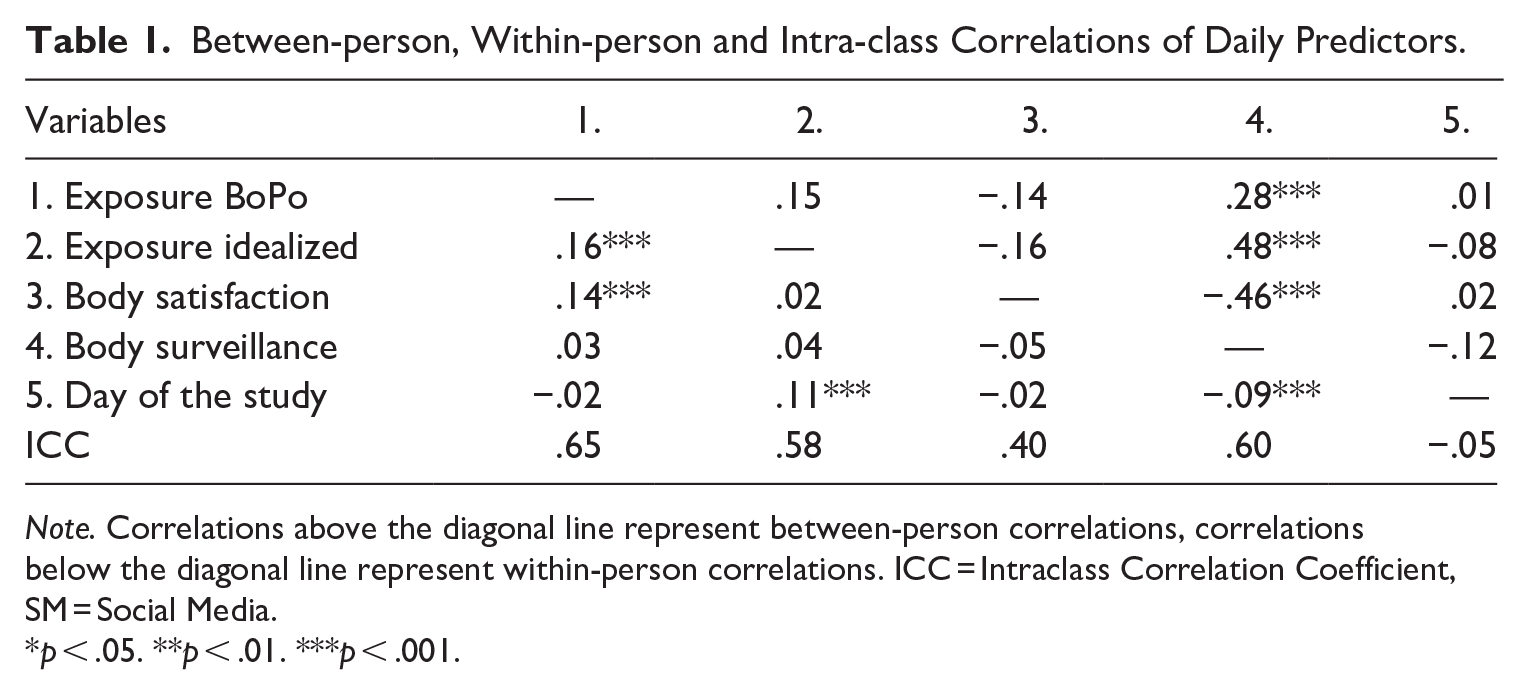
Note. Correlations above the diagonal line represent between-person correlations, correlations below the diagonal line represent within-person correlations. ICC = Intraclass Correlation Coefficient, SM = Social Media.
p < .05. **p < .01. ***p < .001.
Additionally, we also plotted our variables over the course of the study for a random subset of individuals (see Supplemental materials). Specifically, on some days participants saw more idealized or BoPo content than other days and reported being more/less satisfied or invested with their body. In addition, while looking at the ICC values (Table 1), we saw that for the media variables these were below .65 and for the body image variables below .60, meaning that respectively 35% and 40% of the variance could be explained by within-person variation.
Exposure to Idealized Content
When testing the associations between exposure to idealized content, body satisfaction, and body surveillance, we only found a significant between-person association with body surveillance (β = .81, p < .001). This means that if adolescents saw more idealized content (than others), they also experienced higher levels of body surveillance. We did, however, find no significant within-person associations or lagged effects, indicating that exposure to idealized content on the previous day did not predict body satisfaction or body surveillance on the current day. Overall, we largely reject H1a, H1b, and H3a, except for the between-person association with body surveillance.
Exposure to BoPo Content
In contrast to exposure to idealized content, the models examining the impact of exposure to BoPo content did show a significant within-person effect. Specifically, we found that exposure to BoPo content was positively associated with body satisfaction (β = .18, p < .001), indicating that on days that adolescents saw more BoPo content than usual (compared to their own means), they also reported higher levels of body satisfaction. However, for body surveillance, we did not find a significant within-person association but only a significant between-person association (β = .45, p = .004). In fact, this association contradicted our expectations because if adolescents saw more BoPo content (than others), they also experienced higher levels of body surveillance. Finally, no lagged effects were found, suggesting that next-day effects—and thus directionality—cannot be inferred, as exposure to BoPo content and body image states were assessed within the same day’s survey, leaving the directionality unclear. Based on the results, we should thus largely reject H2a, H2b, and H3b, expect for the within-person association with body satisfaction.
Interaction Between Exposure to Idealized Content and BoPo Content
In Table 2 the results of the interaction analyses are displayed. Regarding the model focusing on body satisfaction, we saw that, when combining our media variables in one model and adding an interaction between them, the within-person association with exposure to BoPo content remained significant (β = .18, p < .001). However, we did not find a significant interaction between the media exposure variables (Table 2), meaning that both do not seem to influence each other in predicting body satisfaction. Furthermore, no lagged effects were found, further limiting the directional interpretation of the results.
Interaction between Exposure to Idealized Content and BoPo Content.
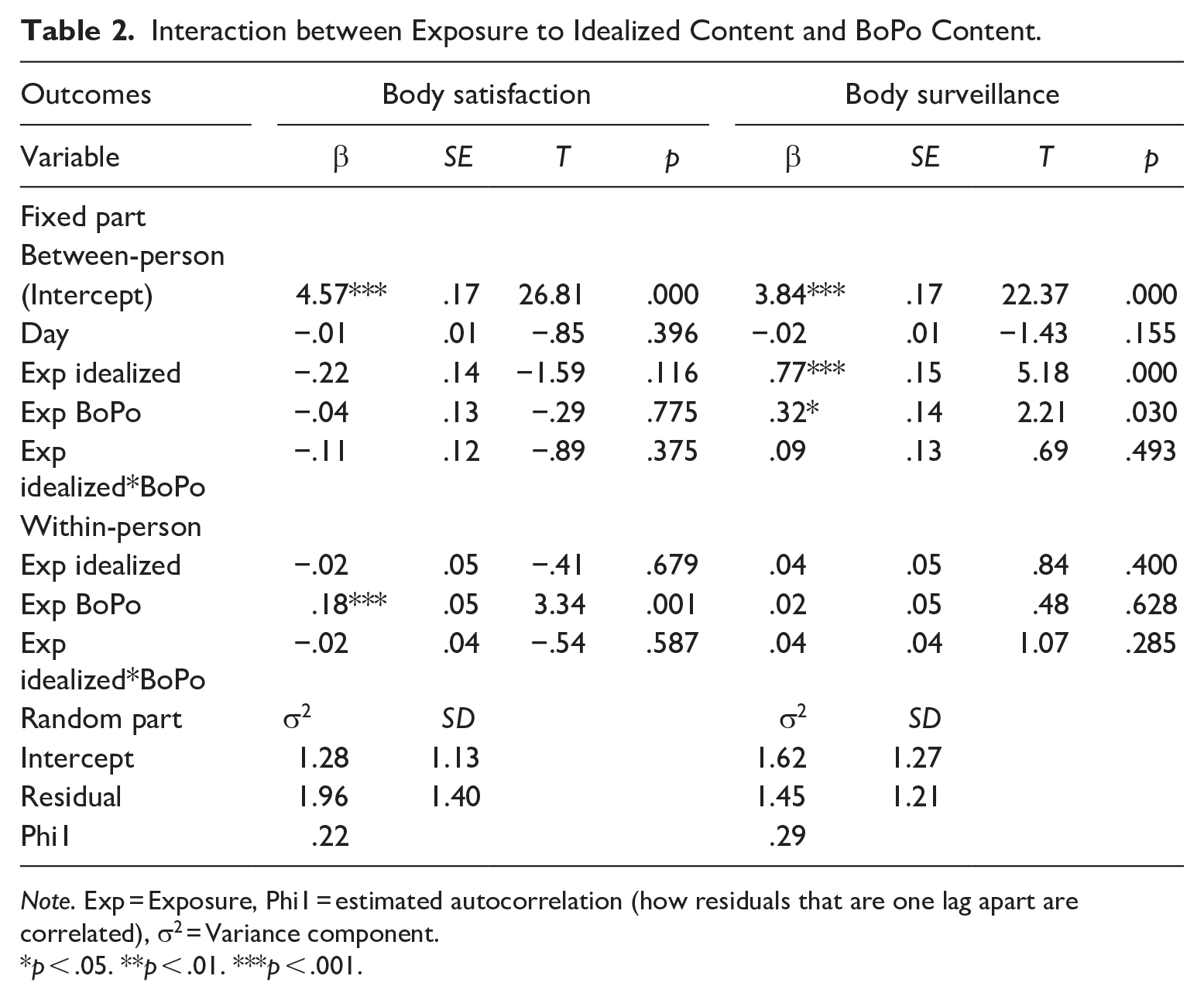
Note. Exp = Exposure, Phi1 = estimated autocorrelation (how residuals that are one lag apart are correlated), σ2 = Variance component.
p < .05. **p < .01. ***p < .001.
As for the model focusing on body surveillance, we again saw that the significant between-person associations with exposure to idealized content (β = .77, p < .001) and BoPo content (β = .32, p = .030) remained significant. Yet, no interaction or lagged effects were found at a within-person level (Table 2). Overall, RQ1a and RQ1b on the interaction between the media variables and RQ2 on the lagged interaction cannot be confirmed.
Exploratory Analyses
As outlined in our pre-registration (see OSF), we also conducted exploratory analyses involving gender and the internalization of beauty ideals, as these factors have previously been shown to relate to body satisfaction (e.g., Jarman et al., 2021) and body surveillance (e.g., Sevic et al., 2020). However, we could not predict whether these models would converge, which is why they were treated as exploratory analyses. In particular, we examined their moderating role and found the following results. The supplemental materials provide an overview of the means on the variables of interest per gender. For gender, we found a significant interaction between gender and exposure to idealized content on the between-level (β = −.66, p = .027). This interaction should be interpreted for the reference category girls, meaning that exposure to idealized content was only associated with a lower body satisfaction for girls but no significant association was found for boys (see Figure 1). The relationship between exposure to idealized content and body satisfaction on the between-level thus seems to differ by gender. However, no significant other moderation effects of gender were found (e.g., body surveillance, exposure BoPo), nor did we observe any lagged effects.
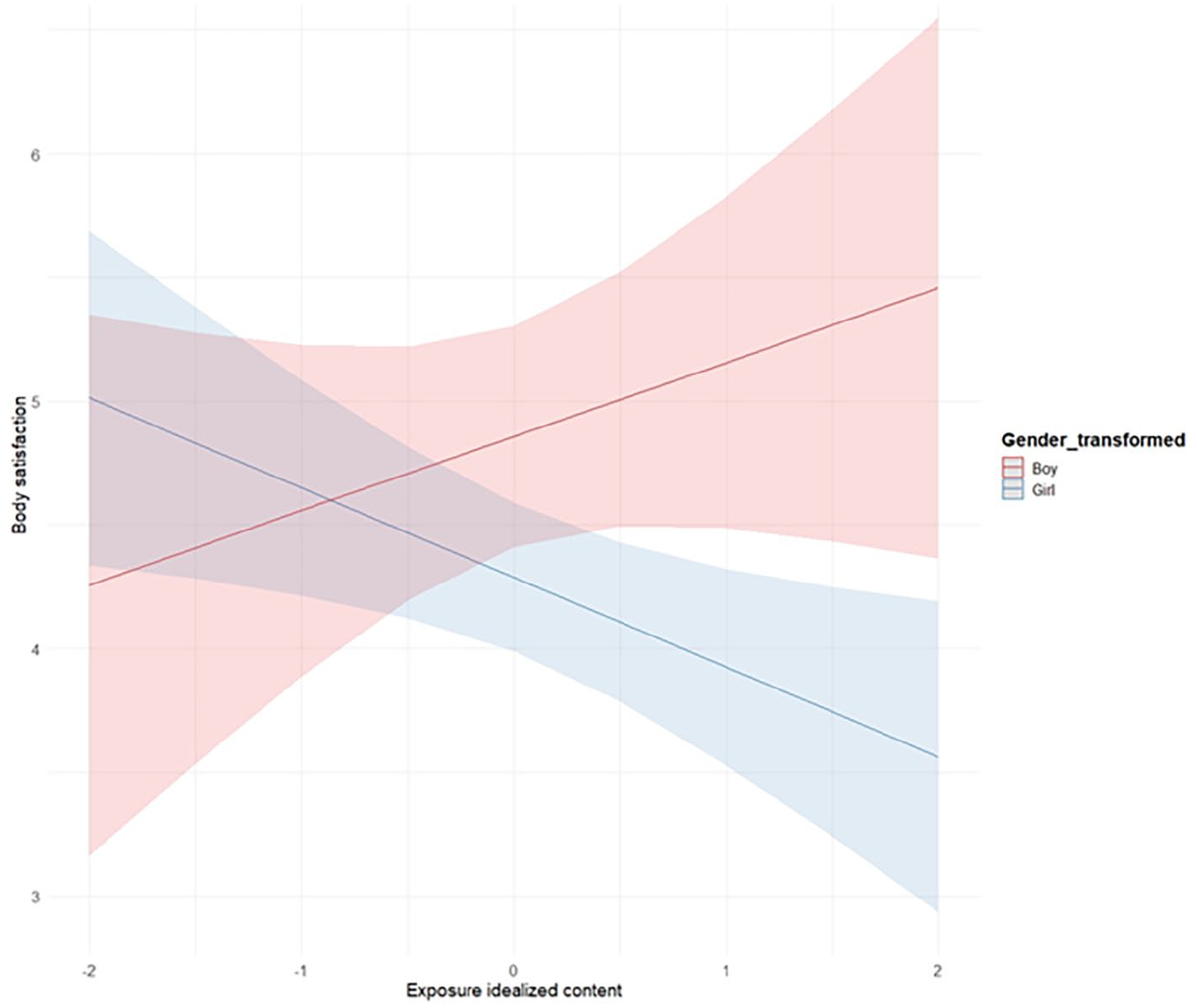
Exploratory interaction between exposure to idealized content and gender.
Internalization of beauty ideals was measured in the background survey using the 10-item sociocultural attitudes toward appearance questionnaire-4 (Schaefer et al., 2015). We did not find any significant moderation effects but we did see that internalization of beauty ideals was positively associated with body surveillance (β = .48, p = .005), meaning that individuals scoring high on internalization, also tended to have higher levels of body surveillance.
Discussion
With this study, we aimed to explore the relationship between adolescents’ daily exposure to appearance content on social media and their state body satisfaction and surveillance. From our findings, we notice the fluctuating nature of both adolescents’ body image and exposure to appearance-based content. First, regarding body image, the graphs in combination with the ICC values depict notable daily variations in body image states within persons, underscoring the fleeting and changing nature of adolescents’ feelings toward their bodies (e.g., Fuller-Tyszkiewicz, 2019). Hence, next to investigating body image trait components, scholars can benefit from delving into state components of body image during adolescence, a period characterized by numerous contextual factors—such as negative appearance remarks online—that can influence body perceptions at a daily level (Ricciardelli, 2012; Wertheim & Paxton, 2011).
Second, adolescents’ exposure to appearance content on social media also fluctuated, with some days showing minimal exposure to BoPo and idealized content and other days showing high exposure to such content. These findings reveal the complexities of adolescents’ appearance-oriented media diets, emphasizing the need for a nuanced understanding of their daily body image experiences. More broadly, this points to the importance of examining the heterogeneous nature of media exposure and recognizing the current fragmentation of media experiences. This fragmentation contrasts with traditional assumptions of consistent, homogeneous media consumption. Social media algorithms can sometimes push diverse content—idealized, BoPo, or otherwise—into users’ feeds, leading to exposure to a wider variety of perspectives and experiences. As such, adolescents may not always find themselves trapped in a static bubble, but rather experience shifts in content exposure that can vary day-to-day. This variability makes it even more crucial to understand how algorithms and media curation impact adolescents’ body image experiences in dynamic ways, reflecting a broader range of narratives and images.
When delving into the links between idealized appearance content on social media and adolescents’ daily body image states, we found that when adolescents report seeing more idealized content (than others), they also report higher levels of body surveillance. Such findings align with between-person results of prior cross-sectional (e.g., De Vries et al., 2016; Salomon & Brown, 2019) and longitudinal studies (e.g., Sevic et al., 2020). Additionally, in our exploratory analyses, we found that exposure to idealized content was only associated with lower levels of body satisfaction among girls at a between-person level. This finding aligns with sociocultural theories of body image suggesting that girls experience a greater societal pressure to comply to appearance standards in comparison to boys (Hargreaves & Tiggemann, 2004). Hence, girls may be more vulnerable to the negative impact of idealized content. These differences in beauty standards can explain the observed gender differences in our relations.
Observing the within-person relations then, no changes in adolescents’ individual levels of exposure to idealized appearance content were linked to increases or decreases in their state body satisfaction and surveillance. The observed presence of between-person relations and the absence of within-person relations in our data implies that adolescents who are more focused on appearance and consume more idealized content are likely to report greater body image concerns. However, daily fluctuations in exposure to such content (e.g., higher-than-average exposure on a given day) do not appear to significantly affect body image states within individuals. Additionally, given the correlational nature of the data (no lagged effects were found for the next day), it is plausible that individuals with poorer body image may actively seek out more appearance-focused content. However, the temporality (particularly midterm) and transactional nature of the effects remain unclear. Therefore, future research should include multiple surveys per day to better differentiate between exposure types, track fluctuations, and assess how specific timing (e.g., immediately after exposure rather than across the entire day) affects body image states.
Further, other contextual factors might be more influential for adolescents’ individual-level fluctuations in their state body satisfaction and surveillance. More specifically, (negative or positive) appearance talk with peers and parents in the online or offline world (e.g., Paddock & Bell, 2024; Rudiger & Winstead, 2013) can significantly affect adolescents’ body image. Adolescents are particularly influenced by peer interactions and discussions surrounding their appearance, as peer approval and social validation are key during this stage of development. These conversations may also partially steer the interpretation and eventual impact of appearance-related media, shaping how adolescents engage with and internalize these messages. In addition to social interactions, noticeable (daily or weekly) changes in one’s appearance (e.g., seeing a pimple after waking up, having a bloated tummy after eating dinner) might also affect youth’s daily body image states, and such changes could steer which content elements adolescents pay attention to, further influencing their body image perceptions. Hence, we highly recommend future research to take on a more ecological approach and examine intra-individual (e.g., small but noticeable body changes) and inter-individual factors (e.g., peer and family interactions) alongside different media interactions (e.g., exposure to idealized appearance content on social media, on television, in pornography) to better disentangle adolescents’ daily body image fluctuations. Such dynamics have already been observed in other fields of research, including youth experiencing pressures to have a successful lifestyle (Devos et al., 2023).
Also, it might be fruitful to delve into these daily individual-level dynamics among younger samples (e.g., tweens) who are transitioning to adolescence. Tweens are potentially more susceptible to the influence of idealized appearance content, given that they are at a life stage where they encounter an increased exposure to such content, facilitated by factors like receiving their first smartphone (Vanwynsberghe et al., 2024). Hence, their experiences can be different than those of adolescents, who might have already been familiarized with idealized appearance content and, thus, do not experience any individual-level increases or decreases in their body image states anymore as a product of this content. Here, a ceiling effect might thus potentially have been present.
As for adolescents’ exposure to BoPo content, at a between-person level, we found that if adolescents saw more of such content (than others), they also experienced higher levels of body surveillance. Such between-level associations have been hinted at in prior literature, with BoPo content being criticized for still depict sexualizing practices, embodying cultural standards of beauty, and focusing on one’s appearance (e.g., Cwynar-Horta, 2016; Lazuka et al., 2020). Indeed, experimental studies have shown increases in self-objectification after viewing such content, (e.g., Cohen et al., 2019b; Vendemia et al., 2021). Hence, finding between-person links between the behavioral manifestation of self-objectification, namely body surveillance, and BoPo content are not that surprising as BoPo still elevates an appearance focus. Future research might want to delve further into this dynamic and examine which appearance content, if any, can eliminate a heightened appearance focus. Or, even, if it is necessary to avoid such a focus, taking into account the possibility that the benefits of BoPo content (e.g., increased body satisfaction) might potentially outweigh the harms of an elevated appearance focus.
We further demonstrated that on days that adolescents saw more BoPo content than usual (compared to their own means), they also were more satisfied with their bodies. This relation remained significant even after controlling for their level of exposure to idealized content on that day. Benefits of being exposed to BoPo content have already been noticed in prior literature assessing between-person level relations, and thus seem to be consistent (e.g., Cohen et al., 2019b; Cowles et al., 2023; Fioravanti et al., 2023; Glaser et al., 2024; Stevens & Griffiths, 2020; Tiggemann & Anderberg, 2020). We found that these links did not persist until the next day, limiting their causal interpretation as the directionality could also be reversed.
What is surprising here is that only BoPo, and not idealized appearance content, was linked to adolescents’ body image states at a within-person level. Potentially, BoPo content stands out more in the stream of idealized appearance content, and thus is more noticeable to adolescents when they eventually encounter more of such content in their media diets. Indeed, looking into the descriptive statistics, participants indicated that they on average would encounter idealized content in half of the posts they saw during the day. For BoPo content, on the other hand, average exposure rates were less prevalent, indicating that they might be less familiar with this content and, thus, still experience individual-level changes when encountering BoPo. Thus, even though BoPo content seems to be less pervasive in adolescents’ media diets, its potential benefits might be tied and explained by its rareness. Future research is therefore recommended to explore whether or not BoPo content still holds the same potential if it becomes more mainstream and pervasive in adolescents’ media diets (e.g., by conducting multiple exposure experiments).
When combining exposure to two types of appearance content, the interaction term was found to be insignificant. This indicates that the combined content had no discernible effect. Instead, it was the BoPo content alone that remained influential at a within-person level. Nevertheless, it still remains crucial to acknowledge the complexity and conflicting nature of appearance content that adolescents encounter in their daily digital lives, as within-person correlations point to the co-occurrence of both types of content. Future research is recommended to recognize the mixed nature of appearance content when adolescents shift between platforms (e.g., authentic content on BeReal and idealized content on Instagram). More so, they can encounter mixed content when they scroll through the same platform and see different types of posts or stories (e.g., idealized or BoPo). Adolescents may encounter mixed content within the same post, such as a BoPo post that still includes idealized features. Content analytical research has shown that even within BoPo posts, a significant portion still aligned with culturally prescribed beauty standards (Lazuka et al., 2020) and often depicted objectifying practices (Willoughby et al., 2024). The impact of encountering such mixed content on social media has received limited attention in the literature and shows mixed findings, oftentimes because most studies either pay attention to negative or positive body image outcomes. For example, Vendemia et al. (2021) found that sexualized BoPo images contributed to both self and other objectification. Note that they did not include positive body image indicators. In addition, Cuoto and Willoughby (2024) demonstrated that body appreciation content, even when embedded in objectifying imagery from influencers, led to positive outcomes, such as increased self-compassion and body appreciation, at least in the short term. Note that they did not include negative body image components in their study. When exploring mixed content, future research is recommended to delve into adolescents’ cognitive strategies, such as their engagement in protective filtering, as a potential indicator of conditional boundaries (Wood-Barcalow et al., 2010). Such skills include criticizing or reframing the harmful content they encounter (as shown in prior studies, e.g., Alleva et al., 2024) or filtering out the positive content from a mixed environment and, thus, potentially benefitting from a mixed environment. Those with low protective filtering skills might pay more attention to the negative content, and instead experience harm.
Practical Implications
Given the daily fluctuations in exposure to idealized and BoPo content, it is crucial for health communicators, practitioners, and educators to promote media literacy programs that help adolescents critically engage with social media. Teaching adolescents how to identify and process idealized content and recognize when BoPo content still aligns with beauty standards can help reduce the internalization of harmful messages, as shown from prior intervention studies (e.g., Kurz et al., 2022; Paxton et al., 2022).
A key focus of these programs should be cognitive dissonance, which has been shown to be particularly effective in preventing negative body image outcomes (Kurz et al., 2022). According to Festinger’s (1957) consistency theory, individuals strive to maintain alignment between their beliefs and behaviors. When exposed to conflicting messages (e.g., idealized vs. BoPo content), they experience discomfort. Interventions that provide opportunities for participants to reflect on these contradictions—such as discussion groups or role-playing—can help reduce dissonance without inducing reactance, which could otherwise lead to adverse effects (Stice et al., 2019). By addressing cognitive dissonance, these interventions can empower participants to critically engage with the appearance content they encounter. Moreover, creating and resolving cognitive dissonance may lead adolescents to feel more empowered and inspired by BoPo content, as they reconcile conflicting messages (e.g., de Lenne et al., 2022). Relatedly, educators might benefit from incorporating cognitive strategies such as “protective filtering,” where they selectively focus on the positive aspects of content while discarding harmful elements. This approach can help adolescents navigate mixed media landscapes, where idealized and BoPo content appear side by side (Paxton et al., 2022).
Limitations
Several limitations need to be addressed when discussing the study’s findings. First, participants’ exposure to appearance content on social media was measured using self-reports, which may be subject to recall bias, such as over or under estimating the number of posts containing BoPo content. However, this bias may have been minimized by asking participants to report the appearance content they encountered over the previous 24 hr each day, 1 hr before bedtime, unlike other correlational or longitudinal research which asks participants to report on their exposure in general. Future research is recommended to include data donation approaches (e.g., participants could provide researchers with links to all of the content they viewed on social media each day) to obtain objective measures of their exposure to appearance content on social media. This way, we can more accurately assess whether BoPo content or idealized content only contained BoPo or idealized messages, or were mixed themselves (e.g., BoPo posts still depicting sexualized practices).
Second, while this study examined both between- and within-person effects, allowing observation of individual changes over time, it did not investigate person-specific effects. Consequently, we cannot determine if the relationships between exposure to idealized appearance content or BoPo content and state body satisfaction and surveillance vary among adolescents. Future research should collect more data points per individual to investigate individual trajectories and explore which participants experience positive, negative, or no effects from different types of appearance content on social media.
Third, no lagged effects were found and the results should thus be interpreted as within-person correlational as we are unable to determine the direction of the relationships. For example, it is just as likely that those high in body surveillance would seek out more appearance content (both BoPo and idealized content) on social media as it is that viewing such content would cause increases in body surveillance. Future research could use experimental and longitudinal methods to determine the causal effects of exposure to mixed appearance content on adolescents’ body image outcomes. To fully capture the fluctuating nature of body image experiences, it may also be essential to use Ecological Momentary Assessment (ESM) with more frequent and diverse measures. ESM can provide real-time data on how adolescents’ body image perceptions fluctuate in response to exposure to such content, offering a more nuanced understanding that complements experimental and longitudinal approaches.
Fourth, the questions used in the study do not allow us to determine whether participants perceived the same or different posts as being idealized or BoPo. Specifically, we relied on providing examples to measure both BoPo and idealized content exposure, which may have limited participants’ responses to those specific types of posts. As a result, it is possible that participants underreported their exposure to these content types, as they may not have considered other posts that could also be classified as BoPo or idealized following other facets part of these constructs (e.g., for BoPo: promotion of body acceptance in captions; for idealized content: portrayal of enlarged lips). To gain a more comprehensive understanding of how adolescents perceive different types of content, more detailed questions and qualitative research are needed. Future studies should consider using broader conceptualizations of BoPo and idealized content and explore participants’ perceptions of such content in more depth to better capture the diversity of posts encountered on social media.
Fifth, our sample consisted of adolescents from France, which may limit the generalizability of the findings to other cultural contexts. In non-Western samples, different beauty ideals are known to exist, and these differences may influence the impact of appearance content on social media.
Conclusions
In sum, this study is the first to examine daily fluctuations in adolescents’ exposure to BoPo and idealized appearance content on social media and its relations to state body satisfaction and surveillance. At a between-person level, exposure to idealized appearance content and BoPo content was linked to higher body surveillance. This link was only present among girls. No within-person level relations emerged for exposure to idealized appearance content. For exposure to BoPo content, on days that adolescents saw more BoPo content than usual (compared to their own means), they also were more satisfied with their bodies. These relations did not last until the following day but remained significant when controlling for levels of exposure to idealized content. However, when exploring the impact of the interaction between exposure to BoPo and idealized content, non-significant results emerged. Daily variations in adolescents’ exposure to appearance content as well as their state body satisfaction and surveillance were present. These results underscore the complexity of adolescents' media interactions and the need for future research to adopt an ecological approach, considering both intra-individual and inter-individual factors alongside different media exposures. Additionally, exploring these dynamics among younger samples, such as tweens, could provide further insights.
Supplemental Material
sj-pdf-1-crx-10.1177_00936502251338901 – Supplemental material for #BoPo, #Ideal, or #Mixed? Exploring Adolescents’ Daily Exposure to Appearance Content on Social Media and Its Relations with Body Image Components
Supplemental material, sj-pdf-1-crx-10.1177_00936502251338901 for #BoPo, #Ideal, or #Mixed? Exploring Adolescents’ Daily Exposure to Appearance Content on Social Media and Its Relations with Body Image Components by Chelly Maes, Robyn Vanherle, Jasmine Fardouly and Laura Vandenbosch in Communication Research
Footnotes
Acknowledgements
We want to acknowledge Anaëlle Gonzalez, Gaëlle Vanhoffelen, Jasmina Rosic, and Dr. Luca Carbone of the ERC-MIMIc project, who played crucial roles in the collection and management of the data.
Declaration of Conflicting Interests
The authors declared no potential conflicts of interest with respect to the research, authorship, and/or publication of this article.
Funding
The author(s) disclosed receipt of the following financial support for the research, authorship, and/or publication of this article: This work has received funding from the European Research Council (ERC) under the European Union’s Horizon 2020 research and innovation program (Grant agreement No. 852317).
Open practices

Supplemental Material
Supplemental material for this article is available online.
Author Biographies
References
Supplementary Material
Please find the following supplemental material available below.
For Open Access articles published under a Creative Commons License, all supplemental material carries the same license as the article it is associated with.
For non-Open Access articles published, all supplemental material carries a non-exclusive license, and permission requests for re-use of supplemental material or any part of supplemental material shall be sent directly to the copyright owner as specified in the copyright notice associated with the article.
