



Abstract
A robust web of semi-veiled unpaid cultural intermediation in the South Korean-born Webtooniverse is marking a rapidly shifting ecology of an emergent digital mediasphere. Networks of participatory fans swarming around serialized webtoons are facilitating indirect translation in this webcomic domain in previously understudied ways. Shedding light on this protoindustrial communicative phenomenon, this study investigates some of the nuanced collaboration involved in the Korean fantasy–action superhero webtoon Sidekicks (2014 -) and how its global fans are leveraging convergent technological affordances to generate a new source of communitainment value. An analysis of the indirect translation activities on the Webtoons platform, which is fueling a transnational IP frenzy of its own, demonstrates how this exploited labor is central to a content production and consumption process that challenges current understandings of the creator economy and its participatory culture dynamics.
Keywords
Introduction
Various aspects of cultural intermediation including input from a range of economic taste agents and their contributions to the cultural production process in the creative industries have long shaped the size and scope of the creator economy, as well as the development of communities across the digital media platform domain (Cunningham & Craig, 2021; Hutchinson, 2017, 2023). Increasingly, an expanding repertoire of creator-centric podcasts, web series, webnovels, and webtoons has become the “source material du jour” for the global entertainment industries, instigating an ascending “IP frenzy.” 1 Within this emergent digital media environment, webtoons are playing a significant role by inspiring the production and consumption of transmedia while impacting participatory culture dynamics in ways yet to be fully understood.
Originally released as web comics in the early 2000s and idealized for mobile apps since the proliferation of smartphones in the 2010s, South Korean-born webtoons are a largely creator-owned serialized multi-genre format of vertically scrolling digital comics. One of the major forces in the webtoon industry is the vertically integrated Internet and entertainment conglomerate Naver, which owns both the largest Korean-language and globally facing English-language webtoon platforms (called Naver Webtoon and Webtoon, respectively), as well as a film and television production studio (Studio N), mobile image messaging and multimedia app (SNOW), and other subsidiaries. In early 2021, Naver (aka the “Google of Korea”) acquired Wattpad, which is the largest webnovel and social networking service of its kind, thereby significantly boosting the parent company's access to a stockpile of potential IP. Today, Naver's production company Studio N has become a key part of a larger IP-engine (Yecies et al., 2019), transforming a multitude of Korean webtoon IP into well-received series on global streaming platform giants such as Netflix, Disney+, and Paramount + . In turn, this is enabling Korean soft power, that is, the charismatic appeal of South Korean media and popular culture among global audiences, to reach new heights.
In July 2014, Naver launched its English-language Webtoon site in the United States, featuring internally translated versions of many Naver Webtoon series that already had proven to be popular in Korea. A much smaller number of webtoons created by non-Koreans were gradually added to the site, and today, there is a greater balance between webtoons created by Koreans and non-Koreans. Then, in March 2015, Webtoon began testing a beta version of a crowd-sourced translation feature (https://translate.webtoons.com)—for a select number of ORIGINAL (i.e., highly popular and remunerated) series, which immediately differentiated it from all other webtoon platforms. As a key proprietary technology and user interface that remains partially unseen for everyday webtoon readers, this feature offers individual and teams of fan “transcreators” (Yecies et al., 2019), a simple dedicated space to contribute their volunteer translations in 31 different target languages. They usually begin with the English version—called the “genesis file,” and each page contains pre-determined speech bubbles to populate with dialogue. Multiple translators can contribute to a single series and its various episodes over time, with completion percentages displayed for all transcreators to see. Given the structured nature of this area of the platform, there is little need for much technical know-how. Additionally, various support videos uploaded to YouTube by Webtoon staff and other influencers ease the initial learning process. This Translate corner of Webtoon thus creates economic and other value (Bolin, 2009) or “total value” (Turnbull & McCutcheon, 2017) for the platform and series creators whose work is globalized via multiple language versions. It also facilitates exceptional value for the transcreators who upload their content and then cross-promote their work on other social media platforms to build a community of followers and/or attract further offers of professional work. In turn, this augmented translation service and content, which is now available to a greater number of amateur and experimental series in Webtoon's CANVAS section, becomes a lure for attracting and retaining users from across the world. An additional feedback loop, involving the posting of likes, comments, and questions to staff and fellow translators, encourages fan translators to network and engage with others in a collaborative cultural intermediation process.
While their modified form of traditional comic esthetics and narrative structures may be well-suited to modern digital devices, the rising webtoon industry has spawned a new economic paragon for cultural production. They exploit a form of competitive crowdsourcing heavily reliant on precarious and/or free labor (Fuchs, 2020; Kim & Yu, 2019). Adding to the complex platformization story (Poell et al., 2019), webtoons and webtoon-inspired comics are now seen by content industry leaders as an influential source of savoir content for platforms such as Apple Books and Amazon's Kindle. 2 With the increasing rise of the platform economy outside the Anglophone world, a surprisingly small number of savvy digital and social media platforms such as Webtoon, have developed innovative tools for building bridges between English and foreign-speaking users—irrespective of the lingua franca. While automatic language recognition functionality is typically enabled by natural language processing and artificial intelligence (AI)-powered tools, platforms such as Webtoon continue to exploit the power of the crowd, that is, the unpaid efforts of people (i.e., fans) and the “indirect translations” they produce to generate multilingual content for global users. To interrogate the rapidly shifting ecology of this emergent digital mediasphere, the present study focuses on this collaborative intermediation process of indirect translation, which refers to the reconstruction and unintentional manipulation of source-text features in each target language based on existing translation(s) in the same or other pivot languages (Pięta, 2017). Specifically, the authors analyze some of the inconspicuous activities of participatory fans swarming around the representative serialized Korean fantasy–action superhero webtoon series Sidekicks (2014 -) to understand the nuanced style of collaboration and leveraging of convergent technological affordances to generate a new type of communitainment value.
Literature Review
Webtoon's open, fan-driven, volunteer Translation Service represents a clear distinction from the mostly illegal fan-led scan-translated reproductions of Japanese manga and other comics (aka “scanlations”) from the past, delineating this authorized proprietary service and technology as a prime example of platform-structured creator culture. As such, it is considered “formal,” as opposed to the IP-violating content generated within the informal media economy (Lobato & Thomas, 2015). Yet, beyond questions of intra-medium transference and multimodal complexity, only a few previous studies have explored the cross-cultural impact of translated comics and their alternative networks of translation, distribution, and consumption, such as manga “scanlation” (Fabbretti, 2017; Lee, 2009). Despite ongoing research efforts, previous literature on this emergent sphere, especially including its appropriation of indirect translation mechanisms, reveals relatively little about emerging digital and social media practices in Korea and the wider East Asia, an important aspect of the region's complex and divergent paths to modernity (Cho, 2016; Li, 2017). Meanwhile, scholarship on the nexus between indirect translation and the creative industries has found an absence of pre-determined links between a given mediating text and the subsequent target versions (Evans, 2020).
While webtoons have yet to be included in this tradition until now, each new multi-language version facilitated by transcreators via the Translation Service stands as a target text in its own right for consumption in a reader's corresponding target culture(s). Henceforth, fan translations of webtoons display a degree of mobility, suggesting a propensity to evolution rather than to occupying a fixed element located on a discursive identity spectrum conceptualized elsewhere (e.g., Robyns, 1994). According to Robyns (1994), translators can respond in several ways as they negotiate the task at hand. Either they follow their own accord or adhere to internal guidelines provided by an employer (or a platform). In doing so, translators normally adopt one of four possible “stances” (i.e., imperialist, defective, trans-discursive, and defensive) relative to the challenge of preserving foreign language elements from the source material while crafting their translated text. In the “imperialist stance,” the translator plays a relatively transparent role in producing the derivative work, seeking to remain true to the sentiments and conventions of the source language. For those adopting the “defective stance,” the text is presented as a translation with foreign elements retained, at the risk of compromising readability. In the “trans-discursive stance,” the translator exercises some creative latitude in retaining foreign elements, enabling him/her/them to display more domain expertise than in the other stances. Inverting this pattern, the “defensive stance” acknowledges the foreign origin of the source text without identifying any foreign elements in the translated text.
Innovative translation scholars such as Hadley (2021) extend the arguments in Robyns (1994) by describing the highly variable phenomenon of “translational relay,” which involves successive engagements with multiple, intersecting versions in the same or different languages. In other words, the intermediation process tends to transform as the translational relay passes from translator to translator, curtailing the imperialist stance (Hadley, 2021). Given that all foreign-language translations stem from Webtoon's English-language version or the “genesis file,” transcreators are invited to bypass an existing original Korean version without any imperialistic intent. However, they may appear somewhat defensive in choosing an approach that internalizes a category of content and practices that share common traits. Shortly, the discussion returns to the genesis file utilized in the Sidekicks webtoon published on Webtoon to illustrate some of the localized and trans-discursive points of difference in Webtoon's fan-translation chain. Meanwhile, the two primary methodological lenses by which the authors investigate this case are online collaborative translation and communitainment value.
Online collaborative translation
The specific aspect of online collaborative translation (hereafter OCT) observable on Webtoon offers a metaconcept for explaining how a variety of joint efforts made by online and mobile crowds or collectives are utilized to complete a focused translation project (Jiménez-Crespo, 2017). Yet, despite appearing inclusive and valuable to the parties involved, OCT poses ethical challenges to the translation profession and broader digital economy, as digital labor or “work of love” contributions by participants in such unpaid initiatives are ultimately exploited by profit-focused firms such as Naver. These companies frequently utilize the translated content to train machine translation or AI systems, as well as to escalate content diversification for global consumption.
Nevertheless, Yu (2022) provides a comprehensive characterization of OCT by conducting a critical analysis of its relevance from both within and outside the field of translation studies. Yu utilizes OCT as an umbrella term to describe various online social interactions involving translingual practice, such as crowdsourcing translation, user-generated translation, volunteer translation, and fan translation. The emergence of OCT can be attributed to advancements in platform technologies within Web 2.0 and Web 3.0 environments, facilitating connectivity among participants who willingly engage in labor, whether compensated or voluntary. It is their shared interests and causes that motivate collaborative cultural intermediation—beyond traditional translation practices prevalent in legacy media and traditional publishing industries. Through their collective efforts, OCT participants often leverage their translingual and intercultural skills to enhance the diversity of source materials. This is typically exemplified by fan translation which underscores the transformative potential of engaged users in working together to facilitate cross-cultural diversification of media content such as webtoons. However, in reality, the prescribed nature of the translation system and task on Webtoon leaves little room for creative latitude in the finished product. Instead, an alternative by-product is created: communitanment value.
Communitainment value of Webtoons and IP in the creator economy
The present study draws on the portmanteau thesis of “communitainment” originally coined by Internet and media industry consultants Rashtchy et al. (2007) and advanced by Cunningham and Craig (2016) and Stollfuß (2020). It is a concept that underpins the new media environment where community, communication, and entertainment intersect and invigorate each other, as well as the careers of creative industry practitioners and their fans, subscribers, and supporters. The authors consider the participatory translation case of webtoons as a distinctive form of “communitainment,” which highlights the protoindustrial networks, communicative nexus, and chains of (re)valuation that characterize the rapidly shifting cultural ecology of the emergent Web 2.0 digital mediasphere. This expanding field of cultural production and its place in the “fan economy” (He & Li, 2023; Liang & Shen, 2016) incorporates the technological, industrial, social, cultural, and economic affordances of advanced and interconnected social media platforms, communication and interactivity strategies, content genres, and formats. When applied to the production and organization of the increasingly global webtoon industry, we can begin to understand how such platform conventions enable a mix of communication, interactivity, and a sense of community among creators, readers, and fans in ways that differ sharply from both legacy and newer media. The present investigation builds upon the abovementioned studies on communitainment by highlighting the essential digital labor of fan translators in co-creating diverse value for webtoon content, platforms, and the broader creator economy, especially in terms of its linguistic, cultural, and technological domains.
Traditionally, comics in translation have undergone a complex process of transmutation, involving the simultaneous rendering of visual and verbal elements from one linguacultural context to another (Kaindl, 1999; Zanettin, 2020). All linguistic, pictorial, and typographic components are usually considered to extract verbal information from the interactive generation of meaning in the original corpus. Next, this detail is reassembled into the re-configured visual frames to create an integrated translated version. Building on these various approaches, the present research expands the boundaries of inquiry by investigating the dynamic tropes of indirect translation (Hadley, 2021; Li, 2017; Pięta, 2017) and applying them to the novel field of webtoons. Specifically, in addressing the intersections between OCT and the resources involved in collaborative cultural intermediation, our study highlights some of the new medial complexities involved in the communitainment of webtoon translation.
Such creator-centric social media entertainment practices, especially those facilitated by Korean-born platforms such as Webtoon, challenge notions of platform imperialism that reinforce a US dominance sustained through Western capital accumulation and the IP control it affords major industry leaders (Cunningham & Craig, 2019; Jin, 2013). The creator economy, which includes the wider webtoon industry, maintains an IP regime where distributed content is primarily user-generated (and, at least initially, amateur), thus fundamentally differing from the conventional top-down corporate-centered IP control by which preconceived platform imperialism is exercised (Cunningham & Craig, 2016, 2021; Rieder et al., 2023). In short, the apparent process of collaborative cultural intermediation overrides centralized content control for professionalizing amateur creators to develop career paths in a new screen ecology, giving rise to an increasingly robust diversification of products (webtoon series), creators (webtoonists), platform technologies (Translation Service), languages (31 possible choices), and cultures (fandom and transcreation). With this in mind, the authors argue that: more than being a “form of service to the fan community” (Evans, 2019), the translating fans on Webtoon actively generate economic, cultural, social, and industrial value—or what Turnbull and McCutcheon (2017) call “total value”—for the thriving fan economy and creator economy, which include the ever-expanding global audiences for webtoons. In simple terms, this value refers to a mix of financial rewards, community solidarity, and cultural ties, and it behooves one to delve deeper into its intricate linkages to the process of collaborative cultural intermediation.
Research Method
This study employs a mixed method for exploring how Webtoon and its proprietary built-in indirect translation feature facilitate opportunities for fan translators to participate in what the authors call a process of “collaborative cultural intermediation.” It combines aspects of a case study and content analysis. Firstly, the authors tabulate the number of registered translators on the site and explain the technical infrastructure on the site's backend, which elucidates how such transcreators augment an existing English-language webtoon by producing a derivative version in one of 31 other languages. This is precisely how fans engage in a form of community-driven communication. Secondly, the authors analyze representative cuts (aka scenes) from three separate episodes in the original Korean version of the superhero webtoon series Sidekicks, plus the English-language genesis file text that Webtoon's Translation Service uses as the starting point for all Sidekicks’ (and all webtoons’) foreign-language versions. This exercise also documents the participatory activities surrounding Sidekicks in order to showcase how translators respond when the translated nature of their work and the awareness of foreign origins form part of the shared knowledge in the target context of its cultural reception. Central to this method is how digital media and translation scholars qualitatively measure the drift across and within individual target-language solutions when indirect translation is employed by a publisher. Put another way, how is a service provider or a social media entertainment platform promoting another translated product from the same origin to target audiences?
Thirdly, to explicate the communitainment dynamics of Webtoon and the Sidekicks series more specifically, the authors developed a basic analytics program to collect all the relevant raw data for this study. The machine program enabled a page-by-page search of all Asian-language translators and translations linked to the 131 episodes of Sidekicks hosted on Webtoon. Each of the relevant 1179 Asian-language episodes has a distinct URL, which the program identified and sorted into a spreadsheet. This enabled the data to be presented in a column-specific table-structured format, thus providing the names and a detailed overview of the individual and teams of translators involved in each language, the total number and/or percentage of episodes completed, dates of activity, as well as the number of likes and comments for each episode. Through this process, inconspicuous details regarding the fans and their contributions to the Webtoon platform are revealed.
When first peering at Webtoon's main landing page, it is plain to see that it caters to readers of many languages. At the bottom of the home page, visitors are invited to display the overall site in one of six core languages: Chinese, Thai, Indonesian, Spanish, French, and German. The Translation Service landing page, on the other hand, is a little harder to find, requiring interested users to search the web for “webtoon” and “translate.” After locating this semi-inconspicuous part of the site, users can register to become a contributor, search through a list of individual and teams of translators (according to nickname and language), see/read the progress (completion percentage) of the latest translations, and log in to begin/resume a translation. From this location, featured (i.e., not all) webtoon series are accompanied by their available multi-language fan translations, and registered users are invited to contribute translations of incomplete episodes in one of the 31 languages of their choice. See Figure 1 below.
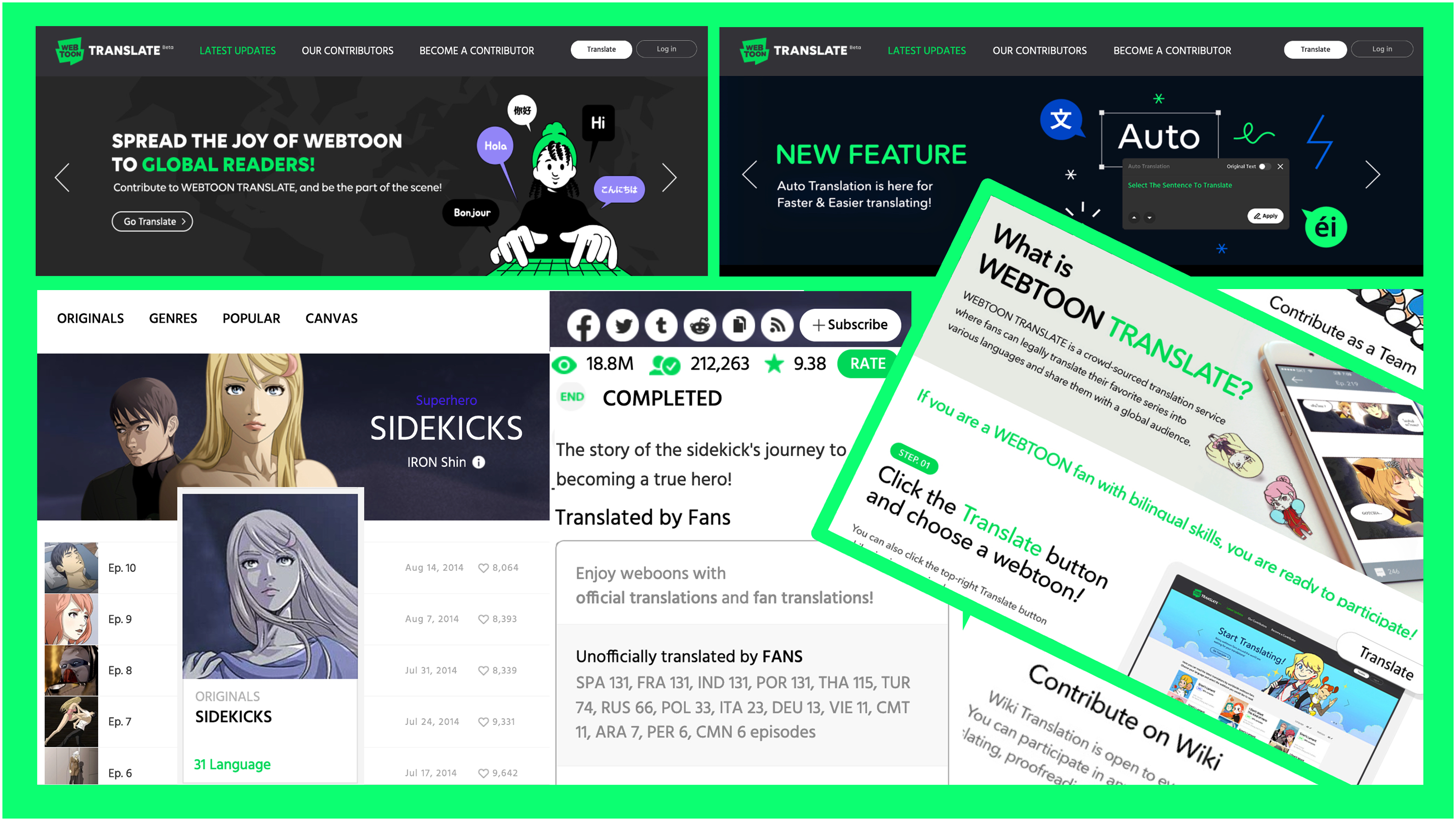
Author's own collage of screencaps created from the https://translate.webtoons.com landing page and reproduced for criticism purposes under the fair dealing exceptions in the Australian Copyright Act 1968.
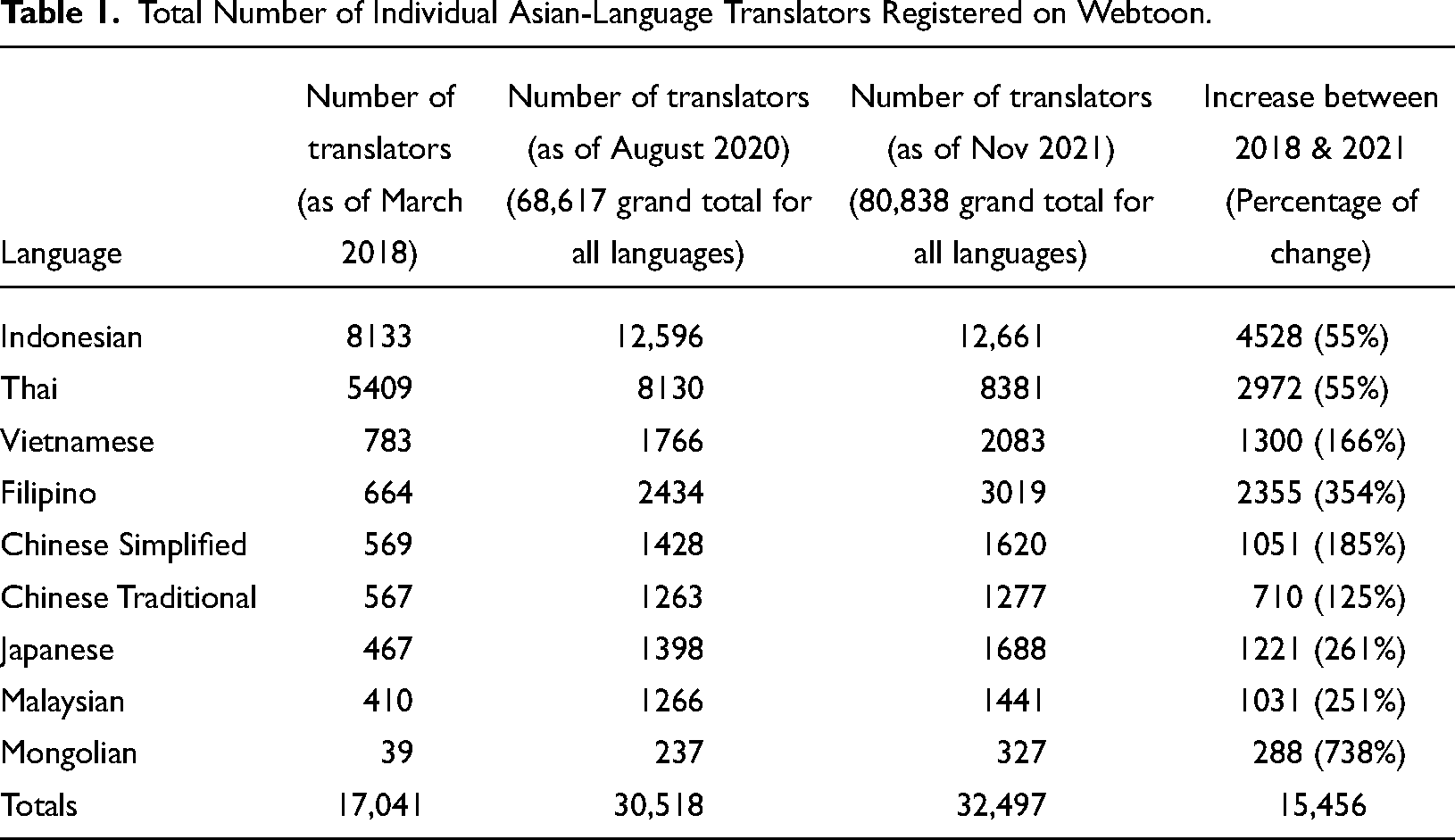
By the author's count in November 2021, a total of 32,497 translators (up from 17,041 in March 2018) were registered to work on 11 different target Asian languages (see Table 1). In mid-2023, around 25 percent of all ORIGINAL Webtoon series were open to fan translations, which the site brands as “unofficial.” This is opposed to the “official” translations of series offered on Webtoon's abovementioned six core site versions. Again, by the author's own count, since its launch by the Korean parent company Naver Webtoon in mid-2014, Webtoon has attracted a steadily increasing 80,838 volunteer fan translators, who have contributed to around 90 completed and ongoing ORIGINAL series, with over 23 million lines of text translated to date.
Total Number of Individual Asian-Language Translators Registered on Webtoon.
Further explanation of the research method reveals additional nuanced understandings of Webtoon's mode of operation and how it enables fan translators to generate value through their collaborative cultural intermediation. Registered users establish an account and are given an ID number, enabling them to create a username and set a profile picture (mostly an avatar of sorts). The backend of the site tracks their core language code and their translation activities. Merit badges and points are allotted to encourage competition between translators and to display pride in their work. Weekly competition results are tracked and displayed, as well as a tally of all translated lines and episodes that each user has completed. In addition, the Translation Service allows for teams of translators to be formed, thus encouraging group contributions and community growth. To form such a team, a member must have over 1000 accepted translated lines on the platform, which adds further competitive spirit to these user-generated activities. To us, this internal infrastructure is “tokenizing” the work of translators, that is, ascribing a value to their outputs, which previously had no extrinsic or exploitable meaning or value.
Enticing prospective contributors, Webtoon's conspicuous FAQs reassure fan translators that their work does not violate copyright because the service is offered with the consent of the series’ original authors/creators. All such “collaborative cultural intermediaries,” are credited for their work, which is quality-controlled through an ongoing internal assessment process—again possibly setting Webtoon apart from other social media entertainment platforms. Besides the potential admiration loosely facilitated by the site, fan translators are encouraged to seek financial support (in the form of monthly membership subscriptions) from followers on external platforms such as Patreon and Kickstarter.
To summarize, the abovementioned crowd-sourced intelligence facilitates curatorial evaluation of the large volume of content while generating value on and for Webtoon. These features unify the system and constitute the core cycle of this part of the “Webtooniverse” (Yecies & Shim, 2021). Taken together, this gives Webtoon (and its mother company Naver) a major edge over its competitors, as it offers multiple services while disseminating increasing streams of data and IP across the whole site and into the hands of production Studio N. Bearing this in mind, the Sidekicks series is presented as a case in point to elaborate the creator- and fan-driven production and translation chains of webtoons. By exploring the case of the Sidekicks webtoon series, one can begin to see how participatory indirect translation helps to mediate this and other popular webtoons while sacrificing the essential techno-innovation the original series represents in the Korean context.
The case of Sidekicks (2014 -)
In addressing the primary aims of this research, it is necessary to unpack some of the nuanced differences between fan-translated versions of Sidekicks in Korean, English, Chinese (Traditional), Indonesian, and Thai. Hitherto, we inquire how this precarious indirect translation work pivots first from Korean (on Naver Webtoon) and then to English (on Webtoon), further globalizing this Asian-born digital content. Accordingly, the popular Sidekicks series, and the superhero webtoon genre more generally, as well as the innovative technological affordances of Webtoon, provide a cogent example of the dynamic meaning-making processes resulting from both collaborative cultural intermediation and communitainment in previously underexplored ways.
Sidekicks is an ORIGINAL featured series spanning 131 episodes across two seasons. As of late 2023, it is one of only 41 ORIGINAL and 5640 CANVAS superhero genre series. Created by leading illustrator/writer Iron Shin, this series is part of a larger fantasy–action superhero story world and transmedia storytelling franchise that includes additional seasons and spin-offs released in Korean on Naver Webtoon between 2014 and 2020. These include Sidekicks 1 (2014), Sidekicks 2: Nightmare (2015–2016), Sidekicks: First Mission (prequel, 2017–2018), Sidekicks 3: Armageddon (2018–2020), and Sidekicks EX: The Rookie (prequel, 2020 to present). The series was introduced in March 2014 in Korean on Naver Webtoon and within 6 months, due to its popularity among Korean readers, Sidekicks was selected as one of the inaugural series featured in English on Webtoon when the platform was launched in the United States in July 2014. To date, only the first two seasons of Sidekicks have been released in English, and subsequently made available for unofficial fan translations in 31 languages on Webtoon. While this series was completed in December 2016, a cursory search for its fandom milieu on Facebook, Twitter, YouTube reveals fans around the world have continued to promote it through their unofficial translations and positive commentary.
As a “Featured creator,” Iron Shin and his webtoons represent a creative apex most practitioners aspire to reach—at least this is a prevalent view among the dozens of webtoonists whom the authors have met over the past decade. Shin first appeared on Naver Webtoon with Schoolholic (2008–2012), a popular slice-of-life webtoon based on his own experiences as a secondary art teacher. Previously, Schoolholic (in 2006) had been self-published on SHIN's personal Cyworld Korean social media site; he migrated it to Naver's expanding Webtoon Section in 2008 after Cyworld collapsed. Within a year of Shin debuting on Naver Webtoon's new Best Challenge Section, content managers advanced his series to the Featured section, where only the most popular webtoons appear. He soon quit teaching to become a full-time webtoonist, a canny career shift which earned him approximately $25,000 USD per month as a “Featured creator.” In 2019, a total of 359 individual Featured artists, actively uploading weekly content, were earning an average income of 310 million KRW (around $275,000 USD). Superstar webtoonists—the top 20 content creators in this cohort—earned around 1.75 billion KRW per year (approximately $1.55 million USD). 3 It is not hard to spot the key motivation for aspiring webtoonists, which constitute the bulk of creators in the Webtooniverse.
Based on his success, and his experience with creating his own IP, Shin was elected as the inaugural president of YLab Academy after its launch in 2015 by YLab—one of Korea's largest webtoon agencies, with contents published across numerous platforms including Naver Webtoon, Daum Webtoon, Kuaikan (China), and Comico (in Korean, Japanese, Chinese, Thai, Indonesian, and Spanish), as well as on the Japan-based platforms Kadokawa, Kodansha, Shueisha, Shogakukan, and Square Enix. In terms of the superhero genre, and reminiscent of the Marvel Cinematic Universe and DC Comics’ Multiverse, YLab's “Super String blockbuster IP” features 20 different characters across its portfolio of fourteen superhero genre series—all set within a unified story world. Naver Webtoon offers a special section of this sci-fi universe (in Korean) called Super String, showcasing all these interconnected webtoon characters, accompanied by ambitious plans to develop feature films, television dramas, and games based on YLab Universe's Super String IP. It is through this portal that major Korean webtoon enterprises, including series such as Sidekicks, are actively seeking entry into the transmedia world of superhero blockbuster IP, thus far dominated by US enterprises. Despite the close relationship between YLab and Shin, who continues to serialize with YLab, Sidekicks thus far remains outside of the YLab Universe.
Nevertheless, in the Sidekicks story world created by Shin, “superblics”—a portmanteau term combining “super power” with “public”—are humans born with extraordinary skills. Impervious to all combat weaponry, the superblics’ most effective weapon is their own body, which is powerful enough to maim other mortals. After realizing their superhuman abilities, they can choose to become either a superhero or a supervillain. All superblics become a “sidekick” to a master character and then obtain a coveted superhero or supervillain status for eternity. Popular character duos include: Nightmare (sleep and nightmare inducer) and her sidekick Blood Pack (psychokinesis); Blackhound (aka Theo; having ability to change power levels)—a sidekick to Lightning and then Darkslug; and Bloody Queen (aka Camilla) and her sidekick One-Eyed Shadow—a former villain turned good. Endeavoring to develop this line-up of characters suggests how the IP of a new superhero franchise and universe might be developed in this platform environment.
The franchise depicts a fantasy society in which the characters negotiate the moral boundaries of hyper-capitalism and patriarchy, underscoring the type of social commentary sought by many Korean webtoonists. In the first two seasons of Sidekicks, each side fights for control of Prana, the core energy source for all the characters’ power. The series’ main character, Dream Girl, is forced to fight various villains and do the dirty work for her abusive superhero master, Darkslug. After enduring the demands of her unscrupulous boss, the buxom Dream Girl (scantily dressed in pink spandex) eventually becomes a full-fledged superhero. Beneath this thin science-fiction veneer lies a powerful social commentary and indictment of authoritarianism, contemporary gender relations, and the irrational fear of a so-called alien invasion. Based on its strong female characters, and its engagement with modern social issues, it is little wonder that readers from all language and cultural backgrounds enjoy this series, with a variety of fans seeking to contribute to this vital intermediary arena through indirect and localized translatorial participation.
Findings
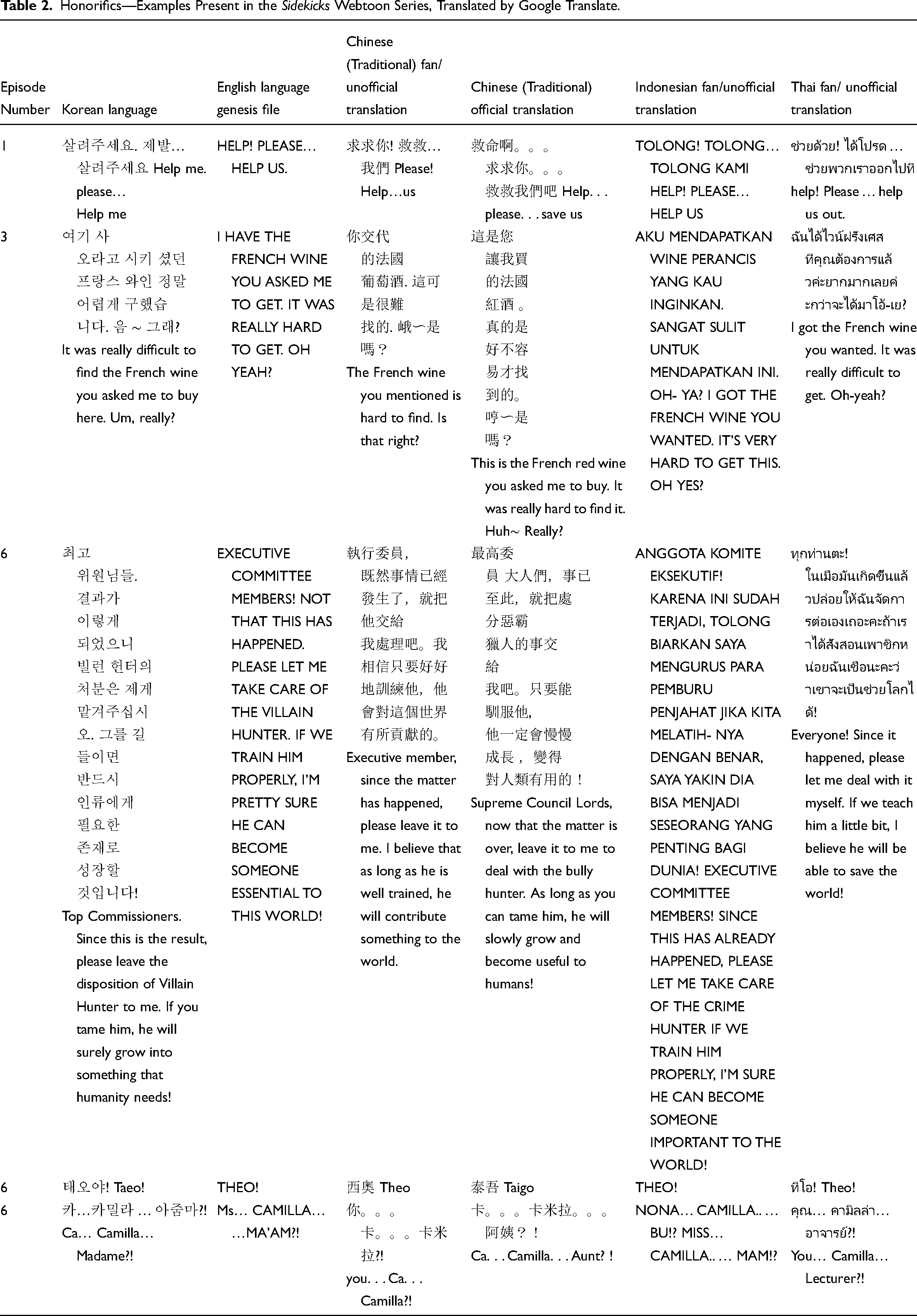
Our findings reveal representative localized differences in Webtoon's fan-translation chain. Table 2 illustrates some of these differences by introducing five cuts from three separate episodes in the original Korean version, plus the English-language genesis file text—the version that the Translation Service uses as the starting point for all 31 potential target language versions. The authors have nominated these examples after combing through the entire dataset and identifying the quintessential moments in which localized translations have occurred. Drawing on the Korean, English, unofficial and official Chinese (Traditional), Indonesian, and Thai versions reveals the nuanced differences in the ways that honorifics are presented in this format. As it happens, these are the only episodes (and examples) containing honorifics that have been translated by fans in the target languages chosen for this study. This may be a small subset of results, yet it speaks clearly about the communitainment value created by this process.
Honorifics—Examples Present in the Sidekicks Webtoon Series, Translated by Google Translate.
While 100% and 89% of all Sidekicks’ 131 episodes in seasons 1 and 2 have been translated into Indonesian and Thai, respectively, at the time of writing only 8% of episodes, or a mere nine episodes in total, have been unofficially translated into Traditional Chinese on the English-language site. (Spanish, French, and Portuguese are the only other languages translated in full, however, they fall outside of the scope of this study.) When attempting to access episodes yet to be translated by the site's cultural intermediaries, a pop-up invitation of sorts appears, to stimulate further cultural intermediation: “Not yet translated! This episode is not yet translated into Traditional Chinese—by fans. Please select the [other] language you want to read. Are you fluent in more than one language and interested in translating comics? Start translating today! Click here!” The lack of participation by volunteer Chinese translators is understandable, given the availability of all 131 episodes on Webtoon's official Traditional Chinese sister site (www.webtoons.com/zh-hant). Clearly, the community sees little value in translating content that is already available elsewhere on the platform.
Put simply, and as suggested in Figures 1 and 2, to assist fan translators, Webtoon's Translation Service streamlines the intermediation process by providing specific text balloon locations, preferred lettering and sound-effect text styles (i.e., fonts, sizes, and colors), and punctuation conventions (i.e., asterisks, dashes and hyphenations, quotation marks, ellipses, and numbers). In effect, this aids the standardization of the various open translated (i.e., localized) versions of a series, while eliminating the need for micromanaging all the fan contributions from the platform's side (clearly a costly staffing issue). Guiding the indirect translation choices in this way enables individuals and teams of translators to maintain the nuances of an original story while making room for small changes in the honorifics and character names used—for example, between the original Korean and English-language genesis text.
In the original Korean text, the following honorific suffixes are used: yo (요) in episode 1, when the trapped younger kids are asking Dream Girl for help; seumnida (습니다) in episode 3, when Dream Girl is speaking to her boss, Darkslug; and sipsio (십시오) and imnida (입니다) in episode 6, when Secretary General Camilla addresses the members of the security committee. Typically, the ending 요 is an informal but polite convention used when speaking to elders, as well as to strangers who may seem older or are unknown to the speaker, while 습니다 is a more formal and polite verb/adjective suffix that is commonly encountered in televised news programs and in newspaper and magazine articles. By the same token, younger speakers would normally use 십시오 when asking an older person or someone with a higher status (e.g., in relation to age, social position, and family/work relationship) to do something, and the 입니다 suffix during official/formal business situations such as a job interview, or in public announcements. Conversely, one would use a colloquial style or level of speech with close friends or acquaintances who are the same age. These differences are marked by specific verb endings, as well as suffixes applied to other parts of speech. In short, in spoken Korean, honorifics are utilized to signal respect toward listeners or someone who is the topic of conversation.
By comparison, in episode 3, the official Chinese version includes the character nin (您; you), which reflects the subordinate status of the speaker in relation to her addressee. In other words, a polite form of “you” is used, setting the official Chinese version closer to the Korean version than its English counterpart. In the cuts from episode 6, Dream Girl uses a higher register honorific when speaking to her boss, and Camilla uses the same convention when referring to executive committee members, whereas these respectful usages are mostly obfuscated in the unofficial translation. Our final example shows how the fan translators handle the names and speech of Camilla and Tae-o (태오야), which are slightly modified—the Chinese and Indonesian versions follow the English rather than the Korean original. In the unofficial Chinese version, Theo's use of formal “you” (您) when addressing “Ms.” Camilla seems out of place because it fails to reflect the nuances of the relationship between these two characters. Similarly, the term ajumma (아줌마) in episode 6 can be loosely translated as “ma’am.” While there is no equivalent of “Ms.” in either Chinese version, using a yi (阿姨) in the official text represents a polite honorific which can be rendered in English as “auntie.” (While Korean ajumma is often translated as “aunt,” it rarely refers to an actual blood-relative and is an informal polite way of speaking (or referring) to a middle-aged or older woman, especially given that it is socially unacceptable to use an elder's name without a formal title.) Lastly, both the unofficial Indonesian and Thai fan-translations omit most of the honorifics in the original Korean text, following the indirect translation chain via the English-language version.
As seen above, essential cultural elements accompanying the original source content are often omitted by the indirect translator. As a result, the collaboration undertaken by Webtoon fan translators differs from the objects of fan translation mentioned elsewhere (Evans, 2019; Wang, 2022). Moreover, the translated webtoons analyzed here have little in common with illegally fan-translated comics, television series, and films, which clearly exist elsewhere in the informal economy as a surrogate for officially translated texts. At the linguacultural level, however, the nuanced changes made during the translation process via Webtoon's interface (see Figure 2 below) highlight some of the unintended transformations of the site's officially condoned practices.
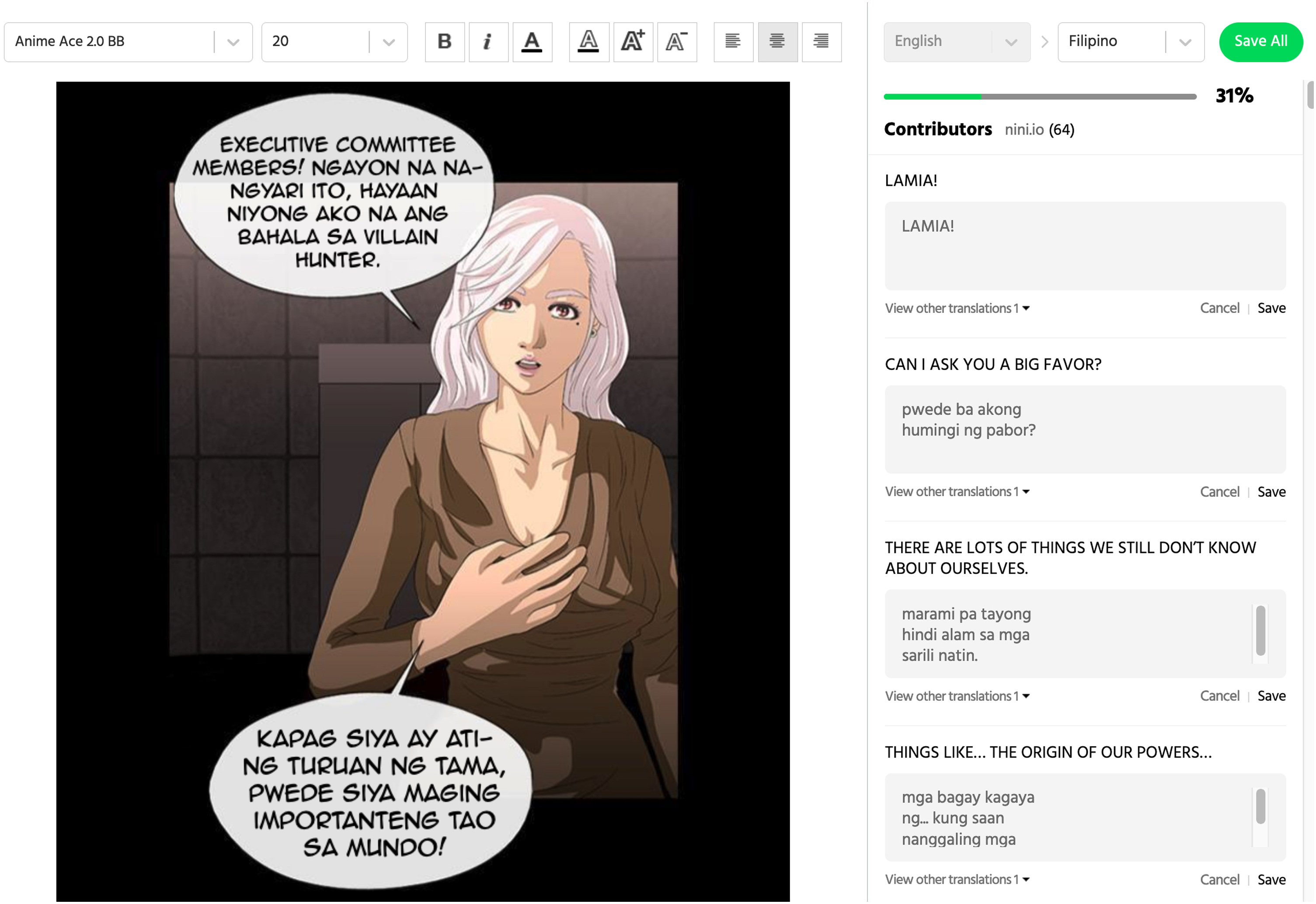
The author's own screen capture was created after logging in to the Translate section of the Webtoon platform. The Filipino language option for episode 6 of Sidekicks has been chosen. This image is reproduced for criticism purposes under the fair dealing exceptions in the Australian Copyright Act 1968.
To take one further example, the Korean word oppa (오빠) is one of those nuanced cultural terms that continues to challenge translators—precisely because it is difficult to translate into English and other languages, given the enormous media flows of which webtoons are a part both within and beyond East Asia. While oppa literally means a female's older brother, it is conventionally used endearingly when referring to not just one's actual older brother, but also to a close and slightly older male friend, a romantic partner, or one's husband—providing they are older than the speaker. Using the term in the dialogue of a popular-culture text, such as a webtoon, webnovel, film, or television series, thus reflects a specific cultural meaning. Omitting the term in a translated text and failing to provide a close equivalent effectively changes the communication style and relationship of the characters involved. Indeed, much of the controversy surrounding the recent Korean Squid Game (2021) series on Netflix concerned the translated—or, rather, untranslated—English subtitles (Oh, 2022). A number of Korean viewers were disturbed by the apparent negative impact on character development and relationships resulting from the absence of oppa, and also of hyung (형)—a respectful term used by males to refer to an older friend—among other terms.
When it comes to expertise versus efficiencies, some fan translators may lack a deep understanding of Korean culture and its intricacies, which can result in the loss of nuanced meanings and cultural connotations during translation. They may not possess the sophisticated translational expertise to render the totality of source webtoon stories in an accurate and faithful manner. Webtoon eliminates much of the guesswork by enabling fan translators a modicum of authority to intentionally omit or alter cultural elements in order to make the translated text easier to read for the target users. Thus, readability is prioritized at the expense of referential accuracy and cultural authenticity. Similar tendencies may be demonstrated by professional translators in high-stake activities of literary translation where language solutions are determined more prevalently by patronage and other socio-political factors at play than their closeness to a particular source text. For more insights on the nuanced art of translating Korean texts for international audiences, see Paquet (2020), which reflects on the high-profile work associated with Bong Joon Ho's Academy Award-winning film Parasite (2019). As such, fan translations of webtoons are part of the platform's localization drive, in which translation as cross-cultural meaning construction is slightly opened beyond linguistic accuracy and equivalence. Fan translators actively draw resources from diverse directions and sources to achieve the eventual coherence and meaning in each localized version. Their exploited work facilites efficient content diversification by making webtoon products accessible to global users and therefore generating different types of value in different recipient contexts.
Discussion
Webtoons, with their constant availability and instant distributability, have captured the attention of fans who are attracted by the medium's unique genre-bending stories that embody both Koreanness and a sense of universality. Unlike many traditional comic book fans, webtoon fans do not need to possess physical copies of the content to establish their fan identity. Fan translators, engaging with webtoon content transculturally and exclusively through collaboration, contribute to the transnationalization of webtoons by creating multiple language versions of the source works, establishing a significant value dimension to the Webtooniverse and its expanding global fandom. In turn, translated webtoons serve as a catalyst for international fans to learn about Korean language and culture, fostering a community that embraces a pop cosmopolitanism centered around the screen-based transmedia practice of reading and translation. This too is contributing to South Korea's soft-power success story in the making.
While the abovementioned exploitation of fan translators deprives them of a share in the profit generated by their activity, this outcome does align with the broader observations made by Zwischenberger (2022) on corporate-driven OCT and translation crowdsourcing. According to Zwischenberger (2022), OCT is “unarguably an element of exploitation” even if the volunteers (or fans) “evidently see themselves as benefiting in various ways through their work” (2). The corporate-driven OCT model prioritizes profit maximization over recognition and remuneration for the significant contribution made by fan translators. To us, this critique highlights the need for webtoon platforms to recognize fan translators’ intellectual and affective labor and provide appropriate compensation, leading to fairer and more equitable collaborative translation practices. Although not always in harmony, the exemplary forms of value generated by and through webtoons are shaped by these agents that mediate the processes of user-generated and user-circulated content. In this way, they have become integral and collaborative parts of this enlarging creator economy, and those who influence how translated cultural industry goods are produced, distributed, consumed, and perceived.
As informal translators, the fan transcreators who contribute to Webtoon belong to a cohort that maintains a common sense of identity. Hence, such cultural intermediaries often deliberately decide to “neither retain foreign elements [in the translated texts], nor acknowledg[e] their nature as translation” (Hadley, 2021, p. 676). By collaboratively shaping the source text into something new, these intermediaries become more than mere translators adopting an “imperialist” approach. Here, the authors call such translators (and subtitlers) “oppa killers” if they take it upon themselves to remove or replace oppa, which is an important “honorific” that Koreans use in everyday conversation. Words such as oppa have little if any exact translations in English, although this is likely to matter less now that the 2021 Oxford English Dictionary has included oppa in its “definitive record of the English language.” Nonetheless, translating is more of an art than a science, and the translator's work is usually influenced by factors such as time and budget limitations, the language conventions of the target audience, and contemporary slang trends. That said, linguacultural authenticity is not the only value that is eroded and/or enforced by translation.
By its very nature, the indirect translation process, that is, making translations of translations, involves the nuanced excision of original language and cultural markers. Our study begins to show why these emergent media developments matter in the context of Sidekicks and webtoons more broadly. This is where the translation of graphic narratives has evolved into highly variable forms of communitainment—which typifies a fusion creator-centric experience formed at the nexus between communication, collaboration, and entertainment. There be various forms of value at this meeting point. While the term “communitainment” may sound somewhat jaded in this context, “total value,” in both the real and imagined senses of the term (Turnbull & McCutcheon, 2017), is created because of this process.
Our notion of “value” mined in this study is underpinned by the sociological insights of Bourdieu (1986), who theorized how goods are transformed through the relations between (and influences on) the mediating actors within a commodity chain, interacting to meet consumers’ needs and tastes. Based on our observation, the indirect translation of webtoons is generating at least ten notable forms of value that extend beyond economic wealth creation. In this way, especially since the US billion-dollar acquisitions of the English-language webnovel enterprises Wattpad (Canada) and Tapas (US) in early 2021— by the leading Korean webtoon platforms Naver and Kakao, respectively—Korean webtoon enterprises have become fan-driven social media entertainment platforms operating at the intersection of the Korean Wave and the global media industries. As a result, creator-led webtoons and webtoon platforms are fast becoming true competitors to the creator cultures and social media entertainment platforms that lie at the intersection of Hollywood and Silicon Valley. This is a rising phenomenon anticipated by Rashtchy et al. (2007) and further conceptualized by Cunningham and Craig (2019) and others.
Unsurprisingly, based on our tabulations from the Webtoon dataset, the number of translators working in English on Webtoon jumped from 2508 in March 2018 to 7362 in August 2020, increasing to 10,401 in October 2021 (an overall rise of 315%), demonstrating that this popular digital culture medium and its collaboratively produced translations are proliferating across the Anglophone, too. This is seen clearly in our research case example of Sidekicks. Not only do the collaborative cultural intermediaries studied here enjoy a degree of social prestige (even though this may not have been their chief goal), they create economic value for the platform through the division of labor, as well as via the creation of charismatic free content that can drive traffic to other parts of the platform and parent company Naver's sites. Obviously, the Translation Service has been a great success for Webtoon, as it has allowed it to target a large range of languages without having to commit its own resources. Economic value is also generated for the content creators whose popularity earns them potential income from their respective platforms—based on subscribers, viewing statistics, and ad-sharing revenues. Prolific webtoon translators can “bank” the fruits of their labor by using their experience to gain additional paid work, although Webtoon's FAQs would never state this to justify the unpaid nature of fan-translation work facilitated by its site.
Conversely, cultural value is generated by these digital intermediaries in terms of professional and personal recognition, credibility, and esteem. This cultural value constitutes a sustained contribution to a community of fans and followers, further advancing the consumption of user-generated and user-circulated culture. Social value takes the form of viewer/audience enjoyment of these and other fan-translated entertainment media texts, and an intellectual form of socio-cultural value is generated through public debate among multiple language speakers over the themes and social criticism conveyed by the original (and translated) texts. At the same time, industry value is expanded for the original IP and its nurturing of new transnational audiences, thus strengthening the potential for future transmedia adaptations in multiple languages and for ancillary products across different markets. Finally, in the present study, technological value is manifested in terms of Webtoon's utilization of cultural production infrastructure to increase audience engagement. In sum, total value is sustained in this precarious domain, culminating in the communitainment value of webtoons.
Conclusion
As the largest English- and multi-language emergent media platform of its kind, Webtoon features free access to 1098 popular completed and ongoing ORIGINAL series plus over 100,000 amateur and experimental CANVAS series. Unlike almost all its Korean and foreign rivals, the Translation Service on Webtoon allows selected series to be viewed in multiple languages other than their original Korean- or English-language versions. By focusing on this prominent yet understudied platform and its affordances for the creator economy, the authors have identified some new aspects to the cultural intermediation facilitated by this site and how collaborative texts and translation chains created by fan translators are enabling them to traverses cultures through their unpaid work. In so doing, the authors have extended the utility of the communitainment concept to further our contemporary understandings of translation and its critical revaluation of creator-centric digital content.
As the authors have shown, the communitainment processes of Webtoon fan translation are simultaneously multimodal, given the specific media and technology involved, and multifaceted in terms of the ways that fan translators choose to engage with the contents in the work of translation. Fan translators contributing to Sidekicks are part of a translational relay entailing successive and often asynchronous engagements with several potential intersecting intermediaries and their personal choices in translating aspects of an episode in the same language. In other words, they are performing the “heavy lifting” required for the platform's globalization of communitainment. Consequently, the developments pioneered under the auspices of Webtoon are contributing to a new wave of media globalization, thus enabling content creator–owners, translators, and other cultural intermediaries to access a hierarchically structured commercial market with greater ease than in the case of traditional and other digital media industries. Clearly, however, further case studies will be necessary to analyze these differences more precisely in the indirect translation chain, and some of the subtleties manifested by the indirect translation process, keeping in mind the controlled engagement processes dictated by each platform.
The communitainment of Webtoon translation urges future research to revise the basic concept of “online collaborative translation” (Zwischenberger, 2022). Whereas this development in Translation Studies has yielded significant insights into web-based praxis such as website localization, news translation communities, and other forms of crowd-sourced translation (Jiménez-Crespo, 2017; Yu, 2022), their critiques on fan translation as an exploited source of labor in the creator economy requires further verification. This can be based on empirical knowledge of “translational fandom” (Guo & Evans, 2020; Wang, 2022) and the nascent philosophy of digital humanism (Fuchs, 2020). While new media research is moving forward along this line of inquiry, our illustration of Webtoon fan translation demonstrates that: although not always in harmony, the exemplary forms of value generated by (and through) the webtoons are shaped by a range of agents that intervene in and mediate the processes of user-circulated and user-generated content. In this way, they become integral parts of this emergent media arena of creator culture, and those who influence how translated cultural industry goods are produced, distributed, consumed, and perceived. Significant elements in an original text can be preserved, lost, or radically transformed, not only in terms of their semantic meaning and cultural signification but also in their technologies of production.
Furthermore, especially at the time of writing, the concept of sustainability also warrants consideration when examining the impact of AI on fan translators, content platforms, and webtoon communities. The proliferation of Generative AI (GenAI) technologies such as ChatGPT raises questions about the role of human agency in translation and across the sider creator economy, inducing ontological and systemic shifts in the task of the “transcreator.” As such, new skills will be necessary to facilitate, control, and enhance human-AI co-creation, tailoring prompts to produce diverse outputs that meet end-user specifications (Rothwell et al., 2023). This collaborative translation process is complexly dialogic, as GenAI technologies respond to human-generated prompts, sustaining an intersubjective chain of digital intermediation. This expansion of OCT practice beyond human-based skills, workflows, and media will lead to more-than-human alternatives in physical, virtual, and cognitive domains. However, despite AI's ability to handle superdiverse multimodal content, current technologies have yet to surpass human intelligence in high-stakes communication and high-level intercultural mediation. Webtoon fan translation, a robustly evolving communitainment field that intersects language, visual storytelling, digital arts, and technology, will continue to rely on human/fan intermediaries for global diversification. Therefore, future research could explore the intricate network of individuals, webtoon content, technologies, platforms, virtual communities/fandom, media institutions, and traditions that extend beyond the local realms of human intermediaries, shedding light on the dynamic interplay between these elements and their contributions to the Webtooniverse and its localization.
Naturally, there are limits to the present study in so far as revealing the complex interpersonal, economic, and technical factors behind the nexus of translation chains and instantiating the interplay among individual theoretical stances. To further illuminate the total value generated by these interconnected elements, given the symbiotic coterie of cultural intermediaries and digital platforms (van Dijck, 2013), future scholars will need to deepen their interdisciplinary approaches to unravel the conundrums of new media and translation. It would seem particularly critical to shed light on the host of indirect mediations stemming from webtoons, web series, webnovels, and the like—as clusters of adapted source materials inspired by their genesis files. In terms of the non-literal translation aspects analyzed above, many translations cannot reproduce the contextualized meanings of the original language. Clearly, this phenomenon is not unique to the Webtoon platform, as it exists in many other crowd-sourced translation platforms as well. More understanding of whether this decontextualization in indirect translation is an intentional translation approach, a limitation of a fan's own knowledge, literacy, and skills, or if there are other underlying explanations is needed elsewhere. The prospect of creating this expanding totality of value is likely to inspire scholars and industry stakeholders to develop new understandings of communitainment and transnational media exchange and their impacts on the wider creator economy.
Footnotes
Declaration of Conflicting Interests
The authors declared no potential conflicts of interest with respect to the research, authorship, and/or publication of this article.
Funding
The authors disclosed receipt of the following financial support for the research, authorship, and/or publication of this article: This work was supported by the Australian Research Council, (grant number DP180101841).
Ethical Statement
Human ethics (i.e., Institutional Review Board) review was unnecessary to conduct the low-risk research and summary of numerical data for this study because it involves information freely available in the public domain as an open source of anonymized data. Nearly all translators use pseudonyms and very little if any of their personal details appear in their individual and group translator profiles.
