



Abstract
The chin represents an important component in facial aesthetics. A wide range of facial deformities may alter the chin’s position and may bring along aesthetic and functional implications. It is imperative to consider the current aesthetic ideals, while diagnosing and creating a patient’s treatment plan, instead of using the usual cephalometric analysis. The principal objective of this study was to evaluate the chin’s position in a group of male individuals considered to be facially attractive.
Introduction
The chin constitutes a cornerstone in facial aesthetics, variations in its position can drastically change the profile view of people influencing the way they perceive themselves and how the world perceives them. Throughout history, connotations of sexuality, physical strength, personality, power, and a moral sense of good or evil have been attributed to it. The Greek culture associated a strong and well-defined chin to power and beauty, During the Italian Renaissance a slightly less projected chin was preferred. In modern art the protrusion of the chin is a constant.1,2
Any chin malformation is considered a facial deformity, Guyuron in 1995, described and categorized the different deformities of the chin, based on the analysis of 2879 patient photographs, he then classified them in 7 categories, in this classification the most common type is, Microgenia, it’s presentation may have functional alterations, such as lip incompetence, hypertonification of the mental muscles, and reduction of the superior airway, which can cause obstructive sleep apnea syndrome.3.4
In many of these patients, a correct diagnostic analysis is necessary. Historically, the cephalometric analysis has been used widely, taking Pogonion (Pog) and Menton (Me) as the main landmarks and reference points, as their relationship with other structures. Recently Burstone and Legan, and Farkas have carried out the analysis based on lateral photographs, taking as a reference point a true vertical that passes through the Subnasal (base of the columella), and an oblique line at negative 6 degrees, which represents the ideal position of the chin.2,5 Another soft tissue reference line is the one traced from the Pogonion to the lip line, described by Ricketts and Park 6 ; Steiner’s S line, which is establishes the position of the lips in relation to the Pogonion and the nasal S line; the aesthetic line of Jarabak and Ricketts that goes from Pronasal to Pogonion; and the distance from Cervical to Menton or Pogonion. 7
It should be noted that these cephalometric studies of hard and soft tissues are performed based on a “representative” group, which yield constant values and standard deviation. However, as described by Arnett in his manuscript, where he studies soft tissue landmarks, published in 1999, his representative group is based on 46 facially balanced Caucasian individuals, from whom dentoskeletal and soft tissue reference values were determined 8 20 years later This results were later debated by the same author, when he concluded that the analysis of over 100 “normal” subjects, cannot give us representative values applicable to all patients, and in the case in which we consider them as the goal values, we will have an endless number of complications in our treatment plan, with moderate to poor cosmetic results. His current facial analysis considers an aesthetic and functional correlation, under the premise that if the face works well, then it must look good. Seeking in each patient to comply with the three facial functional keys: breathing, communication and eating. 9 Starting with a correct position of the patient to be analyzed; the natural position of the head has proven to be the position with the lowest rate of deviation in relation to a true horizontal, leaving other classic planes, such as the Frankfort, with a higher error rate. 10
Cocconi and Raffaini described the labiomental unit to determine the most aesthetic position of the Pogonion considering hard tissues, which should be on a true vertical that passes through the buccal aspect of the lower central incisor. 10 A novel study by Naini from 2012 determined that the most attractive position of the pogonion for a group of 185 observers, was having the Pogonion on a true vertical that will pass through Subnasal, being also attractive silhouettes with a retrusion or protrusion no greater than 4 mm from this point. For these 185 observers, the silhouettes that presented a retrusion greater than 10 mm or a protrusion greater than 6 mm should undergo mentoplasty. 1
Dentofacial deformities, specifically those associated with the jaw-chin relationship, are usually resolved primarily by bringing the patient to a correct occlusion through orthodontics, orthognathic surgery, or a combination of both, and secondarily by bringing the chin to a correct functional and aesthetic position. Mentoplasty can also be performed for aesthetic purposes only in the cases where silicone implants are placed to improve the facial profile. These changes in chin position are normally planned based on radiographic cephalometry and the perception of the clinician. These parameters have not evolved along with the aesthetic ideals of modern times, so the purpose of this study was to define what is the ideal aesthetic position of the chin in a male group of people considered to be attractive and develop the clinical parameters for diagnosis and treatment.
We hypothesized that the position of the chin (determined by the Pogonion point) should be present in an area bounded by true verticals passing through the Subnasal and the Maxillary Central Incisor (Aesthetic Chin Lines) in most of the individuals studied. The specific objectives were: 1. Determine in how many males have the Pogonion point behind the vertical of the upper central incisor, 2. Determine in how many of them, the Pogonion point is situated between the verticals of the upper central incisor and of Subnasal, 3. Determine if the position of the pogonion point is in front of the vertical of Subnasal.
Materials and methods
The research was approved by the review board of the Universidad del Ejército y Fuerza Aérea Mexicanos. This manuscript shows an observational, longitudinal, and descriptive study. A selection of high-quality digital photographs of 100 male subjects was made, all photographs showed a lateral view of the face, with the head oriented in a natural position and smiling and showing at least the upper central incisors. The models were described as facially attractive on specialized websites (sp.depositphotos.com, shutterstock.com, istockphoto.com). Exclusion criteria included excess facial hair and the presence of jewelry and other accessories, that made it difficult to locate facial structures. The photographs that met all the criteria were rotated and positioned subjectively by 3 independent surgeons until the natural position of the head was achieved. The Subnasal, Pogonion points and a point on the vestibular face of the upper central incisor were marked, subsequently two true verticals were traced in each photo, one that passed through the Subnasal and the other that passed through the vestibular face of the upper central incisor, which were named “Aesthetic Chin Lines,” it was determined the relationship between the Pogonion and these two lines (Figure 1). No measurements were made due to the lack of millimeter scales in the photographs.
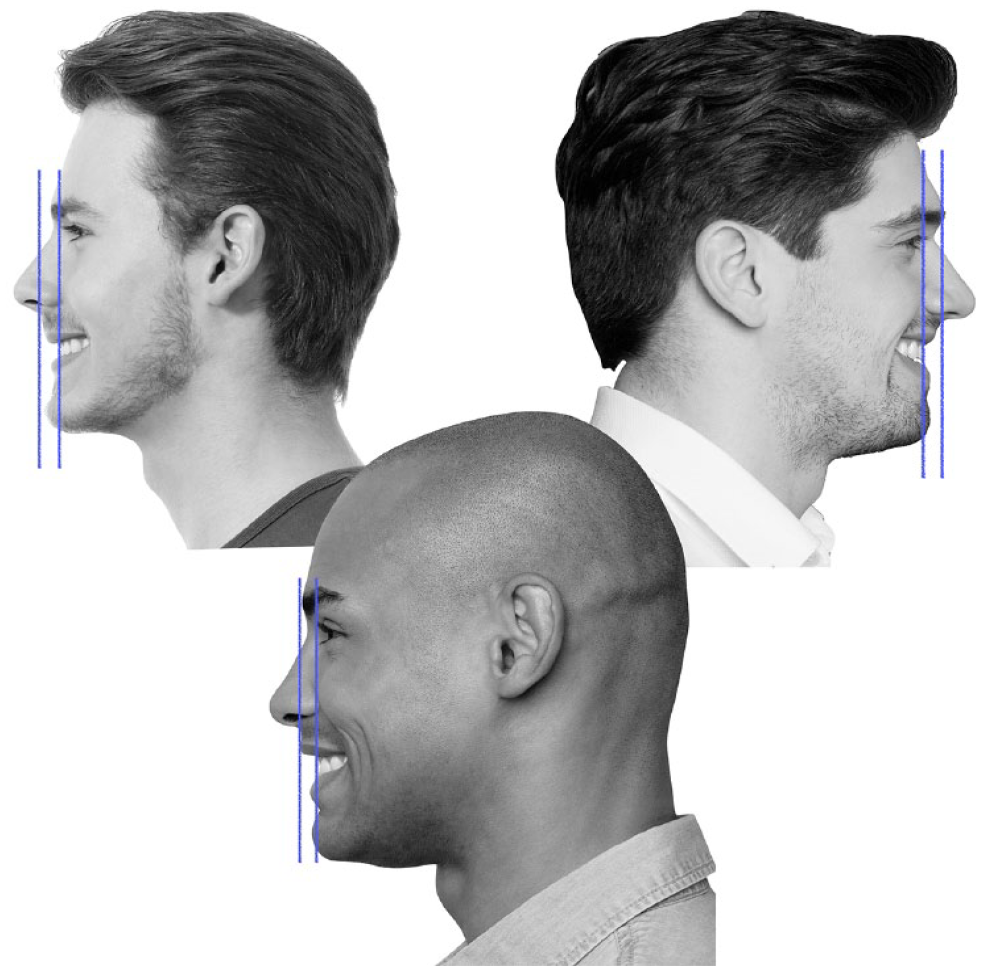
Aesthetic Chin Lines and its relationship with ideal Pogonion position in three different models (A, B, C).
The qualitative variables that were taken into consideration were the Aesthetic Chin Lines (Lines that determine the anteroposterior position of the chin) and the chin deformities (Anatomical alterations that affect the shape and position of the chin).
Results
Hundred photographs of male subjects were included in this study to carry out the analysis. The evaluation of the relative sagittal position of the Pogonion point in the lateral photographs, in relation to the Aesthetic Chin Lines (true vertical of the Upper Central Incisor and true vertical of the Subnasal) in males considered as physically attractive, yielded the following results:
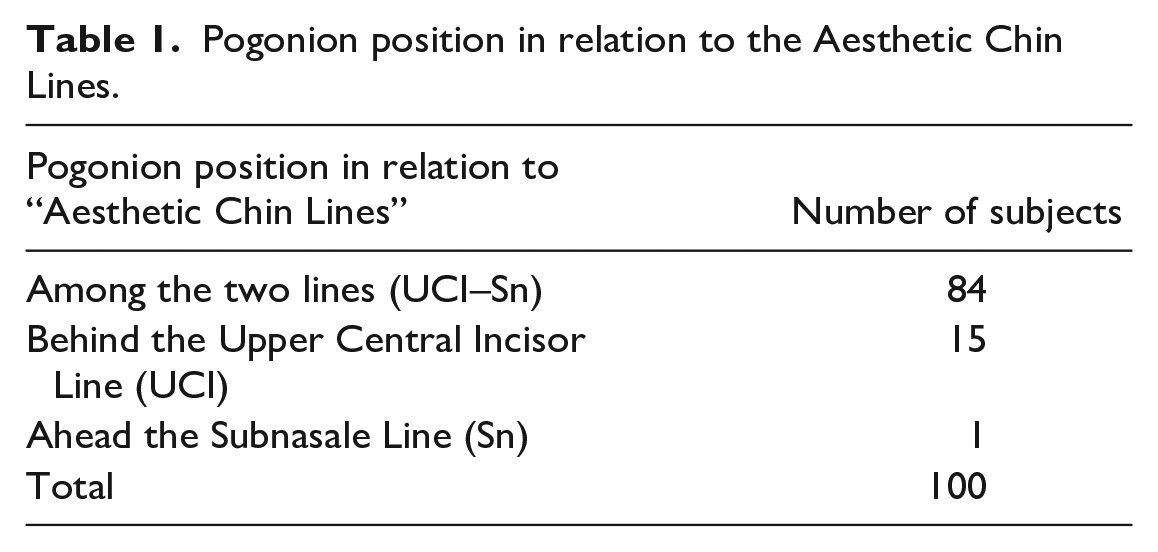
In 84 cases (84%) the Pogonion was found between the Aesthetic Chin Lines. In 15 cases (15%) it was found behind the Upper Central Incisor line, and in 1 case (1%) it was found in front of the Subnasal line (Table 1).
Pogonion position in relation to the Aesthetic Chin Lines.
Discussion
The parameters and guidelines today established up for the diagnosis and treatment plan of chin deformities are based on a group of people from a specific population. These groups do not represent the current globalized standards, even in a specific nationality population. The marked globalization of the world, a population group in specific, and the sample used to establish previous guidelines cannot be considered representative due to its small size. Knotted to this, the sample group is not considered particularly attractive, beautiful or with suitable facial proportions, but rather it is a group of average people, without dentofacial deformities and with a correct occlusion. Therefore, an update in the analysis of the chin’s position is necessary, including people who be considered attractive in globalized and actual standards.
This study was planned considering the current trend that clinical and photographic analysis should prevail over the radiographic cephalometry, since facial harmony has been found in a very wide range of cephalometric values. 11 Which makes facial cephalometry, a very limited and even obsolete diagnostic resource. Instead, the use of soft tissue landmarks, such as the forehead, nose, lips, and chin, has been considered as a better option to analyze. Andrews in 2008 was one of the first ones, to reach this conclusion and propose a new diagnostic method and treatment plan. Represented in his work, in which he made use of a lateral smile photograph of women (and in a second study of men) with good facial harmony, to determine the position of the upper incisor in relation to the forehead.12,13 This has been ratified in subsequent studies, which have established the importance of the lateral view images in facial aesthetics and of the smile as a mean of social expression. 14 Hernández-Alfaro in 2010 verified that his subjective analysis of the position of the central incisor ahead of Nasion in attractive people was a constant in the lateral view images of smiling professional models. 15 Which constitutes a very important tool to plan the movement of the upper jaw during orthognathic surgery or dental in orthodontics.
Our study proposes to continue with these ideals, in this specific case by analyzing what is the most common current position of the chin in a group of attractive males, to treat chin deformities, considering the concepts of current aesthetics. By achieving this we could offer a better quality of life and improve the image and perception pf the patient by the society.16,17
The results of our study showed that Pogonion is found 84% of the time within the true verticals of Subnasal and Upper Central Incisor within the population studied (Graph 1). Which allows us to implement the Aesthetic Chin Lines as a reference in the diagnosis and treatment plan of chin deformities.
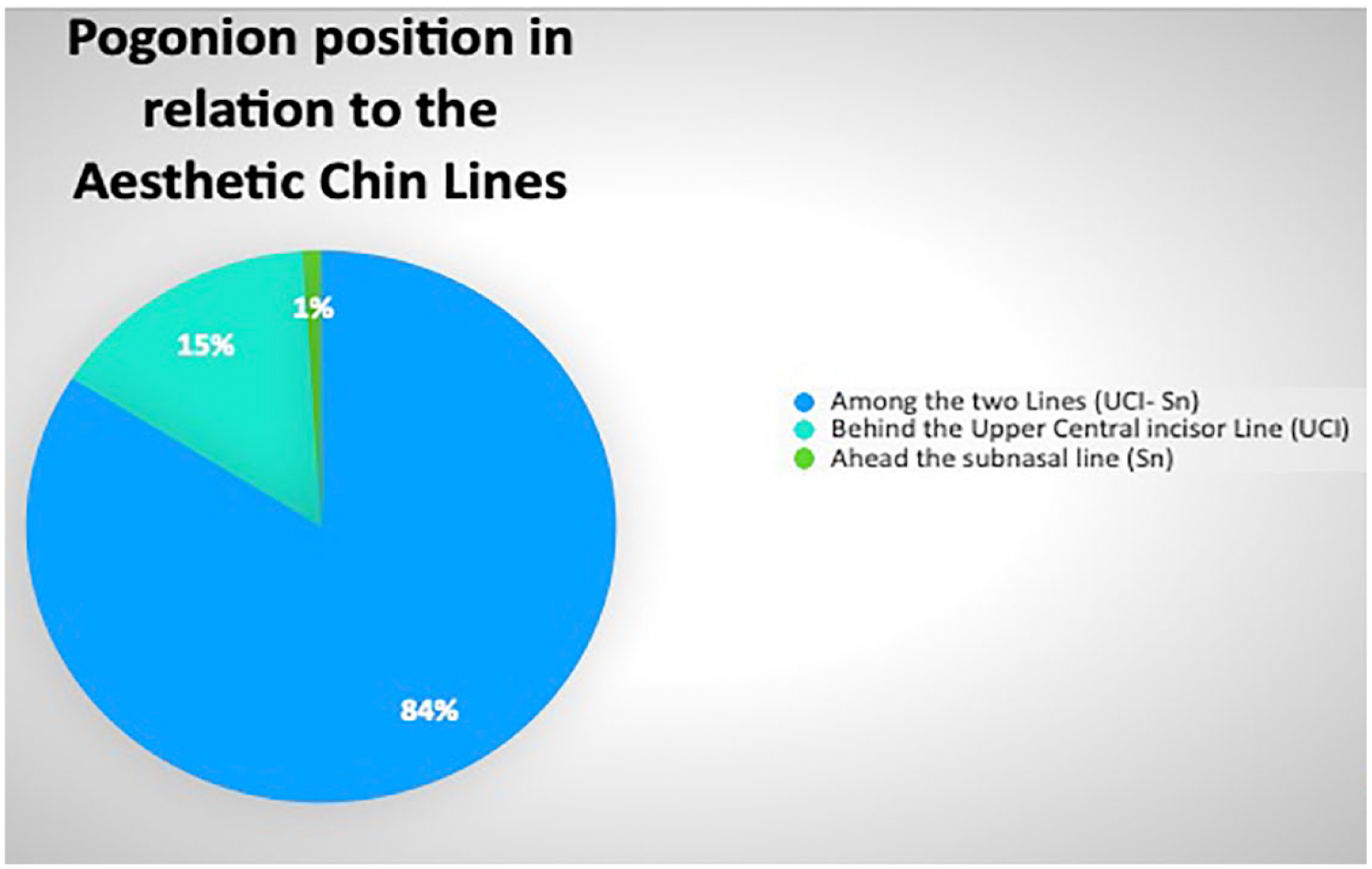
Pogonion position in relation to the Aesthetic Chin Lines.
To our knowledge, based on the scientific literature search (Pubmed, Sciencedirect, and Medigraphic), this is the first description of the Aesthetic Chin Lines, which provides the required parameters to aesthetically position the chin in the male population, taking as reference soft tissues (Subnasal) and hard tissues (Upper Central Incisor), allowing a clinical and photographic analysis of the facial profile, without the need radiographic lateral views. This reference allows us to combine the artistry of subjective analysis with the precision of objective analysis. When used for diagnostic purposes, the analysis is not as strict as with the usual cephalometric studies, meaning that the chin can be in an aesthetic position throughout the entire range of the Aesthetic Chin Lines, without the need to calculate means, or standard deviations.
Once an unaesthetic or functional chin has been identified, it gives us the basic tools to plan a personalized and unique treatment for each patient, if the Pogonion is within the verticals Subnasal and Upper Central Incisor, a digital program for surgery planning will allow us to make a measurement of the ideal position of the chin and compare it with the current position (Figure 2).
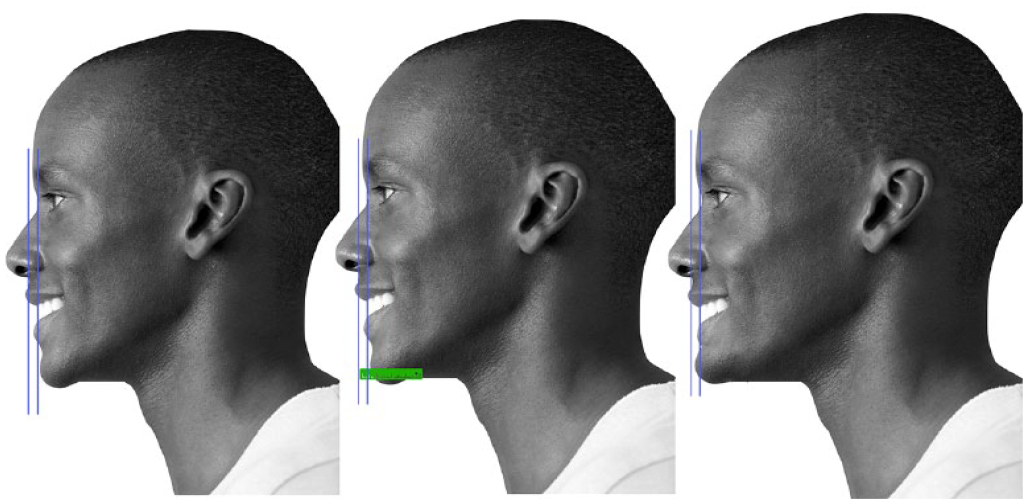
(A) Assessment of pogonion position in male individual; (B) Measurement of the ideal position of Pogonion in relationship with the Aesthetic Chin Lines; (C) Edited Prediction image of the ideal position of Pogonion in relationship with the Aesthetics lines of the chin.
This study represents a trend about what is aesthetic today in relation to the position of the chin. And it provides us with the tools to be able to apply it to our diagnosis and treatment plan for dentofacial deformities.
Not making use of millimeter-scale photographs, subjective rotation until reaching the natural position of the head, and the impossibility of ruling out malocclusions in our study group, represent our limitations and areas of opportunity for further studies.
Conclusion
Despite the limitations of this study, the constant position of Pogonion, in attractive male people’s profiles, remained within the true verticals of Subnasal and Upper Central Incisor in 84% of the cases. We can conclude that the Aesthetic Chin Lines that we propose, can be a diagnostic resource and treatment plan to treat dentofacial and chin deformities in male patients.
Replicating this study in female models, could be an important line of research, which would prove the applicability of the Aesthetic Chin Lines in the female population that by nature should has less prominent chins.
Footnotes
Declaration of Conflicting Interests
The author(s) declared no potential conflicts of interest with respect to the research, authorship, and/or publication of this article.
Funding
The author(s) received no financial support for the research, authorship, and/or publication of this article.
Ethical Approval
Institutional Review Board approval was not required.
