




Abstract
One powerful way to prepare students with significant support needs for employment in adulthood is to ensure they experience employment during high school. To assist students with significant support needs in developing their employment goals and connecting to and sustaining a job, we developed a person-centered planning meeting focused centrally on employment—the Employment Planning Meeting. During the meeting, an Employment Planning Meeting Tool (The Tool) is used to guide and provide structure and organization for a team supporting a student. It serves as a living document of the student’s interests, needs, and goals as they relate to employment during and after high school. This article describes each step of the meeting and how to use the Tool with students and their support team members. In addition, we share the experiences of professionals who organized and facilitated Employment Planning Meetings with a student with significant support needs and their families.
Keywords
“To prepare students with significant support needs for employment, opportunities to engage in early work experiences can play an influential role.”“The purpose of an Employment Planning Meeting is to collaboratively determine how a student can participate in valuable, paid work experiences during high school that will set them on a strong trajectory toward meaningful work in early adulthood.”
A primary purpose of the Individuals with Disabilities Education Act (IDEA, 2004) is to prepare students with disabilities, including those with significant support needs (e.g., individuals with an intellectual disability, autism with a cognitive impairment, and/or multiple disabilities) for future employment aimed at ensuring economic self-sufficiency. In addition, the Workforce Innovation and Opportunity Act (WIOA, 2014) requires Vocational Rehabilitation (VR) to allocate 15% of federal funding to Pre-Employment Transition Services (Pre-ETS) to assist students with disabilities in the transition to employment. Across these two large pieces of legislation, it is clear that a priority of transition education is focused on preparation for employment. In addition, we know that students with significant support needs expect to work. In a national study of youth with significant support needs in the United States, 86.3% of youth with an intellectual disability, 77.7% of youth with autism, and 86.1% of youth with multiple disabilities said they “definitely will” get a paid job after high school (Wagner et al., 2007).
To prepare students with significant support needs for employment, opportunities to engage in early work experiences can play an influential role. Indeed, obtaining early work experience prior to graduation is a predictor of later employment for students with disabilities (Mazzotti et al., 2021). In a recent study, Mamun et al. (2018) found that early work experience increased the probability of being employed 2 years later by 17 percentage points. Other benefits of early work experiences include exploration of interests, development of new skills, learning good work habits, assumption of valued roles, contributions to local need(s), and development of new friendships (Luecking, 2020; McLaren et al., 2017). Despite the many benefits of adolescent work experiences, barriers to these experiences persist, particularly for students with significant support needs (Awsumb et al., 2022; Carter et al., 2011).
One way to support students with significant support needs in finding early employment is to conduct an Employment Planning Meeting. Of course, each student has their annual individualized education program (IEP) meeting where their measurable postsecondary goal for employment is addressed; however, only a small portion of an IEP meeting focuses specifically on planning for students’ future employment. The purpose of an Employment Planning Meeting is to collaboratively determine how a student can participate in valuable, paid work experiences during high school that will set them on a strong trajectory toward meaningful work in early adulthood. Moreover, it identifies the roles students, families, educators, and additional student supports will each play in pursuing and supporting these important early work experiences.
A collaborative team, involving those in and outside of the school system, should assist students with disabilities in connecting to early work experiences. Prior research clearly demonstrates that collaboration is an essential practice to improve postschool outcomes (e.g., Bumble et al., 2022; Mazzotti et al., 2021; Park & Bouck, 2018). Moreover, both IDEA (2004) and WIOA (2014) emphasize that transition services can and should be provided by a variety of persons who know the student well in collaboration. However, despite the legal mandates and what prior research tells us about the effectiveness of collaboration, collaboration is still lacking (e.g., Bumble et al., 2022; Neubert et al., 2018; Oertle et al., 2021). In addition, few models exist for schools to use to increase interagency collaboration (e.g., Povenmire-Kirk et al., 2015).
The Employment Planning Meeting and the Tool
As part of a multiyear study focused on promoting early work experiences for youth with significant support needs, we developed a person-centered Employment Planning Meeting and an Employment Planning Meeting Tool (The Tool). The Employment Planning Meeting was held with nearly 25 students throughout the study. Each meeting lasted up to 90 minutes. During an Employment Planning Meeting, the Tool is used to guide the discussion during the meeting. Adapted from the Summer Activities Planning Tool (Carter et al., 2009), it incorporates seven planning sections: (1) identifying a student’s strengths and needs, (2) determining an employment goal, (3) considerations for transportation, (4) recognizing a student’s needs and supports, (5) identifying potential community employment options, (6) discussing employment plans for after high school, and (7) addressing other comments and concerns. In the remainder of this article, we address how to lead an Employment Planning Meeting and we describe each section of the Tool.
Who to Invite to an Employment Planning Meeting?
An Employment Planning Meeting is structured as a person-centered meeting where the student leads, or assists in leading, the discussion of their employment-related goals. They share their preferences, interests, needs, and strengths (often referred to as a student’s PINS) during the meeting so that they can obtain a paid job that furthers their long-term goals. For this reason, the student is the most important attendee at their Employment Planning Meeting. As a primary support of the student, their parent(s)/guardian(s) must also attend. Once students reach the age of majority and are their own guardian, we recommend their parent(s)/former guardian(s) are invited as part of the team with the student’s permission. In our experience, parents/former guardians can play an important role in supporting students in sharing information necessary to obtain and maintain a job (e.g., if they have a state ID or social security card, support needs).
Prior to the meeting, assemble a support team including the transition professional, student, parent/guardian, and other in-school and out of school supports that will: (a) support the student in obtaining paid employment and (b) help the student transition from high school to post-school life. The support team needs to include people who know the student well and can help speak to the student’s PINS. These individuals can include in-school professionals such as a case manager, special educators, general educators, paraprofessional, Pre-ETS provider (e.g., community rehabilitation providers, transition school to work personnel), and/or related service providers (e.g., speech language pathologist, occupational therapist). We recommend that other agencies, such as VR, the Department of Intellectual and Developmental Disabilities, Centers for Independent Living, and American Job Centers be included on the support team as they can provide critical assistance and services students need to be successful on the job. Moreover, in addition to aiding with employment (e.g., applying for jobs, job placement, job coaching, and transportation), these agencies can also provide assistive technology funding, benefits counseling, transportation, and more. Additional members can be included on the student’s support team based on the student’s individual needs.
One member of the support team serves as the lead facilitator. This team member is typically a professional providing transition services such as the special educator or Pre-ETS provider. The lead facilitator is a person that knows the student well and is available to take on the following responsibilities: identifying members to join the team, inviting each member of the support team, coordinating schedules so everyone can attend, preparing the student for the meeting, and communicating with the support team after the meeting. Although the student will lead the meeting as much as possible, the facilitator will use the Tool to guide the conversation and ensure all topics are covered.
Where to Hold the Employment Planning Meeting?
The location of an Employment Planning Meeting will be easy for the student, their family, and the entire support team to get to (e.g., the student’s school). This meeting can also be held on a virtual platform or in a hybrid format where some members of the team meet in person and others join virtually. We found it is best that the student, family, and facilitator attend the planning meeting from the same location, even if remaining team members are virtual, so the student has sufficient support. We also suggest that although virtual platforms are convenient for accommodating schedules, teams should meet in-person when possible. Our experiences holding in-person, virtual, and hybrid Employment Planning Meetings have made it clear that attendees are most engaged when teams are able to be physically together.
Preparing for and Holding an Employment Planning Meeting
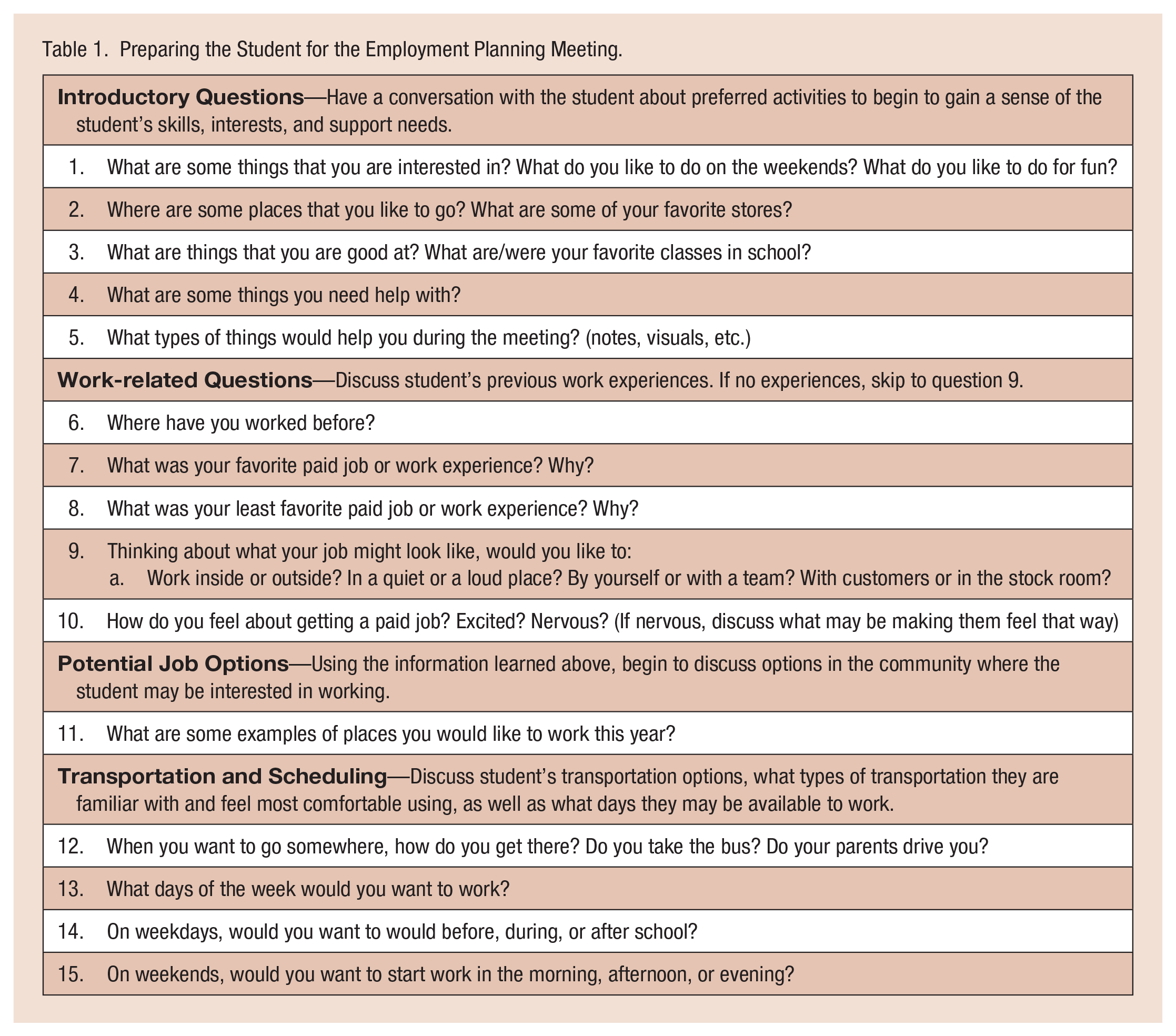
Ahead of an Employment Planning Meeting, the lead gathers all materials and assists the student in preparing for the meeting. Meeting materials include (a) the Preparing Students for the Employment Planning Meeting form (see Table 1) and (b) the Employment Planning Meeting Tool (see Figure 1). Each document includes questions to help the lead and other support team members assist the student in their employment endeavors. In each document, questions are categorized into areas of interest that will help the student prepare for and engage in an Employment Planning Meeting, find paid employment after the meeting, and maintain paid employment after exiting high school.
Preparing the Student for the Employment Planning Meeting.
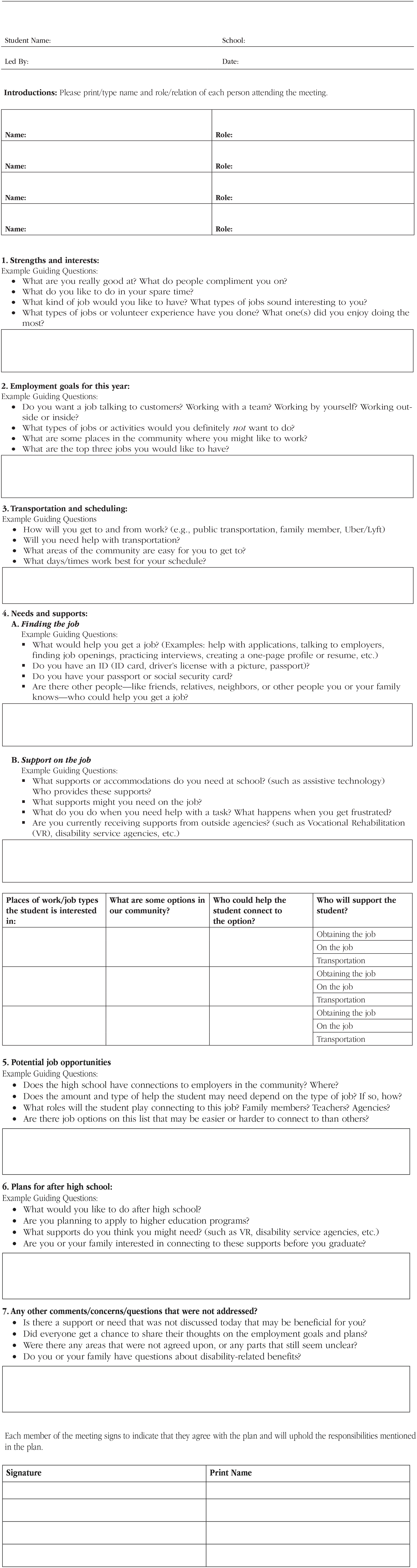
Employment Planning Meeting Tool.
To help students get ready for their Employment Planning Meeting, the lead helps them complete the Preparing Students for the Employment Planning Meeting form. It provides questions for the student to answer about themselves related to their personal interests, previous volunteer and work experiences, jobs they might enjoy, known transportation options, and scheduling preferences. The team lead can assist the student in answering the questions as well as recording the student responses. As well, families can provide additional helpful information.
For students with more significant support needs, certain assessments can help students prepare for the Employment Planning Meeting. The first section of the tool addresses students’ preferences in a more general sense, such as what they enjoy doing in school and after school. One assessment we used for our students with more significant support needs to answer these questions was the Preferences for Leisure Attributes Assessment (Kreiner & Flexer, 2009). It is a computer-based assessment that presents two pictures at a time for students to select from. For questions that identify employment preferences, students used the Pictorial Interest Inventory (n.d.). Students select pictures of job duties and careers that they were interested in and when the assessment is scored, it identifies from the eight categories of careers available the top careers and jobs the student is interested in. Using this information from these assessments helped the student create a one-page profile and PowerPoint with assistance prior to the Employment Planning Meeting.
During the Employment Planning Meeting, the support team will use the Tool as a guide. The top of the Tool includes space to list members of the support team and the roles they play (e.g., teacher, speech language pathologist, VR counselor). The team then works through each of the seven sections of the Tool. The purposes of these seven sections are to identify potential workplaces where the student will be successful and what considerations and supports are needed to ensure that the student is set up for a valuable paid work experience.
Section 1: Identify Strengths and Interests
This section invites the student to answer multiple questions related to their PINS. Having the student share this information at the start of the Employment Planning Meeting helps the team start to think about potential jobs that would be a good fit for the student. It also establishes the student as the central focus and voice of the meeting. To support students in sharing their PINS, slides (e.g., PowerPoint and Keynote) or a vision board can provide a structured approach. The student will discuss their strengths, their free time interests, jobs they might like to try, and past experiences in which they have explored or developed work-related skills (e.g., volunteer work, work-based learning experiences with their school, paid or unpaid jobs).
Section 2: Determine Employment Goals
This section poses questions that help the student set an employment goal. This involves identifying what is important to them in a job, their work environment and activity preferences, and the three jobs that most interest them. The student and support team discuss work preferences, such as group versus independent work, an energetic versus quiet atmosphere, indoor versus outdoor work, and their comfort engaging with customers. When discussing a student’s preferences, having the student discuss workplace dislikes can be insightful.
Teams could also use the information gleaned from this section to form employment goals in the transition section of the student’s IEP. Knowing a student’s preferences when deciding on an appropriate job placement can be used as a measurable postsecondary goal for employment. For example, one of the students wanted to be a server at a restaurant but had never worked in a restaurant before. While in high school, they worked as a busser and a host, and the measurable postsecondary goal in employment for that student was “Upon completion of their high school diploma, student will be a server at a restaurant.” In addition, skills that need to be worked on to obtain the employment position the student desires could be written as transition measurable annuals goals for the student.
Section 3: Consider Transportation Options
Questions in this section focus on exploring transportation options and scheduling. The team works together to identify what transportation is available and feasible to use to get to potential workplaces. The team will also discuss the supports a student may need while using different forms of transportation (e.g., a wheelchair accessible lift, travel training, a transportation support person). The support team may need to spend time during this part of the meeting brainstorming creative transportation solutions. For example, the school district may be able to use the same bus used for work-based learning opportunities to transport the student to work. Or perhaps a parent or family member can provide transportation support. Other transportation options can include sharing rides with peers from school, rideshare services, public transportation, or specialized transportation for people with disabilities such as paratransit.
Section 4: Recognize Needs and Supports
This section is divided into two parts focused on the supports a student will need to find a job and maintain a job. First, the team identifies what supports are needed to connect to a job. This is the time to designate member(s) of the support team who can help the student complete a resume or one-page profile, complete job applications, and obtain any required identification (e.g., ID card and social security card). Finally, during this section, it is important to brainstorm any other persons in the student’s network that may not be at the Employment Planning Meeting, but who could assist the student with finding a job.
Next, the team identifies the supports needed to maintain a job. Here, the team will discuss any accommodations from school that may also be helpful in the workplace. For example, does the student use assistive technology or a daily task list? Would these accommodations be helpful or necessary in a workplace, too? Provide the student time to share who they turn to when they need help with social scenarios, asking for help, and task management. In answering these questions, the team can better identify the type of support the student will need and be ready to communicate these needs with the employer. Of course, supports must always be individualized based on a student’s needs. Finally, the team discusses whether the student is connected to outside services (e.g., VR, community disability service agencies) and, if not, what steps will be taken. Connecting to an outside agency can help the student obtain supports needed for employment during and after high school.
Section 5: Identify Potential Places of Work in the Community
After completing Sections 1 to 4, the student and support team are ready to identify three businesses to approach. In the Tool, there is a fillable table for the lead to complete during the meeting. The table includes columns for (1) the student’s job interests, (2) workplace options in the community, (3) who could support the student connecting to the employer, and (4) who will support the student with obtaining, maintaining, and transportation to and from the job.
First, the student and the team work together to list the type of jobs that interest them and the top three places to begin the job search. Then, the support team will discuss who could connect with the employer at each workplace of interest. In many cases, someone on the team has a connection to one of the businesses identified. Draw upon each team member’s connections to the community to help the student arrange an interview. The final column on the table names which team members are responsible for each aspect of support related to obtaining and maintaining the job. Who is responsible for helping the student initially get the job? Who is responsible for supporting the student to complete an application, turn in the application, go through the interview process, and follow-up after the interview? The next place to complete on the table identifies who will provide support on the job; this could mean job coaching, modeling, or providing a schedule of tasks. Finally, the persons who would be responsible for transportation to and from each of the job options is determined. Considering that the three potential job choices could be in different geographical areas, all three workplaces could have different transportation plans. Make sure the persons listed within the table are not limited to the parent/guardian or the special education teacher. A benefit of the meeting is to spread out responsibility among team members so no one person feels overwhelmed with helping the student find and maintain employment.
When assigning responsibility for connecting students to jobs, there are additional questions provided that the support team may need to consider. Think about the connections the high school already has with places in the community. Could a business that provides work-based learning also hire a student for pay? Who else will help the student connect to potential workplaces? Does the family own a business or have friends who own businesses in the community who are open to hiring? It is important to consider which businesses the support team has the strongest connections to. If the student is amenable, starting with their second or third choice may be the quickest and most efficient job option. Keep in mind, businesses that the support team are not connected with will often take more effort and time to cold call, email, or physically meet.
Section 6: Discuss Plans for After High School
This section focuses on the student’s post-high school plans. Students share whether they would like to continue working after graduation or if they want to enroll in a postsecondary education program. If they want to continue working, the student, their family, and the other members of the support team need to identify what supports will be needed to continue working, either at the student’s current place of employment or a new business. For this reason, it is helpful to have agency representatives present, such as VR, to address available services based on the student’s needs. A VR counselor can help the student prepare for changing jobs, enroll in a certification or technical program, provide assistive technology, and much more. It is important for teachers to emphasize to the student and their family that the student needs to be connected to these services prior to graduation.
Section 7: Address Other Comments and Concerns
The last section asks the support team to address any items not discussed. It is important that everyone has a chance to share their opinions about the employment goals and plans for the student’s employment process. The team lead asks whether any parts of the plan seem unclear and need to be repeated so that everyone on the team knows what the next steps are regarding their role in the employment plan. Any questions related to disability benefits are answered here. The Tool concludes with a signature section for everyone on the team to sign, indicating they will fulfill their responsibilities regarding the plan. Once the Employment Planning Meeting is over and the Tool has been completed, everyone will know their roles and responsibilities to support the student’s employment goals.
Action Steps After the Employment Planning Meeting
Following the Employment Planning Meeting, ongoing and action-oriented communication between all support team members is essential. We recommend the lead facilitator send a follow-up email to the student and team members that summarizes the roles and responsibilities everyone agreed upon during the meeting. As well, the lead shares the completed Tool and the student’s slides or vision board (if used) for reference by the support team. If any support team member was not in attendance, include them in the group email, share the expectations of their support for the student, ask them to confirm their ability to fulfill their role, and follow-up with any questions.
Action items will vary depending on the student. However, all action items will directly relate to finding paid employment before graduation. Examples of common action items include (a) completing a VR intake meeting, (b) applying for state identification, (c) creating a 1-page profile or resume, (d) attending benefits counseling sessions, (e) completing work-place readiness training, (f) conducting a job search, and (g) applying for jobs. Personalize action items based on the student’s work interests, skills, agency supports, and accommodation needs.
The creation of the shared email thread encourages ongoing communication and collaboration. The facilitator sends out weekly employment updates. Likewise, they can use the group email thread to brainstorm business outreach ideas and to coordinate schedules when additional meetings are needed. Finally, communicating with families and school staff using the group thread helps combat miscommunication issues and streamline job search efforts.
In our work, we have used the group email thread to solve communication and collaboration barriers such as ensuring everyone is on the same page about the status of paperwork (e.g., agency applications and job applications), the connection to agencies (e.g., Pre-ETS providers and VR counselors), or the support being provided by agencies. Creating accountability through the shared email thread can emphasize the importance of taking responsibility for goals the student has set and helping the student move forward with meeting their goals. If a support team member does not respond within an adequate timeframe, it is the lead’s responsibility to reach out to the team member directly to follow-up.
Employment Planning Meeting Tool Teacher Feedback
As part of our broader research project, we asked team leads to share their experiences leading Employment Planning Meetings and using the Tool and preparation materials. Overall, the leads reported positive experiences. When asked which aspects were most useful, one special educator referred to the usefulness of the preparation materials sharing that the “sheets to help us guide through . . . made it very simple.” She acknowledged that communication with parents and agencies is often very difficult, but the Employment Planning Meeting “takes something off the teachers” and “helped out big time.” She also discussed the student presentation template, saying “I think that the slideshow that [the student] and I put together, how proud he was of being able to present that, have pictures, he had his note cards to read I mean those things really stick out.” Another special educator had similar reflections and said the Tool and preparation materials “were helpful, helping guide the whole process and keeping everybody on track.” Regarding the collaborative nature of the Employment Planning Meeting, one special educator said, I loved it when everybody came together in the meeting, all the different agencies came together and were just pitching ideas and like: “Hey, I can do this! I can do that!” I’ve invited agencies before, but they’ve never really showed up, or they’re like, “Oh, if the parent needs anything, let me know.” So, for me as a teacher, having those agencies there, everybody in the classroom, even with COVID and the rules, they still showed up. They were there. We got a plan together.
Finally, a special educator shared the benefits of holding the Employment Planning Meeting, I think it’s great to have a whole team come together and be like, this is what we can do. This is how each person can help. I feel like it’d be a very smooth process if everything was in place and to have those meetings to ensure the smooth transition. It gives a school and community a good transition because it’s hard for when our kids leave. If there’s not that transition piece and we just end one thing and then they’re expected to start something completely brand new that they don’t know or understand, that’s a lot. Yes, I think it’s a great idea. I love it.
Concluding Thoughts
Students with significant support needs require in-school preparation and support to access paid employment opportunities before graduation (Mamun et al., 2018; Mazzotti et al., 2021). We developed the Employment Planning Meeting Tool to assist students and their support teams in planning and collaborating in ways that lead to valuable employment experiences. The Tool is a living document to be revisited and updated regularly as needed. Approaching a student’s employment planning as its own person-centered planning meeting provides a space for the student to identify employment opportunities that interest them now and to discuss pathways to long-term employment goals. Of course, this can also include conversation about postsecondary education or training programs that might help students achieve their career goals.
The Employment Planning Meeting and Tool ensure students with significant support needs form a support system and that they themselves know who makes up that support system. This is important to help students know who to turn to when they have questions and needs related to their employment endeavors. Defining each person’s roles on the support team increases the likelihood that action steps will be taken after the meeting. The result of this team-based person-centered Employment Planning Meeting and the completion of the Tool is that students are provided necessary assistance to connect to a paid job that meets both their desires and strengths. Trying jobs allows students to refine their long-term employment goals and test and improve their skills as well as build an understanding of skills they may still need to develop (Bowman et al., 2022; Schutz et al., 2023). Well before students near school exit, consider holding an Employment Planning Meeting and using the Tool as a mechanism to bring together current and new members of the support team to create a plan and begin to connect students to paid employment opportunities.
Footnotes
Conflict of Interest
The author(s) declared no potential conflicts of interest with respect to the research, authorship, and/or publication of this article.
Funding
The author(s) disclosed receipt of the following financial support for the research, authorship, and/or publication of this article: The work reported in this article was supported by grant funding from the National Institute on Disability, Independent Living, and Rehabilitation Research-Rehabilitation Research and Training Center (RRTC) on Employment of Transition-Age Youth with Disabilities (HHS-2019-ACL-NIDILRR-RTEM-0339).

Author Biographies
Jessica Awsumb, Ph. D., is a Research Assistant Professor in the Department of Special Education. Her work focuses on the importance of preparing youth with disabilities for meaningful community participation and on addressing individual and systemic factors that lead to successful or unsuccessful adulthood outcomes for youth with disabilities.
Justine Hrvatin, M.S.Ed., M.A.T. is an Education Consultant in the Department of Special Education at Vanderbilt University. Through her teaching experience with youth with high support needs in alternative and low socioeconomic settings, she has focused on the improvement of teaching practices surrounding transition in the classroom and community, in addition to the education of families on the transition process.
Hilary Travers, Ph.D., is an assistant research professor in the Department of Special Education. Dr. Travers’ research has focused on supporting the lives of students with disabilities age 14 and older to ensure their access to opportunities in school and their success in the transition to life after high school.
Erik W. Carter, Ph.D., is Cornelius Vanderbilt Professor of Special Education at Vanderbilt University. His research and teaching focuses on evidence-based strategies for enhancing outcomes and valued roles in school, work, community, and congregational settings for individuals with intellectual disability, autism, and multiple disabilities.
Laura Guest, M.S.W., joined Vanderbilt University’s Special Education department in February 2020, as an Educational Consultant. Focusing on increasing the employment outcomes of youth and adults with intellectual and developmental disabilities.