




Abstract
What are contemporary practices of collaborative funding and financing for artists, and how are institutional funders involved? To address this question, we map contemporary funding models in the Netherlands. We identify three ways in which governments and other (semi-public or private) entities engage in collaborative funding and financing: cooperating funds, which are similar to traditional subsidies but cater to artists who do not fit into a single category; pooled funds, newly created resources aimed at marketable initiatives with the potential for revolving structures; and matching funds, which come in three variants with an expected flywheel effect. With upfront matching funds, governments can incentivize each other. Hubs are physical spaces with incubator qualities that encourage additional funding. And platform-supported matching funds rely on technology to crowd in resources from both institutional funders and fans. The implications of our study suggest that collaborative funding models can increase financial resources for artists and promote productivity and inclusivity, although they may also involve coordination costs that reduce net funding. For policymakers, it is essential to design and coordinate these models carefully to ensure they remain fair, effective, and capable of providing sustained support over time. We conclude by speculating on the future role of artificial intelligence in artist funding, based on insights generated by artificial intelligence itself.
Introduction
The funding landscape in the cultural and creative sectors is increasingly defined by a new paradigm that departs from traditional models of public and private financial support (Loots et al., 2022). This emerging paradigm emphasizes collaborative approaches to funding and financing, including support through and by incubators and accelerators, as well as crowdfunding, digitized fundraising methods, online monetization, and impact investment (Handke and Dalla Chiesa, 2022; Lücke, 2015; Patrickson, 2021; Peukert, 2019; Terui and Takahashi, 2022; Tosatto et al., 2019). Technology supports some of such new modalities, for example, by tokenized funding and platform-based crowdfunding. The benefits of digitalization in funding and financing include more dynamic and faster financial allocations (Handke and Dalla Chiesa, 2022), transparency (Mollick, 2014), lower transaction costs (Belleflamme et al., 2013), and the representation of the voice of the crowd that ensures a collective legitimization of funding goals (Loots et al., 2024). The relationship between public finance and these developments remains underexplored—a surprising omission given the long-standing and often contested tradition of public support for the arts and cultural sectors (Hughes and Luksetich, 2004). This article seeks to address that gap.
Public support to the arts is often justified based on arguments that boil down to externalities or public/collective good properties (Abbing, 2002; Samuelson, 1947/1983; Towse, 2019). How the arts can be best supported is another question. A widely accepted form of public support for the arts in many parts of the world are subsidies for artists (Alper and Wassall, 2006; Bille et al., 2017; D’Andrea, 2017; Mangset et al., 2016; Throsby and Zednik, 2011). Persistent discussions within this topic are whether subsidies solve artists’ low-income problem (Abbing, 2002), whether governments tend to support artists that are already earning an income in the arts market (Rengers, 2002), and whether subsidies attract more artists to the profession leading to a perpetuation of low incomes rather than a solution of this problem (Towse, 2019).
The aim of the present article is to update existing insights in public funding by focusing on a new direction in funding of the arts that we label “collaborative funding.” Collaborative funding refers to forms of financial support that combine money from different origins and trespass the long-lasting boundaries between public and private. Collaborative funding practices may entail an element of financing (with the expectation that money is paid back) instead of simply funding. Collaborative funding remains underexplored in the academic literature, despite its potential to address declining public arts funding and to mobilize private support. Our research question is: What are contemporary practices of collaborative funding and financing for artists and in what ways are institutional funders involved? The thesis of this article is that collaborative funding is still in an experimental phase, emerging in diverse forms without a consolidated model, as the needs and frameworks for collaboration among funders remain fluid and unsettled. To answer the research question, we draw upon a mapping and analysis of contemporary public funding initiatives in the Netherlands to identify the ways in which the government and other (semipublic or private) entities engage in collaborative funding and financing. In addition, this research aims to explore the future of collaborative funding, with a particular focus on the potential role of artificial intelligence (AI). As part of a speculative exercise, we engaged with OpenAI's ChatGPT (GPT-4o, July 2025 version) to generate reflections on the future role of AI in arts funding.
The impending importance of collaborative funding is expressed on different societal levels. In the Netherlands, the major advisory body for culture (de Raad voor Cultuur/the Council for Culture) recently issued an advice on access to culture on the way to a new system in 2029 (Raad voor Cultuur, 2025). The council argues for providing more variation in the available financial instruments. In addition to the familiar forms (e.g., institutional subsidies, project subsidies, program subsidies and grants for individual makers), the council states: “We also see other ways for the government to finance culture, such as loan facilities, guarantees or forms of financing that make in-depth investments possible for the longer term” (p. 133). It is this variation—in its contemporary and future manifestations—that the present study seeks to examine, to better understand a funding landscape where public and private sources increasingly intertwine rather than compete with, or crowd out, one another.
Academically, examining contemporary forms of collaborative funding contributes to a longstanding tradition of arts funding research, which has historically focused primarily on public subsidies (Ashton, 2023; Pinnock, 2024). In practice, it offers valuable insights for artists and arts organizations seeking to diversify their funding sources and for governments and cultural funding bodies exploring new collaborative approaches to arts support. In the remainder of the article, we begin by clarifying the terminology used to classify various types of funding and financing followed by a brief review of the literature on subsidies for artists. We then outline our methodological approach and present a legend for interpreting the models featured in the findings. Finally, we discuss the implications of collaborative funding for society, artists, and cultural policy and speculate on AI's potential role in future funding.
Terminology
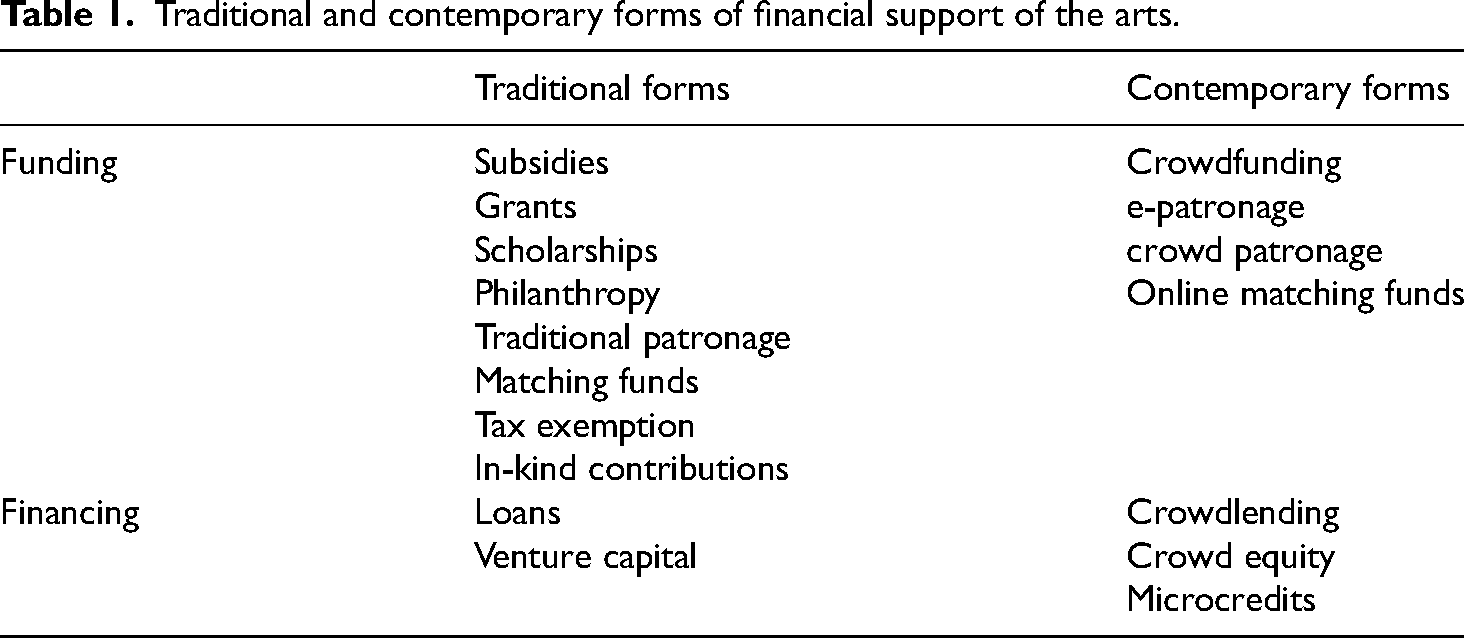
While funding and financing are sometimes used interchangeably, there is a conceptual distinction between the two. Funding typically refers to nonmarket-based mechanisms and includes support from public or private partners, consisting of grants and subsidies, tax exemptions, as well as financial support from philanthropy, patronage and, more recently, crowdfunding. Financing, in contrast, typically refers to money provided as a loan, investment, or credit, which needs to be repaid often with interest or a return on investment. Financial institutions and investors provide financing to projects or entities, which are expected to generate sufficient income or profit to repay the borrowed money and/or provide returns. Both forms of financial support in the arts can be classified according to their traditional or contemporary character. While traditional forms of financial support may be more sustainable in the long run and less subject to variation and fluctuations, the flexibility of new forms of financing may be attractive to some creators. Some contemporary forms are implemented in the digital sphere. Table 1 provides a conceptual overview.
Traditional and contemporary forms of financial support of the arts.
Literature: Public funding for artists
Economists have justified public funding for artists based on a few contestable arguments, namely: externalities, innovation, public goods, and merit goods. The externalities argument implies that subsidies can be granted to artists to increase their presence and visibility in international markets, with presumed spillover effects (Abbing, 2002; Potts and Cunningham, 2008). An innovation argument relies on a similar premise: subsidies can lead to artistic innovations that eventually benefit other domains in an economy (tourism, technological innovation; Potts and Cunningham, 2008). Another angle can be found in a public/collective good argument (Samuelson, 1947/1983) supported by the expectation that the benefits of the arts accrue to (all) citizens, and the market fails to arrange for the provision of the arts, leading to its underprovisioning (Towse, 2019). However, economists have long maintained that without subsidies, art would not be underproduced because of artists’ strong preference to make artworks rather than engage in other work or leisure activities (Abbing, 2002; Throsby, 1994). This tendency is often interpreted as a matter of artists’ intrinsic motivation (Caves, 2002; Cnossen et al., 2019; Sheldon and Corcoran, 2019). The last argument is coined as the merit good argument whereby certain art forms are socially and culturally understood as having intrinsic value to society. For example, heritage institutions, orchestras, operas, and museums are typically categorized as sectors marked by market failure but possessing significant cultural value—an argument often used to justify public subsidies (Potts and Cunningham, 2008). While this rationale is widely accepted in cultural policy, it has also been criticized as patronizing or elitist (Abbing, 2002), and as insufficiently addressing the broader role of the arts in contemporary society (Belfiore and Bennett, 2007).
In practice, public funding in the form of subsidies is frequently considered a necessary addition to artists’ income and even established to alleviate poverty among this occupational group. However, research has revealed the complexity of the matter. Abbing has explained what happens under the surface of such an artists’ policy (2002; 2011). Typically, the population of artists is diverse and consists of (1) a relatively small group of artists who are not poor (some even wealthy); (2) artists who are poor, but not inevitably: they can make a living but tend to spend any additional or unexpected income on their art; and (3) artists who are inevitably poor and are in a danger zone because they can hardly make a living. Many young artists belong to the latter group. Put differently, the income distribution of artists is skewed (Mangset et al., 2016). Subsidies to artists may make those belonging to the first group better off (as per Rengers, 2002), those belonging to the second group spending more on their art, and those belonging to the third group a bit further from the danger zone (Abbing, 2002; 2011).
Empirical research shows that such mechanisms can turn out even more harmful for poor artists. For example, Rengers (2002) studied the origin of visual artists’ income in relation to its private or public origin. He distinguished between a private market (consisting of market demand, commercial galleries, and non-governmental organizations) and a public market (controlled by the government and including tasks such as the provision of subsidies, buying and lending art, promoting art). Artists and these two markets relate in several ways to each other. In a specialized market structure, artists chose to operate in either of both markets, for example, because of information and other transaction cost advantages. In an independent market structure, artists can be successful in one or either of both private and public markets based on specific efforts. Finally, the art market can also be conceived of as a winner take all structure, with a relatively small number of artists who are successful in both private and public markets (Rosen, 1981). Based on his empirical research, Rengers (2002) concluded that the Dutch art market functions as a winner takes all system, a dynamic further reinforced by government subsidy policies that tend to favor artists already active in the private market. Overall, 57% of the total income of all artists active in the Netherlands was earned in the private market, 43% of it came from the public market, and a very limited number of artists gained their income from both private and public sources (year of reference = 1995). This research seems to suggest that subsidies for artists did not make (poor) artists less poor. In a similar vein, and more recently, Peters and Roose (2022) found that in Belgium, it has become increasingly difficult for emerging artists to obtain subsidies, while established artists are more likely to benefit from public support.
It has also been suggested that subsidy-based policies for artists may inadvertently attract more individuals to the field (Towse, 2019), thereby increasing competition for limited resources. Rather than alleviating poverty among artists, such subsidies risk exacerbating an excess supply of artists—an issue further complicated by the intrinsic motivations driving artists and the asymmetrical information inherent in artistic labor markets (Caves, 2002). Mangset et al. (2016) have tackled the question explicitly by asking “why are artists getting poorer, despite the generous public funding of culture in Norway?” (p. 544). They find that excess supply affects income development on an aggregate level but not for all artistic professions. They find other explanations for declining artists’ income (between 2006 and 2013): decreasing artistic working time (and a corresponding increase in artistically related and non-artistic working time) and decreasing cultural consumption (spending) among Norwegians (Mangset et al., 2016). However, individuals were also found to demonstrate their support for the arts and artists through financial contributions, particularly during the Covid-19 pandemic (Terui and Takahashi, 2022). Thus, despite the presumed increased competition for arts funding, the causes of the impoverishment of artists are more complex than public funding alone. The declining productivity gains in labor-intensive sectors (Baumol and Bowen, 1966), the increasing occupational diversity among artists (Booth and Røyseng, 2022; Throsby and Zednik, 2011), and the decreasing cultural spending by consumers have all been well documented. Together, these factors reflect a complex arts landscape where information is unevenly distributed, artistic output is abundant, and consumer demand is interdependent (Becker, 2023).
Nevertheless, all existing studies tend to adopt a traditional perspective, concentrating solely on public support for artists rather than exploring hybrid funding models that may have different impacts on the artistic labor market. Given the decline in state funding for the arts in many countries, there is a pressing need for deeper insights into new forms of financial support to artists to better understand the interplay between arts funding, artistic practices, and the labor market.
Methods
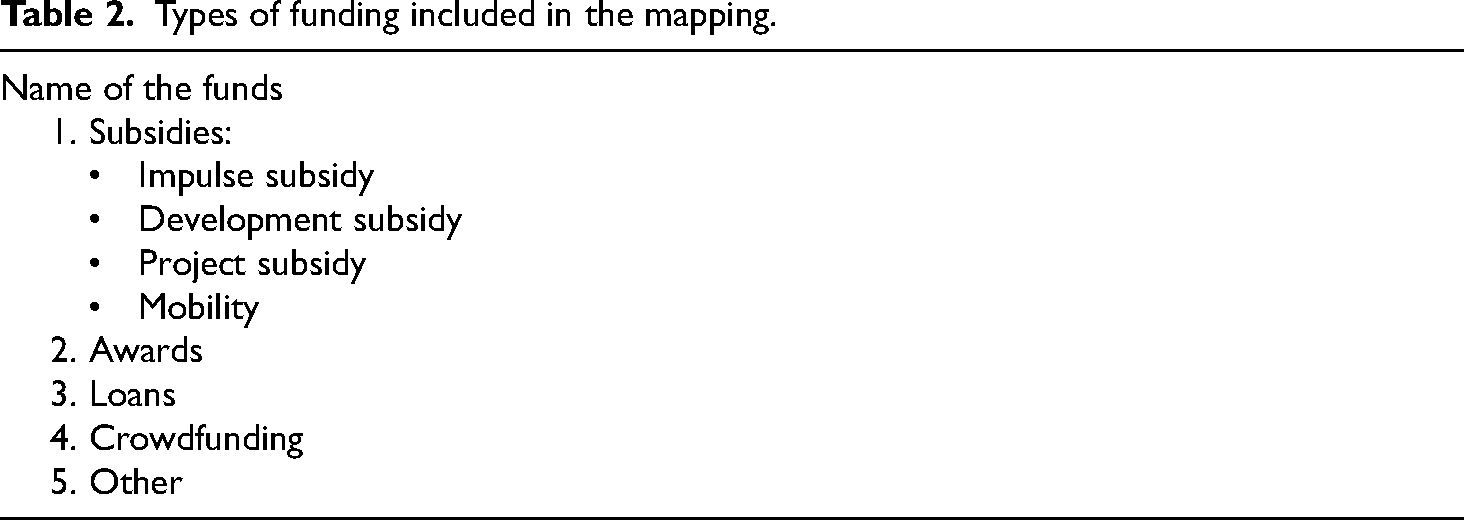
To provide a contemporary perspective, we draw on a mapping method based on website information and annual reports of 25 public, semipublic and private funding entities in the Netherlands. Between October 2023 and January 2024, two researchers created a working document in which all financing and funding schemes for individuals (artists as well as other makers and creators) were systematically outlined. Subsequently, two researchers independently selected the forms of funding and financing among them that illustrated the collaborative funding trend. These were thoroughly discussed, clustered and eventually modeled (cf. Findings section). Table 2 presents the classification scheme used to map the funding options.
Types of funding included in the mapping.
As part of a speculative exercise, we engaged with OpenAI's ChatGPT to generate reflections on the future role of AI in arts funding. ChatGPT is a language model developed by OpenAI. We used the GPT-4o version available through ChatGPT as of July 2025. The prompts we used are included in Appendix 1. We provided ChatGPT with key insights from our research, which it used to synthesize and propose potential roles for AI in the collaborative funding of artists. All outputs were carefully reviewed and interpreted by the authors to ensure they aligned with our research context and aims. We assessed the AI-generated suggestions for their realism, practical value, and conceptual nuance. To support the validity of our interpretations, we also consulted with an expert affiliated with a partner organization monitoring the project, with whom we discussed our reading of the AI-generated outputs.
This research project was funded by the Ministerie van Onderwijs, Cultuur en Wetenschap (Ministry of Education, Culture and Science; hereafter, ministry of culture) and monitored by three organizations, each with a specific role in the Dutch cultural field. First, Platform Arbeidsmarkt Culturele en Creative Toekomst (The Cultural Labour Market and Creative Future Platform, also known as Platform ACCT) is an organization that supports artists and creators in their professional practice, including legal and legislative needs. Second, Cultuur + Ondernemen (Culture + Entrepreneurship) aims to promote the entrepreneurship of organizations and individuals in the cultural sector. Third, Voordekunst (For the Art) is a crowdfunding platform with a particular focus on publishing and supporting projects in arts and culture. All three entities are interested in combined funding and financing practices. In addition to the mapping, the researchers involved conducted interviews with artists and focus-group conversations with funders and funding recipients. The project (In the Mix) was characterized by several iterations and feedback loops between the academic team and the partners, who simultaneously researched the institutional perspective on combining funding schemes.
The context is the Netherlands, a country with a long tradition of subsidies for artists, which are currently organized at arms’ length by quasi-independent cultural funds comparable to the UK's art councils (Van Andel and Loots, 2022). These quasi-independent cultural funds have been set up to distribute government funding while creating distance between these bodies and the political environment. In addition to six public rijkscultuurfondsen (national culture funds), of which five are sector focused and one is focused on cultural participation, there are numerous private, semipublic (e.g., connected to lotteries) and regional funds. The Netherlands also has a well-developed cultural and creative crowdfunding system in place, which usually happens through Voordekunst, an online crowdfunding platform that emerged from a public local cultural fund (Amsterdams Fonds voor de Kunst). The highly diversified funding landscape in the Netherlands makes it an ideal context for studying new forms of arts funding. Additionally, focusing on a single national context allows for a more nuanced analysis of the interactions between ecosystem actors, which are expected to be more closely attuned.
Legend
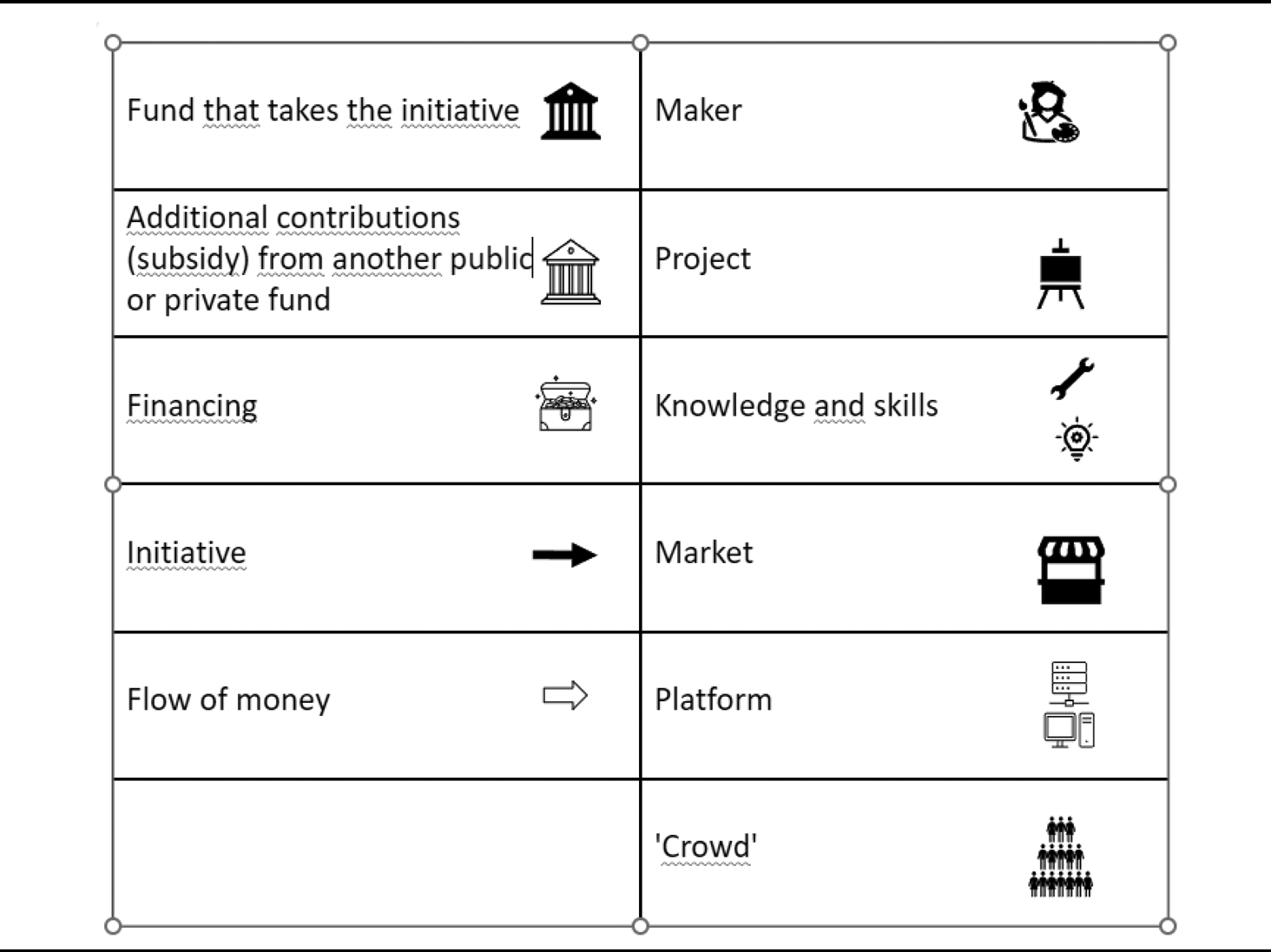
Before discussing the models of collaborative funding, we first visualize the funding and financing processes. The visuals illustrate how the models represent a pathway, where a stakeholder takes the initiative, leading to one or more flows of money. These models highlight both the pathways and the intersections where other entities—such as the market, additional financiers, platforms, and the like—may also play a role. While the models are generally simple, depicting one-way flows, some represent more complex traffic intersections connecting multiple funding and financing entities. In these models, we depict the artist as a painter, with her envisioned project as a painting; however, other creative types and end goals can be imagined in this framework Table 3.
Legend.
Findings
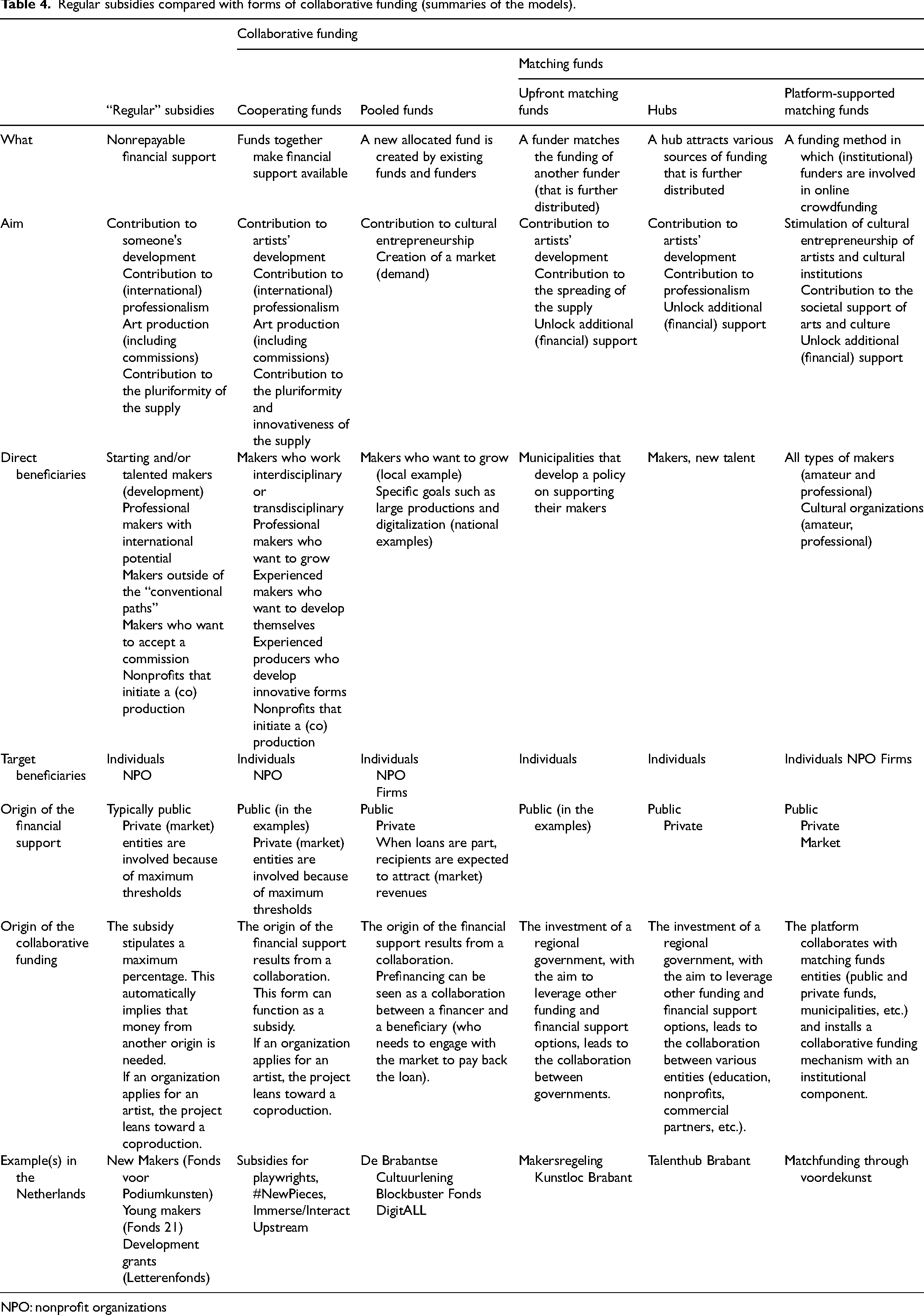
Our findings are structured as follows: We first present a model of (a) regular subsidies and describe a few deviating examples. Then, we move to (b) collaborative funding, which consists of three main categories: cooperating funds, pooled funds, and matching funds. The latter further includes upfront matching funds, hubs, and platform-supported matching funds. Each section details our model and a brief description of the examples with illustrations (summarized in Table 4). We use real names for the examples to allow readers to explore them further. However, our primary focus is on the abstract generalization of these concrete examples—constructing ideal-typical cases that can represent a variety of scenarios globally. As such, we do not delve into specific details such as project duration, available budgets, or examples of funded projects.
Regular subsidies compared with forms of collaborative funding (summaries of the models).
NPO: nonprofit organizations
Regular subsidies
Subsidies are a well-known form of funding commonly issued by a government or funds that make resources available to artists. Most research on arts funding concerns this model (Alexander, 2018; Feder and Katz-Gerro, 2012; Peters and Roose, 2022; 2023). Subsidies are not always restricted to projects in terms of a production (e.g., theatre production, exhibition, film project, and music recording) but can also be made available for artistic development. In that case, they are referred to as grants (or scholarships). Subsidies typically do not cover the total cost of a project nor do they suffice to make a living. It is up to the artist or an organization assisting the artist to seek additional financial support from other financiers or funds or through sales. Often, the maximum amount of the subsidy is a predetermined percentage of the eligible costs. The artist applies for the funding, but sometimes financiers expect an organization to apply on behalf of the artist. In such cases, that organization acts as an implicit or explicit coproducer.
Because this form of funding is the standard, it is well known to artists. As a result, artists do not have to go outside their comfort zone as much when applying for this type of financial support. By applying for subsidies, artists are not put in a position where they need beg audiences or patrons for money, which they find difficult (van den Braber, 2024). Finally, subsidies reduce artists’ dependence on the whims of the market. However, a major drawback is that the available budget often falls short of meeting all subsidy requests, leading to selection procedures that may disadvantage newcomers and artists working in niche areas (Loots, 2019; Peters and Roose, 2020).
In the Netherlands, sectoral and other (semi-)public funds provide numerous subsidies to artists, often with specific conditions attached. Typically, an applicant qualifies for only one funding scheme at a time, though there are exceptions. An example is the development grants scheme of the Nederlands Letterenfonds (Dutch Foundation for Literature). The Nederlands Letterenfonds sets explicit conditions for two forms of funding. To apply for a development grant, an applicant must also apply for a project grant. This policy is designed to invest in both the artistry and cultural entrepreneurship of authors. Project subsidies are available to writers who are developing a professional publication, have previously published work, and earn below a certain income threshold. The development grant, which can cover travel and accommodation costs, aims to support authors in achieving developmental goals, as achieved, for example, through training, coaching, or guidance.
In the case of regular subsidies, funds traditionally focused only on the interaction between the artist and the fund, with rare exceptions. Although artists might need to apply for various subsidies to fund their projects, funds generally are not concerned with these other applications. Yet, within the regular subsidies, we increasingly see hints of more collaborative approaches. One example of such a subsidy is the New Makers scheme from the Fonds Podiumkunsten (Performing Arts Fund). The New Makers scheme is designed for talented early-career artists (or collectives) seeking to develop their work over the long term, in collaboration with production companies, venues, and/or festivals. What sets this scheme apart is that applications must be submitted by the collaborating organization, which establishes a commitment between the artist and the organization, which acts as an intermediary between the artist and the fund. The fund also imposes a maximum subsidy share—covering only 50–80% of the total project cost—thereby requiring cofinancing. In a similar vein, Fonds 21 (a private Dutch fund) implemented a scheme dedicated to young makers. Specifically, the scheme, unrestricted in terms of artistic sector, aims to give space to makers and/or performers with a younger career in development. Makers must have graduated no more than 3 years previous to their application; have several productions to their name; and create work that receives praise from the press, the public, and peers. In this case as well, arts or cultural institutions apply on behalf of the artist, potentially increasing the artist's dependence on institutionalized procedures. The application cannot exceed 25% of the total project cost. These cofunding or cofinancing requirements are reflected in the second path of Model 1 (Figure 1).
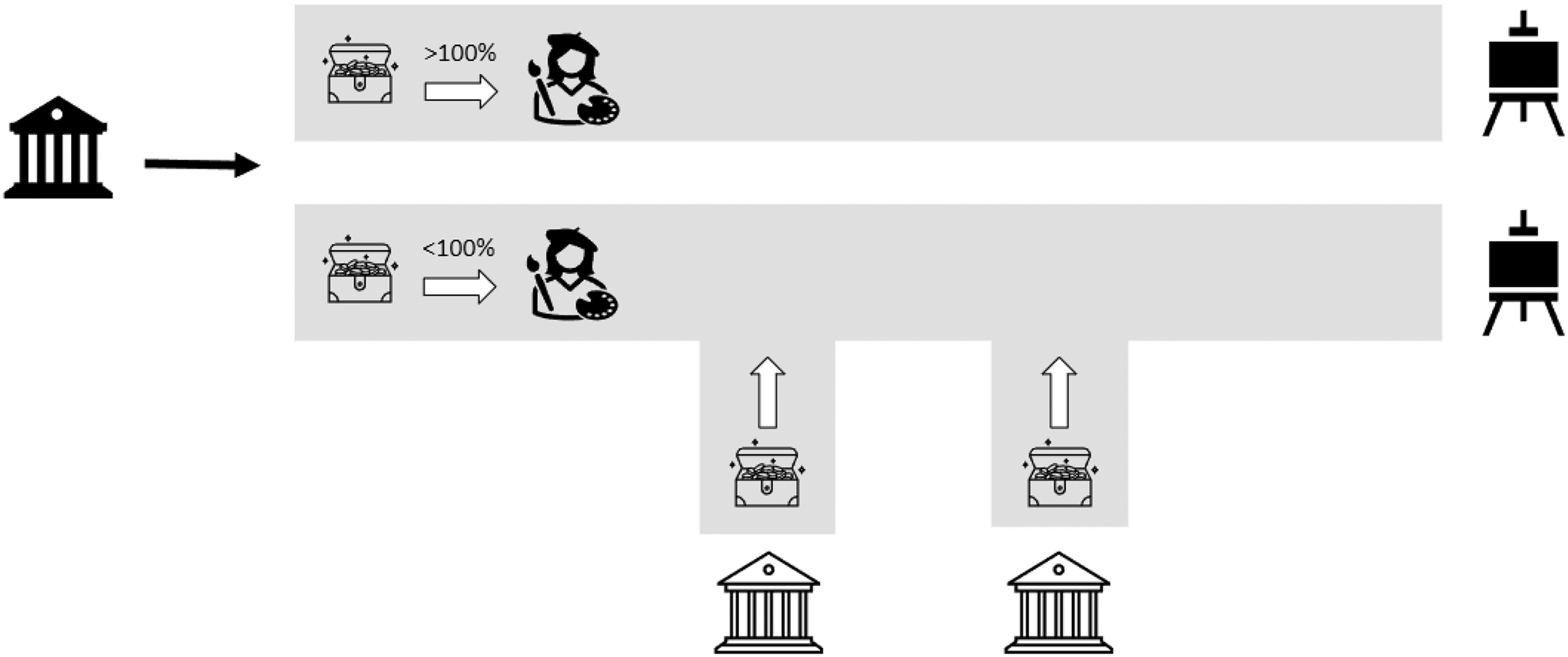
Model 1: Regular subsidies.
Collaborative funding
The requirement for additional funding in several traditional subsidy schemes means that artists must develop a funding portfolio to be competitive. However, in recent years, funding bodies in the Netherlands have begun to collaborate explicitly from the outset, resulting in combined funding for artists before the selection process takes place. We distinguish three types of collaborative funding practices: (1) cooperating, (2) pooled, and (3) matching funds (see Table 4).
Cooperating funds
One way collaborative funding emerges is through funding bodies that together make resources available to artists. They often focus on crossovers between artistic disciplines or new transdisciplinary forms for which markets may not yet have emerged. Like traditional subsidies, this model typically does not cover the full cost of a project, requiring artists to secure additional resources. Since it retains the structure of traditional funding (applying for a subsidy through a project description, budget, and similar requirements), it does not demand significant learning or adaptation from applicants. Although collaborations between funding bodies can provide solutions for interdisciplinary artists, only a fraction of potential artistic genre combinations are currently supported in the Netherlands. The funding appears experimental and tends to come in temporary schemes. Artists working outside of these more common combinations—or those ahead of the curve—are often overlooked. Additionally, the focus on established artists leaves younger artists underserved, despite the fact that many new developments often emerge from younger generations (Galenson, 2009).
An example is a scheme for playwrights designed by the Nederlands Letterenfonds, in collaboration with the Fonds Podiumkunsten. The aim is to stimulate the quality, diversity, and development of the Dutch theatre repertoire. The implementation of the scheme is carried out jointly by the two funds. Cooperation with a producer, who provides a stage, is encouraged. The playwright must already be active and integrated in the professional performing arts in the Netherlands and have experience in writing literary works. In a similar vein, the same partners developed a #NewPieces scheme, aimed at novice artists (writers, spoken word artists), without a professional arts education, who want to develop a new product or need development, guidance, or coaching. In this case, an experienced organization applies on behalf of the artist. The organization is expected to contribute financially and in kind. Another example is the immerse/interact subsidy, a collaboration between the Stimuleringsfonds Creatieve Industrie (Creative Industries Fund) and the Nederlands Filmfonds (Netherlands Film Fund). The scheme supports innovative media productions that explore the future of digital storytelling in a changing media landscape. Producers with demonstrable experience in the field of specific media forms, as well as individual artists with a track record, can apply for the scheme if they meet its many criteria.
Somewhat in contrast is Fonds Podiumkunsten's Upstream, a career-leap scheme cofinanced by Sena, the Foundation for the Exploitation of Neighbouring Rights in music. This initiative exemplifies how funding entities can collaborate to support the development of talented artists. Upstream targets artists further along in their careers (mid-career or established) and provides a mix of financial support: part is allocated as a regular subsidy, another portion is offered as a loan, and a significant share is expected to be contributed by the artist themselves. Hence, the scheme covers up to 50% of the costs. The underlying assumption is that an artist ready to make a career leap already has an established fan base and is therefore supported by the market. Among all the criteria, those related to feasibility are the most important. Specific stipulations include that the artist “is in the ‘(pre)mid-career’ phase; has completed multiple releases and tours, generated media attention, and built a fan base” (Fonds Podiumkunsten, 2025).
The cooperating funds are currently all institutional public funds (rijkscultuurfondsen). The depiction of Model 2 mirrors that of Model 1, with the key difference that two funders collaborate from the outset to develop a specific scheme (Figure 2).
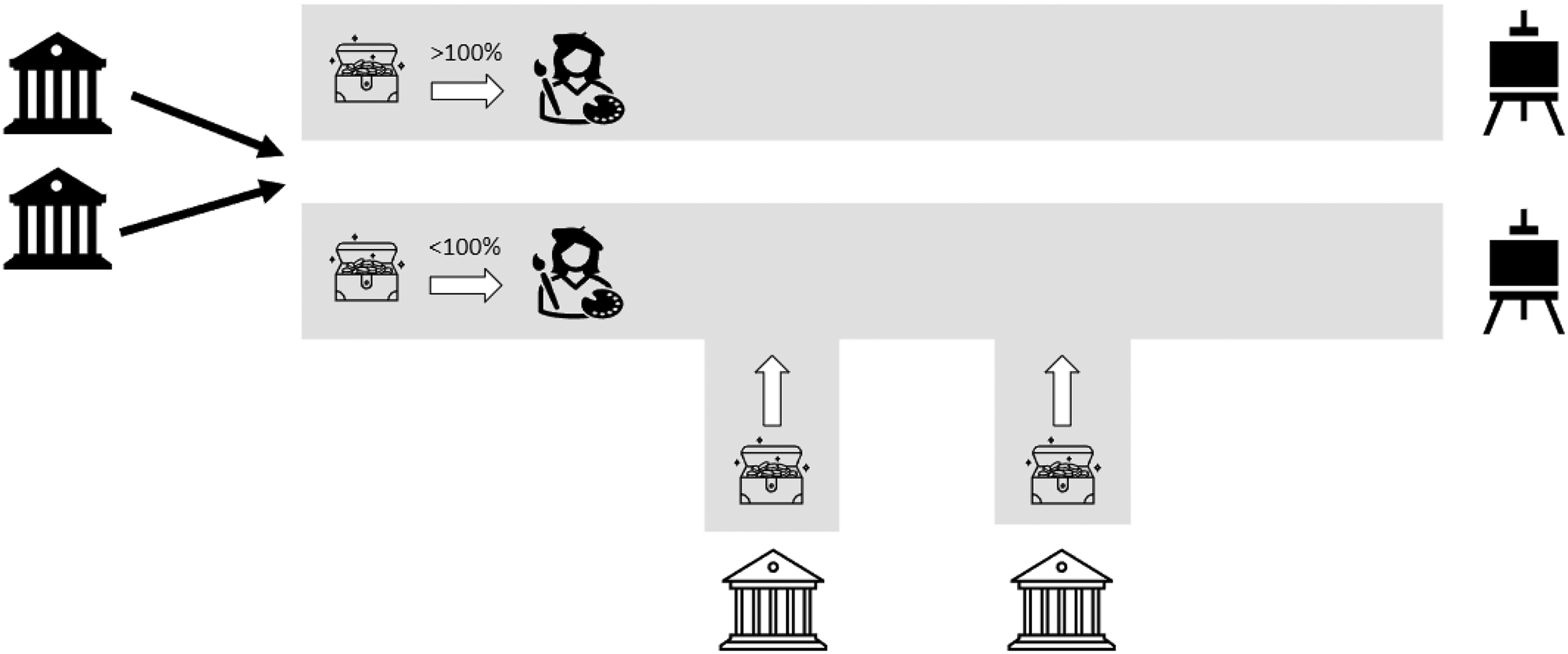
Model 2: Cooperating funds.
Pooled funds
Pooled funds are like cooperating funds, with the key difference that a new, allocated fund is created. There is some variation among these funds in the Netherlands. For example, the Brabantse Cultuurlening (Brabant Culture Loan) is an initiative from the Brabant province, administered by a quasi-independent entity supported by the Ministry of Culture and Cultuur + Ondernemen. The loan is designed to support the next step in an artist's career. If desired, artists can first participate in a voucher scheme to develop their entrepreneurial skills. The culture loan provides start-up capital to artists and organizations, up to €60,000 at an interest rate of 2%, to be fully repaid. It came into being based on the observation that banks are less inclined to cater to these groups. The funding operates as a revolving fund, with the underlying goal of strengthening both the entrepreneurship of artists and the cultural sector through the availability of financial support. Rather than artistic quality, the selection of artist/borrowers is based on factors such as their financing needs, likelihood of success, whether a loan is the appropriate instrument, and alignment with regional cultural policy goals. Examples of loan purposes include purchasing an instrument, building a studio, and prefinancing an exhibition or performance.
Other pooled funds are not exclusively reserved for artists. One example is the collaboration between three major private funds and a lottery in the Blockbusterfonds, which aims to stimulate cultural entrepreneurship and support the realization of events with superstar potential (Rosen, 1981). In this case, entities (rather than individuals) can apply for a loan to make additional marketing investments to attract more visitors, with a guaranteed purchase of entrance tickets. This pooled fund falls within the realm of impact investing or venture capital, targeting initiatives with market potential, like the global Makers Fund, a venture capital fund dedicated to games and interactive entertainment (Makers Fund, 2025). Another example in the Netherlands is DigitALL, a public–private partnership involving private funds, a lottery, and the Ministry of Culture, aimed at helping cultural organizations connect with audiences through digital technologies. The funding is provided as a subsidy in three categories: development, piloting, and project roll-out.
In contrast to Model 2, the third model involves the creation of a new fund by existing funds pooling their resources. Currently, the funding is limited to specific target beneficiaries, such as large, profitable projects (by firms), regional initiatives, or efforts in the digital sphere. A loan component may also be included to address prefinancing challenges (Figure 3).
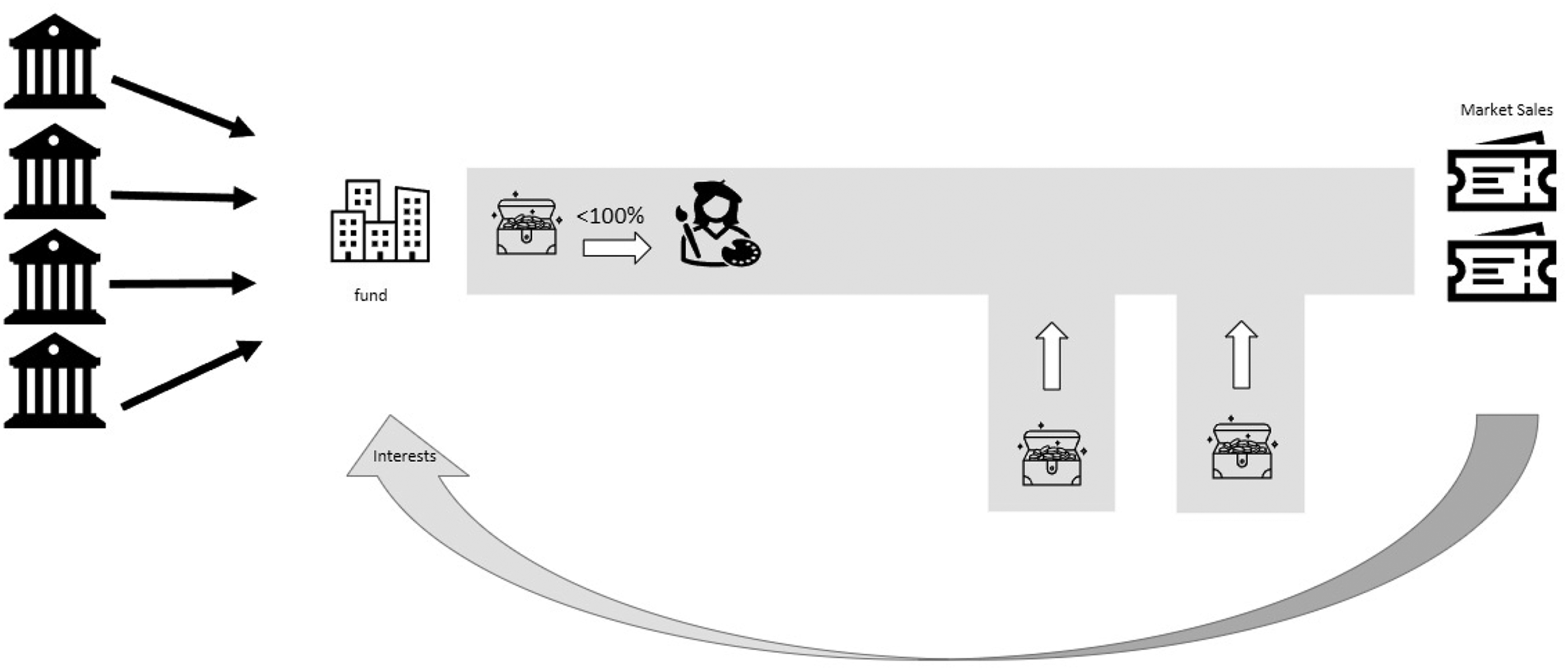
Model 3: Pooled funds.
Matching funds
In matching funds, a funding entity commits to providing support for a project (or annual budget) once funds from another source have been secured. For example, if an organization generates earnings from product sales, a government fund can match a portion of the earned income. Variants include government contributions per unit produced or sold (Towse, 2019) or matching philanthropic or sponsorship support for cultural institutions. Matching funds can signal trust in the entity's quality and create a flywheel effect, which refers to the gradual buildup of momentum through consistent, incremental efforts, leading to breakthrough results and sustained success over time (Collins, 2001). However, allocating these funds may require administrative effort from both the funder and the recipient. While this form of matching funds is not currently part of the funding landscape for artists in the Netherlands (Loots, 2015), it acts as a starting point of forms that are available (Figure 4).
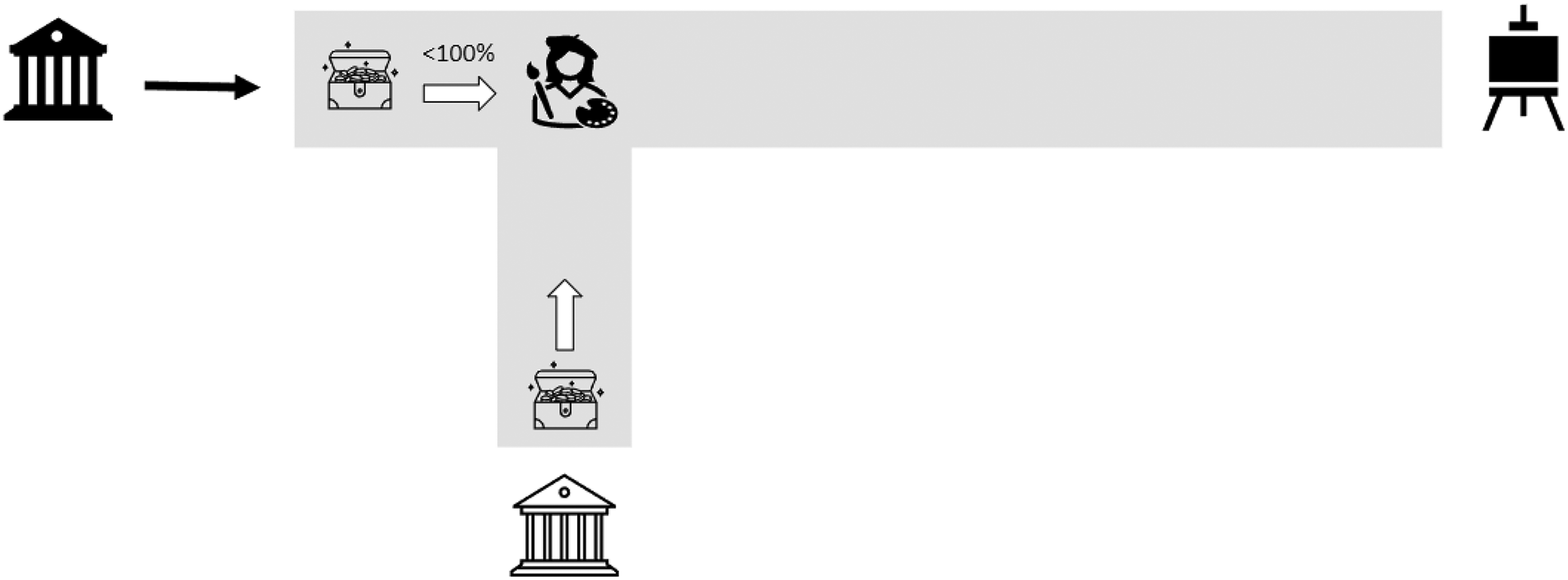
Model 4: Matching funds.
Upfront matching funds
A specific variant of matching funds occurs when a funding entity commits to providing a certain amount of support once another entity has developed and outlined a funding scheme. The matched amount is proportional to the funds earmarked by the second entity. Typically, the first entity is a higher-level government body, while the second is a lower-level government body. In this way, the higher-level government encourages the lower-level government to allocate funds to beneficiaries, potentially influencing local cultural policy.
The makers’ scheme of Kunstloc Brabant, which ceased to exist, is an example (Kunstloc Brabant, 2025). Although an independent organization, Kunstloc Brabant collaborates with various levels of government, educational and social organizations, and the business community to enable the citizens of North Brabant to engage with arts and culture. They focus on several themes: cultural participation, education, cultural entrepreneurship, art and society, talent development, and impact. The makers’ scheme is a matching initiative in which the Province of North Brabant encourages municipalities to invest more in projects by individual makers within their locality. This initiative aims to enhance the production climate, expand presentation opportunities for professional makers, and support their artistic development (Kunstloc Brabant, 2025). Municipalities that have a subsidy scheme for the stimulation of the professional development of makers can have their budget matched with a provincial contribution of 50%, up to €50,000. How they issue the budget to makers (e.g., by means of regular subsidies, quick money, vouchers) is up to municipalities (Figure 5).
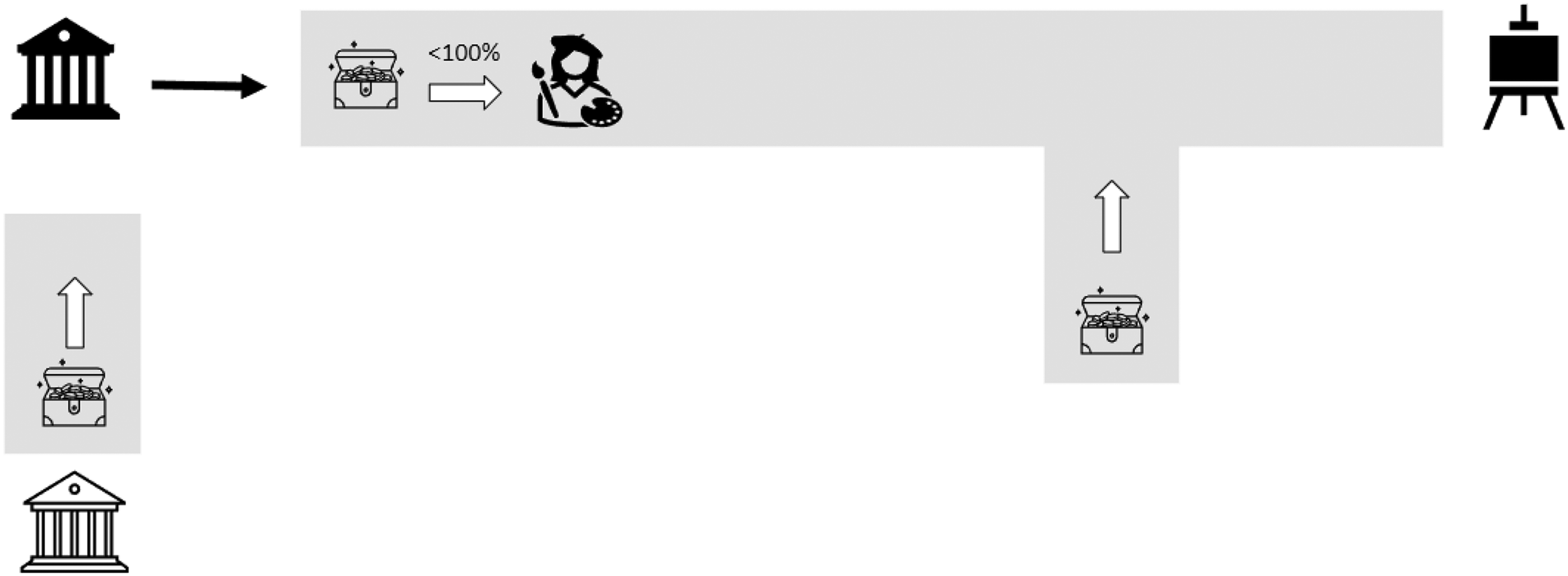
Model 5: Upfront matching funds.
Hubs
In the case of talent hubs, the government views its financial contribution as an investment, designed to stimulate additional funding from both private and public sources. While hubs are typically physical spaces, they can also function as more abstract network organizations. Although setting up and maintaining a hub require financial resources that could be used for more direct cultural production funding, the hub model offers distinct advantages. For young artists, in particular, informal knowledge transfer through personal contacts is essential for development (Wijngaarden et al., 2020), and hubs are well positioned to facilitate such interactions. Private companies can sponsor hubs, increasing their involvement in supporting the local cultural and creative sector. Hubs can support a wide range of scales, target groups, genres, and more. EIT Culture & Creativity, for example, is setting up an investor network at the European level, leveraging the same principle of connecting diverse stakeholders to foster innovation (EIT Culture & Creativity, 2025).
In the Netherlands, the province of North Brabant experimented with talent hubs that used the financial mechanism of matching funds. The province sees its contribution as an investment and calculated that its financial support led to 126% additional investment in 2020–2022 (73% from the national funding level, 24% from municipalities and regions, and 29% from other sources). The province formulates it as follows: “The investment of the province of North Brabant in TalentHub Brabant has a financial flywheel effect. This makes it easier for the talents and hubs to qualify for additional resources” (TalentHub Brabant, 2025). Talent hubs are organized on a sectoral basis. For example, Next is a talent hub for film, documentary, and animation. The initiative originated from an educational institution, which then attracted other educational partners and various market players. The hub receives funding from the province, the Dutch Ministry of Culture, the Nederlands Filmfonds, and private partners, including the streaming service Netflix. For instance, Netflix supported a writing retreat for screenwriters. Similar talent development missions are pursued by existing hubs in the performing arts and music. While the provincial investment helps leverage additional funds from the Fonds Podiumkunsten, the hub also serves as an incubator, fostering collaboration and learning. Model 6 illustrates how public and private partners collaborate to facilitate a physical space (Figure 6).
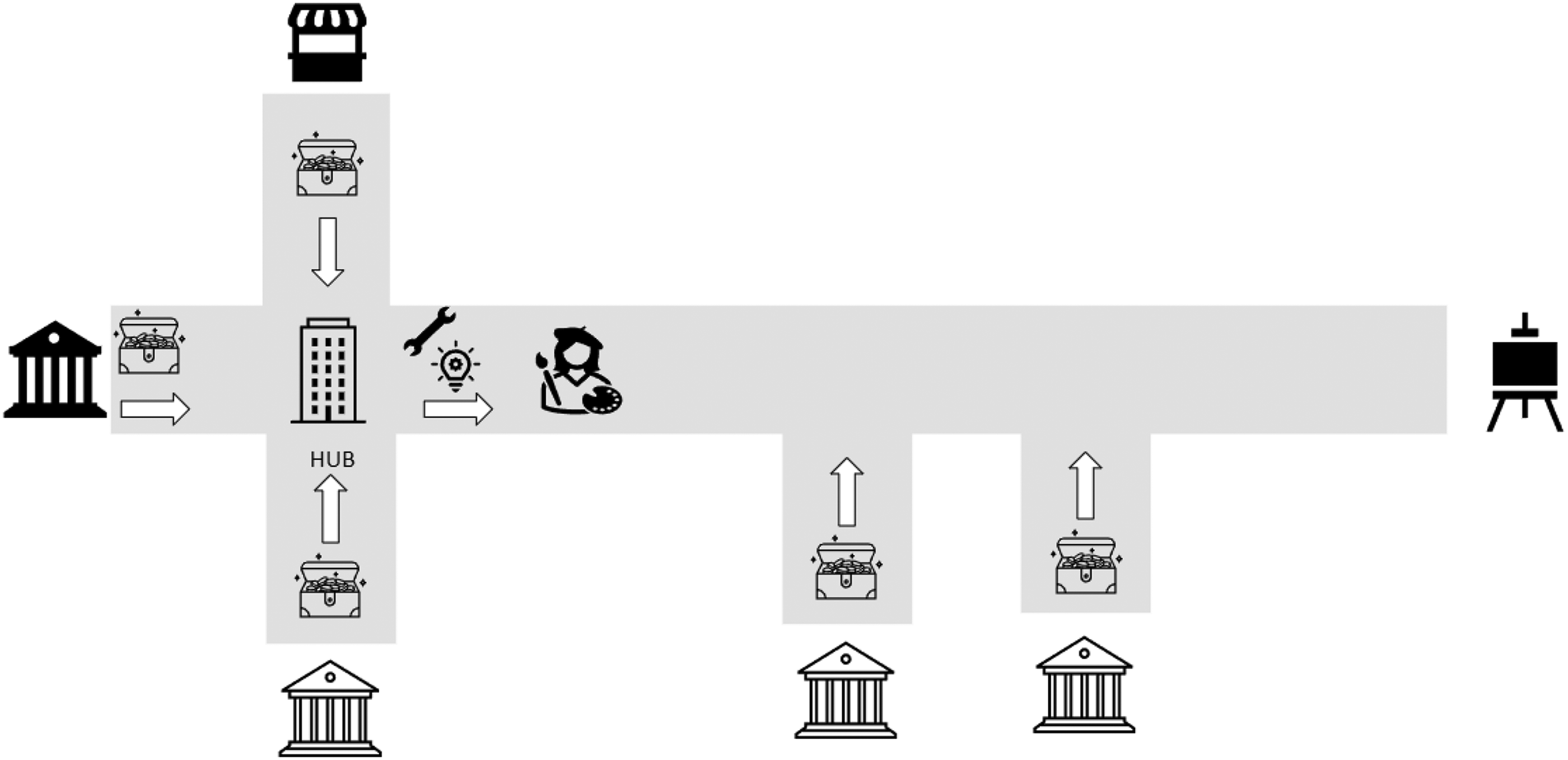
Model 6: Hubs.
Platform-supported matching funds
A similar level of complexity is involved in setting up matching funds via crowdfunding platforms. Platform-supported matching funds are a funding method in which governments or funds contribute financially to campaigns hosted online (Dalla Chiesa and Alexopoulou, 2022; Loots et al., 2024). Such involvement effectively creates a public–private partnership, facilitated by the platform technology. The private contributions come from the crowd (the market) but may also include donations from firms or other entities. The matching partner can determine the contribution size (potentially in consultation with the platform) and decide which projects to support and when to make the contribution—at the beginning of the campaign, signaling support; or in the middle or end, reinforcing the crowd's or market's choices (Baeck et al., 2017).
The Dutch crowdfunding platform Voordekunst is an independent organization that in 2021 began reaching out to public entities and private funds with the proposal to match funds through their platform. The procedure and benefits of crowdfunding as a collaborative funding mechanism (Senabre Hidalgo and Fuster Morell, 2019) have been discussed in previous studies (Dalla Chiesa and Dekker, 2021; Handke and Dalla Chiesa, 2022). In brief, many small donations from diverse stakeholders can collectively accumulate into a significant total sum. Individuals with limited willingness to pay can still participate in roles beyond that of consumers, while high-value donors have the option to support a project of their choice, either anonymously or publicly.
This type of crowdfunding platform is increasingly accessible to campaigners, including interdisciplinary, innovative, and nonprofessional artists, who can use it to develop an audience or test the feasibility of a new project. The platform enhances the visibility of a project, and its reputation may also positively impact the artist's own reputation. By collaborating with institutional funders, the advantages of platformization may make traditional funding procedures more compelling: Platforms are more flexible in terms of timing, have fewer complex terms of engagement, do not rely on expert gatekeepers, and are not bound by a predetermined or restricted budget. Artists can seek funding for various stages of a project and communicate their ideas through not only written descriptions but also audio-visual materials. By eliminating intermediary roles and leveraging economies of scale and networks in promotion and fundraising, transaction costs for all involved entities can be reduced (Belleflamme et al., 2013). However, when public funding enters the platform space, its institutionalization and legitimization characteristics may also transfer to the platform and its beneficiaries. Some of the disadvantages of crowdfunding include uncertain outcomes, artists’ underestimation of costs (including labor costs), and the public visibility of success or failure (Dalla Chiesa and Dekker, 2021).
The Dutch example relies on reward-based crowdfunding with matching funds that restrict their contributions to small amounts of money (donations/subsidies) and generally do not follow up on the realization of the beneficiaries’ projects (Loots et al., 2024). However, investment-based crowdfunding and matching funds are increasingly entering cultural sectors worldwide. Some platforms, such as the Symbid platform in the Netherlands, have successfully achieved tax-deductible status for their donations. Symbid is the first platform to combine venture capital and crowdfunding to support startups. Like the other matching fund models, this one also requires some upfront coordination. However, unlike the others, we have depicted the artist as the initiator in this model (Figure 7).
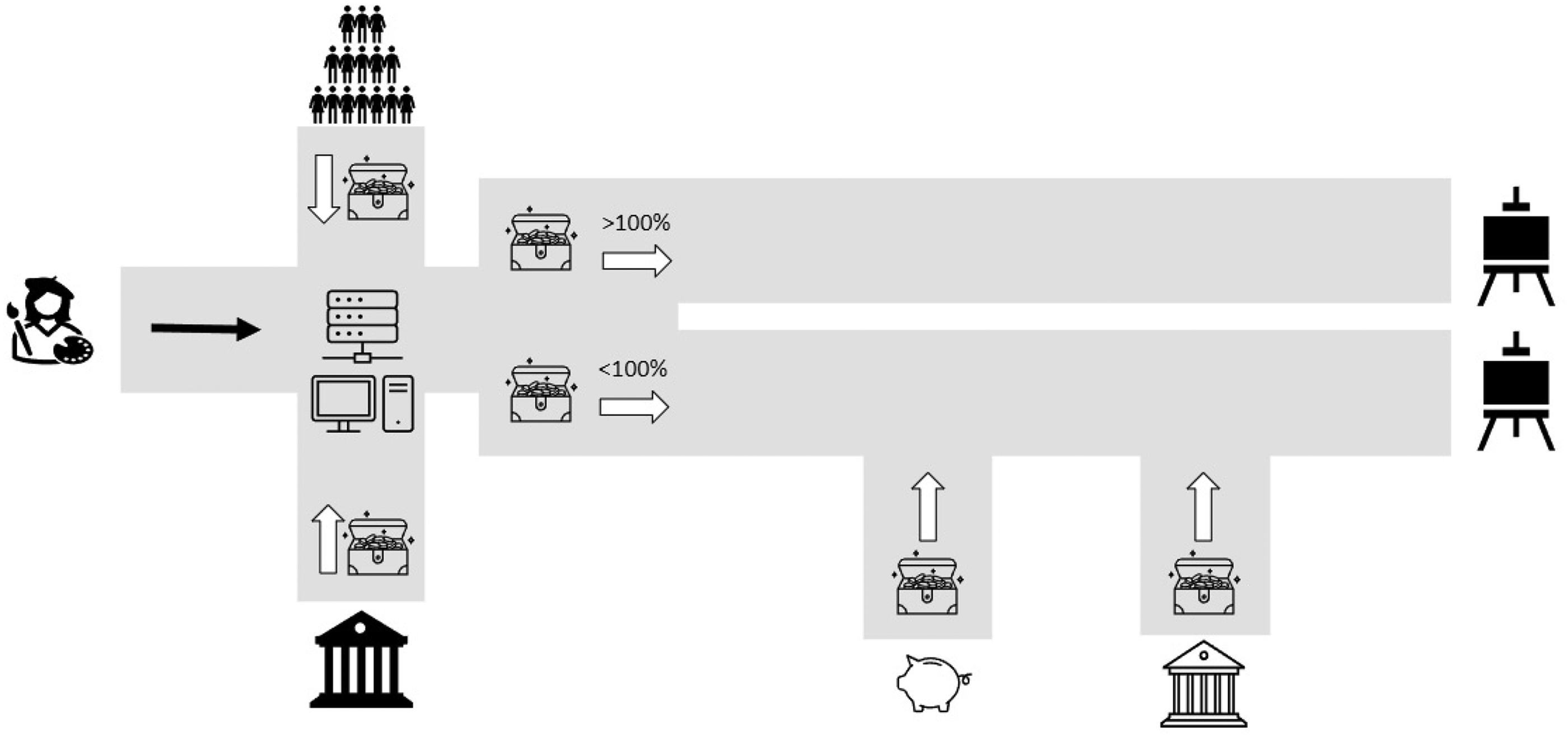
Model 7: Platform-supported matching funds.
Implications for society, artists, and policy
In the present section, we explore several potential implications of the continued growth of collaborative funding. These include the possible increase in funding opportunities, a rise in the number of artists, enhanced artist productivity, and the potential effects—both positive and negative—on the diversity of the arts.
First, certain new arrangements—such as hubs and platform-based matching funds—are expected to increase the financial resources available to artists. This outcome depends on their ability to generate a flywheel effect and establish the practical conditions necessary to enable new and potential funders to contribute. Whether more funding becomes available will depend on the scale and diversity of new contributors: both large private funders and broad-based public participation through small contributions could significantly increase the resources accessible to artists. However, collaborative funding mechanisms also entail coordination, negotiation, and information costs, which may reduce the net funding ultimately available. Second, some collaborative arrangements—such as hubs and platform-based matching funds—are expected to result in a greater number of funded artists, particularly if they succeed in expanding the overall pool of available resources, both monetary and in-kind. Additionally, certain collaborative funding mechanisms function as impact funds or revolving funds, which require partial repayment. This feature may incentivize increased productivity among artists, enabling them to reinvest in the production and distribution of their work. Third, regarding artistic diversity, collaborative funding mechanisms—such as cooperative and pooled funds—have the potential to support a broader range of artists, including those working in interdisciplinary, regional, and niche contexts. By broadening their eligibility criteria, these funds can contribute to greater inclusivity and representation within the arts sector. On the downside, when funding structures require organizations to apply on behalf of individual artists, only a limited number of artists may benefit from this more selective and resource-intensive process. This could eventually reduce both the number and diversity of artists receiving support.
The implications of collaborative funding models are significant for both artists and policy. For artists, the diversification of funding sources offers new opportunities, particularly for those previously excluded from traditional channels. This includes individuals who do not fit established funding categories, early-career artists without clear signals of market demand, and those experiencing financial precarity—often balancing multiple jobs to sustain their artistic practices (Abbing, 2002; Rengers, 2002). The reluctance of artists to seek financial support from family and friends (van den Braber, 2024) may be mitigated by more resourceful public or private entities offering matching funds on crowdfunding platforms. Nevertheless, many of the funding examples discussed in this article represent one-time opportunities that demand considerable dedication, effort, and skill. Artists who continuously transition from one project to the next may forgo earnings that are essential to cover their living expenses and career development, potentially exacerbating financial insecurity and deepening poverty (Feder and Woronkowicz, 2023; Mangset et al., 2016).
For policy, the central implication is that while these innovative funding models hold clear potential, they require intentional design and coordination to function effectively. Policymakers must consider how best to support these mechanisms to ensure they deliver sustainable, equitable outcomes across the sector. In addition, policy can play a proactive role in incentivizing sponsorship, philanthropy, and other forms of support for the arts—for example, by offering tax benefits for private donors, creating matching fund schemes to leverage public and private investments, recognizing and rewarding corporate cultural sponsorship through visibility incentives, and fostering the creation of hubs that facilitate collaboration and resource-sharing among artists, funders, and organizations.
Imagining futures: The role of AI in collaborative funding for artists
Our mapping exercise revealed that while collaboration is central to current funding models, there is relatively little emphasis on digitalization within these emerging collaborative approaches. For example, a simple review of 15 funding websites (conducted in mid-2025) showed limited use of digital tools such as chatbots, suggesting that AI-driven interfaces are not yet widely adopted. This stands in contrast to academic literature that anticipates a future funding paradigm in which digitalization, alongside collaboration, plays a key role. These studies suggest that digital integration could lead to greater efficiency and transparency in funding allocation, broader representation, and lower transaction costs (Dalla Chiesa and Handke, 2022; Loots et al., 2022; Mollick, 2014). To further explore the potential future role of AI in the arts funding landscape, we conducted a speculative exercise in which we asked AI itself to reflect on its evolving role in shaping funding ecosystems.
We find that AI could play a role in enhancing the efficiency, accessibility, and impact of funding opportunities for artists. For example, AI-powered platforms could match artists with the most relevant funding opportunities based on their discipline, project type, needs, and career stage. These platforms could aggregate data from public and private funding sources and use recommendation algorithms to align opportunities with artists’ profiles. Furthermore, by analyzing historical data such as funding trends and successful applications, AI could estimate the likelihood of someone's success for a given grant. This predictive capability could help artists prioritize the most promising opportunities and save time. In the crowdfunding space, AI is already being used to predict donor behavior. Expanding this use, AI could help artists identify likely contributors, suggest tailored engagement strategies, and enhance campaign effectiveness on platforms. As such, AI-enabled tools could support both artists and funders in the application process. For artists, AI could further assist in drafting proposals by drawing on past successful submissions and tailoring content to meet specific criteria. For funders, AI could help evaluate applications, increasing consistency and saving time. In both cases, AI could enhance the quality, clarity, and efficiency of the process. Taken together, we could envision AI-powered platforms or virtual incubators (hubs) that suggest tailored funding options, identify opportunities for collaboration, cofunding, and distribution, and offer project development tools aligned with artists’ profiles and goals.
However, there are more imaginable roles for AI. For example, AI could help policymakers and funders track the flow of funds by analyzing real-time data on fund allocation. This capability could highlight inefficiencies or areas with insufficient funding, ensuring a more equitable distribution of resources. Finally, AI could play a role in evaluating the impact of funding by monitoring project outcomes, audience engagement, and the financial performance of funded projects. These data points, including artist visibility, marketability, and career advancement, could provide valuable insights for shaping future funding strategies and policy priorities.
In collaborative funding specifically, AI may play a role in improving efficiency, transparency, and collaboration. By leveraging AI-powered platforms, funders can coordinate more effectively, artists can access a broader range of opportunities, and all stakeholders can work toward shared goals more seamlessly. AI could enhance the visibility of the funding process, ensuring that resources are allocated equitably and strategically. In addition, AI can foster better collaboration between funders by enabling real-time data sharing and transparent decision making across the entire funding ecosystem. Hence, AI can optimize matching algorithms, making sure that artists are paired with the most relevant opportunities across multiple funders. It can also use predictive analytics to help funders make informed decisions about where to allocate resources. In sum, AI may provide real-time insights into fund allocation, highlighting inefficiencies or underfunded areas, and guiding smarter decision making that maximizes the impact of collaborative funding efforts.
While AI may play a pivotal role in mediating between funders and artists, enhancing efficiency and transparency, a central question remains: can it also foster creativity? Given AI's reliance on existing data and patterns, there is a risk that its use by both artists and funders may reinforce established norms rather than encourage innovation. If AI becomes involved in drafting as well as evaluating funding proposals, it prompts a deeper concern about how genuine creativity can be supported. This concern situates AI-driven funding within the broader debate on the role of AI in cultural production and distribution, highlighting how decisions made in the financial infrastructure, often considered separate from creative practice, may critically influence how artistic innovation will be enabled or constrained in future funding practices.
Discussion, conclusion, and limitation
Public arts funding has been a subject of research since the mid-20th century, with studies primarily addressing evaluation procedures (Gielen, 2005; Hughes and Luksetich, 2004; Loots, 2019), grant writing (Peters and Roose, 2020, 2023), and justification (Fullerton, 1991). However, relatively little has been written on innovation in public funding for the arts and cultural sectors (Loots et al., 2022), despite the increasing vulnerability of arts funding, which arguably calls for more attention to this area.
The thesis of this article was that funding in which (public and private) funding entities collaborate is still in an experimental phase, emerging in diverse forms without one single consolidated model, as the needs and frameworks for collaboration among funders remain fluid and unsettled. Guided by the research question (what are contemporary practices of collaborative financing and funding of artists, and in what ways are institutional funders involved?) and based on a national mapping, we identify three key modes of contemporary collaborative funding. First, cooperating funds support artistic innovation through a scheme that resembles traditional subsidies, including the requirement for other income, targeted at inter- and transdisciplinary artists. This model also incorporates a career leap scheme involving repayable loans. A step further is the creation of pooled funds, some of which exhibit characteristics of impact or revolving funds, with expectations for repayments or even returns on investment. These funds are typically directed toward marketable initiatives. Next, matching funds are implemented in three forms, all designed to generate a flywheel effect. Upfront matching funds, often initiated by governments, encourage other governments to invest in their cultural landscapes (Dalla Chiesa et al., 2025). Hubs, functioning as physical spaces with incubator properties, incentivize different funders, with the goal of enhancing a region's cultural attractiveness. Finally, platform-based matching funds use public contributions to signal the legitimacy of a project or to support its feasibility, thereby attracting additional resources from other institutional funders and fans.
Based on empirical realities identified in the Netherlands, we modeled potential funding approaches, while acknowledging that variants of these models are conceivable. It remains uncertain whether they represent temporary manifestations in a gradual evolution of funding practices or the precursors of a radically new paradigm for financing the arts. New models of funding and financing do not necessarily need to be radical to better align with the needs of contemporary artists. As in other countries—such as Canada, the United States, Australia, and Brazil—artistic workers in the Dutch cultural and creative sectors are predominantly self-employed and earn, on average, less than workers in other sectors (Been et al., 2024; Feder and Woronkowicz, 2023). The COVID-19 pandemic has disproportionately affected these independent creators (Jeziński and Lorek-Jezińska, 2021), in some cases exacerbating preexisting structural labor conditions in the arts, such as multiple-job holding and the prevalence of precarious freelance work (Gill and Pratt, 2008). Collaborative approaches to funding for artists represent a diversification of funding and financing and may provide artists with more options that align with the portfolio-based careers many of them pursue. These new avenues could help normalize access to private funding sources, including “other people's money” (Sigurdardottir and Candi, 2019, p. 4), which many artists are traditionally reluctant to rely on (van den Braber, 2024). They may also facilitate access to professional financing, such as bank loans, from institutions that have historically been wary of engaging with artistic and creative entrepreneurs (Lee et al., 2018; O’Dair and Owen, 2019). A combined funding and financing portfolio may make artists spread their risks across various sources and potentially increase their resilience, especially in critical moments. Finally, greater variation of funding sources may alter the winner-market structure that public funding has been found to reproduce (Rengers, 2002). AI-driven tools may open more funding opportunities for more and more diverse artists, but as they become more accessible, competition for funding is also likely to increase.
Potential drawbacks include the requirement for artists to navigate the differing expectations and rules of various funders, which can increase the need for administrative knowledge, strategic skills, as well as result in higher transaction costs. There is also a risk that the emergence of new funding modalities may crowd out public support—particularly in contexts where governments are reluctant to invest in the (so-called) high arts—without necessarily increasing the total amount of funding available. It remains uncertain whether such developments will alleviate poverty among artists, especially given that adapting to a new funding landscape demands time and effort to acquire new competencies—resources that could otherwise be directed toward more immediate or lucrative opportunities. The same holds for future AI-driven funding tools, which may enhance efficiency but also demand new and different skills, potentially casting a shadow over artists’ creative autonomy.
While empirical evidence points to the emergence of a new paradigm in the structuring of funding and labor conditions in the arts (Loots et al., 2022), its actualization will ultimately depend on the direction and commitment of cultural policy. Here too, careful policy design and coordination are crucial in the present to ensure that new funding models remain equitable and effective; while looking ahead, it will be essential to balance any AI-driven efficiency with the preservation of creative integrity.
A limitation of the present study is its sole reliance on available online primary data from a single country context. As a result, the study misses insights from experts, the experiences of artists and administrators, and examples of collaborative funding in other contexts, such as at the transnational level. Additionally, based on our data, it is challenging to predict the long-term relevance of the novel funding arrangements we identified: are they merely trends, or do they represent genuine precursors to radical innovations in the funding landscape? And what about our speculations on AI: will they prove accurate? Future studies may focus on the evolution of these funding models and their impact on artistic ecosystems, expanding our analysis to provide further insights into emerging funding models.
Footnotes
Acknowledgments
The authors acknowledge Platform ACCT, Voordekunst, Cultuur + Ondernemen, Emma Dijkhuizen and Jet Schaap Enterman.

Ethics approval
There are no human participants in this article and informed consent is not required.
Author contributions
Ellen Loots: conceptualization, methodology, investigation, writing–original draft, writing–review and editing, and funding acquisition. Carolina Dalla Chiesa: writing–original draft and writing–review and editing. Yosha Wijngaarden: writing–review and editing and visualization.
Funding
The author(s) disclosed receipt of the following financial support for the research, authorship, and/or publication of this article: The research was funded by the Dutch Ministry of Education, Culture and Science (Ministerie van Onderwijs, Cultuur en Wetenschap).
Declaration of conflicting interests
The author(s) declared no potential conflicts of interest with respect to the research, authorship, and/or publication of this article.
Data availability
A mapping document can be made available upon request.