




Abstract
This work aims to analyze how the electronic music scene in Salvador da Bahia is structured and consolidated as a cultural movement in the city. The aim is to understand how this cultural movement is validated and constructed, exploring the nightlife scene and its contribution to the local economy. The research addresses concepts of culture, cultural hybridity, cultural fields, and symbolic values. It reflects on the importance of electronic music for Salvador, analyzing how this scene can strengthen cultural identity and stimulate local economic development. Interviews were conducted with three producers from the Salvador scene. The electronic music scene in Salvador faces serious obstacles, such as the devaluation of local artists, low fees, and high operating costs, exacerbated by informality and socio-economic inequalities. These challenges create an adverse environment for the sustainability and expansion of the cultural movement. However, events such as the em.off party and the support of Só Shape Tabacaria exemplify how strategic partnerships and community initiatives can strengthen the local cultural scene.
Introduction
The electronic music scene in Salvador da Bahia has emerged as a significant cultural movement, shaping nightlife, identity, and local economic dynamics. Yet, its consolidation faces structural challenges—from the undervaluation of artists to financial precarity—raising questions about how such scenes sustain themselves amid socio-economic inequalities. This study examines the mechanisms through which Salvador's electronic music scene is validated and institutionalized, interrogating its dual role as both a cultural movement and an economic driver.
This academic inquiry stems from a need to critically examine electronic dance music (EDM) as a cultural movement in Salvador—a city renowned for its vibrant musical diversity yet marked by institutional neglect toward its electronic scene. While Salvador's cultural landscape thrives through genres like Axé, Samba, and Reggae, the EDM scene remains undervalued by both public and private stakeholders, despite its potential to foster cross-genre dialogue and enrich the city's cultural ecosystem. By interrogating this gap, the study highlights how EDM could amplify Salvador's cultural identity, not as a replacement for traditional genres, but as a complementary axis of artistic innovation and social integration. Such recognition could catalyze more inclusive policies and collaborative practices, bridging the divide between electronic music's subcultural roots and its broader socio-economic contributions.
Salvador is internationally recognized as an important cultural center, boasting the title of “City of Music” from the Creative Cities Network of the United Nations Educational, Scientific and Cultural Organization (UNESCO) due to its diversity of artistic manifestations. The city has a rich history, intrinsically linked to Afro-diasporic movements and culture, reflected in its customs, cuisine, religious practices, and, of course, in its forms of artistic consumption. From the creation of Axé Music (Henry, 2008) to the historical influence of the Samba de Roda culture (Samson and Sandroni, 2013), Salvador has exported big names in Brazilian music, establishing direct links with Afro-Brazilian culture, whether through skin color, religious practice, or cultural customs. Due to its creative and artistic potential, Salvador stands out as one of the country's leading hubs of cultural production (Costa, 2017).
However, the scant presence of academic studies on electronic music culture in Salvador and its large volume of production are noteworthy. This movement is still little recognized and valued as part of the city's cultural catalog, confined to a bubble that struggles to sustain itself and gain mainstream relevance. The monopoly of the primary regional events industry in the segment, the lack of incentives for independent production, and the scarcity of financial resources for independent producers impose a series of challenges on the electronic cultural scene in Salvador, such as the lack of sectoral notices that include the category, the lack of fair fees for local artists, the concentration of information, functions and various resources, as well as geographical barriers and stereotypes that marginalize the genre.
When dealing with the concept of the cultural scene, Jeder Janotti Junior (2012) points out that the scene is not just a physical agglomeration of artists but a network of social, economic, and cultural interactions between various agents, such as artists, audiences, and the media. These relationships establish an environment conducive to creating and maintaining shared cultural identities and values, broadening the scope of cultural production beyond local and physical limits.
Methodology
The methodological approach adopted in this study combined qualitative and digital research strategies to provide a comprehensive understanding of the electronic music scene in Salvador. A thorough literature review was conducted to establish a theoretical and historical framework, drawing on key studies in cultural production, electronic music, and symbolic economies. In addition to the literature review, digital methods were employed, specifically data scraping from a relevant online platform dedicated to the local music scene. This digital data provided insights into event organization practices and patterns of cultural production, thereby complementing the theoretical framework with empirical evidence.
Furthermore, primary data collection was carried out through semi-structured interviews with key participants in the local electronic music community. All interviewees voluntarily agreed to participate in the research and provided informed consent before the interviews. They were informed about the purpose of the study, the use of the collected data, and their right to confidentiality and anonymity. Participation was entirely voluntary, and interviewees could withdraw without any consequences. The interviews were designed to elicit detailed narratives about the challenges, strategies, and experiences of organizing and participating in electronic music events in Salvador. These interviews were subsequently anonymized to preserve confidentiality, and their content was analyzed thematically to identify recurring patterns and significant divergences within the field.
We interviewed three producers of electronic music events in Salvador, each with a different background, ranging from 5 to 10 years on the local scene. The interviews were conducted online via video call and audio conversations via WhatsApp. A semi-structured questionnaire was drawn up as a guide, allowing for the addition of questions throughout the interview. Although it wasn’t the best platform for conducting these interviews, it was necessary because some interviewees didn’t have the time to do them in person or by video call.
Context of this cultural field
EDM is a musical genre that emerged in the late 20th century and gained significant global prominence in the early 21st century. It is distinguished by its pulsating electronic beats, sophisticated synthesizer work, and a strong emphasis on high-quality production techniques. The EDM subculture emerged from the late 1980s and early 1990s underground house music scene, primarily in gay Latino and African American disco clubs. Between 1995 and 2009, EDM shifted from its countercultural roots as promoters adopted nightclubs and mainstream venues. By the early 2000s, the subculture underwent significant commodification, with events expanding to include large-scale productions, amusement park rides, advanced staging, and budgets exceeding $100,000 (Conner and Dickens, 2023).
When considering Pierre Bourdieu's concept of cultural field, we understand that a field is […] a structured social space, a field of forces, a force field. It contains people who dominate and others who are dominated. Constant, permanent relationships of inequality operate inside this space, which at the same time becomes a space in which the various actors struggle for the transformation or preservation of the field (Bourdieu, 1998: 40).
The electronic music scene in Salvador constitutes a distinct cultural field where artists, producers, and other agents seek to obtain material and symbolic resources, intending to transform this field as a potential for sustainable cultural production and a social driver for new local cultural and musical producers, through the promotion and acquisition of symbolic values such as prestige, recognition and identity legitimization through their musical creations and cultural events. Further examples of cultural fields examined from a Bourdieusian perspective can be found in Webb (2007), Threadgold (2015), and Guerra (2016).
As Bourdieu's cultural fields fundamentally represent arenas of class struggle, independent producers and artists attempting to enter the scene's artistic circuit often face interference—whether incidental or deliberate—reflecting the dominant actors’ tendency to preserve their power status. “But we know that in every field we shall find a struggle, the specific forms of which have to be looked for each time, between the newcomer who tries to break through the entry barrier and the dominant agent who will try to defend the monopoly and keep out competition” (Bourdieu, 1993: 72). Thus, the functioning of a field is socially constructed through a process of struggles between its agents and institutions. This, in turn, when we consider the strategies for maintaining power, harms the governance of cultural events. This may not be a problem exclusive to the electronic music market. Still, these disputes and the overlapping of individual interests over collective interests, in addition to this internal tug-of-war, keep this debate from being secondary during conversations about Salvador's electronic scene.
EDM in Salvador transcends its function as entertainment; it represents a space of cultural resistance, expression, and identity for diverse audiences. Through cultural hybridization and the dynamics of cultural fields, this scene continues to develop and reinvent itself, challenging stereotypes and contributing to the diversity and vitality of local culture.
This statement is corroborated by analyzing the data from scraping the Aldeia Nagô cultural agenda, a digital platform established to promote events within Salvador's cultural landscape and its metropolitan region, with a particular focus on the alternative scene. The website was founded by an economist and cultural producer with over two decades of active engagement in the city's alternative cultural scene. For the scraping process, Python programming software was used to create a series of codes that automate the data collection process based on the source code of the site's columns. Using the scrapy command, the program collected all the corresponding information used to name each piece of information on the site, thus inserting the data collected on the site into an Excel spreadsheet. The scraping was done considering the last 10 years. Searching for “electronic music,” we came across 512 events from July 18, 2013, to February 23, 2024. It is crucial to note that this diversity of events covers various proposals and descriptions, all related to electronic music, without specifying musical genres. Considering only this platform, we have already obtained a considerable production volume. Considering non-cataloged events and other cultural agendas, the figures presented could be higher, but the current sample already serves its purpose.
When we delved deeper into the search for more specific terms, such as “Techno” and “Trance,” we identified 50 Techno events, registered from August 17 to April 8, 2024, and 36 Trance events, registered from December 14, 2013, to December 10, 2022. In addition, for the term “House Music,” we found 426 events (Figure 1). It's important to note that some of these events were not limited to house music but also included house subgenres and other musical genres, such as samba, funk, pop, jazz, and MPB, among others.
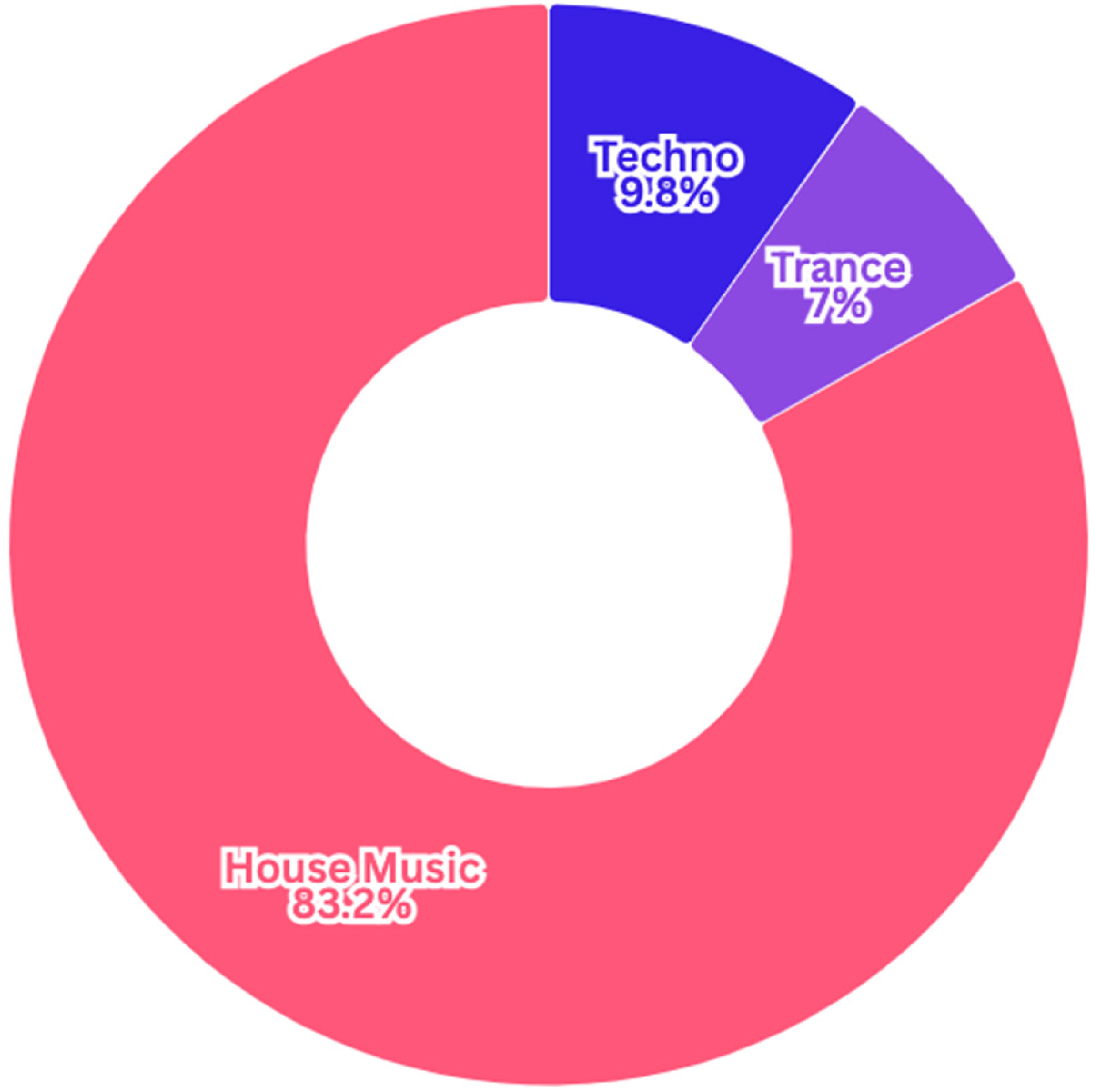
Proportion of events among electronic dance music genres in Salvador.
This diversity of events reflects the richness and variety present in Salvador's electronic music scene, demonstrating its ability to attract and involve different audiences. From analyzing this data, it becomes clear that EDM has become an integral part of local culture and plays a significant role in the city's cultural dynamics. The analysis highlights a disparity in Salvador's definition and perception of electronic music. While House Music and its subgenres stand out with a significant volume of events, the Techno and Trance genres also have a presence, albeit on a smaller scale. This diversity of events and the frequency with which they occur demonstrate the vitality and richness of the city's EDM cultural movement.
Finally, recognizing this production volume is fundamental for us to understand that electronic music in Salvador is not just a fad or an isolated phenomenon but a consolidated and vibrant cultural movement with a 30-year history that has undergone several renewal processes. This scene represents a form of entertainment and a space for expression, inclusion, and diversity. Strengthening symbolic exchange relationships and reinforcing local culture and expression gives local artists and producers more opportunities and stability. For this to happen, the public and private sectors must recognize and value this movement, offering support and opportunities for its continued growth and development.
Considering their production volume alone, it is possible to see specific impacts on local culture. Considered a welcoming and socially inclusive environment, EDM events become important vectors for environmental and social management since their impacts not only promote entertainment and non-judgmental space for the population but also generate income for local inhabitants and add value as an economic promoter for the municipality. Considering the city's tourist potential and the possibilities for investment in the events sector, with more significant qualification of the EDM scene in Salvador, private and public management could look more receptively at local actions and events, fostering the city's creative economy, as well as stimulating tourism and hotels, thus boosting not only EDM in Salvador but its entire economy.
Institutional organization, mobilization strategies, and image
For this topic, we interviewed three producers of electronic music events in Salvador, each with a different background, ranging from 5 to 10 years on the local scene. When conducting the interviews, it became clear that organizing, financing, and prospecting for financial, material, or symbolic resources vary significantly. This is mainly due to the financial realities of each producer team, the forms of sponsorship and support networks, the uniqueness of the public, and what they seek in these events. The strategies adopted by producers are similar in some respects but different depending on the size and scope of the event, resulting in a hit-and-miss system. Many producers operate in a kind of “dark room” concerning the effectiveness of their strategies because there is a concentration of information and no incentive for data transparency in this sector.
Despite having a more loyal and motivated audience to participate in its clubber culture movements, one of the events confront structural challenges. Geographic barriers exacerbated by Salvador's inadequate public transportation system and audience dispersion due to socio-economic constraints significantly limit participation. As one interviewee noted, “There is a clubber community. But people don’t have the money to experience it” (Producer 3, in an interview with the authors, 2024).
This behavior among support groups is common in Salvador's electronic music scene, considering that many independent producers don’t have the initial working capital to design their events. This forces them to rely on partnerships between nightclubs, crowdfunding, DJs, partners, and others interested in the event within their own support network, as well as having to be creative when implementing sales strategies in an attempt to get around the tight budget of the Salvadoran public and move the event itself. Something that has been seen a lot recently is the holding of free electronic music events in open places such as the beaches of Stella Maris, and also in closed areas such as Só Shape Tabacaria, which is located in the heart of Rio Vermelho, in an attempt by local independent producers to stimulate the consumption of electronic music in the city, bringing the public of different financial realities closer to the musical genre.
This constant appeal from independent electronic music producers, who have yet to consolidate the brands of their events in the city, means that the less commercial scene becomes an environment based on amateurism, guesswork, and instability. Since there is no guidance and collaboration between producers from different collectives, the electronic scene becomes a place of network disputes, where whoever has more contact or affinity with x or y gets more opportunities. This lack of guidance and dialog between local producers can be viewed with a bad eye by the players in this cultural movement, whether at the regional or national level, considering that there have already been cases of sabotage between small, medium, and large producers, which creates an environment of distrust, segregation of forces and concentration of information in this sector, making it challenging to hold constructive dialogs between the proponents. Although this is not a problem exclusive to the electronic music sector, it is clear that this obstacle is holding back the growth of new event labels and the market as a whole.
Despite the conflicting tendencies among producers, some are looking for a more distributed organization, with the implementation of institutional organization charts and a corporate culture. This is the case with one of the interviewees, who explained a little about how the company functions in the pre-production, production, and post-production periods: Our work is divided into three distinct sectors. The operational division is responsible for all aspects of the event's human resources, structure, curatorship, and concept. In addition, there is the bureaucratic part, which involves documentation, releases, and financial issues (Producer 1, in an interview with the authors, 2024).
The team didn’t have an organizational chart or a defined institutional structure when the event started. The initial approach was collective creation. Over time, this structure evolved as demands increased. Initially, we didn’t have an organizational chart or a defined institutional structure. We started with a collective creative approach, mainly my business partner and me. Naturally, I needed to invite a friend of mine at the time, who also joined us because he had experience in event production. Although he had some experience, he had more, so we brought him in to help, mainly with promotion and social media, and helping to format some ideas. Over time, this evolved according to demands, and today, we have a more defined organizational chart. Specifically for the event, we have a corporate board that decides on goals, objectives, and formats. We each have our responsibilities: I’m more in charge of artistic curation and general management, my partner takes care of social media, and my friend is in charge of public relations and press relations. Despite this division, we all collaborate in all areas, and as we are not yet a micro-enterprise, we operate under the MEI. We are in the process of opening our own company. Still, in the meantime, we organize our work this way, with each person responsible for a specific area but everyone contributing on all fronts. We don’t have any employees. We work with freelance contractors and provide services (Producer 2, in an interview with the authors, 2024).
When asked about the main source of funding for the event, it was unanimous that the box office was the main source of income. However, direct ticket sales don’t always prove to be productive, as there is a tendency for the public to wait until the last possible moment to try to get a place on the famous “lists.” This means there is little hope of attracting tickets before the event, leaving the producer in a situation of insecurity, prone to harm if the event doesn’t live up to the investment made. Several electronic music events in Salvador's metropolitan region have faced bankruptcy, debt accumulation, and public scandals due to producer negligence. The Aurora rave serves as a particularly egregious case study: its 2013 edition was marred by a participant's death (BNews, 2013), while the 2017 event saw a disappearance and a snakebite-related hospitalization amid unauthorized operations (G1, 2017). The final 2018 iteration was ultimately shut down by police—who named their intervention after the event itself—resulting in over a dozen arrests (G1, 2018) before the organizers ceased activities.
The most recent case of an event breaking down and dissolving was the rave Insanno festival, which in 2022 held its seventh-anniversary edition, with three stages and more than 3000 people taking part. However, due to logistical problems and production carelessness, the event was marred by a lack of drinking water, public discomfort, and defaults on local artists and producers. What was supposed to be a milestone in the history of Insanno itself ended up being marked by more losses and scandals.
According to the BNews portal (BNews, 2022), the event's producer took to the festival's website to justify himself. One of the justifications given by the event's producers for what happened during and after the event was that there was an underestimation of the festival's scale, which resulted in a larger average audience than predicted by sales, as well as claiming that third-party companies harmed the festival's team. This was due to many factors. Still, one of the most notable was a few weeks before the festival when some lists and commissioners—a term describing individuals responsible for promoting ticket sales through personal networks—issued complimentary tickets to give body to the event since there is a saying: “The best decoration for an event is a full house.” This means that the list strategy is seen as something negative for the event, as it loses its meaning. The list should be aimed at a portion of the public directly or indirectly involved with the event's production, such as promoters, partner artists, influencers, etc.
With the excessive opening of the guest list, the public takes advantage of this and does not buy tickets in advance. Some producers avoid publicizing these lists, applying other sales strategies such as raffles, matched purchases, discounted tickets to encourage early purchases, and even combos of quadrisadinhas (combo of four tickets, with a scalable price reduction). In these cases, the producers give up a portion of the full price of the tickets and try to encourage Salvador's electronic culture participants to get their like-minded friends to buy the tickets together rather than individually. Although this appeal somewhat reduces the event's profitability, it is functional for capturing audience data. It gives the producer a more accurate expectation of the total number of attendees at the event.
Taking a quick look at São Paulo's electronic scene to draw a small parallel, we realize that one of the most effective strategies for encouraging the public to attend the event is to convert the value of the ticket into vouchers for consumption in the bars. This strategy is not commonly seen at events in the capital of Bahia. Considering the high bar prices in nightclubs, this sales action would be an additional attraction for consumers of electronic events in the city, since this would theoretically reduce costs during the event for the public, giving a feeling of personal advantage during the purchase of the ticket.
Despite managing to hold its own independently, the electronic scene in Salvador is unfortunately isolated regarding financial sponsorship. The stereotypical view of what a rave or clubber event is, which is often associated with an environment geared towards drug use and breaking moral standards, means that big brands that could directly boost these events financially keep their distance from this reality. Due to various factors, some of which have already been mentioned, the electronic scene in Salvador is seen as unprofitable and amateurish, especially when compared to direct investment in events of other musical genres, such as Axé.
Nevertheless, collaborative relationships persist between local producers and major brands. While these partnerships do not involve financial backing, they are sustained through material support—brands provide products or services for event activations, while producers offer visibility and audience engagement opportunities. This type of fundraising strategy gives credibility and creates an argument of authority in relation to the event, considering the consumer's identification with the sponsoring brand. As one of the interviewees said: In the context of an alternative and countercultural movement, many brands still have a negative, even pejorative, view of this type of event. This is partly due to previous histories in which some producers didn’t follow proper standards, resulting in problems that tarnished their image in the media (Producer 1, in an interview with the authors, 2024).
These inadequate standards could be avoided if there were a search for professionalization or sharing of information and methods among local producers. However, this challenge is far from being overcome, and the electronic scene will continue to be driven by events put on by informal producers, with no technical or academic training in the area, without an attractive level of quality to deconstruct the negative image of the electronic scene concerning the media and the non-participating public. This reflects on the relationship between the event and the sponsoring brand: As a result, brands are afraid to associate their images with anything that could be considered harmful. Deconstructing this perception is a significant challenge, albeit a necessary one. It is understandable that this barrier, whether from public authorities or private companies, is still very high (Producer 1, in an interview with the authors, 2024).
To foster professionalization and support the emergence of new labels, public authorities should develop and implement targeted policies and strategies designed to enhance qualifications and professional standards within the electronic music sector. This could include calls for tenders to encourage technical training, the publication of rules and laws that producers should be aware of, and even the creation of calls for tenders to stimulate the creative economy and the construction of artistic training environments inside and outside these events.
The implementation of these possible policies and the formatting of events face challenges due to the lack of joint coordination between producers. Implementing events that include artistic training spaces for new DJs and music producers, transforming them into environments for sharing information and education, could allow new artists to emerge, considering the Bahian capital's latent artistic and musical vein.
It's well known that Bahia is recognized for its creative and artistic potential due to the many names that have been exported from the land of Salvador and the countryside to the national and international scene in various sectors of art, such as Dorival Caymmi, Gilberto Gil, Baco Exu do Blues, Ivete Sangalo, Wagner Moura, among others. This is also true of the DJ and music producer market, which, as in all other fields of art, has a high potential for exporting electronic music artists to the national and international scene despite facing a scenario of instability and uncertainty. DJs and music producers are mostly forced to have one or more side jobs, as their artistic careers are not self-sustaining. Despite this, many electronic music artists are driven by the cultural importance of their role. This factor is also stimulated by the artistic diversity found in the city of Salvador, further encouraging event producers and DJs to research and present different sounds to the public, providing more authentic experiences, as one of the interviewees reports: In Salvador, our scene is complex. We have a vast and diverse artistic production, resulting in a more restricted audience, especially in the electronic music niche. However, this peculiarity is also special because, when attending events in the city, it is common to find the same type of sound. For a different and authentic experience, it is necessary to attend events related to LGBT culture, ballroom culture, funk, and Brazilian electronic music (Producer 2, in an interview with the authors, 2024).
For the public, the role of the DJ, in addition to being the party's curator, also becomes a cultural diffuser. As one of the central figures in electronic culture, the DJ can even be seen as culture itself: The event producer is just a businessman who is there to make a profit, work, and do his job. The producer has his role to play, but he’s looking to make a profit, right? It’s his job. So, he will look for what will give him the best return. As for the question of culture itself, culture is the DJ. Culture is music production (Producer 3, in an interview with the authors, 2024).
In other words, unlike the producer, the DJ sees himself more in providing good memories and educating the dance floor during his performance, becoming a central figure in spreading this culture. However, there is also a concern about the event's profitability since receiving the fee depends directly on the event's success. So, as an artist, the DJ has to play the role of sales promoter to guarantee the prospect of receiving his fee. In some cases, even if they fill the house with their support network, the artist is subject to shortages and minimal fees, which generally range from 150 to 500 reais, if they are offered a fee. This pattern of devaluing the artist presents yet another challenge for the local electronic scene, since compared to the producer, the artist spends a large part of their fee on the event they are going to perform at, thus creating a demoralization of the industry.
Although this is not an isolated situation within the electronic music scene, this devaluation of artists, especially local ones, makes it even more challenging to develop a sustainable and profitable scene for all parties involved.
Local artists, audiences, and views on the current scene
Due to the lack of sustainability in local careers, artists on the Salvador scene face a discouraging scenario. In Salvador, it is tough to maintain a musical career due to the low rates offered by contractors and the high cost of travel, which is not considered during the proposed contract and must be incorporated into the total fee amount. Artists opt for app-based transportation because of the fear of muggings, given that Salvador is currently considered the Brazilian capital with the worst rates of poverty, violence, and unemployment (UOL, 2024). Another challenge is the high cost of the events and the tiny consumption fee of 50 reais, which barely covers the payment of water during the performances. In contrast, exorbitant fees are paid to attractions from other states or countries, as well as all the logistics, pre-established consumption by the artists themselves, and other perks backed up by contractual issues.
This kind of treatment of native artists can be seen as a strategy to maintain the status quo, undervaluing local artists, classifying them as cheap labor, and offering them fewer rights and privileges than artists from abroad. This line of reasoning, based on devaluing the local artist, is well portrayed by Roberto Hermano's analysis of Bourdieu's work, which brings us this notion of organization and domination within the political field. Hermano reports that the dominant classes or social fractions impose their kind of capital as the principle of hierarchization of the field. However, this is not merely a political struggle (the political field is a field like any other) but a struggle, mostly unconscious, for power (Hermano, 2006: 40).
Local artists who work independently rarely get contractual support due to the great informalization of the profession and the constant use of verbal agreements between the contractor and the hired. Despite this practice being considered “beneficial,” this current contracting model keeps DJs on the margins of labor laws and rights since many are unaware of creating an MEI—a business registration option in Brazil for self-employed individuals—to formalize the service provided and guarantee a social security fund. These bad habits practiced by many contractors force local artists to look for alternative sources of income to make ends meet or to continue investing in their musical careers. Inequality in Salvador affects the points mentioned above and the career planning and structure of low-income DJs and music producers due to the high costs of visual identity, audiovisual capture, online promotion, and equipment purchases.
Many artists end up giving up their careers because of the constant challenges they face. On the other hand, those who persist in rising in the music scene use creativity to stay relevant in the face of competition, whether it’s by creating content for social networks, producing and constantly promoting new music or DJ sets that demonstrate the value of their curation and their ability to lead the dance floor. However, for those who don’t face the financial challenges imposed on those from lower social classes, establishing themselves and making a living from an artistic career is also challenging. However, due to their more excellent financial stability, they can invest in high-quality audiovisual services, professionals press kits, audio equipment, press relations, platforms for distributing demos and other tools that broaden access to new opportunities and qualify artistic projects, giving artists a solid base to focus solely on writing their music and performing. Those who make it to the top of the local scene and move on to the national and international stage find it necessary to leave the capital of Bahia and move to states such as São Paulo, Paraná, and Santa Catarina, where there is a greater flow of electronic music events, more opportunities for gigs and more attractive fees.
Artists who haven’t yet achieved national attention tend to look for ways to keep the movement and the love of electronic music alive, often taking on the role of cultural producers. By holding their events, they can continue to promote themselves and profit from ticket sales, considering the agreements with concert halls and nightclubs that make only the ticket price available as profit for the producer. The bar becomes a way for the house to profit from the event. This relationship between the venue and the cultural producer (DJ) is a win-win for the event. However, you must consider the operational, logistical, and artistic costs of holding an event. In addition to the costs, it is essential to consider the audience's experience and put yourself in their shoes. What challenges will the public face in attending the event? Is the venue easily accessible? What day of the week will the event take place? Thinking about these questions is crucial to understanding the chances of the event happening in the best possible way, generating profit from the gate and bar, and also being promoted among the friendship cycles of those who attend. In this process, it’s essential to consider the experience, the quality of the environment, sound, scenery, and various other factors.
A successful case that can be taken as an example is the em.off party, held at Só Shape Tabacaria, which managed to consolidate itself through the organic movement of the public. The initial promotion was done through Instagram, taking advantage of the growing popularity of Só Shape. The event, which is now free, receives support from Só Shape. The em.off (Figure 2) shows that the consolidation of local events depends on various factors, such as the quality of the experience, the sound, ease of access, and communication with the public.
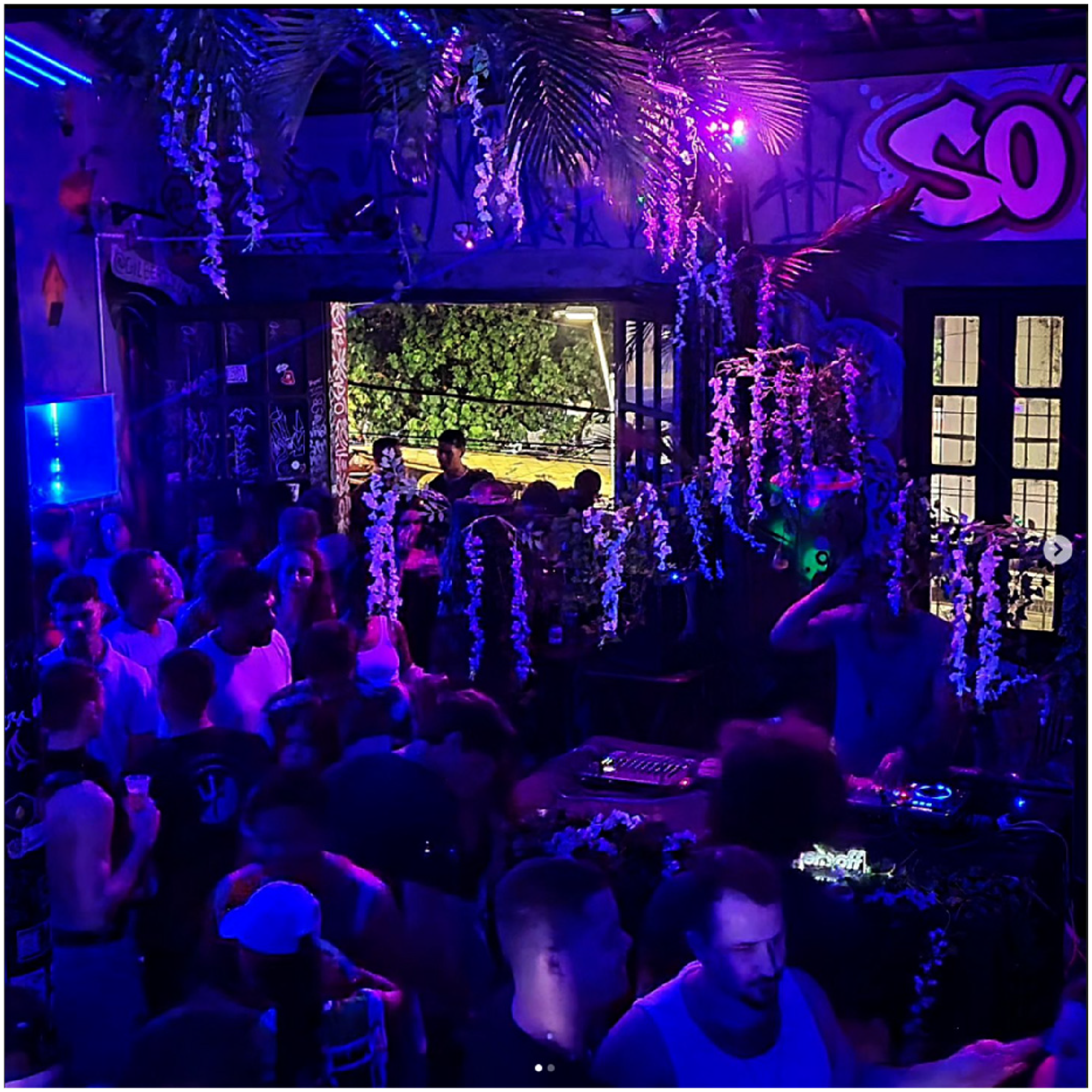
Em.off at Só Shape Tabacaria.
Só Shape has become so established on the city's nightlife circuit that it has adopted a unique cultural promotion policy, where the venue offers a cost and consumption allowance so that producers and artists who have a good relationship with the venue and cannot afford the fees, can hold their events. However, there is a fixed requirement in the space: the event must be free of charge. This can be seen as something positive or neutral, but it does add a specific symbolic capital, which is nothing more than a title or a form of recognition. Symbolic capital is, in fact, an effect of the distribution of other forms of capital in terms of recognition or social value; it is power attributed to those who have obtained sufficient recognition to impose recognition (Campos and Lima, 2018: 110).
Considering that a free event is more attractive to the public, the producer gives up his main source of income: the box office. However, the house profits from the constant and rotating flow of people in the space and the bar's revenue. For the producer, despite giving up the revenue from ticket sales, the event can add a successful status, depending on the work done during the event's post-production. Photographic or audiovisual content of the event can be used as marketing material and, depending on its recurrence, can serve as a future promotion. In addition, financial and geographical accessibility increases the chances of the venue reaching maximum capacity.
Located in the heart of Salvador's nightlife in the Rio Vermelho neighborhood, Só Shape is easily accessible for some. Still, for many others, it is complicated by the precarious public transport system and the absence of night bus routes, whose absence is justified by insecurity and the inefficiency of public authorities in combating this problem. Journeys from outlying areas like the Suburbana neighborhood are long and exhausting. In addition, the transportation infrastructure is not adequate for the demand, making urban mobility a significant challenge for those on low incomes due to the high prices of app-based transportation during the early morning hours.
This unequal reality directly affects the size of potential audiences and the dissemination of the cultural movement, constituting an unfair competitive format between producers with more significant financial capital and those on low incomes. A low-income producer won’t be able to provide the same experience as one with more substantial economic power, and this directly affects the public's decision to consume, as one of the interviewees observed: “People don’t have the money to go out every weekend and go to what they see as the most complete, comfortable, and well-delivered. Without any stress” (Producer 3, in an interview with the authors, 2024).
For independent events to continue to grow and consolidate, it is essential to consider and tackle the challenges of urban mobility, unfair competition, and inequality, seeking solutions that make access to events more democratic and attractive to audiences from all regions. This offers event producers an opportunity to roam, holding events in various neighborhoods and houses in the city, diversifying their audience and democratizing access to the experience. Só Shape, as well as being a space for socializing and welcoming people, can serve as a model for other venues in the city, showing that it is possible to create profitable and mutually supportive partnerships, fostering and stimulating the holding of events in their own space.
With venues such as Só Shape in Rio Vermelho and VilaB in Lauro de Freitas municipality promoting electronic music events, the recurring public sees these places as meeting points. With the constant holding of electronic music events, the consumer public's exposure to this musical niche is nurtured, thus creating a demand for small events to cater to a segmented public spread throughout the city. Considering that Salvador is a city that breathes cosmopolitanism, where each neighborhood has a unique cultural semiosphere (Lotman, 2009), this reflects directly on the public's cultural consumption habits.
In addition, each capital region is a distinct semiosphere with its own habits. Salvador's local scene can also be analyzed by age group. Younger people tend to like sounds closer to trance due to the faster beats. At the same time, adults generally attend more house-oriented events because of the more clubby character and the experience, which is usually more comfortable than a rave. More mature adults prefer nostalgic and melodic sounds with the same intensity and energy.
The electronic music scene in Salvador faces significant challenges that directly impact the sustainability of local artists’ careers and the consolidation of small events. Artistic and financial devaluation, lack of structural support, and socio-economic inequalities create a hostile environment for independent artists to thrive. However, examples such as em.off party and Só Shape Tabacaria demonstrate that making and fostering resilient cultural movements through strategic partnerships and community initiatives is possible. For this scene to continue to grow and consolidate, local producers and artists must face the challenges of creativity and collaboration, seeking to democratize access and offer rich and inclusive cultural experiences.
Conclusion
The electronic music scene in Salvador faces several organizational, infrastructural, and financial challenges. However, it is still pulsating and vibrant, with a growing flow of new events, which gives Salvador's alternative nightlife scene an air of renewal. More and more attention is turning to electronic music events. This flow offers a perspective of renewal of this cultural scene since, with the popularization of free events, new people become interested in the musical genre or the event experience, often for the first time at that venue.
Looking at the horizon, we realize that Salvador's cultural potential is immeasurable. However, all the players must put aside their differences and work together to build an editorial calendar for large and medium-sized events, making room for the organization of smaller events. This would avoid competing for the same date with more significant events, promoting greater diversity and access. Another vital factor is valuing local producers and artists, who face various challenges in maintaining this cultural movement. Unequal pay, the lack of formal contracts, and the absence of institutional support make it difficult for artists and producers to sustain their careers. Despite these challenges, many continue to look for creative ways to stand out and keep the love of electronic music alive.
Só Shape, for example, has shown that it is possible to create profitable and mutually supportive partnerships, offering a model for other venues in the city to follow. With initiatives like this, the electronic music scene in Salvador can continue to grow and consolidate, democratizing its access and offering rich and inclusive cultural experiences for audiences from all regions.
The music scene in Salvador faces significant challenges that directly impact the sustainability of local artists’ careers. Financial devaluation, lack of structural support, and socio-economic inequalities create a hostile environment for independent musicians to thrive. However, examples such as the em.off party at Só Shape Tabacaria demonstrate that it is possible to create resilient cultural movements through strategic partnerships and community initiatives. For the scene to continue to grow and consolidate, local producers and artists must face the challenges of creativity and collaboration, seeking to democratize access and offer rich and inclusive cultural experiences. In this way, the city of Salvador can become a true hub of musical innovation and diversity, where artists from all backgrounds can find a space to express their talent and win over their audiences.
In addition, creating a public calendar of events for producers, valuing local producers and artists, and improving urban mobility are fundamental steps toward strengthening and expanding the electronic music scene in the city. With the union and articulation of most of the players involved, Salvador has the potential to stand out even more on the Brazilian and international music scene, providing a unique and vibrant cultural experience for everyone.
We must consider that the relationship between Salvador and electronic music is something that has not yet been explored academically, which presents itself as an excellent possibility for research in the academic world, containing several layers that can be explored from different approaches, such as power, semiotics, aesthetics, identity, among others.
Footnotes
Acknowledgments
The authors would like to thank the producers and artists of Salvador's electronic music scene for their invaluable contributions to this research. They also acknowledge the support of the Universidade Federal da Bahia (UFBA) for providing the academic environment necessary for this study.

Ethical considerations
This study was conducted in accordance with the ethical standards of the Universidade Federal da Bahia (UFBA).
Informed consent
All participants provided informed consent prior to their involvement in the research.
Funding
The authors received no financial support for the research, authorship, and/or publication of this article.
Declaration of conflicting interests
The authors declared no potential conflicts of interest with respect to the research, authorship, and/or publication of this article.
Data availability statement
The data supporting the findings of this study are available from the corresponding author upon reasonable request.