




Abstract
Several studies have investigated mean-level changes in subjective well-being (SWB) in adolescence, but how the different SWB facets are dynamically related at this age is underexplored. In this article, we apply psychometric network modeling to longitudinal data from the 3-wave GLUECK panel study of 1,427 adolescents to analyze within-person and between-person dynamics in the structure of SWB (life satisfaction, positive affect, negative affect, school satisfaction, self-satisfaction, family satisfaction, friendship satisfaction and neighborhood satisfaction). School satisfaction was the most central domain on the within-person level, while satisfaction with the self was prominently central at the between-person level. We did not find strong evidence for longitudinal top-down or bottom-up effects between life satisfaction and domain satisfaction. Instead, we found more evidence for temporally lagged relationships between domain satisfaction and affective well-being. We conclude that domain satisfaction is central to relationships across SWB facets in adolescence and should be considered more often in this context.
Subjective well-being (SWB) is a multi-dimensional construct constituted of affective (positive and negative affect) and cognitive (life satisfaction, domain satisfaction) well-being (Diener, 1984). Affective well-being refers to positive and negative emotional experiences (Rahm et al., 2017; Schimmack, 2008). Life satisfaction reflects people’s global judgments of their lives while domain satisfaction comprises cognitive evaluations of satisfaction with different domains of life such as health (Michalos & Zumbo, 2002) or relationships (Bühler et al., 2021).
Traditionally, the structure of SWB was studied from a static perspective, examining the relationships among its facets cross-sectionally (Busseri, 2018; Wedderhoff et al., 2021). However, SWB is dynamic over both short and long time spans (Buecker et al., 2023; Luhmann et al., 2021) and should therefore be investigated from a dynamic perspective (Schaefer et al., 2024). A period that is especially suitable to study the dynamic structure of SWB is adolescence. Adolescence is a particular critical phase in the development of SWB, as multiple studies suggest that core facets such as life satisfaction substantially decline during this period (Buecker et al., 2023; Daly, 2022; Henkens et al., 2022; Orben et al., 2022). These declines may have long lasting negative impacts on adolescents future life outcomes such as physical health (Kim et al., 2024) or financial income (De Neve & Oswald, 2012).
So far, however, only few studies have investigated the dynamic structure of SWB in adolescence (see Kim and Jeong, 2017 for an example). In addition, few studies have considered domain satisfaction (Chen et al., 2015; Winn et al., 2025; Zhou et al., 2025) as a critical part of adolescent SWB. To close these research gaps, the present research adopts a dynamic perspective based on longitudinal psychometric network modeling (Borsboom et al., 2021; Epskamp, 2020) to analyze the relationships across different SWB facets during adolescence.
SWB as a Dynamic Construct
In general, dynamics in psychological constructs describe changes occurring within a certain timeframe (Revelle & Wilt, 2021). In this article, we conceptualize dynamics in SWB as within-person deviations from a person-specific stable baseline (Danvers et al., 2020). Across different facets of SWB, such dynamics might be correlated, occurring simultaneously (e.g., adolescents who are more satisfied than usual with school are simultaneously more satisfied with their lives than usual) or with some temporal lag (e.g., adolescents who are more satisfied than usual with school are subsequently more satisfied than usual with their lives). These dynamic relationships are implied in existing structural models of SWB. For example, according to the causal model of SWB (Busseri & Sadava, 2011; Schimmack et al., 2002), changes in affective well-being should predict changes in life satisfaction, but not vice versa. However, existing studies testing structural models of SWB have mainly used cross-sectional designs (Busseri, 2018; Wedderhoff et al., 2021), which cannot disentangle within-person dynamics from stable between-person differences (Hamaker, 2012). Here, we aim to explore these within-person and between-person associations with longitudinal psychometric network models (Borsboom et al., 2021), which are well-suited for this purpose (Schaefer et al., 2024).
Integrating Domain Satisfaction Into the Structure of SWB
Research on the structure of SWB often omits domain satisfaction and instead favors the tripartite model, which consists of life satisfaction, positive affect, and negative affect (Busseri & Sadava, 2011). This oversight is likely due to the arbitrariness in choosing which life domains to include (Rojas, 2006). The relative importance of different domains may vary across subpopulations or even across individuals (Diener et al., 2009). For example, some life domains might be more (or less) relevant during adolescence than during late adulthood (e.g., school satisfaction vs. health satisfaction). However, as Schaefer et al. (2024) argued based on the rationale given by Diener et al. (2009), it is better to include a good but possibly incomplete list of domains than to leave them out altogether. In addition, considering domains is essential to gain a better understanding of top-down and bottom-up models of SWB (Heller et al., 2004). The core question here is whether life satisfaction is a consequence of satisfaction with different life domains (bottom-up model) or whether life satisfaction influences satisfaction with different life domains (top-down model). In sum, it is useful to consider domain satisfaction as part of SWB not only due to the original definition of the construct given by Diener, but also due to its strong theoretical relevance as part of the top-down vs. bottom-up debate.
During adolescence, domains like school (Buecker et al., 2018; Steinmayr et al., 2018, 2019) or family (Guo et al., 2023; Izaguirre Azpiazu et al., 2021; Izzo et al., 2022) are particularly relevant for SWB. Additionally, friendship quality is essential for adolescents’ SWB (Alsarrani et al., 2022). Furthermore, the perception of the self becomes increasingly important during adolescence (Park, 2005). Finally, the neighborhood impacts SWB in adolescence (Cicognani et al., 2008), as adolescents who live in disadvantaged neighborhoods with poorer infrastructure report lower SWB (Laurence, 2019; Marquez et al., 2024). Ignoring these domains might lead to an incomplete picture of SWB in adolescence.
Analyzing SWB Dynamics with Network Analysis
Conventional methods for modeling dynamic associations, such as the random-intercept cross-lagged panel model (Mulder & Hamaker, 2021), are usually restricted to bivariate associations. Psychometric network modeling (Borsboom et al., 2021) offers an alternative for the analysis of SWB dynamics (Schaefer et al., 2024), as it can take into account associations across multiple variables at different levels simultaneously.
Psychometric network analysis allows separating within-contemporaneous associations (e.g., being more satisfied with school than usual co-occurs with higher-than-usual life satisfaction) and within-temporal associations (e.g., being more satisfied with school than usual is associated with being more satisfied with life at a later point in time) from stable between-person relationships (e.g., adolescents who are generally more satisfied with school also tend to be more satisfied with life in general). The meaning of the temporal effects depends on the timeframe. Since we analyze data that was recorded semi-annually, the estimated temporal associations reflect effects that persist across six months.
What can network models teach us about SWB? Prior analysis of adults showed that satisfaction with various domains showed varying degrees of centrality for adults, meaning their overall connectedness with other SWB facets differed, with family, work and income satisfaction being most central (Schaefer et al., 2024). Results from a recent cross-sectional network analysis of SWB in adolescence suggest that facets of negative affect (being anxious, worried, or upset) might be central to SWB (Wang et al., 2023). In another study, feeling satisfied was central for adults’ well-being within the same hour (Woerkom et al., 2022). At a temporal level, domain satisfaction often exhibits a bi-directional relationship with life satisfaction in middle-adulthood (Schaefer et al., 2024). In sum, longitudinal network models can provide valuable insights into the dynamic structure of SWB, but to our knowledge have so far been used exclusively with adult samples.
The Present Paper
To date, most studies on the dynamic relationships among different facets of SWB were conducted among adults. In addition, studies on SWB in adolescence have mostly omitted domain satisfaction. In this paper, we aim to close these two research gaps and clarify which domains are most central to SWB in adolescence (Research Objective 1), how the temporal relationship of life and domain satisfaction is best characterized (Research Objective 2), and how positive and negative affect are related to life satisfaction, while accounting for domain satisfaction (Research Objective 3). For this purpose, we use data from the GLUECK study, a longitudinal study where SWB was assessed in eighth and ninth-grade students at three waves over one year.
Methods
Transparency and Openness
The analyses for the present study were preregistered at the Open Science Framework (OSF). Contrary to the preregistration, we do not primarily report the stability-corrected model, as this model was overly strict and could potentially obscure important results. Instead, we report stability indicators for all edges of every network. The preregistered model with stability correction can be found in the online supplement. We also report minor deviations from our preregistration, the blinded preregistration, and descriptive statistics including zero order between- and within-person correlations, intraclass correlations coefficients (ICC), results from our additional robustness check and provide access to the scripts and data for the statistical analysis: https://osf.io/rgcu7/?view_only=a1e0f7687ecb410598f466b8284b4d05.
Sample
We used data from the GLUECK study, which followed adolescent students from eighth to ninth grade from the Ruhr area in Germany over the course of one year. The study consisted of three waves with a baseline survey (T1: 10/17/2022 to 12/16/2022) and two follow-up waves, each 6 months apart (T2: 04/17/2023 to 06/16/2023; T3: 10/16/2023 to 12/15/2023). Students were allowed to join the study at T2 if they had missed the first measurement point. We used all available data (total N = 1,427). Prior research based on simulation with longitudinal network models showed a strong increase in sensitivity in contemporaneous and especially in temporal networks from N = 100 to N = 1000 (Freichel & Epskamp, 2024). Therefore, our sample size should be sufficient for the analyses carried out here. Mean age at T1 was 13.3 (SD = 0.6) years, with girls being slightly overrepresented (57.3% girls, 41.5% boys, 1.2% non-binary). The study received ethical approval from the local ethics board of the first author’s institution.
Measures
Life satisfaction was measured with the habitual SWB scale (Dalbert, 1992). The scale consists of seven items using a 6-point Likert scale ranging from 1 (not true at all) to 6 (exactly right). An example item is “I am satisfied with my life situation”. Responses were averaged such that higher scores reflected higher levels of life satisfaction. Cronbach’s alpha was .88 at all waves.
Positive and negative affect were measured with the Scale of Positive and Negative Experiences (SPANE; Rahm et al., 2017). This scale usually presents six positive and six negative emotions (e.g., “happy”, “sad) which are rated in terms of frequency during the last four weeks on a 5-point Likert scale ranging from 1 (very rarely or never) to 5 (very often or always). We excluded the items “positive” and “negative” because the participants tended to confuse them with questions regarding positive and negative COVID-19 tests, which they had experienced during the recent pandemic. We estimated the mean for the remaining five items per facet such that higher scores reflected higher levels of either positive or negative affect. Cronbach’s alpha ranged from .82 to .84 for positive affect and from .78 to .80 for negative affect across waves.
Domain satisfaction was measured with the Multidimensional Students’ Life Satisfaction Scale (Huebner et al., 1998) including the domains family (“I like being at home with my family), peers (“My friends treat me well”), school (“I am looking forward to going to school”), neighborhood (“I like where I live”), and self (“It is fun to spend time with me”). Participants rated these items on a 6-point Likert scale ranging from 1 (not true at all) to 6 (exactly right). To ensure that the survey could be completed within a 45-min school lesson, we selected four items per domain based on prior test statistics and expert ratings. Friendship satisfaction, school satisfaction and neighborhood satisfaction each had one negatively pooled item that had to be recoded. We used the mean for all the domains for subsequent analyses such that higher scores reflected higher levels of domain satisfaction. Cronbach’s alpha ranged from .86 to .87 for family satisfaction, from .83 to .84 for school satisfaction, from .74 to .78 for friendship satisfaction, from .72 to .76 for self-satisfaction, and from .67 to .70 for neighborhood satisfaction across waves.
Data Analysis
A network model consists of different variables (nodes) connected through edges, which describe the relationships across nodes via partial (directed) correlations. In contrast to traditional statistical models, those edges represent partial effects that are controlled for all other variables present in the current network (Borsboom et al., 2021). For example, within a network of life satisfaction, school satisfaction, and family satisfaction, a positive edge between life and school satisfaction might indicate that life satisfaction is higher when school satisfaction is higher, given equal family satisfaction. Applying a network analysis to longitudinal panel data (Epskamp, 2020) generates a model with three different network structures: within-temporal, within-contemporaneous and between-person. Associations in the within-temporal network capture how dynamics in one node predict dynamics in itself (autoregressive effect) or in other nodes at the next measurement occasion. The within-contemporaneous network contains information on how dynamics are correlated at the same time, while the between-person network captures associations across the stable person means averaged across time points (Epskamp, 2020).
The analysis was carried out in R Version 4.3.3 with the psychonetrics R package (Epskamp, 2021) based on the multi-step procedure described by Schaefer et al. (2024). We used grand-mean standardization on all variables to improve the estimation (Burger et al., 2022). Full-information maximum likelihood estimation (FIML) was used to handle missing data. To identify our final model, we first pruned the network by removing all edges which were not significant at α = .05. Second, the model was improved further via the modelsearch algorithm (Epskamp, 2020, 2021). We evaluated the stability of the different edges with 1,000 case-drop bootstraps (Epskamp et al., 2018), randomly removing 25% of the sample and re-estimating the model with the remaining subsample. A lower stability indicates that the edge is only representative for a subgroup of the sample. Model fit was deemed adequate if the normed fit index (NFI), comparative fit index (CFI), and Tucker-Lewis index (TLI) were ≥0.90 and root-mean-square error of approximation (RMSEA) was ≤.08 (Sahoo, 2019).
We additionally performed a robustness check, where we removed any of the main nodes and subsequently correlated the overlapping parts from the original network with the reduced networks. This check was utilized to evaluate the robustness of our results to variations in network structure.
To address Research Objective 1, we estimated node strength (Deserno et al., 2022) by summing up the absolute edge weights of a node (excluding autoregressive effects in the temporal network). With this, we can compare the strength of the overall connections of different nodes within a network as a measure of centrality. We chose node strength as other measures of centrality have been identified as largely unfit for applications in psychological networks (Bringmann et al., 2019). However, the usefulness of centrality measures still remains debated (Neal et al., 2022; Neal & Neal, 2023) especially regarding potential causal interpretations that require strong additional assumptions (Dablander & Hinne, 2019). We used a bootstrapped difference test that was designed in reference to the procedure described in Epskamp et al. (2018), which allowed us to investigate if the centrality of any two nodes is significantly different. Research Objective 2 was addressed via an inspection of the edges between life and domain satisfaction in the temporal network. The strength of temporal effects was assessed according to effect size guidelines for cross-lagged effects (Orth et al., 2024) who proposed to use the following benchmarks: .03 (small effect), .07 (medium effect), .12 (large effect). Research Objective 3 was addressed via an inspection of the edges between positive and negative affect as well as life satisfaction in every network.
Results
Preliminary and Stability Analyses
The model fit was acceptable with NFI = .92, CFI = .95, TLI = .94, RMSEA = .035, 95% CI [.032, .038]. Average edge stability was highest in the contemporaneous network (M = 89.7%, SD = 24.4), slightly lower in the between-person network (M = 88.8%, SD = 22.9), and substantially lower in the temporal network (M = 62.3%, SD = 35.2), indicating that some edges could not be reliably replicated with a reduced sample size. This result could hint at stronger differences across subpopulations at the temporal level but could also mean that the temporal network is more susceptible to reductions in power due to comparably smaller effects. In general, edges with low replication rates (see Tables 7 to 9 in the online supplement for exact replication rates) should be interpreted cautiously. The ICC indicated that about 51 to 72% of variance originated from the between-person level (see online supplement for exact results).
The additional robustness check suggested that our results were largely robust to variations in network composition. Correlation across the full and the reduced networks was highest for the contemporaneous network (mean r = .95) and slightly lower for the between-person (mean r = .90) and the temporal networks (mean r = .89).
Temporal Dynamics in SWB
Edge Weights for the Temporal Network

Note. Edge weights (partial directed correlations) with 95% bootstrapped confidence intervals in brackets. Out-effects (edge weights that originate from a node) can be read column by column, in-effects (effects that are directed towards a node) can be read row by row. Autoregressive effects are shown on the main diagonal. †Stability under 70%, ††Stability under 20%.
Bootstrapped Difference Tests (Temporal)

Note. Values on the main diagonal depict the strength of every node (sum of absolute edge weights originating from a node and incoming to that node). 95% confidence intervals from the bootstrapped difference tests are below the main diagonal. Brackets in

Temporal (left), contemporaneous (middle) and between-person (right) networks. Numbers show the partial (directed) correlations. The Fruchtermann-Reingold algorithm implemented in qgraph (Epskamp et al., 2012) was used for node placement
Contemporaneous Dynamics in SWB
Bootstrapped Difference Tests (Contemporaneous)

Note. Values on the main diagonal depict the strength of every node (sum of absolute edge weights connected to a node). 95% confidence intervals from the bootstrapped difference tests are below the main diagonal. Brackets in
Associations Among Stable SWB Components
Bootstrapped Difference Tests (Between-Person)
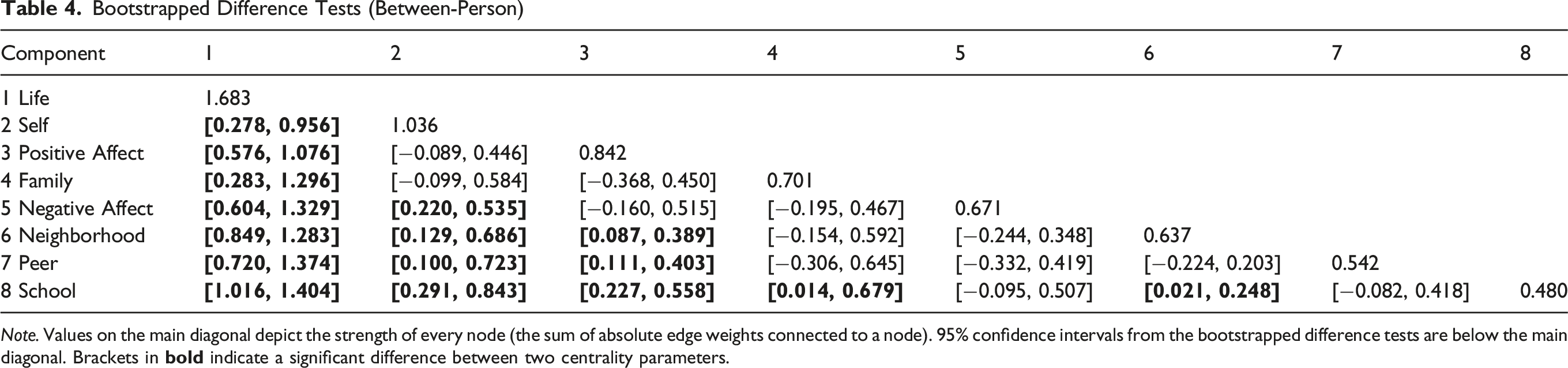
Note. Values on the main diagonal depict the strength of every node (the sum of absolute edge weights connected to a node). 95% confidence intervals from the bootstrapped difference tests are below the main diagonal. Brackets in
Edge Weights in the Contemporaneous Network

Note. Edge weights (partial correlations) with 95% bootstrapped confidence intervals. †Stability under 70%, †† Stability under 20%.
Edge Weights in the Between-Person Network

Note. Edge weights (partial correlations) with 95% bootstrapped confidence intervals. †Stability under 70%, †† Stability under 20%.
Self-satisfaction again occupied a central place in the network (see Figure 2), with strong associations with life satisfaction (rpartial = .46) and school satisfaction (rpartial = .37) and a weaker association with family satisfaction (rpartial = .11). Self-satisfaction was additionally positively related to negative affect (rpartial = .10). Students who were more satisfied with themselves in general were more likely to experience negative affect, which suggests that a high level of satisfaction with the self may not be without negative side effects. However, our additional robustness check demonstrated that the positive association between negative affect and self-satisfaction disappeared, when life satisfaction was not included in the network structure. This result suggests that adolescents that are more satisfied with themselves in general will only experience more negative affect if they are compared to individuals with comparable life satisfaction. Node strength for the temporal network (left), contemporaneous network (middle), and between-person network (right). Higher values indicate higher centrality. Temporal centrality is lower because these associations were generally weaker. Tables 2, 3 and 4 depict the centrality indices in detail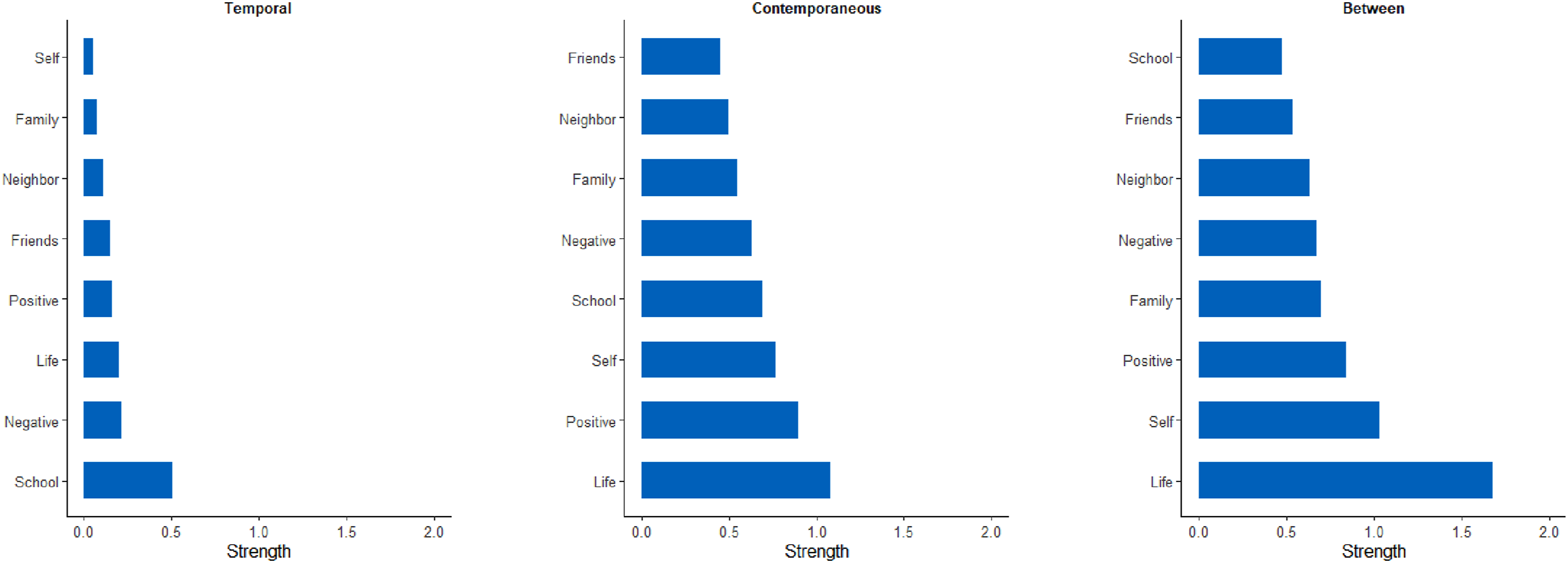
Discussion
This study examined the dynamic structure of SWB in adolescence with longitudinal psychometric network analysis. Several important results should be highlighted: First, we analyzed differences in centrality across domains (Research Objective 1) and found that satisfaction with school and the self were most central to the network of SWB. While school satisfaction was most central in the temporal network, satisfaction with the self was prominently central at the contemporaneous and between-person levels. Second, we investigated associations among life satisfaction and domain satisfaction (Research Objective 2), which provided little evidence for temporal relationships, with only one bottom-up effect of school satisfaction on life satisfaction. However, compared to associations between life satisfaction and positive and negative affect, similarly strong associations between life satisfaction and most domains were apparent at the contemporaneous level. Regarding Research Objective 3, we showed that life satisfaction, positive affect, and negative affect were all related at the contemporaneous level but showed little connection at the temporal level. Additionally, positive and negative affect were unrelated at the stable between-person level. These results provide essential insights into the dynamic network relations of SWB in a previously underexplored life stage.
New Insights Into Network Dynamics of SWB in Adolescence
The core strength of network analysis is its ability to explore relationships among several variables, gaining new insights into complex phenomena such as the dynamic structure of SWB. Due to the manifoldness of the individual results, we cannot discuss all findings in detail. Instead, we will highlight four results that we think are particularly interesting.
First, we found an unexpected temporal association between school satisfaction and subsequent satisfaction with neighborhood, indicating that students who are more satisfied with their school life evaluate their neighborhood subsequently as more favorable. A possible explanation is that school satisfaction and satisfaction with neighborhood are both affected by a common cause: socioeconomic background. As socioeconomic background is related to school satisfaction (Horanicova et al., 2022) and satisfaction with neighborhood (Fauth et al., 2004). The found association might be attributable to this aspect.
Second, negative affect and self-satisfaction showed reversing relationships at the within-contemporaneous (positive) and between-person level (negative). While experiencing more negative affect than usual seems to hurt self-satisfaction (or vice versa), adolescents who tend to be more satisfied with themselves in general also experience more negative affect in general. However, our additional robustness check (see online supplemental materials) indicated that the latter was only true if life satisfaction was part of the network composition. This means that this effect only holds if life satisfaction is controlled for, which might explain why previous research that assessed the association between self-esteem and negative affect in a daily diary study found the opposite effect (Nelis & Bukowski, 2019). How can we interpret this unexpected effect? In general, high self-satisfaction seems to be a protective factor, as it also coincides with high life satisfaction. However, if we compare adolescents who are similarly satisfied with their lives, we may speculate that those who rely more on self-satisfaction may be more prone to frustration due to events that do not support this perception.
Third, we found a robust reoccurring association between peer satisfaction and positive affect, which was especially noticeable as peer satisfaction was not or only relatively weakly related to overall life satisfaction. Previous research has shown the importance of peers for affective well-being (Alivernini et al., 2019) and that friendship quality may impact affective well-being by fulfilling basic needs (Demir & Özdemir, 2010). Therefore, these results might indicate that satisfying peer relationships are an especially important condition for positive affective well-being among adolescents. Additionally, the results from the temporal network suggest that an improvement in positive affect is followed by an increase in peer satisfaction. As affective well-being does not seem to affect friendship selection (Van Workum et al., 2013), this may indicate that friendship quality not only improves adolescent´s well-being (Alsarrani et al., 2022), but that positive affect may also enhance friend relationships. The broaden-and-build theory of positive emotions (Fredrickson, 2004) offers a possible explanation, assuming that positive emotions broaden mindsets, providing mental resources for new relationships. Applied to our study, adolescents improving in affective well-being gain resources to establish new social bonds, potentially improving friendship satisfaction.
Fourth, self-satisfaction and school satisfaction showed one of the strongest relations at the between-person level but were not related at any within-person level. Adolescents are thus likely to be similarly (dis-)satisfied with both domains in general, but dynamic changes in these domains seem to have no demonstrable effect on each other. This suggests that there may be universal causes that affect the general level of both SWB facets, for example, socioeconomic status (Horanicova et al., 2022; Twenge & Campbell, 2002). In contrast, singular events affecting only one domain, such as a particularly good grade in an important exam, are unlikely to lead to temporary increases in the other domain.
School Satisfaction is the Most Central Domain at the Within-Person Level
In general, our results confirm prior research on the importance of the school domain for SWB in adolescence (Buecker et al., 2018; Steinmayr et al., 2018). However, it is remarkable that the school domain is especially central at the within-person level. This finding suggests that, for example, poor average school performance might not automatically result in poor average SWB (Buecker et al., 2018), but being more or less satisfied with school than usual might be quite impactful. School-based events that disrupt the previous status quo of school satisfaction, for example poor school transitions (West et al., 2010), might be especially adverse for overall SWB. Strengthening students‘ school satisfaction to prevent negative fluctuations might be an important factor to prevent declines in students‘ SWB. Among the most important aspects related to positive school satisfaction are teacher-student relationship, teacher support, peer relationship and academic achievement (Danielsen et al., 2009; Hui & Sun, 2010). Thus, strengthening these aspects might lead to an increased school satisfaction which might also prevent a decline in SWB. However, the strong temporal effect of school satisfaction on life satisfaction was not present if positive affect, neighborhood satisfaction, or self-satisfaction were omitted as part of our additional robustness check. Therefore, this result should be interpreted with more caution and requires replication in additional samples.
Weak Evidence for Top-Down or Bottom-Up Effects in Adolescence
Regarding life satisfaction and domain satisfaction, research on network dynamics of SWB in adulthood suggests that bidirectional relationships among these facets are weak (Schaefer et al., 2024). Similarly, our results provide only little evidence for top-down or bottom-up effects between life satisfaction and domain satisfaction in adolescence. Instead, we found several top-down effects from negative and positive affect on various domains, which indicates that in adolescence, dynamics in affective well-being are more impactful for future domain satisfaction than general life satisfaction. However, the relatively low number of measurement occasions can substantially reduce the sensitivity, especially in the temporal network (Freichel & Epskamp, 2024). Therefore, we cannot rule out that associations across domains and life satisfaction may be just too weak to detect them in this study. Another explanation for this result might be that the investigated timeframe of half a year is too long. Top-down or bottom-up effects might be more pronounced over shorter periods (e.g., hourly, daily, weekly or monthly). For example, events that are not directly associated with the school domain such as a dispute in the family or among friends may only have a short-term impact, as indicated by the contemporaneous effects, but these effects could become insignificant after a few weeks.
The Tripartite Structure Differs Across Networks in Adolescence
Regarding the relationships among the facets of the tripartite structure, two results are particularly important. First, we could not find significant evidence for a relationship between negative and positive affect at the between-person level, which is in line with prior research that used shorter time frames for adults (Bleidorn & Peters, 2011; Möwisch et al., 2019). However, this result was not found if life or self-satisfaction were omitted from the network composition, indicating that this is only true for adolescence with similar levels of life or self-satisfaction. Second, when we compare our results to findings on the dynamic network structure of adults (Schaefer et al., 2024), it becomes apparent that the between-person associations of positive and negative affect with life satisfaction are considerably stronger, particularly for negative affect. This difference is remarkable as the associations on the within-contemporaneous level are relatively comparable. This finding provides further evidence for the important role of negative affect for overall SWB in adolescence, where the experience of constant negative affect seems to be especially detrimental to life satisfaction, highlighting the need to provide access to early training in emotional regulation strategies for adolescents (Dowling et al., 2019). Additionally, we found less evidence for temporal associations across these facets, with only a weak effect of negative affect on life satisfaction. However, as discussed before, the lack of associations at the temporal level might be explained by a lack of sensitivity for smaller effects.
Limitations and Implications for Future Research
First, the present paper demonstrated the importance of considering domain satisfaction for the investigation of SWB in adolescence, as the results support prior evidence on the importance of school satisfaction for SWB in adolescence in comparison to other domains. Therefore, researchers should aim to include domain satisfaction in research on SWB in adolescence. Satisfaction with school and the self may be especially important when considering within-person processes due to their high centrality in the SWB network. However, as there are countless domains that could potentially be relevant (Diener et al., 2009; Rojas, 2006), this study might not be complete or optimal. For example, financial satisfaction (Gariepy et al., 2017) might also be relevant for adolescents and should be examined in subsequent studies. Furthermore, our study used data from a regionalized German sample. These results might therefore not be generalizable to other cultural contexts, as minor differences across domains and SWB in children were found across European countries (Mínguez, 2020).
Second, no direct comparison across different age groups was possible. Prior research showed the dynamic structure of SWB does not fundamentally change across the adult lifespan, although small age differences can be observed (Schaefer et al., 2024). To investigate whether a more drastic change occurs from adolescence to adulthood, it would be optimal to conduct studies with equal domains and directly compare network structures across age groups.
Third, longitudinal network analysis is a suitable method to analyze SWB in adolescents and can produce valuable novel insights. However, the model here imposed a fixed effect structure (Epskamp, 2020), which does not consider significant variation at the individual level (Beck et al., 2025; Rast et al., 2012). Therefore, future research should also consider alternative approaches which focus on analyzing network structures at the individual level, which might even feature individualized domains (Nissen & Beck, 2025).
Fourth, positive and negative affect were assessed in terms of frequency over the last four weeks while life satisfaction and domain satisfaction were assessed without any specification regarding the timeframe, which might have influenced our results. However, Luhmann et al. (2012) demonstrated that different time frames in measurement are unlikely to affect the relationships between cognitive and affective well-being. Finally, as pointed out earlier, the small number of measurement occasions may reduce sensitivity, especially in the temporal network (Freichel & Epskamp, 2024), which may have also contributed to reduced stability of most temporal edges. Future studies should therefore use longitudinal data with more measurement occasions to be able to detect weaker temporal relationships and provide more robust results.
Conclusion
This paper provides new evidence on the network structure of SWB in adolescence. Results indicate that school satisfaction is the most impactful domain at the within-person level, and that affective well-being might be more strongly temporally associated with domain satisfaction than with life satisfaction. Theoretically, the results underline the central role of domain satisfaction in the structure of SWB and provide additional evidence that long-term top-down and bottom-up effects tend to be relatively weak. In fact, temporal relationships may be stronger between domain satisfaction and affective well-being in adolescence. In summary, a network perspective and psychometric network analysis seem suitable to gain new insights into the dynamics of adolescents SWB.
Supplemental Material
Supplemental Material - Network Dynamics of Life Satisfaction, Domain Satisfaction and Affective Well-Being in Adolescence
Supplemental Material for Network Dynamics of Life Satisfaction, Domain Satisfaction and Affective Well-Being in Adolescence by Bernd Schaefer, Ricarda Steinmayr, Miriam Schmitz, Marcus Roth, Alicia Neumann, Maike Luhmann in Personality Science
Footnotes
Author’s Note
Dr. Sointu Leikas was the handling editor.
Acknowledgements
The first author thanks Kai Latzel and Max Schülein for their support during the GLUECK study.

Funding
The authors disclosed receipt of the following financial support for the research, authorship, and/or publication of this article: This project was supported by a grant from the Mercator Research Center Ruhr (MERCUR) to R. Steinmayr, M. Roth and M. Luhmann (“Determinants of subjective well-being in sensitive periods of adolescence”, No. Ko-2021-0022).
Declaration of Conflicting Interests
The authors declared the following potential conflicts of interest with respect to the research, authorship, and/or publication of this article: Maike Luhmann is a member of the journal’s editorial board.
Data Availability Statement
Supplemental Material
Supplemental material for this article is available online. Depending on the article type, these usually include a Transparency Checklist, a Transparent Peer Review File, and optional materials from the authors.
References
Supplementary Material
Please find the following supplemental material available below.
For Open Access articles published under a Creative Commons License, all supplemental material carries the same license as the article it is associated with.
For non-Open Access articles published, all supplemental material carries a non-exclusive license, and permission requests for re-use of supplemental material or any part of supplemental material shall be sent directly to the copyright owner as specified in the copyright notice associated with the article.
