



Abstract
Future self-continuity, or the degree to which individuals feel connected to mental representations of their future selves, has been negatively associated with temporal discounting, or the tendency to choose smaller, immediate rewards over larger, delayed rewards. Although somewhat stable and trait-like, future self-continuity is also malleable, making it an important target for intervention. Over the past decade, clinical, social, and health psychologists have developed interventions designed to increase future self-continuity by making the future self more vivid and accessible. While promising, the results of these interventions have been mixed. Thus, the goal of the current study was to provide a systematic review of the literature on future self-continuity interventions with a focus on behavioral outcomes. The review protocol was pre-registered on PROSPERO (CRD42024610111). A literature search was conducted between November 2024 and February 2025. Of the 1,256 articles initially identified, 14 articles (containing 23 studies) met the inclusion criteria. Studies included a range of methodologies and outcomes, and most focused on young adults recruited from undergraduate samples or online platforms. Despite some gaps in the literature, the reviewed interventions produced small to large effects on behavioral outcomes, suggesting that future self-continuity interventions are a promising method for enacting behavior change.
Future self-continuity, also known as future self-identification, refers to the degree to which individuals feel connected to mental representations of their future selves (Bixter et al., 2020; Hershfield, 2011). Evidence shows that there is meaningful variation in this construct, with some individuals feeling strongly connected to their future selves and others perceiving their future selves as separate or dissimilar entities (Hershfield, 2011; Sedikides et al., 2023). More specifically, future self-continuity has been shown to vary along three dimensions: vividness (i.e., how clearly the current self can imagine the future self); similarity (i.e., how similar the current self is to the future self); and positivity (i.e., how positively the current self feels towards the future self; Bixter et al., 2020). Although these dimensions are positively and significantly associated with one another, they also predict distinct psychological and behavioral outcomes (Bixter et al., 2020).
The concept of future self-continuity has its roots in multiple selves theory (Parfit, 1984), which postulates that the self should be conceptualized, not as a continuous, unitary construct, but rather as a series of distinct identities, loosely connected by overlapping traits, desires, intentions, and memories (Parfit, 1984). According to Parfit (1984) and others (Frederick, 2003; Hershfield et al., 2012), the degree of connection we feel to different versions of our ‘multiple selves’ depends on temporal distance. Specifically, we feel more connected to mental representations of selves that are closer, versus farther, to us in time (e.g., our self in 1 month versus our self in 20 years; Bartels & Rips, 2010). In fact, a growing body of research suggests that temporally distant ‘selves’ are often perceived as altogether separate people. For example, work by Pronin and Ross (2006) suggests that the attributions we make about our future selves resemble the attributions we make about other people. Specifically, we attribute the behavior of our current selves to situational factors, while attributing the behavior of our (imagined) future selves (and other people) to stable, dispositional factors. Additionally, studies from the field of social neuroscience suggest that the patterns of neural activation we exhibit when imagining our future selves resemble the patterns we exhibit when imagining another person (i.e., reduced activation in the medial prefrontal cortex and rostral anterior cingulate, brain areas which play roles in decision-making and reward processing; Ersner-Hershfield et al., 2009).
Future Self-Continuity and Psychopathology
In recent years, future self-continuity has become an important construct in the clinical psychology literature, with a growing number of studies suggesting that disconnection from the future self may be a transdiagnostic vulnerability factor for psychopathology. More specifically, studies have found that future self-continuity (1) distinguishes between individuals who do and do not meet criteria for various psychological disorders and (2) prospectively predicts both internalizing and externalizing symptoms across a variety of populations. For example, Sokol and Serper (2019a) administered measures of future self-continuity, mood symptoms, cognitive insight, and adaptive functioning to 60 psychiatric inpatient participants and 60 healthy controls. Results showed that inpatient participants had lower levels of future self-continuity than control participants, and that, among inpatient participants, lower future self-continuity was associated with more severe mood symptoms, less insight and less adaptive functioning. Sokol and Eisenheim (2016) administered measures of future self-continuity to 246 participants recruited through MTurk and found that future self-continuity was negatively related to suicidal ideation and symptoms of depression/anxiety. Additionally, future self-continuity accounted for incremental variance in the prediction of suicide risk, above and beyond mood symptoms and negative life events. In one of the few prospective studies of future self-continuity and psychopathology, Xue et al. (2023) surveyed 426 Chinese college students and found that baseline levels of future self-continuity prospectively predicted depression symptoms three months later. Building on this methodology, Mao and Li (2024) found bi-directional relationships between future self-continuity and negative emotional states in a year-long, three-wave longitudinal study of Chinese college students. Future self-continuity has also been associated with behavioral indicators of psychopathology, such as substance use (Kooij et al., 2018; Zhao et al., 2020) and delinquency (Van Gelder et al., 2015); conditions which also tend to be characterized by shortened time horizons and an inability to imagine the future (Kooij et al., 2018; Petry et al., 1998).
Explanatory Mechanisms
There are several mechanisms that may account for the relationship between future self-continuity and emotional and behavioral health. The mechanism that has received the most empirical support is temporal discounting or the tendency to choose smaller, immediate rewards over larger, delayed rewards (Bartels & Urminsky, 2011; Bentley, 2022; Pietroni & Hughes, 2016). Individuals who are low in future self-continuity tend to perceive their future selves as separate or dissimilar entities. As a result, they may be reluctant to forgo immediate rewards (e.g., tasting sugary foods, using drugs, spending money) in order to benefit those future selves (i.e., they may exhibit temporal discounting). This explanatory model has been supported by numerous studies which have found associations between future self-continuity and temporal discounting across a variety of outcomes, including choice of monetary rewards (Bartels & Urminsky, 2011), investment in retirement accounts (Hershfield, 2011), discretionary spending (Schanbacher et al., 2023), academic procrastination (Chishima & Wilson, 2021), ethical decision making (Hershfield et al., 2012) and weight loss (Bentley, 2022). Moreover, all three dimensions of future self-continuity (i.e., vividness, similarity, and positivity) have been found to independently predict temporal discounting (Bixter et al., 2020).
In addition to temporal discounting, there are several other explanatory mechanisms that may mediate the effects of future self-continuity on emotional and behavioral outcomes. Manipulations designed to increase future self-continuity have been shown to boost positive mood (Sokol & Serper, 2019b), agency (Pataranutaporn et al., 2024), and motivation to change (Pataranutaporn et al., 2024), as well as to decrease hopelessness (Sokol et al., 2021) and to minimize self-esteem loss following a discouraging task (Sokol & Serper, 2019b). All of these factors (self-esteem, agency, hope, motivation) have been shown to promote behavioral change and/or better mental health outcomes (Orth & Robins, 2022; Prochaska et al., 1992; Ryan & Deci, 2023) and, as such, may serve as important mediators in the relationship between future self-continuity and indices of mental and behavioral health. Notably, however, more research is needed to elucidate these potential mechanisms and their impact on heterogeneous outcomes.
Future Self-Continuity Interventions
Future self-continuity is relatively stable over short periods of time (Sokol & Serper, 2019c) and is associated with many trait-like variables, including subjective well-being (Zhang & Chen, 2018), grit (Wei et al., 2025), low impulsivity, and low hopelessness (Han et al., 2025). At the same time, future self-continuity has been shown to be malleable, making it an important target for intervention (Hershfield, 2011). In fact, over the past decade, clinical, social, and health psychologists have developed a wide range of interventions designed to increase future self-continuity by making the future self more vivid and accessible. Some of these interventions overtly manipulate future self-continuity, through exercises such as viewing age-progressed photos (Hershfield, 2011), writing letters to a future self (Chishima & Wilson, 2021; Rutchick et al., 2018), interacting with a future self in a virtual environment (Hershfield, 2011; Van Gelder et al., 2013), or setting up a Facebook profile for a future self (Van Gelder et al., 2015). Other studies have manipulated future self-continuity in less direct ways, using subtle suggestions or ‘nudges’ to create a sense that the self is stable over time (Pietroni & Hughes, 2016). These interventions often involve asking participants to read passages about identity stability or to generate reasons why their identity is likely to remain stable over time (Bartels & Urminsky, 2011; Pietroni & Hughes, 2016; Schanbacher et al., 2023; Sheldon & Fishbach, 2015).
While somewhat promising, the results of future self-continuity interventions have been mixed, and some studies have yielded null findings (Bentley, 2022; Mertens et al., 2023). Additionally, the results of future self-continuity studies have varied based on intervention methodology and study outcomes, making it difficult to draw firm conclusions about their effectiveness and the factors that moderate their efficacy. It is also important to note that future self-continuity interventions are often lumped together with other types of future orientation/time horizon interventions in the literature (e.g., possible selves interventions, episodic future thinking interventions, mental contrasting interventions). This is problematic, given the important conceptual and methodological distinctions between these various interventions. For example, possible selves and mental contrasting interventions involve envisioning specific versions of a future self (e.g., a desired or a feared future self), while episodic future thinking interventions involve imagining details of specific future events (e.g., an upcoming wedding). In contrast, future self-continuity interventions are broader and encourage participants to connect with all aspects of their future self (positive and negative) across all situations.
Despite the issues described above, as well as the existence of several excellent theoretical reviews (Bixter et al., 2020; Hershfield, 2011; Sedikides et al., 2023), to date, there have been no systematic, empirical reviews of the future self-continuity intervention literature. The current study aims to fill this gap by conducting a systematic review of the literature on future self-continuity interventions that target behavioral outcomes in adults. The overarching goals of the review are to (1) synthesize the existing literature on future self-continuity interventions in adults by describing the types of interventions that have been conducted, the range of behavioral outcomes that have been targeted, and the participant populations that have been studied, (2) evaluate evidence for the efficacy of future self-continuity interventions in adults, and (3) identify existing gaps or weaknesses in the future self-continuity intervention literature, as well as directions for future studies.
Methods
Search Strategy
Database Search Terms

Inclusion and Exclusion Criteria
Studies were eligible for inclusion in the review if they (1) were reported in English, (2) were randomized controlled trials or cluster randomized trials, (3) included a control or comparison group, (4) included an intervention designed to increase future self-continuity, (5) focused on adult participants, and (6) targeted a behavioral outcome. For the purposes of the current review, behavioral outcomes included behavioral observations, self-reported behaviors, and self-reported behavioral intentions (e.g., intentions to adhere to COVID-19 safety measures). Studies were excluded from the review if they (1) did not use random assignment or contain a control/comparison group, (2) focused on child participants, (3) targeted only non-behavioral outcomes, such as change in future self-continuity, self-esteem, or depression, or (4) used an intervention that did not specifically aim to increase future self-continuity. Studies involving other types of time horizon/future orientation interventions, such as possible selves, episodic future thinking, and mental contrasting interventions, were excluded from the review.
Data Extraction
Search results were downloaded to EndNote Version 21 (Clarivate, Philadelphia, PA), and duplicate articles were removed. All article abstracts were then uploaded to Rayyan (Ouzzani et al., 2016) where they were screened for eligibility by two independent/blind raters (two of the following: ERG, HAT, MAS, and JLS). Rating discrepancies were resolved by discussion. Following this first phase of title/abstract screening, full texts of potentially eligible articles were reviewed by two blind raters (ERG and HAT), and the reference lists of these articles were thoroughly examined to detect additional relevant studies. Rating discrepancies were again resolved through discussion. All data were extracted by ERG, entered into an Excel spreadsheet, and checked by one additional author (HAT, MAS or JLS). The following information was extracted from each article: publication date, country, sample demographics, sample size, study design, intervention procedures, control group procedures, outcome measures (baseline and follow-up), and results. The quality of all eligible articles was assessed by ERG and HAT using a modified version of the National Institute of Health’s quality assessment tool for randomized controlled trials (https://www.nhlbi.nih.gov/health-topics/study-quality-assessment-tools).
Due to the small number of eligible studies, the wide range of intervention and measurement techniques used, and the fact that some eligible studies did not provide raw data or effect sizes, it was decided that a quantitative review/meta-analysis was not feasible. Thus, the data were synthesized using a narrative approach, which allowed for a comprehensive analysis of this very heterogeneous and small literature.
Results
A PRISMA flow chart depicting the screening process is presented in Figure 1. A systematic search of electronic databases yielded a total of 1,256 articles, 147 of which were duplicates. The titles and abstracts of the remaining 1,109 articles were screened by independent raters, and 1,085 were deemed ineligible due to not meeting inclusion criteria. The majority of ineligible studies (N = 1,037) were excluded because they did not include random assignment or control/comparison groups. The other ineligible studies were excluded because they targeted non-behavioral outcomes (N = 19), described future orientation interventions that did not specifically target future self-continuity (N = 23), or targeted youth samples (N = 6). PRISMA 2020 Flow Diagram for Systematic Reviews
The full texts of the remaining 24 articles were evaluated by two authors (ERG and HAT). Three of these studies were removed because they utilized youth samples, and two were removed because they were study protocols and did not include data. An additional five studies were removed because their interventions did not specifically target future self-continuity; three of these studies included possible selves interventions, one included an episodic future thinking intervention, and one included an intervention designed to increase the tendency to think about the future. This left 14 articles that were eligible for inclusion in the review. Thirteen of the articles were published manuscripts, and one was an unpublished dissertation (Bentley, 2022). Notably, several of these articles contained multiple small studies, which used separate, independent samples of participants (Bartels & Urminsky, 2011; Hershfield, 2011; Schanbacher et al., 2023; Van Gelder et al., 2013). In these cases, each individual study within an article was treated as a separate study. Thus, there were 14 articles with 23 individual studies included in the review.
Study Populations
Twelve of the 23 studies included in the review used undergraduate samples (Bartels & Urminsky, 2011; Gao et al., 2024; Hershfield, 2011; Mertens et al., 2023; Pietroni & Hughes, 2016; Rutchick et al., 2018; Sheldon & Fishbach. 2015; Sims et al., 2020; Van Gelder et al., 2013). One study used a young adult, community sample (Bartels & Urminsky, 2011). One study used participants who were clients at an investment firm (Kausel et al., 2024). Six studies used participants from a publicly available online recruitment site, such as MTurk or Prolific (Bentley, 2022; Hershfield, 2011; Schanbacher et al., 2023; Van Gelder et al., 2013), and three studies reported that participants completed online surveys, but did not specify how or from where these participants were recruited (Bartels & Urminsky, 2011; Hershfield et al., 2012; Simic et al., 2021). Most participants, across undergraduate, online, and community samples, were under the age of 30, and none of the studies examined age as a moderator. Thus, it is unclear whether future self-continuity interventions are as effective or utilize the same mechanisms of behavior change when given to middle-aged/older adults, as opposed to younger adults.
The majority of studies in the review recruited participants from the United States. However, five studies recruited participants from other countries: one study recruited participants from China (Gao et al., 2024); one recruited participants from the Netherlands (Mertens et al., 2023); one recruited online participants who were fluent in Bosnian, Serbian, or Croatian (Simic et al., 2021); and two did not specify participants’ country of origin (Kausel et al., 2024; Van Gelder et al., 2013). Notably, only one study in the review (Bentley, 2022) included participants who expressed a desire to change (in this case, a desire to lose weight). Thus, the effectiveness of future self-continuity interventions in clinical samples or samples of individuals who express a desire to change remains unclear.
Interventions
Studies Using Overt (Face Valid) Techniques
The majority of interventions in the review sought to make future self-representations more accessible by using explicit techniques such as viewing age-enhanced photos (Hershfield, 2011; Kausel et al., 2024; Mertens et al., 2023), vividly imagining a future self (Bentley, 2022; Gao et al., 2024; Schanbacher et al., 2023), or writing letters to a future self (Rutchick et al., 2018; Simic et al., 2021; Van Gelder et al., 2013). These overt techniques are explicitly designed to promote interaction with, or imagination of, a future self and are considered to be face valid. For example, Rutchick et al. (2018) randomly assigned undergraduates to write a letter to themselves either 3 months or 20 years in the future. Participants were then asked to provide daily reports of how many minutes per day they exercised over a period of 10 days. Gao et al. (2024) randomly assigned participants to engage in a series of present-focused meditations or to imagine themselves 10 years in the future. At the end of the study, participants completed measures of self-reported physical activity, nutritional habits, and health responsibility behaviors. Using a similar methodology, Bentley (2022) assigned MTurk participants to (1) visualize their future self in 1, 5 and 10 years (the future self-continuity condition), (2) visualize a specific, personalized, future event (the episodic future thinking condition), or (3) write about a positive, personal experience they had within the past week (the control condition). All participants were then asked to complete a weight-related temporal discounting task.
Studies Using Subtle (Non-face Valid) Techniques
Other studies in the review manipulated future self-continuity in more subtle, less direct (i.e., less face-valid) ways (Bartels & Urminsky, 2011; Pietroni & Hughes, 2016; Schanbacher et al., 2023; Sheldon & Fishbach, 2015). For example, Bartels and Urminsky (2011) asked participants to read a passage stating either that young adulthood is characterized by identity stability (the high future self-continuity condition) or identity change (the low self-continuity condition). Participants were then given the choice of receiving a small gift card immediately or a large gift card in a year. Similarly, Pietroni and Hughes (2016) asked undergraduates to assess how their social skills compared to the social skills of the average student. Half of the participants then read a quote suggesting that good social skills are the key to an empowered future (the high future self-continuity ‘nudge’). At the end of the intervention, all participants completed measures of temporal discounting and future self-continuity.
Studies Using Specialized Technology
Notably, several studies in the review used specialized technology (e.g., virtual reality, digital avatars) to increase the vividness of future self-representations (Hershfield, 2011; Mertens et al., 2023; Sims et al., 2020; Van Gelder et al., 2013). For example, Hershfield (2011) asked participants to view digital representations of either their current self or an age-progressed version of their current self in a virtual mirror. Participants then completed a series of exercises in which they indicated how much money they wanted to save for retirement. Sims et al. (2020) asked community college students to view and build a web profile for a digital avatar that reflected either their current or their future (age-progressed) self. Images of the avatars were then embedded in a series of online surveys administered to participants. At the end of the study, all participants were assessed for financial literacy, financial confidence, and interest in taking a workshop on financial planning. Using a somewhat different methodology, Mertens et al. (2023) assigned university students to interact daily with a smartphone app called “Future U.” When using the app, participants saw an age-morphed photo of themselves who initiated chats, asked questions, gave assignments, and made positive comments. Participants who used the app were asked to work through three, week-long modules focusing on (1) increasing identification with the future self, (2) stimulating future oriented decision making, and (3) achieving growth mindsets. Participants who used the app (as well as those in an inactive control group) were then assessed on a wide range of outcomes, including future self-continuity, vividness of the future self, future orientation, self-defeating behaviors, goal achievement, goal commitment, impulsiveness, psychosocial wellbeing, and academic achievement.
Study Timing
The interventions included in the review were administered in a variety of ways. Five of the studies were longitudinal (Gao et al., 2024; Kausel et al., 2024; Mertens et al., 2023; Rutchick et al., 2018; Sims et al., 2020), with the timing of follow-up assessments ranging from 10 days (Rutchick et al., 2018) to 3 months (Mertens et al., 2023; Sims et al., 2020). Among these longitudinal studies, there were differences in whether participants were exposed to the future self-continuity intervention once (e.g., Kausel et al., 2024; Rutchick et al., 2018) or multiple times (e.g., Gao et al., 2024; Mertens et al., 2023; Sims et al., 2020). Notably, however, the majority of interventions in the review were delivered in a single session. Approximately half of these single-session studies assessed the impact of future self-continuity interventions on spending versus saving behaviors, as measured by monetary temporal discounting and money allocation tasks (Bartels & Urminsky, 2011; Hershfield, 2011; Pietroni & Hughes, 2016; Schanbacher et al., 2023). The other single session studies (Bentley, 2022; Hershfield et al., 2012; Sheldon & Fishbach, 2015; Simic et al., 2021; Van Gelder et al., 2013) assessed a range of outcomes which are discussed in more detail below. Notably, only one study in the review (Bentley, 2022) compared the effectiveness of a future self-continuity intervention to that of another type of future time orientation intervention – in this case, an episodic future thinking intervention.
Outcomes
The studies in this review assessed a wide range of behavioral outcomes, including spending versus saving (Bartels & Urminsky, 2011; Hershfield, 2011; Kausel et al., 2024; Pietroni & Hughes, 2016; Schanbacher et al., 2023), weight related temporal discounting (Bentley, 2022), physical activity and nutrition (Gao et al., 2024; Rutchick et al., 2018), academic achievement (Mertens et al., 2023), intentions to adhere to COVID-19 safety measures (Simic et al., 2021), intentions to enroll in a financial literacy workshop (Sims et al., 2020), and delinquent/unethical behaviors (Sheldon & Fishbach, 2015; van Gelder et al., 2013). Notably, only eight studies in the review (Gao et al., 2024; Hershfield, 2011, studies 4 and 5; Hershfield et al., 2012; Mertens et al., 2023; Sheldon & Fishbach, 2015; Simic et al., 2021) explicitly measured future self-continuity, making it difficult to determine whether study interventions worked as intended (i.e., whether they actually increased future self-continuity). Studies that assessed future self-continuity tended to use total scores from composite measures, rather than examining the three subdimensions of future self-continuity (vividness, positivity, similarity) separately. The two exceptions to this were Gao et al. (2024), who found that their intervention increased all three dimensions of future self-continuity, and Mertens et al. (2023), who found that their intervention specifically increased vividness.
Effects
Characteristics of Included Studies

Note. FSC = future self-continuity.
Quality Assessment Items for Longitudinal and Single Session Studies
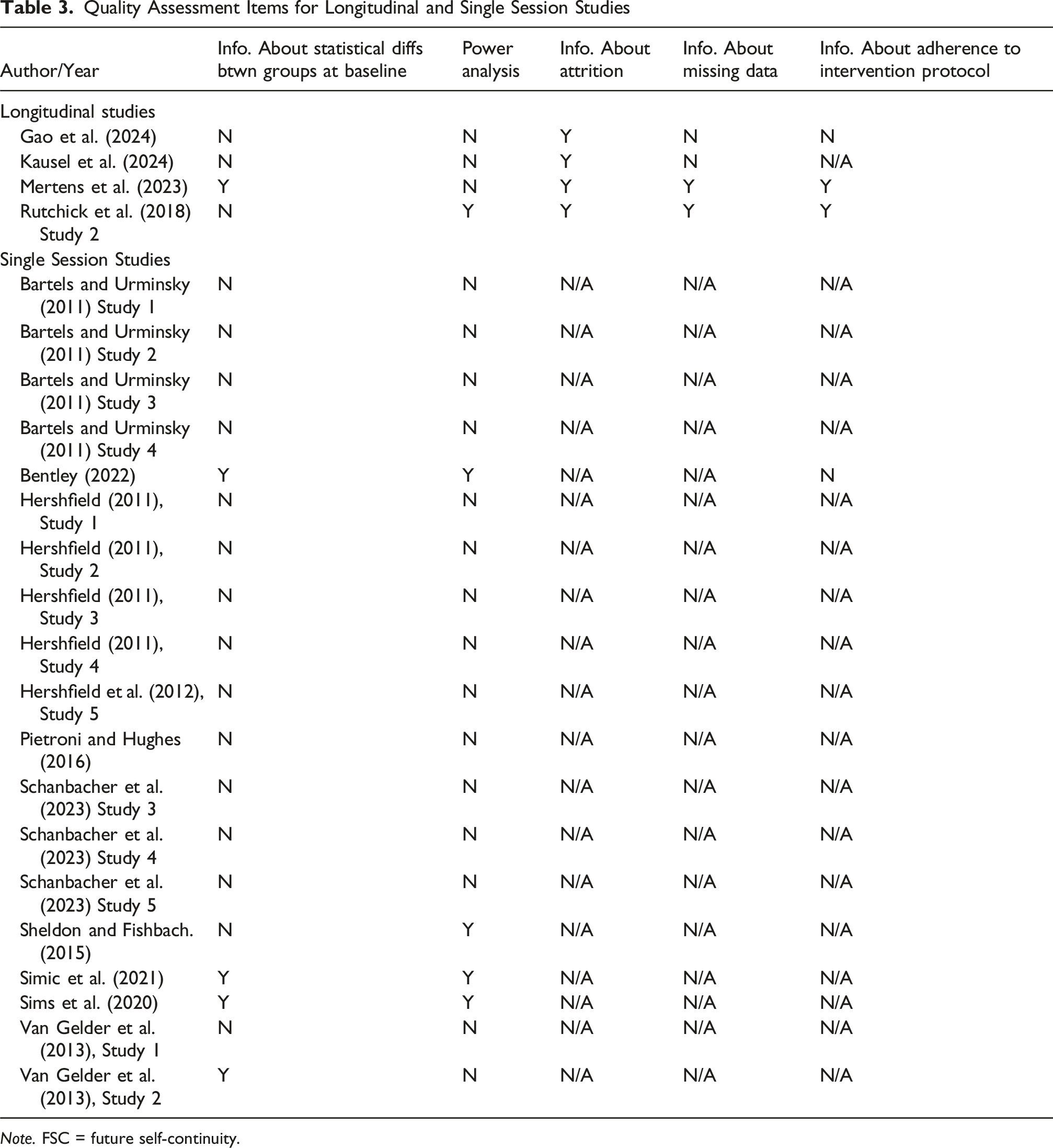
Note. FSC = future self-continuity.
Discussion
Overall, this review suggests that future self-continuity interventions are a promising tool for reducing temporal discounting and increasing future-oriented behaviors. Despite some null effects, the majority of interventions in the review yielded positive results across a wide range of outcomes. Nonetheless, the small number of studies in the review, as well as their heterogeneous methodologies and outcomes, makes it difficult to draw firm conclusions about intervention effectiveness. Additionally, all but one of the studies in the review (Bentley, 2022) were published manuscripts, which raises the risk of publication bias, or the tendency to overlook unpublished studies with null findings. Thus, there is a need for more studies that explore the effects of future self-continuity interventions and allow for a quantitative synthesis of effect sizes in both published and unpublished literature.
Notably, the interventions in the review were characterized by two types of methodologies. Most of the interventions used explicit (i.e., face-valid) techniques to foster a connection with a future self (e.g., interacting with a virtual, age-progressed self, or writing a letter to a future self). Other studies aimed to increase future self-continuity by using more subtle, non-face valid techniques (e.g., reading a paragraph about the stability of identity). Although both types of interventions were associated with positive findings, the effects of non-face valid interventions tended to be assessed using single administration, temporal discounting tasks (Bartels & Urminsky, 2011; Pietroni & Hughes, 2016), while the more explicit, face-valid interventions were used to target a wider range of behavioral outcomes, including health behaviors (Gao et al., 2024; Rutchick et al., 2018; Simic et al., 2021), academic achievement (Mertens et al., 2023), and delinquency (van Gelder et al., 2013), in addition to discounting tasks (Hershfield, 2011; Schanbacher et al., 2023). Currently, it is unclear whether non-face valid interventions (or nudges) effectively target real-world health, academic, and prosocial behaviors, and additional research is needed to address this question.
Remaining Questions and Future Directions
This review highlights a number of unanswered questions in the future self-continuity literature. First, more studies are needed to determine the types of populations for whom future self-continuity interventions work best. All interventions in this review were administered to non-clinical samples, and only one (Bentley, 2022) recruited participants who expressed an interest in changing their behavior. It is therefore unclear whether future self-continuity interventions are effective for clinical populations, such as individuals who meet criteria for substance use disorder or antisocial personality disorder. Notably, emerging studies are beginning to address this issue. For example, Sokol et al. (2021) recently pilot tested a new therapy called continuous identity cognitive therapy (CI-CT) designed to reduce suicidal ideation in individuals with serious mental illness. A core component of CI-CT is the construction of a continuous self-narrative that enables clients to meaningfully connect with a future self. Although CI-CT is in the early stages of development, results from the pilot trial support the utility of future self-continuity interventions for the treatment of psychopathology and suggest that further research in this area is needed.
Second, most of the studies in this review recruited participants from undergraduate institutions or online platforms (e.g., MTurk, Prolific), and most study participants were under age 30. Research suggests that undergraduate and online samples differ from other types of samples in non-trivial ways (e.g., age, socioeconomic status, digital literacy; Paolacci & Chandler, 2014). Thus, the degree to which results from this review generalize to broader community samples is unclear.
Research also suggests that there are significant age-related changes in identity stability (Löckenhoff & Rutt, 2017), as levels of future self-continuity tend to increase with chronological age (Rutt & Löckenhoff, 2016). Therefore, the process of connecting with a future self, particularly a “far future self,” might be different for young adults, as opposed to middle-aged or older adults. More research is needed to determine whether age moderates the effectiveness of future self-continuity interventions, or whether there are certain developmental windows (e.g., the transition to college) in which these interventions work best. More broadly, there is a need to decrease the field’s reliance on young adult, undergraduate and online samples, and to test the efficacy of future self-continuity interventions in broader community and/or clinical populations.
Third, research is needed to clarify which characteristics of intervention content and administration serve to maximize effectiveness. For example, the interventions in this review differ widely in their emphasis on creating realistic, visual representations of the future self. Although some interventions simply prompt participants to think generally about identity stability or the stability of their own identity in particular, others use apps, age-progressed photos, or virtual reality to create vivid, visual images of a future self. Even though the ability to vividly imagine a future self has been associated with increased future self-continuity (Bixter et al., 2020), it is unclear whether technology-based manipulations, such as virtual reality and age progression, increase vividness above and beyond simpler techniques, such as writing a letter to a future self. Thus, research is needed to examine the added value and cost/benefit ratio of using high-tech manipulations to create highly realistic and vivid future selves.
The studies in this review also differ in the frequency with which participants are exposed to interventions, with some studies using single exposures (e.g., Bartels & Urminsky, 2011; Bentley, 2022; Kausel et al., 2024; Rutchick et al., 2018) and others using repeated exposures (Gao et al., 2024; Mertens et al., 2023; Sims et al., 2020). Evidence from the broader, brief intervention literature suggests that both repeated exposure to an intervention and post-intervention contact can increase intervention efficacy and engagement (Craig et al., 2014; Wurdak et al., 2016). However, the effects of repeated exposure have yet to be tested in the future self-continuity literature, and more research is needed in this area.
Fourth, relatively few studies in the review explicitly measured future self-continuity or assessed whether changes in future self-continuity mediated relationships between intervention exposure and outcomes. Moreover, only two studies in the review examined the degree to which interventions affected different sub-dimensions of future self-continuity (Gao et al., 2024; Mertens et al., 2023) and no studies assessed whether these individual dimensions mediated the effects of interventions on outcomes. Future research is needed to clarify how and why different types of interventions affect different dimensions of future self-continuity, and how those relationships affect outcomes.
Fifth, the majority of studies in this review were based on a mechanistic model driven by temporal discounting. In fact, nearly half of the studies in the review treated temporal discounting as the primary outcome variable, and most others referred to it as a mechanistic variable. Notably, however, there are many other variables (besides temporal discounting) that might explain the effects of future self-continuity on behavioral outcomes. These variables include changes in emotional state (e.g., interacting with an age-progressed avatar might increase hope or decrease anxiety), changes in cognitive processes (e.g., writing a letter to a future self might result in goal clarification/prioritization), or changes in motivational state (e.g., imagining oneself in the future might increase motivation to change). Moreover, it is possible that future self-continuity interventions act on multiple mechanistic variables simultaneously. Thus, research is needed to test more complex, multidimensional explanatory models that include multiple pathways through which future self-continuity interventions might exert their effects.
Finally, only one study in the review (Bentley, 2022) compared the effects of a future self-continuity intervention to those of another type of intervention. As mentioned earlier, there are several related types of future orientation/time horizon interventions, including episodic future thinking, possible selves, and mental contrasting interventions. Although these multiple types of interventions all focus on imagining a personalized future, they differ in their focus and hypothesized mechanisms. To date, however, it is unclear (1) how the efficacy of future self-continuity interventions compares to that of other time horizon interventions, or (2) whether it is possible to maximize efficacy by combining different forms of future orientation techniques into a single intervention.
Clinical Implications and Conclusions
In sum, future self-continuity interventions represent a novel method of targeting behavioral change by increasing identification with the future self and decreasing temporal discounting. Because temporal discounting has been associated with numerous harmful behaviors, including smoking (Kollins, 2003; Reimers et al., 2009), alcohol use (Amlung et al., 2017; MacKillop et al., 2010), marijuana use (Johnson et al., 2010), reduced physical activity (Bosworth Garza et al., 2013), overeating (Epstein et al., 2010), and gambling (Ledgerwood et al., 2009; MacKillop et al., 2011), future self-continuity interventions, which can reduce temporal discounting, have the potential to alleviate a wide range of problem behaviors. Future self-continuity has also been linked to broader societal issues, such as the promotion of pro-environmental behaviors (Qin et al., 2024). Importantly, future self-continuity interventions can be delivered in low-cost, highly scalable forms (e.g., through the use of standardized prompts or online tools), making them particularly useful for individuals who cannot access more formal treatments, and limiting the training needed for successful administration. Finally, future self-continuity interventions are grounded in a comprehensive theory (i.e., multiple selves theory). This conceptualization helps to elucidate theory-driven pathways and factors that may mediate the relationship between future self-continuity and behavior change. In sum, the literature on future self-continuity intervention efficacy is limited and needs to be expanded, but existing studies have yielded promising results and indicate that future work is warranted.
Supplemental Material
Supplemental Material - The Effects of Future Self-Continuity Interventions on Behavioral Outcomes in Adults: A Systematic Review of the Literature
Supplemental Material for The Effects of Future Self-Continuity Interventions on Behavioral Outcomes in Adults: A Systematic Review of the Literature by Emily R. Grekin, Halle A. Thomas, Mariam A. Souweidane, Jennifer L. Stidham in Personality Science.
Footnotes
Author Note
The authors were invited to submit this manuscript in response to a call from the journal for interdisciplinary papers in the field of personality science. Dr. Sointu Leikas was the Handling Editor.
Acknowledgements
Not applicable.
Author Contributions
Entered in SAGE-track system.
Funding
The authors received no financial support for the research, authorship, and/or publication of this article.
Declaration of Conflicting Interests
The authors declared no potential conflicts of interest with respect to the research, authorship, and/or publication of this article.
ORCID iD
Not applicable.
Data Availability Statement

Supplemental Material
Supplemental material for this article is available online. Depending on the article type, these usually include a Transparency Checklist, a Transparent Peer Review File, and optional materials from the authors.
Notes
References
Supplementary Material
Please find the following supplemental material available below.
For Open Access articles published under a Creative Commons License, all supplemental material carries the same license as the article it is associated with.
For non-Open Access articles published, all supplemental material carries a non-exclusive license, and permission requests for re-use of supplemental material or any part of supplemental material shall be sent directly to the copyright owner as specified in the copyright notice associated with the article.
