




Abstract
In this study, we investigate how the accumulation of stressful life events and chronic stressors experienced in adolescence predict young adults’ future self-identification (i.e., connectedness, vividness, and valence of the future self) in a sample of 1482 Swiss youth. Furthermore, we investigate future self-identification as a source of resilience mediating the association between accumulated stressful life events on the one hand, and increased delinquency and less educational attainment on the other. In line with our hypothesis, we found that experiencing more stressful life events predicted reduced future self-connectedness. This was not the case for vividness and valence of the future self. Furthermore, we found that future self-connectedness partially mediated the association between stressful life events and low educational attainment. Lastly, latent class trajectories revealed that there was no association between the timing of stressful life events – whether in early or late adolescence – and future self-identification.
Introduction
Before reaching adulthood, an adolescent will likely experience one or more stressful life events – such as the death of a family member, divorce of parents, hospitalization, moving to a new school, unemployment of a caregiver, or violent victimization (Steinhoff et al., 2020; Timmermans et al., 2010; Garcia et al., 2009). As adolescents experience more stressful life events, they are at greater risk for exhibiting psychopathologies, alcohol and drug abuse, delinquency, poor academic performance, and other externalizing behaviors (Flouri & Kallis, 2007; Flouri & Mavroveli, 2013; Rafnsson et al., 2006; Simmons et al., 1987; Thoits, 2010; Timmermans et al., 2010). However, most adolescents exposed to stressful life events demonstrate resilience and develop into functioning adults despite this adversity. This suggests resilient youth rely on compensatory resources (e.g., genes, individual-differences, skills) unavailable to their less-resilient peers. Identifying alterable resources, or “assets,” that mediate the link between stressful life events and negative outcomes presents opportunities to spur the development of interventions that can strengthen them to mitigate the risk of negative outcomes (Masten, 2001). Thus, the current analysis investigates such mediating resources on two related markers of normative adult functioning: delinquency and (low) educational attainment.
These outcomes are directly, with respect to delinquency, or indirectly, with respect to educational attainment (e.g., studying or school attendance), the result of the degree to which people prefer immediate rewards over delayed ones. Recent research finds that the degree to which a person shares identity characteristics with their future self reduces their preference for present-oriented behaviors (Hershfield & Bartels, 2018). This suggests that a weaker identification with one’s future self may explain the increased risk of present-oriented outcomes related to stressful life events.
Here, we argue that (1) stressful life events signal future uncertainty to adolescents, (2) experiencing such uncertainty reduces future self-identification, which (3) increases the likelihood of present-oriented behaviors and related negative outcomes. In what follows, we discuss the concept of future self-identification, how future self-identification may be impacted by stressful life events during early and late adolescence, and finally how future self-identification may be a mediating mechanism between experiencing stressful life events and the increased risk of negative outcomes resulting from present-oriented behaviors.
Future Self-Identification
An important challenge of adolescent development into adulthood is to shift from the “here and now” towards becoming less present-oriented in planning and behavior (Nurmi, 2005; Nurmi et al., 1994). A proposed cognitive mechanism underlying this shift is that people imagine and identify more with their future selves as they mature. Theorists argue that people make present- or future-oriented choices based on attitudes held towards their future selves: to either approach if the future self is desirable or avoid if the future self is undesirable (Markus & Nurius, 1986; Oyserman & James, 2011). Recent research suggests that people are motivated to approach, or work to become their future self, when their present and future selves share identity characteristics (Sedikides et al., 2023).
Hershfield et al. (2018) described relationships between present and future selves along three dimensions: a sense of connectedness, valence, and vividness. Here, we adopt the nomenclature proposed by Bixter et al. (2020), which uses the term “future self-identification” to encompass all three of these components. By way of defining each component, future self-connectedness represents the sense of shared identity between present and future selves, often operationalized by the overlapping circles measure first introduced by Aron et al. (1992). 1 Future self-vividness represents how well a person can imagine and describe their future self. Finally, future self-valence represents the degree to which an individual sees their future self as either positive or negative. For the most part, extant work has focused on future self-connectedness and future self-vividness, finding for instance, that people who feel more connected to their future self discount the future less (Bartels & Rips, 2010; Ersner-Hershfield et al., 2009; McCue et al., 2019), engage in less procrastination (Blouin-Hudon & Pychyl, 2015), and advocate for more ethical paths (Hershfield et al., 2012). Further, in adolescent populations, those who were more connected to their future selves obtained better academic outcomes (Adelman et al., 2017), and were more likely to study and receive better grades when they felt more connected to their ‘school-oriented’ future self (Nurra & Oyserman, 2018; Oyserman et al., 2006). In terms of future self-vividness, vividness interventions have been shown to reduce delinquency (Van Gelder et al., 2013, 2015, 2022), increase exercise behavior (Rutchick et al., 2018), and reduce preference for sugary foods (Kuo et al., 2016). Future self-valence, on the other hand, has rarely been investigated in relation to present-orientation, but is related to higher general well-being and less psychopathology (Sokol & Eisenheim, 2016).
Past Experiences May Shape Future Self-Identification
To date, no studies have examined how future self-identification may develop from past experiences. In theory, future self-identification might change when expectations about the future are altered. That is, when the identity of one’s future self is disrupted, the relationship between the current and future self may be weakened. For instance, participants reported less future self-connection after they were induced to believe that important characteristics of their future selves were going to change (Bartels & Urminsky, 2011), when changes would be negative or unexpected (Molouki & Bartels, 2017), or when their future selves had experienced negative, large, or unexpected events (e.g., by reading vignettes about transformative events, such as religious conversion, returning from a war zone, or being kidnapped) (Bartels & Rips, 2010).
Here, we propose that the expectation of disruption that reduces future self-identification may also be learned through experiencing stressful life events during adolescence. This learning process may be similar to how adolescents adjust their preference for present- or future-oriented behaviors when growing up in adverse environments. Adolescents who grow up in relatively harsh and unpredictable environments (e.g., high-crime neighborhoods, moving homes, parental unemployment) may learn that their environment is threatening, resources are scarce, and that opportunities and threats could appear and disappear at any moment (Ellis et al., 2009). In these environments, the benefits of present-oriented behaviors (e.g., having unprotected sex) may be seen as outweighing their risks (e.g., negative future health outcomes; Frankenhuis et al., 2016). These arguments and findings suggest that the accumulation of stressful life events, such as the death of family members, moving to foster care, or hospitalization, may signal to an adolescent that their future self can expect to experience further harshness and unpredictability, in turn leading to an impoverished future self-identification.
Bartels and Rips (2010) found that future self-connectedness was reduced after anticipating transformative stressful life events, such as kidnapping, but not when anticipating small negative events, such as developing an acute sensitivity to pollen. This focus on transformational events omits how adolescents may learn to identify less with their future self from chronic stressors experienced throughout adolescence. Yet, these chronic stressors apply continuous pressure daily, for instance from resource deprivation, fear of victimization, chronic illness, or relationship uncertainty (Wheaton, 1994). Chronic stress (e.g., like the type that arises from stressful life events) has been shown to increase negative outcomes in adulthood (Diehl et al., 2012), increase the risk of distress, anxiety, and depression (Wheaton, 1994), and to be positively associated to increased present-oriented behaviors (Bradley & Corwyn, 2002; Devenish et al., 2017; Gunnoe, 2013; van Gelder et al., 2018). Thus, stressful life events and chronic stress may jointly influence future self-identification. As a result, we include as covariates in our analysis socio-economic status and the parent’s use of corporal and inconsistent discipline as chronic risk factors. Further, we also include as covariates parenting styles of positive parenting and involvement that are related to less present-oriented behaviors (Davis et al., 2022; Frick et al., 1999).
Notably, stressful life events and experiences may affect future self-identification differently if the disruption is experienced during early compared to late adolescence. Adolescents form beliefs about their identity – in terms of their social roles, personality, morals, and abilities – and imagine possible future selves who they want to become (Oettingen, 2012). In early adolescence, the characteristics of one’s identity are unstable and judged in relation to one’s immediate social group of parents and peers (Smetana et al., 2006). In contrast, older adolescents have better integrated their characteristics into a coherent self-concept that is informed less by their social group and more by their personal experiences, goals, and development (Damon & Hart, 1982; Diehl et al., 2011). Extant research has not explored whether there is a differential impact of stressful life events on future self-identification as a function of whether such events are experienced in early adolescence versus late adolescence. Thus, in exploratory analyses, we investigate these possibilities.
The Present Study
Taken together, we propose that accumulated stressful life events reduce future self-identification, which in turn, increases the likelihood of present-oriented behaviors. That is, future self-identification is argued to mediate the relation between stressful life events and outcomes that stem from present-oriented behaviors (namely, increased delinquency and lower educational attainment).
We first hypothesize that the accumulation of stressful life events during adolescence may negatively predict future self-identification, while controlling for chronic risk and promotive factors. Second, we hypothesize that the effects of stressful life events on present-oriented behaviors will be mediated by future self-identification. More specifically, we expect that future self-connectedness and future self-vividness may play a mediating role but remain agnostic regarding the role of future self-valence, due to scant prior research. Lastly, we explore whether there are differential impacts of accumulated stressful life events on future self-identification as a function of whether they are experienced in early versus late adolescence. To investigate these hypotheses, we used longitudinal multi-wave data from a large sample of urban youth from the city of Zurich, Switzerland measured at ages 12, 15, 17, and 20.
Method
Sample and Procedures
The data were drawn from the Zurich Project on the Social Development from Childhood into Adulthood (z-proso), a cohort study that sampled 1675 students (52% boys) from a population of 2520 first graders in Zurich, Switzerland from 56 public elementary schools stratified by school size and district. The sampling method and translation of study documents resulted in a slight overrepresentation of students from low-socioeconomic backgrounds and encouraged students and parents from diverse backgrounds to take part. Just over half of students’ birthmothers were not native to Switzerland. Data collection began in 2004 when participants were 7 years old and again when they were ages 8, 9, 11, 13, 15, 17, and 20. Participants were compensated with ∼$30 at age 13, increasing to $75 at age 20 (see Ribeaud et al., 2021 for a complete description of the sample and the original research).
We used data from the ages 13, 15, 17, and 20 when stressful life events and parental discipline were measured (N age13 = 1362; N age15 = 1443; N age17 = 1305; Nage20 = 1180). In total, 1482 participants completed at least one measurement.
Measures
Future self-identification
Descriptive Statistics of Study Variables.
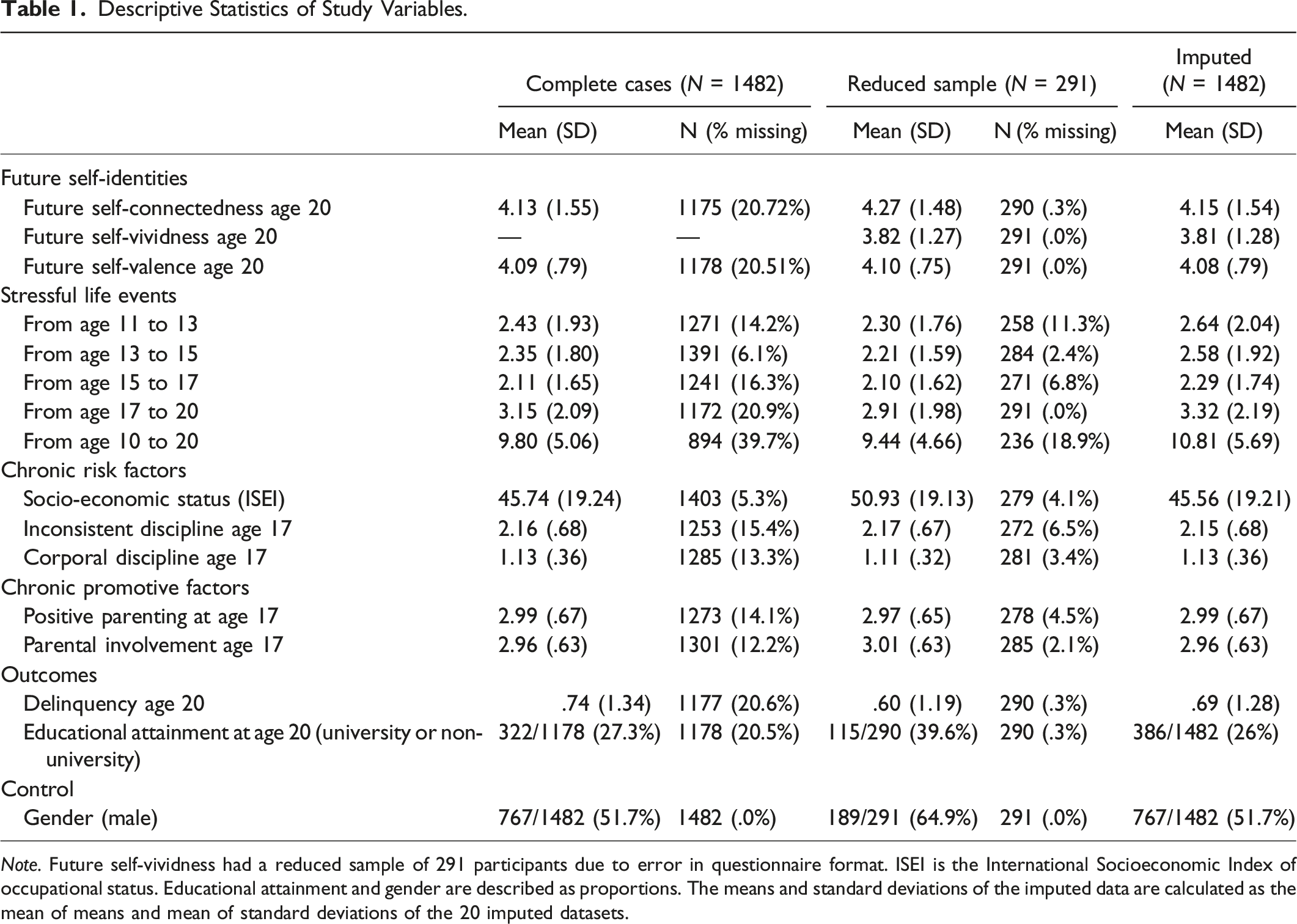
Note. Future self-vividness had a reduced sample of 291 participants due to error in questionnaire format. ISEI is the International Socioeconomic Index of occupational status. Educational attainment and gender are described as proportions. The means and standard deviations of the imputed data are calculated as the mean of means and mean of standard deviations of the 20 imputed datasets.
Accumulated stressful life events
Stressful life events (SLE) were measured at all ages. These 22 events included mental or physical illness requiring hospitalization, death of a close relationship, parent unemployment, moving to a foster home, divorce, romantic break-up, failing school, repeating a grade, violent or sexual victimization (see Appendix A for a comprehensive list as well as descriptive statistics for each life event). At ages 13, 15, and 17, participants were asked if they had experienced each of the 22 events in the last two years; at age 20, participants were asked if they had experienced each of the 22 events in the last three years. Four of the 22 items pertaining to violent and sexual victimization were taken from a different scale in the survey and only inquired about the last twelve months. Five cumulative scores of the 22 dichotomous SLE items were constructed: one cumulative score between each measurement (i.e., at ages 13, 15, 17, and 20), and one cumulative score of the sum of SLE events experienced across all ages.
Chronic risk factors
Socio-economic status (SES) was operationalized using the International Socio-Economic Index of occupational status (ISEI). The ISEI indexes occupations based on the education required and income provided (Ganzeboom et al., 1992). In our sample, ISEI ranged from 16 (low) to 90 (high). The ISEI was measured at ages 10, 13, and 15; here we take the highest measurement across these three periods. Parental inconsistent discipline and corporal discipline were both measured at age 17 from the self-report of the Alabama Parenting Questionnaire (Shelton et al., 1996). We used the age 17 measurement because it was the last measurement when the adolescents lived with their parents. Participants rated each item from never, rarely, sometimes, often, or always. Exploratory factor analysis revealed three items representing inconsistent discipline: “Your parents threaten to punish you but subsequently do nothing,” “You talk your parents out of punishing you when you have done something wrong,” and “Your parents let you out of a punishment early, or reduce the punishment (e.g. you are allowed to watch TV or go out earlier than originally said”); and four items representing corporal discipline: “Your parents spank you with their hand,” “Your parents slap you,” “Your parents pull your hair or ears,” and “Your parents hit you with a belt, staff, or other object.” Both measures demonstrated acceptable reliability (inconsistent discipline: ωTotal = .73; corporal discipline: ωTotal = .76).
Chronic promotive factors
Positive parenting and parental involvement were also measured at age 17 through the self-report of the Alabama Parenting Questionnaire (Shelton et al., 1996). Participants rated each item from never, rarely, sometimes, often, or always. Positive parenting for each participant represented the average of “Your parents let you know when you have done a good job with something,” “Your parents reward you when you have done a good job with something,” and “Your parents compliment you if you were particularly good at school, in a sport, or at a hobby.” Parental involvement represented the average of “Your parents talk to you about your friends or about the other students in your class,” “You play games or do other fun things with your parents,” “Your parents help you when you struggle with your homework,” “Your mother or father hugs you to comfort you when you are sad,” “Your parents are interested in what you do,” and “When you have a problem you can talk to your parents about it.” Both measures demonstrated acceptable reliability (positive parenting: ωTotal = .73; parental involvement: ωTotal = .86).
Present-oriented outcomes
Both delinquency and educational attainment were measured at age 20. The delinquency measure was adapted from Wetzels et al. (2001) and included a total of 14 delinquent acts ranging in severity, and included driving without a license, graffiti, vandalism, purchased illegal drugs, theft from work or school, theft from home, theft from a store under 50 franks, theft from a store under 50 franks, burglary, vehicle theft, carried a weapon to protect yourself, threaten, or attack others, robbed someone using force, robbed someone threatening force, and physical assault (Ribeaud & Eisner, 2006). The delinquency items were dichotomized and a sum of the 14 delinquency variables was made to create a variety scale. We used a variety scale over an incidence scale because dichotomization underweights common, less severe forms of delinquency (e.g., vandalism) and as a result better represent an individual’s range of delinquency (Bendixen et al., 2003).
Educational attainment was assessed by the highest diploma achieved at age 20. In the Swiss education system, after grade 9 students enter into apprenticeships or high schools geared towards attending a vocational or academic university. Earning a diploma from a university-track high school is required for Swiss nationals to attend academic university and thus grants entry into the widest range of future academic and career possibilities. We coded those that earn a diploma from a university-track high school as “university,” and all others as “non-university.”
Analysis Plan
To investigate our first hypothesis that accumulated SLE at age 20 would be related to lower future self-identification components, we regressed future self-connectedness, -vividness, and -valence at age 20 on accumulated stressful life events throughout adolescence while controlling for SES, gender, inconsistent discipline, corporal discipline, positive parenting, and parental involvement measured at age 17.
To investigate our second hypothesis that future self-identification mediates the link between stressful life events on outcomes stemming from present-oriented behaviors, we used the future self-identification components as mediators between the association of accumulated SLE at age 20 on delinquency and educational attainment at age 20, again controlling for SES, gender, inconsistent discipline, corporal discipline, positive parenting, and parental involvement measured at age 17. Mediation was calculated through the causal mediation analysis method to account for exposure (i.e., SLE) and mediator interactions (VanderWeele, 2016). Variables were mean centered to calculate the interactions. Specifically, we conducted six mediation analyses (taking into account the three components of future self-identification and the two outcome variables).
Finally, to measure the differential impact of experiencing stressful life events in either early or late adolescence, we estimated latent growth trajectories of accumulated SLE from measurements at ages 13, 15, 17, and 20, then classified each individual by their trajectory, and lastly regressed the trajectories on the future self-identification components. Latent class trajectories were calculated from participants’ accumulated stressful life events at ages 13, 15, 17, and 20 using latent-class mixture models, an extension of Group-Based Trajectory Modeling that accounts for within-individual differences (Nagin, 2005, Muthen, 2004). Our objective was to classify participants into at least two groups that represent (1) students who experienced more SLE in early adolescence versus later adolescence (high – low), or (2) those who experienced less SLE in early versus late adolescence (low - high). We ran three by six sets of linear, quadratic, and cubic growth models that predicted k (1–6) number of class-specific trajectories of stressful life events measured at ages 13, 15, 17, and 20. We selected the final model based on their relative theoretical fit (e.g., distinguished high - low and low - high trajectories), model fit, and discrimination. Model fit was assessed through having a relatively low Bayes information criterion (BIC) and discrimination was assessed by having a relatively high entropy and posterior probability (Lennon et al., 2018; Weller et al., 2020). After selecting the model, participants were assigned to a trajectory group based on their highest posterior probability from their mean SLE scores. Finally, we ran the same regression analysis used to test hypothesis 1, but instead of using accumulated SLE, we predicted future self-identification by using the assigned trajectory group.
Power analyses were run to detect small effects for coefficients in our linear models using five and ten predictors for the hypothesized association of the future self-identification components. We calculated power using 1180 participants who completed the future self-identification variables. Results show we had sufficient statistical power of 1 to detect a small effect (R2 = .02) with both five and ten predictors. For models using the restricted sample of 291 participants used with future self-vividness, a linear model with five and with ten predictors had insufficient statistical power of .46 and .32 to detect small effects, but sufficient statistical power of .99 to detect medium effects (R2 = .15).
Most study variables had a missingness rate of around 10%–40% in comparison to the total sample. We used imputation to account for the bias due to measurement and item non-response in this dataset. A previous analysis on the attrition in this dataset found that the attrition had characteristics that were missing at random (Eisner et al., 2019), meaning that imputation was appropriate in this case. We used two methods for imputation: multiple imputation with chained equations (MICE) for the regression and mediation analyses, and full information maximum likelihood (FIML) in the latent class trajectory modeling. We used FIML for the latent class analysis because there is no standard way to pool estimates from imputed datasets for latent class analysis. MICE was advantageous for our regression analyses because it can derive sum scores from imputed stressful life events items, imputes values based on the distributional assumptions of each variable (e.g., the imputation method for delinquency was assumed a negative binomial distribution), and can include influential auxiliary variables in imputing the missing data. We used all data from all adolescents who participated once between the ages of 13 and 20 (N = 1482) and generated 20 imputed datasets using MICE (for imputation diagnostics see Supplementary Materials 1). For the regression and mediation, the estimates from the 20 imputed datasets were pooled following the method in Rubin (Rubin, 1987, p. 76–77).
Analyses were conducted in R (R Core Team, 2021) using the RStudio graphical interface (RStudio Team, 2022). Power analysis was conducted with the ‘pwr’ package (Champely, 2020). We implemented multiple imputation with the ‘mice’ (van Buuren & Groothuis-Oudshoorn, 2011) and ‘countimp’ (Kleinke & Reinecke, 2019) packages in R. Mediation analysis was conducted with the ‘regmedint’ package (Yoshida & Li, 2022) and latent class mixture models with the ‘lcmm’ package (Proust-Lima et al., 2017). Data and code for the analysis are available on request from the first author. Main analyses were pre-registered on the Open Science Foundation (https://osf.io/n8jqx). 2
Results
Table 1 details the descriptive statistics of all study variables. Correlations between study variables can be found in Appendix A.
Accumulation of Stressful-Life Experiences Negatively Influence Future Self-Connectedness
Regression Coefficients and 95% Confidence Intervals for the Future Self-Identity Attitudes Predicted by Accumulated Stressful Life Events in Adolescence, Chronic Risk and Promotive Factors, and Gender.
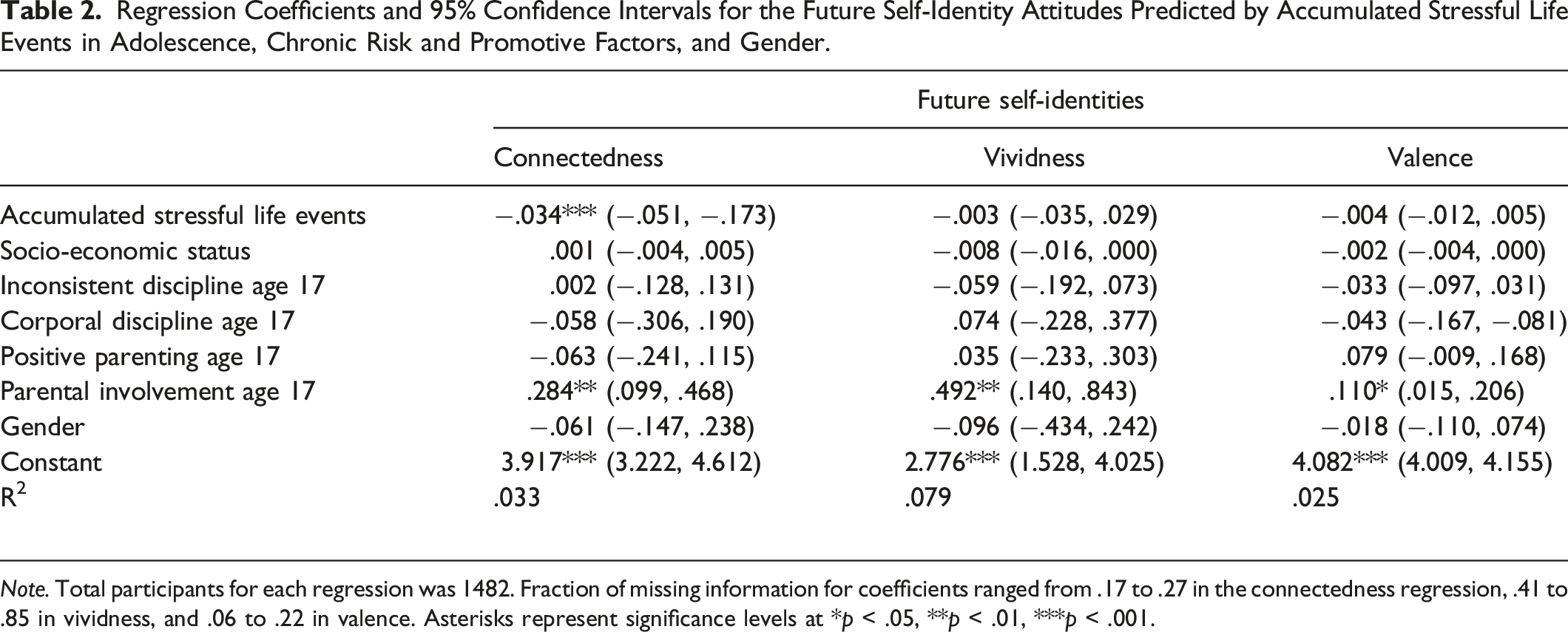
Note. Total participants for each regression was 1482. Fraction of missing information for coefficients ranged from .17 to .27 in the connectedness regression, .41 to .85 in vividness, and .06 to .22 in valence. Asterisks represent significance levels at *p < .05, **p < .01, ***p < .001.
Future Self-Connectedness Partially Mediates the Association Between Stressful Life Events during Adolescence and Educational Attainment at Age 20
SLE was associated with future self-connectedness but not vividness or valence, so we present the mediation models of the effects of SLE on delinquency and educational attainment for future self-connectedness only (see Supplementary Materials 2 for full results). We calculated the proportion of the total effect of SLE on delinquency and educational attainment that operates through the indirect effect of future self-connectedness, using the same control variables as above.
For delinquency, we found that an increase in one SLE was associated with a .076 increased log-odds of delinquent acts (t (344.416) = 8.452, p < .000, 95% CI [.058, .093]). An increase in future self-connectedness was associated with a non-significant −.25 decrease in the log-odds of delinquent acts (t (1218.648), p = .433, 95% CI [–.088, .038]). This weak effect of future self-connectedness on delinquency and the negligible association between future self-vividness and -valence provide no evidence that future self-connectedness mediates the relationship between SLE and delinquency.
For educational attainment (see Figure 1), we found that an increase of one SLE was associated with a −.065 decrease to the log-odds of attending university at age 20 (t (700.450) = −4.319, p < .000, 95% CI [–.094, −.035]) while an increase in future self-connectedness was associated with a .243 increase in the log-odds of attending university at age 20 (t (484.877) = 4.622, p < .000, 95% CI [.140, .346]). The mediation analysis revealed that the total indirect effect of SLE operating through future self-connectedness was −.008 (t (632.46) = −3.159, p = .002, 95%CI [–.013, −.003]) which partially mediated 11% of the total effect of SLE on educational attainment (t (451.513) = 2.671, p = .008, 95% CI [.029, .193]). Mediation results. Indirect effect via future self-connectedness: b = −.008**, 95% CI [-.013, −.003]. Note: Coefficients to educational attainment are in log-odds. Asterisks represent significance levels at *p < .05, **p < .01, ***p < .001.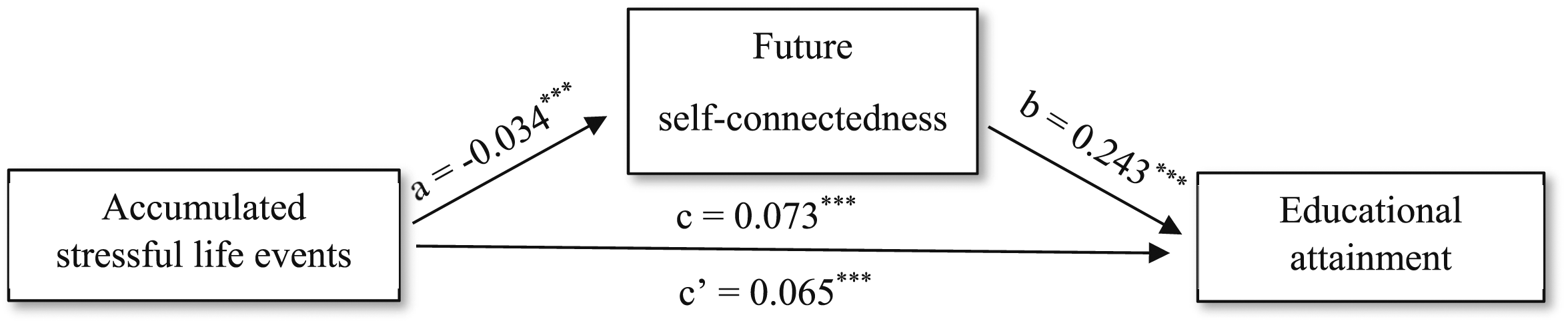
No Evidence for a Differential Impact of Experiencing Stressful Life Events in Early versus Late Adolescence on Future Self-Identification
The data for the SLE at each age were non-normally distributed. Therefore, to achieve better model fit, we estimated models using gaussian, beta, and 5-quantile spline link-functions. We found the best fitting model according to BIC to be a quadratic growth model with one latent class (BIC = 19,146.26). This model suggests that participants had similar growth trajectories - meaning they experienced a similar amount of SLE from measurement to measurement.
Selecting models for theoretical fit (i.e., high - low and low - high) and then model fit, we found the best model was the quadratic, 4-class solution (BIC = 19,200.63). This model, however, had poor discrimination (entropy = .45) and the average posterior probabilities of class assignment were low at .65 in class 1, .71 in class 2, .70 in class 3, and .60 in class 4. The four trajectories, which are shown in Figure 2, were characterized as: (1) High – low, participants had an estimated probability of around 4.2 SLE at age 13 and descended monotonically to 1.2 SLE at age 20; (2) Constant high had an estimated probability of 3.59 SLE at age 13 which remained constant terminating with 4.08 SLE at age 20; (3) Constant low had an estimated probability of 1.6 SLE at age 13 and 2.13 at age 20; (4) Low - high had an estimated probability of 1.59 SLE at age 13 but then 4.53 SLE at age 20. This classification assigned 4.13% of the sample to high – low, 37.08% to constant high, 50.47% to constant low, and 8.32% to low – high, leaving an acceptable sample size per group of, respectively, 56, 607, 698, and 121. Trajectories of stressful life events at ages 13, 15, 17, and 20. Note: shaded areas represent 95% confidence intervals around the trajectory.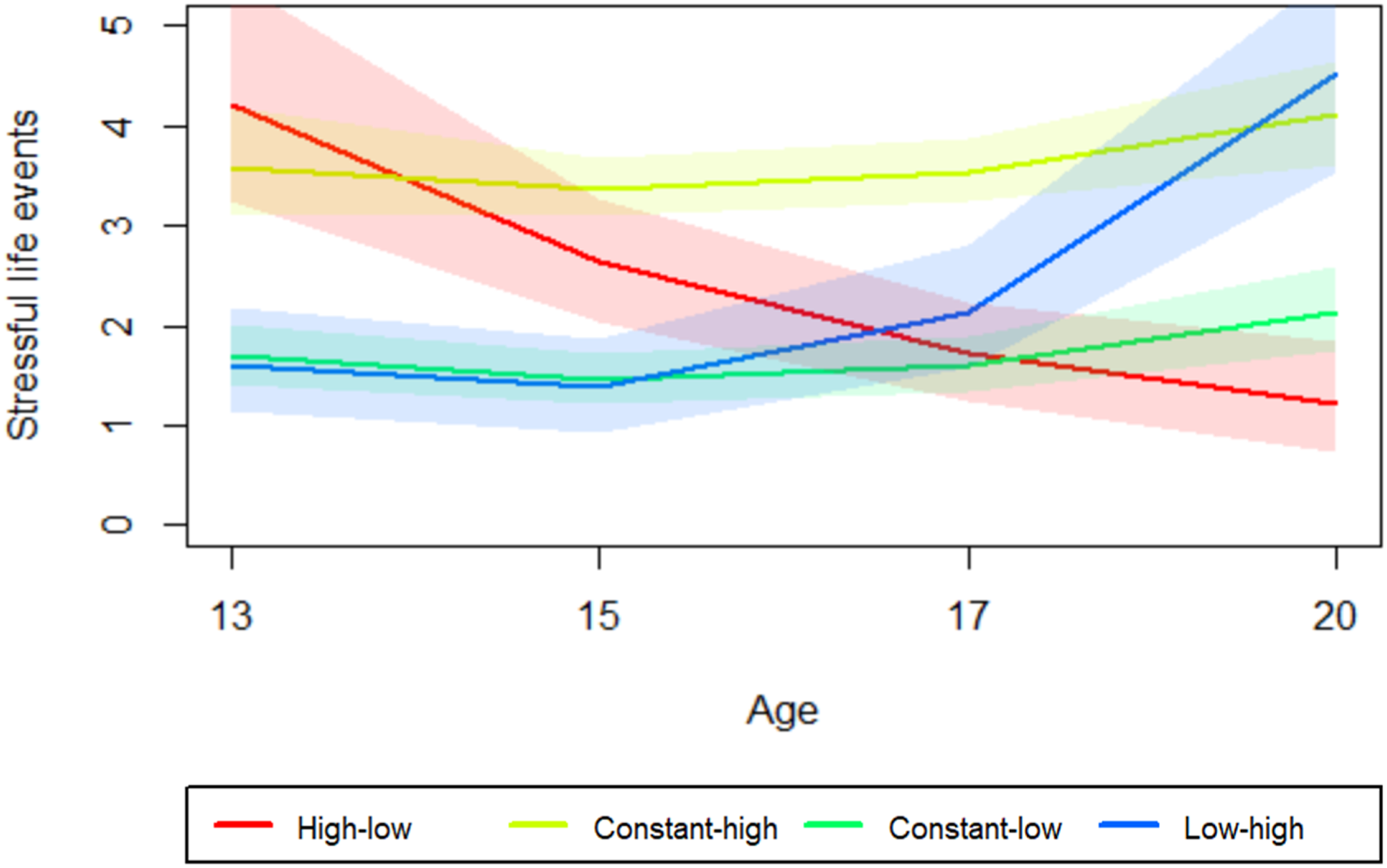
Regression Coefficients and 95% Confidence Intervals for the Future Self-Identification Components Predicted by the Four Latent Class Trajectories of Stressful Life Events.
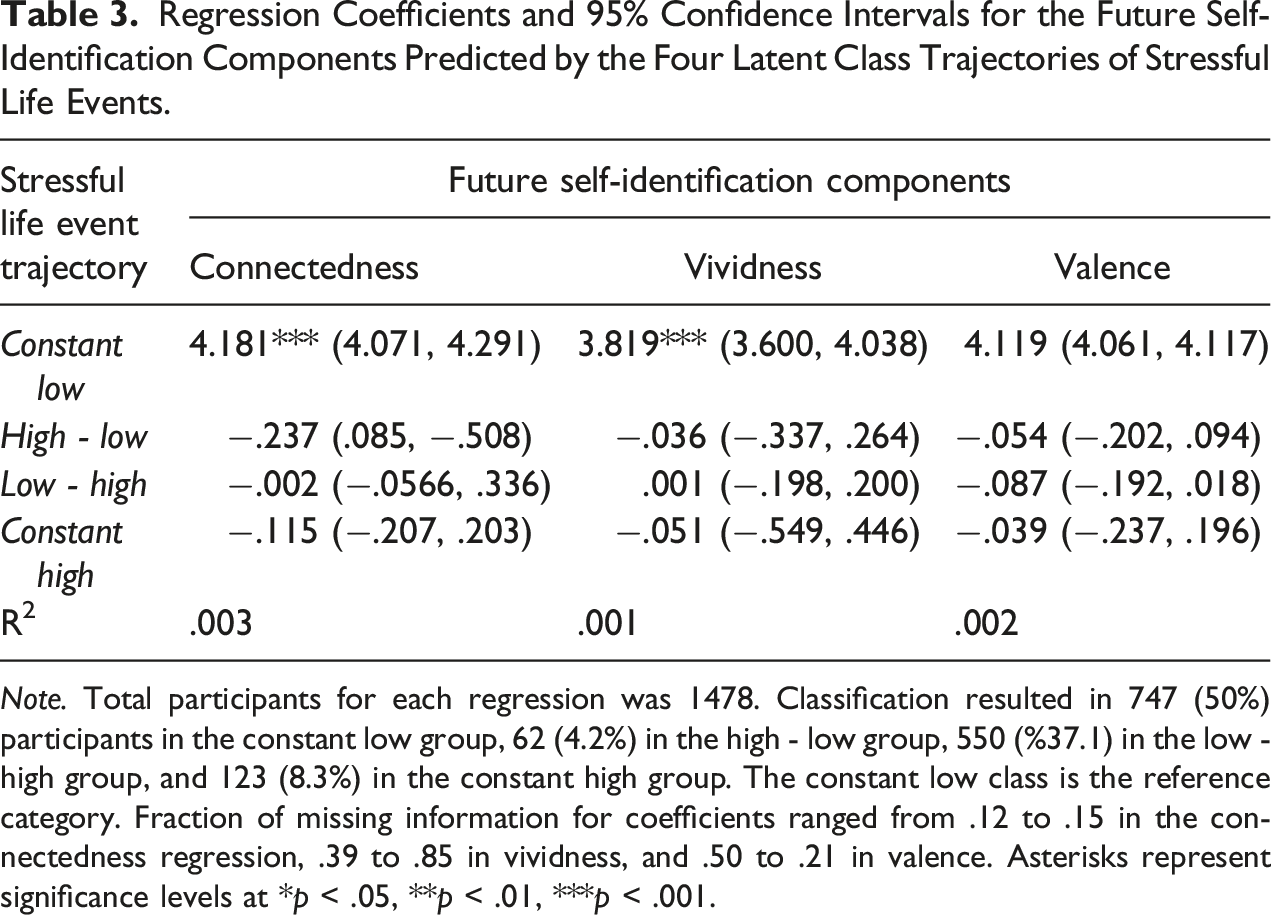
Note. Total participants for each regression was 1478. Classification resulted in 747 (50%) participants in the constant low group, 62 (4.2%) in the high - low group, 550 (%37.1) in the low - high group, and 123 (8.3%) in the constant high group. The constant low class is the reference category. Fraction of missing information for coefficients ranged from .12 to .15 in the connectedness regression, .39 to .85 in vividness, and .50 to .21 in valence. Asterisks represent significance levels at *p < .05, **p < .01, ***p < .001.
Discussion
This study examined the relationship between the accumulation of stressful life events in adolescence and future self-identification in early adulthood. We reasoned that the accumulation of stressful life events leads adolescents to believe that their environment is harsh and unpredictable, which disrupts the relationship between their present and future selves. Concretely, we predicted that stressful life events would reduce connectedness to the future self and vividness of the future self but were agnostic whether stressful life events would influence positive feelings about the future self. In our analyses, we controlled for daily, chronic risk factors of inconsistent discipline, corporal discipline, and socioeconomic status (SES), and chronic promotive factors of positive parenting and parental involvement. In partial confirmation of this hypothesis, accumulated stressful life events were associated with reduced future self-connectedness, but not with future self-vividness or -valence. These results were found after controlling for chronic risk and promotive factors, of which only parental involvement had a large, positive association to all future self-identification components.
We also predicted that accumulated stressful life events and less future self-identification would be associated with more present-oriented behaviors. Here, we explored the possibility that future self-identification is an adaptive mechanism, mediating the risk from accumulated stressful life events to two outcomes associated with present-oriented behaviors: delinquency and (low) educational attainment.
We found evidence that future self-connectedness partially mediated the relationship between accumulated stressful life events and the likelihood of graduating from a university-track high-school, but not the incidence of delinquency.
Lastly, to identify critical periods of adolescence to target interventions, we first ran a latent class analysis to classify participants by their growth trajectories of when they experienced stressful life events and second investigated the associations between participants classification and future self-identification. After classifying participants into latent trajectories by when they experienced stressful life events in early versus late adolescence (e.g., high – low, low – high, constant high, and constant low), we found no associations between class trajectories and future self-identification. This latter result should be taken with caution because (1) the classification model had poor discrimination of latent trajectories; and (2) the results found no meaningful difference between the constant high and constant low classes in predicting future self-identification, which we would expect to find given the results of the mediation analysis.
The results of the analyses of the first hypothesis suggest that future self-connectedness is associated with past major disruptive events, perhaps due to environmental harshness and uncertainty, though these two factors are ripe for investigation by future researchers. This relationship exists over and above chronic risk factors of SES, corporal discipline, and erratic discipline.
Furthermore, the results from the mediation analysis suggest that adults who experienced more stressful life events felt less connected with their future self and that this loss of connection contributed to lower educational attainment. This suggests that future self-connection may be a modifiable resource that people could draw upon when faced with accumulating stressful life events. Thus, adolescents faced with stressful life experiences may benefit from interventions aiming to maintain or improve their connection to their future self, which may, in turn, improve their educational attainment. There are a variety of interventions that have been shown to increase future self-connection (Hershfield & Bartels, 2018), such as visual exposure to age-morphed images or virtual reality avatars (Hershfield et al., 2011), writing letters from the future self to present self and then back from the future self (Chishima & Wilson, 2021), role-playing as your future self (Ganschow et al., 2021), or writing about one’s future self (Nurra & Oyserman, 2018). These interventions could be further tailored to the academic context by having adolescents visually interact with, write letters to, or role-play as their future selves who have graduated high school or university.
Notably, our results also demonstrate no association between stressful life events and future self-vividness and future self-valence. We note here that the null results for future self-vividness across our analyses may be explained by small sample size and subsequent reduced statistical power of the vividness measure due to an error in questionnaire design. While we did increase statistical power through multiple imputation, these relationships should be investigated with an adequate sample size.
We also found that parental involvement had a large, positive association to all future self-identification components, while the other chronic risk factors of SES, corporal and erratic discipline, and the promotive factor of positive parenting were not correlated with future self-identification. The parental involvement association was also relatively larger than that of stressful life events. To demonstrate, the average score of parental involvement of 2.95 (out of 4) was associated with an increase of .852 in future self-connectedness. By contrast, a person would need to experience 25 stressful life experiences to reach a similar magnitude, which only 8 participants in our sample reported.
We also found evidence that future self-connectedness played a mediating role between stressful life events and low educational attainment, but not in terms of delinquency. Previous studies demonstrated that changes to future self-vividness reduced delinquency in an adolescent sample (van Gelder et al., 2015) and also in a sample of convicted adults (van Gelder et al., 2022). The null finding in the present study may be due to the age and representativeness of our sample; perhaps the relationship between future self-identification and delinquency is more readily apparent in adolescence rather than early adulthood and in samples drawn of convicted offenders than the general population. To the first point, delinquency peaks during late adolescence to declines steadily thereafter (Sweeten et al., 2013). In our sample, delinquency was measured over the past year when participants were between ages 19 to 20, which may have reduced the variety of delinquency found in our sample. This is further compounded by the reduced statistical power to detect these smaller effects because of an implementation error in the future self-vividness items.
Limitations and Future Directions
Our results should be taken as preliminary given a major caveat: both the mediator and the outcomes were measured at the same point in the time. Further research is thus needed to investigate causality. Prior research has in fact demonstrated a causal link between increased future self-identification (as measured by future self-connectedness) and more future-oriented outcomes (Bartels & Urminsky, 2011), but such causal links need further exploration in the present context of stressful life events and life outcomes.
Further, our analytical models explain only a small portion of the total variance in outcomes. Stressful life events are likely one among many factors in adolescence that are associated with future self-identification. Additionally, the variability could also indicate imprecision in the measurement of future self-identification, perhaps due to measuring future self-connectedness and -valence with one question each and -vividness with three. Future researchers may wish to use a larger battery of questions about future self-identification (Bixter et al., 2020), or focus on more specific aspects of connectedness to the future self (e.g., values, personality, and behaviors; (Sokol & Serper, 2020).
Despite the limited explanatory power of the association of stressful life events on future self-connectedness, these findings are meaningful when compared to the outcomes from previous experiments. Past research found that increases if around .5 units of connectedness were associated with reduced present-oriented behaviors, such as less unethical behavior (Hershfield et al., 2012), more patience in laboratory tasks (Bartels & Urminsky, 2011), or increased retirement allocation (Bryan & Hershfield, 2012; Hershfield et al., 2011).
Finally, our analysis is limited to a Swiss sample of adolescents, and thus, these results may not generalize to other national contexts with a higher prevalence of delinquency, lower rates of university participation, or different secondary school systems. However, in a previous multi-national analysis of the prevalence of adolescent delinquency, Switzerland was no different than other Western-European, Northern-European, and Anglo-Saxon (e.g., United States, Canada) countries (Junger-Tas, 2012). Further, around 25% of Swiss youth attend 4-year institutes of higher education (Hoffman & Schwartz, 2015), which is comparable to 30% of the United States (National Center for Education Statistics, 2023). Last, our operationalization of educational attainment reflects earning a diploma that allows entrance into academic universities (which most graduates attend). This university-track diploma is specific to countries, like Switzerland, that have a tiered system of secondary schools. In countries where the high school diploma does not confer university acceptance, like the United States or Japan, grade point averages or college examination results could substitute.
Conclusion
Some adolescents are dealt a difficult hand in life, unjustly experiencing multiple stressful life events that impact identification with their future self. Here, we found initial evidence that such stressful events are negatively associated with future self-identification, and that lowered future self-identification is associated with less educational attainment. Future work should continue investigating these relationships in an effort to identify effective interventions.
Footnotes
Declaration of conflicting interests
The author(s) declared no potential conflicts of interest with respect to the research, authorship, and/or publication of this article.
Funding
The author(s) disclosed receipt of the following financial support for the research, authorship, and/or publication of this article: This work was supported by the European Research Council Consolidator Grant; 772911.
