




Abstract
Personality and cultural psychology have often advanced in parallel, yet their integration is essential for building a truly comprehensive personality science. This review synthesizes existing insights into a three-part roadmap for bridging the two fields. First, personality—broadly understood as individual differences in beliefs, traits, and values—shows systematic variation across societies. Second, personality and culture are dynamically entangled: culture co-shapes beliefs, traits, and values, while personality co-shapes how individuals select, interpret, adapt to, and co-create cultural environments. Third, meaningful diversity exists not only across but also within cultural groups, highlighting intragroup variability that is often obscured by focusing on group-level averages and guarding against ecological fallacies. By connecting these perspectives, the roadmap aims to provide a conceptual scaffold for more comprehensive, context-sensitive, and inclusive personality science.
Keywords
Personality and cultural psychology have often developed in parallel, with the former emphasizing variation within populations and the latter emphasizing differences between them. Yet, the two areas are not fundamentally distinct—rather, they are deeply entangled. As many have forcefully argued, individuals’ affects, cognitions, and behaviors cannot be fully understood in isolation from the cultural contexts they experience (Benet-Martínez, 2021; Henrich, 2010; Oyserman, 2016; Thalmayer et al., 2021). Personality develops within cultural contexts, and personality in turn helps shape the environments people inhabit.
By personality, we refer broadly to individual differences in beliefs, traits, and values that are relatively stable across time and context (Roberts & Yoon, 2021). At the same time, the development and expression of these patterns are shaped by cultural environments. By culture, we refer broadly to a system of historically accumulated meanings, norms and practices, transmitted through social institutions and interactions, that structure individuals’ experiences and guide how personality is expressed and evaluated (Markus & Kitayama, 2010).
Several lines of research have illustrated the deep connections between personality and culture. For instance, cultural values such as survival vs. self-expression or traditional vs. secular-rational values develop in tandem with societal economic and political development, illustrating how macro-level cultural change can shape psychological tendencies over time (Inglehart & Welzel, 2005). As another example, research in behavioral ecology has shown that cultural differences in affect, cognition, and behavior can be understood as adaptive responses to recurring ecological conditions, whereby environments shape the proliferation of psychological traits to enhance adaptiveness (Sng et al., 2018). At the same time, personality also shapes how individuals engage with cultural contexts. Research on person-environment fit, for instance, suggests that individuals whose personality profiles align with the ideological and social climate of their environment—e.g., political conservatism in conservative regions—report greater subjective well-being and even live longer (Ebert et al., 2023).
While there has been many fruitful research on the interplay between personality and culture, a broader reckoning with psychology’s reliance on WEIRD (Western, Educated, Industrialized, Rich, and Democratic) samples (Henrich, 2010; Muthukrishna et al., 2020) in recent years has catalyzed editorial calls for greater cultural and social diversity in research (e.g., Atari et al., 2025), including in personality psychology (e.g., Adler, 2022; Vazire, 2023). Indeed, personality psychology is uniquely positioned to contribute to this endeavor not only by documenting cross-cultural variation, but also by offering tools to examine how personality differences are shaped by and, vice versa, shape the cultural environments individuals inhabit.
Herewith, we synthesize and systematize main insights from the existing but often siloed strands of research on the personality-culture interplay. More precisely, we provide a three-part roadmap (see Figure 1) consisting of (I) The Entangled Relationship Between Personality and Culture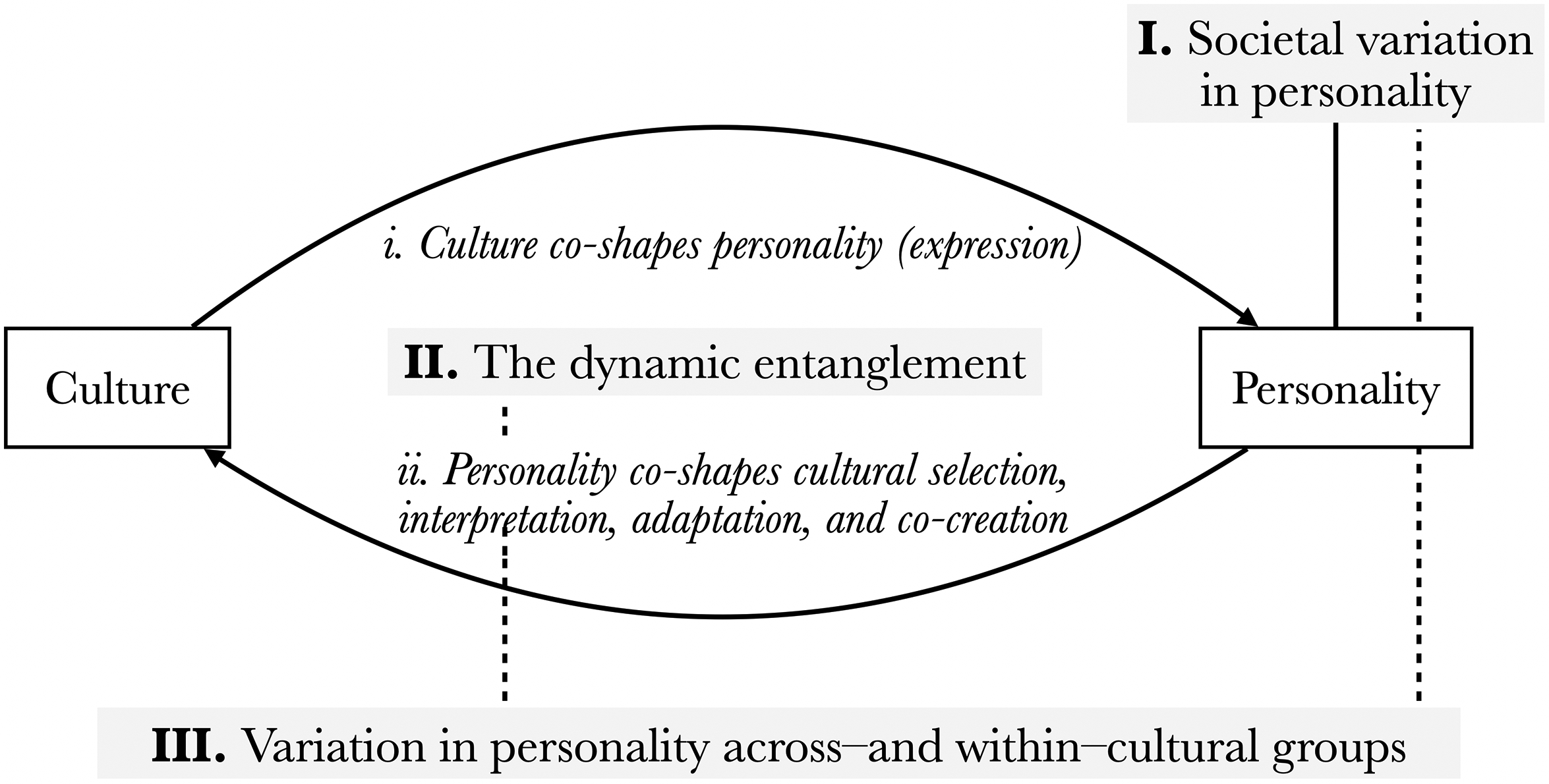
Societal Variation in Personality
Cross-cultural research has consistently shown that individuals’ traits, values and ideologies vary meaningfully across sociocultural contexts. In this section, we illustrate how such differences might by co-shaped by cultural, ecological, and historical conditions.
To start with, research has pointed at the cultural specificity of central ideologies. For instance, Krys et al. (2024) argue that happiness maximization, often assumed to be a universal goal, is in fact a cultural product of specific societal values, namely, a “WEIRD” way of living. In a similar vein, Cappelen et al. (2025) have shown wide-ranging global variation in universalism, the extent to which people prioritize the interests of strangers versus in-group members, by revealing divergent fairness judgments and practices in hypothetical money allocation tasks. Further, Inglehart and Welzel’s (2005) well-known framework describes two cultural value dimensions (traditional vs. secular-rational values, survival vs. self-expression values) on which societies differ systematically. These dimensions capture how sociopolitical environments shape prevailing value orientations, with countries varying on the spectrums depending on their historical and institutional development. In addition, research on Schwartz et al.'s (2012) theory of basic human values has found that while the structure of human values is universal, the relative importance of specific values (e.g., benevolence, conformity, and power) differs systematically across cultural contexts.
Importantly, such differences in cultural values are not confined to beliefs, but also manifest in concrete patterns of social behavior. For instance, a global field experiment revealed substantial cross-cultural variation in the likelihood of returning lost wallets, with higher rates of returning lost wallets observed in countries where rule-of-law values and self-transcendence are culturally emphasized (Cohn et al., 2019). Similarly, countries with the cultural tradition of simpatia—a range of amiable social qualities in Latin American and Hispanic cultures to be friendly, nice, agreeable, and good-natured—were on average more helpful, especially in helping strangers (Levine et al., 2001). Likewise, people in societies with higher relational mobility (i.e., the perceived ease of forming new relationships) report more proactive interpersonal behaviors (e.g., self-disclosure and social support) and psychological tendencies that help them build and retain relationships (e.g., general trust, intimacy, self-esteem) (Thomson et al., 2018).
Ecological perspectives further highlight how environmental and social affordances shape population-level trait profiles. For example, Durkee et al. (2022) found that countries with greater niche diversity—i.e., more diverse occupational and social roles—exhibit more differentiated personality structures, suggesting that the ecological contexts in which people operate may shape the emerging trait patterns. Concerning a specific personality disposition, Zettler et al. (2025) found, across countries and US-states, that higher aversive societal conditions in terms of the joint presence of corruption, inequality, poverty, and violence are associated with elevated levels in the common core underlying all aversive personality traits (D; Moshagen et al., 2019). From a behavioral ecological perspective, such divergent personality levels may emerge as context-sensitive adaptations to environments where exploitation is common and prosocial norms are weak such that higher levels of D may reflect broader social learning of what is more incentivized, justifiable, socially tolerated, and widespread in a cultural context. In a similar vein, in harsh or unpredictable environments, individuals may develop traits like impulsivity and vigilance, reflecting ecologically adaptive strategies (Frankenhuis et al., 2016), and Sng et al. (2018) found that traits associated with individual agency may be advantageous in low-threat, resource-rich environments but maladaptive in high-risk, interdependent contexts.
Measurement research further reinforces the idea of cultural variation in personality. For instance, the HEXACO Personality Inventory-Revised (Lee & Ashton, 2018; Moshagen et al., 2019) as a measure of the HEXACO Model of Personality (Ashton et al., 2014; Zettler et al., 2020) has demonstrated structural invariance, suggesting that its factor structure is broadly replicable across culturally diverse samples (Thielmann et al., 2020). However, not all personality traits generalize equally well; traits such as Emotionality or Agreeableness vs. Anger have been shown to exhibit lower invariance at the intercept level. In line with similar findings from other trait measures (e.g., Dong & Dumas, 2020), this might indicate that there may be cultural variations in the meaning or social desirability of assertiveness, emotional restraint, or interpersonal harmony (Benet-Martínez, 2021; Chen et al., 2014).
Finally, it is important to recognize that the well-known basic personality frameworks in terms of the Big Five/Five-Factor model (FFM) and the HEXACO model may not be universally valid (e.g., Cheung et al., 2008; De Raad et al., 2010). Indeed, Thalmayer et al. (2024) showed that in some contexts, personality might be better captured by two broad dimensions rather than the commonly used Big Five/FFM or HEXACO model, proposing a culturally decentered model of personality consisting of two dimensions: Agency/Dynamism, reflecting approach vs. avoidance tendencies and encompassing competence, confidence, fearlessness, positive mood, sociability, and surgency, and Communion/Social Regulation, reflecting the internalization of vs. resistance to the social norms and encompassing industriousness, morality, respect, warmth, and even temper (Thalmayer et al., 2024).
Together, these findings substantiate the existence of societal variation in personality. While cross-cultural similarities exist to some degree, individuals’ beliefs, traits, and values are deeply embedded in a society’s ecological and institutional environment. But beyond documenting cross-cultural differences or treating culture as a backdrop, personality science must reckon with culture as an active co-constructor of how an individuals’ personality is developed, expressed, and understood. At the same time, it is important to note that cultural group averages often obscure meaningful variation within societies, a perspective we return to in Part III.
The Dynamic Entanglement of Personality and Culture
Culture Co-Shapes Personality
Whereas the previous section provided examples of cross-societal variation in personality, this section sketches the dynamic processes through which personality and culture influence each other. So, rather than asking how personality differs between populations, this section focuses on why such differences emerge, change, and exert influence.
On the developmental side, meta-analysis showed that both genetic predispositions and socioecological factors jointly influence personality trait levels across the lifespan (Briley & Tucker-Drob, 2014). Cultural ecologies provide the norms, values, and social roles that individuals internalize, shaping the goals they pursue and the traits they cultivate. For instance, individuals growing up in high-inequality environments are more likely to endorse values such as achievement and power, while placing less emphasis on benevolence (Du et al., 2024). Economic development tends to shift populations from survival-oriented to self-expression-oriented values (Inglehart & Baker, 2000; Li et al., 2021; Siy et al., 2023). Similarly, exposure to democratic institutions is related to a stronger endorsement of universalism, a value with far-reaching effects on moral, policy, and social views (Cappelen et al., 2025).
Culture also affects how traits are perceived and expressed. The “Conscientious paradox” (Chen et al., 2014), for instance, describes that individuals from collectivistic cultures often report lower self-rated Conscientiousness despite behaviorally exhibiting high diligence—due to modesty norms and cultural expectations about self-presentation. In other words, the same behavioral tendencies may be framed and internalized differently depending on the prevailing cultural mindset.
From a cognitive-motivational angle, culture-as-situated cognition theory (CSCT; Oyserman, 2016) posits that individuals’ goals, beliefs, and behaviors are dynamically activated depending on situational cues embedded in cultural contexts (Adam-Troian et al., 2021). For instance, relational mobility is associated with how individuals experience interpersonal trust and intimacy (Thomson et al., 2018).
Several mechanisms may explain how culture shapes personality (expression), including acculturation (i.e., changes following exposure to a new cultural environment, see e.g. Güngör et al., 2013), cohort shifts (i.e., changes across generations in response to macro-level conditions, see e.g., Brandt et al., 2022), social roles (i.e., expectations associated with family, work, or community, see e.g., Chopik & Kitayama, 2018), and ideological interventions (i.e., deliberate efforts to promote particular norms or values, see e.g., Hameiri et al., 2014). Through such mechanisms, culture affects individuals’ thoughts, emotions, and behaviors. In line with recent models that conceptualize personality as dynamically expressed in context (Li, 2022, 2025; Li & Wilt, 2025), these mechanisms highlight the situated, cyclical nature of person–culture interplay. More broadly, cultural ecologies embed individuals within historically and socially structured systems of meaning, shaping how they think, feel, and act. These ecologies not only frame how individuals interpret their own characteristics, but also how they are perceived and evaluated by others—reinforcing personality development through socialization and feedback.
Personality Co-Shapes Cultural Selection, Interpretation, Adaptation, and Co-Creation
Just as culture shapes personality, personality also shapes how individuals engage with culture—through the kinds of cultural environments they seek out, how they interpret, adapt to, and ultimately co-create them.
One mechanism through which personality affects cultural engagement is person-environment fit (P-E fit; Vianen, 2018). Individuals tend to gravitate toward environments that align with their dispositional tendencies (Li & Wilt, 2025), promoting the pursuit of valued goals such as relationship satisfaction, well-being, or work success (Kandler et al., 2024), but also hedonism, risk or delinquency (Van Gelder et al., 2025). More value-related traits—such as Honesty-Humility and Openness to Experience in the HEXACO model (Thielmann et al., 2020)—may be especially influential in shaping cultural selection. They guide how individuals navigate their cultural landscape and how they engage with social norms and institutions. For example, individuals high in Openness to Experience may be more drawn to cosmopolitan, diverse, or liberal environments. In this sense, personality acts as a filter through which culture is selected, evaluated, and internalized (Li & Wilt, 2025).
At the collective level, personality can also shape the cultural environments that people create together. As Allik et al. (2023) note, “the collective actions of groups of individuals with shared traits might modify the culture of a nation” (p. 3). Empirical evidence supports this view. For instance, US states with higher average levels of Big Five Openness showed higher percentage of votes for democratic candidates (Bill Clinton in 1996, Al Gore in 2000, and John Kerry in 2004) and lower percentage of votes cast for conservative candidates (Bob Dole in 1996 and George W. Bush in 2000 and 2004) across three presidential elections, and greater endorsement of progressive policies (Rentfrow, 2010). Similarly, cross-national studies suggest that the psychological profiles of populations—such as aggregate levels of Agreeableness or Extraversion—relate to variation in social capital, institutional trust, and innovation (McCrae & Terracciano, 2005). Taken together, these findings indicate that personality traits are not only culturally shaped, but also culturally generative: over longer timescales, personality at the aggregate level may shape culture through processes such as the spread of shared values and collective practices and behaviors, thereby reinforcing, modifying, or challenging dominant norms and institutions.
In short, personality and culture are not static entities but dynamically co-constructive systems. Traits are both embedded in cultural frames and agents of cultural change—shaped by, and shaping, the environments they inhabit. Nevertheless, it is important to note that the way individuals engage with culture is heterogeneous—even within the same society. This intragroup variation requires explicit attention.
Variation Across–and Within–Groups
Understanding differences across cultural and ethnic groups is essential for capturing broad patterns of human variation. However, an exclusive focus on between-group differences can obscure the equally important diversity within groups. In fact, research on the personality–culture interplay has often emphasized cross-cultural differences while, in turn, neglecting within-group variation. Emphasizing this perspective in this roadmap serves both a cautionary and enriching layer: cross-societal patterns and dynamic entanglement processes must be interpreted in light of intragroup heterogeneity. Without considering such within-group variation, findings risk ecological fallacies—overgeneralizing group-level averages to individual-level processes—and may inadvertently reinforce cultural stereotypes.
Within-group heterogeneity is not simply “noise” but theoretically meaningful and practically consequential. As Na et al. (2010) caution, cultural differences observed at the group level do not necessarily reflect the way individuals differ within those cultures; for example, differences in social orientation and cognition between cultures may not have direct counterparts in the way individuals vary within each culture. At the same time, even in societies with strong cultural norms, individuals differ in how they internalize, endorse, or act upon those norms. For example, individuals with strong independent self-construal can be found in collectivist societies, just as those with interdependent mindsets exist in individualistic cultures.
Methodologically, overlooking within-group variation poses significant challenges. Fisher et al. (2018) argue that the lack of group-to-individual generalizability is a threat to human subjects’ research. Many studies derive conclusions based on ‘group averages’ or aggregate data. However, group averages often fail to represent the heterogeneity of individuals within those groups, and conclusions based on societal-level patterns may not accurately reflect individuals’ lived experiences (Fisher et al., 2018). This problem is akin to Simpson’s paradox, where an effect observed in aggregate data reverses or disappears when examined within subgroups (Kievit et al., 2013). For example, at the cultural level, higher levels of cultural individualism are positively associated with life satisfaction. Yet at the individual level, life satisfaction is not correlated with a person’s own individualism but instead tends to be positively associated with personal collectivism (Germani et al., 2021). Such group-to-individual inferences are especially problematic in applied contexts, where interventions based on average tendencies may fail to resonate with individuals whose traits deviate from the norm. Ignoring these differences not only limits scientific precision but may also reduce the effectiveness of psychological interventions.
Beyond theoretical and methodological considerations, attending to heterogeneity within cultural groups also has important social implications. Recognizing such diversity helps counteract stereotyping and promotes more nuanced, respectful, and empirically grounded understandings of identity and individual difference. By contrast, overlooking within-group variation can lead to designs and policies that systematically neglect the needs of substantial subpopulations. As an example, car crash safety tests were historically designed around the “average male body,” resulting in disproportionately higher injury rates for women, because variation within the population (gender, body size) was ignored (Perez, 2020). Acknowledging within-group heterogeneity enables educators, organizational leaders, and policymakers to design inclusive environments that accommodate diverse personality profiles and motivational structures. Such efforts can foster equity, wellbeing, a greater sense of belonging, and individual thriving.
Discussion
This paper integrates existing substantive insights into a coherent roadmap that can guide both empirical and theoretical developments on the interplay between personality and culture. Specifically, we delineate three interrelated perspectives: First, research on cross-cultural variation in personality has demonstrated that traits, values, and behaviors differ systematically across sociocultural contexts, shaped by historical ecologies, economic conditions, value systems, institutional structures, and prevailing social norms. Second, we highlighted the dynamic entanglement between personality and culture. While culture shapes individuals’ values, ideologies, cognitive styles, and personality expressions, individuals are not merely passive recipients of cultural influence. Rather, personality plays an active role in how people select, interpret, adapt to, and co-create cultural environments. This bidirectional process calls for models that recognize individuals as cultural agents, who contribute to the evolution and maintenance of social norms, values, and practices. Third, we emphasized the importance of acknowledging diversity within as well as across cultural groups. A focus exclusively on intergroup differences risks overlooking the meaningful within-group heterogeneity. Intragroup variation challenges stereotypes, enriches person-centered theory and methods, and potentially allows for more targeted and effective interventions.
Together, these perspectives point toward a more inclusive and dynamic personality science—one that moves beyond static cross-cultural comparisons and embraces the co-constructive nature of personality development. This approach aligns with increasing calls to study how personality is shaped by socioecological, institutional, and developmental contexts (e.g., Benet-Martínez, 2021; Kitayama & Uskul, 2011; Lu et al., 2023; Sng et al., 2018).
Conversely, individuals also shape their cultural and social environments. Through cumulative daily interactions, personality traits can influence emergent social norms. While large-scale effects may be subtle or slow-moving, small but consistent personality-based preferences—such as with whom one associates with, what social roles one chooses, what situations one selects into, or what behaviors one tolerates—may gradually influence social climate, institutional design, or cultural patterns (Rentfrow et al., 2008). Although self-selecting into nations or cultural systems may appear limited in magnitude, localized self-selection (e.g., into cities, occupations, or ideologically congruent communities) may still shape microcultures and affordance structures relevant for personality expression and development. Future work could explore this dynamic through agent-based modeling.
As we have primarily focused on societal-level cultural influences, it is worth noting that other non-cultural environmental factors, such as climate (Rammstedt et al., 2015) and geographical features (Militaru et al., 2024) may also be associated with personality variation.
Methodological Considerations in Studying Personality-Culture Relations
Importantly, research into personality-culture dynamics must contend with the typically small effect sizes observed in cross-cultural comparisons. This is not necessarily a limitation, as even small effects can have large cumulative impact at the population level. However, it underscores the need for conceptual replications and theoretical precision before firm conclusions are drawn.
Moreover, as Allik et al. (2023) emphasize, several methodological challenges complicate this endeavor. First, trait specificity cautions against collapsing across facets as it might risk obscuring meaningful patterns. Second, response artifacts such as socially desirable responding might pose threat to validity in self-report studies. Third, the duality principle suggests that trait indicators may have a dual nature: they simultaneously capture underlying dispositions and culturally shaped characteristic adaptations (Allik et al., 2023). For example, lower self-reported Conscientiousness amongst East Asians as compared to Euro-Canadian participants may not reflect weaker dispositional tendencies, but rather cultural adaptations such as modesty norms that shape self-presentation (Chen et al., 2014), making it methodologically challenging to disentangle true trait differences from culturally shaped expressions.
To address these concerns, Allik et al. (2023) recommend multi-trait multi-method designs, as reliance on a single instrument risks conflating measurement artifacts with substantive differences in personality. More broadly, methodological rigor will benefit from designs that combine multiple methods, establish measurement invariance, and incorporate longitudinal approaches.
Conclusion
As personality psychology aspires to become a truly global science, integrating cultural perspectives is not optional but essential. This review has synthesized diverse insights into a three-part roadmap for bridging personality and cultural psychology: recognizing systematic societal variation in traits, values, and behaviors; theorizing the dynamic entanglement of personality and culture as co-constructive processes; and foregrounding intragroup variation to guard against ecological fallacies and simplistic generalizations.
By offering this integrative roadmap, our goal is to make cultural perspectives more accessible to personality scientists, and, conversely, to highlight for cultural psychologists the value of personality science. Embracing this broader vision, personality science can rise to the challenge of inclusivity—not by diluting its rigor, but by extending its reach and deepening its explanatory power in accounting for human individuality across cultures.
Supplemental Material
Supplemental Material - Entangled Minds: A Roadmap for Bridging Cultural and Personality Psychology Research
Supplemental Material for Entangled Minds: A Roadmap for Bridging Cultural and Personality Psychology Research by Ranran Li and Ingo Zettler in Personality Science.
Footnotes
Author Note
This paper is part of the special issue bundle call for interdisciplinary papers in the field of personality science. Jenny Wagner was the handling editor.
Acknowledgements
Not applicable.

Author Contributions
Funding
The authors received no financial support for the research, authorship, and/or publication of this article.
Declaration of Conflicting Interests
The authors declared no potential conflicts of interest with respect to the research, authorship, and/or publication of this article.
Supplemental Material
Supplemental material for this article is available online.
References
Supplementary Material
Please find the following supplemental material available below.
For Open Access articles published under a Creative Commons License, all supplemental material carries the same license as the article it is associated with.
For non-Open Access articles published, all supplemental material carries a non-exclusive license, and permission requests for re-use of supplemental material or any part of supplemental material shall be sent directly to the copyright owner as specified in the copyright notice associated with the article.
