




Abstract
Individuals with borderline personality disorder (BPD) have higher temporal discounting rates (i.e., an increased propensity to prefer immediate over delayed rewards) than healthy controls. However, it is unknown if BPD features are associated with temporal discounting in a general population and, if so, which of those traits is most predictive of discounting. As part of a larger online study, 342 participants completed a BPD screening questionnaire, a rejection sensitivity questionnaire, and a temporal discounting task, in which they made choices between smaller, immediate and larger, delayed monetary rewards. BPD summary scores and temporal discounting were positively correlated. Among the nine diagnostic BPD features, only identity instability was associated with higher temporal discounting. In addition, higher expectations of rejection, but not anxiety about rejection, were associated with higher discounting. Thus, people with BPD features may discount delayed rewards due to their fragmented sense of self, coupled with negative future expectations.
Keywords
Borderline personality disorder (BPD) is a heterogeneous disorder marked by a disturbed sense of self, impulsive behavior, rejection sensitivity, and affective dysregulation (Gunderson & Lyons-Ruth, 2008; Sanislow et al., 2002; Staebler et al., 2011). This constellation of traits can lead a person with BPD to make maladaptive value-based decisions. For example, individuals with BPD tend to show greater temporal discounting than healthy controls do (Boog et al., 2022; Paret et al., 2017), such that they are more inclined to prefer smaller, sooner rewards over larger, later rewards. It is important to understand which specific features underlie elevated temporal discounting in the context of BPD, since people with high temporal discounting rates are more likely to engage in harmful behaviors such as gambling (Weinsztok et al., 2021), substance abuse (Amlung et al., 2017), and excessive credit card borrowing (Meier & Sprenger, 2012). They are also less likely to engage in behaviors that are beneficial in the long-term, such as saving money, exercising, and flossing (Bartels et al., 2023). Here, we sought to answer two open questions. First, we examined whether BPD features are associated with temporal discounting in an online, community sample. Second, we explored which BPD features are most strongly associated with temporal discounting, in order to understand the personality traits that drive impatient choice.
Given that many symptoms and traits are shared among psychiatric disorders, understanding the neurocognitive basis of these dimensions of behavior may provide insights and yield treatments that transcend categorical psychiatric diagnoses (Morris & Cuthbert, 2012). The features of BPD vary even in a normal population (Downey & Feldman, 1996) and may be present in other disorders as well (e.g., eating disorders; Schell & Racine, 2023). Similarly, temporal discounting varies in a normal population (Lempert et al., 2019), and excessive temporal discounting is a feature of some disorders (e.g., major depressive disorder; Amlung et al., 2019), but not others (e.g., obsessive compulsive disorder; Pinto et al., 2014; Steinglass et al., 2017). Understanding which BPD features relate to temporal discounting, even in a community population, might help clinicians to (1) predict how decision making might be affected in people with different presentations of BPD, and (2) understand the behavioral sequelae of BPD traits even in people who do not have BPD. Whereas it is possible that only suprathreshold BPD symptoms lead to a change in temporal discounting, here we explored whether BPD features are continuously associated with temporal discounting in a community sample.
There are nine clinical features that are assessed in the diagnosis of BPD (American Psychiatric Association, 2013): impulsivity, identity instability, anger, emptiness, affective instability, relationship instability, paranoia/dissociation, fear of abandonment, and suicidality. Although we took an exploratory approach to see which of these, if any, is associated with temporal discounting, we expected, based on previous research, that impulsivity and identity instability would be the BPD features most likely to be associated with temporal discounting.
Relative to other BPD features, impulsivity was most strongly associated with temporal discounting in a previous study of people diagnosed with BPD (Berenson et al., 2016). This finding may seem intuitive given that temporal discounting is often referred to as “impulsive choice” (Chan et al., 2023; Reynolds et al., 2006). However, impulsivity is a complex construct (Evenden, 1999), and self-report measures of impulsivity frequently do not correlate with temporal discounting (Eisenberg et al., 2019; Murphy & Mackillop, 2012). For instance, self-reported impulsive behaviors can emerge from a failure to consider future consequences or from a devaluation of future outcomes (Nagin & Pogarsky, 2004), or both. Temporal discounting, on the other hand, tends to capture the extent to which future outcomes are devalued, rather than completely disregarded (Lempert et al., 2019). Therefore, while impulsivity is a good candidate for the BPD feature that is most closely linked to temporal discounting (Berenson et al., 2016), it is also plausible that the type of impulsivity captured by the BPD screening questionnaire is not the same as that which underlies steep discounting.
Another feature of BPD that is likely to be related to temporal discounting is identity instability (Wilkinson-Ryan & Westen, 2000). Often, people with BPD have an unstable identity, leading to a difficulty in establishing a coherent self-concept (American Psychiatric Association, 2013; World Health Organization, 2019). This lack of self-concept also results in a temporal splitting between past, present, and future selves (Fuchs, 2007), such that people with BPD identify strongly with their current affective state and have difficulty projecting themselves into the future or the past. In other words, people with BPD lack “self-continuity” over time, which leads to struggles in forming enduring values or relationships, or long-term aspirations (Fuchs, 2007). Having a sense of self-continuity is critical for making more future-oriented decisions (Ersner-Hershfield et al., 2009); for example, showing participants age-progressed renderings of themselves decreases temporal discounting by increasing self-continuity (Hershfield et al., 2011). On the basis of these findings, it is possible that more identity instability might be associated with higher temporal discounting.
In the current study, we assessed the relationship between BPD features and temporal discounting in an online community sample, collected via Prolific. We used a modified version (see Methods) of the BPD screener from the Structured Clinical Interview for DSM-5 Axis II (SCID-II) Personality Disorders Questionnaire, which provides scores for the nine diagnostic criteria of BPD, including impulsivity and identity instability, but also anger, emptiness, affective instability, relationship instability, paranoia/dissociation, fear of abandonment, and suicidality. Another core trait of BPD that is not assessed by the SCID-II BPD screener is rejection sensitivity, i.e., an increased propensity to both expect social rejection and to be distressed by the possibility of social rejection (Berenson et al., 2009). Thus, a secondary aim of the study was to assess rejection sensitivity with a modified Adult Rejection Sensitivity Questionnaire and relate it to temporal discounting.
Methods
Transparency, openness, and reproducibility
The current study is an offshoot of a larger data collection effort, aiming to examine how learning and decision-making traits might specifically relate to post-traumatic stress disorder and BPD traits in an online community sample. The full dataset has not yet been published and other manuscripts are forthcoming. The subset of data used in the current study is available at https://osf.io/cyfsd/files/osfstorage.
The protocol, sample size, and exclusion criteria were all pre-registered at https://osf.io/cyfsd/. All measures included in the larger study are mentioned in the Procedure section, and the specific measures used for this study are described in detail in the Measures section below. None of our hypotheses related to temporal discounting were pre-registered; all analyses in this paper are exploratory. The analysis plan for deriving discount rates from temporal discounting task data (including the log-transformation step) was included in the pre-registration; the other analysis steps were not.
The sample size was determined prior to data collection, based on the main question of the overarching study. Power calculations using G*Power (Faul et al., 2007) indicated that a sample size of 375 (n ∼ 315 post-exclusion) was needed to obtain 95% power to detect small-to-medium effects (Cohen’s f2 ≥ 0.05) and 80% power to detect small effect sizes (Cohen’s f2 ≥ 0.031), assuming a multiple linear regression analysis with two predictors of interest and one control predictor, a Type I error rate of 0.05, and using a two-tailed test. Although we had more predictors in some of our models below, thus reducing our power, we were unable to change the sample size since the data were drawn from an already collected dataset.
Participants
Participants (n = 342) were recruited online via Prolific (https://www.prolific.com/) for a two-day study. The final, post-exclusion sample included 310 participants (mean age = 30.6, SD = 7.33, range: 18–52 years old; 152 M, 154 F, 4 other; 213 White, 34 Black, 29 Asian, 5 American Indian/Alaskan Native, 1 Native Hawaiian/Pacific Islander, 3 Other, 25 More than one race). They were U.S. residents, fluent in English, who completed between 10 and 500 Human Intelligence Tasks (HITs) with >98% approval rating. The average amount of time between the two sessions was 12 days (SD = 4.16, range: 1–25). All participants provided informed consent and were paid an estimated $10.50/hour. Participants completed a series of tasks (Day 1 median time on task = 58.88 min; Day 2 median time = 48.92 min) measuring various aspects of learning and decision making, as well as psychopathology (see Procedure section below for list of measures). For the purposes of this paper, we focused on three measures: the Structured Clinical Interview for DSM-5 Axis II Personality Disorders Questionnaire screener for BPD (SCID-II BPD screener; First et al., 1997; American Psychiatric Association, 2013), the Adult Rejection Sensitivity Questionnaire (A-RSQ; Downey & Feldman, 1996), and a temporal discounting task (Tuen et al., 2023). The SCID-II BPD screener was completed on the first day of the study, while the temporal discounting task and A-RSQ were completed during the second session.
To assess data quality and determine a criterion for exclusion (a critical component of online studies in which conditions are not under the researcher’s control), we pre-registered and followed a novel quality assessment (QA) protocol developed in-house. For each participant, we calculated the overall study duration, the number of passed attention checks, and the proportion of consecutive identical responses for each survey measure that had a series of questions with a common response scale. In addition, for each behavioral task we calculated the overall duration (excluding task instructions), the task instruction duration, the proportion of consecutive identical responses, the proportion of response times under 300 ms, the proportion of response times over 10 seconds, and the number of times the participant checked another browser window or application. To identify participants with poor quality data across the whole study, we then min-max normalized each of the above QA measures to the range [0-1] and removed those that were highly collinear (i.e., removing any measures with a Variance Inflation Factor (VIF) above 10 in an iterative procedure). We then entered the median-normed value (across participants) for each QA measure into a median QA vector and then calculated the Euclidean distance from the median QA vector for each participant. The resulting QA distance score is higher for participants with multiple QA measures that lie further from the population median (i.e., higher QA distance = poorer performance). To determine a threshold for participant exclusion, we calculated the median QA distance score and the Median Absolute Deviation (MAD) for the sample and excluded participants whose scores were more than 3 MADs above the median (9.06%; n = 31). An additional participant with missing temporal discounting data was also excluded.
Procedure
Participants completed an array of tasks over the course of two sessions separated by approximately one week. The tasks completed during Session 1 were: a demographic survey, a trustworthiness appraisal task, a trustworthiness rating task, a trust learning task (and a lottery task as a control), a working memory task, the Life Events Checklist for DSM-5– Extended Version Amended (Weathers, Blake, et al., 2013), the PTSD Checklist for DSM-5 – Amended (Weathers et al., 2013), the Structured Clinical Screening Interview for Borderline Personality Disorder (Modified SCID-II BPD Screener; First et al., 1997), the Brief Symptom Inventory (Derogatis, 1975), the Alcohol Use Disorders Identification Test (Babor et al., 2001), and the Short Inventory of Problems-Revised (Kiluk et al., 2013).
Session 2 consisted of: a cyberball task (Williams & Jarvis, 2006), a slot machine gambling task, a temporal discounting task (Tuen et al., 2023), a social discounting task (Tuen et al., 2023), a risky decision-making task, a Beauty Contest Game task (Duffy & Nagel, 1997), the Adult Rejection Sensitivity Questionnaire-Amended (A-RSQ; Berenson et al., 2009), the Center for Epidemiologic Studies Depression Scale (Radloff, 1977), the UCLA 3-item Loneliness scale (Hughes et al., 2004), the Childhood Trauma Questionnaire (Bernstein et al., 1994), the Personality Inventory for DSM-5 Faceted Brief Form – Adult 100 Item Version (Maples et al., 2015), the Level of Personality Functioning Scale – Brief Form 2.0 (Weekers et al., 2019), and the Reflective Functioning Questionnaire (Fonagy et al., 2018).
Measures
Modified SCID-II BPD screener
The Structured Clinical Interview for DSM-5 Axis II Personality Disorders Questionnaire: SCID-II BPD screener for Personality Disorders (First et al., 1997) is a self-reported screening questionnaire for BPD, as described in the DSM-5. The SCID-II BPD screener was originally designed as a screening questionnaire in which participants answer questions with a yes or no (First et al., 1997) in order to assess if individuals fulfill the DSM criteria associated with BPD. The SCID-II BPD screener evaluates the DSM criteria for BPD, including emptiness, anger, paranoia/dissociation, suicidality, affect instability, relationship instability, impulsivity, fear of abandonment, and identity instability. We Likertized the questionnaire (to a 0 - 12 scale) to allow for measurement of finer gradations of each feature 1 , consistent with prior adaptations of this scale (Meyer et al., 2004; Miano et al., 2013). Additionally, the paranoia/dissociation question, “When you are under a lot of stress, do you get suspicious of other people or feel especially spaced out?” was divided into two separate questions: “Have you gotten suspicious of other people when you are under a lot of stress?” and “Have you felt especially spaced out when you are under a lot of stress?” This change was made in order to assess paranoia and dissociation separately.
The responses for each participant were summed for an overall SCID-II BPD screener score. In addition to providing an overall score, the SCID-II BPD screener assesses individual subscores for each DSM-5 feature. The features of emptiness, affect instability, relationship instability, impulsivity, and fear of abandonment each correspond to one question. Identity instability and anger are assessed with three questions each, and suicidality and paranoia/dissociation are assessed with two questions each (First et al., 1997). The answers to the respective questions for each feature were summed to obtain scores for each feature.
Modified A-RSQ
The Adult Rejection Sensitivity Questionnaire (A-RSQ; Berenson et al., 2009) is an adaptation of the Rejection Sensitivity Questionnaire (RSQ; Downey & Feldman, 1996). It assesses rejection expectation, rejection anxiety, and a combined measure, rejection sensitivity, in adults. The A-RSQ consists of 9 situations (e.g., “You ask your parents or another family member for a loan to help you through a difficult financial time”) in which participants respond with how concerned or anxious they would be if they were rejected in that scenario, on a scale of “very unconcerned” to “very concerned.” Our measure of rejection anxiety was the average answer to this question over all 9 situations. For each situation, participants also responded with how likely they are to expect a positive outcome (e.g., “I would expect they would help as much as they can”), on a scale of “very unlikely,” to “very likely.” Our measure of rejection expectation was computed by reversing and averaging the answers to this question over the 9 scenarios. The standard A-RSQ uses a Likert scale ranging from 1 to 6; our modified A-RSQ used a scale ranging from 1 to 132. Multiplying the rejection anxiety and rejection expectation scores together for each scenario, and then averaging those quantities across scenarios determined the total rejection sensitivity score. Therefore, the total rejection sensitivity score is highest when both the expectation of, and the anxiety about, interpersonal rejection are high.
Temporal discounting task
The temporal discounting task was a 27-question choice task drawn from a recent study (Tuen et al., 2023). This task was originally adapted from the Kirby Monetary Choice Questionnaire (Kirby et al., 1999). In this task, participants choose between smaller, sooner monetary rewards and larger, later monetary rewards in a randomized order. On each trial, participants see a screen that says, “Would you prefer…” followed by two options, such as “$20 now?” or “$55 in 1 week?” The immediate rewards ranged from $11-$69 and the delayed rewards ranged from $25-$85. The potential delays for the delayed rewards were 1 week, 2 weeks, 3 weeks, 6 weeks, and 12 weeks (see Tuen et al., 2023 for full list of trials). This task was designed to capture a range of discount rates, so that discounting rates can be assessed quickly and accurately.
The discount rates were obtained from participants’ choice data as follows. Participants’ individual choice data for the temporal discounting task were fit with the following logistic function using maximum likelihood estimation in MATLAB:

The subjective values of the options were estimated using a hyperbolic discounting function (Green & Myerson, 2004; Kable & Glimcher, 2007; Mazur, 1987):

Analysis
Correlation and regression analyses
Descriptive Statistics and Internal Consistency Measures for Variables of Interest.

Note. Descriptive statistics and internal consistency measures (where relevant) for temporal discounting, the SCID-II BPD screener and all subscales, as well as the A-RSQ with its subscales.

Pearson correlation heatmap for temporal discounting, rejection expectation, rejection anxiety, rejection sensitivity, and the 9 BPD features, as well as the total SCID-II BPD Screener score. Of note, identity instability (r = 0.15; p = .006), anger (r = 0.12; p = .04), relationship instability (r = 0.15; p = .01), rejection expectation (r = 16; p = .005), and the total SCID-II BPD Screener score (r = 0.13; p = .03) are significantly associated with temporal discounting.
Next, we tested whether BPD features are related to temporal discounting overall, by conducting a linear regression with discount rate as the dependent variable and the total SCID-II BPD screener score as the independent variable. To assess the relationship between individual BPD features and temporal discounting, all nine feature subscores from the SCID-II BPD screener were entered into a multiple linear regression with temporal discounting as the dependent variable. Prior to conducting this analysis, we ensured that the features were not collinear by inspecting Variance Inflation Factors (VIFs; VIFs < 10 suggest low collinearity).
Prior to running rejection sensitivity analyses, Pearson correlations were performed between the overall SCID-II BPD screener scores and the A-RSQ scores and subscores to confirm that rejection sensitivity was correlated with other BPD features. Then, linear regression was conducted with discount rate as the dependent variable and two of the subscores derived from the A-RSQ – rejection expectation and rejection anxiety – as independent variables. Due to the fact that the total A-RSQ rejection sensitivity score was collinear with the expectation and anxiety scores, we ran a separate linear regression with the A-RSQ total score as the independent variable and discount rate as the dependent variable. For all analyses, the alpha level was set at p < .05. Statistical analyses were conducted with Jamovi version 2.4.
Robustness checks
For any regressions that yielded significant associations (p < .05), we planned to conduct robustness checks by performing follow-up multiple linear regressions, in which we re-ran the models, this time controlling for relevant demographic covariates. The demographic variables that we considered were age, education level, gender, and race. We included as covariates any demographic variables that were associated with either the total SCID-II BPD screener scores or discounting.
Results
BPD summary score and temporal discounting
In our sample, the average SCID-II BPD screener score was 50.6 (SD = 33.2; range: 0–172). Of the 310 participants, 24 scored above a 7 (on a 13-point scale) for five or more features of BPD 3 , suggesting that some participants in our sample may have had clinically significant levels of BPD symptoms. The average temporal discounting rate (before log-transformation) was 0.0365 (SD = 0.0565; range: 0.0002–0.253). Descriptive statistics and internal consistency measures for all variables are presented in Table 1. Internal consistency was high for measures assessed with multiple questions (all Cronbach’s αs > 0.68). Only the distribution of the suicidality BPD feature was heavily skewed, as might be expected given the severity of this feature.
People who reported a greater number of and/or more intense BPD features (as measured by their overall SCID-II BPD screener score) showed higher temporal discounting (standardized β = .15, p = .033, 95% CI [0.01–0.29]; see Supplemental Table 1 for full regression model results). That is, people with a more BPD-like phenotype were more likely to choose smaller, sooner rewards over larger, yet later rewards in the temporal discounting task.
Next we examined whether this relationship was robust to controlling for demographic variables that are associated with BPD features. In our sample, SCID-II BPD screener scores were significantly related to age (r (308) = −.22, p < .001), education (r (308) = −.22, p < .001), and gender (F(1,300) = 10.5, p = .001) 4 , but not race (F(5,14.1) = 1.23, p = .345). Race was also not related to temporal discounting (F(5,14.7) = 1.98, p = .141). When including age, education, and gender as covariates in the regression, the relationship between SCID-II BPD summary screener scores and temporal discounting was no longer significant (standardized β = .11, p = .074, 95% CI [-0.01–0.22]; Supplemental Table 1).
Identity instability is associated with temporal discounting
Regression Table for BPD Features Predicting Temporal Discounting.
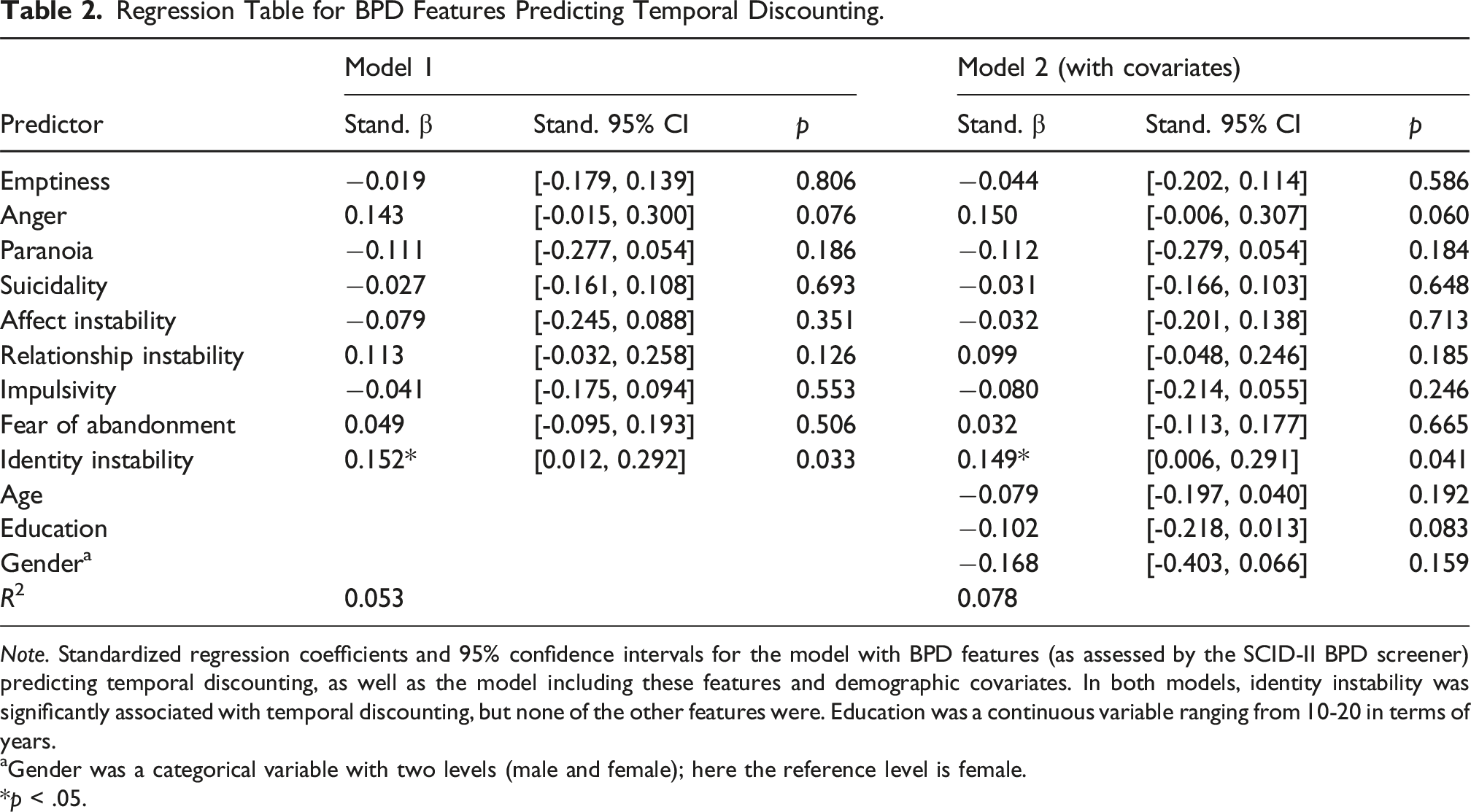
Note. Standardized regression coefficients and 95% confidence intervals for the model with BPD features (as assessed by the SCID-II BPD screener) predicting temporal discounting, as well as the model including these features and demographic covariates. In both models, identity instability was significantly associated with temporal discounting, but none of the other features were. Education was a continuous variable ranging from 10-20 in terms of years.
aGender was a categorical variable with two levels (male and female); here the reference level is female.
*p < .05.

Temporal discounting is not associated with impulsivity (a), but is positively associated with identity instability (b). Lines are best-fit lines, and shaded areas indicate 95% confidence intervals. Although a multiple regression analysis was performed examining the effects of all BPD features on temporal discounting, bivariate correlations on raw scores are displayed above for illustration purposes only.
One limitation of this analysis is that different BPD features were assessed with different numbers of items. Thus, it is possible that the reason that identity instability was the only feature significantly associated with temporal discounting is that it was measured with three items and was therefore measured more reliably than the features (such as impulsivity) that were measured with one item. To address this concern, we ran a series of follow-up regressions in which we reduced each feature subscale to just one single item, and then ran a regression for every combination of single items for each two- and three-item subscale. This resulted in 36 unique regression models (each containing 9 predictors). Only one item from the SCID-II BPD screener was consistently associated with temporal discounting in every regression in which it was included. This single item was a question from the identity instability subscale: “Over the last five years, have you abruptly changed your sense of who you are and where you are headed?” Thus, even when identity instability is measured using a single item, it still predicts temporal discounting above and beyond all other BPD features, and no other single item from any subscale had a significant effect on temporal discounting in any of the regression models. This suggests that differences in measurement reliability are unlikely to explain our results.
Rejection expectation is associated with temporal discounting
Finally, we examined if scores on a separate questionnaire of rejection sensitivity (A-RSQ) were related to temporal discounting. The average rejection sensitivity score in our sample was 37 (SD = 16.7; range: 1–99.4). The average rejection expectation score was 4.28 (SD = 1.69; range: 1–12.1), and the average rejection anxiety score was 8.03 (SD = 2.32; range: 1–13). Given the well-established connection between rejection sensitivity and BPD (Staebler et al., 2011), it was unsurprising that rejection expectation (r (308) = .19, p < .001, 95% CI [0.08–0.30]), rejection anxiety (r (308) = .34, p < .001, 95% CI [0.24–0.43]), and total rejection sensitivity scores (r (308) = .35, p < .001, 95% CI [0.25–0.45]) were all positively correlated with overall SCID-II BPD screener scores. However, only rejection expectation was significantly associated with temporal discounting (standardized β = .16, p = .005, 95% CI [0.05–0.27]; Figure 3(a); Table 3), but rejection anxiety was not (standardized β = .02, p = .717, 95% CI [−0.09–0.13]; Figure 3(b); Table 3). In a separate regression, the total rejection sensitivity score was also not associated with temporal discounting (standardized β = .08, p = .142, 95% CI [−0.02–0.20]; Figure 3(c); Supplemental Table 5). When controlling for age, education, gender, and rejection anxiety, the relationship between the expectation of rejection and temporal discounting remained significant (standardized β = .13, p = .025, 95% CI [0.02–0.24]; Table 3). Relationships between temporal discounting and rejection expectation (a), rejection anxiety (b), and rejection sensitivity (c). Lines are best-fit lines, and shaded areas indicate 95% confidence intervals. Although we conducted regression analyses, bivariate correlation coefficients and scatterplots are shown for illustrative purposes. Regression Table for Rejection Expectation and Anxiety Predicting Temporal Discounting. Note. Standardized regression coefficients and 95% confidence intervals for the model with rejection anxiety and rejection expectation predicting temporal discounting, as well as the model including these features and demographic covariates. In both models, rejection expectation was significantly associated with temporal discounting. Education was a continuous variable ranging from 10-20 in terms of years. aGender was a categorical variable with two levels (male and female); here the reference level is female. **p < .01. *p < .05.

Post-hoc analyses
Given the novel finding that rejection expectation (but not rejection anxiety) was associated with discounting, we next conducted post-hoc bivariate correlational analyses to explore how rejection expectation and rejection anxiety related to impulsivity and identity instability. Rejection expectation (r (308) = .17, p = .003, 95% CI [0.06–0.27]), rejection anxiety (r (308) = .17, p = .003, 95% CI [0.06–0.28]), and total rejection sensitivity scores (r (308) = .22, p < .001, 95% CI [0.11–0.32]) were all positively correlated with identity instability. However, impulsivity was positively associated only with rejection anxiety (r (308) = .19, p < .001, 95% CI [0.08–0.30]) and total rejection sensitivity scores (r (308) = .16, p = .005, 95% CI [0.05–0.27]) but not with rejection expectation (r (308) = .05, p = .342, 95% CI [−0.05–0.17]). In sum, rejection expectation and identity instability were associated with each other and with temporal discounting. Impulsivity and rejection anxiety were associated with each other, but neither was associated with temporal discounting.
We also tested whether the relationship between identity instability and temporal discounting was mediated by rejection expectation, or vice versa. To this end, rejection expectation scores and identity instability scores were entered as predictors in a multiple linear regression with discount rate as the dependent variable. The relationships between identity instability and discounting (standardized β = .13, p = .024, 95% CI [0.02–0.24]) and between rejection expectation and discounting (standardized β = .14, p = .015, 95% CI [0.03–0.25]) both remained significant in this model. Thus, both identity instability and rejection expectation accounted for independent sources of variance in temporal discounting. Moreover, these associations remained significant even when controlling for impulsivity and rejection anxiety (identity instability: standardized β = .14, p = .024, 95% CI [0.02–0.26]; rejection expectation: standardized β = .14, p = .015, 95% CI [0.03–0.25]; impulsivity: standardized β = −.0.03, p = .583, 95% CI [-0.15–0.09]; rejection anxiety: standardized β = .004, p = .947, 95% CI [-0.11–0.12]).
Discussion
Here, we examined the relationship between BPD features and temporal discounting in an online community sample recruited via Prolific. Our study showed that people who reported the presence of more and/or more severe BPD features showed higher temporal discounting. Among the nine BPD features assessed by the SCID-II BPD screener, the only feature that was significantly associated with temporal discounting was identity instability; those with a more unstable self-concept were less patient when deciding between immediate and delayed rewards. Additionally, rejection expectation, but not rejection anxiety or total rejection sensitivity, was associated with temporal discounting, such that people who felt that interpersonal rejection was more likely made fewer future-oriented choices. The relationship between identity instability and temporal discounting remained significant even when controlling for age, gender, education level, and the eight other BPD features. Similarly, the relationship between rejection expectation and temporal discounting remained significant even when controlling for age, gender, education level, and rejection anxiety. Moreover, both of these features independently predicted variance in temporal discounting.
Our findings are in line with previous studies showing that people with BPD have higher temporal discounting compared to healthy controls (Boog et al., 2022; Paret et al., 2017). It was previously unclear, however, if BPD features would be associated with temporal discounting in the general population. In the current study, we used a modified version of the SCID-II BPD screener that allowed for a greater range of responses and found that the BPD summary score did predict discounting, although this association did not survive when controlling for age, gender, and education. This finding suggests that steep temporal discounting is not just a characteristic of people diagnosed with BPD (Paret et al., 2017), but rather, there is a continuous, positive relationship between temporal discounting and BPD features. Examining BPD features continuously in a large, online sample instead of simply comparing people with BPD to those without BPD (Morris & Cuthbert, 2012) allowed us to sidestep potentially confounding variables related to a BPD diagnosis, such as comorbidities between BPD and a history of trauma (Verfaellie et al., 2024) or substance use disorder (Amlung et al., 2017), both of which have been linked with temporal discounting previously. Furthermore, collecting data online allowed us to obtain a large (n > 300) sample size, a geographically diverse sample, and a wide range of responses, all of which strengthen our conclusions. A disadvantage of collecting data online is reduced experimental control over the participant’s environment. However, we addressed this issue by applying a novel, rigorous quality assurance procedure to exclude any participants who were not fully engaged with the tasks.
Among the BPD features assessed by the SCID-II BPD screener, only identity instability was a significant predictor of temporal discounting. This association remained significant when controlling for age, gender, education, and all of the other BPD features. People with more unstable identities, such as those with BPD, not only feel that they have different identities in different situations, but they also lack self-continuity over time (Fuchs, 2007), finding it more difficult to connect their past, present, and future selves. Self-continuity is critical for making choices that are beneficial for the long-term, such as choices to exercise (Rutchick et al., 2018). People with more self-reported overlap between their present and future selves tend to have lower discount rates (Ersner-Hershfield et al., 2009), and manipulations that increase self-continuity have been shown to reduce discounting (Hershfield et al., 2011; Rutchick et al., 2018). To our knowledge, this is the first study to link BPD-associated identity instability to temporal discounting. Although present-future self-continuity is the most likely mechanism by which identity stability impacts temporal discounting, we did not explicitly assess present-future self-continuity in our sample. We encourage future research to more directly test this mechanism, perhaps by testing the effects of self-continuity manipulations on temporal discounting in patients with BPD.
One prior study (Berenson et al., 2016) suggested that impulsivity is the driving factor behind the increased temporal discounting in BPD, but our study showed no significant relationship between self-reported impulsivity and temporal discounting. This null result is not unprecedented, given that self-report measures of impulsivity often do not correlate with task-based measures of impulsivity (Eisenberg et al., 2019; Murphy & Mackillop, 2012). One reason for this lack of an association might be methodological; self-report measures differ from task-based measures in a number of ways (e.g., Enkavi et al., 2019), thus reducing the likelihood that they will correlate, even if they are capturing the same construct. Since we found that other self-report measures (e.g., identity instability) were associated with temporal discounting, though, the null relationship between self-reported impulsivity and temporal discounting cannot be attributed solely to methodological differences between these measures. Instead, it may be that self-report impulsivity questionnaires and temporal discounting tasks are capturing distinct constructs (Friedman & Banich, 2019). It is possible, for example, that the impulsivity question in the SCID-II BPD screener is capturing a disregard for future consequences, whereas the temporal discounting task is assessing how much future consequences are valued (Lempert et al., 2019; Nagin & Pogarsky, 2004). Another possibility is that the SCID-II BPD screener is unable to capture the nuances of impulsivity in just one item, and that we might have seen a significant relationship if we had used a different impulsivity measure that was more reliable.
Finally, in a secondary aim of the study, we found that rejection expectation, but not rejection anxiety or overall rejection sensitivity, was associated with temporal discounting. Moreover, fear of abandonment, a BPD feature that was associated with both rejection anxiety and rejection sensitivity, but not with rejection expectation (see Figure 1), was also not associated with temporal discounting, highlighting the specificity of this relationship to the perceived likelihood of rejection occurring, rather than to the intolerance of rejection (Palihawadana et al., 2019). These results are consistent with previous work, including work from members of our team (Fertuck et al., 2023), showing that rejection expectation and rejection anxiety have distinct behavioral and neural correlates (Preti et al., 2020). The fact that only the cognitive (rejection expectation), but not the affective (rejection anxiety), component, was associated with temporal discounting, is in line with research showing that temporal discounting is more strongly associated with individual differences in cognition rather than affect (Keidel et al., 2021). One possible explanation for our result is that people with strong rejection expectations hold pessimistic beliefs about the future in general. These pessimistic beliefs might then increase discounting, since thinking about the future in a negative light has been shown to increase discounting (Liu et al., 2013), and anxious-depressive tendencies are associated with discounting as well (Keidel et al., 2024). Of course, one limitation of the A-RSQ is that rejection expectations might not just reflect pessimism; they may reflect an actual lack of social support as well. That is, it could be that someone expects to be rejected because they actually have often been rejected by family and friends. Given that community trust can also support more future-oriented choice (Jachimowicz et al., 2017), future research is needed to investigate this possibility. Interestingly, while both identity instability and rejection expectation may reflect attitudes about the future, they had independent effects on discounting when we entered them into the same regression. Therefore, someone with BPD tendencies who either expects interpersonal rejection or sees themselves as inconstant over time (or both) is likely to pursue immediate rewards at their long-term expense.
There are several limitations of this study that are worth noting. First, since the SCID-II BPD screener includes single-item, two-item, and three-item measures of BPD features, this could have led some features to be measured more reliably than others. Since identity instability was measured using three items, while several other features (including impulsivity) were measured using one item, this increased reliability might have driven the significant association between identity instability and temporal discounting. However, we think that this is unlikely to be the case because follow-up regression analyses found that even when identity instability is measured using a single item, it still outperforms the other features in predicting discounting. Moreover, other features that were measured using multiple items (such as anger) did not show significant associations with temporal discounting in our multiple regression model, showing that our result cannot be explained by increased reliability alone. Another limitation of our study is the fact that we made some adjustments to existing questionnaires. However, previous studies have also “Likertized” the SCID-II screener (Meyer et al., 2004; Miano et al., 2013), and we believe that the small adjustments we made were important for examining the associations between BPD features and temporal discounting in a community sample. Nevertheless, the extent to which our findings will generalize to a sample with a BPD diagnosis is unknown. Third, since this study was part of a larger data collection effort, it is possible that the presence of other instruments in the study, and the fact that they were spread out over two sessions, might have impacted our findings. However, running large online studies to answer several research questions at once is becoming common practice (e.g., Rusch et al., 2023), and we are not aware of any evidence that findings gleaned from those studies are less replicable than those from more targeted studies. Furthermore, temporal discounting has high test-retest reliability (Kirby, 2009; Weafer et al., 2013), so discount rates were unlikely to change over the week or so between our testing sessions. Finally, this was an exploratory study; although we pre-registered some aspects of the protocol, we did not pre-register any hypotheses related to temporal discounting. Therefore, it is important for our findings to be replicated in a cross-validation study, ideally one with pre-registered hypotheses, a pre-registered analysis plan, single-timepoint measurement, and more reliable measurements for each of the BPD features.
In conclusion, we found that the BPD features of identity instability and rejection expectation were associated with temporal discounting in a community sample. Temporal discounting has been shown to predict real-world behaviors, with reduced discounting being associated with better outcomes, such as better health and financial security (Bartels et al., 2023). Therefore, our findings might help inform novel treatment strategies to help people with BPD-like traits make more future-oriented choices. For example, increasing self-continuity by showing someone with BPD an age-progressed picture of themselves might help them to plan for the future. Similarly, cognitive-behavioral interventions that can help people to better calibrate their rejection expectations might also have beneficial downstream effects on value-based decision making. Together, our results add to the growing literature showing that temporal discounting is a useful transdiagnostic indicator that captures attitudes about the future (Keidel et al., 2024; Lempert et al., 2019; Levitt et al., 2023).
Supplemental Material
Supplemental Material - The borderline personality disorder feature of identity instability predicts temporal discounting in a community sample: An exploratory study
Supplemental Material for The borderline personality disorder feature of identityinstability predicts temporal discounting in a community sample: An exploratory study by Chloe A. Ott, Alexandra Voce, Jack Grinband, Teresa Lopez-Castro, Eric A. Fertuck, Damian A. Stanley, and Karolina M. Lempert in Personality Science
Supplemental Material
Supplemental Material - The borderline personality disorder feature of identity instability predicts temporal discounting in a community sample: An exploratory study
Supplemental Material for The borderline personality disorder feature of identityinstability predicts temporal discounting in a community sample: An exploratory study by Chloe A. Ott, Alexandra Voce, Jack Grinband, Teresa Lopez-Castro, Eric A. Fertuck, Damian A. Stanley, and Karolina M. Lempert in Personality Science
Footnotes
Author note
Not applicable.
Acknowledgements
The authors would like to thank Ian Frazier for help with setting up the Qualtrics surveys.

Author Contributions
Funding
The authors disclosed receipt of the following financial support for the research, authorship, and/or publication of this article: This research was funded by the Professional Staff Congress and City University of New York (PSC-CUNY) Research Award Program, Grants (TRADB-64610-00 52 and TRADB-62619-00 50), and by the National Institutes of Health, Grant (R15AG080449).
Declaration of conflicting interests
The authors declared no potential conflicts of interest with respect to the research, authorship, and/or publication of this article.
Data Availability Statement
Supplemental Material
Supplemental material for this article is available online.
Notes
References
Supplementary Material
Please find the following supplemental material available below.
For Open Access articles published under a Creative Commons License, all supplemental material carries the same license as the article it is associated with.
For non-Open Access articles published, all supplemental material carries a non-exclusive license, and permission requests for re-use of supplemental material or any part of supplemental material shall be sent directly to the copyright owner as specified in the copyright notice associated with the article.
