




Abstract
Prior research has demonstrated a link between personality and emotion; however, the causal direction between these constructs remains unclear. Further, mixed findings in the literature have been found for the influence of emotional states on personality assessment scores. The current study investigated the impact of state affect on personality assessment scores across emotions. Participants (n = 235) were randomly assigned to one of four emotion manipulation conditions: happiness, calmness, anger, or sadness. Personality was assessed in the same sample over two assessment occasions, the latter of which included an emotion manipulation component. The results demonstrated that personality assessment scores were stable within individual over time despite manipulated emotion states. Further, the emotional state manipulations, varying in valence and activation level, had little to no significant effects on assessment scores between individuals. Those findings that were found to be statistically significant did not result in substantive differences in score interpretations. These findings provide evidence to support the notion that personality assessments are robust to the effects of transient emotional states and time, providing confidence in their use for organizational purposes.
Personality measures are often used in organizations due to their ability to consistently predict work-related motivations, behaviors, and performance across context and time (Oswald & Hough, 2011). A common worry for organizations, however, concerns the reliability of personality scores (Ademola-Shanu, 2021; Haynie, 2021; Martin, 2014; Meinert, 2015). For example, a common misconception is that one’s mood or current emotional state will affect the stability of their assessment scores (e.g., Meinert, 2015). Given the self-report nature of personality assessments, some have argued that despite the relative stability of personality in adulthood (Bleidorn et al., 2022), scores may be biased by one’s mood at the time of the assessment (Heide & Grønhaug, 1996). Further, the causal and directional relationship between emotional states and personality assessment scores has not been well established. For instance, while some research suggests the instability of personality measurement in the presence of mood variations (e.g., Heide & Grønhaug, 1996; Querengässer & Schindler, 2014), other researchers have found non-significant effects of emotional state on personality scores (Masters & Furman, 1976; Underwood et al., 1980). As such, the research has demonstrated mixed findings on this topic. Further, it is important to note that the measures used in many of these studies do not reflect the current widely accepted five factor (FFM) taxonomy of personality (Digman, 1990; Goldberg, 1992; John, 2021; McCrae & Costa, 1987). In addition, past research does not address the role of emotions in the assessment of dark personality (i.e., subclinical traits associated with the DSM-IV Axis II personality disorders, American Psychological Association, 1994; Hogan & Hogan, 2001).
As such, the current research contributes a novel examination of the influence of state affect on FFM and dark personality assessment scores. This examination not only attempts to answer the question of whether varying emotional states affect personality scores differently, it also evaluates the proclivity of emotionally driven changes in assessment scores by analyzing both between-person and within-person differences. The findings of this research will therefore better inform the practical use of these assessments for applications such as personnel decisions. A second contribution of this research is developing a better understanding of the relationship between emotions, which vary in valence and activation, and personality by exploring the causal direction of emotional states on assessments scores across two time points. The results presented thus add to the theoretical and empirical debate about this relationship.
Personality assessment
Personality assessment provides organizations the ability to predict relevant organizational outcomes such as work-related thoughts, motivations, and behaviors across situations and over time (Oswald & Hough, 2011). It provides insight into a person’s ability to be successful in specific jobs, highlights why one might enjoy a particular role or work environment, and can influence leadership ability (Hogan et al., 2007). The most widely accepted personality structure is the Five Factor Model (FFM) which serves as a foundation for many personality assessments (John, 2021; McCrae & Costa, 1987). The FFM consists of the dimensions of Agreeableness, Conscientiousness, Emotional Stability, Extraversion, and Openness to Experience (c.f. Digman, 1990; Goldberg, 1992; John, 1990; McCrae & Costa, 1987). This taxonomy provides a useful framework for the construction of inventories that capture normal personality, providing a method for categorizing individual differences in social behavior (Hogan et al., 2007).
When discussing personality assessment, it is important to also discuss the underlying theories beyond the FFM taxonomy that are thought to influence personality expression and assessment. Socioanalytic theory distinguishes personality between identity (i.e. how you view yourself) and reputation (i.e., how others view you) such that personality assessment is thought to reflect personality’s reputation side (Hogan, 1982; Hogan et al., 1996; Hogan & Shelton, 1998; MacKinnon, 1944). Socioanalytic theory, which acknowledges the group-like nature of human interaction and development, further argues that there are three major motivations that humans pursue in groups: to get along with others, to get ahead of others, and to find meaning (Hogan, 1982). As such, when applied, Socioanalytic theory is intended to explain individual differences in career and social success through the attainment of these motivational patterns. Therefore, personality, more specifically personality’s reputation side, can be expressed as one’s aptitude for achieving the social motivations of getting along and getting ahead (Hogan & Blickle, 2013; Hogan & Sherman, 2020).
Personality can be further classified into bright and dark personality. The bright side of personality refers to peoples’ behavior when they are paying attention to how they are impacting those around them, reflecting a person’s normal or day-to-day behavior (Hogan et al., 2021). In turn, the evaluation of normal personality captures desirable social performance that facilitates an individual’s ability to get along and get ahead (Hogan & Hogan, 2007). In contrast, the dark side of personality refers to people’s behavior under stress and other conditions that challenge self-regulation. This category concerns behaviors that inhibit performance or derail success, particularly reflecting failed attempts to get along and get ahead (Hogan & Hogan, 2001). For the purposes of this research, dark personality is defined in the framework of subclinical expression of the DSM-IV Axis II personality disorders as discussed and expressed in the literature (American Psychological Association, 1994; Hogan & Hogan, 2001; Harms et al., 2011; Spain et al., 2014) and can be thought of as extensions of normal personality when self-monitoring is inhibited (Hogan et al., 2021; Hogan & Hogan, 2009). Both bright and dark side personality are relevant to organizations (Judge et al., 2009) and contribute to the prediction of work performance such that research indicates that personality predicts variance in outcomes like job performance and career success (e.g., Barrick et al., 2001; Benson & Campbell, 2007; Oswald & Hough, 2011). Further, organizations can leverage assessments of both the bright and dark side of personality for personnel selection as well as for developmental feedback (Hogan et al., 2007). Importantly, the predictive validity of personality is often incremental, suggesting that personality predicts above and beyond the variance accounted for by other constructs such as cognitive ability, demonstrating its value in organizational contexts (e.g., Barrick et al., 2001; Cupello et al., 2024; Dudley et al., 2006; Hogan & Holland, 2003, etc.). Given their value to organizations and their use in high-stakes decision-making, it is critical to determine whether these assessments are reliable and robust to transient states.
Incidental state affect
Emotions are reactions to the perception or imagination of events, states, or objects that result in both subjective and objective manifestations (Reisenzein & Weber, 2009). More specifically, discrete emotions are short-lived, intense feelings that arise from a stimulus and have clear cognitive content accessible to the person experiencing the emotion (Clore et al., 1994; Frijida, 1986). The stimulus has attributes that trigger the experience of specific emotions with distinct action tendencies or behavioral outcomes for an individual (Angie et al., 2011). Beyond the stimulus, emotions are best understood as multi-componential, where emotional experiences may result in changes to cognitive, experiential, central physiological, peripheral physiological, or behavioral response systems (Lang, 1978). A common model for representing emotionality, or the behavioral component of emotion, is a circumplex model. Circumplex models of emotions hold that emotional experience is comprised of arousal/activation and valence which make up the two axes of the circumplex (Russell, 1980; Watson & Tellegen, 1985). Emotional arousal is the behavioral reaction to the intensity of an event, while valence can be discussed as a continuum specifying how negative or positive said event is (Lang et al., 1993; Mehrabian & Russell, 1974; Russell, 1980).
Aspects of arousal and valence are thought to influence reactions to events. Circumplex models of emotions represent emotional valence as ranging from negative to positive. Research has demonstrated how emotional valence influences behavioral responses. For example, those experiencing positive emotions have been shown to prefer safer choices than those experiencing negative emotions (Chuang & Kung, 2005). Circumplex models of emotions also depict the arousal or activation level of emotions as ranging from low to high (deactivating to activating). Research has shown that activation level plays a role in behavior as well, with those experiencing a highly activating emotion (e.g., anger) being more likely to make heuristic based decisions, whereas those experiencing deactivating emotions (e.g., sadness) are more likely to withdraw and engage in detail-oriented thinking (Connelly et al., 2002; Garg, 2004; Semmler & Brewer, 2002). It is important to note that these aspects of emotion do not occur in isolation, but rather, the circumplex model divides emotions into one of four quadrants: positive activating, positive deactivating, negative activating, and negative deactivating. Anger is an example of a negatively valanced, activating emotion. Behavioral responses associated with anger are often explicit and heuristic-based (Angie et al., 2011; Bodenhausen, 1993; Bodenhausen et al., 1994). Conversely, calmness is a positively valanced, deactivating emotion, such that it is associated with rest and recovery in the present (Gilbert, 2014). Examples of negatively valanced, deactivating emotions and positively valanced, activating emotions include sadness and happiness respectively (Russell, 1980). The differences in valence and activation level are likely to influence different behavioral responses.
Importantly, not only can emotions influence behavioral outcomes in the moment, but the emotions that people experience in one situation can influence their judgments and behaviors in other situations, even if the situations are unrelated (Wyer et al., 2019). This is referred to as the incidental properties of emotion. Both negative and positive emotions can be incidental and can influence behaviors related to motivations and goals (Han et al., 2007; Kruglanski et al., 2002; Lerner & Keltner, 2001; Raghunathan et al., 2006). For instance, negatively valanced emotions are aversive, thus goals may be related to attempts to reduce or eliminate them (Isen, 1984) while positive emotions may motivate maintenance of such feelings. The emotions examined in this study include anger (activating/negative valence), sadness (deactivating/negative valence), happiness (activating/positive valence), and calmness (deactivating/positive valence). The emotions elicited in this study were directed towards behaviors viewed in film clips which may subsequently influence unrelated assessment responding.
The literature suggests that anger has unique attention-focusing properties that can carry over from prior situations to influence future behavior (Lerner & Tiedens, 2006; Solomon, 1990; Tavris, 1989). Research has demonstrated the incidental properties of anger by showing that angry individuals may act more aggressively towards others, be more punitive, and are more likely to submit negative evaluations of a service in a context different than the one that aroused their anger (Goldberg et al., 1999; Su et al., 2018). Sadness has also demonstrated incidental properties related to behaviors such as withdrawal and hedonic consumption in unrelated contexts (Isen, 1984; Salerno et al., 2014). Happiness may motivate individuals to maintain their good feelings, incidentally, serving as emotional information that encourages them to persist in efforts to maintain their mood (Clore & Palmer, 2009; Hirt et al., 2008; Song et al., 2018). While calmness, which is low in arousal and motivates present-focused rest and recovery (Gilbert, 2014; Russell, 2003), is likely to encourage conservation, adjustment, and disengagement that fosters the maintenance of a peaceful state (Hamm et al., 2021; Smith & Baltes, 1997). Considering the incidental properties of emotion, it is important to examine if these properties carry over and affect scores on personality assessments. For instance, given that happiness is positively valanced and activating, if a personality assessment is not stable, this state could influence responses related to one’s adjustment or sociability. Conversely, given that anger is negatively valanced and activating, an angry state could influence responses to dark personality characteristics that are linked to bold or mischievous behaviors.
Affect & personality
Personality and emotion are often studied together with the causal direction of these two variables under scrutiny. In correlational terms, the literature suggests positive relationships between the personality traits of emotional stability, sociability, and adjustment and emotional states like happiness (Smith, 1961; Wessman & Ricks, 1966), conscientiousness and pride (Costa & McCrae, 1996), and agreeableness and psychological well-being (McCrae & Costa, 1991). Given these findings, the question becomes not if emotion and personality are related, but rather if, and in what ways, do emotional states affect personality assessment scores.
Research examining the causal relationship between affect and personality has been less clear. While some have argued for emotion or mood states affecting personality, others have argued for a relationship in the opposite direction, where personality affects the experience and intensity of emotions. For instance, Revelle and Scherer (2009) argue that personality is the coherent patterning of affect, behavior, cognition, and goals over time and space. Expectations of a person’s behavior can be thought of as personality, whereas what one observes in any moment may fluctuate due to emotion or situational variables (Revelle & Scherer, 2009; Zajenkowski et al., 2012). In further support of the idea that personality affects emotions or mood, the literature suggests that emotion systems consist of a mechanism that both monitors the relevance of cognized events for a person’s motives and communicates motive-relevant changes to propose a particular action towards a goal; this mechanism is thought to be one’s personality (Frijida, 1994; Reisenzein & Weber, 2009; Reizenzein, 2006). Others argue that the relationship may be bi-directional, such that sadness effects reported neuroticism scores, but conversely, high scores on neuroticism predicts greater responsiveness to induced sadness (Querengässer & Schindler, 2014; Schindler & Quarengässer, 2018), further muddying the directionality of the relationship.
Importantly, people not only have or experience emotions, but they also have the capacity to regulate them (Frijida, 1986; Gross, 1998). This capacity is thought to be dictated by one’s personality, as research suggests that personality factors (specifically Extraversion and Neuroticism) correspond to positive and negative affect dimensions (Costa & McCrae, 1980; Warr et al., 1983; Watson & Tellegen, 1985). For example, those high in both extraversion and neuroticism have been found to experience emotions more intensely (Costa & McCrae, 1996) and variations in extraversion and neuroticism have been shown to influence negative and positive reactions to films (Gross et al., 1998). Further, extraversion and neuroticism, paired with individual differences in mood regulation expectancies has been shown to influence positive and negative affect decay (Hemenover, 2003). However, further research on the relationship between these two personality characteristics and mood dimensions suggests that situational variables (i.e., neutral vs. performance situations) may result in unstable and variable findings (Zajenkowski et al., 2012).
The literature on emotion as it relates to assessment in general suggests that effects of emotion can be both adaptive and maladaptive (Reisenzein, 1996). Research suggests that emotions can impact cognitive reasoning, where those in negative moods perform worse on logical reasoning tests than those in positive moods (Jung et al., 2014). Negative emotions have been linked to test anxiety and worries, which may account for 5%–10% of the variance in test performance (Cassady & Johnson, 2002; Chapell et al., 2005; Chin et al., 2017; Gregor, 2005). Further, emotions can be inhibitory to processes such as learning and motivation (Derakshan & Eysenck, 2009; Putwain et al., 2010, etc.). Evidence suggesting that mood/emotion may bias judgment and evaluation tasks (Forgas & Bower, 1987; Forgas et al., 1984; Johnson & Tversky, 1983; Schwarz & Clore, 1983) can lead to concern for the extent to which mood may bias personality assessment results as well. Some have argued that, given that personality assessments are self-report, they should be viewed as judgment tests and therefore may be susceptible to these biases (Heide & Grønhaug, 1996). While relationships between emotions and cognitive assessments have been less favorable, personality assessment differs from performance situations in that they involve evaluating the relevance of statements to oneself and does not involve learning or preparation. Therefore, if a personality assessment is well designed, it should not be affected by emotional states.
Despite this assumption, research has demonstrated mixed findings related to personality assessment. As discussed, Heide and Grønhaug (1996) argued that the self-report nature of personality assessment makes it more susceptible to changes in emotion. However, other researchers examining self-report personality found non-significant effects of state emotion on personality scores (Masters & Furman, 1976; Underwood et al., 1980). Despite these mixed findings, it is important to note that these studies did not examine the now widely accepted FFM of personality. Given the widespread use of FFM assessments for applied organizational and research purposes, it is important to examine these relationships in this context to enhance practitioner trust in these tools. Research has begun to examine this relationship leveraging the FFM framework, initiating a promising line of research. For example, a bi-directional relationship between emotion and FFM personality has been empirically tested such that findings revealed that induced sadness influenced reported neuroticism scores, while higher neuroticism scores also predicted enhanced responsiveness to the sadness manipulation (Querengässer & Schindler, 2014; Schindler & Quarengässer, 2018). While important, this research leveraged a student sample. Research suggests that personality becomes more stable in adulthood (Bleidorn et al., 2022), therefore research is needed which examines the effects in a working adult sample, extending the research for organizational value. Further, the results of the aforementioned studies that suggested a bi-directional relationship found a significant three-way interaction, where personality factor, induced emotion, and condition predicted changes in personality assessment score, pointing to the uncertainty involving the direction and driving factors of this relationship and warranting further exploration.
Regarding dark personality, research on this topic has not yet explored the relationship between state affect and the assessment of dark side personality. As discussed, dark personality can be thought of as an extension of normal personality under inhibited self-monitoring (Hogan & Hogan, 2009) and has grown in usage for applied organizational and research purposes (e.g., Gøtzsche-Astrup et al., 2016; Moscoso & Salgado, 2004; Gøtzsche-Astrup et al., 2016; Reichin et al., 2019; Spain et al., 2014, etc.). Given the suggestion that these characteristics are likely to behaviorally emerge under stress, which can induce negative emotional experiences and encourage a state where one’s self-monitoring is inhibited, it is important to empirically determine whether induced emotions influence responses to dark personality measures.
Given the mixed literature, limited evaluation of FFM personality in this context, and the lack of empirical evaluation involving dark personality, the current study seeks to examine whether state affect influences personality assessment scores by examining both within- and between-person differences. As such, we ask the following research questions: RQ1: Do state emotions affect bright/dark personality scores within person over time? RQ2: Do state emotions, varying in valence and activation level, affect personality scores across individuals?
Methods
This study used a randomized controlled experiment design with a group of working adults to test the effects of emotional states on personality assessment scores. Leveraging repeated measures data, this experiment was able to examine the between-person effects of emotion on assessment scores as well as the within-person stability of assessment scores over two assessment occasions.
Research participants
A total of 298 working adults from a Prolific participant pool received compensation for voluntarily participating in this study. Participants who answered the film engagement measure indicating they were not engaged, did not properly answer four attention check items or improperly filled out a provided Captcha code were removed from the analyses for inattentive responding. Attention check items were items meant to be absurd. Two example attention check items are “I have never seen my own naked body” and “All my friends are astronauts.” Although we aimed for a sample of at least 200 people with n = 50 per group, given the voluntary nature and time limit to complete the study, 235 people (nGroup1 = 61, nGroup2 = 59, nGroup3 = 55, nGroup4 = 60) were included in the study after data cleaning procedures. Given the repeated measures design of the study, power was approximated using the pwr.t.test function of the pwr package (Champely et al., 2020) in R to calculate the ability to detect meaningful effects. Results indicated approximate power of .33, .97, and .99 to detect small (d = .20), medium (d = .50), and large (d = .80) effects respectively.
After data cleaning, the final group of participants included 122 men (51.91%), 111 women (47.23%), and 2 (0.85%) individuals who indicated their gender was not man or woman. The average age for participants was 38.57 (sd = 11.23). Participants were primarily White (n = 149, 63.40%), followed by Black (n = 44, 18.72%), Hispanic or Latino (n = 16, 6.81%), Asian (n = 14, 5.96%), Two or More Races (n = 11, 4.68%), and Native American or Alaskan Native (n = 1, 0.43%).
Procedure
Participants were drawn from a larger multi-round study. For the first round of data collection, participants took the bright and dark side personality assessments under regular conditions in March of 2024 using the Qualtrics survey platform. They were provided general instructions to complete the personality assessments. The second round of data collection occurred in August of 2024. Participants were randomly assigned to one of four emotion manipulation conditions as outlined below. The study began with participants being randomly assigned to an emotion manipulation condition where they viewed a short video clip. Participants were instructed to view the clip in a single sitting, in a quiet environment, without distractions, using a laptop or similar device capable of playing sound. These instructions were intended to provide a level of standardization given that experimental settings have been shown to be related to emotional reactivity (i.e., Detenber & Reeves, 1996; Detenber et al., 2000; Jakobs et al., 2001; etc.). Following the video clip, which ranged from 2:23 to 4:43 min in length depending on the clip assigned, participants were asked to complete the bright and dark side personality assessments. Demographic information for this group was collected prior to both of these rounds of data collection.
Independent variable
State affect
State affect served as the independent variable of interest in this study. Four emotions were primed in the sample by prompting participants to watch a validated film clip. The emotions represented a unique quadrant in the emotion circumplex model: anger (negative, activating), sadness (negative, deactivating), happiness (positive, activating), and calmness (positive, deactivating; Russell, 1980). As discussed, emotional states have been shown to be related to personality characteristics, thus this research manipulated emotional states to examine both between- and within-person effects of state affect on personality assessment scores.
Pilot study
To confirm the effectiveness of the video clips used to manipulate emotion, a pilot study was conducted on a separate group of 142 participants from a different Prolific participant pool. Participants were removed if they did not respond to any of the measures following the film clip, resulting in a total of 132 working adults. The pilot group was primarily White (n = 103, 78.03%), followed by Black or African American (n = 14, 10.61%), Two or More Races (n = 8, 6.06%), Asian (n = 6, 4.55%), or Not Listed (n = 1, 0.76%). Around half of the group were Women (n = 70, 53.03%) and half were Men (n = 62, 46.97%). Finally, the average age was 42.19 (sd = 12.17).
This pilot study tested the effectiveness of several video clips designed to elicit emotions as identified in the literature (Bednarski, 2012; Rottenberg et al., 2007), and to minimize the possibility of priming effects caused by asking participants to reflect on their emotions in the full study. Research suggests that film clips are capable of eliciting emotional responses that rival or exceed the response strength of emotions elicited using other ethical procedures (Rottenberg et al., 2007). Further, they are considered more naturalistic and generalizable than other techniques, such as examining facial movements, as they represent prototypical situations that improve the ecological validity of the method (Rottenberg et al., 2007). Two clips for each emotion were selected and participants were randomly assigned to one of eight possible conditions (4 emotions, 2 activation levels). To reduce error variance due to the video clips, suggestions for matching them across affect dimensions were followed. This included having videos with similar lengths, assessing emotions with known effects in the literature, and considering valence and activation (Detenber et al., 1998; Rottenberg et al., 2007). After watching the randomly assigned video, participants completed a state affect measure designed to assess the effectiveness of the manipulation. Next, they were asked to complete several covariates including trait emotions, emotional reactivity, engagement with the clip, and familiarity with the film. Scores on the state affect scale were then compared.
Results of ANOVA for state affect in the pilot and current study.

Note. PANAS-S manipulation check for selected video clips in the pilot study and full study. Group 1 = Happiness; Group 2 = Anger; Group 3 = Calmness; Group 4 = Sadness.
*indicates significance at p < .01. Group Comparisons were conducted using Tukey’s Honestly Significant Differences test.
Dependent variables
FFM personality
To measure bright side personality, the Hogan Personality Inventory (HPI) was used. This measure is designed to assess normal range personality. The HPI is a 206-item assessment which uses a 4-point scale designed to measure normal personality in working adults. The HPI is based on the FFM of personality but breaks the dimensions of Extraversion and Openness down into two scales each (Hogan & Hogan, 2007). This assessment consists of the scales Adjustment (Emotional Stability), Ambition (Extraversion), Sociability (Extraversion), Interpersonal Sensitivity (Agreeableness), Prudence (Conscientiousness), Inquisitive (Openness), and Learning Approach (Openness). For validity information, scale definitions, correlations, and reliabilities see the HPI technical manual (Hogan & Hogan, 2007).
Dark personality
To measure dark personality, the Hogan Development Survey (HDS) was used. The HDS is a 154-item assessment which uses a 4-point scale designed to measure subclinical ranges of dark personality in working adults (Hogan & Hogan, 2009). This assessment consists of the scales Excitable, Skeptical, Cautious, Reserved, Leisurely, Bold, Mischievous, Colorful, Imaginative, Diligent, and Dutiful. For validity information, scale definitions, correlations, and reliabilities see the HDS technical manual (Hogan & Hogan, 2009).
Manipulation checks
State affect (PANAS-S)
State affect served as the manipulation check and was measured using the PANAS State Emotion Form (Watson et al., 1988) which asked participants to indicate the extent to which they felt the stated emotion while watching the film clip on a 5-point Likert scale (1 = Very Slightly/Not at All; 5 = Extremely). Each of the 16 emotions were assessed using a single item (Angry, Anxious, At Ease, Bored, Calm, Disappointed, Discouraged, Enthusiastic, Excited, Fatigued, Frustrated, Happy, Irritated, Relaxed, Tense, Uneasy). While state affect served as a manipulation check in the full study, to minimize priming effects it followed the outcome measures. The duration of state affect is highly variable, where emotion can last anywhere from mere seconds to several hours (Frijida et al., 1991; Verduyn et al., 2009) and recommendations for emotion elicitation through film include consideration of the proximity between activation and measurement (Rottenberg et al., 2007). Thus, the pilot study serves as evidence of appropriate emotion elicitation from the selected clips with immediate measurement of emotions following activation from viewing the video clip. For the purposes of being thorough, the results of the PANAS-S from the full study are presented in Table 1 and demonstrate identical patterns of inducing the desired emotion as demonstrated in the pilot study.
Film engagement and familiarity
The literature on using film to elicit emotion warns users of the complexity of emotion elicitation and the challenges associated with standardizing film engagement (Rottenberg et al., 2007). Given that films engage the visual and auditory responses, it is important to provide participants with standard viewing instructions (i.e., view in a quiet place, free from distractions) and measure the level of engagement with the film clip. Further, familiarity, or prior viewing of the film has been associated with heightened reports of the target emotion (Gross & Levenson, 1995). As such, we used an adapted form to capture film familiarity and engagement (Rottenberg et al., 2007). Familiarity was captured using a single item that asked if participants had seen the film before (yes or no). We found that 49 (17.22%) of participants indicated they had seen the film clip before. The Happiness, Calm, and Sad groups had 13 (19.70%), 10 (14.49%), and 24 (34.78%) people respectively who had seen the film clip before. Engagement was captured using three items asking participants if they closed their eyes or looked away during the scene, whether they viewed the clip in a quiet environment, uninterrupted, and if they turned down the volume or stopped listening during the scene (yes or no). We found that 12 (4.40%) people indicated they looked away during the video clip. Three (4.55%) of these people were in the Anger group and nine were in the sad group (13.04%). All participants indicated they watched the video clip in a quite uninterrupted environment. Two people (0.73%) indicated that the stopped listening during part of the video clip. These individuals were in the Anger and Sad groups.
Analysis
The goal of this study was to understand if emotion would affect personality assessment scores. Thus, we began analyses by examining means, standard deviations, and intraclass correlation coefficients (ICCs) to quantify the extent to which scores remained the same from the first to the second round of data collection. To assess the relationship between personality and emotions as well as determine the robustness of our findings, we elected to estimate linear mixed models using nonparametric bootstrapping with 1000 resamples via the percentile method. The bootstrap procedure was applied to each fixed effect in the LMM to generate bias-corrected 95% confidence intervals (CIs). Estimates with confidence intervals that did not include zero were considered statistically significant. Bias percentages are calculated as the bias value divided by the estimate times 100. Bias values below 10% are considered acceptable. The analysis was performed using the boot package in R (Davison & Hinkley, 1997).
Results
Descriptive statistics for the HPI and HDS happiness and calmness conditions.

Note. Happiness n = 61; Anger n = 55; ICC = Intraclass Correlation Coefficient for Round 1 versus Round 2; d – Cohen’s d. Cohen’s d values are standardized mean differences, with |d| values less than 0.20, 0.50, and 0.80 indicating negligible, slight, and moderate differences. |d| values equal to or greater than 0.80 indicate large differences.
ADJ: adjustment; AMB: ambition; SOC: sociability; INP: interpersonal sensitivity; PRU: prudence; INQ: inquisitive; LRN: learning approach; EXC: excitable; SKE: skeptical; CAU: cautious; RES: reserved; LEI: leisurely; BOL: bold; MIS: mischievous; COL: colorful; IMA: imaginative; DIL: diligent; DUT: dutiful.
Descriptive statistics for the HPI and HDS anger and sadness conditions.

Note. Calmness n = 59; Sadness n = 60; ADJ: adjustment; AMB: ambition; SOC: sociability; INP: interpersonal sensitivity; PRU: prudence; INQ: inquisitive; LRN: learning approach; EXC: excitable; SKE: skeptical; CAU: cautious; RES: reserved; LEI: leisurely; BOL: bold; MIS: mischievous; COL: colorful; IMA: imaginative; DIL: diligent; DUT: dutiful.
The fixed effect of time was non-significant in all cases indicating no overall differences in personality scores across all groups between time points. Bias was greater than 10% for Learning Approach, Excitable, and Bold. However, the bootstrapped confidence interval contained zero for all Time effects indicating that even when bias may have been large, the true estimate could still be zero and due to non-significance, the parameter didn’t have a significant effect on the overall model.
The fixed effects of emotion group were non-significant in all but five parameters (9%). There were significant effects for the Calm (Group 2) group on Ambition, Interpersonal Sensitivity, Prudence, and Diligent. There was also a significant effect for the Anger (Group 3) group for Mischievous. The bias estimates were small for all of these significant effects and the confidence intervals did not contain zero. This indicates there may have been some differences in personality scores for these groups as compared to the reference Group 1 (Happiness) at the first assessment occasion.
Results of bootstrapped LMM.
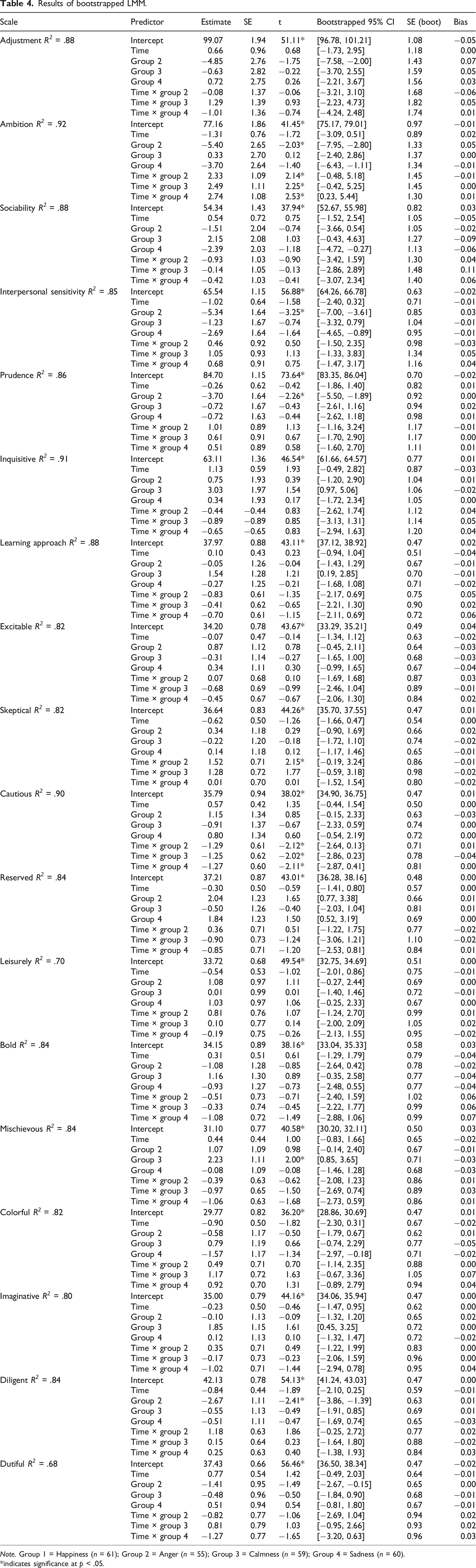
Note. Group 1 = Happiness (n = 61); Group 2 = Anger (n = 55); Group 3 = Calmness (n = 59); Group 4 = Sadness (n = 60).
*indicates significance at p < .05.
Discussion
The current study evaluated the relationship between state emotion and personality assessment scores by testing both between-person and within-person effects. Results demonstrate non-significant overall effects of time, indicating that, on average, personality scores are stable regardless of emotional state. Results also demonstrated non-significant interactions between time and group with the exception of a significant effect for the Calm group on the Ambition scale between assessment rounds. We found that Ambition increased at a higher rate than the referent group (happiness) for those who watched the video meant to elicit calmness. However, the non-significant results of time regardless of emotion manipulation suggests that this result should be interpreted with caution. Overall, these findings provide evidence that personality assessment scores seem to demonstrate stability on average regardless of specific state emotion.
The literature on personality suggests that it is a relatively stable characteristic over the lifespan (Bleidorn et al., 2022), thus personality assessment scores should demonstrate stability if they are reliable and valid measures of the construct. Some research has argued however, that mood or emotional states will have effects on personality assessment scores given that they are self-report measures (Heide & Grønhaug, 1996). Though possible, little prior research examining this relationship was conducted on the well-established FFM or dark side of personality, nor did it consider the possibility that the relationship may operate in the opposite direction, where personality dictates experiences of emotion (Revelle & Scherer, 2009). The research that did examine this relationship using FFM measures did so using a student sample and found evidence for a bi-directional relationship, where personality was also found to determine emotional reactions. The results of the current study provide initial evidence of the stability of personality and personality assessment scores even when state emotion is manipulated. Further, by making between-person comparisons, the results further demonstrate that different emotional states, that vary based on valence and activation level, for the most part do not have significant effects on scores. Even when statistically significant findings are demonstrated, it is important to note that the changes in scores do not result in substantive differences in terms of score interpretation. For example, the calmness condition demonstrated a significantly different change in Ambition scores compared to those in the happiness condition. This difference was equivalent to a change of −1.31 in Ambition mean scores for the happiness condition and 1.18 for the calmness condition. Therefore, in practice, one would likely not notice a substantive difference between people with a score difference of this magnitude. Therefore, not only will emotional states not modify one’s own assessment scores over time, but particular emotional states, which can differ in valence and activation level, also do not substantively influence scores between individuals.
Limitations and future directions
While this study provides initial evidence of the robustness of personality assessments to emotional states, limitations should be noted. First, while film clips are capable of eliciting emotional responses that rival or exceed the response strength of emotions elicited using other ethical procedures (Rottenberg et al., 2007), there are challenges associated with eliciting intense or authentic emotions in an experimental setting (Coan & Allen, 2007). For instance, anger is an especially “elicitation-resistant” lab emotion (Coan & Allen, 2007) and this can be seen in the relatively low mean scores in our sample. Future research should seek to replicate these findings as well as explore other emotions and elicitation techniques.
Second, while the film clips did demonstrate significant effects on state emotion, it is possible that not all participants found the emotions elicited in the clips to be relevant. Further, emotional states were not captured in the first data collection round, nor was it determined if participants were experiencing a particular emotion prior to the manipulation. Participant awareness biases, or priming participants to pay attention to the emotion they are experiencing, may minimize the effects of the manipulation. The goal of emotion manipulation is to ensure that participants respond in a manner consistent with how they would respond if confronted with the emotion outside of the lab (Harmon-Jones et al., 2007). Thus, it was important to this research that assessing emotion outside of the experiment was not conducted and that the assessment of emotions did not prime participants to think about their current state and thus minimize the manipulation. However, future research should be done to determine whether emotion states primed outside of a lab setting have effects on assessment scores. Further, while it is suggested that happiness and calmness differ in their activation levels, the calmness manipulation did not elicit calmness significantly more than happiness despite a greater mean score. This could indicate that people responding to the emotion manipulation check (PANAS-S, Watson et al., 1988) do not differentiate happiness and calmness interpretively. As such, future research should examine other common emotional states to further examine the robustness of personality assessments.
Third, while instructions were provided to participants to enhance standardization, this research was completed remotely at the discretion of the participant. Therefore, there was a lack of true experimental control. For instance, the environment in which the clip was viewed and an inability to verify participant responses to the film engagement and familiarity measures are limitations of this research. Future research should explore other methods of emotion elicitation, in controlled settings, and/or include state emotion as a regular measure paired with personality assessment to replicate these findings.
Final thoughts on future research directions include an exploration of other aspects of emotions as it relates to personality. Alternative personality measures should be used to enhance the generalizability of these findings. In addition, research has suggested that situational characteristics may influence the stability of the relationship between personality and emotions (Zajenkowski et al., 2012). Thus, future research should examine whether the context of the personality assessment (i.e., high stakes vs. low stakes testing) influences the effect of emotional states on assessment scores.
Implications
These findings address the question of whether emotional states during assessment will influence personality assessment scores. Theoretically, these findings contribute to the literature on personality stability over time by demonstrating that assessment scores are robust over multiple rounds of data collection. Additionally, this study contributes to the literature on the personality-emotion relationship by suggesting that state emotion is not likely to influence assessment scores. However, more research in this area is needed to better understand the strength and direction of this relationship empirically.
From a practical standpoint, these results demonstrate the robustness of personality assessments to and across emotional states. These findings indicate bright and dark personality assessment scores are likely not affected by incidental emotions. This is an important finding, demonstrating the stability of assessment scores and affording greater trust in using these tools for personnel decisions. This study provides additional confidence that personality assessments may be a good choice for pre-employment selection as they seem to be resistant to state emotionality and thus, will likely yield stable scores across testing occasions.
Supplemental Material
Supplemental Material - Emotionally stable: Robustness of personality scores to emotional states
Supplemental Material for Emotionally stable: Robustness of personality scores to emotional states by Joseph W. Stewart and Alise Dabdoub in Personality Science
Supplemental Material
Supplemental Material - Emotionally stable: Robustness of personality scores to emotional states
Supplemental Material for Emotionally stable: Robustness of personality scores to emotional states by Joseph W. Stewart and Alise Dabdoub in Personality Science
Footnotes
Author note
Carolynn MacCann was the handling editor.
Acknowledgements
Not applicable.
Author contributions
Funding
The author(s) received no financial support for the research, authorship, and/or publication of this article.
Declaration of conflicting interests
The author(s) declared no potential conflicts of interest with respect to the research, authorship, and/or publication of this article.
Data Accessibility Statement
The data used in this research are proprietary and owned by Hogan Assessments. Access to this data is therefore not publicly available.

Supplemental Material
Supplemental material for this article is available online.
Notes
Not applicable.
References
Supplementary Material
Please find the following supplemental material available below.
For Open Access articles published under a Creative Commons License, all supplemental material carries the same license as the article it is associated with.
For non-Open Access articles published, all supplemental material carries a non-exclusive license, and permission requests for re-use of supplemental material or any part of supplemental material shall be sent directly to the copyright owner as specified in the copyright notice associated with the article.
