




Abstract
In the Group Interaction and Perception of Others (GIPO) project, we collected data (N = 1460) containing a large number of self- and informant-reported personality items and incentivized measures of prosocial and cheating behavior. Many participants (N = 699) also attended a laboratory session in which they interacted in groups of 7–9 individuals in two modified versions of the public goods game with punishment. During and after the public goods games, participants reported their perceptions, expectations, and evaluations of each other through round-robin ratings. Due to the extensive assessments of personality and incentivized social behavior included in the GIPO data, these data are suitable for investigating the links between personality traits and prosocial and cheating behavior. Furthermore, they can be analyzed to gain a fine-grained picture of the perceptions, expectations, and evaluations that precede or follow behavior in economic games. Finally, researchers might want to use the GIPO data to investigate the psychometric properties and in particular the validity of the personality measures we used. To facilitate use of the data, we made the anonymized GIPO data publicly available. Taken together, the GIPO data are a publicly available rich resource for investigating the links between personality and incentivized social behavior.
Keywords
Humans often face the dilemma of choosing between self- and group-interests. Whether an individual opts for self-interests over group-interests is related to their personality (for a meta-analysis, see Thielmann et al., 2020). However, the links between personality and perceptions and evaluations of other group members preceding or following self- or group-interested behavior have rarely been investigated so far (for exceptions, see, e.g., Böckler et al., 2017; Schäpermeier et al., 2024). Thus, it is to some extent unclear why personality traits are related to self- or group-interested behavior and why these behaviors lead to certain interpersonal consequences (e.g., punishment, trust or lack thereof, high or low social status). We believe this gap can be narrowed with data from the Group Interaction and Perception of Others (GIPO) project. The GIPO data include responses to a large number of self-report and informant-report personality items, incentivized measures of prosocial and cheating behavior, and incentivized behavior from a large behavioral experiment in which participants interacted in groups of seven to nine individuals in two modified versions of the public goods game with punishment (e.g., Fehr & Gächter, 2000). Individuals in these groups answered questions about their perceptions and expectations and evaluated each other during and after the games through round-robin ratings.
The GIPO data have already been used to investigate links between personality, self- and group-interested behavior, and interpersonal evaluations (e.g., Grosz et al., 2025a, 2025b, 2025c; Rau et al., 2025). 1 To make the GIPO data more accessible to researchers outside the GIPO project team, the current paper addresses the following four questions: (a) What are the GIPO data? (b) What research questions can be investigated with the GIPO data? (c) How can the GIPO data set be accessed and what should be considered when using it? (d) What are the limitations of the GIPO data? Because the current work informs about these four questions rather than empirically investigates a particular empirical research question, we used the four questions as section headings to structure the article. Additional information about the GIPO data can be found in Grosz et al. (2025c) and the codebook on the OSF project page of the current paper: https://osf.io/e3cpn/.
What are the GIPO data?
For the GIPO project, we recruited German-speaking participants between the ages of 18 and 55 through university lectures, flyers, posters, email distribution lists, and announcements on social media sites. 2 Due to the focus on the Münster area, most participants were students at the University of Münster. The study protocol was approved by the ethics committee (review board) of the Faculty of Psychology and Sports Science of the University of Münster (identifier: 2018-09-MG). Data collection spanned from the middle of October 2021 to the end of June 2023.
The GIPO project consisted of three parts: a 30-min online questionnaire, a 5-min informant-report online questionnaire, and a 60-min laboratory session with computer-mediated interactions in groups of seven to nine people.
Thirty-minutes online questionnaire
Overview of the measures included in the 30-min online questionnaire.

Note. We additionally asked the participants about their sex, age, highest educational attainment, main occupation, degree program, main study subject, other study subjects, and current semester (see the GIPO codebook). BFI-2 = Big-Five Inventory 2 (Soto & John, 2017); Coin Toss Task = Participants were asked to flip a real or virtual coin twice and report if they got two “heads” in a row (Bucciol & Piovesan, 2011; Lilleholt et al., 2020). If they did, they received an additional payoff of €5; DoPL = Dominance Prestige and Leadership Scale (Suessenbach et al., 2019); FFMI-SSF = Five-Factor Machiavellianism Inventory – Super Short Form (Du et al., 2021); General Trust Scale (Yamagishi & Yamagishi, 1994); GP-5 = Five-Item Guilt Proneness Scale (Cohen et al., 2014); HEXACO-60 (Ashton et al., 2014); ISVO = Incentivized Social Value Orientation Slider Measure (Murphy et al., 2011); Item from the SOEP = Risk aversion item from the SOEP (Richter et al., 2013); KSA-3 = Kurzskala Autoritarismus (Beierlein et al., 2014); M4 = M4 scale (Grosz et al., 2025b); M7 = M7 scale (Grosz et al., 2020); MAAQ = Machiavellian Approach and Avoidance Questionnaire (Blötner & Bergold, 2022); NARQ = Narcissistic Admiration and Rivalry Questionnaire (Back et al., 2013); PES = Psychological Entitlement Scale (Campbell et al., 2004); SD4 = Short Dark Tetrad (Blötner et al., 2022; Paulhus et al., 2020); TDMS = Two-Dimensional Machiavellianism Scale (Monaghan et al., 2018); UPPS-P = Urgency Premeditation Perseverance Sensation Seeking-Positive Urgency Impulsive Behavior Scale (Schmidt et al., 2008).
aWe did not exclude participants who participated in the pilot study in 2019, incorrectly responded to any of the three attention checks, read the wrong instructions to the UPPS-P scale, or were in the one laboratory session with technical difficulties.
bThe validity of the German version of the Psychological Entitlement Scale was not explicitly investigated as far as we know, but it was used in many studies (e.g., Back et al., 2013; Lange et al., 2019).
cWe did not compute Cronbach’s alpha for the ISVO measure because, to attain a scale score, the item responses were not simply added up; rather, an SVO angle was computed (Murphy et al., 2011).
Five-minutes informant-report online questionnaire
Overview of the measures included in the 5-min informant-report questionnaire.

Note. We additionally asked the informants about their level and type of acquaintance with the target and their sex, age, and highest educational attainment (see the GIPO codebook). M4 = M4 scale (Grosz et al., 2025b); NARQ = Narcissism Admiration and Rivalry Questionnaire (Back et al., 2013); NISVO = Non-incentivized Social Value Orientation Slider Measure (Murphy et al., 2011); PES = Psychological Entitlement Scale – brief version (Campbell et al., 2004).
aThe sample size indicates how many informants responded to each measure/scale. The same target was frequently assessed by more than one informant. Thus, the sample sizes are larger than for the 30-min questionnaire.
bWe did not compute Cronbach’s alpha for the NISVO measure because, to attain a scale score, the item responses were not simply added up; rather, an SVO angle was computed (Murphy et al., 2011).
Sixty-minutes laboratory session
Overview of the procedure of the 60-min laboratory session.

Incentivized game behavior in the 60-min lab session.

Note. In Game A, two of the 377 individuals who had the opportunity to contribute contributed nothing in any of the four rounds; 120 participants contributed the maximum amount of €2 in each of the four rounds. Of the 322 individuals who had the opportunity to punish, 103 did not punish in any of the four rounds of Game A. In Game B, 13 of the 691 individuals contributed nothing; 462 individuals contributed the maximum amount of €2. The results were based on the sample that included participants who had participated in the pilot study in 2019, incorrectly responded to any of the three attention checks, read the wrong instructions for the UPPS-P scale, or were in the one laboratory session with technical difficulties. We also included both lines of the participant who took part in two laboratory sessions.
aIn Round 5 (Game B), none of the group members could punish. That said, one elected group member could redistribute up to €5 from some group members (including themselves) to other group members (including themselves) in Phase 2 of Game B (Figure 2).
Round-robin ratings during the 60-min lab session.
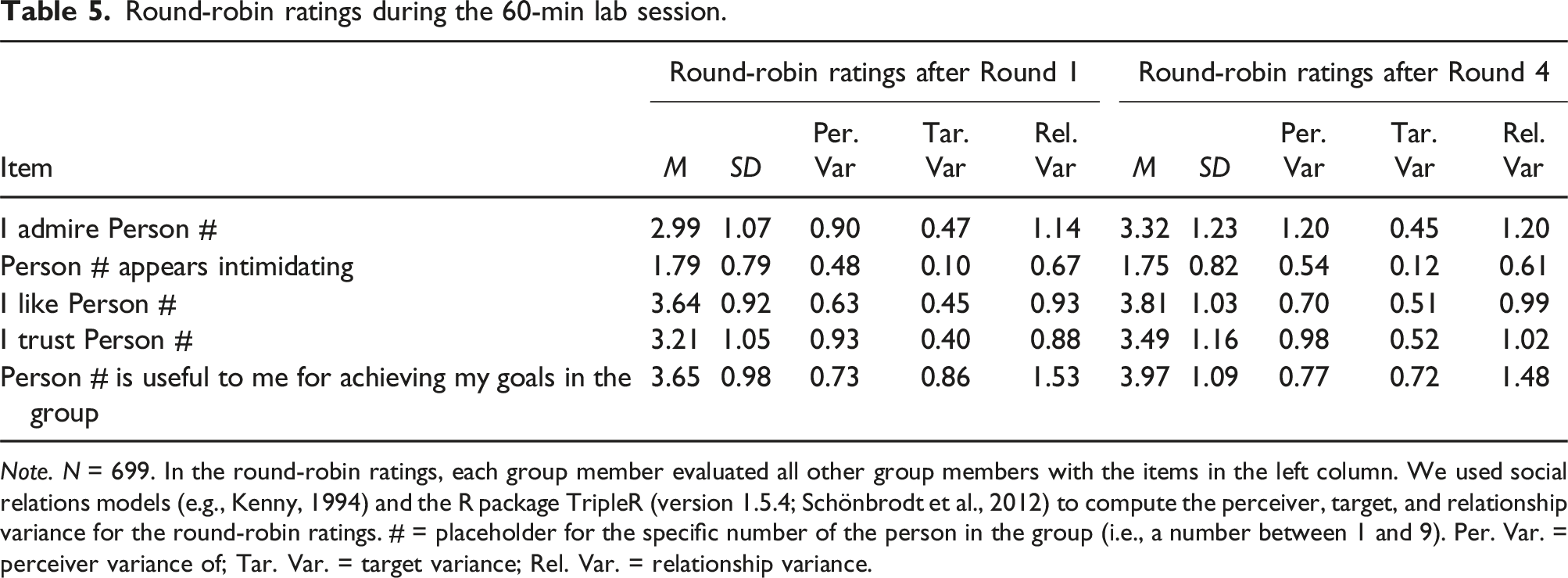
Note. N = 699. In the round-robin ratings, each group member evaluated all other group members with the items in the left column. We used social relations models (e.g., Kenny, 1994) and the R package TripleR (version 1.5.4; Schönbrodt et al., 2012) to compute the perceiver, target, and relationship variance for the round-robin ratings. # = placeholder for the specific number of the person in the group (i.e., a number between 1 and 9). Per. Var. = perceiver variance of; Tar. Var. = target variance; Rel. Var. = relationship variance.
Non-round-robin questions asked during the 60-min laboratory session.
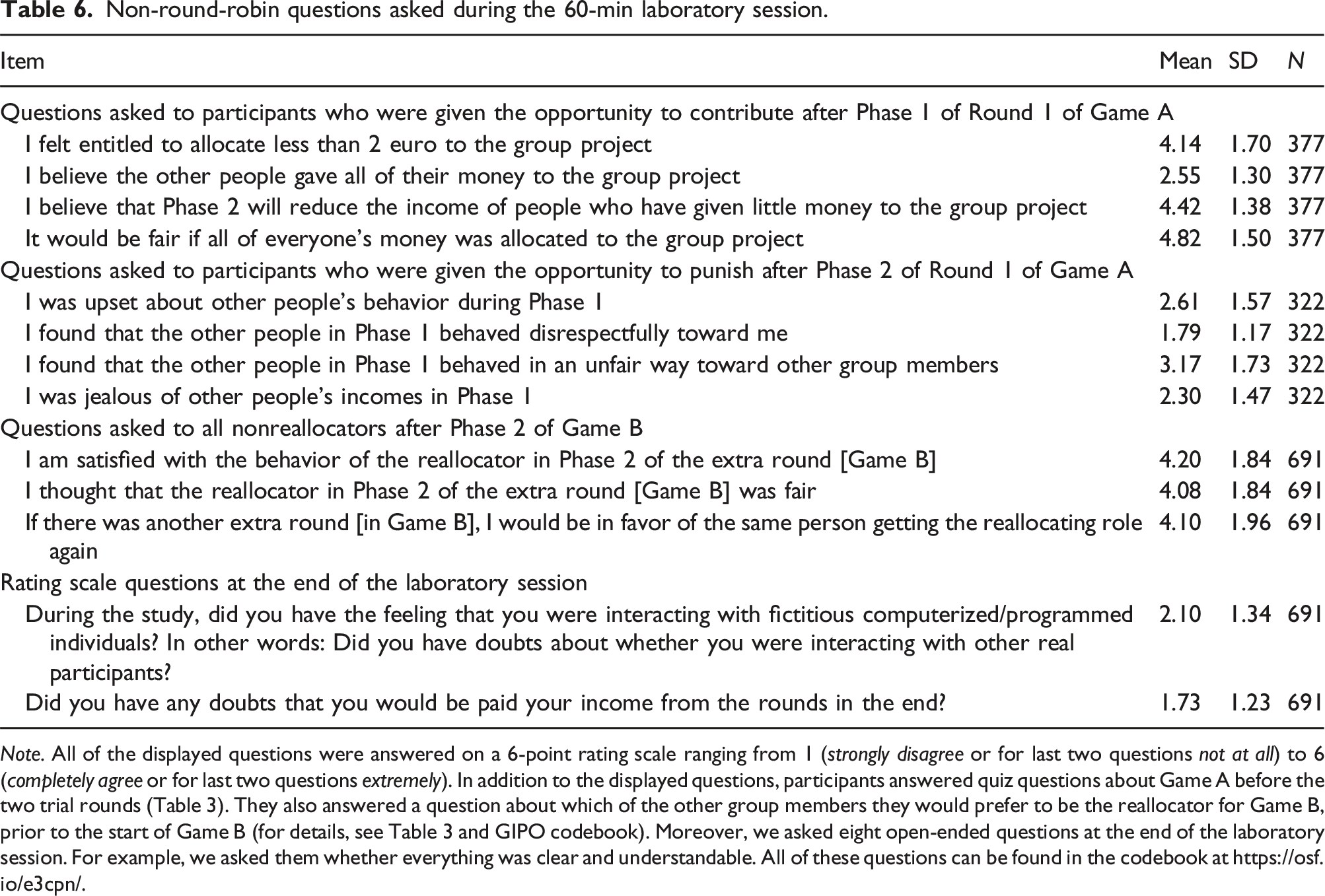
Note. All of the displayed questions were answered on a 6-point rating scale ranging from 1 (strongly disagree or for last two questions not at all) to 6 (completely agree or for last two questions extremely). In addition to the displayed questions, participants answered quiz questions about Game A before the two trial rounds (Table 3). They also answered a question about which of the other group members they would prefer to be the reallocator for Game B, prior to the start of Game B (for details, see Table 3 and GIPO codebook). Moreover, we asked eight open-ended questions at the end of the laboratory session. For example, we asked them whether everything was clear and understandable. All of these questions can be found in the codebook at https://osf.io/e3cpn/.
Participant compensation
Participants were compensated with a fixed amount of either two research participation credits (for psychology students at the University of Münster) or €12 for completing both the 30-min online questionnaire and the laboratory session. Those who completed only the 30-min questionnaire could receive partial compensation. In addition to the fixed compensation, participants received a variable amount of money that depended on their responses to the coin toss task and the social value orientation slider measure in the 30-min online questionnaire and on their earnings in Games A and B in the laboratory session. The variable compensation (excluding fixed compensation) of the persons who took part in the laboratory session ranged from €7.27 to €28.49 (M = €16.61; Mdn = €16.23; SD = €3.43).
What research questions can be investigated with the GIPO data?
The GIPO data set differs from existing personality data sets in several key ways. Unlike the GIPO data set, many existing data sets contain assessments of personality and other factors repeatedly over years in large and diverse samples (e.g., Rammstedt et al., 2023; Wiechers et al., 2023). However, these other data sets do not assess group behavior and interpersonal perceptions in groups. Some personality data sets focus on group or dyadic interactions and interpersonal perceptions (e.g., Geukes et al., 2019; Rentzsch et al., 2023). However, these group and dyad data sets include a smaller number of participants than the GIPO data and emphasize face-to-face social interactions (including video and audio recordings) rather than computer-mediated interactions. Furthermore, these other interpersonal interaction studies focus less strongly on incentivized cheating, prosocial, and punishing behavior than the GIPO data set does. As such, the GIPO data set is uniquely suitable for investigating the links between personality and incentivized cheating and contributing behavior, reactions to others’ lack of contributing behavior, and perceptions, expectations, and evaluations that precede or follow contributing and punishing behavior in economic games.
Personality and contributing behavior
The GIPO data set could be used to investigate the links between personality traits and contributing behavior in Game A (Figure 1) and Game B (Figure 2). Contributing is individually costly but beneficial to the other group members. Previous studies with the GIPO data found that self-reported narcissistic rivalry and narcissistic admiration were negatively related to contributing behavior in Game A (Grosz et al., 2025c). Grosz et al. (2025a) are currently investigating how Machiavellianism is related to contributing behavior in Games A and B. In addition to narcissistic admiraton and rivalry and Machiavellianism, many other personality variables were also assessed in the GIPO project (Tables 1 and 2). However, research has yet to investigate how these variables are related to contributing behavior in Games A and B (for a meta-analysis of previous studies with other games, see Thielmann et al., 2020). Eight-person version of Game A. Note. Game A was a modified version of the repeated public goods game with punishment (for the standard version, see Fehr & Gächter, 2000). Participants played Game A in the first four rounds of the laboratory session (Table 3). In Stage 1 of each round of Game A, Persons 1 to 4 were able to contribute, but they were not able to punish in Stage 2. In Stage 2 of each round of Game A, Persons 5 to 8 were able to punish Persons 1 to 4, but they were not able to contribute in Stage 1. In the depicted example, Persons 1 and 2 each contributed €1.50 to the group project, Persons 3 contributed €1.20, and Person 4 contributed €1. Together, the individuals thus contributed €5.20 to the group project. All eight group members received €5.20 × 0.3 = €1.56 each from the group project. In Stage 2, Person 7 punished Person 4, whereas no other person punished anyone. That is, Person 7 spent €0.20 on reducing Person 4’s payoff. Therefore, Person 4’s payoff was reduced by €0.60. Each person’s final payoff of the round is displayed on the right of the figure. The figure illustrates only the eight-person version of Game A. The seven- and nine-person versions of Game A are illustrated in the supplement in Figures S1 and S2 (see https://osf.io/e3cpn/). We adapted the figures from Grosz et al. (2025c) and Rau et al. (2025). Eight-person version of Game B. Note. Game B was a modified version of the repeated public goods game with punishment (for the standard version, see Fehr & Gächter, 2000). Participants played Game B in the extra (fifth) round of the experiment. In Stage 1 of Game B, all eight group members were given the opportunity to contribute to the group project. In Stage 2 of Game B, one elected group member could reallocate up to €5 from some group members (including themselves) to other group members (including themselves). No other group member could reallocate, contribute, or punish in Stage 2 of the extra round. In Stage 1 of the displayed example, Persons 1 to 8 contributed a total of €14.35 to the group project. All eight group members received €14.35 × 0.15 = €2.15 each from the group project. In Stage 2, one elected member, in this case Person 5, reallocated €0.60 among different individuals. Each person’s final payoff in the extra round is displayed on the right side of the figure. The figure illustrates only the eight-person version of Game B. The seven- and nine-person versions of Game B are illustrated in the supplement in Figures S3 and S4 (see https://osf.io/e3cpn/). We adapted the figures from Grosz et al. (2025c) and Rau et al. (2025).

Personality and reactions to others’ lack of contributing behavior
Furthermore, studies could investigate how personality is related to reactions to others’ lack of contributing behavior (i.e., free-riding) in Game A. Participants who had the opportunity to punish could react by punishing low contributors. Punishing is individually costly, at least in the short run, but it is beneficial for the group because it deters free-riding in subsequent rounds (e.g., Balliet et al., 2011; Boyd & Richerson, 1992; Fehr & Gächter, 2000). Grosz et al. (2025c) found that narcissistic rivalry was positively related to punishing behavior in Game A. Many other personality variables (Tables 1 and 2) might also be related to punishing behavior in Game A.
Participants who had the opportunity to contribute in Game A could react to free-riders by increasing or decreasing their contributions in the following rounds. How people who have the opportunity to contribute react to others’ low contributions might depend on their own personality and whether and how severely the low contributors were punished by others.
Perceptions, expectations, and evaluations that precede or follow behavior in economic games
Unlike most studies with economic games, we assessed not only personality variables and behavior in economic games but also group members’ perceptions, expectations, and evaluations of each other during and after the economic games (see Tables 5 and 6). Most prominently, the group members evaluated each other via round-robin ratings after the first and fourth rounds of Game A (Table 5). In addition to the round-robin ratings, participants were asked about their motives, expectations, and perceptions of others after making their decisions in the first round of Game A (Table 6). Participants also elected a person with reallocation power before Game B (Table 3 and Figure 2) and were asked how satisfied they were with the behavior of this elected person after Game B (Table 6). All of these assessments can be harnessed to gain a fine-grained picture of the perceptions, expectations, and evaluations that precede or follow self- or group-interested behavior. Hence, the GIPO data are suitable for answering questions such as: How are one’s own motivation, expectations, game behavior, and personality related to the tendency to perceive and evaluate other group members in a particular way (i.e., perceiver effects)? How is one’s own game behavior related to the tendency to be perceived and evaluated by others in a particular way (i.e., target effects)? And how is one’s own personality related to the perception and evaluation of a specific other group member (e.g., a group member who contributed less than others) after perceiver and target effects are controlled for (i.e., relationship effects; see, e.g., Rau et al., 2025)?
For example, Grosz et al. (2025c) found that average contributions tended to increase from Round 1 to Round 4 (see also Table 4) but less so in four groups in which individuals did not punish anyone in the first three rounds (for similar findings, see Fehr & Gächter, 2000). This finding suggests that the punishments deterred free-riding and thus benefited the groups in terms of contributions (see also Balliet et al., 2011). The GIPO data enables researchers to investigate how punished and unpunished individuals perceive and evaluate individuals who punish others, and these perceptions and evaluations might help us understand when and why punishment is effective for deterring free-riding.
Psychometric properties of the used measures
Finally, due to the GIPO data set’s large sample size, extensive assessment of personality, and use of incentivized measures (i.e., contributing and punishing behavior in Games A and B, incentivized social value orientation slider measure, and cheating in the coin-toss task), these data provide a rich database for investigating the psychometric properties, particularly the validity, of the measures that were used (Tables 1 and 2). For example, we used a nonincentivized informant-report version of the social value orientation slider measure (Murphy et al., 2011) whose validity has not yet been investigated as far as we know. Similarly, it would be desirable to expand previous research on the psychometric properties of a German version of the UPPS-P Impulsive Behavior Scale and its positive urgency scale in particular (Blötner et al., 2022; Keye et al., 2009), a relatively new measure of social power motives (Suessenbach et al., 2019), and the German version of the Short Dark Tetrad (Blötner et al., 2022; Paulhus et al., 2020), to name just a few (for previous research on the validity of German scale versions, see Table 1).
How can the GIPO data be accessed and what should be considered when using it?
On https://osf.io/e3cpn/, we have made the anonymized GIPO data publicly available under the CC BY Attribution 4.0 International license so that researchers can independently use our data with the only requirement being that they cite the current paper. The optimal version and use of the GIPO data depend on the variables that researchers wish to include and the exclusion criteria they want to apply. We explain these factors in more detail next.
Two versions of the data: with and without informant reports
Once researchers decide that they want to use the GIPO data, the next decision they need to make is whether they want to use the data from the 5-min informant report online questionnaire or not. If they do not want to use the informant-report data, they should use the file “250223_GIPO_without_informants.” This version of the data is in wide format (i.e., one line per participant). 4 If they want to use the informant-report data, they should use the file “250223GIPO_with_informants.” This version is in long format (i.e., participants who were rated by more than one informant have more than one line).
Excluding participants from the analysis
Next, data users need to decide which participants to exclude from their analysis. Whereas excluding participants can reduce bias and measurement error in some scenarios, it might induce bias in others (Alsalti et al., 2025). Thus, the optimal choice will depend on the particular research question.
First, data users interested in investigating game behavior from the laboratory session may want to exclude participants who also participated in the 2019 pilot study. We pretested Games A and B in two pilot studies conducted in 2019 and 2020. Participants from the 2020 pilot were prohibited from participating in the main study’s lab session, whereas those from the 2019 pilot could do so. The dummy variable “pilot” identifies the two participants from the 2019 pilot who participated in the main study’s lab session. The most important change after the 2019 pilot was the addition of two trial rounds before Game A (Table 3). Furthermore, data users might want to remove participants who responded incorrectly to any of the three attention checks in the 30-min questionnaire (e.g., “Please choose the response category strongly agree here”). The dummy variables “check1,” “check2,” and “check3” indicate whether a participant responded correctly or incorrectly to each of the three attention checks. We recommend including participants who failed only one of the three attention checks because one of the checks (“Please tick the response option on the far right here”) might not have worked as intended because the response options were displayed below each other on smartphones rather than next to each other.
Researchers who want to use the UPPS-P Impulsive Behavior Scale might opt to exclude the first 477 participants of the 30-min questionnaire who read the wrong instructions to the UPPS-P scale. The instructions contradicted the labels of the answer options in the items (for details, see the codebook). The dummy variable “supps_wrong” indicates which participants viewed the inconsistent instructions.
Moreover, it might be advisable to exclude the second participation of a participant who took part in two different laboratory sessions. Participants were prohibited from participating twice. Unfortunately, we unintentionally allowed one participant to participate in a second laboratory session. This participant responded to the self-report questionnaire only once. Consequently, the responses to the self-report questionnaire are missing values in the second line for that participant. The variable ‘second_participation' indicates which two lines belong to the same person and which line is the second participation, which should be excluded. The person did not show any unusual behaviors in their second laboratory session. Hence, we do not recommend excluding the data from all the people who were in the laboratory session when this person took part for the second time.
Finally, researchers who use data from the laboratory session might want to consider removing participants who were in the one laboratory session that experienced technical difficulties (for details, see Table S1 in Grosz et al., 2025c). The dummy variable “oTree_defekt” indicates which participants were in the compromised laboratory session.
Dependencies in the round-robin data
If researchers want to use the round-robin ratings (Tables 3 and 6), they need to consider dependencies among the observations because participants rated and were rated by the six to eight other participants that took part in the same lab session. Hence, participants are nested within seven-to-nine person groups, and ratings are nested within perceivers (i.e., the person who rates) and targets (i.e., the person who is being rated). Furthermore, two ratings from the same dyad (e.g., Person 1 rating Person 2 and Person 2 rating Person 1) might be more similar to each other than ratings from different dyads (e.g., Person 1 rating Person 2 and Person 3 rating Person 4). Thus, there might also be dyadic dependencies—although these dependencies are probably small because the group members interacted only via computer in the lab sessions. Depending on the research question and how the round-robin data is used, the various dependencies might need to be taken into account in the analysis. This can be done, for example, by using social relations models and multilevel modeling with random effects for groups and/or dyads (e.g., Snijders & Kenny, 1999).
Limitations of the GIPO data
In the GIPO project, an extensive sample of participants responded to a large number of self- and informant-reported personality items, incentivized measures of cheating, contributing, and punishing behavior, and items about perceptions, expectations, and evaluations of each other during and after the contributing and punishing behavior. Despite these strong features, there are some noteworthy limitations. For example, in the laboratory group sessions where participants evaluated each other, group members interacted solely via computer and could only display either contributing or punishing behavior. Although this design minimizes alternative pathways and explanations for links between a participant’s behavior or personality and how they are perceived by other group members, the highly controlled setting raises questions about the generalizability of the findings to natural face-to-face groups (Grosz et al., 2025c).
The composition of the sample needs to be considered when using the GIPO data, as contributing and punishing behavior, and reactions to them, might depend on cultural factors (e.g., Henrich et al., 2010). Like in many psychology laboratory studies, most participants in the GIPO project were university students from a Western country. Thus, participants were relatively young, highly educated, and relatively wealthy.
Furthermore, data collection for the GIPO project started during the COVID-19 pandemic, and some participants wore face masks during the laboratory sessions. These circumstances may have influenced behavior and perceptions during the sessions. Researchers using the GIPO data might want to keep in mind the potential impact of the pandemic on the data and possibly replicate findings with data not impacted by the pandemic to ensure the generalizability of the findings.
To reduce the chances of acquainted participants taking part in the same laboratory session, we aimed to invite only participants who did not study the same major in the same semester as any other participant in the session. However, in exceptional circumstances (i.e., when we were one person short and could not invite any other participant), we did invite a person from the same major and semester. Still, even if two group members in the session knew each other, they did not know which other person on the screen was the person they knew. Hence, the effects of being acquainted should have been minimal.
Conclusion
The GIPO data set stands out due to its relatively large sample size for laboratory studies involving incentivized economic games, the inclusion of numerous self-report and informant-report personality items, and the repeated assessment of interpersonal perceptions and evaluations during and after the economic games. These strengths make it a rich resource for investigating the relationships between personality and self- or group-interested behavior.
Supplemental Material
Supplemental Material - The GIPO data: A publicly available data set on personality and incentivized prosocial behavior
Supplemental Material for The GIPO data: A publicly available data set on personality and incentivized prosocial behavior by Michael P. Grosz, Julia Fuchs and Mitja D. Back in Personality Science
Footnotes
Author Note
Atsushi Oshio was the handling editor.
Acknowledgements
We are grateful to Constanze Dettke, Niklas Hölter, Luise Hönig, Philippa Kircher, Levi Kreienfeld, Lilly Kruse, Richard Rau, Eva Wilgenbus, and Cara Zieren for their help with data collection and documentation; to Leon P. Linder, Nurzat Rakhmanberdieva, Dominik Strutz, and Matthias P. Walther for their help with programming the study; and to Jane Zagorski and Microsoft Copilot for language editing.
Autor contributions
Declaration of conflicting interests
The author(s) declared no potential conflicts of interest with respect to the research, authorship, and/or publication of this article.
Funding
The author(s) disclosed receipt of the following financial support for the research, authorship, and/or publication of this article: This research was supported by a grant from the Deutsche Forschungsgemeinschaft (DFG, German Research Foundation) to Michael P. Grosz—project number 407503175. The funder played no role in study design, data collection and analysis, decision to publish, or preparation of the manuscript.
Data Accessibility Statement
On the OSF project page at https://osf.io/e3cpn/, we have made the anonymized GIPO data publicly available under the CC BY Attribution 4.0 International license so that researchers can independently use our data with the only requirement being that they cite the current paper. Additionally, the codebook, supplemental figures, and R code can be found on https://osf.io/e3cpn/ (for time-stamped, immutable, and permanent versions of the files, see  ).
).
Supplemental Material
Not applicable.
Notes
References
Supplementary Material
Please find the following supplemental material available below.
For Open Access articles published under a Creative Commons License, all supplemental material carries the same license as the article it is associated with.
For non-Open Access articles published, all supplemental material carries a non-exclusive license, and permission requests for re-use of supplemental material or any part of supplemental material shall be sent directly to the copyright owner as specified in the copyright notice associated with the article.
