



Abstract
Research on goal pursuit often assumes goals remain stable. Yet goal pursuit is a dynamic process where goals and perceptions of them can change, of which our understanding is limited. Past research has mostly focused on the role of performance and negative feedback in laboratory or experimental studies. We investigate what predicts goal change and how goals change over time in everyday life. Participants (N = 420 North American undergraduate students; 75% female) reported on two goals biweekly for three months (n = 1505 follow-up observations). People changed goals on 5.4% of occasions, although 27.38% of participants changed goals at least once over three months. Other (non-academic) goals were changed more frequently than academic goals. Multilevel models revealed commitment, goal progress, time, and stress predicted goal change. People were less likely to change goals later in the study and when they were highly committed, but more likely to change goals when they made very little or a lot of progress (quadratic effect), and when they experienced greater stress. Whether they changed or kept their goals, their perceptions of goal difficulty, commitment, and self-efficacy changed over time. We discuss implications of such changes for theories and research on personal goal pursuit.
Introduction
People pursue goals to develop themselves, improve well-being, and find purpose in life. But how stable are these goals? One way goals may change is when someone objectively redefines or revises their goal (e.g., get an A to get an A-). Another type of change is when the goal (or end state) remains the same, but their perceptions change (getting an A suddenly feels harder). Research on New Year’s resolutions suggests that despite a lack of progress or effort, people are reluctant to fully disengage and change their goals (Moshontz & Hoyle, 2022). Research on personal goals also shows that perceptions of goal characteristics (e.g., motivation, difficulty) fluctuate across time points (Kiendl et al., 2024). The present study investigates two ways in which goals can change, and what predicts those changes. Research questions 1 and 2 examine how frequently goals objectively change (i.e., a person reports a new, different goal) and what predicts those changes (e.g., goal difficulty, stress, goal domain). Research questions 3 and 4 examine the extent to which people’s perceptions of goals change (i.e., perceptions of difficulty, self-efficacy, and commitment), and what predicts those changes. This paper helps provide practical expectations for how goals change in longitudinal personal goal research, in addition to bolstering our theoretical understanding of goal change by uncovering some antecedents to change.
Research on the facilitators of successful goal pursuit often focus on a single goal or set of goals and their characteristics (perceptions) that are assumed to remain stable throughout the study (e.g., Koestner et al., 2002; Werner et al., 2016). Indeed, in many studies of personal goals, researchers ask participants to define an initial set of personal goals they are pursuing and then rate these goals on various characteristics (e.g., perceived difficulty, self-efficacy, commitment). These baseline characteristics are then used as predictors of longitudinal goal success. Yet goal pursuit is a dynamic process unlikely to follow a linear or stable path (Milyavskaya & Werner, 2025). Individuals may falter in their efforts, encounter obstacles, or even exceed their own expectations, impacting how they view their goal, or leading them to change the goal altogether. Changing a goal could include a change in the level of the goal (e.g., A to A-), or changing the outcome of the goal entirely (e.g., from “I want to apply to med school” to “I want to apply to law school”). Changing perceptions, on the other hand, could happen when the person continues with the same goal, but views it as more or less difficult, shifts their commitment to the goal, or generally shifts their own attitudes or perceptions of the goal itself.
But when would such changes occur? The rubicon model of action phases (Gollwitzer, 1990) posits that people deliberate on which goals to pursue before settling on one goal; they then pursue that goal until completion or failure, at which point they re-enter the deliberation phase. This view implies that goals can change only during very specific stages of the goal pursuit process. The cybernetic control theory (Carver & Scheier, 1981, 2001) of self-regulation posits that individuals are continuously assessing the discrepancies between their current and ideal (goal) state. When the discrepancy approaches extremes, such as when goals are impossible to attain or when one is near or at goal accomplishment, motivation decreases and changing or revising goals is one way to restore optimal discrepancies and motivation (Carver & Scheier, 1981, 2001). This similarly suggests that the timing of goal change is a rare event tied to goal progress (or lack thereof).
Research on objective goal change has most frequently examined goal disengagement (Creed & Hood, 2014; Ntoumanis & Sedikides, 2018; Wrosch et al., 2003, 2007). For example, research on new year’s resolutions finds that by the end of the year, people have explicitly disengaged from 6.6% of their goals, and a further 7.1% have completely withdrawn effort and commitment towards their goal (Moshontz & Hoyle, 2022), while other goals are put on hold (suggesting perhaps a change of focus onto a different goal). Research has also examined goal change in a constrained laboratory environment (e.g., Nicklin & Williams, 2011) or in the context of a domain-specific goal (e.g., academic, work, and sport domains; Creed & Hood, 2014; Donovan & Williams, 2003; Jawahar & Shabeer, 2021). Less is known about how idiosyncratic personal goals naturally change in everyday life. One study that touched on this question asked participants about their personal goals across six waves (two or three weeks between waves); they then examined whether the goals that participants wrote at each wave were the same as in the prior wave, or had ‘disappeared’ (Segerstrom & Nes, 2006). Results showed that the average goal lasted 32.3 days before being changed, with a wide distribution (i.e., some goals were changed quickly, while 30% of the goals were unchanged by the end of the study). However, that study did not examine how the goals changed, or what predicted goal change. We extend this research by examining both the frequency of goal change in personal everyday goals, as well as investigating some possible predictors of those changes.
The aforementioned research focused on the content of the goals themselves (i.e., change from a goal of an A to A-), not on people’s perceptions of their goals. But even though people may not relinquish or change a goal altogether, they are likely to shift how they view it (Milyavskaya & Werner, 2025). Indeed, past research has shown common goal characteristics like self-efficacy are malleable to a variety of influences, such as training, course work, and experience gains (Mencl et al., 2012; Zhao et al., 2005). Other research that has repeatedly measured goal perceptions on dimensions such as attainability and commitment shows that while they can be highly correlated, they are not entirely consistent from one time point to the next (Brunstein, 1993; Pomaki et al., 2009). Indeed, a recent study assessing changes in goal characteristics over time (including commitment, motivation, and expectancy) found that 26–70% of variance in perceptions was across assessments (i.e., over time; Kiendl et al., 2024). In the present study, we focus specifically on such changes in perceptions (of goal difficulty, commitment and self-efficacy), and what predicts these changes.
Goal-specific predictors of change
People evaluate their goals on multiple characteristics or dimensions (Austin & Vancouver, 1996). Leading theories of goal setting and goal pursuit (Bandura, 1977; Locke & Latham, 2002) suggest that people’s perceptions of how difficult the goal is, how self-efficacious they feel about it, and how committed they are to it are especially important. Difficulty, in this case, refers to how subjectively challenging the goal will be to attain (e.g., Werner et al., 2016), self-efficacy is how capable one feels about carrying out behaviours instrumental to accomplishing goals (Bandura, 1977), and commitment speaks to one’s determination to reach their goal (Locke et al., 1988). Prior research has looked at these perceptions as predictors of goal progress (e.g., Koestner et al., 2002; Monzani et al., 2015), but little research has investigated how malleable these perceptions are, whether they predict goal change, and whether making progress itself influences how people perceive these characteristics or change their goals.
According to the cybernetic control theory (Carver & Scheier, 1981, 2001), successful goal striving reduces current-ideal state discrepancy, which signals to the individual that they are reaching their goal. Yet this may also reduce motivation to continue pursuing that goal (e.g., Louro et al., 2007). This may lead to explicit goal change, where the person would change or revise their goal (e.g., making it more difficult), to create a new sufficiently motivating discrepancy (Carver & Scheier, 2001). Conversely, circumstances that enlarge discrepancies or preclude reductions (e.g., setting an impossible goal) may prompt individuals to disengage or revise their goals downward to reduce discrepancies (Creed & Hood, 2014). Unattainable goals may be more likely to change; disengaging from such goals and reengaging in other goals is adaptive and beneficial for one’s well-being (Creed & Hood, 2014; Ntoumanis & Sedikides, 2018; Wrosch et al., 2003, 2007). Similarly, both self-efficacy and commitment may impact whether people decide to change their goals. Low levels of self-efficacy (associated with fear of failure and procrastination; Steel, 2007) may preclude progress and prompt downward revision. Yet at the same time, increased self-efficacy may lead people to feel their goals are too easy, or that they can accomplish more, leading them to change their goals (presumably through up revision) to create a more motivating discrepancy. Relinquishing commitment is a key part of disengaging from goal pursuit (Wrosch et al., 2003) and high commitment arises when goals are desirable and feasible. Yet the one study that directly examined commitment in goal revision (in the sport context) found that commitment did not predict changes in the goal itself (Williams et al., 2000); perhaps people continued with the same goal, but simply viewed the goal, or their capacities for pursuing it, differently.
Indeed, the more our goal perceptions shift, the more we may see that same goal differently in other ways. High difficulty may lead to reduced commitment (if the person redirects their energy to another goal without fully disengaging from the difficult one; Louro et al., 2007), or reduced self-efficacy (i.e., feeling like they simply don’t have the capacity to do it). Low levels of self-efficacy may also reduce commitment. High goal self-efficacy is associated with goal persistence and progress (Koestner et al., 2002; Sheldon & Kasser, 1998; cf. Vancouver & Kendall, 2006; Wright et al., 2013) and may promote increased commitment. Finally, one way in which people gain information about their goal progress is through feedback. According to Social Cognitive Theory, positive or negative performance feedback will also shape self-efficacy (Bandura, 1997). In laboratory studies, those who receive feedback indicative of success feel more confident in achieving their goals while feedback indicative of poor performance lowers confidence (Karl et al., 1993; Vancouver & Kendall, 2006). Thus, we predict changes in both self-efficacy and difficulty will be predicted by prior progress. Investigating these theoretically derived predictions about the ways goals change over time, particularly how perceptions shift and influence each other, helps advance our understanding of the temporal interplay between goal perceptions, and could help develop theories that better take this interplay into account.
Individual difference: Trait self-control
Trait self-control is an individual difference broadly related to “the effective pursuit of personal goals” (Wennerhold & Friese, 2023). Individuals high in trait self-control experience fewer conflicts with their goals (Hoffmann et al., 2012), and engage in more goal-striving strategies (e.g., implementation intentions: “if-then” plans for when, where, and how they will pursue their goal; Werner et al., 2020). Trait self-control is very closely related to grit (r > .70 ), which is operationalized as perseverance towards long-term goals (for a review of this overlap see Crede et al., 2017). As such, individuals higher on trait self-control may be more likely to persist in their goal pursuits and/or maintain high commitment (e.g., Kokkoris & Stavrova, 2021). Yet trait self-control is also linked to more flexible goal pursuit including re-engaging in new goals (e.g., Bieleke et al., 2022), which may require the relinquishing of commitment of an old goal. Further, those higher in trait self-control tend to view goal-related obstacles as less problematic (Leduc-Cummings et al., 2022), which may change the perceptions one has about the difficulty of their goals as well as their abilities to enact the behaviours to achieve them (i.e., self-efficacy).
Contextual variables
Contextual factors such as workload (i.e., the amount of work that one needs to accomplish) and perceived stress (e.g., one’s sense of a lack of control or coping in recent life events; Cohen et al., 1983) may impact perceptions of goals, goal progress, and goal change. Successful goal pursuit occurs when individuals have adequate resources to pursue the goal and opportunities to invest those resources (Brandstädter & Rothermund, 2002; Mens et al., 2015; Wrosch et al., 2003). High workloads and stress levels tend to drain individual resources and limit opportunities for goal pursuit (e.g., Jacobs & Dodd, 2003), though having more on one’s plate can also facilitate better goal management and support goal attainment (Guilmette et al., 2019). As stress levels and workload shift, people may have fewer or greater resources to allocate to certain goals, which may lead them to change how they view themselves or their goals, or change the goal altogether (Brandstädter & Rothermund, 2002). For example, in organizational contexts, overload can lead people to feel less efficacious (Lindberg & Wincent, 2011), which by extension may make their goals feel more difficult (Koestner et al., 2002; Lee & Bobko, 1992; Senko & Harackiewicz, 2005; Yukl & Latham, 1978). Findings have also shown, although inconsistently, a negative relationship between the resources someone has for a project, as well as stress, and goal commitment (Bipp & Kleingeld, 2011; Chak et al., 2023). Extended to the academic setting, a student overwhelmed by their coursework may see themselves as less capable of earning an A, or they may perceive that goal as more difficult. Furthermore, if contextual variables change such that resources become limited, this may impair people’s ability to progress on their goals (e.g., longer work shifts reduce time available for studying; Brandstädter & Rothermund, 2002). An adaptive response to such limitations may be to disengage from the unattainable goal and reengage in one that is attainable (Mens et al., 2015). Contextual variables, including stress and workload, may thus influence both the goals that people are pursuing and how their perceptions of these goals change over time.
Goal domains: Academic and non-academic goals
The goals that people set can be relevant to various domains of their life, such as work, school, relationships, health, spirituality, etc. Some research on goal change finds similar patterns of results across domains; for example, both athletes and students lower the difficulty of their goals when they perform below their expectation (Donovan & Williams, 2003; Thibodeaux et al., 2017; Williams et al., 2000). Past research often assumes that goal pursuit unfolds similarly across domains, and either averages across goals (e.g., Koestner et al., 2002; Sheldon & Kasser, 1998) or examines relationships at the goal-level without testing differences between goal domains (e.g., Werner et al., 2016; cf. Sheldon & Elliot, 2000). It is unclear whether these studies are correct in making this assumption; those that have explicitly examined differences sometimes show mixed findings (Sheldon & Cooper, 2008; Sheldon & Elliot, 2000). By comparing academic and non-academic domains, we can determine whether goals change consistently across domains, and whether the effects may be moderated by something unique to a given goal context.
Present study
The present study is a nuanced investigation into changes in goal perceptions and the goals themselves in the context of goal pursuit in everyday life. Specifically, we investigate four main questions: (1) How frequently do people change their goals (over the span of 10 weeks)? (2) What predicts whether people change a goal? (3) To what extent do people’s perceptions of their goals’ difficulty, commitment, and self-efficacy change over time? (4) What predicts changes in people’s perceptions of their goals?
With respect to what predicts goal change, we hypothesized a curvilinear relationship between progress and goal change (with most change occurring when progress is low or high) (H1a). Additionally, we hypothesized that goal self-efficacy would positively predict goal change (H1b). We also predicted that trait self-control would negatively predict goal change (H1c). With respect to how goal perceptions change and what predicts these changes, we hypothesized that goal progress would predict an increase in both goal self-efficacy and goal difficulty (H2a), and that goal self-efficacy would predict an increase in goal difficulty (H2b). 1 The study uses an existing dataset 2 , but the background, analytical decisions, and planned analyses were pre-registered on the Open Science Framework (https://osf.io/eab4m/, file: AnalysisplanPIAD), prior to conducting any analyses. All explicit hypotheses were pre-registered – we did not have a priori hypotheses for the other research questions and treated most of them as exploratory. We did not explicitly pre-register interpretations of results. When applicable, deviations from the pre-registration are noted in the text. The analysis plan, study materials, code, output, and supplementary materials are also available on OSF: https://osf.io/eab4m/. The study received ethics approval from Carleton University Research Ethics Board-B, and is in compliance with APA ethical standards.
Method
Participants
Participants were 523 university students recruited from the student participant pool at a North American university, receiving up to 3.5 course credit for their participation. The data from 103 participants were removed for not completing a minimum of one follow-up survey after baseline (n = 93), not providing goals or providing non-goal content (n = 2), or showing problematic data (e.g., answered “4” on all Likert scale items; n = 4), or a combination of those reasons (n = 4). The final sample included 420 participants (317 female, 97 male, 3 other, 3 missing), aged 17 to 71 (M = 20.98, SD = 6.16), 54.3% White, 17.6% Asian/Pacific Islander, 12.4% Black/African American, 15% other. All participants provided informed consent electronically.
Procedure
Over the course of ten weeks, participants completed six online surveys (one baseline and five follow-ups) at 2-week intervals. At baseline, they identified one academic goal and one other 3 goal that they were currently pursuing (using instructions from Koestner et al., 2002), and rated these goals on self-efficacy, commitment, and difficulty. They also completed measures of trait self-control and demographics. At each follow up, participants rated the progress they made on each of their goals. They were then asked about the status of each goal, and could leave the goal unchanged, modify it, or set a new goal in the same domain. They subsequently rated their perceptions of each characteristic for each goal, and reported their perceived stress levels and the intensity of their workload (academic and other) over the past two weeks. A full list of measures, including those not used in the present manuscript, can be found on OSF (folder: Materials). Participants were given three days to complete each survey. In total, 1531 follow-up surveys were completed after baseline. Data from 26 of them were deemed as poor quality (e.g., participants entered all 7s, or all 4s) and were removed, resulting in 1505 follow-ups (M = 3.64 per person).
Measures
Goal-level variables
All items assessing goal-level variables were rated on a scale of 1 (strongly disagree) to 7 (strongly agree).
Goal self-efficacy
Goal self-efficacy was assessed using three items (e.g., “I have confidence in my ability to attain this goal”; Leduc-Cummings et al., 2023). A mean of the items was computed for each goal at each time point (academic goals: ω within = .63, ω between = .96; other goals: ω within = .63, ω between = .96).
Goal commitment
Goal commitment was measured with three items (e.g., “I am determined to achieve this goal”; Leduc-Cummings et al., 2023). The three ratings were averaged for each goal at each time point (academic goals: ω within = .64, ω between = .92; other goals: ω within = .68, ω between = .96).
Goal difficulty
Three items were used to assess goal difficulty (e.g., “It will be challenging to attain this goal”; Leduc-Cummings et al., 2023). One (reverse-coded) item had poor fit (inter-item correlations <.30; Boateng et al., 2018) and was not retained. A mean of the other two items was calculated for each goal at each time point (academic goals: ω within = .50 4 , ω between = .94; other goals: ω within = .61, ω between = .98).
Goal progress
The following items were used to measure goal progress: “I have made a lot of progress towards this goal”; “I feel like I am on track with my goal plan”; “I feel like I have achieved this goal” (Hope et al., 2016; Milyavskaya et al., 2015). The last item was not retained due to poor fit (inter-item correlations <.30; Boateng et al., 2018). A mean of the first two ratings was computed for each goal at each time point (academic goals: ω within = .83, ω between = .94; other goals: ω within = .88, ω between = .98).
Goal status
Participants were asked “Where do you currently stand on your goal?” and selected one of the following options: “I changed or adjusted this goal”, “I am still pursuing this goal”, “I abandoned this goal”, “I achieved this goal”, “I’m unsure”, “Other”.
Goal change
After reporting their goal status, participants could review their goal by editing the text (copied over from their last goal) in the textbox and were asked to modify goals they indicated that they changed or adjusted Figure 1. If they abandoned or achieved their goal, they were asked to provide a different goal in the same domain. If they selected any other option on the goal status question, they were asked to leave their goal unchanged. Goal change was operationalized as any change in text entry, comparing the current time point to the previous one. Goal change instructions with example goal.
Individual differences variables
Trait self-control
The Brief Self-Control Scale (Tangney et al., 2004) was used to measure trait self-control. Participants rated each item (e.g., “I wish I had more self-discipline”) on a scale ranging from 1 (not at all like me) to 7 (very much like me). A mean of the 13 items was calculated, such that higher numbers represent better self-control (α = .84).
Contextual variables
Perceived stress
A four-item version of the Perceived Stress Scale (PSS-4; Cohen et al., 1983) was used to assess participants’ subjective levels of stress over the past two weeks (e.g., “How often have you felt difficulties were piling up so high that you could not overcome them?“) Each item was rated on a scale from zero (never) to 4 (very often), and a mean of the ratings was computed (ω within = .40, ω between = .93).
School and other workload
Participants were asked one item per category: “Please rate the intensity of your workload related to schoolwork over the past 2 weeks. Note: this includes all schoolwork (e.g. readings, assignments, studying, etc.)” and “Please rate the intensity of your workload outside of school over the past 2 weeks. Note: this includes all part-time or full-time work, volunteering, family/home responsibilities, etc.“. Both were rated on a scale of 1 (very light) to 7 (very heavy).
Analysis plan
Multilevel analyses were conducted in R using the lme4 package (Bates et al., 2015).
To address the first research question regarding the frequency of goal change in everyday goal pursuit, we looked at the descriptive statistics of goal change at both the individual and goal level. For the second research question, examining predictors of goal change, we used multilevel logistic regression models, with goal change (yes/no) as the dependent variable. Two different approaches were used to examine the effects of different sets of predictor variables 5 . First, to examine the role of trait self-control and goal-level variables (goal self-efficacy, goal commitment, goal difficulty, and goal progress) on goal change, we used observations nested within persons for both goals together (so that each person would have up to 10 observations – 5 for each goal), and included a variable reflecting the goal domain (academic vs. other), as well as another one representing the time point, in all analyses. We could not use this approach when using contextual variables (perceived stress, school workload, and other workload) as predictors, since these variables were invariant across the two goals at each time point. Instead, we conducted the analyses for each goal domain separately, with observations nested within persons (up to 5 observations per person) and a variable representing the time point included as a covariate. The third research question focused on how much people’s perception of their goals’ self-efficacy, commitment, and difficulty changed over time. We first calculated the absolute mean differences in each goal characteristic and used random-intercept only models to determine whether there was any change (i.e., whether they were different from zero). Then, we used multilevel regression models to explore whether the variability in goal characteristic change depended on whether a person continued pursuing their goal or set a new one. Finally, for the fourth research question regarding predictors of change in goal characteristics, we used the same models as for the second research question, but with a different set of dependent variables (the difference score of each goal characteristic). The code and output for all analyses can be found on OSF (Folder: Analyses and results).
Results
Descriptive Statistics of all Variables.
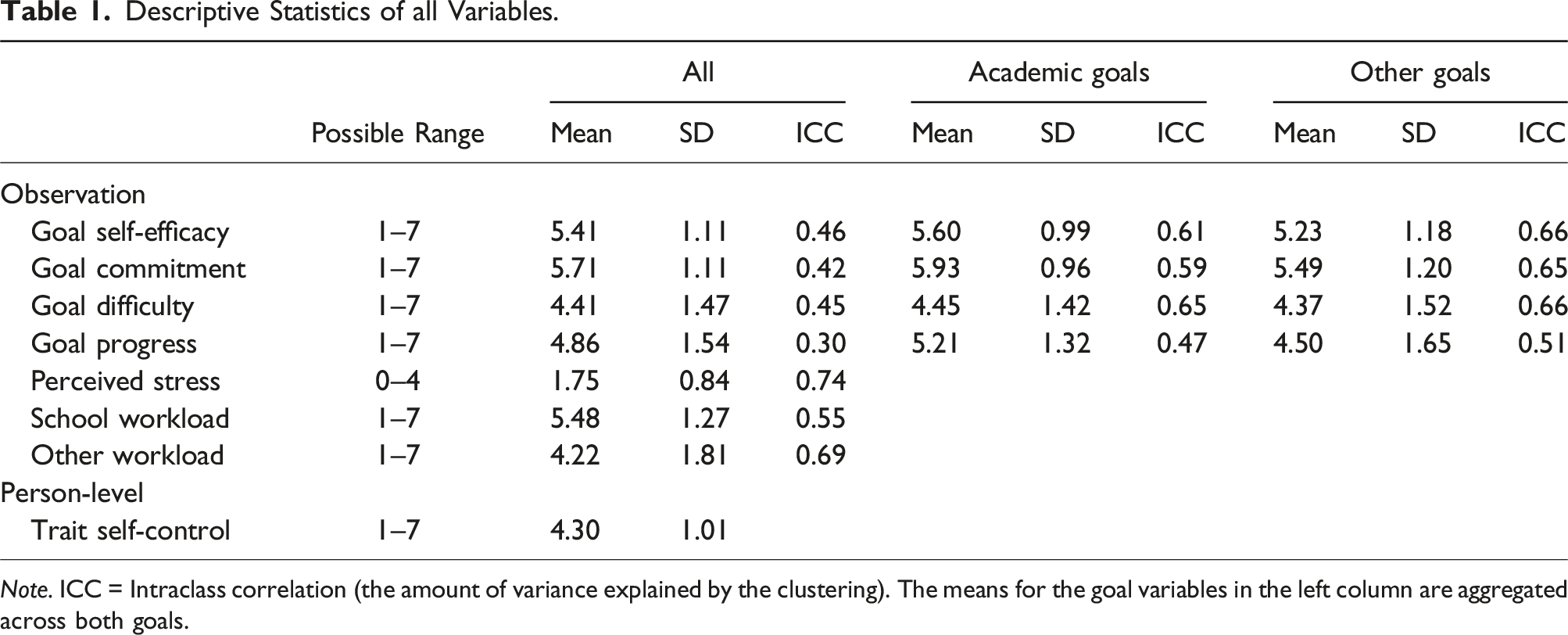
Note. ICC = Intraclass correlation (the amount of variance explained by the clustering). The means for the goal variables in the left column are aggregated across both goals.
Combined Correlation Table (Combined/Academic/Other).

Note. Lower triangular: Within-group correlations; Upper triangular: Between-group correlations. Bolded values are significant at p < .05.
Frequency of goal change
We recorded 162 observations of goal change – whether that be completely changing one’s goal, or revising it in some way – and 2827 of unchanged goals (see Figure 2). Although most goals remained unchanged, participants more frequently changed their other goals (7.3% of occasions, n = 108) than academic ones (3.6%, n = 54). At the person level, of the participants who responded to 4 or 5 out of the 5 follow-ups (N = 248), 68.2% of participants did not make any changes to their goals, 20.6% made 1 change, 8.06% made 2 changes, 3.2% made 3 changes, and no one made 4 or more changes. Proportion of goal change over time. Note. The top panel of the figure shows the proportion of academic goal change, while the bottom panel shows the proportion of non-academic goal change. The labels inside the bars provide information on the proportion of goals that were changed at each follow-up. Goal change is relative to the previous time point, not the original goal (people may have changed their goals more than once).
Although we had preregistered that we would use change in the text entry of the goal as our key indicator of goal change, we also examined participants’ self-reported reasons for changing their goals (Figure 3). Out of the 162 goal entries where the text was changed, 63% reported changing or adjusting their goals, 20.4% reported they had attained their previous goal, and 16.1% had abandoned it. More information can be found in the nature of goal change document in Analyses and results on OSF. Finally, to better understand the actual changes in the goals, two coders examined all the changed goals to determine whether the level of the goal was changed. Out of the 162 changed goals 127 (78.4%) were complete changes, 12 (7.4%) were goals that were changed ‘upward’ (e.g., “get above an A- average” to “get above an A average”) , and 23 (14.2%) were goals that were revised downwards (e.g., “get an 86% average” to “get an 75% average”). A full list of the changed goals, and the codes, are available on OSF (folder: Data, file: changed goals and codes), as are their frequencies per goal and per time point (folder: Analyses and results, file: coded frequencies). However, these small numbers of up-revised and down-revised goals precluded any possible analyses that would consider these goals separately. Breakdown of goal status.
Predictors of goal change
Multilevel Logistic Regression With trait and Goal-Level Predictors of Goal Change.
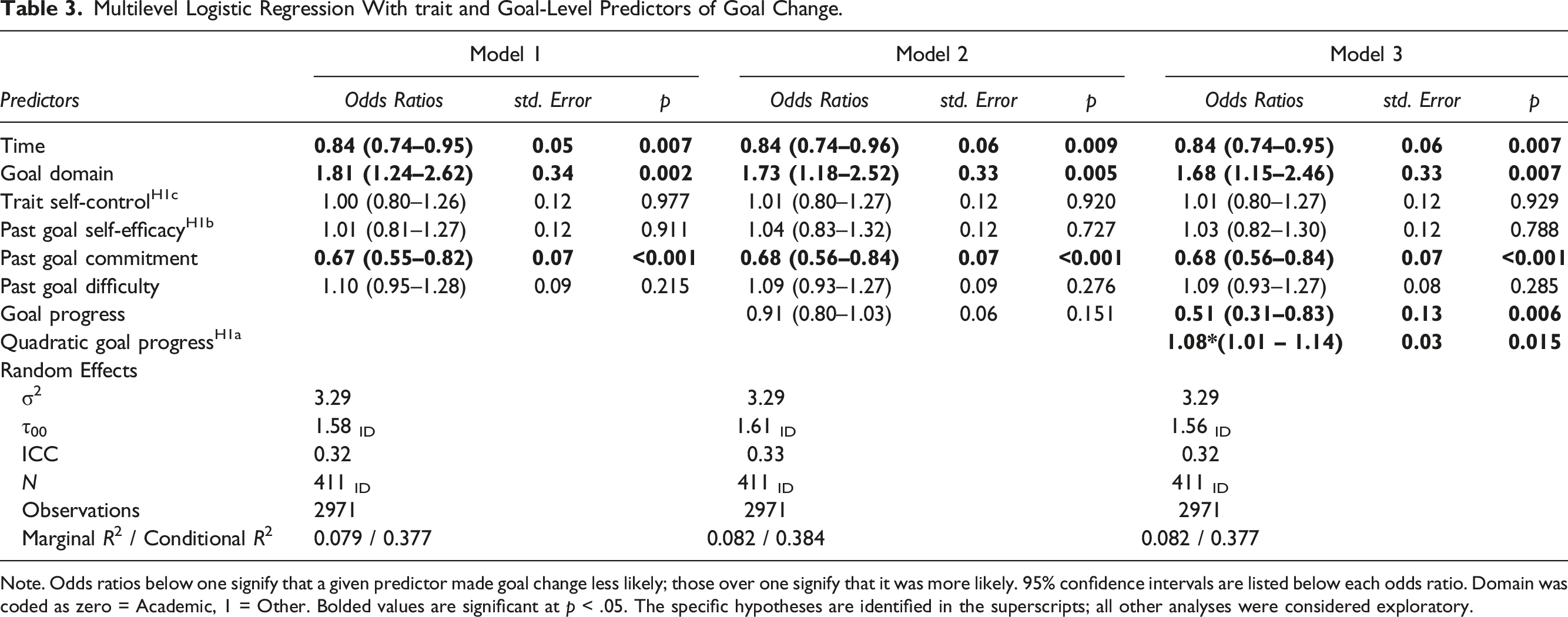
Note. Odds ratios below one signify that a given predictor made goal change less likely; those over one signify that it was more likely. 95% confidence intervals are listed below each odds ratio. Domain was coded as zero = Academic, 1 = Other. Bolded values are significant at p < .05. The specific hypotheses are identified in the superscripts; all other analyses were considered exploratory.
The next model added goal progress as a predictor of goal change (H1a), finding that goal progress was unrelated to goal change (OR = 0.91, 95% CI = 0.80, 1.03, p = .151). When the quadratic effect of goal progress was added as a predictor in the next model, the effect was significant, (OR = 1.08, 95% CI = 1.01, 1.14, p = .015). When we tested the models separately for each goal, there was only a (negative) linear effect of progress on goal change for academic goals (i.e., OR less than 1), but a quadratic effect of progress on goal change for other goals (folder: Analyses and results, file: Supplementary Analyses. Rmd, Table: S1). For other goals, participants were more likely to change their goals when they made either very little or very much progress, and less likely when they made moderate progress (see Figure 4). We also examined the contextual predictors of academic and other goal change separately. Both models included stress, school workload, other workload, and the time point of the assessment as predictors. None of the contextual effects were significant predictors of goal change (see folder: Analyses and results, file: Supplementary Analyses. Rmd, Table: S2). Effect of goal progress on goal change.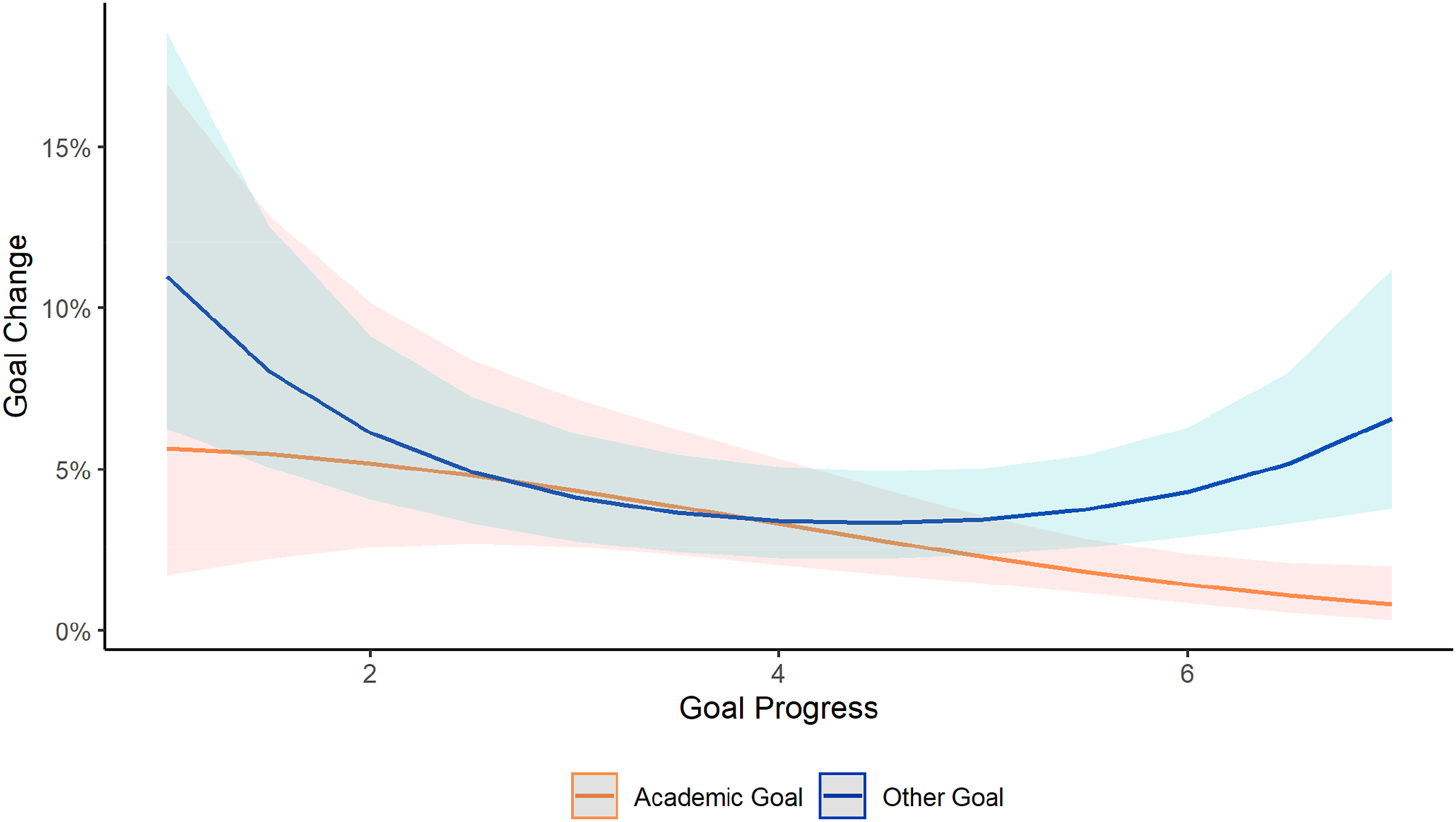
Change in goal characteristics
Mean Change and Absolute Change in Goal Characteristics for Changed and Unchanged Goals.

Note. Difference refers to change from the previous time point (upward or downward; possible range −6 to +6), which in many cases cancel each other out (particularly for unchanged goals, so that the average change appears to be 0. Absolute difference refers to the absolute value, which represents the magnitude of the change (irrespective of direction), and could range from 0–6.
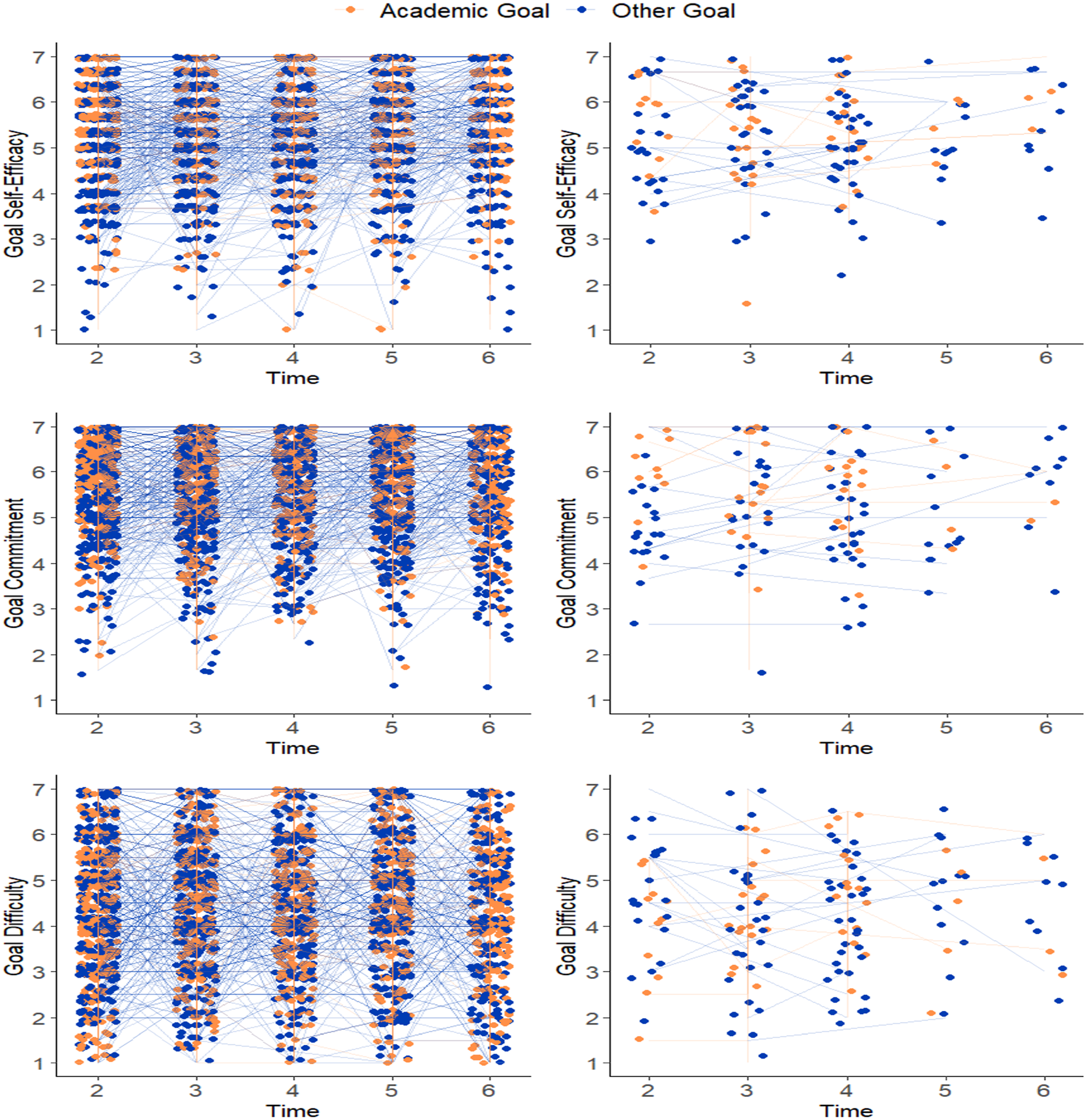
Variability in goal characteristics. Note. The lines represent the trajectory of each individual’s goal characteristic change over time, with orange lines corresponding to academic goals and blue lines to other goals. The left side of the figure shows the goal characteristics of unchanged goals, while the right side shows those of changed goals. The top panel displays goal self-efficacy, the middle panel displays goal commitment, and the bottom panel displays goal difficulty.
Main effects of goal change, goal domain, time, and goal characteristics at the previous time point on change in goal characteristics.

Note. 95% confidence intervals are listed below the effect estimate. Bolded values are significant at p < .05. Goal domain is coded as zero = academic, 1 = other. Goal change is coded as zero = same goal, 1 = changed goal.
Predictors of change in goal characteristics
Trait and Goal-Level Predictors of Goal Characteristic Change.
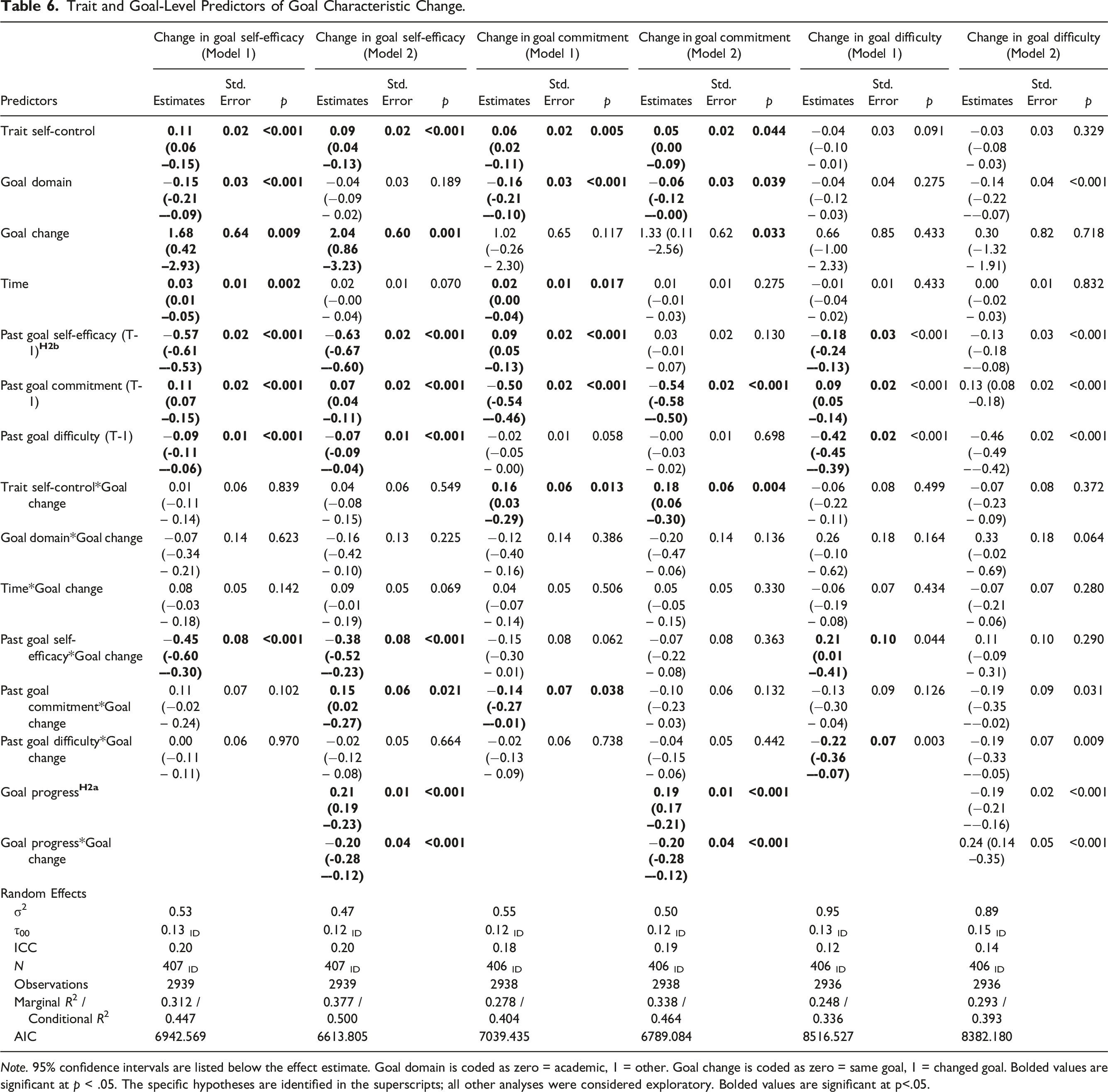
Note. 95% confidence intervals are listed below the effect estimate. Goal domain is coded as zero = academic, 1 = other. Goal change is coded as zero = same goal, 1 = changed goal. Bolded values are significant at p < .05. The specific hypotheses are identified in the superscripts; all other analyses were considered exploratory. Bolded values are significant at p<.05.
Academic goals were more likely to increase in self-efficacy and commitment (but not in difficulty) than other goals. Trait self-control was related to increased perceptions of goal self-efficacy and commitment. The effect on goal commitment was qualified by a significant interaction with goal change such that trait self-control was related to greater goal commitment only when participants changed their goals (see Figure 5).
Perceived self-efficacy increased when participants had previously reported greater commitment for the goal (b = .11, p < .001), but decreased when they had previously reported high difficulty (b = −.09, p < .001) or high self-efficacy (b = −.57, p < .001) 7 ; this was especially pronounced when goals were changed (see Figure 5). Commitment increased when participants previously reported higher self-efficacy (b = .09, p < .001), but decreased when they reported high prior commitment (b = −.50, p < .001), and was particularly pronounced for changed goals (see Figure 4). Perceptions of goal difficulty, in turn, decreased when participants had previously rated the goal as more difficult (b = −.42, p < .001, especially pronounced for changed goals, see Figure 5) or reported greater self-efficacy (H2b; b = −.18, p < .001), but increased when they had previously felt more committed to the goal (b = .09, p < .001).
We re-ran these models with the addition of goal progress. After making progress on their goal, people subsequently rated their goals as less difficult (H2a), and reported greater commitment and self-efficacy (H2a) than at the prior time point. These effects were each qualified by a significant interaction between goal change and goal progress (Figure 5). Simple slopes analyses indicated that for participants who did not change their goals, making progress led to increased perceptions of self-efficacy (b = 0.21, p < .01) and commitment (b = 0.19, p < .01), and decreased perceptions of difficulty (b = −0.19, p < .01). However, for those who did change their goals, making progress on the previous goal did not lead to changes in perceptions any of the three characteristics, bs = .01 to .04, all ps > .2.
Contextual variables
Contextual predictors of goal characteristic change in academic and other goals.
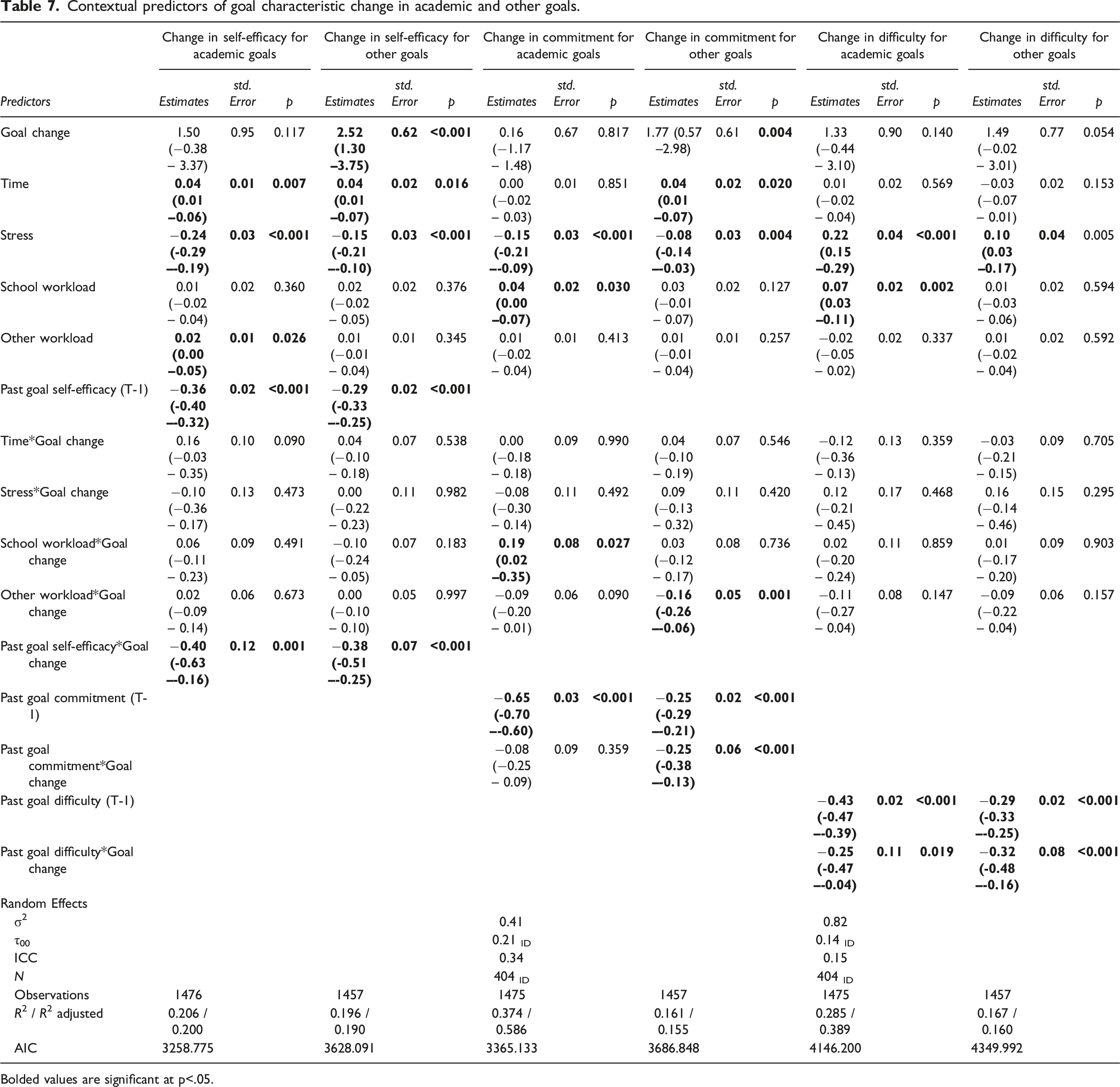
Bolded values are significant at p<.05.
Results showed a significant effect of stress on goal self-efficacy, goal commitment, and goal difficulty across both academic and other goals. When participants experienced more stress, they reported less self-efficacy and lower commitment toward their goals, which they also perceived as more difficult. This was true for both unchanged and new goals. For academic goals, school workload predicted changes in goal difficulty (b = .07, p = .002), along with increased commitment (b = .04, p = .03), whereas other workload predicted changes in goal self-efficacy (b = .02, p = .026). As school workload increased, people perceived their academic goals as more difficult yet reported feeling more committed to them. Conversely, when other workload increased, people felt more self-efficacy toward their academic goals. There was also a significant interaction between school workload and goal change on changes in academic goal commitment (b = 0.19, p = .027), and between other workload and change for other goal commitment. Simple slopes showed that as school workload increased commitment toward academic goals also increased, but only for those who changed their goals (b = 0.20, p < .01). And as other workload increased, non-academic goal commitment decreased, but only for changed goals (b = −0.10, p = .02) Figures 6 and 7. Interactions between goal progress, past goal characteristics, trait self-control and goal change. Note. Panel A (top) includes interactions between goal change and past goal characteristics on changes in self-efficacy (left), commitment (center), and difficulty (right). Panel B (middle) illustrates interactions between goal change and goal progress on change in self-efficacy (left), commitment (center), and difficulty (right). Panel C (bottom) illustrates the interaction between goal change and trait self-control on changes in goal commitment (center), and between past goal change and goal self-efficacy on changes in goal difficulty (right). Interactions between workload and goal change. Note. The plot on the left illustrates the interaction between goal change and school workload on changes in goal commitment for academic goals. The plot on the right illustrates the interaction between goal change and other workload on changes in goal commitment for other goals.

Discussion
The present study examined when and how people change their personal goals and the perceptions of these goals in everyday goal pursuit. Over the course of 10 weeks, participants generally pursued the same goals with a substantial minority (27.38%) changing their goal on at least one occasion. Changes in non-academic goals occurred more frequently than changes to academic goals. We also identified some predictors of goal change (discussed below). For both changed and unchanged goals, there were substantial (non-zero) changes in participants’ perceptions of each goal’s difficulty, and their own self-efficacy and commitment. These changes in perceptions were associated with individual differences, contextual factors, how they previously viewed the goal itself, and goal progress.
Change in goal perceptions
People’s perceptions of their goals (including perceptions of self-efficacy, commitment, and difficulty) showed substantial fluctuations over time, regardless of whether someone has made changes to their goal or not. This change in goal perception is in line with predictions from the integrative model of goal pursuit (Milyavskaya & Werner, 2025), which suggests that one’s perception of goals changes whenever a goal is activated. Given that goals are cognitive structures (Austin & Vancouver, 1996; Kung & Scholer, 2021), their specific representation would be expected to change based on prior experiences and links with other cognitive structures. In our study, we specifically examined trait self-control, time, goal domain, perceptions of goal characteristics at the previous time point, and goal progress as possible predictors of changes in people’s perceptions of their goal characteristics.
Progress and goal characteristics
Often, research on everyday goal pursuit aims to use perceptions of baseline goal characteristics to predict changes in progress (e.g., Koestner et al., 2002; Sheldon & Kasser, 1998; Werner et al., 2016). However, the very act of making progress on a goal (H2a) was associated with lower perceptions of difficulty, and greater commitment and self-efficacy towards it (this only occurred for unchanged goals; when goals were changed, having made progress on the previous goal was unrelated to perceptions of difficulty or commitment for the new goal). This is in line with past research, which shows that positive feedback (indicative of progress) is associated with greater self-efficacy (Escarti & Guzman, 1999; Peifer et al., 2020). We had originally anticipated that prior self-efficacy would positively predict goal difficulty (because people may increase the difficulty of their goals once they realize that they can meet greater demands; H2b). Instead, prior self-efficacy was associated with lower difficulty perceptions. This is likely indicative of the overlap between these two constructs (as seen in the correlations in Table 2), where those with high self-efficacy perceive their goals as less difficult.
Higher levels of prior self-efficacy also predicted greater commitment. That self-efficacy and commitment are intertwined is not surprising. Self-efficacy relates to our beliefs about whether we can execute the behaviours required to achieve our goals, and greater goal commitment may lead to better performance, increasing our sense of ability (Bandura, 1997). Commitment and self-efficacy are linked to greater goal progress (Koestner et al., 2002; Sheldon & Kasser, 1998), which may set up a virtuous cycle where making progress changes how we think about our goals in a way that leads us to make more progress. Finally, commitment was associated with higher difficulty perceptions. Perhaps this is because when we commit to a goal, the demands increase. For example, someone loosely committed to the goal of attending the gym 5 days a week may settle for 3 days, while someone strongly committed would not. Future research could experimentally test this possibility.
Goal change
While perceptions of goal characteristics fluctuated at each time point, actually changing one’s goal to something different was much rarer (72.6% did not change their goals). This suggests that, at least over the short term, people are more likely to stick to their goals once they set them. It is not clear, however, whether this demonstrates resolve, an inability to let go, or simply the natural time course of the goals typically set by university students. Descriptively, we found that when goals do change, people seem to be changing them completely, not just revising them (making the same goal more/less difficult). This is an interesting finding as it might suggest people have a tendency to move on to something new upon accomplishing (or failing) a goal instead of progressing to a higher (or lower) level of difficulty. Whether people’s tendencies to shift or completely change their goal is adaptive or not is an interesting question for future research. While goal change was uncommon, it was not negligible, and could be expected to increase with longer time frames. When conducting longitudinal goal research with multiple time points, it may be wise at each follow-up to ascertain goal status (i.e., whether the participant has completed, still pursuing, shelved, or abandoned the goal), and if a goal has been changed or abandoned to reassess the new goal’s characteristics.
Goal progress
Across goals, progress was quadratically related to goal change (H1a), such that goals were more likely to change when progress was either very high or very low. These results held for non-academic goals but there was a negative linear effect of progress on change for academic goals; participants were less likely to change their goal when they were making good progress (and more likely to change goals when progress was low). This is generally in line with the cybernetic control theory (Carver & Scheier, 1981, 2001), which states that under conditions of low and high progress, people are more likely to change or adjust their goals, to reduce or induce sub-optimally or optimally motivating discrepancies respectively. There may, however, be something more rigid about academic goals that makes them less likely to change when progress is high. This parallels prior findings for performance, where lower performance led to goal change (e.g., Creed & Hood, 2014; Donovan & Williams, 2003; Thibodeaux et al., 2017; Williams et al., 2000).
Goal characteristics
In terms of perceived goal characteristics, only goal commitment negatively predicted changing one’s goal; those more committed to their goal were less likely to change it. This aligns conceptually with the definition of goal commitment as the determination and continued striving towards a goal
Despite the adaptiveness in changing exceedingly difficult goals (Creed & Hood, 2014; Ntoumanis & Sedikides, 2018; Wrosch et al., 2003, 2007), goal difficulty was not a significant predictor of goal change. Similarly, there was no relationship between goal self-efficacy and goal change (contrary to H1b), even though prior research has found that self-efficacy predicts progress (which in turn would predict goal change; Koestner et al., 2002; Sheldon & Kasser, 1998). In both cases, it may be that the relation between difficulty/self-efficacy and goal change depends on progress. For example, one might not change a difficult goal so long as they are making progress on it, but might change a difficult goal if their progress is hindered. Similarly, although high self-efficacy facilitates goal persistence across domains (e.g., Bandura & Cervone, 1983; Bandura & Wood, 1989; Cardon & Kirk, 2013; Liao et al., 2014), those high in self-efficacy may be more likely to persist in a goal up until the point high goal progress warrants change for their goal pursuit to remain motivating (Carver & Scheier, 1981, 2001). Future research can investigate these possibilities by testing whether goal progress moderates the relationship between goal self-efficacy or goal difficulty and goal change.
Trait self-control and the role of personality
Self-control is a key component of goal-directed self-regulation, and trait scales have been used widely in research examining goal pursuit and other positive life outcomes (Cobb-Clark et al., 2022; De Ridder et al., 2012; Inzlicht et al., 2021). In our study, we found that trait self-control related to increased perceptions of self-efficacy and commitment across time. Those high in trait self-control may engage in more self-regulatory behaviours (e.g., implementation intentions, planning, inhibiting temptations and distractions; De Ridder et al., 2012; Troll et al., 2023; Werner et al., 2020), which increases the likelihood of enacting behaviours that lead to goal progress, creating positive feedback that may bolster self-efficacy (e.g., Escarti & Guzman, 1999) and goal commitment (Kokkoris & Stavrova, 2021; Wright et al., 2013). Through their self-regulatory tendencies, those high in self-control could be advantaged to more favourable shifts in people’s perceptions of their goals (e.g., perceived high self-efficacy), which may help explain the positive links between self-control and goal-related outcomes (Cobb-Clark et al., 2022; De Ridder et al., 2012).
Trait self-control is closely related to grit and conscientiousness (Crede et al., 2017; Werner et al., 2019); aspects shared across these traits could be expected to be associated with mire consistent goal pursuit (i.e., less goal change). We had thus hypothesized that trait self-control would negatively predict goal change (H1c). But despite finding a link between trait self-control and commitment (among changed goals), our results showed that trait self-control was unrelated to whether the person kept the goal or changed it. Our findings could have also occurred because trait self-control has both positive (e.g., flexibility) and negative (e.g., commitment) effects on goal change (which cancel each other out; Bieleke et al., 2022). Yet the majority of variance in goal change was within persons, which could explain why an individual difference variable such as trait self-control was not predictive. Future research may want to deploy a more fine-grained look at traits that support self-regulation by investigating facets. For instance, it has been put forth that grit’s measurement does not adequately captured the “passion” component, which increases its predictability and may help it differentiate it from trait self-control (Jachimowicz et al., 2018). Similarly, Menon (2024) proposed an advancement to conscientiousness that focuses on the learned disposition to complete prioritized tasks, which includes the ability to start, return to, and finish tasks all in a timely manner. This conceptualization was found to be more predictive of professional achievement than conscientiousness. Perhaps these different aspects of self-control/conscientiousness/grit would differentially explain a person’s tendency to persist or disengage from personal goals.
Considering the broader implications of our findings for personality research, some personality theories consider how traits manifest in goal-directed behaviours and vise versa. For instance, extroverts may experience more goal activation for social goals, and the concept of personality trait-goal fit has been proposed to suggest why people may endorse or make better progress on certain goals over others (DeYoung, 2015; Little et al., 1992; Moore et al., 2020). At the same time, personality states frequently change to facilitate goal pursuit, and thus may be dictated by a goal’s demands (McCabe & Fleeson, 2016). This likely interplay between perceptions of goal characteristics, personality states, and the demands of the situation could be examined in future research focused on perceptions of goal change on a much smaller time scale (i.e., in a given moment) than what was examined in the present study.
Contextual predictors of goal change
Elevated stress and fluctuating workloads are not uncommon to the student experience (ACHA, 2023; Bewick et al., 2010), and may shift in distinct patterns compared to other groups such as working adults (e.g., high during midterms, low during the summer). While stress and workload did not predict goal change, they were associated with goal perceptions. Higher stress was related to perceptions of lower goal self-efficacy and commitment, and greater goal difficulty. These findings speak to stress as a signal of resource strain, leaving less opportunity for goal pursuit and to making goals feel less achievable (Brandstädter & Rothermund, 2002; Jacobs & Dodd, 2003; Mens et al., 2015; Wrosch et al., 2003).
Academic versus non-academic goals
A final contribution of our paper was the ability to investigate change in two different goals pursued simultaneously. Notably, academic goals were much more stable than other goals. On average, these goals were rated higher on all goal characteristics, including greater commitment and progress. When academic resource demand increased, students also reported greater commitment to their academic goal (Guilmette et al., 2019; Vancouver et al., 2008). That students are more committed to their academic goals does not come at a surprise, but it does provide an interesting case where one group has a disproportionate goal based on their organizational context and life trajectories. This higher commitment is one explanation for why academic goals are less likely to change than other goals. Yet another possibility is that these goals follow different time scales. Indeed, academic goals may be contingent on end-of-year GPAs, while other goals (e.g., build a new habit) may be achieved within a semester, or even a few weeks. People may be positioned to achieve other goals (or realize their infeasibility) more quickly, and this may also explain the higher probability of change.
Taken in the context of multiple goal pursuit, however, we could also be seeing a greater willingness to sacrifice and adjust the other goals for the academic (Mayer & Freund, 2024). Indeed, research on multiple goal pursuit shows that people will prioritize one goal over another if the incentives are higher or when failure comes at a greater cost (Neal et al., 2017; Schmidt & DeShon, 2007). While it may matter little (at least for students early in their health span) whether they make their goal of going to the gym five days a week, the social and career costs of failing at their academic goals may feel relatively intense. Another interesting discrepancy was that for academic goals, other workload was related to greater self-efficacy. An increase in workload would demand greater performance (Carver & Scheier, 1981, 2001), and past performance predicts self-efficacy perceptions (Sitzmann & Yeo, 2013), we could speculate that confidence gained from responding to demanding workloads outside of academia is transferring into academics.
Limitations and future directions
Our study has some limitations which present opportunities for future research. First, although participants reported diverse ethnic backgrounds (46% non-white), our sample was comprised of predominantly female (75 %) undergraduate students in North America. While this study offers insight into the largely female undergraduate context, the generalizability of the findings to non-student populations, other gender identities, and to students outside of the North-American/Western context is limited. Future studies should examine goal change across different types of samples and countries, including how these different contexts impact goal change.
While we were able to follow goals longitudinally (over 10 weeks), longer-term studies may yield more interesting results with respect to goal change, as people may be more likely to change goals as time goes on. We also focused on using data (characteristics and progress) from a prior time point 2 weeks earlier, and did not examine trajectories of change. Changing the distance from the prior survey, or examining how trajectories (i.e., changes in perceptions over the course of multiple intervals) would predict future change, could provide some additional insight. For instance, while high difficulty at a prior time point may not predict change, perhaps a sharp rise in difficulty would. Further, goals may change differently depending on whether they are short-term versus long-term, or depending on the temporal distance of the goal (e.g., athletes’ goal-performance discrepancies better predict goal change when they approach the end of the season; Donovan & Williams, 2003; Williams et al., 2000).
In a similar vein, a further limitation of our study is that we examined changes in only a limited number of goal domains and characteristics. Indeed, students in our study often reported semester or long-term academic goals (e.g., “maintain average of B+ or higher”), while there seemed to be greater variability and less specificity in the time frame of their non-academic goals (e.g., “spend more time with family” or “be more extroverted”). This difference in goal time frames may explain the different rates of goal change across the two types of goals, and inform future studies of goal change in other domains. Other studies have also examined change in goal framing (approach vs. avoidance) over time (Fryer & Elliot, 2007) and goal framing as a predictor in goal revision or change (Gee et al., 2018). Future research can include other goal characteristic perceptions such as specificity or motivation (i.e., reasons for pursuing the goal), to examine goal change more thoroughly. Research is also needed to investigate whether similar results are found for other goal types.
Readers may also notice that the within-person omega reliabilities for many constructs (e.g., goal difficulty, ω within = .50–.61) were quite low (also mentioned in footnote 4). Yet within-person reliability tends to show an upper threshold and depends on the strength of the item’s factor loadings, sample size, and measurement occasions (Yang et al., 2022). For a 2-item scale with n = 200 and medium λ = .70 factor loadings, we might expect a maximum omega of .657. Practices on whether to report within-person reliability vary (e.g., Kiendl et al., 2024), and it would be good to work towards some consistency in reporting and benchmarking.
Other limitations of our research pertain to statistical analyses. Despite a very large number of observations, there were few instances of goal change (approx. 5.7%). While such low base rates are very common (e.g., in medical research), it did affect our potential power to focus in on the perceived characteristics of changed goals, leading us to combine the data from changed and unchanged goals for the analyses examining changes in goal characteristic perceptions (although we did examine interactions). Further, we did not have enough cases to look at differences across reasons for changing goals (e.g., changed, abandoned, achieved), which is a notable limitation. Indeed, the predictors of goal change may look very different when someone abandons a goal versus achieves it. For example, appraising a goal as high in difficulty and subsequently achieving it would be expected to lead to increases in self-efficacy for the next goal, while the same difficulty appraisal could lead to lower subsequent feelings of self-efficacy if the goal was abandoned. Additionally, the sparsity and ambiguity in explicit goal change preclude us from investigating possible mechanistic relationships where traits and contextual variables predict goal change through the way they influence shifts in goal characteristics. Richer longitudinal data on explicit goal change could help us better understand causal pathways.
Convergence issues, caused by the nesting structure of the variables, led us to deviate from our pre-registration by creating separate models for contextual, trait and goal predictors. We also encountered singularity issues with the analyses of change in perceptions of all goal characteristics for other goals, and goal self-efficacy for academic goals. This indicated there was little between -person variability in the change of these perceived characteristic, so we used linear regression to fit the model. Furthermore, when building our multilevel models, we used only random-intercept models and did not center our predictor variables or test random slopes. This was because we had no theoretical reason to test for random slopes and often used categorical predictors (where zero was a meaningful value) or tested non-linear relationships (i.e., the quadratic effect of goal progress). While the decision not to center predictor variables goes against recommendations (e.g., Hoffman & Walters, 2022; Nezlek & Mroziński, 2020), centering might have skewed our interpretation of the effects in these cases, and may have led to further convergence issues due to the unbalanced sample; this was accounted for in our pre-registration. Finally, most of our results were based on exploratory analyses (since no specific hypotheses were formulated for most of the tested relationships), and future research is needed to replicate the current findings. These analytic limitations are balanced by notable strengths, including our preregistration of analyses, and our large sample size (over 3000 observations).
Conclusion
While goal characteristic perceptions are often measured as stable, baseline properties of a goal, our research finds that people regularly change how they perceive their goals (from one survey to the next). These fluctuations can be dependent on traits (i.e., self-control), context, and other perceived goal characteristics. Indeed, when the perception of one aspect of the goal changes, it is likely to influence multiple others. Changing one’s goals entirely during goal pursuit is a regular occurrence even within a relatively short time frame, with approximately 1 out of 3 participants in our study making at least one change within 10 weeks. People are more likely to change their goals when they make very little progress (and, for non-academic goals, when they make a lot of progress), and when they feel less committed. These changes, albeit infrequent, can best be captured by directly asking people about the status of their goal. The implications of goal change for the process of everyday goal pursuit needs to be incorporated into broader theories of goal pursuit to better understand the most effective ways to help people pursue their goals.
Supplemental Material
Supplemental Material - Exploring goal change in everyday life
Supplemental Material for Exploring goal change in everyday life by Tyler Thorne, Isabelle Leduc-Cummings, Anamarie Gennara, Marina Milyavskaya, Mally, Harwood, Chelsea Kisil, and Sierra Micucci in Personality Science
Footnotes
Author note
Dr. Cristian Zanon was the handling editor.
Acknowledgements
Not applicable.
Author contributions
Declaration of conflicting interests
The author(s) declared no potential conflicts of interest with respect to the research, authorship, and/or publication of this article.
Funding
The author(s) received no financial support for the research, authorship, and/or publication of this article.
ORCID iD
Not applicable.
Data Availability Statement

Supplemental Material
Supplemental material for this article is available online.
Notes
References
Supplementary Material
Please find the following supplemental material available below.
For Open Access articles published under a Creative Commons License, all supplemental material carries the same license as the article it is associated with.
For non-Open Access articles published, all supplemental material carries a non-exclusive license, and permission requests for re-use of supplemental material or any part of supplemental material shall be sent directly to the copyright owner as specified in the copyright notice associated with the article.
