




Abstract
Goal setting is only somewhat more common than the failure to follow through on one’s goals. Recognizing the challenge of long-term behavior change, we asked what best predicts long-term goal adherence: extrinsic motivation (the extent to which goal pursuit is experienced as a means to an end) or intrinsic motivation (the extent to which the same goal pursuit is experienced as an end in itself). In a year-long longitudinal study, U.S. adults set extrinsic New Year’s resolutions, but intrinsic motivation predicted adherence to these goals more than extrinsic motivation (Study 1). These findings emerged among adults in China (Study 2) and when measuring goal adherence objectively using the number of steps U.S. adults walked over 2 weeks (Study 3). Understanding how intrinsic motivation affects long-term persistence critically informs interventions that promote goal pursuit. Indeed, increasing intrinsic (vs. extrinsic) motivation increased U.S. adults’ goal adherence (Study 4). Overall, intrinsic motivation both predicted and causally increased goal adherence.
Goal setting is only somewhat more common than the failure to follow through on set goals. Consider New Year’s resolutions. Each year, people set goals—from healthy eating to fitness to savings—that have the potential to change their lives for the better (Dai et al., 2014; Marlatt & Kaplan, 1972; Norcross et al., 2002). Yet midway through February, many have already abandoned their resolutions (Gracia, 2024). Why do people set goals that they later abandon? This research explores one reason: the lack of intrinsic motivation.
Intrinsic motivation refers to experiencing goal pursuit as an end in itself; the benefits of pursuing the goal cannot be mentally or temporally separated from its pursuit (i.e., “means-end fusion”; Kruglanski et al., 2018; Melnikoff et al., 2022; Sansone & Harackiewicz, 1996; Woolley & Fishbach, 2018). Intrinsic motivation is typically contrasted with extrinsic motivation—experiencing goal pursuit as a means to an end. It is the desire to achieve outcomes that are separate from goal pursuit (Higgins & Trope, 1990; Ryan & Deci, 2000). For example, the degree to which runners associate running with long-term health captures their extrinsic motivation; the extent to which they find running inherently enjoyable captures their intrinsic motivation.
People set goals for extrinsic reasons (Heath et al., 1999). They choose resolutions such as eating more healthily, getting in shape, and saving money because they are concerned about their future welfare and want to resist immediate temptations (Fujita, 2011; Milyavskaya & Inzlicht, 2017). It follows that variations in extrinsic motivation—the subjective long-term value of these goals—may predict goal adherence. People who find exercising more important may stick with their fitness goals for longer. Indeed, concerns about one’s future self lead to prioritizing the pursuit of long-term benefits (Bartels & Urminsky, 2011; Hershfield & Bartels, 2018). However, although extrinsic motivation drives goal setting and the initiation of goal pursuit, might intrinsic motivation be a stronger predictor of goal adherence in the long term?
Long-term behavior change is notoriously hard (Allcott & Rogers, 2014; Duckworth et al., 2018). People who manage to change their behavior tend to quickly go back to their old habits (Wood & Neal, 2016). In a megastudy targeting physical exercise, only 8% of the interventions resulted in sustained behavior change after 4 weeks (Milkman et al., 2021). Researchers and policymakers are keen to understand predictors of long-term goal pursuit, yet most studies have been confined to immediate outcomes (Duckworth et al., 2018; Loewenstein, 2018) that do not always generalize to long-term consequences (Saccardo et al., 2023).
We examined whether two key motivational factors—intrinsic and extrinsic motivation—would predict adherence to personal resolutions throughout an entire year. We measured motivation and success multiple times throughout the year to analyze whether the relationship between these motivational factors and goal adherence changed over time (i.e., whether it persisted, faded, or disappeared). We hypothesized that intrinsic motivation would better predict goal adherence in the United States and China and across the various goals people set.
Intrinsic Motivation and Goal Adherence
Why might intrinsic motivation matter for long-term goal adherence? One reason is that intrinsic motivation stems from the presence of immediate benefits, whereas extrinsic motivation stems from the presence of delayed benefits (Kruglanski et al., 2018; Melnikoff et al., 2022; Sansone & Harackiewicz, 1996). Delayed benefits are discounted over time relative to more immediate ones (Ainslie, 1975).
Thus, for goals that are set for larger-later benefits, variations in the short-term experience—captured in intrinsic motivation—might matter. Interventions to increase goal adherence often make goal pursuit more enjoyable in the present. Cafeteria diners ate more healthy food when considering its good taste (vs. health benefits; Turnwald et al., 2019), and gym goers returned more often to the gym when exercise was paired with a fun audiobook (Milkman et al., 2014) or when rewards for exercising were contingent on the presence of a friend (Gershon et al., 2025).
Notably, according to traditional temporal discounting analysis, individuals pursue resolutions despite the short-term costs (i.e., low intrinsic motivation). In contrast, we suggest they might adhere to these resolutions because of the short-term, intrinsic benefits. Although intrinsic motivation might be generally low for personal resolutions (otherwise they would have not been set), these resolutions vary in their short-term costs and benefits, and these variations influence adherence. Resolutions that are less costly—or more enjoyable—are more likely to be pursued.
Alternatively, intrinsic motivation might not predict long-term goal adherence. First, people set these goals because of their extrinsic value. If extrinsic motivation matters for goal setting, it might also matter for goal striving. Second, there is hedonic decline (e.g., Galak & Redden, 2018). People enjoy food less the more they eat it (Larson et al., 2014) and music less the more they hear it (Nelson & Meyvis, 2008). Possibly, people adapt such that their enjoyment at the start of the year declines and does not predict persistence over time.
Initial support for our hypothesis that intrinsic motivation would predict resolution adherence comes from a small-sample study that examined persistence in New Year’s resolutions over 2 months (n = 96; Woolley & Fishbach, 2017). The current research tested the relationship between intrinsic motivation and goal adherence over an entire year with larger and more diverse samples. We further assessed key variables at multiple points throughout the year to examine new questions not previously explored, such as how intrinsic and extrinsic motivation influence each other over time, whether goal adherence has a positive or negative effect on these motivations, and whether intrinsic and extrinsic motivation interact to influence adherence.
Research Overview
Our main hypothesis was that intrinsic motivation would predict and cause greater goal adherence despite setting goals for extrinsic reasons. We expected this effect to persist over time. To test this hypothesis, we first conducted a longitudinal study in which we surveyed U.S. participants about their New Year’s resolutions four times throughout a year (Study 1). We hypothesized that intrinsic motivation would be a stronger predictor of goal adherence than extrinsic motivation and that this effect would persist over time.
Because intrinsic motivation is possibly less strongly related to goal adherence in non-Western, educated, industrialized, rich, and democratic (WEIRD) samples, we then tested our hypothesis in a different culture. Passion, which is related to intrinsic motivation (Wang et al., 2022), is a less powerful predictor of achievement in collectivistic (vs. individualistic) societies (X. Li et al., 2021). For example, Chinese students’ sense of responsibility to their social group motivates them to persist in learning (J. Li, 2012), even when the subject matter does not interest them (Organisation for Economic Co-operation and Development, 2003). Yet other research has found positive outcomes of intrinsic motivation across cultures (e.g., Russia, Germany; Ryan et al., 1999; Schmuck et al., 2000). We expected intrinsic motivation to predict goal adherence more strongly than extrinsic motivation among Chinese participants who set a goal during the first month of the Chinese New Year (Study 2).
By examining New Year’s resolutions, Studies 1 and 2 captured the wide range of personal goals people set for themselves (e.g., health, professional). To measure adherence across these goals, we relied on subjective assessments of success. We complemented these studies with an objective assessment of goal adherence in Study 3, hypothesizing that intrinsic motivation would predict the number of steps people walked over 2 weeks more strongly than extrinsic motivation. Last, we conducted an experiment to test whether intrinsic (vs. extrinsic) motivation would increase engagement with a health app over a 24-hr period (Study 4).
Research Transparency Statement
General disclosures
Study 1 disclosures
Study 2 disclosures
Study 3 disclosures
Study 4 disclosures
Study 1: Adherence to New Year’s Resolutions Throughout the Year
Study 1 examined the relationship between intrinsic and extrinsic motivation and adherence to New Year’s resolutions in a longitudinal, year-long study. We tracked participants who set a resolution at the beginning of the year and measured their intrinsic and extrinsic motivation at 4-month intervals and their subsequent goal adherence. We hypothesized that intrinsic motivation at Time t would more strongly predict successful adherence at t + 1 compared with extrinsic motivation at t and that this relationship would persist over time. Follow-up studies tested (a) whether people intuited this effect, (b) whether people set extrinsic goals, and (c) whether extrinsic motivation predicted goal setting more than intrinsic motivation.
Method
Participants
We recruited 2,000 U.S. participants from Amazon Mechanical Turk (Mage = 38.12 years, SD = 12.02; 47.9% female, 52.1% male). To participate, participants needed to indicate “yes” when asked whether they had set a resolution for the upcoming year.
Procedure
We collected data four times over the course of the year. We first surveyed participants between the last week in December and the first week in January (T1). We sent out follow-up surveys (T2, T3, and T4) at roughly 4-month intervals. Only participants who completed the survey at T1 (n = 2,000) were invited back at T2; likewise, only those who completed the survey at T2 (n = 1,046) were invited back at T3, and only those who completed the survey at T3 (n = 709) were invited back at T4 (n = 577). It is possible that only highly motivated people returned to complete each subsequent follow-up survey. However, analyses comparing participants who completed all four surveys with those who did not suggest that, if anything, this sample consisted of people who reported being less motivated, both intrinsically, t(1998) = 3.32, p < .001, d = 0.16, 95% confidence interval (CI) = [0.07, 0.26], and extrinsically, t(1998) = 2.59, p < .010, d = 0.13, 95% CI = [0.03, 0.22]. For full details and additional analyses, see the Supplemental Material available online.
T1 survey
Participants listed the primary resolution they made for the upcoming year (open-text response). We assessed participants’ intrinsic motivation to pursue their resolution on a scale from 1 (not at all) to 7 (very much) with three items (αT1 = .77): “Is [piped resolution text] something that provides you with a positive experience?” “Is [piped resolution text] enjoyable for you to do?” and “Is [piped resolution text] engaging for you to do?” We also assessed participants’ extrinsic motivation to pursue their resolution on a scale from 1 (not at all) to 7 (very much) with three items (αT1 = .75): “Is [piped resolution text] useful to you?” “Will [piped resolution text] change your life?” and “Is [piped resolution text] important for you to do?” These items were adapted from prior research (Woolley & Fishbach, 2017). Intrinsic-motivation items captured the positive experience of goal pursuit, and extrinsic-motivation items captured the value of the outcome achieved. To confirm that participants listed a resolution they intended to pursue for the entire year, we asked them to answer on a scale from 1 (a couple of weeks) to 7 (the whole year) how long they expected to pursue this resolution for (M = 6.31, SD = 1.16, Mdn = 7).
T2–T4 surveys
We sent three follow-up surveys at roughly 4-month intervals. These surveys used identical materials and are thus described together. At the start of each follow-up survey, we used piped text to remind participants of the New Year’s resolution they listed in the first survey. We then measured our main predictor variables, participants’ intrinsic and extrinsic motivation to pursue their resolution, using the same items and scale from T1 (intrinsic: αT2 = .85, αT3 = .85, αT4 = .86; extrinsic: αT2 = .78, αT3 = .81, αT4 = .82). The correlation between intrinsic and extrinsic motivation was as follows: rT1 = .27, rT2 = .45, rT3 = .45, and rT4 = .39 (ps < .001); for additional correlations, see Table S1 in the Supplemental Material.
We measured participants’ successful adherence to their resolution as our primary dependent variable. Participants reflected on the months since they set their resolution and indicated during this period how successful they had been at sticking with this resolution on a scale from 1 (not very successful) to 7 (very successful).
To complement this measure of successful goal adherence, we also assessed goal completion. We asked participants to select the option that best described their current situation: “I am still pursuing the resolution,” “I quit the resolution,” or “I achieved the resolution.” This measure captured participants’ perception of whether they had achieved, were still pursuing, or had abandoned the goal. See Table 1 for responses. Additional items included for exploratory purposes (e.g., participants’ ratings of their experience of pursuing their resolution on a scale from 1, very difficult, to 7, very easy) are reported in the Supplemental Material. This and all subsequent studies received approval from the Cornell University Institutional Review Board.
Response Rate and Resolution Status Across Time in Study 1
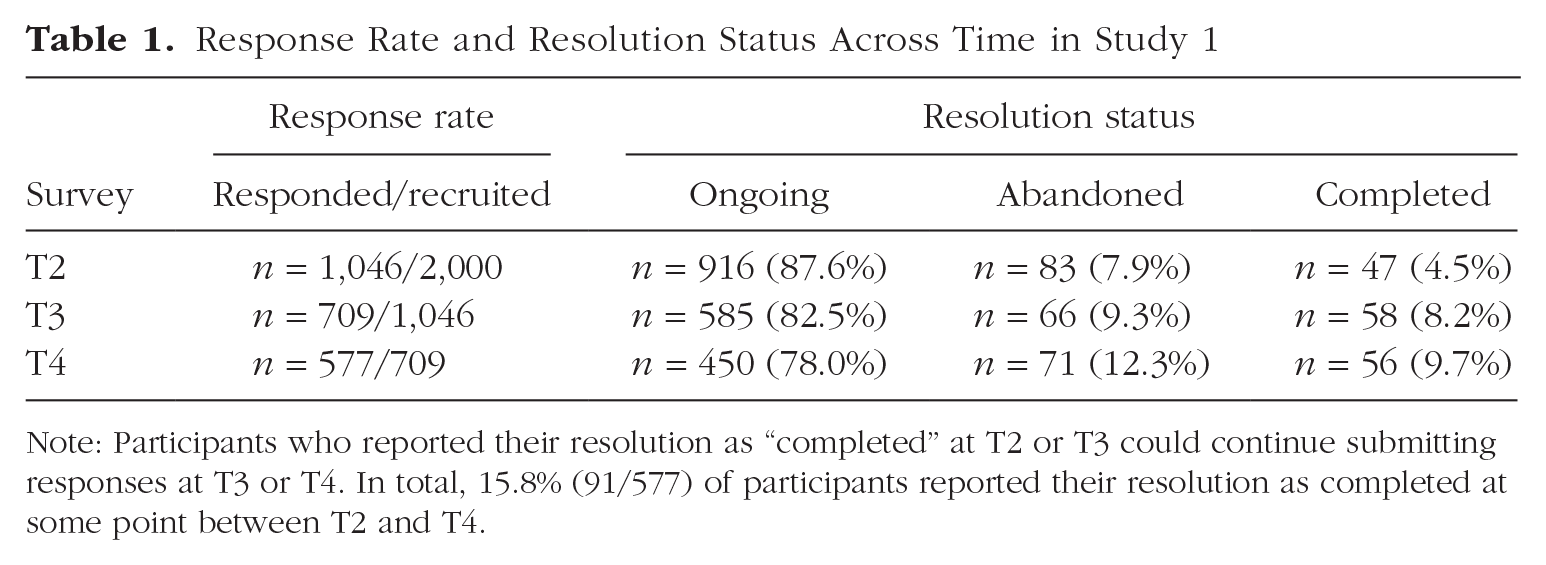
Note: Participants who reported their resolution as “completed” at T2 or T3 could continue submitting responses at T3 or T4. In total, 15.8% (91/577) of participants reported their resolution as completed at some point between T2 and T4.
Two research assistants categorized the resolutions participants listed into one of six categories: physical health (e.g., lose weight, exercise), financial (e.g., save money, get out of debt, make a large purchase), healthier consumption (e.g., eat healthier, quit smoking), professional (e.g., career, academic, or learning-related goals), personal (e.g., enjoy life, stress less), and relationship goals. Coders had high reliability, agreeing on the categorization of 96% of the resolutions; conflicts were resolved by a third coder.
Results
An analysis of resolution type revealed that 39.6% of resolutions were related to physical health, 17.0% to financial goals, 14.6% to healthy consumption, 12.9% to professional goals, 9.7% to personal goals, and 4.5% to relationship goals, with 1.9% categorized as “other” (see Table S2).
Participants were more extrinsically motivated (M = 6.27, SD = .85) than intrinsically motivated (M = 5.41, SD = 1.25) to pursue their resolution, t(1999) = 29.43, p < .001, d = 0.66, 95% CI = [0.61, 0.71], in line with previous research on goal setting (Heath et al., 1999). Our analysis focused on motivation at T1 to test whether people set extrinsic goals; the pattern also replicated across T2 through T4 (see the Supplemental Material).
Analytic strategy
We used multilevel structural equation modeling to test our primary hypothesis that intrinsic motivation would be a stronger predictor of goal adherence over time than extrinsic motivation. We used stationary autoregressive cross-lagged panel models to assess the magnitude and significance of the effect of intrinsic motivation and extrinsic motivation at t on goal adherence at t + 1. At a given measurement occasion, we captured covariances between intrinsic motivation, extrinsic motivation, and goal adherence. All models were performed using the lavaan package in R (Version 4.3.0; R Core Team, 2023), and 95% CIs were obtained using parametric bootstrapping with 10,000 resamples. Missing data were handled with full information maximum likelihood estimation, which uses all available data to produce estimates. The model fit was satisfactory, χ2(21) = 329.614, comparative fit index = .933, root mean square error of approximation = .086, standardized root mean square residual = .056. We found similar results when restricting our analysis to the sample of participants (n = 577) who completed all four surveys (see the Supplemental Material).
Hypothesis testing
First, we examined whether intrinsic motivation and extrinsic motivation exerted longitudinal effects on successful goal adherence (Fig. 1). Successful goal adherence at T2 was positively predicted by intrinsic motivation at T1, β = 0.216, SE = 0.03, z = 6.95, p < .001, 95% CI = [0.13, 0.30], successful goal adherence at T3 was positively predicted by intrinsic motivation at T2, β = 0.099, SE = 0.03, z = 3.00, p = .003, 95% CI = [0.04, 0.20], and successful goal adherence at T4 was positively predicted by intrinsic motivation at T3, β = 0.080, SE = 0.03, z = 2.36, p = .019, 95% CI = [0.01, 0.15], in line with our hypothesis. The overlapping CIs suggest that the positive effect of intrinsic motivation on goal adherence did not diminish significantly over time.
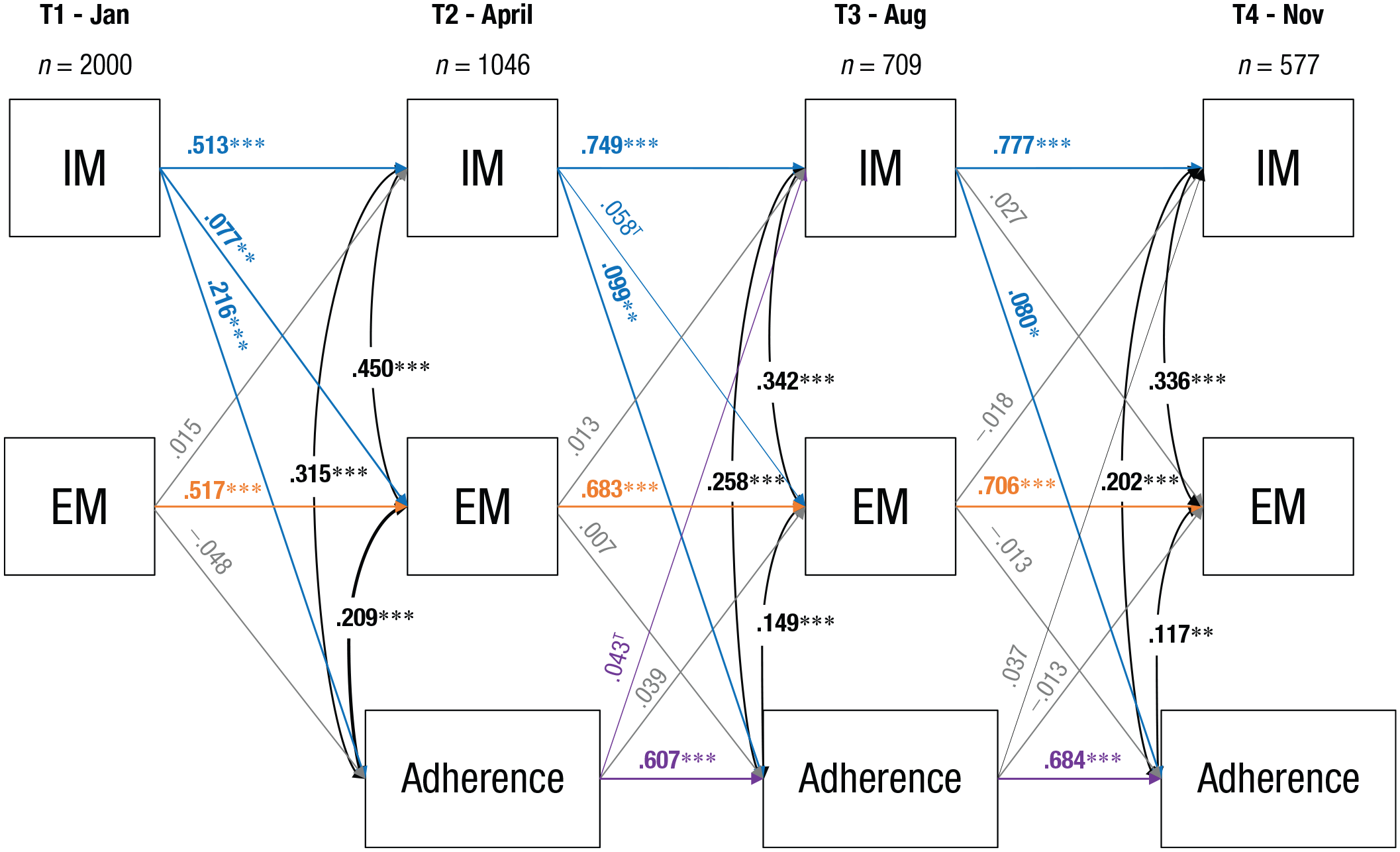
Relationship between IM, EM, and successful adherence to New Year’s resolutions throughout an entire year in Study 1. Blue lines indicate significant or marginal effects of IM on variables over time; orange lines indicate significant effects of EM on variables over time; purple lines indicate significant or marginal effects of goal adherence on variables over time; black lines represent significant associations between variables measured within the same wave; gray lines represent nonsignificant relationships (Tp < .10; *p < .05; **p < .01; ***p < .001). IM = intrinsic motivation; EM = extrinsic motivation.
This pattern was unique to intrinsic motivation because there was no significant relationship between successful goal adherence at T2 and extrinsic motivation at T1, β = −0.048, SE = 0.03, z = −1.48, p = .140, 95% CI = [−0.08, 0.09], successful goal adherence at T3 and extrinsic motivation at T2, β = 0.007, SE = 0.03, z = 0.21, p = .832, 95% CI = [−0.04, 0.08], and successful goal adherence at T4 and extrinsic motivation at T3, β = −0.013, SE = 0.03, z = −0.40, p = .691, 95% CI = [−0.07, 0.05]. Thus, whereas intrinsic motivation predicted successful adherence to one’s resolution over the course of a year, extrinsic motivation did not. Robustness checks supported the conclusion that intrinsic motivation was a significantly stronger predictor of goal adherence than extrinsic motivation and that the relationship between intrinsic motivation and goal adherence was primarily driven by between-persons variance (see the Supplemental Material). That is, we found evidence for a between-persons effect—people who were generally more intrinsically motivated better adhered to their resolution.
Resolution completion
We supplemented the longitudinal analysis on successful resolution adherence by analyzing reported resolution completion (1 = completed, 0 = ongoing or abandoned). A logistic regression of completion (at any point across the year) on intrinsic and extrinsic motivation at T1 further supported our hypothesis. Intrinsic motivation significantly predicted resolution com-pletion, β = 0.47, SE = 0.13, Wald = 12.87, p < .001, odds ratio (OR) = 1.60, 95% CI = [1.24, 2.06], whereas extrinsic motivation did not, β = −0.05, SE = 0.12, Wald = 0.20, p = .657, OR = 0.95, 95% CI = [0.75, 1.20]. In other words, intrinsic motivation was higher for resolutions completed by the end of the year (Mcomplete = 5.73, SD = 1.12; Mincomplete = 5.18, SD = 1.34), t(575) = 3.70, p < .001, d = 0.42, 95% CI = [0.20, 0.65], with no significant relationship between resolution completion and extrinsic motivation (Mcomplete = 6.23; Mincomplete = 6.18), t(575) = 0.49, p = .626, d = 0.06. We replicated this result in two additional robustness checks that addressed the possibility that some participants who coded their resolution as “completed” misunderstood the question (see the Supplemental Material).
Alternative explanations
Intrinsic motivation possibly predicted resolution completion because such resolutions are easier to pursue or have shorter time horizons. Indeed, the perceived ease of pursuing the resolution was positively associated with intrinsic motivation (r = .23, p < .001) and negatively associated with extrinsic motivation (r = −.12, p < .001). Both intrinsic motivation and extrinsic motivation were positively associated with expected duration (rIM = .19 vs. rEM = .30, ps < .001), although the relationship with extrinsic motivation was stronger. Notably, however, we found that intrinsic motivation continued to predict resolution completion when controlling for the perceived ease of the resolution (averaged across T2 through T4; α = .83) and expected duration (i.e., how long people expected to pursue their resolution; assessed at T1), βIM = 0.35, SE = 0.15, Wald = 5.84, p = .016, OR = 1.42, 95% CI = [1.07, 1.89]; βEM = 0.05, SE = 0.13, Wald = 0.16, p = .690, OR = 1.05, 95% CI = [0.81, 1.37].
Another alternative explanation entails the opposite causal direction: When people do something, they tend to like it more. Adherence at T2 did not significantly predict intrinsic motivation at T3 (β = 0.043, p = .097), and adherence at T3 did not significantly predict intrinsic motivation at T4 (β = 0.037, p = .184; Fig. 1), inconsistent with this alternative.
Additional analyses
The longitudinal design of Study 1 and multiple measurements allowed us to explore several additional questions. First, it is possible that goal adherence at t positively predicted extrinsic motivation at t + 1. For example, people who adhere to a goal may find it more important and useful as a result. However, we did not find a significant relationship between adherence at t and extrinsic motivation at t + 1 (T2–T3: β = 0.039, z = 1.40, p = .163; T3–T4: β = −0.013, z = −0.40, p = .689).
Second, it is possible that intrinsic motivation at t increases subsequent extrinsic motivation at t + 1. Could feeling that a goal is interesting and enjoyable lead people to feel it is more useful? Indeed, we found evidence of this effect, although it faded over time (T1–T2: β = 0.077, z = 2.90, p = .004; T2–T3: β = 0.058, z = 1.92, p = .055; T3–T4: β = 0.027, z = 0.81, p = .420).
Third, it could be that extrinsic motivation at t reduces subsequent intrinsic motivation at t + 1. That is, feeling that a goal is important and useful could undermine how enjoyable it feels over time. We found no significant relationship between extrinsic motivation at t and intrinsic motivation at t + 1 (T1–T2: β = 0.015, z = 0.53, p = .596; T2–T3: β = 0.013, z = 0.48, p < .632; T3–T4: β = −0.018, z = −0.64, p = .525), inconsistent with this possibility.
Last, some research has found negative interactive effects between intrinsic and extrinsic motivation on adherence. For example, West Point cadets who were intrinsically motivated to develop themselves and extrinsically motivated to get a good job were less likely to persist in a military career (Wrzesniewski et al., 2014). We explored interactive effects, regressing adherence at t + 1 on intrinsic motivation at t, extrinsic motivation at t, and their interaction, which revealed nonsignificant interactions (T2: t(1042) = −0.42, p = .678; T3: t(705) = −0.13, p = .894; T4: t(573) = −0.20, p = .845).
Overall, Study 1 found that variations in intrinsic motivation predicted successful adherence to New Year’s resolutions over the course of 1 year and that this relationship persisted over time. However, despite setting these resolutions for the extrinsic benefits they provided, there was no significant relationship between extrinsic motivation and successful adherence. Intrinsic motivation predicted the completion of resolutions, whereas extrinsic motivation did not, consistent with this finding.
Follow-up studies
We conducted three follow-up studies to Study 1: Follow-Up 1 examined metamotivational beliefs (Fujita et al., 2024; Scholer et al., 2018), testing whether people are aware that intrinsic motivation predicts goal adherence; Follow-Up 2 asked people whether intrinsic or extrinsic motivation was more important to them when setting a goal; and Follow-Up 3 examined whether extrinsic motivation predicted goal setting more than intrinsic motivation. We describe these studies briefly here and report full details in the Supplemental Material.
Follow-up 1: metamotivational beliefs
Recognition of what motivates behavior is critical for self-regulation, yet people do not always accurately intuit how intrinsic and extrinsic motivation will influence their behavior (Hubley et al., 2024). In particular, because of the empathy gap, people may underestimate the influence of immediate experiences and benefits (including intrinsic motivation) on their behavior (Loewenstein, 2000; Van Boven et al., 2012).
We accordingly examined whether people are aware of what factors motivate themselves and others to adhere to their goals over time. We assigned participants to select, across three binary-choice questions, what would better predict the likelihood that they (vs. another person) would adhere to a healthy-eating goal: extrinsic versus intrinsic motivation (i.e., importance vs. enjoyment, usefulness vs. positive experience, and life-changing vs. engaging goals). We summed participants’ selection of the intrinsic-motivation statements on a scale from 0 (no IM statement selected) to 3 (all IM statements selected).
Participants believed intrinsic (vs. extrinsic) motivation would matter less for goal adherence (M = 1.31, SD = 1.11), t(399) = −3.38, p < .001, d = −0.17, 95% CI = [−0.27, −0.07]. There was a marginally significant effect of condition such that people in the “self” condition were less likely to choose intrinsic motivation (M = 1.21, SD = 1.12) than those in the “other” condition (M = 1.42, SD = 1.09), t(398) = −1.94, p = .053, d = −0.19, 95% CI = [−0.39, 0.002]. People may not intuit what is likely to motivate them, but they may have slightly better insight when predicting others’ motivation.
Follow-up 2: motivation strength
We next tested what is more important in goal setting: intrinsic or extrinsic motivation. Participants indicated whether, if they were to set a New Year’s resolution, it would be because “the resolution is something important for [them] in the long run” (extrinsic motivation) or “the resolution is something enjoyable for [them] to do in the moment” (intrinsic motivation). Most participants (90%) reported setting resolutions for extrinsic reasons (z = 7.90, p < .001).
Follow-up 3: resolution choice
Last, we tested what predicted goal selection. We reasoned that extrinsic motivation may be necessary for goal setting, whereas intrinsic motivation would be necessary to pursue a goal. Previous research predicting persistence from intrinsic and extrinsic motivation did not examine how these factors influence goal setting (Wrzesniewski et al., 2014). Across 20 popular New Year’s resolutions (e.g., saving money, eating healthier; see Table S3), we found a significant effect of intrinsic motivation, β = 0.50, SE = 0.08, z = 6.43, p < .001, 95% CI = [0.35, 0.65], and a significant effect of extrinsic motivation, β = 2.76, SE = 0.12, z = 22.68, p < .001, 95% CI = [2.53, 3.01]. The nonoverlapping CIs indicate that extrinsic motivation was a significantly stronger predictor of goal setting than intrinsic motivation. Notably, there was a stronger effect of extrinsic motivation on goal setting even though the variance was significantly lower for extrinsic motivation (3.43) than for intrinsic motivation (3.82; p < .001). These results advance prior work and show that intrinsic and extrinsic motivation matter in goal setting, with extrinsic motivation having a stronger effect.
Study 2: Chinese New Year
Intrinsic motivation has mainly been studied in WEIRD cultures (Cerasoli et al., 2014; Kruglanski et al., 2018). Study 2 tested whether intrinsic motivation would predict goal adherence in a non-WEIRD population. We recruited participants from China before the Chinese New Year and followed up with them 1 month later to measure adherence to their resolution. We again expected that intrinsic motivation would predict adherence to the resolution more strongly than extrinsic motivation.
Method
Participants
Before the Chinese New Year, we recruited 500 Chinese participants (Mage = 30.06 years, SD = 7.44; 59.20% female, 40.80% male) from Credamo, an online Chinese data-collection platform. To participate, participants needed to indicate “yes” when asked whether they had set a resolution for the upcoming year.
Procedure
We administered the first survey (T1) before the Chinese New Year and the second survey (T2) 1 month later. A total of 267 participants returned to complete the second survey (Mage = 30.22 years, SD = 7.81; 57.30% female, 42.7% male) and were included in the analysis. Those who completed both surveys (included in the final sample) did not significantly differ at T1 from those who completed only the first survey on reported intrinsic motivation, t(498) = −1.48, p = .141, d = −0.13, extrinsic motivation, t(498) = −1.00, p = .317, d = −0.09, or expected resolution duration, t(498) = −1.53, p = .126, d = −0.14, suggesting our final sample did not significantly differ from our original sample. All study information and measures were provided to participants in Chinese after being back translated from English by two research assistants highly proficient in both languages.
T1 survey
Participants listed the primary resolution they made for the Chinese New Year and selected the option that most closely described their resolution from the following list: physical health (lose weight, exercise); healthier consumption (eat healthily, quit smoking); professional, career, or learning; financial; personal (stress less, be more positive); and relationship. If no option applied, participants wrote a short phrase to categorize their resolution under “other.” An examination of resolution type revealed that 45% were related to professional, career, or learning goals; 26% were related to financial goals; 16% were related to physical health; and 13% were made up of the remaining goals (healthier consumption, personal, relationship, and other). Notably, participants listed vastly different resolutions from the U.S. participants in Study 1, allowing us to explore the generalization of our effect not only to a different population but also to a different distribution of resolutions (see Table S2).
As in Study 1, we assessed participants’ intrinsic motivation to pursue their resolution on a scale from 1 (not at all) to 7 (very much) with three items (αIM = .69): “Is this goal you listed something that provides you with a positive experience?” “Is this goal you listed enjoyable for you to do?” and “Is this goal you listed engaging for you to do?” Likewise, we used the same scale and number of items to assess participants’ extrinsic motivation to pursue the resolution (αEM = .41): “Is this goal you listed useful to you?” “Will this goal you listed change your life?” and “Is this goal you listed important for you to do?” Given the lower reliability for the extrinsic-motivation scale, we conducted a factor analysis using principal axis factoring, varimax rotation, and the unrestricted extraction method based on “leveling off” the scree plot, confirming that these motivation measures loaded onto two separate factors (intrinsic motivation: factor loadings > 0.56; extrinsic motivation: factor loadings > 0.41). 1 As in Study 1, we also confirmed that participants listed a resolution they intended to pursue for the entire year (1 = a couple of weeks, 7 = the whole year; M = 5.94, SD = 1.17, Mdn = 6).
T2 survey
One month later, we invited all participants to complete the second survey. As in Study 1, to measure successful goal adherence we asked participants to assess how successful they had been at sticking with their set goal for the new year on a scale from 1 (not very successful) to 7 (successful). We collected additional items for exploratory purposes (see the Supplemental Material).
Results
We first examined differences in extrinsic and intrinsic motivation when setting a resolution. As in Study 1, participants’ resolutions were significantly more extrinsic (M = 6.12, SD = 0.57) than they were intrinsic (M = 5.74, SD = 0.80), t(266) = 7.10, p < .001, d = 0.43, 95% CI = [0.31, 0.56].
We then regressed successful goal adherence at T2 simultaneously on intrinsic and extrinsic motivation at T1. As predicted, we found a significant effect of intrinsic motivation (β = 0.31, SE = 0.06), t(264) = 5.24, p < .001, 95% CI = [0.19, 0.43], whereas the effect of extrinsic motivation was not significant (β = 0.05, SE = 0.06), t(264) = 0.84, p = .402, 95% CI = [−0.07, 0.17]. An SEM analysis using the lavaan package in R, which regressed adherence at T2 on intrinsic and extrinsic motivation at T1, revealed that the effect of intrinsic motivation was significantly greater than that of extrinsic motivation (z = 2.86, p = .004). We also explored whether intrinsic motivation and extrinsic motivation interacted in predicting adherence; as in Study 1, there was no significant interaction effect, t(263) = −1.26, p = .210.
Additional robustness checks revealed that the variance was higher for intrinsic motivation than for extrinsic motivation (see the Supplemental Material). This was possibly part of the effect. Most resolutions are important, but some are more enjoyable than others, and these variations in intrinsic motivation matter for predicting adherence. At the same time, we cannot fully attribute our results to a lack of variance in extrinsic motivation; in a follow-up analysis, we equated intrinsic and extrinsic motivation in terms of variance and continued to find that intrinsic motivation was a stronger predictor of adherence (see the Supplemental Material). Further, extrinsic motivation predicted goal setting more than intrinsic motivation despite a lower variance (Follow-Up 3 to Study 1).
Study 2 conceptually replicated Study 1 and generalized these findings to a sample of participants from China and to a different distribution of resolutions. Again, whereas intrinsic motivation predicted adherence to a resolution, there was no corresponding relationship between extrinsic motivation and goal adherence. Studies 1 and 2 focused on New Year’s resolutions, which represent a wide range of long-term personal goals (e.g., financial, professional, and health-related). A limitation, however, is that we had to rely on subjective assessments to measure adherence across these various goals. Further, these results are correlational. We accordingly assessed objective goal adherence in Study 3 and used an experimental design in Study 4.
Study 3: Daily Steps Walked Over 2 Weeks
Study 3 examined the relationship between intrinsic and extrinsic motivation on behavior. We recruited participants with a goal of walking more and who used a step-counting app. We recorded the number of steps they walked daily for two consecutive weeks. We predicted that the enjoyment of walking more (intrinsic motivation) would have a stronger effect on average daily steps than the importance of walking more (extrinsic motivation).
Method
Participants
We preregistered this study and opened the survey to 500 participants on Prolific. Participants needed to (a) have a goal of walking more steps, (b) have a smartphone app that had recorded their step count over the prior 2 weeks, and (c) upload two screenshots of their step count from the app. A total of 479 participants completed the survey. As preregistered, we excluded participants with duplicate IDs, leaving a total of 439 participants (Mage = 37.94 years, SD = 11.74; 65.1% female, 33.5% male, 1.4% nonbinary). The pattern and significance of results remained consistent when including all participants in the analysis.
Procedure
We asked participants to list the number of steps they walked each day for the past 14 days (14 separate entries). As in Studies 1 and 2, we assessed intrinsic motivation on a scale from 1 (not at all) to 7 (very much) with three items (α = .90): Walking more steps “provides me with a positive experience,” “is enjoyable for me to do,” and “is engaging for me to do.” Likewise, using the same scale and number of items, we assessed extrinsic motivation as follows (α = .79): Walking more steps “is useful for me to do,” “is something that will change my life,” and “is important for me to do.” We asked participants to upload two screenshots of their step-counting app, which allowed us to verify a subset of the steps recorded. We collected additional items for exploratory purposes (see the Supplemental Material).
Results
We again found that people agreed more with extrinsic than intrinsic statements. That is, participants’ goal to walk more was higher in extrinsic motivation than intrinsic motivation (MEM = 5.74, SD = 0.96; MIM = 5.56, SD = 1.12), t(438) = 3.80, p < .001, d = 0.18, 95% CI = [0.09, 0.28].
We regressed the average number of daily steps participants walked over the 2-week period (M = 6,518.26, SD = 3,677.25) on intrinsic and extrinsic motivation. As predicted, we found a significant effect of intrinsic motivation, β = 0.34, SE = 0.05, t(436) = 6.20, p < .001, 95% CI = [0.23, 0.44], whereas the effect of extrinsic motivation was not significant, β = −0.09, SE = 0.05, t(436) = −1.59, p = .113, 95% CI = [−0.19, 0.02]. A nonpreregistered SEM analysis using the lavaan package in R confirmed that these beta coefficients significantly differed (z = 4.45, p < .001). An additional nonpreregistered analysis found, similar to Studies 1 and 2, no significant interaction between intrinsic and extrinsic motivation on goal adherence, t(435) = −0.69, p = .493.
The average number of steps people walked over the 2-week period had a skewness of 0.78, indicating a moderately positive skew. To address skew, we conducted two nonpreregistered analyses. First, we found a similar pattern of results when taking the log(x + 1) for average steps walked (βIM = 0.19, SE = 0.06, t(436) = 3.37, p < .001, 95% CI = [0.08, 0.30]; βEM = −0.02, SE = 0.06, t(436) = −0.29, p = .773, 95% CI = [−0.13, 0.09]). Second, we found a similar pattern of results when winsorizing the upper tail of the data (i.e., capping values above the 95th percentile) (βIM = 0.34, SE = 0.05, t(436) = 6.21, p < .001, 95% CI = [0.23, 0.44]; βEM = −0.08, SE = 0.05, t(436) = −1.46, p = .144, 95% CI = [−0.19, 0.03]).
Study 3 thus conceptually replicated Studies 1 and 2 with an objective measure of behavior. For people wishing to walk more, intrinsic (vs. extrinsic) motivation had a stronger effect on daily steps over time. Participants’ average steps increased by 0.34 SD for each SD increase in intrinsic motivation. This translates to approximately 1,250 more steps when intrinsic motivation was high (+1 SD) compared with average levels of intrinsic motivation. However, extrinsic motivation did not significantly affect daily steps.
Study 4: Motivating Engagement With a Health App
Study 4 causally tested the effect of intrinsic motivation on goal adherence. Participants downloaded a health app that allows users to scan the barcode of a product (i.e., food, cosmetics) to learn about its health impact. We randomly assigned participants to focus on either intrinsic or extrinsic reasons for using the app. Participants reported the number of products they scanned 24 hr later. We predicted that participants focused on intrinsic (vs. extrinsic) motivation would scan more products (i.e., learn more).
Method
We preregistered this study, recruiting participants from Connect by CloudResearch. We initially recruited 458 participants, aiming for 80% power to detect an effect size (d) of 0.25. We observed a significant effect with this sample size; however, the effect size was smaller than anticipated (d = 0.20). To ensure the robustness of this effect, we preregistered recruiting additional participants to have 80% power of detecting an effect size of 0.20. In total, 933 participants completed the first survey (T1) and were invited back to complete the follow-up survey (T2). We set p = .025 to account for multiple comparisons (Keppel & Wickens, 2004).
To be eligible for the study, participants needed to have a smartphone, be willing to download an app during the study, upload a screenshot of the app that day, use the app for 24 hr, and fill out a survey the next day about their experience. Participants who agreed to participate proceeded to our prescreening questions; those who did not returned the survey. We asked participants who entered the survey whether they had used or heard of the Yuka app; those who answered “no” were randomly assigned to a condition (31 participants answered “yes” to one or both of these prescreening questions and were filtered out of the survey before random assignment to a condition). We assumed that participants willing to download and use the app would have a goal to be healthier.
Of the 933 participants invited back, 803 participants completed the follow-up survey. We excluded participants who scanned zero products and an outlier reporting 130,000 products scanned, in line with our preregistration, leaving a final sample of 763 (Mage = 35.72 years, SD = 10.73; 57.9% female, 39.1% male, 3.0% nonbinary). We did not include any measures at T1 so could not compare participants who completed the T2 survey (included in the final sample) with those who did not complete the T2 survey. However, our attrition rate was less than 14%, notably lower than in Studies 1 and 2, likely because of the more intensive recruitment process at T1 (e.g., needing to download an app).
Procedure
We reminded participants who passed our prescreening questions that in the study they would download and use the Yuka app for a 24-hr period. We randomly assigned participants to a condition in a two-cell (intrinsic vs. extrinsic motivation) between-subjects design. In the intrinsic-motivation condition, we described the app as “a fun new game with surprising product discoveries” (see Fig. 2a) and invited participants to write a few short phrases highlighting the playful and entertaining aspects of Yuka that they were excited about. In the extrinsic-motivation condition, we described the app as a way to “get useful and important product information” (see Fig. 2b) and invited participants to write a few short phrases highlighting the information and knowledge they would gain from using Yuka. A pretest confirmed that this manipulation shifted intrinsic (vs. extrinsic) motivation; participants perceived Yuka to be more intrinsically motivating in the intrinsic-motivation condition and more extrinsically motivating in the extrinsic-motivation condition (see the Supplemental Material).

Stimuli from Study 4. In the (a) intrinsic-motivation condition, we described the Yuka app as “a fun new game with surprising product discoveries.” In the (b) extrinsic-motivation condition, we described the app as a way to “get useful and important product information.”
Participants received step-by-step instructions for downloading the app that were tailored to their phone’s operating system. Participants needed to upload a screenshot from their phone to confirm that they downloaded the app. In the intrinsic-motivation condition, we reminded participants to have fun with the app; in the extrinsic-motivation condition, we reminded participants to assess its informativeness and usefulness.
In the follow-up survey, we asked participants to navigate to the “History” tab of the Yuka app and to report the number of products they had scanned in the past 24 hr. We had participants upload a screenshot of their history to verify that they had indeed used the app. We collected additional items for exploratory purposes (see the Supplemental Material).
Results
Participants scanned more products over a 24-hr period in the intrinsic-motivation condition (M = 11.55, 95% CI = [10.25, 12.85]) than in the extrinsic-motivation condition (M = 9.18, 95% CI = [8.26, 10.09]), t(761) = 2.96, p = .003, d = 0.21, 95% CI = [0.07, 0.36], in line with our prediction (nonparametric Mann-Whitney U test: z = 3.26, p = .001). Overall, increasing intrinsic (vs. extrinsic) motivation to use a health app increased actual usage in the 24 hr after downloading the app, amounting to an increase of more than 25% in the number of products scanned.
We conducted several nonpreregistered analyses as robustness checks. First, we ran a hurdle model to examine results when predicting the number of scans (conditional on scanning at least one product) and a binary dependent variable (zero vs. nonzero scan counts). Consistent with our reasoning, this analysis revealed that intrinsic (vs. extrinsic) motivation increased the number of scans among those with at least one scan, β = 0.11, SE = 0.01, z = 10.16, p < .001. Second, we found that the condition did not significantly affect the probability of having a nonzero count (i.e., the likelihood of having at least one scan), β = −0.10, SE = 0.16, z = −0.64, p = .525.
Second, we tested the effect of the condition on the number of products scanned when including participants who scanned zero products in the analysis, which was significant (MIM = 10.93, 95% CI = [9.68, 12.18]; MEM = 8.78, 95% CI = [7.88, 9.67]); t(800) = 2.77, p = .006, d = 0.20, 95% CI = [0.06, 0.33]. Third, we identified positive skew in the number of products scanned (2.89). We addressed skew as in Study 3 by using a log transformation, log(x + 1), for the number of products scanned (MIM = 0.95, 95% CI = [0.91, 0.99]; MEM = 0.86, 95% CI = [0.83, 0.90]); t(761) = 3.38, p < .001, d = 0.25, 95% CI = [0.10, 0.39] and winsorizing the upper tail of the data (MIM = 10.34, 95% CI = [9.49, 11.19]; MEM = 8.85, 95% CI = [8.05, 9.64]); t(761) = 2.52, p = .012, d = 0.18, 95% CI = [0.04, 0.32].
General Discussion
Behavioral scientists and policymakers are keen to understand what predicts long-term behavior change, yet long-term studies have been rare (Duckworth et al., 2018; Loewenstein, 2018). Using a year-long longitudinal design, we found that intrinsic motivation predicted long-term goal adherence in the United States and China and for various goals (e.g., professional, financial, health).
These results contribute to the literature on motivation, goal adherence, and intertemporal choice. Across various extrinsic goals, variations in intrinsic motivation more strongly predicted people’s adherence. This was true despite selecting goals for their extrinsic benefits (Follow-Ups 2 and 3 to Study 1). We theorize that intrinsic motivation matters for goal adherence because it captures immediate benefits—it is the experience of a goal as an end in itself (i.e., means-goal fusion; Kruglanski et al., 2018; Melnikoff et al., 2022; Sansone & Harackiewicz, 1996). These findings advance our understanding of self-control as an intertemporal-choice problem. People adhere to long-term goals not only because they prioritize future benefits over immediate costs in goal setting, but also because they can experience the resolution as relatively less costly in the short term. This insight highlights an important nuance in present bias: Although present bias exists, it can also be leveraged to promote long-term goal pursuit.
Because goals are set despite a lack of immediate benefits, the role of intrinsic motivation in goal adherence may be underappreciated by pursuers (see Follow-Up 1 to Study 1). Importantly, rather than simply “pushing through” immediate costs, our findings indicate that enhancing the intrinsic rewards of goal pursuit is crucial. This is especially true for the many long-term goals that people pursue over days, weeks, months, and years. To show up for one’s goals over a long period, the goal must not lack intrinsic motivation.
Several open questions remain. For one, more research is needed to understand people’s beliefs about what motivates them and others to adhere to goals. People may believe that extrinsic motivation better predicts goal adherence (Follow-Up 1 to Study 1), which could lead to suboptimal planning because beliefs about motivation affect behavior (Fujita et al., 2024; Mukhopadhyay & Johar, 2005). In addition, although our studies span U.S. and Chinese adults, future research should test the generalizability of these findings beyond online participant pools.
Every New Year’s, people commit to becoming a better version of themselves. Yet year after year people set goals that are overwhelmingly extrinsic in nature. Our research shows that people’s likelihood of adhering to their resolution throughout the course of a year is better predicted by variation in intrinsic motivation, even though resolutions are set for the extrinsic benefits they provide.
Supplemental Material
sj-docx-1-pss-10.1177_09567976251350960 – Supplemental material for Adherence to Personal Resolutions Across Time, Culture, and Goal Domains
Supplemental material, sj-docx-1-pss-10.1177_09567976251350960 for Adherence to Personal Resolutions Across Time, Culture, and Goal Domains by Kaitlin Woolley, Laura M. Giurge and Ayelet Fishbach in Psychological Science
Footnotes
Acknowledgements
We thank Emaad Manzoor and Stephen Parry for helpful feedback. We are grateful to Florio Arguillas and the Cornell Center for Social Sciences for verifying computational reproducibility and to attendees of the Bayes Business School Management Research Seminar Series for feedback on an earlier presentation. We also thank Emily Hong, Elliot Lin, and Henry Ponyicsanyi for assistance with data coding.
Transparency
Action Editor: Yoel Inbar
Editor: Simine Vazire
Author Contributions

Notes
References
Supplementary Material
Please find the following supplemental material available below.
For Open Access articles published under a Creative Commons License, all supplemental material carries the same license as the article it is associated with.
For non-Open Access articles published, all supplemental material carries a non-exclusive license, and permission requests for re-use of supplemental material or any part of supplemental material shall be sent directly to the copyright owner as specified in the copyright notice associated with the article.
