



Abstract
Informal caregiving provides societally important healthcare functions but can take a toll on caregivers, with negative consequences for well-being. However, little is known about other psychological effects of informal caregiving and their specific temporal trajectories. Here, we focused on personality traits and examined selection (who becomes a caregiver?) and socialization effects (how do caregivers change over time?). We used longitudinal data from Dutch, German, and Australian representative panel studies (83,706 observations, 24,530 caregivers) to examine selection and socialization effects of caregivers’ Big Five personality traits. Respondents higher in openness were slightly more likely to take on the caregiving role. Over the transition to informal caregiving, we found no consistent evidence for within-person personality changes. However, with increasing time spent on informal caregiving, caregivers increased in neuroticism in two of the three studies and, on the item-level, tended to become less lazy, more considerate, and more worried. Overall, however, results provided more evidence of personality stability than change. We did not find robust moderation effects of gender and the caregiving context (care tasks, relationship with care recipient, and fulltime employment). We discuss theoretical implications for personality development and ways to advance research into psychological antecedents and consequences of informal caregiving.
Informal care and personality: Selection and socialization effects
Providing informal care can be highly consequential to caregivers’ lives and their physical and psychological health (Litzelman et al., 2014; Pinquart & Sörensen, 2003, 2007). Transitioning into a caregiving role can drastically change a person’s life circumstances and relationship dynamics and requires adaptation in terms of behavioral and affective regulation. Due to population aging and strained and understaffed health care systems in many countries, the proportion of people providing informal care at home is likely to increase in coming years. In addition, most aging adults express a preference to remain in their home when the need for long-term care arises (Hajek et al., 2017). For example, out of the 5 million care recipients in Germany (Kuhlmey & Budnick, 2023), the majority (4.2 million) is cared for at home and roughly half solely by informal caregivers (2.5 million). Women tend to provide informal care more often (Ehrlich & Kelle, 2019), contributing to adverse labor market and pension outcomes (Korfhage & Fischer-Weckemann, 2024).
While there is some evidence that the burden of caregiving negatively affects subjective well-being (e.g., Gerlich & Wolbring, 2021; Hajek & König, 2018b; Hansen & Slagsvold, 2013; Krämer & Bleidorn, 2024), there is little research on how caregiving is both influenced by personality and affects personality over time (Hajek & König, 2018a; Rohr et al., 2013). This is important because, on the one hand, personality might affect who takes on caregiving roles (i.e., selection effects) and, on the other hand, the required changes in daily routines, time use, and emotional experience might trigger psychological changes that manifest in people’s personality over time (i.e., socialization effects; Jackson & Wright, 2024). Both scenarios are potentially relevant for interventions that are psychologically tailored to different groups of individuals—either before people decide to become a caregiver or later when they adapt to the new circumstances of providing care.
Using longitudinal data from three nationally representative panel studies from the Netherlands, Germany, and Australia, we investigated both selection effects, that is, whether pre-transition levels of personality predicted who became a caregiver in the first place, and socialization effects, that is, how the transition into the caregiving role affected personality changes. To provide a more complete picture of the diverse reality of caregiving contexts (Zwar et al., 2018), we also investigate how variations in the intensity of caregiving (i.e., time spent) relate to changes in personality, and whether person-level (gender) or contextual factors (types of care activities, relationship to the care recipient, and fulltime employment) moderate these effects.
Theoretical background
The niche picking principle from neo-socioanalytic theory (Caspi et al., 2005; Roberts & Nickel, 2017) describes person-environment transactions and proposes that people select into certain situations and roles based on their personality traits. Based on the Big Five taxonomy (John & Srivastava, 1999), higher agreeableness (especially being kind), conscientiousness (especially being dependable/responsible), and neuroticism (especially worrying) should predict who tends to take on a social role involving personal care for a close other. Some theories of personality development also state that investing in a social role such as the role of caregiver might contribute to increased agreeableness and conscientiousness, and decreased neuroticism (sometimes labelled “personality maturation”; Lodi-Smith & Roberts, 2007; Roberts & Wood, 2006), because this role is associated with certain behavioral demands and role expectations. However, the specific demands and expectations associated with a caregiving role are likely less transparent and clear compared to other social roles such as jobholder, at least in Western contexts of industrialized welfare societies with universal healthcare systems as in the Netherlands, Germany, and Australia. In other countries, multi-generational family caregiving may be more common and expected. Such ambiguity in role expectations in Western contexts may thus favor trait stability (Caspi & Moffitt, 1993). In addition, emotional and physical strains of caring for a relative or loved one may preclude positive personality trait changes, on average. For example, Pearlin’s stress theory (Pearlin, 1989; Pearlin et al., 1990) predicts well-being decreases as a consequence of the caregiver dealing with primary stressors such as the specific tasks that the impaired person requires help with as well as secondary stressors such as family conflict and occupational or economic struggles. This thinking is also in line with role strain theory (Goode, 1960) which predicts that taking on an additional social role that cannot be easily incorporated into the preexisting set of social roles can lead to role conflict and psychological demands that exceed one’s resources and ultimately decrease well-being.
Empirical background
So far, few studies have investigated the relationship between informal caregiving and personality traits. Some studies have examined personality traits differences between caregivers and non-caregivers or selection effects of those who eventually become caregivers. Caregivers in the US were higher in neuroticism and the agreeableness facet compassion and lower in the extraversion facet energy compared to matched controls who did not provide care (Luchetti et al., 2021). In the Netherlands, people high in agreeableness and conscientiousness were more likely to provide informal care and people high in agreeableness spent more time caregiving (Kuper et al., 2023). However, in Germany, people higher in neuroticism were more likely to transition into the caregiver role, even when controlling for socio-demographic differences (Rohr et al., 2013).
The same longitudinal study by Rohr et al. (2013) also investigated socialization effects, that is, how taking on the responsibility of caregiving might subsequently change personality traits. Those who transitioned into a caregiving role slightly increased in their neuroticism over time compared to non-caregivers, although only two measurement occasions for the Big Five were included (spaced 4 years apart). This pattern of change in neuroticism was especially pronounced in women and older caregivers. Another study used the same German panel data (SOEP) but with three waves of personality data and a more robust design controlling for unobserved between-person heterogeneity (Hajek & König, 2018a). These authors also found within-person increases in neuroticism for those who provided any level of care as well as descriptive evidence that changes in neuroticism were more pronounced with more time spent on caregiving. Overall, although some initial evidence exists on cross-sectional associations between personality and informal caregiving, there is little knowledge on the longitudinal within-person effects of informal caregiving and on the contextual factors that shape such changes. So far, longitudinal studies showing that certain personality traits play a role in both selection and socialization effects of informal caregiving (Hajek & König, 2018a; Rohr et al., 2013) were based on a single data set with up to two or three waves of data per person.
Compared to the sparse literature on informal care and personality traits, more studies have investigated relationships between informal caregiving and well-being (Krämer & Bleidorn, 2024) or health. Several studies have shown that starting to provide caregiving on a regular basis is associated with decreased life satisfaction (Gerlich & Wolbring, 2021; Hajek & König, 2018b), affect (Marks et al., 2002), and loneliness (Zwar et al., 2020), although a few studies have also found null or more mixed effects (Hajek & König, 2016; Kramer, 1997; Lakomý, 2020; Quinn & Toms, 2019). Some studies indicated more pronounced well-being decreases for female than male caregivers (Lacey et al., 2019; McDonald & Powdthavee, 2018; Schmitz & Westphal, 2015). This might also be due to the gendered nature of some of the care tasks involved, for example personal care and hygiene, which are performed more often by women than men and tend to be perceived as more straining than, for example, housekeeping or managing financial affairs (Kramer & Kipnis, 1995). Given the well-documented relationship between well-being and personality (Anglim et al., 2020; Joshanloo, 2022), there might be parallel or spillover effects for personality traits, especially in neuroticism.
In summary, while there is evidence for cross-sectional links between personality and caregiving, longitudinal evidence is more sparse and findings were mixed or unclear regarding (a) the specific timing of socialization effects of caregiving, (b) effects of the intensity (time spent) of caregiving, and (c) the moderating role of gender and contextual factors such as different types of informal care relationships (Broese van Groenou et al., 2013; Zwar et al., 2018). To address these gaps in the literature and replicate previous findings based on more extensive data, we investigate the following research questions: • RQ1: Do levels of personality predict who becomes a caregiver? • RQ2: Does becoming a caregiver affect personality over time? • RQ3: How do changes in the time spent on caregiving relate to changes in personality? • RQ4: How do gender and contextual factors (i.e., care activities, relationship type, conflicting role demands) moderate effects of caregiving time on personality changes?
Based on theoretical frameworks of stress theory and role strain theory and on previous empirical research, we preregistered the following hypotheses at https://osf.io/35spn (and updated the preregistration at https://osf.io/2jt6v): • Higher levels of agreeableness, conscientiousness, and neuroticism predict selecting into a caregiving role (H1). • Neuroticism increases following the transition to become a caregiver (H2). • With higher time investment of caregiving, individuals experience more pronounced increases in neuroticism (H3). • Caregivers experience more pronounced increases in neuroticism if they are female (H4a), perform personal care activities (e.g., bathing, showering, dressing; H4b), care for someone in their household (H4c), or are employed fulltime (H4d).
We also preregistered to explore the links with the other Big Five personality traits without specific hypotheses.
Method
Samples
Descriptive statistics for the analyses samples.
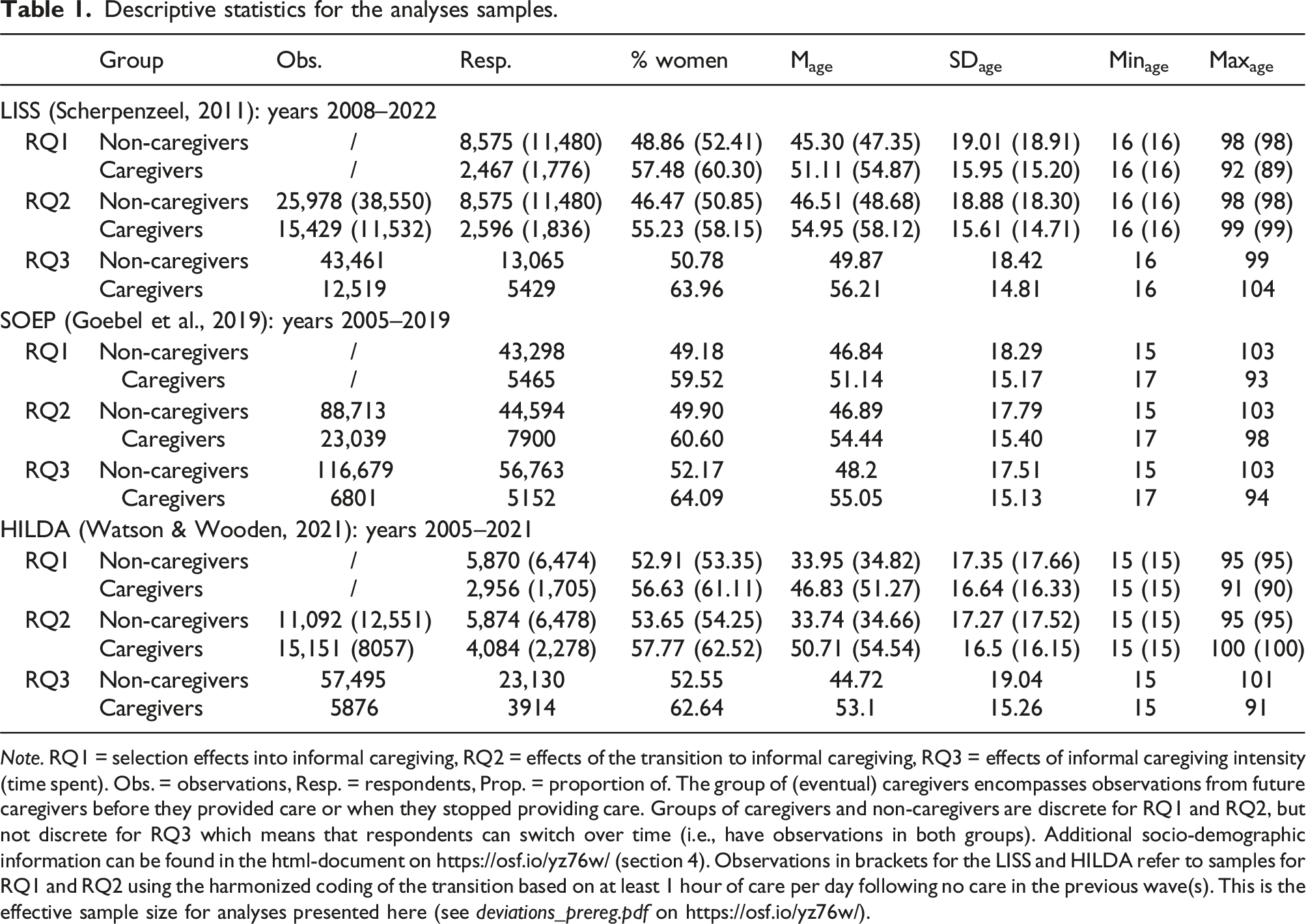
Note. RQ1 = selection effects into informal caregiving, RQ2 = effects of the transition to informal caregiving, RQ3 = effects of informal caregiving intensity (time spent). Obs. = observations, Resp. = respondents, Prop. = proportion of. The group of (eventual) caregivers encompasses observations from future caregivers before they provided care or when they stopped providing care. Groups of caregivers and non-caregivers are discrete for RQ1 and RQ2, but not discrete for RQ3 which means that respondents can switch over time (i.e., have observations in both groups). Additional socio-demographic information can be found in the html-document on https://osf.io/yz76w/ (section 4). Observations in brackets for the LISS and HILDA refer to samples for RQ1 and RQ2 using the harmonized coding of the transition based on at least 1 hour of care per day following no care in the previous wave(s). This is the effective sample size for analyses presented here (see deviations_prereg.pdf on https://osf.io/yz76w/).
We included all respondents with information on both informal caregiving and personality. Specifically, for investigating selection effects (RQ1), we used the last available personality assessment before the transition in the group of (future) caregivers and the last available personality assessment in the group of non-caregivers, given that data on socio-demographic covariates was complete. Investigating the transition to caregiving (RQ2), we included as caregivers those respondents who reported providing informal care after not having done so in the previous assessment wave and as non-caregivers those who never reported providing care. Analyzing the time spent on caregiving (RQ3), we included any observations with valid information on the hours of care they provided and on personality.
Measures
We compiled details about the measurement instruments including their internal consistencies, transformations, and complete scale references in Table S1. Additionally, an overview on the survey years we used is shown in Table S2.
Personality
The LISS used a 50-item version of the IPIP Big Five Inventory scales (Goldberg, 1992) to assess personality in each year but with planned missingness in some years (Denissen et al., 2019). Each trait dimension is measured with 10 items answered on a 5-point Likert scale (1 = very inaccurate, 2 = moderately inaccurate, 3 = neither inaccurate nor accurate, 4 = moderately accurate, 5 = very accurate). Example items included “have a vivid imagination” (openness), “like order” (conscientiousness), “start conversations” (extraversion), “sympathize with others’ feelings” (agreeableness), and “worry about things” (neuroticism). Internal consistencies ranged from
In the SOEP, personality was assessed with a 15-item short form of the Big Five Inventory with 3 items per trait dimension (BFI-S; Schupp & Gerlitz, 2008). Items were answered on a 7-point Likert scale (1 = does not apply at all, 7 = applies completely). Example items included “has a vivid fantasy, imagination” (openness), “works thoroughly” (conscientiousness), “is communicative, talkative” (extraversion), “is considerate and kind to others” (agreeableness), and “worries often” (neuroticism). Internal consistencies ranged from
In the HILDA, 36 adjectives measured the Big Five personality traits (Losoncz, 2007). Respondents were asked to rate on a 7-point scale how well each item described them (1 = does not describe me at all, 7 = describes me very well). Example adjectives included “imaginative” (openness), “orderly” (conscientiousness), “talkative” (extraversion), “sympathetic” (agreeableness), and “moody” (neuroticism). Due to unfavorable psychometric characteristics when using all items, we restricted the scales to six items for neuroticism, five each for conscientiousness, agreeableness, and openness, and four for extraversion when forming scale scores, following the approach extensively documented by Seifert et al. (2022). Internal consistencies ranged from
We took each respondent’s mean of each subscale as their trait score, and, for better comparability across samples, POMP-scored trait scores to be interpretable on a scale from 0 to 100 (Cohen et al., 1999).
Informal caregiving
In the LISS, informal caregiving was assessed asking “Did you perform any informal care over the past 12 months; that is, did you regularly help someone in your environment requiring help due to a disease or other affliction?”, followed by the question “How many hours of informal care did you provide per week, on average?”. In the SOEP, informal caregiving was indicated by the time-use question “What is a typical weekday like for you? How many hours per normal workday do you spend on the following activities? – Care and support for persons in need of care”. In HILDA, we also relied on a time-use question, “How much time would you spend on each of the following activities in a typical week? – Caring for a disabled spouse or disabled adult relative, or caring for elderly parents or parents-in-law”. This question was part of the additional self-completion questionnaire which resulted in somewhat higher initial non-response in HILDA.
We further harmonized the coding of the transition to caregiving by only considering caregiving of at least 1 hour per day following no caregiving in the previous year as a transition in the LISS and HILDA. We did this because the SOEP only assessed whole hours per day (for more detail see Table S3 and deviations_prereg.pdf on https://osf.io/yz76w/; original results are presented in the html-document, sections 5.1.2 and 5.2.1-8 on https://osf.io/yz76w/).
Moderators
Gender
All three panels assessed gender as a binary variable which we dummy-coded (0 = men, 1 = women).
Personal care activities
Caregivers in the LISS described the kinds of care tasks they engaged in. In the SOEP, information about the care recipient’s insurance-relevant care level could be linked to the household caregiver to derive an indicator of care intensity. Therefore, a smaller subset of informal caregivers who reported providing care within the household was used for this analysis in the SOEP. A time-varying moderator personal care (e.g., washing, dressing; 0 = no, 1 = yes) was dummy-coded in both samples. There was no consistent information on care activities in the HILDA panel.
Relationship with care recipient
In all three studies, we dummy-coded the moderator care in household (0 = no, 1 = yes). LISS respondents reported on the specific relationship with care recipients allowing us to distinguish between romantic partners, close relatives (parent, sibling, or child), and others for exploratory follow-up analyses.
Fulltime employment
A threshold of 36 weekly work hours or more indicated fulltime employment (0 = no, 1 = yes) in the LISS, because this constitutes a fulltime job in the Netherlands. We relied on labor force status variables for SOEP and HILDA.
Covariates
For analyses of selection into the caregiving role (RQ1), we additionally included measures of education, employment status, and marital status as covariates. Their exact coding and variable distributions are shown in the html-document on https://osf.io/yz76w/ (sections 3.1 and 4.8).
Analytical strategy
Selection into caregiving
To investigate who selected into the informal caregiving role (RQ1), we ran logistic regression models at the last available pre-transition observation of caregivers and the last available observation of non-caregivers. These models predicted allocation to the treatment group (eventual caregivers) from z-standardized Big Five personality traits, gender, age, education, employment status, and marital status. Additional exploratory models also included well-being aspects (life satisfaction, positive/negative affect, depression/anxiety, loneliness) as covariates or removed all predictors except personality traits.
Transition to informal caregiving
We used fixed effects models to analyze how informal caregiving affects personality longitudinally (RQ2-4; Allison, 2019; McNeish & Kelley, 2019). In longitudinal data, fixed effects models only analyze within-person variance. This is achieved by including a cluster affiliation dummy variable for each person which is conceptually similar to person-mean centering of all variables in multilevel models (Hamaker & Muthén, 2020). Fixed effects modeling is advantageous when the main goal is to estimate average within-person effects of change. Conversely, multilevel modeling would offer more flexibility because it allows for specifying between-person effects as well as random slopes of change (McNeish & Kelley, 2019)—both not a focus of the current research—but would be limited in its control of confounders to those variables measured and included in the model, either directly as covariates or through propensity score methods (Austin, 2011; Chatton & Rohrer, 2024). Thus, the main advantage of the fixed effects models was automatic control for the time-invariant effects of stable background characteristics—both observed and unobserved—such as prior education, intelligence, or stable traits. Thereby, fixed effects models are not biased by omitted time-invariant confounding and provide a clear focus on within-person change.

Exemplary coding scheme to model the transition to informal caregiving (RQ2).

Note. −2 = year 2 before the transition; −1 = year 1 before the transition; 1 = year 1 after the transition; 2 = year 2 after the transition; ≥3 = 3 or more years after the transition. first_three = control for initial elevation bias in the first three years of panel participation. paused = control for temporary pausing of caregiving. stopped = control for stopped caregiving up until the last assessment. See Table S3 for more details.
Longitudinal observations for investigating temporal effects of the transition to informal caregiving (RQ2).

Note. −2 = year 2 before the transition; −1 = year 1 before the transition; 1 = year 1 after the transition; 2 = year 2 after the transition; ≥3 = 3 or more years after the transition. Observations in brackets for the LISS and HILDA refer to samples for RQ1 and RQ2 using the harmonized coding of the transition based on at least 1 hour of care per day following no care in the previous wave(s). This is the effective sample size for analyses presented here (deviations_prereg.pdf on https://osf.io/yz76w/; results without this harmonization procedure are presented in section 5.2.8 on https://osf.io/yz76w/).
Time spent on caregiving and moderators
Next, we included all observations with information on how much time respondents spent on informal caregiving and used a linear predictor hours of caregiving to analyze how changes in the time spent on caregiving affected personality traits (RQ3). Here, we also used fixed effects models to analyze within-person variance and, thus, estimate how a within-person change in the hours of caregiving related to personality trait change. The exemplary model formula predicting openness (Open) reads:
Lastly, for moderation analyses (RQ4), an interaction term with the respective moderator was added to the model. For example,
Software
We used the tidyverse packages for data cleaning and plotting (Wickham et al., 2019) and the plm package (Version 2.6-3; Croissant & Millo, 2008) for fixed effects modeling in R (Version 4.3.1; R Core Team, 2023) where we applied panel-robust (clustered) standard errors to account for nested data. Our main inference criterion was
Results
Descriptively, informal caregivers across the three studies were more likely to be female, older, and slightly higher in conscientiousness and agreeableness compared to respondents who did not provide informal care (and in the SOEP only, also higher in neuroticism; see Tables 1 and S3). Overall, differences in personality were small, however. Next, we present effects of interest and their confidence intervals for the four research questions (see Figures 1–4). The supplementary html-document on https://osf.io/yz76w/ shows variable distributions (section 4.7) as well as complete model results (sections 5.1–5.4). Personality selection effects into the caregiving role. Note. We estimated joint models including all Big Five traits. Models controlled for a preregistered set of socio-demographic indicators (see Figure S1 for full model results). For models without covariates or with each Big Five trait individually, see html-document section 5.1.4 on https://osf.io/yz76w/. Personality trait change trajectories over the transition to informal caregiving. (a) Openness, (b) Conscientiousness, (c) Extraversion, (d) Agreeableness, (e) Neuroticism. Note. Effects reflect changes in personality outcomes on the POMP scale from 0 to 100 (see Table S4 for descriptive trait levels). Confidence intervals (both 95% and 99%) reflect the precision of the estimated effects. The horizontal line indicates no within-person changes. The vertical, dashed line indicates the approximate timing of the transition to informal caregiving. These models are based on the harmonized coding of the transition (at least 1 hour of care per day); original, preregistered transition models are presented on https://osf.io/yz76w/ (html-document section 5.2). Effects of time spent on informal caregiving on personality. Note. Effects reflect a within-person increase of 1 hour per day and are reported on a POMP scale from 0 to 100 (see Table S4 for descriptive trait levels). Moderators of the effect of time spent on informal caregiving on personality. Note. Conscientiousn. = conscientiousness.


Selection into the caregiving role
First, we investigated selection effects of personality on informal caregiving. In contrast to hypothesis H1, initial Big Five levels in the year before people became informal caregivers did not systematically contribute to these selection effects (see Figure 1), with the exception of openness. With higher openness, there was a higher likelihood to select into the caregiving role in all three studies (e.g., LISS: b = 0.10, 99% CI [0.02; 0.18], p = .002). In the unadjusted model without additional socio-demographic covariates, this effect only replicated for the SOEP, though (b = 0.05, 99% CI [0.01; 0.09], p = .001). In the LISS, higher agreeableness was also related to a higher likelihood to become a caregiver (b = 0.23, 99% CI [0.15; 0.31], p < .001). In the SOEP and HILDA, however, this effect was only significant in the unadjusted models (HILDA: b = 0.21, 99% CI [0.13; 0.29], p < .001). Although some individual effects were significant for conscientiousness, extraversion, and neuroticism, they were not consistently linked to selection effects across studies and models (see html-document section 5.1.4 on https://osf.io/yz76w/).
Transition to informal caregiving
Across the three samples, there was little evidence for changes in personality over the transition to becoming an informal caregiver (see Figure 2). The one exception to this were significant increases in neuroticism in the year after transitioning into caregiving in the SOEP (men: b = 1.96, 99% CI [0.02; 3.89], p = .009; women: b = 1.87, 99% CI [0.28; 3.46], p = .002). This effect was barely not significant for women two years after the transition, b = 1.61, 99% CI [-0.002; 3.22], p = .010, but close to zero in the following years, b = 0.17, 99% CI [-1.03; 1.38], p = .712. The increase in neuroticism observed in the SOEP was, however, not present in both LISS and HILDA.
Time spent on caregiving
Next, we examined how changes in the time spent on caregiving affected personality. Most caregivers provided low levels of care (Mdn = 0.57 hours in the LISS, 2 hours in the SOEP, with only whole hours reported, and 0.86 in HILDA). With more time spent on caregiving, respondents in the SOEP reported slightly higher neuroticism (see Figure S2). For the other traits, no substantial descriptive trends were recognizable.
Models of within-person change showed that neuroticism increased in the SOEP when people increased the time they spent on informal caregiving, b = 0.45, 99% CI [0.26; 0.65], p < .001; see Figure 3). This result did not replicate in the LISS and HILDA. In addition, we found in the LISS a smaller increase in agreeableness, b = 0.12, 99% CI [0.05; 0.20], p < .001, which, again, did not replicate in the other two samples.
In exploratory, preregistered follow-up analyses we investigated quadratic effects of caregiving time on personality. We found that increases in neuroticism with higher hours of care followed a quadratic trajectory in both the LISS (b linear = 0.30, 99% CI [0.06; 0.53], p = .001; b quadratic = −0.01, 99% CI [0.0005; 0.02], p = .007) and SOEP (b linear = 0.96, 99% CI [0.61; 1.31], p < .001; b quadratic = −0.03, 99% CI [-0.06; −0.01], p < .001; see html-document section 5.3.7.2 on https://osf.io/yz76w/). This means that initial increments in the time spent on caregiving (e.g., from 0 to 2 hours) had a larger effect on neuroticism than middle range increments. Still, quadratic effects were small and data points concentrated in the lower range of hours (see Figure S2).
Moderators of the effects of time spent on caregiving
Lastly, we tested whether four theoretically derived moderators explained how the time spent on caregiving affected personality trait change (see Figure 4). First, we found only suggestive (at p < .05) and inconsistent evidence for gender differences: In the SOEP only, there was suggestive evidence that women experienced slightly less pronounced increases in agreeableness with higher caregiving time than women, b = −0.29, 99% CI [-0.59; 0.02], p = .016 (see Figure S3a). However, main effects of change remained significant in both men and women. Second, in HILDA only, there was suggestive evidence that caregivers experienced more pronounced decreases in extraversion when care was intensified within the household, b = −0.28, 99% CI [-0.58; 0.02], p = .016 (see Figure S3b). Third, exploratory analyses in the LISS revealed that when care was intensified for a close relative conscientiousness decreased to a higher degree, b = −0.22, 99% CI [-0.38; −0.07], p < .001 (see Figure S3c). Fourth, effects did not differ between caregivers who were fulltime employed and those who were not. Thus, overall evidence for moderation effects was very thin.
Item-level analyses
As an additional robustness check, we performed item-level analyses to gauge the consistency of results across the three studies depending on the items used in the different personality measures. To this end, we used the 15 items from the BFI-S in the SOEP as the basis (i.e., running separate models for each of the 15 items) and matched corresponding items from LISS and HILDA based on overlap in item content. This matching is detailed in the preregistration update (https://osf.io/2jt6v). Here, we present item-level findings that replicated across all studies which included the respective item(s). Full results of the item-level analyses can be found in the Supplement (see Figures S4-S7) and the html-document (section 6, on https://osf.io/yz76w/).
In terms of selection effects, we found that respondents who reported to be less lazy had a higher likelihood to make the transition to provide informal care (e.g., LISS: b = 0.09, 99% CI [0.03; 0.16], p < .001; see Figure S4). In addition, item-level analyses indicated that respondents who tended to be more worried had a higher likelihood to become a caregiver (e.g., LISS: b = 0.10, 99% CI [0.03; 0.17], p < .001). When including items in separate models, we found that items measuring agreeableness (being considerate, forgiving, less rude) were also related to a higher likelihood of becoming a caregiver (e.g., considerate in LISS: b = 0.20, 99% CI [0.14; 0.26], p < .001).
Modeling the effects of the transition into informal caregiving on personality on the item-level, we found no consistent evidence for within-person changes (see Figure S5). Only rarely did effects emerge as significant (e.g., nervous, worried) and, in those cases, they were inconsistent across studies.
Increases in the intensity of informal caregiving affected personality on the item level in the following ways (see Figure S6): As caregivers spent more time on care, they reported to be less lazy (LISS: b = 0.22, 99% CI [0.04; 0.41], p = .002; SOEP; b = 0.28, 99% CI [0.01; 0.55], p = .009), more considerate (LISS: b = 0.26, 99% CI [0.04; 0.48], p = .002, HILDA: b = 0.28, 99% CI [0.06; 0.50], p < .001, but n. s. in SOEP), and more worried (LISS: b = 0.38, 99% CI [0.17; 0.60], p < .001; SOEP: b = 0.86, 99% CI [0.58; 1.14], p < .001).
Finally, moderation analyses on the item level revealed that with increasing intensity of caregiving those who provided care for someone in their household reported to be less worried, compared to providing care outside the household (LISS: b = −0.60, 99% CI [-1.09; −0.11], p = .002; SOEP; b = −0.75, 99% CI [-1.35; −0.14], p = .001; see Figure S7). Other significant moderation effects did not replicate across studies.
Discussion
The ways in which informal caregiving can affect psychological experiences have been examined and debated in different fields (Kramer & Kipnis, 1995; Marino et al., 2017; Ruppanner & Bostean, 2014), but mostly outside psychology and with mixed results. While most of this research has focused on health and well-being, the role of personality trait differences has so far mostly been neglected. Here, we comprehensively examined personality selection and socialization effects of informal caregiving in three large-scale, representative studies.
We found that personality traits affected the likelihood of selecting into the caregiving role in subtle ways: open people were more likely to become a caregiver, whereas effects of other traits were sample-specific. We found no consistent evidence for changes in personality over the course of the transition to a caregiver role. However, with increasing time spent on caregiving, respondents in the LISS increased in agreeableness, while those in the SOEP increased in neuroticism. Here, analyses on the item-level shed further light on nuances of the effects. The person-level and contextual moderators of the effects of increasing care hours that we examined did not consistently shape the ways in which informal caregiving affects personality change.
Selection effects
Unexpectedly, the only finding that was consistent across all three studies was that openness related to selection into caregiving. With higher openness, people were more likely to take on the role of informal caregiver, although this effect was small in size. While openness is traditionally not seen as influencing prosocial behavior, our finding is in line with recent findings on more open people performing civic engagement duties more frequently, specifically volunteering and vaccination (Bleidorn et al., 2024; Stahlmann et al., 2023). Previous findings that higher agreeableness and higher neuroticism increase the likelihood to become a caregiver only replicated in the sample of each original study, that is, higher agreeableness in the LISS (Kuper et al., 2023), and higher neuroticism in the SOEP (Rohr et al., 2013). On the item-level, however, results were more consistent between LISS and SOEP. Respondents reporting to be less lazy, more considerate, and more worried had a higher likelihood to transition into caregiving roles in both studies, partly in line with our original expectations (H1). Thus, perhaps trait domains were too broad content-wise to detect these more subtle selection effects.
Socialization effects
Models of within-person personality trajectories across the transition to informal caregiving did not reveal substantial mean-level development. This is in contrast to both our expectations for neuroticism (H2) derived from stress theory (Pearlin et al., 1990) and more general frameworks of personality development (Roberts & Nickel, 2017; Roberts & Wood, 2006). Importantly, our study has focused on mean-level changes. Individual development might still occur but may be masked when looking at these average trends. Future research might further investigate rank-order stability and interindividual differences in intraindividual change, 1 or approach informal caregivers’ personality change from an idiographic, person-centered perspective (Beck & Jackson, 2022; Jackson & Beck, 2021; Schwaba & Bleidorn, 2018; Schwaba et al., 2023; Wright & Jackson, 2024).
Examining how the time spent on caregiving may affect personality change, we only found two sample-specific effects on the level of trait dimensions that were in line with previous evidence (Kuper et al., 2023; Rohr et al., 2013). As informal caregivers increased the hours of caregiving, they reported higher agreeableness in the LISS and higher neuroticism in the SOEP. The effect for neuroticism also emerged in the LISS when we added quadratic trends of hours of care to the model. Thus, while not completely consistent across studies, there was preliminary evidence that higher intensity caregiving related to increases in neuroticism (supporting hypothesis H3). Therefore, it is possible that personality change only occurs with high-intensity, in-home caregiving, whereas considerable proportions of the current samples only spent one or 2 hours per day providing care to people outside their household. The effect for neuroticism might also be explained by heightened grief and worry when the care recipient progressively declines in health (Wünsche et al., 2020), which fits the broader literature on negative well-being effects of informal caregiving (Gerlich & Wolbring, 2021; Krämer & Bleidorn, 2024; Oshio, 2014; Zwar et al., 2020) and the established relationship of neuroticism with well-being (Anglim et al., 2020).
Two additional factors might explain the null findings of neuroticism socialization effects in the HILDA (and the LISS with linear hours of care). First, it is possible that specifics of each country’s health care and welfare system exerted a stabilizing effect on informal caregivers’ neuroticism, whereas in Germany these systems failed to assist caregivers accordingly. It remains, however, very difficult to evaluate whether such country-level variables are responsible for the observed difference in effects. In some circumstances, policy reforms might be used as natural experiments to estimate causal effects of policy in instrumental variable designs (Grosz et al., 2024; Zhu & Onur, 2023). Second, the between-study differences might be explained by the instruments that were used to assess personality dimensions, which had more content overlap with emotional changes potentially experienced by informal caregivers in the SOEP (relaxed, nervous, worried) compared to the HILDA (e.g., envious, fretful, temperamental; see preregistration update on https://osf.io/2jt6v for the item matching).
Thus, in addition to trait dimensions, our analyses of personality nuances offered valuable complementary information to investigate the role of personality in informal caregiving. In fact, we found that with increasing time spent on caregiving, informal caregivers reported to be less lazy, more considerate, and more worried—consistent across studies where the respective items were available in the personality inventories. Together with the selection effects on the level of nuances, this provides initial evidence for the corresponsive principle of personality development (Roberts & Nickel, 2017). Those trait nuances that lead people to select into the caregiving experience were also reinforced by the experience.
Finally, there was no consistent evidence that gender, personal care activities, caring for someone in the own household, or fulltime employment moderated personality change in informal caregivers.
Limitations
First, the inventories that were used to measure personality were not harmonized across studies. In the case of the SOEP, a short 15-item measure was used to reduce respondent burden in a multi-purpose survey. This might have somewhat impeded comparability of results across the three studies and limited reliability of trait scores. To partly address this issue, we performed item-level analyses that matched items based on content across the three studies and found somewhat greater consistency of results, at least when comparing LISS and SOEP. However, although preregistered in an update, this approach was devised ad hoc based on content overlap and not further validated psychometrically. These first indications that personality nuances (Mõttus et al., 2017) play a role in how personality develops in informal caregivers should therefore be replicated in further studies.
Second, to interpret results of the presented models of within-person change in a causal fashion, additional assumptions are necessary. Importantly, we need to assume that no important time-varying confounding variables exist and that the confounding influence of time-invariant variables is stable over time. Our estimates of caregiving effects might have been biased, for example, if changes in caregiver health affected both personality traits and the likelihood to provide informal care or the intensity of care (Löckenhoff et al., 2011; Mroczek et al., 2020).
Third, we estimated informal caregiving effects in the cultural contexts of the Netherlands, Germany, and Australia, but did not test country-level differences formally. Further, the results presented here pertain to the cultural contexts of Western, industrialized countries with comparatively strong welfare systems. Effects on informal caregivers’ personality might further differ both within these countries depending on region and subculture (Kalenkoski et al., 2022; Wagner & Brandt, 2018) and from other non-WEIRD countries (Bhan et al., 2020) where family caregiving norms are stronger because of low availability of formal care options.
Lastly, other contextual moderators might shape the specific care situation and give insights into individual differences of personality change in informal caregivers. Although we considered some contextual moderators, we only had basic information on the exact care tasks that were performed and the relationship to the care recipient, with no information on relationship quality. Study designs zooming into caregivers’ daily lives, for example using ecological momentary assessments, would help gather such contextual factors with a higher resolution compared to yearly surveys (Han et al., 2024). In addition, dual care responsibilities such as with childcare may exacerbate the stress experienced by these so-called “sandwiched” caregivers (Hodgdon et al., 2023) and should be examined in more detail in the future, as should be situations with multiple care recipients at the same time or in succession.
Conclusion
In this examination of personality selection and socialization effects in informal caregivers, we did not find strong evidence for the influence of personality that was consistent across the three large-scale panel studies. For socialization effects, this is in line with other recent studies demonstrating personality stability rather than change in middle and old adulthood, for example over the transition to grandparenthood (Krämer et al., 2023). Of course, it is possible that the time scales or instruments that are typically used in these studies are not suitable to detect such theorized change (Hopwood et al., 2022). Yet, in line with decreases in different psychosocial well-being aspects (Krämer & Bleidorn, 2024), we found some specific effects that replicated across studies, partly on the item-level, indicating increases in informal caregivers’ neuroticism (specifically worrying) as they intensified their commitment.
Supplemental Material
Supplemental Material - Informal care and personality: Selection and socialization effects
Supplemental Material for Informal care and personality: Selection and socialization effects by Michael D Krämer and Wiebke Bleidorn in Personality Science.
Footnotes
Author note
Atsushi Oshio was the handling editor. This research complies with the Declaration of Helsinki and is exempt from approval from a loval ethics board because it uses archival data freely available for scientific use. No artificial assisted technologies were used in this research or the creation of this article.
Acknowledgements
We thank everyone at the German Institute for Economic Research (DIW Berlin), Centerdata/Tilburg University, and the Melbourne Institute involved in making their data available to the research community.
Author contributions
Declaration of conflicting interests
The author(s) declared the following potential conflicts of interest with respect to the research, authorship, and/or publication of this article: Wiebke Bleidorn is a member of the journal’s editorial board.
Funding
The author(s) received no financial support for the research, authorship, and/or publication of this article.
Data accessibility statement
Preregistration: The hypotheses, methods, and analysis plan were preregistered (https://osf.io/35spn) on 2023-09-13 prior to any analyses as “Study 1”. Another manuscript described as “Study 2” in the preregistration targets well-being changes. Data were already collected but not cleaned at this time. An update to this preregistration made minor adjustments to the analysis plan, added the third data set (HILDA), and detailed the item-level analyses (posted on 2023-10-30 after analyses of personality in the first two data sets at https://osf.io/2jt6v). There were two minor deviations from the preregistration (see deviations_prereg.pdf on  ). Materials: All study materials are publicly available (see Supplemental Material Table S1 at https://osf.io/yz76w/). Additional documentation can be found on the individual panel study websites. Data: Archival data cannot be uploaded to third-party repositories because of data protection regulations but are freely available for scientific use to registered data users of the Dutch Longitudinal Internet Studies for the Social Sciences (LISS; https://www.lissdata.nl), German Socio-Economic Panel (SOEP; Version 38; https://www.diw.de/en/soep), and Household, Income and Labour Dynamics in Australia (HILDA; General Release 21.0; https://melbourneinstitute.unimelb.edu.au/hilda). All data cleaning and analysis scripts as well as html-documents of output are publicly available (https://osf.io/yz76w/).
Supplemental material
Supplemental material for this article is available online. Depending on the article type, these usually include a Transparency Checklist, a Transparent Peer Review File, and optional materials from the authors.
Note
References
Supplementary Material
Please find the following supplemental material available below.
For Open Access articles published under a Creative Commons License, all supplemental material carries the same license as the article it is associated with.
For non-Open Access articles published, all supplemental material carries a non-exclusive license, and permission requests for re-use of supplemental material or any part of supplemental material shall be sent directly to the copyright owner as specified in the copyright notice associated with the article.
