




Abstract
In this study we examined variation in three human attitudes towards animals—speciesism, belief in sentience, and rationalizing animal consumption—across Eastern and Western cultures and demographic characteristics within cultures, and whether individual predictors vary as a function of culture. Analyses were based on 20,996 participants from 23 countries. We examined mean-level differences and associations with inter-individual differences in multi-group confirmatory factor analysis models across both countries and Eastern/Western groups. Participants from Western countries reported much lower speciesism and somewhat higher beliefs in animals’ capacity to experience emotions, but cultural differences in rationalizing animal consumption were small and less culturally systematic. In both culture groups, being female and more left-leaning was associated with lower speciesism and acceptance of animal consumption. Whereas stronger beliefs in animal sentience were associated with lower speciesism in Western but not Eastern countries, they also co-occurred with stronger justifications for land and sea animal consumption in both culture groups—suggesting that the more one believes that animals are sentient, the more cognitive effort is required to consume them. This study provides new insights into how cultural factors affect and interplay with individual factors regarding attitudes toward animals.
Humans have a complex relationship with non-human animals (hereafter, animals). At one extreme, humans understand themselves as qualitatively different from and morally superior to animals, and thus as having the natural right to use animals as they see fit for their own ends. At the other extreme, humans and animals are thought to have essentially equal worth and rights, implying that both should be treated with reverence and respect (e.g., Miller & Dickstein, 2021). Variation in these attitudes may be influenced by both individual and societal or cultural differences.
At the individual level, existing evidence has documented reliable influences including gender identity (Herzog et al., 1991), age (McGuire et al., 2022), political orientation (Dhont et al., 2016), and beliefs about animal sentience (Everett et al., 2019). At a broader societal level, attitudes towards animals are conferred in part by complex cultural traditions, familial norms, and historical trends (e.g., Bai, 2009; Oleschuk et al., 2019; Rawls, 1996). For instance, some cultural traditions that assume a strict human-animal hierarchy nevertheless maintain careful rules about humane treatment of animals, such as the Halal or Kosher food laws in Islam and Judaism, respectively (Farouk et al., 2016; Regenstein et al., 2003). Individual-level reasons may not necessarily apply in the same ways across cultures. For example, it is possible that individual and cultural factors interact, such that associations between demographic and psychological factors and attitudes towards animals found in Western samples will be weaker, or even not apply, to Eastern populations.
The goal of this study was to examine cultural and individual level predictors of human attitudes towards animals, as well as the interaction between these two levels of analysis, in large gender and age representative adult samples from 23 countries (14 Western, 8 Eastern, and Russia, which is considered both Eastern and Western). We specifically aim to test whether (a) negative attitudes towards animals are higher in Eastern relative to Western samples, (b) political orientation, gender identity, age, and belief in sentience predict attitudes towards animals within nations, and (c) these individual level predictors are stronger in Western relative to Eastern samples.
Human attitudes about animals
Human attitudes about animals can be conceptualized both as abstract beliefs and as a more concrete expression in the form of rationalizations for animal use. At an abstract level, speciesism refers to the assignment of moral worth based on species membership (Singer, 2009). People who are high in speciesism tend to think that humans have more moral worth than animals, whereas for people who are low in speciesism, moral worth is more similar across species. Several studies have established that speciesism functions in ways that are very similar to other within-human “isms” that are used to outgroup and oppress minority or underpowered sub-populations, such as racism, sexism, and homophobia (Costello & Hodson, 2010; Dhont et al., 2014, 2016, ; Everett et al., 2019). For instance, Costello and Hodson (2010) found that people who see less similarity between humans and animals, either as an enduring belief or as a function of experimental manipulation, also tend to have more negative views of immigrants. Dhont and colleagues (2014, 2016) found that speciesism and other outgrouping attitudes could be explained by a general tendency for social dominance and authoritarian worldviews, leading to their Social-Dominance Human-Animal Relations (SD-HARM) model. In this model, social cognitive tendencies that are framed by hierarchical attitudes that privilege ingroups explain the connections across various “isms” and situates speciesism as an organizing variable for conceptualizing human intergroup relations both within and across species.
Abstract attitudes and beliefs that diminish the moral worth or mental capacities of animals can manifest in rationalizations for participating in animal harm. Previous research has identified four reasons - dubbed the “4 Ns” - as the most common reasons people give for why they think it is acceptable for animals to be raised and consumed as food (Piazza et al., 2015). These four reasons are the beliefs that it is natural (in terms of ancestral evolution and human physiology), normal (common), necessary (for health), or nice (in terms of taste) to eat animals. Previous research indicated a robust correlation between the 4 Ns and measures of speciesist attitudes (Everett et al., 2019; Hopwood et al., 2021; Piazza et al., 2015; Roozen & Raedts, 2022). Thus, the 4 Ns construct reflects one way abstract speciesist attitudes can manifest and have real world implications in daily life in terms of individuals’ willingness to exploit animals.
The general goal of this study was to better understand cultural and individual predictors of attitudes and beliefs towards animals. We operationalized human attitudes about animals using both speciesism as an abstract worldview and the 4 Ns as a specific manifestation of that worldview. Given that these variables are similar and likely to be highly correlated (Everett et al., 2019), using both of them to compare cultures provides a built-in replication of any findings across measures and may also lead to interesting possibilities about why patterns might differ depending on which variable is used (for instance, if predictors of individual attitudes towards farmed animals differ depending on whether they live on the land or in the sea).
Cultural variation in attitudes about animals
Thus far research on human-animal relations has been conducted primarily in Western populations. One of the main goals of this project was to examine the degree to which these attitudes extend to non-Western populations. We therefore use data from 23 countries on five continents to examine cultural variation in speciesist attitudes.
There are a variety of ways to account for cultural and national variation. One commonly discussed distinction is between WEIRD (Western, Educated, Industrialized, Rich, and Democratic) and non-WEIRD countries (Henrich et al., 2010), which is relevant because most existing research in psychology comes from WEIRD countries in North America and Europe. However, there is no accepted list of officially WEIRD versus non-WEIRD countries, and this construct mixes together a variety of factors that could impact human attitudes towards animals (e.g., cultural, educational, and economic features of different countries).
Cultures can also be classified geographically. Cross-cultural research shows that variability along several values and traits across countries is summarized relatively well in terms of East (Asia) versus West (Europe, North and South America). Muthukrishna et al. (2020) created cultural similarity indexes to China and the United States based on a variety of factors including cultural values, personal values, personality traits, cultural tightness/looseness, altruism, and corruption. Their approach produced scores for many countries in the world, including all the countries sampled in this project, in terms of their cultural distance to China or the United States. However, a general conclusion of their study was that Eastern countries and Western countries tended to cluster together, suggesting that they could be grouped for the purposes of making comparisons of other social and psychological constructs such as attitudes towards animals.
Existing research that compares Eastern and Western samples on attitudes towards animals is quite limited but has generally found that attitudes are more favorable in the West (Anderson & Tyler, 2018). For instance, Phillips and McCulloch (2005) showed that American and European college students were more likely to believe in animal sentience and to disapprove of cruel treatment of farm animals than students from Asian countries. Phillips et al. (2012) extended these findings in a larger sample with more nations and a wider range of attitudes about animals. However, neither of these studies examined the measurement equivalence of the attitude assessments, potentially complicating the interpretation of these findings. Indeed, it is possible that results were not directly comparable across groups, or that the means of measurement-equivalent latent variables would not show the same effects. Moreover, like most other research in this area, both studies used convenience samples whose generalization to the broader population is tenuous. In this study, we assessed attitudes towards animals in larger, gender and age representative samples and examine measurement equivalence prior to comparing levels across countries.
Findings from Muthukrishna et al. study help provide some context for these cultural differences. In that study, Eastern countries were “tighter” and less individualistic, which means that people from Eastern countries are more likely to follow social norms. Animal agriculture and consumption is pervasive throughout the world, and to the extent that it supported by speciesism, the 4 Ns, and beliefs that animals are not sentient, such attitudes may be stronger and more uniform in Eastern countries. Western countries valued a focus on the future more in the Muthukrishna et al. study. Given the important role of animal agriculture in the climate crisis, it is possible that individuals in the West who are concerned about environmental issues have begun to question common attitudes about animals to a greater extent than individuals in the East. Finally, the personality traits Agreeableness and Openness were associated with Western cultural values. These traits are also the strongest predictors of vegetarian and vegan diet (Reist et al., 2023).
Based on these cultural differences and preliminary cross-cultural evidence, we expected that levels of speciesism, the 4 Ns, and doubts about animal sentience would be higher in Eastern relative to Western samples.
Individual-level predictors of human attitudes about animals
Individual differences in attitudes towards animals have been studied primarily within a social justice paradigm in recent work with Western samples. From this point of view, negative attitudes towards animals have been understood as mechanisms of oppression, like those that have supported the oppression of various underprivileged human groups throughout history (Dhont et al., 2014, 2016, 2020; Everett et al., 2019; Singer, 2009). This body of work provides a context for understanding the kinds of variables that tend to predict variation in attitudes about animals. For example, people from Western populations who are on the political left have, on average, more positive attitudes towards animals than those on the political right (Dhont et al., 2016). Women, who tend to be on the political left relative to men (Inglehart & Norris, 2000), also tend to have more favorable attitudes towards animals than men (Herzog et al., 1991). Likewise, although political attitudes tend to be stable, it is more common for people to become conservative than liberal as they age (Peterson et al., 2020), and likewise younger people tend to be more concerned about social justice and less speciesist (McGuire et al., 2022).
A related line of work addresses the conflict between people who do not hold right wing authoritarian world views, but nevertheless consume animals while at the same time holding the belief that animals are sentient and thus, on some level, have rights to be treated with respect. Experimental work indicates that this “meat-paradox” creates cognitive dissonance that can be reduced by ignoring the exploitation involved in animal consumption or reframing views about animals in such a way that minimizes their moral standing (Bastian & Loughnan, 2017; Buttlar & Walther, 2018; Dowsett et al., 2018; Pauer et al., 2022; Rothgerber, 2020). This implies that such individuals experience some level of psychological discomfort about exploiting animals, presumably because they believe it is unjust to do so, and thus indirectly supports understanding human-animal relations through a social justice lens.
Fourth, the belief that animals are not sentient would logically justify ranking them as morally inferior and rationalizing their use for human ends. Although human emotions are subjective, and it is not possible for humans to know whether their subjective experience of inner sensations “feel the same” as those of animals (Williams et al., 2020), a large body of research supports the idea that animals with a central nervous system are sentient in some sense (e.g., experience pain or joy; Proctor, 2012). Despite this evidence, people vary in the degree to which they believe that animals are sentient (Leach et al., 2023), and lower levels of this belief have been found to be related to speciesism and tolerance of animal exploitation (Ang et al., 2019; Everett et al., 2019; Leach et al., 2021; Piazza et al., 2020; Piazza & Loughnan, 2016; Tamioso et al., 2018). Moreover, concern for animal suffering diminishes as the perceived utility of that suffering for humans increases (Bastian & Loughnan, 2017; Braithwaite & Braithwaite, 1982; Rothgerber, 2020).
Based on this growing body of work, primarily in Western samples, we predict that people who identify as women and on the left side of the political spectrum, who are younger, and who believe that animals are sentient would have more positive views about animals, in the form of lower speciesism and 4 Ns scores. However, the consistency of these patterns across cultures, and in particular the degree to which these patterns hold in Eastern samples, remains an open question.
Cultural moderation of individual differences in attitudes towards animals
Some evidence suggests that patterns of individual-level predictors of attitudes towards animals may be similar across Eastern and Western cultures (Schnettler et al., 2009). For instance, studies in Asian samples have also found evidence that women and people with more left-leaning political views tend to have more positive attitudes about animals than men and people with more right-leaning views, similar to patterns observed in Western samples (Ling et al., 2016; Sinclair et al., 2017).
However, research on individual factors associated with attitudes about animals in Eastern populations is relatively limited, and the historical, ethnic, and cultural traditions that bear upon attitudes towards animals in Asia may be very different from those that influence attitudes in the West (e.g., Kowner et al., 2019). Thus, paradigms for understanding the psychology of human-animal relationships developed in Western samples may not apply in Asian populations (Risley-Curtiss et al., 2006). For instance, in a qualitative study about dissonance-reducing strategies in Australia and India, Khara et al. (2021) found that Australians tended to focus on animal agriculture in more populated countries, whereas Indians tended to ground their thinking in sociocultural tradition. To the degree that the factors that underlie attitudes towards animals may vary across individuals in a way that is systematically different in the East and West, the factors associated with attitudes towards animals may not be comparable.
The existing literature suggests that, whereas a social justice lens provides a coherent account of individual differences in human attitudes about animals in the West, a complex array of cultural factors may influence attitudes towards animals in the East. Specifically, existing research in Western samples provides a strong basis for predicting that women, people on the political left, younger people, and those who believe in animal sentience would tend to have more positive views about animals in this study. However, to the degree that these findings from Western samples do not accurately capture the factors that influence animal attitudes in the East, these individual-level predictors would tend to be weaker in more collectivist, Eastern samples. We therefore expect a stronger association between the individual-level predictors political orientation, gender identity, age, and belief in sentience in Western relative to Eastern countries.
The present study
Attitudes towards animals matter for human-animal intergroup relations and have also been identified as an important variable for indicating how individuals think about and interact in their social environment, adopt and sustain political values, consume goods, and perceive human impacts on climate health. Such attitudes are reliably related to individual differences in personality and a variety of demographic and societal variables. However, previous research has been limited in accounting for the various factors that underlie attitudes towards animals. By collecting large gender and age representative samples from 23 countries across the world, this study aims to address these limitations and provide a more comprehensive account of individual and cultural variation in attitudes towards animals.
We specifically aimed to test three hypotheses. First, speciesism and the 4 Ns will be higher in Eastern relative to Western countries. Second, attitudes about animals will be more negative among individual people who are more conservative, men, older, and more skeptical about animal sentience. Third, there will be a stronger link between individual attitudes about animals and gender identity, political orientation, age, and belief in animal sentience in Western relative to Eastern countries. Although we focus on East-West differences in this study both for theoretical reasons described above and given that our sampling of 23 countries limits power to examine more fine-grained cultural differences, we also explore differences across individual countries within these broad groups.
Methods
Transparency and openness
All data, materials, and the preregistration of the overall project are available at https://osf.io/tx3u9/?view_only=07504017687249d3bb05d93db9c83914. Hypotheses and analytic approach for this particular study are described in detail in a separate preregistration (https://osf.io/ndh2v?view_only=None). Analysis scripts and supplementary materials for the current study are available at https://osf.io/kdgtx/?view_only=bf22ece589864c73999c987d5ee0b532. All analyses were run in Mplus 8.0 (Muthén & Muthén, 1998-2007) or R version 4.1.3 (R Core Team, 2022) with the R packages ggplot2 Wickham et al., 2016), lavaan (Rosseel, 2012), psych (Revelle, 2020) and semTools (Jorgensen et al., 2016). We report how we determined our sample size, all data exclusions, all manipulations, and all measures in the study. The ethics committee of the College of Arts and Sciences at the University of Zurich declared this study exempt.
Participants
Sample descriptives.

Note. Pol. Ori. = political orientation ranging from 1 = Left (or liberal) to 4 = Center to 7 = Right (or conservative).
Assessments
We used or developed items in English and translated them for all non-English surveys using a back translation process. As part of our preregistration, we already examined the structure of each instrument using Confirmatory Factor Analysis (CFA) models within each country using criteria of CFI >.90 or RMSEA <.10 as indicative of adequate fit, and used model comparison tests with constrained structure (i.e., configural invariance), factor loadings (i.e., metric invariance), and item intercepts (i.e., scalar invariance) to examine measurement equivalence, using changes of ΔCFI ≤−.010 as our criteria for nonequivalence (Chen, 2007). Full details about the measurement models and equivalence tests are available on the OSF page.
Speciesism was measured with four items similar in content to previous scales (e.g., “Humans should be allowed to use farm animals as we want”; Dhont & Hodson, 2014) on a 7-Point Likert scale ranging from 1 = strongly disagree to 7 = strongly agree. CFA models of this measure indicated adequate fit in all 23 countries (average CFI = .979; average RMSEA = .065). To measure internal consistency of our scales, we used both Cronbach’s alpha (α) and McDonald’s hierarchical omega (ω). Both the average α and ω for this scale across countries equaled .77.
The 4 Ns were measured with 8 items that are similar in content to previous scales (e.g., “It is natural to eat meat/seafood”; Hopwood et al., 2021; Piazza et al., 2015) on a 7-Point Likert scale ranging from 1 = strongly disagree to 7 = strongly agree. Four items asked about farmed land animals (i.e., meat), and four about farmed sea animals (i.e., seafood). Each item corresponded to one of the “4 Ns”. Both versions fit the data adequately in all 23 countries (land: average CFI = .994; average RMSEA = .038; sea: average CFI = .993; average RMSEA = .042). For farmed land animals, the average Cronbach’s α and McDonald’s ω across countries were both .88. For aquatic animals, average α was .88 and average ω was .87.
Belief in Animal Sentience was measured with a 6-item questionnaire (e.g., “Farm animals are able to feel pain”) adapted from Phillips and McCulloch (2005) on a 7-Point Likert scale ranging from 1 = strongly disagree to 7 = strongly agree. We specifically asked whether participants believe that farmed animals can feel pain, happiness, fear, boredom, excitement, and calm. Initial CFA modeling suggested the need to allow items asking about pain and fear to correlate and to allow happiness and calm to correlate (i.e., residual correlations). Given that these emotions also tend to covary in multidimensional models of mood (Watson et al., 1988), we correlated their residuals in the measurement model. Having done this, fit was adequate in all 23 countries (average CFI = .954; average RMSEA = .089) except for Brazil (CFI = .871; RMSEA = .151). The average Cronbach’s α was .89 and the average McDonald’s ω was .86 for this scale.
Political Orientation was measured with a single item on a 7-Point Likert scale, ranging from 1 = Left (or liberal) to 4 = Center to 7 = Right (or conservative).
Age was measured in years.
Gender identity was measured with a question on which individuals were asked to indicate whether they identified as female, male, or another category. For this study, we only included scores for people who identified as female or male (n = 164 excluded participants).
Analyses
We have already examined country-level differences in each of the three latent variables in this study as part of the initial preregistered analyses. To ensure that the factor means were comparable across countries despite a lack of scalar measurement invariance in a multi-group confirmatory factor analysis across all countries, we used the alignment approach in Mplus 8.0 (Muthén & Asparouhov, 2018; Muthen & Muthen, 1998-2017). The analyses are described in detail in the pre-registration for the general study (https://osf.io/tx3u9/?view_only=07504017687249d3bb05d93db9c83914).
In the current study, we focus on differences between Eastern and Western cultures. Thus, for our primary analyses we classified countries as either Eastern or Western, based on the work of Muthukrishna and colleagues (2020). Given that Russia was considered similarly Eastern and Western in the Muthukrishna et al. study, we left Russia out for East-West comparisons. Based on the CSI, 14 countries in our sample were Western (Argentina, Brazil, Canada, Chile, Colombia, France, Germany, Italy, Mexico, the Netherlands, Poland, Spain, the United Kingdom, and the United States) and eight were Eastern (China, India, Indonesia, Japan, Malaysia, Singapore, South Korea, and Thailand).
For our main analysis, we used a multi-group confirmatory factor analysis with two groups (i.e., Eastern vs. Western cultures; lavaan R-package; Rosseel, 2012). First, we estimated the measurement model for speciesism, the 4 Ns, and belief in animal sentience across the two groups. We then tested for measurement invariance across groups, by estimating the model (a) without additional parameter constraints (i.e., configural invariance), (b) with equality constraints of factor loadings across groups (i.e., metric invariance), and finally (c) with additional equality constraints on the item intercepts across groups (i.e., scalar measurement invariance). Again, we used changes of ΔCFI ≤−.010 as our criteria for nonequivalence (Chen, 2007). When measurement invariance was violated, we freed the parameter constraints that resulted in the largest model misfit increase (i.e., partial measurement invariance).
For the first hypothesis, we compared the factor means of speciesism and the 4 Ns under scalar measurement invariance constraints between the two culture groups. To do so, we constrained the factor mean of the Western culture group to 0 (i.e., reference scaling). We expected the factor mean in the Eastern culture group to be positive and significant for all three factors (i.e., speciesism; land animal 4 Ns; aquatic animal 4 Ns).
For the second and third hypothesis, we included age, gender, political orientation and belief in animal sentience as predictors of the three factors (see Figure 1). Belief in animal sentience was included as a latent factor, whereas the other covariates are manifest variables. To test the second hypothesis, we examined whether the regression coefficients in both East and West groups are significant and in the expected direction. Model used to examine individual predictors of speciesism and 4 Ns. Note. The model was estimated separately for speciesism, land animal 4 Ns, and sea animal 4 Ns. Or = orientation.
For the third hypothesis, we tested whether the regression coefficients can be constrained to equality across the two groups. We constrained each regression coefficient separately and examine if the constraints decreased model fit (i.e., AIC, BIC,
To account for a potential heterogeneity of effects within the two broad culture groups, we also estimated the model depicted in Figure 1 in a multi-group model across all 23 countries. Because metric invariance was less problematic than scalar invariance in the preregistered analyses across all countries, we used a multi-group confirmatory factor analysis model and freed factor loadings in case of violated metric measurement invariance (i.e., partial measurement invariance). To compare Western and Eastern cultures based on the 23-country model, we pooled the effect sizes (i.e., both factor means and regression coefficients) with a random-effects model (meta R-package; Balduzzi et al., 2019). We compared the pooled effect size between culture groups and examined the heterogeneity of effects within culture groups (τ2 with Restricted Maximum Likelihood estimation; Viechtbauer, 2005).
Results
Measurement invariance
Measurement invariance across culture groups.

Note. CFI = Comparative Fit Index; RMSEA = Root Mean Square Error of Approximation; SRMR = Standardized Root Mean Square Residual. Partial = partial scalar measurement invariance. Acceptable levels of measurement invariance are marked in bold (ΔCFI ≤ −.010).
Mean-level differences
We then examined mean-level differences across culture groups based on the (partial) scalar measurement invariance model. The standardized factor mean differences between the culture groups (i.e., Eastern vs. Western) are presented in Figure 2. As can be seen, participants from the Eastern culture group had higher speciesism scores (d = 0.79; p < .001), and lower belief in animal sentience (d = −0.22; p < .001) than participants from the Western culture group. They also reported lower agreement with it being normal, nice, or natural to eat land (d = −0.10; p < .001) or sea (d = −0.05; p = .002) animals. However, as suggested by the lack of scalar measurement invariance in the 4 Ns, this did not apply to whether it is necessary to eat land or sea animals to be healthy. When looking at the score differences for this item, respondents from the Eastern culture group reported higher average values on this item than their Western counterparts (land: 4.91 vs. 4.46; d = 0.28; p < .001; sea: 4.99 vs. 4.61; d = 0.23; p < .001). In summary, hypothesis 1 was only supported with respect to speciesism and belief in animal sentience, but not the 4 Ns—although we observed some differential item functioning in this case. Mean-level differences between Eastern and Western countries. Note. Depicted are the standardized factor means of the Eastern culture group compared to the Western culture group as a reference (i.e., factor means constrained to 0). Error bars represent the 95% confidence intervals. Positive values indicate higher scores.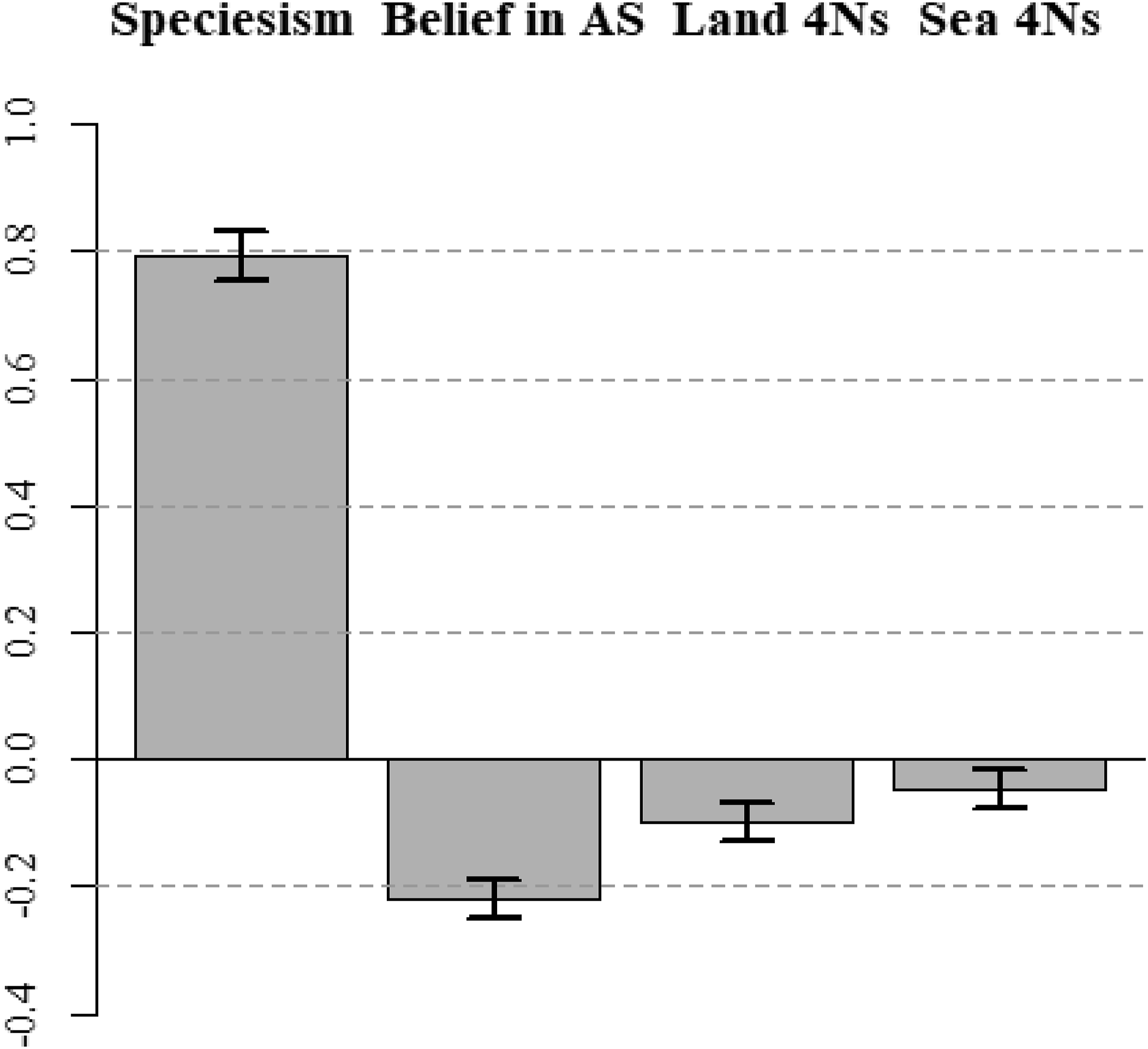
Unstandardized factor means for each country, estimated with the alignment approach in Mplus (see preregistration for details) are presented in Figure 3. The mean-levels represent the difference to the USA mean, which we set to 0 for reference group identification. We chose the USA for this, as it generally had mean-levels close to the overall average across all countries. As can be seen, the mean-level differences for speciesism and beliefs in animal sentience were rather consistent within the culture groups, except for belief in animal sentience in Italy being much lower than in other Western countries. For the 4 Ns, differences were inconsistent, with participants from India scoring by far the lowest on 4 Ns for land animals, and together with Argentina lowest on sea animal 4 Ns. Mean-level differences across countries. Note. Depicted are the unstandardized factor means compared to the USA as a reference group (i.e., USA factor mean constrained to 0) estimated with the Alignment approach. Blue lines represent Western countries, red lines Eastern countries. Argen. = Argentina, Colom. = Colombia, Germa. = Germany, Nethe. = Netherlands, Indon. = Indonesia, Malay. = Malaysia, Singa. = Singapore, Thail. = Thailand.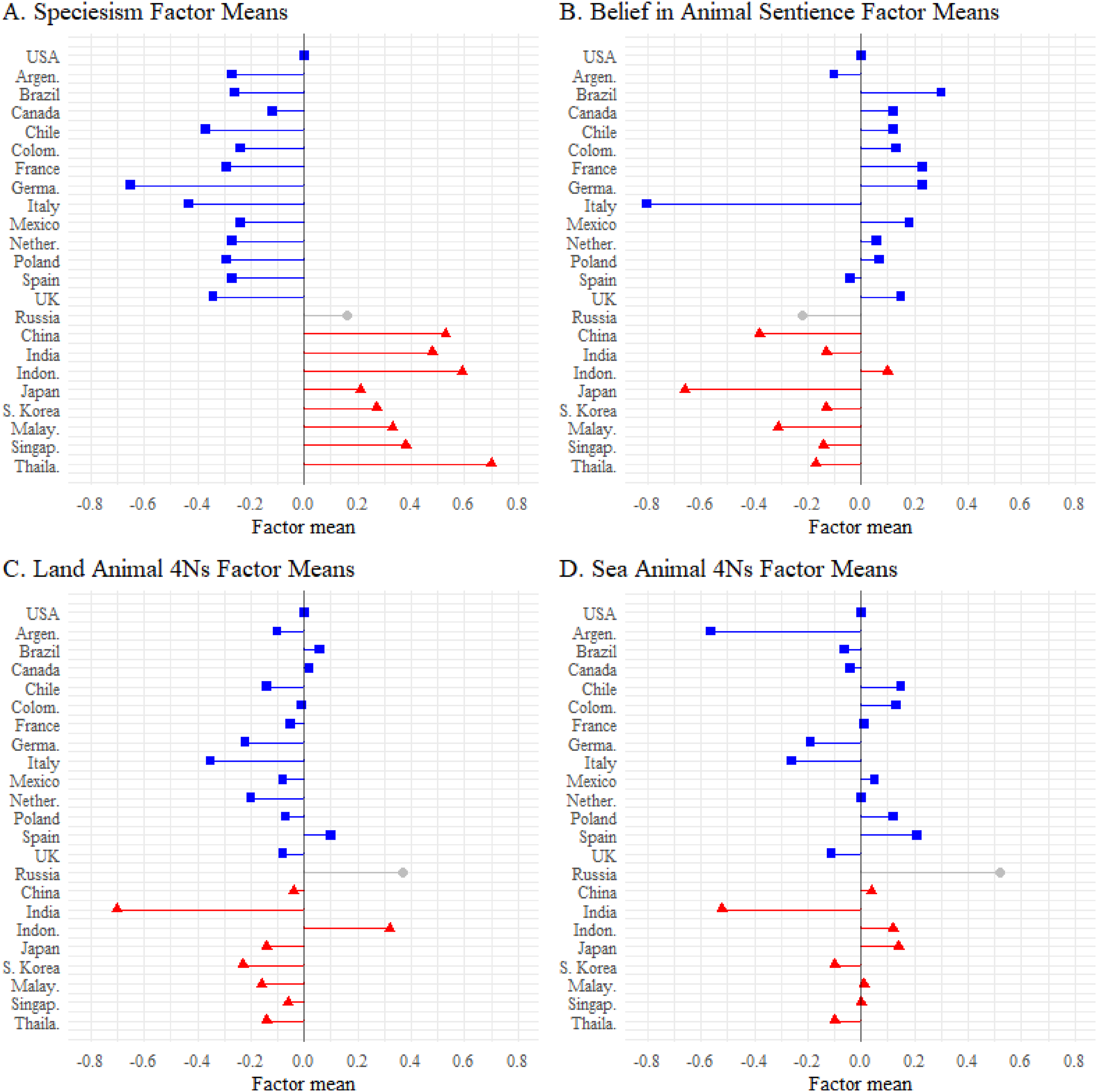
Associations with covariates across cultures
Correlations between political orientation and gender (Western: r = −.05; p < .001; Eastern: r = −.01; p = .226; full sample: r = −.05; p < .001) or age (Western: r = −.05; p < .001; Eastern: r = .02; p = .133; full sample: r = −.02; p = .022) indicate slight tendencies of women and younger participants to be more liberal in Western countries, but not in Eastern countries. However, the associations in Western countries were very small.
Standardized regression weights and equality tests of associations with covariates.

Note. Pol. Or. = Political Orientation. BFAS = belief in animal sentience, Unc. = unconstrained, Con. = constrained. AIC and BIC values in bold indicate whether the unconstrained or constrained model was supported.
Being female and more liberal was associated with lower values in the 4 Ns. Based on the BIC, the effect of political orientation was similar in both cultures (land: Western/Eastern: β = .11/.06; both p < .001; sea: Western/Eastern: β = .08/.04; p < .001 / p = .008), but the effect of gender was stronger in Western cultures (land: Western/Eastern: β = −.13/−.06; both p < .001; sea: Western/Eastern: β = −.10/−.03; p < .001 / p = .014). Findings for the association with age were inconsistent, with younger participants reporting lower 4 Ns for seafood in both culture groups (West: β = .10; p < .001; East: β = .06; p < .001), but not for land (West: β = .01; p = .261; east: β = −.06; p < .001). Contrary to expectations, belief in animal sentience was positively associated with the 4 Ns in Western countries (land β = .09; p < .001; sea β = .13; p < .001), with the associations being significantly stronger in Eastern countries (land β = .22; p < .001; sea β = .23; p < .001). In summary, hypothesis 2 was only supported for gender and political orientation, with belief in animal sentience only being associated with lower speciesism, but not lower 4 Ns. Age did not seem to have an effect. With respect to hypothesis 3, gender had a stronger effect in Western compared to Eastern countries, but the effect of political orientation was similar. Belief in animal sentience also showed stronger negative associations with speciesism in Western countries but was more strongly (and positively) related to the 4 Ns in Eastern than Western countries. All of these results should be conditioned on the fact that all effects were relatively small.
Associations with covariates across countries
To account for a potential heterogeneity of associations within the broad culture groups, we also examined the associations with the covariates at the country level. Metric measurement invariance across the 23 countries was achieved for the 4 Ns (land: configural: CFI = .996; RMSEA = .068; metric: CFI = .992; RMSEA = .060; sea: configural: CFI = .995; RMSEA = .073; metric: CFI = .991; RMSEA = .066). However, metric measurement invariance was not achieved for speciesism (configural: CFI = .985; RMSEA = .087; metric: CFI = .965; RMSEA = .083) and beliefs in animal sentience (configural: CFI = .970; RMSEA = .125; metric: CFI = .957; RMSEA = .117). We thus freed the factor loading of speciesism item 2 (CFI = .979; RMSEA = .073) and belief in animal sentience item 5 and 6 (CFI = .962; RMSEA = .119) for partial metric invariance.
We then estimated the associations with speciesism and the 4 Ns in all countries. To compare the findings to the two-group analysis, we also computed random-effect pooled effect sizes across the standardized regression weights for the two culture groups. The associations are presented in Figures 4–7. The pooled effect sizes were similar to the associations found in the two-group confirmatory factor analysis (see Table 3). Country-level associations with age. Note. Depicted are the standardized regression weights with 95% confidence intervals estimated in a multi-group confirmatory factor analysis. WEST and EAST represent random-effect pooled effect sizes of the corresponding country-level effects. Blue lines represent Western countries, red lines Eastern countries. Dashed lines indicate p > .01. Country-level associations with gender. Note. Depicted are the standardized regression weights with 95% confidence intervals estimated in a multi-group confirmatory factor analysis. WEST and EAST represent random-effect pooled effect sizes of the corresponding country-level effects. Blue lines represent Western countries, red lines Eastern countries. Dashed lines indicate p > .01. Gender was coded such that negative values mean positive associations with men. Country-level associations with political orientation. Note. Depicted are the standardized regression weights with 95% confidence intervals estimated in a multi-group confirmatory factor analysis. WEST and EAST represent random-effect pooled effect sizes of the corresponding country-level effects. Blue lines represent Western countries, red lines Eastern countries. Dashed lines indicate p > .01. Political orientation was coded such that positive associations mean stronger correlations with right-leaning attitudes. Country-level associations with belief in animal sentience. Note. Depicted are the standardized regression weights with 95% confidence intervals estimated in a multi-group confirmatory factor analysis. WEST and EAST represent random-effect pooled effect sizes of the corresponding country-level effects. Blue lines represent Western countries, red lines Eastern countries. Dashed lines indicate p > .01.


Across all countries, the associations differed in terms of absolute effect sizes, but were rather homogenous in terms of the direction of the association. For example, we found negative associations (p < .01) with gender (i.e., being female) in 22 (speciesism), 15 (land 4 Ns) and 10 (sea 4 Ns) countries, but no positive associations. We found positive associations with political orientation (i.e., being more conservative) in 17 (speciesism), 10 (land 4 Ns) and 10 (sea 4 Ns) countries, but no negative associations. For belief in animal sentience, we found negative associations with speciesism in 16 countries, and only 2 positive associations. For belief in animal sentience and 4 Ns, we found positive associations in 13 (land) and 15 (sea) countries, but no negative associations. Only the effects of age were inconsistent: In 3 countries age was positively associated with speciesism or land 4 Ns, and in 3 countries negatively. In contrast, we found 13 positive associations between age and sea 4 Ns, but no negative associations.
Exploratory analysis
Associations between beliefs in animal sentience and the 4 Ns
Item-level correlations between beliefs in animal sentience and the 4 Ns.
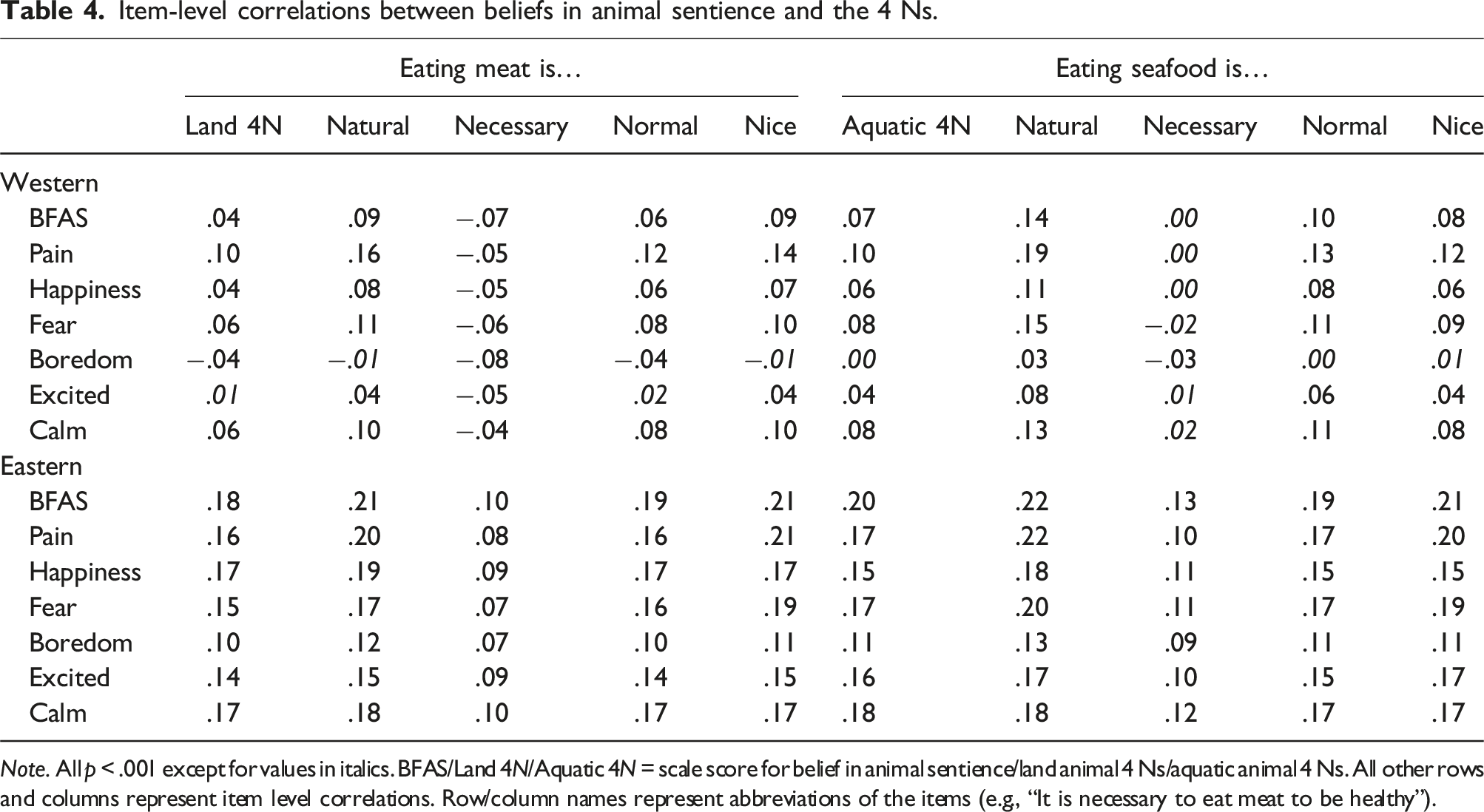
Note. All p < .001 except for values in italics. BFAS/Land 4N/Aquatic 4N = scale score for belief in animal sentience/land animal 4 Ns/aquatic animal 4 Ns. All other rows and columns represent item level correlations. Row/column names represent abbreviations of the items (e.g., “It is necessary to eat meat to be healthy”).
Associations between speciesism and the 4 Ns
Rationalizations for eating animals (i.e., 4 Ns) were understood as more concrete manifestations of the more abstract world belief of speciesism. However, the findings on speciesism and the 4 Ns differed with respect to mean-level differences across countries and in their association with beliefs in animal sentience (i.e., negative for speciesism but positive for the 4 Ns). As such, we examined the degree to which speciesism and the 4 Ns were correlated, and if this association differed across cultures. To do so, we estimated a two-group (i.e., Western vs. Eastern) confirmatory factor analysis including all three factors in one model (CFI = .930; RMSEA = .092). In the Western group, speciesism correlated with land and sea animal 4 Ns by ρ = .34 and .26 (p < .001), respectively. In the Eastern group, speciesism correlated with land and sea animal 4 Ns by ρ = .37 and .29 (p < .001), respectively. These results suggest a moderate to strong association between the two constructs in both culture groups, but also a large degree of unshared variance.
Discussion
We examined to what extent speciesism and the rationales for eating meat or seafood differed across Eastern and Western cultures, individual countries within those cultures, and individuals within those countries. We found that overall, people from Western countries reported less speciesism and a somewhat weaker tendency to rationalize animal consumption. Effects were relatively strong for speciesism in particular, surpassing commonly assumed differences such as modesty bias in job performance ratings (Cho et al., 2023) or interpersonal cooperation (Spadaro et al., 2022).
With respect to individual predictors of differences in speciesism and the rationalization of eating meat or seafood, we found that women and people with a more liberal political orientation reported lower scores than men or more conservative individuals, respectively. While political orientation had a similar association with speciesism and rationalizations of eating land or sea animals across Western and Eastern countries, the effect of gender was somewhat more pronounced in Western countries. However, all effect sizes associated with individual differences in speciesism and the 4 Ns were quite small.
In line with our expectations, stronger beliefs in animal sentience were associated with less speciesist attitudes. However, contrary to expectations, these stronger beliefs also co-occurred with a stronger rationalization of eating land and sea animals. Taken together, our results point to cultural differences in overall speciesism and rationalizations for eating animals, as well as cultural differences in individual predictors thereof. In what follows, we discuss several major themes from this study in terms of how they advance our understanding of human attitudes towards non-human animals.
Cross-cultural validity of animal attitudes
Although some previous research has focused on attitudes towards animals in different cultures, little evidence exists regarding the similarity of attitude constructs across different cultures. Our measurement invariance results suggest that, for the most part, speciesism and belief in animal sentience are comparable across the broad Eastern and Western culture groups. This suggests that they are meaningful and coherent constructs that can be used to understand how people think about animals in different regions of the world. Indeed, we observed scalar invariance for speciesism and animal sentience.
In contrast, we were only able to achieve scalar invariance for the 4 Ns variable by relaxing the intercept that it is necessary to eat meat to be healthy. Whereas cultural differences in the other items were rather small and unsystematic (see Figures 2 and 3), participants from the Eastern culture group reported a higher necessity to eat meat or seafood for health reasons than their Western counterparts. This suggests that this reason for eating animals may not be equivalent across the culture groups. While a large body of research has conceptualized the 4 Ns as a singular construct having to do with the general tendency to rationalize meat eating regardless of specific reasons (Piazza et al., 2015), previous research has shown that they can be distinguished both via covariance analyses of items and in terms of their distinct correlates (Hopwood et al., 2021). Thus, depending on how the 4 Ns are measured, we would not necessarily expect rationalizations to eat animals to form a distinct construct, nor be surprised if some rationalizations to eat animals are not as strongly correlated with others in certain contexts.
Overall, although there are mean-level differences between Eastern and Western countries as elaborated in the next section, evidence for measurement invariance, coupled with similar correlations with gender and political orientation described below, suggest that these variables reflect generalizable and coherent constructs for conceptualizing attitudes towards animals across cultures.
East and West
As discussed in the Introduction, there are a variety of ways to group countries into cultural categories (Henrich et al., 2010; Muthukrishna et al., 2020). In general, our results indicate that distinguishing Eastern and Western countries is reasonable in terms of capturing broad patterns of variation in attitudes towards animals, albeit with exceptions. The distinction between East and West worked particularly well for speciesism and belief in animal sentience. Individuals in Western samples reported much more egalitarian views about interspecies relationships than individuals in Eastern samples. This was the strongest and most consistent effect in the study – the distribution of mean levels was non-overlapping. Although the effect was smaller, individuals in Western samples are also more likely to believe that animals are sentient than individuals in Eastern samples. There were some exceptions here, with particularly low beliefs in sentience in Italy, despite Italy scoring like other Western countries on speciesism and the 4 Ns. It is difficult to explain this effect, which has not been reported to our knowledge in previous research.
In contrast to these relatively clear differences between the East and West, grouping countries this way did not seem to capture cultural differences in rationalizing animal consumption particularly well. Although the pattern of scores is relatively similar for 4 Ns scores as they pertain to land and sea animals, suggesting that cultural attitudes about rationalizing land animal consumption generalize well to cultural attitudes about rationalizing sea animal consumption, there was more heterogeneity in these attitudes within Eastern and Western countries than between them. For instance, India had the lowest scores on both variables. This may be explained by the high proportion of vegetarians in India due to religious beliefs, with around 25.1% participants from the Indian sample reporting to never eat land or sea animals, compared to only 2.1% in the remaining sample. However, Thailand and South Korea also had relatively low scores within the East, whereas Indonesia had relatively high scores. In the West, Italy, Germany, and Argentina tended to have the lowest scores, whereas Canada, Columbia, and Spain tended to have the highest. Interestingly Russia, which we classified as neither Eastern nor Western, had the highest level on this variable. Again, it is difficult to discern a pattern that could explain what these groups of countries have in common. This suggests that examinations of motives for eating animals may need to go beyond broad cultural comparisons to consider narrower cultural and individual factors.
Rationalizing animal consumption, dissonance, and culture
One piece of information that might help us understand influences on rationalizing animal consumption is that belief in sentience was positively correlated with the 4 Ns across cultures. Although we expected the opposite pattern, this finding is consistent with a dissonance account, particularly when one considers that 96.9% of the total sample reported at least occasionally eating land or sea animals. A stronger rationalization for eating meat or seafood while at the same time believing more strongly in animal sentience may represent a mechanism aimed at decreasing the dissonance associated with eating animals that are perceived to experience emotions (e.g., meat-paradox; Bastian & Loughnan, 2017; Buttlar & Walther, 2018; Dowsett et al., 2018; Pauer et al., 2022; Rothgerber, 2020). Our findings indicated that this was primarily achieved through rationalizing that it is normal, natural or nice to eat meat or seafood, but not (Western countries) or to a lesser extent (Eastern countries) that it is necessary for health reasons.
However, dissonance is likely a subtle effect, and other factors, such as cultural beliefs or norms, exposure to different kinds of attitudes, religious beliefs and practices, and education may also influence the rationalization of animal consumption in ways that vary across cultures. For instance, although we found either non-significant or positive associations between belief in sentience and rationalizing animal consumption in all countries, this effect tended to be stronger in Eastern countries. It is possible that in more collectivist countries, reasons for eating meat are more culturally embedded or driven by social influence (Ruby & Heine, 2012), thus putting a stronger emphasis on the rationale for eating meat or seafood to decrease dissonance associated with the “meat-paradox”. More work is clearly needed on how people think about animal consumption in different cultures and as a function of different individual factors.
Interaction of individual differences and culture
One of the main goals of this study was to examine whether demographic predictors that are relatively well-established in Western samples generalize to the East. We anticipated a smaller impact of inter-individual differences on attitudes about animals on more collectivist countries in the East, relative to more individualistic countries in the West. Contrary to this expectation, we found that the negative associations between a more liberal political orientation and speciesism or the 4 Ns (see also Costello & Hodson, 2010; Dhont et al., 2014, 2016, 2020; Everett et al., 2019) were similarly strong across both culture groups (see also Ling et al., 2016; Schnettler et al., 2009; Sinclair et al., 2017).
In line with previous research, women tended to report more positive attitudes about animals or animal treatment (Dhont et al., 2016; Everett et al., 2019; Herzog et al., 1991). The association between gender and speciesism was similar across cultural context, but slightly more pronounced for the 4 Ns in Western countries. Because we controlled for political orientation in the models (women were only slightly more liberal on average in Western countries), this effect may be driven by other associated differences, such as higher empathy in women compared to men (e.g., Baron-Cohen & Wheelwright, 2004; Rueckert & Naybar, 2008).
Age effects were more complicated and may be somewhat culture specific. We found no associations between age and speciesism, and the association with political orientation was so small that age-differences therein would not be able to explain potential associations with speciesism (if not controlling for political orientation). Previous studies on speciesism also did not report any associations with age in adult samples (Everett et al., 2019; McGuire et al., 2022), although there is evidence that children show lower levels than adults (McGuire et al., 2022; Neldner & Wilks, in press). With respect to the 4 Ns, older participants scored lower on land animal 4 Ns only in Eastern countries, and older participants scored higher on sea animal 4 Ns only in Western countries. Because of the heterogeneity of these findings across countries we assume that the mixed findings for speciesism and the 4 Ns may represent sampling error fluctuations around an underlying correlation of zero.
Implications
The main goal of this study was to improve on previous work examining cultural differences in attitudes towards animals by using a larger and more diverse sample and confirming measurement equivalence prior to comparing levels and associations across groups. Hypotheses were thus based on previously reported findings in the literature. However, this study also has important implications both for our understanding of cultural differences in human attitudes about animals and applied implications for enhancing social justice for non-humans.
One of the major findings was that, for the most part, variables reflecting attitudes towards animals function similarly across cultures. This was more evident at the gross East-West level of comparison than when measurement properties were compared across individual countries. It was also more true for the more abstract attitudes speciesism and belief in animal sentience than specific reasons for eating animals, and in particular eating animals for health reasons. This pattern of invariance was also reflected in mean differences, which were larger between Eastern and Western countries on abstract attitudes about animals than specific reasons for meat consumption. It seems likely that reasons for eating animals are influenced by a variety of factors, particularly in countries that vary in the role of meat in cultural traditions and practical concerns such as availability, cost, and emergent wealth (Gossard & York, 2003; Stoll-Kleemann & Schmidt, 2017). This could have important implications for meat reduction advocacy, insofar as there may be value in focusing more or less on speciesism depending on the cultural context, whereas levels of the 4 Ns seem more universal, albeit perhaps predicted by different factors across cultures.
This study presents novel evidence for the meat paradox, in that stronger belief in animal sentience was associated with stronger rationalizations of eating meat across cultures. Previous work on this concept has focused almost exclusively on within-culture comparisons (Bastian & Loughnan, 2017; Buttlar & Walther, 2018; Dowsett et al., 2018; Pauer et al., 2022; Rothgerber, 2020). Using a variety of designs, this previous research has shown that people who are asked to consider the negative impacts of their meat-eating behavior experience cognitive dissonance, which they resolve by diminishing their beliefs in animal sentience and related variables. The current work shows that, at a broader level, the more people believe that animals are sentient, the more they endorse reasons to eat meat. This finding suggests rationalizing meat consumption by asserting that it is necessary, natural, normal, and nice also helps resolve conflicts associated with eating non-humans that people understand to have feelings, attachment bonds, and planful cognition.
This work may have applied implications for reducing meat consumption. In particular, it suggests that different appeals may be more or less useful depending on individual and cultural factors (Bakr et al., 2023; Graça et al., 2019). For instance, speciesism beliefs are much stronger in East. This implies that social justice appeals that emphasize animal rights may be more effective in Western contexts where people may be more open to perspectives that do not arrange human-animal relations in a hierarchical fashion. At the same time, gender-based and left-right political differences in speciesism are relatively consistent across cultures. This implies that women and left-leaning people, who generally find it more distasteful to order humans’ moral standing based on demographic characteristics such as gender, race, or sexual orientation than men and right-leaning people (Everett et al., 2019; Salmen & Dhont, 2023; Vezirian & Bègue, 2023), may be more conflicted about doing so with animals and thus find justice-based appeals for animal welfare more compelling.
In contrast to speciesism, the complex picture of mean differences in 4 Ns suggests that broad conclusions cannot be drawn about how to influence reasons to consume meat at a cultural level. It may be more useful to focus on individual differences within cultures, and to consider both values-based and practical influences on peoples’ decisions to eat animals. For instance, in cultures where meat eating is a sign of wealth (Lokuruka, 2006), or where it is more challenging to find, purchase, and prepare healthy plant-based foods (Leroy et al., 2015), focusing on abstract beliefs about the moral standing of animals my be less effective than market-based solutions.
Limitations and future directions
Despite the strengths of this study, such as the collection of large samples from 23 different countries and the use of latent factor analysis to examine cross-cultural differences in the mean-levels and correlations, some limitations of this study deserve further attention for future research. The first set of limitations involved our sampling approach. We did not sample participants from several world regions (e.g., Africa or the Middle East) that differ considerably in cultural background from the Western and Asian countries examined. We also included both omnivores and vegetarians/vegans in the samples, and it is possible that the patterns we found could be moderated by dietary behavior and identity. Finally, although our data were census matched to country demographics, they were not representative.
Second, we examined differences between countries or cultures at a descriptive level. Due to the relatively small number of countries, we were not able to include country-level predictors, such as education or health expenses, civic liberties, or press freedom. Future studies that sample from more nations could use multi-level approaches to study whether these country-level variables can explain differences in the means and correlations found across countries.
We solely relied on self-reports in this study. A multi-method approach including actual behaviors and qualitative data would be desirable to examine if the associations with the more abstract beliefs also translate to actual differences in animal or diet-related behaviors. There may have also been specific limitations to the measures we used (e.g., we measured political orientation as a single dimension despite evidence that different dimensions can be distinguished [Demel et al., 2024], we did not distinguish the 4 Ns [Hopwood et al., 2021]), and replication with other measures would lend confidence to these results. It would be of interest to measure a wider age range, including children, given some established findings regarding differences in how children and adults think about animals. Gathering information on actual cultural variables, as opposed to inferring them from international differences, would add considerable nuance to studies like this. Measuring personological characteristics known to be associated with attitudes towards animals in Western samples, such as right-wing attitudes or antisocial personality characteristics, would provide valuable information about the implications of cultural differences for social justice and environmental causes. People have a variety of attitudes towards animals, and often variation across animal species is psychologically important (Bastian et al., 2012; Knight et al., 2004; Piazza & Loughnan, 2016). Future cross-cultural work distinguishing attitudes and how attitudes interact with species across cultures would significantly expand the current results. It is possible that invariance testing does not fully account for cultural differences in attitudes towards animals based on measures that were developed in WEIRD samples, and future research using bottom-up and more culturally informed perspectives would bring considerable value to this area of research. Finally, experimental studies could help establish social cognitive mechanisms that underlie the attitudes towards animals described in this study.
Conclusion
In summary, we found that speciesism and rationalizations for eating land or sea animals (i.e., 4 Ns) tend to be lower in Western countries than Eastern countries, and lower for women, liberals, and people with stronger beliefs about animals’ capability to experience emotions. While cross-cultural differences in the effects of gender and political orientation were rather small, we found considerable differences in associations with beliefs in animal sentience. Most notably, these beliefs were negatively associated with speciesism in Western but not Eastern countries. In most countries, the belief in animals’ capacity to feel emotions was also associated with stronger rationalizations for eating land and sea animals, with the associations being stronger in Eastern countries. Overall, this study highlights the effects of individual and cultural differences on attitudes about animals and animal consumption.
Supplemental Material
Supplemental Material - A cross-cultural examination of individual differences in human attitudes about animals
Supplemental Material for A cross-cultural examination of individual differences in human attitudes about animals by Christopher J. Hopwood, Gabriel Olaru, Adam T. Nissen, João Graça, Courtney Dillard, Andie M. Thompkins and Daniela R. Waldhorn in Personality Science.
Footnotes
Author note
Not applicable.
Acknowledgements
Not Applicable.
Author contributions
Declaration of conflicting interests
The author(s) declared the following potential conflicts of interest with respect to the research, authorship, and/or publication of this article: Mercy For Animals is an organization dedicated to ending factory farming.
Funding
The author(s) declared the following potential conflicts of interest with respect to the research, authorship, and/or publication of this article: This study was supported by funding from Mercy For Animals.
ORCID iD
Not applicable.
Data accessibility statement
The preregistration, data, and study materials for the broader project are available at the OSF repository and can be accessed at https://osf.io/tx3u9/?view_only=07504017687249d3bb05d93db9c83914. Preregistration for this study is at https://osf.io/dj234/?view_only=585c4743957c4ed59b0fe94d255206cd. Analyses scripts for this study are available at  .
.
Supplemental material
Supplemental material for this article is available online. Depending on the article type, these usually include a Transparency Checklist, a Transparent Peer Review File, and optional materials from the authors.
Notes
References
Supplementary Material
Please find the following supplemental material available below.
For Open Access articles published under a Creative Commons License, all supplemental material carries the same license as the article it is associated with.
For non-Open Access articles published, all supplemental material carries a non-exclusive license, and permission requests for re-use of supplemental material or any part of supplemental material shall be sent directly to the copyright owner as specified in the copyright notice associated with the article.
