




Abstract
Prior research has established that individuals high in narcissism may favor certain professions over others, but the reasons for this remain speculative. The present study employs the Narcissistic Admiration and Rivalry Concept model to differentiate between two motivational drivers of narcissism – admiration (desire for praise) and rivalry (desire to denigrate others) – and explores their influence on vocational preferences in an online sample of 386 full-time U.S. employees. Further, we examine the role of work values (achievement, comfort, status, altruism, safety, autonomy) as mediators in these preferences. By understanding how narcissism’s two dimensions shape interest in various vocations, we expand upon previous research on subclinical personality and career preferences, offering organizations a way to proactively identify workers with potentially derailing personality characteristics. Finding that work values mediate the relationship between narcissism and vocational interests suggests the importance of investigating this mediating mechanism with other bright and dark traits.
Introduction
Narcissism has proven to be an important predictor of workplace behaviors ranging from workplace deviance and destructive leadership to job performance and creativity (Grijalva & Harms, 2014). Although some research has suggested that employees high in narcissism are becoming more prevalent in the workplace overall (e.g., Twenge et al., 2008), it has also been shown that they are attracted to particular jobs and industries where they may ultimately cluster and become more problematic (Hirschfeld & Van Scotter, 2019; Kowalski et al., 2017; Schneider et al., 2017). However, much of this research has simply noted the preferences of individuals high in narcissism for particular jobs and industries while only speculating on the values they hold that drive these vocational preferences. Although there have been studies linking narcissism to particular work values such as wanting recognition, power, autonomy, and high salaries (e.g., Furnham & Pendleton, 2016), these studies have not taken the additional step of showing how these values then impact vocational preferences. Moreover, to date, no studies have addressed how facets of narcissism may differentially impact vocational preferences. Further, extant research suggests that aggregating personality traits can sometimes obscure relationships between personality variables and outcomes (see Landay et al., 2020) and that narrower traits typically have higher predictive incremental validity than broader measures (Paunonen, 1998). Consequently, it is imperative that researchers examine more specific personality traits, as we do herein with narcissistic admiration and rivalry, to avoid obscuring important associations. There have also been calls for more detailed examinations of the relationship between subclinical traits 1 and vocational interests and for investigating the function of work values in occupational interests (Kowalski et al., 2017). To address these issues and provide a clearer picture of why individuals high in narcissism may be attracted to particular jobs, we examine how two distinct aspects of grandiose narcissism-admiration and rivalry-are associated with dispositional biases in work values that lead individuals to pursue particular vocational interests.
Research has begun turning away from a unidimensional conceptualization of narcissism and toward a multifaceted one (Back et al., 2013; Miller et al., 2021) that particularly emphasizes the fact that there are both positive and negative sides to narcissism (e.g., Back et al., 2013; Fatfouta, 2019) as well as distinct processes entirely. One such model is the Narcissistic Admiration and Rivalry Concept (NARC; Back et al., 2013) which suggests that grandiose narcissism is best understood by examining two core motivational drivers of narcissistic behavior: the desire to attain others’ praise (narcissistic admiration) and the desire to denigrate or harm others who are seen as potential challengers or competitors (narcissistic rivalry). While theory suggests that narcissistic admiration and rivalry share the same underlying motive for social status (Grapsas et al., 2020), the NARC also asserts that the two unique behavioral dynamics employ different social tactics (i.e., self-promotion and self-defense, respectively) and correspond with unique nomological nets, establishing the clear distinction between the two processes. As such, distinguishing these two dimensions will likely provide new insights into the processes driving individuals high in narcissism to make vocational preferences that were obscured in prior research using broader measures of narcissism (e.g., Kowalski et al., 2017).
In adopting a functionalist perspective focused on why individuals high in narcissism are attracted to certain vocations more than others, we required a theory-backed model that differentiated between distinct motivations and manifestations of behavior. As such, we selected the NARC model for the above reasons as well as its noted potential for increasing our understanding of affect, cognition, behavior, and vocational choice by teasing out specific narcissistic behaviors (Cragun et al., 2020).
The utilization of a multidimensional model of narcissism has previously been critical in revealing mixed relationships between narcissism and a variety of outcome variables. For example, utilizing the NARC model revealed differential relationships between narcissistic admiration and social potency, and narcissistic rivalry and social conflict (Back et al., 2013). Given that narcissism, when not divided into facets, is often described as a “mixed blessing” (Liu et al., 2022) marked by positive and negative empirical results (e.g., Grijalva, Harms, et al., 2015, see also Harms et al., in press), we posit that utilizing the NARC multidimensional model will uncover more fine-grained relationships that would otherwise be obscured at an aggregate level.
Prior research and theorizing have demonstrated that individuals seek out environments and contexts that reflect their values (Roberts, 2006; Schneider, 1987), meaning individuals will be more attracted to jobs that align closely with their values and behaviors. Specifically, according to attraction-selection-attrition (ASA) theory, individuals are attracted to and self-select into organizations that align with their personality and values (Schneider et al., 1995). Prior research has suggested that individuals high in narcissism are more interested in occupations reflecting the artistic, social, and enterprising types of careers found in Holland’s (1997) RIASEC typology of vocational interests (Kowalski et al., 2017; Velji et al., 2023). This is likely because narcissism is an interpersonal trait (Gurtman, 1992), meaning individuals high in narcissism desire interactions with others where they can feed their grandiose sense of self through either self-enhancing or antagonistic behaviors. Further, dimensional models of vocational interests suggest that the RIASEC circumplex can be characterized by two dimensions: people versus things and data versus ideas. Artistic, social, and enterprising professions are all characterized as being more people-oriented in this model (see Prediger, 1982) meaning that they provide greater opportunities for individuals high in narcissism to obtain the praise they crave from others through more interpersonal interactions. To further understand why these individuals make these choices, we adopt ASA theory and examine the specific work values that drive these vocational preferences (see O’Reilly et al., 1991; Rounds & Armstrong, 2005). Based on the explanatory logic and theorizing used in prior research linking traits with vocational interests, we posit that work values serve as a link between narcissism and vocational interests because they reflect how much value individuals place on certain aspects of a job environment (e.g., pleasant coworkers, job security, compensation) which are ultimately factors individuals consider in selecting, applying for, and committing to work at various vocations (Berings, et al., 2004).
It is important to clarify that work values are definitionally different from vocational interests, and this difference rests on whether the construct reflects individual differences in preferences for activities or outcomes (Hansen & Wiernik, 2018). Vocational interests are individuals’ distinctive patterns of preferences for particular work activities and environments. More specifically, interests are characterized by how appealing or engaging a person finds particular activities (e.g., writing), topics (e.g., mathematics), environments (e.g., the office), or methods of working (e.g., alone vs. in a team). Contrastingly, work values reflect people’s distinctive patterns of preferences for particular work outcomes, goals, or objectives (Hansen & Wiernik, 2018). Work values reflect the different weights that people give to the various benefits, psychological states, relationships, or circumstances that work can provide. While there is some overlap between constructs because particular activities are more likely to correspond with particular outcomes (reflected in moderate correlations in this study between certain work values and vocational interests) the distinction between values and interests is critical.
The present research builds on prior work linking narcissism to vocational interests by both extending the evaluation of narcissism to a narrower level (i.e., narcissistic admiration and rivalry) and by exploring the mediating effect of work values. Because the hypotheses to be tested with two narcissism facets, six values, and six work preferences are too numerous to reasonably predict, we investigate the mediating role of work values as an exploratory research question. Specifically, which and to what degree do work values mediate the relationship between grandiose narcissism and vocational preferences? Moreover, are these relationships different for the two facets of grandiose narcissism, admiration and rivalry? Examining these questions will provide insight into the psychological mechanisms driving narcissistic vocational choices and provide a better understanding of whether and when more narcissistic individuals may cluster toward certain professions so that organizations can be proactive in managing these individuals accordingly.
Methods
Participants and Procedure
Participants were recruited through Prolific Academic which has demonstrated sufficient sampling diversity and data collection capability over and above other research recruitment tools (Peer et al., 2022). To improve generalizability to the U.S. working population, we only allowed full-time employees residing in the United States to take the survey. Of the 401 initial participants, 15 were removed for careless responding based on response time evidence and the long-string index (see DeSimone et al., 2015). This resulted in a final set of 386 respondents 2 . Participants in this sample were similar to previous studies on subclinical personality traits and vocational interests. The sample had a mean age of 39 years (SD = 11.76) and was 51.0% female. The majority held a college degree (65%), were Caucasian (73.8%), and made more than $40,000 per year (72%). Participants were paid $2.70 for their participation in the survey.
Measures
Narcissistic Admiration and Rivalry Questionnaire (NARQ)
The NARQ (Back et al., 2013) consists of a 9-item narcissistic admiration scale (e.g., “I will someday be famous”) and a 9-item narcissistic rivalry scale (e.g., “I want my rivals to fail”), both of which were scored on a Likert-type response scale ranging from 1 = Not agree at all to 6 = Agree completely.
Work Values
Work values were assessed using the Minnesota Importance Questionnaire (MIQ; Rounds et al., 1981) that asks participants to report how important each value is to them for selecting a future occupation on a 5-point Likert-type scale ranging from 1 = Not important to 5 = Of supreme importance. The MIQ is regarded as the most comprehensive measure of work values (Rounds, 1990) and presents 20 items spanning achievement (i.e., the importance of accomplishment), comfort (i.e., freedom from stress), status (i.e., the importance of recognition and prestige), altruism (i.e., the importance of helping others), safety (i.e., the importance of stability and structure), and autonomy (i.e., the importance of control over one’s work).
Vocational Interests
We assessed vocational interests using a 54-item job preference scale where participants indicated their interest in different occupations corresponding with Holland’s (1997) RIASEC model on a 5-point Likert-type scale from 1 = Strongly dislike to 5 = Strongly like 3 . The six domains of the RIASEC are Realistic (e.g., truck driver, firefighter), Investigative (e.g., physicist, botanist), Artistic (e.g., graphical designer, writer), Social (e.g., schoolteacher, social worker), Enterprising (e.g., travel agent, lawyer), and Conventional (e.g., office clerk, accountant).
Controls
We chose to include age and gender 4 as control variables because past research has demonstrated there are significant age (e.g., Chopik & Grimm, 2019; Weidmann et al., 2023) and gender (Grijalva et al., 2015; Harms et al., 2020; Weidmann et al., 2023) differences in narcissism and vocational interests (Morris, 2016). Following best practices, we ran the analyses with and without control variables and found the majority of relationships did not change 5 . Because extant research has demonstrated the importance of accounting for age and gender differences in narcissism, we report the following analyses with control variables.
Transparency, Openness, and Reproducibility
The current study is not pre-registered. Our analysis code, data, and research materials are available online (see Index of Supplementary Materials). Our research was reviewed and approved by the University of Alabama Institutional Review Board under the project title of “Personality and Vocational Interests,” protocol #22-11-6097, ensuring compliance with all relevant ethical guidelines.
Analytic Strategy
We performed correlational analysis and hierarchical regression analyses using SPSS. We tested the indirect effects of narcissistic admiration and rivalry on vocational interests through the work values following the bootstrapping-based analytic approach (Edwards & Lambert, 2007), using Mplus Version 8 with 5,000 bootstraps. Figure 1 shows our theoretical mediation model. The means, standard deviations, and correlations for all study variables are presented in Table 1. The coefficient alphas for each variable are presented along the diagonal in parentheses. We conducted supplemental analyses to confirm our theoretical model, validate the discriminant validity of work values and vocational interests, and test for common method variance (CMV) (see Supplemental Analysis section). Theoretical mediation model. Descriptive Statistics and Correlations for Study Variables. Note. N = 386. Coefficient alphas along the diagonal in parentheses. *p < .05, **p < .01.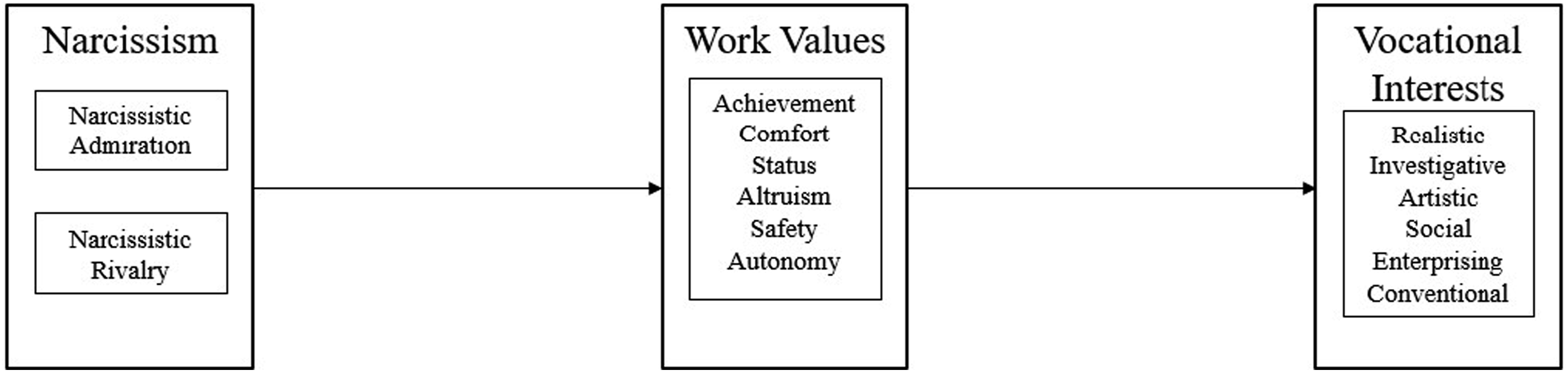

Results
The Effects of Narcissistic Admiration and Rivalry on Work Values.
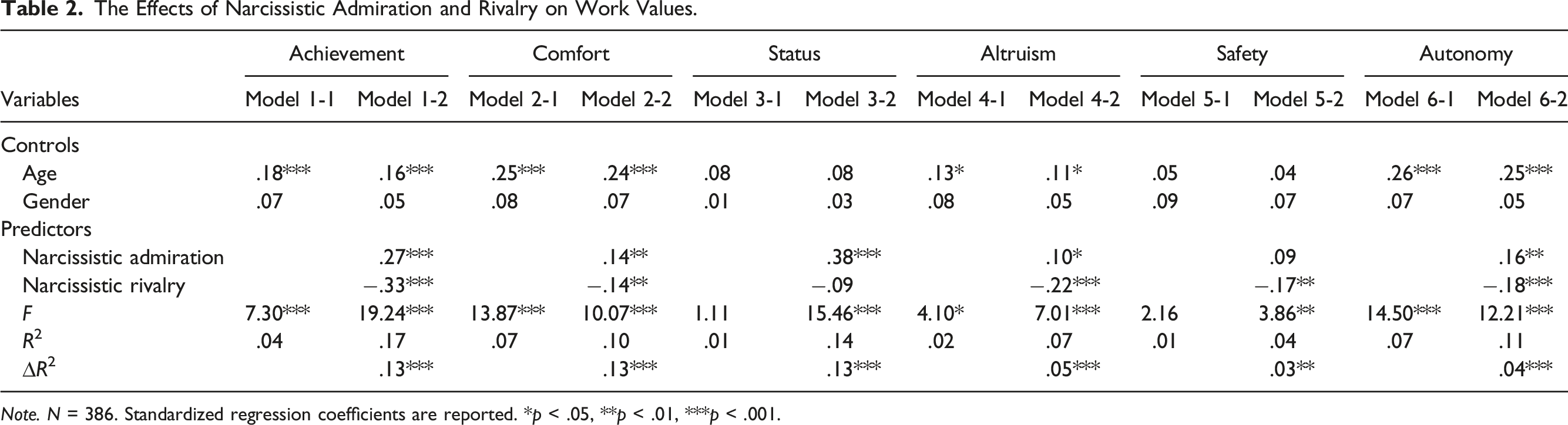
Note. N = 386. Standardized regression coefficients are reported. *p < .05, **p < .01, ***p < .001.
Narcissism and Vocational Interests (RIASEC).

Note. N = 386. Standardized regression coefficients are reported. *p < .05, **p < .01, ***p < .001.
Indirect Effects of Narcissism on Vocational Interests via Work Values.

Note. N = 386. Indirect effects are unstandardized; Bootstraps = 5000; CI = Confidence interval; SE = Standard error; SD = Standard deviation.
*p < .05.
**p < .01.
***p < .001.
Supplemental Analysis
Confirmatory Factor Analysis Model Fit Comparisons.

Note. N = 386; For all χ2, p < .05. SRMR = standardized root-mean-residual; RMSEA = root-mean-square of approximation; CFI = comparative fit index; TLI = Tucker-Lewis index.
Our CFA results indicate relatively poor model fit, however, the use of CFA in vocational interest research (e.g., Warlick et al., 2018) and personality research (e.g., Hopwood & Donnellan, 2010) has often resulted in poor model fit. Poor fit is likely the result of the inherent complexity of broadband vocational interest and personality dimensions, a high number of survey items, and the restrictive assumption of CFA that each latent factor needs to be highly unidimensional (Su et al., 2019). Thus, poor model fit is not necessarily an indication of poor theory in this particular study.
Because common method bias is a risk in cross-sectional and self-report data, we conducted supplemental analyses to assess its impact on our findings. Firstly, we employed Harman’s one-factor test (Podsakoff et al., 2003) which revealed that a single factor accounted for only 13.97% of the variance, well below the established threshold of 50%, suggesting a low risk of common method bias. We also conducted a common latent factor (CLF) analysis which involved comparing the standardized estimates obtained with and without the inclusion of a common latent factor. The results indicated no significant discrepancies between estimates obtained with and without the inclusion of a common latent factor. Most differences observed were less than 0.2, with only five out of 92 items exhibiting differences greater than 0.2. Together these findings provide evidence that our measurement model is not substantially affected by common method bias (Podsakoff et al., 2003). The risk of CMV in this study is further reduced by the randomization of question and scale order and assessment of the independent, mediating, and outcome variables in separate survey blocks.
To be certain that there exist significant correlational differences between narcissistic admiration and rivalry – lending further support for the importance of distinguishing between the two facets – we additionally calculated difference test statistics. All difference test statistics were significant for the six work values, and all were significant for the vocational interests except for realistic, investigative, and conventional interests. These results are available from the authors upon request.
Discussion
According to ASA theory, people are attracted to careers that match their personal values and behavioral patterns. Prior research has suggested that individuals high in narcissism are particularly drawn to careers that reflect artistic, social, and enterprising interests, but the theoretical connection between these constructs has never been empirically tested. To address this gap in the literature, we investigated the specific work values that influence occupational preference decisions. In addition, we sought to resolve the potential issue of whether the relationship between narcissism and vocational interests had been obscured in prior research by separately considering the two motivational dimensions of the NARC framework. As such, the present study built on past research by utilizing an ASA theory lens and exploring how narcissistic admiration and rivalry influence the work values individuals use to make decisions about what occupations or industries are the best match for their character.
We found that narcissistic admiration and rivalry were associated in opposite directions for nearly every work value (see Table 2) highlighting the importance of distinguishing between these two aspects of narcissism in future research. Direct effects from narcissism on work values echo past research that show narcissistic admiration is associated with the need to self-enhance by achievement-striving, seeking status, and desiring autonomy (e.g. Back et al., 2013; Young & Pinsky, 2006). However, some of the relationships uncovered in the present research should be interpreted with caution. For example, the positive association between narcissistic admiration and comfort was likely driven by the lower-order need subscales of independence and compensation. The positive association between narcissistic admiration and altruism was not significant at the zero-order level and is therefore likely the result of a suppressor effect.
Narcissistic rivalry demonstrated significant negative effects on all work values except status. The negative associations between narcissistic rivalry and comfort, safety, and altruism are to be expected as individuals high in narcissism are typically seen as high risk-takers and habitually manipulate and exploit others (Buelow & Brunell, 2018). That narcissistic rivalry is negatively associated with achievement is somewhat surprising, but it is possible that individuals high in rivalry are not motivated by achievement because they care more for their relative performance over others (e.g., they do not need to win first place as long as they beat their most salient rival). Another potential explanation involves the fact that contrary to admiration, rivalry is particularly related to aspects such as fear of failure and low trait self-esteem (Back, 2018), meaning individuals high in rivalry may be afraid to strive and fail and simultaneously lack confidence that they can achieve certain goals. Regardless, this finding warrants further examination in future research to rule out the possibility that this relationship is spurious.
In terms of the relationship between narcissism and vocational interests, our results once again echoed past research in that narcissistic admiration was positively associated with artistic, social, and enterprising interests, but also realistic and conventional interests to a smaller extent. Importantly, the narcissistic admiration and rivalry facets demonstrated distinctly different patterns of interest across the vocational types. For example, admiration was strongly and positively associated with artistic and social vocations, but narcissistic rivalry did not demonstrate significant direct effects on any vocational interests besides conventional.
Our results indicate that narcissistic admiration seems to operate on vocational decisions primarily through achievement-striving and status-seeking. While we find that the relationships between narcissistic rivalry and investigative and conventional interests are also mediated by achievement, we further find that narcissistic rivalry is operating through the avoidance of both altruism and autonomy. The relationship between narcissistic rivalry and low altruism follows previous findings that individuals high in narcissistic rivalry are described by antagonistic orientations and habits including manipulation and exploitation of others, impulsivity, and anger proneness (Back et al., 2013). This relationship between rivalry and autonomy is likely attributable to the fact that the content of the items related to autonomy represents both the opportunity and expectation for creativity and responsibility, both of which require proactive behavior. However, because rivalry is a reactive trait whereby individuals respond with hostility to perceived slights (Back et al., 2013), individuals high in rivalry are not motivated by the need to display these proactive behaviors.
The positive relationships between both admiration and rivalry and conventional interests were a surprise, as it was not one the past literature has realized. We believe this association could be an artifact of the vocational interests measure we utilized. More specifically, our RIASEC measure is balanced for occupational prestige so that high, medium, and low-prestige professions are equally represented. However, most conventional vocations are typically lower-prestige jobs (e.g., bookkeeping, data entry) so our measurement may have overweighted high-prestige conventional jobs relative to other RIASEC measures. Consequently, future research may want to replicate this study with a different vocational interest measure to see if the relationships still hold.
It is important to note that some of our bivariate correlations differed from the regression results. Narcissistic admiration didn’t correlate significantly with comfort, altruism, safety, and autonomy, but – except safety – all of these associations became significant when we controlled for narcissistic rivalry and other variables. This indicates that the relationships between narcissistic admiration and work values are more nuanced and complex than what can be captured by a simple bivariate correlation. Furthermore, our study revealed that narcissistic rivalry was negatively associated with all work values besides status, even when controlling for narcissistic admiration and other variables, implying that individuals high in narcissistic rivalry may be largely influenced by their avoidance of certain aspects of work rather than their pursuit of status. Narcissistic admiration showed significant positive bivariate correlations and regression coefficients for realistic, artistic, social, enterprising, and conventional interests, suggesting that the positive influence of narcissistic admiration on these vocational interests is not underscored by factors beyond what was initially indicated by the bivariate correlations. Narcissistic rivalry displayed significant bivariate relationships with realistic and conventional interests but the regression results show a positive significant relationship only with conventional interests. This highlights the limited impact of narcissistic rivalry on vocational interests compared to admiration.
Theoretical and Practical Implications
These findings have important theoretical implications. Specifically, the finding that narcissistic admiration and rivalry are associated with different work values and different vocational preferences builds further support for the importance of distinguishing grandiose narcissism using the NARC model. Additionally, disentangling previously obscured relationships between aggregated narcissism and vocational interests provides further evidence for the value of investigating more narrow personality traits so as not to cloud important predictive relationships.
Additionally, the finding that work values help explain the relationship between narcissistic admiration and rivalry and vocational preferences means that work values are also likely to serve as mediators for the association between other dark (and bright) traits and vocational preferences. Consequently, investigating which values are endorsed by individuals high in the other Dark Triad (Paulhus & Williams, 2002) traits such as Machiavellianism and psychopathy and how these values mediate their occupational preferences may prove fruitful not only in confirming the presence of the mediating link but also demonstrating how these processes may have unique patterns for other subclinical personality traits. Further, this study expands the literature on ASA theory by explicating how vocational preferences are partially mediated by endorsed work values.
These findings also have practical relevance in that they inform organizations about which professions may attract more narcissistic workers, allowing them to proactively identify these workers in the hiring (or employee) process. Additionally, because narcissism has been previously linked with many negative workplace behaviors (e.g., Grijalva & Harms, 2014) it is important for organizations to proactively identify where these employees may be drawn so that they can structure jobs and train employees accordingly to eliminate these behaviors as best as possible and mitigate negative consequences within the organization.
Limitations and Future Directions
While studying ideal vocational preferences may have its limitations because individuals cannot always work in vocations that match their personality traits and interests, this study nonetheless allows us to understand the mindset and motivations of such individuals when making vocational choices. That said, future research may want to utilize situational judgment tests or look at longitudinal data concerning actual vocational choices to better establish the link between the facets of narcissism and vocational outcomes.
We used self-reported and cross-sectional data to investigate these relationships which limits our ability to claim causality in the relationships studied. Although self-reporting was likely the best method of measurement because one’s values and interests are internal and we found low risk of common method bias in our data, a longitudinal analysis that utilizes more than self-report data (i.e., peer-reports) would be worthwhile for future research to triangulate results and to investigate how the relationships uncovered in this study develop and change over time. In addition, data on the mediating factors were gathered in the same collection as the independent and dependent variables. As such, rather than causal mediation, we examined and confirmed statistical mediation effects. While it is important to note that a cross-sectional approach is regarded as appropriate when theory supports the predicted relationships and particularly when the relationships have not been identified in prior research (Spector, 2019), we recognize that the cross-sectional nature of this study limits our ability to test and describe causal relationships. To better capture the sequential effects of work value endorsement on vocational preferences and choices, researchers looking to gain a deeper understanding of the mechanisms by which different career interests are chosen by more narcissistic individuals may want to adopt more precise experimental designs or event sampling techniques in the future.
Some of our measures displayed reliabilities that were lower than expected. That said, the models (RIASEC) and measures (MIQ) are widely accepted and frequently used for measuring vocational interests and work values (Larson et al., 2002; Leuty & Hansen, 2011). As experts have noted, construct validity and content coverage are more important than high internal validity when evaluating scales (John & Soto, 2007) and we believe that the current measures are suitable for use in this study. Additionally, some of our confidence intervals were very close to zero, but this is likely because we are dealing with very small effect sizes as is common in organizational research (Paterson et al., 2016). Further, our relatively large sample size reduces the chance of these effects being false positives.
Our sample was limited to workers from the United States, but it is possible that the relationships found in this study could vary across different cultural settings. Despite this weakness, this study does extend beyond past studies (e.g., Velji et al., 2023) by using real U.S. employees rather than samples of undergraduate university students. Although our findings provide a theoretically-derived model explaining variation in the relationship between narcissism and vocational interests through work values, the causal mechanisms might be affected by various contextual factors, including individual and situational factors that are unaccounted for that are possibly creating some of the non-significant direct effects we observed. For example, narcissistic traits could be more salient in working contexts characterized by highly competitive organizational cultures. We encourage subsequent studies to investigate how various contextual factors may affect the relationships found in this study.
ASA theory tells us that a second process influences how and why personality types cluster in certain vocations, and that is that organizations often select individuals who possess personality traits that fit their organizational culture, climate, and values (Schneider et al., 1995). As such, a possible avenue for future research entails investigating whether certain vocations tend to seek out and select individuals with certain subclincal traits like narcissism. Further, ASA theory posits that over time, individuals who do not fit with an organization’s culture are likely to leave or be pushed out (Schneider et al., 1995). It is thus an important future route to explore what vocations with high concentrations of individuals high in narcissism look like and what the implications of these vocations are for organizations overall.
While the NARC model fits our research goals of exploring why individuals high in narcissism are drawn to certain vocations through a theory-backed model, future research may wish to see if these relationships replicate under different theoretical models of narcissism such as the extended agency model (Campbell & Foster, 2007) or the three-factor model (Crowe et al., 2019; Miller et al., 2021). According to some researchers, conventional analytical techniques, such as multiple regression, may result in residual forms of narcissistic admiration that are particularly positive after statistically removing overlap with narcissistic rivalry, as well as residual forms of narcissistic rivalry that are particularly negative after statistically removing overlap with narcissistic admiration (Cheshure et al., 2020). This pattern can be somewhat seen in our analysis and future research using this framework should be aware of this potential issue.
Finally, future research may also investigate whether vocations can help to understand when narcissism can be a benefit or a hindrance to successful functioning at work (Grijalva et al., 2015; Hirschfeld & Van Scotter, 2019; Liu et al., 2022). For example, someone high in narcissistic admiration who works as a commodities trader (i.e., enterprising) may perform better if they are in a position of high status because their vocation is aligned with their intrinsic motivations and values. This would continue to expand the literature on the “mixed blessing” of narcissistic personality (Liu et al., 2022).
Conclusions
The present findings add to our understanding of when and why subclinical personality traits such as narcissism can impact vocational preferences. ASA theory provides a framework for understanding how individual differences shape the composition of organizations, including how certain personalities endorse particular work values and self-select into vocations that match their interests. Moreover, by investigating the mediational paths that underpin vocational preferences, we illuminate the psychological processes that are typically assumed in the theorizing of prior research. Specifically, we examined how individual differences in narcissistic admiration and rivalry are associated with individual-level career interests as mediated by work values. We contend that examining narrow individual differences helps illuminate important details about personality traits and subsequent vocational interests that would otherwise be obscured. Further, we demonstrate that individuals high in narcissistic admiration and individuals high in narcissistic rivalry have unique motivational patterns in their work values that influence them to pursue certain vocations, relationships that were previously obscured. This paper answers calls for a more detailed examination of the relationships between narcissism and vocational interests and for investigating the function of work values in occupational preferences. It is hoped that the present study will provide a grounding for future research examining the relationships between the facets of subclinical personality traits and workplace behaviors and outcomes.
• Work values mediate the relationship between narcissism and vocational interests. • Narcissistic admiration and rivalry are motivated by different work values. • Narcissistic admiration operates on vocational decisions through achievement-striving and status-seeking. • Narcissistic rivalry operates through the avoidance of altruism and autonomy. • Surprisingly, narcissistic rivalry is negatively associated with achievement. This study is relevant, unique, and expands upon dark personality and vocational interests' research by investigating the mediational paths that underpin vocational preferences and by parsing narcissism into narcissistic admiration and rivalry.Key insights
Relevance statement
Supplemental Material
Supplemental Material - All the Working World’s A Stage: Narcissism, Work Values, and Vocational Preferences
Supplemental Material for All the Working World’s A Stage: Narcissism, Work Values, and Vocational Preferences by Tyler N. A. Fezzey, Peter D. Harms, and Younsung Cho in Personality Science
Footnotes
Author note
Atsushi Oshio was the handling editor.
Acknowledgements
Not applicable.
Author contributions
Declaration of conflicting interests
The author(s) declared no potential conflicts of interest with respect to the research, authorship, and/or publication of this article.
Funding
The author(s) received no financial support for the research, authorship, and/or publication of this article.
ORCID iD
Not applicable.
Data accessibility statement
The data and materials required for reproducing the study results can be found on the OSF: https://doi.org/10.23668/psycharchives.12668 for the data used in this article and  for scripts, code, etc.
Supplemental material
Supplemental material for this article is available online. Depending on the article type, these usually include a Transparency Checklist, a Transparent Peer Review File, and optional materials from the authors.
Notes
References
Supplementary Material
Please find the following supplemental material available below.
For Open Access articles published under a Creative Commons License, all supplemental material carries the same license as the article it is associated with.
For non-Open Access articles published, all supplemental material carries a non-exclusive license, and permission requests for re-use of supplemental material or any part of supplemental material shall be sent directly to the copyright owner as specified in the copyright notice associated with the article.
