




Abstract
In this registered report (N = 423), we investigated in a competitive intergroup context to what extent the perception of targets scoring high in grandiose narcissism varies depending on whether they belong to one’s own group or to an opposing outgroup. In a laboratory study, members of newly formed groups had direct contact with another group and competed for scarce resources. Contrary to our hypothesis, perceivers did not ascribe targets scoring high in narcissistic admiration higher status when they belonged to their ingroup versus the outgroup. Also unexpectedly, they did not like targets scoring high in narcissistic rivalry better when they belonged to their ingroup. Instead, our findings indicate that narcissistic admiration was generally linked to more dominant-expressive behavior and that participants had a stronger inclination to interpret a specific behavior as aggressive when it was shown by a member of the outgroup, rather than a member of the ingroup.
The idea for this research developed during a soccer world cup years ago. The first author watched his home team Germany play against Portugal. Like many Germans, he was annoyed by Portugal’s Christiano Ronaldo’s narcissistic displays of dominance and arrogance during the game. A few days later, he watched the Portuguese play against the Spanish, but this time he supported Portugal. He was surprised to notice that now, he was much less disturbed by Ronaldo’s narcissistic gestures, he actually approved them and thought they might serve the team. Could it be that in the context of an intergroup competition, how people evaluate narcissistic persons differs greatly, depending on whether these narcissists belong to one’s ingroup or to the opposing outgroup?
Grandiose narcissism is a personality trait characterized by egocentrism, feelings of grandiosity and entitlement, arrogance, and a lack of regard for other people (Campbell & Miller, 2011). Grandiose narcissists (i.e., persons scoring high on grandiose narcissism) often emerge as leaders in politics or corporations (Maccoby, 2000; Rosenthal & Pittinsky, 2006). Particularly in threatening environments, dominant and narcissistic leaders are popular (i.e., liked, enjoyed, or supported by many people; Cambridge Advanced Learners Dictionary, 2008)—because such ‘strong leaders’ are considered capable of standing up against the threats and defending the group (Nevicka et al., 2013; see also Laustsen & Petersen, 2017; Kakkar & Sivanathan, 2017; Padilla et al., 2007). In the current research, we will focus on one such context, where groups face a common threat from the outside, namely intergroup competition. We test the hypothesis that in this context, narcissists polarize between the in- and outgroup in the sense that the higher a person’s narcissism is, the more their ingroup popularity exceeds their outgroup popularity.
Narcissists perceived from an ingroup perspective
In the context of an intergroup competition, how are narcissistic persons viewed by members of their ingroups? When narcissists enter a group, they typically desire social influence and aim for leadership positions (Emmons, 1989; Zeigler-Hill et al., 2018). And quite often, they are successful in this endeavor. Narcissists possess attributes that are considered desirable in leaders, such as assertiveness, charm, and self-confidence (Maccoby, 2000; Rosenthal & Pittinsky, 2006), and often they emerge as leaders in newly formed groups (Grijalva et al., 2015). Thus, in newly formed groups, narcissists are often valued by their ingroup members, and particularly so in threatening environments (Kakkar & Sivanathan, 2017; Laustsen & Petersen, 2017; Nevicka et al., 2013; Padilla et al., 2007), because they are perceived as efficient leaders.
This effect should clearly be present in the face of a competing outgroup. An outgroup is often perceived as an external threat, particularly if it is competing over scarce resources (Esses et al., 1998; Sherif, 1966). Past research indeed indicates that during zero-sum intergroup debates, dominant persons are particularly likely to be selected as group spokesmen (Halevy et al., 2012). It thus seems likely that under the conditions of an intergroup competition, narcissists are popular among their ingroup members.
Narcissists perceived from an outgroup perspective
How are narcissists viewed by members of a competing outgroup? It seems likely that under the very same circumstances that produce a positive link between narcissism and ingroup popularity—namely intergroup competition—narcissists are viewed much more negatively by members of the opposing group. An intergroup competition is typically a zero-sum situation, in which the benefit of one group directly comes at the cost of the other group (Sherif, 1966). Thus, with their self-confident demeanor and readiness to defend their group, narcissists should be viewed as a threat, or nuisance by members of the outgroup, to the extent that they undermine the outgroup’s chances of success. Indirectly supporting this possibility, recent findings indicated that the former U.S. president Donald Trump—who arguably scores very high in narcissism (Lee, 2017)—is perceived to have a much less desirable personality profile by supporters of his political opponents than by his own supporters (Hyatt et al., 2018). Accordingly, it seems likely that under conditions of intergroup competition, narcissists are considerably less popular among the members of an opposing outgroup than among the members of their ingroup.
The processes linking narcissism to popularity
Past research in single group settings indicates that two opposing processes underlie the link between narcissism and popularity (Küfner et al., 2013). On the one side, narcissists show dominant and expressive behavior, which leads to being seen as assertive, which then increases their popularity. At the same time narcissists show arrogant and combative behavior, which leads to being seen as aggressive, which then decreases their popularity. Follow-up research by Leckelt et al. (2015) took a detailed look at the subcomponents of narcissism, as postulated by the Narcissistic Admiration and Rivalry Concept (NARC; Back et al., 2013). According to the results, the narcissism-assertiveness-popularity pathway was driven by the admiration component of grandiose narcissism, which represents a tendency toward agentic self-enhancement. The narcissism-aggressiveness-unpopularity pathway, in contrast, was driven by the rivalry component, which represents narcissists’ tendency toward antagonistic self-protection. (For a comprehensive review of research findings on the NARC model, see Back, 2018.)
Whereas past research mainly focused on likability as an indicator of popularity, in the current case it seems worthwhile to separately investigate another aspect of popularity, namely status, which represents the respect, admiration, and voluntary deference an individual is afforded by others (Anderson et al., 2015). The major difference between these two constructs is that while likability mainly safeguards social inclusion, status brings about power (Anderson et al., 2015; Cheng et al., 2013). Past research indicates that status is mainly influenced by agentic attributes, such as assertiveness, whereas likeability is primarily influenced by communal attributes, such as (low) aggressiveness (Wojciszke et al., 2009). Thus, the admiration-assertiveness pathway should lead to high status, and the rivalry-aggressiveness pathway should lead to low likeability.
But at what points in the process might effects differ for evaluations of in- and outgroup members? Two different hypotheses can be formulated in this regard (see Figure 1). Potential processes underlying the links between narcissism and in- and outgroup popularity. Bold lines represent strong associations, dashed lines represent weak associations. All effects, except d1 and d2, are thought to be positive in directionality.
First, it is possible that in- and outgroup members differ in how they process narcissists’ behavior during the intergroup competition. Back et al. (2013) argued that the effects of objectively assessed behaviors on peer-perceptions depend on the situational context. The more salient a specific behavior is for a peer, the stronger its effect should be. Research on social identification, in turn, has shown that the salience of a specific behavior can differ, depending on whether it is shown by an in- or an outgroup member (Xiao et al., 2016). During an intergroup competition, identifying assertive team members is often highly important, as such members are potentially suited for taking the lead of the group. Thus, assertiveness, as indicated by dominant and expressive behavior, should be a salient attribute for ingroup members and might be particularly well detected by them. In this case, dominant and expressive behavior should be more strongly linked to perceived assertiveness when assertiveness ratings refer to ingroup members than when they refer to outgroup members (path a1 > path a2). Aggressive behavior, in contrast, should be highly salient from the outgroup’s perspective. Aggressiveness, as indicated by arrogant and combative behavior, can pose a severe and direct threat to the opposing group and should therefore be particularly well detected by outgroup members. Thus, arrogant and combative behavior should be more strongly linked to aggressiveness when aggressiveness ratings refer to outgroup members than when they refer to ingroup members (path b1 < path b2). We will refer to these predictions as the differential sensitivity hypothesis.
Second, it is possible that the consequences of perceived behavior for popularity are different, depending on whether the behavior is shown by an in- or an outgroup member. Back et al. (2013) also suggested that the effects of perceived assertiveness and aggressiveness on popularity depend on the situational context, which in the current case is the in- versus outgroup status of the target person. If the target is from the ingroup, assertiveness brings about benefits for the group’s goal and therefore targets who are perceived as assertive should be highly valued. If the target is from the outgroup, no benefits can be derived from assertiveness. The reverse is true for aggressiveness. Only if the target is from the outgroup, aggressiveness will bring about harm and should be strongly disapproved. Hence, for both perceived assertiveness and perceived aggressiveness, the links to popularity should be more positive/less negative when judgments refer to an ingroup member than when they refer to an outgroup member (path c1 > path c2; path d1 > path d2). We will refer to this prediction as the differential evaluation hypothesis.
The current research
In the current research, participants were placed into two teams that compete against each other. In such a context, narcissists should be beneficial for their ingroup and detrimental for the outgroup, which means their popularity should clearly diverge. We tested participants in actual, newly formed groups that will compete with each other in direct interactions. The research procedure allows each participant to form an evaluation of each member of his or her own team and of the opposing team. Under these circumstances, the link between admiration and status should be more positive for judgments pertaining to members of the own team than for judgments pertaining to judgments of the opposing team. Furthermore, the link between rivalry and likability should be more negative for judgments pertaining to members of the opposing team than for judgments pertaining to members of the own team. Due to the differing proposed mechanisms, both hypothesized effects should remain significant, once the other narcissism dimension is controlled. We will also investigate the processes underlying the links between narcissism and in- and outgroup popularity. We will do so by testing both the differential sensitivity hypothesis and the differential evaluation hypothesis as depicted in Figure 1. Note that the two hypotheses are not mutually exclusive; in principle, both processes could be simultaneously at work.
Method
The data, analysis code and a study codebook is available on the OSF project page: https://osf.io/eank8/?view_only=94c5f470cb054b79b903e22b5adf4d66.
Sample and design
Data were collected as a part of a larger study on intra- and intergroup processes. Originally, data from 426 cases was available. At closer inspection, we found out that one person participated twice, the data from his second participation was dropped. Furthermore, two persons left during the laboratory sessions. Their data were dropped as well, resulting in a final N of 423 cases (Mage = 22.84, SD = 3.88; 73% female, 26% male, 1% other). An approval for the study by the ethics board of the German Psychological Society has been obtained. Participants were required to be at least 18 years old. Most participants were either current or former university students (91%) and the vast majority of them (98%) were fluent in German. They had been recruited via social networks, notice-boards, and flyers. In the study advertisement, they had learned that the study would take 2 hours in total, deal with group processes and that they would receive between € 25 and € 35 for their participation. (The actual amount of compensation indeed depended on their group’s performance, see below.)
Prior to the group sessions, participants completed an online questionnaire that involved assessments of demographic and personality variables (including narcissism). Participants registered online for the group sessions, which consisted of 6 to 10 persons of the same gender. In total, there were 54 groups and the average group size was 7.83 (SD = 1.31). When they did so, names of the other members were visible to them. Participants were told explicitly to only sign in for a group in which they do not know any person.
The laboratory sessions were video recorded. In the beginning of the sessions, participants briefly introduced themselves to each other and subsequently they were randomly assigned to one out of two competing teams. Then, the two teams competed with each other in a debate game (for a detailed description, see the study codebook). The game consisted of three rounds, in which three distinct controversial topics were discussed. In each round, each team was instructed to defend a randomly assigned viewpoint on the topic (e.g., “in favor of the proposal” vs. “against the proposal”). In the first round, participants were presented with a moral dilemma task in which a person has betrayed his/her partner and the question is whether the person should make a confession even though this puts the relationship at risk. The second topic was whether people should be obliged to participate in political elections. The third topic was whether marijuana should get the same legal status as alcohol. Participants learned that at the end of the third round, the experimenter would declare the team that made the more convincing case for their position as the winning team and that members of the winning group would receive € 35, whereas the members of the losing team would only receive € 25 Euros.
Assessments of status, likability, perceived assertiveness, and perceived aggressiveness took place at three times during the lab session. The first assessment took place in the beginning of the session. By that time, participants had introduced themselves to each other briefly, but team assignment has not taken place yet. The second assessment took place between the second and third round of the debate game. The third assessment took place after the game, after a winner had been determined. We used the values from the second assessment as the main outcome in our models, as by this time participants were in a competitive mindset and potential effects of the game outcome could be excluded. The values of the first assessment were included as covariates (baseline assessments) in our models (see analytic procedure).
Measures
We will only describe the measures that are relevant for the current question. A full list containing all study variables can be found in the study codebook.
Narcissism
We used the Narcissistic Admiration and Rivalry Questionnaire (NARQ, Back et al., 2013) to assess narcissistic admiration and narcissistic rivalry. Each subdimension was measured with 9 items. Participants indicate their agreement with each statement for both questionnaires on a rating scale from 1 (not agree at all) to 6 (agree completely).
Popularity
We assessed status with three items (“This person has my respect,” “This person deserves admiration,” “This person could serve as an example for others”) which are adapted from Anderson et al. (2012) and Wojciszke et al. (2009). We measured likability with three items (“I like this person,” “I could imagine being friends with this person,” “I find this person likeable”), which have been successfully used in past research from our laboratory. Ratings were be made on a 6-point Likert scale (1 = not at all to 6 = very much).
Dominant-expressive and arrogant-combative behavior
We assessed codings of behavior during the debate game and peer-perceptions using the same items that were used in the above described study by Küfner et al. (2013, Study 2) on narcissism and popularity. To obtain behavior codings, four trained coders viewed the video recordings of the whole debate game and rated each participant in terms of how “dominant” (based on the items “dominates the interaction,” “takes a leadership position,” “displays dominant facial expressions and gestures”, ICC (3, 4) = .90), “expressive” (based on the items “expressive facial expressions and gestures,” “outgoing,” and “displays positive emotions,“ ICC (3, 4) = .80), “arrogant” (based on the items “displays arrogant facial expressions and gestures,” “over-emphasizes own contribution and ability,” “acts in a conceited fashion”, ICC (3, 4) = .66) and “combative” (based on the items “contributes aggressiveness to the interaction,” “makes aggressive, antisocial remarks,” “displays angry and aggressive facial expressions and gestures,” ICC (3, 4) = .68) he or she behaved (1 = not at all, 6 = very much). As in the study by Küfner et al. (2013), “dominant” and “expressive” as well as “arrogant” and “combative” were aggregated into two composite scores.
Peer-perceived assertiveness and aggressiveness
Participants rated each other in terms of how “assertive” and “aggressive” they were during the debate game. Both ratings were made on a 6-point Likert scale (1 = not at all to 6 = very much).
Analytic procedure
Overview of all hypotheses and respective models that will be used to test them.

In a preparatory step, we estimated univariate Social Relations Models (SRMs; Kenny, 2019) for ratings of popularity (i.e., status and likeability) using the R package TripleR (Schönbrodt et al., 2012). This allowed us to determine the proportions of variance explained by perceiver, target, and relationship effects. We used a SRM for observed variables based on the mean of the three liking items and the mean of the three status items, respectively. The models were estimated separately for ratings at baseline and after Round 2 of the game. We then extracted the relationship effects from the four models and saved them for further analyses. Through this procedure, variance in dyadic judgments of popularity that was due to differences between laboratory sessions, perceivers, and targets was removed from the data.
We tested our hypotheses using multilevel modeling. This was necessary because at the relationship level, there was still a source of variance that needed to be considered, namely variance that was due to dyadic reciprocity. In each dyad, two scores exist for each variable, one of them representing Person A’s view of Person B and the other representing Person B’s view of Person A. Dyadic reciprocity exists if these two scores are correlated, which is often the case for interpersonal evaluations (Kenny, 2019). We controlled for such effects by including a random intercept for dyads.
We then predicted the relationship effect of the respective popularity indicator (status or likability) after Round 2 of the game from (a) the relationship effect of popularity at baseline, (b) team membership (same team vs. opposing team), (c) the respective narcissism dimension of the target (admiration or rivalry), and (d) the interaction effects between team membership and the narcissism dimension. Narcissism scores were grand mean centered, and team membership was effect-coded using a weighted coding scheme. Specifically, teammates were coded as 0.5 and opponents as −0.4, because in laboratory sessions of ten participants the ratio of same team dyads and opposing team dyads was 20/25. As a consequence of this coding scheme, and because individual differences in popularity had been removed, the intercept of the model and the effect of the narcissism dimension was exactly zero. Moreover, the effect of baseline popularity will represent the amount of stability in dyadic popularity, the effect of team membership will represent the difference in popularity between teammates and opponents (after controlling for differences in dyadic popularity at baseline), and the interaction effect will represent how this latter effect is moderated by target’s narcissism.
To address Hypotheses III and IV, which claim that the relation between the respective narcissism dimension and popularity persists once the other narcissism dimension is controlled, we will investigate the unique effects of the two narcissism dimensions. The respective models will be identical to the ones above, but include both admiration and rivalry as well as the interaction effects between team membership and the two narcissism dimensions as additional predictors.
Hypotheses V and VI, which postulate effects of narcissism on behavior, do not refer to the relationship level, but describe effects at the person level. Thus, multilevel models with participants nested in laboratory session groups will be used to predict the behavior codings of dominant-expressive and arrogant-combative behavior by admiration (Hypothesis V) and rivalry (Hypothesis VI).
Hypotheses VII to X (i.e., the differential sensitivity and evaluation hypotheses), which again refer to the relationship level, will be tested using the same analytic approach we described for Hypotheses I to IV. We will first extract relationship effects for the involved peer perceptions and then we will use multilevel modeling in an analogous fashion to the popularity analyses to test for interaction effects between team membership and behavioral codings for targets (Hypotheses VII and VIII) or between team membership and relationship effects of peer perceptions (Hypotheses IX and X). Details are provided in Table 1.
The multilevel models we ran to test our hypotheses were based on maximum likelihood estimation, taking into account all available data points. This method provides unbiased parameter estimates if values are missing at random. We conducted a simulation study to determine the required sample size (see Supplemental Online Material, SOM).
Results
Preliminary analyses
Person variables
Descriptive statistics and intercorrelations for variables located at the person level.

Note. N = 420. Values in square brackets indicate the 95% confidence interval for each correlation. * indicates p < .05. ** indicates p < .01.
Relationship variables
The results of the univariate manifest SRMs that we used to extract the relationship effects for all variables on the relationship level are shown in Table S1. The amount of relationship variance exceeded 10% in all cases, which indicated sufficient variability for analyses on the relationship level (Kenny, 1994). Because these analyses are not able to distinguish between relationship and error variance, we also ran latent SRM analyses using the R package srm (Nestler et al., 2020) for the variables that contained more than one item (i.e., assessments of status and likability). These analyses again indicated that the amount of relationship variance exceeded 10% for all variables (see Table S2). (For completeness, the correlations between the narcissism measures and perceiver and target effects are shown in Table S3).
Descriptive statistics and intercorrelations for all variables located at the relationship level.
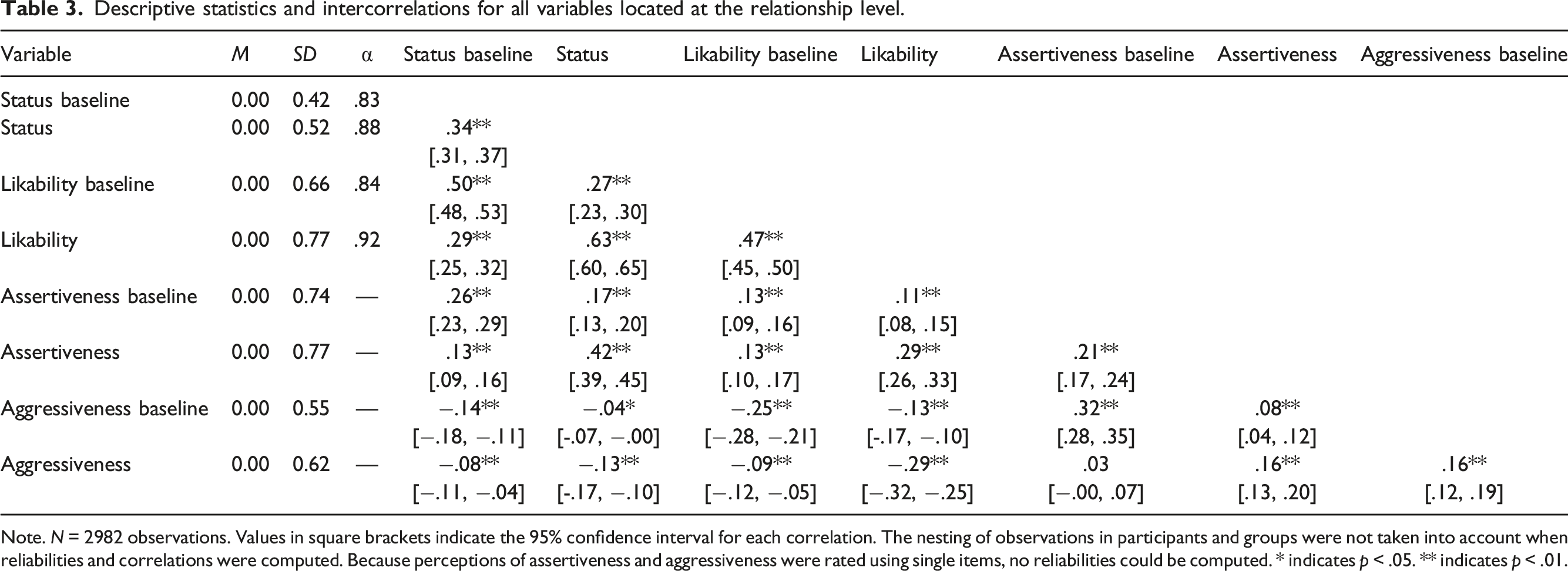
Note. N = 2982 observations. Values in square brackets indicate the 95% confidence interval for each correlation. The nesting of observations in participants and groups were not taken into account when reliabilities and correlations were computed. Because perceptions of assertiveness and aggressiveness were rated using single items, no reliabilities could be computed. * indicates p < .05. ** indicates p < .01.
Hypothesis testing
Hypothesis tests.
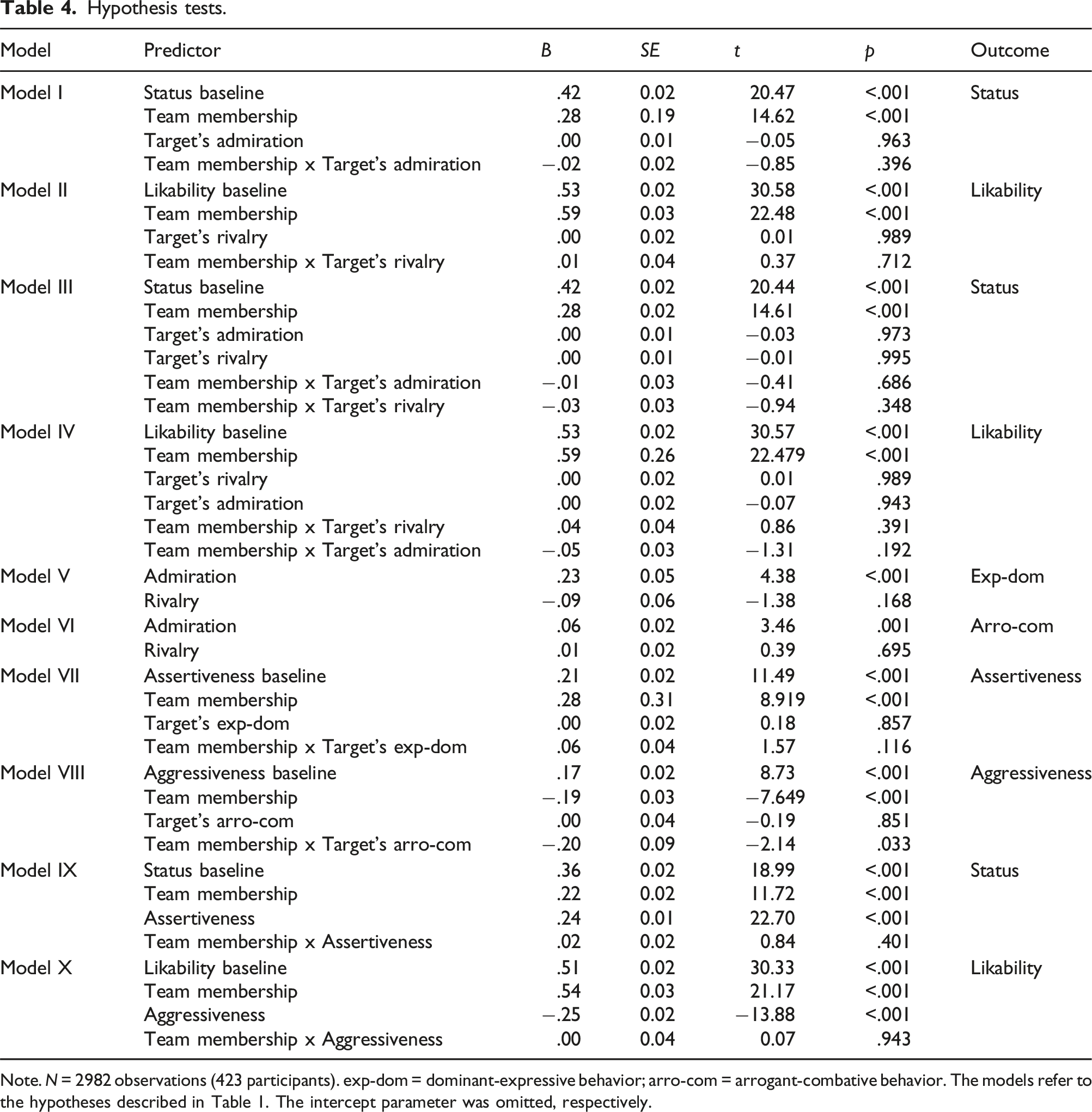
Note. N = 2982 observations (423 participants). exp-dom = dominant-expressive behavior; arro-com = arrogant-combative behavior. The models refer to the hypotheses described in Table 1. The intercept parameter was omitted, respectively.
We then turned to Hypothesis II. Again, there was significant stability in likeability judgments, a positive effect of team membership, indicating that ratings were more positive for members of one’s own team than for members of the opposing team, and no effect of target’s level of rivalry. The interaction between rivalry and team membership was non-significant, which contradicted Hypothesis II. In opposition to Hypotheses III and IV, when we considered the partial effects of target’s level of admiration * team membership (see Model III) and of target’s level of rivalry * team membership (see Model IV), no significant interaction effects occurred.
We then investigated the unique associations between the two narcissism dimensions and social behavior. In line with Hypothesis V, admiration positively predicted dominant-expressive behavior. However, in contrast to Hypothesis VI, rivalry did not significantly predict arrogant-combative behavior.
Next, we turned to the differential sensitivity hypothesis. As results for Model VII show, the baseline assertiveness judgments positively predicted later assessments, which again indicates stability. None of the other effects were significant, which means that perceptions of assertiveness were not predicted by target’s dominant-expressive behavior and that the effect was not different for members of one’s own team versus members of the opposing team. This latter result contradicted Hypothesis VII.
For ratings of aggressiveness, the picture was slightly different. Again, there was significant stability. This time, however, also a significant interaction occurred, which indicated that the relation between target’s aggressive-combative behavior and ratings of aggressiveness was more positive when aggressiveness ratings referred to members of the opposing team than when they referred to members of one’s own team (see the slightly non-parallel regression lines in Figure 2). This pattern of results supported Hypothesis VIII. The Effect of Targets’ Arrogant-Combative Behavior on Dyadic Perceptions of Aggressiveness, Moderated by Team Membership. Note. Values were grand-mean centered for arrogant-combative behavior. Please note that because we only included the relationship variance of perceived aggressiveness, the average (team-independent) effect of targets’ arrogant-combative behavior is necessarily zero. The shaded areas depict 95% CIs.
Finally, we addressed the differential evaluation hypothesis. The significant effects of baseline score and team membership in Models IX and X have already been mentioned above in our presentation of Models I and II, which used the same outcomes. Model IX further indicated that status was positively predicted by assertiveness and Model X indicated that likability was positively predicted by aggressiveness, which was in line with our general reasoning. However, none of these effects were moderated by team membership, which contradicted Hypotheses IX and X.
Exploratory analyses
We also conducted a number of exploratory analyses (for a results overview, see the SOM). First, as an alternative strategy to including the social evaluation baseline assessments as covariates into the models, we computed difference scores by subtracting the baseline scores from the actual scores and re-ran the hypothesis tests located at the relationship level. The resulting difference scores thus represented indicators of change in social evaluations. Again, the only significant hypothesized effect was the interaction between arrogant-combative behavior and team membership on perceived aggressiveness from Model VIII (see Table S4).
Second, we used the third assessments of social evaluations, which had been gathered after the end of the game as outcomes and re-ran our original hypothesis tests. None of the hypothesized effects were significant (see Table S5).
Third, participants had also completed the Narcissistic Personality Inventory (NPI, Raskin & Hall, 1979; German: Schütz et al., 2004, α = .83), which is a unidimensional measure of grandiose narcissism, and the Hypersensitive Narcissism Scale (HSNS, Hendin & Cheek, 1997; German: Morf et al., 2017, α = .55), which is a measure of vulnerable narcissism. We re-ran Models I and II to explore whether narcissism, as assessed by these instruments, interacted with team membership to predict popularity. As shown in Tables S6 and S7, this was not the case.
Fourth, we explored whether any cross-paths among the effects of social behavior on social perceptions might exist, in the sense that dominant-expressive behavior might lead to perceptions of aggressiveness and that arrogant-combative behavior might lead to perceptions of assertiveness. We again considered whether such effects might be moderated by team membership. As shown in Table S8, the effect of target’s dominant-expressive behavior on perceptions of aggressiveness was indeed moderated by team membership, in the sense that participants had a stronger inclination to interpret dominant-expressive behavior as an indicator of aggressiveness when the target person belonged to the opposing team than when they belonged to one’s own team (see Figure S1).
General discussion
The current research tested the core assumption that perceivers’ tendency to favor target persons from the ingroup over targets from the outgroup is exacerbated if the target is highly narcissistic. This assumption was not supported by the data. We did not find any evidence for our hypothesis that the tendency to ascribe elevated levels of status for ingroup members is pronounced for targets scoring high on admiration (Hypothesis I) nor for the hypothesis that the tendency to dislike outgroup members is pronounced for targets scoring high on rivalry (Hypothesis II).
What could be the explanation for these null effects? Statistical power to detect small effects was high, the measures were reliable and there was a sufficient amount of variance on the relationship level in the social evaluations, which means that these methodological factors cannot be the explanation. Could it be that the experimental paradigm was not psychologically meaningful enough? What speaks directly against this possibility is that, as documented in another publication based on the same data (Kraft et al., 2024; Gelman & Hill, 2007), winners experienced more positive affect and less negative affect than losers, had a greater tendency to view the game outcome as a success and attributed it in a self-serving fashion. Furthermore, the effects of team membership on status and likability in our models indicate the presence of an ingroup bias, in the sense that persons from the ingroup were evaluated more positively than persons from the outgroup. All these effects indicate that our paradigm was psychologically meaningful.
Could it be that narcissism was not related to objectively observed behavior in the current context? As predicted (Hypothesis V), admiration positively predicted dominant-expressive behavior. Contrary to our expectation (Hypothesis VI), however, it was also admiration—and not rivalry—that uniquely predicted arrogant-combative behavior. Even though the latter finding diverges from past research studying single-group contexts (Leckelt et al., 2015), the results nevertheless show that one narcissism dimension (i.e., admiration) was linked to behavior. Accordingly, null effects of narcissism on social behavior within the intergroup competition also cannot be the explanation.
But was such behavior interpreted differently, depending on whether it was shown by a member of the ingroup or a member of the outgroup, as predicted by the differential sensitivity hypothesis? This was not the case for the effect of target’s dominant-expressive behavior on perceived assertiveness (contradicting Hypothesis VII), yet the effect of target’s arrogant-combative behavior on perceived aggressiveness was indeed (as predicted by Hypothesis VIII) more positive when ratings referred to a person from the outgroup than when they referred to a person from the ingroup. This latter result supports the differential sensitivity hypothesis, as it indicates that arrogant-combative behavior is interpreted in a more benevolent manner when it is shown by a member of one’s ingroup than when it is shown by a member of the outgroup. Furthermore, the exploratory analyses revealed that also the effect of dominant-expressive behavior on perceived aggressiveness was more positive when ratings referred to a person from the outgroup than when they referred to a person from the ingroup. Thus, the social behavior that was shown by persons high in admiration (i.e., dominant-expressive paired with arrogant-combative behavior) was indeed interpreted differently by members of the in- and outgroup. Yet, presumably, these effects were not strong enough to produce differing popularity of narcissistic individuals depending on their in- versus outgroup status.
Concerning the associations between evaluations of assertiveness and aggressiveness with popularity, the general effects were as expected, with perceived assertiveness being linked to high status and aggressiveness being linked to low likability. Of note, whereas past research has documented such effects at the level of persons, the current research has shown that an analogous pattern exists at the level of the relationships (which does not have to be the case, see Dufner & Krause, 2023). However, we did not find any support for the differential evaluation hypothesis, positing that assertiveness and aggressiveness are more positively linked to popularity for members of the ingroup than for members of the outgroup. Accordingly, differences in the evaluation of assertiveness and aggressiveness could therefore not lead to differing popularity of narcissistic individuals in the in- and the outgroup.
Even though our main hypotheses concerning the popularity of narcissistic individuals were not supported, the results on the differential sensitivity hypothesis are novel, and of theoretical and practical relevance. They indicate that when persons from the in- and outgroup show the same objective levels of dominant-expressive and arrogant-combative behavior, members of the outgroup have a greater tendency to interpret such behaviors as aggressiveness than members of the ingroup. Such biased interpretations are likely to play a role in many life contexts, such as, for example sporting competitions, where the same behavior is interpreted as fair play by the ingroup and as foul play by the outgroup (Plessner & Haar, 2006). Future research should test which role such interpretational biases play in the development of group-serving biases (Allen et al., 2020).
It should be acknowledged that the current research analyzed perceptions in a particular context, namely intergroup competition. Thus, it is unclear how persons scoring high in narcissism would be perceived by members of their own group and an outgroup in the absence of intergroup conflict. According to our reasoning, the processes that lead to differing perceptions of narcissistic individuals in the in- and outgroup should be exacerbated in the context of intergroup competition. Because we did not find the expected effects in this context, we consider it unlikely that they occur in the absence of intergroup competitions. Yet, this would need to be tested in future research. Future research might also investigate existing groups, where additional processes, such as narcissists’ decreasing ingroup popularity over time (Paulhus, 1998) and their tendency to abandon their group after failure (Benson et al., 2019) might also play a role. Finally, it is conceivable that it is not so much how individuals actually score on a self-report narcissism measure that leads to popularity polarization between the in- and outgroup, but the extent to which they are perceived as highly narcissistic by the others. After all, past research indicates that perceived self-enhancement (a trait closely related to narcissism) is more strongly linked to social evaluations than actual self-enhancement (Dufner et al., 2013). This possibility could be addressed by using peer-reports of narcissism in future research.
• People like members of their ingroups more and grant them more status than members of an opposing outgroup. • This tendency is not exacerbated when the target persons scores high in narcissism. • People have a stronger tendency to interpret dominant-expressive and arrogant-combative behaviors as aggressive when they are shown by a member of the outgroup. This research is the first to investigate the interpersonal dynamics of narcissism in a competitive intergroup setting with actual groups interacting. The findings contribute to understanding the complexities of social dynamics and group interactions.Key insights
Relevance statement
Supplemental Material
Supplemental Material - Our versus their narcissist: Are narcissistic persons more popular in their ingroup than in a competing outgroup?
Supplemental Material for Our versus their narcissist: Are narcissistic persons more popular in their ingroup than in a competing outgroup? by Michael Dufner, Johannes Zimmermann, Livia Kraft, Anna Z Czarna, Sekerdej Maciej and Stefan C Schmukle in Personality Science
Footnotes
Author note
The handling editor is Ryan Hong. An approval for the study by the ethics board of the German Psychological Society has been obtained.
Acknowledgements
Not applicable.
Author contributions
Declaration of conflicting interests
The author(s) declared no potential conflicts of interest with respect to the research, authorship, and/or publication of this article.
Funding
The author(s) disclosed receipt of the following financial support for the research, authorship, and/or publication of this article: The work was supported by grant no. DU1641/3-1 from the German Research Foundation (DFG) awarded to Michael Dufner and grant no. 2016/23/G/HS6/01397 from the National Science Centre, Poland, awarded to Anna Z. Czarna.
ORCID iD
Not applicable.
Data accessibility statement
The data, materials, and preregistration required for reproducing the study results can be found on the OSF: https://osf.io/ewga8?view_only=94c5f470cb054b79b903e22b5adf4d66 for codebook; https://osf.io/xka9u?view_only=94c5f470cb054b79b903e22b5adf4d66 for documents, stimuli, images, etc. (materials for the debate game); https://osf.io/pvx3n?view_only=94c5f470cb054b79b903e22b5adf4d66 for scripts, code, etc.; https://osf.io/5sh8c?view_only=94c5f470cb054b79b903e22b5adf4d66 for additional analyses (includes command to read in the correct data from the osf); and  for preregistration.
Supplemental material
Supplemental material for this article is available online. Depending on the article type, these usually include a Transparency Checklist, a Transparent Peer Review File, and optional materials from the authors.
Notes
References
Supplementary Material
Please find the following supplemental material available below.
For Open Access articles published under a Creative Commons License, all supplemental material carries the same license as the article it is associated with.
For non-Open Access articles published, all supplemental material carries a non-exclusive license, and permission requests for re-use of supplemental material or any part of supplemental material shall be sent directly to the copyright owner as specified in the copyright notice associated with the article.
