




Abstract
Narcissists successfully emerge as leaders. However, the processes by which this occurs are mostly unknown. Following a dual-pathway approach and differentiating between agentic (narcissistic admiration) and antagonistic (narcissistic rivalry) narcissism, we investigated the behavioral processes underlying narcissists’ leadership emergence in social groups. We applied data from a multimethodological laboratory study (N = 311) comprising three groups of variables: personality traits, expressed interaction behaviors, and interpersonal perceptions. Prior to the laboratory sessions, participants provided self-reported answers to various narcissism measures. Interpersonal perceptions were obtained from round-robin ratings after participants completed the Lost on the Moon task in small groups. Participants’ behaviors during the group discussion were videotaped and coded by trained raters. Results supported the notion of a pathway from agentic narcissism to leadership (measured as target effects of being seen as a leader) determined by narcissistic admiration, dominant-expressive behavior, and being seen as assertive. To clarify narcissism’s relationship to leadership emergence, the effects were (a) contrasted with narcissism’s effects on popularity and (b) set in relation to process pathways leading from intelligence and physical attractiveness to leadership. The findings underscore the benefits of a behavioral pathway approach for unravelling the impact of narcissism on leadership emergence.
The performance and satisfaction of groups that do not have formal leaders critically depends on the person who eventually emerges as the group’s informal leader. Emergent leadership has become an important topic in organizational (Pescosolido, 2001, 2002), personality, and social psychological research (e.g., Ensari et al., 2011; Ogunfowora & Bourdage, 2014; Ong et al., 2016). The trends of self-managing work teams (S. Cohen, 1993; Lawler et al., 1995; Manz & Sims, 1993) and of decentralization in organizations (M. Y. Lee & Edmondson, 2017) foster the emergence of leaders from within work groups. Consequently, understanding why a particular person informally emerges as a leader and how this happens is becoming more important for an organization’s prosperity. Also, individuals repeatedly come together in social groups outside the business context (e.g., study groups, sports teams) in which they interact to complete tasks, solve problems, and pursue goals (e.g., to prepare for an exam, train for a competition). Thus, interacting in groups is a fundamental part of people’s daily social lives. A key personality trait that has consistently been found to predict leadership emergence in social groups is narcissism 1 (e.g., Grijalva et al., 2015).
Prior research on the relationship between narcissism and leadership emergence has not looked at the behavioral and perceptual processes that drive the effects of narcissism on leadership emergence (Brunell et al., 2008). Moreover, recent research has suggested that researchers should differentiate between at least two dimensions of grandiose narcissism (i.e., agentic and antagonistic aspects of narcissism) when aiming to understand how narcissism results in social consequences (e.g., Back, 2018). However, research has rarely considered narcissism’s multidimensionality when examining narcissism’s impact on leadership emergence (Grijalva et al., 2015). In the present study, we addressed these issues by testing a comprehensive path model on narcissists’ leadership emergence in social groups. Building on the narcissistic admiration and rivalry concept (NARC; Back et al., 2013), we (a) disentangled the two narcissistic process pathways to leadership (i.e., agentic and antagonistic), (b) compared them with narcissism’s effects on popularity (i.e., likeability), and (c) compared the pathways with effects of intelligence and physical attractiveness on leadership emergence.
Previous Research on Narcissism and Leadership Emergence
Main Effects of Narcissism on Leadership Emergence
Grandiose narcissism is a form of entitled self-importance (Krizan & Herlache, 2018) that goes along with grandiosity, a need for admiration and dominance, vanity, arrogance, disregard for others, and a tendency to manipulate others (Back et al., 2013; Braun, 2017; Miller et al., 2011; Raskin & Terry, 1988). According to self-regulatory models, in order to enhance and maintain their views of a grandiose self, narcissists have an extraordinary need for admiration and external validation (Morf & Rhodewalt, 2001). Consequently, narcissists are expected to be highly motivated to seek out leadership positions as these go hand in hand with high social status (Gardner, 2007). Leadership positions provide narcissists with an ideal opportunity to exhibit their competencies and demonstrate their superiority (Campbell & Campbell, 2009). Thus, they might view a leadership position as a platform for self-promotion that will help them earn the admiration and glory they are convinced they deserve (Wallace & Baumeister, 2002). Accordingly, narcissism has shown positive associations with desires for power (Carroll, 1987; Raskin & Novacek, 1991; Rogoza et al., 2016), status (Zeigler-Hill et al., 2018), and leadership (Brunell et al., 2008; see also Benson et al., 2016). Narcissists also seem to be successful at attaining leadership positions: Taking a closer look at illustrious positions of leadership (e.g., president, CEO), narcissists appear to be prevalent in leadership roles (Deluga, 1997; Maccoby, 2000; Rosenthal & Pittinsky, 2006; Watts et al., 2013; see also Ahmetoglu et al., 2016; Wille et al., 2013, 2019). Indeed, narcissists have attained leadership and status in social groups in the short-term (Brunell et al., 2008; Carlson & DesJardins, 2015; Harms et al., 2011; Nevicka, De Hoogh, et al., 2011; Nevicka, Ten Velden, et al., 2011; Ong et al., 2016; Paunonen et al., 2006; see Grijalva et al., 2015, for meta-analytical evidence).
The association between narcissism and leadership emergence must not be mistaken for the association between narcissism and leadership effectiveness (see Grijalva et al., 2015). Leadership emergence and leadership effectiveness are conceptually distinct constructs (Lord et al., 1986) that become relevant at distinct temporal stages of group processes (Ong et al., 2016). Leadership emergence processes are characterized by uncertainty (Marinova et al., 2012) and describe being viewed as a leader by group members that have limited information about that individuals’ performance (R. Hogan et al. 1994; Judge et al. 2002) at the beginning of group processes (Ong et al., 2016). Leader effectiveness processes describe the group leaders’ actual task performance in the leadership position (R. Hogan et al. 1994; Judge et al. 2002; Stogdill, 1950) at later stages of group processes when groups already identified their leader who then provides indicators of more or less effective leadership (Ong et al., 2016). The present study solely focuses on narcissism’s association with leadership emergence.
Behavioral Mediators of the Relationship Between Narcissism and Leadership Emergence
According to process models of personality and social relationships (Back et al., 2011, 2018; Grosz et al., 2020; Nestler & Back, 2013), narcissism might only have an effect on leadership emergence if (a) an individual’s narcissism is expressed in observable behaviors (behavioral expression), (b) these expressed behaviors are detected by interaction partners and used to form impressions (interpersonal perception), and (c) these social impressions are evaluated with regard to leadership emergence (evaluation). Even though the full mediation process linking narcissism to leadership emergence is unclear (Brunell et al., 2008), there is some preliminary evidence. Ong et al. (2016) found that peer-rated transformational leadership mediated the relationship between narcissism and peer-rated leadership emergence in early stages of group processes. Therefore, narcissists’ expressed behaviors that are linked to charismatic and visionary components of transformational leadership (e.g., inspirational speech, creating a vision; see Deluga, 1997; Khoo & Burch, 2008) might account for the link between narcissism and leadership emergence. Cheng et al. (2013) differentiated between two pathways that could be followed to exert influence in social groups. They were found to be associated with two distinct underlying behavioral strategies: prestige and dominance. Both behavioral strategies have been found to be associated with narcissism (Cheng et al., 2010; Zeigler-Hill et al., 2018). Prestige includes demonstrating competence and a willingness to share knowledge as well as behaving in a charismatic, charming, expressive, and confident manner. These expressed behaviors are expected to lead to interpersonal impressions of being respected and admired. Dominance involves the use of aggressive behavior, manipulative tactics, and threat. These expressed behaviors are expected to lead to interpersonal impressions of being feared (Cheng et al., 2010, 2013; Cheng & Tracy, 2014; Maner & Case, 2016; Witkower et al., 2020). Indeed, preliminary evidence has shown that distinct sets of nonverbal behaviors are related to group members’ perceptions of being admired and respected or being feared as well as group members’ and external observers’ ratings of social influence (Witkower et al., 2020). Moreover, individuals who were perceived as engaging in prestige and dominance by group members and by external observers (video-based ratings of group members as “respected” and “bossy and pushy”) were found to exert social influence (Cheng et al., 2013).
Evidence for Distinct Relations of Agentic and Antagonistic Narcissism With Leadership Emergence
Modern conceptualizations treat grandiose narcissism as a multidimensional construct that encompasses agentic (e.g., grandiosity, self-assuredness, charmingness, assertiveness) and antagonistic (e.g., hostility, aggressiveness, arrogance, exploitativeness) aspects (e.g., Back, 2018; Back et al., 2013; Brown et al., 2009; Krizan & Herlache, 2018; Miller et al., 2016; Tamborski et al., 2012; Wright & Edershile, 2018). This structure has been supported by several factor-analytic studies (e.g., Ackerman et al., 2011; Back et al., 2013; Crowe et al., 2019; Glover et al., 2012). Agentic and antagonistic narcissism have also shown distinct effects in adjacent social contexts, such as peer popularity (Küfner et al., 2013; Leckelt et al., 2015) and dating (Wurst et al., 2017; see Back, 2018, for an overview). By contrast, studies on narcissism and leadership emergence have yet to systematically differentiate between the effects of the agentic and antagonistic subdimensions of narcissism (Braun, 2017; Grijalva et al., 2015; Zeigler-Hill et al., 2018). Preliminary evidence of differentiated effects of agentic and antagonistic narcissism on leadership emergence has stemmed from studies that examined (a) facets of the Narcissistic Personality Inventory (NPI; i.e., Brunell et al., 2008; Carlson & DesJardins, 2015), (b) variables that are closely associated with agentic and antagonistic narcissism (i.e., Paunonen et al., 2006), and (c) personality traits that might (partly) account for the relationship between narcissism and leadership emergence (i.e., Brunell et al., 2008; Carlson & DesJardins, 2015; Grijalva et al., 2015).
A Dual-Pathway Approach Linking Narcissism to Leadership Emergence
The NARC (Back, 2018; Back et al., 2013) provides a framework that allows researchers to move beyond previous work on narcissism and the leadership by (a) analyzing more complete process pathways including behavioral expression, interpersonal perception, and evaluation process stages and (b) disentangling the effects of the agentic and antagonistic aspects of narcissism (see also Back et al., 2018; Küfner et al., 2013). The NARC differentiates between two distinct interpersonal strategies that serve narcissists’ overall goal of attaining and maintaining a grandiose self: narcissistic self-promotion and narcissistic self-defense. The tendency to engage in assertive self-promotion translates into agentic dynamics (narcissistic admiration; e.g., dominant/self-assured and expressive behavior) that tend to evoke indicators of social potency, particularly in short-term-acquaintance contexts. By contrast, the tendency to engage in antagonistic self-defense translates into antagonistic dynamics (narcissistic rivalry; e.g., arrogant and aggressive behavior, other-derogation) that tend to evoke indicators of social conflict.
Pathway From Agentic Narcissism to Leadership Emergence
On the basis of the NARC (Back et al., 2018), we expected that narcissistic admiration would have a positive effect via dominant-expressive behavior and being perceived as assertive by interaction partners on leadership emergence. As narcissistic admiration is the default strategy (Back, 2018; Grapsas et al., 2018; Wetzel et al., 2016), admiration should be expressed in dominant-expressive behaviors, particularly in a task-oriented getting-acquainted situation that provides narcissists with an opportunity to demonstrate their grandiosity (Back et al., 2018; Küfner et al., 2013; Leckelt et al., 2015). Dominant-expressive behaviors should then yield perceptions of assertiveness that should be evaluated positively with regard to leadership emergence, as both perceptions of assertiveness and perceptions of leadership emergence concern interpersonal agency (Abele et al., 2008; Abele & Wojciszke, 2007; R. Hogan, 1982; Wojciszke et al., 2009).
Regarding behavioral dynamics, this notion is supported by the conceptual resemblance of the agentic narcissism pathway with the prestige pathway as both encompass expressive, confident, and charming behaviors—all of which are assumed to foster social status (Cheng et al., 2010, 2013). Indeed, narcissistic admiration was found to be primarily associated with reports of engaging in prestige strategies but less so with reports of engaging in dominance strategies (Zeigler-Hill et al., 2018).
Regarding perceptual dynamics, our framework fits well with implicit leadership theories (ILTs) that suggest that leaders are selected on the basis of how well they are perceived to fit with an inner image of the prototypical leader (Foti et al., 1982; Lord et al., 1984, 1986; Shondrick et al., 2010). In particular, agentic narcissism corresponds with agentic leader attributes such as extraversion (e.g., Back et al., 2013; Bradlee & Emmons, 1992; K. Lee & Ashton, 2005), (sociable) dominance 2 (e.g., Bradlee & Emmons, 1992; Raskin & Terry, 1988), confidence (e.g., Back et al., 2010; Campbell et al., 2004; Paulhus, 1998), and charisma (e.g., Back et al., 2010, 2013; Ong et al., 2016)—characteristics that have been found to predict leadership emergence (Ensari et al., 2011; Judge et al., 2002; Lord et al., 1986; Ong et al., 2016).
Finally, research on narcissism facets has provided additional indirect evidence for a positive effect of agentic narcissism on leadership emergence. Variables strongly associated with agentic narcissism (egotism, self-esteem) were found to predict peer ratings of which peers were seen as natural leaders in a sample of military cadets registered in the same training program (Paunonen et al., 2006). Also, the agentic NPI subfactors (Emmons, 1984)—leadership/authority (L/A) and self-absorption/self-admiration (S/S)—were found to predict initial peer ratings of high status in small groups of unacquainted undergraduates (Carlson & DesJardins, 2015).
Pathway From Antagonistic Narcissism to Leadership Emergence
On the basis of the NARC (Back et al., 2018), we expected that narcissistic rivalry would have a significantly smaller positive or even negative effect via arrogant-aggressive behavior and being perceived as untrustworthy by interaction partners on leadership emergence than narcissistic admiration. Particularly in getting-acquainted situations, narcissists might engage less often in arrogant-aggressive behaviors as social disapproval is unlikely to occur (Back, 2018; Grapsas et al., 2018; Küfner et al., 2013; Leckelt et al., 2015). Also, antagonistic behaviors might be difficult to detect such that they should only weakly yield impressions of untrustworthiness (e.g., Roulin et al., 2015). Finally, perceptions of untrustworthiness might be evaluated negatively with regard to leadership emergence because they have demonstrated a strong correspondence with social evaluations (e.g., N. H. Anderson, 1968; Dumas et al., 2002). However, given that perceptions of trustworthiness concern interpersonal communion, whereas perceptions of leadership emergence concern interpersonal agency, impressions of untrustworthiness might be less influential (Abele et al., 2008; Abele & Wojciszke, 2007; R. Hogan, 1982; Wojciszke et al., 2009).
On the other hand, regarding behavioral dynamics, because the antagonistic narcissism pathway conceptually resembles the dominance pathway (both encompass aggressive behaviors), which has been found to foster social status (Cheng et al., 2010, 2013), antagonistic narcissism should have a positive impact on leadership emergence. Indeed, narcissistic rivalry was found to be primarily associated with reports of engaging in dominance strategies but less so with reports of engaging in prestige strategies (Zeigler-Hill et al., 2018). However, this finding was not consistent with findings that aggressively behaving confederates did not exhibit much influence within small groups, were perceived less favorably, and elicited resistance behaviors (Ridgeway, 1987; Ridgeway & Diekema, 1989). On the other hand, the aggressive confederate was still perceived as having a higher status and leadership ability than a submissive confederate (Ridgeway, 1987).
Regarding perceptual dynamics, ILTs are in line with a negative impact of antagonistic narcissism on leadership emergence. Sensitivity (e.g., warm, helpful; Epitropaki & Martin, 2004; Offermann et al., 1994) represents a desired leader attribute and should be negatively associated with antagonistic narcissism. Tyranny (e.g., manipulative, conceited; Epitropaki & Martin, 2004; Offermann et al., 1994) represents an undesired leader attribute and should be positively associated with antagonistic narcissism. However, constructs related to sensitivity (e.g., agreeableness) have been found to be unimportant for leadership emergence (e.g., C. Anderson et al., 2001, 2008; C. Anderson & Cowan, 2014; Ensari et al., 2011; Judge et al., 2002; Taggar et al., 1999). Constructs related to tyranny (e.g., aggressiveness, antagonism) have been found to (a) have a negative impact on (e.g., Ogunfowora & Bourdage, 2014), (b) be unrelated to (e.g., Limon & La France, 2005), and (c) have a positive impact on leadership emergence (Ensari et al., 2011; Lord et al., 1986).
Research on the facets of narcissism has contributed to the mixed results. On the one hand, antagonistic aspects of narcissism may have contributed to self- and peer ratings of leadership emergence in small leaderless group discussions (Brunell et al., 2008). On the other hand, emergent leaders in a sample of military cadets suppressed variables that were strongly associated with antagonistic narcissism (manipulativeness, impression management; Paunonen et al., 2006). Also, the antagonistic NPI subfactor entitlement/exploitativeness (E/E; Emmons, 1984) was a unique predictor of the lower status of undergraduate students who regularly participated in small group discussions (Carlson & DesJardins, 2015).
Contrasting Effects on Leadership Emergence With Those on Popularity
To allow for specific insights, it is important to test for whether effects of narcissism on leadership emergence can be explained by its effects on being liked (i.e., popularity) or whether there are distinct, leadership-specific effects. We expected differentiated effects given that leadership emergence and popularity are distinct social outcomes (Carlson & DesJardins, 2015; Hollander & Webb, 1955; Theodorson, 1957; Wherry & Fryer, 1949) located in different places in the interpersonal sphere (Bakan, 1966; R. Hogan, 1982; Hopwood, 2018; Kiesler, 1983; Wiggins, 1991; Wojciszke et al., 2009). Specifically, leadership emergence is an agentic quality that is related to “getting ahead,” whereas popularity/being liked is more a communal quality that is related to “getting along.” Also, leadership emergence is a hierarchical construct with zero-sum dynamics (i.e., not every group member can emerge as a leader), whereas likeability is not (i.e., every group member can be well-liked; C. Anderson et al., 2015; Dufner et al., 2016). Therefore, the agentic narcissism pathway might be more decisive for leadership emergence as assertiveness represents an agentic quality (Abele et al., 2008; Abele & Wojciszke, 2007; see also J. Hogan & Holland, 2003). By contrast, the antagonistic narcissism pathway might be less likely to obstruct leadership emergence as trustworthiness represents a communal quality (Abele et al., 2008; Abele & Wojciszke, 2007). Indeed, whereas preliminary evidence of the impact of antagonistic narcissism on leadership emergence has been ambiguous, studies have consistently found a negative impact of narcissistic rivalry on popularity (Küfner et al., 2013; Lange et al., 2016; Leckelt et al., 2015; Leckelt, Geukes, et al., 2019; see Back et al., 2018, for an overview). In line with this, the dominance pathway, which resembles the antagonistic narcissism pathway, was found to have a positive impact on social influence but a negative impact on liking (Cheng et al., 2013).
Additional Intelligence and Physical Attractiveness Pathways
Adding the intelligence and physical attractiveness pathways allowed us to analyze whether the effects of narcissism on leadership emergence would remain meaningful beyond additional attributes of prototypical leaders (Lord et al., 1984; Offermann et al., 1994) that have consistently been found to predict leadership emergence (Ensari et al., 2011; Hochschild Jr. & Borch, 2011; Judge et al., 2004; Lord et al., 1986; Poutvaara, 2014). Even though narcissism was found to be unrelated to intelligence (O’Boyle et al., 2013), narcissists tend to be seen as intelligent in group discussions (Paulhus, 1998), which may be due to agentic narcissism (Back et al., 2013) and which might to some extent explain why they emerge as leaders (see also Rubin et al., 2002). Narcissism was found to be positively related to observer-rated attractiveness (Holtzman & Strube, 2010), which may be due to agentic narcissism (Back et al., 2013; Dufner et al., 2013; Weber et al., 2019) and which might be another reason for why they emerge as leaders.
The Present Study
With this study, we aimed to shed light on how narcissists emerge as leaders in social groups. Building on the NARC (Back et al., 2013), we took a dual-pathway approach (Küfner et al., 2013) to address two main open issues in research on narcissism and leadership emergence. First, we conceptualized grandiose narcissism as a multidimensional construct, and we differentiated between agentic and antagonistic aspects. Second, we employed a multimethodological and process-oriented approach for understanding the social mechanisms underlying the narcissism-leadership emergence relation. Specifically, we went beyond previous research by integrating three groups of variables into the comprehensive behavioral pathway model depicted in Figure 1: stable personality traits, expressed behaviors (coded by six trained raters), and interpersonal perceptions (actual perceptions of interaction partners in a realistic interaction setting). For this purpose, we applied data from a large multimethodological data set, the Personality Interaction Laboratory Study (PILS; Geukes et al., 2019). 3
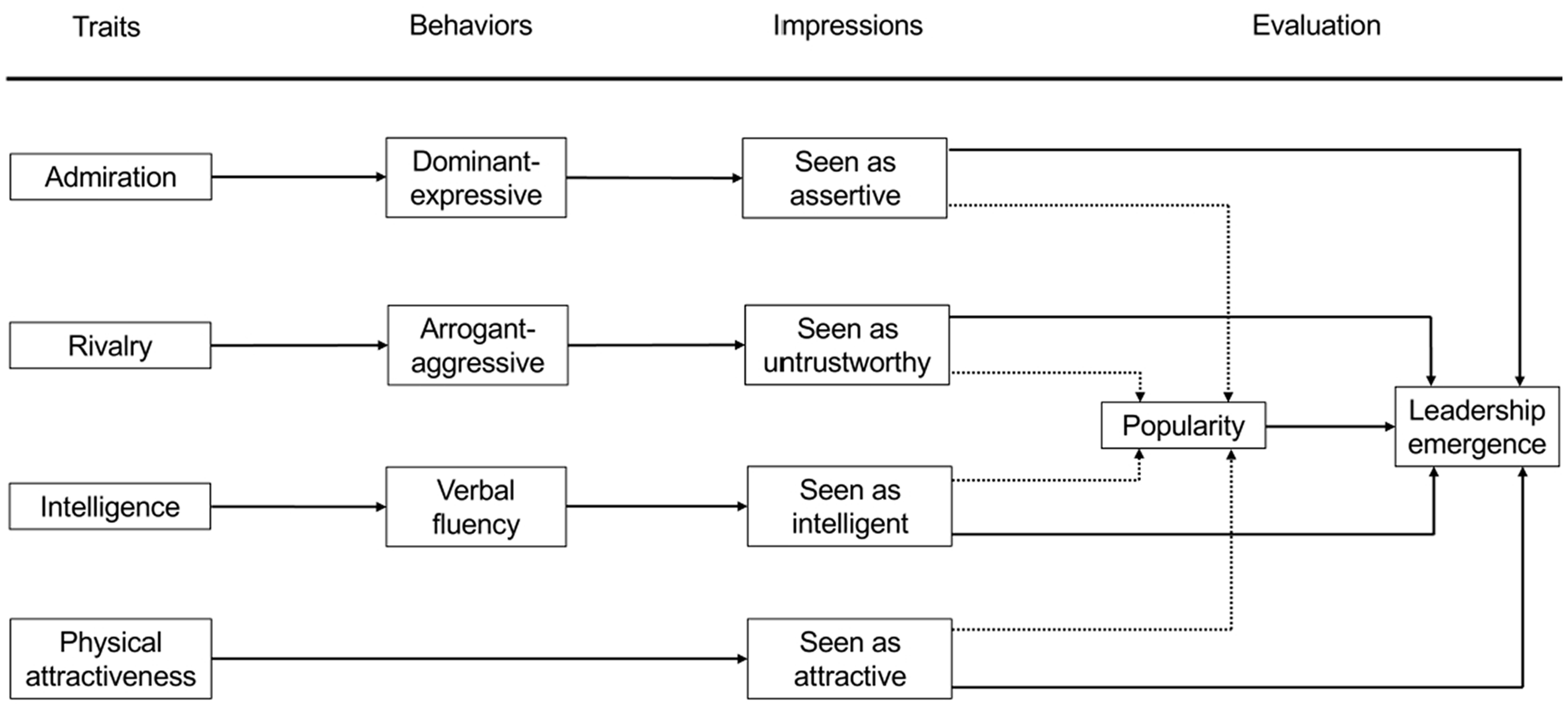
A Comprehensive Behavioral Pathway Approach to Narcissistic Leadership Emergence in Social Groups.
To clarify unique relations with leadership emergence, we contrasted the effects of the two narcissism pathways on leadership emergence with their effects on popularity. To explore the robustness and relative relevance of the narcissism pathways, we set the narcissism pathways in relation to intelligence and physical attractiveness pathways to leadership emergence. We expected the agentic narcissism pathway to exert a positive influence on leadership emergence; that is, we expected the indirect effect (IE) of admiration on being seen as a leader to be positive (Hypothesis 1). We expected the agentic narcissism pathway to exert a stronger influence on leadership emergence than the antagonistic narcissism pathway; that is, we expected the absolute value of the IE of admiration on being seen as a leader to be stronger than the absolute value of the IE of rivalry on being seen as a leader (Hypothesis 2). We expected the agentic narcissism pathway to exert a more positive influence on leadership emergence compared with its influence on popularity; that is, we expected the IE of admiration on being seen as a leader to be more positive than the IE of admiration on being liked (Hypothesis 3). We expected the antagonistic narcissism pathway to exert a less negative influence on leadership emergence compared with its influence on popularity; that is, we expected the IE of rivalry on being seen as a leader to be less negative than the IE of rivalry on being liked (Hypothesis 4). None of our hypotheses and exploratory questions were preregistered.
Method
Sample
The sample consisted of 311 university students from various majors mainly recruited via email lists, advertising posters, and lecture announcements at the Johannes Gutenberg University in Mainz, Germany. Participants were free to choose whether they would receive monetary compensation or course credit. Fourteen participants did not provide complete personality and demographic data, resulting in 297 participants (162 women) who filled out the online questionnaire and attended at least one laboratory session. The average age in this sample was 23.81 (SD = 3.92), ranging from 18 to 39. The first/second laboratory session was attended by 311/305 participants (171/169 women). The average level of participants’ prior acquaintance was low (M = 1.33, SD = 0.95; on the item “I know this person” on a scale ranging from 1 = does not apply at all to 6 = applies perfectly). All participants provided written consent to participate in the study and to be recorded during the laboratory sessions.
Because the data were not specifically collected to test the present hypotheses, no power analysis prior to data collection was conducted. As the dataset has been successfully applied in studies computing similar models (Leckelt et al. 2015, Rau et al. 2019), it likely provides sufficient power to detect the effects we were interested in. Moreover, our sample was bigger than samples of most studies with real group interactions and behavioral measurements (e.g., Cheng et al., 2013; Küfner et al., 2013; Witkower et al., 2020). However, to gain a more precise understanding of the power in the present study, we used Schoemann et al.’s (2017) online tool to calculate the power for the IE of admiration on being seen as a leader via dominant-expressive behavior and being seen as assertive (Hypothesis 1). The tool computes Monte Carlo power analysis simulations and tests IEs with bootstrapped confidence intervals (CIs). We computed the model with two serial mediators, 5,000 replications, 20,000 Monte Carlo draws per replication, and a confidence level of 95% (random seed = 1234). We entered n = 283 conservatively considering only complete cases. We entered correlations drawn from previous studies (radmiration, dominant-expressive behavior =.41, radmiration, seen as assertive = .34, Back et al., 2013; radmiration, leadership emergence = .12, Grijalva et al., 2015; rdominant-expressive behavior, seen as assertive = .42, Leckelt, Geukes et al., 2019; rdominant-expressive behavior, leadership emergence = .18, Witkower et al., 2020; rseen as assertive, leadership emergence = .88, Cheng et al., 2013). We assumed standardized variables. The computed power was 1.00.
Procedure
All procedures used in the PILS study were approved by the review board of the University of Mainz (title: “The longitudinal course of narcissists’ reputations: A developmental social interaction approach”; no protocol number) and were in line with the recommendations of the German Research Foundation (DFG) and the German Psychological Society (DGPs). First, participants were asked to complete an online questionnaire for collecting demographic information and self-reported personality traits. Thereafter, participants attended three laboratory sessions that each took place one week apart and lasted for about one hour. For the laboratory sessions, the sample was divided into 54 groups of four to six participants (M = 5.76) with 37 same-sex (21 females) and 17 mixed-sex groups. The laboratory sessions took place in a video laboratory. Participants were seated around an oval table in the middle of the room. At the beginning of the sessions and after each task, the group members provided self-ratings and round-robin ratings of each other via netbooks placed in front of them. In addition to individual cameras and microphones that recorded each participant separately, two dome cameras were installed to record the overall group setting.
The laboratory sessions were designed to investigate group interactions from zero to short-term acquaintance. Participants completed three tasks in the first session (Tasks A, B, and C) and two tasks each in Session 2 (Tasks D and E) and Session 3 (Tasks F and G). At the end of Session 1, participants completed cognitive ability measures and participated in a photo shoot under standardized conditions. For the present study, only Task A (Reading Aloud task) and Task D (Lost on the Moon task) were of direct interest. For the Reading Aloud task, each participant read a sheet with a different version of a composition of texts (e.g., a poem, a weather report) out loud. Thereafter, participants provided a brief self-introduction (Task B) followed by a detailed self-introduction (Task C). For the Lost on the Moon task (Bottger, 1984; Robins & Beer, 2001), group members were told to imagine that they were participating in a space race after experiencing a harsh landing on the moon that damaged their space shuttle and most of their equipment. Only 15 items had survived the crash intact. Participants first individually selected and ranked 12 of the 15 items that they thought would be most helpful for getting to the mother ship and then discussed their solutions in the group. 4 We focused on the Lost on the Moon task because (a) it has been successfully applied to investigate leadership emergence and status attainment in group settings (e.g., Cheng et al., 2010; DesJardins et al., 2015). (b) It was the first task in the second laboratory session and was thus located somewhere in the transition zone between zero-acquaintance and short-term acquaintance (see Leckelt et al., 2015). This should have ensured that individuals had only limited information about their group members’ performance so that our findings would be related to leadership emergence and not to leadership effectiveness (see Judge et al., 2002; Marinova et al., 2012; Ong et al., 2016). (c) It requires group discussions, which are particularly suitable for investigating the narcissism pathways. This is the case because such discussions provide the opportunity to be admired by others so that the agentic narcissism pathway can be triggered but also to be criticized and outperformed by others so that the antagonistic narcissism pathway can be triggered (Küfner et al., 2013). For a detailed description of the procedure applied in the larger project the data stemmed from, see the Codebook at https://osf.io/4hpuf/.
Measures
Narcissism
Narcissistic admiration (e.g., “I am great”; α = .82) and rivalry (e.g., “Other people are worth nothing”; α = .78) was measured with the 18-item Narcissistic Admiration and Rivalry Questionnaire (NARQ; Back et al., 2013) using 6-point scales ranging from 1 (do not agree at all) to 6 (agree completely).
Intelligence
A 15-item short version (Denissen et al., 2011) of Raven’s Advanced Progressive Matrices (Raven et al., 1962) was used to measure participants’ fluid intelligence (α = .71). The German multiple-choice vocabulary test B (Mehrfachwahl-Wortschatz-Test B, MWTB; Lehrl, 2005) was used to measure participants’ crystallized intelligence (α = .63). 5 A numeric computation span task (Oberauer et al., 2000) was used to assess participants’ working memory capacity (WMC). Subscores for processing information (α = .70) and storing information (α = .71) were substantially correlated (r = .33, p < .001). Therefore, they were z-standardized and aggregated into an overall working memory capacity score. To obtain a comprehensive indicator of participants’ intelligence, we aggregated the z-standardized scores from all three intelligence measures (rRaven, MWTB = .17, p = .002; rRaven, WMC = .19, p < .001; rMWTB, WMC = .16, p < .004). 6
Physical Attractiveness
Full-body photographs (upright format) and portrait photographs (landscape format) of each participant were taken under standardized conditions and with a neutral facial expression. Six trained coders rated participants’ overall physical attractiveness on the basis of the full-body photographs (ICC [2,k] = .82) and the physical attractiveness of participants’ faces on the basis of the portrait photographs (ICC [2,k] = .81). Scales ranged from 1 (not at all attractive) to 10 (very attractive). Both indicators were substantially correlated (r = .91, p < .001) and aggregated into an overall physical attractiveness score.
Coded Behaviors
Behaviors were coded on the meso-level, which is positioned between global label ratings (macro-level) and the counting of micro-behaviors (micro-level) because the meso-level allows ratings to be reliable and psychologically meaningful at the same time (Funder et al., 2000). Ratings were made on 6-point scales ranging from 1 (not at all) to 6 (very strongly). Six trained coders 7 rated verbal fluency on the basis of the audio footage obtained in the Reading Aloud task (“speaks fluently: speaks fluently; pronunciation matches the content; makes reasonable breaks”; ICC [2,k] = .76). Another six trained coders rated dominant/self-assured behavior (“shows dominant behavior: dominates the social interactions; takes the leading role; exhibits dominant facial expressions and gestures; behaves self-confidently and convincingly”; ICC [2,k] = .92), expressive behavior (“shows expressive behavior: exhibits expressive facial expressions and gestures; is outgoing; shows positive emotions; speaks a lot”; ICC [2,k] = .90), arrogant behavior (“shows arrogant, pretentious behavior: exhibits arrogant facial expressions and gestures; overemphasizes his/her own performance/ability; behaves in an arrogant and conceited way”; ICC [2,k] = .84), and aggressive behavior (“shows aggressive behavior: affects the interaction in an aggressive way; makes aggressive, unsocial comments; shows angry, aggressive facial expressions and gestures; shows annoyed and irritated reactions”; ICC [2,k] = .83), based on the video footage obtained in the Lost on the Moon task. Dominant/self-assured and expressive behavior (r = .93, p < .001) as well as arrogant and aggressive behavior (r = .93, p < .001) were strongly related. Thus, we z-standardized and aggregated them into measures of dominant-expressive behavior and arrogant-aggressive behavior.
Interpersonal Impressions
Interpersonal impressions stemmed from participants’ round-robin ratings after the Lost on the Moon task. Items were answered on 6-point scales ranging from 1 (does not apply at all) to 6 (applies perfectly). Participants rated each other on perceived assertiveness (“This person is assertive”), trustworthiness (“This person is trustworthy”), intelligence (“This person is intelligent”), and physical attractiveness (“This person is physically attractive”). We computed target effects on the basis of the social relations model (Back & Kenny, 2010; Kenny, 1994) with the TripleR package (version 1.2.1; Schönbrodt et al., 2012) in R (version 3.5.2; R Core Team, 2018) to capture individual differences in being seen as assertive, trustworthy, intelligent, and attractive. Partner effect reliability was .74 for being seen as assertive, .22 for being seen as trustworthy, .54 for being seen as intelligent, and .74 for being seen as attractive. 8
Leadership and Popularity
Leadership emergence (“I can well imagine this person as a leader”) and popularity (“I like this person”) were measured in a round-robin design after the Lost on the Moon task on 6-point scales. We computed target effects. Partner effect reliability was .66 for leadership emergence and .40 for popularity. For a detailed description of all measures applied in the larger project the data stemmed from, see the Codebook at https://osf.io/4hpuf/.
Analytical Approach
First, we calculated bivariate correlations for all variables. To account for the nesting of participants in groups, we used group-mean-centered traits, behavioral ratings, and target effects. We used the correlations to derive (a) general associations between variables, (b) initial support for the predicted pathways, and (c) indications for cross-paths that should be considered in the following analyses.
Subsequently, we computed four multiple mediator models (MMMs; Preacher & Hayes, 2008) building on one another to test the proposed pathways in a stepwise manner: (a) beginning with the agentic and antagonistic narcissism pathways, (b) additionally entering popularity as a second interpersonal evaluation, (c) introducing the intelligence and physical attractiveness pathways, and (d) ending up with a comprehensive model integrating all pathways. To account for the nesting of participants within groups, we used group-mean-centered variables. To attain standardized path coefficients and IEs, we z-standardized all group-mean-centered variables before we computed the MMMs.
We used the statistical program R and the interface RStudio (version 1.0.136; RStudio Team, 2016) for descriptive analyses, to compute bivariate correlations, and to prepare the data for Mplus. To test for differences between bivariate correlations, we computed Williams’ (1959) t (see Hittner et al., 2003) and J. Cohen’s (1988) q as corresponding effect size. We specified the MMMs with Mplus Version 8 (Muthén & Muthén, 2017). To test for differences between the path coefficients, we computed z-tests. We used a nonparametric bootstrapping approach implemented in Mplus to compute 95% CIs for the IEs. The number of bootstrap samples was 10,000. To test for differences between IEs, we used bootstrapping. As we formulated one-sided hypotheses for these comparisons, we computed 90% CIs.
We provide supplementary results (see the Supplemental Results at https://osf.io/4hpuf/) for all reported models in which we used (a) alternative operationalizations of narcissism by applying the NPI (see Section A) 9 and (b) an alternative analytical approach, namely, multilevel structural equation models (ML-SEMs; e.g., Preacher et al., 2010; see Section B). 10 Further, we provide results for the intermediate stages of the reported models (see Section C). The data and statistical code for all main and supplementary analyses can be found at https://osf.io/4hpuf/.
Results
Descriptive Statistics and Bivariate Correlations
Descriptive statistics and intercorrelations of the measures we used are displayed in Table 1 (see Supplemental Results Section D for a table with all measures on the different levels of aggregation; https://osf.io/4hpuf/). The bivariate correlations provided initial insights into the proposed pathways to leadership emergence. All component variables of the agentic narcissism pathway were positively correlated with each other and with leadership emergence. The same was true for the intelligence and physical attractiveness pathways. Results for the antagonistic narcissism pathway were more ambiguous. Rivalry was not correlated with being seen as untrustworthy or with being seen as a leader. Arrogant-aggressive behavior was positively correlated with being seen as leader, whereas being seen as untrustworthy was negatively correlated with being seen as a leader.
Descriptive Statistics and Bivariate Correlations of the Measures Used in the Multiple Mediator Models.
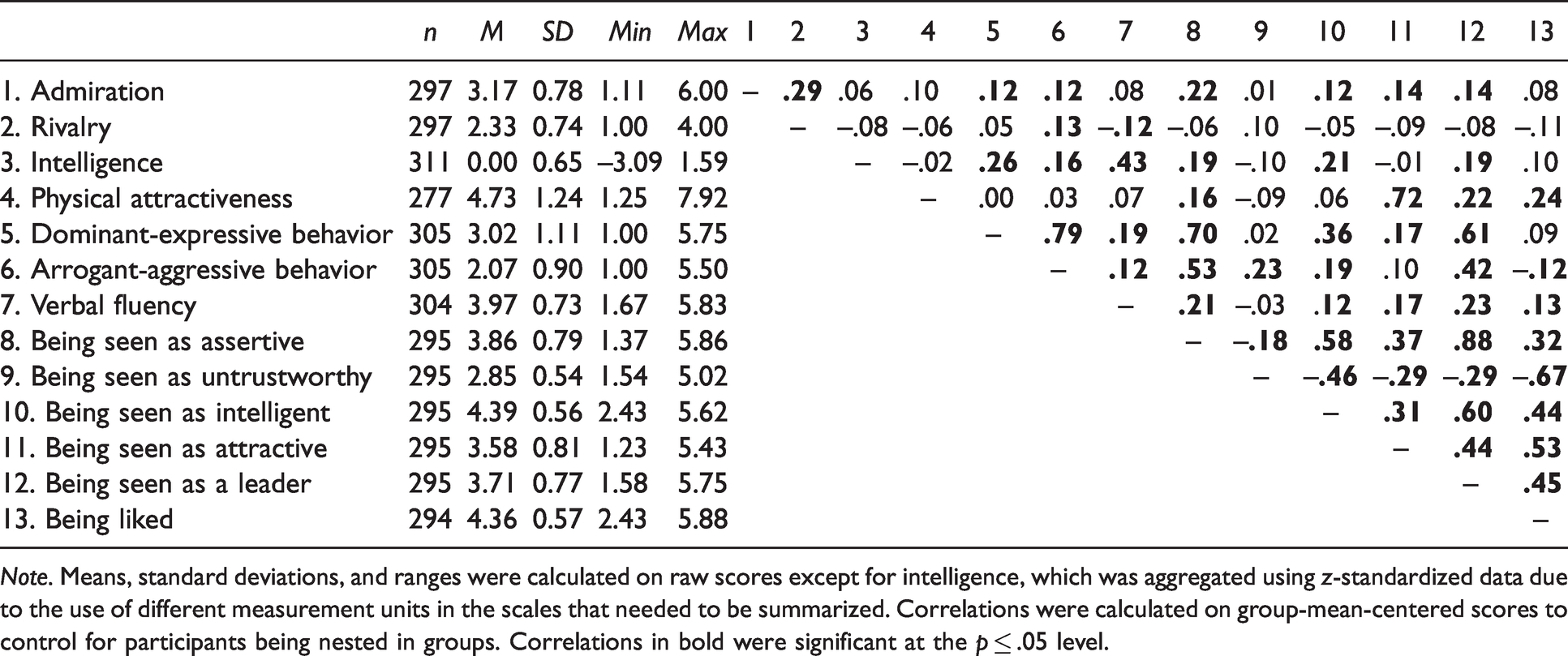
Note. Means, standard deviations, and ranges were calculated on raw scores except for intelligence, which was aggregated using z-standardized data due to the use of different measurement units in the scales that needed to be summarized. Correlations were calculated on group-mean-centered scores to control for participants being nested in groups. Correlations in bold were significant at the p ≤ .05 level.
To gain initial insights into the importance of the narcissism pathways regarding leadership emergence and popularity, we compared the correlations of the corresponding interpersonal impressions with being seen as a leader and being liked. In line with our expectation that the agentic narcissism pathway would exert a more positive influence on leadership compared with popularity, being seen as assertive was more strongly positively correlated with being seen as a leader than it was with being liked, Δr = 0.56, t(292) = 18.05, p < .001, q = 1.04. Conversely, in line with our expectation that the antagonistic narcissism pathway would exert a less negative influence on leadership emergence compared with popularity, being seen as untrustworthy had a smaller negative correlation with being seen as a leader than it did with being liked, Δr = –0.38, t(292) = –8.17, p < .001, q = 0.51.
Finally, the bivariate correlations provided indications for adding two cross-paths between the narcissism pathways (from admiration to arrogant-aggressive behavior and from arrogant-aggressive behavior to being seen as assertive) and one cross-path between the intelligence and attractiveness pathways (from verbal fluency to being seen as attractive) to the MMMs. Adding these cross-paths enabled us to explore more complex effects of narcissism on leadership emergence.
Model Results
Model 1: Pathways From Narcissism to Leadership Emergence
The first model (Figure 2) contains the pathways from agentic and antagonistic narcissism to leadership emergence. As expected, the agentic narcissism pathway exerted a positive influence on leadership emergence: The IE of admiration on being seen as a leader was positive. The antagonistic narcissism pathway did not exert an influence on leadership emergence: The IE of rivalry on being seen as a leader was not significant.
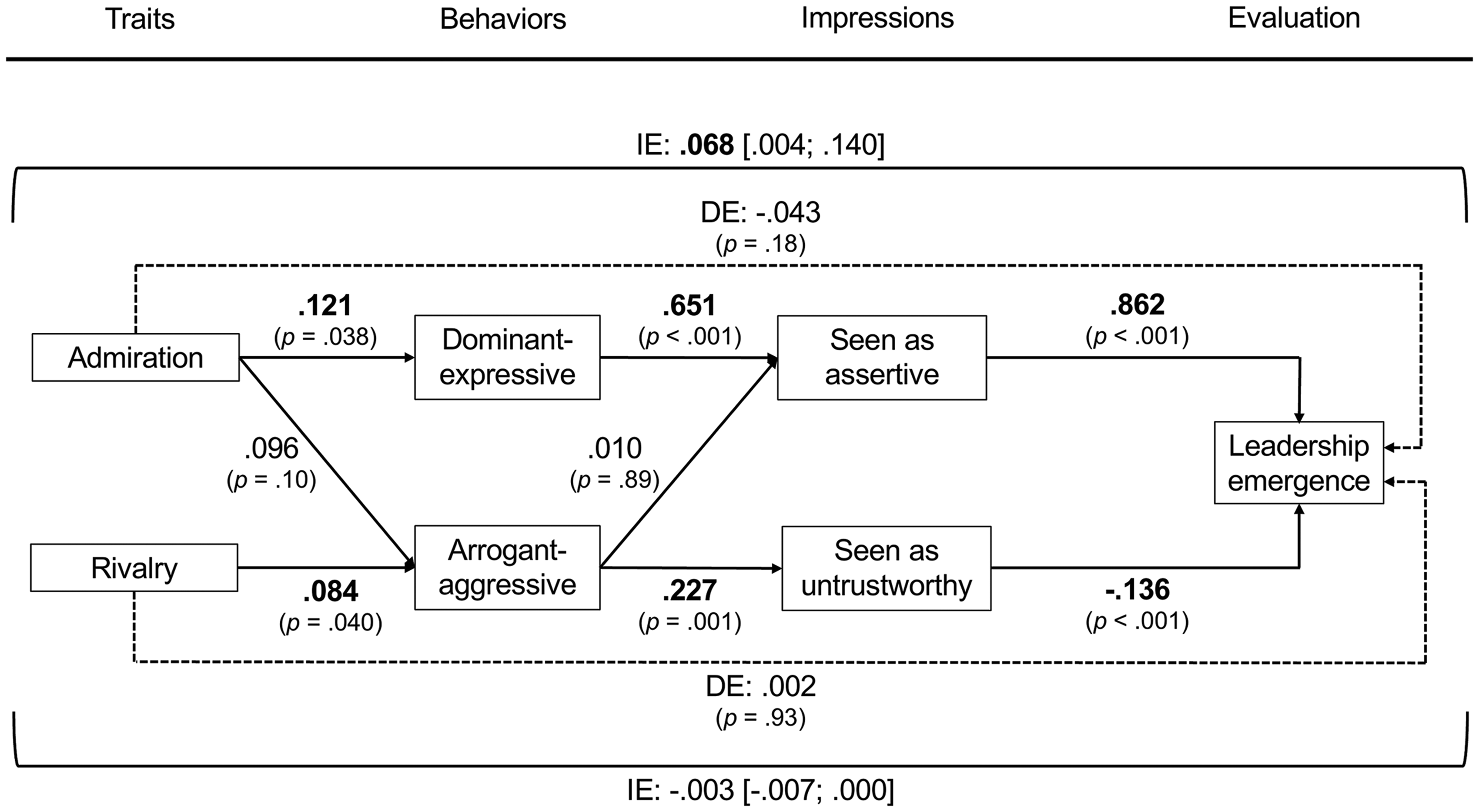
Results for Model 1: Path Model From Narcissistic Admiration and Rivalry to Leadership Emergence in Social Groups. Note. Personality traits, expressed behaviors, and interpersonal impressions were allowed to covary among each other (paths are not displayed for the sake of clarity). Results are presented as standardized path coefficients. The 95% confidence intervals of the standardized indirect effects are displayed in brackets. DE = Direct effect. IE = Indirect effect. Standardized path coefficients, IEs and DEs in bold were significant at the p ≤ .05 level.
As expected, the agentic narcissism pathway exerted a stronger influence on leadership emergence than the antagonistic narcissism pathway: The absolute value of the IE of admiration on being seen as a leader was stronger than the absolute value of the IE of rivalry on being seen as a leader (Δβ = .065, 90% CI [.011, .124]). This can be retraced by comparing the corresponding coefficients for each pathway. Admiration was descriptively but not significantly more strongly expressed in dominant-expressive behavior than rivalry was expressed in arrogant-aggressive behavior (Δβ = .037, z = 0.52, p = .60). Dominant-expressive behavior was more strongly reflected in being seen as assertive than arrogant-aggressive behavior was reflected in being seen as untrustworthy (Δβ = .423, z = 4.75, p < .001). Finally, being seen as assertive was more strongly related to being seen as a leader than being seen as untrustworthy was (Δβ = .725, z = 15.22, p < .001).
Even though the bivariate correlations indicated two cross-paths, one from admiration to arrogant-aggressive behavior and the other from arrogant-aggressive behavior to being seen as assertive, neither of the cross-paths was significant. Hence, neither the explored IE of admiration via arrogant-aggressive behavior and being seen as untrustworthy on being seen as a leader (β = –.003,95% CI [–.008, .001]) nor the IE of admiration via arrogant-aggressive behavior and being seen as assertive on being seen as a leader (β = .001, 95% CI [–.013, .019]) was significant.
Model 2: Pathways From Narcissism to Leadership Emergence and Popularity
The second model (Figure 3) also included popularity as an additional interpersonal evaluation. DEs and IEs from the agentic and antagonistic narcissism pathways to leadership emergence and popularity, respectively, are shown in Table 2. The agentic narcissism pathway still exerted a positive influence on leadership emergence: The IE of admiration on being seen as a leader was almost unchanged compared with Model 1. The path coefficient from being seen as assertive to being seen as a leader was barely affected by the inclusion of popularity. The antagonistic narcissism pathway did not exert an influence on leadership emergence. As expected, the agentic narcissism pathway exerted a stronger influence on leadership emergence than the antagonistic narcissism pathway: The absolute value of the IE of admiration on being seen as a leader was stronger than the absolute value of the IE of rivalry on being seen as a leader (Δβ = .065, 90% CI [.012, .122]).
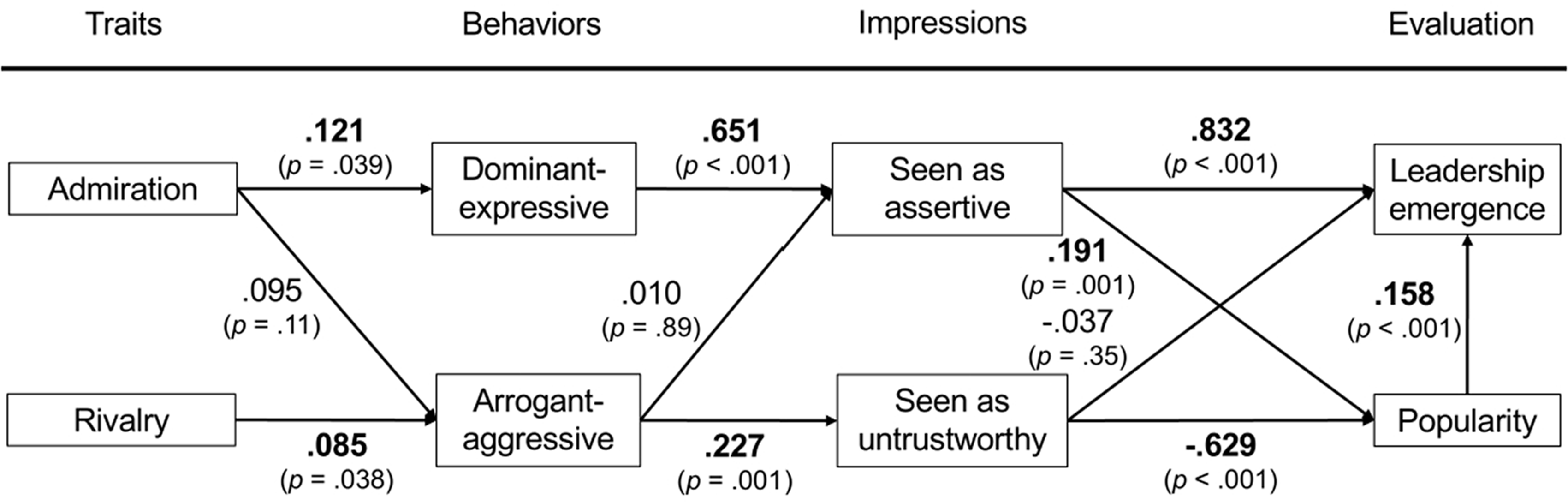
Results for Model 2: Path Model from Narcissistic Admiration and Rivalry to Leadership Emergence and Popularity in Social Groups.Note. Personality traits, expressed behaviors, and interpersonal impressions were allowed to covary among each other (paths are not displayed for the sake of clarity). Results are presented as standardized path coefficients. Standardized path coefficients in bold were significant at the p ≤ .05 level.
Direct and Indirect Effects in Model 2.
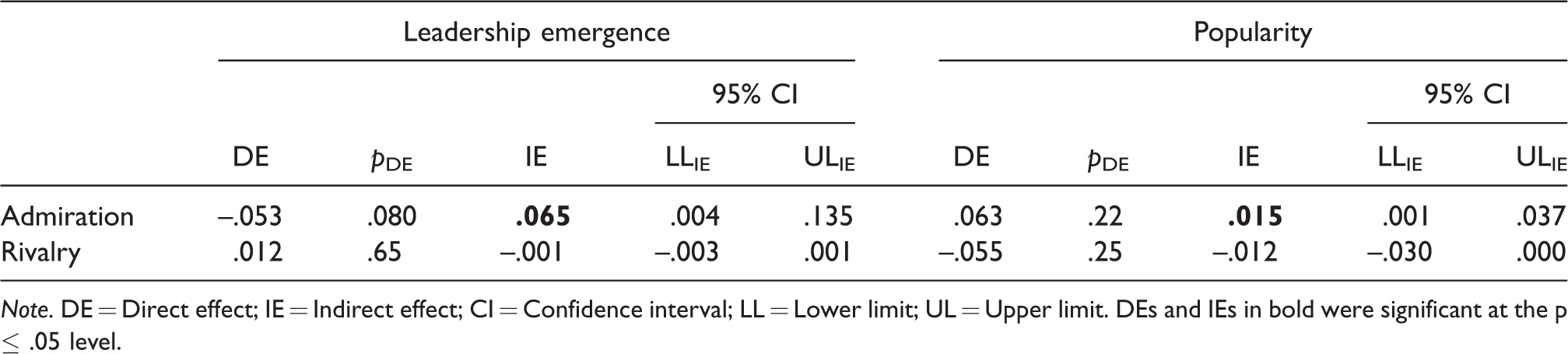
Note. DE = Direct effect; IE = Indirect effect; CI = Confidence interval; LL = Lower limit; UL = Upper limit. DEs and IEs in bold were significant at the p ≤ .05 level.
Including popularity allowed us to compare the effects of the pathways from agentic and antagonistic narcissism to leadership emergence and popularity. As expected, the agentic narcissism pathway exerted a more positive influence on leadership emergence than it did on popularity: The IE of admiration on being seen as a leader was more positive than on being liked (Δβ = 0.050, 90% CI [0.010, 0.095]). Being seen as assertive influenced being seen as a leader more positively than it influenced being liked (Δβ = 0.640, z = 10.19, p < .001). As expected, the antagonistic narcissism pathway exerted a less negative influence on leadership emergence than it did on popularity: The IE of rivalry on being seen as a leader was less negative than the IE of rivalry on being liked (Δβ = 0.011, 90% CI [0.002, 0.025]). This difference was significant when testing one-sided but only marginally significant when testing two-sided (95% CI [0.000, 0.028]). Since we have not formally pre-registered our hypotheses, this finding should be interpreted with increased caution. Being seen as untrustworthy influenced being seen as a leader less negatively than it influenced being liked (Δβ = 0.592, z = 8.07, p < .001).
Model 3: Pathways From Intelligence and Physical Attractiveness to Leadership Emergence and Popularity
The third model (Figure 4) introduced intelligence and physical attractiveness as pathways to leadership emergence. Intelligence and physical attractiveness showed significant IEs on leadership emergence (see Table 3) underlining the utility of adding these pathways to Model 2 to explore the robustness of the narcissism pathways.
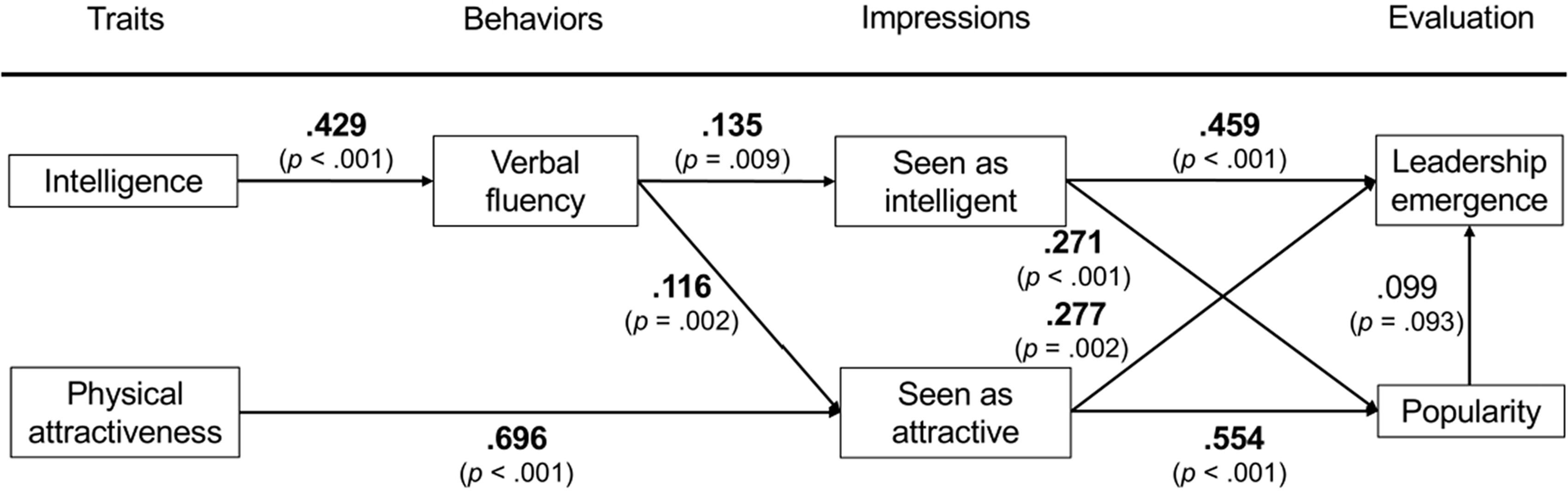
Results for Model 3: Path Model for Intelligence and Physical Attractiveness as Additional Pathways to Leadership Emergence and Popularity in Social Groups.Note. Interpersonal impressions were allowed to covary among each other (paths are not displayed for the sake of clarity). Results are presented as standardized path coefficients. Standardized path coefficients in bold were significant at the p ≤ .05 level.
Direct and Indirect Effects in Model 3.
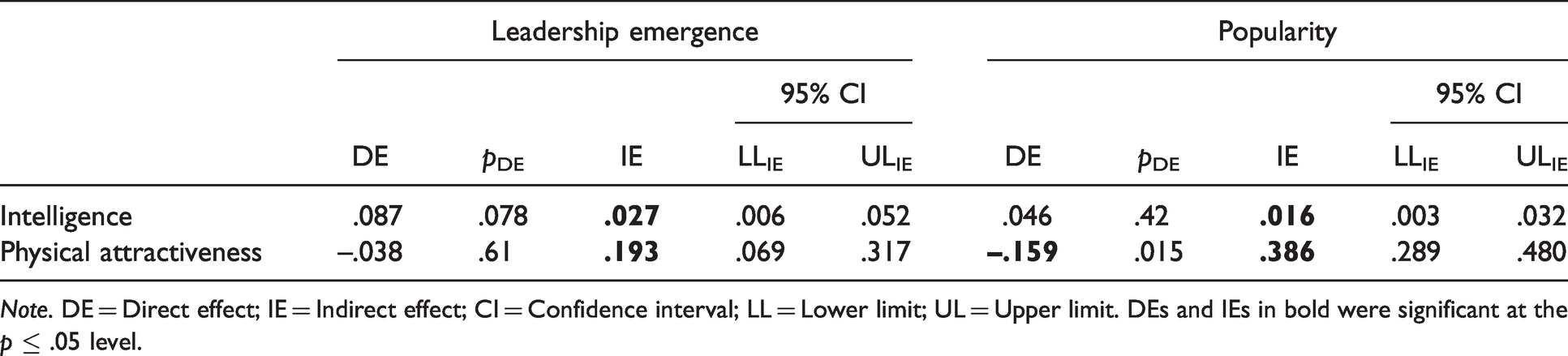
Note. DE = Direct effect; IE = Indirect effect; CI = Confidence interval; LL = Lower limit; UL = Upper limit. DEs and IEs in bold were significant at the p ≤ .05 level.
Model 4: Pathways From Narcissism, Intelligence, and Physical Attractiveness to Leadership Emergence and Popularity
The fourth model (Figure 5) contains the pathways from agentic and antagonistic narcissism to leadership emergence and popularity and presents them in relation to the pathways from intelligence and physical attractiveness. The DEs and IEs of the pathways from agentic and antagonistic narcissism and the pathways from intelligence and physical attractiveness to leadership emergence and popularity, respectively, are shown in Table 4.
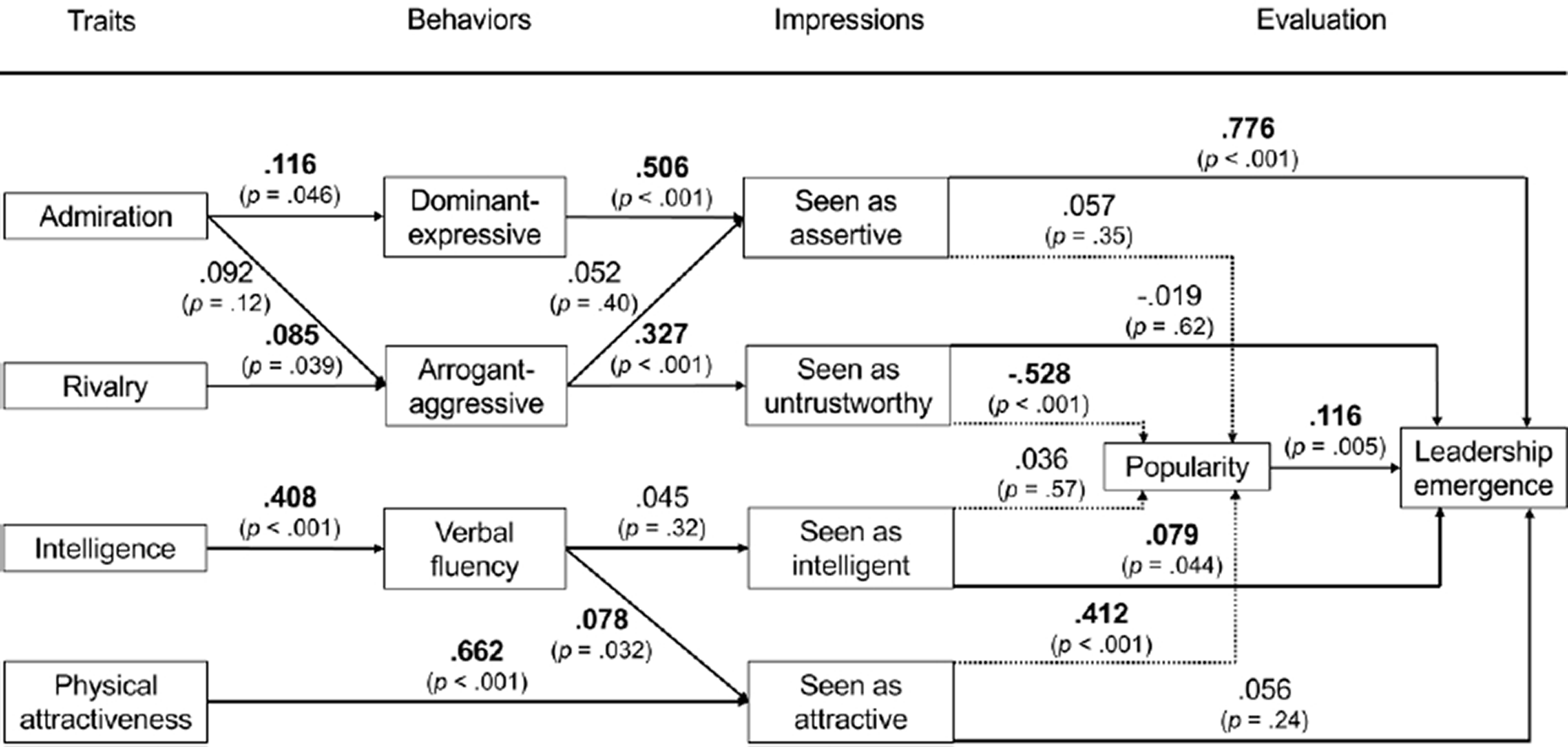
Results for Model 4: Comprehensive Path Model of Narcissistic Admiration and Rivalry and the Additional Pathways, Intelligence and Physical Attractiveness, to Leadership Emergence and Popularity in Social Groups.Note. Personality traits, expressed behaviors, and interpersonal impressions were allowed to covary among each other (paths are not displayed for the sake of clarity). Results are presented as standardized path coefficients. Standardized path coefficients in bold were significant at the p ≤ .05 level.
Direct and Indirect Effects in Model 4.
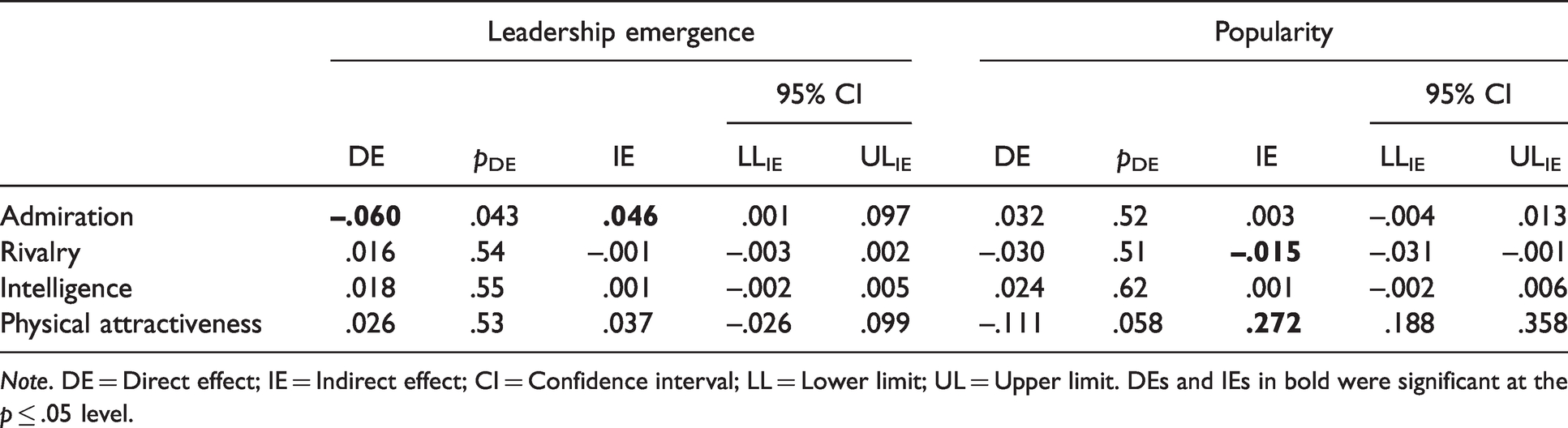
Note. DE = Direct effect; IE = Indirect effect; CI = Confidence interval; LL = Lower limit; UL = Upper limit. DEs and IEs in bold were significant at the p ≤ .05 level.
The agentic narcissism pathway exerted a positive influence on leadership emergence. By contrast, the antagonistic narcissism pathway and the intelligence and physical attractiveness pathways did not have significant IEs on being seen as a leader. Corresponding to Models 1 and 2, the agentic narcissism pathway exerted a stronger influence on leadership emergence than the antagonistic narcissism pathway: The absolute value of the IE of admiration on being seen as a leader was stronger than the absolute value of the IE of rivalry on being seen as a leader (Δβ = .045, 90% CI [.008, .087]). This difference was significant when testing one-sided but only marginally significant when testing two-sided (95% CI [.000, .096]). Since we have not formally pre-registered our hypotheses, this finding should be interpreted with increased caution. Next to being seen as assertive, being seen as intelligent was the only interpersonal impression predicting being seen as a leader. The impact of being seen as assertive was stronger than the impact of being seen as intelligent (Δβ = .697, z = 10.51, p < .001).
We explored two alternative pathways from admiration to being seen as a leader to determine whether the narcissism pathways as specified in the NARC (Back et al., 2013) uniquely drive narcissism’s effects on leadership emergence. We found positive correlations between dominant-expressive behavior and being seen as intelligent and between dominant-expressive behavior and being seen as attractive (see Table 1). Indeed, when we added the cross-paths from dominant-expressive behavior to being seen as intelligent (β = .282, p < .001) and from dominant-expressive behavior to being seen as attractive (β = .130, p = .003) to Model 4, both became significant. However, the IEs of admiration via dominant-expressive behavior and being seen as intelligent to being seen as a leader (β = .003, 95% CI [.000, .007]) and of admiration via dominant-expressive behavior and being seen as attractive to being seen as a leader (β = .001, 95% CI [–.001, .004]) were not significant.
Comparing the strengths of the influences of the pathways from agentic and antagonistic narcissism, respectively, to leadership emergence and popularity, we found the same pattern as in Model 2. The agentic narcissism pathway exerted a stronger positive influence on leadership emergence than it did on popularity: The IE of admiration on being seen as a leader was more strongly positive than the IE of admiration on being liked (Δβ = 0.042, 90% CI [0.008, 0.084]). The antagonistic narcissism pathway exerted a less negative influence on leadership emergence than it did on popularity: The IE of rivalry on being seen as a leader was less negative than the IE of rivalry on being liked (Δβ = 0.014, 90% CI [0.003, 0.027]).
Discussion
We applied the NARC (Back et al., 2013) and the dual-pathway approach (Küfner et al., 2013) as a process-based framework to specify two distinct pathways that linked narcissism to leadership emergence. This allowed us, for the first time, to identify the underlying behavioral processes and interpersonal impressions that explain how narcissists emerge as leaders and to thereby differentiate between recent conceptualizations of agentic and antagonistic narcissism. We applied data from a large multimethodological data set encompassing personality traits, expressed behaviors in a realistic interaction setting, and interpersonal impressions measured as round-robin ratings and combined these variables in comprehensive, process-oriented models. This approach enabled us to demonstrate (a) how narcissists emerge as leaders in social groups, (b) how different aspects of narcissism have diverging impacts on leadership emergence and popularity, and (c) the robustness of the narcissism pathways.
How Do Narcissists Emerge as Leaders?
As hypothesized, agentic narcissism (which encompasses the self-enhancing aspects of narcissism) was positively related to leadership emergence. This finding corresponds to previous findings of positive associations between the more agentic facets of narcissism and leadership emergence (Brunell et al., 2008; Carlson & DesJardins, 2015; Paunonen et al., 2006). Here, we zoomed in on the underlying interpersonal processes and provided an explanation: Participants high on narcissistic admiration behaved in a dominant-expressive manner; therefore, they were seen as assertive, which in turn predicted evaluations of being seen as a leader. Thus, this agentic narcissism pathway seems to encompass behaviors and interpersonal impressions that fit people’s views about the prototypical leader (Foti et al., 1982; Lord et al., 1986, 1984; Offermann et al., 1994; Shondrick et al., 2010).
The antagonistic narcissism pathway (which encompasses the other-derogating aspects of narcissism), by contrast, did not exert a meaningful influence on leadership emergence, and the influence of the agentic narcissism pathway on leadership emergence was substantially stronger. Even though narcissistic rivalry was expressed in arrogant-aggressive behavior that predicted being seen as untrustworthy, which in turn was negatively related to leadership emergence, the separate effects were too weak for the entire pathway to be influential. This finding corresponds to the lack of clear evidence of effects of antagonistic narcissism on leadership emergence. Studies on the relations between the antagonistic facets of narcissism and leadership emergence have found diverging results (Brunell et al., 2008; Carlson & DesJardins, 2015; Paunonen et al., 2006). Constructs related to rivalry (e.g., disagreeableness) have been shown to be unrelated to leadership emergence (e.g., Ensari et al., 2011; Judge et al., 2002; Taggar et al., 1999). However, the lack of support for a positive effect of antagonistic narcissism is not in line with the dominance pathway (e.g., Cheng et al., 2013).
Contrasting Effects With Popularity
In line with interpersonal theory and agency and communion frameworks (Bakan, 1966; Dufner et al., 2016; R. Hogan, 1982; Hopwood, 2018; Kiesler, 1983; Wiggins, 1991; Wojciszke et al., 2009), the agentic narcissism pathway exerted a more positive influence on leadership emergence than it did on popularity, and the antagonistic narcissism pathway exerted a less negative influence on leadership emergence than it did on popularity. This differentiated pattern of effects could be traced back to (a) assertiveness perceptions being more important for leadership and (b) trustworthiness perceptions being more important for popularity. Thus, leadership and popularity are distinct indicators of social value that are attained in different ways: Group members systematically value different characteristics (i.e., assertiveness vs. trustworthiness) when deciding who should become their leader versus who they like. This matches Carlson and Desjardins’ (2015) finding that narcissists initially attain status in social groups despite not being particularly well-liked. Our findings suggest that this is likely due to the two distinct narcissism pathways that are differently linked to emerging as a leader and being liked.
Robustness of the Narcissism Pathways
Considering other powerful predictors of leadership emergence (i.e., popularity, intelligence, and physical attractiveness), not only did the agentic narcissism pathway remain a meaningful predictor of leadership emergence, but it also appeared to be the most robust one. This finding is noteworthy in view of the substantial amount of literature emphasizing the importance of intelligence (e.g., Ensari et al., 2011; Judge et al., 2004; Lord et al., 1986) and physical attractiveness (e.g., Hochschild Jr. & Borch, 2011; Poutvaara, 2014) for leadership emergence, connections that were also suggested by ILTs (Offermann et al., 1994). Thus, the agentic narcissism pathway appears to be a robust and substantial path to leadership emergence (see also Grosz et al., 2020).
Implications for Understanding Grandiose Narcissism
Our findings go along with the emerging consensus on a multidimensional conceptualization of grandiose narcissism encompassing agentic and antagonistic aspects (Back, 2018; Back et al., 2013; Brown et al., 2009; Krizan & Herlache, 2018; Miller et al., 2016), which have been shown to have diverging effects on a broad spectrum of social outcomes, such as interpersonal liking (Küfner et al., 2013; Lange et al., 2016; Leckelt et al., 2015; Leckelt, Geukes, et al., 2019), dating outcomes (Wurst et al., 2017), and financial and occupational success (Leckelt, Richter, Schröder, et al., 2019; Leckelt, Richter, Wetzel, et al., 2019). Our results extend this research by showing that a detailed examination of the behavioral, interpersonal perception, and evaluation processes helps provide a better understanding of the relationship between narcissism and leadership emergence. Our results also provide further evidence for the validity of the NARC (Back et al., 2013). Admiration uniquely triggered the agentic narcissism pathway, whereas rivalry uniquely triggered the antagonistic narcissism pathway. None of the alternative pathways we explored via cross-paths between the examined pathways were significant in determining leadership emergence. Thus, it was uniquely the agentic narcissism pathway as specified in the NARC that predicted leadership emergence.
Implications for Understanding Leadership Emergence in Social Groups
We also identified general processes for successful leadership emergence in social groups. Four interpersonal impressions predicted leadership emergence (i.e., being seen as assertive, untrustworthy, intelligent, or attractive) with being seen as assertive (and to a smaller extent being seen as intelligent) as the most important and robust precursor of leadership emergence. We do not claim that individuals need to be narcissistic in order to evoke such perceptions and emerge as leaders. There are other personality traits (e.g., extraversion) that elicit dominant-expressive behavior and thus foster impressions of assertiveness. Analogously, there are several traits and corresponding expressed behaviors that yield impressions of intelligence. Indeed, even though we found that being seen as intelligent was a unique predictor of leadership emergence, the intelligence pathway was not meaningful in the context of the other pathways. Consequently, it might be more important to appear intelligent than to actually be intelligent in order to emerge as leader (see Rubin et al., 2002).
These general findings are highly relevant as they allowed us to identify discrepancies between variables that facilitate the ability to emerge versus to perform effectively as a leader, which might be used to improve processes of leadership emergence by shifting the focus to variables that are crucial for leadership effectiveness. For instance, research has suggested a curvilinear relationship between assertiveness and leadership effectiveness (Ames & Flynn, 2007). Thus, whereas being seen as highly assertive was best for emerging as a leader, a moderate level of assertiveness might be best for performing effectively as a leader. Likewise, whereas we found that being seen as untrustworthy was not a good predictor of leadership emergence, research has suggested that trust is important for leadership effectiveness (Ferrin & Dirks, 2002).
Limitations and Future Directions
First, the role of the level of acquaintance in a given social context should be considered more closely when examining the effect of narcissism on leadership emergence jointly with its effect on leadership effectiveness (see Ong et al., 2016). According to the contextual reinforcement model (CRM; Campbell & Campbell, 2009), narcissism is often associated with positive social consequences in the short-term and with negative social consequences in the long-term. In the domains of peer popularity and romantic relationships, Leckelt et al. (2015) and Wurst et al. (2017), respectively, found that narcissistic admiration and rivalry explained this timely pattern (see also Back et al., 2018). Admiration tends to dominate in social contexts that prevail in the early stages of social relationships (e.g., one-sided self-presentations), leading primarily to positive social consequences, such as being liked (Back et al., 2010; Küfner et al., 2013; Leckelt et al., 2015; Paulhus, 1998) and initial romantic attraction (Wurst et al., 2017). As time passes, however, rivalry becomes more important because it dominates in the social contexts that prevail in the later stages of social relationships (e.g., intimate interactions), leading to more negative social consequences, such as being disliked (Küfner et al., 2013; Leckelt et al., 2015; Paulhus, 1998) and problems in romantic relationships (Wurst et al., 2017). It would be interesting to investigate how exactly our pattern of findings might change in the advanced stages of group processes in which group members already provide behavioral indicators of more or less effective leadership, potentially affecting who is selected as a leader in the end. Indeed, research has provided initial indications that antagonistic narcissism might have a negative impact on leadership emergence in the later stages of group processes (see Carlson & DesJardins, 2015; Paunonen et al., 2006).
Second, operationalizing leadership emergence as being seen as a leader by group members (“I can well imagine this person as a leader”) might be especially applicable to situations in which group members jointly decide who should become the leader of their group. Individuals may then vote for the group member who is perceived to possess characteristics that reflect those of the prototypical leader (Foti et al., 1982; Lord et al., 1984, 1986; Offermann et al., 1994; Shondrick et al., 2010). However, in situations in which leaders emerge less on the basis of group consensus but rather by exerting influence over the group, operationalizations of leadership emergence that focus on actually exerted influence (e.g., “This person led the group”) might be more important. Here, it might even be the case that the antagonistic narcissism pathway contributes to leadership emergence in the same way that behaving in an arrogant-aggressive manner can lead to exhibiting influence in social groups (see Cheng & Tracy, 2014; Cheng et al., 2010, 2013; Maner & Case, 2016; Witkower et al., 2020). This might (partly) explain the diverging results in which the antagonistic narcissism pathway did not predict leadership emergence in the present study and the dominance pathway positively predicted leadership emergence (e.g., Cheng et al., 2013). Future studies might thus use peer ratings that assess (a) perceived suitability as a leader and (b) perceived exerted influence and complement these measures with more objective measures (e.g., visual attention; see Cheng et al., 2013; Maner et al., 2008).
Third, future research should compartmentalize and add behaviors and interpersonal impressions. Compartmentalizing behaviors using a bottom-up approach might reveal which specific verbal (e.g., commanding/combative comments), paraverbal (e.g., dominant/aggressive tone), and nonverbal (e.g., dominant pointing gestures, staring others down) behavioral indicators are particularly important for the link between narcissism and leadership emergence. To address such questions, (a) more heterogenous samples might be recruited because certain behaviors have been suggested to be expressed more strongly in heterogenous groups (e.g., dominant behaviors; Chatman & Flynn, 2001), and (b) situations that trigger behavioral differences might be examined (Tett & Guterman, 2000; e.g., experimental manipulations that induce ego threat might enhance antagonistic behaviors; see Bushman & Baumeister, 2002; Heatherton & Vohs, 2000; Horton & Sedikides, 2009; Kernis & Sun, 1994). Compartmentalizing (e.g., trustworthiness into its subdimensions ability, benevolence, and integrity; see Mayer et al., 1995) and adding interpersonal impressions (e.g., fear; see Cheng et al., 2010, 2013; tough-mindedness, cold-heartedness) seems particularly promising for clarifying the influence of the antagonistic narcissism pathway by capturing additional variance.
Fourth, it would be interesting to examine whether the present results generalize to real-life groups across contexts (e.g., work and study groups, sports teams) in which there is a great deal at stake (e.g., financial bonuses, grades, athletic success). Group members might (a) express behaviors differently (e.g., employees might be highly motivated to contribute to their work group) and (b) evaluate interpersonal impressions differently (e.g., employees who often work together on important long-running projects might value trustworthiness; see Ferrin & Dirks, 2002). Also, group dynamics might vary with group size; for instance, in larger groups, interruptions might occur more often and increase the potential for conflict (Hare, 1981), thus triggering the antagonistic narcissism pathway. Complementing the detailed observation of specific interaction tasks (e.g., video-taped interactions) with more continuous assessments of interaction dynamics across time (e.g., experience-sampled interaction partner reports; Harari et al., 2016; see also Leckelt et al., 2019) would be another promising approach that could be applied to better understand narcissistic leadership emergence across social groups and contexts (see also Wrzus & Mehl, 2015).
Finally, future studies might investigate contextual moderators of the narcissism pathways to clarify the influence of the antagonistic narcissism pathway. Antagonistic narcissism might have a more positive effect on leadership emergence in contexts in which (a) competitiveness is emphasized, 11 (b) antagonistic behaviors are instrumental for the group’s success, and (c) inducing fear is possible. According to ILTs, people may adapt their leader prototypes on the basis of the context (Lord et al., 2001). Thus, in competitive contexts that call for toughness and strength, leader attributes such as tyranny might be valued, whereas sensitivity might be less valued (DesJardins et al., 2015). According to functionalist theories and the micropolitics model (C. Anderson & Cowan, 2014; C. Anderson & Kennedy, 2012), individuals will attain status if they are perceived as contributing to the group (Willer, 2009). With regard to intragroup constellations, narcissists might direct their aggressiveness toward low contributors (Böckler et al., 2017), eradicate social loafing behavior, and in doing so contribute to the group (Boyd & Richerson, 1992). With regard to intergroup situations, in the presence of intergroup competition, dominant-aggressive leaders were found to prioritize their own group’s success (Maner & Case, 2016), antagonistic behaviors were found to be used to defend ingroup interests (Laustsen & Petersen, 2017), and deviant-extreme leaders were found to be preferred (Chang et al., 2015). According to the dominance-prestige account (Henrich & Gil-White, 2001), aggressive behaviors might contribute to leadership emergence by inducing fear (Cheng et al., 2010, 2013; Cheng & Tracy, 2014), which should be effective in contexts in which the aggressor holds threat potential (e.g., withdrawal of resources).
Conclusion
In the present study, we zoomed in on the behavioral, perceptual, and evaluative processes underlying narcissistic leadership emergence. The present research provides clear evidence for differentiated effects of agentic and antagonistic narcissism. Whereas agentic narcissism positively predicted leadership emergence via dominant-expressive behaviors and being seen as assertive, antagonistic narcissism did not predict leadership emergence. These effects were distinct from effects on popularity and held when the intelligence and physical attractiveness pathways were also included. Applying a two-dimensional process-based understanding of grandiose narcissism seems to be a fruitful avenue for future research on leadership emergence.
Supplemental Material
sj-pdf-1-erp-10.1177_08902070211046266 - Supplemental material for Pathways From Narcissism to Leadership Emergence in Social Groups
Supplemental material, sj-pdf-1-erp-10.1177_08902070211046266 for Pathways From Narcissism to Leadership Emergence in Social Groups by Tobias M. Härtel, Marius Leckelt, Michael P. Grosz, Albrecht C. P. Küfner, Katharina Geukes and Mitja D. Back in European Journal of Personality
Footnotes
Authors’ Note
Selected results from an earlier version of this manuscript were presented at a conference: Härtel, T. M., Leckelt, M., Grosz, M. P., Küfner, A. C. P., Nestler, S., Geukes, K., & Back, M. D. (2019). Narcissists’ pathways to leadership in naturally emerging social groups. Talk at the 15th meeting of the section Differential Psychology and Psychological Assessment of the German Psychological Society, Dresden, September 16–18, 2019.
Data Accessibility Statement
The study materials, data and analysis scripts used for this article can be accessed at https://osf.io/4hpuf/.
Declaration of Conflicting Interests
The author(s) declared no potential conflicts of interest with respect to the research, authorship, and/or publication of this article.
Funding
The author(s) disclosed receipt of the following financial support for the research, authorship, and/or publication of this article: This research was supported by Grant BA 3731/6-1 of the German Research Foundation (DFG) to Mitja Back, Steffen Nestler, and Boris Egloff.

Supplemental Material
Notes
References
Supplementary Material
Please find the following supplemental material available below.
For Open Access articles published under a Creative Commons License, all supplemental material carries the same license as the article it is associated with.
For non-Open Access articles published, all supplemental material carries a non-exclusive license, and permission requests for re-use of supplemental material or any part of supplemental material shall be sent directly to the copyright owner as specified in the copyright notice associated with the article.
