



Abstract
Background:
Endometriosis is a chronic, systemic, inflammatory disease with a prevalence likely higher-than-reported due to diagnostic challenges. Characterized by the growth of endometrial-like tissue outside the uterus, endometriosis often causes pain, abnormal bleeding and infertility, frequently resulting in significant diagnostic delays and impaired quality of life.
Objective:
To humanize the experience of living with endometriosis through a personal narrative, and to identify key challenges in diagnosis and management within an advanced health care system, supported by a review of global literature. To raise awareness among clinicians around the world as to the complexities of endometriosis, its diagnosis, and treatment.
Methods:
This narrative review and commentary combine the lived experience of one author (C.A.P.) with a synthesis of salient literature. Eight major challenges in endometriosis pathogenesis and care are identified and discussed, integrating personal testimony with evidence from national and international studies.
Results:
The narrative highlights persistent gaps in menstrual health education and the “normalization” of severe menstrual pain. Diagnostic delays for endometriosis average eight years; patients often see multiple providers before the diagnosis. Clinical challenges include subjective and poorly quantified pain assessment, fragmented electronic medical records, limited access to minimally invasive diagnostic surgery, insufficient research funding, financial burdens, and restricted treatment options. The disease imposes direct and indirect costs on individuals and the health care system, disrupts education and employment, and is associated with psychological distress. Despite therapeutic advances, no cure exists, and treatment options remain limited. Patients may experience recurrent symptoms and ongoing challenges with activities of daily living.
Conclusions:
Endometriosis is a complex, under-recognized disease with profound impacts on physical, psychological, social, and economic well-being. Addressing educational gaps, improving clinician awareness, enhancing access to specialized care, developing multidisciplinary approaches, and increasing research funding can improve outcomes for those living with endometriosis.
Introduction
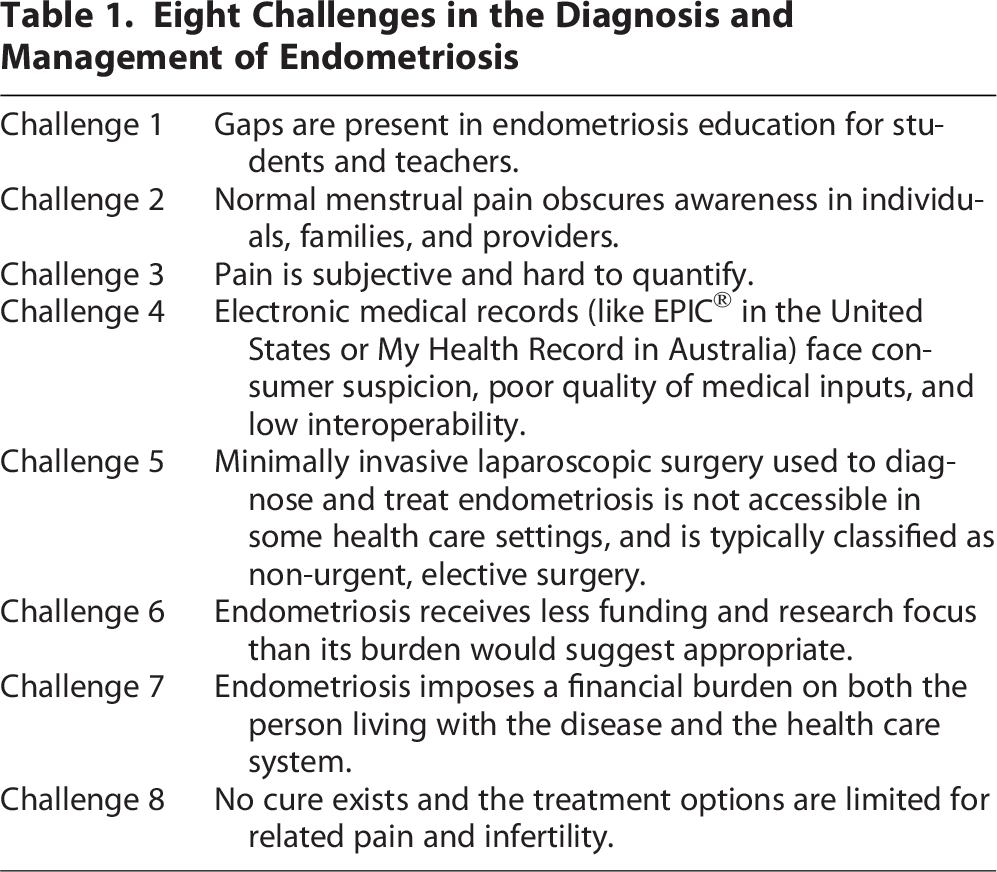
Endometriosis is a chronic, systemic, inflammatory disease where tissue similar to the lining of the uterus grows outside the uterus, often causing pain and, in some cases, infertility. 1 Endometriosis can be difficult to recognize, manifesting in diagnostic delays that average eight years. 2 Its elusive diagnosis reflects a limited awareness of the disease, including gaps in medical, nursing and school-system education, confusion with normal menstrual pain, a need for invasive diagnostics, and comparatively low research funding. In this narrative review, we seek to humanize endometriosis through recounting the lived experience of one of us (C.A.P.) within an advanced health care system, citing salient medical and nursing literature. These experiences are anecdotal and may not be representative of the full diversity of presentations, disease severity, or care experiences among individuals living with endometriosis. Through the dual prism of the global literature and a personal testimony, we seek to identify key challenges in the diagnosis and management of endometriosis (Table 1).
Eight Challenges in the Diagnosis and Management of Endometriosis
From age 12, I’ve been plagued by excruciating chronic pain that often impedes my life. Severe, debilitating, stabbing, shooting abdominal, back, and leg pain, heavy menstrual bleeding with clotting, bloating, fatigue, nausea, diarrhea, constipation, difficulty concentrating, migraines, and dizziness are my reality. This is not limited to my period but continues spontaneously and unpredictably throughout the month.
My first period arrived a month before I began high school in Australia. Amid the transition into a new environment and my teenage years, I juggled bleeding through maternity pads, being unable to participate in sports classes, regularly visiting my school’s sickbay, leaving school early because I was going to faint or vomit, and habitual absences. I was given no sense that this was abnormal. Despite being in an all-girls school, we never talked about our periods—it was a taboo topic. However, it seemed that none of my friends were in as much agony as I was. I couldn’t understand why I wasn't able to manage the pain like everyone else.
Challenge 1 Discussion
Major gaps in the knowledge of endometriosis exist in both school and health care systems. Menstrual health education is not mandatory in Australia, with 7% of Australian women reporting not receiving it in school. 3 If it is taught, it may be offered years after most teenagers have had their first period. 3 Content typically focuses on the biology of the reproductive system without specific reference to endometriosis. In Armour and colleagues’ survey of 4,202 Australians, only 53% of school students had heard of endometriosis. 4 Teachers often lack the training and confidence to discuss puberty. An Australian study found that 83% of male teachers did not feel comfortable teaching menstrual education, 5 a problematic finding given the number of health and physical education teachers that are male. Accordingly, less than half of adolescents who experience dysmenorrhea (i.e., painful periods) in Australia sought medical assistance. 4 Even those with worse pain who thought their symptoms were abnormal mostly did not seek medical advice. 4
Additional misconceptions surround endometriosis. Endometriosis involves uterine-like tissue growing outside the uterus, especially in the peritoneum and/or fallopian tubes. 1 Endometriosis is not restricted to the pelvic region and abdominal cavity, but has been found in all organs and venues, including the bladder, 6 bowel, 7 lungs, 8 and brain. 9 The type of tissue is evolutionarily adapted to the uterus and behaves accordingly, continuing to thicken and then break down with each menstrual cycle. While uterine tissue that is sloughed and expelled from the uterus is normal, ectopic tissue is trapped; the tissue with no exit can result in cysts, scar tissue, adhesions, inflammation, and/or infection in the abdominal cavity or elsewhere.
Enduring pain can be life-altering; excessive bleeding and/or infertility occur in 30%–50% of sufferers. 10 While endometriosis symptoms are pronounced at the time of menstruation, they can occur at any time of the cycle. 11 Endometriosis lesions can infiltrate organs with such dysfunction as bowel blockage or lung collapse, and have been associated with cardiovascular disease 12 and ovarian cancer. 13 Endometriosis affects one in seven Australians assigned female at birth and is likely even higher globally, given underreporting, misdiagnoses, and invasive diagnostic procedures. 14
At age 14, on one of the many days that I left school early due to illness, I fainted on the train home, overcome with pain. This led to me speaking to the first of several doctors about my symptoms, where I was told that period pain is “normal”. There was a dismissive belief that I was being dramatic. My family told me to toughen up; menstrual pain was a requisite of being female.
By age 17, I was experiencing near-daily diarrhea, nausea, and vomiting for six full months. I had stool and breath tests, a colonoscopy and endoscopy, computerized tomography (CT) scans, and numerous ultrasounds. I was referred back and forth between doctors, including gastroenterologists who settled on an irritable bowel syndrome (IBS) diagnosis and ibuprofen therapy, and gynecologists who were not concerned beyond apparently extreme menstrual pain, prescribing me oral contraception for menstrual regularity. I developed acne, gained weight, and experienced mood changes. Only halfway through that terrible year did I discover I was intolerant to gluten, lactose, eggs, soy, legumes, fruits, and some vegetables—in addition to my pre-existing nut allergy. While my diarrhea lessened with time, my food choices became restricted and eating, particularly when socializing, became challenging. Gluten-free food may contain cheese, and vegan food may contain chickpeas or tofu. It became difficult to consume nutritionally adequate meals, so my iron, B12, and calcium levels dropped to the point where I required iron infusions and B12 injections.
Challenge 2 Discussion
Indeed, pain during one’s period has been considered normal throughout history and something to be tolerated, a view often shared by parents with their adolescent children. 15 In a study from Puerto Rico, participants felt that endometriosis was perceived by the public as less serious than other chronic conditions and was a normal part of being a woman. 16 They reported that their relatives and partners viewed them as “changuerias” (“complainers”) for whining about their symptoms. 16 In Australia, Wong et al. reported that 76.1% of surveyed rural girls believed that dysmenorrhea was normal, so only 14.8% sought medical treatment. 17 Similarly, Armour et al. found that 51% of surveyed persons believed their symptoms were normal, despite having severe dysmenorrhea. 4 Tewhaiti-Smith et al. found that an average of 2.9 years passed before persons living with endometriosis (PLWE) presented to a clinician following symptom onset. 2
General practitioners, pediatricians, and nurses can conflate endometriosis symptoms with nonpathogenic menstrual pain. 18 Abnormally severe endometriosis pain during one’s period may be misconstrued as dysmenorrhea or polycystic ovarian syndrome (PCOS), while dyspareunia may appear to be a urinary tract infection (UTI). Abdominal pain and bloating are non-specific symptoms and are easily confused with other syndromes. Coincident medical conditions complicate the diagnosis even further, as with the gluten intolerance reported in the narrative. Conditions that may mimic endometriosis symptoms include dysmenorrhea, polycystic ovarian syndrome, irritable bowel syndrome/disease, gluten intolerance, urinary tract infection, ovarian cysts, adenomyosis, pelvic inflammatory disease, uterine fibroids, and diverticulitis. When endometriosis occurs in the context of any of these, the endometriosis diagnosis is even easier to miss.
In some cases, PLWE report having their symptoms doubted by health care professionals, being labeled complainers and opioid drug-seekers, 19 who exaggerate their pain. 16 Such invalidation can lead PLWE to feel hypochondriacal, doubt their symptoms and postpone seeking medical care. The Endometriosis UK organization reported that 80% of PLWE aged 16–24 years old postponed seeking medical advice for fear of being dismissed or told their symptoms were normal, 20 reflecting the stigma that PLWE may face in health care settings. Delayed diagnosis is associated with continued endometrial tissue growth and accompanying pathogenesis. As provider trust and satisfaction are important determinants in patients’ medical adherence, diagnosis, and treatment pathways, such delays can undermine an ideal therapeutic alliance of practitioner and patient. 21
Those who seek medical assistance, overcoming the stigma and societal normalization of even severe symptoms, face an average of eight years between first presenting to a medical professional and diagnosis, seeing an average of five doctors before diagnosis. 2 Diagnostic delay is associated with more pelvic symptoms and reduced quality of life. 22 Continuing ectopic tissue growth can compromise fertility. 23 There are psychological tolls inherent in diagnostic delays, including social isolation, poor self-esteem, 18 distrust in oneself and the health care system, and other psychological distress. 24 Burdens on the health care system from delayed diagnosis and therapy are considerable. In a study of 11,793 patients, those with intermediate or long diagnostic delays had significantly more emergency visits and inpatient hospitalizations before diagnosis than those with short delays. 25
At age 19, I relocated from Melbourne to Sydney to study. Now living with my aunt, she witnessed me curled up in a ball immobilized by pain and argued that this wasn’t normal. She rushed me to the emergency department (ED) where they suspected my appendix had burst and I was booked in for an appendectomy. It wasn’t uncommon to wait 18 hours in the ED before being transferred to a ward, with no communication about when a doctor or surgeon may arrive. I was prepared for surgery, only for it to be cancelled after 11 hours of fasting. I was given more tests to confirm I wasn’t pregnant than tests that would lead to a diagnosis. I was doused in painkillers when all I wanted was my heat pack to be microwaved, but this warming was against hospital policy. The tapentadol box had warning labels so I thought that it must have been strong, yet it was doing nothing for my pain. Note: Tapentadol is classified as a Schedule II narcotic in the United States.
Challenge 3 Discussion
Pain, the primary symptom of endometriosis, is subjective and hard to quantify. Triage nurses ask, “On a scale of one to ten, rate your pain.” There are no guidelines on what each number means, and one’s response is relative to past experiences and cultural norms. Health care providers do not realize that “a chronic pain patient can function with a pain level that would incapacitate any other person” 26 and many PLWE have mastered hiding their pain to avoid stigma or negativity. Endometriosis is listed in the United Kingdom National Health Service’s (NHS) Top 20 most painful conditions alongside heart attack and broken bones. 27 An additional complication is that pain does not correlate with the severity of endometriosis—a patient could be living with severe pain and have minimal disease, while someone with minimal pain could have Stage 4 deep, infiltrating endometriosis. 28
A week-long stay in hospital was the first of six hospital admissions over the next few years, missing university to battle what I felt to be dismissive triage nurses and apathetic doctors. During this period, I was hospitalized and underwent ultrasound and CT scans for suspected appendicitis, deep vein thrombosis, muscle hematoma, livedo reticularis (mottled skin), mesenteric adenitis, and ovarian pathology; had a colonoscopy to rule out bowel malignancy; and was tested for bacterial infections. None of these investigations were diagnostic, as the underlying cause—later identified as endometriosis—had not yet been recognized. I was sent home with inconclusive diagnoses, only for the pain to worsen. I became a collector of hospital bracelets, toasted skin-syndrome from heat pack exposure (erythema ab igne), along with a raft of pathology and imaging reports, discharge summaries, referrals, and prescriptions. Each time I visited a new provider, I carried my files with me, self-advocating in an effort to help them connect the dots. This was a frustrating and stressful time; I felt unheard and ignored by the medical system.
Challenge 4 Discussion
In Australia, there is no mandatory electronic medical reporting requirement for practitioners, pathology, or diagnostic imaging providers; hence, patients’ files typically contain incomplete records. 29 Only 2% of documents uploaded by doctors are viewed by other doctors. 30 As legislation allows a person’s EMR information to be provided to the police, the Australian Tax Office, or third parties, there is consumer hesitancy surrounding security and privacy, 31 with 10% of Australians opting out of having an EMR (My Health Record [MHR] in Australia). 32 PLWE may have a long medical history of surgeries, medications, pathology reports, and scans from multiple practitioners and facilities. When this information is not shared or noted by clinicians, patients are subjected to repeated tests and time burdens, costly for patients, practitioners, and health systems alike.
With my newfound independence in Sydney and increased self-confidence of turning 19, I decided I had to act. I conducted my own research, joined online endometriosis groups and suspected I had endometriosis. I booked a private and expensive consultation with a leading endometriosis-specialized gynecologist in Sydney. In mid-2020, during my initial appointment with him, I felt seen and believed for the first time. Endometriosis was officially on the table. However, a diagnosis required laparoscopic surgery. I needed to purchase private health insurance, endure the 12-month waiting period before my hospital cover kicked in, and save up for surgery. The alternative: join the public health care system waitlist for at least two years, and risk being operated on by a trainee, assisted by a surgeon not specialized in endometriosis.
Finally, the one-year mark was approaching, and my family had their flights booked to support me for my laparoscopy. However, in mid-2021, three days before my surgery, Sydney went into a COVID-19 lockdown. The state border closed, and my family was no longer able to visit. I had no idea what this meant for me as my surgery was “elective” and elective surgeries were all cancelled in Melbourne.
Challenge 5 Discussion
While barriers exist to using laparoscopic surgery to diagnose endometriosis, it is the only diagnostic method for detection of the most common aberrant tissues. Minimally invasive surgery still requires hospitalization, general anesthesia, and taking leave from work or school through surgery and the recovery period. PLWE face wait times of 12–24 months on the public health system to have endometrial tissue removed 33 and meet out-of-pocket costs ranging from AU$2,000-$15,000 per surgery, 34 making it inaccessible and unaffordable for many. (In 2021, the average exchange rate was AU$1.00 = US$0.75). Similarly long waits for specialty care and surgery exist around the globe, and not all patients have the resources to accelerate their care with private financial resources. Accomplished endometriosis-specialized gynecologists earn more by working in private clinics, leaving the majority of PLWE in the care of the more affordable but less specialized clinicians in the public system. 35 In Australia, laparoscopies and hysteroscopies are considered nonurgent, elective surgery. 36 Under national guidelines, endometriosis surgery falls into Category 3—the least urgent category, though delays can result in vital organ damage or infertility, alongside compromised well-being. 37 Whether due to a lack of health insurance and costs, workforce shortages, long waiting times, or COVID-19 pandemic restrictions, suspensions of “non-urgent” elective surgeries can delay definitive diagnosis and/or therapy for PLWE.
Although many surgeries were cancelled or delayed due to COVID-19 restrictions, I was fortunate to go forward with my procedure. My many questions revealed my fears. What if they found nothing? How could my symptoms be explained? It would be like the other tests and scans I’d done over the years that were inconclusive. Was I just weak and unable to deal with pain? What would this mean for my fertility? I pushed these thoughts aside. I knew that what I was feeling was real. I knew others with similar experiences and surgery had given them their diagnosis. This wasn’t all in my head.
On 29 June 2021, I underwent a Complicated Operative Laparoscopy with Endometriosis Excision and Hysteroscopy Curetting, Endometrial Biopsy and Intrauterine Device (IUD) Insertion, where I was finally diagnosed with endometriosis, 8.5 years after initially experiencing symptoms. I was grateful that I could afford health insurance, that despite the pandemic, my surgery proceeded, and that my surgeon was trained to find and treat endometriosis. I felt the biggest sense of relief and validation. At last, I had an answer and knew that I wasn’t crazy. Endometriosis helped me find my voice, listen to my body, and trust and advocate for myself. With this diagnosis, my passion for understanding endometriosis was born. Gandhi’s words, “Be the change you wish to see in the world,” instilled me with purpose and determination to advocate for myself and others. The more I learnt, the more frustrated I felt that there was no cure and such little awareness and understanding of this chronic, whole-body disease.
At age 21, I undertook an endometriosis research internship, which was pivotal in discovering my career aspirations of making a difference in the lives of PLWE. I had the privilege of co-authoring four endometriosis-related publications. 38–41 I volunteered with an endometriosis mentoring program. My lived experience helped me recognize the urgent need for reform to alleviate endometriosis-induced suffering and motivated my desire to pursue postgraduate studies to leverage science to positively impact women’s health worldwide. I was awarded a US$50,000 fellowship in support of my research proposal to study the neurological impacts of endometriosis at an American university.
Challenge 6 Discussion
Endometriosis receives less funding and research focus than its burden would suggest appropriate. Endometriosis is a complex problem underpinned by systemic challenges, gender bias regarding women’s gynecological pain, historical and cultural issues, and stigma. In 2022, only 0.038% of the U.S. National Institute of Health’s (NIH) budget was allocated to endometriosis, translating to US$2 per patient, compared with US$31.30 per patient with diabetes. 42 A study into gender disparities in NIH funding found that a disproportionate share of resources was allocated to diseases that primarily affect men, leading to underfunding of diseases that primarily affect women. 43 Fewer resources being dedicated to research, care, and awareness can hinder society’s ability to discover better and less invasive diagnostic and treatment methods to improve the quality of life of PLWE.
Following the surgery, I began to feel the burden of my health care costs. For the laparoscopy alone, the surgeon quoted AU$2,644, the anaesthetist quoted AU$1,224, the hospital estimated AU$4,414, and pathology and pharmacy costs approximated AU$300. My annual health insurance premiums were AU$2,108. My family had urged me to try complementary therapies, so I incurred costs for acupuncture, hypnotherapy, Chinese herbs, a Transcutaneous Electrical Nerve Stimulation (TENS) machine, chiropractic treatment and physiotherapy. There were also recurring expenses for specialist consultation fees, iron infusions, painkillers, nausea medications, allergen-friendly foods, and maternity pads. Thankfully, most of my general practitioner consultations, pathology tests, and imaging scans were bulk billed under Medicare, Australia’s universal health insurance scheme.
I continued to focus on my university work, but it was difficult to concentrate with severe pain, constant fatigue, brain fog, blurred vision, and migraines. I often put pressure on myself to front load my work so that when I was unwell or admitted to hospital, my studies weren’t as severely impacted. My life revolved around my symptoms. I learnt that managing a chronic illness adds a burden that changes one’s university and life experiences.
At age 22, during the 18 months leading up to my studies in the U.S., I worked a full-time corporate job. I found it hard to sit in an office chair for nine hours when I was in substantial pain. It was challenging to dress professionally when experiencing “endo belly”, the severe bloating common in PLWE that mimics pregnancy. I felt guilty taking sick leave and worried that I appeared unreliable. The 10-day yearly allowance was insufficient for a chronic disease that presented itself daily.
Challenge 7 Discussion
Endometriosis imposes a large direct financial cost on PLWE and their families, the public health care system, and private insurers. Substantial indirect costs and work disruptions add to the overall financial burden on individuals, employers, and society. Inflexible workplace policies and limited sick leave allowances can adversely affect PLWE who need extra time off for symptom management and/or medical appointments.
In a 2017 estimate, PLWE incur costs approximating AU$30,900 per year, incorporating health, productivity, and caretaker costs, 44 with the total economic burden estimated to be AU$9.5 billion per year. 45 There were over 3,600 endometriosis-related ED presentations and over 40,500 endometriosis-related hospitalizations in 2021–2022, costing the Australian health system an estimated AU$247.2 million. 46 (With an average exchange rate in both 2021 and 2022 of AU$1.00 = US$0.75, this is US$185.4 million for an Australian population of about 26 million at that time.) Furthermore, indirect costs from endometriosis are substantial; adolescents with the disease lose an average of six study days a month, 2 and pain reduces classroom concentration and performance in school/university. 11 Fully 81% of PLWE are affected negatively in their ability to carry out their daily activities. 47
Endometriosis UK reported that 47% of respondents were concerned about asking their employer for endometriosis-related sick leave. 20 When participants disclosed their symptoms to employers, some were accused of trying to avoid work and had their competency at their jobs questioned. 48 In an Australian study, 65% of participants needed to take unpaid sick leave, 31.2% missed out on a promotion, and 14.2% were fired due to endometriosis. 49 However, the COVID-19 pandemic proved beneficial for the health of PLWE in terms of their ability to manage in the workplace. Working from home enabled freedom to engage in self-management strategies such as using heat packs, taking rest breaks, and wearing comfortable clothing without appearing ill, different, or weak, 38 enhancing workplace productivity.
During my laparoscopy in June 2021, I had an IUD inserted to help manage my symptoms and limit the regrowth of endometrial tissue. When I consented to this procedure, I was told to try it—“If you don’t like it, it can easily be removed.” Yet by January 2022, I had bled vaginally every day for seven months. After being convinced to give it one month, then three months, and subsequently six months, I wanted it removed. The first two attempts with a general practitioner who did these procedures regularly, were excruciatingly painful and unsuccessful, with a string snapping. During the third attempt, in the birthing suite of a hospital under nitrous oxide, it was found to be lodged in the cervix and even the senior obstetrician was unable to extract it. I was admitted overnight and had a hysteroscopy the following day to have it removed under general anesthesia.
Challenge 8 Discussion
There is no sure cure for endometriosis, and the treatment options are limited. In this narrative case, even the use of an IUD was fraught with complications. Laparoscopic surgery to excise endometriosis and hormonal contraceptives to halt tissue growth are often used to manage the illness. Yet endometriosis often recurs and some PLWE continue to experience symptoms even after menopause. 50 While pregnancy and its hormonal shifts suppress symptoms for some, this is not universal. Many PLWE struggle to get pregnant with both inflammatory and anatomical threats to fertility. 51 While a hysterectomy can relieve symptoms, it will not cure endometriosis with extrauterine ectopic tissues. 52
Concluding narrative experience and conclusions
At age 23, three weeks prior to moving to the U.S. in 2024, I underwent another Operative Laparoscopy and Hysteroscopy with Endometrial Biopsy, a procedure that cost AU$7,853, to excise any endometriosis regrowth. Only two days before my flight, I was cleared to fly and needed wheelchair assistance for the 36-hour journey from Sydney to Newark. As I compose this narrative in 2025, I’m committed to researching the intersection of neuroscience and endometriosis to bridge the gaps present. I dream of living in a world where women feel safe to share their experiences and are believed from day one. Where the national narrative surrounding endometriosis disrupts the misconception that it is a gynecological issue, instead promoting multidisciplinary collaboration to tackle a disease that can affect all the body’s organs and debilitate daily functioning, fertility, work, study, finances, and relationships. Where policy is changed to ensure all schools educate students about endometriosis, all doctors are trained to promptly recognize and address endometriosis symptoms, and all persons who cannot afford private health care can efficiently access the medical and fertility care required. Where flexible workplace policies enable women to prioritize their health. Where prioritized research identifies non-invasive diagnostic methods, underpinning causes, and a cure to improve quality of life in the one in seven PLWE.
By adopting translational research methodologies, I hope to utilize science to bring an understanding of endometriosis to the attention of decision-makers, educators, and health care professionals, leverage my research to inform public policy, and develop interventions that improve women’s health outcomes globally. Inspired by former U.S. vice-president Kamala Harris’ words, “I want young women and girls to know: you are powerful and your voice matters,” I’ m determined to be a voice for women living with this invisible illness. I believe that through education, we can empower women to advocate for themselves and normalize conversations surrounding menstrual health.
Footnotes
Authors’ Contributions
C.A.P.: Conceptualization, writing—original draft, and writing—review and editing. S.H.V.: Supervision and writing—review and editing.
Author Disclosure Statement
No competing financial interests exist.
Funding Information
No funding was received for this article.