



Abstract
Background:
Modern techniques for graft choice, preparation, and fixation for anterior cruciate ligament (ACL) reconstruction demonstrate excellent longevity and return-to-play rates; however, up to 10% to 18% of cases continue to suffer reruptures, with even higher rates in specific subsets of patients.
Indications:
Normally, the posterior tibial slope is measured between 7° and 10°, with biomechanical and observational studies showing that posterior slope greater than 12° increases the risk of graft failure by 5× by allowing for increased anterior tibial translation, putting increased stress on the graft. The primary indication for a slope correction osteotomy with a revision ACL reconstruction is a patient with tibial slope greater than 12° who has failed prior ACL reconstruction.
Technique Description:
In our preferred technique, we illustrate a slope reducing anterior closing wedge proximal tibial osteotomy with concurrent revision ACL reconstruction rather than a staged ACL reconstruction.
Results:
The primary benefit of this technique is the ability to correct the tibial slope and reconstruct the ACL in one setting, which decreases recovery time, costs, and risks to the patients by eliminating an additional procedure.
Discussion/Conclusion:
In cases of ACL reconstruction failure, particularly in patients with multiple failures, an increased posterior tibial slope may be a contributing factor. Anterior closing wedge osteotomy has been shown to be an effective treatment, in patients with a native slope greater than 12°. A slope reducing anterior closing wedge proximal tibial osteotomy with concurrent revision ACL reconstruction rather than a staged ACL reconstruction has a wide array of benefits.
This is a visual representation of the abstract.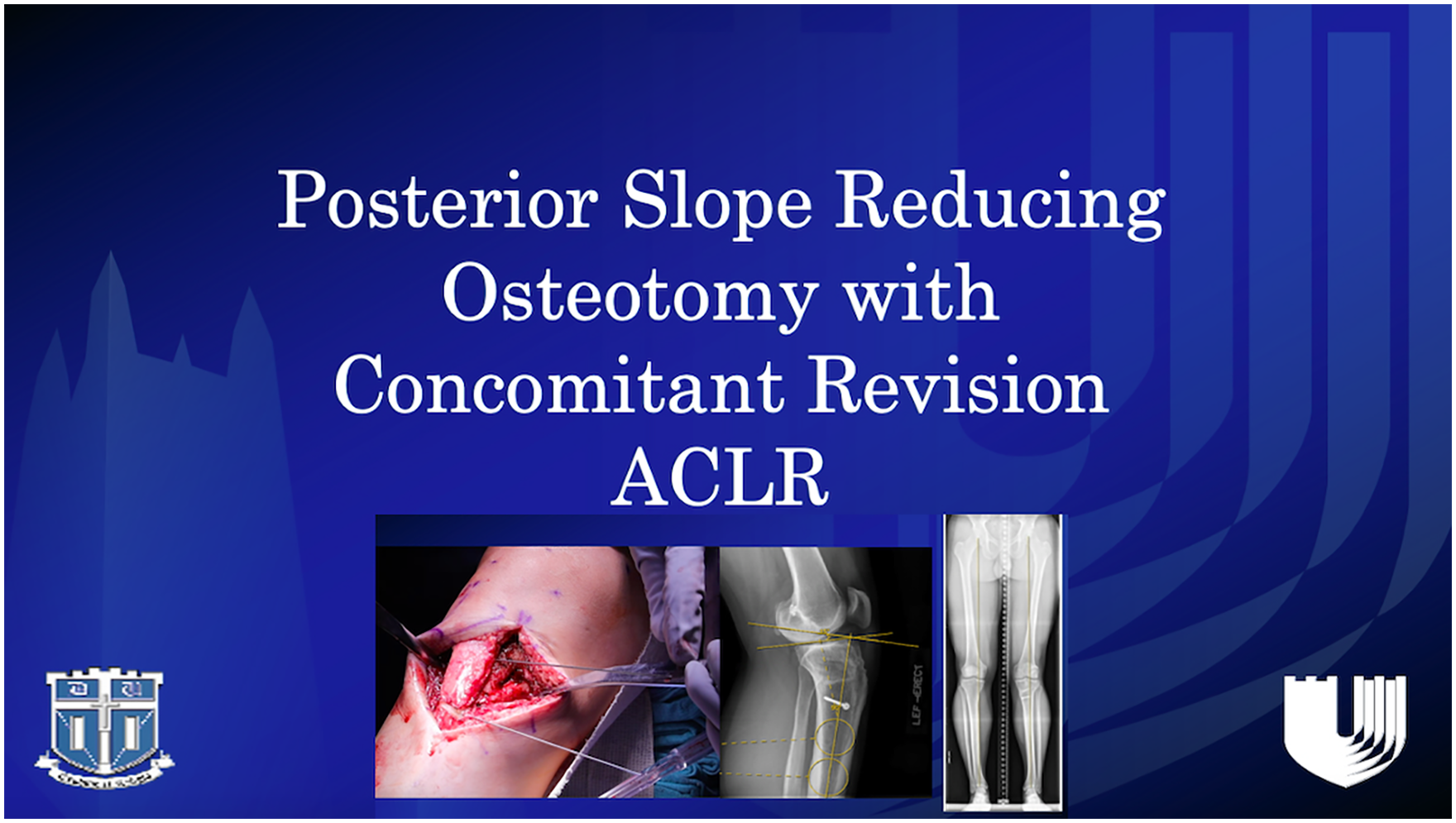
Keywords
Video Transcript
Hello my name is Dr Kier Blevins, and I will be presenting on behalf of my coauthors Dr Danilkowicz, Dr Lau, and Dr Amendola on the technique of posterior slope reducing osteotomy with concurrent revision anterior cruciate ligament (ACL) reconstruction.
Numerous prior biomechanical studies have shown that increasing posterior slope of the tibial plateau results in greater forces across ACL grafts, with a value of 12° commonly cited as the threshold upon which the risk of graft failure increases by up to 5-fold. This adverse effect is even more pronounced in younger patients. The survival rate of ACL grafts at 20 years was only 22% in adolescents with tibial slopes greater than 12° compared with adults having had an ACL reconstruction with tibial slopes greater than 12° having a 74% 20-year graft survivorship.
In this cadaver model study performed by Imhoff et al, ACL graft forces were shown to decrease after slope reduction osteotomy of 10° by 14.7 N at 200 N of testing force and 33.8 N at 400 N of testing force, equating to force reductions of 17.0% and 33.1%, respectively.
Posterior slope correcting osteotomy techniques has been described in the literature and vary in both their approach and concomitant procedures, including with or without tibial tubercle osteotomy or ACL reconstruction.
The indications for a posterior slope correcting osteotomy in conjunction with ACL reconstruction include failed ACL reconstruction with persistent anterior laxity, varus malalignment with unicompartmental osteoarthritis (OA), and a tibial slope of greater than 12°.
Relative contraindications include but are not limited to, primary ACL reconstruction, patients with prior ACL reconstruction tunnels requiring bone grafting until addressed, patients with a deficient posterior cruciate ligament (PCL), individuals with significant varus malalignment in the coronal plane, and patients with significant OA.
In this case, we present a 36-year-old man who is in active duty military and was referred for persistent instability and pain in the setting of prior failed revision ACL reconstruction. He has no additional pertinent medical history. On physical examination, he has full range of motion with a 2B Lachman and positive pivot shift, otherwise ligamentously stable.
In order to determine the posterior slope, 1 of 4 measuring techniques can be used based off of the lateral image, as seen in the figure on the left. Full-length tibial films are preferred if possible. The 4 different methods of measuring tibial slope include referencing the anterior tibial cortex (ATC), the proximal tibial anatomic axis (PTAA), the posterior tibial cortex (PTC), or the proximal fibular anatomic axis (PFAA) at 2 points. Those being a proximal line at the proximal diaphyseal segment 5-cm distal to the tibial tubercle (seen as line a-b in the figure) and a distal line of proximal diaphyseal segment seen as line c to d on the figure at 15-cm distal to the joint line.
In this case, our preoperative imaging using the PTC on the nonoperative side shows a 9° posterior tibial slope and using PTAA on the operative side shows a 15° slope with slight posterior translation of the femur in relation to the tibia. Full-length alignment views show the left knee to be in a slight valgus alignment.
The case was scheduled for closing wedge posterior slope reducing proximal tibia osteotomy with concurrent revision ACL reconstruction using tibialis anterior allograft. For operative planning, the target slope is determined to be around 5°. Each degree of change requires approximately 1 mm of bone wedge. Seen here, we planned for approximately 11.6 mm of wedge cut. When making greater than 15° of correction (or 15 mm of bone removed), this may result in patella alta. This may require distalization of the patella and warrant elevating the tibial tubercle prior to cutting. Of note, there is anterior subluxation of the femur on the tibia. When this is clear on x-ray, it is usually associated with significant slope contributing to long-term instability.
A diagnostic arthroscopy was first performed on the prior ACL graft demonstrating it to be incompetent. The previous graft tunnels are inspected and found to be somewhat shallow and high. A revised femoral tunnel is then created using an outside-in technique. A shuttle suture was then passed to the anterior medial portal.
An anterior midline incision is then made over the proximal tibia. Electrocautery is used to maintain hemostasis. Next dissection is made down to the patellar tendon with the lateral medial and proximal borders are carefully defined. Next, the intended osteotomy sites are better exposed over the medial and lateral proximal tibia with subperiosteal dissection. The intended osteotomy site is then marked, and according to preoperative templating this case, there will be a 10° osteotomy correction. Under fluoroscopic guidance, a medial lateral pin is placed at the osteotomy sites. They are in line with the native tibial slope. A sagittal saw is used for medial lateral cuts of the distal osteotomy site at the intended corrected angle to create a closing wedge osteotomy. Care is taken to preserve the native patellar tendon insertion. Osteotomes are then used to remove the anterior cortical bone with a closing wedge osteotomy. After, rongeurs are then used to remove any remaining anterior metaphyseal bone at the anterior osteotomy site. A sagittal saw is then used to remove the most anterior cortex directly behind the patellar tendon. Here fluoroscopy is used to confirm the intended closing wedge osteotomy site. Curettes and rongeurs are used to remove metaphyseal bone to the posterior cortex of the proximal tibia. The intended osteotomy is confirmed using fluoroscopy and ruler measurement. The posterior cortex of the proximal tibia is perforated gently using an osteotome to facilitate closing of the wedge osteotomy.
A closing wedge osteotomy is then confirmed under fluoroscopy. Fixation of the lateral aspect of the osteotomy is achieved using a staple that is impacted in gently. The medial aspect of the osteotomy is secured using plate and screw fixation. Care is taken to preserve the intended tibial tunnel drilling site for the ACL reconstruction. For this particular plate, the most proximal and central screw hole is left empty until the tibial tunnel is created. This screw will be placed if there is adequate space to protect the tibial tunnel and graft.
Arthroscopy is then performed and a tibial guidepin was then placed. It is over-reamed to create the tibial tunnel for intended ACL reconstruction. A shaver is then used to ream the remaining soft tissue restricting the graft passage. The previously placed shuttling suture is then passed through the tibial tunnel. The ACL graft is then passed in a retrograde fashion into its proper position. Femoral fixation is then achieved with a cortical button and adjustable loop. After cycling the knee and tensioning the graft, an interference screw is used to achieve tibial fixation. A staple is used to augment the fixation as a back-up.
Postoperative radiographs reveal interval reduction of the posterior tibial slope. When a closing wedge osteotomy is planned for greater than 1 to 1.2 cm, one may consider tibial tubercle osteotomy with distalization after completion of slope correction osteotomy. Here 2 parallel guide pins are placed across the tibial tubercle, and an oscillating saw is used to create the osteotomy from a medial to lateral fashion followed by an anterior to posterior cut. The shingle is then freed with the use of an osteotome. This allows improved visualization of the anterior tibia that may improve accuracy when creating the closing wedge osteotomy. Once the slope is corrected the tibial tubercle shingle can be distalized and fixed using compression screws as shown.
Here are some tips to keep in mind when considering this technique.
Taking time to dissect medial and lateral to the patella will allow for increased mobilization.
Using a medial plate will provide increased stability and leaving the proximal–medial screw of the medial plate open is useful in facilitating tibial tunnel placement. One potential pitfall that should be mentioned is the potential for coronal malalignment and postoperative recurvatum. Regarding the coronal plane alignment, the main pearl is to focus on keeping the medial and lateral gaps symmetric. This can be accomplished by measuring both gaps intraoperatively with a ruler or using premeasured wedges prior to osteotomy closure and fixation. Likewise, if you are planning to make a coronal correction in addition to decreasing slope, preoperative measurements are essential and making sure the wedge in the coronal plane matches your preoperative plan. In terms of the recurvatum, while potentially disconcerting at the time surgery, where it seems that there is recurvatum present in the operating room, this issue tends to correct itself postoperatively as the knee rehabilitation and muscular control progresses and is rarely a long-term issue for the patient.
Postoperative rehabilitation protocol includes bracing, limited weight bearing, and an initial range of motion restriction from 0 to 90° during therapy. Gradual progression to functional activity occurs over the course of 16 weeks.
Outcomes for similar procedures in the literature show positive clinical and functional scores with adequate reduction in the posterior slope and no need for additional ACL revision surgery.
This will conclude our presentation on the technique of posterior slope reducing osteotomy with concurrent revision ACL reconstruction. Thank you.
Footnotes
Submitted April 8, 2021; accepted June 23, 2021.
One or more of the authors has declared the following potential conflict of interest or source of funding: A.A. received royalties from Arthrex, Smith & Nephew, Springer, Wolter/Kluwer, and Crossroads Extremity Systems; received research support from Stryker; is a consultant for Arthrex, Bioventus, and Lima corporation; received surgical benefits from Miach Ortho; and has stock in Crossroads Extremity Systems and Rubbert City Bracing. B.L. received research and education support from Arthrex and Stryker and received research support from Wright Medical. AOSSM checks author disclosures against the Open Payments Database (OPD). AOSSM has not conducted an independent investigation on the OPD and disclaims any liability or responsibility relating thereto.