




Abstract
This study aims to precisely control the resonant frequency of synthetic composite foam materials with fixed dimensions. By incorporating rigid hollow glass microspheres XLD3000(XLD) and flexible hollow polymer microspheres MFL-81GCA(MFL) into the base resin (EP), we prepared synthetic composite foams containing different volume fractions of hollow microspheres (EP-XLD and EP-MFL). We conducted tests and analyses on the density, mechanical properties, resonant frequency, and microstructure of the EP-XLD and EP-MFL systems. Results indicate that as the volume fraction of hollow microspheres increases, the flexural specific modulus of the EP-XLD and EP-MFL systems, respectively, exhibits a linear increase and decrease, and the resonant frequency shifts linearly towards higher and lower frequencies. This trend aligns with theoretical predictions, affirming that the material’s resonant frequency is closely related to its flexural modulus. This research not only deepens the understanding of the control mechanisms for the resonant frequency of synthetic composite foams but also proposes an innovative material design strategy with broad application potential, particularly in the fields of acoustics, damping, and structural materials, where it promises to significantly enhance material performance and meet specific engineering needs.
Keywords
Introduction
Syntactic polymer foams introduction
Syntactic polymer foams1,2 are composite materials with hollow fillers inside polymer resin matrixes, which typically include epoxy, vinyl, polyurethane, and phenolic resins purposes. Hollow fillers generally include hollow glass microspheres, polymer microspheres, carbon spheres, and large glass spheres. Because hollow fillers act as independent structural units, they can be considered closed-cell structures and are lightweight, high strength, corrosion-resistant, water-resistant, and show low thermal conductivities. Compared with chemically foamed materials, they have better resistance to hydrostatic pressure and marine environments. They can be designed as lightweight solid deep-sea buoyancy materials,3,4 acoustic materials,5–8 infrared stealth materials,9–11 electromagnetic shielding materials,12–14 self-healing materials, 15 and wave-absorbing materials.16–19 They have been used in the aerospace, ship engineering, automotive, and sports equipment industries. For example, 20 the USA submarine USS Memphis utilizes composite foam materials to significantly enhance the sonar performance of their underwater ultrasonic transmissions. The American Broadcasting Company’s F/A-18 E/F onboard radar antennas use composite foam materials for their high-wave transmission, serving as encapsulating and fixing materials. The U.S. Zumwalt-class destroyer DDG-1000 employs composite foams as lightweight structural materials in its superstructure.
Theoretical model of modulus of composite materials
The modulus of composite materials can be described through various theoretical models, which are typically based on the constituent materials (such as matrix resin and fillers) and their respective volume fractions. This section discusses several commonly used theoretical models to describe the relationship between the modulus of composite materials and the moduli and volume fractions of their components.
Voigt model
The Voigt model21,22 assumes that the fillers and matrix are arranged parallel to each other and that all components undergo the same strain. Since the filler usually has a higher modulus than the matrix resin, the predicted result is closer to the modulus of the filler (especially at high filler volume fractions), leading to an increase in the predicted composite modulus, it typically yields the maximum possible value for a material’s modulus. According to the Voigt model, the modulus of the composite material can be expressed as the volume fraction-weighted average of the moduli of its components

Reuss model
In contrast to the Voigt model, the Reuss model23–25 assumes that the filler and matrix are arranged in series along the direction of stress and that all components experience the same stress. As the modulus of the matrix resin is usually lower, the modulus of the composite is pulled down; the Reuss model often yields the minimum possible value for a material’s modulus. The modulus of the composite material is the reciprocal of the weighted average of the reciprocals of the moduli of its individual components

Voigt-Reuss-Hill model
In practical applications, the modulus of a material cannot be fully described by either the Voigt model or the Reuss model, and the actual modulus of the material usually lies between the two. The Voigt-Reuss-Hill (VRH) model
26
averages the results of the Voigt and Reuss models to provide a more realistic estimate of the macroscopic elastic modulus of composite materials. It is typically represented using arithmetic and geometric means. The VRH model assumes that the distribution and interaction of phases within the composite are uniform. However, the distribution, shape, size, and interrelationships of the phases in the composite material are complex and variable, all of which can affect the overall modulus of the composite material

Halpin-Tsai equation model
The Halpin-Tsai equation27–29 predicts the modulus of fiber-reinforced composites by taking into account the effect of the filler’s shape and orientation on the modulus of the composite. In this model, ξ and η are related to the shape, orientation, and volume fraction of the fibers, and they can be determined through experimental data or theoretical derivation. In practical applications, it is difficult to achieve uniform fiber distribution, often resulting in areas of aggregation or sparsity. Under such circumstances, the Halpin-Tsai equation may deviate from actual outcomes since it is based on assumptions of uniform distribution and ideal alignment of fibers. The reality of non-uniform distribution disrupts these assumptions, leading to discrepancies between predictions and experimental results. The formula for the Halpin-Tsai equation is

A comparative analysis of the above formulas shows a subtle interrelationship between the modulus of composites and the modulus of fillers and matrix resin, as well as their respective volume fractions. Among these, only the Voigt model exhibits significant linear variations, which will play a key role in the subsequent research presented in this paper.
Significance and theoretical basis of material resonant frequency studies
In practical applications of syntactic polymer foams, materials often exist in environments with complex and variable dynamic vibrations. The resonant frequency of a material impacts its effectiveness and safety. When used as structure materials, the resonant frequency of syntactic polymer foams must be far from the frequency of external vibrations to prevent material damage caused by resonance, thereby ensuring safety during use. However, when composite foam materials are used as underwater acoustic detection materials, the opposite situation occurs. Their frequency must be close to the external vibration frequency to achieve resonance at specific frequencies to enhance the efficiency and sensitivity of sonar equipment.
In real-world applications such as in airplanes and submarines, the size and shape of materials are often subject to strict restrictions. This makes the intrinsic resonant frequency of materials difficult to control, which limits their effectiveness in these applications. Previous research has been unable to control the inherent resonant frequency of composite foam materials without changing the material size.
Forced resonance methods involve vibrating a specimen under a constant-amplitude force within a certain frequency range to obtain its resonance curve. The test frequency range may include more than one order of resonance. Under the action of a periodic alternating force with a constant-force amplitude, when the excitation frequency equals the system’s natural frequency, the deformation amplitude of the system reaches its maximum value, that is, resonance occurs. The frequency at this point is its resonant frequency. For the n-th order resonant frequency of a material, the following formula applies
30

This study focuses on precisely controlling the resonant frequency of synthetic composite foam materials by regulating the volume fraction of hollow microspheres, which represents a relatively novel and specific research direction. While previous studies have explored the applications of composite foam materials in various fields such as acoustics, damping, and structural materials, few have systematically analyzed the impact of hollow microspheres on the resonant frequency of these materials. By introducing rigid hollow glass microspheres and flexible hollow polymer microspheres, this study fills this research gap and offers new insights into the mechanism for regulating the resonant frequency of composite foam materials.
Materials and experimental methods
Materials
Parameters of MFL-81GCA and XLD3000.

The above hollow microsphere parameter information was provided by the manufacturer. Determining the pressure resistance of the microspheres involved pressurizing a container filled with a sample of the microspheres already dispersed in water. After the hydrostatic pressure was removed, the polymer microspheres floating on the water surface were weighed. The hydrostatic pressure at which the recovery rate exceeded 90% was considered the pressure resistance strength of the microspheres (the polymer microspheres were compressed when the container was pressurized, and those not damaged recovered once the pressure was released).
Sample preparation
During the preparation process, the required raw materials weighed in a mass ratio of NPEL-128 type epoxy resin: T403 type polyether amine curing agent: BYK-A530 type defoamer of 100: 42: 2. The mixture was mechanically stirred to homogeneously mix the raw materials for 5 min. The mixture was placed in a vacuum oven for degassing to ensure that all bubbles were thoroughly removed. After degassing, the mixture was poured into pre-made molding forms and allowed to cure under specified conditions. The curing regime involved an initial cure at room temperature for 12 h and then at 120°C for 2 h. The cured samples were labeled as EP, and five samples were prepared for each testing item.
Two different types of hollow microspheres, XLD and MFL, were added to the prepared pure epoxy resin mixture in volume fractions of 10%, 20%, 30%, 40%, and 50%, respectively. The mixtures containing the hollow microspheres were placed back into the vacuum oven for degassing and then poured into molds for gradient curing. The curing program first involved a room-temperature cure for 12 h, followed by another cure at 120°C for 2 h. After curing, the samples were numbered according to the type and volume fraction of hollow microspheres they contained. The system of epoxy resin mixed with XLD microspheres was abbreviated as EP-XLD, named EP-XLD-10, EP-XLD-20, EP-XLD-30, EP-XLD-40, and EP-XLD-50; while the system of epoxy resin mixed with MFL microspheres had the general abbreviation of EP-MFL, named EP-MFL-10, EP-MFL-20, EP-MFL-30, EP-MFL-40, and EP-MFL-50. Similarly, five test samples were prepared for each testing item.
Test and characterization methods
Density and porosity
According to the ISO 1183-1:2004 standard, the test instrument used was an MH-300A solid density tester(measurement accuracy: 0.001 g/cm3, measuring range: 0.05–300 g) produced by Kunshan Heron Precision Instrument Co., Ltd. To calculate the porosity of composite foam materials, the ASTM D2734:2003 standard was referenced. The test specimens were cylindrical, with a diameter of 40 mm and a height of 4 mm.
Mechanical properties
The material’s flexural properties were measured in accordance with the GB/T2567-2008 standard using an 3365 universal materials testing machine(measurement accuracy: 0.5%, measuring range: 0–5000 N) manufactured by Instron Co., Ltd. The dimensions of the specimens for flexural properties testing were: 80 mm × 15 mm × 4 mm, with a span of 64 mm and a loading rate of 2 mm/min.
Resonant frequency test
Measurements were carried out using vibration testing equipment(sampling precision: 6400 lines; excitation signal frequency band: 1 Hz-500 Hz, excitation waveform: sine) manufactured by B&K (Denmark). The dimensions of the test sample were 400 mm in length, 40 mm in width, and 12 mm in thickness. The frequency scan covered a range from 1 Hz to 250 Hz, and all tests were performed at a fixed temperature of 25°C. During the test, the clamping length of the sample was fixed at 50 mm to ensure the consistency and accuracy of the tests.
Scanning electron microscopy
An SU5000 field emission scanning electron microscope(accelerating voltage:0–30 kV, resolution: 1.2 nm @ 30 kV) manufactured by Hitachi Ltd. was used to observe samples. Before observations, the samples were gold sputtered to enhance their conductivity. The acceleration voltage was set at 10 kV, and samples were subjected to fractography under liquid nitrogen at 25°C to observe their fracture morphology.
Experimental results and discussion
Density and porosity
Theoretical density, measured density, and porosity of composite foam materials with different volume fractions of hollow microspheres.

Using the data in Table 2, we plotted the theoretical density and measured density curves for both EP-XLD and EP-MFL sample series, as shown in Figure 1. Because the theoretical density of EP cannot be directly obtained, we used its measured density as an equivalent substitute when plotting the density curves. This treatment method is feasible when comparing the tested density and theoretical density of both EP-XLD and EP-MFL materials, as it does not affect analyses of the differences between the two. Comparison of theoretical density and measured density between two materials: (a) EP-XLD; (b) EP-MFL.
Figure 1 reveals a linear decrease in material density upon increasing the volume fraction of hollow microspheres. Notably, the overall densities of both EP-XLD and EP-MFL materials were very similar, with the lowest densities of EP-XLD-50 and EP-MFL-50 reaching 0.695 g/cm³ and 0.704 g/cm³, respectively. This was closely related to the densities of the two types of hollow microspheres themselves.
Comparing the theoretical and actual densities showed that the theoretical density of hollow glass microsphere composite foam materials was lower than their actual densities. The same situation also occurred in composite foam materials with 10% and 50% volume fractions of hollow polymer microspheres. We speculated that this was because the hollow glass and polymer microspheres had relatively thin walls that were prone to breakage during transportation or mechanical stirring.
The theoretical densities of the two types of composite foam materials were overall consistent with the tested densities. This indicates that the amount of air mixed in during the preparation of the composite foam materials, as well as the damage to the microspheres, had a negligible impact on the final material density. Therefore, it could be disregarded.
Flexural properties
Flexural strength and flexural modulus
Figures 2(a) and (c) show a significant decline in the material’s flexural strength upon increasing the volume fraction of hollow glass microspheres. As the volume fraction of hollow glass microspheres increased from 0% to 10%, the material’s flexural strength rapidly decreased from 110.70 MPa to 58.90 MPa. Upon further increasing the volume fraction, the flexural strength fluctuated within the range of 51.90 MPa to 62.60 MPa. Flexural properties of two materials: (a) Flexural strength of EP-XLD, (b) Flexural modulus of EP-XLD, (c) Flexural strength of EP-MFL, and (d) Flexural modulus of EP-MFL.
This was attributed to several factors. First, because the matrix resin was a polymer, its bonding strength with the surface of the glass microspheres may have been lower than the bonding force between its own molecular chains. Therefore, when a small amount of glass microspheres was added, they may have created weak binding interfaces within the material. Due to the high stiffness of the hollow glass microspheres, when the material was subjected to flexural stress, these weak binding interfaces were likely to become areas of stress concentration and lead to rapid material failure. However, as the volume fraction of hollow glass microspheres was further increased, the change in the material’s flexural strength tended to level off. This was because, when the volume fraction reached 10%, a sufficient number of weak binding interfaces were formed inside the material by the hollow glass microspheres to initiate stress concentration and cause material failure. Therefore, even if the volume fraction of hollow glass microspheres continued to rise, the reduction in the material’s flexural strength was no longer significant.
We also noticed that the flexural modulus of the EP-XLD system fluctuated within the range of 2.65–2.84 GPa as the volume fraction of hollow glass microspheres increased. These values were even higher than the flexural modulus of the pure resin, which may be related to the material of the hollow glass microspheres. Borosilicate glass, the main component of the hollow glass microspheres, typically has a modulus much higher than that of polymeric materials. However, because the glass microspheres are hollow, their flexural modulus might be similar to that of the matrix resin used in this study. Therefore, in the EP-XLD system, although the addition of hollow glass microspheres may have impacted the material’s flexural modulus, this impact was insignificant overall. This led to only minor overall changes in the flexural modulus of the EP-XLD-series materials.
Figures 2(b) and (d) show that as the volume fraction of hollow polymer microspheres increased, both the flexural strength and the flexural modulus of the composite material significantly decreased. Specifically, as the volume fraction of hollow polymer microspheres increased from 0% (i.e., pure resin) to 50%, the material’s flexural strength gradually decreased from 110.70 MPa to 38.20 MPa, while the flexural modulus decreased from 2.65 GPa to 0.92 GPa.
This was primarily attributed to the physical characteristics of the hollow polymer microspheres, which have a lower strength and modulus, allowing them to reduce the weight of the final composite. Therefore, they make a comparatively small contribution to the overall mechanical properties of the material. As the volume fraction of hollow polymer microspheres increased, the relative content of the matrix resin in the material gradually decreased, leading to a progressive decline in its overall flexural strength and flexural modulus.
Flexural specific modulus
The specific modulus of a material, defined as the ratio of its modulus to its density, can be used to measure the modulus that a material of unit density provides. This parameter has wide applications in fields such as the aerospace industry because it intuitively reflects the relationship between the lightweight nature of a material and its performance. In subsequent material resonant frequency tests, we opted for the cantilever beam mode because the material’s vibration form is more closely aligned with its flexural form under static mechanics. We divided the flexural moduli of the EP-XLD system and EP-MFL system materials (Figure 2) by their respective densities to obtain their flexural specific moduli.
As shown in Figure 3, the flexural specific moduli of the two types of composite materials exhibited distinctly different trends. The flexural specific modulus of the pure resin was 2.34 GPa/(g·cm−3). For the EP-XLD system, as the volume fraction of hollow glass microspheres increased, the flexural specific modulus gradually increased, ultimately reaching 3.82 GPa/(g·cm−3). This indicates that adding the hollow glass microspheres slightly improved the material’s flexural specific modulus. The performance of the EP-MFL system was markedly different. As the volume fraction of hollow polymer microspheres increased, its flexural specific modulus gradually decreased, eventually dropping to 1.25 GPa/(g·cm−3). Based on the trends in the specific flexural modulus of EP-XLD and EP-MFL as the volume fraction of microspheres changes, it can be concluded that hollow glass microspheres can effectively enhance the material’s specific flexural modulus, while hollow polymer microspheres can effectively reduce the material’s specific flexural modulus. Specific flexural modulus of (a) EP-XLD and (b) EP-MFL.
Based on the resonant frequency calculation in formula (5), we further deduced that due to the change in the flexural specific modulus, the resonant frequencies of both EP-XLD and EP-MFL materials underwent similar changes. Specifically, the resonant frequency of EP-XLD was expected to shift to higher frequencies, while that of EP-MFL was likely to move to lower frequencies.
Study on the flexural specific modulus of composite foam materials
By fitting the volume fraction of hollow microspheres and the flexural specific modulus of the EP-XLD and EP-MFL systems (Figure 3), we identified a significant trend. As illustrated in Figure 4, upon increasing the volume fraction of hollow microspheres, the flexural specific modulus of both materials underwent a linear change with R2 values of 0.93 and 0.99, respectively. This indicates a relatively close linear relationship between the volume fraction of hollow microspheres in the system and its specific flexural modulus. Linear fits of the specific flexural modulus of EP-XLD and EP-MFL.
In the introduction, we elaborated on various models to describe the modulus of composite materials, among which only the Voigt model exhibited a linear change. This provides important theoretical support for our subsequent analysis of material properties. Through comparative studies, we found that the specific modulus trends for both the EP-XLD and EP-MFL systems closely conformed to the Voigt model, which further validates the applicability of this model for describing the mechanical behavior of such composites. Based on the trends in the specific flexural modulus of the two materials depicted in Figure 4, this significant linear relationship sheds light on the underlying mechanism governing how the specific flexural modulus varies with the volume fraction of hollow microspheres. This revelation enables a more flexible and precise approach to designing synthetic composite foam materials. Researchers can now promptly achieve the desired material properties by simply adjusting the volume fraction of hollow microspheres according to specific application needs.
After an appropriate transformation of Equation (1), Equation (6) revealed the determinant factors affecting the material flexural specific modulus changes. It primarily depends on the relative magnitude of the specific modulus of hollow microspheres to the matrix resin. When the specific modulus of the hollow microspheres Ef was greater than that of the matrix resin Em, the flexural specific modulus of the material increased with the volume fraction of hollow microspheres. Conversely, if the specific modulus of the hollow microspheres was lower than that of the matrix resin, then the specific modulus of the material decreased
Because V
f
and the flexural specific modulus exhibited linear changes, the material resonant frequency calculation formula (5) can be used to predict that
Resonant frequency of syntactic polymer foams
Due to the limitations of experimental conditions and testing equipment, this paper primarily studied the first and second resonant frequencies of the materials. We employed the cantilever beam mode to conduct sweep frequency tests on the EP, EP-XLD, and EP-MFL systems within the frequency range of 1–250 Hz. We obtained the material loading frequency and amplitude curves shown in Figure 5. Amplitude and resonance curves of (a) EP-XLD and (b) EP-MFL.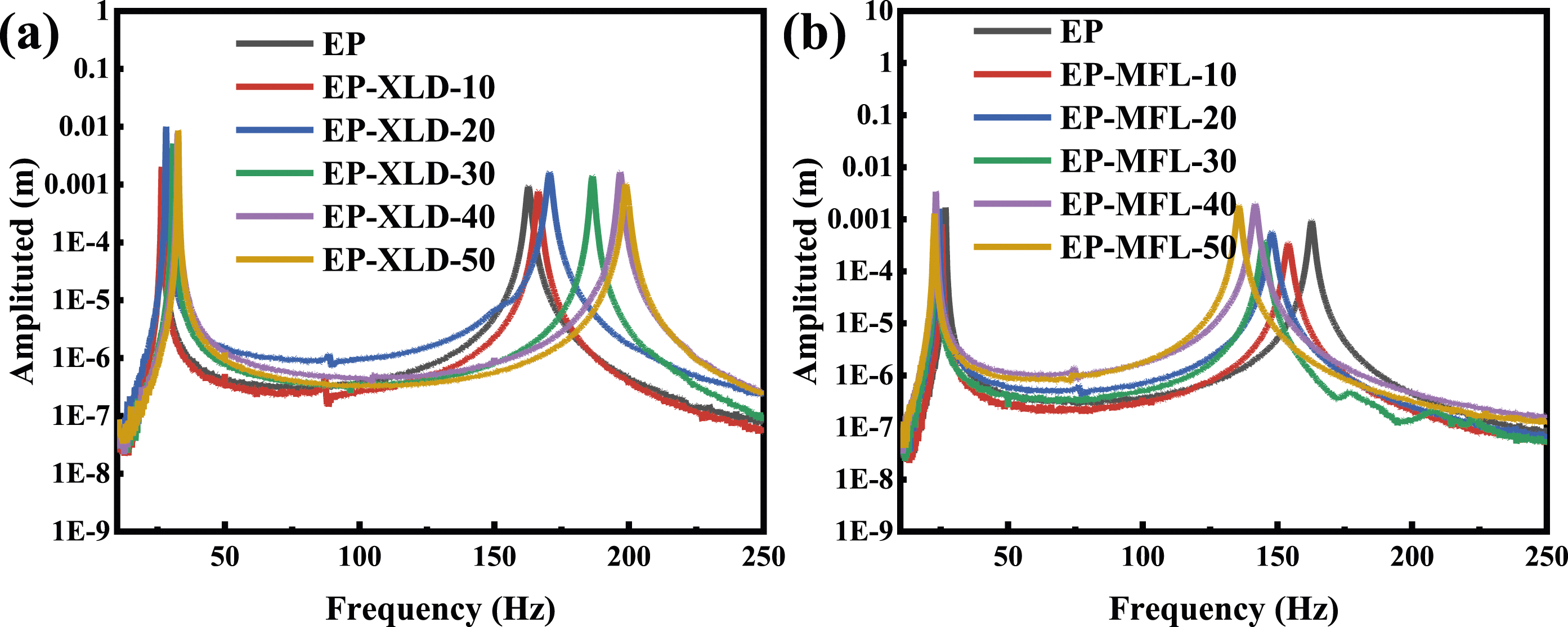
Dynamic mechanics parameters of EP-XLD and EP-MFL under forced resonance conditions.

The first and second resonant frequencies of the pure matrix resin were measured to be 26.80 Hz and 162.73 Hz, respectively. In comparison, the first and second resonant frequencies of the EP-XLD system shifted to higher frequencies, with values of 32.73 Hz and 199.14 Hz, respectively. Conversely, the first and second resonant frequencies of the EP-MFL system shifted overall to lower frequencies, decreasing to 22.73 Hz and 135.63 Hz, respectively. These data indicate that the introduction of hollow microspheres from different systems significantly changed the resonant frequencies of the material.
While maintaining constant material dimensions, we regulated the first-order resonant frequency within the range of 22.73–32.73 Hz, as well as the second-order resonant frequency within the range of 135.63–199.14 Hz. This regulation range makes it possible to optimize a material for specific applications and also verifies the impact of hollow microspheres on the resonance of the material.
Based on the changes in the first and second resonant frequencies for materials in the EP-XLD and EP-MFL systems, there was a linear relationship between the resonance frequencies and the volume fraction of microspheres. This confirmed the inference in flexural properties about the correlation between the volume fraction of microspheres and resonant frequencies. Using a linear fitting method, we derived a formula to calculate the relationship between the material volume fraction and the resonant frequencies, as shown in Figure 6. Linear fitting of resonance frequencies for two materials: (a) first-order resonance; (b) second-order resonance.
The formula for calculating the first and second resonant frequencies of EP-XLD is

The formula for calculating the first and second resonant frequencies of EP-MFL is

However, there was a certain physical limit to the filling rate of hollow microspheres in the resin matrix. When this filling limit is exceeded, voids may form inside the material, which can affect the accuracy of the results obtained using the above formulas. Therefore, in practical applications, we must consider the filling rate of hollow microspheres and ensure that it stays within the physical limits to guarantee the reliability of the results. According to research experience, the volume fraction of hollow microspheres should preferably not exceed about 60%.
Composite material design and resonant frequency control
During actual applications and formulation design of composite materials, the complexity of a formulation far exceeds the scope discussed in this article. In actual formulations, in addition to the base resin and hollow microspheres, it may also include nanofillers, flake fillers, and fibers. For fillers with irregular shapes, the Voigt model may no longer be suitable for calculating the specific modulus of a material, but the method proposed in this article can still provide guidance for controlling the resonant frequency of materials.
To address such complex application scenarios, we categorized both the base resin and irregular fillers as the “matrix phase,” while the regular-shaped hollow microspheres were considered as the “filler phase.” Equation (6) can be rewritten as

There are many different types of commercially available hollow glass microspheres33,36 and hollow polymer microspheres, 37 each with different wall thickness ratios. This offers flexibility for practical applications. Therefore, by flexibly adjusting the ratio of the matrix phase to the filler phase according to actual situations, it is possible to control the comprehensive properties of a material, including its density, mechanical properties, damping performance, and resonant frequency.
Microstructure of the material
This study thoroughly investigated the micromorphological characteristics of two systems, EP-XLD and EP-MFL, after nitrogen fracture and room-temperature fracture. Figures 7(a) and (b) display the fracture microstructures of EP-XLD-50 and EP-MFL-50 samples that underwent brittle fracture in liquid nitrogen. In these images, both hollow glass microspheres and hollow polymer microspheres maintained their structural integrity. Furthermore, the interface between the matrix resin and the hollow microspheres was tightly bound, with no obvious defects. The matrix resin exhibited typical characteristics of brittle fracture,
38
indicating that in liquid nitrogen, the material primarily failed in the matrix resin. SEM images showing the micromorphology of samples: (a) Fracture morphology of EP-XLD-50 in liquid nitrogen; (b) Fracture morphology of EP-MFL-50 in liquid nitrogen; (c) Fracture morphology of EP-XLD-50 at room temperature; (d) Fracture morphology of EP-MFL-50 at room temperature.
Samples that were fractured at room temperature exhibited different fracture characteristics. As shown in Figures 7(c) and (d), the hollow glass microspheres in EP-XLD-50 and EP-MFL-50 remained intact, but the hollow polymer microspheres were damaged. In EP-XLD-50, the interface between the matrix resin and the hollow glass microspheres exhibited debonding, implying that the primary failure mode of this material at room temperature involved the destruction of the interface and matrix resin. For EP-MFL-50, the matrix resin displayed certain tough fracture characteristics as it deformed and tore along with the polymer microspheres. 38
This study proposes several hypotheses to explain the differences in the fracture morphologies of these two materials under liquid nitrogen and room temperature conditions. First, under the extremely low-temperature conditions of liquid nitrogen, the material strength of both hollow glass microspheres and hollow polymer microspheres exceeded that of the matrix resin. Therefore, when the material was damaged, the matrix resin became the primary failure point, while the microsphere structures remained intact. Secondly, when fractured in liquid nitrogen, the bonding strength between the matrix resin and both types of microspheres was much higher than the internal bonding strength of the matrix resin itself. This explains why the matrix resin was more prone to damage in liquid nitrogen. At room temperature, the bonding strength between the matrix resin and the hollow glass microspheres in EP-XLD-50 decreased, leading to the simultaneous failure of the interface and matrix resin. Finally, for EP-MFL-50, the hollow polymer microspheres exhibited good deformability at room temperature, which allowed them to exhibit a certain degree of toughness under an external force. This provides some toughening effects to the matrix resin, causing the matrix resin to show tough fracture characteristics.
Conclusions
This study controlled the resonant frequency of composite foam materials. Based on the theoretical formula for resonant frequency, we shifted the resonant frequency of composite foam materials towards higher and lower frequency directions by adjusting their specific modulus. To this end, we prepared two types of composite foams using rigid hollow glass microspheres and flexible polymer microspheres and systematically tested their density and flexural performance.
The results showed that the flexural specific modulus of the EP-XLD system and the EP-MFL system increased and decreased, respectively, upon increasing the volume fraction of the hollow microspheres. These changes were linear, which is consistent with the theoretical predictions of the Voigt model. Through linear regression analysis, we obtained quantitative relationship formulas between the flexural specific modulus and the volume fraction of hollow microspheres for both the EP-XLD and EP-MFL systems. These formulas revealed the trends in the material’s flexural specific modulus, which depended on the relative magnitudes of the specific modulus of the matrix resin and the hollow microspheres.
Based on these findings, we predicted that the resonant frequencies of the EP-XLD and EP-MFL systems would shift towards higher and lower frequencies, respectively, upon increasing the volume fraction of hollow microspheres. To validate this hypothesis, we conducted frequency loading tests on the cantilever beam modes of the EP-XLD and EP-MFL systems from 1 Hz to 250 Hz and obtained their first and second resonant frequencies. The experimental results confirmed our prediction.
We also derived formulas for calculating the first and second resonant frequencies of the two materials in relation to the volume fraction of hollow microspheres. This enabled us to quickly and accurately predict the materials’ resonant frequencies at different volume fractions.
This study opens new avenues for material design by adjusting the resonant frequency of hollow microspheres. Future research could further explore the mechanisms for controlling the resonant frequencies of multi-component composite materials, incorporating a variety of fillers such as nanoparticles and fibers to meet diverse application needs. Moreover, given that materials often operate in dynamic environments, it will be particularly important to study the stability of resonant frequencies under dynamic conditions, especially in consideration of environmental factors such as temperature. The research methods presented in this paper can be used to regulate the resonant frequencies of composite foam materials and may also play an active role in the design and application of acoustic, damping, and structural composite foam materials. This approach can also be extended to other types of composite materials, but its applicability still requires validation.
Footnotes
Declaration of conflicting interests
The author(s) declared no potential conflicts of interest with respect to the research, authorship, and/or publication of this article.
Funding
The author(s) disclosed receipt of the following financial support for the research, authorship, and/or publication of this article: This study is supported by Postdoctoral Applied Research Project in Qingdao.
