



Abstract
Granulated compounds based on polystyrene with hollow glass microspheres in different proportions were made on a twin-screw extruder. Microspheres were added to polystyrene composition in order to get light-diffusing material with optimal proportion of light transmission and light diffusion properties. The microspheres showed stability due to increased strength in processes. Adding the microspheres led to an increase in the light diffusion factor and to a reduction in the light transmission factor and the material density. The filler gave light diffusion properties to polystyrene in the research doses, whereas the light transmission factor reduced to the acceptable value. The microspheres may be researched additionally for giving light diffusion properties to polymeric materials, used in light engineering.
Introduction
The rapid development of the light-emitting diodes industry and the highly effective light-emitting diodes appearance on the world market opens the necessity for the creation and production of the technical components that constitute light devices, the production of light engineering materials with improved characteristics.
One of the relevant problems in using light-emitting diodes is the high-blinding brightness that limits their application in domestic, industrial, and office light engineering. Light-diffusing elements that make comfort lighting may solve this problem. The spreading of the ray energy regular stream in material is accompanied by its weakening that appears at the result of two independent and principally different things—absorption and diffusion.
Light diffusion happens in optically mixed environment, where light refraction factor changes from point to point irregularly owing to environmental density fluctuations. The light diffusion factor is a value opposite to distance, during which parallel luminous flux weakens at n times for a 1 cm layer. 1
Therefore diffusers spread the light of a source in another way and transform its properties. There are silicate and polymeric materials in light engineering. The last have a number of advantages that are low density, therefore low finished product weight, technological effectiveness, dielectric properties, raw material cost, the setting of the physic-mechanical properties opportunity. Polymeric materials like polymethylmethacrylate, polycarbonate, polystyrene and its copolymers are used in light engineering. Various light-diffusing additives can be used to give light diffusion properties to the polymeric material. Light refraction and diffusion through these materials happens with the addition of microscopic pieces of diffusor.
Nowadays such mineral fillers as titanium dioxide and barium sulfate, titanium phosphate, lead hydro phosphate, zinc oxide, zinc sulfide, magnesium titanate, and calcium titanate are known as light-diffusing additions. Sphere shape additions based on polymers like tied acrylates and silicones are also used.2–4 The main light-diffusing requirements are the compatibility with the polymer used as matrix, sustainability during the material processing, the even pieces spreading in the matrix, maximal luminous flux diffusion together with high light transmission, acceptable cost. However the abovementioned light-diffusing addition can’t always provide high light diffusion with high light transmission at the same time. Whereas light diffusion meets standards, the main problem is that while luminous flux goes through the material, the light absorption takes place, which is why light transmission declines significantly. The light diffusion optical properties improvement is the perspective task in the light engineering area.
Therefore, the aim of this work is the development of composite light-diffusing material with optimal proportion of light-diffusing and light transmission indicators.
Polystyrene was chosen as a light-diffusing matrix. Polystyrene is used for light engineering products 5 because its light transmission coefficient can reach 90%, its refraction factor is 1.5–1.6, and it also has good dielectric characteristics and an acceptable price. The mark 585 polystyrene of general purpose that was made by PC “Nizhnekamskneftehim” (Niznekamsk, Tatarstan Republic, Russia) was used for this work.
The hollow glass microspheres (further “microspheres”) are known as a dispersed filler in polymeric compositions, which allows the modification of the material’s properties.6–8 It is known that the spherical polymeric fractions are used as light diffusion additions in light engineering, this fact described in literature sources.2–4,9 At the same time, the use of hollow glass microspheres is not studied enough. Thereby, it was suggested to explore the possibility of using these microspheres as a light-diffusing addition. Microspheres are the multifunctional addition to polymer, a white loose powder that is made of a stable sodium-lime borosilicate glass. It is an alternative to traditional fillers and additions such as silica, calcium carbonate, talc, and others. Microspheres are water resistant, don’t have pores, therefore they don’t absorb resins. Due to their low alkalinity, microspheres are compatible with the majority of resins and have stable viscosity and a long storage period.10,11
Recently, microspheres have been the focus of considerable attention due to their low density, high specific surface area, high stability, and so on. 12 Nowadays microspheres as a part of different compositions are used to add viscosity reduction and polymeric solution and melt fluidity; and for cost reduction by reducing the consumption of binders, thereby reducing the final product cost. They are used to increase the heat insulation properties of materials, for interior works as a part of light-harding covering, also used in drug delivery, and as lightweight fillers, chemical catalysts, and photonic band gap materials.10,12 Autonomous mending technique also uses microspheres. Here, healing agents are attained or undergo encapsulation in microspheres. The operational mechanism involves the damage initiated in the polymeric system causing the healing agents released to conduct the mending procedure. 13
Hollow silica nanospheres with particle size from 150 to 300 nm were used in thermal insulation coatings. Tests showed good temperature retention and thermo-insulating properties, which indicated that hollow silica nanospheres are potentially used as an inorganic filler for thermal insulation coating. 14
The filler fraction’s spherical shape explains certain composite properties, such as better course characteristics in comparison to fillers with high aspect ratio; balanced pressure distribution around the sphere inclusions and dimension stability; the lack of orientation effects, high isotropy, reduced and balanced predictable shrinkage. The general composite reduction is the important additional function of hollow glass microspheres. 15 Mechanical properties of hollow glass bead-filled acrylonitrile–butadiene–styrene copolymer composites are explored. 16
Microspheres use assumes some processing specificities. Microspheres are a loose material with increased fluidity. Extrusion microspheres processing includes high-sensitive dosing devices that can provide the supply of the exactly set amount of microspheres. The adverse processing conditions can lead to the destruction of microspheres. To reduce the destruction possibility to a minimum, it is not recommended to use the microspheres in processes with a big shearing force in a contact point. While using the material in the extrusion process, it should be introduced in the point after a feed hopper with the help of a side or upper located doser.
A special formula of tested microspheres provides a high proportion of the strength to weight. This provides increased stability in hard technological process conditions such as extrusion and the casting under the pressure. Glass microspheres come in a range of different sizes and varieties, satisfying requirements of various products and production processes. Microspheres made by 3M Glass Bubbles iM16K were chosen for the work. These microspheres have the density 0.46 g sm−3 and isotactic compressive force 16.000 lb in−2. The average fraction size is 20 µm. 10
Experimental
Compounds based on polystyrene with inclusion of the microspheres were produced on a twin-screw extruder with the productivity 100 kg h−1 and L/D = 44. The microsphere influence was studied in the dosage range 0.2, 0.4, 0.5, 0.8, and 1% mak. The samples with width 1, 2, and 3 mm were made by the method of casting under pressure in order to do further research.
To determine the microspheres’ stability in processing conditions, produced samples were studied on a digital microscope KEYENCE VHX-1000 (Osaka, Japan) zooming 500× in the permeating light of the thin composition cut. The density of the samples was measured by hydrostatic method, according to ASTM D792-13, the A method. The method consists of successive weightings on a spring dynamometer at first in the air, then in liquid with a known density. Distilled water 17 was used as the liquid. The samples’ light transmission was measured on a spectrophotometer SPECORD 40 (Analytik Jena, Germany), ASTM D1003-13. Light transmission coefficient value was measured at a wavelength of 698 nm. The light-diffusing coefficient was measured with the help of a single-beam spherical photometer. A green continuous single-frequency beam at the wavelength of 532 nm and a violet continuous single-frequency beam at the wavelength of 410 nm were used as a light source. A control panel for the power and energy meters Thorlabs PM320E (Newton, New Jersey) and a photodiode sensor Thorlabs S302S (Newton, New Jersey) were used to measure the luminous flux power.
Results and discussion
Microspheres with low density are sensitive to a shift, besides the destruction fragments can cause the increased wear of the processing equipment. Taking into account the processing conditions and considerable deformations that the material was subjected to while extrusion and casting under pressure, there was a microsphere unity loss probability. Therefore the samples were studied on a digital microscope. Microphotos of the compositions are presented in Figure 1.
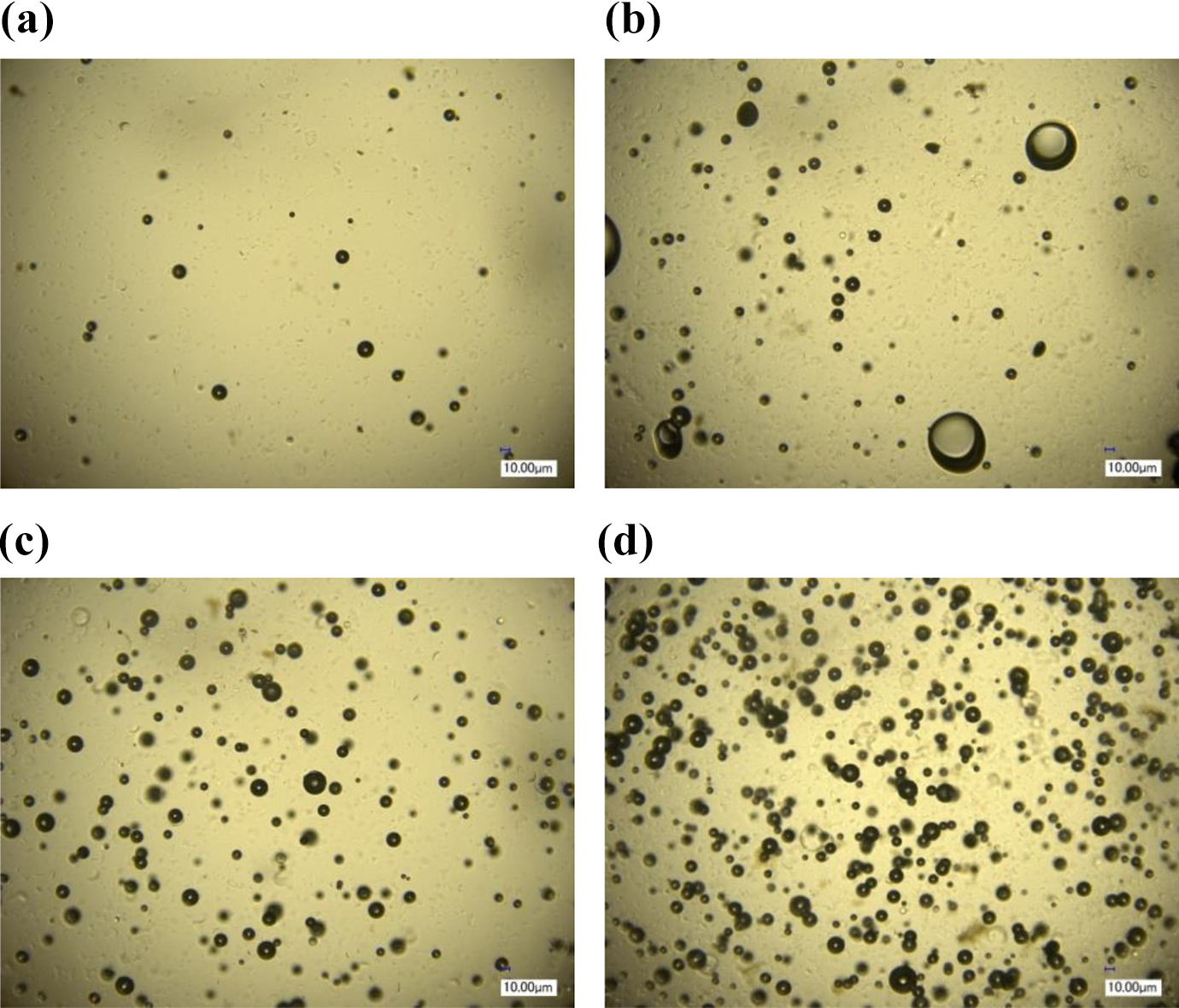
The compound based on polystyrene with the microspheres contents: (a) 0.2%, (b) 0.4%, (c) 0.5%, and (d) 1%.
The microscope data obtained showed the lack of destruction marks, pieces and microspheres and composition fragments. The solid hollow microspheres are clearly visible (Figure 1). In spite of the low density and sensitivity to shift deformations, the microspheres have been through the processing conditions; that confirms the possibility of the studying mark microsphere proceeding by the extrusion and the casting under the pressure. The balanced microspheres spreading in the polystyrene volume were noted. This fact can contribute to properties isotropy of all directions of the finished products.
On the basis of the fact that the hollow microspheres have considerably low density in comparison to polystyrene, it was suggested that their introduction should reduce the final product density. Besides the filler’s spherical shape involves smaller amount of the binder 12 for the surface wetting than another shape filler, which leads to the binder consumption reduction. The influence of the microspheres in dosage range 0.2, 0.4, 0.5, 0.8, and 1% mas. added to the polystyrene composition on the composition density is shown in Figure 2.
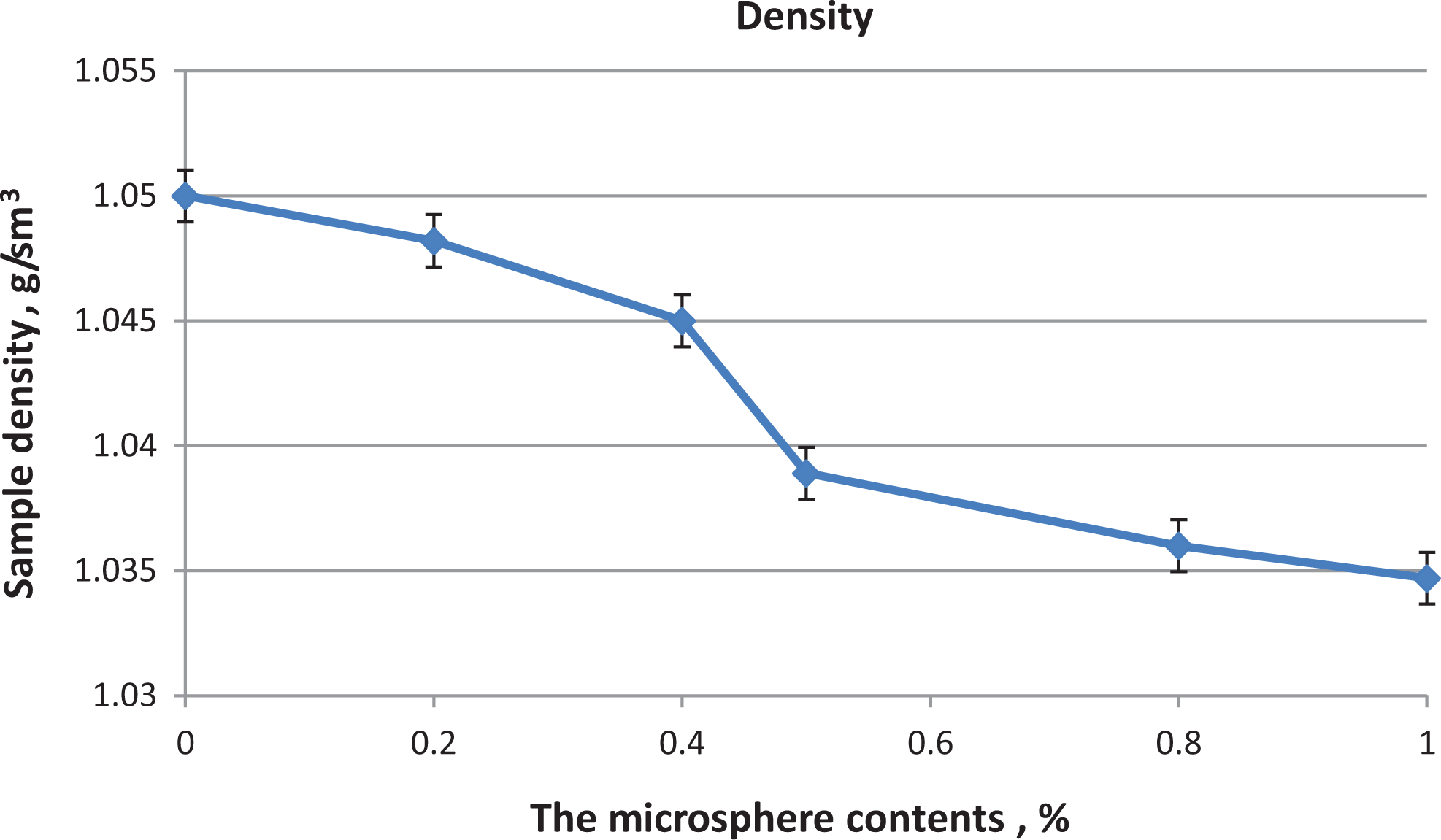
The sample density in terms of the microsphere contents in it.
The microspheres added to the polystyrene content in researching dosage range reduce the composition density slightly in comparison to the pure polystyrene density. The composition density reduction confirms the microsphere stability after processing. Nowadays materials with reduced density become relevant because of the increase of the raw material cost optimization necessity. Adding microspheres to the polystyrene in a large amount can lead to a considerable material density reduction, therefore to the final product’s weight reduction that can lead to a decrease in logistics, raw material, and fuel costs.
One of the most meaningful light engineering sheet characteristics is its efficiency. It determines its energy efficiency and it is the ratio of the radiating element’s luminous flux to the luminous flux that went through the sheet. The material light transmission coefficient was defined for the lamp efficiency assessment. The spectrophotometer results, namely the dependency graph of the light transmission coefficient to the microspheres content, are shown in Figure 3.
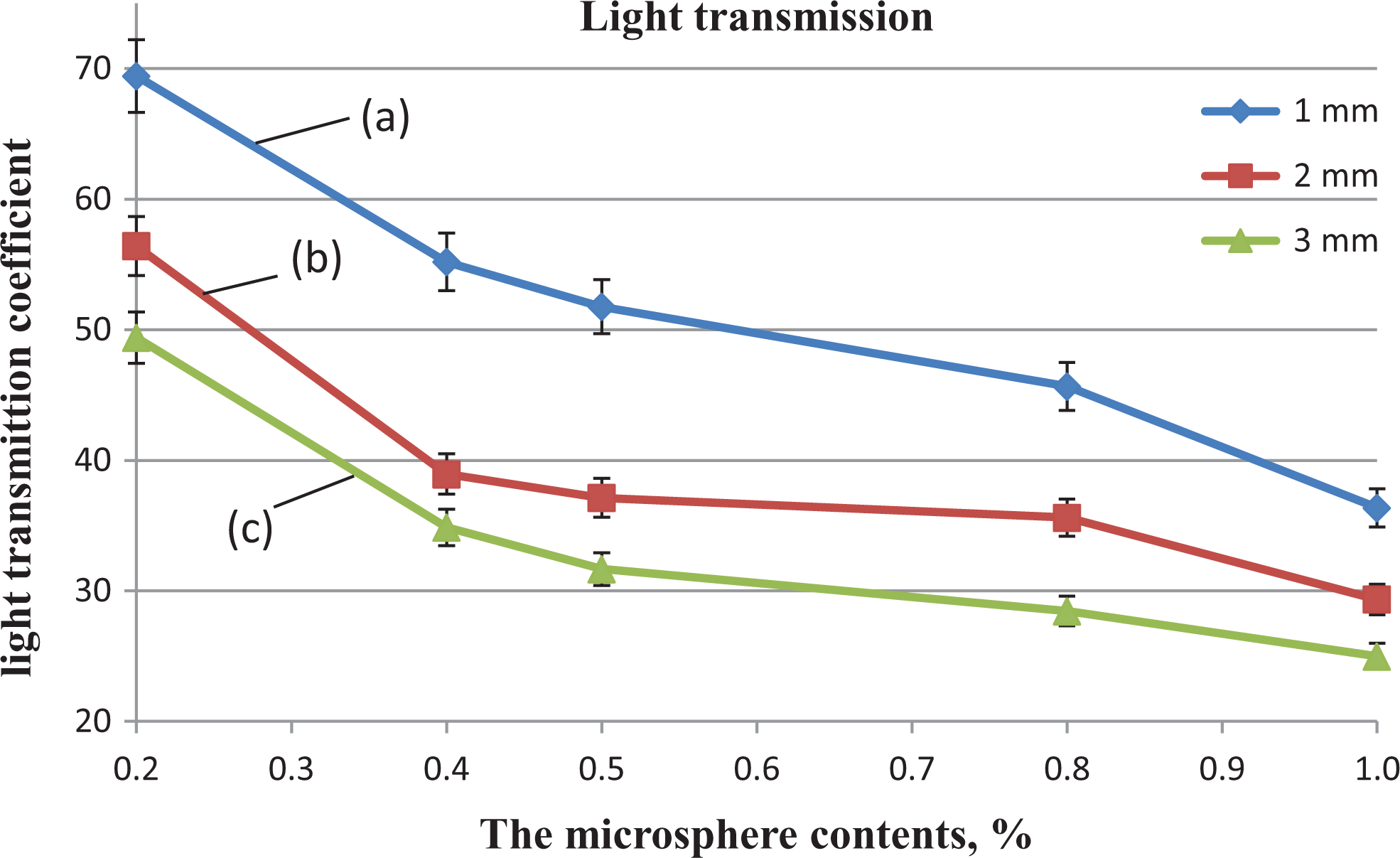
The dependency of the light transmission coefficient of the samples with thickness (а) 1 mm, (b) 2 mm, and (c) 3 mm to the microspheres contents.
The light transmission coefficient is dependent on the sample’s thickness and the microsphere’s contents in it. While increasing the sample’s thickness and the microsphere’s contents, the light transmission coefficient reduced. The light transmission coefficient’s value at least 30% is preferably for practical aims. In case of this value excess, it becomes not energy-economically relevant to use this type of light-diffusing material because of the lamp efficiency reduction.
The light engineering is challenged by the balanced light transmission of extremely bright dot light source for its comfortable acceptance. Light energy spreading after going through the material is numerically characterized by the light-diffusing coefficient. A dependency graphic of the samples’ with the thickness 1–3 mm light transmission coefficient to the microspheres contents with the wavelength at 532 and 410 nm are shown in Figures 4 and 5.
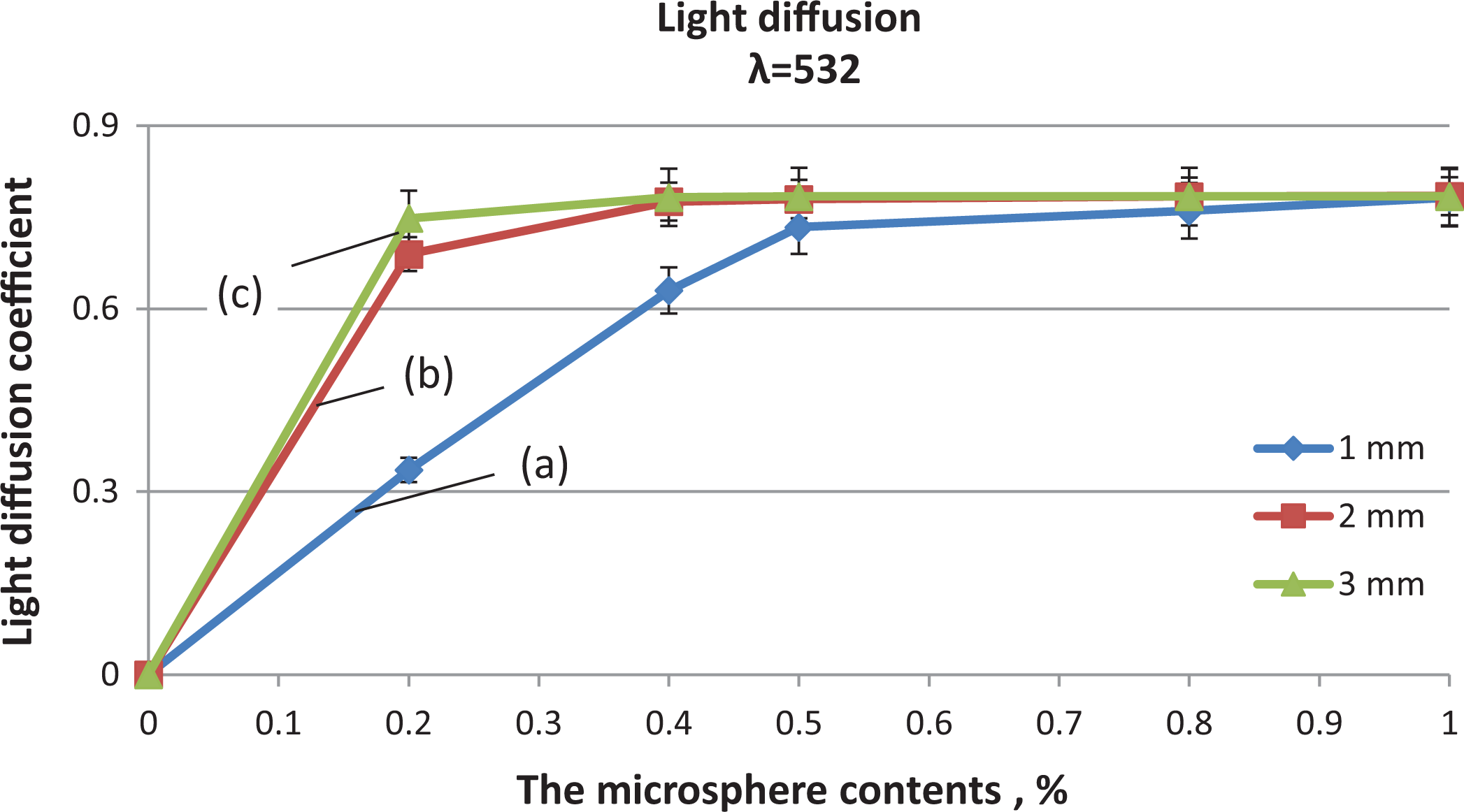
The dependency of the light-diffusing coefficient of the samples with thickness (а) 1 mm, (b) 2 mm, and (c) 3 mm to the microspheres contents λ = 532.
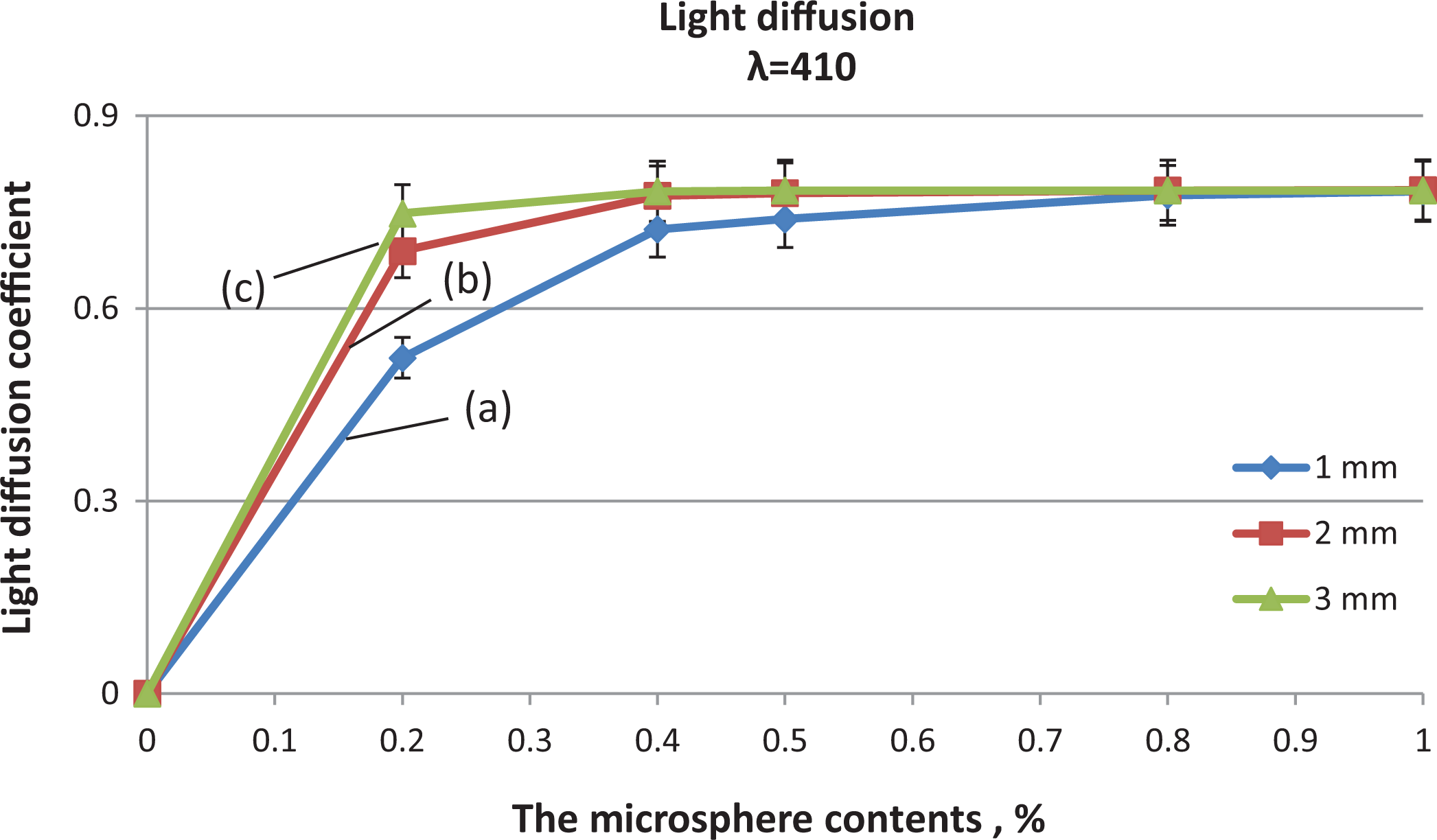
The dependency of the light-diffusing coefficient of the samples with thickness (а) 1 mm, (b) 2 mm, and (c) 3 mm to the microspheres contents λ = 410.
The light-diffusing coefficient sharply increased when adding the microspheres to the polystyrene. The light-diffusing coefficient for thickness 2 or 3 mm at concentration reaching 0.4% changed slightly. The light-diffusing experiments showed that adding the microspheres to the polystyrene content contributes to the light transmission, therefore the microspheres and also other known spherical fillers can be used as light diffusing. Taking into account the aim of the work, the samples’ light transmission and light diffusion experiments results were compared so that the high light-diffusing coefficient close to the maximum among the selection matched with the satisfying light transmission coefficient no less than 30%. During the light transmission and light diffusion data analysis, it was found that the optical way for the samples with thickness 1 mm was the addition of 0.8% microspheres, while the light transmission coefficient was 45.66%, the light diffusion coefficient was 76.04% and 77.62% at the wavelength 532 nm and 410 nm, respectively. For samples with thickness 2 and 3 mm, the optimal way is an addition of 0.5% microspheres. In this case, the light transmission coefficient of the 2 and 3 mm samples reached 37.13% and 31.67%, the light diffusion coefficient of the 2 mm samples reached 78.72% and 77.97%, for 3 mm samples—79.29% and 78.39% at wavelength 532 nm and 410 nm, respectively. Using the prescription above, it is possible to achieve the composition for using in light engineering that can satisfy the aim of light diffusing without much light element efficiency loss.
Conclusions
There were received the light-diffusing compositions based on the polystyrene with the various microspheres contents, that have reduced density in comparison to pure polystyrene. There was studied the composition morphology and there were found the filler adding dosages for getting the optimal proportions of the 1, 2, and 3 mm samples’ light transmission and light-diffusing coefficients. It was also found that hollow glass microspheres can be used as the light-diffusing fillers. The optical properties of received compositions are preferable for the light engineering materials because they can contribute to satisfying light element efficiency value simultaneously with the high light-diffusing value and contribute to the comfortable diffused light acceptance. A combination of received compositions’ physical and optical properties and the economic indicators possibility make the microsphere usage in light-diffusing compositions possible.
