



Abstract
Contemporary economic growth relies on infrastructure. However, post-growth scholarship has only recently begun to grapple with infrastructure as a specific object of analysis and often reduces it to little more than a set of barriers to be overcome or a means to essential service provision. This article challenges such limited perspectives by developing a holistic framework through which to understand post-growth infrastructure, how it works and how it can change. Building on the insights of infrastructural analysis conducted in the fields of Science and Technology Studies (STS), geography and anthropology, we advance a relational understanding of post-growth infrastructure, which we define as those that foster social practices that satisfy situated needs, limit consumption and resist capitalist co-optation. Furthermore, we examine the logics that both explain the social dominance of infrastructure and represent pathways for its transformation; that is, as a phenomenon that simultaneously coerces and seduces individuals to adopt certain practices, yet remains suggestive of and open to other uses. We argue that, in order to explain post-growth transformations, post-growth studies must engage with these logics. Finally, we identify strategies for post-growth infrastructural transformation: appropriating growth infrastructure, reconstructing it in line with a post-growth agenda and ensuring its maintenance in the face of capitalist pressures. In this way, our framework represents an important step towards a larger body of research on post-growth infrastructure.
Introduction
This article addresses the infrastructural gap in post-growth studies and offers a comprehensive, multidisciplinary framework for analysing post-growth infrastructural transformation. Over the past 25 years, post-growth approaches to economics, geography and planning have championed the sustainable and equitable curtailment of economic growth in the Global North, notably as a means to enhance collective and ecological wellbeing (Schneider et al., 2010). These perspectives often critique so-called eco-modernist and green growth infrastructural initiatives for their failure to properly challenge capitalism and contest the prioritization of technology-led solutions to socio-ecological crises (Blühdorn, 2018: 43). Instead, those in favour of post-growth argue for an economic system centred on human wellbeing, the fulfilment of essential needs and ecological regeneration (Xue et al., 2012: 87).
Despite a general interest in the topic, post-growth scholarship has largely overlooked infrastructure as an object worthy of in-depth analysis. Instead, it is typically (and mostly implicitly) viewed as either a problem to be overcome – as in the case of fossil fuel-powered, extractive and military infrastructure – or a means to delivering basic forms of wellbeing and essential services, such as clean energy, water and sanitation (Fitzpatrick et al., 2022; Videira et al., 2014). These approaches take an essentialist view of such infrastructures, treating them as merely large and static objects rather than exploring their particular relations in context, and therefore fail to interrogate their potential importance for a post-growth transition. However, some recent scholarship emphasizes the need to focus specifically on infrastructure given that a post-growth agenda will imply numerous transformations, perhaps even the dismantling of infrastructural arrangements that support the patterns of production and consumption upon which fossil capital depends (Campbell-Verduyn and Kranke, 2025a; Durrant and Cohen, 2024; Pansera et al., 2024; Schmid, 2021).
Our starting point here, therefore, is the claim that post-growth studies today lack the framework necessary to conceptualize and empirically study the complex, often non-linear pathways of infrastructural transformation. In contrast to the approaches outlined above, we propose that infrastructural relations have particular features that render them relevant to understanding processes of change and transformation. In particular, the apparent ‘obduracy’ (Hommels, 2005) of infrastructures and the path-dependency, or ‘lock-in qualities’, that this entails, means that changing current infrastructural arrangements according to post-growth principles may prove more difficult than other kinds of transformation. At the same time, however, this obduracy presents significant opportunities for more durable change.
To meet this challenge, this article develops a critical framework with which to understand infrastructure from a post-growth critical perspective. To do this, and to advance a relational understanding of infrastructure, we draw on an interdisciplinary body of research from the fields of anthropology, STS and (urban) geography (Amin, 2014; Bergan and Power, 2025; Larkin, 2013; Star, 1999). This relational understanding foregrounds the co-constitutive relationship that exists between infrastructures and the practices that they enable, while also illuminating dynamics of obduracy and change. It also builds on strategic insights into the ways in which grassroots infrastructures emerge and deal with challenges over time (see Barinaga and Zapata Campos, 2024; Corsín Jiménez, 2014; Lynch, 2021), which broadly resonate with a post-growth agenda.
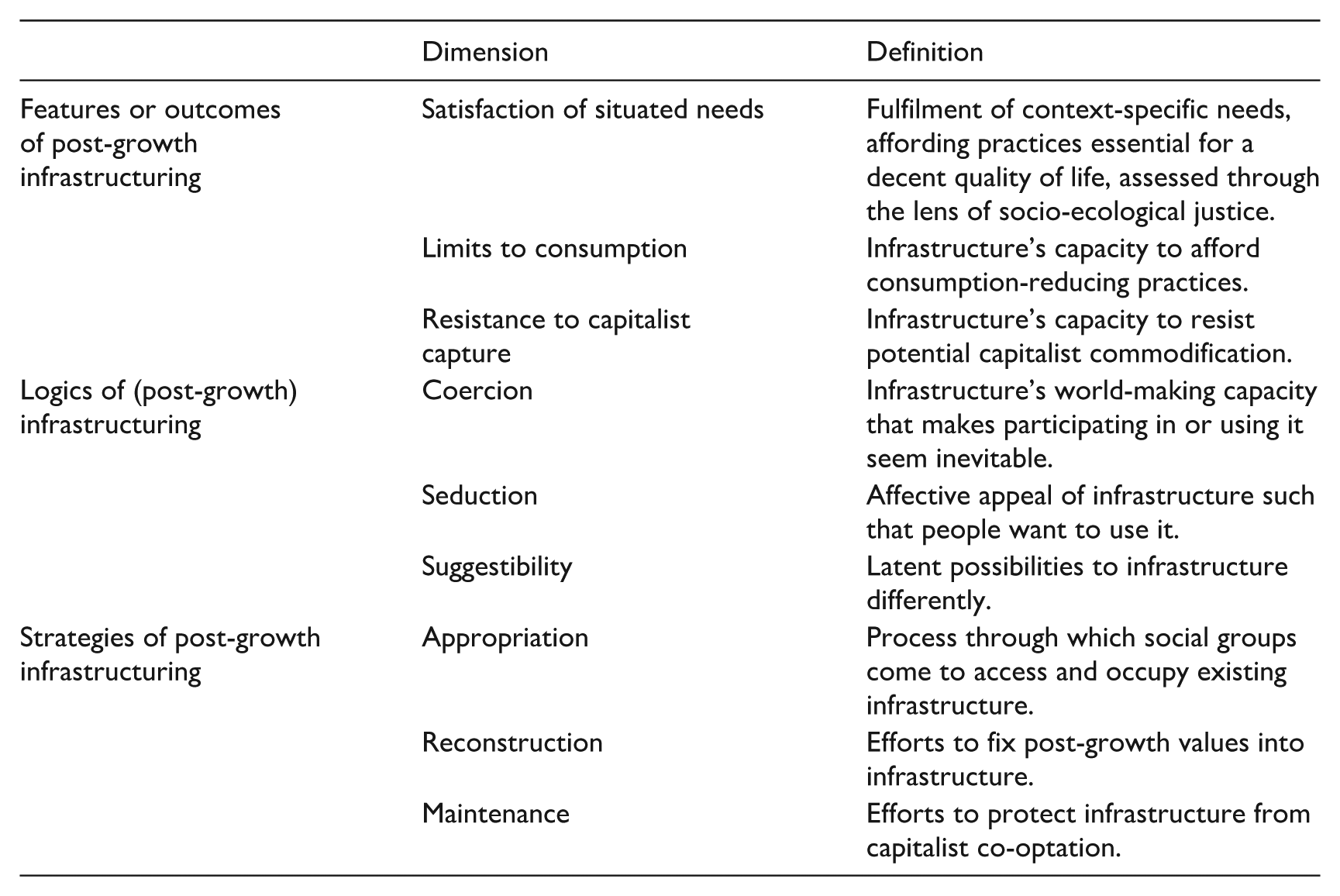
We argue that post-growth research must conceptualize three dimensions related to infrastructure: the features that post-growth infrastructures engender, their logics and strategies for harnessing these features for post-growth purposes. We understand post-growth infrastructure as the ensemble of those facilitating practices that respond to situated needs rather than fuel economic growth, limit consumption and resist capitalist appropriation. Our understanding of infrastructure is, therefore, non-essentialist: the post-growth profile of a given infrastructure is not inherent but rather depends on the kind of practices that it enables or makes more likely.
We further develop this approach by defining the logics of infrastructures, so as to explain their considerable impact at the societal level, that is, the ways in which they shape everyday practices. We identify three logics at play: coercion, seduction and suggestibility. Coercion refers to the structuring and world-making power of infrastructure and is the feature that infrastructural studies tends to examine most. Seduction, meanwhile, describes the desire to participate in and be shaped by infrastructure. Finally, suggestibility is infrastructure’s capacity to accommodate practices that differ from its intended purpose. We contend that, for post-growth scholarship, it is insufficient to merely critique the coercive role of capitalist infrastructure; we must also question how infrastructure’s transformative potential is harnessed in light of these logics. In particular, post-growth studies need to examine how, by leveraging the coercive and seductive capacities of infrastructure, post-growth practices are sustained or reinforced over time.
Having established the above, we are then able to posit three intertwined strategies for post-growth infrastructural transformation: appropriation, reconstruction and maintenance. These strategies describe some of the ways in which radical actors wrestle with the coercive and seductive logics of growth-oriented infrastructure, while fostering equivalent logics of their own for infrastructure that follows post-growth principles. An attention to strategy is particularly important given that post-growth infrastructures necessarily emerge out of uneven power relations that can thwart their transformative potential.
In what follows, we present a non-systematic review of two bodies of literature that are relevant to this article: First, post-growth literatures to consider both explicit and implicit conceptualizations of infrastructure. Second, we outline some key insights from STS scholarship on infrastructure, particularly focusing on scholarship that engaged with questions of transformation, obduracy and change. This was complemented with a wider engagement with more diffuse literatures that engaged with infrastructure-building adjacent to or partially overlapping with post-growth endeavours, found through keyword searches including ‘grassroots’, ‘community’, ‘post-capitalist’ and ‘prefigurative’ infrastructure. We then flesh out the three dimensions of our framework, namely the features, logics and strategies for (post-growth) infrastructuring, building on key debates in post-growth and infrastructural literatures.
The infrastructural gap in post-growth literature
Post-growth research has often dealt with infrastructure indirectly, leaving much scope for in-depth examinations of infrastructural change. Scholars in this tradition approach infrastructure in two main ways, seeing it either as a set of constraining artefacts, and thus a barrier to post-growth goals, or as a means to satisfy basic needs. The first is apparent in critiques of ‘mega’ infrastructures – particularly those that are car-based, rely on fossil fuels, or have a military purpose – as anathema to post-growth (Fitzpatrick et al., 2022: 8; Szabo et al., 2022: 29; Videira et al., 2014). Dunlap and Laratte (2022: 3) take this line of argument the furthest, contending that even low-carbon energy infrastructures ‘colonise landscapes by reshaping, degrading and destroying habitats’. These authors call for divestment from and a moratorium on such infrastructure.
Others provide insights into the surprising ways that infrastructure may fuel the current growth regime, with even low-carbon projects such as cycle paths found to facilitate the circulation of capital through ‘spatial fixes’ (Harvey, 1991; see Bertolini and Nikolaeva, 2022; Spinney, 2020). Similarly, Kirkpatrick and Smith (2011) argue that infrastructural development constitutes a precondition for growth, creating lock-in effects that both necessitate and accelerate the kinds of construction that serve growth purposes rather than satisfying basic needs (see also Furlong, 2025). Such approaches to infrastructure as obstacles to post-growth provide useful insights into growth-based infrastructuring but fail to offer clear ideas about the role that infrastructure should play to enable post-growth transition (if any at all), or how to get there.
By contrast, other post-growth scholars put forward a vision of infrastructure as a necessary tool for delivering essential needs, often in the form of bottom-up or small-scale initiatives. This may include ‘bike infrastructures, co-housing, shared utilities and repair cafés’ (Fitzpatrick et al., 2022: 7), public mobility infrastructures (Heindl, 2022: 226), or open-source, low-tech (digital) infrastructure (Guenot and Vetter, 2022). In line with general post-growth ideals, some call for shared ‘goods and infrastructures’ (Videira et al., 2014) and/or the reclamation of essential infrastructures as commons under conditions of democratic and shared ownership (Durrant and Cohen, 2024; Szabo et al., 2022). These perspectives are useful in providing criteria for post-growth infrastructure yet tend to privilege smaller projects over potentially larger-scale alternatives that may be better suited to providing those essential needs. Both approaches advance an implicitly essentialist and reductive conception of infrastructure, understood as specific spaces or as large and static objects.
There has, then, thus far been relatively little interest in infrastructure as a concept, object of analysis, or locus of transformation in post-growth literature, with the notable exception of Pansera et al. (2024) and Durrant and Cohen (2024), who have taken preliminary steps in this direction. Pansera et al.’s (2024: 2) discussion of the Internet examines how the politics of growth are built into infrastructural artefacts, which they conceptualize as containing both physical and logical layers (such as protocols, finance and design), with the latter ‘governing the extent to which the technology is shaped in the expectation of perpetual growth’. They also sketch out what a more ‘sober’ Internet, one compatible with the tenets of degrowth, might look like, with an emphasis on the delivery of essential services, greater efficiency and limitations on uses that lack a clear environmental and social benefit (Pansera et al., 2024: 9). Meanwhile, Durrant and Cohen (2024: 109) see infrastructures as bundles of economic, social and ecological relations, and champion deliberative democratic practices that would push infrastructural transformations in a post-growth direction. They call for greater economic democracy within infrastructural management, particularly given the democratic deficit in the inception and maintenance of infrastructural projects and their contribution to systemic path dependencies.
A recent special issue (Campbell-Verduyn, and Kranke, 2025a) complements this with in-depth analyses of how growth infrastructures, understood as contingent ‘socio-material arrangements oriented towards or facilitated the pursuit of economic growth’ constrain possibilities for building post-growth infrastructural alternatives (see, for example, Durrant and Cohen, 2024; Furlong, 2025; Neuman Stanivuković, 2025). Campbell-Verduyn and Kranke’s (2025b) contribution is particularly insightful in teasing apart Bitcoin’s infrastructural trajectory from post-growth to growth infrastructure, hinting at divergent and context-dependent relationalities and evolving dynamics between growth and post-growth infrastructures (see also Cerrada Morato, 2025). Yet the special issue’s contributions remain reluctant to name the specific outcomes or features of post-growth alternatives nor the ‘the specific conditions and mechanisms’ (Campbell-Verduyn and Kranke, 2025a: 613) through which post-growth infrastructure could emerge.
Here, some post-growth scholarship focusing on specific infrastructure, particularly housing, has provided further concrete insight: For instance, Savini (2023; see also Nelson and Chatterton, 2022) argues that institutional strategies of ‘nesting’ and ‘federating’ rights and responsibilities help the long-term survival of housing cooperatives, especially against capitalist co-optation. These concerns fit well with Wright’s (2010: 211) emphasis on creating ‘new institutions of social empowerment’, building on ruptural, interstitial and symbiotic strategies – which could be pushed further by an emphasis on the infrastructures as the dynamic socio-material relations that sustain such institutional arrangements.
Finally, some scholars interested in what they conceptualize as post-capitalist infrastructure-building have adopted a similarly strategic approach to this issue: Boyer (2018: 239–240) understands (carbon-based) infrastructures as ‘stored energy’ that can be ‘hacked’ and ‘redistributed’ towards ‘proliferating decentralized small-scale infrastructures’ which progressively disable fossil-fuelled infrastructures. In a different vein, Schmid (2021: 207) argues that ‘hybrid’ infrastructures, by accomodating capitalist uses, while channelling resources towards alternative spaces, can be conducive to long-term transformation.
These initial insights underscore the need to take infrastructure seriously, as a specific object of study in the context of post-growth research, with regard to both its outcomes and underlying logics that explain how they shape everyday practice. These authors also offer some strategic insight into how a transformation towards post-growth infrastructure might be achieved. Building on this work, we argue that there is much scope to examine the potential opportunities for change available in current modes of infrastructuring and how social agents should approach transformative processes around infrastructure. In what follows, we develop a conceptual framework designed to address these questions. We begin by drawing on the STS-inspired literatures on infrastructure, so as to offer a conceptual exploration of the topic, spotlight questions of perdurance and change, and emphasize infrastructure’s affective impact.
The perdurance and changeability of infrastructure
STS scholarship typically understands infrastructure as a set of socio-material arrangements that enable or constrain particular social practices (Star, 1999: 380). Infrastructures and practices are thus co-constitutive: While infrastructures undergird practices, they also only become ‘real in relation to organised practices’ (Star, 1999: 380). For instance, water pipes are – for residents – a type of infrastructure that enable or infrastructure practices such as cooking and cleaning, whereas for plumbers, they are simply an object to be professionally maintained (see Star, 1999). Thus, infrastructures hold ‘world-making capacities’ (Bergan and Power, 2025: 5); they describe a particular type of relation to everyday life. As well as ‘built things’, infrastructures can therefore also be ‘knowledge things’ or ‘people things’ (Larkin, 2013), for instance libraries, the format of the academic journal article (Bowker, 2016), or care (Alam and Houston, 2020).
Importantly, infrastructures contain underlying scripts that shape the ways in which they are used (Akrich, 1992; Star, 1999: 389). Star (1999) calls these ‘master narratives’ and describes how they are built into infrastructures, such as bandages or prostheses coloured to look like pale skin which reveal an underlying master narrative of racism and white supremacy. Similarly, Coutard (2024) points to ‘presentist’ narratives whereby infrastructure-based futuring is viewed as a mere continuation of ‘established practices and embedded logics of growth, extraction, social control and vested interests’ (Coutard, 2024: 88). By considering the practices that infrastructures are intended to enable (and constrain), political commitments and rationalities come to the fore (Larkin, 2013). This makes it possible to theorize which infrastructural arrangements could best serve a post-growth agenda.
Furthermore, infrastructure typically elicits a range of affective responses. Mega infrastructures in particular are frequently thought to encapsulate a ‘mythic quality’ (Durrant and Cohen, 2024), or to inspire awe (Flyvbjerg, 2014). In the 1950s, for instance, dams became tourist attractions, redolent of an optimism about ‘being part of a historical movement, one of ongoing progress and improvement’ (Wakefield and Braun, 2019: 12–13). Larkin (2013: 327) terms these aesthetic and sensorial dimensions the ‘poetics of infrastructure’, that is, the desires, fantasies and promises that infrastructure elicits. Infrastructure’s affective dimensions therefore constitute an additional dimension to consider in post-growth infrastructural transformations.
However, it is infrastructure’s lock-in properties and ‘obduracy’ (Hommels, 2005) that present the most significant analytical challenge for any radical approach to transformation. For not only do infrastructural arrangements influence current practices, they also ‘cast a shadow on the future, laying foundations for daily practices in years and decades to come’ (Shove et al., 2018: 6). This is partly due to ‘the sheer mass of material artifacts, sunk costs from past projects, and the embeddedness of infrastructures within the built environment’, along with ‘the inertia associated with required knowledge and skills, vested interests of incumbents, institutional arrangements and social and cultural practices’ (Monstadt et al., 2022: 2). Obduracy is, therefore, not inherent in any material or technology so much as it is constituted in ‘constrained ways of thinking and interacting’ that ‘congeal [. . .] social and technical elements’ (Hommels, 2005: 342). This renders transformation both a techno-economic and a political and socio-cultural challenge (Monstadt et al., 2022).
Nonetheless, infrastructure may transcend the intentions of its designers, and enable possible transformations, in at least two ways: First, although infrastructures strongly imply certain specific uses, they cannot entirely prescribe them, thereby leaving open opportunities for ‘reinterpretation and reuse’ (Latham and Wood, 2015: 315; see also Thorpe, 2024). Indeed, if infrastructure exists in relation to the practices that it enables, then it is always at risk of failure, as it may be difficult to integrate into everyday life or simply easier to use in ways that differ from what was originally intended. While infrastructures are often presented and widely understood as promises made about the future, they often fail to live up to these promises (Anand et al., 2018). These failures point to the non-linearity of infrastructural trajectories (Coutard, 2024: 75; see also Neuman Stanivuković, 2025), that include design, uses, breakdown and failure and imply different ways of appropriating and altering infrastructures’ functioning. For instance, in a historical perspective, Moss (2024) has drawn attention to the variegated ways in which past infrastructures such as street water pumps have been adapted to changing circumstances.
Second, as lively socio-ecological configurations, (built) infrastructures may themselves exceed design intentions (Amin, 2014; Schwanen and Nixon, 2019: 148). They require upkeep, maintenance and care, failing which they decay and break down over time (Mattern, 2018). Here, the diversity and unpredictability of responses to a piece of infrastructure’s material components may engender alternative uses, as in the case of a ruin that becomes a home for animals and plants. These two considerations invite us to think about the ways in which infrastructure, despite its apparent obduracy, may change over time. It also shows limits to the degree that infrastructural design can straightforwardly solve socio-political issues (Monstadt et al., 2025). This also means that any post-growth perspectives must avoid essentialist and linear understandings of infrastructure and rather examine the post-growth potential of infrastructures in terms of their outcomes across their non-linear trajectories.
Despite the significance of infrastructural obduracy and change, relatively little work has been carried out that examines more radical forms of change, such as how radical values might be scripted into infrastructure or how grassroots actors redirect infrastructural relations towards socio-ecological transformations, especially in an indifferent or hostile climate, in which powerful actors can easily block or co-opt the build-up of alternative infrastructures (Wright, 2010). Indeed, those concerned with socio-technical change have focused instead on redefining the objectives and governance of infrastructure, emphasizing the importance of equity, inclusion and justice, primarily through a top-down lens (Gilbert et al., 2022). Monstadt et al. (2022) identify four common approaches to ‘transformative infrastructural change’: ‘the appraisal of alternative infrastructural pathways via “futuring”’ (Gilbert et al., 2022: 2) based on dominant socio-economic perspectives, ‘cross-domain coordination’ to enable greater energy efficiency and ‘new methods of assessment’ to measure progress. A fourth, ‘experimental’, approach celebrates the role of ‘niches’ or ‘urban labs’ as a means of incubating and scaling up change (Evans et al., 2021; Grin, 2020); however, none of this work questions the deeply embedded values of growth and accumulation that often translate into highly technocratic and top-down infrastructures (Savini and Bertolini, 2019).
Only very recent work has attempted to go beyond critiquing current infrastructural arrangements, to consider more explicitly ways to reach ‘desirable’ infrastructural pathways (Monstadt et al., 2025). Not only has some of this work explicitly critiqued the deleterious impact of economic growth on contemporary infrastructures (Bahers and Rutherford, 2025; Coutard, 2024; Coutard and Florentin, 2022), some scholars have also argued for a greater re-politization and democratization of infrastructural transformation, that is, through community-oriented circularity infrastructure, public deliberation and participatory processes, for instance, with workers or in regional infrastructural planning (Bahers and Rutherford, 2025; Coutard and Gallez, 2025; Glass and Addie, 2025; Ramachandran et al., 2025). In addition, some authors have emphasized the need to go beyond localized small-scale alternatives by calling for greater coordination and ‘infrastructural alliances’ across space (Glass and Addie, 2025: 1789; Monstadt et al., 2025; Traill and Cumbers, 2025). Perhaps going furthest in terms of concrete proposals is Schafran et al.’s (2020) ‘Spatial Manifesto’, which outlines six principles for ‘healthy’ infrastructures, including access and inclusion, elimination of exploitation and planetary boundaries. However, these are accompanied by an a rejection of political economic frameworks to emphasize the uniqueness of each system of provision, thereby eschewing ‘ideological approaches’ (Schafran et al., 2020: 13). While these suggestions chime well with the emerging interest in infrastructures from post-growth scholars, a post-growth perspective can enhance this by offering a more systematic understanding of these desirable outcomes.
A small body of work focuses on bottom-up infrastructuring, forms of which are referred to variously as grassroots, community, revolutionary, prefigurative, commons-based and emancipatory (Barinaga and Zapata Campos, 2024; Boyer, 2018; Karaliotas, 2024; Lynch, 2021; Oscilowicz et al., 2023; Schiller-Merkens, 2022; Zapata Campos et al., 2023). These often respond to local needs, frequently in the absence of state alternatives, and offer important lessons about the construction and maintenance of existing infrastructures beyond current power systems.
These authors emphasize the importance of open and democratic decision-making processes in the construction of grassroots infrastructure, up to and including questions of materiality, through for example open-source prototyping (Corsín Jiménez, 2014), the sharing of ‘techno-popular knowledges’ (Minuchin, 2016) and self-help resources, and communal learning (Lynch, 2021). Democratically deliberating how infrastructure should be built allows alternative values to be materially articulated (Minuchin, 2016). ‘Malleability’ and ‘tinkering’ (Barinaga and Zapata Campos, 2024) then emerge as key features, describing the flexibility and kinds of modular change that maintaining such infrastructure necessitates. This applies not only to the infrastructure itself, but also more strategically, such as in considerations of how visible social agents involved in infrastructuring should make themselves vis-a-vis state actors (Zapata Campos et al., 2023). Others have identified strategies of how to alter the uses of infrastructures for more emancipatory purposes, for example, by conducting ‘unsanctioned “improvements”’ and redirecting traffic flows (Thorpe, 2024) or by occupying and ‘rewiring’ a public broadcasting service (Karaliotas, 2024).
This scholarship offers important insights to explain radical infrastructural transformations; however, it has often been less explicit about the broader systemic goals or transformations that grassroots infrastructuring would ideally support (e.g. post-growth). This seems particularly important given the possible path-dependencies any design, repurposing, or tinkering can generate, requiring an explicit attention of which outcomes infrastructuring should achieve and which to avoid. As such, our framework can add to this scholarship by delineating the outcomes (i.e. practices) that bottom-up infrastructuring should attempt to engender. Furthermore, a post-growth perspective on infrastructure adds to approaches of alternative infrastructuring an emphasis on both the social and ecological outcomes of infrastructures, that is, the importance of reducing (ecologically harmful) consumption while ensuring the fulfilment of basic needs.
Below, we present a distinctive post-growth approach to infrastructure, first highlighting the key outcomes that post-growth infrastructure can contribute to, before conceptualizing infrastructure’s logics so as to explain its endurance and indicate pathways for change. Finally, we apply these features to three strategies for post-growth infrastructural transformation, addressing the question of how post-growth infrastructure can be built.
Defining post-growth infrastructures: Situated needs, limited consumption and anti-capitalist resistance
Taking a relational approach means acknowledging that the properties – post-growth or otherwise – of a piece of infrastructure are never inherent in its social or technical composition but instead adhere in the outcomes that enable particular social practices. We understand social practices, following Schatzki (2002: 72), as organized sets of action that unfold over time and that are held together by shared understandings and know-how, rules and a sense of purpose that are emotionally meaningful to practitioners. These are inevitably contextual and historically bounded.
In defining the features of post-growth infrastructure, therefore, we are interested first and foremost in the outcomes that it affords in specific contexts: While infrastructural design enables a degree of directionality, its subsequent non-linear trajectory shapes its societal impact. These unexpected trajectories include a variety of uses and subversions beyond design intentions, adaptations, repair and decay. It is therefore the outcomes rather than any instrinsic features of particular infrastructures that must be considered and assessed over time.
Drawing on our literature review of post-growth and infrastructure scholarship, we understand post-growth infrastructure as that which enables practices with three characteristics: They respond to situated needs, limit material consumption and enable forms of resistance to capitalist capture.
Importantly, the degree to which infrastructures enable practices that follow these principles may vary, for example, limiting consumption somewhat or significantly, or resisting capitalist co-optation more or less effectively. Similarly, while all three principles are important, there is scope to consider infrastructures that facilitate practices that follow one or two principles as more or less post-growth-oriented, for instance, limiting consumption, but without responding to situated needs or containing explicit elements of anti-capitalist resistance. Assessing the quality of infrastructural outcomes according to these three principles allows for nuanced discussion regarding how infrastructures can be adapted over time and strategically deployed (see Schmid, 2021).
First, post-growth infrastructure-building explicitly enables practices that satisfy situated needs, as opposed to economic growth achieved through productivity or efficiency gains. As argued elsewhere, the history of infrastructural construction has routinely been marked by the pursuit of economic growth, with the imperative of achieving a return on investments often built directly into projects, including low-carbon ones (Kirkpatrick and Smith, 2011; Spinney, 2020). By contrast, post-growth infrastructuring seeks to decouple infrastructural construction and maintenance from the need to generate monetary value out of its use, thereby vastly improving the scope for anti-capitalist and anti-growth practices. This is achieved by focusing on situated needs, that is, practices that ensure wellbeing and quality of life in specific settings. We use the term situated rather than essential needs to foreground the fact that needs are always embedded ‘in certain spatial-social contexts that give [them] particular characteristics’ 1 (Bürkner and Lange, 2021: 41). While certain essential needs such as food, health, transport, housing, clothing, sanitation and clean air are common to all, we draw attention to the ways in which these may differ across populations, implying different kinds of infrastructure in different socio-cultural and spatial contexts. For instance, in rural Germany, rolling supermarkets (accessible lorries that distribute supermarket goods) emerged from grassroots initiatives in response to a situated need for rural food provisioning, especially for the elderly (Schramm et al., 2024), enabling relatively low-carbon food procurement practices. By contrast, in areas where malnutrition is more widespread, larger-scale and state-led forms of infrastructure-building for food provisioning may be more appropriate.
A focus on infrastructure-building that enables practices satisfying situated needs requires an attention to two important elements: First, the situated needs of marginalized societal groups merit most attention, since they are most likely to experience infrastructural violence, i.e. the deleterious effects of infrastructuring, including dispossession and exclusion from key infrastructural provisioning (Rodgers and O’Neill, 2012: 401). This can be understood as a continuing process of imposing distributive socio-ecological justice, where access to vital infrastructures and the prevention of infrastructural harms emerge through the dynamic interaction between infrastructure and the practices it supports or (fails to support) (Chertkovskaya and Paulsson, 2022: 443). Second, conflict between and contestation of different groups’ situated needs are inevitable. We suggest that these political disputes should be resolved following principles of procedural justice, that is, through ‘participation and inclusion in decision-making processes’, with special attention paid to ‘dynamics of power and oppression’ (Chertkovskaya and Paulsson, 2022: 444).
Crucially, and in line with our relational definition, the capacity of infrastructure to meet situated needs is not inherent in the infrastructure itself but emerges from the specific ways it is designed, owned and managed, thereby shaping the specifics of the practices it enables (using social media, doing online shopping). The Internet, for example, is not a growth infrastructure per se, but becomes one inasmuch as it supports outcomes of marketing, stimulates consumerism and consolidates the power of global tech capital. However, it could also facilitate practices of the free exchange of knowledge and software, according to the principles of low-tech web design (in the form of static sites, dithered images, default typefaces and by foregoing third-party tracking, advertising and cookies) and by countering the increasing resource intensity of content, as currently pursued by the Low-Tech Magazine (see De Decker et al., 2018). The same could even be said of oil extraction, which does not inherently serve a single purpose, but can enable a range of practices, leading to producing plastic prosthetics or health appliances just as much as it can fuelling unnecessary SUV driving. Likewise, lab-grown organic matter can be deployed both to generate ever higher returns for fast food restaurants and used to cultivate organs for transplants, depending on the intentions guiding its uses.
Second, beyond catering to current needs, post-growth infrastructure is understood as that which engenders practices that reduce consumption. This feature is what distinguishes a post-growth approach most from other system-critical approaches to infrastructuring as outlined above. Whereas growth-oriented infrastructure facilitates the creation and satisfaction of new needs in ever faster and more efficient ways, post-growth infrastructure fosters satiation (Savini, 2025a; see also Georgescu-Roegen, 1971), that is, rendering low-consumption practices easier, less expensive, or more straightforward (cf. Schatzki, 2012: 17). For instance, motorways encourage higher levels of driving, and airport runways do the same for increased aviation, thereby facilitating practices with high levels of carbon and material consumption. By contrast, post-growth infrastructure affords practices that reduce material consumption, with infrastructural design facilitating, yet not determining such practices. This also eases the onus on individuals to self-consciously reduce their consumption through what Alexander (2013) calls ‘voluntary simplicity’, relying on their willpower in a system that incentivizes consumption. Instead, thanks to their lock-in qualities, post-growth infrastructures provide a framework that makes reducing consumption easy and obvious. For instance, ‘infra-structuring’ the Internet to be less carbon-intensive through limiting unnecessary functionalities and low-tech web design would lead to a drop in consumption far greater than if individuals were left to voluntarily reduce the carbon intensity of their Internet use. Static websites, for example, which disable auto-play, enable sufficiency-oriented practices by discouraging less intentional, frequently high-bandwidth Internet uses (De Decker et al., 2018). This is likely to be more effective than individuals resisting auto-play each time.
A reduction in consumption usually goes hand in hand with decommodified economic practices, for example, commoning, which involves removing some infrastructures from the ‘sphere of market exchange’, as well as away from those ‘market values, logic and language’ (Gómez-Baggethun, 2015: 67–68) according to which our (ever-increasing) needs can only be met through the consumption of market commodities (Illich, 1992). By contrast, the decommodified infrastructure-building (e.g. repair cafés, participatory supermarkets, consumer cooperatives) facilitates commoning practices that go ‘beyond consumerist culture’ (Helfrich and Bollier, 2015: 78) by suppressing the need to contrive new needs and desires in the pursuit of profit and instead supporting consumption practices rooted in sufficiency, sustainability and communal care.
Such dynamics, however, mean little where post-growth infrastructure is either isolated or precarious in the face of existing growth systems. In fact, contemporary society is replete with examples of infrastructuring designed to meet situated needs or limit consumption only to be dismantled, gutted, demolished, or commodified. The third property of post-growth infrastructure is, therefore, the capacity to resist capitalist capture.
While post-growth infrastructuring is concerned with the ongoing maintenance, upkeep and potential expansion of post-growth infrastructure, they must do so in ways that continuously engage with market forces, shifting and adapting through practices that resist co-optation, impeding capitalist capture, that is, subordination to ‘the regime of exchange value’ (May, 2005: 147; see Schramm, 2023). This involves paying critical attention to the power struggles around post-growth infrastructure’s radical potential. As Savini and Bossuyt (2022) discuss in relation to large-scale housing estates, post-growth infrastructuring involves resisting co-optation by building macro-networks of support while including provisions to enable self-government practices.
However, an emphasis on resisting capitalist capture does not imply privileging small-scale or low-tech initiatives over large and high-tech technologies per se; instead, we argue that such binaries must be avoided in favour of a detailed examination of how post-growth infrastructures underpin practices responding to situated needs and limiting consumption, regardless of size, while facilitating practices that are capable of withstanding the pressures of commodification and commercialization.
Our non-essentialist, relational perspective on the three core features or outcomes detailed above has two notable implications for post-growth research. First, it overcomes any deterministic or teleological bias towards certain forms of post-growth transition, enabling instead a plurality of infrastructural arrangements depending on context. Second, it calls for a deeper analysis of the motives, power dynamics and uses of particular kinds of infrastructural design. This includes apparently contradictory practices or previously growth-oriented infrastructures that may serve a post-growth agenda. In what follows, we further examine the potential of this perspective by considering the logics of infrastructure in specific contexts.
Post-growth infrastructuring: Coercion, seduction, suggestibility
How does infrastructure enable a given set of practices? How does it recruit users or practitioners? And how are changes to infrastructural arrangements brought about? As explained above, infrastructures are by definition path-dependent, yet they also change over time. It is thus necessary to conceptualize the processes by which stability, obduracy and transformation – such as tinkering, incremental change, breakdown and subversive use – occur.
To do this, we look at three key ways in which infrastructure shapes social practices: coercion, seduction and suggestibility. Infrastructures are necessarily coercive, insofar as they mould practices by making certain kinds of usage appear straightforward or inevitable. They also make these usages attractive, through seduction. Nevertheless, there is always a degree of unpredictability that cannot be removed from these usages, which we term suggestibility.
First, we define coercion as the ways in which infrastructure simultaneously enables and constrains practices, creating powerful path dependencies at the societal level. Infrastructures, in this sense, ‘make’ worlds (Bergan and Power, 2025), or at least make certain practices much more likely than others. The term coercion is not meant to imply violence per se, but rather highlights the fact that individuals are often left with no choice but to engage with specific infrastructural arrangements and the practices they facilitate. In this sense, our concept of coercion is rooted in a Foucauldian understanding of power, conceived as producing narratives, behaviours and institutions rather than straightforwardly destructive and authoritarian.
Infrastructural coercion has both a material and an ideological-discursive component. Centralized electricity and gas infrastructure, for example, are coercive because, materially speaking, they are hard to replace (creating lock-ins), and so pervasive that even imagining a decentralized, fully sustainable or off-grid system poses a serious challenge. 2 Similarly, supermarkets as an omnipresent infrastructure for food provisioning practices render alternatives such as community gardens, food cooperatives and participatory supermarkets not only highly inconvenient and unlikely, but also simply beyond the realm of everyday imagination.
It would be incorrect to see coercion as something to be avoided, or simply as a negative property. In practice, coercion has been regularly deployed by social agents to facilitate new values and practices, as scholarship on counter-hegemonic struggles for post-growth makes clear (see Bärnthaler, 2024; Savini, 2025b). Similarly, Meissner (2021) argues for more forceful ways of popularizing and upscaling post-growth practices, for example through advocacy work, in order to disrupt coercion’s ideological-discursive character. The problem of infrastructural coercion therefore becomes a question of how to disrupt the path dependencies of growth infrastructure while, at the same time, harnessing the coercive capacities of new infrastructure for post-growth outcomes.
Second, we understand seduction as the ways in which infrastructures stimulate a desire to make use of them, beyond pragmatic or financial considerations. It is therefore necessary to problematize this capacity for triggering desire, or the will to enact transformative processes.
Larkin (2013) notes that infrastructures capture imaginaries and collective fantasies; they draw people in, who approach them as aesthetic objects where the salience of elements such as style, beauty and architecture is paramount. In a discussion of how this range of affective responses, which includes ‘joyful, sad, angry and more ambivalent’ ones, is produced, Bosworth finds that it depends on a layering of ‘historical intentions’ with ‘personal knowledge and perceptions’ (Bosworth, 2023: 56). In this context, we are particularly interested in those seductive capacities that build on ‘notions of futurity’ (Appel et al., 2018: 19), a promise of pathways either ‘aligned with or in opposition to the conditions of capitalist political economy’ (Bosworth, 2023: 55). Such elements of seduction may also include particular lifestyles and the embodied practices that particular infrastructures enable.
The question of housing presents a useful example of this dynamic. Homeownership is coercive insofar as institutional, legal and financial frameworks emphasize the value of owning a house, the numerous advantages of which include no longer having to pay rent. In so doing, homeownership encourages a range of financial, domestic, land use and generational practices. Homeowners are encouraged to view their homes as tradable commodities (Spratt, 2022: 9), while mortgage contracts coerce users into more straightforwardly oppressive practices, as citizens come to model their entire lives around ‘debt services practices’; these become a punitive ‘disciplinary mechanism’ for those unable to pay, with catastrophic consequences for financial, mental and physical health (García-Lamarca and Kaika, 2016).
However, (potential) homeowners are also seduced into this infrastructural arrangement by particular ideas about the home, homeliness, the beauty of a given domestic space and safety, as well as norms governing dominant conceptions of adulthood, success, status and reputation (see Blunt, 2005). Following Berlant and McCabe (2011: np), one might see in the seduction of owning one’s home is a sort of ‘cruel optimism’, that is, an attachment to ‘lives that don’t work’ anymore. Indeed, although alternatives may be available, many cling to homeownership as a fundamental goal instead of reimagining what other practices of dwelling might mean for them.
Honing in on infrastructure’s seductive capacities highlights the fact that individual infrastructural use is not only due to a lack of choice but stems from the desire to partake in the practices it renders possible. Capitalism captures these non-capitalist desires (e.g. for stability, homeliness, safety) and subordinates them ‘to the regime of exchange value’ (May, 2005: 147), rather than leaving them open for other pursuits. Post-growth infrastructural analyses must therefore take these seductive capacities into account and leverage them for post-growth transformations. This would entail post-growth infrastructure increasing its appeal by being as aesthetically pleasing, desirable, comfortable and pleasant to use to as many as possible.
Our notion of seduction bears a resemblance to the Gramscian notion of consent with its emphasis on ‘common sense’, that is, ‘ideologically acquired knowledge’ which is commonly accepted and promoted (Osman, 2025: 4). However, seduction particularly emphasizes infrastructure’s affective dimension, or the ways in which they ‘produce emotions’ (Bosworth, 2023) in those who engage with them in order to create consent to partake in the practices they enable. The coercive and seductive logics of infrastructures, therefore, explain the longevity of growth-oriented infrastructures and the power they hold in limiting transformations beyond growth and capitalism (Schmid, 2021; Wright, 2010).
Coercion and seduction are not enough, however, to explain change, nor why infrastructural transformations become possible in certain contexts and not in others. Infrastructure’s capacity to induce social change is, in our understanding, rooted in its suggestibility, 3 or in other words, the degree to which it invites, suggests, or evokes different uses and practices beyond that which was originally assigned to it. Barinaga and Zapata Campos (2024) call this ‘malleability’, and argue that it is a central characteristic of grassroots infrastructures in particular. However, as Star (1999: 382) contends, any type of infrastructure may invite – or be suggestive of – modular alterations.
At the heart of suggestibility is the co-constitutive relationship between infrastructure and practice: Every time a practice is performed, potential changes are enabled to the elements that constitute it, including the infrastructural arrangement itself. This may be the result of open-ended experimentation and tinkering or emerge in response to discontent with the infrastructure itself, as, for example, in the case of breakdown (Star, 1999) or routine repair and maintenance (Graham and Thrift, 2007).
Suggestibility becomes crucial since neither infrastructural coercion nor seduction is absolute and total. A key piece of urban transport infrastructure – streets – coerces and perhaps seduces users into driving while rendering cycling more difficult and dangerous but cycling remains nonetheless possible as a mobility practice (Latham and Wood, 2015). Furthermore, streets as infrastructure may suggest other uses beyond automobility, including disruption, occupation, or experimentation, as in the case of play streets or ciclo vías (Bertolini, 2020).
Moreover, the degree of suggestibility is not intrinsic to material artefacts per se but depends on the specific congealment of social and technological elements in a given social context (see Hommels, 2005). Suggestibility may therefore be particularly strong in some situations and weak in others, especially in infrastructural arrangements that are policed by authoritarian governments. While a lack of access for disadvantaged communities to essential infrastructure, such as housing or electricity, is a significant problem, it is precisely the absence of a diversified and just housing market that has given rise to refusal and noncompliance in many cities, opening pathways for liberatory practices such as squatting, stealing electricity, protesting and the building of alternative networks (Lancione, 2023). Similarly, it has been argued that less centralized infrastructures with distributed ownership models may be more suggestive of other practices, as stakeholders are relatively empowered to adapt them to their needs and desires (Savini and Bossuyt, 2022). Another particularly suggestive kind of infrastructure is ruins, left behind in the wake of capitalist expansion, which may seduce potential users into remodeling, demolishing, retrofitting, or recirculating them anew (see DeSilvey and Edensor, 2013). Ruins can be both material and institutional (such as a law or protocol), that are either barely used or appropriated in very different contexts to achieve previously unanticipated outcomes. In sum, a post-growth perspective on infrastructure cannot limit itself to simply celebrating certain infrastructures over others but must instead focus on identifying and harnessing the post-growth potential in existing infrastructural arrangements.
Coercion, seduction and suggestibility are three features that need to be considered in relation to one another to understand how infrastructure facilitates or constrains certain practices but not others. Such an account makes it possible, then, to grasp both the perdurance of infrastructure and the scope for its transformation. In what follows, we consider how these features could be harnessed to enable the building of post-growth infrastructure to afford post-growth practices.
Strategies for post-growth infrastructuring
Building on both the outcomes that post-growth infrastructure aims to achieve and the three capacities outlined above, we now turn to the question of how a post-growth transformation of infrastructure might be achieved, particularly in our current growth-oriented economic context. This is especially important given post-growth scholarship’s historical roots in the analysis of radical social movements to contest capitalism and its institutions. We identify three strategies for post-growth infrastructuring: appropriating, reconstructing and maintaining infrastructure, which require careful conceptualization in order to explain why certain environmentally destructive infrastructures are transformed or dismantled. This analysis contributes to emerging research on post-growth strategic thought (Barlow et al., 2022; Bärnthaler, 2024; Fitzpatrick et al., 2025; Savini, 2025a; Wright, 2010).
Appropriation: Taking over growth infrastructures
It would be anathema, from a post-growth perspective concerned with both social justice and the ecological costs of contemporary economic activity, to call for a complete overhaul of existing infrastructural arrangements. Rather, social groups often access and occupy infrastructural arrangements that sustain the growth economy, and make use of their suggestibility, repurposing growth-oriented infrastructures to enable post-growth practices. We call this process appropriation and argue that it is essential for understanding how growth infrastructures can be rearranged in line with post-growth agendas, in a context where powerful growth-oriented actors frequently seek to stymie such attempts.
We draw here on Lefevbre’s notion of the ‘right of appropriation’ (Lefebvre, 1996), that is, the ‘right to appropriate urban space’, to ‘live in, play in, work in, represent, characterise, and occupy urban space in a particular city’ (Purcell, 2003: 577–578). This often involves repurposing spaces (or infrastructures) ‘in a creative fashion through collective action’ (Santos, 2014: 154). Crucially, such processes are carried out with a view to maximizing use value as opposed to exchange value, while standing in opposition to individual property (Purcell, 2003: 577). As suggested by Lawhon et al. (2018), this need not be a single moment of appropriation but can be an ongoing or incremental process that shifts the balance of power relations around who uses and owns infrastructures. Given this conflictual dynamic, then, appropriation can be difficult, drawn-out and even violent.
We argue that the absence of infrastructural provisioning or limits to infrastructure’s seductive capacities may provoke acts of appropriation, which can be harnessed for infrastructural arrangements with a post-growth orientation. Appropriation can also function through a variety of means, for instance, following ruptural, interstitial and symbiotic logics (Wright, 2010). For example, housing justice movements regularly appropriate private housing assets, or call for the socialization of housing stock, by squatting, retrofitting, or turning offices into dwellings to meet situated housing needs. The Platform for those Affected by Mortgage, for instance, a post-2008 anti-austerity and anti-eviction movement in Spain, initially blocked evictions and occupied empty buildings owned by banks before engaging more closely with institutional politics, following a more symbiotic strategy (García-Lamarca, 2017; Standring, 2021: 567). In this, they make use of housing’s high degree of suggestibility, its propensity to engender a range of practices, given that access via the market is often incomplete and prone to creating literal ruins.
Appropriation can also work via occupation and expropriation. The so-called permanent occupation of the GKN automobile factory in Florence, Italy, which began in 2021 with the collectivization of recently laid-off workers, led to the development of plans for alternative, sustainable uses (plans such as electric cargo bikes, low-impact solar panels and components for electric busses are in discussion), while the workers are currently seeking to acquire the factory from its former owners (Andretta and Imperatore, 2024). Crucially, they are explicitly ‘shifting the production paradigm from a profit-driven and market-oriented approach to one centred on social utility and collective benefits’ (Andretta and Imperatore, 2024: 8), echoing Lefebvre’s (1996) concern for ‘use values’ over ‘exchange values’. Similar processes of appropriation have also been noted in energy cooperatives, where the profit motive is replaced with an emphasis on ‘more socially equitable results’ and ‘responsive adaptations’ (Petrovics and Savini, 2025).
Our primary argument here is that any post-growth analysis of infrastructure must explain how to convert growth-oriented forms of infrastructuring to follow a set of post-growth objectives and encourage the everyday practices through which these occur. It is therefore insufficient to simply show how post-growth infrastructures function or what criteria they fulfil. Moreover, it is important to note that strategies and tactics of appropriation may differ depending on the regulatory and cultural context at hand.
Reconstruction: Rebuilding post-growth infrastructures
Appropriation makes reconstruction possible because post-growth-oriented actors actively rebuild infrastructure that enables post-growth practices (Corsín Jiménez, 2014; Minuchin, 2016). To do so, these actors must utilize infrastructure’s coercive and seductive capacities, rebuilding in such a way as to effectively fix post-growth values into the infrastructure in question by ‘scripting’ them into its socio-technical configuration (Akrich, 1992).
To return to the example of the GKN factory, workers attempted a so-called reindustrialization from below by scripting the factory and its functions according to different values and specifying, significantly, that ‘any social programme must prioritise addressing environmental issues due to humanity’s dependence on nature’ (Andretta and Imperatore, 2024: 7). By planning for, experimenting with, and starting to produce products to replace those of the unsustainable car company that had occupied the premises previously, the workers’ approach allowed them to engender economic practices compatible with the post-growth value of limiting ecologically harmful consumption.
Similarly, in response to the predatory and profit-driven publishing system that characterizes large parts of the academic landscape – upon which academics are reliant for publications and therefore ultimately job security – open-access journals constitute a form of infrastructure predicated on a different set of values: the situated need for free and accessible knowledge. This facilitates a form of publishing that is consistent with post-growth outcomes. Most notably, rather than exploiting research findings as a source of profit, open-access journals render knowledge freely accessible, thereby de-commodifying it for the public good (Dobusch and Heimstädt, 2024).
Processes of reconstruction also involve a degree of seduction. Indeed, the infrastructures and practices that reconstruction enables are also successful because they are able to seduce actors into using them. For instance, the post-capitalist eco-industrial colony of Calafou in Valbona (province of Barcelona) consists of the ruins of a former textile factory, with some parts of the building structurally unsafe. Both this aesthetic and the practices that such infrastructure tends to engender (including experimentation and precarious living) may appeal to certain groups of ‘tough’ anti-capitalists. By contrast, the design of de Nieuwe Meent, a post-growth-inspired housing cooperative in Amsterdam, aims to appeal more widely to society at large. The everyday practices that it facilitates – with commoning principles applied to some, but not all, aspects of life (e.g. work), leaving space and time for other endeavours outside of the cooperative – may seduce a different and, potentially, wider community.
Maintenance: Instituting endurance
As discussed above, the very definition of infrastructure entails a degree of perdurance over time. This occurs through its protection from appropriation by capitalist actors and/or profit motives.
Indeed, it is worth emphasizing that the history of post-growth practices is full of aborted initiatives, as a result of repression or lack of motivation. Capitalist actors often seek to eradicate, co-opt or exhaust alternatives, which may be heavily policed and monitored. Thus, following Savini (2023), post-growth infrastructuring requires a resistance to market pressures, which can be achieved by creating internal checks and balances alongside external networks of support and advocacy between collectives. Both strategies render the sale of post-growth infrastructure difficult, which, in our understanding, constitutes a coercive means of maintaining it.
The challenge of maintenance is also internal: Post-growth infrastructure can crumble slowly away due to a lack of motivation, engagement and commitment from its members, or shifting values. Put differently, those concerned may be progressively coerced or seduced by growth-oriented or other culturally dominant infrastructures, elements of which they seek to incorporate into their own, engendering growth-oriented practices. A cooperative may for instance choose to reduce practices of sharing and slowly return to practices of individualized uses of dwelling or moving. Coppola and Vanolo (2015: 1161) call this ‘internal normalisation’.
Thus, it is crucial that post-growth scholars take the seductive appeal of post-growth infrastructure seriously. Solnit (2017), for instance, argues that maintaining infrastructures’ seductive capacities requires the ongoing motivation of those committed to them. Such motivation, in turn, necessitates frequent reminders as to why the infrastructure upon which our lives are built matters (Schramm, 2021). This may take a variety of forms, such as talks and educational outreach, shared meals, events and protests, and constitutes a kind of mutual nurturing and regeneration that is especially important in the face of external adversity (including but not limited to capitalist co-optation).
Finally, maintenance work reflects the degree of malleability and flexibility inherent in infrastructural design (Barinaga and Zapata Campos, 2024). While some degree of coercion is indispensable for creating enduring post-growth transformations, those engaged in establishing infrastructures regularly consider how needs and desires change over time, and the requisite adaptations and modular redesigns that might accommodate this (without conceding to ‘internal normalisation’). There is a productive tension between infrastructure’s lock-in capacities and its potential for adaptation and subversion, which must be analysed in the study (and practice) of infrastructural change.
Conclusion
Post-growth scholarship largely overlooks infrastructure as an object of analysis and lever of transformation, typically reducing it either to an obstacle to be overcome or as an essential means of delivering basic services. Such scholarship lacks a systematic conceptual engagement with infrastructural studies, as a result of which post-growth studies risks taking an essentialist and deterministic perspective – often interested in the small and ecological – while neglecting to undertake a thorough analysis of how post-growth infrastructures emerge and endure. This article has sought to address this infrastructural gap in post-growth studies. In so doing, it contributes to both the emerging field of post-growth infrastructural studies and debates around (radical) infrastructural futuring within broader infrastructural research.
Given infrastructure’s unique ‘undergirding’ function, which congeals technological and social components to align with current power relations, much infrastructure currently sustains capitalist growth economies. However, by harnessing its particularities, we argue that infrastructure can be reworked as the foundation of a post-growth transformation. Our conceptualization, therefore, seeks to outline a non-essentialist and relational perspective that combines STS, anthropology and (urban) geography to advance an understanding of infrastructure and practices as mutually constitutive.
We then clarified how post-growth infrastructures should be defined, approached and studied. We delineated a number of outcomes or features that post-growth infrastructure brings about: it facilitates practices that respond to situated needs, limit consumption and resist the advances of capitalist co-optation. In line with our relational understanding, these qualities are not inherent in any particular infrastructure per se but rather reflect the practices that they enable in specific socio-spatial contexts. This means that close attention must be paid to the ways in which infrastructures are designed, used and maintained, along with any unintended consequences that may result. In turn, infrastructure straightforwardly generates neither post-growth nor growth-related outcomes, regardless of whether it is small, convivial, or built with ecological materials. Indeed, infrastructures that have historically served capitalist expansion can be repurposed for post-growth ends, rather than abandoned a priori as harmful; this applies, for example, to railways, large-scale social housing and biotechnologies.
Drawing on this outcome-oriented definition, we have distilled the logics of infrastructure, that is, how infrastructure and practice shape each other, into three components in a way that both explains their societal dominance and identifies possibilities for transformation. As outlined above, infrastructures have coercive capacities, making worlds and coercing individuals to participate in a productive rather than destructive sense. In a complementary vein, infrastructures have seductive capacities which engender a desire to engage with them. Thus, they ensure their continued use by seducing actors to use them in the pursuit of success, pleasure, or status. Together, these capacities explain the extraordinary longevity of many infrastructural relations, though they are never complete, instead leaving space for refusal, adaptation and different uses; we term this quality suggestibility. Infrastructures may therefore coerce and seduce potential users into certain practices, but they may also be suggestive of others, depending on context. Our argument is that post-growth infrastructural transformation makes use of these logics to script desirable post-growth outcomes into relevant pieces of infrastructure.
Finally, given its roots in social movements and critiques of capitalism, post-growth studies must conceptualize and empirically observe the strategies through which post-growth infrastructuring emerges and endures. We have presented three such intertwined strategies: First, the appropriation of growth infrastructures, taking advantage of their suggestibility to implement decommodified rather than market-oriented, profit-driven uses. Second, the reconstruction of growth infrastructures by fixing post-growth values that meet situated needs and limit consumption into their very design, thereby mobilizing their coercive and seductive capacities. Third and finally, maintenance, which concerns protecting infrastructure from capitalist capture, or more precisely, from the ongoing coercive and seductive appeal of profit-driven elements in society. This is achieved by actively creating checks and balances to curb the potential for capitalist co-optation, as well as sustaining the seductive appeal of post-growth infrastructures and the practices that they facilitate.
Ours is a comprehensive framework through which to understand post-growth infrastructural transformation that brings together post-growth scholarship and an interdisciplinary body of work on infrastructure. Our decision to craft a holistic overview is predicated on our conviction that the three dimensions of our framework – the logics (coercion, seduction and suggestibility) of post-growth infrastructure, the features that it produces and the strategies employed – should be thought together in order to understand the pitfalls and potentialities relevant to post-growth infrastructural transformations. Still, each of these dimensions, or concepts, merits further conceptual and empirical attention, which could be academic examinations of their own. This could lead to further research on, for example, the specific means through which post-growth outcomes are achieved, how infrastructural suggestibility can be enhanced for post-growth purposes, and how the strategies of appropriation, reconstruction and maintenance work in practice.
Footnotes
Acknowledgements
We thank Tommaso Calzolari and Matilda Becker for providing helpful and encouraging feedback as well as the anonymous reviewers for their very thoughtful comments. We are also grateful for a generous round of feedback by the members of the ‘Circular Grassroots’ consortium meeting on a nearly finished version of this manuscript in Barcelona in April 2025.

Ethical approval
N/A.
Informed consent statements
N/A.
Funding
The authors disclosed receipt of the following financial support for the research, authorship and/or publication of this article: This article was funded by the DUT grant ID: F-DUT-2022-0110 on ‘Circular grassroots’ (Dutch Scientific Council).
Declaration of conflicting interests
The authors declared no potential conflicts of interest with respect to the research, authorship and/or publication of this article.
Data availability statement
N/A.