




Abstract
There is a growing maintenance debt of ageing and critical infrastructures in many municipalities in European welfare states. In this article, we use the multidimensional concept of local capacity as a point of departure to analyse how and in what ways Swedish municipalities work with the routine maintenance of infrastructures, including municipal road networks as well as water and sewage systems. For the road networks, maintenance is generally outsourced to contractors and there is also a large degree of tolerance for various standards on different road segments within and between the municipalities. Less used road segments are not as prioritised as those with heavy traffic. For the water and sewage systems, in-house technical capacity is needed as differences in water quality are not tolerated. Economies of scale mean that in-house capacity is translated into the creation of inter-municipal bodies. As different forms of capacities tend to reinforce each other, municipal capacity builds up over time in circular movements. These results add knowledge to current research by pointing to the ways municipalities are overcoming a run-to-failure mentality by building capacity to pay off the infrastructural maintenance debt.
Introduction
In many welfare states, municipalities are facing great challenges in providing public goods and services as their critical infrastructure is getting older and prone to breakdown and failures (Bergholz, 2018; Bergholz & Bischoff, 2018; Gasparro, 2018). While demographic change has meant that many rural municipalities have a hard time finding an optimal provision of public goods and services (Faust et al., 2015; Humphreys et al., 2018; Šuman et al., 2018; Syssner & Jonsson, 2020), urban development and sprawl have become a challenge for larger cities, not least since expansion of infrastructure has difficulties keeping pace with land exploitation and housing construction (Trigaux et al., 2017). As the infrastructural networks of energy, transportation, waste and water are essential in the everyday life (Bendz & Boholm, 2019a; Graham & Thrift, 2007), these have been termed critical infrastructure networks by Hodson and Marvin (2011). Maintenance and repair of these are of high significance to keep modern societies going (Graham & Thrift, 2007) and to some they have to come to epitomise modernity itself (cf. e.g. Larkin, 2013). Questions of how to keep up maintenance of these ageing and often invisible infrastructure networks is subsequently a huge task for municipalities in the welfare states in the global North (Barnes & Lord, 2017; Graham & Thrift, 2007; Syssner & Jonsson, 2020; Vaillancourt et al., 2013).
Sweden is no exception. Heavy public investments were made in large infrastructure networks for public roads as well as water and sewage during the period from 1950s to mid-1970s. Over the years, sections of these networks have become outdated, fallen into despair and are generally in extensive need for reinvestment. The Swedish Association of Local Authorities and Regions (SALAR, 2016) estimates that there is a neglected, and so urgent need for, maintenance for about 18% of the municipal road network, which corresponds to a cost of 12 billion SEK. A similar pattern could be found within water and sewage infrastructure. The Swedish Water and Wastewater Association (SWWA, 2017) states that the current estimated level of reinvestments on 12 billion SEK on water and sewage supply needs to increase to 35% to secure safe drinking water. To finance these investments, the tariffs need to be doubled over the coming 20 years. In short, the long period of underinvestment in maintenance and repair of critical infrastructure networks, often caused by short-term financial considerations and a run-to-failure mentality, has led to the growth of a so-called maintenance debt (SALAR, 2016).
Although all infrastructure systems have an inherent and continuous unreliability and are likely to breakdown and fail (Graham & Thrift, 2007), it has been suggested that critical infrastructures are invisible and only become visible upon breakdowns, or when the flow that the infrastructures are supposed to sustain is interrupted (Bendz & Boholm, 2019b; Graham & Thrift, 2007; Henke & Sims, 2020; Lach et al., 2005; Star, 1999). Moreover, because infrastructure networks like road and sewers are so essential to our daily life, they are prone to fade away from conscious awareness. Constant flows of water and traffic produce a deep taken-for-grantedness and, in some form, make the immobile infrastructures enabling the mobile flows invisible. In turn, a sudden absence of, or a dramatic change in, the flows renders the underlaying infrastructures visible and the everyday functional aspects of infrastructure become apparent (Graham & Thrift, 2007; Henke & Sims, 2020). In fact, Graham and Thrift (2007) suggest that it is the space between invisibility and visibility where the questions of maintenance and repair are disclosed and where critical research may be situated. Instead of analysing the flows making up of everyday life, they suggest that a focus directed towards the questions of repair and maintenance is essential to understand how infrastructures are configured without reflection, or ‘ready-to-hand’, to use a Heideggerian concept.
With this article, we wish to contribute to the literature that is bridging this analytical gap. As such, we are not interested in analysing local crisis, or serious disturbance in critical infrastructure networks or its continuous flows, but instead, we wish to explore the space between the invisible and visible infrastructure networks and in what ways Swedish municipalities work with routine maintenance of municipal roads and water and sewage infrastructure. The overarching purpose of this article, then, is to analyse the municipalities’ capacity, or lack of capacity as it may be, in relation to infrastructure maintenance and in what ways municipalities have developed a capacity to organise maintenance work. Maintenance is defined in this article as measures in the form of different capacities to maintain the function of the infrastructure throughout its lifetime (Ivey et al., 2004).
The article is structured as follows. In the next section, we introduce our theoretical framework. We suggest that one way to understand and analyse in what ways Swedish municipalities work with routine maintenance of municipal roads and water and sewage infrastructure is by using the multidimensional concept of capacity. We then outline the chosen methodology, which is followed by a presentation and analysis of the empirical material where we will explore how municipalities and inter-municipal bodies in the south of Sweden have been building capacity to keep up maintenance and repair of infrastructure. Based on the multidimensional concept of local capacity, we then discuss and analyse the empirical findings. Finally, we conclude the article by summarising our results.
Theorising capacity
Municipalities, or local governments, maintain and repair critical infrastructures based on their capacity to do so. While this may come across as a circular line of reasoning, it is, as capacity is built over time by doing, adjusting and learning how maintenance is carried out in an organised manner, year after year. Local governments’ capacity (or lack of capacity) to carry out and execute public services has been analysed and discussed in previous research and the concept of capacity has been discussed and defined by a range of scholars. Our definition is based on Ivey et al. (2006: 946) who suggest that capacity could be defined on the basis on a relational perspective which emphasises the ability for organisations and governments to establish and achieve their own goal and agenda. Several other scholars have a similar viewpoint where there is an implicit focus on the relational aspect of a specific organisation’s ability to achieve its objectives (e.g. de Loë et al., 2002; Franks, 1999; Gargan, 1981; Pirie et al., 2004).
Local capacity has been used as a point of departure to, for example, analyse effectiveness and efficiency within the public sector in general (Collinge & Leach, 1995; Gargan, 1981; Honadle, 2001), in developing countries (Cohen, 1995; Grindle & Hilderbrand, 1995; Vicent & Stephen, 2015), more specifically with public sector water management (de Loë et al., 2002; Franks, 1999; Ivey et al., 2006; Pirie et al., 2004), and the capacity within public sector organisations to adapt to environmental change (Ivey et al., 2004; Larson et al., 2017). However, to the best of our knowledge, there is a lack of studies that have analysed municipalities’ capacity and/or lack of capacity to organise, govern and work with everyday maintenance of invisible infrastructure systems such as the municipal roads and water and sewage infrastructure networks.
Capacity is multidimensional (de Loë et al., 2002; Gargan, 1981), and therefore, a theoretical framework that takes several aspects of capacity into account is needed to fulfil the purpose of this article. Even though different frameworks use different terminology, there seems to be a broad consensus that capacity includes aspects such as financial, human, managerial and technical resources, while the institutional environment also should be included in such a theoretical framework (Grindle, 1996; Grindle & Hilderbrand, 1995; Hamdy et al., 1998; Honadle, 2001; Ivey et al., 2004).
The approach used in this study draws to a great degree on the work on de Loë et al. (2002). They propose a conceptualisation of local capacity built upon five interrelated aspects: technical, financial, institutional, political and social capacity, and while the importance of each of the aspects will vary from municipality to municipality, they are interrelated and influence each other and will all to some extent influence the overall capacity of an organisation to achieve its objectives. Our use of the multidimensional concept of capacity harmonises with other key concepts in this study, most notably maintenance and repair. We see these latter concepts from a broad socio-political perspective, in which maintenance and repair does not only denote a piece of technology but also embraces social and political elements (cf. Henke & Sims, 2020).
Aspects of the technical
Both maintenance of municipal road networks and water and sewage infrastructures could be defined as complex and technical activities. de Loë et al. (2002) state that to which extent a municipality is able to undertake such technical activities is an important measure of the capacity of the municipality. Here, the availability of educated staff with specialised knowledge plays a crucial role with regards to the technical activities. It is also of high importance that the staff may interpret and use information provided by external players, such as consultants.
Financial aspects
In line with de Loë et al. (2002), we take a broad approach in terms of the financial aspects involved in capacity building and define it as a municipality’s resource available for maintenance of municipal road, and water and sewage infrastructure. They suggest that the quantity of financial resources and their sources (e.g. local tax base, tariffs and grants from external agencies) is crucial to trace in order to understand how capacity is built. Thus, the size of a municipality’s budget is one element that affects how much they can spend on maintenance and it is also of significance in what way the maintenance is funded. In relation to groundwater protection, de Loë et al. (2002) state that the costs of this technical activity depend on the size of the municipality because bigger municipalities with bigger populations normally have a stronger economic basis and do not have to rely on ad hoc sources to the same degree as smaller municipalities.
Institutional aspects of capacity
Institutional considerations are important for understanding how capacity is built in local governments and de Loë et al. (2002) stress that institutional considerations impact institutional capacity on two levels. The first one is the institutional arrangements created by the municipalities, such as plans, policies and strategies. The second one is, according to de Loë et al. (2002), the institutional environment within which municipalities operate. An institutional environment is shaped by laws, rules, regulation, power relationships and procedures and affects and influences explicit and implicit capacity of the municipalities (Ivey et al., 2004; Pirie et al., 2004). One indication of the degree of institutional capacity, according to de Loë et al. (2002), is the extent of which regulatory and non-regulatory institutional arrangement exists within a certain area, which in our case is both roads and water and sewer networks.
Aspects of political capacity
Another key dimension for capacity building, raised by de Loë et al. (2002), is the extent to which the political leadership is willing and able to form horizontal and vertical linkages within and beyond the organisation. Pirie et al. (2004) suggest that municipalities can overcome, or at least reduce, institutional obstacles through establishing vertical and horizontal linkages. A horizontal linkage is developed with one or several organisations operating at the same administrative level in order to accomplish a given task collectively. A vertical linkage is an agreement, or partnership between different administrative levels of government, as a result of sharing of information and/or resources (de Loë, et al., 2002; Pirie et al., 2004).
Social aspects of capacity
Beyond the technical, financial, institutional and political aspects of local capacity building, citizens or the inhabitants in a municipality play a significant role, both through participating in decision-making and reporting on failure or mismanagement of maintenance. Although technically trained staff, consultants as well as subcontracted entrepreneurs undertake much of the maintenance and repair work, de Loë et al. (2002) stress that a municipality’s capacity to enact its plans and policies is to some degree dependent upon the relationship between the municipality and its civil servants on the one hand, and the citizens on the other hand. As citizenship is partly built around the provision of universal and evenly distributed public infrastructure across the urban space (e.g. Graham & Marvin, 1996, 2001; Graham, 2000), the privatisation of infrastructure, or its under-maintenance, tends to raise public concerns over equal access and opportunities, and possibly also citizens’ ability to engage in the spatial development of the city (e.g. Holston & Appadurai, 1996). Although many citizens perceive of infrastructural debates as a minor aspect of urban politics and life, these struggles are in fact foundational as they involve an engagement with the way politics becomes realised through material artefacts and effects (Knox, 2017; Shelton, 2015).
Studying capacity, maintenance and repair: A method
Research context
Municipalities in Sweden have a high level of local self-government and deliver a wide range of public services. Some tasks are optional, as leisure and culture, while some are mandatory like land use planning, elderly care, social services and water and sewage (Bendz & Boholm, 2019b; Thomasson, 2015; Wollmann, 2004). Although municipalities are principals for managing and organising the maintenance of municipal roads and water and sewage infrastructure, the two different areas are funded and organised in two distinct ways. The municipal road network is mostly funded by the general municipal tax and the municipal administration has the main responsibility for investments and maintenance. In the water and sewage sector it is different. There, all investments and all of the maintenance of the infrastructure are funded by tariffs on a cost-based principle, consisting of both fixed and variable costs. Both the tariff and the municipal tax are decided by the municipal council. Yet, several municipalities have chosen to organise the responsibility for water and sewage operations in inter-municipal cooperation bodies (Thomasson, 2015, 2017). This study is based on empirical material from two such bodies as well as six municipalities located in the western region of Scania, southern Sweden.
VA SYD is a joint committee with five municipal partners in the southwestern part of Scania, while NSVA is a public limited committee with seven municipal partners in the north-western part of the region. According to Thomasson (2017), both forms of cooperation are established voluntarily by municipalities with the aim of delegating specific functions to these inter-municipal bodies. In our case, water and sewage, and both organisations operate at arm’s length from the political power. Thomasson (2017) points out that the political influence in these kinds of collaborations is limited to appoint members of the council or board. The members of the council in VA SYD and the board in NSVA are appointed by the city councils in each of the municipalities. The members are selected among local politicians. While the board of NSVA has two members per municipality, the number of members in the council of VA SYD reflects the size of each of the municipalities. The same applies for the VA SYD board where the members are appointed by the VA SYD council.
Research design and empirical material
Included municipalities.
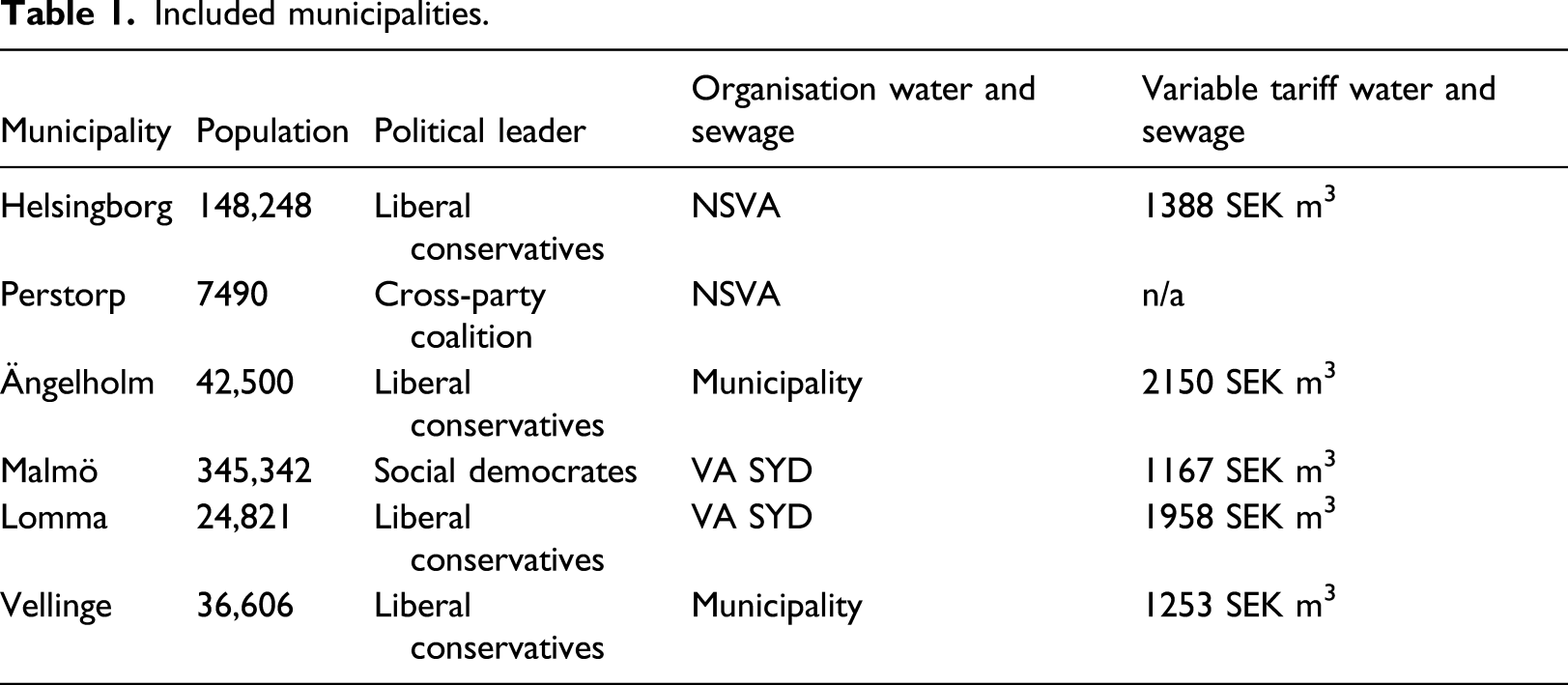
The aim of the study and the theoretical framework together constituted the guiding principles for designing, thematising and analysing the interviews. In order to analyse the municipalities’ (in)capacity to conduct infrastructural maintenance and repair, we have, with inspiration from Kvale and Brinkmanns’ (2009: 102) seven stages of an interview inquiry, gathered the empirical material through semi-structured interviews. We developed an interview protocol against the backdrop of the capacity concept, and the questions in this protocol were complemented with other questions, to cover introductory, follow-up, probing, and direct questions (cf. Kvale & Brinkmann, 2009: 135).
As we wished to cover all aspects of the multidimensional concept of capacity, the interviewees were selected on the basis of the theoretical framework. While leading politicians were chosen as they are formally responsible for, or have mandate over, financial capacity (decision-making power over budget and water and sewage tariff) and political capacity (establishment of horizontal or vertical linkages), civil servants were chosen because they have the formal responsibility for technical capacity (specialised knowledge) and institutional capacity (developing plans, policies and strategies). At the same time, we do acknowledge that ‘the social aspect’ of capacity in a strict sense is involving both politicians and civil servants, as it includes public participation in decision-making and reporting on failures, or mismanagement of maintenance.
Interviewees.
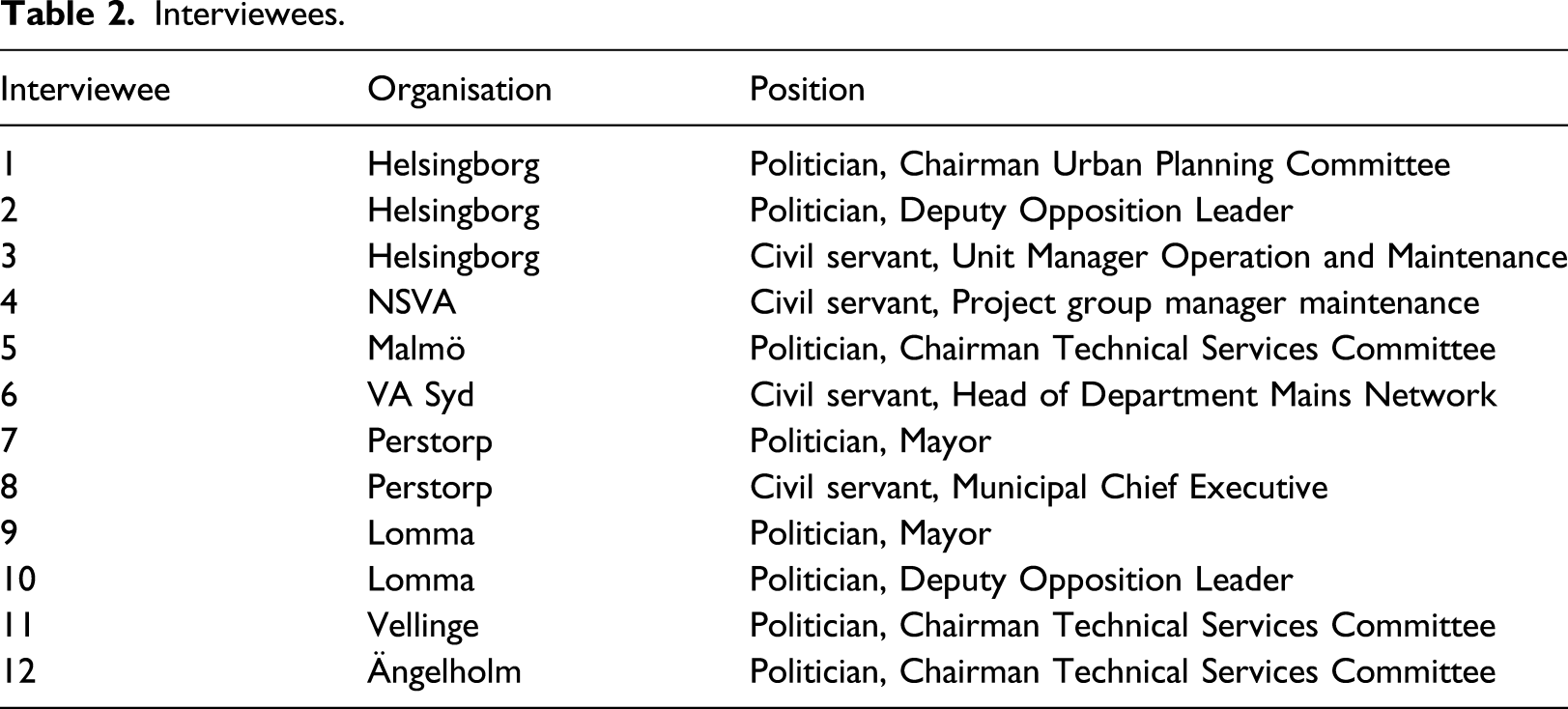
To supplement the empirical data gathered from the interviews (and were we did not find interviewees), we also gathered publicly available documents from the municipalities and the inter-municipal bodies in the form of public inquiries, articles of associations, budgets, business and policy plans, strategies and organisational decisions. It is crucial to keep in mind, though, that not every municipality included in this study produced such documents. This could in itself indicate a lack of capacity. The documents we gathered, read and analysed had all been prepared by civil servants, as part of creating a basis for decision-making for the politicians. This harmonises with the capacity concept as institutional and technical capacity is an inherent part of daily routines of civil servants, while political and financial capacity is confined to the elected politicians.
Due to the principle of public access to official records, we could easily obtain all documents we asked for, but in many cases, like strategy and budget plans, they were available freely online. The public documents were gathered both before and after the interviews. Before, we read infrastructural maintenance plans as a way to do background research. During each interview, we asked the interviewee to name (and if possible, e-mail us) the most important plan or document relating to maintenance and repair of infrastructures in his/her organisation.
The analysis has been conducted in two steps. First, the interviews were transcribed and thereafter each interview was categorised using the theoretical framework. The same process was conducted with regards to the collected public documents. Second, the interviews and gathered documents were organised based on the following themes: funding; ownership and operations; organisation and governance and citizens. Again, these themes were developed using the theoretical framework as a point of departure. On the basis of this two-step process, we conducted the analysis and reported of our findings.
Capacity: In municipalities and inter-municipal bodies
In this section, we will explore how municipalities and inter-municipal bodies in the south of Sweden have been building capacity to keep up maintenance and repair of infrastructure. Emerging from our analysis were, as previously mentioned, the following themes: funding; ownership and operations; organisation and governance and citizens. Although these themes undeniably overlap, we will here explore them separately to show how the everyday maintenance of roads, as well as water and sewage infrastructures, is organised.
Funding of maintenance and repair
It goes without saying that the municipal economic framework is limited. In the municipalities we studied, there appears to be a tug of war between soft and hard political areas in relation to how much money is to be invested in ‘soft’ welfare systems (e.g. education and care) or ‘hard’ infrastructures. This struggle takes place in some municipalities between different administrative sectors, rather than between political parties. In the studied municipalities, the responsibility of road maintenance is layered in multi-level governance. There are ‘national’ roads and highways that are maintained by the Swedish Transport Administration. The municipalities are responsible for local roads, but in Sweden, there are also many civic road associations, which are responsible for the maintenance of neighbourhood roads, roads through forests or roads in other places where usage is limited. Maintenance of the public road network is, as mentioned above, financed through various taxes, while the civic road associations receive funding from the Swedish Transport Administration and each municipality. However, the quality requirements on civic roads differ from public roads, whereby the maintenance costs are lower for civic roads (Blomkvist, 2010).
The municipal road network has been neglected for a long time and one obstacle for catching up on the maintenance debt is the relatively small amount of allocated financial resources. Responsible politicians seem to accept that there are shortcomings in the municipal road network. One municipal official in Helsingborg told us that he believes that it is one step forward and two steps back all the time. There are hardly any resources to make new paving for one-third of the roads that are flagged as being in a status of emergency. The same official points out that in relation to maintenance, the administration has become better at using tax money more efficiently. One example is the development of a digitalised and online ‘excavation map’. Previously, various actors within the municipality were digging in the same part of the street at different times, which meant double-work and additional costs. This so-called ‘excavation map’ shows where, and when, there are plans of digging in the streets and roads in the municipality, which means savings in both time and money. The digitalised map is available online within a common intranet and used by all relevant municipal administrations and public limited companies. The excavation map is also highlighted by NSVA as an excellent collaboration tool that complements the face-to-face meetings that they otherwise have.
Furthermore, the budget for maintenance does not grow at the same rate as some of the municipalities grow, which might lead to new maintenance debts in the future. Nevertheless, most of the municipalities keep the responsibility of the maintenance of roads within the municipal administration after development projects have been finished. One reason for this, we were told, had to do with the fact that the municipality wishes to have full access and control of the infrastructure networks, not least water and sewage systems. But in Malmö, the municipality has chosen to hand over the responsibility for maintenance of neighbourhood roads to civic road associations. This is done to keep up the rate of housing development. However, there is awareness within the municipality that this form of solution may entail an increasing cost in the long term, especially if the civic road associations have a run-until-breakdown mentality to keep costs down and the municipality then must take over the maintenance and the direct costs associated with that. This has been the case in Vellinge, where the municipality does not wish to take over responsibility for road maintenance from the civic associations, mainly because it would contribute to an increased maintenance cost of SEK 35 million per year, or a budget increase by almost 200% (ibid.). Another solution is to increase the municipality’s financial support to the civic local road association. This is what happened in Vellinge in the end. But there are also municipalities that have chosen to take over the responsibility for maintenance, as in Ängelholm, at great costs.
Unlike the tax-funded road maintenance, the maintenance of water and sewage infrastructure is funded by user fees. The tariff is decided by the municipal council and is based on the so-called cost principle. The basis for a decision on the tariff is prepared in the inter-municipal cooperation by VA SYD and NSVA, respectively, while in municipalities outside these inter-municipal bodies, the management within the municipalities calculates all costs and based on this suggests a tariff. Declining infrastructure network is often explained by a run-to-failure mentality and a deeply rooted desire not to raise the tariff. Taken together, this contributed to limited resources being devoted to infrastructure maintenance in all studied municipalities. A patchwork of maintenance interventions in the water and sewage infrastructure has kept the networks operational, although leakages occur every now and then. Yet, the overhanging maintenance debt remains.
Infrastructure ownership and maintenance operations
All municipalities employ consultancy firms to assess the quality and possible maintenance needs of the municipal road network. These assessments are, or can be at least, costly, one official in Helsingborg told us. Therefore, both external and internal assessments are carried out to keep costs down. The time intervals for doing these assessments vary between municipalities. For example, in Ängelholm, a scan of the paving is performed every 2 years. With this knowledge, the politicians prioritise and make decisions on budget allocations. In all municipalities, maintenance of municipal roads is performed by contractors, who are awarded this through public procurement processes. The municipalities first specify what to do and then procure these services from the market. But competition is weak, a representative for the municipality of Vellinge told us. As the market suffers from a lack of competition, this leads to unreasonably high prices and poor quality of work.
The fact that several municipalities chose to organise water and sewage in inter-municipal cooperation bodies means that they transfer competence from municipal administrations to these bodies. This competence involves specialist expertise and local knowledge about particular infrastructure networks. While inter-municipal cooperation gains competence in the long run, municipalities lose this and their ongoing experience of maintaining infrastructure. One representative in Helsingborg emphasises that cooperation between the inter-municipal cooperation body NSVA on the one hand and the governing politicians in the city on the other hand had to work, otherwise plans could be stalled or obstructed. The politicians in the city hall could not go about making the necessary formal decisions, for example, on tariffs or new major investments, unless they trusted the reports provided by NSVA.
The representative from Malmö points out that since water and sewage competence has largely left the municipal administration to the inter-municipal cooperation body VA SYD, it is problematic for the municipality to critically review and evaluate the proposals for investments and/or maintenance produced by VA SYD. This happened, for example, in Helsingborg, where the costs of a large project were considerably underestimated, and the municipality had to revise its budget to be able to finalise the project. However, a representative from NSVA had another take on this. Should municipal competence within water and sewage remain, this would imply that both organisations did the same thing, and that the municipalities could develop plans diverging from NSVA’s, causing administrative double-work and potential practical problems when it comes to coordination.
Organisation and governance
In the larger cities of Malmö and Helsingborg, politicians manage the technical administrations primarily through management by objectives and directives, while in smaller municipalities it is mainly through direct meetings and through dialogue between politicians and administration. So-called business plans and maintenance plans, combined with the budgets, are the main instruments within the water and sewage sector. As discussed above, many of the municipalities have joined forces to establish inter-municipal bodies within water and sewage, while multi-level governance is more evident when it comes to investments and maintenance of the road network. In contrast to water and sewage, where inter-municipal cooperation bodies are governed by jointly set goals, these kinds of goals are often missing within road maintenance. Within water and sewage, municipalities have built capacity through the formation of VA SYD 2009 and NSVA in 2010. Since both organisations are owned by their respective member municipalities, there is close cooperation between NSVA and VA SYD and its owners.
In general, smaller municipalities wish to cooperate with other municipalities, as competence and resources are limited. This was evident in Perstorp. The municipality joined NSVA in January 2020 and the main argument was that it would be cheaper and more uncomplicated to coordinate the maintenance of the neglected infrastructure in the inter-municipal body than continuing to the maintenance on its own. At an earlier stage, Perstorp had inquired about a collaboration within water and sewage with neighbouring municipalities. However, all inquired municipalities faced the same problem as Perstorp. Therefore, an entry into NSVA was ultimately the only alternative for the municipality.
In the municipality of Ängelholm, there was a wish from the liberal and conservative parties to investigate the consequence of an entry to NSVA. But the proposal was rejected by the opposition and other parties and therefore water and sewage are still organised and governed within the municipality (Ängelholm Municipality, 2015). Arguments for not joining the inter-municipal cooperation body are based in notions of autonomy and that the inter-municipal body is difficult-to-manage, bureaucratic and plagued by red tape. The idea that VA SYD is unmanageable is also highlighted by the representative from Malmö. In Vellinge, this also emerged. While VA SYD is interested in having the municipality of Vellinge as a member, the political leadership in Vellinge is hesitant. A representative for the municipality said that one of the reasons why they have not yet become a member is because there are too many politicians involved in the governing of the inter-municipal cooperation body. In addition, it was found that a membership would be associated with a considerable direct cost, and that the municipality would lose its own competence in the water and sewage area.
Since membership in an inter-municipal organisation such as VA SYD or NSVA would entail multi-level governance, membership would involve a certain degree of complexity. This is apparent in those cases where water and sewage maintenance are handled by an inter-municipal body and road maintenance is handled by civic road associations. If one association needs to dig in the road or change the paving on the surface, then it would need to contact VA Syd, and not the municipality as VA Syd owns the water and sewage network and not the municipality. This, we were told, would be complicated because civic road associations generally lack established contact and personal inroads to VA SYD, which is a large organisation that primarily wants to cooperate with municipalities, not civic road associations. From the municipality of Vellinge’s point of view, it is therefore easier if they keep the responsibility of maintenance of the water and sewage network in-house.
Civic local road associations are built on horizontal networks, where citizens come together and are expected to contribute to the maintenance, but different civic local road associations can also cooperate. In Vellinge, for example, there are 13 civic local road associations that work together and train stewards who control the status of the maintenance. In larger cities, civic local road associations are not that common but they do occur. Exactly how the boundary is to be drawn between the municipality’s and the citizens’ responsibility for road maintenance appeared in several municipalities, not least in municipalities with very rural areas but also in municipalities where former summer residences were converted into full-year housing. With both more and heavier traffic, this has become a difficult task. The deficiencies that have been identified include damage to the asphalt due to digging of pipes and lines (loom) and that gravel roads need to be planned to be level (Vellinge Municipality, 2014).
Citizens
Infrastructure maintenance is rarely an issue that comes high on the political agenda, but there is nonetheless a civic commitment to maintenance issues. Although water and sewage networks often are described as invisible infrastructure, our interviews revealed that there is a relatively widespread commitment among citizens, not least when the water and sewage tariff is increased or when there is disruption in the network. Similarly, citizens are engaged and contact the officials and/or politicians when they discover potholes or see generally bad roads in the municipality. There is also widespread awareness, especially among the inter-municipal bodies that they must be proactive and customer oriented. The business plans of VA SYD (2018) and NSVA emphasise availability of information as important and that it is of significance for organisations to be available to customers through various information channels, both traditional media (such as being able to call customer service) and social media. For NSVA, it is also about efficiency, both for the customer and for the organisation. By creating an informative and updated website, the customer should be able to find answers to their questions without contacting customer service (NSVA, 2019).
Overall, the maintenance of road networks was described as an unpolitical issue. Reducing the level of investments in the road networks is comparatively easy if the resources are allocated to other sectors, where there is a greater need. When it comes to the maintenance of roads it is also easier for citizens to identify if maintenance is needed. Potholes and tear and wear become visible and will, obviously, affect the quality of the road and possibly also the speed. This means, at least in comparison with water and sewage, that citizens can be active in addressing shortcomings in maintenance. This has, for example, been the case in Helsingborg. After the municipality launched an app where citizens could complain about potholes and other things, it was overloaded with complaints. At one point, they did a follow-up on citizens’ complaints in Helsingborg and the responsible contractor was asked to take care of, and catch-up, on the maintenance work. Also, in Lomma, the citizens are active in addressing shortcomings and as much as 90% of all incoming citizen complaints concern the technical things, for example, roads, lampposts and green spaces, such as parks and lawns. The citizens of Lomma were also described as well-informed and experienced enough to lobby and try to influence the local politicians. The citizens of Vellinge were also ascribed as having a high level of competence and well-equipped for taking care of relatively complex tasks, such as road maintenance.
We were told that some citizens believe that they should receive better maintenance because they are able to comment on the effects of a lack of maintenance, and because they pay more municipal taxes. However, no municipal representative believed that these things mattered. The even distribution of maintenance across space also emerged as an issue. The politician from Ängelholm said that it was of pure self-preservation that infrastructure maintenance followed some notion of equality. Because if the municipality would accept poor infrastructure maintenance in some areas, this would spread, he told us. The same approach emerged in Malmö. Although there is usually a consensus on questions about infrastructure maintenance, infrastructure is, ostensibly, also linked to social issues and the notion of the universal welfare state more generally. Households and residents in the most vulnerable and disenfranchised areas must be able to trust that they are getting proper and well-functioning infrastructure and good maintenance. Otherwise, inequalities will grow further and households and residents in those disenfranchised areas will eventually know that they are not getting the same level of maintenance as residents in more well-off areas. Therefore, the politician in Malmö pointed out, perhaps maintenance in those disenfranchised areas must even be better than in other places.
Discussion
Both infrastructure networks that we have studied have in common that they are tightly coupled systems, that is, the users are dependent on all parts of the infrastructure for their daily routines not to be interrupted. This is especially apparent within water and sewage, where a disturbance of the infrastructure (e.g. leakages or clogged pipes) can have far-reaching consequences (e.g. contaminated or polluted water), while there to a higher extent is room for a maintenance deficiency within the road network. Furthermore, in the road network, there is a greater degree of tolerance for various standards on different road segments before the system breaks down. Consequently, there is a completely different state-of-readiness within water and sewage than with the road network and there is a greater need of in-house technical capacity to quickly manage (un)expected problems.
Technical capacity
Building and sustaining technical capacity (de Loë et al., 2002) as well as competence in relation to water and sewage is also mentioned as one of the main reasons why inter-municipal bodies were established some 10 years ago. Municipalities choose to join these bodies as it had become obvious that it is challenging and difficult to take care of these issues on their own. This development is, inter alia, shaped by an institutional environment where many municipalities have been lacking sufficient plans, policies and strategies within water and sewage, and together with directives and rules on national and European level on water quality, which has explicitly and implicitly affected the municipalities’ capacity to cope with the maintenance of water and sewage infrastructure.
To overcome or reduce these institutional challenges, many of the municipalities have formed horizontal linkages and joined inter-municipal bodies. This is not only the case for the municipalities we studied. After all, as many as 19 out of the 33 municipalities in Scania have established horizontal linkages to work with the maintenance of water and sewage systems. These kinds of horizontal linkages are not found within the organisation of the public road network maintenance. Instead, there is a myriad of vertical linkages between the municipalities and the Swedish Transport Administration, but also with civic road associations. Although there are formalised meetings and dialogues between these organisations, they often lack common goals and do not share the same interests, which ultimately affect the municipalities’ capacity to organise the maintenance of the local public road network.
Capacity in financial terms
Comparing the financial capacity in the two infrastructures, stark differences emerge. While the maintenance of water and sewage infrastructures is funded by tariffs on a cost-based principle in each municipality, the road network is funded by municipal taxes. Although there might be a political debate whether to increase or decrease the tariff, and this is also frequently debated in the inter-municipal bodies, the cost-based principle means that funding is only to be used for water and sewage maintenance. Each generation should pay its fair share of investments and maintenance of water and sewage systems. As the public road network is funded by the municipal tax, there are often heated political debates in each municipality, where different sectors and budget posts stand in opposition to each other. Although political debates and politics are materialised through artefacts and effects, not least urban infrastructures (Shelton, 2015; Knox, 2017), none of the politicians we talked to said it was possible to win an election based on the promise of maintaining and repairing the water and sewage system, or the road network. As these networks are supposed to operate day after day, failure was not acceptable. Yet, these networks fail and when they do, the costs of repair are always scrutinised and compared to costs in social welfare, which is regarded as pivotal. However, the two critical infrastructures have one thing in common, namely, that the financial capacity is tightly connected to technical capacity. With stronger financial muscles, it is easier to recruit and educate technical staff, but it is also possible to invest more resources in maintenance, not least in tools, equipment and long-term competence development.
Social aspects of capacity
Because the road network is both visible and used by many citizens, all the municipalities wished that their citizens reported on potholes and broken infrastructures (e.g. de Loë et al., 2002). If nothing else, the municipalities wanted to use this information to hold the contracted companies accountable for their incapacity to carry out maintenance and repair. At the same time, the civic road associations’ responsibility for maintaining the civic roads is one example of how municipalities engage in vertical linkages in order to ensure the maintenance of the entire road network locally. Unlike the road network, the water and sewage system is not visibilised to the same extent. Although many of the municipalities have developed in-house technical capacity to manage expected failures, they cannot know or expect precisely where the next failure will occur. For this, the inter-municipal bodies rely on the citizen’s willingness to report water leakages. This is also why direct online communication channels have not only been established between the inter-municipal bodies and their users but also between the inter-municipal bodies and the citizens at large (cf. Graham & Marvin, 1996, 2001; Graham, 2000).
Political capacity
Both de Loë et al. (2002) and Pirie et al. (2004) suggest that political capacity is nested in the ability to establish linkages and networks. This includes both within the municipality, with other municipalities or inter-municipal bodies. Within both the inter-municipal bodies and the municipalities, civil servants produce plans, strategies and other documents that together form the basis for political decisions. One such key decision is whether or not to raise the water and sewage tariff, and whether or not allocate more tax-based funds to the maintenance of the road network. If the underlaying documentation was inadequate, the politicians found it difficult to make informed decisions, which could delay repair interventions. We, therefore, suggest that political capacity has an influence on financial capacity, especially within the water and sewage sector. Establishing horizontal linkages, such as inter-municipal bodies, enabled the build-up of technical capacity, we were told, but this also formed the basis for more developed policies and strategies. This, we argue, points to the circularity of capacity building. Because inter-municipal bodies engage in maintenance and repair more often, on a daily basis in fact, they also develop a greater capacity to deal with both expected and unexpected infrastructural failures. Although Ivey et al. (2004), Pirie et al. (2004) and de Loë et al. (2002) label this circularity institutional capacity, we argue that this capacity cuts across all the other forms of capacity, by providing the foundation for them.
Conclusions
In this article, we have studied municipalities’ capacity (or lack of capacity) in relation to infrastructure maintenance and why, and in what ways municipalities have developed a capacity to organise, govern and work with everyday maintenance of infrastructures. The multidimensional concept of local capacity has been used as a point of departure to analyse how and in what ways Swedish municipalities work with routine maintenance of municipal roads and water and sewage infrastructure. Based on the analysis and discussion, we summarise our results in two ways.
Firstly, there is a completely different state-of-readiness within water and sewage than with the road network and there is a greater need of in-house technical capacity in the water and sewage sector. To overcome, or at least reduce, institutional challenges with maintenance of water and sewage infrastructure, many of the municipalities formed horizontal linkages and created and/or joined inter-municipal bodies. Furthermore, the results indicate that political capacity also has an influence on the financial capacity, especially within the water and sewage sector, as there many municipalities share a belief that horizontal linkages, such as inter-municipal bodies, come with greater technical capacity, that it will form the basis for more developed policies and strategies, and thereby also better knowledge and documentation. This will improve, it is assumed, political decisions and the work with maintenance of water and sewage infrastructure.
Secondly, there is a greater degree of tolerance for various standards on different road segments compared to water and sewage before the whole system breaks down. In addition, municipalities work more on their own and there are no established horizontal linkages with other municipalities when it comes to road maintenance work. Instead, there are vertical linkages with a state agency and many small local civic road associations, but these linkages are not as institutionalised as those within the water and sewage sector and do not in the same way add to the municipal capacities. However, to overcome a run-to-failure mentality and to build capacity, inclusion of so-called social capacity is more frequent when it comes to the maintenance of road infrastructure, while water and sewage infrastructure continue to be invisible in the eyes of the citizens and so primarily ready-to-hand.
Footnotes
Declaration of conflicting interests
The author(s) declared no potential conflicts of interest with respect to the research, authorship, and/or publication of this article.
Funding
The author(s) disclosed receipt of the following financial support for the research, authorship, and/or publication of this article: Miljöstrategisk Forskning, (Grant/Award Number: ‘2019/0437’).
