



Abstract
We document how river stories, as sources of local knowledge, can inform management applications in the Waimatā Catchment on the East Coast of Aotearoa New Zealand. Analysis of semi-structured interviews with residents and users of the catchment shows how river stories express deep-seated connections for the river, emphasising concerns for river health, ancestral relations, recreational and aesthetic functions and biodiversity values. By opening dialogue about the catchment, river and its management, we show how river stories can help to extend participation processes from ‘being informed’ to ‘being an informer’. Equally, stories provide a basis to challenge or refute commonly held beliefs. Identification and coding of local knowledge derived from river stories provides a readily accessible method to appraise socio-cultural connections to rivers, providing nuanced understandings of social, cultural, economic and biophysical considerations. Ways of being and knowing expressed in/through river stories can help to facilitate locally owned and locally informed, place-based approaches to river management.
Introduction
Despite enormous expenditure, river restoration initiatives are yet to deliver sustainable management outcomes in biophysical, socio-economic and cultural terms (Bernhardt et al., 2005; Christian-Smith and Merenlender, 2010; Stewart-Harawira, 2020). All too often, prescriptive and narrowly defined approaches fail to capture unique attributes and values of individual river systems (Doyle et al., 2013; Hilderbrand et al., 2005; Kondolf et al., 2001; Lave, 2009). If management efforts are to meet social and cultural aspirations, nuanced understandings of local values are required to support management applications. Perhaps inevitably, diverse value sets fashion social constructions of nature and the ways conservation and restoration are imagined (e.g. Boelens et al., 2023; Chan et al., 2016; Eden et al., 2000; Tadaki et al., 2017). Indeed, the etymology of the word ‘river’ has the same root as ‘rivals’; the Latin noun ‘rivalis’ refers to those who use the same stream as a source of water (Cresswell, 2021). The intent, purpose and meaning of restoration, and the approach taken to enact it, are inherently value-laden, deeply contextual and often highly contested, as particular mindsets and values underpin the generation and use of knowledge to achieve particular purposes (Hikuroa et al., 2021; Hillman, 2009; Pascual et al., 2023; Tadaki et al., 2017). Here, we explore the use of river stories as a method to understand and express local knowledges to support management practices.
Holistic approaches to river management traverse boundaries between knowledge types (political, biophysical, social, cultural and economic), interweaving community and institutional perspectives (Horacio-Garcia et al., 2021; Koppes, 2022; Murphy et al., 2022). In Aotearoa New Zealand (ANZ) 1 this entails working ‘across worlds’, at the interface of mātauranga Māori and western knowledge frameworks (Salmond, 2014). Multiple ongoing reforms shape the drive for co-management and co-governance of water and rivers in ANZ (e.g. Harmsworth et al., 2016; Hikuroa et al., 2021; Te Aho, 2019). Concerns for phronesis, place-based knowledges developed through experiences and cultural values (Hillman, 2009), present a generative platform to develop new practices that incorporate Māori relations to (being part of) river systems (e.g. Parsons et al., 2021; Stewart-Harawira, 2020).
Storywork is an integral part of indigenous knowledge practices (Archibald, 2008), sharing knowledge about a particular place. Lyotard (1994) noted how anthropological fieldwork represents both a scientific ‘laboratory’ and a personal ‘rite of passage’, an impossible attempt to amalgamate objective and subjective practices through intersubjective dialogue, translation and projection. For some time, the impossibility was hidden by marginalising the intersubjective components of the fieldwork, relegating understandings to nothing more than prefaces and anecdotes. Today, however, what had previously been seen as interpretative accounts are now afforded recognition as a form of allegory (a story, poem or picture that can be interpreted to reveal a hidden meaning), from which complex and truthful accounts can be unearthed. As spoken allegory, stories are susceptible to contestation. However, as a written version with a basis in fieldwork and observations, they form a story among stories that builds towards a wider story.
From this perspective, we build upon how stories provide a valuable tool to document complex, truthful accounts of scientific phenomena. They can be used to characterise the diversity and changing nature of socio-cultural meanings and relations to rivers in space and time (e.g. Coates, 2013; Desfor and Keil, 2000; Parkes, 2022; Wessell, 2021). Sharing and cross-referencing stories presents a basis to get closer to notional ‘truths’ (Kelly, 2017; Lyotard, 1994). In an Australasian context, stories include settler histories of colonial relations to rivers (e.g. Mander, 1974; Robertson et al., 2000; Wessell, 2021) and anti-colonial perspectives expressed through more-than-human voicing experiments (e.g. Wintoneak and Blaise, 2022). As river stories build upon ancestral and personal interactions with rivers, they reflect local values, meanings and aspirations. Reflecting upon these place-based relations, Larsen and Johnson (2016: 158) suggest that ‘Places contribute to storyscapes such that “the entire land [is] like a living geography text and history book in one”’ (citing Ihimaera, 1986: 103). Here we explore how river stories express place-based values, meanings and knowledges for the Waimatā catchment on the East Coast of ANZ (Figure 1).
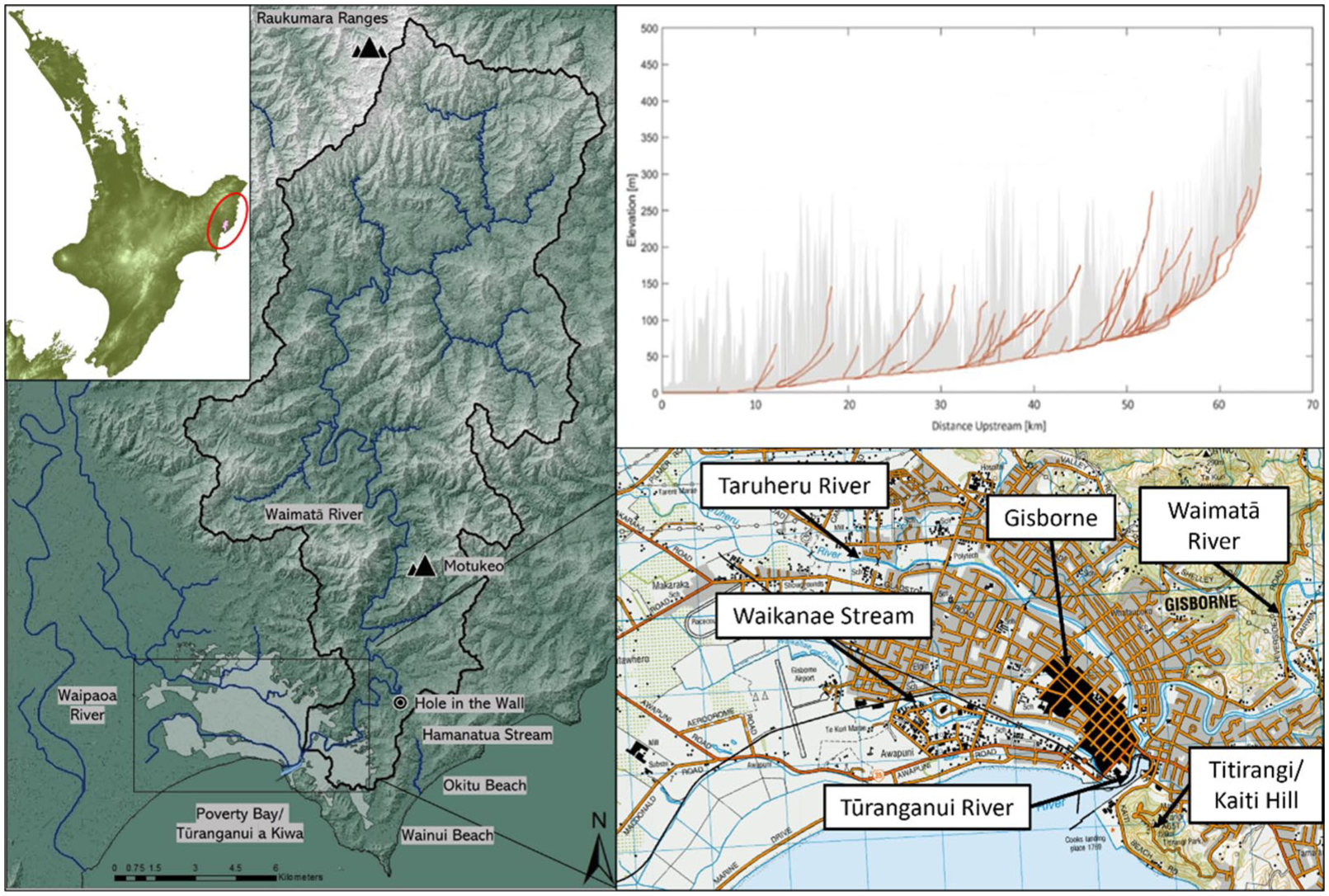
Waimatā catchment map with notable landmarks labelled (left). Gisborne City is located at the river mouth (bottom right). Waimatā River has a concave-upwards long profile with recurrent tributary inputs, and it flows within a relatively narrow, terrace-constrained valley (top right). Long profile and valley width derived using data sourced from the LINZ Data Service and licenced for reuse under the CC BY 4.0 licence.
Waimatā catchment setting
The Waimatā River drains a catchment area of 228 km2 (Figure 1). Emerging from the Raukumara Ranges, the river readily conveys water, sediment and logs (slash) from deeply dissected, highly erodible headwaters through terrace-constrained flume-like reaches in mid-catchment to the narrow coastal plain at Gisborne (Fuller et al., 2023). Average annual rainfall ranges from 1800 mm yr-1 in the headwaters to 1000 mm yr-1 on the coastal flats. Short-duration, high-intensity rainfall events from tropical cyclones trigger significant floods and landslide activity.
The East Coast region of ANZ has a continuous history of Māori settlement and land use since the 14th century (Figure 2). Early Māori settlements in lowland areas around Tūranganui River and Waikanae Stream used local resources for mahinga kai (gathering of natural food resources) and established gardens along Taruheru Stream, clearing areas of native forest to around 250 m above sea level (Coombes, 2000). The Waimatā River provided a transport route and a shared resource among various hapū and iwi (Māori family groupings and tribes, respectively) (Coombes, 2000; Clapham, n.d.).
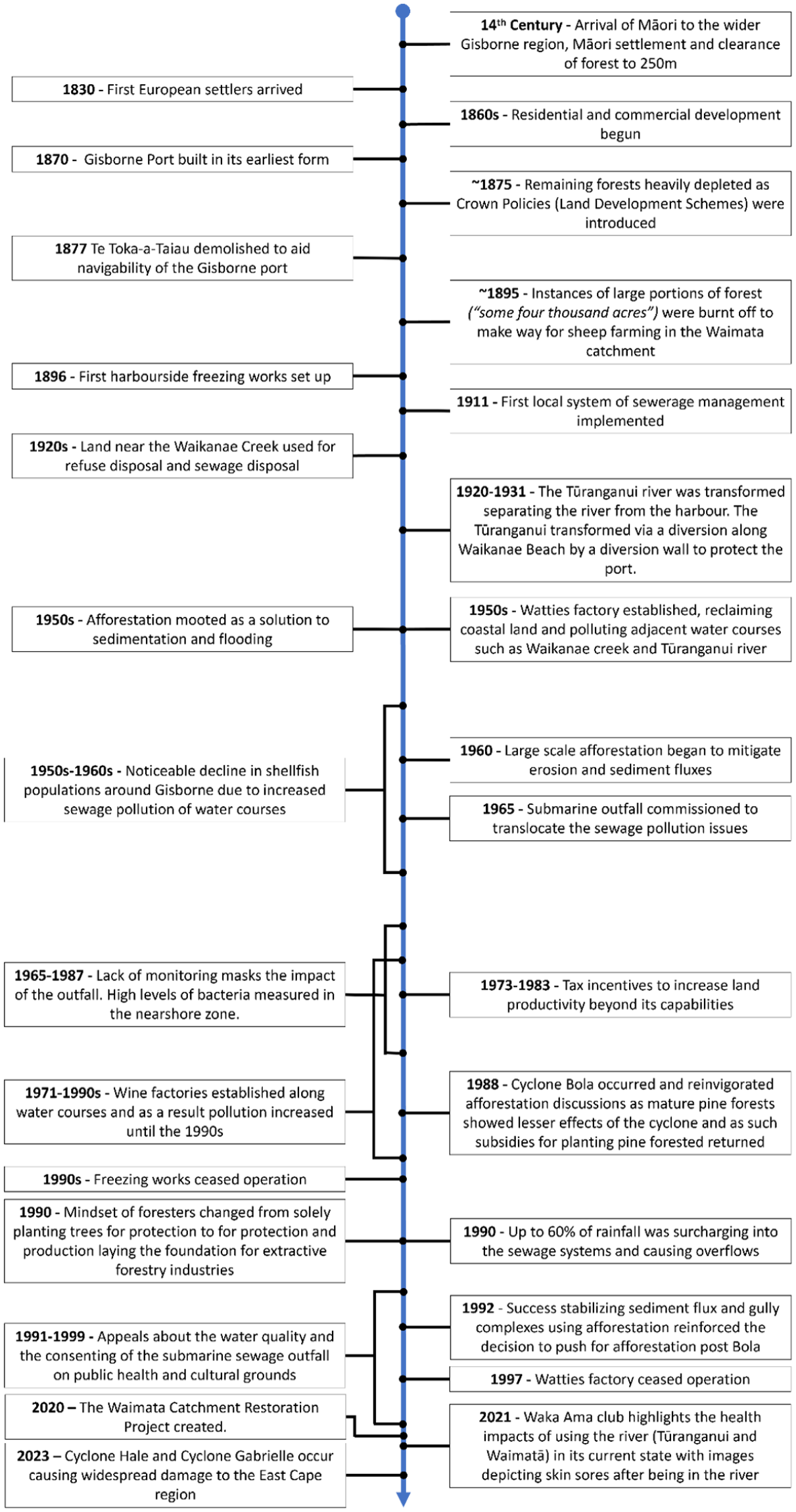
Environmental history of Waimatā Catchment and adjacent areas (after Coombes, 2000; Salmond et al., 2022; Spedding et al., 2006).
Initial interactions between Europeans and Māori on the East Cape in October 1769 were violent. Te Maro, a Ngāti Oneone (a local Māori tribal group) rangatira (a person of high rank or highly esteemed), was shot by some of James Cook’s men from the Endeavour expedition at the mouth of the Waimatā (Tūranganui River on Figure 1). Although tensions remained high in the years that followed, European settlers assimilated into local society over the next 100 years (Salmond et al., 2022; Spedding, 2006). By 1911 the population of Gisborne was approximately 8,000, reaching approximately 47,000 in 2018 (Coombes, 2000; StatsNZ, 2018).
The river has continuously played a central role in cultural, commercial and recreational activities in the region. Contemporary relations to and knowledge of the catchment are deeply etched within the local community’s ways of being (Cairns et al., 2024). As experienced across much of ANZ, European settlers reshaped landscapes to fit the European ideal of productive landscapes and waterscapes, displacing Māori knowledge (mātauranga) of the land and freshwater (Hikuroa et al., 2021; Knight, 2016; Parsons et al., 2021). Contemporary land cover in the catchment comprises a mixture of well-established exotic species–pasture for agriculture, pines (Pinus radiata) for silviculture and a range of trees and shrubs for lifestyle blocks (a rural residential property). Native vegetation is now restricted to around 15% of the catchment. Sheep and beef farming is the dominant land use in Waimatā catchment, along with exotic pine plantation forest, making up around 49% and 20% of the catchment area, respectively. To date, lessons learnt from the devastating impacts of Cyclone Bola in 1988 are yet to be translated into effective relief programmes following similarly devastating cyclonic storms in 2022 and 2023 (Figure 3; Fuller et al., 2023; Marden and Seymour, 2022; see, also, Thomas et al., 2025a, 2025b). The Waimatā Catchment Restoration Project (WCRP), established in 2020, promotes and applies participatory approaches to achieve catchment-scale conservation, recreation and community education outcomes, working towards the common goal of a healthier Waimatā River (Cairns et al., 2024). Specific emphasis is placed on programmes to address poor water quality and flooding and erosion problems (Figure 3; Cairns et al., 2024; Salmond et al., 2019; Waimatā-Pakarae Catchment Plan, 2022).
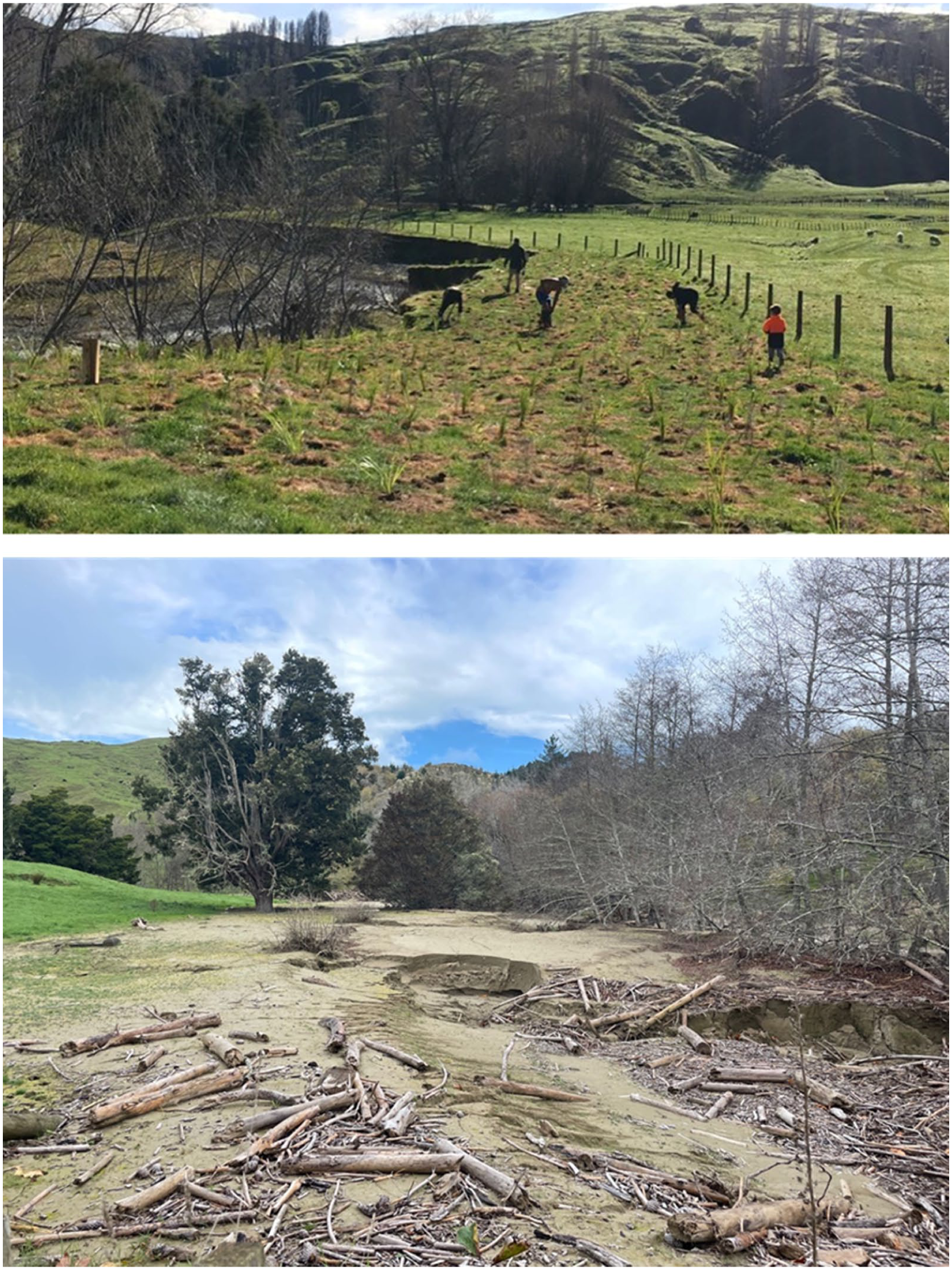
Restoration practices in Waimatā Catchment. A. Revegetation programmes orchestrated through Waimatā Catchment Restoration Project (image from WCRP). B. Recent storms devastated many sites along the river (image from Megan Thomas).
Storytelling as method
Increasingly sophisticated approaches to qualitative and quantitative research now incorporate storytelling as a part of information-gathering practices (e.g. Gallagher, 2011; Pluye and Hong, 2014). Stories can help to communicate complex phenomena and transmit new or existing knowledge. However, the telling of stories can be audience specific. Simplified messaging may omit or overlook various complexities and assumptions. Misinterpretation as a result of judgement or bias may promote disengagement and loss of trust (Bamberg, 2012). In their analysis of the use of stories to supplement scientific enquiry in steps to address the declining state of aquatic ecosystems in ANZ, Doehring et al. (2024) highlight the importance of trusted messengers as restoration knowledge brokers in rural catchment communities. Inevitably, stories are unable to capture and communicate all relevant information, with associated concerns for emphasis of key messages and intonation (Bamberg, 2012). However, a journalistic approach to storytelling can aid science communication (Krzywinski and Cairo, 2013).
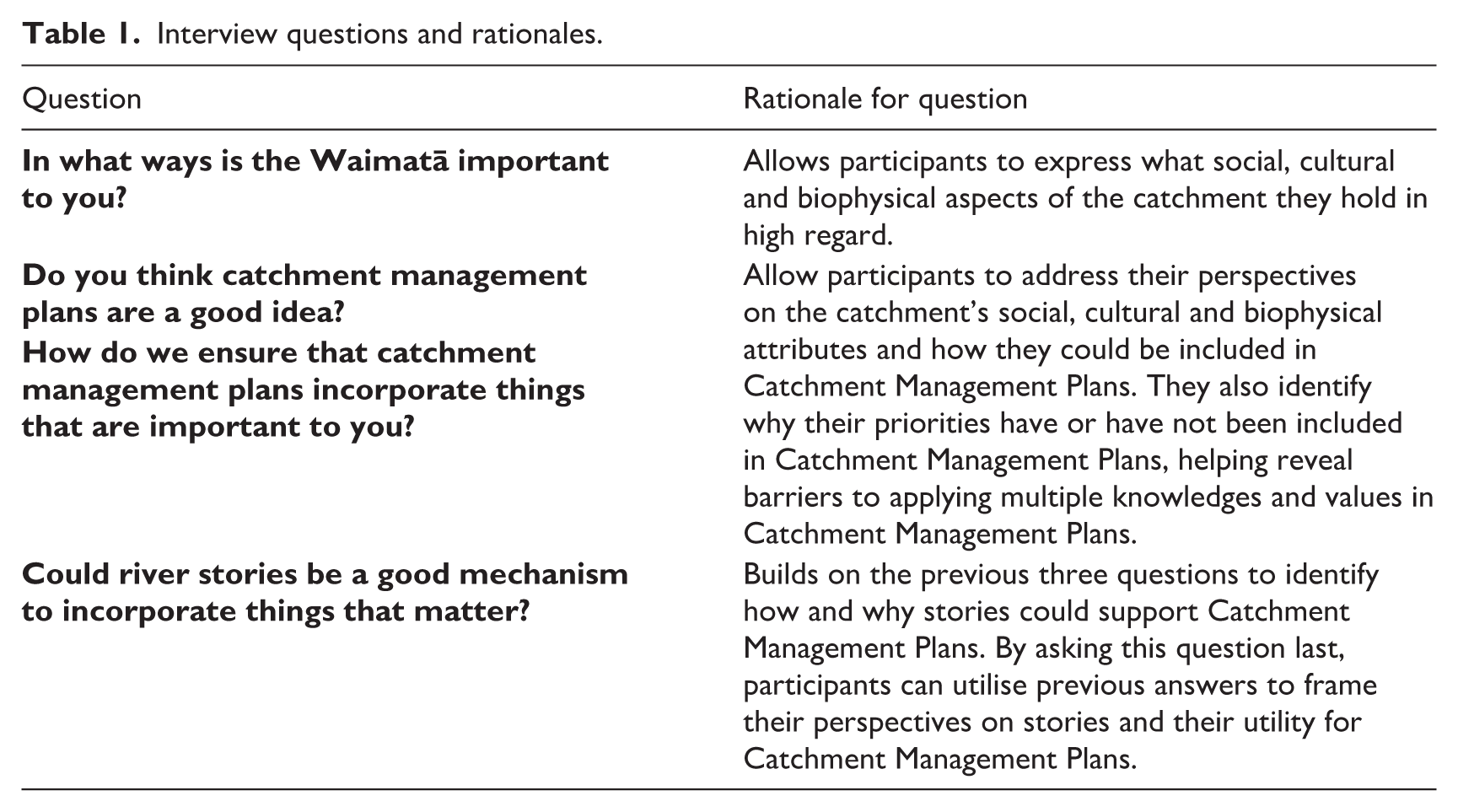
In light of these caveats, the approach to storytelling applied in this study is considered to generate indicative rather than representative results. No attempt is made to achieve saturation or exhaustion in the range of relations to rivers expressed through stories in the region. Semi-structured interviews were chosen to elicit stories, as they provide a common starting focus in conversations about the river, allowing participants to lead discussions in the directions they desired (Dowling et al., 2016; Hitchings and Latham, 2020). Interviewees were selected based on them living and engaging daily with the river. Interviews lasted between 30 minutes and 1.5 hours, conducted in spaces decided by each participant to ensure they were comfortable in their surroundings (i.e. their home, next to the river, indoors or outdoors; Adams-Hutcheson and Longhurst, 2017). In this way, each participant was able to draw on their surroundings to further explain their stories and knowledge, sharing insights that express what is important to them, at a level of detail they desired (Dowling et al., 2016; Hitchings and Latham, 2020; Merriam, 2009). A series of recurrent themes was used to prompt interviewees to reflect upon their experiences through river- and catchment-based stories (Table 1).
Interview questions and rationales.
The ten participants were selected through initial recruitment with community group leaders, followed by snowballing procedures that included potentially interested parties that had not previously been considered (Crang, 2002). Participants were not categorised by ethnicity and were unintentionally of various ages and genders. The study did not specifically collect this information as it was not deemed central to the focus of study. Instead, focus was placed on the participant’s perspective upon their knowledge. Participants ranged from landowners to river recreationalists and included people that live and frequent the catchment for a variety of reasons including work, social engagements, family and friendships. Tenures of participants within the catchment ranged from inter-generational associations to associations that are developing (< 10 years). Interviews were recorded and transcribed using the Zoom video conferencing software. Manual revision of transcripts was used to ensure accuracy, accounting for colloquial, cultural and slang terms which were not effectively transcribed. Transcripts were sent to participants to either alter or confirm that the content was correct.
Figure 4 presents a summary representation of methodological steps applied in this research. This iterative process allowed reflection of what each portion of the transcript meant, both in isolation and as part of all interviews. Our structural and dialogical analyses focused on holistic narratives, contextualising stories derived from sections of the interview as part of over-arching, bigger-picture relations and understandings. Analysis focused on content over form, emphasising what was conveyed through stories to a greater degree than how stories were delivered (Bamberg, 2012; Frank, 2002).
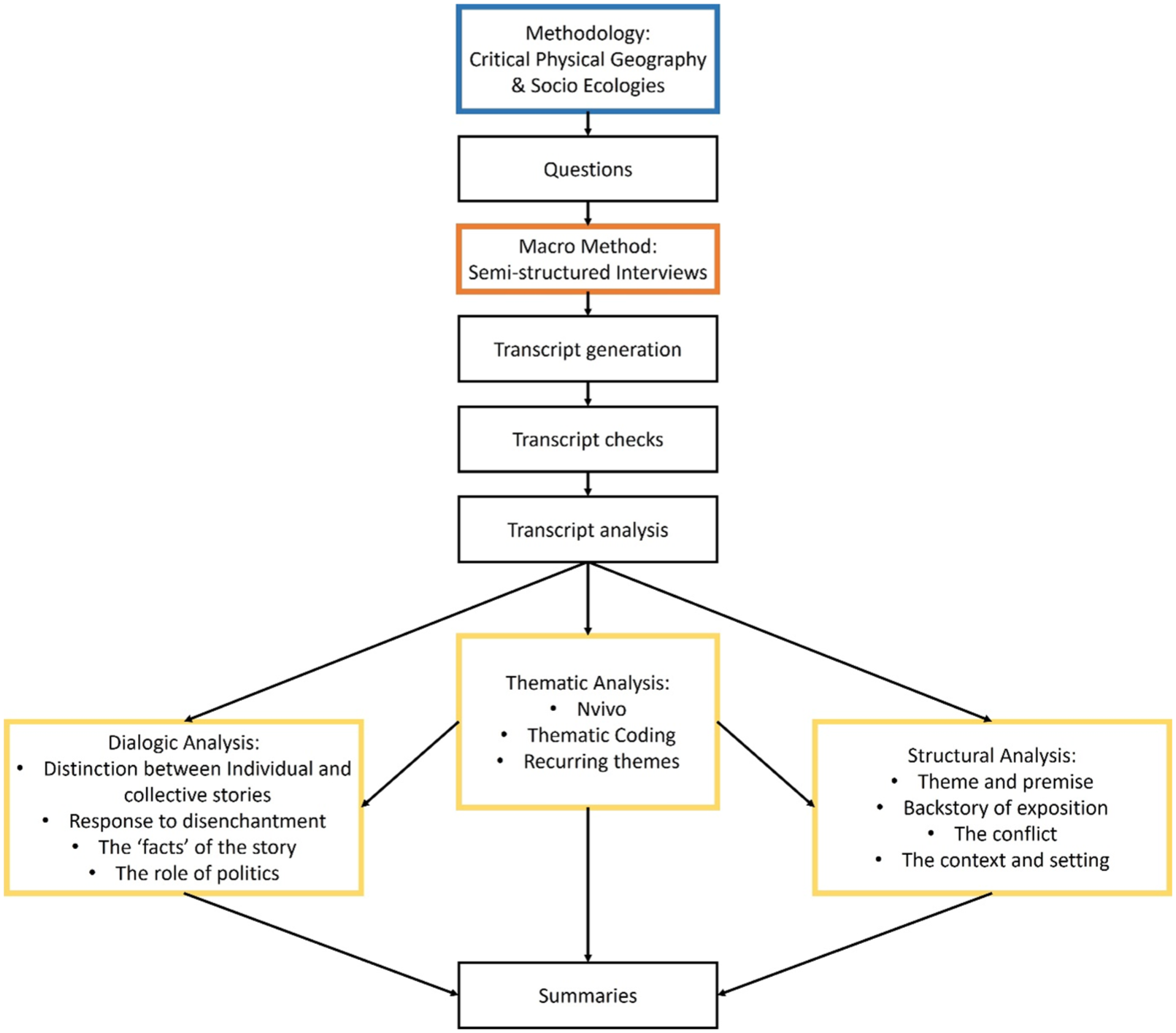
Iterative process for the analysis of stories collected during interviews.
Analysis techniques let the interview data stand for themselves as far as possible, striving to retain expressions of local knowledges and attachments to place and space without being altered by our (the researchers) perspectives (Taylor, 1991). Keywords from each interview were identified using NVivo – a computer software programme that allows researchers to manage, analyse and visualise qualitative data and documents systematically and individually. This provided the initial basis for thematic coding. An iterative process was applied to group together codeword results to derive more general, recurring categories (themes) for analysis (e.g. Braun and Clarke, 2006; Coffey and Atkinson, 1996; Cope, 2009). Key words and themes extracted from transcripts were considered in wider context with the text preceding and following the portion of text where the key word or theme appeared. This allowed the intent of the text to be identified rather than the key words being taken out of context.
Following Rose (1997), we (the researchers) took a stance as an ‘outsider’ to the catchment that was researching ‘insiders’, who understand and observe catchment changes constantly (Herod, 1999). We remained reflexive to social, political and cultural cues while conducting interviews and writing up the results and how this may shape our discussion.
Despite our efforts to remain critically reflexive about the underlying assumptions in the conduct of this work, our perspectives are both informed and limited by our positionality. We (the researchers) have a background in physical geography, with a specific focus on fluvial geomorphology and earth system sciences. Despite our efforts, we acknowledge that we become the lens through which the meanings of stories have been woven together in this study. As far as practicable, we endeavoured to promote a transparent and authentic interviewing process to ensure participants knew what their responses meant for the research and the broader discussion of environmental management in the catchment (Thomas and Harden, 2008). In this light, in presenting the results we strive to use the voice of participants themselves to express and communicate their river stories. We present our findings as a series of anecdotes that highlight and reflect ‘things that matter’ to participants, striving to provide insights into how such issues and relations came to be and how they are envisaged to permeate into the future (Bamberg, 2012). Collectively, this presents a form of portal into how the catchment is ‘known’ and ‘made’. Following Earthy and Cronin (2008) and Fauzan (2016), we focus on four key threads: The theme and premise (the things that matter); The backstory of exposition (the stories being told); The conflict (why things that matter have not yet been addressed) and The context and setting (how and why the narrative or story is told and who it impacts or intends to impact).
Results
Nuanced perspectives and knowledges expressed in interviews reflect diverse relations to the Waimatā River, highlighting rich insights into socio-cultural connections and generational change. Thematic analysis of interview transcripts indicates high levels of motivation and concern among interviewees to have a voice in restoration activities in Waimatā Catchment. Indeed, the depth and breadth of engagement with the research presented challenges in expressing and summarising findings in ways that did justice to the knowledge and insight expressed by participants. Multiple layers of stories reveal how different circles of influence do and do not interweave.
Structural analysis of the interview transcripts identified three main types of narrative or story that have slightly different intents and appeal to different audiences. First, informal conversations about firsthand experiences provided a natural and accessible communication pathway to target and engage practitioners. Second, existing publications (documented experiences, primary, secondary or ancestral) communicated stories about past successes and failures from governing bodies and national audiences of interest (other catchment groups or community groups)., fictional stories based on true events or phenomena had wide appeal to all ages of audience, primarily targeting children and future generations.
Connections to and meanings of the Waimatā River
Participants’ connections to and meanings of the river were related through daily observations, recreational activities, professional relationships through catchment groups, family and land ownership. Through sharing this connection, the context for participant relations and narratives became evident. Participants drew attention to differing representations of stories, including maps, publications, oral narratives, artwork, performances, images and physical artefacts and how they have manifested through time:
. . . as it’s the main river that flows through Gisborne, . . . I see it every day. . . . I ended up having a connection with the Waimatā as I could see that it had a lot of potential for restoration.
Art is also really terrific [at telling stories]. It’s not just the stories, but things like video installations and various kinds of artwork or festivals on the river.
. . . they (children) looove building the bivouacs, going up the hill, and they really love the stories. They really like making stuff and getting hands-on and they do it together . . . they are really different when they are there . . . see them interacting with each other because the kids run the show pretty much, it’s not a top-down type of process . . .
. . . even those publications . . . are stories in themselves of people recognising what was wrong. You know, way back from the 70s and 80s.
Various perspectives became evident on how stories can be communicated, with no one form favoured over another. Stories ranged from recent personal experiences to ancestral connections and narratives communicated to participants through time. Stories not only capture personal values, meanings and insights, they also help to maintain knowledge and communicate information. Participants drew parallels between changes in the landscape, historical anecdotes and the potential for incorporating historic and contemporary stories in regulatory frameworks and educational objectives:
When you listen to some of these ancient stories, where Te Maro’s summer gardens were . . . how it was a highway, how it was a water highway and what did mana whenua do in terms of getting their goods to market or how is the river a part of their lives and its uncovering some of that stuff too
We know quite a bit about the Māori history of the river, and this area here was a refuge when people were getting beaten up on the coast. They’d come up here and plant gardens . . . And that high hill, there is Motukeo, the leaping off place of spirits, which is linked with Titirangi, the hill right beside the mouth of the river. Poho-O-Rawiri marae is oriented towards Motukeo so that when you die, your wairua flies up the river to Motukeo and then goes out to sea and then off to Hawaiki. It’s that kind of landscape, you know, which a lot of people don’t know about and don’t appreciate how important it is to the locals.
These excerpts highlight the cultural and spiritual significance of the catchment, showing how complex narrative-based relationships underpin the central role of the river in the development and identity of Gisborne and the broader region. The river provides a space and place to engage with nature and with others. Its accessibility and ease of use support recreational activities such as waka ama (outrigger canoes), kayaking, swimming, paddle-boarding, fishing, horse riding, ‘popping manus’ (a diving technique to create a large splash) and walking. Given this breadth of interests and relations, the health of the Waimatā and Tūranganui rivers is a key issue for recreational users and the wider community. Impacts of land management decisions by regulators and landowners affect the physical useability of the river and health concerns that arise after its use. Sedimentation, forestry debris and use of the river for waste disposal have impacted societal and cultural connections to the river. This has prompted personal motivations to enact change to restore ecosystem health and recreational values:
When I was a kid, on the river, mullet, kahawai were coming up the river, inanga, whitebait, a lot of life, the eels would swim up and down and out to sea and go off on their migrations. The birds in the bush and the bush itself, that’s all part of the river community, and then the people. You want them all to have a fair go at being healthy and prosperous.
I think its state reflects the life and the quality of the community that surrounds it or the communities that surround it, the quality of the urban landscape as well, so there’s a connection or relationship between the state of the water body and the state of the city.
Every one of the paddlers, I can assure you, rues about the condition of the river, and when it’s in bad condition, certainly that’s when you’ll hear a lot of mumbling and a lot of expletives being said . . . because they’re passionate.
I’m concerned about it . . .. I take my mokopuna on it, it’s still a place to engage with, but I think it’s got something else too, both in itself, but also in the potential that it has to unite us as a community around its restoration.
. . . I’ve got grandchildren. I want them to be able to not only swim in this river but understand what makes a river have a life and be healthy because then they are going to have the responsibility of continuing that.
Transcript results highlight a disconnect between national level policy guidelines and on-the-ground outcomes. This exemplifies challenges faced by local or regional councils in coming to terms with multiple values, meanings and understandings of rivers, including concerns for downstream or legacy impacts. Participants reflected upon siloed thinking that permeates through institutional perspectives and regulatory requirements dictated by central government. Interviewees commented on how recent restoration activities are already enhancing community relations, connections and interactions with river:
. . . they’d [stories] be hugely beneficial if they were able to somehow quantify observations that they’ve been told about in the past and correlate that with current observations measurements to see whether things are improving or going backwards. I mean, that’s really worthwhile knowing. There are many of those stories . . . whether it’s the stream biota, what it was like in the days when they were collecting puha or koura in the upper catchments whereas now there aren’t any, then that gives you an indication, if we want to try and restore that balance, how would we do it, and where would we do it?
I mean it comes back for us to what [the regional council] are required to follow and respond to from the national policies statement for fresh water, so the specific requirements on their policy statement that [the council] respond to but probably at its simplest, it all starts with identifying freshwater values, so they are the things that matter the most . . .
Using river stories to weave local understandings within multiple (plural) knowledges
Although participants expressed a diverse range of values and meanings in relations to the river, a collective commitment for greater co-generation and use of local knowledge in management activities was expressed by all interviewees. Inevitably, such prospects reflect how power relations play out between landowners, community advocates and management authorities. Interviewee comments indicated frustrations with the limited use of local knowledge, as contemporary management practices fail to appreciate the wider body of knowledge held within the catchment. Interview responses highlight tensions between the governing bodies and catchment residents/users.
I think it’s arrogance. I think a lot of the agencies have a lot of arrogance that they are the council [Council], or they are the Department [Department of Conservation], and so, therefore, what would anybody else know. There is almost like a threat, you know they feel threatened
Participants envisaged how open-ended and transparent approaches to co-generation and sharing of knowledge would provide a stronger basis to ‘keep knowledges alive’ through kōrero [a conversation or discussion] that weaves lived and situated local knowledges to support co-governance and co-management of planning goals and applications:
The way that those stories [ancestral and fictional stories] are woven creates a singular narrative that can be associated with a water body that then forms the basis for understanding it in the first instance and then moving towards a place in the future in order to achieve some of the aspirations that are embedded within those stories themselves, so it’s a way for us to navigate into the future . . . in a meaningful way
. . . the opportunity for bringing stories out that are from first peoples who were here, from tangata whenua, mana whenua, is really important, and I think it’sgoing to be important for us all and the Waimatā has got the opportunity to gift that back if we, we engage with it well enough.
I think river stories also reflect that the river has had a life and has had a journey as well, and that helps build [a narrative]. I’m just thinking of my moko [grandchildren] and their moko . . . I want them to understand the stories . . . behind their river
Participants commented that lack of community engagement and participation compromised the effectiveness of past management actions. Failure to acknowledge and incorporate local knowledge has engendered a sense of mistrust and fear for loss of autonomy in decision-making. Recent events organised by the WCRP highlight the importance of clear communication to the wider catchment community, expanding knowledge bases and collaborative buy-in. Good communication and feedback processes through WCRP activities have improved approaches to engagement and participation. Meaningful approaches to communication can take many forms, including simulations, digital mapping and time-lapse imagery:
It [simulations, maps and graphics] definitely would have its place, yeah, like digitally if you could map someone’s property looking at critical source areas, erosion control problems and things like that. It would be helpful . . .
. . . it [simulations, maps and graphics] really quickly helps to paint a picture, of what’s happening, and I think there’s a lot of data already out there, but if you’re to put something in a visual representation, it’s an easy to digest form of information that a lot of people can digest and yeah help influence . . ..
Sometimes, however, contemporary approaches to data analysis and communication failed to achieve their intended goals:
that’s a big flaw of the modellers these days. They become geeks behind computers but have very little understanding of how the environment actually works and how things have changed over time. They implicitly believe their models. They are rarely field checked to see if they’re real or not . . . Even though they believe them implicitly, the rest of us who have worked out in the field do not believe them. We just do not, and we could probably back up or identify some of the bloody falsehoods that they may come up with
Overall, participants were enthusiastic about the use of stories as a part of participatory and adaptive management practices.
Use of river stories within engaged and participatory approaches to adaptive management
Participants commented on prospective use of river stories to enhance community engagement in restoration activities. The disconnect between decision-making processes and local values and knowledge is considered to have compromised prospects to deliver the greatest return on investment. For example, neglect of place-based knowledge in the downsizing of regional planning authorities has hindered prospects to re-instigate locally informed regenerative catchment plans:
We’ve had the opportunities; there’s no doubt about it. We’ve had funding through the East Coast forestry project, for example . . . there’s this conflict between the operating of these funds between government and councils . . . between council’s and landowners as to where, or how to invest the money, where best to invest it, what you’d need to incorporate into catchment management plans to deal with the issues. And this has led to underspending and poor decisions around where the money has been spent . . . none of these programmes or projects that are essentially being designed to fix catchment management problems have ever been completed.
I’ll give you another example . . . East Coast forestry project . . . to begin with. . . was run locally, out of the Gisborne office . . . they had people on the ground to go out and talk to landowners and they had maps and photographs and all the information they needed to have a chat to the individual landowners and say look there’s funding here, for this would you be interested. Where should we do it or come to some sort of consensus and basically either run with it or not run with it. Things ticked along quite easily . . . then in their wisdom, they decided to take the control of the program to Wellington and run it out of there and still retained the Gisborne office GIS capability, but reduce the number of on the ground staff if you like, and things didn’t start to work so well, mainly because they’d lost contact with the local landowners.
If they’re done in the right manner. . . it needs to be from the community upwards . . . It has to represent the values and objectives of those that are living within the catchment otherwise it’s never going to be achieved . . . you’re not going to bring people along the journey, so you’re not going to be successful or contribute in a meaningful way
Participants also discussed a fundamental disconnect between Māori knowledge and contemporary restoration practices. The deep history of life central to Māori culture and storytelling challenges the dependency upon a relatively narrow slice of time encompassed by engineering approaches:
In Māori studies, . . . We think about river communities. From that vantage point, the river community includes the land, the water, the plants, the animals, the people. They’re all equal members if you like . . . What we’ve been trying to think about . . . all the different voices of the river – the human voices, the birds, the plants, the animals, the whitebait, the eels and the ancient history of the land . . . the very ancient stories before people turned up, which was most of its history. 80 million years or whatever. The river has been here for a very long time, and humans have been here for two seconds, and we think we own the place
It is about just going and listening to Ngāti Oneone . . . listening to Rongowhakaata, listening to Ngāti Wai . . . Ngai Tawhiri, it’s just actually spending time doing that . . . forming relationships that the river can offer us and we need . . . [to] listen to all of these stories around the awa, listen to all of what the awa means to people, and listen to all of what it requires of us, so I think that we’ve got that relationship is important
We need to put as much effort into hearing and putting energy into other people’s perspectives and viewpoints and wishes and desires, and that’s not an easy process . . . particularly in Tairāwhiti where the encounter between Māori, tangata whenua and pākehā was pretty fraught, there are stories that have been hidden or too scared to tell on both Māori and non-Māori sides, I think we have to unpack some of that before we can even start thinking about what a plan might look like.
Initial signs indicate that the inclusive approach and clear communication adopted by the WCRP is starting to reduce some concerns for the limited effectiveness of past interventions:
We’ve already got all our landowners, bar one, onside. Everybody wants to do something to contribute, and so when we first meet with our landowners, we said to them, what do you think the problem is . . . there are key questions that you can get out of the community if you do it the right way and they [Catchment Planners] will realise that they will get a lot further ahead and a lot more people onside if they are including the community and the iwi and everybody onside, right from the start and it will give them the biggest head start, rather than just coming in off a blank canvas, which is what they would be doing.
Discussion and concluding comment: Stories as method
Ways of knowing entail concerns for product and process – what is known and how knowledge is derived and used. Stories provide a mechanism to express local ways of being (values, meanings), ways of knowing (plural methods that create place-based understandings) and ways of doing (engagement, participation and adaptive management). The interview process also created space for participants to reflect critically on the value and limits of their own stories. Rather than merely recounting experiences of the river, interviewees considered what their narratives could and could not accomplish, thinking about the work their stories do in shaping collective understandings. In doing so, they moved beyond presenting stories as isolated nodes of expertness and instead became active participants in the ongoing reiteration and reworking of river narratives. Findings from this study show how river stories reveal rich veins of knowledge that run through the Waimatā Catchment. They express common concerns for the condition of the system and aspirations to enhance its health.
Locally led approaches to adaptive management, stewardship and guardianship build directly on people’s attitudes and behaviours (Murphy et al., 2022; Yocum, 2014). Spatially heterogeneous value sets reflect the diverse needs of multiple communities along a river’s course (Lliso et al., 2022; Maca-Millán et al., 2021). Participants interviewed in this study highlighted concerns for the appropriateness of insights derived elsewhere to manage ‘their’ river system. The use of storytelling as method presents opportunities to better incorporate local (phronetic) knowledges within management practices (Hillman, 2009), helping to transform the participation process from ‘being informed’ to ‘being an informer’. Such approaches to shared learning extend beyond traditional consultation models and more formalised approaches to stakeholder engagement, participation and negotiation. It is not just the use of river stories, but the emergent reflectivity and reassessment of the storytellers, that can help bridge knowledge and communication gaps in collaborative approaches to decision-making, helping to build social capital and trust, thereby supporting locally-driven management practices that engage more broadly with multiple perspectives, demographics and cultures (e.g. Hillman, 2009; Krueger et al., 2016; Mould et al., 2021; Robertson et al., 2000). Such interactions are integral parts of river co-learning arenas (de Souza et al., 2025; see, also, Brierley et al., 2025).
Storytelling and storylistening provide mechanisms to understand and in some instances regain and add to meanings that have been marginalised or excluded over time (Murveit et al., 2023). Stories can be used to explain complex phenomena and share knowledge across generations. This compelling pedagogical tool can help to reimagine river restoration and associated ‘constructions of nature’ in ways that engage directly with, and build explicitly upon, local knowledges (Eden et al., 2000). Used effectively, the rich tapestries of understanding expressed through river stories provide a way to incorporate local knowledges within the fabric of river management (after Koppes, 2022).
River stories can be considered as ‘data with a soul’ (Brown, 2015) – living forms of stored knowledge that reflect particular recollections of values, behaviours and environmental traits (Lobo and Kindon, 2021). As stories incorporate elements of intrigue, surprise and suspense, they engage listeners in sense-making, unravelling meanings while reflecting upon the motivations and actions that drive conflict in the story. For example, participants in this study highlighted parallels between the power of stories to weave settler and indigenous histories and value sets and relations between technical knowledge, scientific knowledge and place-based knowledge.
In the Waimatā Catchment and Aotearoa New Zealand generally, concerns for ora (collective wellbeing) seek to re-embed Māori presence in the landscape through flourishing relationships that live generatively with living rivers (Moko-Painting et al., 2023). This entails coming together through wananga – an expression of collective responsibility that strives to be at one – physically and metaphorically – the river and community as one (Moko-Painting et al., 2023). Prospectively, crafting and telling stories from the perspective of the river itself can help to shift focus from what needs to be done to the river to what the river needs to maintain its wellbeing (Salmond et al., 2019).
Footnotes
Acknowledgements
We gratefully acknowledge the participants who participated in this research and the wider Tairāwhiti community, all of whom offered great support and buy-in for this project. We thank the editor and two reviewers for constructive reviews that enhanced this work.
Author note
All claims expressed in this article are solely those of the authors and do not necessarily represent those of their affiliated organisations or those of the publisher, the editors and the reviewers. Any product that may be evaluated in this article, or claim that may be made by its manufacturer, is not guaranteed or endorsed by the publisher.

Author contributions
All authors listed have made a substantial, direct and intellectual contribution to the work and approved it for publication.
Funding
The authors received no financial support for the research, authorship, and/or publication of this article.
Declaration of conflicting interests
The authors declared no potential conflicts of interest with respect to the research, authorship, and/or publication of this article.