



Abstract
In open-air museums and restored historic sites in Toronto, Canada, the pioneer garden exhibit is an integral part of creating a “pioneer setting” and attracting visitors. Since the 1960s, following a boost in public funding for heritage projects to celebrate the Canadian Centennial, groups and conservation authorities in Toronto have devoted time and resources to researching, implementing, and maintaining these garden exhibits. Taking for granted that the pioneer garden is a non-innocent site that was not only crucial to colonization, but continues to produce and maintain settler ecologies, this paper asks what work the pioneer garden exhibit does today. Using the analytic of “colonial grammars” and paying special attention to the history of settler colonial gardening, ongoing claims to settler innocence, erasures of settler complicity in ecological crises, and attempts to invoke contemporary ecological sensibilities, this paper describes how the pioneer garden exhibit re-narrativizes colonial planting in a way that territorializes white, settler-colonial belonging on contested Indigenous lands. This paper builds on work in political ecology, anti-colonial geography, and Black and Indigenous feminisms that clarifies the insidiousness and everydayness of white supremacist landscapes in settler-colonial places.
Introduction
Walking through the Black Creek Pioneer Village 1 in Toronto for the first time in October 2022, I was met with a series of invitations to be charmed – gregarious sheep, a broom-maker’s shop, staff in period costume and humble wooden structures painted in earth tones. The Village is an open-air, ‘living history’ museum set in 1866, one of many such villages representing ‘pioneer life’ in Ontario. 2 It evokes the romantic simplicity of bygone days by bringing stories of pioneer labour and settler domesticity to life (Gordon, 2009). A less attention-grabbing, but nonetheless essential means of conveying pioneer life, are the Village’s ten garden exhibits. These gardens are the product of extensive research and upkeep and are a crucial storyteller in the territorialization of early settler-colonizers in the Toronto region. As someone who researches the ongoing logics of conquest and dispossession in urban nature management, I was intrigued by these gardens, how they came to be and the stories they upheld.
The Village’s gardens first emerged as part of a project run by the Garden Club of Toronto (Langdon, 1972; The Garden Club of Toronto, 1970) and played an integral role in creating an authentic and complete open-air museum. At the time, museum planners understood the gardens and landscaping as a critical part of restoring the village – a site that had been ‘developed’ through modern agricultural use – to a ‘pioneer setting’ (The Globe and Mail, 1972: 31). The gardens are also the subject of a book by Eustella Langdon (1972), documented in a special pamphlet (The Garden Club of Toronto, 1986) and referenced in subsequent garden project proposals (Sexton, 1989) by the Garden Club of Toronto. More than an afterthought or a backdrop to the rest of the Village’s displays, the gardens are an integral feature of the museum.
Contrary to what one might expect, the Village was not opened by a heritage organization per se, but by a natural resource conservation and management agency – the Metropolitan Toronto & Region Conservation Authority (now the Toronto & Region Conservation Authority, or TRCA). This is the same agency that tasks itself with nature management and flood plain regulation programmes across Toronto. What does a living history museum about early European colonizers have to do with natural resource management? What does a conservation authority gain through programming a living history museum and maintaining its historic garden and agricultural displays? Rather than situated within the violent territorialization done by settler-colonizers – part of a project that has and continues to come at the cost of Indigenous life and sovereignty – pioneer garden exhibits are presumed innocent, like many other features of open-air museums commemorating pioneer life. My guiding question in this article is therefore the following: what work does the pioneer garden exhibit do?
To answer this question, I examine the pioneer garden as a site to open up a discussion about the colonial grammars of urban nature management and the production of white environmental knowledges in Toronto. This is not to condemn the gardens themselves nor the people who helped bring them to life – I acknowledge the thoughtful, detail-oriented and consistent work of garden volunteers, curators and researchers in creating and tending to ‘living history’ displays. I also acknowledge that gardens are complex sites with many contradictions, as I will later discuss. Still, my analysis takes seriously the role of the garden in making ‘settler moves to innocence’ (Tuck and Yang, 2012) past and present and speaks to openings for a different way of relating to the white settler-colonial ecologies on Turtle Island. 3 Specifically, I am interested in the pioneer garden exhibit’s naturalization of settler belonging through the ‘vicious sedimentation’ 4 of settler ecologies (Whyte, 2018), its concealment of the colonial dimensions, or grammars, of settler gardening, and the inventions it materializes.
Examining three sites of Victorian-era garden exhibits in Toronto – the Village at Black Creek, Colborne Lodge and Spadina House – I define pioneer garden displays as not only resonant with, but integral to, the naturalization of settler belonging that settler colonialism requires to justify its legitimacy. I also connect their creation to dominant practices and environmental knowledges existing in urban nature management in Toronto. My discussion focuses on three principal functions of the pioneer garden exhibit: claims to settler-colonial innocence, the remaking of settler-colonial origins, and the invocation of contemporary ideas of environmentalism and nature management. By way of conclusion, I share my reflections on the necessity of troubling colonial grammars of nature in settler-colonial places for building more liveable futures.
Gardens and colonization
The colonial garden
Troubling the innocence of the settler-colonial garden first requires situating the longer history of settler colonial planting on Turtle Island. By now it has been well established that gardens were not only a part of, but integral to colonization (Besky and Padwe, 2016; Ginn, 2008; Mastnak et al., 2014; Sayer, 2005; Seed, 1995). As Mastnak et al. (2014) put it, ‘settler colonialism was always about the ‘settling’ of plants as well as people’ (p. 367). Beyond violently displacing Indigenous peoples and clearing land for settler use, the work of setting up and maintaining a garden helped to signal the success of the settler project and territorialize the homes of settler-colonizers (Seed, 1995). Gardening was also a primary site through which white settler-colonizer women – often presumed innocent vis-à-vis colonization due to their lesser social status – contributed to the colonial project (Lynch, 2014). As a form of ‘ecological imperialism’ (Crosby, 2004), settler planting sought to replace Indigenous ecologies with European ones. As Crosby describes it, ‘portmanteau biota’ – organisms European settler-colonizers took with them, including foods, medicines and ornamental plants – were critical to colonization. Indeed, by planting European plants and uprooting Indigenous ones, colonizers’ early gardens were an extension of conquest (Mastnak et al., 2014). They signalled the success of settler claims to property, territorializing and marking space as belonging to European settler-colonizers.
In the case of English colonization on Turtle Island, this is especially true. Seed (1995) discusses how the English garden in colonized places was a clear sign of ‘English possession’ tied to the Lockian notion of improvement. Gardening, planting, fencing – all were acts of possession whereby colonizers practised their colonial authority (Blomley, 2005) and made the imperial project visible. Practically speaking, when Englishmen were unable to enclose a parcel of land to demarcate their property, they planted a garden and fenced it as a ‘central and visible’ marker not only of ownership, but ‘of the entire colonial ambition to possess the land’ (Seed, 1995: 29). This notion of the garden as possession is not merely historic; it has contemporary expressions on Turtle Island, with cases where evidence of gardening assisted courts in determining entitlements to property (Blomley, 2005). We can consider the settler-colonial garden, then, not as mere symbol of white possession, but as a critical part of marking white settler property and belonging.
The settler-colonizer’s garden was also motivated by nostalgia. In his work on the 19th-century acclimatization movement in Australia and New Zealand, Dunlap (1997) notes that settlers’ introduction of European species in these places was part of ‘the settlers’ continuing attempt to come to terms with their new lands, to find their place in the country and its place in them’ (p. 304). Early ‘pioneer’ English settler colonizers in Ontario echo this language in their writing, expressing a great deal of relief vis-à-vis the process of clearing the lands they settled (Figure 1). As Bentley (2012) writes, this is manifest in accounts about settler-colonial relations to indigenous trees in Ontario: Irish-English settler-colonizer Anna Jameson (1838) wrote that ‘A Canadian settler hates a tree, regards it as his natural enemy, as something to be destroyed, eradicated, annihilated by all and any means’ (p. 96). A garden in the ‘clearing’, then, was a great comfort for settler-colonizer women. Ontario-based settler-colonizer nature writer Catharine Parr Traill viewed her garden as a great ‘civilizer’ that evoked feelings of home (Traill, 1857). Still, in her 1868 book Canadian Wild Flowers memorializing native plants, she also described her grief at the ‘inevitable’ extinction of native plants amid ‘the onward march of civilization’ that would soon ‘[clear] away the primeval forest’ and ‘turn the waste places into a fruitful field’ (Traill & Fitzgibbon, 1868: p. 8). Traill was mistaken (the wildflowers in her book still exist today, though their spread has decreased dramatically), but her grief articulates the magnitude of settler-colonial transformations of the landscape she witnessed, as well as her complicity.
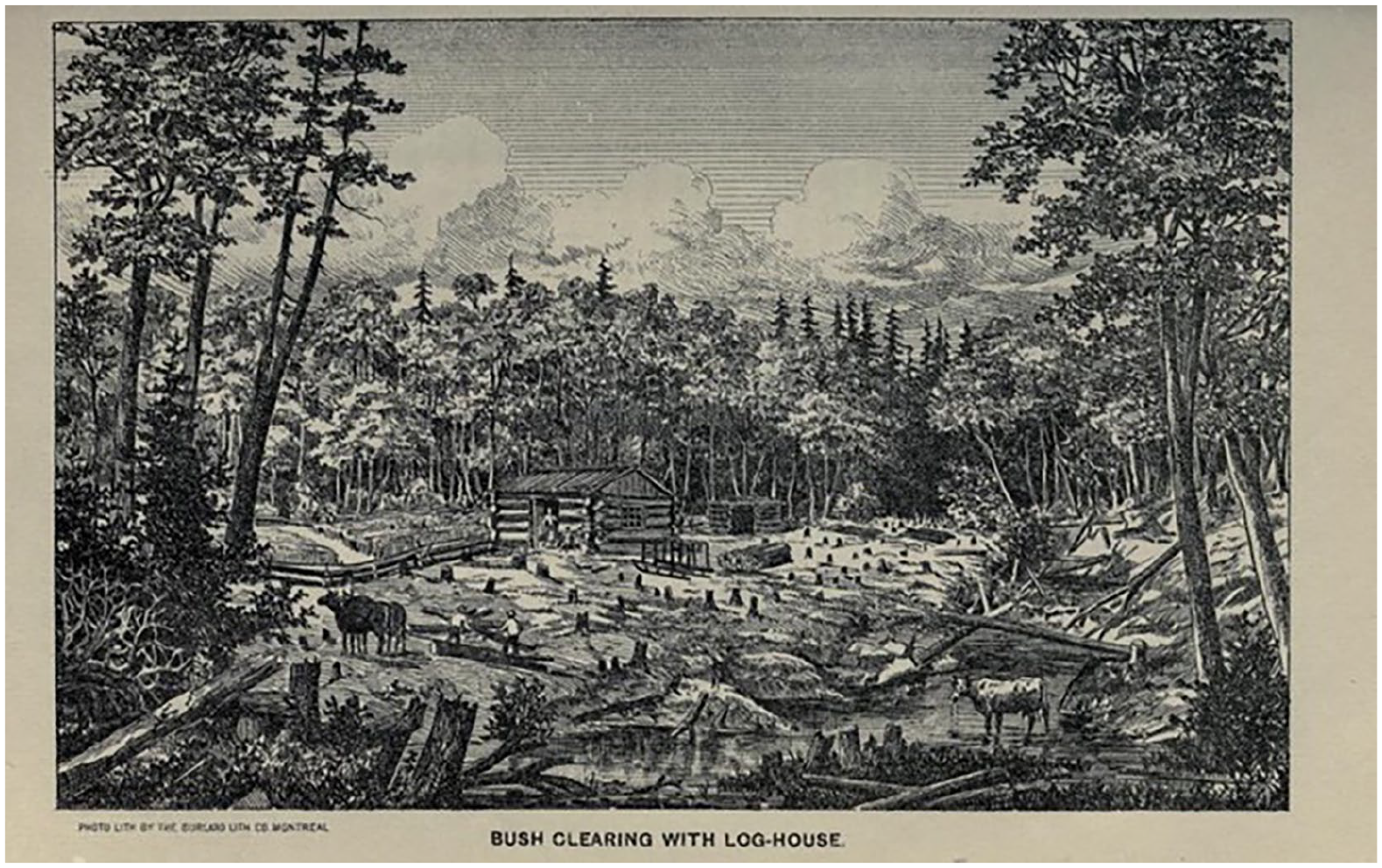
Illustration of ‘bush clearing’ in progress in Upper Canada.
The colonial project in the Toronto region, with its intensive deforestation and dispossession of Indigenous peoples from their traditional hunting and fishing grounds, did not succeed in clearing away the ‘primeval forest’. Though subjected to centuries of colonial violence, Indigenous people and their environmental legacies have survived (Johnson, 2013). Thus, it bears noting that while the colonial garden was doubtless a key player in the colonial project, its history is also marked by failure. This is an important consideration that appears in Ginn’s (2008, 2009) work on 19th-century botanical gardens in Christchurch, New Zealand. He emphasizes that while plants and animals have been ‘active participants in the extension of the colonial landscape’, they are also ‘subversive agents’ (2008: 358) – he argues that the gardens, as complex sites with messy, contradictory relations and histories, require attention beyond celebration or outright condemnation. Because the contemporary pioneer garden exhibit is itself a site of contradictions, teasing apart some of the relations it contains, particularly those that are difficult or otherwise concealed, is therefore necessary for understanding its work within the museum setting and beyond.
On grammars
In my analysis, the grammars analytic is a generative means of denaturalizing the logics that inform how the dominant, white settler-colonial culture in the Toronto region and beyond relates to ecologies. Understood generally as a system of rules or principles that structure language and thinking, the ‘grammars’ analytic that interests me in this article has been used by scholars to describe the structure and logics underlying racial statements and matters (Bonilla-Silva, 2012; Spillers, 1987; Wilderson, 2010), settler colonial ideologies and institutional practices (Calderon, 2014), settler colonial spatial logics (Goeman, 2014), the naturalization of private property regimes (Safransky, 2022), and the shared dialogic spaces between slavery, genocide and settler colonialism (King, 2019; Marquez, 2021). As Marquez (2021) writes, Grammatical structures that both hold knowledge and direct one’s ability to articulate are vehicles through which settler colonial and racial common-sense are maintained and reproduced, but also a means through which material relations of power can be (re)structured, shifted, and changed. (p. 124)
Critically, then, grammatical structures maintain and reproduce colonial logics, yet they are also vehicles for transforming the relations of power produced by such logics.
When I name colonial grammars in this article, I am referring to the repetitive practices and ways of thinking that maintain whiteness, settler-colonial ideologies and myths in nature management in Toronto. Words such as ‘pioneer’, ‘traditional’ and ‘typical’, when used to describe settlers’ gardens, carry a charge in the service of naturalizing settler belonging. By repetitively referring to settler gardens and contributions to place as natural, innocent and admirable, the dominant culture reproduces the very colonial logics that justified the violent displacement of Indigenous people from their lands. The language of private property regimes, of control and dominion over the landscape and of the enclosures delimiting property lines, also helps to reproduce the logics that justify ‘white possession’ of the land (Moreton-Robinson, 2015). That said, the use of grammars in this article expands beyond specific words to other kinds of expressions and practices that shape and structure possible environmental knowledges, such as practices of planting and ‘displanting’ (Mastnak et al., 2014) in the service of conquest mentioned previously.
While the grammars analytic is incredibly generative and expansive, one challenge for this article in engaging the grammars of pioneer gardens is avoiding perpetuating the human exceptionalist framing of nonhuman landscapes as mere backdrops to and products of human actions (Tsing, 2015). That is, in emphasizing the colonial grammars of the pioneer garden exhibit, I risk overshadowing the agencies of the plants themselves. While I see this article as being in conversation with critical contributions highlighting plant agencies and human exceptionalist frameworks in political ecology and anthropology (Franklin, 2006; Ginn, 2008, 2009; Hamilton, 2018; Taylor, 2017), my focus here is on the human agents producing the gardens, as a means of underscoring human complicity and responsibilities in the production of landscapes. Rather than disavowing the agencies of nonhuman actors in the gardens, this allows me to examine the human actions inherent in remaking the landscape as well as emphasize colonial environmental relations that seek to limit plants’ many ‘disruptive agencies’ (Doody et al., 2014).
If, in acknowledging the coupled work of plants and people in colonizing Turtle Island, we consider ecological imperialism to be a facet of settler colonialism, we can consider the work of ecological imperialism as a process that is ongoing and requires constant doing (Goeman, 2014; Whyte, 2018). This is in part because of the ongoing existence and resistance of Indigenous lifeways, people and ecologies in colonized lands. The dominant culture’s ‘constant ascriptions of settler ecologies onto Indigenous ecologies’ (Whyte, 2018) facilitates amnesia, allowing settler-colonizers to feign ignorance about the invasiveness of their own culture, what some have described as the paradox of human exemption (Head and Muir, 2004; Mosquin, 1997). Although Indigenous environmental legacies are visible in settler-colonial places, including Toronto, settler-colonial ecologies, including ones produced by European private property regimes, are naturalized to the point of being seen as ‘simply part of the landscape’ (Blomley, 2003) in a process Whyte (2018) calls ‘vicious sedimentation.’
In Toronto and across Turtle Island, this results in a dynamic wherein problematic plants deliberately introduced by settler-colonizers (such as garlic mustard, common buckthorn and dog-strangling vine to name a few) are deemed invasive while white settler-colonial culture is not. While settler-colonial grammars of conservation have shifted over time, they still rely upon many of the same structures, hierarchies, relationships and material realities even as they engage in ecological restoration work. For instance, settler culture in Toronto is invested in the management of invasive plants, but it does not question the belonging of remnants of settler colonialism’s invasiveness, such as private property regimes, white-led environmental stewardship, colonial understandings of nature and European gardens (Doiron, 2023). The City of Toronto has previously produced public education material vilifying the settler-introduced shrub Common Buckthorn, but one would be hard-pressed to find a City of Toronto public education campaign condemning the environmental impacts of local settler-colonial transformations of the landscape, such as deforestation, dispossession, and the burying of waterways. The City of Toronto has also received calls from Indigenous land stewards to end its dependency on colonial forms of invasive plant management, such as the use of herbicides (The Indigenous Land Stewardship Circle, 2019).
There are necessary limits to the state’s environmental commitments when it remains invested in private property, maintains settler control over nature management and redresses dispossession in contemporary terms (McCreary and Milligan, 2021). Some Indigenous peoples on Turtle Island even stress that the invasiveness of this settler culture – a Euro-American ‘invasive land ethic’ – is more troublesome and harmful than the threats tracked by invasion biology (Reo and Ogden, 2018). Many scholars have demonstrated how ecological crises intensifying in the present have their roots in the effects of settler colonialism, imperialism and racial capitalism (Davis et al., 2019; Murdock, 2018; Whyte, 2018). In claiming possession of the land, white settler culture continues to control and reproduce settler ecologies and their grammars, at the site of the garden and beyond. All of these dimensions of planting in settler-colonial places – the centrality of the garden in white settler possession, the ongoing sedimentation of settler ecologies on Indigenous lands, and the paradoxes and omissions in contemporary nature management – underscore the many intimacies of the garden and colonization.
Indigenous dispossession in the Toronto region
Prior to colonization, the Mississaugas were, by 1705, the stewards of most of what is now considered southern Ontario (Mississaugas of the New Credit First Nation, 2001). While several efforts over the last thirty years have made information about Toronto’s Indigenous history more accessible to residents of the City of Toronto, as evident in initiatives such as First Story Toronto, Ogimaa Mikana and the Talking Treaties Project, the specifics of the colonization of the Toronto region remain obscured in the dominant discourse. These initiatives have demonstrated that far from a simple land transfer from the Mississaugas to the British, the Toronto Purchase of 1787 – the sale of the lands in the Toronto region, ‘reconfirmed’ in 1805 (Figure 2) – remains contested. The Missisaugas and numerous historians point to the fact that the region now known as Toronto was ceded through ‘a series of problematic land surrenders’ (Freeman, 2010: 24) marked by invalid documentation, differing ideations of land use and ‘ownership’, inadequate compensation for land ceded, shifting boundaries of territory without agreement, and false promises (Mississaugas of the Credit First Nation, 2001; Freeman, 2010; Talking Treaties Collective, 2022).
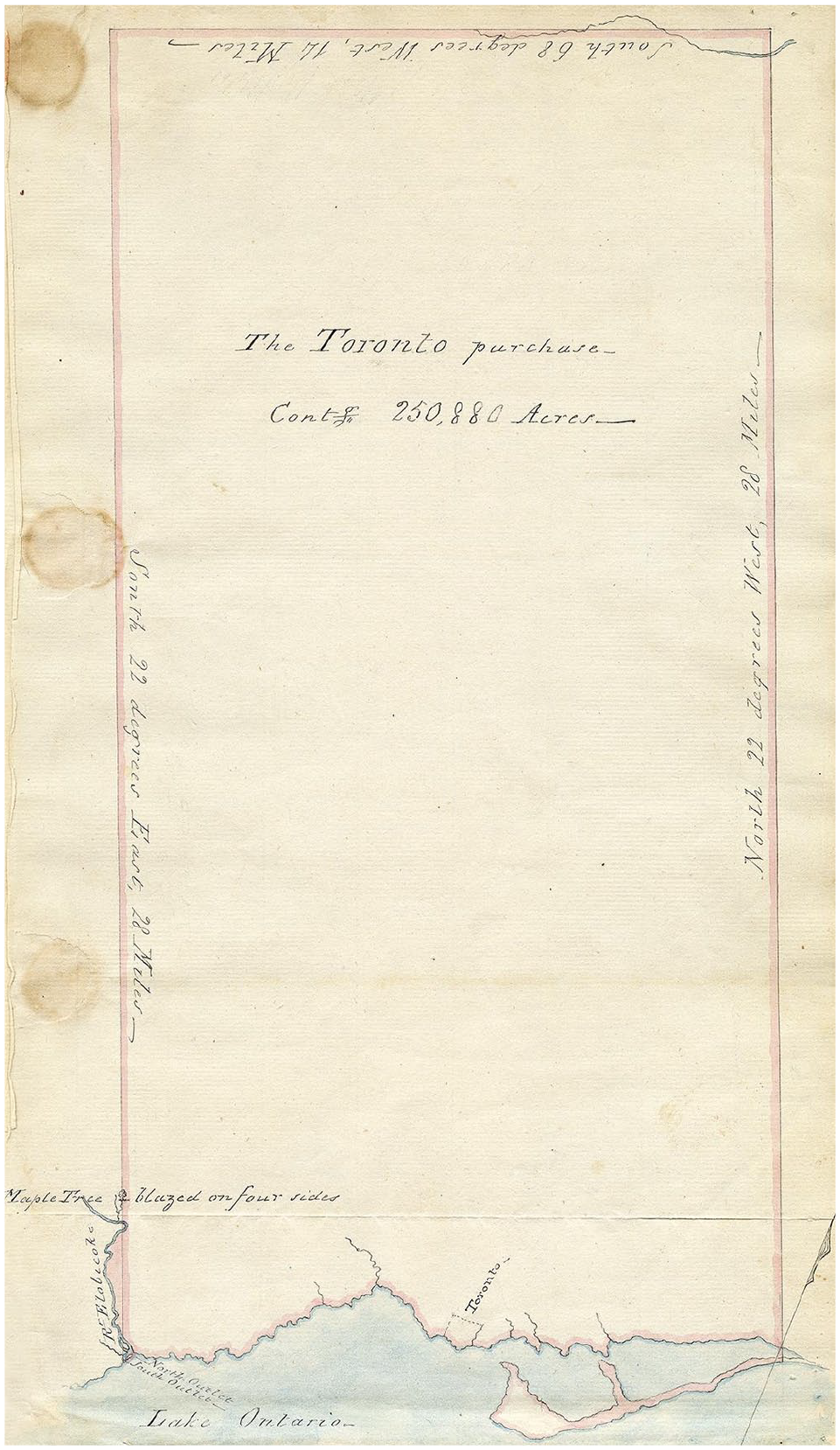
1805 Map depicting the territory purchased by the British from the Mississauga.
There remains no shared understanding of what terms the Mississaugas and the British agreed to during the sale (Talking Treaties Collective, 2022). However, the Mississaugas clearly remembered promises the British made to them: that they would never live in poverty, that they would receive farming assistance from settlers, and that they would continue to have full access to their lands to encamp, hunt and fish (Talking Treaties Collective, 2022). Indigenous chronicles describe how settler-colonizers broke their promises, driving Indigenous peoples off the shore, threatening to shoot them, shooting at their dogs, offering no assistance with farming and failing to honour their treaty obligations (Talking Treaties Collective, 2022). Moreover, settler-colonizers’ land uses – intensive poaching, agriculture and sawmill development – destroyed the Mississaugas’ hunting and fishing areas to which they had been promised continued access (Freeman, 2010: 24).
Much of Southern Ontario was also home to the black oak savannah ecosystem, with its grasslands and scattered oak trees. These areas were often the first to be cleared and developed by settler-colonizers as they were relatively ‘easy’ to transform (Johnson, 2013). An ecosystem that co-evolved with millennia of Indigenous land stewardship and burning practices, the black oak savannah was greatly impacted by colonization, with only 0.5% of its precolonial spread in Ontario alone being intact today (Johnson, 2013). Due to their settlement and harassment of the Mississaugas in the late 18th century, settler-colonizers increasingly pushed Indigenous peoples out of the Toronto region (Freeman, 2010; Johnson, 2013). Under problematic and contested terms between 1783 and 1820, the Mississaugas lost almost all of their land, barring a few small reserves (Mississaugas of the New Credit First Nation, 2001). It is in this context of Indigenous dispossession across the Toronto region, as well as the settler-colonial project of transforming the landscape, that I am analysing the work of the pioneer garden exhibit.
The work of the pioneer garden exhibit
The pioneer garden
By way of introduction, the pioneer garden as a concept requires some degree of imagination. Several garden historians have noted how little is written about early home gardens in Upper Canada in the 19th century, and thus how little we can know with certainty about their contents, design and purpose. There are few detailed photographs, no plans and only a few descriptions of gardens in diaries and nature writing – a fact often attributed to the hard life of early settlement that presented more urgent matters than documenting gardens (Minhinnick, 1970; Skinner, 1983). There is some consensus that the early gardens were planted for subsistence, with little attention to ornament. It is believed that vegetables were grown in the most ‘favourable position’, near the house with plenty of sun (Skinner, 1983: 36). As settler-colonizers became increasingly established, the gardens they produced are said to have been evocative in form to English cottage gardens, with densely planted clusters of vegetables, herbs and flowers. The ‘dooryard garden’ was planted at the side or rear of the house, with flowers and vegetables ‘planted thickly’ in clumps (Minhinnick, 1970: 8). Surrounded by a board fence, the dooryard garden was protected from animals and intruders (Minhinnick, 1970; Scherck, 1905). Several illustrations from 19th-century Upper Canada (see Figure 3) depict this type of fencing.
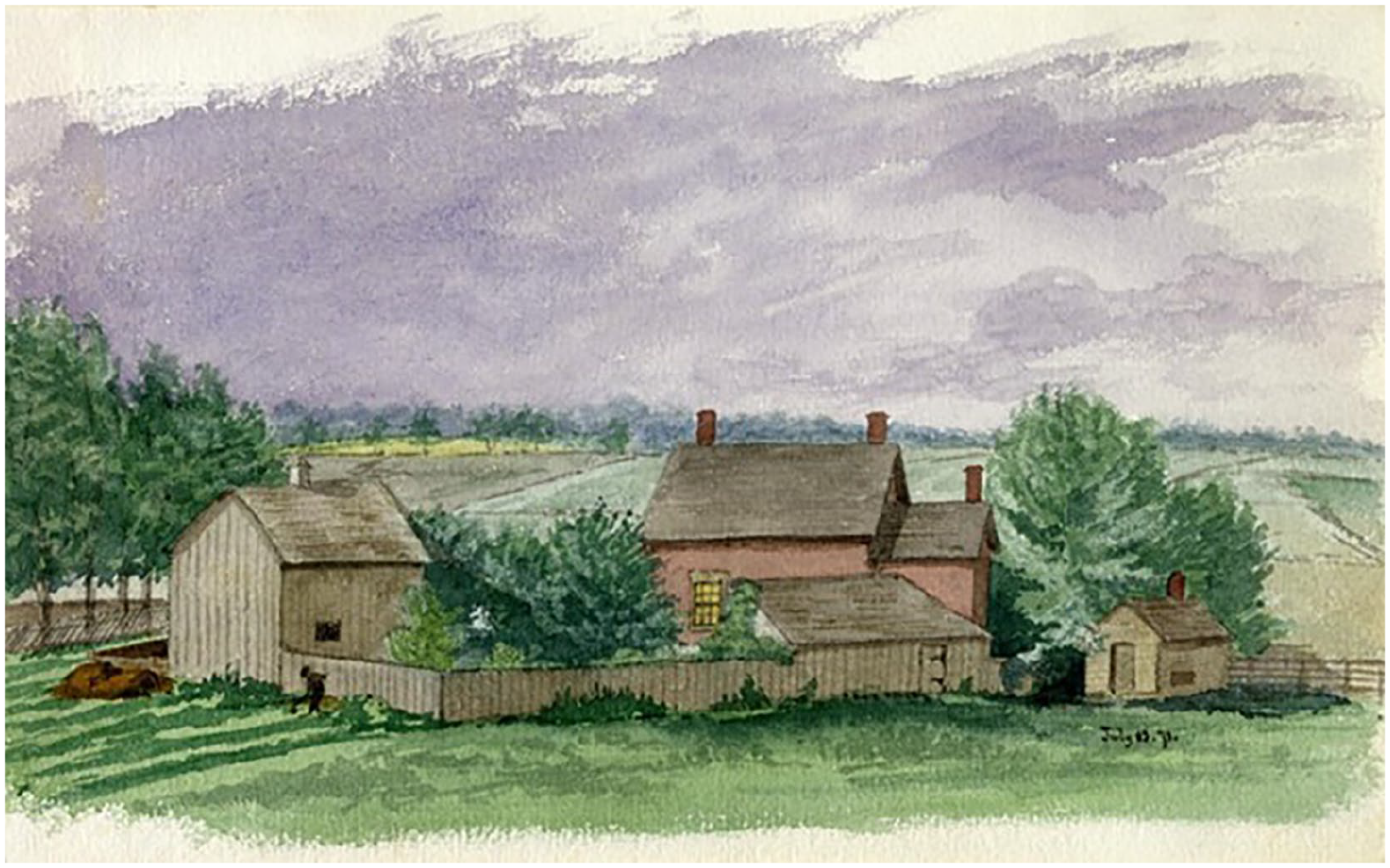
1871 watercolour painting of Edward Miles’ house in York (amalgamated into Toronto in 1998), depicting a dooryard board fence wrapping around the garden at the side and rear of the house.
Claims to innocence
The pioneer garden exhibits I am engaging in this article all exist alongside heritage buildings, as part of open-air museums commemorating pioneer life in the Toronto region. The most evocative example – the ten gardens at The Village at Black Creek, formerly the Black Creek Pioneer Village – illustrates several intimacies between heritage and nature conservation (Figure 4). The Village sits in the north end of the city of Toronto, on Indigenous land caretaken by the Anishinabek Nation, the Haudenosaunee Confederacy, and the Huron-Wendat, near a former Huron-Wendat village and archaeological site, and a section of the historic Carrying Place trail, near a highly diverse, low-income ‘priority neighbourhood’ and the York University campus. Opened in 1960 by the Metropolitan Toronto & Region Conservation Authority, it was set up to depict a typical Pennsylvania German settlement in the 1860s. The Pennsylvania Germans arrived in southern Ontario at the end of the 18th century, and one family among them, the Stongs, figures prominently in the Village, with many of the museum’s features being built around their original buildings (Government of Ontario, 1880).
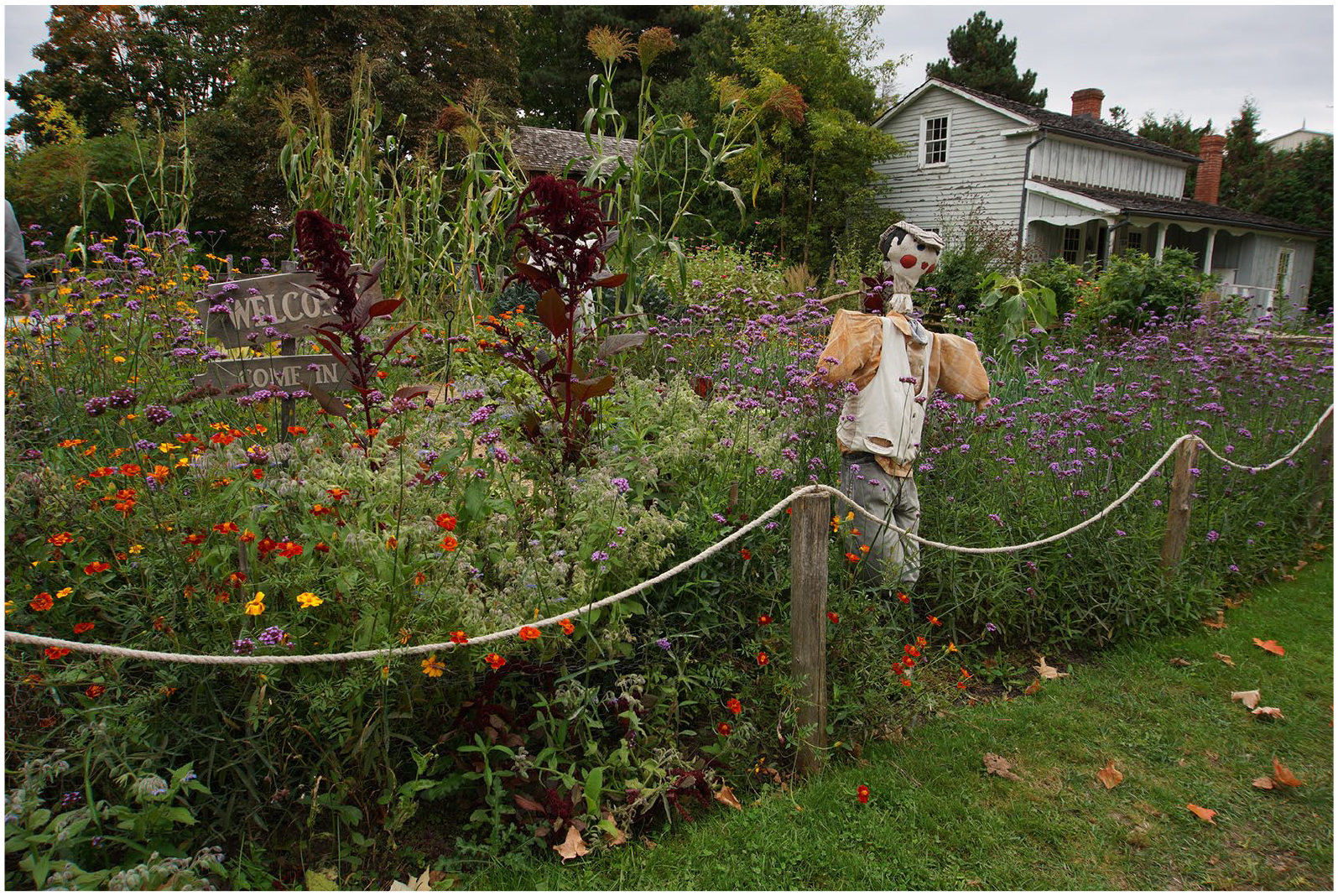
Food and flower garden outside the Mackenzie house at Black Creek Pioneer Village, fall 2024.
Much of the TRCA’s work, historically and in the present, is nature management and flood plain regulation. Why then would a conservation authority task itself with the programming of a living history museum? In fact, when the TRCA first opened the Village, they were very clear that they saw no difference between the museum and their other conservation parklands. The narrative they gave the Village fit perfectly with their environmental mission as a conservation authority, going so far as to say that it was a ‘needed instrument in [their] resource management program’ (MTRCA, 1981). In their framing, the TRCA positioned the Pennsylvania German settlement in the area as distinct from that of other European settler-colonizers. While other settlers may have been careless in their agricultural practices, destroying the land and priming it for flooding, the Pennsylvania Germans were careful, methodical and responsive to the landscape. In the MTRCA’s words, ‘The lands and waters of the region have served the needs of man for countless generations and the stewardship of the land exhibited by our forefathers can provide valuable examples to present and future generations’ (MTRCA, 1981).
At least, that is how the story goes. And thus the MTRCA saw the Village not only as compatible with their mission, but as a critical component of their conservation activities. The Village was an exemplary model of land stewardship in their eyes, one to inspire future development in the Toronto region. As Gordon (2009) argued, while the mid-century Ontario pioneer village model suggested a clear ‘anxiety about modern life and an attempt to find refuge in an idealized past’, it also ‘represented a reference to the past that confirmed the direction, and the legitimacy of the present and future’ (p. 480). The Black Creek Pioneer Village – buildings, gardens, animals of heritage breeds and all – set a scene that both romanticized the past as environmentally conscious and legitimized the settler-colonial present and future.
The ‘restored gardens’ at Colborne Lodge (Figure 5), a heritage house museum within Toronto’s High Park, came together through the work of volunteers and City of Toronto staff (Allan, 2006). The house, the residence of carceral architect and engineer John Howard and painter Jemima Howard, is a Regency-era cottage John built shortly after he and his wife arrived to Toronto from England in 1832. Among the two gardens recreated are a Victorian ornamental garden as well as a kitchen door-yard garden, both deemed ‘typical’ of the period between 1860 and 1870 and referencing information contained in ‘John’s meticulous journals’ (Allan, 2006). The museum is run by the City of Toronto and is surrounded by nature trails now considered ‘environmentally significant’, as they are home to one of the only remaining sites of the rare black oak savannah mentioned earlier (Foster and Sandberg, 2004). Here, the gardens help to spatialize the home of the Howards as an influential and powerful Toronto couple, an invitation to visitors to revel in the beauty and simplicity of their home (Figure 6). The very existence of High Park is attributed to John Howard’s transfer of the property to the City in 1873 under several conditions, including that it be maintained as a park space accessible to all. Colborne Lodge and its gardens, then, are a monument to the man who gave Torontonians High Park.
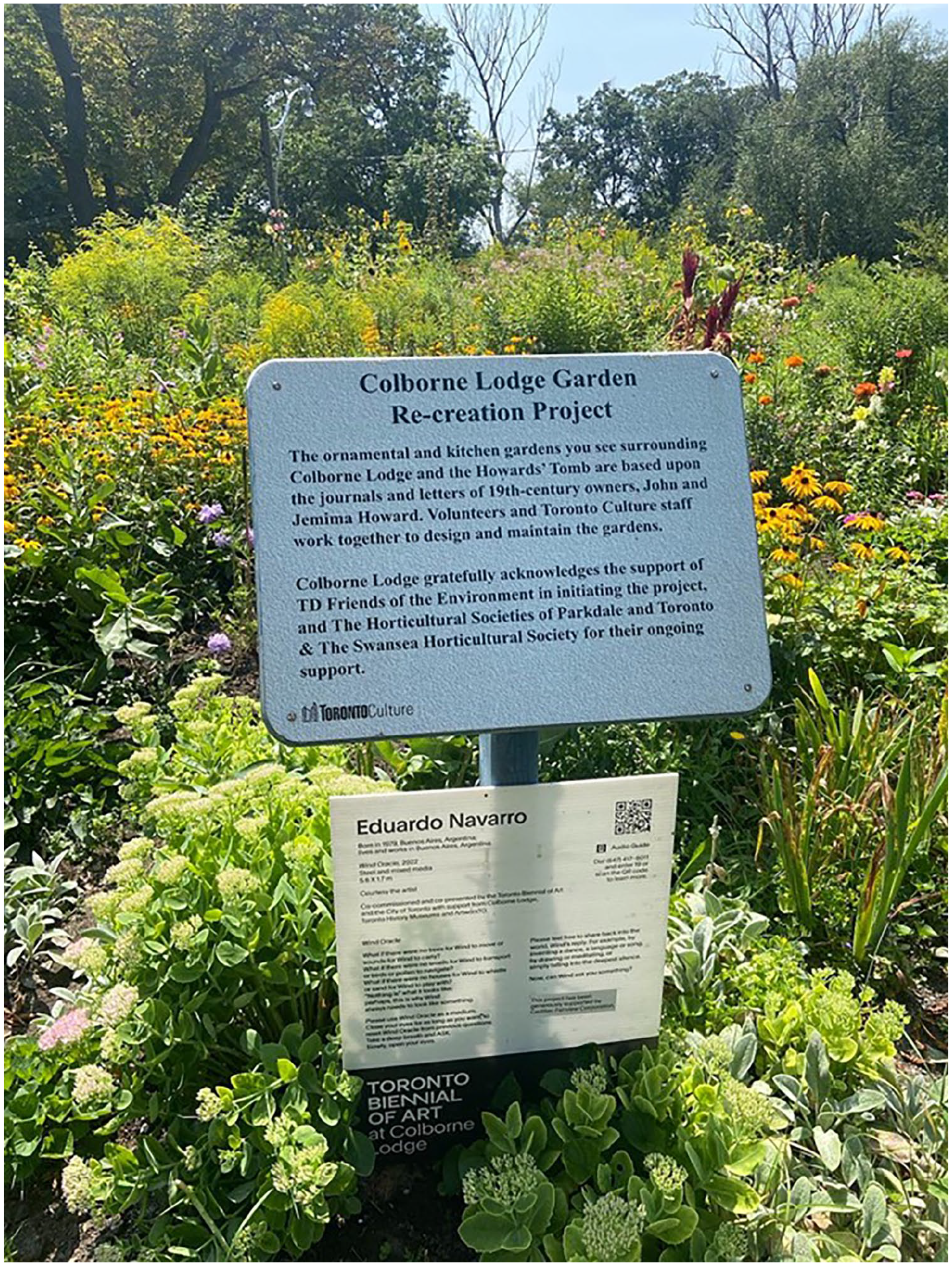
The text panel at the Colborne Lodge gardens, summer 2023.
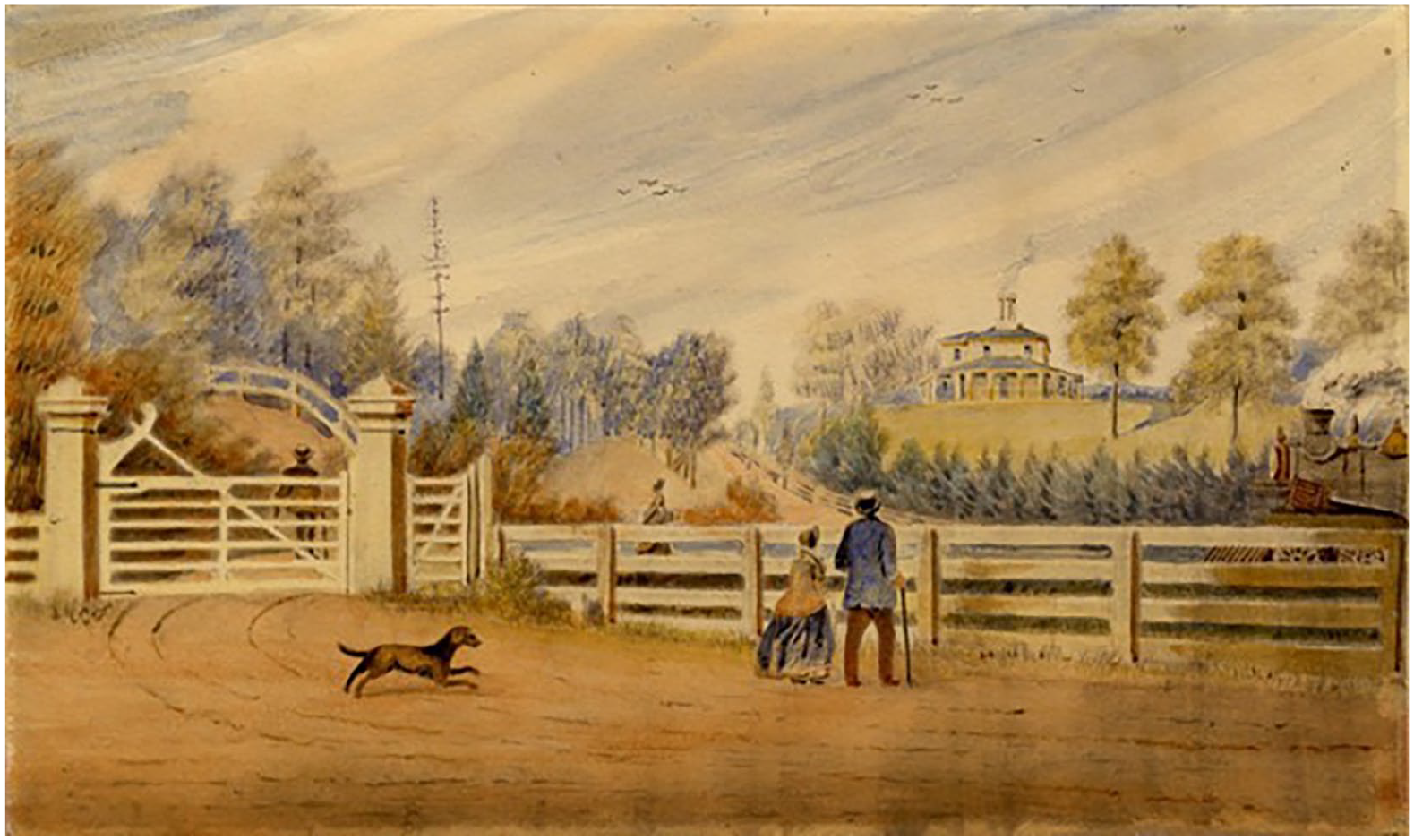
Portrait of Colborne Lodge, 1870.
Far more elaborate are the gardens at the city-run Spadina Museum (Figure 7), a historic house belonging to the affluent Austin family who lived there for three generations, from 1866 to 1982. Situated northeast of High Park, at the intersections of Spadina and Davenport roads, its namesake references Ishpadinaa, an Anishnaabe word meaning ‘the rise in the land’, referring to a natural bluff nearby (Johnson, 2013). Not so long after they worked on the gardens at Black Creek, the Garden Club of Toronto also led the creation of gardens at the Spadina House museum (Dawson, 1981; Primeau, 1995), an impressive achievement that documents almost 150 years of changing garden styles, starting in 1880. While the property formerly spanned 80 acres, the museum now sits on a mere 5.7 acres, including formal lawns, gardens, a kitchen garden, a greenhouse and an orchard. Here too, research on ‘typical’ gardens informed the choices made by Garden Club volunteers, in part because there does not appear to have been a wealth of primary source material to verify. Plants were chosen ‘some for their colors, some for their historical reasons, some for their capacity to withstand adverse weather’ and the plan was not to restore gardens to a particular era, ‘but to represent all periods through the use of plant materials’ (Dawson, 1981: L8). These gardens, while different in scope from those at the Village and Colborne lodge, also bring settler-colonial possession of the landscape to life, historicizing and naturalizing the ecologies of early settler-colonizers in Toronto and presenting them as a landscape to be admired. Still, while this site commemorates the land uses of a settler-colonial family, the environmental legacy of Indigenous people is not lost here, not only due to the museum’s name but also because it sits just north of Davenport road, the oldest extant road in Toronto, having been used by Indigenous peoples for millennia (Johnson, 2013).
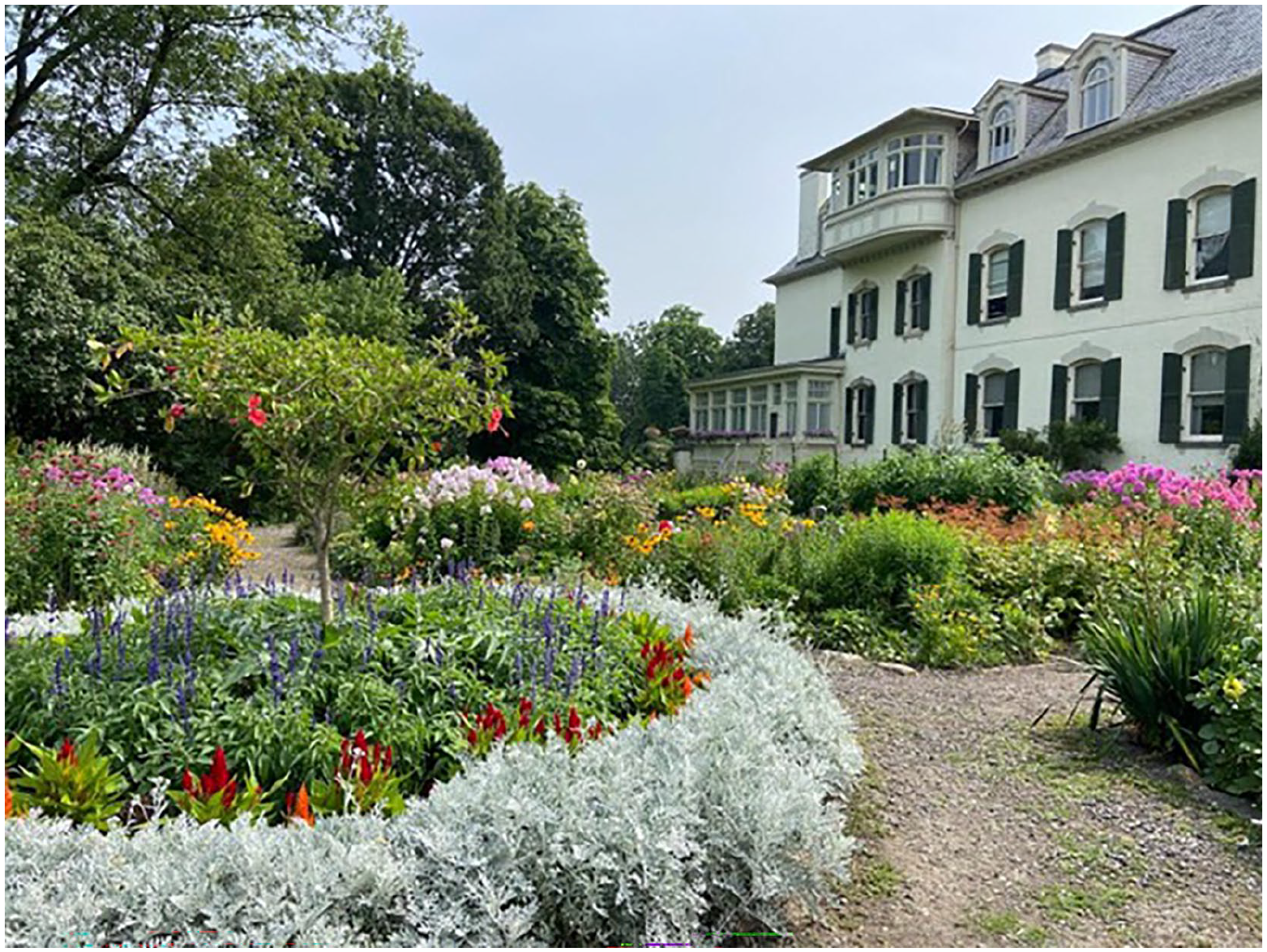
Ornamental gardens at Spadina House, summer 2023.
Remaking origins and erasures in the garden
This country, in the main a country of immigrants, is always redefining origins, jockeying and smarming for degrees of belonging. (Brand, 2002: 64)
One of the strategies for legitimizing settler-colonial stewardship is through the remaking of origins. This is a practice through which white settler-colonizers, in describing themselves as pioneers, remake themselves as the original and legitimate inhabitants of the land they colonized. As a sort of ‘settler adoption fantasy’ (Tuck and Yang, 2012), this remaking of origins presents settlement as an unproblematic, innocent homemaking venture on lands they discovered and subsequently adopted. This remaking naturalizes white settler belonging and land use to the exclusion of Indigenous and Black peoples and land uses, relying on the disappearing of Black and Indigenous life. This echoes Toronto-based poet Dionne Brand’s apt assessment of the Canadian nation-state as one that ‘is always redefining origins’ (Brand, 2002: 64).
As I described earlier, the case of settler-introduced invasive plants, and its absence from the presentation of pioneer garden exhibits, captures one aspect of this remaking of origins. In the pioneer garden exhibit, the garden is reimagined and maintained as a space free of problematic species, effectively rewritten as an innocent space rather than a critical site of colonization. Native and non-native plants familiar to many gardeners – herbs such as sage and rosemary, and flowers such as roses – are arranged in such a way that asserts colonial planting as exempt from and unrelated to ecological crises. While it would be irresponsible to plant seeds now deemed invasive in their gardens, the Village’s herb garden – a ‘typical dooryard garden’ exhibit – includes no interventions clarifying the omissions of problematic species or the land relationships and agricultural systems displaced by settler colonization. Rather than taking an opportunity to trouble the innocence of the garden, 5 the explanatory narrative focuses on the importance of herbs for seasoning and medicine. It remains unclear if an herb garden of this kind would have actually existed in 19th-century Ontario. Minhinnick (1970) maintained that while settlers cooked with herbs and used them medicinally, there was no evidence to suggest that there was a tradition of planting herb gardens in Ontario – instead, herbs were likely planted among other plants (Figure 8).
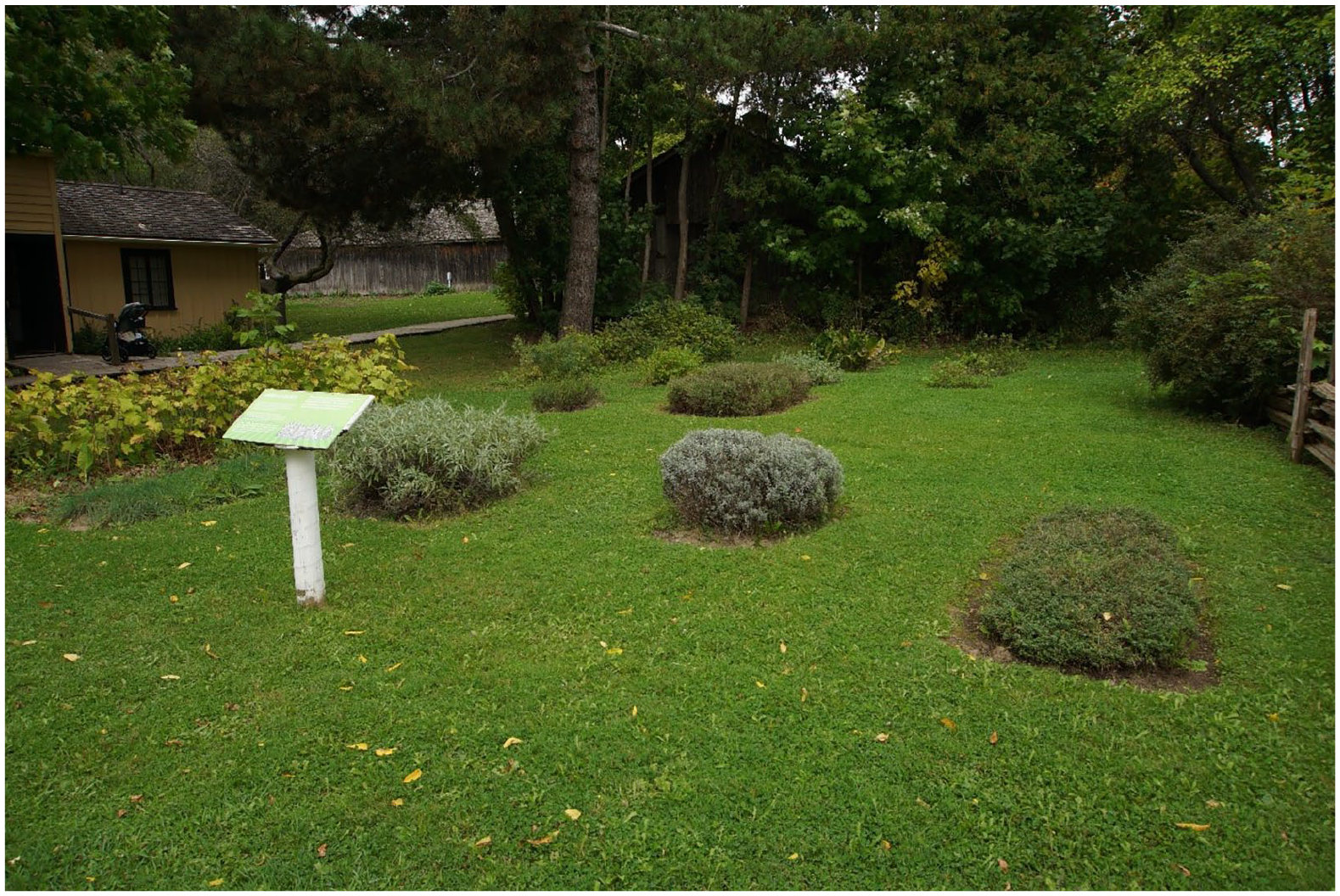
The herb garden at the Village at Black Creek, fall 2024.
While not all, most plants now deemed invasive in the Toronto region were introduced by settler-colonizers alongside the violent conquest that enabled settlement on Indigenous territories across Turtle Island. Settler-colonizers attempted to remake the lands they colonized through the creation of their homesteads, bringing seeds from home with them for medicines, food, windbreaks and ornamental purposes. In some cases, the Government of Upper Canada even gave newcomers seeds of European origin to help get them started (Langdon, 1972). Garlic mustard, a much-maligned plant deemed invasive throughout Turtle Island today, was itself introduced by settler-colonizers as a frost-hardy herb and medicine and would have been present in some early gardens (Doiron, 2023).
Given the scarcity of evidence for early gardens in Upper Canada as previously mentioned, the pioneer garden exhibit also remakes origins by virtue of trying to replicate something that is itself impossible to replicate. The volunteers who put together the research for the gardens at the Village noted that the domestic plants grown in the 19th century were quite different from plants of the same name grown today, with hybrids being ‘practically unknown’. In their words, ‘it is not really possible, today, to duplicate a pioneer garden’ (The Garden Club of Toronto, 1970: 5). Attempts to recreate the pioneer garden require a great deal of puzzling, imagination and some conjecture, and there remains a lack of transparency around the reality of this process. The pioneer garden exhibit’s reliance on what is ‘typical’ is therefore not an innocent imaginative exercise. Rather, it materializes an incomplete story that risks concealing settler-colonial complicity, effectively rewriting history.
Such claims to innocence extend beyond the garden site into the spaces of museum programming. As part of its special programming during the Covid-19 pandemic, the Village invited its visitors to engage the museum’s gardens by learning how to make their own container herb gardens (Black Creek Pioneer Village, 2021). While there is nothing inherently wrong with a container herb garden, of course, the invitation to recreate a garden based on the plantings in a village commemorating settler colonial life and ecologies is worth examining. What does it mean to reproduce a settler garden in the present, without reflecting on erasures and mythologies in colonial environmental history? What does it do to emphasize the ‘pioneer’s’ relationship to herbs without considering her relationship to other nonhuman life on Turtle Island? This kind of invitation took a more explicit turn when the Whitchurch-Stouffville Museum in Ontario (n.d.) invited its visitors to ‘make up [their] own settler garden’, a sort of cosplay inviting visitors to learn by putting themselves in settler-colonizers’ shoes. Through these presentations of settler gardens and invitations to recreate them, origins are remade as innocent and familiar, from gardener to gardener.
Tending to a 21st-century ecological sensibility
The invitation to see oneself reflected in the settler-colonizer gardener leads to a third aspect of the work of the pioneer garden display: the invocation of a contemporary ecological sensibility. The work of the pioneer garden display is most successful in sedimenting settler-colonial grammars when it projects a vision of the past as being more sustainable and ecologically oriented. For instance, in earlier descriptions of its commitments to sustainability, the Black Creek Pioneer Village described itself as ‘Toronto’s Original Green Event Venue’, stating that ‘At Black Creek Pioneer Village, being “green” means going back to our past’ to the green ‘way of life’ in 1860’s Toronto (Black Creek Pioneer Village, 2018). The plants in the gardens at Black Creek Pioneer Village, Spadina House and Colborne Lodge would largely be familiar to a contemporary white settler home gardener. At the Colborne Lodge gardens, the presence of pollinator-friendly flowers like Black-eyed Susans (accompanied by a panel naming the attempt to recreate the original garden) works to present the Howards as ecologically-minded settler-colonizers, as responsible stewards, which resonates with Howard’s legacy of giving Toronto High Park. Comparing contradictory grammars at these sites is therefore useful for highlighting tensions in the environmental narratives surrounding these gardens.
At the Village, near the market garden display and between heritage buildings, there is an anachronistic ‘rain garden’ (Figures 9 and 10) with many native species planted – Common goldenrod and Asters, to name a few. A rain garden is a contemporary garden type that is shallow and sunken to collect storm water, reducing the potential for things like flooding and stream pollution (TRCA, 2018). Typically, these gardens also feature native, perennial, pollinator-friendly plants to help make them low-maintenance. In front of the rain garden at the Village, an explanatory panel reads: You wouldn’t have seen a rain garden in an historic village, but today our cities need them. This is because concrete, asphalt and compacted soil – the materials we use to make our roads, sidewalks, and much more – prevent rainwater from soaking into the ground. Rain gardens help to absorb this runoff. They reduce flooding, filter pollutants, and even provide habitat for wildlife like butterflies. (TRCA, n.d.)
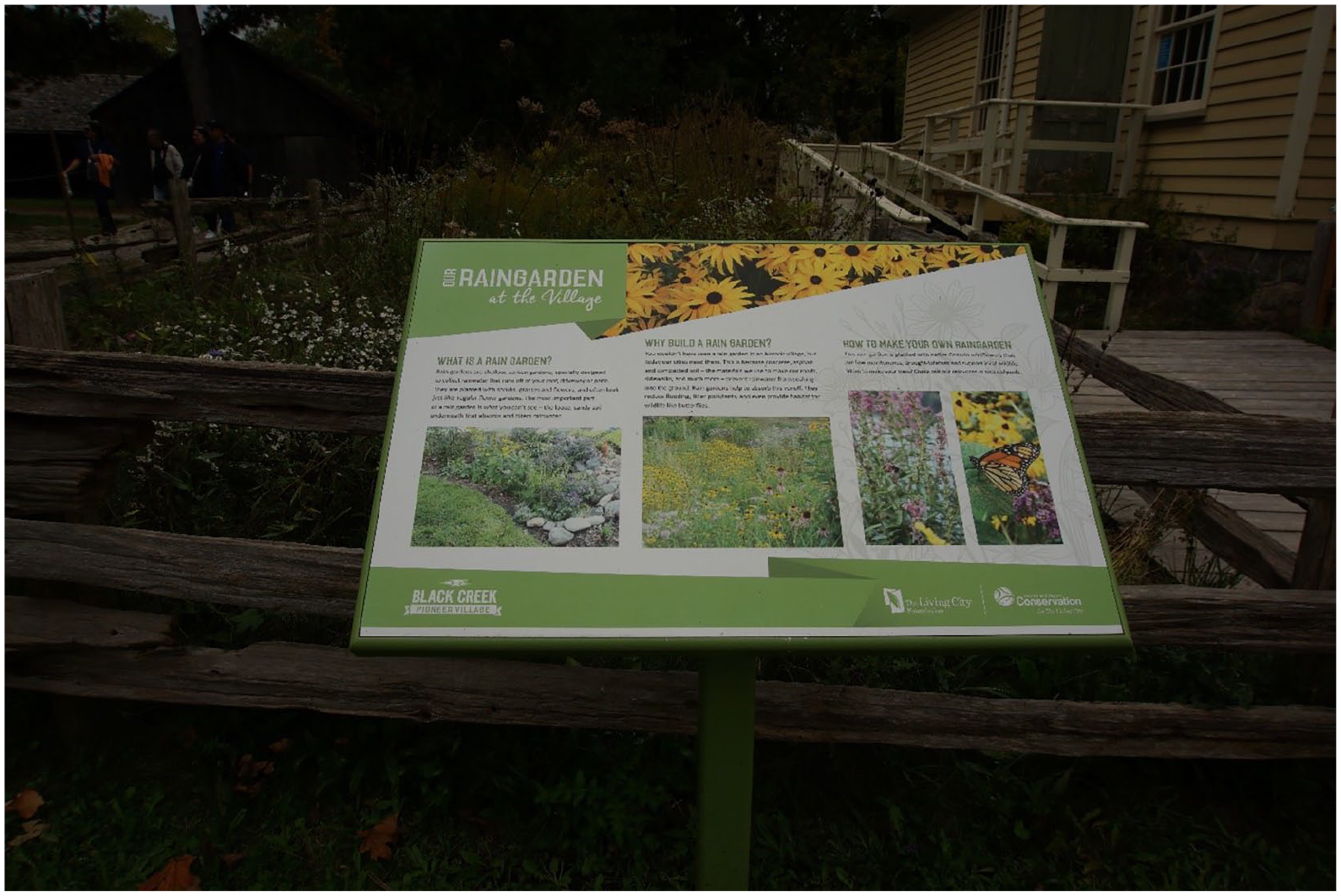
Text Panel for the ‘rain garden’ at the Village at Black Creek, fall 2024.
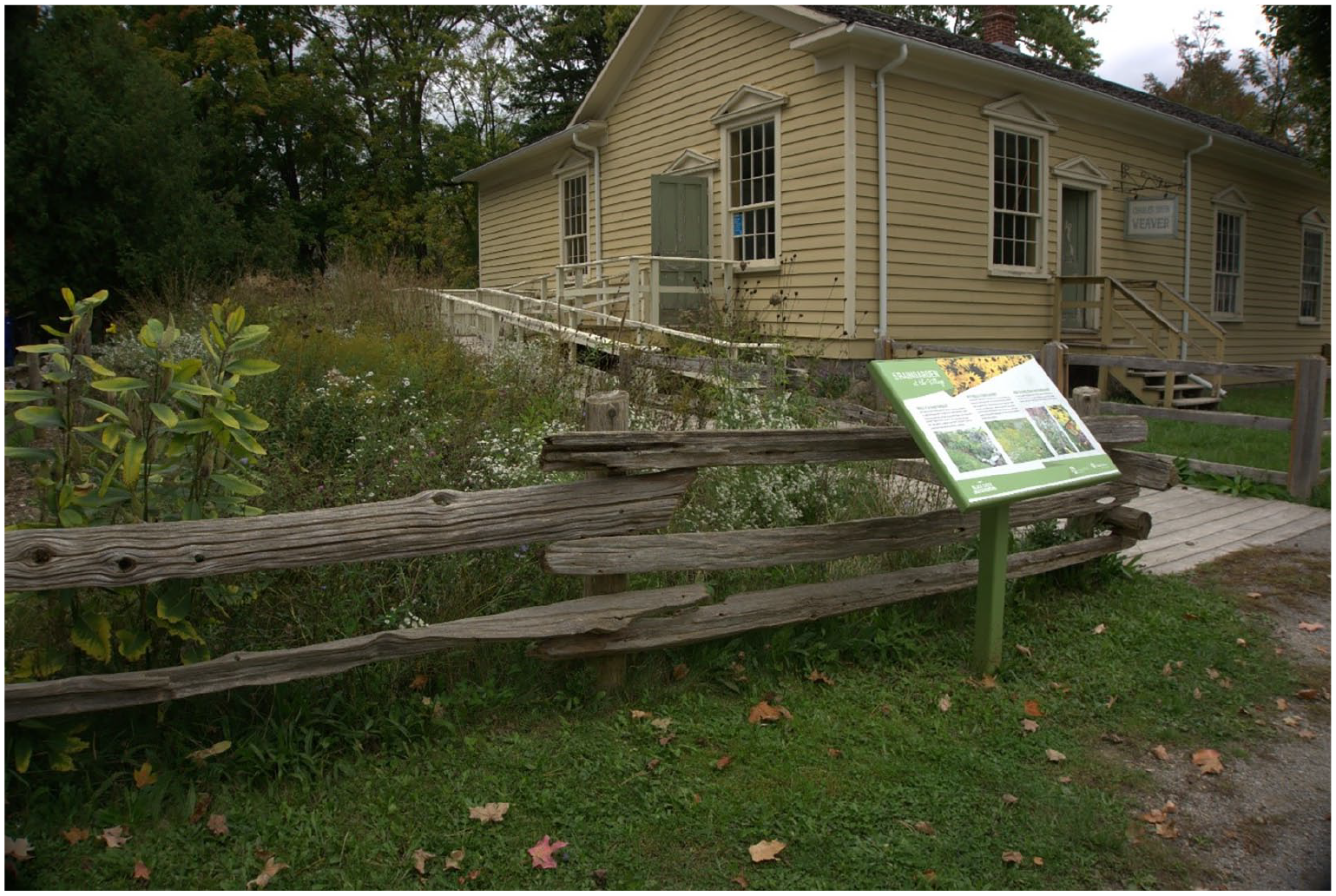
The ‘rain garden’ at the Village at Black Creek, fall 2024.
The rain garden – a contemporary rebranding of sustainable Indigenous ecologies, casting a native plant garden as a sort of modern invention – exists as a concept because of the damage caused by settler-colonial expansion and conquest, yet this is never made explicit. It is a solution to the flooding risks associated with settler-colonial transformations of the landscape, a solution that comes from Indigenous ecologies and knowledges, no less. Rather than seizing an opportunity to discuss the complicity of the garden and the settler-colonizer in contemporary environmental issues – rather than addressing the sedimentation of urban settler-colonial land transformations – the TRCA presents its bounded territories and displays as innocent and natural. The ecologies of the Village are part of the terraforming project that has intensified ecological crises such as flooding, pollution and lack of habitats for pollinators. Inserting a lone rain garden in the Village with an explanatory panel that does not link these histories is therefore misleading. Moreover, many histories and relationships are concealed through the framing of this rain garden, particularly regarding Indigenous stewardship. La Paperson (2014) writes that, far from a historical problem, ‘Indigenous vanishing is essential for the twenty-first century ecological settler to become the new adoptive “native,” and thus rightful re-inhabitant of Native land’ (p. 117). In this light, the colonial grammars of nature management – emphasizing modern solutions to modern problems – risk being another way through which settler-colonizers possess the landscape.
These are only a few examples of the intersections of these gardens and their sites with nature management and settler environmentalism. Paying attention to the contesting grammars of the pioneer garden exhibit and its surroundings helps to clarify some of the tensions in these spaces. Sitting with the contradictions in these sites while being attentive to the production of white settler ecologies, one starts to find ways of troubling the innocence of the garden. Not only does the garden’s referent have a clear connection to the settler-colonial project, but the display itself – the product of intensive research, creative choices and ongoing management – is invested in a narrative of settler-colonial stewardship. Noticing grammars is a particularly effective way of engaging naturalized structures, the structures that the dominant environmental culture does not want to be questioned. And as Marquez (2021) argues, reckoning with grammars themselves opens up possibilities for restructuring and shifting knowledges. Troubling the innocence of the garden and engaging the concealment that occurs in discourse about nature management and ecological legacies, is, in my view, never superficial, but rather necessary work, revealing important intimacies between whiteness, conquest, invasiveness, property regimes and the environment.
Conclusion
As participants in the making and unmaking of territory, plants are both victims and agents of ‘slow violence’, exacted over decades and even centuries on landscapes and their occupants [Nixon, 2011] (. . .) To understand how the territory of humans and plants might be otherwise, we must first understand what territory has been and continues to be. (Besky and Padwe, 2016: 22)
The work of the pioneer garden exhibit, presumed innocent, is multi-dimensional, doing far more than educating visitors on historic modes of planting. Plants become complicit in, and victim to, the territorialization of the settler colonial project (Besky and Padwe, 2016). Renarrativizing the story of settler colonization as innocent settlement, the exhibit risks obscuring the complicity of gardeners in the violent project of colonization and naturalizing white settler ecologies. While it educates its visitors on plant histories, it also conveniently tends discourses of innocence as it naturalizes settler planting on stolen land. More than neutral, innocent sites, these gardens territorialize white settler belonging.
Today, with what the TRCA refers to as the evolution of the public perception of pioneer villages since the 1960s, the Village is under pressure to modernize their displays and address their omissions (Black Creek Pioneer Village, 2023; Wijesooriya, 2022). In response, they are in the process of transforming the site into an ‘inclusive community common’, expressing in 2022 that ‘With a renewed vision for Black Creek Pioneer Village that is forward-focused, ambitious, and inclusive, the Village can be a catalyst for inclusive conversations on the history of the Toronto region, while also spurring revitalization in the surrounding neighbourhoods’ (Wijesooriya, 2022). Black Creek Pioneer Village’s recent moves to ‘restory’ the Village to shift its focus away from settlers of European descent (BCPV, 2023) are overdue and will doubtless transform the dominant telling of the history of the region to include more Indigenous and Black perspectives and interventions. Since 2024 – two years after my initial visit – the TRCA has taken several steps towards transforming the narrative of the museum. In the spirit of inclusivity, they have rebranded, dropping ‘pioneer’ from their name to reflect their change in focus. They have also been working with Indigenous education consultants to review their school programming and they installed a new exhibition on Indigenous perspectives on colonization inside one of the Village buildings, with more changes to come (The Village at Black Creek, 2024). As of November 2024, however, the gardens and the panels that described them, as well as the broader structure of the village with all of its charming features mentioned earlier, remained largely untouched. While it is encouraging to witness efforts to change the narrative, I also take to heart the limits of liberal recognition politics when structures of power remain unchanged (McCreary and Milligan, 2021). It therefore remains to be seen what such interventions – at the Village at Black Creek or elsewhere – can meaningfully achieve towards the disruption of innocence and naturalized white settler ecologies.
At the beginning of this article, I asked why a conservation authority might task itself with the maintenance of an open-air museum honouring the early contributions of settler-colonizers. What do an old-timey post office, heritage farm animals and Victorian costumes have to do with nature management? As this article demonstrated, the project of conservation is itself not so distant from the project of memorializing pioneers – indeed, both projects, as practised in settler-colonial places, so often rely upon claims of innocence and erasures. Much critical scholarship in geography and beyond has clarified how the enclosures of nature conservation intersect with and reinforce settler state power, contribute to the dispossession of Indigenous peoples from their lands and practices, and reproduce the harmful dichotomy of Man and nature (Adams, 2020; Cronon, 1996; Simpson & Bagelman, 2018). Seen in this light, a pioneer garden display at a living history museum run by a settler-led conservation authority actually makes sense.
Presumed innocent and ubiquitous in its expressions, it is little wonder that the pioneer garden exhibit has been neglected as a site of study in Ontario. Clearly, however, it has so much to offer in an analysis of the territorialization of whiteness in settler-colonial places. Distinct from other heritage displays, such as the buildings at all three sites, the pioneer garden display requires constant, involved attention to cycles of preparation, tilling, sowing, tending and weeding – it is a repetitive, seasonal practice. And the questions it raises are applicable in other local contexts – after all, pioneer garden exhibits, particularly the ornamental ones, look remarkably similar to award-winning gardens in the City of Toronto’s ‘traditional garden’ award category. Much work and repetition of colonial grammars had to take place in order for an English garden design to be deemed ‘traditional’ on a territory that has been home to Indigenous peoples for at least 11,000 years (Johnson, 2013). Many cumulative practices of planting and ‘displanting’ (Mastnak et al., 2014) made this happen, reinscribing settler belonging, again and again, and producing particular, racialized environmental knowledges. These are environmental knowledges that privilege white settler colonization and land relationships, using concealment to deny Black and Indigenous land relations and contributions to place (Goeman, 2014; McKittrick, 2006; Whyte, 2018).
Noticing the grammars of these knowledges – evoked by erasure-laden words like traditional, settler and pioneer – creates an opening for a different way of reading and thus producing ecologies. Plants have been both subject to, and agents of, colonial violence – as such, Besky and Padwe (2016) argue that the only paths to an otherwise to the imperialist status quo are through ‘understand[ing] what territory has been and continues to be’ (p. 22). Decoding naturalized grammars in the pioneer garden exhibit is one way of understanding territory – how it is defined, reasserted and legitimized. It clarifies how grammars persist through repetition and are not static nor inevitable. In this way, troubling the innocence of settler ecologies and examining the pioneer garden’s grammars is a path towards practicing an otherwise, of tending an alternative to the status quo of white settler belonging.
Identifying and reading colonial grammars in the garden is significant for several reasons. For one, the practice uncovers how the innocence of the garden is constructed and utilized. The rewriting of the pioneer garden as home to non-problematic plants helps to bolster a nature management practice that is about targeting enemies rather than helping Indigenous foodways and ecologies flourish. 6 The repetition of the form of the settler-colonial garden and its subsequent familiarity in settler-colonial places makes Indigenous ecologies appear to be out of place or novel, such that a native plant garden can successfully be rebranded as a ‘rain garden’. Yet this normalized white settler possession is not invisible to all – as Moreton-Robinson (2015) critically articulates, for Indigenous people, white possession ‘is hypervisible . . . signs of white possession are embedded everywhere in the landscape’ (p. xiii). Reading the grammars of the pioneer garden exhibit, then, reveals the site as not entirely natural, but rather a settler-colonial construction.
Studying the site of the pioneer garden also opens up analyses relevant to unpacking the logics of settler colonialism more broadly. Coulthard (2014) argues that ‘settler-colonialism should not be seen as deriving its reproductive force solely from its strictly repressive or violent features, but rather from its ability to produce forms of life that make settler-colonialism’s constitutive hierarchies seem natural’ (p. 152). This dynamic – of naturalizing settler forms of life, ecologies and relationships in ways that more quietly displace Indigenous forms of life, ecologies and relationships – plays out in all lands occupied by settler-colonial nation-states, from Turtle Island to Palestine (Jaber, 2019; Salih and Corry, 2022). Place names in Australia are the products of colonial naming practices and nostalgia for a European homeland (Plumwood, 2003). Jaber (2019) notes that the Jewish National Fund has planted millions of non-native trees in occupied Palestine, mostly pines, to assist in making the landscape look more European as well as to attempt to obliterate Palestinian ecological heritage. All the while, despite ongoing colonial efforts to possess the territory and maintain white settler ecologies, Indigenous ecologies and the Indigenous people who have relations with them persist (Salih and Corry, 2022; Whyte, 2018). If this were not the case, the colonial undertaking of naturalizing a white settler status quo would not need to be repeated nor reasserted. 7
Building on critical work in political ecology that pays attention to colonial grammars in racial ecologies – studying, for instance, the deliberate practices of planting memorialized in living history museums, which gardening traditions are celebrated by the state, or how the garden assists in making and defining property lines – is a generative practice for geographers. Not only does it begin to denaturalize landscapes taken for granted, but it also helps to underscore how grammars are unstable, becoming naturalized through repetition. An otherwise to the violent status quo – a world where histories of colonization, genocide and ecocide are not concealed, but contended with to inform more liveable futures – is possible. Examining grammars that have shaped and continue to shape the landscapes around us is one path to tending this otherwise, in geographic literatures, on the ground, and beyond.
Footnotes
Declaration of conflicting interests
The author declared no potential conflicts of interest with respect to the research, authorship and/or publication of this article.
Funding
The author received no financial support for the research, authorship and/or publication of this article.