




Abstract
The uptake of more-than-human thinking in geography seeks to centre the ways that our diverse life-worlds are sustained by interconnected and more-than-human relations. As a relatively new framework to the discipline, more-than-human thinking has offered different ways to address some of the world’s increasingly complex problems. But to what extent does this framework pay attention to the underlying context of Indigenous and settler colonial land relationships? And how might more-than-human thinking attend to complex problems such as researching on stolen Indigenous land? This article aims to take seriously the fact that tensions around settler colonial and Indigenous land relationships are not resolved, nor overcome by more-than-human thinking alone. We offer the Goats Foot Flower story, as told by Gumbaynggirr story-holder Aunty Shaa Smith, to share how diverse knowledges held within story are helping us to better understand what respectful land relationships might look like and mean. The story emphasises how heeding Country’s authority is foundational to maintaining respectful relationships with the land through living agreements. It teaches us that attending to respectful relationships on stolen land is an active and ongoing responsibility of continuing connections with and as Country. As we grapple with the complexities of what it means for each of us to be in respectful relationship with Country, we recognise that there is an urgent need to attend to Land Back as part of the process.
Keywords
Introduction
It’s a huge thing, this land thing. It feels so strong about needing a land base, about how essential that is . . . Whoever comes onto that property you have to consult with me, relate with me, because I’m part of Country. That’s how I see it. It’s not just metaphorically speaking, it’s like people stepping onto this piece of ground where protocols have to be respected – Gumbaynggirr Country protocols have to be respected. Aunty Shaa Smith, 2020
We write this article as Yandaarra, a human and more-than-human, Gumbaynggirr and yirraali (whitefella) research collective, led by Gumbaynggirr Country, the Old Fellas, 1 and Gumbaynggirr Elders and Custodians. Yandaarra means to shift camp together in Gumbaynggirr language (Yandaarra with Gumbaynggirr Country including Smith et al., 2022). Yandaarra is both who we are and what we do; learning to be in good relationship with ourselves, each other and Country. In this article, Yandaarra includes Gumbaynggirr Custodians, Aunty Shaa Smith, Neeyan Smith, yirraali PhD student, Liz Murphy-May, and three yirraali academics, Lara Daley, Sarah Wright and Paul Hodge. Gumbaynggirr Country is what holds and shapes us as Yandaarra, leading our Country-led learning, and guiding our sharing in this article. Gumbaynggirr Country is the unceded homelands of Gumbaynggirr people. Situated on the mid-north coast of New South Wales along the eastern seaboard of so-called Australia, Gumbaynggirr Country stretches from the Nambucca River in the South to the Clarence River in the North, as far West as the Great Diving Range and to the Pacific Ocean to the East. Country is the physical land, sea and sky, and it is more than that too. Country includes human and more-than-human, tangible and intangible presences and actors such as people, trees, waters, birds, winds, songs, stories, agreements, Law/Lore, hopes and dreams (Smith et al., 2018, 2021; Yandaarra including Smith et al., 2024). Some of these presences are readily sensed with eyes and ears, yet all are better sensed from a spirit place and engaged respectfully as more-than-human sovereignties that co-become as Country (Bawaka Country et al., 2016).
As a research collective, we are working together to better understand and care for Country, heeding Gumbaynggirr Law/Lore and Dreaming as shared by Aunty Shaa through story and as ever-present in the landscape. In this article, we use Law to refer to the ongoing place-based legal orders, systems of relations and responsibilities that continue with and as Country. Lore refers to the practices and stories that uphold Law through story, song, dance and ceremony (Ngurra et al., 2019; Smith et al., 2018, 2021; Yandaarra including Smith et al., 2024). We use and capitalise Law/Lore throughout this article to honour the co-existence of Laws/Lores on Gumbaynggirr Country, and to acknowledge that stories like the Goats Foot Flower share Gumbaynggirr Law/Lore. In this article and throughout our work together, Law/Lore is what holds us to account in bringing things into balance and setting things right, guided by Country and the Old Fellas (Yandaarra including Smith et al., 2024; Yandaarra with Gumbaynggirr Country including Smith et al., 2022). This includes addressing the deep and ongoing injustices of stolen land that come up again and again, and in multiple ways are always there (Murphy-May with/as Yandaarra, 2020; Smith et al., 2021; Yandaarra including Smith et al., 2024; Yandaarra with Gumbaynggirr Country including Smith et al., 2022). As Aunty Shaa shares in the opening of this article – it’s a huge thing, this land thing, it’s essential, it’s about relationships and it needs to be respected! In this article, we look at how the Law/Lore held in the Goats Foot Flower story communicates important knowledge of what it is to keep Country’s spirits, ancestors and more-than-human relationships alive in the here and now through our relationships with land.
Our work responds principally to Aunty Shaa’s call to engage deeply with the land and to heed the communications of Gumbaynggirr Country as a fundamental part of working together well. This is a collective responsibility we share as Yandaarra. In centring Country and Aunty Shaa’s call, we follow work in academia that emphasises the need to begin with and from Indigenous ontologies and world views, and to start from Indigenous legal orders and practices, in shaping our understandings about what it means to live respectfully, accountably and thoughtfully on unceded lands (Bishop, 2023; Kwaymullina, 2016; Todd, 2018; Watts, 2013; Yunkaporta, 2019).
In attending to the need to centre land relations and the agency of Country, we also respond to calls within the more-than-human literature to take seriously Indigenous-led knowledges and ontologies, and to attend to the underlying context of Indigenous and settler colonial land relationships, which are often sidelined or ignored. In geography, more-than-human thinking has gained traction as a means of addressing some of the world’s increasingly complex socio-environmental problems (Abram, 1996; Bennett, 2005; Lorimer and Hodgetts, 2024; Whatmore, 2002, 2006). Yet geographers have tended to conceptualise more-than-human thinking by drawing on Western concepts including Non-Representational Theory and Actor-Network Theory. These are powerful ways to challenge the presumption that socio-material change is an ‘exclusively human achievement’ (Whatmore, 2006: 604), and to point instead to the ways that the world is continuously remade and ‘spun between people and animals, plants and soils, documents and devices in heterogenous social networks which are performed in and through multiple places and fluid ecologies’ (Whatmore, 2002: 14).
We acknowledge that this work is an important invitation to humans to deepen their/our consciousness. However, it tends to sideline Indigenous knowledges by ignoring complex land relations and re-inscribing self-referential colonising relationships in new language and patterns of thought (Sundberg, 2014). First Nations scholars like Métis person Zoe Todd (2018), for example, have long argued that the scripting of Indigenous peoples and their knowledges as absent in more-than-human thinking contributes to the consolidation of the settler colonial project in research. Further, many researchers in more-than-human thinking conduct their work on stolen land, yet often overlook the ethical implications of this fact and thus fail to confront the colonial legacies that underpin their presence (Kwaymullina, 2016; Rigney, 1999; Sundberg, 2014; Todd, 2018).
There have been some important contributions by geographers, including non-Indigenous scholars, to wrestle with the issues we attend to in this article (see, for example, Barker and Pickerill, 2020; Larson and Johnson, 2017; Lobo, 2024; Rosiek et al., 2020). For example, Barker & Pickerill’s (2020) work on ‘doings with the land and sea’ resonates with our aim to foreground Indigenous sovereignties and Country in our more-than-human thinking. They call for an active rethinking of geography towards an action-based, continuous ‘commitment to a place and people’ (p. 644), whereby scholars can ‘radically rethink how we understand the world, what we privilege within it, how we relate to place and time, and how we do geography’ (Barker and Pickerill, 2020: 655) in relation to Indigenous sovereignties. We see work such as this as contributing to the potential reshaping of more-than-human thinking in ways that both challenge colonial legacies in geography and embrace a shared commitment to centring Indigenous relationships, knowledges and sovereignties.
In our work, we are attentive to ensuring that the complexities of stolen land and centring of Gumbaynggirr sovereignty extend more-than-human thinking throughout our research. We do this by engaging with a Gumbaynggirr Country-led, more-than-human framework to listen to the land’s voice through story, whilst acknowledging the lived tensions around settler colonial and Indigenous land relationships that are an unavoidable, unsettling and complex part of our shifting camp together. We suggest there is a need to approach more-than-human thinking in its full context – that is, within a broader context of settler colonialism, Indigenous dispossession and ongoing Indigenous land relationships (see also Country et al., 2015, 2019; Todd, 2018; Tuck and Yang, 2012). We do this by reflecting on and sharing some of our learning through a story called the Goats Foot Flower that Aunty Shaa shared with Liz. The Goats Foot Flower, a vine growing along Gumbaynggirr sand dunes, holds diverse knowledges that have informed much of Liz’s personal learnings as part of Yandaarra. In our more-than-human thinking with the Goats Foot Flower, we are sharing a Country-led practice of taking seriously what the Flower can teach us about more-than-human and land relationships in all their complexities.
In the context of settler colonialism, engaging with Indigenous land relationships from within academia is fraught and challenging, even perhaps incommensurable (Tuck and Yang, 2012), and we do not suggest that we have the answers. The Flower’s continuing presence in our learning reminds us that tensions are not overcome by more-than-human thinking alone. Rather, we must attend to thinking and to practice, and to the ways these are deeply entwined.
Our article has four sections, each following specific knowledges that grow from the Goats Foot Flower story and that weave together, strengthening both Gumbaynggirr sand dunes and our Country-led learning around land relationships. First, we follow how the Goats Foot Flower shapes our understanding of Country, including land, as a more-than-human, agentic and reciprocal relationality to discuss the ethical imperative of engaging in complex land relationships as fundamental to our more-than-human thinking. Second, we trace a Goats Foot Flower-led critique of land-as-property, emphasising the impossibility of respectful relationships with land in capitalist and colonising contexts. Third, we generatively respond to this critique by acknowledging the Goats Foot Flower’s sovereignty and living agreements which inform the responsibilities of what it means to be in respectful relationships with Country. Finally, from our different positions, we bind these threads of Country-led learning together to reflect on their lessons of deepening more-than-human thinking as shifting land relationships on stolen Gumbaynggirr lands.
What is land/Country?
There’s a vine and a flower. It’s a plant that grows on the sand dunes and stabilizes the sand dunes. My Great Uncle used it as a remedy and rubbed the sap onto his legs. The plant creates stability for the sand, creates stability for little insects as it creates a surface on the vine for the small creatures to travel and the bees love the flower for their honey. It’s a medicinal plant so it holds stability in the muscle and creates stability for healing and the flow of energy, the power and the magic. I’m using it as a metaphor for healing and the flowers which hold the essence, energy and spirit. The agreement I could make with that flower, which I haven’t yet, or with that vine is if I create a song for you [the Flower, the vine] and sing for you, will you allow me to use your essence for healing? So that’s creating a relationship with Country, it’s personal, it’s sacred and it’s binding – Aunty Shaa, 2020
This story of the Goats Foot Flower emerged during a conversation between Aunty Shaa and Liz as they sat together in Gumbaynggirr Country over a cup of coffee in early 2020. Liz had asked Aunty Shaa about the roles and responsibilities within Gumbaynggirr land relationships and Aunty Shaa responded with this story. Many of Country’s messages come through stories. Gumbaynggirr stories share important lessons on how to respectfully relate with and as the land. The Goat’s Foot Flower story communicates important Country-led messages from both the Goats Foot Flower and Aunty Shaa about how to enter into relationship with land through living agreements. One way we are trying to live such agreements is by making land an ongoing focus in our research. Liz, who is the first yirraali co-author of this article, was asked by Aunty Shaa to make land the centre of her honours project in 2020 and now a continued focus of her PhD studies and this article. With Aunty Shaa, Neeyan, Country and the Goats Foot Flower story itself guiding us, Yandaarra is trying to go deeper together into this land thing, to be open, to engage Country’s messages about land relationships as critical to our more-than-human thinking, and to recognise Country’s authority in our collective learning on this.
The Goats Foot Flower story centres land as relational, emphasising that agreements made with and as the land are personal, sacred and binding (see Figure 1). When Aunty Shaa and Neeyan talk about land, it changes depending on the context, time and place. Sometimes land is described as Country: a living entity where humans and more-than-humans co-become; a teacher of knowledge, governance and Law/Lore; a food provider; and a relative to whom everyone is accountable (Smith et al., 2018, 2021). Other times, land is described as a physical and material entity that can be involved in an agreement about its use, ownership, or access (Yandaarra with Gumbaynggirr Country including Smith et al., 2022). The complexity of land as relational and more-than-human adds to the fraught nature of agreement-making on stolen land. Making agreements with and as the land, including stolen land, involves grappling with the Custodial need to uphold the intergrity of Gumbaynggirr Law/Lore; to access land; and to do so in ways that won’t reify the colonial occupation of Gumbaynggirr Country. These tensions underscore the urgency of engaging with land not just as a concept within more-than-human thinking, but as a living agent that requires active and ongoing engagement and negotiation. And so Yirraali authors like Liz need to recognise where their/our thinking and doing are coming from, ensuring that their/our relationships with the land are about maintaining balance and integrity, not of controlling or commodifying.
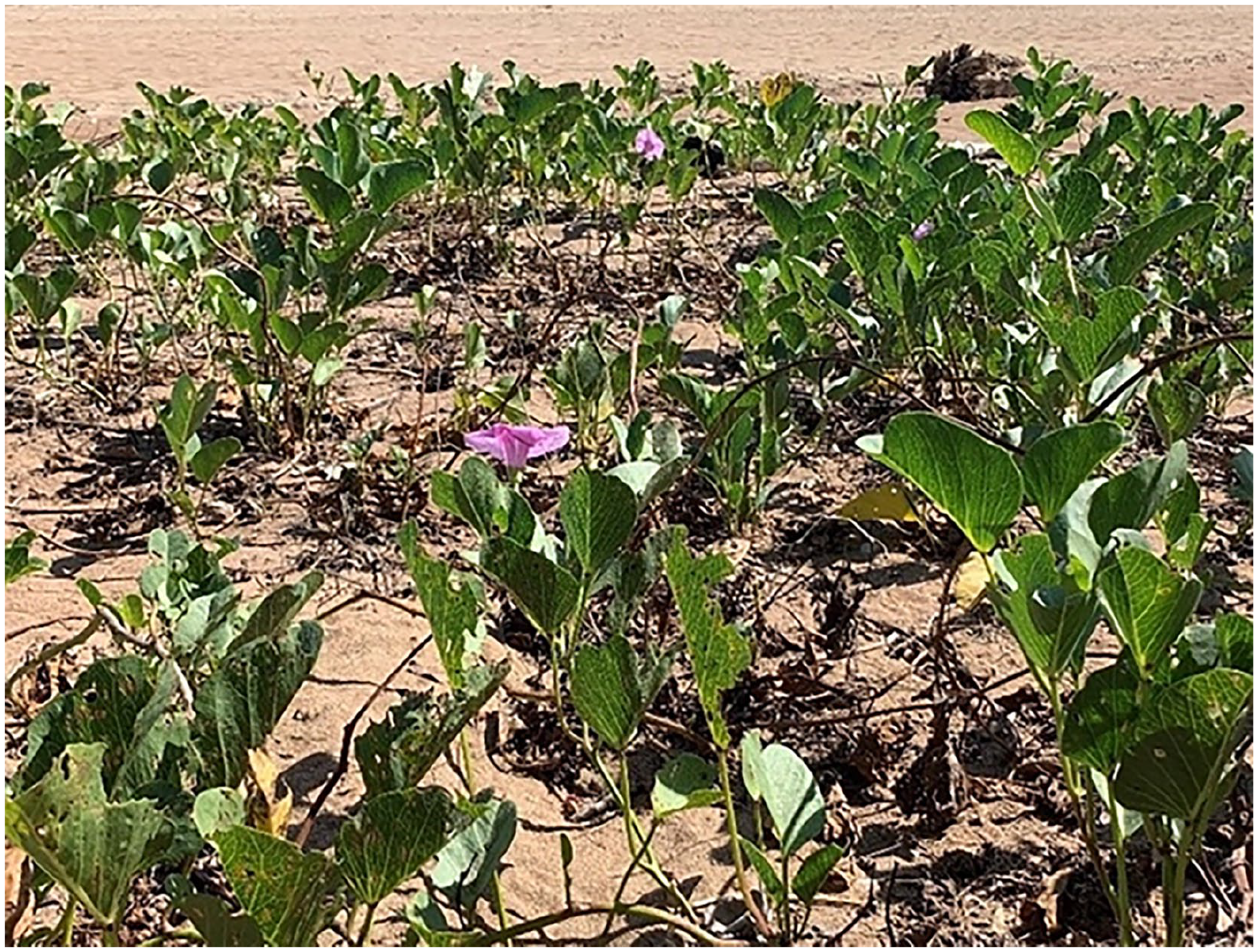
The Goats Foot Flower on the coastal sand dunes at Valla on Gumbaynggirr Country.
Listening to the Goats Foot Flower is one of the ways we come to know and understand the land as relational, agentic and generous. On Gumbaynggirr Country, the Flower offers its essence for healing and shares sap with the bees; as the bee ingests the sap, it is ingesting energy and knowledge from the soil, sunlight and rain, elements that have allowed the Flower to grow and repair itself. The flower teaches that land is multidimensional and relational, and that balance is maintained through living agreements and responsibilities with and as Country. In this complex web of relations, agreements involve emotion (Suchet-Pearson et al., 2013; Smith et al., 2018) and care. Agreements must work to maintain relationships and to enact the agentic, reciprocal and more-than-human processes of co-becoming Country. When Aunty Shaa asks permission from the Flower to use its essence for healing, she is continuing a more-than-human relationship with Country through living agreements with and as the Flower.
In our Country-led practice of attending to land relationships, we are inspired by Indigenous writers whose place-based knowledges share how the land is kept spiritually alive and connected through respectful relations (Coulthard, 2014; Ngurra et al., 2019; Tynan, 2020; Watts, 2013). Their place-based perspectives offer insights into the complexities of how Yandaarra is trying to practice what it is to live respectfully on stolen land. Dene man and scholar from Turtle Island, Glen Coulthard (2014), describes land as ‘a system of reciprocal relations and obligations [that] can teach us about living our lives in relation to one another and the natural world in non-dominating and nonexploitative terms’ (p. 13). In this view, land is an active participant in shaping and guiding knowledge and informing relational responsibilities to maintain balance and connectedness.
We are also inspired by Watts’ (2013) conceptualisation of land as a place where meaning, agency, spirit and life grow, as Haudenosaunee ways of knowing and being are inscribed into and emanate through their relationship with land. This relational understanding of land resonates with Tongva writer and feminist, KJ Hernández (2020), who describes land as ‘a system of social relations and ethical practices that uphold a framework for decolonial critique’ (p. 1006). These Indigenous-led and place-based understandings of land each take seriously the agency of land, and all that exists within it, as communicative and emerging. Land is not a backdrop to life but is a powerful participant and presence in shaping life. Land is active and constantly emerging through patterns and relationships with place and people. To this end, relationships with the land are a critical part of understanding Country and its relationality.
Back on Gumbaynggirr Country, the Goats Foot Flower story illustrates how Country, including land, is a more-than-human, agentic and reciprocal web of relations that need to be related to respectfully. Along the sand dunes is an always-emerging interconnected web of relations between more-than-human beings and Country itself. This interconnectedness co-exists with and exceeds settler colonialism, and is maintained through living agreements enacted as reciprocal duties between the Flower, bees, Aunty Shaa and her Ancestors, and the lands where she and they are from. The Goats Foot Flower story demonstrates how relating with and as land is simultaneously physical, spiritual, more-than-human and relational (Country et al., 2015; Smith et al., 2021; Watts, 2013). As Aunty Shaa shares, I know there is a communication line between me and the plants, it is open. I can find that way of communicating with the plant. If I’m going to ask about a plant and its medicine, I’m understanding the spirit of the plant, and how it uses its spirit for human [. . .] It’s not like ‘If I do this for you, will you do that for me’. The plant has an intelligence of its own and a medicine of its own – an alchemy.
Aunty Shaa’s continuing relationship with the plants offers both a metaphor and lived reality for researchers to consider more-than-human thinking as embedded within an already always existing complex web of life. While the story cultivates important messages and lessons about how to respectfully relate with Country, it also invites more-than-human researchers to take seriously continuing systems of kin relations and practices that uphold Gumbaynggirr land relationships on stolen land. As such, Aunty Shaa’s relationship with the plants reflects a Gumbaynggirr-led notion of living agreement-making that works to maintain balanced and sacred relationships. Rather than aiming to take from the land, the Goats Foot Flower or other medicinal plants, Aunty Shaa requests to enter into a relationship. Together, Aunty Shaa and the Goats Foot Flower are sharing important messages about how to centre the sentience and agency of land and how to properly seek the consent of Country (Yandaarra with Gumbaynggirr Country including Smith et al., 2022). This means coming to terms with times when Country might express messages of disagreement and refusal – especially to those who haven’t followed certain protocols and Law/Lore (Yandaarra with Gumbaynggirr Country including Smith et al., 2022; Bawaka Country et al., 2016). In the context of more-than-human thinking, coming into deeper, more respectful relationships involves a shift towards taking Country and its communication of consent or refusal seriously in what we do, how we do it, and in our research ethics (Yandaarra with Gumbaynggirr Country including Smith et al., 2022). The Goats Foot Flower offers an opportunity to make space for Country to lead the way, to be guided by relationships with Country, heeding its Law/Lore and listening to its messages. These are the kinds of practices that might enable yirraali to move from colonising feelings of entitlement and greed towards relationships of balance and respect. By coming into a proper relationship and not taking too much sap, Aunty Shaa is following protocols that nourish, care and enact balanced relationships with and as Country. The Goats Foot Flower and Aunty Shaa are teaching us that consent involves reciprocity and ongoing nourishment; like Aunty Shaa singing for the Goats Foot Flower, creating a personal, sacred and binding relationship with Country.
A Goats Foot Flower-led critique of land-as-property
Original dispossession has enabled Aboriginal Custodians to be positioned as trespassers in their own lands (Moreton-Robinson, 2015; Watson, 2014), a position that is reinforced by, and embedded in, private property regimes. The notion and practice of land-as-property refers to the persistent and damaging settler colonial and capitalist logics that operationalise and materialise land ‘into severable commodities and doing the creative, yet often invisible work of dispossession’ (Blatman-Thomas and Porter, 2019: 35). This imposed colonial-capitalist commodification and separation of land and people serves to rationalise the ongoing violent dispossession of land (Blatman-Thomas and Porter, 2019; Porter et al., 2020). Land-as-property is enacted through possessive relations of ownership and consumption and has normalising and depoliticising effects over the dispossession of land, working to erase Indigenous relationships, Law/Lore and life (Moreton-Robinson, 2015; Porter et al., 2020; Tuck and Yang, 2012). Moreover, the logic and practices of land-as-property situate human thought and action as distinct from the land – positing that a human’s sense of self is not relationally nor spiritually connected to land; and that land is therefore considered without agency (Graham and Dadd, 2021; Watts, 2013). Relating to land-as-property, then, can perpetuate the impossibility of maintaining respectful relationships by situating land as a ‘relation not between people and land, but a relation between people, in regard to land’ (Blomley, 2016: 226).
The separation of people and land is not only enacted by private property regimes but also through public lands managed by the settler state. For example, Aunty Shaa reflects on the complexities of relating with land and sea Country mediated by Western resource management institutions who seek to ‘control, direct, limit and stop people eating, catching and caring for the land and being cared for’ by the land (Yandaarra with Gumbaynggirr Country including Smith et al., 2022: 11). As Custodians living on stolen land, Gumbaynggirr people need to request permission from Western resource management organisations to access food, land, and relationships (Yandaarra with Gumbaynggirr Country including Smith et al., 2022). These organisations’ conservation efforts often uphold the problematic Western ideal of so-called ‘pristine’ and ‘untouched’ landscapes (Porter et al., 2020), while simultaneously limiting Custodial access and connection to the land (Yandaarra with Gumbaynggirr Country including Smith et al., 2022). In this way, Western practices of land management can perpetuate the impossibilities of relating well with the land. Not only do these colonial-capitalist regimes deeply disrupt Custodial responsibilities, but settler state management and private property markets lock Aboriginal people out of a secure land base, limiting their access and disrupting their ability to care for the lands that support and sustain life itself (Blatman-Thomas and Porter, 2019; Porter et al., 2020; Tuck and Yang, 2012; Yandaarra with Gumbaynggirr Country including Smith et al., 2022).
In contrast, the Goats Foot Flower teaches that relationships with land need to be nurtured through reciprocal agreements that nourish balanced relationships in and as Country. Relating with land as the Goats Foot Flower suggests, means that Country and its more-than-human entities can never be owned nor possessed because they are sovereign agencies within, and as part of, living agreements. When it comes to living and researching on stolen land, there is no easy more-than-human approach to continuing good relationships – no place of separation or innocence (Porter et al., 2020; Tuck and Yang, 2012). People, Gumbaynggirr and non-Indigenous, and Country itself, all have a part to play in addressing ongoing dispossession and the attempted erasure of Gumbaynggirr knowledge and systems of kin relations.
The richness of ongoing relations in the Goats Foot Flower story highlights that there is a moral and political obligation to challenge land-as-property within colonising-capitalist contexts (Porter et al., 2020). Even while we live and work on land that is layered with Western land tenure systems, the Goats Foot Flower’s teaching demonstrates that land and property are incommensurable, and that property is unable to fully grasp the indelible power of Gumbaynggirr sovereignties. This resonates with Blatman-Thomas and Porter’s (2019) reframing of land-as-property to property-as-land, drawing attention to land as the constitutive outside of property, where property is no longer property but always still land. In our learning, it is the vines that stabilise Country, continuing to move, grow and heal our Country-led learning into our learning beyond the academy. While colonial-capitalist logics and practices work to render Gumbaynggirr knowledge invisible, the Goats Foot Flower story attests to the fact that Gumbaynggirr systems of relations and Law/Lore continue – that land is, and always will be, Gumbaynggirr Country. This means that even while the settler colonial operationalisation of land-as-property is inscribed on the land, Gumbaynggirr land relationships persist and resist (Tuck and Yang, 2012; Longman et al., 2020; Watts, 2013) as acts of survivance (Smith et al., 2021), and healing (Hernández, 2020).
The Goats Foot Flower asserts Gumbaynggirr sovereignty
As the Goats Foot Flower trails along the threads of this article, its story invites us to go deeper into the persistence of Gumbaynggirr land relationships and engage the ways that the story asserts its own Gumbaynggirr more-than-human sovereignty (Bawaka Country et al., 2015, 2016; Burarrwanga et al., 2019). By turning again to the Goats Foot Flower’s wisdom and Law/Lore, we now attend to Country’s authority in places that are deeply disrupted by ongoing colonisation yet are never fully colonised. Indeed, our approach to doing more-than-human thinking as a Country-led practice involves shifting our learning, so that we do not expect to merely receive good feelings of being nourished by Country. Rather, our Country-led practice through the Goats Foot Flower involves grappling with land as stolen, complex, living, as having a will (Arnold et al., 2021), whose consent is paramount (Yandaarra with Gumbaynggirr Country including Smith et al., 2022; Yandaarra including Smith et al., 2024), and as an important and powerful authority (Bawaka Country et al., 2015).
The Goats Foot Flower story offers a metaphor to help us generatively respond to the challenging realities of settler colonial impositions on land. Guided by Country and the Old Fellas, the story’s intelligence takes us into a sovereign space of creating new and different relations – ones of balance and respect, not of commodification or control. From a Gumbaynggirr-led perspective, all aspects of life have always been guided by Law/Lore; a Law/Lore that is held in stories and informs more-than-humans of their/our responsibilities in maintaining balance within a web of relations. Through its teaching, the Goats Foot Flower invites responding to the ‘whole land thing’ from a sovereign space. However, doing this requires being clear on what sovereignty means and looks like from a Gumbaynggirr Country-led perspective.
As a medicinal plant, the Flower informs us of Gumbaynggirr sovereignty as a relational responsibility that binds and heals beings together in and as place (Bawaka Country et al., 2015; Smith et al., 2021; Yandaarra with Gumbaynggirr Country including Smith et al., 2022) – each more-than-human simultaneously embodies and upholds their agreements in relation to others, all continuing the ongoing presence of Country (Kimmerer, 2013; Yunkaporta, 2019). While more-than-human notions of multispecies justice acknowledge the inherent agency, indeed inherent entitlement to justice, of all beings (Celermajer et al., 2020), the Goats Foot Flower reinforces the ways that non-humans have always participated in the many relational and living agreements between Country’s co-becomings since the emergence of time itself, that is, in sovereign negotiations. Further, the story communicates how every being holds their own essence, energy and spirit and this is something that cannot be owned, possessed or claimed elsewhere. While settler colonial spaces evoke sovereignty and agency as the possession, ownership and absolute power over land (Moreton-Robinson, 2015), relational sovereignty from a Country-led perspective has more to do with its foundational nature being held in the land, its plants and beings. It is a process of honouring Law/Lore through living agreements in order to listen and live the land’s connections and to appreciate emerging relationships. In its ongoing emergence, Country’s authority is at the centre of it all.
The living agreements held in the Goats Foot Flower offer practical lessons for how listeners can tune into the story (and therein themselves) on a deeper level, enabling them to respond to Country’s authority as re-asserting its sovereignty. Less than a one way, greedy ‘if I do this for you will you do this for me’ (Aunty Shaa Smith, 2020, pers. Comms, 22 August), asking permission to use the Flowers’ essence for healing, serves as an invitation to help us think more deeply, and to be with the land in ways that are held within, and led by Country. As Aunty Shaa shares: . . .It’s not like that at all. It’s got a lot to do with yourself. Being able to be with yourself in that place of making and living an agreement. . . You have to live it from that place. It’s looking at Country and what happens in Country where agreements are being made (Aunty Shaa Smith, 2020, pers. Comms, 22 August)
In this way, asking permission is about understanding our Country-led practice as a living agreement of coming into being through Country’s authority and guidance. It does not assume that humans are entitled to such knowledge or medicine; rather, it asks those who are ready to listen, to remember to ask permission from others and Country, as a living agreement of continuing respectful relationships. This kind of Country-led practice helps to realign ourselves and our more-than-human relationships in Gumbaynggirr ways so that we can each pay closer attention and actually listen to Country’s intelligence, and be ready to respond and act (Smith et al., 2021). This is an intelligence that knows us intimately, already knowing what we need to be doing to help heal and stabilise relationships because we are intimately part of everything (Burarrwanga et al., 2019; McGrath and Rademaker, 2023). It is through living agreements of Law/Lore that Country informs us of our responses and responsibilities with and as each other, thus making us who we are. Heeding the intelligence imparted by the Goats Foot Flower empowers its sovereignty as a relational sovereignty experienced as part of an interconnected web of relations. As Aunty Shaa explains: Feeling sovereign is when I’m in tune with and in harmony with my surroundings. Sovereignty is not just a thing that you are over the top of somebody or someone. It means you are autonomous. You are in connection with your surroundings and how this connection informs how you are living and where you are living. . . You can only say ‘I am who I am’ if you are in relationship with what’s around you and who is around you (Aunty Shaa Smith, 2020, pers. Comms, 22 May).
Feeling sovereign within your being in relation to all other beings, is what maintains balance from a Country-led perspective. Along with Aunty Shaa’s sentiments of feeling sovereign as relationally bound, the Goats Foot Flower’s expression of Country’s sovereignty also resonates with Indigenous writers in other lands and their understandings of relational sovereignty (see Ngurra et al., 2019; Burarrwanga et al., 2019). Val Napoleon (2007), a Salteau scholar from northeast British Columbia’s Treaty 8 states that ‘all one has to know is where one fits, and the surrounding relationships to determine what one has to do in order to fulfil their responsibilities in that society’ (p. 15). Napoleon highlights how the land’s authority is felt, sensed, and understood by being in relationship with other human and non-human members of that society. This highly organised and agentic nature of relating resonates with Watts (2013), who explains how ‘habitats and ecosystems are better understood as societies . . . meaning that they have ethical structures, inter-species and agreements’ (p. 23). The land, nonhumans, spirit and agency are not separate from the political, social, cultural and economic aspects of life. This reinforces the fact that there are continuing Indigenous land relationships and ontologies that are the founders of life itself that exist within, beneath and beyond the settler colonial logic. Moreover, it is humans who need to tune into these ontologies and sovereignties by coming into proper relationships, as learners and listeners of their knowledge and wisdom.
Honouring Gumbaynggirr Law/Lore by living agreements of Country, we each have our own set of differential responsibilities in enacting the Law/Lore and engaging with injustices around land. We can take guidance from the Goats Foot Flower’s teachings in this as it informs us of our complex relationships with Country. As Aunty Shaa shares: So, when we are looking at the story, we are in that creation time. It’s so big because there’s destruction happening but there is also creation happening. When people are in that time together, we need to ask ourselves, where do we stand? Where is our place in that story? It doesn’t matter if you’re in the destruction because you are part of the story. It’s the way we think about life.
So, we each have a part to play in figuring out this ‘whole land thing’. But how do we, from our different histories and places, come to know our role in being part of the different structures that Aunty Shaa talks about? And how might we generatively respond as part of this story? Living agreements supported by Country, the Old Fellas and the Goats Foot Flower come back to the relational sovereignties, the connection and the respect. In our continued learning of this story and what it offers, it emerges for Yandaarra that shifting land relationships and honouring Gumbaynggirr Law/Lore is an ongoing process that involves knowing ourselves, and those who have come before. Who we are can shape how we engage and respond with Country and people, and how we might understand our role in shifting land relationships. From our different positions and on stolen land, it is through this process we can learn to not only listen to relational sovereignties but respond and act as changing the shape of our relations and thus our lives.
The Goats Foot Flower as a lived reality through, with and as Country
In this article, we have shared some of the ways in which the Goats Foot Flower story invites us to meaningfully relate on stolen land. The Goats Foot Flower’s knowledge of living agreements opens the possibility for more-than-human researchers to re-think settler colonial land relationships by centring Indigenous ontologies and ways of being. Journeying together as Yandaarra, the story reminds us to come back to the Law/Lore and living agreements that maintain the balance of respectful land relationships, and furthermore to attend to Land Back in our research. As a transnational movement, Land Back is a call for not only the physical return of Indigenous land back to Indigenous people (Longman et al., 2020), but also the return of relational structures that honour Indigenous land governance. In the context of so-called Australia, Land Back also involves challenging the colonial systems that continue to disrupt and damage continuing connections between Country and its Custodians, by centring First Nations responsibilities and obligations to Country (Common Ground, 2025). As a group, attending to these expansive land responsibilities is how we express our respect for the land through, with, and as the Goats Foot Flower. In this way, we argue the Goats Foot Flower story exists as a lived reality, which is also deeply political.
We each have a part to play in setting things right (Smith et al., 2021), and this obligation is much bigger than human agency. It is an entire process unfolding in complex, non-linear ways where Country already knows, feels and informs us of what to do. Humans are part of this web, but so is everything else! The Flower and the Bee in the story are interdependently woven into relationship through living agreements, and so they enact their obligations in continuing Gumbaynggirr Country’s emergence. They do not demand relationships but attend to their responsibilities, informed by Country and its authority in maintaining balance. This teaching is relevant for yirraali, whose sense of belonging is enabled by the ongoing dispossession and displacement of Aboriginal people from land (Land, 2015). Knowing these tensions, yirraali need to be mindful that they/we can never know or feel entitled to all the land’s knowledge, as this is not fully open to non-Indigenous people. It is not their/our place to know everything, but rather to learn of their/our political and moral obligations to be good guests of these places; to interrogate and reckon with the colonial complicities of living on stolen land as beneficiaries of the laws of white possessive relations in so-called Australia (Moreton-Robinson, 2015; Porter et al., 2020; Watson, 2014).
So, as settlers, yirraali need to step back and allow Country and Custodial authority to guide the way. This means engaging in the critical self-reflexive work of acknowledging uncomfortable relational realities as part of working and learning together, so that Country and its people can continue. It also means Land Back (Smith et al., 2021). One way Aunty Shaa is trying to approach this from her sovereign space is through offering a land invitation (https://youtu.be/1vhG_E46zZk) – an invitation for others to financially contribute towards purchasing land back as part of a broader practice of shifting land relationships, and as part of a collective obligation of keeping Country’s connections alive. As Aunty Shaa states: That’s why we need the property, just to help people shift their perception. I don’t know how to explain it but having our own property in Western terms and then somewhere in there comes the sense of sovereignty where we have the space and ability to then do things on our terms (Aunty Shaa, 2020, pers. Comms, 22 May)
Buying land through the land invitation is about creating new relationships through living Gumbaynggirr practices that keep everything connected, flowing, and spiritually alive. To be clear, Aunty Shaa emphasises how buying land in this way cannot equate notions of value with a dollar sign as land relationships are more than monetary. The invitation asks for preparedness to be led on Gumbaynggirr terms, allowing Country to guide people in shifting perceptions of how to relate with land from a Gumbaynggirr-led perspective. In this invitation, Aunty Shaa shares how much learning can come from sitting in the conflict of land relationships in the here and now, listening to them as a way to help heal Country, the land and ourselves. This is an inescapable and fundamental part of continuing Gumbaynggirr land and life. Learning through conflict is part of our healing process, and yes, it can be challenging, and uncomfortable for both settlers and Aboriginal people and Country; perhaps it is supposed to be (Kelly-Edwards et al., 2022; Tuck and Yang, 2012). And, perhaps, if the discomfort that springs from reckoning with this conflict is faced, then the work of undoing such violence together can truly begin (Land, 2015). The flower and vine, bees, humans and other beings all exist within an always-emerging web of relations, and some relations are fraught and complicated. We invite you to listen if you are ready to, to the messages Aunty Shaa shares through her invitation: These two different ways of relating are being in conflict with one another. I’m at a time now, when my daughter and I are looking to buy land so that we are able to set up our camp and share our story. We feel we have to buy the land and it’s now bringing this into a place of being with that conflict within us. Sitting with Country, with the land in a way of belonging and connection. . . And so sitting in this way, and the other way, to understand what this all means. We’re coming into this story of the two ways of relating to land that are in conflict with each other.
To meaningfully engage with invitations such as this, it is critical for yirraali go deeper, to look within themselves/ourselves and to their/our responsibilities in relating with land and Land Back. The Goats Foot Flower story offers potential threads for how to integrate the complexities of land relationships into our everyday lives, our learning and beyond (Country et al., 2015; Smith et al., 2021). A big part of this learning involves enacting our different responsibilities in attending to the tangible, action-based work to create new relationships together on stolen land – taking part in ceremony to deepen relationships in a Country-led way (Murphy-May with/as Yandaarra, 2022; Smith et al., 2021; Yandaarra including Smith et al., 2024; Yandaarra with Gumbaynggirr Country including Smith et al., 2022); situating Country as teacher and authority within academic research; attending and participating in processes of buying land back; and more (Murphy-May with/as Yandaarra, 2020; Yandaarra with Gumbaynggirr Country including Smith et al., 2022). Living in a time and place where Country is calling us all to shift camp (Smith et al., 2021), we see these examples as just some of many needed to set things right for all of us, Gumbaynggirr, yiraali and everyone living in Gumbaynggirr Country.
Conclusion
Given that in settler colonial contexts such as Australia we all live, work and learn on unceded Aboriginal land, the journey of understanding our relatedness is a complex, ongoing and critical part of more-than-human thinking (Hernández, 2020; Sundberg, 2014; Todd, 2018). We suggest there is a need to approach more-than-human thinking in its full context – that is, within a broader context of settler colonialism, Indigenous dispossession and ongoing Indigenous land relationships (see also Bawaka Country et al., 2015, 2016; Todd, 2018; Tuck and Yang, 2012). In this vein, we assert that more-than-human ways of knowing and being that do not carefully consider these complexities risk reproducing settler colonial violence. In our Country-led learning with the Goats Foot Flower, we are advocating for a more-than-human practice that involves acknowledging the continuing leadership of Custodians and Elders in deepening existing relationships of balance with the land and creating new ones. Learning protocols and agreements of Gumbaynggirr Law/Lore through stories shared by Aunty Shaa is an ongoing responsibility and an important part of we, as Yandaarra, are responding to the dilemma of how to live and work respectfully on stolen land.
At the heart of our journey together is land – the living agreements that keep more-than-human connections alive and the return of land back to Gumbaynggirr people. We want to emphasise that this is a difficult and ongoing process – one that needs constant attention, of trying to ensure our relationships with the land are of respect and Law/Lore, not of greed and control.
We realise this process far exceeds what can be discussed in an article and that it cannot be, must not be, contained within academia or the written form. The academy is all too well versed in trying to squeeze knowledge and complex ways of being into written language. The Goats Foot Flower reminds us that our ways of knowing must go beyond language itself; they are also in the land itself and the relationships we nourish and that nourish us. It’s in the stories we share and listen to, the emotions, dreams, foods, reciprocities and values of Land Back. The significance of land relationships is not lost to Gumbaynggirr Elders and Custodians who have maintained these connections since time itself.
At the same time, our writing is one of the ways we are trying to contribute to setting things right. Our work engaging with First Nations scholars, Elders, Custodians and the Goats Foot Flower is one attempt at taking seriously the need to attend to complex relationships on stolen land. Whilst this doesn’t overcome the complexities of researching on stolen land, we hope the Goats Foot Flower story offers a starting point for others to also have important conversations on how Indigenous people, non-Indigenous people, and Country, might maintain respectful land relationships in Country-led ways. And for non-Indigenous geographers and more-than-human thinkers to reflect with the lands they live and work on and with: what kinds of relationships, agreements, presences, aspirations, world views, communication lines, and support systems exist from your place?
By centring the Gumbaynggirr agreements held in the story and that underpin our learning, we are trying to embody a lived reality of re-making agreements with the land as Country. The story we share with you is one that we also exist within and co-become; the Goats Foot Flower’s knowledge is what enables us to walk, move, grow and re-connect together in ways that prioritise Gumbaynggirr practices, worldviews and sovereignties. We persist with such practices as fundamental to our research because it is what we believe will truly make room for more-than-human relations. This is a lived reality.
Footnotes
Acknowledgements
We honour and acknowledge the Old Fellas of Gumbaynggirr Country. We recognise the deep and continuing Custodial connections Gumbaynggirr people have with and as Country, and their ongoing resistance and survivance as they continue to seek land justice. We would like to thank the reviewers of earlier drafts of this article, for their encouragement and thoughtful feedback.

Data availability statement
A copy of the full dataset on which this publication is based, is available on request from the corresponding author (L.M.M.)
Declaration of conflicting interests
The author(s) declared no potential conflicts of interest with respect to the research, authorship and/or publication of this article.
Funding
The author(s) disclosed receipt of the following financial support for the research, authorship and/or publication of this article: The research for the project was supported by a Linkage grant from the Australian Research Council [LP160100366]. Murphy-May is supported by an Australian Government Research Training Programme (RTP) Scholarship. Wright is also supported by a Future Fellowship from the Australian Research Council [FT160100353].
Ethical considerations
Reference number H-2016-0382 (Human Research Ethics Committee HREC. The University of Newcastle)