



Abstract
The proliferation of screens, satellites, and sensors presents new methodological challenges and possibilities for geography. This article provides a heuristic to guide empirical research that engages combinations of digital and material topics and tools. Analytically separating objects of analysis and methods of inquiry and locating them “on the ground” and “in the cloud” enables researchers to chart a pathway through complex digital geographies and research processes. Drawing on my own research in Myanmar farmers’ fields and Facebook groups, I demonstrate how iteratively combining in situ and digital ethnography, social media analysis, and interviews enabled me to understand agrarian and technological change, formulate new research questions, and adapt to acute constraints. As a strategy within growing methodologies for digital geography, moving from ground to cloud and back is a device for navigating empirical research that relies on an ethos of experimentation and an ethic of care.
Introduction
Geography’s digital turn has prompted methodological innovation. Across the social sciences, scholars have adapted data collection and analysis techniques to the Internet, from app-walkthroughs (Light et al., 2016) to blog analysis (Harris, 2021; Kurtz et al., 2017) and collaborative data diaries (Tkacz et al., 2021). Digital methods evolve alongside the architectures of particular platforms (Rogers, 2013). As they do so, geographers encounter persistent tensions in representativeness and triangulation even as they formulate new approaches, from focusing on the digital-visual to the digital mundane (Leszczynski, 2017, 2018, 2019). Increasingly, geographers are combining qualitative, quantitative and computational techniques in ways that resonate with a longer tradition within the discipline of combining humanistic and technical approaches in projects born of critical epistemologies, for example, in critical GIS (Burns, 2021; Mahmoudi and Shelton, 2022;) and critical remote sensing (Bennett et al., 2022).
The impressive breadth and diversity of approaches in the rich literature on digital methods can quickly become overwhelming, particularly for graduate students learning the ropes of research, but also for more experienced scholars crafting projects that incorporate geographies through, by and of the digital (Ash et al., 2018). Part of the problem lies in parsing how, exactly, the digital is implicated in a particular study. The idea that online and offline worlds are not separate from, but rather continuously reshaping each other across multiple domains is fundamental to digital geography (Dodge and Kitchin, 2005). Yet this reality brings practical challenges for the researcher, including determining when, where, and how “the digital” is the object of analysis and/or mode of inquiry. Such questions become more challenging as situations change, for instance, when pandemic lockdowns, armed conflict and other acute disruptions to fieldwork force researchers to rapidly adapt in-person research plans to new constraints. Combining remote and in-person methodologies, often on the fly, geographers labor to understand spatial phenomena that are, themselves, both digital and material.
This article aims to help guide this process. To do so, it provides a heuristic: a rule-of-thumb for problem-solving that simplifies complex decisions. In this case “from ground to cloud,” is a device for navigating empirical research in the design stage and as a project develops over time. The first step is to analytically separate analogue methods and topics, or those that take place on what I will call “the ground,” from digital methods and topics, or what I will call “the cloud.” The second step is to pin down when, in the research process, the digital is the object of analysis, and when it is a tool of inquiry. This dissection yields four distinct combinations: digital tools for digital topics, analogue tools for digital topics, digital tools for analogue topics, and analogue tools for analogue topics. Any or all may be used in different stages of a research process. The notion of moving from ground to cloud and back emphasizes this temporality. Together, this heuristic aids researchers in charting both objects of analysis and methods of inquiry across digital and material domains in order to develop and refine their own research approach over the life of a project.
Heuristics are, inherently, oversimplifications. The artificial separation of ground and cloud may appear to undermine sophisticated scholarship that emphasizes that, and explores how, the digital and the material are intertwined. My usage of the term “cloud,” to index the digital, for example, contradicts astute analyses of the cloud’s materiality (cf. Amoore, 2020). Yet it is my contention that it is these very complexities that make practical guidance necessary. Analytically separating digital-material relations is essential to understanding them.
“Ground to cloud” is not a manual to be followed blindly, but rather a starting place and touch point for planning and adapting research amid complex and changing circumstances. In the following section, I introduce the notion of moving from ground to cloud, drawing on materials I developed for three multi-part methodology workshops with graduate students and researchers in the United States, Asia, and Europe, taught on Zoom in 2021 and 2022. 1 Next, I use my own experience studying agrarian and technological change in Myanmar from 2014 through 2023 to illustrate the process of moving from ground to cloud and back again. Finally, I discuss the possibilities and limitations of this strategy for advancing rigorous, critical knowledge in the face of evolving digital geographies and practical constraints.
From ground to cloud (and back)
If we take seriously the idea that online and offline worlds are continuously reshaping each other, we can run into problems defining what exactly it is that we are setting out to study, and how. In response to this dilemma, I take inspiration from Internet ethnographer Jenna Burrell’s (2009) strategy for constructing a networked field site. This is the challenging, iterative work to build and bound a set of interlinked on- and offline spaces as a research site. Given that it is impossible to study everything, yet no longer reasonable (if it ever was!) to assume that one might stumble onto a discrete, disconnected site, Burrell advises the Internet ethnographer to seek entry points and intersections, cautioning that selection and inclusion have analytical and political implications.
Constructing a networked field site demands conceptualizing a research project as unfolding over and investigable through both material and digital space. To do so, I suggest that we picture our investigation as including aspects both “on the ground” and “in the cloud” (Figure 1). Here, “ground” refers to traditional, offline research sites and strategies, while “cloud,” provides a catch-all for online and digitally mediated topics and techniques. Our object of analysis, on the horizontal axis, might unfold across either or both physical landscapes and digital domains. Likewise, methods of inquiry, on the vertical axis, could be either in-person or online. The distinction between “ground” and “cloud” is artificial, but essential. Analytically separating these quadrants can help researchers pinpoint how digital tools or topics feature in broader research plans.
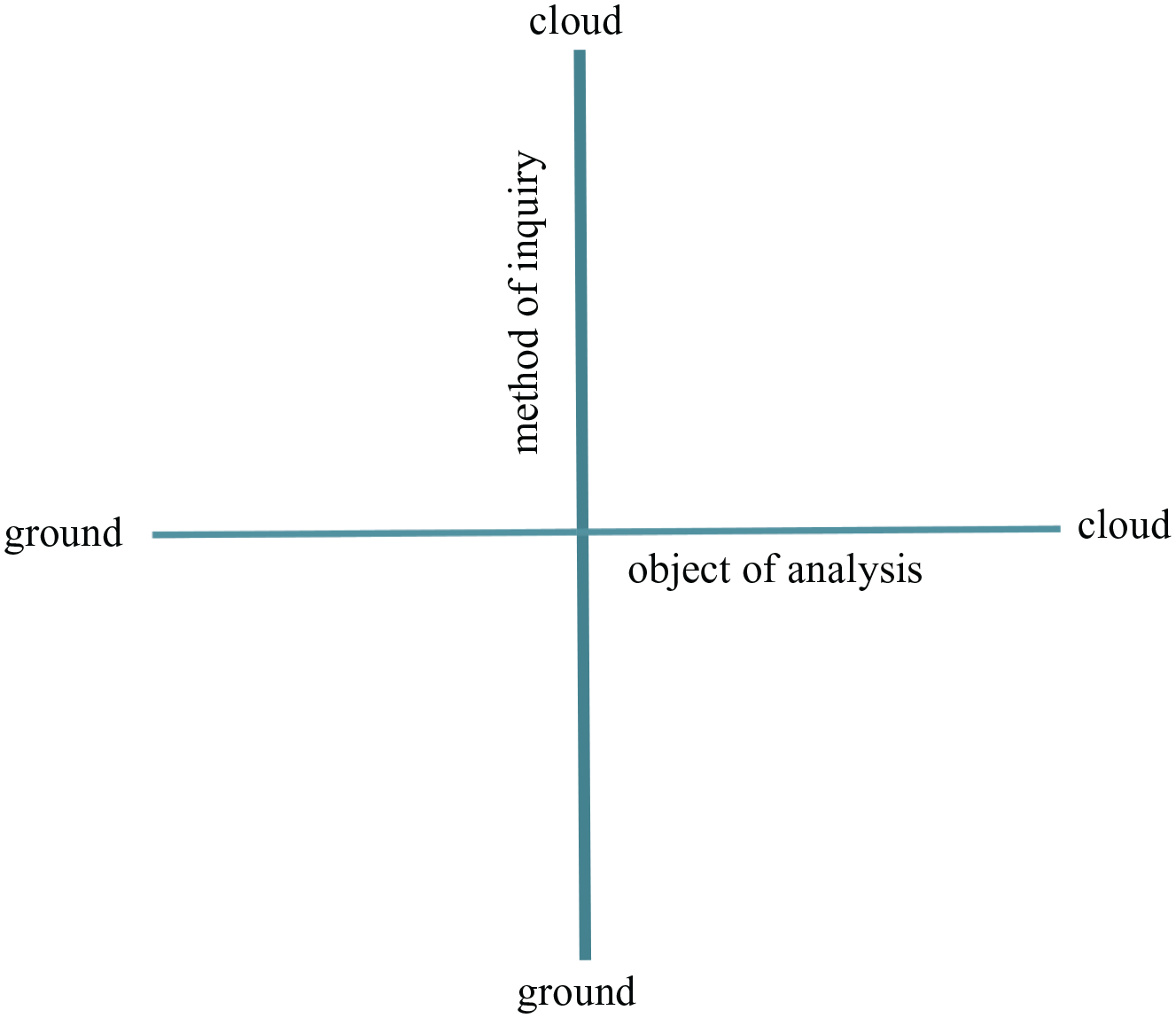
Visualizing ground and cloud.
Strategies that conscientiously combine ground and cloud-based inquiries are rooted in recognizing the partiality of knowledge. Big Data do not provide a god’s eye view. Rather, drawing from feminist science studies scholar Donna Haraway (1988) and more recent work in critical data studies (boyd and Crawford, 2012) and feminist digital geography (Elwood and Leszczynski, 2018), I understand both online and offline worlds as partial, subjective, and subject to interpretation. In this context, moving from ground to cloud is the challenging, iterative work of building and bounding a pathway for inquiry through interlinked on- and offline spaces. Analogous to Ian Russell’s (2022) notion of “mid-range ethics,” ground to cloud provides a guide for reflexively navigating between abstract principles, on one hand, and the specific techniques and often unanticipated choices faced in the field, on the other hand. As such, it should be adapted to sites and circumstances and over time, as a component of and potential starting point for what Rachel McArdle (2022) terms, “flexible methodologies.”
Figure 2 invites consideration of a vast range of potential combinations, including (clockwise from top left) remote methods for understanding material practices, digital archives of digital activity, in-person interviews about online activities, and good old-fashioned ethnography. These are just a few examples. We could imagine using an online method to understand a grounded phenomenon, in the top left quadrant, for example by analyzing Twitter data on a recent Iranian election (Kermani and Adham, 2021), or using an in-person method to understand digital phenomena, in the bottom right, for example, an authoethnographic account of digital health (Thompson, 2021). Our object of analysis, on the horizontal axis, might range from evictions or climate change impacts, on the left, to cultural heritage preservation Facebook groups or TikTok videos, on the right. Similarly, our method of inquiry, on the vertical axis, could be either in-person or Internet-based. Tools might range from interviews and participant observation on the ground (bottom), to online surveys in the cloud (top). Strategies that reside in the same quadrant can vary substantially. For example, computational text analysis, a method that employs software to count the words that appear in a text, and qualitative coding, an interpretive method for categorizing key themes in text, interviews, or images, can both be applied to social media posts, which would put them both in the top right quadrant.
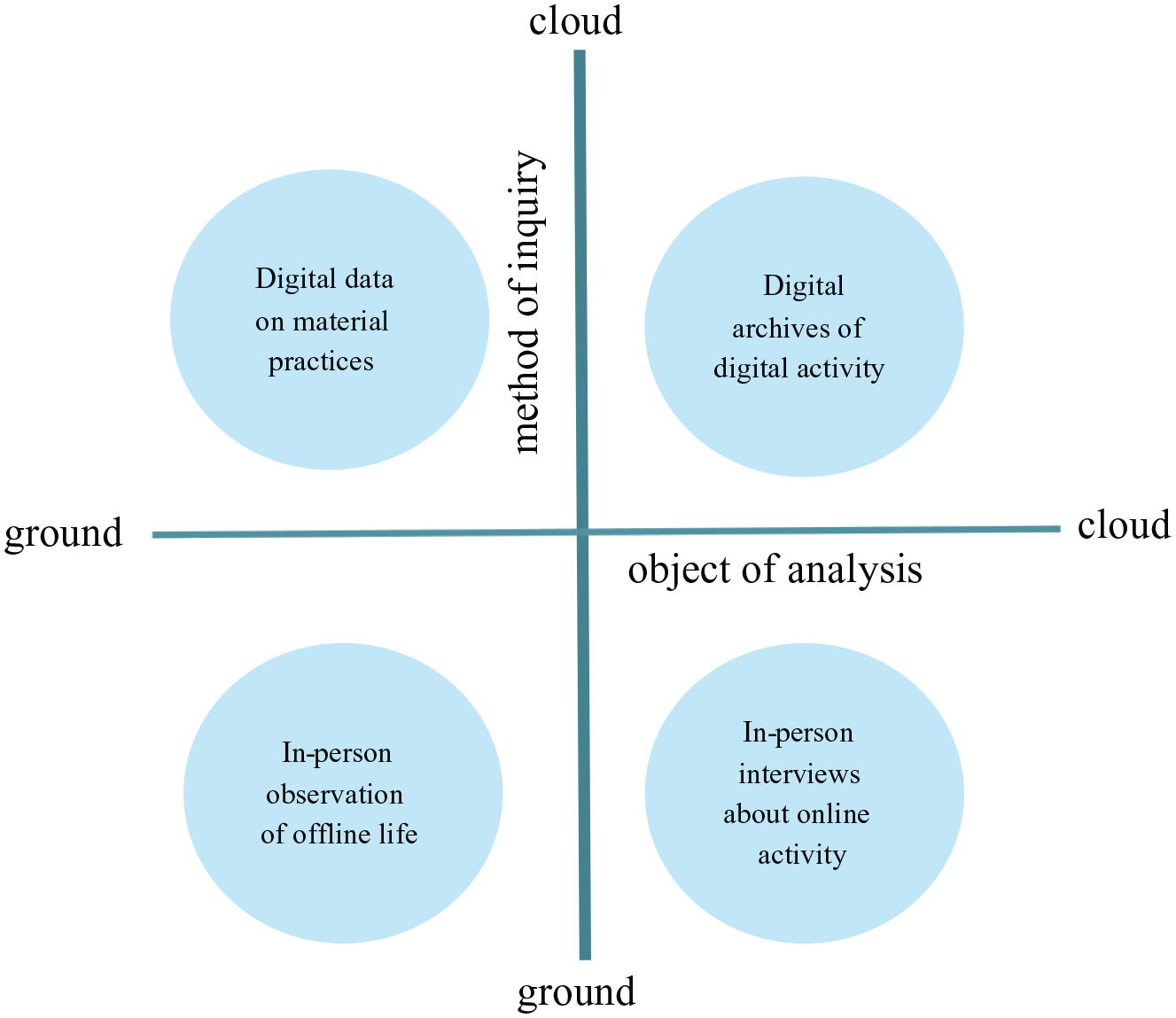
Locating research strategies.
While enumerating the diverse techniques available to researchers is beyond the scope of this article, it is worth noting that each method carries different opportunities, constraints and ethical dilemmas. For example, digital ethnography has expanded in recent years as researchers employ online forms of participant observation to understand everyday life in an era of ubiquitous computing (Duggan, 2017). Yet as researchers move from “deep hanging out” in the village or laboratory to “lurking” online in Slack channels and Twitter (now X) threads, they reencounter persistent problems of time and trust (Coleman, 2010). The digital ethnographer is granted new access, even as she is severely limited to observing life within the screen. In web scraping, however, researchers can access massive amounts of data through APIs 2 and online archives. Yet, automated systems for data collection are guided by algorithms with their own assumptions and analytics (Marres and Weltevrede, 2013). While a researcher can reflect on his or her own positionality and interests, the biases introduced by algorithms designed by others can be more difficult to assess. Complicating matters further, computational tools vary by platform, and some require new programing skills. And platforms change over time, often restricting access. 3 Both digital ethnography and webscraping require that researchers understand the affordances of particular platforms, build new organizational systems, and reconsider consent in light of the heightened difficulties of veracity, security, and privacy.
Weaving these data collection strategies together often means that a research project will traverse quadrants over time. Combined approaches such as Ayona Datta’s (2019) coupling of in-person focus groups where women mapped urban safety (bottom left) with individual WhatsApp diaries where they recounted personal experiences of moving through the city (top left) can help hone research questions and deepen insights. Combining methods also allowed Datta to overcome some of the key limitations of digital research, for example, a lack of relationship with the “user” and inability to reliably situate them in social and material space, while also allowing greater trust and deeper discussion over time, in this case through short online interactions woven into the fabric of women’s busy daily lives. In this way, moving between ground and cloud provides analytic advantages, making the combination of methods more than the sum of their parts. Movement between the quadrants enables a better understanding of digital-material space.
Sequences can be designed far in advance or adapted in the face of new challenges. In graduate workshops on post-pandemic methods, for example, I suggested that students facing acute disruptions to research due to COVID start thinking about the possibilities for digital methods by articulating their intersection with an interest or question developed offline. I also suggest starting small: we begin with a show and tell of one image that captures something about the student’s project and its digital manifestation, for example, a screenshot of a social media post from a Puerto Rican agroecology collective. Sharing these images an easy, social exercise that invites curiosity and enables students to develop a vocabulary for discussing online artifacts in relation to broader research projects, for example, food sovereignty and coloniality in Puerto Rico. Next, they find and follow a single user, group or hashtag, a process useful for contextualizing, formulating or answering research questions. These modest exercises provide a foundation for incorporating social media into planning for broader projects. 4
Envisioning the ground and cloud as both objects of analysis and methods of inquiry reveals not only that various combinations exist, but also that the relation between ground and cloud is not static. Rather, during the process of research, a researcher might chart a pathway through the quadrants, employing exploratory digital ethnography, in-person observation, remote interviews, and scraping web data. While some topics and techniques trouble the clear distinction between ground and cloud, conceptualizing the research project as moving iteratively through modes and objects of inquiry in an evolving networked field site enables the researcher to make conscious decisions along the way about what and how to study, both before and during data collection. To give a sense of what this looks like in practice, I offer a reflection on a decade of research into agrarian and technological change in Myanmar.
Moving from ground to cloud in Myanmar’s digital villages
Historical circumstances, rather than formal training, pushed me into digital research. When I moved to Myanmar in 2014, the Internet was almost completely inaccessible. Most people could not afford to go online; I paid over US$120 for my first mobile SIM card—about 10% of the country’s average annual per capita income. Later that year, SIM cards were sold on my street for a dollar, a price drop due to the privatization of the military’s telecoms monopoly that represented one of the more tangible results of the country’s fraught transition to democracy. Facebook quickly became the nation’s dominant platform and a key public sphere. I came to support and learn about struggles for environmental justice and gender equality, but along the way, I became obsessed with understanding what expanding digital connection meant for the communities of farmers and activists with whom I lived and worked. This interest pushed me into new terrain—empirically, conceptually, and methodologically—as I stumbled from accidental toward meaningful and ethical digital research.
My study began on the ground, in the paddy fields, churches, monasteries, offices, and homes where I conducted ethnographic research from 2014 to 2019. Like many contemporary researchers, I used the Internet to stay up-to-date about current events, following media outlets and government pages on Facebook. Though I rarely use social media personally, it became increasingly invaluable professionally; I participated in and observed locally based online communities, including Viber groups for buying and selling land in the provincial town where I was based, land rights activist messenger groups for coordinating events and sharing news, and village Facebook groups, where current residents and those working abroad could share missives from daily life, advice about livelihood opportunities, and encouragements to contribute to community development projects. I became curious about how Internet use was extending and reshaping the processes of political and agrarian change that I set out to study, and began to ask about the significance of digital platforms in my interviews and informal conversations with grassroots activists, villagers, and provincial bureaucrats. The digital had gone from a method of inquiry to an object of analysis.
I continued my research by using on-the-ground methods to understand the significance of digital connection. In early 2019, I began a series of village focus group discussions on technological change, which included a participatory activity to make and discuss a timeline for the arrival and prevalence of a range of machines, from TVs and solar panels to combine harvesters and mobile phones. Focus groups provided useful snapshots of technological change, showing how it unfolded over time and varied between villages of different ethnic groups and across generation, gender and class within villages. To better understand individual patterns of behavior and interpretations of the digital, I conducted a series of semi-structured interviews in which I chatted with villagers as they used Facebook, asking about what they were doing and why. Notably, these in-person conversations uncovered patterns and meanings I could not have inferred from online observation alone, for example, the creation of multiple Facebook profiles for distinct types of activities. This over-the-shoulder investigation was critical to generating a grounded theory of the digital village, a networked social space in which online practices emerged from preexisting agrarian relations to reshape economic, social and political life (Faxon 2022).
This on-the-ground research structured my later inquiries from the cloud. In late 2020, I was awarded a grant to lead a project on digital cultures and exclusion in Myanmar. Funds came from Facebook as an unrestricted gift to the Myanmar organization with whom I worked. Taking money from the platform raised questions, but ultimately enabled me to support one of Myanmar’s leading digital rights groups, to employ Myanmar analysts and researchers as well as graduate student collaborators, and to access Crowdtangle, Meta’s data analysis tool for public content shared on Facebook, Instagram, and Reddit, to study the digital village at a larger scale. My first goal was to understand the extent of and activity on the farmers’ Facebook groups I had observed villagers using to buy seeds and solicit pest eradication advice. With a trusted research assistant who had accompanied me on much of my in-person field work, I began with a digital ethnography of these groups, following two dozen and taking notes on key themes and interesting posts. These observations became the basis for subsequent keywords and codes. After generating a list of Myanmar language keywords related to agriculture, my team used Crowdtangle to search for pages and groups, reviewing the results for relevance to create a dataset of 110 pages and 100 groups related to Myanmar agriculture. Each week, we downloaded the top 100 posts from the pages and top 100 posts from groups. Using a codebook based on key categories generated from the first phase of digital ethnography, we qualitatively coded individual posts for overlapping themes, for example, “advertisements,” “markets,” and “agricultural advice.” We met on Zoom to discuss trends and clarify and update codes. After 6 weeks of coding, trends were clear: pages and groups provided spaces to promote agricultural goods, share information on commodity markets and farming advice, and memorialize the struggles and achievements of contemporary agrarian life (Faxon 2023).
Originally, I planned to follow this analysis with interviews with Facebook group administrators and users to understand who was participating in these online communities and how they interpreted them, moving our method of inquiry from cloud to ground. But these plans were stymied, first by COVID, and then by Myanmar’s 2021 military coup. Instead, my team continued to collect social media data after the coup, generating an archive of over 2000 posts. The following year, we collaboratively analyzed this archive to reveal the ways in which seemingly mundane online spaces changed amid national political crisis and ensuing violence, drawing on close reading of illustrative posts to show how agrarian populations experienced democratic and economic collapse (Faxon et al. 2023). In tragic and difficult circumstances, digital methods provided some insight into agrarian anti-authoritarian politics.
My ongoing work returns to more traditional methods to understand questions of governance, motivation and meaning, which are difficult to assess online. One study consists of remote and in-person interviews with members of the Myanmar diaspora to understand how their online activities extended connections to former and current homes, both before and after the coup. Another uses interviews with local digital rights activists and current and former Facebook staff to understand the platform’s response to the military coup. These interview-based approaches enable us to probe individual interpretation and broader context with social media designers and users. My objects of analysis, in these projects, are online processes of community support and platform governance. My method of inquiry has moved from the cloud, back to the ground.
Discussion
This brief personal account provides an overview of a research sequence that iteratively employs ground- and cloud-based modes of inquiry to study the entanglement of virtual and agrarian space. While my PhD dissertation proposal barely mentioned the Internet, I relied on digital methods to study processes of political, social, and environmental change. This type of opportunistic, ad hoc usage of digital methods was widespread before the pandemic and has become ubiquitous since; making it a conscious part of research strategy was essential to ensuring rigor and ethical conduct in my own case. As the digital became an object of my analysis, grounding my research in longer work in paddy fields and farmers’ homes guided the types of questions that I asked and enabled me to interpret the online patterns I observed. During my dissertation fieldwork and again in later projects, I employed in-person interviews and ethnography to study digital patterns and their significance. I also used digital methods to study mobilization and online patterns of agrarian commerce and connection. Over the course of a decade, this sequence traversed digital and material topics and tools, adapting to new research questions and constraints. Overall, moving from ground to cloud and back enabled me to understand the effects of digitization within longer social histories, the role of digital connection in mediating economic and political geography, and to continue my work amid increasingly adverse conditions. An abbreviated version of this movement from ground to cloud and back is represented in Figure 3.
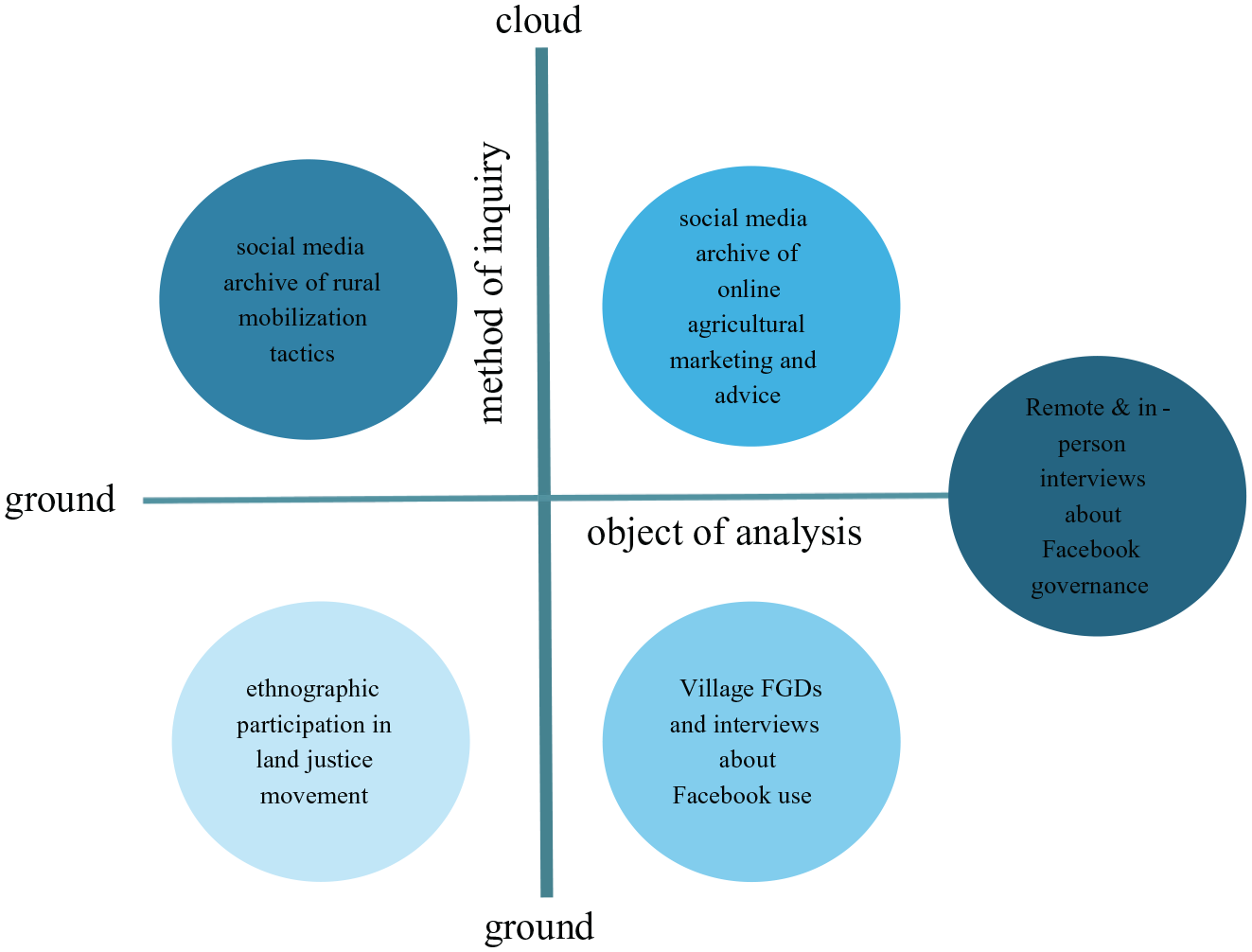
Reflecting on a research trajectory. Lighter shading represents earlier stages of the research process.
In my own case, thinking across the ground and cloud illuminated the advantages and disadvantages of various approaches, enabling me to overcome the blindspots that plague any single study. Using tools like Crowdtangle allowed me to expand the scale of my analysis while revealing some of the limitations of my past work. For example, while my interest in rural politics and previous observation of satirical cartoons and government critique in farmers’ Facebook groups had led me to focus on the role of the Internet in enabling grassroots mobilization, quantitative analysis revealed that, before the military coup, political critique made up a miniscule amount—less than 5%—of popular posts. While arguably any public critique is remarkable in a country with a long history of repression, analysis revealed the striking degree of commercialization—one-third of posts were some sort of promotional content. This and related studies attests to Facebook’s outsized role in not just marketing, but also in making markets (Wittekind & Faxon 2023).
Crowdtangle came with its own constraints. First, my access was contingent on corporate decisions. Crowdtangle was an independent company acquired by Meta in 2016, which gave Meta itself the ability to grant or deny access to publishers, journalists, and academics. Access was free, but dwindled over time: Meta disbanded the Crowdtangle team in 2021 and cut off all new user registrations in 2022. In 2024, Meta announced it would shut down CrowdTangle altogether, underscoring the power of platforms to control data availability. While Crowdtangle enabled me to monitor agrarian politics when pandemic and political crises limited in-person access, it came with its own constraints. Second, Crowdtangle’s vast quantities of data came with their own limitations. Because Crowdtangle only includes public data, the village Facebook groups I focused on in earlier research were invisible, as were activist messenger groups and other private online spaces to which I had gained access on the basis of offline trust. Crowdtangle privileges popular posts, which makes it a poor tool for studying minority views. We partially overcame this with our keyword search, which enabled us to target a specific online community that operated outside of popular national media, government and celebrity pages, but a persistent frustration was Crowdtangle’s proxy for popularity, the “overperforming score,” which my team found baffling and Facebook employees themselves describe as “complicated” and “arbitrary.” 5 During the time I used the platform, the tool itself was mired in controversy; in part for its decision not to measure “reach” or the number of people who have read posts. 6 As we learned when welcoming a new member of our research team who ran the Facebook page for his family’s agricultural machinery business in Myanmar, Facebook does indeed collect such data, as well as data on the gender and location of users, but chooses to make it available only to page administrators, not to researchers. This tantalizing glimpse provides an impetus for researchers to consider building relationships with individual users, especially page administrators, in order to access and understand online data.
Having our data filtered by an algorithm provided a dataset that, like ethnography, was partial, but, unlike ethnography, was derived from the assumptions and analytics of unknown designers. If left unacknowledged, these limitations could lead to fallacies, but, read cautiously as one partial account within longer, ground-based research, Crowdtangle data provided insights into Myanmar agrarian and political life that, particularly in light of COVID and the coup, had become increasingly difficult to observe. Like methods that seek to study platform urbanism “outside the black box” (Fields et al., 2020), combining social media analysis with broader ethnographic engagement provided one strategy for situating vast but partial data, skewed and hidden by corporate priorities.
My experience raises additional questions about the practices and politics of research that moves from ground to cloud. As my own funding and use of Crowdtangle demonstrate, research activities are not neatly separable from the politics of corporate Internet. Taking research money from platforms, in my case without any corporate oversight but still as a symbolic part of a public relations initiative, enabled funding local research assistants even as it heightened pressure to consider our intentions, positionality and critical perspective. I suspect that decisions about research funding and collaborations with platforms will become more numerous in decades to come. COVID, but also acute political crisis, not only forced immediate adaptation but also had a lasting impact on the research landscape in Myanmar, where on-the-ground inquiries are now nearly impossible, and increasing surveillance means that few people speak out publicly online. Navigating between ground and cloud therefore demands continual attention to consent and anonymization as risks change. In my own case, collaboration and long-term engagement in a research site have been essential to negotiating these dilemmas, as well as to making sense of findings and refining research questions. These considerations gesture at the much wider set of issues to be addressed as researchers integrate ground to cloud strategies with specific research questions and techniques as part of a comprehensive methodology.
Conclusion
This article has provided a heuristic for navigating research tools and topics enmeshed in complex digital-material geographies. Conceptualizing both potential objects of analysis and methods of inquiry as unfolding in “on the ground” or “in the cloud” enables the researcher to find and follow a pathway through geographies produced through, by and of the digital. Drawing on my own experience in Myanmar’s villages and Facebook groups, I have demonstrated how moving from ground to cloud and back is an iterative process that enables researchers to understand and supplement the partial knowledge and limitations of any singular method, providing a picture of both a particular process of digitization and wider political and agrarian geographies.
Moving from ground to cloud demands an ethos of experimentation and an ethic of care. Like any research process, choices about tools and topics are shaped by the researcher’s interests, values, disciplinary conventions, and epistemic frameworks. Designing and adapting a methodology is often a process of trial-and-error, as researchers observe new trends, formulate new questions, and confront acute constraints. Given the rapidly changing nature of digital platforms and the access afforded to researchers, as well as situational shifts that can change research questions and offline access, flexibility and nimbleness are essential. The exercise of mapping ground and cloud provides a range of options that can be considered, tried out, and changed throughout an evolving series of studies.
To embrace an ethos of experimentation is not to condone a policy of moving fast and breaking things. Throughout this process, researchers must reflect on their own responsibilities. Digital methods raise new ethical questions, for example, about what is considered “public” and “private,” whether to announce oneself online as a researcher, and if and how to secure consent. For example, after discussions with my university ethics review committee, digital humanities and social science librarians, and research team, I decided not to announce myself or ask consent to use data from large (greater than 100,000 member) Facebook groups that were set as “public,” but I do cover usernames and identifying information when reproducing posts in presentations and publications. Ethical considerations, as well as methodological strategies, will differ across platforms and geographies, whether in the encrypted Signal chats of Hong Kong protesters or the highly censored mainstream of the Chinese Internet. Rather than adopting a static set of rules, researchers moving between ground and cloud must embrace an ethics of care, a stance that emphasizes critical reflection at different stages of research and considers different communities of accountability in the face of changing circumstances (Berkeley, 2021; franzke et al., 2020; Zook et al., 2017).
Ground to cloud is inspiration for investigation, not a one-size-fits-all solution. In my own courses, the exercise of mapping and charting a pathway from ground to cloud and back has been useful for designing and updating methodologies for a range of projects, from understanding Latinx cultural heritage in L.A. to assessing climate change in Myanmar. This heuristic has proved useful for both proud and reluctant digital geographers, helping researchers pin down exactly how the cloud is an object of analysis and/or a method of inquiry. As more and more researchers focus on digital topics or adopt digital tools in various stages of research across a wide range of subjects, consciously conceptualizing research as moving from ground to cloud and back again can aid reflection on the possibilities and limitations of distinct approaches, and the development of customized strategies to understand urgent puzzles in an increasingly, but still unevenly, digital world.
Footnotes
Acknowledgements
Gratitude to my collaborators Kendra Kintzi, Courtney Wittekind, Mai Van Tran, Swan Ye Htut and Kay Zak Wine, my companions in the Matrix Collective, and my research assistants, advisors, friends and interlocutors during the many stages of this project.
Declaration of conflicting interests
The author declared no potential conflicts of interest with respect to the research, authorship, and/or publication of this article.
Funding
The author disclosed receipt of the following financial support for the research, authorship, and/or publication of this article: Data collection and preliminary analysis for part of the research mentioned in this article was funded by an Independent Award from Facebook Research. Work on this article was also supported by funding from the European Union’s Horizon 2020 research and innovation program under a Marie Curie Fellowship.
