



Abstract
In this article, a spatial political economy approach is used to examine the development of global capitalism through an analysis of the expansionary movement of commodity frontiers. It surveys the early history of oil exploitation in Chile and offers a close analysis of Patagonia’s constitution of its oil commodity frontier as Cheap Energy. It is argued that focusing on the internal relation of space and Nature can enhance our understanding of capitalism as an emergent and dynamic totality grounded in particular places where value is extracted. The article sheds new light on the spatialities of Import Substitution Industrialisation in Latin America using the case of Chile and its development agency, Corfo, and reveals how the capitalist ideology of Nature was wrought as a state project. The political economy of scale in this context is examined by analysing the central role of state and class relations in the environment-making process of capital accumulation. The article advances a new understanding of State–space within uneven and combined capitalist development. The spatial political economy lens allows for a fresh understanding of past history, which may help us understand the current ‘green’ energy transition by means of the production of space and Nature.
Introduction
In November 2020, the Chilean state launched the Green Hydrogen National Strategy to develop the ‘green hydrogen’ industry in the country, aligned with the idea of a ‘mission-oriented economy’ (Gobierno de Chile, 2020: 21). This strategy not only asserts that Chile has ‘the cheapest green hydrogen on the planet’ but projects ‘a new clean industry as large as the mining sector’ (Gobierno de Chile 2020: 11–12). The strategy’s claims are based on Chile’s renewable energy potential, defined according to three geographical macro-zones for renewable energy exploitation (McKinsey, 2020: 31). A high potential area identified for producing green hydrogen is southern Chilean Patagonia due to its on-shore winds being as strong as its off-shore winds. 1 In this context, Patagonia is positioned as a subnational scale connected to world-capitalism through its potential to become a world hub for green hydrogen production. Chilean Patagonia has been identified before as a critical place to organise the country’s energetic needs through historically specific processes of state spatiality restructuration seeking to integrate it into the circuits of capital. Therefore, it represents a quintessential case to study the current hectic global race to achieve the ‘green’ energy transition in the uneven development. My contention, however, is that this process can be better understood through a spatial political economy lens by analysing the constitution of commodity frontiers through the production of space, arguing that the green energy transition is based upon a socially abstracted notion of Nature and space rooted in developmental policies dating back to mid-20th century. As Hesketh (2021: 543) argues – regarding the wind parks in Oaxaca – the green energy transition operates within the borders of ‘a spatially abstracted, colonial epistemology of capital-centred development’, which, in turn, involves ‘a remaking of space and a process of appropriation of Nature on behalf of capital’. This article expands this analysis to understand the historical roots present in today’s race to comprehend the social production of Nature for the energy transition.
Chilean Patagonia could be understood as a local social space with a particular history that reflects the global movement of capital, as it has recently been claimed that the global capitalist economy has emerged from local configurations of social space and power through the expansion of commodity frontiers (Beckert et al., 2021b: 435, 440). Hence, this article aims to contribute a ‘spatial political economy’ interpretation of the expansion of commodity frontiers by internally relating space, Nature and the state (Christophers, 2022; McLoughlin, 1994; Morton, 2017; Stilwell, 1992). It focuses on how we can relate space and Nature to better understand ‘capitalist emergent and dynamic totality’ grounding in particular places (Altun et al., 2023: 12). The study of this expansionary movement of commodity frontiers shows some of the ‘fundamental dynamics of capitalism and its connection to and subsumption of new spaces, new countrysides and new forms of nature’ (Beckert et al., 2021a: 437). The article contends that a spatial political economy approach is needed to analyse space and Nature as part and parcel of the uneven development. Furthermore, a spatial political economy approach reveals how the social production of space and Nature is embedded in the hegemonic project of capitalist accumulation, as it insists on the constitutive role of space in the production and reproduction of capitalist social relations (McLoughlin, 1994: 1114; Stilwell, 1992: 15). It emphasises how commodity production, surplus extraction, and accumulation in the capitalist system generate shifting geographies of accumulation (Cuthbert, 2006: 15).
Approaching the analysis from a spatial political economy standpoint overcomes the challenge of the apparent aspatial condition of accumulation strategies and development agencies, by seeing both as embedded in the production of space and Nature. While Smith (2007) argues that capitalist societies produce Nature from ‘an incidental and fragmented reality to a systemic condition of social existence’ (pp. 21–22), Lefebvre (1991 [1974]) contends that ‘the raw material of the production of space’ (p. 123) is Nature itself, transformed into a product. Therefore, societies not only incorporate different aspects of Nature into social relations but produce a particular spatial relation – this is the fundamental capitalist dynamic that spatial political economy unveils. The article argues that the state, as the balance of the ‘condensation of social forces’ (Poulantzas, 1978 [1974]: 158–159), forges a legibility of Nature for capital accumulation. Yet, this legibility of ‘Nature’ is contingent on the global expansion of capitalist development by means of the constitution of commodity frontiers in specific places (Moore, 2000: 410–413, 2015: 2). Hence, the study of capitalism through commodity frontiers shows how particular places and processes have been incorporated and connected to capitalism’s ongoing surplus extraction dynamics. Furthermore, it shows the making of capitalism Cheap strategy – that is, the combined praxis of appropriation of external Nature and its process of creation to achieve capital accumulation (Moore, 2015: 17). In this sense, the article delves into the role of the state to shed light on the current green energy transition, as the Chilean state is also playing a major role by making the current local Patagonian oddity part and parcel of the global ambition where multinational energy companies are already behind the Chilean-based projects. 2 The article will do a progressive-regressive methodological analysis, collecting the evidence from the most effervescent period of the Import Substitution Industrialisation (ISI) strategy in Latin America, in which the constitution of the oil commodity frontier took place in Chilean Patagonia. Then, as a conclusion, it will show how the current race for the green energy transition is rooted in the appropriation and exploitation of Nature for capitalist accumulation. In so doing, the article will explain how the state appropriates, makes and exploits Nature to expand capitalist accumulation. Accordingly, we will be ‘using the past to make sense of the present, then using the present to understand the past, and a progressive analysis open to the future, to the possible’ (Elden and Morton, 2022: xxix). Therefore, we will explore the capitalist environment-making process in the oil commodity frontier to make sense of the green hydrogen industry’s present development to open the possibilities of a greener future.
Yet, the spatial political economy approach can also incorporate space as socially produced and co-constitutive of Nature–Society relations of an emergent totality in the capitalist system. Drawing on Lefebvre’s (1991 [1974]) production of space framework, which ‘acts retroactively upon the past, disclosing aspects and moments of it hitherto uncomprehended. The past appears in a different light, and hence, the process whereby the past becomes the present also takes on another aspect’ (p. 65). Hence, this article argues that the production of space is internal to capitalist uneven and combined development and that the production of Nature interweaves with the production of space to expand capitalist accumulation. In contrast, mainstream scholarship on space and Nature usually offers an analysis centred on how economic activities are carried out or circulate in or across different places, in which Nature seems to be a given (Barnes, 2009: 315; Florida and Adler, 2020: 25). Thus, spatial science has become swallowed in the enumeration of objects, things and categories that are externally connected in or across discrete fragments of a static spatial whole (Lefebvre, 1991 [1974]: 88–91). This external approach fails, therefore, to investigate what the hidden abodes of these spatial appearances of capitalism are because while the appearance of objects, things and categories can be multifaceted (e.g. wind parks, industrial complexes, infrastructures, commodity production chains and networks, etc.) in and across discrete fragments of space, their essence is a hidden abode of the internal relations of space-Nature–Society in capitalism. Therefore, spatial scholarship needs to centre a theorisation of space and Nature in the uneven development of capitalism. This article contributes to this debate from a spatial political economy approach by analysing how capital’s ‘praxis of external nature’ becomes an ‘ideology of Nature’ wrought as a state’s project to expand capitalist accumulation through the production of Nature (Moore, 2015: 17; Smith, 2010 [1984]: 10–48). A close analysis of the Chilean Development Corporation (Corfo), funded in 1939, contributes to the debate about the role of development agencies in Latin America as agents in the state environment-making process. It also contributes to understanding the role of the state as promoter and enhancer of capital’s ideology of Nature, which has been central to the appropriation and exploitation of human and non-human Nature for capitalist accumulation.
Using a spatial political economy approach to consider the role of development agencies that led ISI strategies in Latin America, the state’s role is investigated in two interrelated ways. First, spatial political economy unpacks the spatial character of state policies by going beyond the apparent aspatial condition of policies that impact specific locations (Brenner, 2004: 79). In this sense, spatial political economy ‘goes back to the old political economy’ by analysing the production of space as underpinning the hegemonic project of capitalist accumulation (Hesketh, 2017: 84; Lefebvre, 1991 [1974]: 104). Second, drawing on Morton (2018, 2017: 23), this article elucidates how the state organises space in everyday life and unpacks the multiple modernities that have shaped Latin American geographical spaces. State institutions view space as an instrument for mobilising and organising social relations of production, which is crucial for the production of Nature (Lefebvre, 2009 [1978]: 226). The state emerges, therefore, as a critical condition in our analysis of the production of space and Nature – as a strategic site for leveraging socio-spatial divisions of labour crucial for capital accumulation (Jessop, 1990: 260; Santos, 1996 [1978]: 51), as a condensation of social forces and as a hinge for the internalisation of external interests across scales (Cardoso and Faletto, 1979: xvi; Poulantzas, 1978 [1974]: 158, 159).
This research thus expands the analysis of the state’s role in wrought capital’s ideology of Nature through State–space to constitute the oil commodity frontier, which is crucial in peripheral economies. As Coronil (1997: 32) argues, commodity production in the periphery is not only organised around labour exploitation but also around ‘natural’ resources in a mutual commodification of labour power and Nature. The article’s first section addresses capital’s ideology of Nature as an external object to be appropriated and exploited – wrought as a state project. The second section considers the organisation of capital’s interests around the oil commodity frontier and how the state emerged as the condensation of social forces to explore and exploit oil as a free gift of Nature. The third section discusses the role of Patagonia as a subnational scale in the national modernisation of capitalist accumulation, highlighting how the state planned and produced State–space for capitalist accumulation. To conclude, the article offers new understandings of the past to help us understand the present challenges of the ‘green’ energy transition by taking a progressive step into Patagonian space.
Capital’s ideology of Nature wrought as a state project
Capitalism is understood here as environment-making in a socio-ecological relation. As Smith (2010 [1984]) contends, in the process of achieving that foremost of capitalists’ aims, surplus extraction, ‘capital stalks the whole earth, it attaches a price tag to everything it sees and from then on it is this price tag which determines the fate of nature’ (p. 78). This section tackles how the capitalist ideology of Nature is shaped and promoted by and through the state. I argue that the Chilean state, through Corfo, constructed the foundations required to externalise, expand, organise and make Nature work as the cornerstone of Chilean capitalist development (Moore, 2015: 86, 112–113); that is, the Chilean state orchestrated the incorporation of human and non-human Nature into capitalist accumulation, expanding the frontiers of accumulation through the capitalist dualist rationale of Nature–Society relations. Drawing on Hesketh’s (2021: 543–46) approach that links the colonial deployment of spatially abstract knowledge – saber – to energy production, this article explores its primitive manifestation in Patagonia.
According to Hesketh (2017: 40), new rounds of accumulation can only occur through a restructuring process of the space economy, and it is essential to consider some crucial contextual conditions in the Chilean economy to understand how Corfo played a significant role in organising the national space of accumulation. At the beginning of the 20th century, the Chilean economy was organised through a discontinuous and segmented chain of individualised spaces of accumulation, which constituted the ‘material bases of political power’ for each fraction of the dominant class (Poulantzas, 2000 [1978]: 104–105). This situation meant that forming a national market collided with the political character of the subnational spaces of accumulation, as the capitalists’ spatial differentiation vis-à-vis their political organisation at the national scale was forged in divergent economic activities. The national space of accumulation was characterised by subnational spatial differentiation: the Norte Grande at the end of the British nitrate exploitation cycle, the Norte Chico, as the emergent copper producer led by US companies, the centre-south regions, mainly oriented towards coal exploitation and Mapuche’s territory violent appropriation, and the Central Valley, which was the base for the traditional landlords dedicated to agroindustry and merchant activities. At this time, Chilean Patagonia was consolidated as part of the national territory focused on the sheep breeding industry. Each of these spaces was outward productively oriented, formed as spontaneous productive poles in previous accumulation strategies, and the rational and scientific space was being constructed through the agency of Corfo. Hence, the interaction between state and territory creates a mutually constitutive process which involves an encounter between different spaces: a rational and scientific space produced by the state, and spontaneous growth poles that come from previous modes of production (Lefebvre, 2009 [1978]: 228, 39).
In consequence, Corfo’s priority has been to modernise capitalist accumulation in Chile through a ‘rationalising and standardising format’ to produce Chilean Nature as a resource for enhancing and diversifying the capitalist mode of production (Scott, 1998: 4). A prominent example of spatially abstract knowledge can be found in key documents produced by Corfo, which were the cornerstone for presenting and developing state-driven industrialisation and for which purpose, an ideology of Nature was neither arbitrary nor accidental. This ideology of Nature served the purpose of capital by consolidating the externality of Nature as a so-called natural resource. This ideology of Nature incorporates both input and outcome: the production of Nature deploys utilitarian knowledge, which focuses on those aspects of Nature subject to appropriation and exploitation (Scott, 1998: 13) and it involves a dialectical relation between spatial differentiation and equalisation, mediated by a homogenisation process of space, which renders space as homogeneous, quantifiable, fragmented, yet unitary and hierarchical (Dimendberg, 1998: 24; Smith, 2010 [1984]: 175).
In 1942, Corfo’s first Executive Vice-President (acting chief executive officer (CEO)) and one of its founders gave a speech at the annual assembly of the ‘Confederación de la Producción y del Comercio’ (the main industrial business association in Chile) explaining that Corfo’s first duty was to elaborate a General Production Plan. However, Corfo could not make this Plan in a short time because ‘We did not have any idea neither systematised nor complete about the richness of our land. We did not know precisely about the rational use of the riches of the country’s regions’. (Guillermo del Pedregal, in Corfo, 1944: 30). 3 Hence, Corfo’s modernisation of Chilean capitalism was structured according to neoclassical approaches for measuring and quantifying the so-called national income, natural resources, and labour power. Yet, these studies were ‘the very-first comprehensive and detailed study that has been made in our country [Chile]’ (Oscar Gajardo Villarroel, Corfo’s CEO, in Corfo, 1945: 9). In addition, it is relevant to highlight that Corfo’s project was aligned to Keynesian ideas of the state ‘intervention’ in the economy. Corfo was the second Latin American agency for development, preceded by Nafinsa (Mexico, 1934), and this was the dawn of Keynesianism in Latin America. Corfo’s General Manager also argued about the need for a production plan prioritising specific industries’ ‘need of resources’: ‘the absence or scarcity of these indispensable factors for industrial progress, makes it imperative to coordinate the efforts aimed at the development of production, making the best use of all these resources to satisfy the national interest’ (Desiderio García, in Corfo, 1944: 31–32). These excerpts illustrate the coordinating role that Corfo sought to play in the modernisation of Chilean capitalism and the production of Nature for capital accumulation. Spatial political economy seeks to understand how the state orchestrates the exploitation of ‘natural’ resources located on subnational scales to organise the national scale of capital accumulation. Section 3 discusses how subnational scales were organised according to the national scale’s production needs by means of State–space.
The ‘Renta National’ report was central to Corfo’s documentation; it proposed quantifying the country’s productive industries to provide a base for expanding capitalist accumulation. ‘Renta Nacional’ had begun in 1940 to produce a neoclassical economic base from which to formulate the national production plan (Corfo, 1945: 12). As Coronil (1997: 42) asserts, ‘the neoclassical economics determines value through the subjective preferences of economic agents’ and, accordingly, the value of so-called natural resources is defined by their ‘utility for consumers as measured in the market’. Hence, the role of Corfo was to put in motion this approach to Nature and generate an adequate legibility of Nature as a resource for capitalist accumulation. In the Renta Nacional report, Nature was defined as a dominated external object while the state was described as a key player in its exploitation, as never before in history, men [sic] have witnessed a greater degree of civilisation and culture, feel more consciously their dominion over nature, and reach a more omnipotent capacity for production. There is an obvious fact that nobody can deny: the need for greater state participation in the orientation and direction of the economy. Intervention that is justified as a means of achieving greater and more stable national wealth. (Corfo, 1945: 7–8)
Viewing Nature as both serving and dominated by Society through the state shows also that the state is a social relation and a site of strategy with a formal ability to secure the accumulation strategy in specific spatiotemporal contexts (Jessop, 1990: 260, 2008: 144; Poulantzas, 1976: 75). The Chilean state, through Corfo, represented the condensation of social forces that could make Nature work to enhance surplus extraction. From a spatial political economy approach, Corfo can be seen as harnessing science to produce and apply the ‘dualistic world of bourgeoise ideology’ of Nature to enhance national industrialisation (Smith, 2010 [1984]: 50). This was achieved by coordinating the capitalistic role of subnational scales through the production of State–space, as discussed below.
The ideology of Nature ran intertwined with the ‘scientific’ approach in Corfo’s ‘state intervention’ in the economy. During the preceding decades, Chile’s industrialisation had emerged from intra-dominant class struggle, where business associations, as agents of capital, had a decisive role in ISI. Business associations developed different industrialisation plans, which were incorporated into Corfo’s economic strategy as ‘Planes de Acción Inmediata’ (Immediate Action Plans) (Nazer Ahumada, 2016: 295–296). These plans represented the initial steps in the state-driven economic development, showing that the dominant class’ industrial fraction was embedded in the state’s ‘intervention’ in the economy. Moreover, it captures at the agency level, capital’s inner connections that transcend the ontological exteriority built upon dualisms – such as the state and capital – as separate entities (Bieler and Morton, 2018: 6–7). For instance, the ‘Plan de Fomento Industrial’ (Industrial Production Plan) (Corfo, 1939) – published only 5 months after Corfo’s (1939) foundation – aimed to ‘[channel] industrial activities towards production that meets the needs of the different regions of the country’ and organise a ‘rational use of natural resources’ (p. 5). It emphasised the need for a combination of scientific research and industrial technological studies with results to be ‘disseminated systematically and in due time so that industry may benefit widely from them’ (Corfo, 1939: 5). The use of scientific research to achieve a ‘rational’ use of Nature thus involved an objectification of external Nature in theory and practice (Corfo, 1939: 5).
According to Smith (2010 [1984]: 71–72), the development of the state is critical to expanding the capitalist economy of a social formation, and, in capitalist societies, the state coordinates those aspects that capital is unwilling or unable to coordinate. In this process, the state engages in the ‘practical unification of all nature in the production process’. For example, after only 5 years of operation, Corfo (1944) reported that, through the Immediate Action Plan for Agriculture, it had created ‘new forests’ and increased the existing ones in an ‘efficient manner’, adding ‘it is easy to conclude, then, the serious contribution that these new forests will make to the development of this industry’ (pp. 149–150). However, Corfo did not understand the socio-ecological crises that these new forms of Nature would create, and there is no evidence that Corfo changed direction in the praxis of this externalisation of Nature over time. This approach led to different socio-ecological transformations and crises in different Chilean subnational spaces encompassed by the state (see Ammerman, 2022; Avilés, 2015; Bustos-Gallardo and Irarrazaval, 2016; Fuentes et al., 2021). Consequently, in the current Green Hydrogen National Strategy, Corfo is aligned with new ‘green’ tag. Green hydrogen produces elemental hydrogen from water with increasing scale and efficiency, and in its production, water can be separated into its constituents – hydrogen and oxygen – using renewable power. Hence, hydrogen production can use solar and wind energy; this is the reason behind the production’s ‘green’ quality. However, there are no questions about the sourcing of water, environmental impact of wind turbines and the production of new spaces of production.
Corfo’s case study reveals complex capitalist relations: a ‘disciplined process of abstraction and simplification’ to improve the legibility of Nature through the capitalist rationale (Scott, 1998: 23) and the state’s functional adequacy to secure the conditions for capital accumulation in peripheral capitalist societies (Jessop, 2008: 138). Alongside the state-owned companies created by development agencies, new institutions were created to ‘facilitate the production of nature in the form of productive forces’ to enhance surplus value extraction (Smith, 2010 [1984]: 72). By 1960, Corfo’s unit whose function was to study ‘natural resources’ was turned into an external state-managed scientific institute, the ‘Instituto de Investigación de Recursos Naturales’ (Research Institute for Natural Resources). Included in the institute’s mission was (and still is) ‘to enhance research on basic natural resources for Economic Development’ (IREN, 1966: 5). Corfo (1963: 172) created many other institutions with a capitalist rationale towards Nature, including the Geological Research Institute (1958), the Forestry Research Institute (1961), the Agrosciences Research Institute (1964), and the Fishing Production Institute (1964). The state’s functional adequacy involved policies designed for specific circumstances, including institutional arrangements that secured the functional needs of capital (Morton, 2013: 72). With the neoliberal turn in Chile, Corfo became the state branch for the privatisation of state-owned companies; the production of Nature’s role for productive forces was conferred to ‘Fundación Chile’ – founded in 1976 through Chilean state and US capital – whose aim was to provide ‘a greater capacity for applied research and technology transfer’ given the ‘abundant natural resources of the country in mining, agriculture, fishing and forestry’ (Cordua and Klima, 2017). However, Corfo is leading the charge in the green energy transition allocating US$265 million to develop the ‘Instituto de Tecnologías Limpias’ (Clean Technologies Institute), from which to coordinate the required technical knowledge (Gobierno de Chile, 2021: 4) to organise the new commodity frontiers required for the green energy transition. In addition, the new Chilean National Lithium Strategy will be coordinated by a ‘Corfo Committee’ under the name ‘Comité Estratégico de Litio y Salares’ (Strategic Committee for Lithium and Salt Flats), also in charge of boosting the public-private partnerships, and technological and scientific policies to develop productive activities to add value to the lithium productive chain (Gobierno de Chile, 2023: 25).
In conclusion, analysis of this development agency reveals the capitalist relation with Nature, secured through a functional adequation of the state, which creates institutions operating beyond the illusory separation between the economic and the political to produce and reproduce capitalist Nature–Society relations. As Moore (2015) argues, the capitalist system organises quasi-stable relations between human and non-human nature ‘in service to endless accumulation’ (p. 112). The ‘praxis of external Nature’ is accumulation’s most durable form, allowing state agencies to create new Natures by advancing science. The case is now for the green energy transition, which, for the Chilean case, has been taking shape through the production of new commodity frontiers led by Corfo – cheap hydrogen and cheap lithium. Hence, the historical relevance of development agencies is not just state ‘intervention’ in the economy: Corfo’s case reveals how development agencies built, expanded, and promoted a social ideological function of Nature – characterised by an apparent division between Nature and society – to serve capital’s purposes. While this process created ‘public institutions’ from which ‘private institutions’ and ‘the industry’ could benefit, there was an internal unity in these apparent divisions as they were part of successive layers of capitalism with different levels of determination on its laws of motion (Bieler and Morton, 2018: 9, 12–13; Mandel, 1976: 19–20). Thus, the production of Nature is embedded in capital accumulation, which is required to render and produce Nature as external in appearance. The next section uses the oil commodity frontier to illustrate the production of space as another internal process in the emerging totality of capitalism.
Oil commodity frontier: Appropriating, making and exploiting cheap energy in state hands
At the turn of the 20th century, settler-colonial capitalists in Patagonia consolidated themselves as a subnational capitalist class by exploiting wool, creating a new Patagonian countryside. As McMichael (2022: 59) argues, the making of the modern world involved local consequences of imperial capitalism. Sheep breeding in Patagonia operated at the contours of the British empire through relational geography (Smith, 2003: 345). Local Patagonian capitalists looked to exploit oil within this ‘commodity regime’ of wool production (Beckert et al., 2021b: 441). As Coronil (1997) points out, ‘oil, more than any other commodity, illustrates the importance and the mystification of natural resources in the modern world’ (p. 49); accordingly, there was a race to find potential oil sites across the country, with more than 50 potential sites, identified by superficial oily water or gas emissions. Patagonian settler-colonial capitalists’ efforts to constitute an oil commodity frontier became more intense during the first two decades of the 20th century. Yet, Corfo would become the key agent in achieving a systematic exploration of potential sites, which bore fruit by 1945, when oil was discovered in Patagonia. This section focuses on two spatial political economy processes central to understanding how oil as a ‘free-gift of nature’ ended up in state hands to constitute the frontier (Marx, 1991 [1894]: 879): the subnational capitalists’ inability to constitute themselves as a fraction of capital in oil exploitation and the national scale dominant class interests intermingled with foreign capital in oil distribution.
To investigate these two processes, I draw on the political economy of scale, where the equilibrium of compromises can be seen in the process of capitalist accumulation (Jenss, 2021: 6; Smith, 2010 [1984]: 181–202; Swyngedouw, 2017: 49). Scale itself can be a ‘hinge’ for capital accumulation, where fractions of capital can coordinate an accumulation strategy. Coincidental grounds across scales between local, national, and foreign capital are needed to materialise the internalisation of external interest (Cardoso and Faletto, 1979: xvi). This section explains how the state emerges as an ensemble of social forces enabling the organisation of capitalist interests through State–space to expand capitalist accumulation. As the oil commodity frontier produced an additional layer of space, integrating Patagonia into the national system of production, it is argued that capitalist accumulation’s spatial configuration does not always follow the requirements of capital, and class struggles play a crucial role in this configuration (Massey, 1995: 87).
To tackle the first contradictory process – the subnational capitalists’ inability to constitute themselves as a fraction of capital in oil exploitation – the discussion will focus on Patagonia as a subnational scale. The central argument is that local capitalists ultimately reached out to the state as they could neither assume the risks nor constitute the required amount of capital to advance into the oil commodity frontier. As discussed earlier, the state emerged to coordinate those aspects that capital could not (Smith, 2010 [1984]: 71). In Patagonia, as local capitalists missed the opportunity to appropriate and exploit oil, the state was not confronted by a class contestation in appropriating oil as a ‘free-gift of nature’. While the sheep breeding capital fraction was not interested in assuming a central role in the constitution of the oil commodity frontier, this fraction did ultimately expand its surplus extraction through ‘ground-rent’ as space was commodified in sheep breeding’s key as ‘terre-capital’ and oil needed infrastructure located in pasture lands (Marx, 1991 [1894]: 756). The local capitalists, however, realised the necessity of ‘seeing like a state’ (Scott, 1998: 24); that is, to view Nature – through scientific geological research – as a resource and to avoid blind attempts to discover commercial oil.
Instead of seeing Nature through the state’s codification of the frontier, the subnational capitalists were leaning heavily on the US experience – an imaginary where oil gushed from the ground, offering an almost automatic path to richness. As declared by one ‘well-reputed Punta Arenas resident’, ‘when these businesses turn out well, an insignificant participation, no matter how small, is enough to become rich in a short period’ (El Comercio, 1910b: 2). Figure 1 shows an image from a Chilean geologist’s report illustrating ‘the productive power possible to obtain from drilling an oil field’ (Valdés, 1911: 26). 4 Thus, random exploration and high expectations led to the frustration of capital’s agents but gave centrality to the state in achieving the constitution of the oil commodity frontier. The state’s ‘intervention’, through Corfo ultimately solved these problems, as shown below.
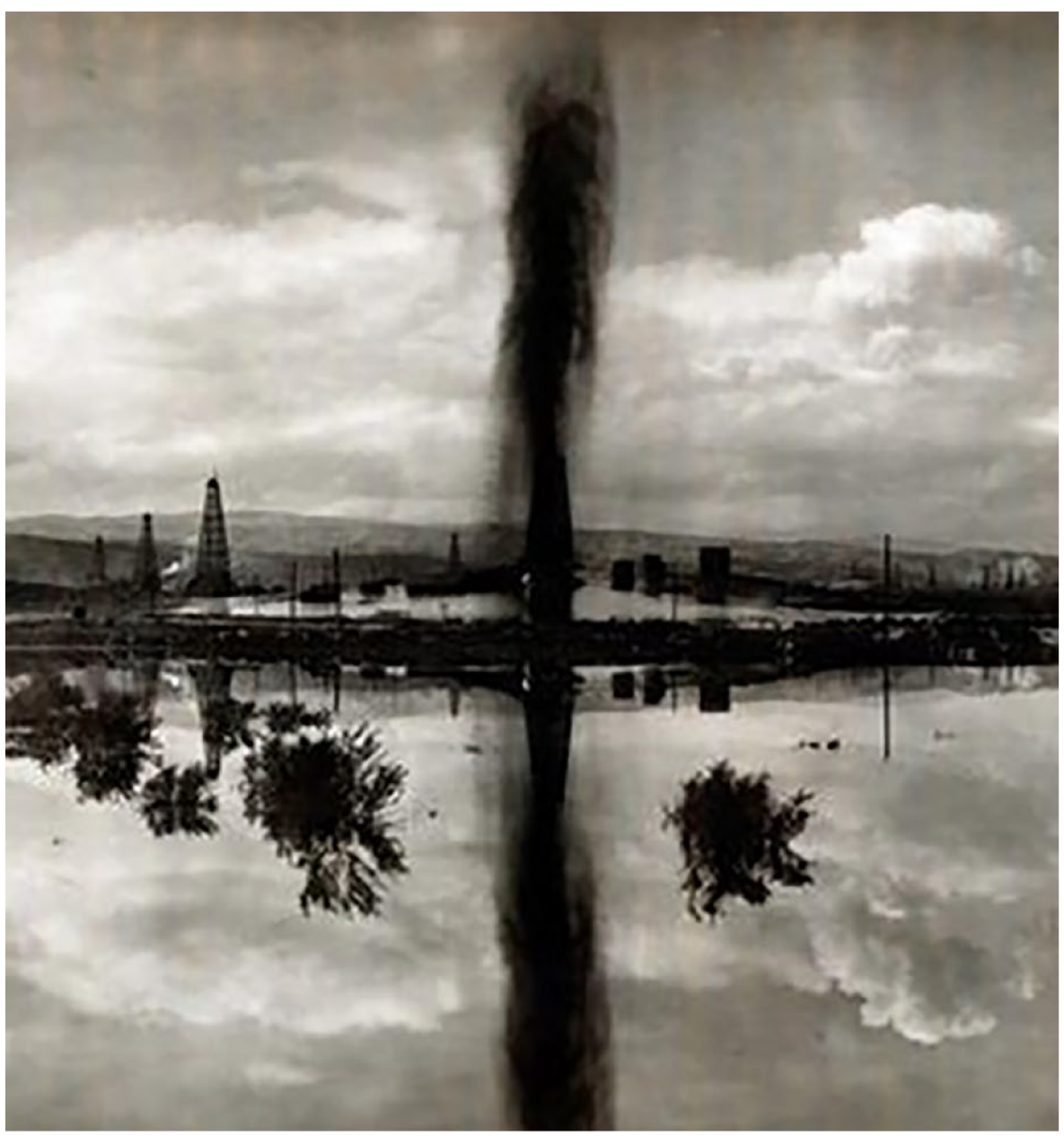
Image from Lakeview Gusher (California, USA) included in Valdes’ geological report and symbolised the strength of an oil spill that could be found in Magallanes.
Not seeing like a state: ‘All the money spent exploring these regions will be well invested’
The first report in Patagonia about the potential discovery of oil was registered in 1899 5 in a site called Agua Fresca (Martinic 2005 [1983]: 16). This initiated land speculation as the owner of the surface land would also own the right to exploit the underground minerals 6 and most of the land was already dedicated to sheep breeding (Puga Vega, 1964: 68). Within 6 months, there were not only 180 mining requests to exploit oil – covering around 9000 hectares – but also calls published in local newspapers to set up oil exploitation companies (Martinic, 2005 [1983]: 17). Hence, during the first three decades of the 20th century, there were several waves of speculation fuelled by the possibility of finding commercial-grade oil although most of these explorations ended in frustration (Bucheli, 2015: 81). Figure 2 shows the oil claim sites during the first two decades of the 20th century.
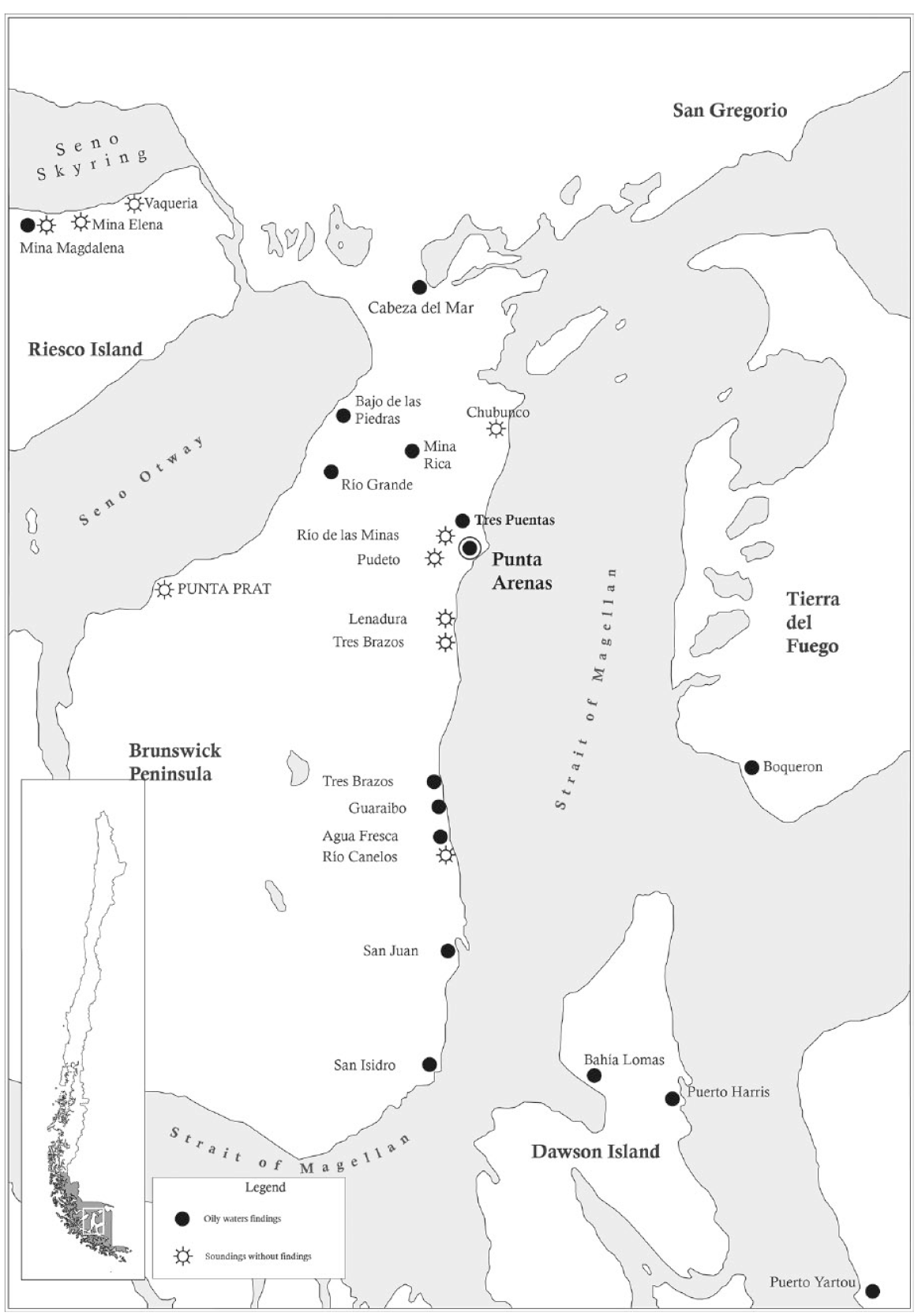
Oil explorations between 1899 and 1945 (before Corfo’s explorations). The black dot indicates oily waters/gas findings; the white dot indicates drilling.
Mauricio Braun and Rodolfo Stubenrauch were two members of the wool fraction of capital interested in participating in oil exploration endeavours, albeit with a minor advance of capital. In a letter to a friend, Braun opined that ‘everything is nothing more than a kind of gas filtration from below the surface. Hence, the matter [oil exploitation] is not important’ (Mauricio Braun, 1899, in Martinic, 2005 [1983]: 22). Nonetheless, Braun and Stubenrauch continued participating in the explorations, especially those linked to Alejo Marcou. Marcou was a French settler-colonial who arrived in Patagonia in 1892. His consolidation as a member of the local capitalist class came through a long-lasting business relationship with Braun (Toledo, 2011: 81). In 1899, Marcou secured mining exploitation rights over the area where the first report of oil was made, Agua Fresca, and he sent extracted samples to laboratories in Buenos Aires and Paris, which confirmed the presence of hydrocarbon oils (Jofré Rodriguez, 1995: 32). Consequently, Marcou constituted different companies for exploration and exploitation. 7 After several years of frustrating operations, the subnational capitalists started to realise the central role of geological studies in pinpointing those areas where oil could be located. Within this context, the subnational capitalists began to ask the Chilean state to contribute the required geological scientific research to define these areas. Evidence of this convergence of the subnational capitalist class with interests in oil exploitation was to be found in local newspapers, particularly, ‘El Comercio’, owned by a local capitalist. For instance, regarding oil explorations in Agua Fresca, the newspaper stated that ‘What at first was believed as a utopia is becoming a promising reality’ (El Comercio, 1906: 2).
However, large oil reserves were never found in Agua Fresca. By 1907, the Chilean President had visited Punta Arenas and local capitalists requested state-led studies to evaluate regional sites for oil potential (Martinic, 2005 [1983]: 29). Between 1907 and 1927, the state sent geological missions, and in Patagonia these were concentrated in areas where the subnational capitalists’ companies had found oil manifestations (Donoso Rojas, 2019: 54–58). Following one geologist’s visit to Patagonia, an article was published stating that ‘It is to be hoped that the State, . . . will not omit expenses or sacrifices, to carry out all the necessary explorations to achieve the pursued success’ (El Comercio, 1910a: 3).
Local capitalists realised that a large amount of capital was required to constitute the oil commodity frontier and that the state’s involvement was needed to harness science and technology to produce Nature as a resource. Meanwhile, Marcou – who would later be called ‘Magellan Oil’s Prophet’ (Davila Alveal, 1985: 10) – continued to promote the explorations. In 1911, he founded another oil drilling company to control most of the drilling explorations in Patagonia (Jofré Rodriguez, 1995: 34). El Comercio newspaper had started to promote the idea of monopolist exploitation due to the amount of capital required. It published a lengthy article proposing monopolistic oil exploitation by ‘creating only one company with enough capital to make the explorations’ (El Comercio, 1910b: 2–3). Local capitalists had failed before – the brief gold rush ended due to a lack of studies and the random approach to the exploitations. Aligned with local capitalists’ interests, a long-waited geologist’s report concluded that as the presence of oil was certain, ‘all the money spent exploring these regions will be well invested’ (Machado, 1911: 13–14). Yet, by 1913, Marcou was convinced that the ‘explorations and exploitation required an enormous amount of capital’ to continue (Alejo Marcou, in Martinic, 2005 [1983]: 48).
Ultimately, neither Marcou nor his few competitors achieved the constitution of the oil commodity frontier; their companies had run out of capital, and they had to abandon the explorations. Meanwhile, the state continued to send geological missions, but these too were unsuccessful. Smith (2007: 22) identifies this situation as a ‘local oddity’ in the production of Nature that capitalism needs to transform into national and global ambitions to achieve surplus extraction. By now, fractions of capital at the national scale and the petty bourgeoisie were starting to appreciate the retail distribution of imported oil and foreign capital’s interests, and the transformation from a local oddity to a global ambition was needed to constitute the commodity frontier.
From local oddities to global ambition: The intermingled interests of foreign and national capital in oil distribution
As mentioned above, a second spatial political economy process was emerging in the constitution of the oil commodity frontier. At the national scale, the northern mining region was rising in importance due to nitrate and copper exploitation as foreign capital interests were shifting from Britain to the United States (Barton, 2000: 236). That is, US capital was becoming the dominant player through copper exploitation, driving the rise of oil importation (see Figure 3). The Northern mining exploitation was also experiencing an energy transition linked to technological changes, with oil replacing coal as the primary fuel source for machinery (Donoso Rojas, 2019: 60).
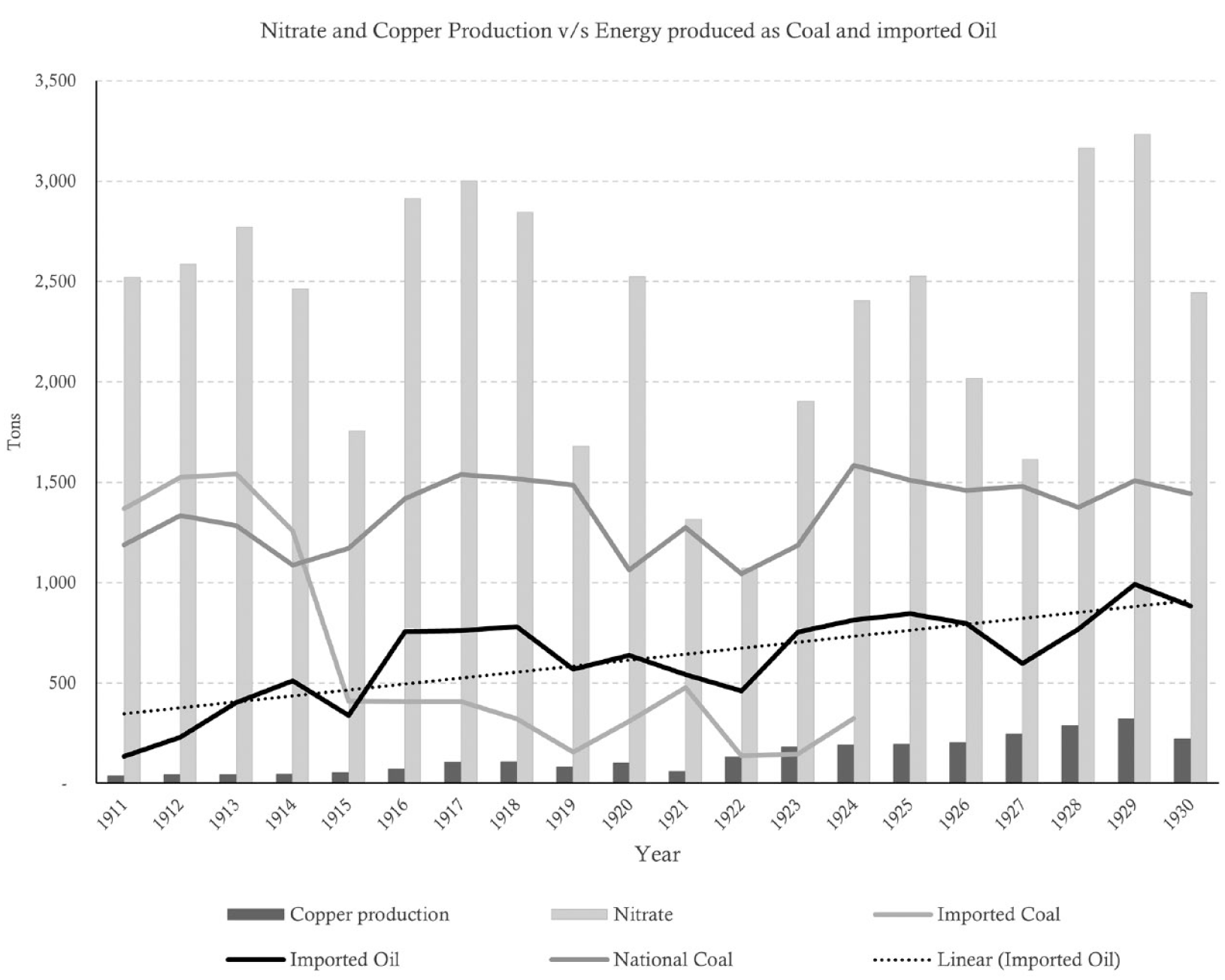
Evolution of oil importation, coal importation and national production.
This energy transition from coal to oil was creating tensions within fractions of the dominant class. As they were losing market terrain, the coal mining fraction of capital started to mobilise political action. For example, it requested the state to apply a tax on oil importation, arguing this was required to protect the national coal industry, the only industry remaining in Chilean capital’s hands (Donoso Rojas, 2019: 61). However, the state refused based on advice from the National Mining Association (NMA, ‘Sociedad Nacional de Minería’). NMA’s president at that time was a nitrate and agricultural capitalist who was part of the oligarchy that controlled the state (Greve, 1960: 11). His anti-tax arguments rested on the coal companies’ ineptitude and their lack of preparedness for declining coal consumption in the emergence of the nitrate and copper industries (Gandarillas, 1922: 596). These industries relied more heavily on oil consumption due to its superior calorific power and regularity of supply, which according to Gandarillas (1922) was also ‘not interrupted by workers’ strikes’ (p. 598). Hence, the nitrate and coal mining capitalists preferred oil importation, 50% of which came through two northern ports (Iquique and Antofagasta) by 1929. Nonetheless, oil importation was still expensive for Chilean capitalists because it was imported refined (Puga Vega, 1964: 78). What would be needed to mobilise the intermingled interests of national and foreign capital was the establishment of a local refinery and exploitation of oil in Chile.
It is argued here that the processes that led to the constitution of the oil commodity frontier were connected to the production of space and Nature, linked to capitalist accumulation strategies through the constitution of commodity frontiers. The focus of this article thus far has been on the dualistic ideology of Nature incorporated into the state, and how the subnational capitalist class was unable to constitute themselves as an oil fraction of capital due to a lack of capital. Yet, the national spatio-capitalist dynamics transformed local oddities into national and global ambitions. I argue that the state produced spatial relations of production through State–space which incorporated interregional relations whereby one function in the organisation of production could operate in more than one place to achieve a national expansion in capitalist accumulation (Massey, 1995: 96). That is, the state as social relation is the place where subnational, national, and foreign interests achieved equilibrium through an accumulation strategy, albeit with concomitant losers and winners.
In 1926, foreign capital mobilised their interests into oil exploitation in Patagonia. Royal Dutch Shell, Jersey Oil Co., and Pan American Petroleum and Transport all requested mining rights to conduct geological surveys to evaluate the area’s oil potential. Their requests covered around 1,500,000 hectares (Donoso Rojas, 2019: 64). However, the period in which these companies’ mining rights requests were made – between 1924 and 1927 – was characterised by high political instability at the national scale. In December 1926, a law was approved that required all oil deposits to be reserved for the state and all companies’ mining rights were declared invalid.
Jersey and Shell had started operations in Chile in 1913 and 1919, respectively, and they controlled almost 100% of the oil importation and distribution until 1935 (Bucheli, 2015: 82), importing oil from exploitation fields in other Latin American countries (Philip, 1982: 183). However, foreign capital faced nationalist policies in many Latin American countries, and in Chile, this preluded the ISI through Corfo (Philip, 1982: 182). Law 4217 of December 1927 declared the expiration of all private oil explorations and exploitation rights, prohibited foreign companies’ direct ownership or participation, and banned concessions for private transactions (Ministerio de Hacienda, 1927). Bucheli (2015: 83–88) describes the oil corporations’ many attempts to prevent this law being enacted. Now, the intermingled interests of national and foreign capital played a crucial role. In 1934, the petty bourgeoisie organised a Chilean capital petroleum company (COPEC) to participate in the oil distribution market. This is crucial for understanding the Chilean state’s oil ownership as a free-gift of Nature. COPEC is a management-controlled corporation par excellence, which by the mid-1960s was the eighth largest Chilean corporation and by 2021 was still among the top ten largest publicly listed companies (Acevedo, 2021; Bucheli, 2015: 88; Zeitlin and Ratcliff, 1988: 22). Its influential role was derived from the directors’ position within the dominant class (Zeitlin and Ratcliff, 1988: 77), and reveals the state’s substantial counterweight role vis-à-vis foreign capital, as COPEC had been protected by state policies to achieve at least 20% of the internal distribution market. This privileged position allowed COPEC to operate as an oil cartel with Shell and Jersey, sharing oil’s importation and distribution market (Bucheli, 2015: 89–90; Philip, 1982: 188). Consequently, surplus value was extracted from refined oil’s distribution, which illustrates the transversal relevant role of Cheap Energy among industrial capital.
As noted above, industrialisation requires energy. In Chile, while oil was already scarce and expensive due to importation, it became even more scarce because the accumulation strategy was organised around industrialisation. Due to this scarcity, Corfo was conferred special powers to explore and exploit oil through a new oil law introduced in 1942 in which the state retained ownership while Corfo was given exploration and exploitation rights. As Cheap Energy was central to Chile’s industrialisation, it is important to consider Corfo’s expenditure during their first 10 years of operation. Corfo invested 30% of its nationwide expenditure on energy production, equal to Corfo’s capital advanced in manufacturing industries, which is usually considered as the state’s intervention in the economy (Corfo and FPAC, 1962: 246). Between 1942 and 1953, 30% of Corfo’s (1954: 16, 27–28) capital advanced into energy was directed to oil exploration and exploitation in Magallanes alone. 8 Hence, Corfo began its explorations in Magallanes in 1943 with state-funded capital as the US and British governments were blocking funding for oil-related industries in Chile to support US and British oil companies (Philip, 1982: 189). However, in 1940, Corfo hired a US geologist and sent a Chilean mining engineer to work in the United States for an oil company (Serrano and Scantlebury, 1993: 70). From 1942, it also received technical assistance from the United Geophysical Co., and imported drilling machinery from the United States (Corfo, 1944: 289–291). In December 1945, the first commercial-grade oil was found in Manantiales, in Tierra del Fuego, around 130 kilometres to the north-east of Agua Fresca (Martinic, 2005 [1983]: 48; Planeamiento, 1965: 99).
After the oil was discovered, Corfo started applying for foreign loans to fund a new state-owned oil company. Foreign credit was central to Corfo’s funding scheme; between 1940 and 1954, more than 77% of Corfo’s credits came from the US Export-Import Bank (EXIM Bank) (Corfo, 1954: 30). A funding agreement between EXIM-Bank and Corfo was conditioned on the use of this funding for the importation of capital goods manufactured in the United States (Corfo, 1944: 81; Nazer Ahumada, 2016: 301), that is, it was aligned with US international capital interests, which had a central political role in promoting US foreign investment through ISI in developing nations (Maxfield and Nolt, 1990: 52). While US oil companies were not directly part of the ISI, they were nonetheless well represented by those firms exporting capital goods to Latin American countries (Maxfield and Nolt, 1990: 53). As Bucheli (2015: 92) points out, US oil corporations blocked the loan to Corfo because mining corporations were major oil consumers. Therefore, Corfo had no choice but to negotiate directly with private corporations to provide technical assistance and capital to create a state-owned oil company. Ultimately, Livermore Corporation and Kellogg Pan-American Corporation provided the technical assistance and capital to create the state-owned Empresa Nacional del Petróleo (Enap, National Petroleum Company), which was created in 1950 (Corfo, 1954: 27). Starting in 1950, production was exported from Puerto Percy, 70 km from the exploitation site, and refined by Administración Nacional de Combustibles, alcoholes y Portland (ANCAP), the Uruguayan state-owned oil company located near Montevideo (Table 1) (Donoso Rojas, 2019: 77; Martinic, 2005 [1983]: 128).
Enap oil productivity and refinery.
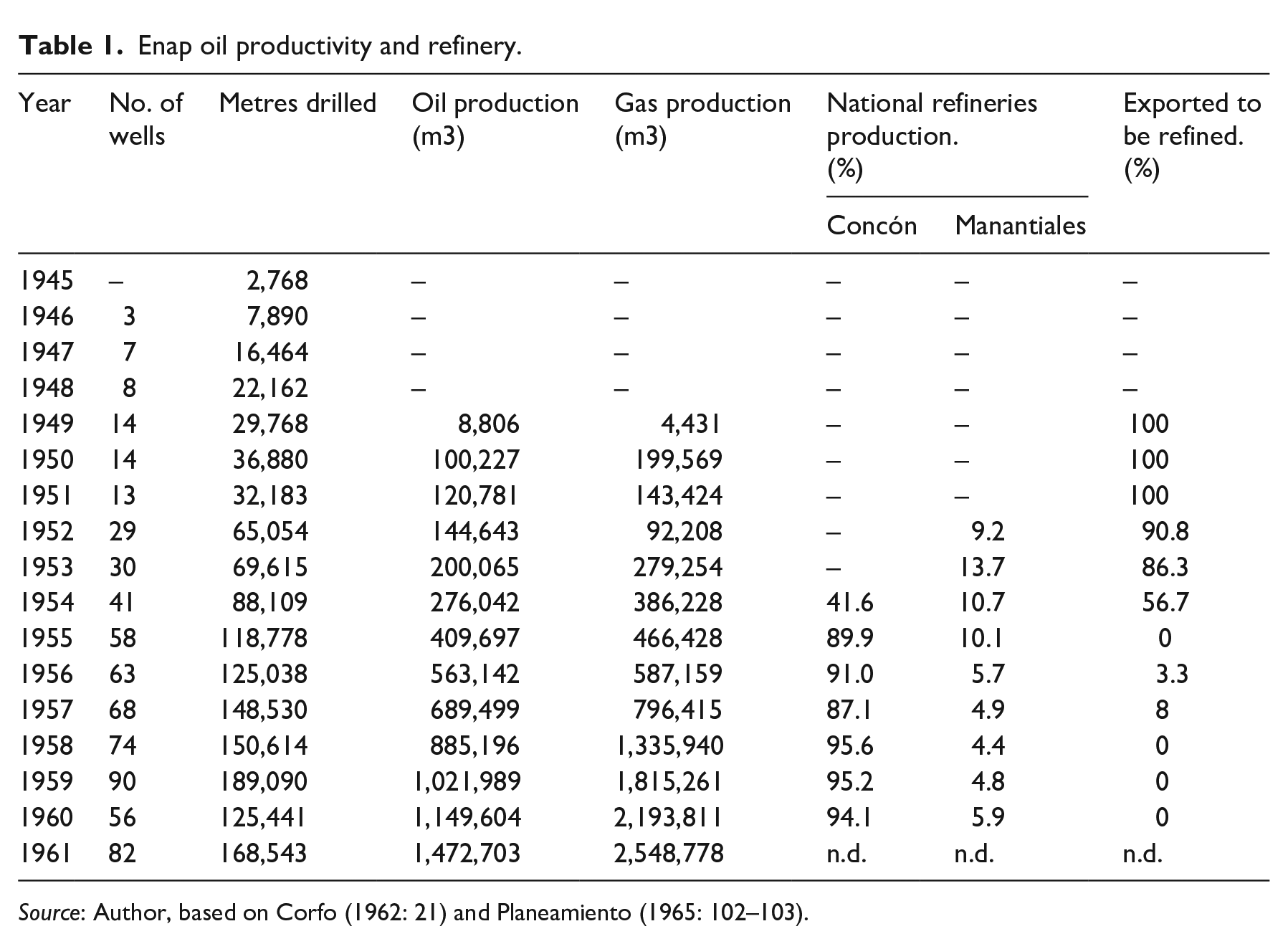
Source: Author, based on Corfo (1962: 21) and Planeamiento (1965: 102–103).
In 1952, Corfo and Enap built a small refinery plant in Manantiales – with the technical assistance of the US company Hudson Engineering Corporation – to provide oil derivatives to the region. The plant aimed to improve the production process by re-injecting gas into the underground deposits (Corfo, 1962: 21). However, the most significant oil consumption requirements were to be found in the northern mining regions, central valley, and centre-south regions. Crude oil would be worthless if it were not aligned with the industrialisation accumulation strategy led by Corfo and, of course, oil consumption in northern mining regions. For this reason, between 1952 and 1955, Corfo and Enap commissioned the US company The M. W. Kellog Co. to build a larger refinery plant near Valparaíso (Concón) (Corfo, 1962: 21). As mentioned above, ‘interregional relations of production’ are key to understanding the role of Corfo and the oil commodity frontier because, as Massey (1995) points out, ‘each spatial structure is a system of interdependence into which the industrial activity of any local area is inserted’ (p. 114). Therefore, the oil refinery in Concón served to refine the oil from Patagonia as well as the imported oil, making the derivatives cheaper for the industry and general consumption. Foreign and national capital with oil interests also benefitted from this plant, and in 1957, Enap, Copec and Jersey created a company (Sonacol) to build and manage all oil pipes required to transport the refined oil production to wholesale distribution (Corfo, 1962: 23). Now, the state – by means of Corfo, through Enap – constituted the oil commodity frontier, and national and foreign capital extracted surplus value through distribution around the country, where the demand for Cheap Energy was to be found. Consequently, the state emerged as a condensation of the social forces constituting the oil commodity frontier and producing a new spatial organisation through the interregional relations of production. The following section describes capital’s environment-making process through the oil commodity frontier in Patagonia and how Patagonia’s geographical structure reflects the reorganisation of the national geographical structure through State–space (Massey, 1995: 133).
State–space: The dialectical relation between the subnational and national scales for capitalist accumulation
Through the process of modernising the uneven development in Chile, two additional layers were emerging: the production of State–space as a relational geographical form mediated by the political economy of scale between the subnational and national scale to enhance capitalist accumulation; and the environment-making process through state’s strategic spatial actions, in which the built environment plays a crucial role. Both processes are central to the role of the state in building the scalar organisation of subnational articulations of production linked to national and supra-national capital interests (Hesketh, 2017: 21).
Brenner (2004: 69–113, 115) presents an analytical framework that tackles the restructuration process of state spatiality as a path-dependency process of interaction between old and new political strategies. In this process there is a state spatial selectivity through which the state produces and uses space to achieve the expansion of capitalist accumulation. Brenner (2004: 89–94), proposes two moments of state spatiality: structural and strategic. The structural moment includes State–space in its narrow and integral senses, both of which have a strategic ‘evolution’ as state spatial projects and state spatial strategies, respectively. This article argues that these approaches can be understood through the production of the space condition of ‘fluidity’ (Lefebvre, 1991 [1974]: 86–88) as these structural moments do not evolve into strategic moments. Rather, state spatial strategies are oriented towards re-organising the structural moments in a dialectical relation based on the ‘roughness’ of space, where space is produced as a permanent synthesis (Santos, 1986 [1971]: 63–64). Therefore, the structural and the strategic should not be seen as moments of state spatiality. Structural conditions evolve continually according to the ability of strategic actions to affect these structural conditions. Consequently, structural conditions are not overcome, as such, but rather there is a continual dialectical process occurring in the seesaw of uneven development wherein the state produces spatial strategic actions to reorganise and affect the structural conditions through a process of spatial selectivity.
This is how strategic selectivity operates: the state as a site of strategy evolves – adopting certain political strategies and discarding others – as an emergent effect of the interaction between past and present political strategies and struggles (Jessop, 1990: 260). Meanwhile, State–space is an emergent effect of the interaction between previous and current spatial accumulation strategies through spatial strategic actions targeting structural conditions. Through these strategic actions, the state produces its spatiality. In our case, it is therefore necessary to analyse how productive fixed capital for the oil commodity frontier was accompanied by strategic spatial actions that, through a spatial selectivity process, produced space in Patagonia. The Chilean state, by means of the production of State–space, was able to change its territorial control over Patagonia from an absolute geographical form to a relational geographical form mediated by a political economy. That is the relevance of this territory; the area was under dispute between Chile and Argentina until the constitution of – what I call – the wool commodity frontier (reinforced by the 1881 border treaty) through what Harambour Ross (2016) has called “sheep sovereignties”. The wool commodity frontier was constituted at the contours of the British Empire – that is, the Chilean state controlled geographically this territory, but the political economy was embedded in the British Empire. Through Corfo, the Chilean state definitely incorporated the Patagonian territory into the national space of accumulation by means of relational economic geography.
State–space is crafted in different ways, as illustrated by another critical research project initiated in 1945 by Corfo: the Chilean Economic Geography 9 (ChEG hereafter) study. This was led by ‘Fundación Pedro Aguirre Cerda’ (FPAC), another apparently non-economic institution created by Corfo to develop industrial education in the country (Corfo and FPAC, 1950: 7). The report from the study reveals the capitalistic rationale behind the project: ‘the desire to know what the country has in terms of natural, human, financial and economic resources, and to what extent and in what way these can be used to increase national progress’ (Corfo and FPAC, 1950: 5). The report also emphasised the ‘manifest paucity of scientific literature’ in economic geography. The ChEG study, therefore, aimed to study all the physical and human geographical matters that could define the ‘economic horizons’ which ‘men [sic] can make with the inhabited land to secure prosperity’ (Corfo and FPAC, 1950: 5–6). Corfo was thus measuring, codifying, and improving the legibility of localised Nature to be assimilated into the logics of capital accumulation. Through the ChEG project, Corfo, as an agent of the state, not only located, dissected, and characterised each fraction of a socially produced external Nature that could be appropriated and exploited by capital but also discarded everything that could interfere with, or could not be converted into, the commodity form (Scott, 1998: 21–22). The outcome of this report is revealing: the country, ‘has to be divided into six regions, which have not been arbitrarily conceived, they represent areas with a certain degree of homogeneity’ (see Figure 4) (Corfo and FPAC, 1950: 7). This division was not politico-administrative – this remained the same – rather, it constituted a geographical relational form to enhance capital accumulation by means of building the interrelations between scales to create a national market.
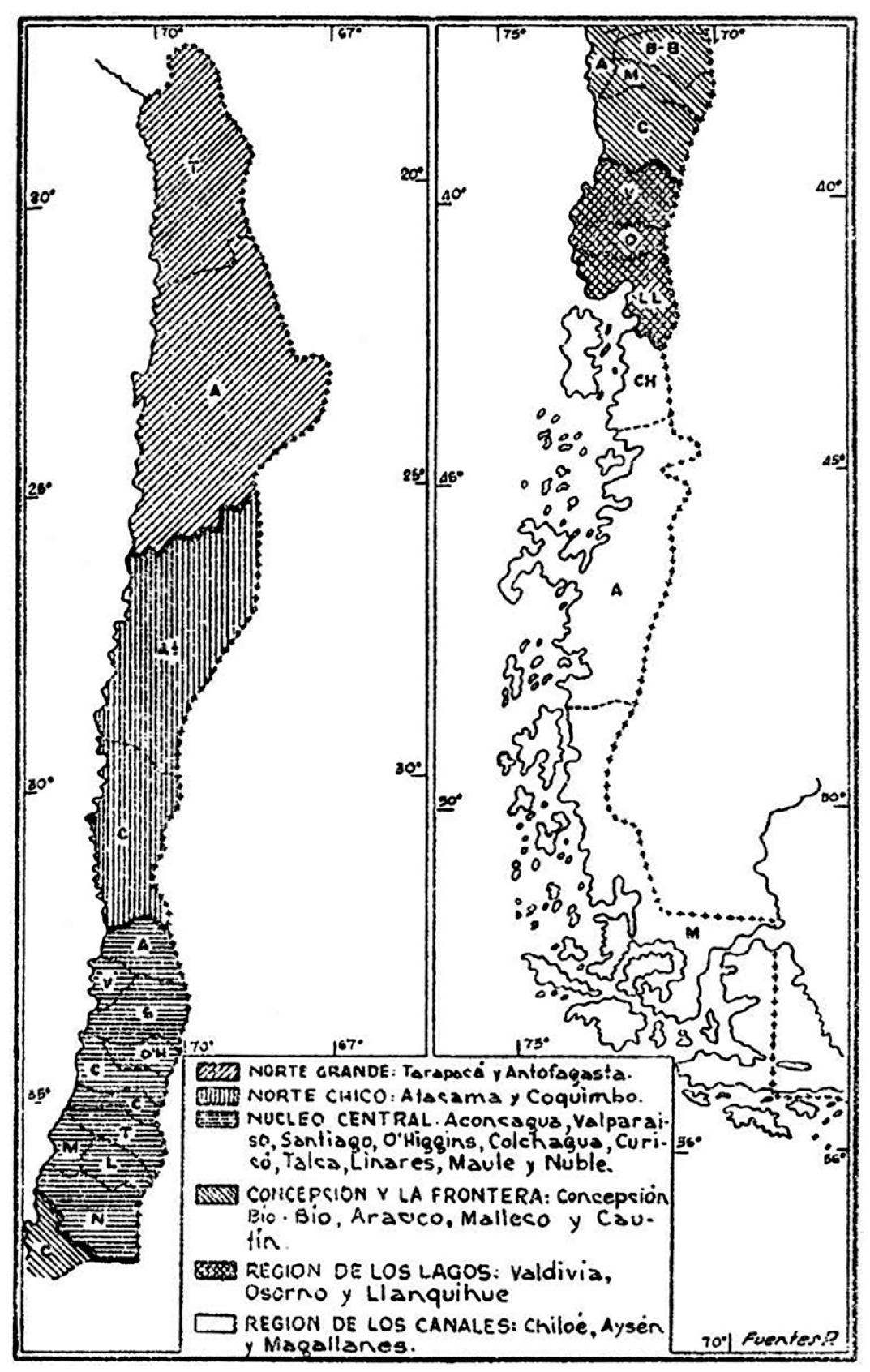
Corfo’s State–space. The caption indicates Corfo’s division and Chilean politico-administrative province; from top to bottom: Norte Grande, Norte Chico, Núcleo Central, Concepción y La Frontera, Región de Los Lagos, and Región de Los Canales (Patagonia).
Each volume of the ChEG report reveals a particular developed legibility of Nature. The ‘economic horizon’ of the subnational Patagonian space had two determining factors: the national scale need for energy to fuel industrialisation, and its subnational localisation. Regarding the first factor, ChEG indicated ‘energy supply plays a fundamental role since a high industrial production is a consequence of a higher mechanical capacity of the industrial plants’ (Corfo, 1944: 243). In addition, the state also depended on capital accumulation, and oil exploitation would have an impact in reducing the dependency on foreign exchange as the importations were in US dollars, as ChEG indicated ‘although it was possible to achieve an increase in thermal energy production, this meant greater availability of foreign exchange for the purchase of oil’ (Corfo, 1944: 243).
Three options for tackling energy scarcity were available (footnote 6). Notably, hydroelectricity became another example of the ‘rational’ use of natural resources by ‘harnessing wasted waters’ that were ‘lost’ in the ocean (De Montmollin, 2023). Energy requirements were challenging due to the ‘high price and unavailability of fuels’ in Chile (Corfo, 1939: 4), and external factors continually impacted the dependence on imported fossil fuels, conditioning the implementation of a long-term industrial development (Donoso Rojas, 2019: 52). Corfo’s Five-Year Report – published before the oil discovery – states ‘our country requires greater amounts of this fuel [oil] every time, and industrial development increases the rate of consumption’, additionally, ‘the foreign exchange savings that it would import to produce such a precious fuel in the national territory’, created the conditions to advance capital into oil exploration (Corfo, 1944: 283). It was therefore critical to find oil on national territory to ensure the success of ISI in Chile.
Capital accumulation was thus needed to systematically transform the local oddity in a way that was aligned with national ambition. Corfo was convinced that oil exploitation was needed for industrialisation purposes and for reducing dependency on foreign exchange. The ChEG project mainly characterised Patagonia as offering free-gifts of Nature – lignite coal, peat, and oil – sources of Cheap Energy (Corfo and FPAC, 1950: 170–197). As mentioned above, while there was much speculation about the existence of oil in Chilean Patagonia, there had been no systematic approach to this industry. Corfo’s (1944) Five-Year Report stated, ‘when the government handed over the exploration to Corfo, it wanted to put an end to this isolated work and allocate the necessary resources until the enigma of oil in Magallanes [Patagonia] was completely solved’ (p. 289). Patagonia’s role – the ‘economic horizon’ of this subnational scale – was decided according to national scale requirements to ensure ISI’s success, as it has been now with the green hydrogen industry, in which an additional layer of state spatiality has been proposed and it is deploying. This reflects Brenner’s (2004: 79) State–space in the integral dimension, that is, explicit spatial policies and actions that the state makes in a particular territory, but also the apparent aspatial policies that impact specific locations, that is, the spatial effect of policies that do not necessarily have a spatial focus. Outwardly, Corfo appeared to be funded with the aim of promoting capitalist development in Chile, and it was a state agency with the external appearance of an aspatial agency. However, Corfo’s actions, policies, and strategies reveal a dialectical relation in the production of national and subnational scales for capitalist accumulation. In this way, Corfo produced and enhanced a particular ideology of Nature, as an external resource which was codified by the state to serve the purpose of capital accumulation and organised through the production of State–space (Moore, 2015: 112–113; Scott, 1998: 23; Smith, 2010 [1984]: 12–13).
Strategic spatial actions: The oil commodity frontier in place
The built environment plays a crucial role in strategic spatial actions in the environment-making process. As Stanek (2011) contends, ‘space appears to be a general means, medium, and milieu of all social practices, and yet it allows accounting for their specificity within the society’ (p. 133). Corfo was embedded in the modernisation of the Chilean state, which introduced its own organisation of space. Hence, the rationality of modernisation was expressed in the production of space, which was directly related to productive necessities and the social division of labour. Corfo’s discovery of the first commercial-grade oil field in 1945 precipitated a hectic process of technological change and technical requirements in Patagonia through a spatial equalisation process of capitalist production (Marx, 1976 [1867]: 520; Smith, 2010 [1984]: 153). This process included constructing oil tanks to store the oil produced as well as building the pipes for oil transportation to future ports, from which the oil would be sent overseas to be refined (until the Chilean refineries were built). The discovery of the Manantiales site was followed by the discovery of a series of exploitation sites on northern Tierra del Fuego, and in 1976, Enap began its exploitation through sea platforms in the Strait of Magellan. Moreover, between 1950 and 1962, Enap built a network of 1393 kilometres of pipe to transport the oil and gas from production sites to Puerto Percy and Caleta Clarencia, in Tierra del Fuego, to be sent to oil to refineries in Chile or Uruguay (Planeamiento, 1965: 106).
As Enap continued to invest in fixed capital for production, its requirement for labour-power increased. In 1943, Enap had 91 workers but by 1980 there were 2390, which was the highest number of Enap workers in Tierra del Fuego (Cvitanic Díaz and Matus Carrasco, 2019: 208). Hence, between 1945 and 1972, Enap was building camps and houses for its employees: Manantiales (1953), Percy (1957), Clarencia (1951), Cerro Sombrero (1958), Cullen (1960), Gregorio (1962), and Posesión (1962) (Figure 5). In constructing the oil camps, the state was deploying modernisation rationality – building from scratch the town-country relation and following the modernist ideology as applied to space, for example, by dividing the urban functions into zones.
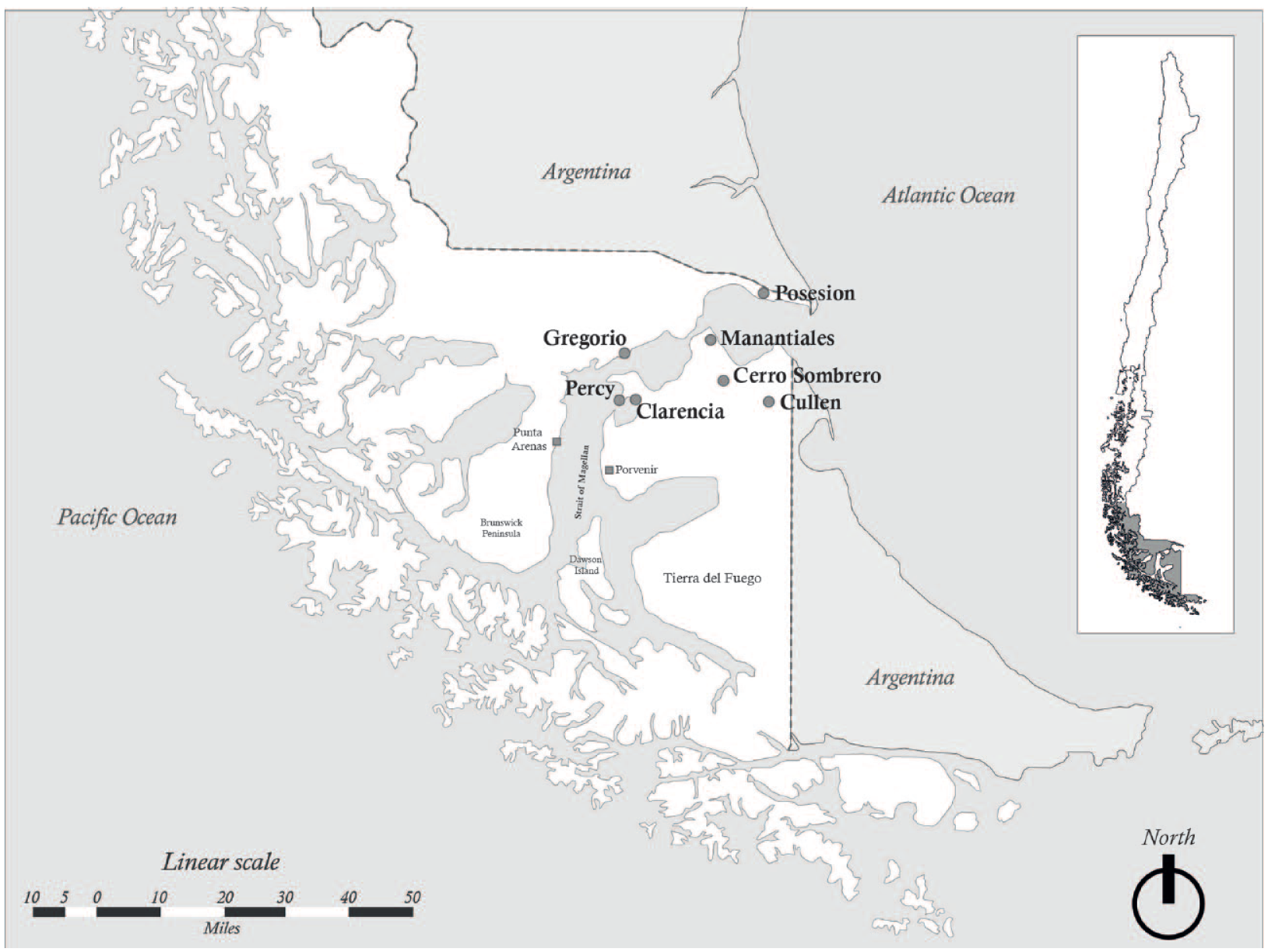
Enap’s oil camps.
Indeed, Cerro Sombrero became one of the most emblematic and paradigmatic examples of the modern architectural movement in Chile, which had been fully coordinated with the CIAM 10 since 1947 when the Chilean chapter was inaugurated (Hecht, 2002: 65). This modern architectural movement was so embedded in Chilean bourgeois architecture that Le Corbusier was seen as a hero and social reformer (Domínguez Bastidas, 2011: 18) and Cerro Sombrero followed the main architectural modern movement principles of Dwelling, Recreation, Work, and Transportation (CIAM, 1946 [1933]). The need to create towns was intrinsically linked to the production process. At that time, Tierra del Fuego had minimal infrastructure to support the living conditions of workers due to had been mostly made up of pasturelands for sheep farming. By 1955, the project to build Cerro Sombrero was starting to take shape in Enap’s headquarters in Santiago; it needed to provide a city standard of living for workers who were mainly travelling from Santiago to Tierra del Fuego. In other words, city conditions were at the centre of the State–space, as the director of Enap’s Department of Architecture was an active member of the Chilean CIAM chapter (Domínguez Bastidas, 2011: 33).
Cerro Sombrero was conceived as a company town – a self-enclosed settlement forming an additional layer to the spatial organisation of the existing space produced by the sheep breeding industry. As Lefebvre (2009 [1978]: 225) argued, the ‘state has its space’ and ‘state is a social space’ that engenders social relations in space. Thus, while the living conditions for the oil wage labour were provided, the space itself reproduced differentiated conditions according to oil’s social divisions of labour. For all camps – of which Cerro Sombrero was considered the capital – the industrial area was conceived far from the town centre and residential zone (see Figure 6). The residential zone was organised according to the social divisions of labour, reflected in the smaller houses for the blue-collar workers (labourers and drivers) and larger ones for the white-collar employees (executives). The recreational zone contained buildings to help residents avoid the extreme outside weather conditions. All zones were connected according to the circulation rationality inherent in the modern architectural movement, whereby the aim is to secure a self-enclosed ‘machine for living in’ (Corbusier, 1931: 95). As Lefebvre (2009 [1978]: 234) argues, Le Corbusier idealised the space of the capitalist mode of production, that is, space controlled and produced by the state. When production in the oil commodity frontier started to decline, there was no reason for Enap to have workers living in the camps and towns. The State, therefore, turned back against its historical conditions, re-organised the space of production, and Enap started to relocate workers and transition to a shift system of work. By 1965, the town was officially recognised as a city and transformed into the capital of a new politic-administrative arrangement, with authority designated by the central government, ignoring the fact that community members had developed their own social organisations (Martinic, 1982: 174). The physical manifestation of State–space was thus transformed into a new structural condition of the state’s spatial dominance; a rational and scientific space was produced, as idealised by Le Corbusier and actualised by capitalism (Lefebvre, 2009 [1978]: 234, 239). It is still to be seen how capitalism would actualise the space for the cheap hydrogen commodity frontier, for now we can learn a few lessons from history.
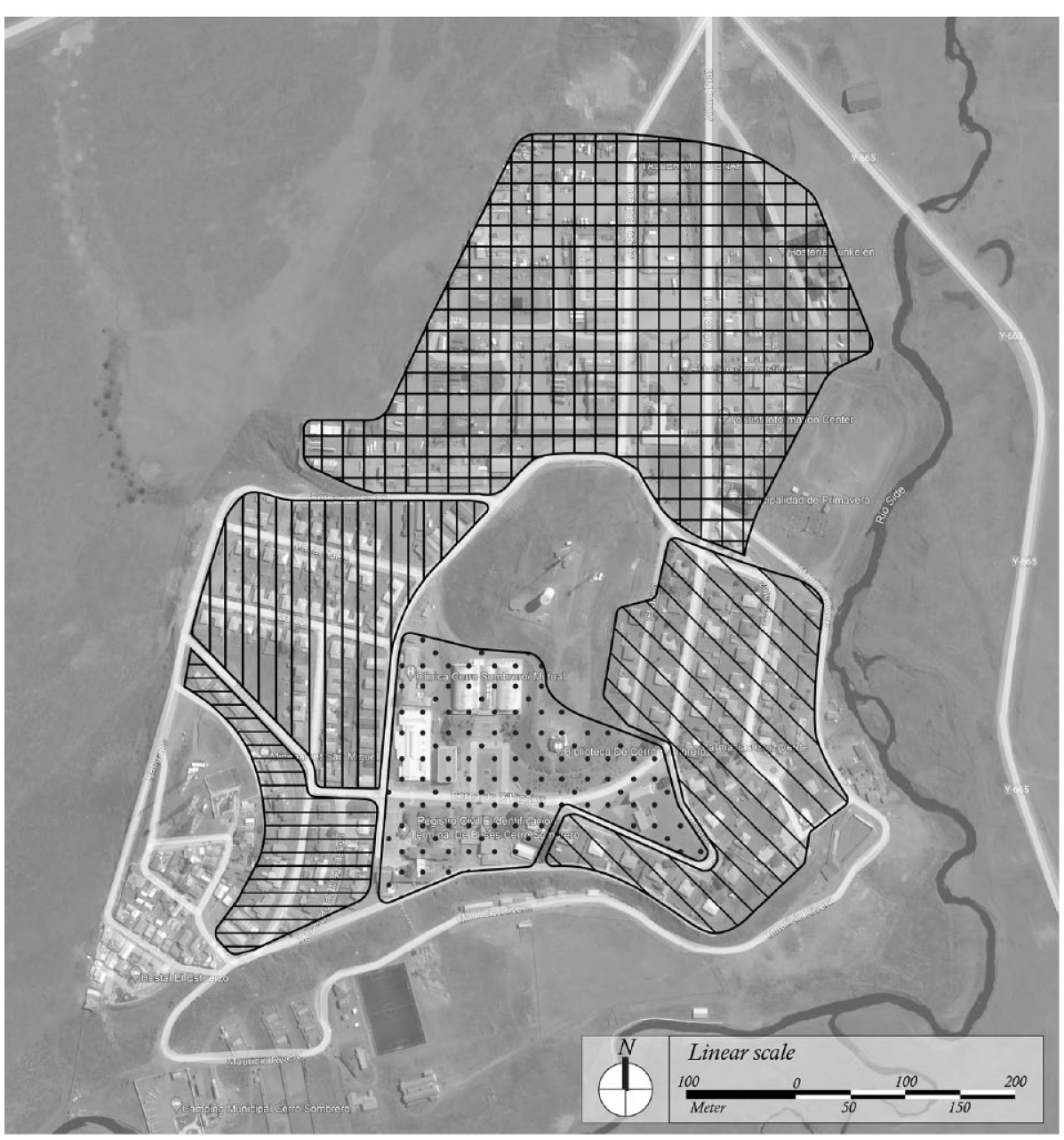
Cerro Sombrero’s urban zoning. Pattern grid: industrial; dotted: urban equipment; vertical: blue-collar housing; diagonal: white-collar housing; horizontal: drivers’ housing.
Conclusion
In this article, I have explored the development of global capitalism from a spatial political economy perspective. The article has contributed to understanding the expansionary movement of commodity frontiers, through which new spaces and forms of Nature are connected and subsumed into the logics of capital accumulation. The case of Chilean Patagonia has shown how space and Nature are internally related in the uneven and combined capitalist development and that the social production of space and Nature are central to the hegemonic project of capitalist accumulation. In addition, a spatial political economy approach has allowed to navigate from the abstract capitalist ideology of Nature to the environment-making process, which produces new forms of Nature and space in place. This has shed light on three processes: (1) how the state measures, codifies, and improves the legibility of Nature for capitalist accumulation; (2) how state power appropriates, constructs, and exploits new socially produced Nature and (3) how State–space – in apparently aspatial policies – shapes the interregional relations of production and the physical realm of space by means of commodity frontiers.
This article has provided a new understanding of the past, which helps us see the present in a new light. The challenges, in the form of commodity frontiers, that contemporary Patagonia faces are connected to the territorialising dynamics of capital that I discussed in this article and have global implications as space and Nature are embedded in capitalism. These dynamics seek to continually integrate human and non-human Nature into the circuits of capital by means of making Nature cheap (Patel and Moore, 2017: 203). What makes this ‘Cheap’ a law, it is the expansive Nature of capitalism, in its scale, scope, speed, and intensity through an ‘ongoing, radically expansive, and relentlessly innovative quest to turn the work/energy of the biosphere into capital’ (Moore, 2015: 14, 53). What we saw above is the emergent totality of capitalist development – for, cheap oil, cheap hydrogen and cheap lithium – all based on incorporating Nature into the circuits of capital, as a productive force and as a natural agent of production that costs the capitalist nothing (Marx, 1991 [1894]: 782). In addition, these dynamics codify Nature to transform it into commodities and to produce commodities. However, more hidden abodes can be detected in deploying these new rounds of capitalist investment. First, none of these commodity frontiers can be constituted without capital’s internal process of primitive accumulation upheld by the state. As Roberts (2017: 546) argues, capital itself cannot carry out primitive accumulation; it needs primitive accumulation to operate. That is, the state does the ‘dirty work’, as it depends on capital accumulation for its operations. In this sense, we are disclosing aspects of the past and recasting them in a different light (Lefebvre, 1991 [1974]: 65).
For a new understanding of the current green energy transition debates, the analysis has taken a historical approach (a regressive step) to argue that the state was a central agent in capital territorialisation through the commodity frontiers, deploying a colonial abstract notion of space and Nature through its development agency. Meanwhile, for these current deployments of commodity frontiers (a progressive step) for the green energy transition, capital also needs the state, as the state and capital build on their own historical conditions. All of these capital territorialisation processes are underpinned by the Chilean development agency (Corfo), which, again, codifies Nature as a resource for capital. Hence, we can use the past to understand the present and open up the future. In this sense, cheap hydrogen requires a codification and appropriation of wind, water and space, because the wind turbines will be located on land that has already been commodified. However, we need to ask ourselves about the extent to which these appropriations do not endanger our own future and how Indigenous knowledge – non-abtract and non-colonial epistemology – plays a role in these developments.
Yet, just as ISI required increasing amounts of energy – materialised in oil – the current ‘green’ energy transition likewise requires an external conception of Nature as an exploitable resource. In focusing on Chilean Patagonia and the ISI, this article has centred space and Nature in the capitalist global economy debate. As Schlögel (2014 [2008]) notes, spatial location captures the complexity of simultaneous processes, which is needed to move beyond methodological nationalism towards localised experiences embedded in the systemic movements of capitalist’s emergent totality. Drawing on Smith (2010 [1984]: 15–18), this article has argued that the state harnessed science tied to productive activity and local capitalist oddities, and systematically organised these to dialectically build the national and subnational scales for capitalist accumulation through the production of Nature. The spatial political economy perspective shows that development agencies in Latin America paved the way for a dualistic conception of Nature, positioning Nature as an external resource to be exploited, contributing to the current socio-ecological crises. The analysis shows that history ‘is not “passed” nor the past, but an ongoing presence in the present’ (Loveman, 1979: 1), in which Nature’s exploitation is at the centre of global capitalism.
Footnotes
Acknowledgements
The author thanks Adam David Morton and Gareth Bryant for their valuable feedback during the PhD research from which this article emerged. Thanks to Lee Ridge for his feedback on the early versions of this article. In addition, the author appreciates the constructive feedback from the referees, which substantially helped improve the quality of the article. The author thanks Corfo’s Librarian, Fabiola Neira Rodríguez, for her help navigating the Library of Corfo, and Arlene Harvey for her editorial guidance. Finally, an early version of this article was also presented at the International Political Economy Section Pre-Conference Workshop for Early Career Researchers at the International Studies Association Annual Convention, 14–18 March 2023, Montréal, Canada.
Declaration of conflicting interests
The author declared no potential conflicts of interest with respect to the research, authorship and/or publication of this article.
Funding
The author disclosed receipt of the following financial support for the research, authorship and/or publication of this article: This work was funded by the Chilean National Agency for Research and Development (ANID)/Scholarship Program/Doctorado Becas Chile /2017 – 72180304.
