



Abstract
Between the first two decades of the 21st century, the gentrification of the academic subject of Geography within Britain rose to a new peak. By the mid-2010s, undergraduate geographers had become the least likely group, of all British university students, to have qualified for free school meals while at school. This article reveals that they are now also the most likely group to have grown up in the most affluent parts of Britain and suggests that this rising segregation of origins is the cumulation of a long running process which can be indexed to the growth in social divides in Britain over the last four decades. As Britain changed from being one of the most equal nation states to become the most economically unequal large state in Europe, British Geography departments became the least likely place to find students from disadvantaged or even average income backgrounds. This article also demonstrates that an unusually high number of academic geographers working in Britain grew up in Britain and attended a British University. The article explores what else is now known, and is unusual, about the changing demographic characteristics of academics employed in the Geography departments of British Universities. It then speculates as to how these changes over time may have influenced the lived experiences of British Geography students and academics, the subsequent contributions that British geographers now make, and then how the gentrification of British Geography may influence the subject and politics in particular ways and directions globally. The article ends with a plea: if we can better know ourselves, we may choose to not continue supporting the current self-referential siloes in geographical thought and may better understand how and why they came about.
Introduction
When writing about the trajectories and possibilities for Geographical research and teaching for the 21st century, it is first worth recognising the unpredictability involved. To greatly varying degrees, geographical research and teaching are carried out in many countries, probably by an increasingly wide variety of people in most of those countries. Thinking you can predict how such a varied group might behave in future is foolhardy. However, note the word ‘probably’ in the sentence above. It is perfectly possible that Geography academics are becoming more diverse in some ways but less diverse in others. I have come to conclude that without examining closely the data about ourselves we could easily be tempted to fool ourselves into thinking we are more diverse than we are, and we may have very little idea of the ways in which we could be becoming less diverse. There is a pipeline from who chooses and is able to study Geography at university, through to who can afford to take a masters degree, undertake a PhD, cope with the precarity of post-doc work and then become a university academic. University academics will tend to reflect the social characteristics of students from a generation earlier.
There is a danger that this article may appear to be elitist because it concentrates on British Geography. However, it does this because near complete population level national data are collected on both British academic geographers and geography students which are not available, as far as the author has been able to determine, in other countries. Without such data, it is very easy to fool yourself (influenced by various diversity initiatives) into believing that the discipline of Geography in any particular country is on a particular trajectory. For instance, because you are aware of academic hiring programmes aimed at scholars with particular backgrounds, or aware about new targeted funding of students from previously underrepresented backgrounds, you may then extrapolate from those observations more widely. However, these are the things your eye has been drawn to, and that might well help you imagine that overall your discipline is becoming more inclusive and aware. But is it?
The positionality of geographers matters because that will alter what we see as important in future and what research we next decide to concentrate on most. We know that positionality matters about ourselves, but we rarely consider the effects of our collective positionality; the effect in general of who geographers are and how that is changing. I do not think it is that useful to concentrate on potted biographies of the ‘biggest hitters’ in Geography, but instead we should ask what aggregate social statistics can tell us about the changing nature of everyone in one country who studies, researches and teaches Geography at university. A subset of today’s students will decide the trajectory of Geography tomorrow. Who they are will matter greatly for what that trajectory is.
The positionality of British Geography
By various measures, British Geography is now growing in size as a discipline, but it could just as easily have shrunk away too, just as its sister subject Anthropology did over the course of the 20th century in Britain and in many other countries. One claim I will make below is that part of the reason why Geography has become more popular again among some children in Britain applying to university may be related to the changing social structure of Britain in recent decades. Aggregate statistics on the social and economic backgrounds of students and the numbers and ages of academics were not so easily available to access in the past, which partly explains why the approach I take here is unusual and why so many caveats are necessary – what is done in this article could not have been attempted until very recently.
British Geography first became substantial in size largely because of the colonial origins of the subject, created in British universities at the time of the British Empire (Kearns, 2010). It was partly the shrinking of that Empire that, in the 1960s and 1970s, caused the subject to decline in the United Kingdom. The ‘new’ universities of York, Warwick and Strathclyde chose not to have Geography departments. The subject had, at that point in time, become more and more associated with the past. The same was true in the United States where Harvard, Yale and Princeton did not have, or eradicated, their departments. By 1989, it was being argued that Geography Departments in the United States needed an increased intellectual approach for them to be sustained. It was pointed out that a research contribution might ‘resurrect the discipline in those elite institutions that do not now have it’ (Turner, 1989: 88).
However, in contrast to trends in the United States, something began to change in the United Kingdom in the 1980s which gathered pace in the 1990s, and that then led to a revival of British Geography. This can be seen in terms of a generational bulge in British geographers, with academic appointments in the last two or three decades resulting in unusual numbers of people now being in post at particular ages, as compared to other academic subjects in Britain. In this article, I argue that there is now enough evidence in the statistical record of academic geographers in Britain by age, to make the claim that the subject has now become unusual as compared to other academic subjects in Britain. This particular generational bulge is not reflected in any other academic discipline in the United Kingdom (other than in Sports Science). I go on to suggest that this rise in the popularity of Geography may have been partly associated with growing social inequality in the United Kingdom since the early 1980s.
As three geographers recently pointed out again, ‘If there is one take-away from the last half century of historiographical reflection on science and intellectual histories, it is that all scholarship is a product of its time and place’ (Sidaway et al., 2020). However, it is also a product of the people who produce the product. If a particular social group becomes increasingly likely to be more and more represented among those scholars in those times and in that place, that too will have a large effect on what is produced. Sidaway et al. were discussing geography textbooks originally published in 1979 and 1985 and written by authors who had lived almost all of their lives in social settings which were becoming gradually more equitable. Social inequalities in the United Kingdom as measured by income inequality fell relentlessly from 1918 all the way through to the mid-1970s. For those educated in and writing at that time, and immediately after, this may have resulted in a growing confidence in the future, including in the future of academic Geography. I would contrast those textbooks and times with the situation today where those same three geographers suggest there is a growing need ‘to bridge the increasingly self-referential siloes in geographical thought’ (Sidaway et al., 2020).
The coming together of British society from the 1920s through to the mid-1970s and then its pulling apart from then, right through until the present day, appears to have had a particular effect on Geography in Britain, on who is taught, on what is taught, and what is researched and how. The subsequent splintering of British society may not be unconnected to the splintering of Geography (Castree et al., 2021). Inside British Geography, and further-a-filed, there has been an increase in self-referential siloes, creating a subject now described as being a ‘broken bottle’ (Liu et al., 2022).
What I am suggesting here is that it was not any intellectual revival within the subject, which led to its revival in popularity in Britain. Academics understandably often see the research they are conducting as being of importance; but the revival of Geography in Britain may well have almost nothing to do with any changes in what academic geographers had been studying and teaching in the recent past, and a great deal more to do with the growing supply of undergraduates from particular social groups in recent decades. It may well have been changes in geography undergraduate student numbers and their social characteristics have mattered most in shaping Geography in Britain and, indirectly, this may also have an impact worldwide in terms of the wider influence of British geographers.
This article is necessarily speculative and I have no way of substantiating many of my suggestions for the future other than to offer them up for criticism and investigation as to their plausibility. However, I do believe that the same limitation holds for almost all speculation about why geographers do what they do, and in which directions Geography might now head. Where I think I am being novel in this article is by asking us to look a little more carefully at our positionality, at who we are, who we have studied Geography with, at who our students are and who sits alongside them in their classes, and how all this is changing. All this creates a picture of a very particular human geography of British geographers.
If the approach being presented here proves useful I hope it can be replicated elsewhere, and that there are data which I do not know about which can be used for this purpose in other countries where geographers work and where the trends over time and by social class may have been very different. In Britain, those of us who should know often forget that, less than 20 years ago, there was a rapid decline in the overall numbers of students studying Geography at school beyond age 14 across all of Great Britain and Northern Ireland: The number of candidates taking GCSE geography in 1996 was 302,298, the number in 2003 was 240,310, the lowest number ever since GCSEs were introduced. Over the last two years alone numbers have fallen by 8.25%, which amounts to nearly 21,000 students . . . (Breckon and Gardner, 2004: paragraph 4)
But at the very same time, as the number of students taking General Certificate of Secondary Education (GCSE) Geography (the age 15/16 exam) in Britain’s schools as a whole was falling, surprisingly it was found that ‘Through the 1990s and since, the [university] undergraduate intake has continued to rise’ (Breckon and Gardner, 2004: paragraph 41). In other words, by the 1990s and into the 2000s, British university Geography departments were taking a growing number of students from a smaller and smaller pool; and probably from a smaller number of schools as well. Did certain schools, who needed to maximise their numbers of university entrants, see Geography as a good option due to the reduced competition?
Without data we have to rely on anecdote. I know that between 2003 and 2013 when I lived in Sheffield (a large city in the heart of the United Kingdom), the majority of secondary schools in that city had given up offering A-level Geography. It was only schools in the more leafy parts of the city that still offered it. I believe that this is still the case in many parts of the United Kingdom, but that geographical pattern it is talked about less now among those concerned about the subject because the overall numbers studying Geography at school nationally has risen.
Nationally, in 2021, the numbers of students taking GCSE geography rose to an 11-year high of 285,000 candidates. The number of A levels awarded rose by 16% in a single year; but there was only a 3% increase in students entering universities to study Geography. This was hailed as a great success for the subject and was partly the product of increased interest in climate change and the climate emergency (Brace, 2021). But was that really the key explanation, and if we can understand what was really behind the turnabout, where is this trend likely to lead to next?
As I began by saying, it can be foolhardy to try to predict the future. However, a reinterpretation of the recent past may be less foolish. What I can show you is that the payroll of Geography in Britain is now more and more dominated by younger academics. These younger academics will reflect more closely the social characterises of Geography undergraduates in the decades around the turn of the century. In British Geography, there is now a dearth of older academics, a greater dearth than in any other major academic subject being taught in Britain (other than in Sports Science). The significance of this is that it implies that Geography, as compared to other academic disciplines, shrunk more and then grew more – in response to the shrinking and then growth in demand for studying Geography at a university in Britain in recent decades.
At first glance, this rise of the young might be thought to herald an era of new ideas, of renaissance and revitalisation. However, if the large bulk of younger academics working now in Britain were educated in Britain (and we can check that) then they will also have been educated at a time when fewer and fewer students were studying Geography in most schools. The future of British Geography, and disproportionately the future of Geography internationally, may well now reflect the interests of academics who were disproportionately drawn from the shrinking minority of schools that concentrated most on applications to read Geography at university in the 1990s and 2000s. This may not matter, or it may turn out to be of quite some importance in what geographers as a group are doing, and do next.
The demography of UK academic Geographers
In UK academic statistics, ‘Geography & Environmental Studies’ is a ‘cost centre’ – ‘a financial concept which groups staff members to specific related cost centres which enables analysis between the Student, Staff and Finance streams’. For the academic year 2019/2020, there were some 2615 academic staff employed in ‘Geography & Environmental Studies’ in all the universities of the United Kingdom, a rise of 11% as compared to 5 years earlier, a net increase of 275 full-person-equivalent ‘geographers’. This figure includes all staff deemed to be academics, of which some may be full-time researchers, with some have teaching only contracts, but most are both teaching and researching. 1
At first glance, a rise of 11% in just 5 years may be seen as a cause for disciplinary celebration on this small island. A common reaction to such a change is ‘We are getting bigger, so we must be getting better’. This, though, is not necessarily true. For instance, we may be getting bigger partly because a particular demographic bulge has worked its way through, retirements are now low and hires are constant. Or we may be getting bigger, but not as quickly bigger, because the size of the student cohort to be taught is itself growing larger. Or we may be getting bigger, but more and more of us are employed precariously. Or a mixture of all of this, and more. So, let us start with the demographic bulge issue, and consider Table 1.
Academics in the United Kingdom in Geography & Environmental Studies 2019–2020.
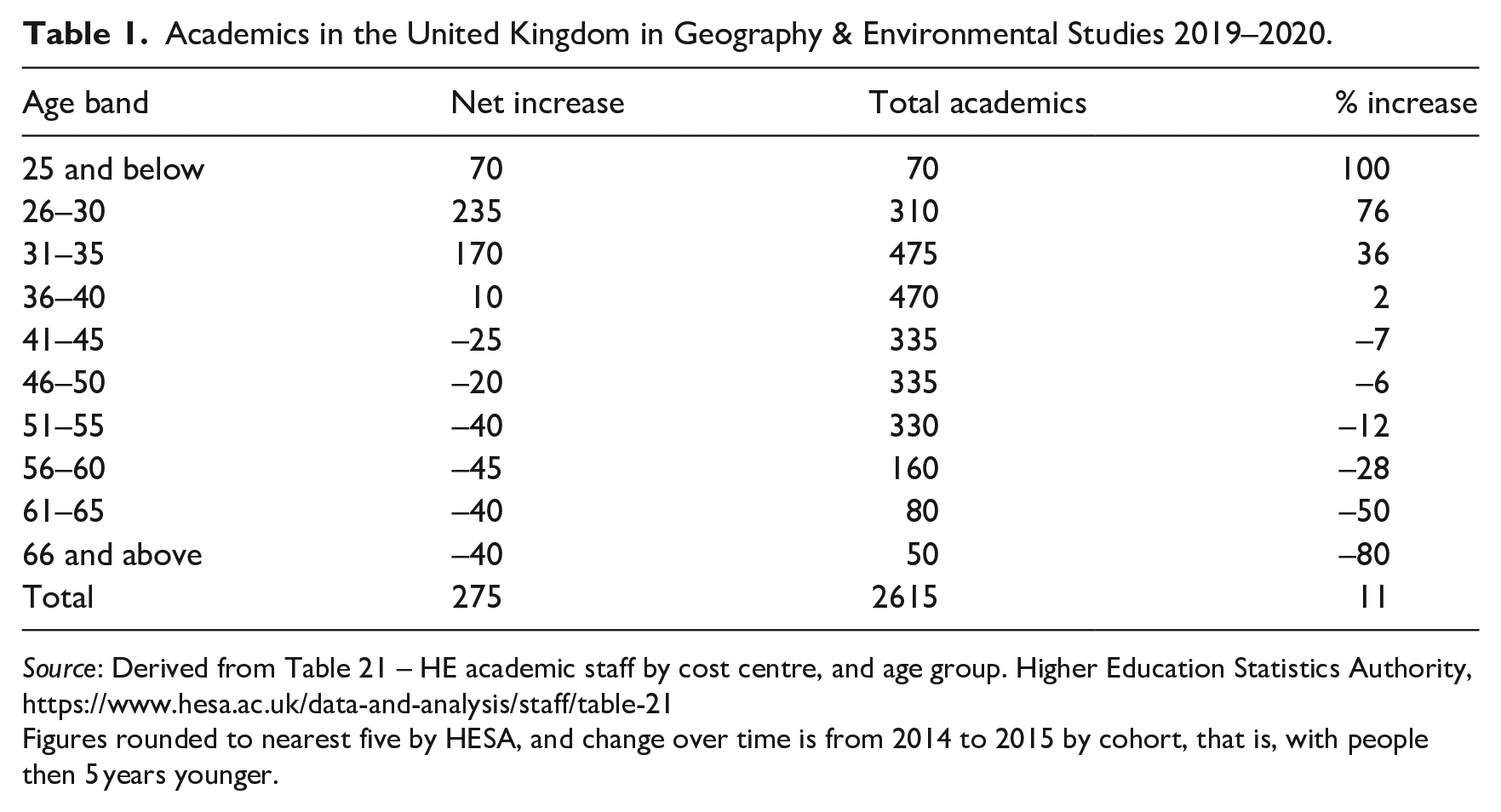
Source: Derived from Table 21 – HE academic staff by cost centre, and age group. Higher Education Statistics Authority, https://www.hesa.ac.uk/data-and-analysis/staff/table-21
Figures rounded to nearest five by HESA, and change over time is from 2014 to 2015 by cohort, that is, with people then 5 years younger.
There is a clear demographic bulge in UK geography. Only 290 Geographers were aged 56 or over in the 2019–2020 academic year, just 11%. Of the 44 academic subjects that the Higher Education Statistics Authority define as cost centres in the United Kingdom, only ‘Sports Science & Leisure Studies’ has a smaller cohort aged 56 and above (just 8% of their academics). The other 42 all have a higher proportion than Geography: 18% in History, 19% in Mathematics and Sociology, 21% in English, 28% in Social Work and Social Policy and 34% in Education – compared to just 11% in Geography.
The demographic deficit of older geographers does not make the subject’s academics exceptionally young. In fact, 13 of the 44 ‘cost centres’ have a younger average age of academic despite 12 of these 13 (and thus all of them other than Sports Science) having a higher proportion of their academic staff aged 56 or above! Geography has its bulge in the middle of the age range. The majority of its academic staff are now aged 36–55, and the average age of an academic in Geography in 2019–2020 was 42 years, up from 41.4 years of age in 2014–2015. So British Geographers are not getting younger; but at the very same time, there are just fewer and fewer older geographers working in universities in the United Kingdom today. This age distribution reflects the fall and then rise in the demand for geographers in the United Kingdom over time.
When most British academic geographers were undergraduates at university less than 2% of them and their fellow students were drawn from homes where they qualified for free meals at school because of the low income of the parent(s). At that time, of every subject studied at university, only veterinary students recorded a lower proportion. Figure 1 shows this, and also reveals that although that proportion increased by the smallest of fractions in the decade to the mid-2010s, it increased faster for veterinary students and so geography undergraduates then became the group at British universities least likely of all university students to have qualified for free school meals while in school (Sutton Trust, 2021: Figure 8). If you did study Geography at a British university in the last 20 years and thought that perhaps your cohort of fellow students were not especially disadvantaged, you would have been right. Later in this article, I show that Geography undergraduates are also the most likely of all students in Britain to have grown up in the most socially advantaged areas of all. What is then key to how this then feeds through to who becomes academics, is the pipeline.
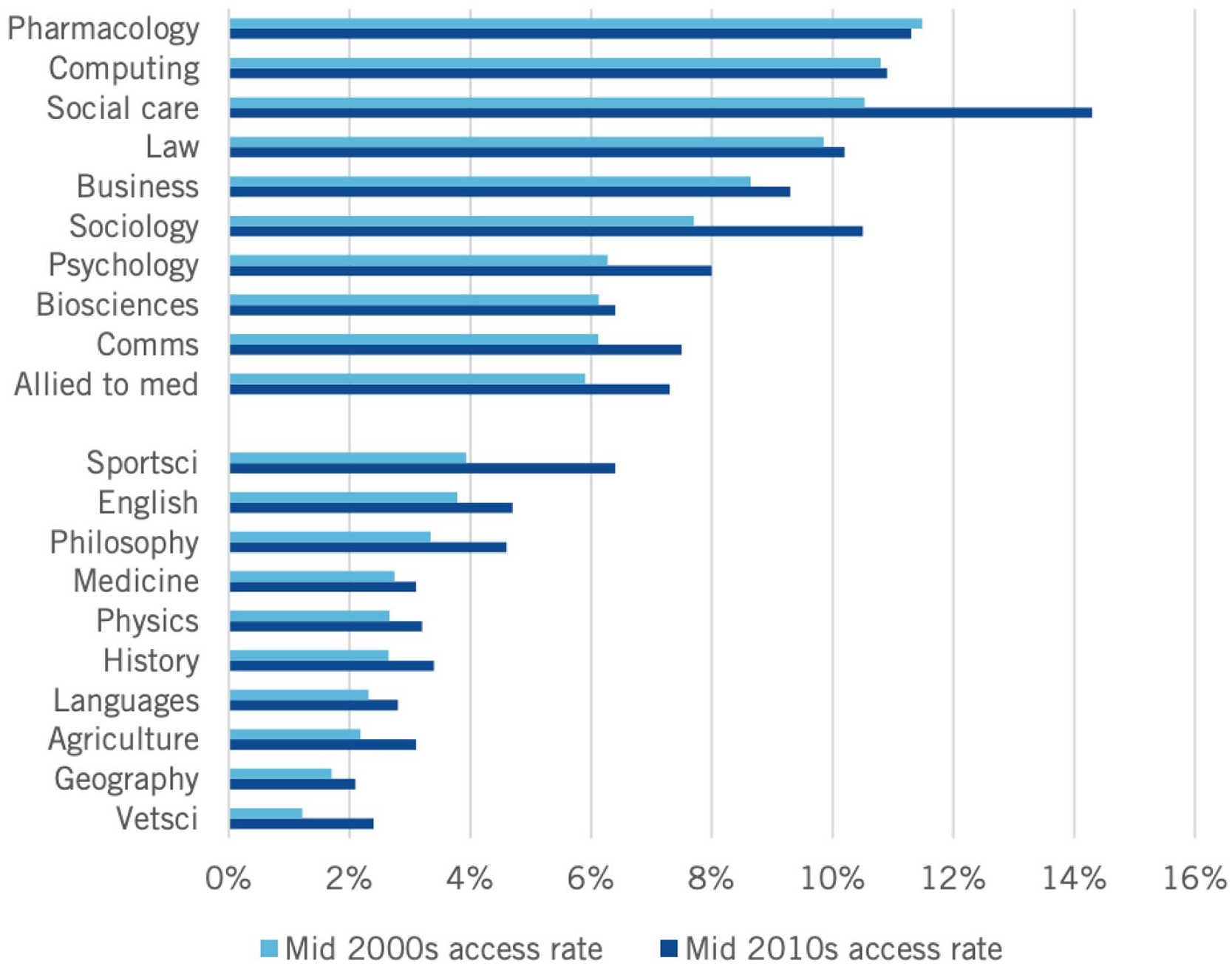
Proportion of students in Britain eligible for free school meals by subject studied at university in the 2000s and 2010s, top 10 and bottom 10.
Should you be an academic geographer based in the United Kingdom reading this article, then Table 1 (above) allows you to see how usual or unusual you are and what might well happen to you in future. For example, if you were aged between 26 and 30 (inclusive) in the academic year 2019/2020, then you were one of 310 academic geographers of your age. Just over three quarters of you (76%; net) were not academic geographers 5 years earlier. You may have been a postgraduate student; a researcher or lecturer in another discipline, or working in Geography in another country; or you may not have been in academia, or employed, at all. The table also shows that anyone working in 2019/2020 aged above 36 was likely to have been an academic geographer 5 years ago, and was almost certain to have been one if aged above 56. Your transitional probabilities of remaining in the pipeline will have been influenced by your social circumstances and the times you lived through. The majority of the 310 academic geographers aged 26–30 in 2019/2020 will have had to have self-financed a masters degree. That was not a requirement for my generation as there were very few masters courses then.
For someone of my age (54 as I write this), there are 330 fellow UK geographers in my 5-year age bracket. This is a net reduction of 40 (or 12%) as compared to our number 5 years earlier when we were all aged 46–50. A few of us will have died or retired, others will have left academia, moved sideways or ‘upwards’ into management. For the few extra that came in from ‘outside’ into our cohort, an equal number will have had to have left for all these figures to balance. The cohort above my cohort, people who were aged 56–60 in 2019/2020, is half my cohort’s size and depleting at twice the rate we are (by 28% in 5 years); the one above that is half as large again (it is aged 61–65 as I write) and it has seen half its members leave in the last 5 years.
You might want to ask more questions, such as how many chose to go, how many were pushed, and the extent to which both factors played a part in these reductions, but these are not revealed by the statistics, which also do not even break down the characteristics of the Geography academics by sex or ethnicity. Nevertheless, what they do reveal is that the large majority of academics working in British university Geography departments today were at school in the 1990s or more recently; and that this is unusual as compared to all other academic disciplines, other than Sports Science.
However, before looking further into the implications of the changing numbers and ages of academic geographers, we should first look at the numbers of students they teach at university. This is partly because we know more about the social and economic backgrounds of Geography undergraduates and postgraduates, and from that we can at least speculate a little on the more likely backgrounds of younger academics in Britain. But it is also because the main source of the wages of academics and hence the prime determinant of their numbers, the backbone of funding for the subject is the fees paid for teaching. Those fees were almost entirely paid by the state in the past, but from 2012 onwards have been both raised and paid for by the individual, in roughly 90% of cases through a loan from the state (other than in Scotland where the state still pays). Furthermore, in recent years, there has been a fall in the numbers of people reaching adulthood in Britain. Why has that not resulted in a small reduction in students and also of academics in Geography teaching them?
The demography of Geography students in the United Kingdom
Could the growth in academic staff numbers be due to a growth in the numbers of students studying Geography over time? The way students are counted changed in the most recent year for which statistics are available (2019–2020) and so here, in Table 2, I just look at change from 2014–2015 to the latest year before the definitional changes (2018–2019). 2
Students in the United Kingdom in Geography by age 2014–2015 to 2018–2019.
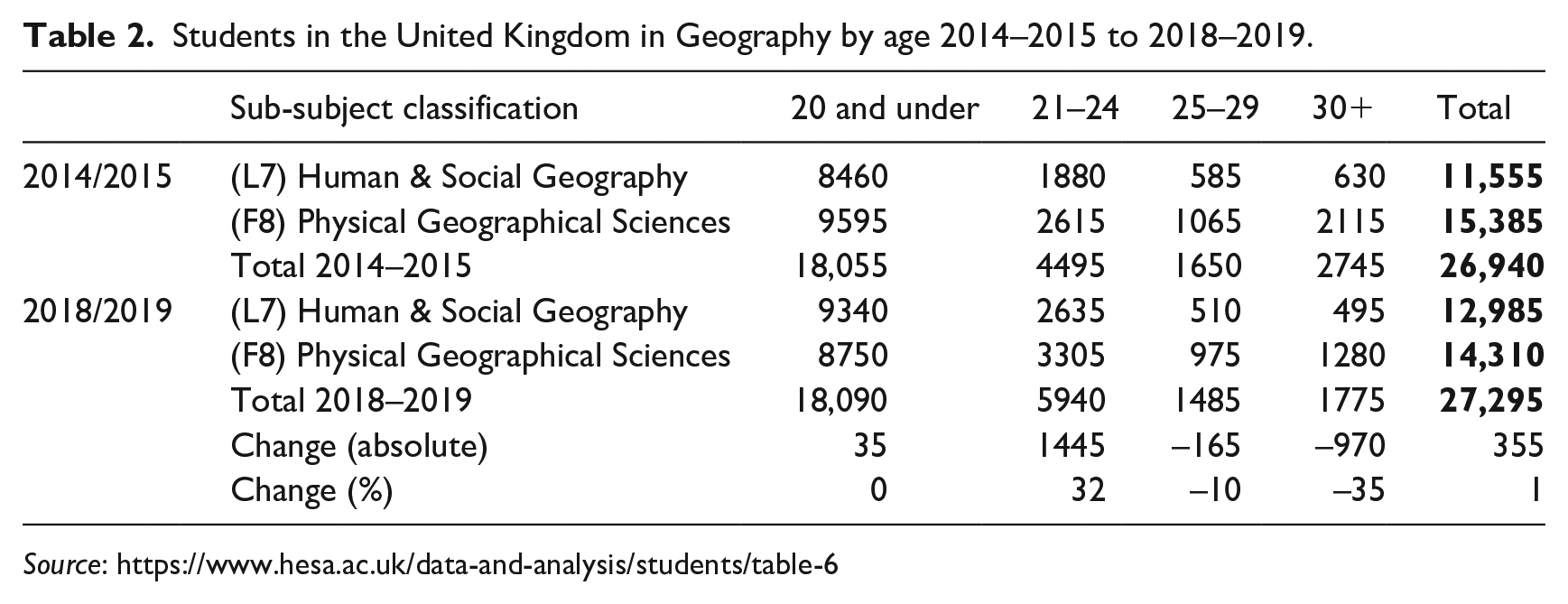
Before examining the changes in Table 2, it is worth noting that the number of young people turning 18 years in the United Kingdom in 2015 was at a maximum of 787,378 due to a rise in birth rates 18 years earlier. This then fell steadily to 733,067 by 2019, or by 7% in the 4 years 2015–2019. 3 The first thing to note is that the total number of UK Geography students of normal undergraduate age only rose by 35 students and stayed just above 18,000. In a way, this was an achievement, given the falling size of the birth cohort. It is also 3000 higher than the total two decades previously (Breckon and Gardner, 2004: paragraph 40). However, the lack of change between 2014–2015 and 2018–2019 was also coincident with the ending of external control of student numbers, meaning that any British university Geography department could admit any number of undergraduates. What then happened was that the British Geography departments in total only just managed to hold their ground in terms of student recruitment. If being charitable, you could argue that British Geography student recruitment, by staying practically still, had actually seen a relative increase of 7% as the cohort to recruit from declined in size by 7%. But in the years when the climate emergency was making headlines and geographical inequalities in life chances were becoming a national topic of intense public debate (resulting in ‘Levelling Up’ becoming a national government policy in 2021), it is worth asking why Table 2 reveals that the subject in general was only treading water in terms of overall university recruitment; with only a 1% absolute increase in student numbers over 4 years?
Table 2 reveals much more besides the headline statistic of no overall rise in undergraduate geography students in the United Kingdom and just a 1% rise in students overall (due to slightly more postgraduate students). It also reveals that the balance between human and physical geography undergraduates shifted in this period, to marginally more being enrolled on ‘Human and Social Geography’ courses by 2018/2019 – the mirror image of 4 years earlier. This may be a result of those student number controls being removed after 2012 which gave students (and their parents and schools) more freedom to choose what they wished to study. When given the choice, more opted for courses labelled as Human and Social.
The ending of student number controls pitted university against university, and department against department. By the 2015–2016 academic year, any number of undergraduate students could be admitted anywhere. British university admissions had become a free market (Hillman, 2014). This, though, had begun earlier with postgraduate degrees where number controls had never existed and increasingly, if you could pay, you could enrol. The social background of who can afford to pay postgraduate fees began to matter as a key gatekeeping device once master degrees began widespread.
Table 2 reveals a rapid rise in Geography masters students and possibly younger PhD students in the age 21–24 category in the United Kingdom, a rise of a third in just 4 years. However, this was, in turn, cancelled out by a similar fall in the number of students aged 25 or more studying Geography as undergraduates. Many of those may have been mature students taking undergraduate degrees. The advent of the £9000 a year fees in most of the United Kingdom after 2012 put off a large number of mature students. In England alone, there was a 40% fall in mature (aged 21+) undergraduate students between 2011 and 2018 (Hubble and Bolton, 2021). This recent loss of mature undergraduate students and rise in mostly self-financed postgraduate students suggests a further gentrification of the subject over time, a rise above that revealed in Figure 1 above during the 2010s.
The growth in Geography masters students of around 1445 more annually, nationally, in 4 years is not enough to explain the growth in academic staff of 275 more in 5 years (one extra member of staff for every four more students). In fact, as Geography academic staff, have been getting a little older in recent years, and are set to get much older as the bulge aged 36–55 works its way through, Geography students have been becoming slightly younger. It is also worth noting that some masters degrees are much more expensive than undergraduate degrees and some UK universities may be headed towards charging what is now normal in parts of the United States (or even higher) when it comes to postgraduate degree fees (Weissmann, 2021).
The Geography and funding of UK Geographers
Could it be increased precarity and more research-funded temporary posts that have increased the numbers of British Geography academic staff? In 2014–2015, some 450 academic Geographers in UK universities were funded by sources of funding not raised by the universities (so not by tuition fees). 4 Their average age was 35.3 years. Five years later, those same figures were 510 and 37.0 years. In other words, a net increase of 60 posts with a slightly older average age; but this is an increase in posts that only explains 22% of the overall increase.
Figure 2 perhaps explains most clearly what was happening in the long term. The ‘unit of resource’ had increased. Universities were receiving more money per student; and so universities began to hire more freely because there was no drop in student numbers after 2012, despite the introduction of very high fees of £9000 a year (later rising to £9250 a year). There is no guarantee that this funding rise will continue in future, as the fees are not – so far – being raised again. But to start to answer the question of where we are now heading, we have to turn to exactly who Geography academics increasingly are in the United Kingdom and their own Geography – where they come from.
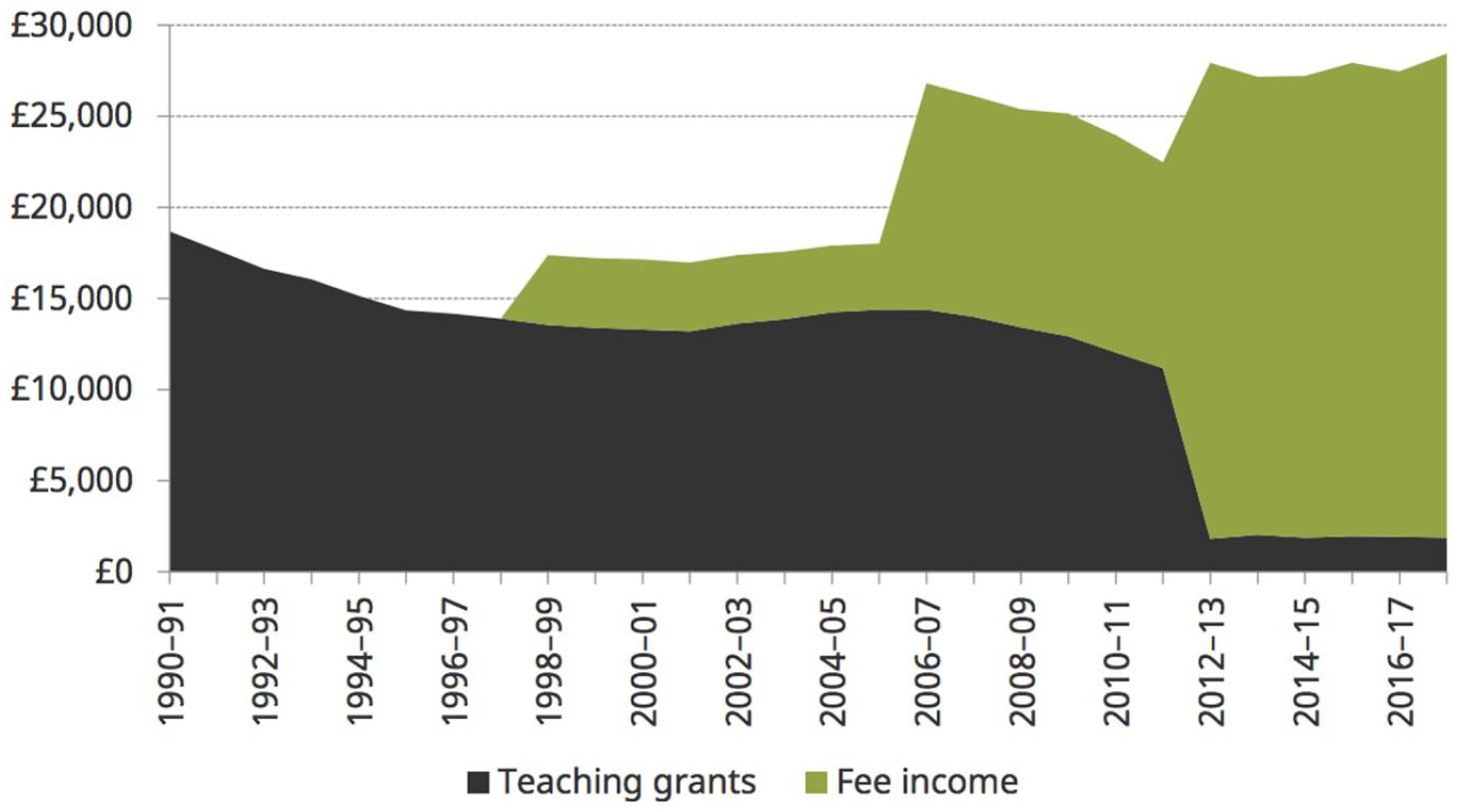
University resources per student per degree for students starting between 1990–1991 and 2017–2018 (2017 prices).
What might the span of nationalities be of UK academic geographers? You might expect it to be a little more varied than many academic subjects as ‘geographers like to travel’, but in fact, it is not. Some 68% of UK academic Geographers are UK nationals, identical to the proportion of academics employed in all subjects in UK universities. This contrasts with only 48% of academics in modern languages in British universities being UK nationals, and just 33% in Economics and Econometrics! Half of all academic economists are nationals of the 22 countries listed immediately below, only 26% of academic geographers are. Out of the 2610 UK geographers working in British universities today, numbers coming from these countries (rounded to the nearest five) are as follows: 95 from the United States; 70 each from Germany and Italy; 45 each from China, France and Ireland; 40 from Canada, India and the Netherlands; 30 from Spain; 25 from Greece; 20 from Brazil; 15 from Australia, Poland, and Sweden; and 10 apiece from Colombia, Denmark, Iran, Nigeria, Portugal, Russia and ‘Nationality not known’. 5 So there has been no stampede from abroad.
If British academic geographers are mostly British, what of their students? Well they are overwhelmingly British, but that is not what is most remarkable about them. The most remarkable aspect is revealed when we ask what sort of neighbourhoods most young geography undergraduates in the United Kingdom have grown up in? As Table 3 shows, a majority (50.78%) of new human geography undergraduates in 2019 came from areas labelled as ‘Polar 5’. These are the most educationally advantaged areas of the United Kingdom. In many ways and by many other measures, these are the most affluent quintile (fifth) of neighbourhoods of the United Kingdom. Table 3 is sorted by the ratio of Polar 5 students to those whose home address is a Polar 1 area, the least socially advantaged neighbourhoods. In 2019, there were exactly 12 human geography students from the most advantaged of neighbourhoods for every one student from the least advantaged – the highest ratio of over 80 academic subjects for which a reliable ratio could be calculated (where at least 500 students studied the subject across the whole of the United Kingdom). Furthermore, hardly any of the students, even from the most disadvantage areas were from the most disadvantaged economic backgrounds within those areas, as Figure 1 above makes clear.
Eighty-six subjects ranked by Polar 5 to Polar 1 ratio in 2019, UK universities age 18.
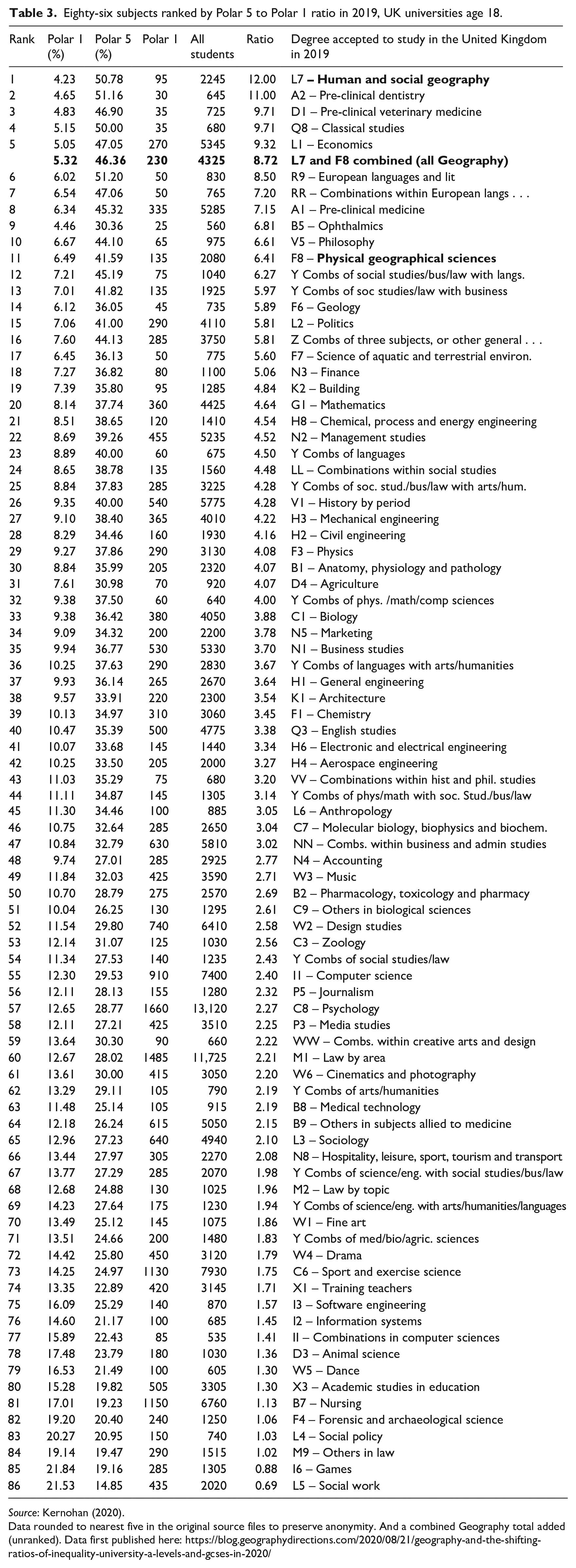
Source: Kernohan (2020).
Data rounded to nearest five in the original source files to preserve anonymity. And a combined Geography total added (unranked). Data first published here: https://blog.geographydirections.com/2020/08/21/geography-and-the-shifting-ratios-of-inequality-university-a-levels-and-gcses-in-2020/
Looking through Table 3, it becomes clear that UK physical geography undergraduates were fractionally less socially privileged in 2019 than human and social undergraduate geography students. It is extremely likely that most of the increase in Human Geography undergraduates shown in Table 2 above has been of students from more advantaged areas highlighted by Table 3 (it is hard to find any other explanation for all the evidence presented here so far). However, there is no evidence to suggest that the social profile of UK geography students in general has not been quite similar to that shown in Table 3 for several decades, including the time when many younger academic geographers were themselves students.
Why does any of this matter? It is my impression that, in general, British academic Geographers tend to be unaware of just how unusual the social backgrounds of their own students often are, and perhaps also of their own collective positionality. In December 2019, 89 Geographers, including 59 heads of department, wrote a letter published in the Times Higher Education titled ‘Geography degrees are preparing disadvantaged students for relevant careers’ (Blunt and Evans, 2019). If that letter had included the subtitle ‘and, when it comes to human and social geography, less than any other degree subject in the UK’ it would have shown a little more self-awareness. Hardly any socially disadvantaged students study Geography in Britain as undergraduates, when being at a social disadvantage is estimated from their geographical neighbourhood of residence. And even fewer are known to have grown up in homes where they qualified for free meals at school.
In Britain, academic geographers can become a bit prickly when mention is made of how the subject today tends to recruit more from the affluent areas of Britain (more than any other subject does). This may partly be because they have often been subject to ridicule; and partly because they are just not that aware of the social statistics available about their own students and themselves (as the letter to the Times Higher revealed). But look again at Table 3 and you will see that many of the social sciences are similarly highly ranked. Now turn to Figure 3 and note that across all of the United Kingdom, three of the top 10 degrees, that appear to lead on to jobs paying the highest salaries are in the social sciences (including Geography). I highlight ‘appear to’ as it may well not be the degree, but who goes on to do the degree and where they came from before they began the degree that matters most for pointing them towards jobs paying higher salaries – not so much what they learn at university.
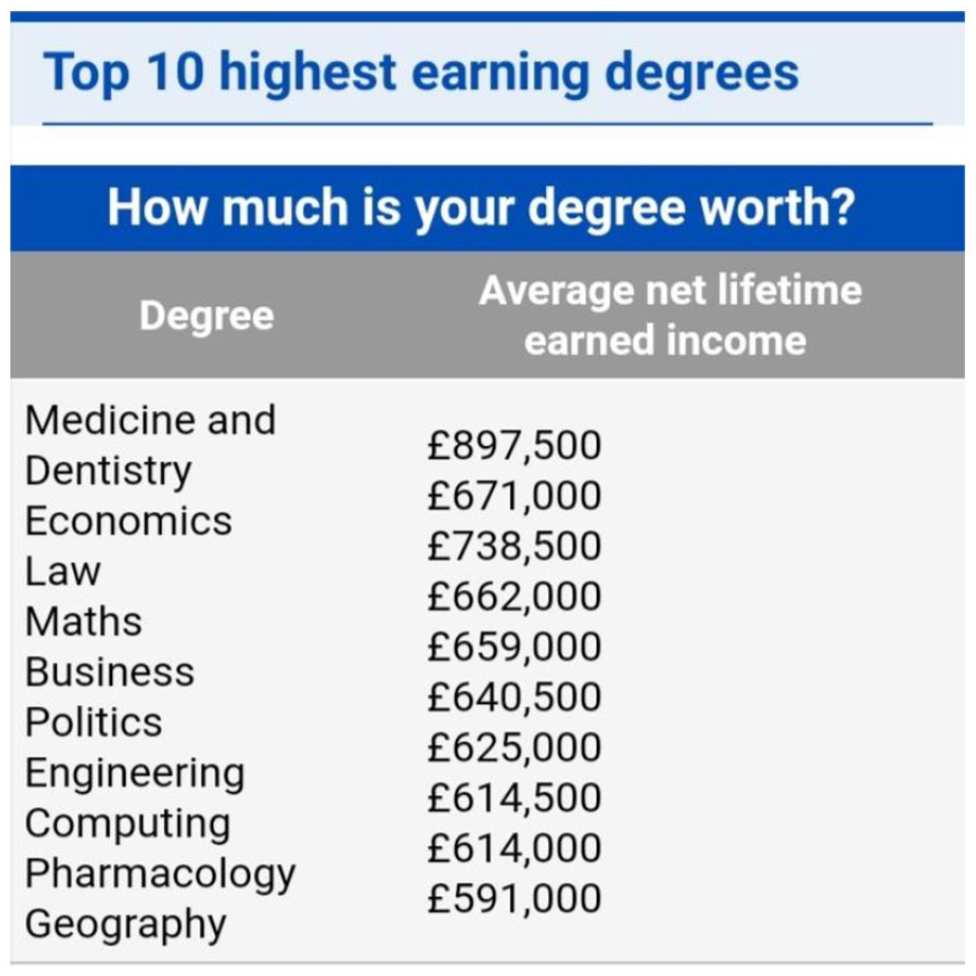
Top 10 highest earning degrees in the United Kingdom.
UK geographers, and their representative bodies, the Geographical Association and Royal Geographical Society-IBG (RGS-IBG), are often at something of a quandary over how to deal with this information and how to promote the subject more widely. Thus what could be promoted as a discipline that might, in future, contribute most positively to key issues such as combatting climate change and reducing economic inequality is sometimes instead suggested as a discipline you might want to study because it will also make you personally very well-off. On 9 August 2021 (the day before annual A-level results were released), the Head of Education of the RGS-IBG tweeted the following message: ‘On the eve of A Level results, a reminder of the economic benefit (there being lots of other benefits too) of #ChooseGeography’ (Brace, 2021). This message was sent to his 3505 followers with the image shown in Figure 3. Part of the motivation will have been to try to encourage students from poorer backgrounds to apply because they may not realise what career opportunities there were. However, what we cannot easily know is what does inspire the tiny numbers of geography undergraduate students from poorer backgrounds. Anecdotally, because I work on inequality, I receive emails each year from a few such students who often tell me they went into school teaching after studying Geography at university. They also often say how lonely it felt to be the only, or one of only two, students from a normal or poorer background in their classes.
The crude implication of the simple ranking of degrees by starting salary is that if you study Geography, you are likely to earn a lot in which ever career you later enter. Perhaps, students from poorer and average areas of the United Kingdom, from ethnic minority groups and from state schools, were put off studying Geography because they could not see themselves getting a well-paid job if they did so? However, if you compare Figure 3 and Table 3 you might wonder to what extent it is the Geography degree, or the social background students had before commencing the degree, that mattered most. It is now very well known that university students who grew up in more affluent areas tend to gain higher salaries later in life regardless of the degree they take (Green et al., 2019). One irony of using the table above to try to boost recruitment is that it was taken from a newspaper article with the title: ‘Would your teen be better off with an apprenticeship than uni? Figures reveal young people who swap college for work are £52,732 better off after three years as middle-class students are urged to consider ditching degrees’ (Robinson, 2021).
Conclusion
We hope for a progressive and useful future, and so there is a temptation to end articles such as this one by suggesting how British (and many other) geographers in decades to come might contribute more to mitigating and ameliorating the problems of climate change and social and economic inequalities of various kinds, among so much else of great good that they might concern themselves with. That might all come to pass. However, it is worth also considering the alternatives. There is a little reason why geographers in the future should be especially progressive given their likely social and geographical backgrounds, and the careers that a large number undertake in some of the highest paid jobs in the United Kingdom (often jobs in finance, advertising and real estate). We might instead see a growth in ‘financial opportunity geography’, no doubt ‘green, sustainable, ethnical financial opportunity geography’, but still something not that far away from the dark money and the funders of right-wing think tanks.
Although this article has told a very British story, it has wider implications for geographers in other countries. If you are reading this outside of the United Kingdom, think what the common misconceptions in your country might be. Note that a large number of British geographers believed that ‘Geography degrees are preparing disadvantaged students for relevant careers’. They believe that the various efforts they had made over the years to widening access have meant that such a statement true. Of course, for some of the 95 human geography students from Polar 1 areas (roughly one student per academic department), this might have been true; but it would then have been better to say that each of our academic departments ‘are each preparing, on average, one disadvantaged student a year for a relevant career’.
What though is the actual preparation that a Geography degree offers for a relevant career? This is not just a question for British geographers. If you are a North American geographer, you may lament the removal of elements of natural science or mathematics from the curricula and how little Physical Geography is studied by most undergraduates today (Rhoads, 2022). Similar laments to that of Rhoads (2022) are often heard from physical geographers in British Geography departments. However, in both North America and Britain, you may also believe that you are currently seeing a sea-change because of the record number of academic searches specifically for Indigenous and Black geography faculty; members of communities who are understood to be at structural, historical, disadvantages. This is certainly a positive development, but it is not just someone’s ethnic background that matters, but also their wider social background. The Cambridge based academic, Priyamvada Gopal, made this point very directly when she commented upon the apparent diversity of the top ranks of the current British government: The harsh truth is that diversity-washing Johnson’s regime with a handful of black and brown faces is a way to shore up hierarchical rule and vicious class and race inequalities. It serves the purpose of performing inclusion without changing the exploitative and racist politics of One Nation Conservatism. It is laughable for a cabinet that is two-thirds privately educated and nearly half of whom have Oxbridge degrees to claim to be among the ‘most diverse’ in history. (Gopal, 2019)
To conclude on the theme of politics and belief, in Britain, the list of some of the best known geography graduates who initially went to work in the world of finance includes, just from one Geography department, a former Prime Minister (Theresa May, Geography, Oxford 1977), Catherine Blaiklock (Geography, Oxford 1984) who founded the Brexit party but who stood down after making ‘derogatory comments about Islam’ (BBC, 2019) and Lord Neil Mendoza (Geography, Oxford 1981) Provost of Oriel College, who wanted to put resources into ‘the contextualisation of the college’s relationship with Cecil Rhodes’ (instead of removing his statue from above the college entrance). On this issue, the historian David Olusoga recently explained that This decision is part of a mind-set that presents the addressing of modern-day inequalities as an alternative to addressing the fact that we live in a nation studded with memorials that celebrate the lives of men who committed terrible crimes . . . (cited in Harris, 2021)
It would be interesting to know if there are any parallels to the situation in Britain elsewhere in the world. Geographers in the United States often think that because most of the Ivy League universities, other than Dartmouth, do not have a Geography Department, then the children of the elite are not studying Geography. However, the tables of data on the United Kingdom in this article above would hardly be altered at all if Oxford and Cambridge were taken out of them! Those two elite British Universities contain too few students and staff in their Geography Schools to account for anything but a tiny fraction of the social patterns seen across Britain in terms of undergraduate social background or academic age and country of origin profile revealed in the tables in this article. The United Kingdom is the most economically unequal large country in Europe, and the United States is even more economically unequal than the United Kingdom, so it would be a little surprising if both universities, and in particular, Geography departments in the United States, were actually as socially progressive in what they achieve as some people working within them may think they are or think they are becoming.
A now very long dead Geographer once wrote that ‘Who rules East Europe commands the Heartland; who rules the Heartland commands the World-Island; who rules the World-Island commands the world’ (Mackinder, 1919: 150). A tongue-in-cheek update, might be that ‘Who fills the British geography school classrooms, will later become the academics; the academics who will dominate English language Geography; those who dominate English language Geography command the world of Geography’.
Outside of the English speaking world, but still in the affluent world, there are not that many Geography Departments in much of mainland Europe, especially in the most economically equitable countries of Europe. Suppose it was the other way around? Suppose that there were hardly any Geography Departments in North America and the United Kingdom and other anglophone countries; but instead the bulk of Departments in the richer countries of the world were concentrated in the more socially and economically equitable nations? What might geographers then mostly have studied and taught, have done, and do in future?
In recent years, very wide ranging views of what Geography is have been proffered, ranging from the extremes of one of the favoured subjects of the English elite, to a bastion of political correctness. For example, in 2005, when speaking at a conference of private school head teachers held at Brighton College in East Sussex, Chris Woodhead (who had been the British her Majesty’s Chief Inspector of Schools from 1994 to 2000) claimed that within schools the subject of Geography had become ‘a toxic mix of new-age mysticism and political correctness’ (Smithers, 2005). The article in which that quotation first appeared did also explain that ‘He was challenged by one head-teacher who pointed out that it was Mr Woodhead himself who headed the last major review of the curriculum’. Chris Woodhead also used similar language to damn the teaching of what were called ‘British values’ in Citizenship lessons in schools just 5 years later. He said, ‘“I guess it was brought in to help create a politically correct society that has no firm beliefs on “anything.” . . . [And] dismissed the citizenship classes as a “non-subject”’ (Pilditch, 2010).
Given comments such as those of the former chief inspector of schools, as well as what the statistics in this article reveal, British geographers can, at times, be sensitive to caricature. In Britain, we know how small our subject is internationally, even if we tend not to know as much about ourselves. We know this because our sociology, politics, economics, physics, chemistry, biology and history colleagues are playing in more global arenas; but they are often unaware that Geography is a little less widely practised internationally.
The lack of international diversity in British Geography is a worry for the future, as is the privileged origin of the majority of British Geography undergraduates which might be indicative of a wider and longer term trend in student recruitment. Within the United Kingdom, this will influence who goes on to become an academic Geographer in the future. Often geographers think of themselves as progressive, but despite the warm words that are so repeatedly written within the subject, there is a little reason why Geography should either be so or remain so; and it certainly was not a very progressive subject in the recent past. As this article has tried to explain, in some ways, it has become a safe space for certain types of schools and social classes. Anything but tokenistic diversification threatens that. However, I do hope that by better understanding ourselves we can think a little more carefully about why we do what we do.
There are many different directions that Geography can take internationally; there is absolutely no need for British Geographers to continue to play as leading a global role as they have through their sheer numbers. We will know when Geography has become more global when British geographers are less dominant across the board, including being authors in, and holding many of the senior editorial posts of, many international Geography journals. However, if British geographers are dominant in future and if they remain unaware of their subject’s positionality, it is possible, if hopefully unlikely, that they might swing the subject more towards the direction that British politics has taken in recent years: a Conservative outlier in Europe; that increasingly sees place and identity as important, pours scorn on other places and other identities, and has a particular view of history. You may think this future unlikely, but it is perfectly possible and something that could initially grow unnoticed within and between the current ‘self-referential siloes in geographical thought’. The opposite is also of course also very possible, but is more likely to occur if not assumed to be inevitable – but is fought for.
Footnotes
Acknowledgements
The author is very grateful for the very thoughtful comments of Agnieszka Leszczynski and Noel Castree on earlier versions of this paper.
Declaration of conflicting interests
The author declared no potential conflicts of interest with respect to the research, authorship and/or publication of this article.
Funding
The author received no financial support for the research, authorship and/or publication of this article.
