



Abstract
This article broadens the scope of Victorian urban exploration by extending it from the slums of London’s courts and rookeries to the River Thames, which was both a vital commercial artery and a source of fascination and fear. While the Thames supported imperial trade, it was also associated with poverty, crime, pollution, and moral decay, particularly in the eastern docklands. The article argues that the river offers an alternative perspective for understanding urban social exploration. Unlike the traditional urban landscape, where familiar markers guided explorers, the Thames presented an alien, disorienting environment of decaying warehouses, fog, and muddy riverbanks. This shift to a boat, navigating the treacherous waters of the Thames, took writers into a marine underworld that mirrored themes of criminality and poverty. The river’s oppressive atmosphere led writers to project imperial narratives of civilization versus savagery onto the landscape, blending with the macabre image of the Thames. These encounters were often filtered through an ‘imperial gothic’ lens, wherein the river emerged as a malevolent force that threatened lives, disrupted progress, and corrupted the working-class communities of the eastern districts. By exploring these narratives, the article illustrates how the Thames, as both a literal and symbolic landscape, played a crucial role in shaping the Victorian imagination of urban decay and the tensions between modernity and the perceived threats of the primitive and the criminal.
Introduction
In the early nineteenth century, visitors to London marvelled at the sheer size of the Thames docks, with its ‘enormous’ ships and warehouses that were teeming with people, and goods from around the British Empire. The expansion of the docks in the early nineteenth century facilitated the movement of imperial traffic and trade to an unprecedented level, with one commentator noting that ‘everything is on a colossal scale’ with ‘sugar enough to sweeten the whole adjoining basin, and rum enough to make half of England drunk’. 1 However, for those social commentators familiar with the city, the Thames harboured a dark secret. Writers, such as Charles Dickens, became convinced that, through industrialisation, poverty and pollution, the Thames had become a malevolent force that had played a role in forging a primitive maritime culture in the dockland region of London. To investigate the darker aspects of the river, writers and journalists took to the Thames to explore nocturnal London. Unlike a street walk, the Thames was a fixed route for the researcher and the boat was a restricted mode of travel. As they dropped into the odorous and black polluted water and travelled east, they were immediately immersed in the changing ecology of London’s watery industrial and urban environment.
This article will explore how social observers imagined London’s waterfront and the urban anxieties that shaped their perceptions of the Thames and its people. Like their urban surveying counterparts such as James Greenwood, Thames explorers entered the river at night, adding a degree of danger and jeopardy to the proceedings. 2 While undoubtedly a river expedition at night was designed to attract a popular readership, it also enabled the journalists to accompany the police on their quest to arrest the notorious ‘river pirates’ of the Thames. However, while the initial objective was the apprehension of river pirates, journalists reported a growing sense of unease provoked by an alien watery environment, which disrupted their visual and auditory perception. The river’s foreboding atmosphere became accentuated as they continued into the unfamiliar territory of East London. It was here that journalists assumed an imperial gaze on encountering a riverside of urban dereliction, poverty and a ‘primitive’ maritime people.
For many journalists, their nocturnal expeditions by boat were such an unsettling experience they imagined that the ‘dark’ Thames was the source of physical and moral degeneration, corrupting those who lived and worked by the river. Significantly, writers gave consistent narratives of the Thames that were framed more widely within an ‘Imperial Gothic’ context that drew on both imperial anxieties and the supernatural, while othering a malign maritime-urban culture of the settlements in the east. 3 This article argues that the ‘Imperial Gothic’ gaze was instrumental in formulating a narrative where the Thames was a malicious and primeval force. Not only did the Imperial Gothic perspective enable writers to capture society’s prevailing anxieties, it also informed their own ‘cultural performance’ on the river. This was an unsettling and dangerous journey in which the passengers were vulnerable to the mysterious elements of the river. Moreover, echoing the narrative structures of imperial expeditions, this alien and marginal space was imagined as a site of confrontation with criminal and ‘savage’ others. In exploring the Thames in the Victorian popular imagination, the article will provide insights into how broader coastal imaginaries were shaped by spatial liminality, temporal contexts, and dominant social anxieties.
The historiography of nocturnal urban explorers has almost exclusively focused on those who travelled through the Victorian city’s main thoroughfares and ill lit ‘rookeries’ on foot. Historians acknowledge that British urban explorers shared with their imperial missionary counterparts similar assumptions to those they encountered in often ‘alien’ working-class urban districts. However, the level to which imperial discourse penetrated British urban analysis has been a contentious issue for historians. Certainly, the language of exploration had become interchangeable, with terms such as ‘civilising’, ‘heathens’, and ‘savagery’ liberally employed by explorers in both imperial and domestic settings. For example, Joseph McLaughlin’s research on literary sources such as Arthur Conan Doyle, William Booth and Jack London, amply demonstrated how ‘the imperial mission’ was as important in Britain as it was the empire. 4 However, as Seth Koven has argued in his seminal study on slumming, we must acknowledge the complexities and nuances that drove middle-class men and women into ‘discovering’ the dark underworld of Victorian life. His study is a subtle analysis of private conscience and public policy where humanitarian goals, sexual desires, the accumulation of personal wealth, and cultural capital all potentially had a part to play in motivating an individual into engaging in slum exploration. 5
Recently, Oliver Betts has questioned whether historians have over-emphasised the imperial overtones of Victorian urban writing and has argued that explorers were also attempting to understand Britain’s shifting urban landscape and the people who resided in them. 6 This is an important corrective since we should not imagine that urban exploration conformed to a universal imperial template since local, contextual issues undoubtedly influenced the explorer’s narrative and assessment of the district. 7 However, in the context of the Thames the British Empire was embedded in the commerce, structures and demography of the district. Certainly, Jonathon Schneer described the docks as a physical manifestation of empire on British soil as it was a ‘cross roads’ for imperial goods, people and culture. 8 Moreover, while the Thames was London’s major conduit to the British Empire, its eastern dockland settlements were still a mystery to many social observers. 9 Given that the docks were ‘a physical manifestation’ of empire, it is perhaps of little surprise that social researchers drew from imperial narratives to imagine their navigation of the Thames.
The literary scholar Patrick Brantlinger argued that the ‘Imperial Gothic’ emerged in the late nineteenth century as a reaction to scientific materialism and a recurring anxiety that British and imperial societies were in a degenerate decline. In literary fiction, this response combined imperial contexts with the uncanny that threatened both imperial and domestic societies. For example, novels such as H.G. Wells’ Time Machine (1895) depicted the degeneration of humanity into Eloi and Morlocks, while Richard Marsh’s The Beetle (1897) engaged with fears that malevolent forces from the imperial periphery could ‘invade’ and terrorise British society. 10 While the Imperial Gothic is a literary sub-genre, its use of the spectral to articulate the fragility of imperial civilisation can be found in journalistic accounts of the Thames in the last half of the nineteenth century.
When journalists viewed the Thames through an Imperial Gothic lens, it undoubtedly enriched the ‘cultural performance’ of social explorations. Alan Mayne’s seminal work on ‘the imagined slum’ mapped out some key characteristics that defined slum journalist’s cultural performance in the nineteenth century city. He noted that the ‘cultural performance’ began when writers stood on the threshold of the slum borderlands. The author then moves on to their crossing into the slums, after which we reach the climax of the piece in which the intrepid explorer outlines the horrors of the territory itself. 11
The sense that Victorian journalists engaged in a ‘cultural performance’ and that they stood on the threshold of danger and lawlessness runs through the various narratives of nocturnal walks. James Greenwood stands out as perhaps the most successful purveyor of urban anxieties and his many nighttime encounters with the vicious, violent and immoral were consolidated in his book The Seven Curses of London (1869). 12 However, in contrast to Greenwood’s nightmarish view of London, other ‘nightwalkers’ underwent fewer terrifying experiences on London’s gas-lit streets. For example, Dickens, whose insomnia prompted him to publish ‘night walks’ (1861), only encountered night workers and the homeless. 13 Thus, while he described eerily deserted streets and the haunting sounds of the night, he set out to give a sympathetic view of the homeless in London. Alongside motivation, the tone and subject matter of urban night explorers was, of course, dictated by the district or institution they chose to visit. Therefore, Greenwood’s sojourn into a workhouse or the notoriously vice-laden Ratcliffe Highway was designed from the outset to cause a sensation. In contrast, Journalists, who observed other areas of the East End found them to be ‘dull’. In short, then, London’s many districts and institutions offered an opportunity for the social explorer to find their chosen quarry and consequently, Victorian narratives of London night walks were often varied and inconsistent.
The historiography of conventional social explorers undoubtedly helps us understand those who investigated London through the Thames. The Thames, operated as both a physical and symbolic gateway to the Empire, informed the outlook of riverine explorers, who inscribed imperial meaning on to those they encountered on the river and its banks. Furthermore, we can identify Mayne’s ‘cultural performance’ present in the social explorer’s descent on to the Thames. On leaving dry land and boarding the boat, the journalist was crossing over a threshold into a murky unknown watery world. However, it is here that the exploration of the city via the Thames diverge from more orthodox nightwalking. From the river, the city took on a new and unsettling perspective since riverbanks, mist, and dark murky waters, obscured their observations, limited their horizons, and disoriented the writer. Thus, the familiar urban landscape markers that signified the passage from the ‘civilised’ to the ‘heathen’ districts were not visible. Instead, rather than a neighbourhood or district taking on the mantle of a defined site of danger, the Thames itself became the malevolent force, polluting, disfiguring and spreading immorality to everything in its path. Influenced by their disturbing experience of the nocturnal Thames, writers assumed an ‘Imperial Gothic’ gaze as they rowed towards the eastern Thames settlements.
The Eastern Thames Settlements and the Descent into the Underworld
In Victorian society, the River Thames held a dual identity, serving as both a vital source of life and commerce, while also being seen as a malicious force that claimed lives, encouraged criminal activity, and spread pestilence. The Thames had been Britain’s largest port since Roman times. During the early modern period, London’s port exported over eighty percent of Britain’s textile goods and imported seventy percent of the nation’s wine. While London lost trade to the west coast ports of Liverpool and Bristol during the eighteenth century, the port remained dominant in the North Sea trade. 14 It was in this period that the districts of Wapping and Ratcliffe became important settlements where maritime traditions and living patterns became culturally embedded. 15 As Leonard Schwarz has argued, ‘the port had its own social structure and its own pattern of life’, as ‘until the advent of steam from about the middle of the nineteenth century, the pulse of the port beat to the trade winds and to foreign harvests’. 16 For example, while there was constant marine traffic throughout the year, the arrival of the American ships in the spring and autumn triggered intensive periods of activity. Moreover, the truly international character of the port meant that London’s sailor population was continually changing with seafarers lodging temporarily in the many boarding houses located in the Wapping area.
By the mid-eighteenth century, Wapping High Street had become the unrivalled maritime centre as, due to its proximity to the water’s edge, a microeconomy of boarding houses, public houses, brothels, sail makers, and general marine trades had developed in the area. However, in the nineteenth century, Britain’s imperial expansion and the development of larger ships merited the construction of London Docks situated to the north and west of Wapping High Street. The newly constructed western and eastern docks occupied approximately 30 acres of land and lay close to Ratcliffe Highway, which ran through the three parishes of Wapping, St George’s, and Shadwell. 17 The docks’ construction was a response to Britain’s dominant imperial trading position and was not unrelated to London’s rapid population and geographical expansion (Figure 1). Between 1861 and 1891, the population in greater London rose from 3.1 to 5.5 million. 18
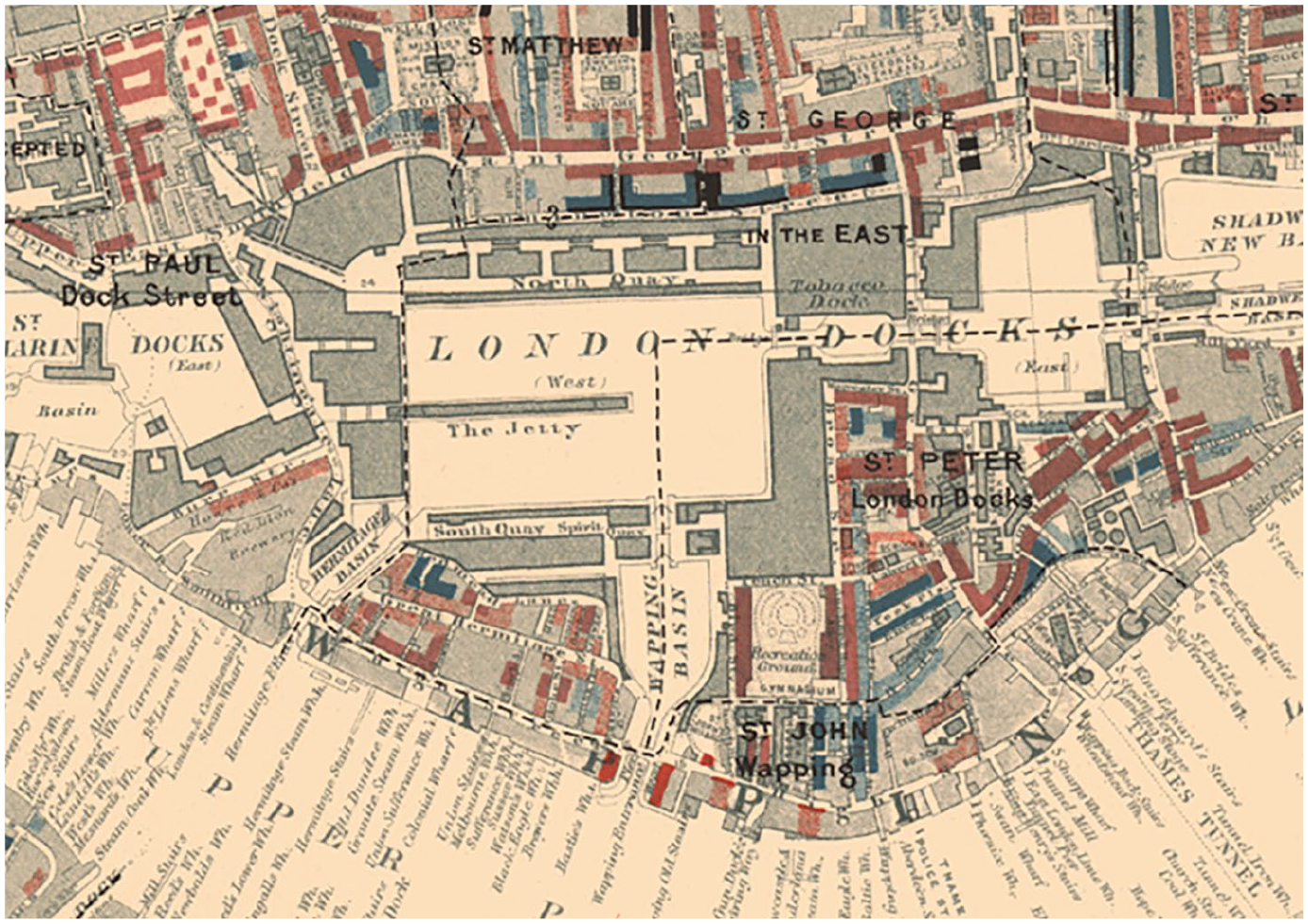
Smith’s new map of London, 1860, Library of Congress, Geography and Map Division. The work is in the public domain.
The London Docks, built in the early nineteenth century, effectively killed off Wapping’s maritime quarter and signs of dereliction began to appear as early as the mid-nineteenth century. 19 By the 1850s, sailors ashore made for the boarding houses and entertainment venues of Ratcliffe Highway, which was the main thoroughfare north of the docks. Indeed, by the mid-nineteenth century, the Ratcliffe district had become the principal maritime settlement in London and had gained a worldwide notoriety. 20 Such was the Highway’s reputation, the local authorities took the unusual decision to change its name to St George’s in the East in the 1850s, though contemporaries continued to refer to it as Ratcliffe Highway well into the twentieth century. However, with the building of larger docks further east, ships and sailors began to migrate out from Ratcliffe Highway towards Deptford in the late nineteenth century. 21
The eastern districts of the Thames, such as Wapping, Ratcliffe, Shadwell, and Deptford, which were dominated by docks and warehouses, had long been perceived as mysterious and dangerous. Journalists emphasised their unsettling experiences once they had travelled east beyond the familiarity of central London. One Daily Telegraph ‘special reporter’ described how ‘on leaving the silent city to go eastward at night, I have a feeling as though I had passed beyond the haunts of civilisation into some strange desert’. He added that ‘nor is the idea hyperbolical; for that district lying along the Thames East of London Bridge is a country in itself. Here in the ‘wilderness’ borderlands there was a deathly silence where one can ‘hear the echo of your own footsteps’.
22
For the writer, this symbolised the journey from civilisation to a heathen urban underworld. Indeed, the eastern urban-maritime settlements were portrayed as undiscovered and wild districts beyond the comprehension of the social investigator’s readership. Household Words speculated that ‘nobody knows anything about Ratcliffe’, and wondered if it had ‘shared the fate of those lost countries recorded in the folk lore of nearly all primitive races overwhelmed by the waves, and now perhaps lying beneath the mud and ooze of the Thames?’
23
One journalist wrote ‘Ratcliffe Highway and Shadwell, a region, we believe, as utterly unknown to most Londoners – as a perfect a terra incognita – as Iceland’.
24
In a similar vein, James Ritchie, the Victorian travel writer, speculated that, for the uninitiated, Ratcliffe had the appearance of a district ‘cut off from the rest of the empire’.
25
Indeed, a common feature of these travelogues was that Ratcliffe was both a mystery to the average Londoner, and a very different world. In his study of East London, Walter Besant was struck by the importance of the sea which profoundly influenced the character of Ratcliffe Highway. He noted that the districts of Wapping and Shadwell were ‘populated by sailors, belonged to sailors, and those who make their liv Its riverside is cut up with docks; in and about among the houses and the streets around the docks rise forests of masts; there is no seaport in the country, not even Portsmouth, which is charged and laden with the atmosphere of ocean and the suggestion of things far off as this port of London and its riverside.
26
The portrayal of the eastern maritime districts as exotic and mysterious was underpinned by a fear of criminality and violence. By the late eighteenth century, London Port was the largest in the world thanks to Britain’s growing trading empire. An abundance of goods passed through the port and were accommodated in large warehouses and ships that were subject to theft and smuggling. So much so, that in 1800 the businessman and magistrate Patrick Colquhoun established the River Police, a body that was effectively Britain’s first police force. By 1865, the River Police consisted of 112 men, including 25 inspectors and 85 constables that were subdivided equally in the upper and middle districts of the Thames. Each district was divided into three reliefs to ensure that the river was never left unprotected. 27 The River Police were met with great hostility from those who worked on the Thames and a crowd of over 2,000 people attempted to burn down the police premises resulting in the death of one police officer. However, Colquhoun’s utilitarian cost-benefit analysis proved a persuasive factor since he could demonstrate that the initial £4,200 investment from port merchants had resulted in savings from theft of over £122,000. Moreover, Colquhoun’s claim that over 11,000 known criminals were involved in theft and smuggling condemned the Thames in the public’s eye as a place of corruption and a ‘lair for thieves’. Such was the perceived gravity of the problem; in 1800 the government passed the Marine Police Bill that effectively nationalised the Thames River Police. Given this context, it should come as no surprise that the first urban explorers who took to the river did so with the aim of witnessing crime and the criminal fraternity.
Riverine Encounters: The Criminal Underworld
One of the first social observers to explore nighttime London by boat was Charles Dickens. Dickens may well have been influenced by the capture of a notorious gang of ‘river pirates’ in 1847. 28 The gang was described as ‘water burglars’ who had terrorised the Thames for several years. It was reported that ‘“Dancer” Donovan, “Goose-eye” Denny McSweeny, John Johnson, and “Bobby” Bryan formed a gang whose history, graphically told, might prove as exciting as many tales of the “Newgate Callendar”’. 29 The notion of riverine highway robberies was perhaps too good a literary opportunity for Dickens to ignore. Thus, in 1853, Dickens accompanied the Thames River Police with the firm intention to witness waterborne thieves, or as Dickens coined them, ‘water-rats’. He described how they ‘were watching certain water-rats of human growth, and lay in the deep shade as quiet as mice; our light hidden and our scraps of conversation carried on in whispers’. 30 The accompanying police officer claimed that successful policing ashore had made it more difficult for criminals to ‘live by “thieving” in the streets’ and so the criminal classes had turned to the river. He explained that there were different categories of thieves on the Thames. There were the ‘Tier Rangers’ who silently dropped along tiers of shipping at night and stealthily robbed the captain and his mate while they slept. Then there were the ‘Lumpers’ or labourers employed to unload cargo, who wore loose canvas jackets with large circular inside pockets that they concealed stolen goods. Another genre of criminals was the ‘Truckers’, who had their own vessels and smuggled larger cargo under the guise of transporting items such as groceries. Finally, there were the Dredgermen, who stole items from un-attended decks by throwing them overboard and secretly retrieving the goods later. 31 For Dickens, however, the evening was to result in disappointment as they did not witness any of these criminals let alone take them into captivity. As we shall see, instead, Dickens spent most of his article reflecting upon the more macabre side of the Thames.
Almost ten years later, Henry Mayhew claimed that ‘there are a great number of robberies of various descriptions committed on the Thames by different parties’. Possibly inspired by Dickens’ earlier observations, Mayhew described the different categories of criminals that ranged from ‘the little ragged mudlark stealing a piece of rope and a few handfuls of coals from a barge, to the lighterman carrying of bales of silk several thousand pounds in value’.
32
Like Dickens, Mayhew described dock labourers who pilfered goods by secreting it about their clothing, and Dredgermen who ‘go alongside vessels and steal copper funnels and ropes’.
33
Mayhew also seemed to have developed the category of felon he called ‘River Pirates’, a band of criminals that for all intense and purposes were Dickens’ ‘Tier Rangers’, as they plundered the crew while they slept.
34
Finally, he described the ‘lightermen who were employed to navigate barges into the dock, but often made off with its valuable cargo. According to Mayhew, the unprincipled lightermen: often spend their time in dancing and concert-rooms, and are to be seen at the Mahagony Bar at Wellclose Square and Paddy’s Goose, Ratcliffe Highway. They generally cohabit with prostitutes. They are a different class of men from the tier-rangers, or river pirates, who also live with prostitutes.
35
Mayhew, then, began to speculate that there existed a dedicated and professional marine criminal class that operated on the Thames and had networks in the notorious Ratcliffe Highway. Indeed, Mayhew claimed that the river criminal was apprenticed at an early age and that they ‘in most cases have sprung from the ranks of the mudlarks, and step by step, have advanced further in crime, until they have become callous brutal ruffians, living as brigands on the sides of the river’. 36 These categories of ‘river pirates’ were still in vogue in the 1870s, with the Globe reporting that the Thames were over-run with mudlarks tier rangers, scuffle-hunters ‘or other amphibious animals who should be found prowling about for unlawful purposes’. Notably, like his predecessors, the Globe reporter did not encounter any river pirates during his nocturnal Thames excursion. 37
These intricate vignettes of various members of the Thames’ criminal fraternity were in the classic style of Dickens and Mayhew; character sketches that were part-observed, part-embellished, and partly fictional that we should read cautiously. 38 However, what they do reveal is how the police and social commentators imagined that an informal apprenticeship of crime had evolved where young ‘mudlarks’ were developed into criminals. Significantly, these marine felons were concealed by criminal networks in waterfront communities. Indeed, by the 1860s, social observers had constructed a hierarchy of professional maritime felons, categorised them, and had shed light on their supposed modus operandi.
Journalists continued to explore London via the Thames, each following the pattern that had been set by Dickens in the early 1850s. For example, a reporter from the Daily News gained permission from the River Police to accompany them on a nighttime search for criminal activity on the Thames in 1865. After the police had described the various criminals that inhabited the Thames, the journalist was rowed into an eerily quiet Thames. A rather disillusioned journalist described the scene as ‘singularly quiet and still, the sounds of Saturday night’s revelry from one of the waterside taverns, and the shriek of the distant railway whistle, being the only noises mingling with the monotonous splashing of the oars’. Despite framing the article as an investigation into the maritime criminal classes, like Dickens’ expedition, they failed to see or arrest a single criminal. 39 Other intrepid journalists writing in the Strand and Cassell journals in the late nineteenth century were also attracted to the Thames to witness the marine criminal class in action. However, like their predecessors who sought to observe and apprehend ‘River Pirates’, on every occasion they were left disappointed. 40
Riverine Encounters: The Macabre Thames
Although writers were unable to encounter the criminal class they believed was ‘infesting’ maritime London, their experiences of travelling on the river reveal how unsettling it was for them. Thus, while the writers failed in their initial aim of locating a criminal class, they became intimately acquainted with the Thames and its waterfront neighbourhoods. It was these encounters they found particularly disturbing as they came to regard the Thames as the source of the moral and physical decay of the modern city. While the Thames flowed through the heart of London, writers imagined the river as a separate gothic entity, a vast dangerous highway that had its own mysterious marine architecture and peoples. The nocturnal Thames conjured up disturbing spectral images and soundscapes that were far removed from civilised and rational society.
For example, Dickens imagined the Thames to be a ‘black highway’, noting how his boat was rowed: among the tiers of shipping, whose many hulls, lying close together, rose out of the water like black streets. Here and there, a Scotch, an Irish, or a foreign steamer, getting up her steam as the tide made, looked, with her great chimney and high sides, like a quiet factory among the common buildings. Now, the streets opened into clearer spaces, now contracted into alleys; but the tiers were so like houses, in the dark, that I could almost have believed myself in the narrower bye-ways of Venice.
41
Dickens re-imagined the Thames as a watery urban metropolis, complete with factories, highways, and dark courts and alleys. In a similar vein, Charles Manby Smith described the Thames during the day as a bustling urban highway and an eery silent watery throughfare by night.
42
However, in many of their accounts, writers were troubled by this alternative urban-maritime environment that seemed to exude a spectral quality. Undoubtedly, the Thames’ reputation as a location for suicide hung over journalists as they sauntered down the river. Indeed, one of the grim tasks of the river police was to drag lifeless bodies from the Thames. This prompted one journalist to label the Thames ‘the place of the dead’, while another informed their readers that the river police had hauled out 9 or 10 bodies a month in 1896.
43
The Thames’ association with death was captured by a Globe journalist, who described a night on the Thames with the river police in 1873. He reported that 161 human bodies were found by the river police that year and observed that: One who looks down at the river cannot but think of the dreadful objects that every now and again come up from its gloom to tell of deeds of murder and suicide, or of those who never come up – those who go down in the stillness and secrecy of night, drift on and on through tangled river weeds, over beds of slime and mud. . .
44
To add an even more macabre gloss to his story, the reporter speculated how even experienced river police ‘fearless of all things living’ would call out in terror as they unexpectedly ‘found themselves side by side with a hideous grinning corpse’. 45
The chilling descriptions of pulling cadavers from the river undoubtedly disturbed journalists and contributed to the perception that the Thames imbued a spectral dimension. For one reporter, even the white safety-posts that alerted night wanderers to the proximity of water gave a more menacing message and resembled ‘spectres pointing out with ghostly hand a ready means of suicide’. 46 Dickens described the Thames in a similar fashion. Recalling the scenes on one of his nocturnal visits, he noted that ‘the river had an awful look, the buildings on the banks were muffled in black shrouds, and the reflected lights seemed to originate deep in the water, as if the spectres of suicides were holding them to show where they went down’. 47 Dickens’ was also alarmed by his auditory experience on the river. While on the police boat, he described ‘uncomfortable rushes of water suggestive of gurgling and drowning, ghostly rattlings of iron chains, dismal clankings of discordant engines, formed the music that accompanied the dip of our oars and their rattling in the rowlocks. Even the noises had a black sound to me. . .’. 48 Indeed, the eerie and spectral atmosphere of the river fascinated Dickens, and he frequently described how he was haunted by the nocturnal isolation of the Thames, with its uncanny light reflections, the strange noises, and the foreboding black slimy water. 49 The river’s eery soundscape was also acknowledged by other social commentators and perhaps best captured in the cartoon ‘The Silent Highwayman’, of 1858. In July of that year, Punch published several cartoons addressing the ‘Great Stink’, a period during which the Thames experienced unprecedented levels of pollution. ‘The Silent Highwayman’ (Figure 2) depicts Death rowing silently through the murky water claiming those unfortunate enough to live on the riverbanks of the Thames.

‘The Silent Highwayman’, Punch, 10 July 1858, 137. The work is in the public domain. 50
Riverine Encounters: Pestilence and Primitive People
Writers from the 1850s encountered the Thames at night with some trepidation due to its associations with criminality and death. However, their accounts show that as they journeyed further east along the Thames, they felt themselves sinking deeper into a corrupt and diseased maritime-urban culture. These were the districts of London that had survived the Great Fire of London, yet suspicion lingered that the old wooden housing that characterised these river-side communities were not only a symbol of decay but also a breeding ground for disease and immorality. 51 In his 1837 novel Oliver Twist, Dickens described Jacob’s Island in Bermondsey as ‘the strangest, the most extraordinary of the many localities that are hidden in London’ that comprised ‘crazy wooden galleries’ that were elevated from the Thames’ ‘slime’ beneath. Dickens not only portrayed Jacob’s Island as a primitive and unsanitary place, but also as a thieves’ den. 52
Over ten years later, Henry Mayhew christened the eastern Thames as ‘Pestilentia’, and a modern ‘plague spot’ of London. He calculated of the 12,800 cholera deaths that year, 6,500 had occurred in the eastern Thames in places such as Lambeth, Southwark and Bermondsey. On visiting the now notorious Jacob’s Island, Mayhew claimed that it was ‘a century behind even the low and squalid districts that surrounded it’. He described Jacob’s Island as consisting of ‘wooden galleries and sleeping-rooms at the back of the houses which overhang the dark flood, and are built upon piles, so that the place has positively the air of a Flemish street, flanking a sewer instead of a canal’ and that whole place had a ‘stench of death’. 53 A few years later, a Daily News correspondent claimed that melancholy, ‘decay and neglect hangs over the whole district’, with buildings fallen into wreck and ruin through ‘time or violence’. 54 In 1858, Punch encapsulated the growing sense that the Thames was damaging the nation’s health and creating diseased and monstrous children along its river banks. In Figure 3, John Leech’s cartoon depicts Father Thames offering up its grotesque and sinister off-spring to ‘the fair city of London’.
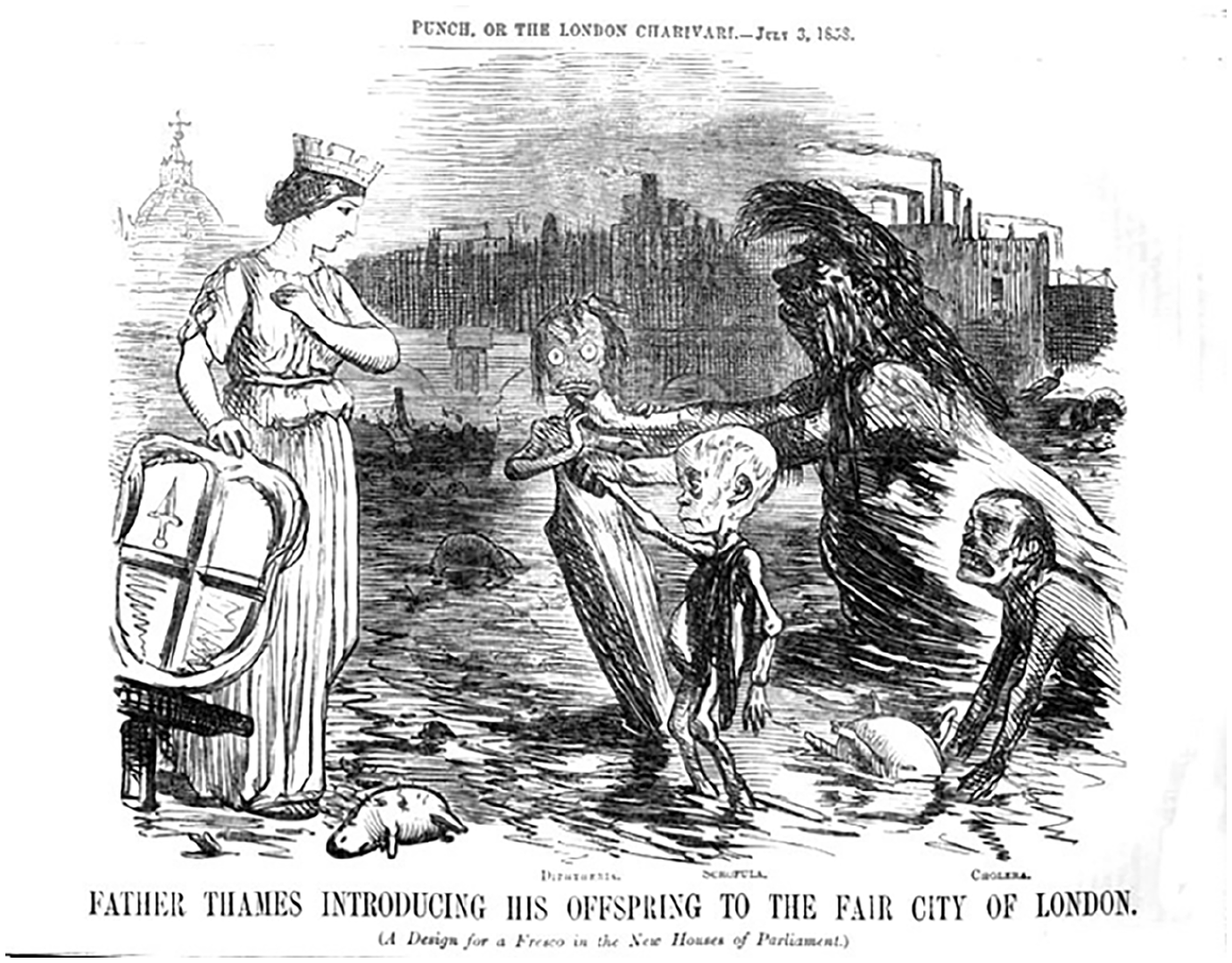
‘Father Thames introducing his offspring to the fair city of London’, Punch, 3 July 1858, 5. This work is in the public domain. 55
Similarly, in 1872, Blanchard Jerrold described Shadwell as the ‘worst part of the great City’s story’, a ‘dead shore’ where a tangible melancholy hung over the Thames and its waterside communities. 56 Likewise, in 1906, Joseph Conrad imagined the waterfront constructions that lay on the river bank as ‘the matted growths of bushes and creepers veiling the silent depths of an unexplored wilderness, they hide the depths of London’s infinitely varied, vigorous seething life. . .dark and impenetrable at night like the face of a forest, in the London waterside’. 57
To the social explorer floating along the eastern Thames, the small communities that had settled on the banks of the river were sites of urban abandonment. Moreover, observers began to believe that the dark and foul-smelling river, polluted by industry and domestic waste, had become a malevolent force that had a degenerating impact on the moral and physical health of river communities. One reporter for the Daily News imagined that the river dominated the inhabitants’ lives, manners and customs. In 1865 he wrote: The smells, sounds and sights of the neighbourhood are all maritime, or at least marine-store like. The odours of tar and bilge water, of hemp and ardent spirits, float gently in the air: the polyglot oaths and shouts, the delicate jests, the playful badinage . . . all speak a population, both floating and permanent, which is indissolubly connected with water-life.
58
Thus, it naturally followed that with the Thames’ compelling influence on waterfront communities, the river’s moral and ecological pollution would corrupt those who were ‘indissolubly connected with water-life’. The journalist George Scala recalled that between 1840 and 1870, the Thames ‘was getting dirtier, squalider year after year’ until it was ‘little better than an open sewer, bordered by uninteresting brick tenements and warehouses’. 59 Likewise, James Ritchie described how at midnight the ‘dark wharves and the ‘black river’ had a menacing atmosphere, as it was not only polluted by organic matter but it was a place where ‘suspicious people have a knack of turning up’. 60
The modern industrial city and its increasing impact on the docks and river, further stoked these fears about the degeneration of the eastern waterfront districts. In recalling his frequent excursions around the dockland area, Dickens described how modern industrialisation and urban squalor had not only contaminated the Thames environment but also the morality and decency of its communities. Dickens imagined the Thames as a malevolent force, ‘creeping, black and silent’, while at the same time ‘hiding strange things in the mud’, like suicides and ‘accidentally drowned bodies’. 61 In one nocturnal expedition, Dickens placed the sinister qualities of the Thames at the centre of his description of the people of Ratcliffe and Stepney. The evening before his expedition he had viewed woodcuts of ‘the famous Dance of Death’, scenes which, for him, later evoked comparisons on his walk the following evening.
The borders of Ratcliff and Stepney, eastward of London, and giving on the impure river, were the scene of this uncompromising dance of death, upon a drizzling November day. A squalid maze of streets, courts, and alleys of miserable houses let out in single rooms. A wilderness of dirt, rags and hunger. A mud-desert, chiefly inhabited by a tribe from whom employment has departed, or whom it comes but fitfully and rarely. . .they have come into existence and propagate their wretched race.
62
Dickens ‘othered’ the Thames eastern waterfront communities, viewing them as separate and primitive districts. The implication was that the modern evils of industrialisation had polluted the Thames and unleashed poverty and want in the district. Moreover, there is more than a hint of Lamarckian theory in Dickens’ writing since he implied that these desperate conditions had been instrumental in raising a ‘race’ of ‘residuum’ people. Indeed, his night observations seemed to have become an inspiration for passages in Our Mutual Friend as the riverside features as a dark menacing space that is only visited by night. Two of the main characters, Mortimer Lightwood and Eugene Wrayburn travel to the Ratcliffe area to inspect a body that was pulled out from the Thames. Lightwood and Wrayburn are lawyers, and like Dickens, are unacquainted with Ratcliffe and the riverside communities. In a scene similar to his own experience of the district, Dickens casts Ratcliffe as a hostile and unsavoury environment: The wheels rolled on, and rolled down by the monument and by the Tower, and by the Docks; down by Ratcliffe and Rotherhithe; down by where accumulated scum of humanity seemed to be washed from higher grounds, like so much moral sewage, and be pausing until its own weight forced it over the bank and sunk it in the river. In and out among vessels that seemed to have got ashore, and houses that seemed to have got afloat – among bow-sprits staring into windows, and windows staring into ships – the wheels rolled on, until they stopped in a dark corner.
63
Once Mortimer Lightwood and Eugene Wrayburn reach Ratcliffe, they meet Gaffer, a dredgerman whose main occupation seemed to consist of pulling bodies from the Thames, robbing them and afterwards reporting the body to the authorities. This gruesome occupation was a consequence of modernity since dredgermen were formerly watermen who, with the introduction of steamboats, had been forced out of business. 64 These passages convey how the riverside unsettled Dickens. This was a disorienting physical space since the land and water appeared to have become indistinguishable and where the forces of modernity had washed-up a ‘moral sewage’ and the ‘scum’ of humanity on the banks of the river Thames. The river had acquired a reputation for a dark Otherness well before the craze for slum journalism was fully underway.
Conclusion
This article has extended the scope of Victorian urban exploration from the courts and rookeries of London’s slums to the River Thames, which itself had become a source of fascination and fear. The Thames, while a vital artery of commerce and imperial trade in Victorian London, was also imagined as a malevolent force fostering poverty, crime, pollution, and a sense of moral decay, especially in the eastern dockland districts. The social observer’s riverine encounters offer the historian an alternative dimension to the study of urban social exploration. Whereas the traditional urban explorer could locate familiar urban landscape markers, the Thames, with its monotonous derelict warehouses, decaying settlements, mist, muddy riverbanks, and dark waters, obscured observations and disoriented writers. Leaving dry land and boarding a boat crossed the threshold into a dark and menacing marine underworld. Writers were at the mercy of a vessel that floated on black ‘greasy’ and ‘pestilent’ waters, through districts associated with criminality and poverty. In this alien and perilous environment, writers projected the imperial narratives of civilisation versus savagery on to the domestic urban riverscape. It was these imperial tropes that were consistently bubbling up to the surface and fusing with the ‘macabre Thames’, that led writers to understand their encounters through an ‘Imperial Gothic’ gaze. It was a gaze that imagined the Thames as a malicious and primal force that claimed lives, disrupted modernity, and corrupted the ‘primitive’ communities in the eastern districts. An Imperial Gothic gaze informed both the journalists’ ‘cultural performance’ and their encounters with the Thames and its people. The ‘performance’ in turn deepened the Imperial Gothic perspective as the chosen mode of exploration, the challenging and alien environment, and preconceived notions of criminality and degeneracy, produced a compelling story steeped in imperial anxiety and spectral imagery. The article has sought to offer a broader insight into how estuary, port, and coastal imaginaries were formulated, promoted, and functioned. It has demonstrated that these waterfront imaginaries were not merely reflections of physical geographies but were shaped by temporal dynamics, spatial configurations, and prevailing societal anxieties. As liminal spaces, the waterfront was situated between the stability of land and the unpredictability of the water and was imbued with a heightened sense of transition and permeability. This spatial ambiguity and unsettling environment made the Thames a fertile terrain for the projection of Imperial Gothic tropes that captured the prevailing anxieties of the day.
Footnotes

Funding
The author received no financial support for the research, authorship, and/or publication of this article.
Declaration of Conflicting Interests
The author declared no potential conflicts of interest with respect to the research, authorship, and/or publication of this article.